

Submitted:
19 February 2026
Posted:
27 February 2026
You are already at the latest version
Abstract
This study evaluates the cost-effectiveness of the MAR-HF-Titration telemedicine programme, implemented at Hospital del Mar for patients with heart failure with reduced ejection fraction (HFrEF). A pre-post retrospective cost-effectiveness analysis was conducted using data from 208 patients enrolled between 2021 and 2023. Effectiveness was estimated by constructing individual pre- and post-intervention QALYs based on literature-derived utility values. Cost data were obtained from hospital administrative records at the patient level. Paired t-tests were performed, and costs and QALYs were modelled using gamma and beta distributions for probabilistic sensitivity analysis. A sensitivity analysis excluding newly diagnosed patients was also conducted. The programme was associated with a 52% reduction in total healthcare costs (€4,771.79 per patient), mainly driven by a reduction of the heart failure-related intervention costs, which accounted for 88% of total costs and decreased by 58% in the post-intervention period (€4,384.97 per patient). This reduction was also associated with a substantial decrease in length of stay during the post-intervention period, with a 76.63% reduction in total hospitalisations and an 82.34% reduction in hospitalisations related to heart failure. The effectiveness analysis showed an increase of 0.0298 QALYs per patient during the six-month intervention period. Similar outcomes were observed for non-newly diagnosed patients.
Keywords:
telemedicine
; health failure
; cost-effectiveness
; hospitalisations
; telemonitoring
; reduced ejection fraction
; nurse-led intervention
; healthcare resource utilisation
1. Introduction
Heart failure (HF) represents one of the leading causes of hospitalisation, mortality, and healthcare expenditure in Catalonia, particularly among older adults [1,2]. This high care burden has driven the adoption of innovative care models aimed at improving clinical outcomes while promoting a more efficient use of healthcare resources.
Telemedicine has emerged as a promising strategy in the management of HF. Several international studies have shown that home telemonitoring and structured follow-up can improve therapeutic adherence and reduce HF-related hospitalisations, [3] as well as contribute to significant reductions in mortality and hospital admissions associated with telemonitoring programmes [4]. At the European level, multiple interventions have confirmed these findings [5,6,7]. Short-term pilot programmes have demonstrated clinical improvements at very low costs, [5] while other studies have reported substantial reductions in hospitalisations and medical costs among HF patients undergoing telemonitoring,[6] in unplanned admissions, [7] as well as meaningful decreases in hospital costs derived from remote follow-up [8]. In addition, recent economic evaluations have confirmed that telemedicine can be cost-effective in European patients with HF [9]. The literature also highlights the role of nurse-led services as effective and efficient strategies for the outpatient management of HF [10]. However, despite the growing international evidence, the availability of studies assessing the economic impact of telemedicine programmes within the Spanish healthcare system remains limited.
Within this context, the MAR-HF-Titration study developed at Hospital del Mar in Barcelona provides relevant evidence on the clinical effectiveness of an intensive nurse-led telemedicine programme [1]. Preliminary results show substantial improvements in ejection fraction, reductions in NT-proBNP levels, and a decrease in hospitalisations, reinforcing the hypothesis that this model can optimise the management of patients with heart failure with reduced ejection fraction (HFrEF).
This study evaluates the cost-effectiveness of the MAR-HF-Titration programme from the healthcare provider’s perspective, using real-world costs and clinical outcomes. Effectiveness is estimated in quality-adjusted life years (QALYs) to determine whether the observed improvements in patients’ clinical status translate into a more efficient utilisation of healthcare resources.
2. Methodology
2.1. Programme and Population
The MAR-HF-Titration study is a prospective, single-centre, non-randomised interventional study conducted at Hospital del Mar between September 2021 and December 2023. The primary objective of the programme was to evaluate the implementation of a nurse-led telemedicine model for pharmacological titration and optimisation in patients with heart failure with reduced ejection fraction (HFrEF). Secondary objectives included the analysis of changes in left ventricular ejection fraction (LVEF), NT-proBNP, therapeutic adherence, and the incidence of hospitalisations and mortality during the follow-up period.
A total of 210 consecutive patients diagnosed with HFrEF (LVEF < 40%), according to European Society of Cardiology criteria, [11] were included. Both newly diagnosed patients and patients with chronic heart failure requiring therapeutic optimisation were considered. Inclusion criteria comprised a confirmed diagnosis of HFrEF, clinical stability following the acute episode, ability to use telemonitoring devices, and provision of informed consent. Exclusion criteria included moderate to severe cognitive impairment without a regular caregiver, severe psychiatric disorders, institutionalisation, language barriers without access to a translator, or life expectancy of less than one year (unless attributable to HF itself). The mean age of participants was 70.2 ± 11.8 years, with 35.8% women. New-onset HF was present in 60.5% of patients, while 39.5% had ischemic aetiology. The mean baseline LVEF was 31%.
The programme consisted of providing each patient with a tablet with 4G connectivity, a blood pressure monitor, and a scale to allow daily recording of blood pressure, heart rate, weight, and symptoms. Data were automatically transmitted to a telemedicine platform integrated with the Hospital Information System. During an approximate five-month period, nurses reviewed the data daily and conducted biweekly follow-up video consultations. During these sessions, symptoms, adverse events, and adherence were assessed, and pharmacological titration of prognosis-modifying therapies (ARNI/ACEI, beta-blockers, mineralocorticoid receptor antagonists, and SGLT2 inhibitors) was performed according to algorithms agreed upon with the Cardiology Department. Cardiologists supervised patient progress and validated therapeutic modifications. The system enabled early detection of decompensations and prompt medication adjustments, thereby reducing the need for face-to-face visits and the likelihood of hospitalisation.
The MAR-HF-Titration study was approved by the Research Ethics Committee of Hospital del Mar, in accordance with the principles of the Declaration of Helsinki. The present cost-effectiveness analysis exclusively uses anonymised data derived from this project and therefore did not require additional ethical approval.
2.2. Costs
Data were based on 5,493 records corresponding to 208 out of the 210 patients from Hospital del Mar enrolled in the telemonitoring programme, obtained from Red Española de Costes Hospitalarios (RECH) [12]. The missing observations were due to two patients who could not be linked to cost records. Cost data were available at the patient level, categorised by age, type of healthcare resource used, and intervention category, among other variables.
For each patient, the post-intervention period was defined as the exact duration of participation in the telemonitoring programme. All records occurring after the end of the intervention were excluded. To ensure a balanced pre-post comparison, the pre-intervention period was defined as the same number of days immediately preceding the start of the intervention for each individual. As a result, pre- and post- intervention periods were equal in length within each patient, although their duration varied across patients according to their time in the programme.
Cost groups were classified according to general ward, operating room, prostheses, pharmacy, radiology, or laboratory services. Intervention groups were categorised based on whether hospital admissions were related to heart failure, including cardiology, pulmonology, internal medicine, nursing, rehabilitation, emergency services, CUAP emergency units, addiction services, pharmacy, hospital-at-home, and geriatrics, or were unrelated to heart failure.
Changes in costs were evaluated through an analysis of pre-post differences at the individual level using paired-samples t-tests. The within-patient changes were computed between pre-intervention and post-intervention periods, and it was tested whether the mean change differed from zero and was distinguishable from random variation, using 95% confidence intervals. Within-patient pre-post changes were also tested across groups according to whether the interventions were heart-failure related or not, and across cost groups. An additional probabilistic sensitivity analysis was performed to account for uncertainty given the gamma distribution of costs.
2.3. Effectiveness Measures
Utility values, expressed as quality-adjusted life years (QALYs), were extrapolated from the existing literature. Baseline utility values for patients with heart failure with reduced ejection fraction (HFrEF) were obtained from the systematic review by Di Tanna et al. [13] which reports utility estimates ranging from 0.67 to 0.74 in this population. The mean value of this range (0.705) was used in the base-case analysis. Utility values associated with periods of hospitalisation were also derived from Di Tanna et al., [13] with reported values ranging from 0.54 to 0.63 during hospitalisation, and the mean of this interval (0.585) was likewise applied in the base-case analysis. The reported ranges were subsequently used to characterise parameter uncertainty in the probabilistic sensitivity analysis, with utility values modelled using beta distributions, in accordance with standard recommendations for economic evaluations.
The incremental utility gain attributable to telemonitoring was extrapolated from the TIM-HF2 randomised clinical trial, which estimated a gain of 0.013 QALYs over 12 months compared with standard care [9]. The use of utility values derived from Sydow et al. [9] was considered appropriate, as the MAR-HF-Titration cohort showed a broadly comparable demographic and clinical profile, particularly with respect to age, sex distribution, ischemic aetiology, and heart failure severity. Although some differences were observed in baseline markers of disease severity, left ventricular ejection fraction and NT-proBNP values remained within the spectrum of HFrEF populations reported in the literature, supporting the external validity of the applied utility estimates. Uncertainty related to potential differences in baseline severity was explicitly addressed through probabilistic sensitivity analysis.
Mortality rates under standard care were obtained from previous telemonitoring evidence in heart failure patients, [4] which reported an all-cause mortality of 12.8% at approximately one year. To be able to compare it to the 2.9% 6-month all-cause mortality observed in the MAR-HF-Titration study, [1] the cumulative all-cause mortality reported by Scholte et al. [4] was recalculated to a 6-month horizon, assuming a constant hazard using an exponential survival model, resulting in a pre-intervention 6-month all-cause mortality of 6.89%.
For each patient, pre- and post- intervention QALYs were calculated using the following formula:
where: i = 1, …, 208 represents the study participants,
k = pre, post indicates the pre- or post- intervention period,
corresponds to the all-cause mortality for period k,
is the baseline utility for patients with HFrEF,
is the incremental utility gain attributable to telemonitoring,
is the duration of the intervention for individual i (days),
is the number of days hospitalised for individual i during period k,
represents the utility loss associated with hospitalisation .
Both and were proportionally adjusted under the assumption of a constant effect over time. For the statistical comparison of pre- and post-intervention QALYs per patient, paired t-tests were performed. To account for uncertainty in utility parameters, a probabilistic sensitivity analysis (PSA) was performed. The PSA incorporated the pre-intervention utility range and the hospitalization utility ranges reported by Di Tanna et al., [13] and the incremental utility range obtained by subtracting pre- and post- intervention utility intervals reported by Sydow et al., [9] resulting in a QALY gain range of -0.025 to 0.051, with 0.013 as the mean value used to represent the utility improvement in the construction of individual QALYs. Utility parameters were modelled using beta distributions, in accordance with methodological recommendations for economic evaluations.[14]
2.4. Sensitivity Analysis
To assess the robustness of the results, a cost-effectiveness analysis was repeated in a subgroup of patients who were not newly diagnosed with heart failure. This subgroup excluded individuals whose first diagnosis of heart failure occurred during a hospitalisation immediately preceding programme enrolment, after which they entered the telemonitoring intervention. The sample size was reduced from 208 to 81 patients, representing approximately 38.94% of the total cohort.
3. Results
3.1. Costs Outcomes
Telemonitoring was associated with a statistically significant reduction in total healthcare costs of 52.09% (p = 0.00003). On average, each patient participating in the telemonitoring programme represented a cost saving of €4,771 at the hospital (paired t-test; mean difference of €4,471.79, p = 0.00003). The reduction was primarily driven by heart failure-related interventions, which account for a reduction of €4,384.97 per patient (a pre-post change of 58%, p = 0.00004), whereas costs related to other medical conditions decreased by only €86.81 per patient (a pre-post change of 8.54%, p = 0.7071), a non-significant change (Figure 1). The probabilistic sensitivity analysis (PSA), assuming gamma distributions for costs, showed a comparable reduction in total cost per patient, with mean savings of €4,698.47 (95% CI: -4,4304.4 to 24,592.4). The cost category most affected was inpatient ward costs, which decreased by 59.13% (p = 0.00000). Ward costs also accounted for more than half of the total medical expenditures in the study cohort, representing 73.3% of total costs pre-intervention and 62.5% post-intervention (Figure 2). Significant reductions were also observed in radiology (-59.02%, p = 0.00006) and laboratory (-52.94%, p = 0.00000) costs; however, together these categories only represented approximately 5% of total pre-intervention costs. Costs related to prostheses decreased by 60.46%, but this change was not statistically significant (p = 0.11047). Pharmacy and operating room costs were largely unaffected by telemonitoring, showing non-statistically significant reductions of 3.07% (p = 0.96665) and 0.47% (p = 0.98965), respectively (Table 1) .
3.2. Effectiveness Outcomes
A substantial reduction in total inpatient nights was observed between the pre-telemonitoring and telemonitoring periods, decreasing from 1,348 to 315 nights, a 76.63% reduction, corresponding to almost 5 nights per patient (95% CI: 3.7363 to 6.1963; p = 0.0000). This significant decrease in hospitalisations contributed to an improvement in effectiveness, measured as quality-adjusted life years (QALYs), with a mean gain of 0.0298 QALYs per patient over a 6-month period (95% CI: 0.0295 to 0.0302; p = 0.0000). The probabilistic sensitivity analysis, modelling utilities with a beta distribution, yielded consistent results, with a mean QALY gain of 0.0294 (95% CI: 0.0276 to 0.0313) and a 100% probability that the QALY change was positive. The distribution of incremental QALY gains for both the paired t-test and the probabilistic sensitivity analysis (PSA) is presented in (Figure 3). Both methods demonstrate a consistent positive shift in effectiveness, with mean values closely aligned around 0.03 QALYs.
As both cost savings and QALY gains were observed, the resulting incremental cost-effectiveness ratio (ICER) is negative, indicating that the telemonitoring programme dominates standard care.
3.3. Subgroup’s Outcomes
In the subgroup of patients not newly diagnosed with heart failure, total costs were reduced by €3,058.31 per patient (95% CI: -97.45 to 6,214.08) when comparing the pre-telemonitoring and telemonitoring periods, with heart failure-related costs representing 85.92% of total costs. This reduction, however, was not statistically significant (p = 0.057). (Table 2) This outcome is consistent with the results of the probabilistic sensitivity analysis using a gamma distribution for costs, which showed a mean reduction in total costs of €3,090.209 per patient (95% CI: -4,1049.08 to 30,371.39).
Reductions in ward costs were statistically significant, amounting to €2,477.64 per patient (95% CI: 946.15 to 4,009.13; p = 0.0018), accounting for approximately 81% of total costs, as well as reductions in inpatient nights, which decreased from 516 to 122 nights, corresponding to 4.8 fewer nights per patient (95% CI: 2.54 to 7.07; p = 0.00006) (Table 2). The mean QALY gain per patient remained similar, at 0.0298 QALYs (95% CI: 0.0298 to 0.0312; p < 0.001). Results from the beta-distribution PSA were consistent, showing a mean incremental gain of 0.0294 QALYs (95% CI: 0.0275 to 0.0312).
4. Discussion
The results of this study demonstrate that the MAR-HF-Titration programme was associated with reduced healthcare resource utilisation and measurable clinical improvement, supporting the notion that nurse-led telemedicine can be an effective strategy in the management of heart failure with reduced ejection fraction (HFrEF). The reduction in inpatient days was the main driver of cost savings. During the post-intervention period, patients accumulated only 315 inpatient nights, compared with 1,348 nights pre-intervention, representing a decrease of more than 75%, directly reflecting the reduction in ward-associated costs, which comprise the main component of total costs in these patients. This finding is consistent with prior studies demonstrating that intensive telemonitoring enables early detection of decompensation and rapid medication adjustments, reducing hospital admissions.
Clinical improvement is also reflected in QALY gains, which, although modest, are consistent and statistically significant. The observed mean gain of 0.0298 QALYs per patient aligns with similar findings from the TIM-HF2 trial,9 where telemonitoring produced comparable short-term utility improvements. Probabilistic sensitivity analysis confirmed the robustness of these results, as all simulations showed positive QALY gains, including adverse scenarios. This pattern suggests that, even with broad uncertainty intervals, the programme produces a net improvement in health-related quality of life, primarily attributable to the prevention of hospitalisations, which are periods of highest utility loss.
The coincidence of cost reduction and improved clinical outcomes strengthens the plausibility that the programme is cost-effective and potentially cost-saving. These results are in line with other international economic evaluations showing substantial reductions in hospital costs and improved overall efficiency of heart failure management through telemonitoring programmes, both in microsimulation models and comparative analyses across European and North American healthcare systems [15,16,17]. The TIM-HF2 trial further supports that continuous monitoring and therapeutic optimisation can be cost-effective in European contexts, highlighting that integration of digital health technologies and nurse-led follow-up is a robust and generalizable strategy.[9]
A distinctive aspect of the MAR-HF-Titration programme is the central role of specialist nurses in pharmacological titration and longitudinal patient monitoring. This approach is supported by the literature, which describes specialist nursing services as highly effective in the outpatient management of patients with heart failure.[10] In this study, the ability to adjust medication in real time, the daily review of clinical parameters, and structured biweekly video consultations are components that, in combination, likely explain the observed impact on hospitalisations and healthcare resource utilisation. The integration of the telemedicine platform with the electronic health record may have contributed to improved continuity of care by reducing delays in clinical decision-making and facilitating coordination with cardiology services.
Several limitations should be considered. First, the study follows a pre-post design and lacks a concurrent control group; therefore, the influence of other contextual changes within the healthcare system cannot be ruled out. Nevertheless, the magnitude of the observed reductions and their consistency with international evidence support the robustness of the findings. Second, the utility values used to calculate quality-adjusted life years (QALYs) were derived from the literature rather than from direct patient-level measurements, which may limit the precision of individual utility estimates. However, the sources used are robust and widely applied in economic evaluations of heart failure. Third, the follow-up period is relatively short; thus, results cannot be readily extrapolated to longer time horizons, nor can the impact on mortality be estimated, although existing literature suggests that telemonitoring programmes may reduce mortality. [4,9]
Another important consideration is that the analysis was conducted exclusively from the healthcare provider’s perspective and therefore does not include social costs associated with the disease, such as patient transportation, caregiver time, or potential productivity losses. Incorporating these components could further widen the difference between the telemedicine model and usual care, as reductions in hospitalisations and travel tend to generate substantial benefits beyond the strictly clinical setting, thereby reinforcing the conclusions of this analysis. Future evaluations adopting a societal perspective would allow for a more comprehensive estimation of the programme’s economic value and better capture its real impact on patients, families, and society.
The results of this study provide evidence supporting the feasibility, effectiveness, and potential economic efficiency of intensive nurse-led telemedicine programmes for patients with heart failure. The consistency with international evidence and the magnitude of the observed reductions in both costs and hospitalisations -while maintaining or even improving patients’ quality of life-suggest that this care model could be sustainably integrated into public healthcare strategies for the management of heart failure with reduced ejection fraction (HFrEF). Its adoption could simultaneously contribute to improved clinical outcomes and to a more rational and sustainable use of healthcare resources.
5. Conclusions
The MAR-HF-Titration programme, based on telemonitoring and intensive nurse-led follow-up, represents a promising intervention for managing patients with HFrEF. The study demonstrated significant reductions in healthcare resource use, particularly hospitalisations, and modest but significant gains in quality of life. These findings indicate that the programme not only improves patient clinical status but also reduces healthcare burden and enhances system efficiency. The alignment between cost reductions and health outcome improvements supports the viability and potential value of integrating intensive nurse-led telemonitoring into standard HFrEF care.
Author Contributions
Glòria Merino-Pinto directed the methodological design and effectiveness modelling. Jaume Viñas-i-Tarradas was responsible for the cost analysis, including data curation. Arlet Puigferrat-Campderrós conducted the literature review and the draft of the discussion and conclusions. Francesc López-Seguí contributed to the overall coordination of the study and the final refinement of the discussion and results. Antoni Gilabert-Perramon and Sonia Ruiz-Bustillo contributed to the drafting and revision of the text, providing expertise for cost classification as well as contributing to the original clinical trial design. Miguel Cainzos-Achirica, Pilar Ruiz-Rodríguez and Ana María Linas-Alonso also contributed to the original clinical trial design and data collection.
Funding
This research received no external funding.
Informed Consent Statement
Any research article describing a study involving humans should contain this statement. Please add “Informed consent was obtained from all subjects involved in the study.” OR “Patient consent was waived due to REASON (please provide a detailed justification).” OR “Not applicable” for studies not involving humans. You might also choose to exclude this statement if the study did not involve humans.
Acknowledgments
The authors thank Guillem López for his review of the final manuscript and the Red Española de Costes Hospitalarios (RECH) for providing the hospital cost database.
Conflicts of Interest
The authors declare no conflicts of interest.
References
- Ruiz-Bustillo, S.; Vicente, M.; Ruiz-Rodríguez, P.; others. Effectiveness of a nurse-led telemedicine-based program for pharmacological and prognostic optimization of patients with heart failure and reduced ejection fraction: The MAR-HF-Titration study. European Journal of Cardiovascular Nursing 2025. [Google Scholar] [CrossRef] [PubMed]
- Vela, E.; Clèries, M.; Vella, V.A.; Adroher, C.; García-Altés, A. Análisis poblacional del gasto en servicios sanitarios en Cataluña (España): ¿qué y quién consume más recursos? Gaceta Sanitaria 2019, 33, 24–31. [Google Scholar] [CrossRef] [PubMed]
- Grustam, A.S.; Severens, J.L.; van Nijnatten, J.; Koymans, R.; Vrijhoef, H.J.M. Cost-effectiveness analysis in telehealth: A comparison between home telemonitoring, nurse telephone support, and usual care in chronic heart failure management. Value in Health 2018, 21, 772–782. [Google Scholar] [CrossRef] [PubMed]
- Scholte, N.T.B.; Gürgöze, M.T.; Aydin, D.; others. Telemonitoring for heart failure: A meta-analysis. European Heart Journal 2023, 44, 2911–2926. [Google Scholar] [CrossRef] [PubMed]
- Wańczura, P.; Aebischer, D.; Wiśniowski, M.; others. Cost–utility analysis of 3-month telemedical intervention for heart failure patients: A preliminary study from Poland. Healthcare (Basel) 2024, 12, 1360. [Google Scholar] [CrossRef] [PubMed]
- Caillon, A.; Ormieres, J.; Ouvrard, C.; others. A telemonitoring programme in patients with heart failure in France. BMC Cardiovascular Disorders 2022, 22, 278. [Google Scholar] [CrossRef] [PubMed]
- Zaman, S.; Padayachee, Y.; Shah, M.; others. Smartphone-based remote monitoring in heart failure with reduced ejection fraction. JMIR Cardio 2023, 7, e45611. [Google Scholar] [CrossRef] [PubMed]
- Kokkonen, J.; Mustonen, P.; Heikkilä, E.; others. Effectiveness of telemonitoring in reducing hospitalization and associated costs for patients with heart failure in Finland: Nonrandomized pre-post telemonitoring study. JMIR mHealth and uHealth 2024, 12, e51841. [Google Scholar] [CrossRef] [PubMed]
- Sydow, H.; Prescher, S.; Koehler, F.; others. Cost-effectiveness of noninvasive telemedical interventional management in patients with heart failure: Health economic analysis of the TIM-HF2 trial. Clinical Research in Cardiology 2022, 111, 1231–1244. [Google Scholar] [CrossRef] [PubMed]
- Driscoll, A.; Henshall, C.; Pugh, J.; others. Clinical effectiveness and cost-effectiveness of ambulatory heart failure nurse-led services: An integrated review. BMC Cardiovascular Disorders 2022, 22, 509. [Google Scholar] [CrossRef] [PubMed]
- McDonagh, T.A.; Metra, M.; Adamo, M.; others. 2021 ESC Guidelines for the diagnosis and treatment of acute and chronic heart failure. European Heart Journal 2021, 42, 3599–3726. [Google Scholar] [CrossRef] [PubMed]
- Carreras, M.; Buj-Gómez, E.; Guerrero-Salinas, R.; Núñez-García, M.; Oliveras-Alsina, P.; Pons-Cuni, J.; Cots, F. Spanish Hospital Cost Network Database: building a national benchmark from cost accounting practices. BMC Health Services Research 2025, 25, 901. [Google Scholar] [CrossRef] [PubMed]
- Di Tanna, G.L.; Urbich, M.; Wirtz, H.S.; others. Health state utilities of patients with heart failure: A systematic literature review. Value in Health 2021, 24, 1868–1879. [Google Scholar] [CrossRef] [PubMed]
- EQUATOR Network. Consolidated Health Economic Evaluation Reporting Standards (CHEERS) 2022 checklist. 2022. [Google Scholar]
- Boodoo, C.; Zhang, Q.; Ross, H.J.; others. Evaluation of a heart failure telemonitoring program through a microsimulation model: Cost-utility analysis (Medly Program). JMIR Cardio 2020, 4, e17901. [Google Scholar] [CrossRef] [PubMed]
- Mokri, H.; van Baal, P.H.; Rutten-van Mölken, M.P.M.H. The impact of different perspectives on the cost-effectiveness of remote patient monitoring for patients with heart failure in different European countries. European Journal of Health Economics 2024, 25, 111–123. [Google Scholar] [CrossRef] [PubMed]
- Smith, A.B.; Silas, U.; Veloz, A.; others. Cost-effectiveness analysis of a heart failure management system in the United States. Journal of Health Economics Outcomes Research 2025, 12, 1–10. [Google Scholar] [CrossRef]
Figure 1.
Sankey diagram. Decomposition of costs according to interventions being HF-related or not.
Figure 1.
Sankey diagram. Decomposition of costs according to interventions being HF-related or not.
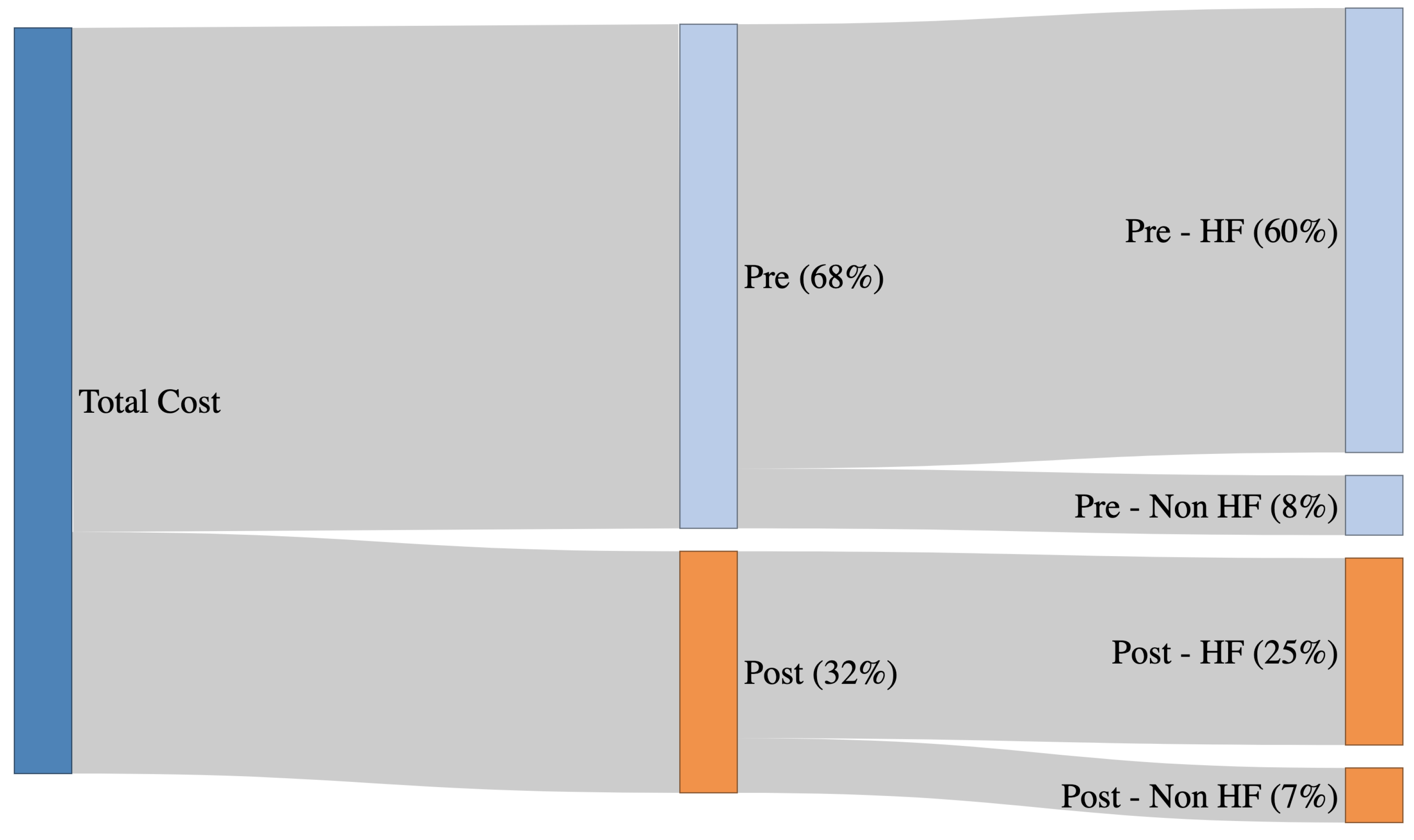
Figure 2.
Sankey diagram. Decomposition of costs according to the type of intervention.
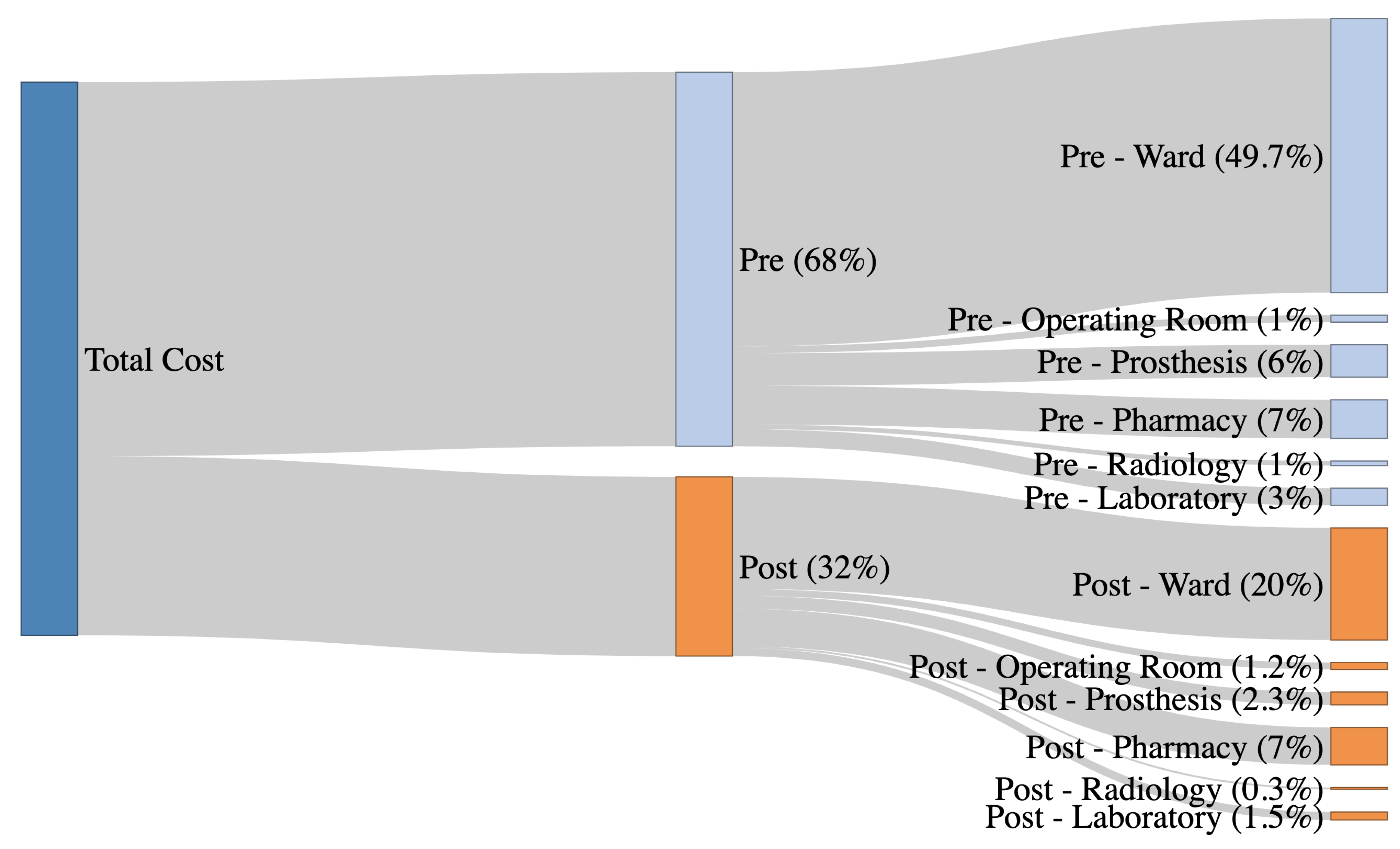
Figure 3.
Distribution of the incremental QALY gains. Results of the paired t-test shown in blue and the probabilistic sensitivity analysis (PSA) using a beta distribution in red, with corresponding mean values indicated by dashed lines.
Figure 3.
Distribution of the incremental QALY gains. Results of the paired t-test shown in blue and the probabilistic sensitivity analysis (PSA) using a beta distribution in red, with corresponding mean values indicated by dashed lines.
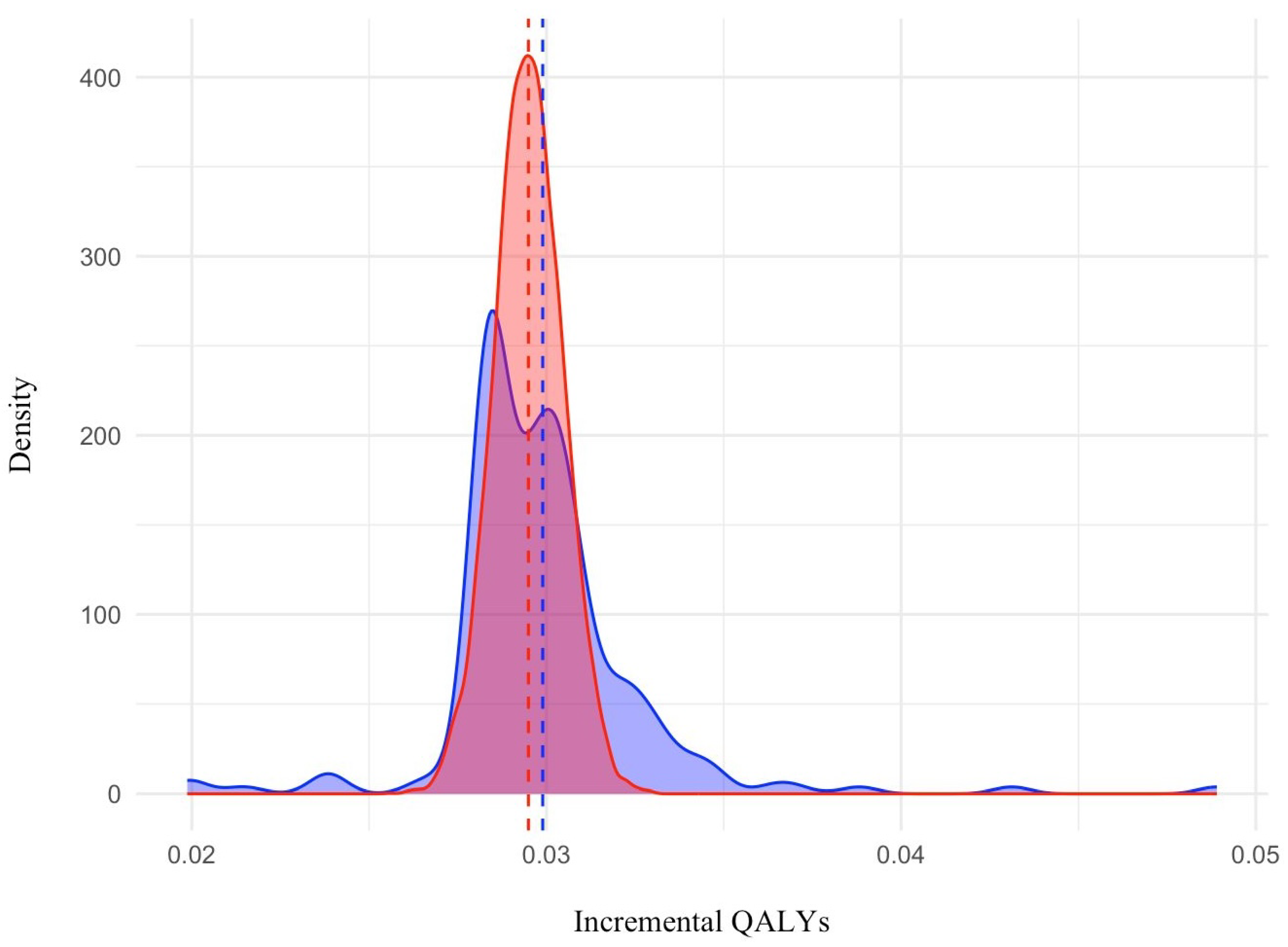

Table 1.
Costs: Pre and post telemonitoring values by category.
| Category | PRE (€) | POST (€) | Nominal change | % change | Est. change per patient | CI low | CI high | p-value |
|---|---|---|---|---|---|---|---|---|
| Total Cost | 1785717.04 | 855585.05 | -930131.98 | -52.09% | -4471.79 | -6525.58 | -2417.99 | 0.00003 **** |
| HF | 1574212.11 | 662137.48 | -912074.63 | -57.94% | -4384.97 | -6440.90 | -2329.05 | 0.00004 **** |
| Non-HF | 211504.92 | 193447.57 | -18057.35 | -8.54% | -86.81 | -542.43 | 368.81 | 0.70756 . |
| Ward | 1309008.59 | 534953.28 | -774055.31 | -59.13% | -3721.42 | -4706.30 | -2736.54 | 0.00000 **** |
| Operating Room | 33043.74 | 32889.23 | -154.51 | -0.47% | -0.74 | -113.50 | 112.01 | 0.98965 . |
| Prosthesis | 155196.14 | 61371.07 | -93825.07 | -60.46% | -451.08 | -1005.88 | 103.71 | 0.11047 . |
| Pharmacy | 184418.33 | 178748.38 | -5669.95 | -3.07% | -27.26 | -1310.91 | 1256.39 | 0.96665 . |
| Radiology | 22146.44 | 9076.31 | -13070.14 | -59.02% | -62.84 | -92.95 | -32.73 | 0.00006 **** |
| Laboratory | 81903.79 | 38546.78 | -43357.00 | -52.94% | -208.45 | -270.29 | -146.61 | 0.00000 **** |
| Nights Admitted | 1348 | 315 | -1033 | -76.63% | -4.97 | -6.20 | -3.74 | 0.00000 **** |
Table 2.
Costs (Subgroup of not-new cases).
Corresponding to the group of patients who are not new cases (82 of 208 patients). Pre values (before telemonitoring) and post values (during telemonitoring).
Broken down by category. Total changes, nominal per patient, percentage changes, and estimates with the 95% confidence interval and corresponding p-values.
Table 2.
Costs (Subgroup of not-new cases).
Corresponding to the group of patients who are not new cases (82 of 208 patients). Pre values (before telemonitoring) and post values (during telemonitoring).
Broken down by category. Total changes, nominal per patient, percentage changes, and estimates with the 95% confidence interval and corresponding p-values.
| Category | PRE (€) | POST (€) | Nominal change | % change | Est. change per patient | CI low | CI high | p-value |
|---|---|---|---|---|---|---|---|---|
| Total Cost | 638216.67 | 387434.81 | -250781.86 | -39.29% | -3058.32 | -6214.08 | 97.45 | 0.05733 . |
| HF | 548406.48 | 310613.26 | -237793.23 | -43.36% | -2899.92 | -6135.61 | 335.77 | 0.07830 . |
| Non-HF | 89810.19 | 76821.55 | -12988.64 | -14.46% | -158.40 | -997.49 | 680.69 | 0.70820 . |
| Ward | 434035.23 | 230868.66 | -203166.57 | -46.81% | -2477.64 | -4009.13 | -946.15 | 0.00185 ** |
| Operating Room | 6881.99 | 10599.25 | 3717.26 | 54.01% | 45.33 | -96.44 | 187.11 | 0.52644 . |
| Prosthesis | 57909.57 | 49400.09 | -8509.48 | -14.69% | -103.77 | -1186.32 | 978.77 | 0.84921 . |
| Pharmacy | 101775.78 | 75798.04 | -25977.75 | -25.52% | -316.80 | -2683.05 | 2049.45 | 0.79062 . |
| Radiology | 7654.02 | 3779.51 | -3874.52 | -50.62% | -47.25 | -92.07 | -2.44 | 0.03904 * |
| Laboratory | 29960.07 | 16989.26 | -12970.81 | -43.29% | -158.18 | -260.05 | -56.31 | 0.00275 ** |
| Nights Admitted | 516 | 122 | -394 | -76.36% | -4.80 | -7.07 | -2.54 | 0.00006 **** |
Disclaimer/Publisher’s Note: The statements, opinions and data contained in all publications are solely those of the individual author(s) and contributor(s) and not of MDPI and/or the editor(s). MDPI and/or the editor(s) disclaim responsibility for any injury to people or property resulting from any ideas, methods, instructions or products referred to in the content. |
© 2026 by the authors. Licensee MDPI, Basel, Switzerland. This article is an open access article distributed under the terms and conditions of the Creative Commons Attribution (CC BY) license (http://creativecommons.org/licenses/by/4.0/).
Copyright: This open access article is published under a Creative Commons CC BY 4.0 license, which permit the free download, distribution, and reuse, provided that the author and preprint are cited in any reuse.