

Submitted:
17 February 2026
Posted:
26 February 2026
You are already at the latest version
Abstract
Chemical recycling of mixed plastic waste can return polymers to fuel- and feedstock-range hydrocarbons, but legacy additives and non-intentionally added substances (NIAS) may persist in the products or leach during use. We investigated six polyolefin-rich wastes (P1–P6) by analytical pyrolysis coupled to comprehensive two-dimensional gas chromatography–time-of-flight mass spectrometry (Py-GC×GC-TOF-MS) and profiled potential emissions from three consumer-grade plastics (P7–P9) via headspace/solvent-extraction GC–MS and water-migration tests. When the plastics were polysized at 650°C, the resulting pyrolysates are dominated by aliphatic hydrocarbons (C₅–C₃₀): n-paraffins and α-olefins for PE-rich feeds, and branched olefins with modest mono-aromatics for PP. Oxygenates are negligible in non-oxidized feeds but persist at low levels in weather-aged HDPE, consistent with carry-through of pre-existing carbonyls; one aged film (P5) shows an epoxide spike (~5–6 area %). Across oils we identify hallmark NIAS from antioxidant packages (e.g., 2,4-di-tert-butylphenol; Irganox®-1010 spiro-dione) at trace to sub-percent levels, while heavy polycyclic aromatics are not detected above method limits. A 3D GC×GC visualization highlights the dense, resolved hydrocarbon envelope and the minor heteroatom features that guide upgrading targets. VOC/SVOC and leachate analyses (P7–P9) reveal mainly low-intensity hydrocarbons, esters, and fragrance/cosmetic residues; no phthalates were detected in the tested samples, although caprolactam and other additive-related NIAS occur sporadically. Collectively, the results indicate that well-sorted polyolefins yield oils suitable for refining to fuels or monomers, but quality assurance should address oxygenate tails in oxidized PE and antioxidant-derived NIAS.
Keywords:
mixed plastic waste
; pyrolysis oil
; GC×GC–TOF–MS
; volatile organic compounds (VOCs)
; non-intentionally added substances (NIAS)
; additive degradation
; extractables and leachables
; circular economy
; chemical recycling
; UNEP Global Plastics Treaty
1. Introduction
The global shift toward a circular plastic economy[1] has intensified focus on chemical recycling technologies like pyrolysis, which can convert mixed or contaminated plastic waste into reusable hydrocarbon feedstocks[2]. However, realizing this potential requires a deep understanding of how legacy contaminants and additives present in waste streams behave during thermal conversion[2,3,4,5,6,7,8,9,10,11]. A decisive policy driver behind this work is the UN-led Global Plastics Treaty now under negotiation (INC-5, Busan, 2025)[12], which aims to deliver a legally binding agreement that tackles plastic pollution across the entire life-cycle, including strict control of hazardous additives and full chemical transparency for recycled outputs[13,14,15,16]. In a previous study[17], we characterized nine diverse plastic waste samples (P1–P9) using a suite of spectroscopic, thermal, and elemental analyses, revealing pervasive additives, fillers, and toxicants (e.g., heavy metals, halogens) in certain streams. Those findings underscored that post-consumer and post-commercial plastics often carry a “chemical legacy” of thousands of substances[3,4,6,11], including regulated additives[9,18,19,20,21,22,23,24,25] and unknown NIAS[26,27], some of which can migrate into food, water, or the environment[9,28,29,30,31,32]. Critically, the study[17] concluded that highly contaminated or heterogeneous plastics may require chemical recycling (e.g., pyrolysis) to mitigate safety risks and recover value, rather than direct reuse. Building on that foundation, this current study examines the outputs of pyrolysis and potential emissions, using advanced analytical techniques to ensure continuity with feedstock insights.
Pyrolysis oils derived from samples P1–P6 are analyzed via comprehensive two-dimensional GC–TOF–MS (GC×GC–TOF–MS), providing unprecedented resolution for complex mixtures. Traditional one-dimensional GC–MS often fails to deconvolute the hundreds of hydrocarbons in waste-plastic pyrolysate, especially overlapping aliphatic isomers. By contrast, GC×GC separates compounds across two different polarity columns, allowing detailed group-type characterization of paraffins, olefins, naphthenes, aromatics, and detection of trace heteroatom species. Recent studies [33,34] have demonstrated GC×GC–MS’ superiority in profiling polyolefin pyrolysis oils, identifying components that would be obscured in 1D GC–MS[33]. Here, we apply this to real-world waste plastics, aiming to identify polymer degradation products, additive-derived NIAS, and any heteroatom-containing compounds (O-, N-, S-species) that persist in the oils and may affect downstream use.
In addition to liquid oils, we address potential emissions from both the pyrolysis process and the plastic materials themselves. During heating and reuse, plastics can release volatile and semi-volatile organic compounds (VOCs/SVOCs) or leach chemical additives into the surrounding media[26]. To capture this, we performed VOC analysis and water leachate testing on samples P7–P9, which represent consumer-grade items that might be repurposed or come into contact with water. This analysis targets priority contaminants such as phthalate plasticizers, known endocrine disruptors[31] that frequently leach from plastics, and other SVOCs like alkylbenzenes, short-chain hydrocarbons[35], or chlorinated paraffins[36,37,38] reported in plastic leachates. Identifying even low-level extractables is crucial, as these substances could pose environmental or health risks when recycled materials are used in sensitive applications (e.g., food packaging, aquatic environments).
Recent advances in analytical methodology strongly support the dual strategy adopted here—GC×GC-MS for pyrolysis oils and headspace / solvent-extraction GC-MS for VOC-, SVOC-, and water-migration studies[39]. Beccaria et al. [34] and Hang Dao Thi et al. [40] showed that GC×GC-TOF-MS resolves thousands of isomeric hydrocarbons and ppm-level heteroatom species in mixed-plastic pyrolysis oils that would otherwise co-elute in 1-D GC-MS, while Kusenberg et al.[41,42] linked such detailed fingerprints to feed composition and downstream upgrading needs. Complementary work by Dong et al.[29] and Horodytska et al.[26] demonstrated that headspace-SPME-GC×GC or static headspace GC-MS, coupled with solvent extractions, can sensitively profile VOCs/SVOCs and non-intentionally added substances (NIAS) in recycled polymers, enabling chemometric discrimination of quality and origin. For water-migration, Steimel et al.[43] reviewed PET/rPET leachate studies showing that even ng L⁻¹–µg L⁻¹ levels of NIAS merit scrutiny, a concern echoed in the UNEP (2023) technical report[11] on “Chemicals in Plastics.”
Overall, the goals are: (1) to comprehensively characterize the chemical composition of pyrolysis oils from contaminated mixed plastics, correlating them with feedstock properties (Part I) and assessing their suitability as recycling outputs; (2) to evaluate the emission profile of representative waste plastics through VOC release and leaching tests, highlighting any hazardous compounds in comparison to known pollutants; and (3) to discuss the implications of these findings for toxicological risk assessment and regulatory compliance in plastic recycling. By integrating feedstock and product analyses, this two-part study provides an end-to-end perspective on contaminants in the plastic life cycle, directly supporting emerging regulations (e.g., the UNEP Global Plastics Treaty’s mandate[12,13,14,15,16] to address plastic additives and pollutants) and guiding industry towards safer, more circular recycling practices.
2. Materials and Methods
2.1. Plastic Samples and Pyrolysis Procedure
Plastic waste samples P1–P9 analyzed in this study are the same as those described in the reference[17] (provided by Napco National, Saudi Arabia). In summary, these samples encompass mixed polyolefin wastes from post-consumer, commercial, and industrial sources, with P1, P2, P5, P7, and P8 being predominantly polyethylene (HDPE and/or LDPE) with minor fillers/oxidation, P3 and P4 being polypropylene (PP) products, P6 a PE/PP blend, and P9 a mixed HDPE/PP stream (see Part I for detailed characterization of polymer composition, additives, and contaminants). Notably, P2 and P5 contained ~6–10 wt% calcium carbonate (CaCO₃) filler and showed FTIR evidence of oxidation (carbonyl bands), whereas P3/P4 were relatively pure PP, and P6/P9 were polymer blends with low inorganic content. These inherent differences informed the pyrolysis behavior and product yields.
For analytical pyrolysis, each sample (P1–P6) was subjected to micro-chamber pyrolysis interfaced directly to the GC×GC system (Py–GC×GC–TOF–MS). Approximately 0.5–1.0 mg of finely ground plastic was loaded into a quartz pyrolysis tube. The pyrolyzer (CDS Pyroprobe 6150 model) was set to 650 and 450°C (controlled to ±1 °C) and held for 15 seconds under an inert helium atmosphere. This temperature ensured rapid and complete thermal decomposition of the polyolefins into volatile fragments. The pyrolysis vapor was directly introduced into the GC inlet (300 °C, split ratio ~1:300 to avoid column overload). A blank run (empty tube) was performed between samples to confirm no carryover.
2.2. GC×GC–TOF–MS Analysis of Pyrolysis Oils
Instrumentation: A comprehensive two-dimensional Agilent 7890B gas chromatography system (Agilent Technologies, Wilmington, Delaware) equipped with a Zoex ZX1 cryogenic thermal modulator (Zoex Corporation, Houston, Texas) and a time-offlight mass spectrometer TOF-MS (AccuTOF GCx-plus, JEOL, Japan) was used, equipped with a thermal modulator for 2D separations and a time-of-flight mass spectrometer for detection. The first-dimension (^1D) column was a non-polar HP-5MS UI type (30 m length, 0.25 mm ID, 0.25 µm film) optimized for separating hydrocarbons by boiling point. The second dimension (^2D) column was a mid-polar BPX-50 capillary column (2 m length, 0.1 mm ID, 0.1 µm film) providing separation by polarity/polarizability.
GC Conditions: Helium was used as carrier gas at a constant flow of ~0.8 mL/min. The oven temperature program was: 80 °C (hold 1 min) ramped at 2 °C/min to 300 °C (hold 5 min). The thermal modulator (loop-type) was set to a period of 6 s (hot pulse ~0.350 ms) with cryogenic cooling (liquid N₂ or a cryogen-free loop) to focus analytes. This modulation period produced approximately n=3–4 slices of each ^1D peak, ensuring structured chromatographic patterns (e.g., separate bands for n-paraffins, iso-paraffins, olefins, etc.). The GC×GC system provided effective volatility coverage from C₆ to C3₀+ range, capturing the full breadth of pyrolysis products from light gases to heavy wax fractions.
TOF–MS Conditions: The TOF–MS detector was operated in electron ionization (EI) mode at 70 eV. The mass range scanned was m/z 35–500 at 100 spectra/s (sufficient for ~50 Hz modulation). The MS transfer line was 280 °C, and the ion source was 250 °C. Data were acquired with a mass accuracy check and a dynamic range suitable to detect major components and minor heteroatom species at ppm levels. Identification criteria: Raw GC×GC–MS data were processed using GCImageTM Version 2.9 software (Zoex Corp, USA).Peaks were tentatively identified by matching mass spectra against the NIST 2023 library, requiring a match score ≥800 (out of 1000) for positive identification. Two-dimensional retention indices (ordered pair of ^1D and ^2D retention times) were also compared with literature values or known patterns (e.g., the structured elution of homologous series). In cases of additive-related compounds (e.g., antioxidant breakdown products), identifications were confirmed by comparison to known fragmentation patterns reported in the literature[30]. Semi-quantitative analysis was performed by relative peak area normalization (no effective response factors were applied since we focus on compositional trends rather than absolute yields). Following an initial screening at 450 °C and 650 °C, instrumental parameters were re-optimized (modulation, secondary-oven offset, acquisition rate) and all samples were re-run at 650 °C to capture representative degradation products. Unless stated otherwise, the compositions and figures in the main text refer to these optimized 650 °C runs; the 450 °C chromatograms are archived in the Supplementary Information.
Quality Control: A standard mixture of C8–C20 n-alkanes and a few aromatics was run to calibrate retention and ensure proper modulation timing. Reproducibility was checked by duplicate pyrolysis-GC×GC runs on one sample (variation in major peak areas <5%). The absence of instrumental artifacts was confirmed by blank pyrolyses (producing only trace siloxanes from column bleed). The detection limit for individual compounds in the pyrolysis oil (given the small sample size and split injection) is estimated around 0.1–0.5 wt% of the total oil for a library match, though the sensitive TOF–MS can detect trace components down to the low ppm range for targeted species. We confirmed run-to-run reproducibility at 650 °C in a second batch; comparative figures use the optimized 650 °C data and sub-pyrolytic 450 °C screens are cited qualitatively.
2.3. VOC and SVOC Analysis (Headspace and Leachate GC–MS)
For samples P7–P9, which were not subjected to pyrolysis, we characterized their potential emissions via two complementary methods: static headspace GC–MS (for VOCs) and solvent-extraction GC–MS (for SVOCs and leachables, including water migration extracts).
Headspace GC–MS (VOCs): Each sample (~1 g of plastic, cut into small pieces) was placed in a 20 mL headspace vial with a Teflon-lined septum. The sealed vial was incubated at 80 °C for 1 hour to accelerate the release of any volatile compounds (simulating a warm environmental or storage condition). A 1 mL aliquot of the headspace gas was then auto-injected into a gas chromatograph–mass spectrometer (Agilent 7890B GC coupled to 5977B single-quadrupole MS, or equivalent) in splitless mode. The GC was equipped with a 30 m × 0.25 mm ID, 0.25 µm 5%-phenyl methylpolysiloxane capillary column (HP-5ms or similar). Oven program: 40 °C (5 min) → 10 °C/min → 250 °C (2 min). Helium carrier at 1 mL/min. The MS scanned m/z 15–300 in EI mode. VOCs were identified by NIST library matching (≥90% similarity) and by retention time comparison to a standard mix of common volatiles (including n-alkanes C₅–C₁₂, benzene, toluene, ethylbenzene, xylenes, styrene, etc.). Method blanks (empty vials) and reference vials with known compounds ensured no contaminants from the septa or the instrument. The estimated detection limit for typical volatiles (e.g., toluene) was ~1 µg per kg of plastic (ppb level), given pre-concentration by headspace.
Solvent Extraction and GC–MS (SVOCs & Leachables): To capture semi-volatile additives and any compounds that could migrate into aqueous environments, we conducted a two-step extraction: (1) organic solvent extraction of the plastic, and (2) water migration testing with subsequent extraction. For the organic extraction, ~2 g of each sample (P7–P9) was ground and Soxhlet-extracted in 50 mL of HPLC-grade n-hexane for 8 hours (or alternatively ultrasonicated in hexane for 1 hour). The extract was concentrated to ~2 mL using a rotary evaporator (avoiding complete dryness to prevent loss of semi-volatiles). 1 µL of this extract was analyzed by GC–MS (same instrument as above) in split mode (10:1) to identify extractable additives. The GC method was: 50 °C (2 min) → 5 °C/min → 300 °C (hold 10 min) to elute compounds up to ~C₃₀. Key targets in these extracts included plasticizers (phthalate esters), antioxidants (e.g., BHT), oligomeric hydrocarbons, and other SVOCs known from packaging.
For the water migration test, samples (~1 g each) were immersed in 10 mL of deionized water in glass jars (sealed) and stored at 40 °C for 10 days, following EU food-contact simulant guidelines for overall migration into aqueous media. After incubation, the water was divided for analysis: an aliquot was checked for inorganic ions (e.g., chloride) by ion chromatography (to detect any inorganic leaching, not a focus here), and the remaining was extracted thrice with dichloromethane (DCM, 3×10 mL). The combined DCM extracts were dried over anhydrous sodium sulfate and concentrated to 1 mL. GC–MS analysis of these extracts was performed similarly to the hexane extracts. Because direct injection of water is incompatible with GC, this approach captured organic leachates in the DCM phase. Any detected compounds in water extracts were cross-checked against those from the direct hexane extract to differentiate inherent additives vs. those that actually migrate into water.
Identification and Quantification: The MS data from both headspace and extracts were processed with NIST17/23 library matches[44]. Compounds of particular interest (e.g., diethylhexyl phthalate, dibutyl phthalate, nonylphenol, etc.) were confirmed by comparing them to authentic standards (purchased reference standards injected under identical conditions). Calibration curves for a few priority analytes (five-point calibration for phthalates and phenol, 0.1–10 mg/L in solvent) were prepared to estimate concentrations in the extracts. Method detection limits for SVOCs like phthalates in water were on the order of 0.5 µg/L (given a concentration factor of ~30 from extraction). Results are reported qualitatively (present/absent and relative intensities) with semi-quantitative estimates where applicable.
2.4. Data Interpretation and Literature Comparison
In this section, we present a systematic GC×GC–TOF–MS interrogation of the condensable oils obtained from our polyolefin feed. Each sample (≈ 1 mg) was flash-pyrolysed in an inert micro-chamber; the vapour stream was cryo-modulated (5 s period) through a non-polar × polar column set, and the full two-dimensional chromatograms were deconvoluted into ten functional buckets (α-olefins, iso/di-olefins, n-paraffins, iso-paraffins, naphthenes, aromatics, alcohols, esters, epoxides, “other oxygenates”). We ran the same feedstock at 650 °C and 450 °C to quantify thermal-severity effects, and we repeated the 650 °C experiment on separate days to provide cross-validation and confirm run-to-run reproducibility. An expanded library allowed us to tag additive residues and NIAS down to ~0.05 wt%. The resulting group-type balances form the basis for (i) the internal 450 °C ↔ 650 °C comparison, (ii) cross-validation against our two datasets, and (iii) benchmarking versus the hydrocarbon/NIAS envelopes reported by Kusenberg et al. [42] and Chen et al. [45]. We specifically referenced comparable GC×GC analyses of plastic pyrolysis oils (e.g., van der Werf et al. [46] and Strien et al. [47]) to contextualize our findings on heteroatom content and NIAS[48]. The next subsections detail how temperature reshapes the hydrocarbon skeleton, redistributes oxygenated NIAS, and alters key additive-degradant fingerprints. Further experimental details, raw data (GC×GC chromatograms, mass spectra), and compound lists can be provided on request.
3. Results and Discussion
3.1. GC×GC–TOF–MS Analysis of Pyrolysis Oils (Samples P1–P6)
Mass balance measurements (Table 1) confirm that 450 °C does not lead to appreciable decomposition (mass change <1%), while at 650 °C >70% of the sample volatilizes, leaving a small char fraction. These observations are consistent with Part I[17] (onset of mass loss near 460–480 °C for PE/PP), the 450 °C GC×GC screens did not reflect full pyrolysis; hence, our mechanistic assignments rely on the 650 °C optimized dataset. Given that the 650 °C dataset yields clear degradative fingerprints (whereas the 450 °C dataset showed sub-pyrolytic thermal desorption with negligible mass loss), we focus the chromatographic description on the optimized 650 °C results (Figure 1, Figure 2, Figure 3, Figure 4, Figure 5 and Figure 6); the 450 °C maps are shown in Supplementary Figures S1–S6 for completeness.
3.1.1. Effect of Pyrolysis Temperature on Pyrolysis Oil Composition (450 °C vs 650 °C)
We screened the feed at 450 °C and 650 °C; the 450 °C maps (Figures S1 through S6) show weak partial volatilization and are used only to indicate the onset of product formation, while all quantitative interpretations are based on the optimized 650 °C runs (Figure 1 through 6). These figures (chromatograms at 450 and 650°C) collectively visualise the temperature-driven evolution of each plastic stream: for every sample, the chromatogram (450 °C) captures the initial, partially cracked product slate—long-chain wax arcs for polyethylene-rich feeds or isolated iso-olefin spots for polypropylene—whereas the chromatogram (650 °C) reveals the pronounced shift toward shorter-chain olefins, diminished paraffins, and the first appearance of aromatic streaks. In general, elevating the pyrolysis temperature from 450 °C to 650 °C caused more extensive cracking and dehydrogenation of the polymers, shifting the GC×GC-detected product spectra toward a higher proportion of unsaturated hydrocarbons and smaller fragments. Across all samples P1–P6, the 650 °C runs produced relatively more olefins (alkenes) and fewer heavy paraffins (alkanes) compared to 450 °C, consistent with more complete breakdown of polymer chains at the higher temperature. Concurrently, secondary reactions (cyclization, aromatization) were modestly enhanced at 650 °C, leading to slight increases in aromatic hydrocarbons in some cases (particularly for polypropylene-derived samples[49]. Importantly, oxygenated compounds were only observed in samples containing pre-oxidized polyethylene (P2, P5), and their behavior with temperature reflects the stability of polymer-borne oxygen functional groups.
Individual feeds followed these general trends with varying degrees of temperature sensitivity. PE-rich samples (P1) remained dominated by aliphatic hydrocarbons; long-chain paraffins and α-olefins at 450 °C shifted toward lighter olefins at 650 °C, with aromatics remaining negligible. The oxidized HDPE samples (P2, P5) displayed oxygenate-rich signatures at 450 °C, which decreased substantially at 650 °C but did not completely disappear, indicating partial thermal persistence of oxidized fragments. PP samples (P3, P4) exhibited the strongest shift with temperature, transitioning from mixed paraffin/olefin products at 450 °C to abundant light olefins and a modest aromatic fraction at 650 °C. The mixed polyolefin blend (P6) showed intermediate behavior: increased olefin formation at 650 °C but limited aromatization due to its high PE content. Overall, temperature was the dominant factor controlling product distribution, with 650 °C consistently favoring unsaturation, lighter hydrocarbons, and limited but observable secondary reactions.
Figure 7 provides a three-dimensional surface visualization of a representative GC×GC–TOF–MS chromatogram (Sample P6 pyrolysis oil at 650 °C), illustrating the distribution of compounds across two retention-time dimensions along with their relative abundances (peak intensities). The 3D view highlights the dense cluster of resolved peaks that form the broad hydrocarbon envelope, as well as the absence of any exceptionally large outlier peaks or heavy multi-ring aromatics in this sample.
3.1.2. Overview of Pyrolysis Oil Composition at 650 °C
Pyrolysis of samples P1–P6 yielded oils composed predominantly of C5–C30 hydrocarbons, reflecting the polyolefin nature of the feedstocks. The most abundant semi-volatile NIAS formed at 650 °C are compiled in Table 2. The comprehensive 2D chromatograms show a characteristic “fingerprint” for each sample, but with common features. Across all oils, we observe a dominant envelope of aliphatic hydrocarbons spanning gasoline-range molecules (C5–C12) through diesel-range and waxy oligomers (up to C30+). These include n-alkanes (straight-chain alkanes) and α-olefins (1-alkenes) in roughly comparable abundance, alongside branched alkanes and cycloalkanes. The presence of numerous isomers was evident from the GC×GC separation: e.g., for a given carbon number (say C15H32), a series of spots were separated in the 2D plane (P2, Figure 2), indicating different branching patterns (isoparaffins) distinct from the single n-paraffin spot. Such resolution highlights the complexity of these oils, which conventional 1D GC would struggle to deconvolute. Mono-aromatic hydrocarbons (alkylbenzenes and indanes) formed a minor but notable fraction, especially in oils from PP-rich samples (P3, Figure 3), as discussed below. Crucially, no high-boiling toxic polyaromatic hydrocarbons (PAHs) beyond 2–3 rings (e.g., naphthalene, phenanthrene) were detected at significant levels, suggesting that the moderate pyrolysis temperature (650 °C, short residence) limited secondary aromatization reactions. This is an important finding, since heavy PAHs are a known concern in pyrolysis oils from harsher conditions (e.g., tire pyrolysis oils). In our case, only trace naphthalene and its alkylated derivatives were observed, mostly in PP-derived oils, and compounds like benzo[a]pyrene were not detected (detection limit ~0.1 wt%). Overall, the chemical profile of these pyrolysis oils is analogous to petroleum distillates (containing paraffinic, olefinic, naphthenic, and light aromatic fractions), indicating potential usability as fuel or feedstock after refining[50]. However, detailed analysis of NIAS and heteroatom species is required to judge their quality for high-end applications[48].
3.1.3. Repeat and Comparative Analysis
Replicate-run consistency and literature benchmarks confirm the robustness of our dataset. Re-analysing the identical mixed-polyolefin feed in 2024 (not shown) and 2025 (Table 3 and Figure 8)—with a narrower modulation pulse and finer library buckets in the second campaign—shifted only category labels: total olefins stayed 47–49 area %, paraffins + naphthenes 29–31 %, and oxygenates 14–35 %; the lone chemical change was a five-fold epoxide rise in the weather-aged HDPE lot (P5). To benchmark our findings, we compared them with published GC–FID data from Kusenberg et al. (2022)[42] (see Figure 8 and Figure 9 ). Converting our GC×GC areas to Kusenberg et al.’s FID groupings shows near-identity[42]: PP-rigid oils remain iso-dominated (59 ± 6 wt% vs 62.7 wt%), PE-film oils retain linear α-olefin + n-paraffin signatures (31 ± 3 and 29 ± 4 wt% vs 25.5 and 34.4 wt%)—differences stem from bucket granularity and detector response, not new chemistry[42]. Kusenberg et al. quantified hydrocarbons only, so a true apples-to-apples comparison of oxygenates must use NIAS-oriented studies. Likewise, our NIAS envelope aligns with untargeted migrant surveys: esters 8–18 wt%, alcohols/phenols 7–18 wt%, epoxides ≤ 1 wt% except in oxidised HDPE (≈ 3 wt%), and antioxidant degradants (2,4-DTBP, Irganox spiro-dione) at 0.1–0.5 wt%—all within the ranges flagged for post-consumer PE[26,45]. These concordances across two internal campaigns and two external baselines indicate that any residual discrepancies arise from feed ageing or detector calibration rather than fundamental process variance, reinforcing confidence in the functional-group and NIAS profiles reported here.
3.1.4. Broader Differences Between Samples (Effect of Feedstock):
Sample P1: The GC×GC contour displays a dual-arc pattern: a lower diagonal of n-paraffin/α-olefin homologues (C₇–C₃₀) characteristic of linear PE chains, and an overlying curved band of heavier, more branched waxes produced by LDPE segments. As deduced from Part I[17], FTIR shows only polyethylene C–H modes—no carbonyl peak—while DSC gives two melting endotherms (~110 °C LDPE, ~130 °C HDPE) and TG–MS detects purely hydrocarbon volatiles with > 99 % mass loss, confirming a low-additive, non-oxidised feed. Consistent with this purity, the chromatogram lacks the faint oxygenate ridge seen in oxidised samples (e.g., P2, P5) and shows no halogen- or nitrogen-containing clusters. The minimal char/ash (< 0.5 %) further indicates negligible inorganic fillers. Overall, P1 yields a hydrocarbon-rich oil dominated by linear and mildly branched paraffins/olefins—well-suited, after mild upgrading, for cracker or fuel applications—illustrating that clean post-industrial polyolefin scrap can generate a relatively straightforward pyrolysis fingerprint.
Samples P2 and P5 (HDPE with CaCO₃ and oxidation): These HDPE-rich samples produced oils enriched in straight-chain alkanes and 1-alkenes, reflective of polyethylene’s tendency to undergo β-scission, yielding even n-alkenes and corresponding n-alkanes[48]. Indeed, the P2 oil chromatogram exhibited a strong series of n-paraffin peaks at C10, C12, C14, etc., as well as the complementary α-olefins (e.g., 1-decene, 1-dodecene identified by characteristic m/z 56, 70 fragments). These linear hydrocarbons are highly desirable if the oil is to be used as a petrochemical feedstock, as they can be steam-cracked into ethylene/propylene. P5’s oil was similar but with an overall heavier range (its distribution peaked around C18–C22, likely due to the presence of long-chain oxidized segments in the aged HDPE that break off as heavier fragments). Both P2 and P5 feed contained CaCO₃ filler (~5–10%), which does not form organic products but did influence the pyrolysis residue: each yielded a notable amount of solid char/ash (~6% for P2, ~10% for P5) containing CaCO₃ and carbonaceous matrix. This is consistent with TGA results (Part I), which showed residual ash from these samples. The impact on oil composition is indirect: the CaCO₃ may act as a heat sink and CO₂ source (decomposing >700 °C), slightly altering pyrolysis atmospherics. We did observe a slight enrichment of oxygenated compounds in P2 and P5 oils compared to the PP oils. Specifically, small peaks corresponding to acetone (propanone) and acetic acid were detected in P5 oil, and trace phenolic compounds in P2 oil. These are likely oxidation products from the feed: P5 had a pronounced carbonyl band in FTIR, indicating weathering of HDPE. During pyrolysis, pre-oxidized polymer segments can cleave to form low-molecular-weight oxygenates (acetone, acetic acid, formic acid, etc.), which were absent (or below detection) in the oils from unoxidized plastics. Though present at low levels (<0.5 wt%), such oxygenates contribute to oil acidity and instability. In summary, HDPE-rich waste yields a hydrocarbon-dominated oil favorable for fuel use, but prior oxidation can introduce trace oxygen NIAS that might require downstream removal (e.g., hydrotreating).
Samples P3 and P4 (PP homopolymers): These yielded oils with a higher proportion of branched alkanes and alkyl-aromatics. PP pyrolysis is known to produce significant methyl-substituted hydrocarbons due to random chain scission and tertiary radical formation from the pendant methyls on the polymer backbone[48]. Accordingly, the GC×GC chromatograms for P3/P4 oils showed intense clusters of isoparaffins (branched C8–C20 alkanes) and noticeable signals for aromatic compounds like toluene, xylenes, trimethylbenzenes, and indane derivatives. For example, toluene was identified (mass m/z 92) and quantified at ~2 wt% of P3’s oil; such aromatics arise from cyclization of olefinic fragments at high pyrolysis temperature. By contrast, normal alkanes in P3/P4 oils were somewhat less prominent (relative to P2/P5 oils), and the distribution skewed toward slightly lighter compounds (peak around C9–C12), consistent with PP’s lower thermal stability producing more gases and gasoline-range compounds. These trends align with prior reports that PP pyrolysis yields more volatile products and higher aromatics than PE[33]. Notably, both P3 and P4 feed were essentially additive-free (no fillers, minimal oxidation), so their oils contained few extraneous peaks beyond hydrocarbon pyrolysates. This demonstrates that “clean” polypropylene waste can produce a relatively straightforward pyrolysis oil composition dominated by hydrocarbons (with only minor NIAS, see below).
Sample P6 (Mixed PE/PP): These samples produced hybrid pyrolysis oils, as expected from their mixed-polyolefin nature. For P6 (approximate composition: LDPE, HDPE, and PP blend), the oil chromatogram essentially overlaid features from both PE and PP pyrolysis. We observed a broad distribution of products ranging from C5 to C30, with both n-alkane series and significant branched/alicyclic components. P6 oil had no single dominant peak, reflecting the diverse fragments from different polymers degrading simultaneously (e.g., PP contributes more C3–C8 olefins and methylated compounds, while PE contributes more C10+ linear fragments). Interestingly, the interaction of polymers in co-pyrolysis can slightly shift product yields (e.g., radicals from PP may induce more branching in PE fragments). Our results indicated that P6’s mixed waste oil was chemically broad but did not contain unusual compounds beyond those seen in pure-component pyrolysis. No chlorinated or brominated compounds were found in P6 oils, aligning with feed analysis that showed negligible PVC or brominated flame retardants in these samples (halogen <0.1% in elemental analysis of P6, Part I). This is a positive indication that such mixed polyolefin streams, when largely free of halogenated plastics, do not generate organo-halogen pollutants upon pyrolysis.
3.1.5. Additive-Derived Compounds and NIAS in Oils
One of the focal points of our analysis was identifying non-intentionally added substances (NIAS) in the pyrolysis oils that originate from plastic additives or other contaminants present in the feed (see Table 2). Despite the high temperature of pyrolysis (which tends to break down many additives), several identifiable NIAS were present in P1–P6 oils:
Phenolic Antioxidant Degradants: We detected low levels of 2,4-di-tert-butylphenol in multiple oils (notably P5 and P6). This compound is a known breakdown product of common hindered phenol antioxidants like butylated hydroxytoluene (BHT) or Irganox 1010/Irgafos 168[30,51,52]. In P5 (aged HDPE), the presence of 2,4-di-tert-butylphenol (~0.05 wt%) likely comes from long-term polymer antioxidant usage—either residual BHT in the plastic or its oxidative decomposition during service[27,51]. The fact that it survived as a distinct molecule suggests that antioxidant additives, if not completely depleted in service, can transform into NIAS rather than fully mineralize. Such phenolic NIAS are significant because they can carry toxicity (tert-butylphenols are potential endocrine disruptors) and may affect the stability of recycled fuels or monomers.
Long-Chain Hydrocarbons (Oligomers/Waxes): Each oil naturally contains heavy hydrocarbon waxes from partial polymer cracking. However, beyond these expected oligomers, we looked for signatures of oligomeric additives. No specific oligomer additive (like oligomeric plasticizers or processing aids) was distinguishable, but it’s noteworthy that the pyrolysis oils themselves contain some fraction of long, branched alkanes (C₃₀–C₄₀ range) which are essentially polymer thermal fragments[53]. If these oils were to be reused as feedstock for new plastics, these high-boiling components could act as NIAS in the new material if not removed (they might migrate or affect material properties)[54]. This blurs the line between primary pyrolysis products and NIAS, highlighting a challenge for chemical recycling: ensuring that the output oil is sufficiently purified of high-molecular residues.
Nitrogen- and Sulfur-Containing Compounds: The GC×GC–TOF–MS, with its broad mass range and high sensitivity, did not detect significant nitrogenous or sulfur-bearing organics in P2–P6 oils. Specifically, compounds like amines, nitriles, or thiophenes were below detection limits in our samples, which is consistent with their polyolefin origin (nearly no nitrogen or sulfur in the feed composition)[47,48]. This is an encouraging result, as it indicates that for predominantly polyolefin waste, pyrolysis oils can be essentially free of nitrogen/sulfur contaminants (which, in contrast, are a major issue in pyrolysis of mixed municipal waste that includes Nylon, polyurethane, rubber, etc.[48]). For context, literature reports have shown that pyrolysis oils from mixed plastic (municipal waste) can contain up to several weight percent nitrogen compounds (from protein, nylon, etc.) and sulfur compounds (from PVC plasticizers or rubbers), necessitating post-treatment[48]. Our results imply that careful feedstock selection (as done by our industry partner in sorting out PVC, etc.) yields a “cleaner” oil. Only a trace of a nitrogenous compound—tentatively identified as hexadecenenitrile (a long-chain nitrile)—was found in P6 oil, at <0.01%. This could derive from thermal degradation of slip additives like fatty amides (which form nitriles upon heating). Indeed, many polyolefin films contain oleamide or erucamide as slip agents; these can cyclize to nitriles[55]. The detected C16 nitrile likely comes from such an additive in P6’s feed (perhaps from a film component). Its concentration is negligible, but it exemplifies how processing additives manifest as NIAS in pyrolysis oil. Thus, in summary, heteroatom NIAS were minimal in our oils—an important quality indicator for downstream utilization[48].
Other Additive Residues: We specifically searched for phthalates, chlorinated paraffins, bisphenols, PAHs, and brominated flame retardant byproducts in the GC×GC data, given their high concern level. None of the pyrolysis oils showed peaks corresponding to common phthalates (like DEHP, DINP), which is logical since our feed samples were polyolefins, not PVC (phthalates would more likely appear in pyrolysis of flexible PVC or as surface contaminants)[56,57]. No evidence of short-chain chlorinated paraffins was found either (again consistent with the absence of PVC or certain flame retardants in feed)[37]. Brominated compounds (which would indicate brominated flame retardants like PBDEs) were also not observed, aligning with Part I, where bromine was below XRF detection in these samples. The oils did contain methylbenzenes and naphthalene compounds, which are technically categorized as polyaromatics but of lower molecular weight; these are expected pyrolysis byproducts and are also known environmental pollutants. For instance, we measured ~0.3 wt% naphthalene in P4 (PP) oil and ~0.1 wt% in P2 (HDPE) oil. While low, these are toxicologically relevant (naphthalene is a regulated pollutant). In a circular economy context, if such oil were refined into fuels, those aromatics would likely be dealt with by hydrotreatment; if used for producing new plastics (via monomer recovery), they might carry over unless removed[58]. Thus, even though our oils are mainly hydrocarbons, the presence of light aromatics and traces of additive-derived phenolics means that further refining/purification is needed before these oils can be considered “clean” feedstock. This finding resonates with the concept of “chemical simplification” proposed for recycled feedstocks—the idea that recycling processes should aim to strip away legacy chemicals. Our GC×GC analysis provides the detailed inventory of such chemicals to inform that step.
In summary, GC×GC–TOF–MS proved invaluable in dissecting the pyrolysis oils from mixed plastic waste. It confirmed that, for well-sorted polyolefin-rich streams, the oils are overwhelmingly composed of recoverable hydrocarbons (mirroring virgin petrochemical feedstocks), with only minor impurities. The few NIAS identified (antioxidant degradants, a nitrile, etc.) highlight the need for quality control in recycled oils but are by no means insurmountable barriers—rather, they pinpoint specific targets for removal. The absence of significant halogenated or heavy toxic species in these oils is a promising result for the viability of pyrolysis in treating contaminated waste: many inorganic contaminants (e.g., metals, chlorine) identified in Part I remain largely in the char and are thus separated from the oil phase. This partitioning is advantageous, as the char (with concentrated inorganics) can be handled/disposed of separately, while the oil is relatively free of those inorganic toxins. Of course, capture of pyrolysis gases (especially if any HCl from trace PVC) is still necessary to prevent atmospheric emissions. Our results support the concept that pyrolysis can “clean” a dirty plastic feed to an extent, but analytical scrutiny is essential to verify the output quality, especially if that output is destined for food-grade or sensitive applications.
3.2. VOC and Volatile, Semi-Volatile, and Migrating Organic Compounds
Beyond pyrolysis oils, understanding the potential emissions from recycled plastics themselves is crucial for evaluating their safety and environmental impact. Samples P7, P8, and P9 (representative post-consumer/post-commercial plastics from Part I) were examined for volatile outgassing and aqueous leaching, simulating real-world scenarios (storage, use in contact with water, or environmental exposure). These samples were polyolefin-based (PE or PE/PP) with minor additives (fillers, etc.), making them good candidates to test whether even “simple” polyolefins can release harmful substances.
3.2.1. Volatile and Semi-Volatile Organic Compounds (VOCs and SVOCs)
Dozens of compounds were identified across the VOC (see Table 4) and SVOC (see Table 5) analyses for samples P7–P9, and each has been classified by origin as A (additive), AD (additive degradation product), PD (polymer degradation product), C (external contaminant), or deg (other degradation). This classification scheme is consistent with literature frameworks for NIAS in recycled plastics, which group substances into intentional additives, their breakdown products, polymer decomposition products, and external contaminants (References). We verified and updated each designation by considering the chemical’s known function and source. For example, long-chain aliphatic hydrocarbons (C7–C20_) and alkenes detected (e.g., 1-dodecene, 1-nonadecene) were designated PD because they are well-known thermal degradation products of polyolefins generated during reprocessing. Likewise, the detection of α-methylstyrene (high intensity in P7, medium in P8–P9) was tagged as PD, pointing to polystyrene contamination in the feedstock (polystyrene can depolymerize into styrene and related monomers under heat). In contrast, compounds with structures or usage suggesting an external source—such as perfumes, flavor additives, or solvent residues—were labeled C (contaminants). This comprehensive classification aligns with the consensus that recycled polymers contain a mix of polymer-breakdown volatiles and numerous NIAS introduced from previous use and product contact.
Most identified substances fell into the C (contaminant) category, underscoring the impact of prior use and consumer misuse on NIAS profiles. We observed an abundance of fragrances, flavor agents, cosmetic ingredients, and related consumer product chemicals embedded in the samples, all non-intentionally added during polymer manufacturing. This finding mirrors reports that post-consumer recycled plastics contain significantly more flavor/fragrance compounds and other oxygenated odorants than virgin plastics. Many of these contaminants originate from food or personal care products that were previously stored in the packaging, then absorbed into the polymer matrix. For instance, we detected fragrance compounds like 2-hexyl-1-octanol (a component in perfume oils) and cosmetic additives such as cyclic methylsiloxanes (e.g. hexamethylcyclotrisiloxane, D3) at low levels, all classified as C. These substances – often used as fragrant oils, emollients, or surfactants – are characteristic of household product contamination. Their presence supports the notion that prior consumer use/misuse (e.g., storing perfumed products, detergents, or foods in plastic) introduces a suite of NIAS that persist through recycling. Importantly, many have distinct odors (floral, fruity, spicy, etc.), contributing to the off-smell of recycled material. This class includes flavor and aroma compounds (esters, aldehydes, terpenes) employed in foods and cosmetics, which were prominent in our SVOC analysis as well. Another prominent group comprises additives (A) and their degradation products (AD). Common polymer additives – e.g. antioxidants, stabilizers, plasticizers, lubricants – were rarely found intact in P7–P9, but numerous AD compounds confirm their prior presence. Hindered phenolic antioxidants used in polyolefins (such as Irganox® 1010, Irganox® 1076, and related stabilizers) are known to generate specific NIAS upon thermal oxidation. In our samples, we identified several hallmark antioxidant degradants, including 2,4-di-tert-butylphenol and 2,6-di-tert-butyl-1,4-benzoquinone, both labeled AD. These compounds are recognized as oxidative breakdown products of tert-butylated phenol antioxidants (e.g., BHT or phosphite stabilizers). We also observed a high-intensity oxaspirodione compound (7,9-di-tert-butyl-1-oxaspiro(4,5)deca-6,9-diene-2,8-dione) in the solvent-extracted SVOCs of P8 and P9, which we classify as AD. This NIAS is a known degradation product of Irganox® 1010 antioxidant, and its strong signals (intensity 3) indicate that antioxidant residues persisted through recycling and underwent chemical transformation. The prevalence of such species corroborates prior studies showing recycled LDPE/PP contains many additive-derived NIAS (often at higher concentrations than truly external contaminants). In addition to stabilizers, we found evidence of plasticizer additives (A): for example, dibutyl itaconate (an itaconate ester) was detected at low levels in P9 and categorized as an additive. This compound likely originates from a plasticizer or processing aid added to certain plastic formulations, consistent with reports that a wide variety of additives (e.g., phthalates, itaconates, organophosphites) can be present in post-consumer plastics. Furthermore, a few lubricant and slip-agent residues were identified: branched alkanes such as heptadecane derivatives (AD) appear to stem from the breakdown of lubricant oils or amides originally added to facilitate processing. Overall, the A/AD category in these samples encompasses substances like antioxidant fragments, phthalate alternatives, and long-chain lubricants, reinforcing that the recycled material carried a legacy of its original additive package (albeit in altered forms). The PD (polymer degradation) category includes compounds formed by the thermal or oxidative scission of polymers during use and recycling. Our analysis detected numerous straight-chain hydrocarbons (alkanes and alkenes) and small oxygenated molecules that are typical byproducts of polyolefin degradation. For example, C10–C18 linear alkenes (1-tetradecene, 1-octadecene, etc.) and branched alkenes were found and labeled as PD, since polyethylene and polypropylene are known to crack into such oligomers under the high temperatures of reprocessing. We also found short-chain aldehydes (hexanal, heptanal, nonanal) in the VOC profile – these can arise from polymer oxidation (e.g. oxidative scission of PE chains) or from residual food fragrances, so they were noted as PD or C depending on context. Another polymer-specific NIAS was caprolactam, identified at appreciable levels (intensity 3 in P7 water migrant). Caprolactam is the monomer of Nylon-6, and its presence (classified as PD) indicates polyamide degradation, likely from a multilayer packaging fragment or fiber contaminant in the recycling stream. This finding highlights the issue of cross-contamination: recycled polyolefins can contain fragments of other polymers (like nylon) that break down and leach their monomers. Notably, the α-methylstyrene mentioned earlier falls in the PD class as well, pointing to polystyrene impurities that depolymerized during processing. The overall pattern – alkane/alkene hydrocarbons, low-chain aldehydes, and signature monomers from foreign polymers – aligns with the known degradation behavior of mixed plastic waste. Prior use-cycles and harsh reprocessing conditions are understood to generate additional polymer breakdown products in recycled plastics, and our results confirm that many of the volatile compounds in P7–P9 (especially those with simple hydrocarbon structures or carbonyls) indeed arise from the base polymers’ degradation. The SVOC fraction (less volatile, solvent-extractable migrants) in these recycled samples was dominated by compounds with polar functional groups – notably esters, amides, ketones, and phenolic compounds. This is consistent with recent analyses of recycled polyolefin migrants, which found esters to be the largest group of semi-volatile NIAS. In our data, we identified numerous ester-containing compounds, ranging from short-chain esters (often with fruity/floral odors) to long-chain fatty acid esters (e.g., hexacosyl acetate).
Many of these were contaminants linked to flavor/fragrance oils or cosmetic emollients, as observed in other studies. A number of amide derivatives also appeared in the SVOC list (for instance, traces of long-chain alkanamides and diethanolamides), which could originate from slip additives (like oleamide, erucamide added to plastics) or from proteins/pharmaceuticals contaminating the waste. We additionally detected several cyclic ketones and lactones, which are often fragrance components or polymer oxidation byproducts. Importantly, phenolic SVOCs were prevalent, including the antioxidant degradants discussed above (t-butylphenols, spiro-diones), reflecting their low volatility and tendency to remain in the polymer unless extracted. Overall, the SVOC profile skews heavily toward oxygenated NIAS (esters, alcohols, ketones, acids) and heteroatom-containing species (amides, sulfonamides, siloxanes), which aligns with literature noting that post-consumer plastics are enriched in such compounds compared to virgin materials. These functional groups not only confirm the prior use origins (e.g., cosmetic esters, flavor additives) but also indicate degradation pathways (oxidation, hydrolysis) that occur during the plastic’s lifecycle.
In summary, the VOC/SVOC analyses reveal that recycled plastic samples P7–P9 emit a complex mixture of NIAS, predominantly comprising contaminants from previous product use (e.g. fragrance agents, flavoring compounds, cosmetic oils), degradation products of additives (antioxidants, stabilizers, plasticizers that have partially transformed), and polymer breakdown products (from polyolefins and minor polymer contaminants like PS, PA). Most of these substances can be traced to categories such as fragrances, flavorings, plasticizers, antioxidants, and lubricants, which accords with their likely origin in consumer goods and packaging materials. Notably, the SVOC fraction is rich in esters, amides, ketones, and phenolic compounds, reflecting the dominance of oxygenated functional groups among less-volatile migrants. This compositional profile is fully consistent with recent literature on NIAS in recycled polymers: post-consumer plastics contain many flavor/fragrance-related chemicals and additive remnants that were non-intentionally introduced during the polymer’s first life.
By annotating each compound’s origin and intensity, we highlight which NIAS are of greatest concern. For instance, highly intense species like the Irganox® 1010 spiro degradant (AD) and caprolactam (PD) indicate significant carry-over of additives and polymer contaminants, respectively, which may warrant mitigation. Meanwhile, the prevalence of low-intensity flavor/fragrance contaminants (esters, aldehydes, etc.) explains the noticeable odor of recycled material, although individually these may be present at trace levels. Overall, our structured classification (A, AD, PD, C, deg) provides a clear understanding of how each compound entered the material and/or formed, reinforcing the need for improved decontamination and source-segregation in recycling to minimize these NIAS.
3.2.2. Migrants in Aqueous Food Simulant (Water Migrants)
Migration testing with water (simulant for polar food contact) on samples P7–P9 revealed a subset of SVOCs that readily leach out, many of which overlap with the compounds identified above (see Table 6). The water migrants include various antioxidant degradation products, plasticizers, and other polar NIAS that are soluble or dispersible in water. Notably, we detected 3,5-di-tert-butyl-4-hydroxycinnamic acid (intensity 2 in P9) – an A/AD substance derived from common antioxidants (e.g. Irganox® 1010, which contains this functional moiety). Its presence confirms that antioxidant fragments can migrate into aqueous phases, albeit at low levels, raising potential safety considerations. Another significant migrant was the oxaspiro decanedione (Irganox® 1010 degradant) discussed earlier, which appeared with high intensity (3) in P8 and P9 water extracts. The persistence and mobility of this spiro-AD compound underscore that some large antioxidant byproducts, despite low volatility, can still leach out under certain conditions – a point noted in NIAS reviews. Additionally, caprolactam was found to strongly migrate (score 3 in P7, 2 in P8–P9), consistent with its high water solubility and known tendency to leach from polyamide-containing materials. The detection of caprolactam in water confirms cross-contamination by nylon and highlights that such polymer-derived NIAS can transfer to foods or simulants readily. Besides additive and polymer degradants, the water migration test revealed miscellaneous contaminants likely originating from the plastics’ prior use. For instance, we identified N-ethyl-2-methylbenzenesulfonamide (classified C), which is used as an artificial sweetener and also as a plasticizer in certain polymers – its presence (low intensity in P9) suggests previous contact with sweetener-containing products or adhesive residues. We also found traces of pharmaceutical-related compounds: a notable example is cyclobarbital (a barbiturate drug, in P9 at low level), clearly an unintended contaminant presumably introduced via improper disposal or medical waste mixing into the recycling stream. While such compounds were at trace levels, their detection illustrates the broad scope of NIAS that can appear in recycled materials. Overall, the water migrant analysis reinforces the trends observed in the VOC/SVOC profile. Most migratable substances fall into the same functional categories – antioxidant derivatives, flavors/fragrances, processing aids, and polymer fragments – confirming that these are the dominant NIAS in the recycled samples. The findings highlight that polar NIAS (e.g. phenolic antioxidants degradants, sulfonamides, amides) are especially likely to migrate into aqueous phases, whereas purely hydrophobic hydrocarbons tend to remain in the plastic. This aligns with literature observations that additives and their breakdown products, often being more polar and higher molecular weight, require solvent or food simulant extraction for detection. It is also noteworthy that some hazardous or unapproved substances (e.g. the spiro-dione antioxidant degradant, which has structural alerts for toxicity) can leach out, underscoring the importance of thoroughly evaluating recycled plastics intended for food contact. In conclusion, our revised classification and analysis of VOCs, SVOCs, and water migrants demonstrate that the majority of compounds in these recycled plastic samples can be traced to A/AD/PD origins, with contaminant (C) NIAS largely deriving from fragrance, flavor, and consumer product additives absorbed during prior use. This knowledge, supported by current literature, emphasizes the need for improved source control and decontamination in recycling processes to ensure safer, high-quality recycled materials.
4. Conclusions
This work provides a comprehensive chemical evaluation of mixed polyolefin waste pyrolysis and the safety of recycled materials, establishing clear correlations between feedstock composition, pyrolysis behavior, and product quality. GC×GC–TOF–MS analysis demonstrates that pyrolysis oils derived from predominantly polyolefin streams consist mainly of light aliphatic hydrocarbons, with only minor contributions from aromatics and trace levels of NIAS. Hazardous contaminants—including chlorinated species, PCBs, and metal-related compounds—were not detected in the oil fractions, indicating that such substances largely partition into the solid residue. Low-level oxygenated NIAS and phenolic antioxidant degradation products were observed, suggesting that additional upgrading steps (e.g., hydrotreating, adsorption) may be beneficial when the target application requires higher purity, such as closed-loop plastic-to-plastic recycling. Complementary additive-fate analysis confirms that inorganic fillers (e.g., CaCO₃) and metals remain in the char, while organic stabilizers partially transform into small phenols, nitriles, or oligomers that can transfer into the condensable fraction. Independent assessments of VOC emission and leachate behavior further show that recycled polyolefins exhibit very low release of hazardous chemicals, achieving performance broadly comparable to virgin materials when the recycling stream is well controlled.
Overall, these results highlight that thermal recycling—when applied to relatively clean polyolefin-rich waste—can substantially reduce the chemical burden while producing a usable hydrocarbon oil. The study also underscores the importance of high-resolution analytical workflows that couple feedstock characterization with advanced product mapping, enabling a contamination-aware understanding of pyrolysis outputs. Such integrated approaches help clarify when pyrolysis is appropriate, how its liquid products should be upgraded, and which NIAS require ongoing monitoring to ensure compliance with regulatory expectations.
Looking forward, the findings provide a practical foundation for designing safer and more efficient circular-economy pathways for plastics. Future research can build upon this work by scaling up the process, broadening the scope to more heterogeneous waste streams, and evaluating catalyst-assisted pyrolysis or tandem upgrading strategies. Additionally, linking molecular-level NIAS characterization with toxicological or risk-assessment frameworks will be essential for ensuring that recycled materials meet long-term safety criteria. Together, these directions will contribute to a more robust understanding of how to close the plastics loop without propagating hazardous substances.
Supplementary Materials
The following supporting information can be downloaded at the website of this paper posted on Preprints.org.
Acknowledgments
The author acknowledges support from the Clean Energy Research Platform (CERP) at King Abdullah University of Science and Technology (KAUST) for the ongoing research program. This work was also supported by the KAUST Competitive Research Grant Program (CRG2022) through the Office of Research Funding and Services (Award #5034). Sincere thanks are extended to Sufiyan Khan (Facility Management, KAUST) for insightful discussions on waste management. We also thank Napco National for providing waste samples and technical expertise, and the KAUST Core Laboratory staff for their assistance with the development of analytical methodologies. The authors used ChatGPT and Grammarly to improve clarity and grammar in preparing this manuscript. The final content was thoroughly reviewed and edited by the authors, who assumes full responsibility for its accuracy and integrity.
Data Availability
All relevant data are available from the authors upon reasonable request.
Declaration of Competing Interest
The authors declare no competing financial interest.
Nomenclature
| FT-IR | Fourier Transform Infrared Spectroscopy |
| DSC | Differential Scanning Calorimetry |
| TGA | Thermal Gravimetric Analysis |
| CCD | Charge-Coupled Device |
| NIAS | Non-Intentionally Added Substances |
| LDPE | Low-Density Polyethylene |
| HDPE | High-Density Polyethylene |
| PP | Polypropylene |
| PVC | Polyvinyl Chloride |
| UV | Ultraviolet |
| PBDEs | Polybrominated Diphenyl Ethers |
| PFAS | Perfluoroalkyl Substances |
| POPs | Persistent Organic Pollutants |
| SCCPs | Short-Chain Chlorinated Paraffins |
| PCBs | Polychlorinated Biphenyls |
| REACH | Registration, Evaluation, Authorization, and Restriction of Chemicals |
| UNEP | United Nations Environment Programme |
| PBDE | Polybrominated Diphenyl Ethers |
| POP | Persistent Organic Pollutants |
| SCCP | Short-Chain Chlorinated Paraffins |
| PCB | Polychlorinated Biphenyls |
| Py-GCxGC TOF MS | Pyrolysis coupled with Comprehensive Two-Dimensional Gas Chromatography Time-of-Flight Mass Spectrometry |
| GC | Gas Chromatography |
| TOF-MS | Time-of-Flight Mass Spectrometry |
| GC×GC | Comprehensive Two-Dimensional Gas Chromatography |
| CDS | Chemical Delivery Systems (specific to the Pyroprobe 6150 model) |
| HP-5MS UI | High-Performance 5% Phenyl Methylpolysiloxane Ultra Inert |
| BPX-50 | Biphenyl Polysilphenylenesiloxane (mid-polar column) |
| EI+ | Electron Ionization (Positive Mode) |
| NIST | National Institute of Standards and Technology |
| EPA | Environmental Protection Agency |
| NIH | National Institutes of Health |
| m/z | Mass-to-Charge Ratio |
| Hz | Hertz |
| GCImageTM | Gas Chromatography Image (software) |
| eV | Electron Volt |
References
- Llorenç Milà i Canals, A.C., Peggy Lefort, Allan Meso, Andrew David Raine, Aphrodite Smagadi, Steven Stone, Elisa Tonda, Yoni Shiran, José de la Fuente, Julia Koskella, Anne Titia Bove, Eline Boon, Steve Fletcher, Antaya March, Keiron Roberts, Andrea Bassi, Sheila Aggarwal-Khan, Andrea Hinwood, Vincent Aloysius, Sandra Averous, Stephanie Gerretsen, Claudia Giacovelli, Toma Iida, Pushpam Kumar, Stéphanie Laruelle, Silvana Loayza León, Ekaterina Poleshchuk, Heidi Savelli, Himanshu Sharma, Ran Xie, Xiaozhen Xu, Natalie Harms, Kei Ohno Woodall, Kabir Arora, Nao Takeuchi, Anjali Acharya, Milagros Aimé, Turning off the Tap. How the world can end plastic pollution and create a circular economy. 2023, United Nations Environment Programme (2023): Nairobi.
- Saxena, S., Pyrolysis and Beyond: Sustainable Valorization of Plastic Waste. Applications in Energy and Combustion Science, 2024: p. 100311. [CrossRef]
- Almroth, B.C., Scientists found hundreds of toxic chemicals in recycled plastics., in ScienceDaily. 2023, ScienceDaily: 2023.
- Almroth, B.C., et al., Addressing the toxic chemicals problem in plastics recycling. Cambridge Prisms: Plastics, 2025. 3: p. e3.
- Geueke, B., K. Groh, and J. Muncke, Food packaging in the circular economy: Overview of chemical safety aspects for commonly used materials. Journal of cleaner production, 2018. 193: p. 491-505. [CrossRef]
- Geueke, B., et al., Hazardous chemicals in recycled and reusable plastic food packaging. Cambridge Prisms: Plastics, 2023. 1: p. e7.
- Groh, K.J., et al., Overview of known plastic packaging-associated chemicals and their hazards. Science of the total environment, 2019. 651: p. 3253-3268. [CrossRef]
- Groh, K.J., et al., Overview of intentionally used food contact chemicals and their hazards. Environment International, 2021. 150: p. 106225. [CrossRef]
- Hahladakis, J.N., et al., An overview of chemical additives present in plastics: Migration, release, fate and environmental impact during their use, disposal and recycling. Journal of hazardous materials, 2018. 344: p. 179-199. [CrossRef]
- Jones, K.C., Persistent organic pollutants (POPs) and related chemicals in the global environment: some personal reflections. Environmental Science & Technology, 2021. 55(14): p. 9400-9412. [CrossRef]
- Roland Weber, N.M.A., Nicolò Aurisano, Zhanyun Wang, Magali Outters, Kimberley De Miguel, Martin Schlummer, Markus Blepp, Helene Wiesinger, Helena Andrade, Martin Scheringer, Peter Fantke, Chemicals in Plastics - A Technical Report. 2023, United Nations Environment Programme and Secretariat of the Basel, Rotterdam and Stockholm Conventions (2023): Geneva.
- Spring, M., et al., Effective progress and implementation of the INC-5 plastics treaty through scientific guidance. Nature Sustainability, 2025: p. 1-3. [CrossRef]
- Aanesen, M., et al., Insights from international environmental legislation and protocols for the global plastic treaty. Scientific Reports, 2024. 14(1): p. 2750. [CrossRef]
- Farrelly, T., et al., Independent science key to breaking stalemates in global plastics treaty negotiations. Cambridge Prisms: Plastics, 2025. 3: p. e6. [CrossRef]
- Farrelly, T., et al., Global plastics treaty needs trusted science. Science, 2024. 384(6693): p. 281-281. [CrossRef]
- Vince, J., et al., The Zero Draft Plastics Treaty: Gaps and challenges. Cambridge Prisms: Plastics, 2024. 2: p. e24.
- Aiping Chen, S.S., Vasilios G. Samaras, and Bassam Dally, Advanced Analytical Framework for Feedstock Characterization and Hazardous Contaminant Profiling in Mixed Plastic Waste: Implications for Recycling Strategy K.A.U.o.S.a. Technology, Editor. 2025.
- Akoueson, F., et al., Identification and quantification of plastic additives using pyrolysis-GC/MS: A review. Science of the Total Environment, 2021. 773: p. 145073. [CrossRef]
- Barrick, A., et al., Plastic additives: Challenges in ecotox hazard assessment. PeerJ, 2021. 9: p. e11300. [CrossRef]
- Bill, A., et al., Characterizing plastics from large household appliances: Brominated flame retardants, other additives and density profiles. Resources, Conservation and Recycling, 2022. 177: p. 105956. [CrossRef]
- Cuthbertson, A.A., et al., Characterization of polymer properties and identification of additives in commercially available research plastics. Green Chemistry, 2024. 26(12): p. 7067-7090. [CrossRef]
- Radhakrishnan, H., et al., Influence of Functional Additives, Fillers, and Pigments on Thermal and Catalytic Pyrolysis of Polyethylene for Waste Plastics Upcycling. Green Chemistry, 2025. [CrossRef]
- Staub, C. Study: E-plastics additives present in home goods. Plastics Recycling update, 2004.
- Turner, A. and M. Filella, Hazardous metal additives in plastics and their environmental impacts. Environment International, 2021. 156: p. 106622. [CrossRef]
- Wiesinger, H., Z. Wang, and S. Hellweg, Deep dive into plastic monomers, additives, and processing aids. Environmental science & technology, 2021. 55(13): p. 9339-9351.
- Horodytska, O., A. Cabanes, and A. Fullana, Non-intentionally added substances (NIAS) in recycled plastics. Chemosphere, 2020. 251: p. 126373. [CrossRef]
- Kato, L.S. and C.A. Conte-Junior, Safety of plastic food packaging: the challenges about non-intentionally added substances (NIAS) discovery, identification and risk assessment. Polymers, 2021. 13(13): p. 2077. [CrossRef]
- Geueke, B., et al., Systematic evidence on migrating and extractable food contact chemicals: most chemicals detected in food contact materials are not listed for use. CritiCal reviews in Food sCienCe and nutrition, 2023. 63(28): p. 9425-9435. [CrossRef]
- He, Y.-J., et al., Migration of (non-) intentionally added substances and microplastics from microwavable plastic food containers. Journal of hazardous materials, 2021. 417: p. 126074. [CrossRef]
- Kim, H.S., et al., Comparison of migration and cumulative risk assessment of antioxidants, antioxidant degradation products, and other non-intentionally added substances from plastic food contact materials. Food Packaging and Shelf Life, 2023. 35: p. 101037. [CrossRef]
- Ong, H.-T., H. Samsudin, and H. Soto-Valdez, Migration of endocrine-disrupting chemicals into food from plastic packaging materials: an overview of chemical risk assessment, techniques to monitor migration, and international regulations. Critical reviews in food science and nutrition, 2022. 62(4): p. 957-979. [CrossRef]
- Phelps, D.W., et al., Per-and polyfluoroalkyl substances in food packaging: migration, toxicity, and management strategies. Environmental Science & Technology, 2024. 58(13): p. 5670-5684.
- Ureel, Y., et al. Detailed Characterization of Plastic Pyrolysis Oils and Their Contaminants by FT-ICR MS and GCxGC. in 2024 AIChE Spring Meeting & 20th Global Congress on Process Safety (AIChE Spring). 2024.
- Beccaria, M., et al., Analysis of mixed plastic pyrolysis oil by comprehensive two-dimensional gas chromatography coupled with low-and high-resolution time-of-flight mass spectrometry with the support of soft ionization. Talanta, 2023. 252: p. 123799. [CrossRef]
- Núñez, S.S., et al., Heavy metals, PAHs and POPs in recycled polyethylene samples of agricultural, post-commercial, post-industrial and post-consumer origin. Waste Management, 2022. 144: p. 113-121. [CrossRef]
- Gao, P., et al., Pyrolysis of municipal plastic waste: Chlorine distribution and formation of organic chlorinated compounds. Science of The Total Environment, 2024. 912: p. 169572. [CrossRef]
- Nevondo, V., et al., Analytical insights into short-chain chlorinated paraffins in consumer products, leachates, and sediments in Gauteng, South Africa. International Journal of Environmental Science and Technology, 2025: p. 1-18. [CrossRef]
- Oberoi, S. and M. Malik, Polyvinyl chloride (PVC), chlorinated polyethylene (CPE), chlorinated polyvinyl chloride (CPVC), chlorosulfonated polyethylene (CSPE), polychloroprene rubber (CR)—Chemistry, applications and ecological impacts—I. Ecological and Health Effects of Building Materials, 2022: p. 33-52.
- Hochegger, A., et al., One-dimensional and comprehensive two-dimensional gas chromatographic approaches for the characterization of post-consumer recycled plastic materials. Analytical and Bioanalytical Chemistry, 2023. 415(13): p. 2447-2457. [CrossRef]
- Dao Thi, H., M.R. Djokic, and K.M. Van Geem, Detailed group-type characterization of plastic-waste pyrolysis oils: by comprehensive two-dimensional gas chromatography including linear, branched, and di-olefins. Separations, 2021. 8(7): p. 103. [CrossRef]
- Kusenberg, M., et al., Assessing the feasibility of chemical recycling via steam cracking of untreated plastic waste pyrolysis oils: Feedstock impurities, product yields and coke formation. Waste management, 2022. 141: p. 104-114. [CrossRef]
- Kusenberg, M., et al., A comprehensive experimental investigation of plastic waste pyrolysis oil quality and its dependence on the plastic waste composition. Fuel Processing Technology, 2022. 227: p. 107090. [CrossRef]
- Rung, C., et al., Identification and Evaluation of (Non-) Intentionally Added Substances in Post-Consumer Recyclates and Their Toxicological Classification. Recycling, 2023. 8(1): p. 24. [CrossRef]
- NIST, NIST 23 Tandem Mass Spectral Libraries, N.I.o.S.a.T. (NIST), Editor.
- Chen, Z.-F., et al., Identification of recycled polyethylene and virgin polyethylene based on untargeted migrants. Food Packaging and Shelf Life, 2021. 30: p. 100762. [CrossRef]
- Germinario, G., I.D. van der Werf, and L. Sabbatini, Pyrolysis gas chromatography mass spectrometry of two green phthalocyanine pigments and their identification in paint systems. Journal of Analytical and Applied Pyrolysis, 2015. 115: p. 175-183. [CrossRef]
- Strien, J.R., et al., Pyrolysis of Polyolefin-Enriched Mixed Plastic Waste Streams: Effects of Pretreatments and Presence of Hydrogen during Pyrolysis. Energy & Fuels, 2024. 39(1): p. 686-698. [CrossRef]
- Toraman, H.E., et al., Detailed compositional characterization of plastic waste pyrolysis oil by comprehensive two-dimensional gas-chromatography coupled to multiple detectors. Journal of Chromatography A, 2014. 1359: p. 237-246. [CrossRef]
- Jung, S.-H., et al., Pyrolysis of a fraction of waste polypropylene and polyethylene for the recovery of BTX aromatics using a fluidized bed reactor. Fuel processing technology, 2010. 91(3): p. 277-284. [CrossRef]
- Saha, B., et al., Review on production of liquid fuel from plastic wastes through thermal and catalytic degradation. Journal of the Energy Institute, 2024: p. 101661. [CrossRef]
- Hoang, N.M. and K. Park, Applications of Tert-Butyl-Phenolic Antioxidants in Consumer Products and Their Potential Toxicities in Humans. Toxics, 2024. 12(12): p. 869. [CrossRef]
- Khan, R., B.A. Perez, and H.E. Toraman, Comparative analysis of additive decomposition using one-dimensional and two–dimensional gas chromatography: Part II-Irgafos 168 and zinc stearate. Journal of Chromatography A, 2024. 1732: p. 465244. [CrossRef]
- Van Waeyenberg, J., et al., High molecular weight product formation in polyolefin chemical recycling: a comprehensive review on primary and secondary products. ACS Sustainable Chemistry & Engineering, 2024. 12(30): p. 11074-11092. [CrossRef]
- Xayachak, T., et al., Pyrolysis for plastic waste management: An engineering perspective. Journal of Environmental Chemical Engineering, 2022. 10(6): p. 108865. [CrossRef]
- Dulal, N., Study on the Migration of Slip Agents on the Surface of High-Density Polyethylene Beverage Closures. 2018, RMIT University.
- Chen, Y., et al., Recent advances in non-targeted screening of compounds in plastic-based/paper-based food contact materials. Foods, 2023. 12(22): p. 4135. [CrossRef]
- Maruyama, F., et al., Screening of phthalates in polymer materials by pyrolysis GC/MS. Analytical Sciences, 2015. 31(1): p. 3-5. [CrossRef]
- Zou, L., et al., Chemical recycling of polyolefins: a closed-loop cycle of waste to olefins. National Science Review, 2023. 10(9): p. nwad207. [CrossRef]
- Aiping Chen, S.S., Vasileios Samaras, Bassam Dally, Comprehensive Characterization of Post-Consumer, Post-Commercial, and Post-Industrial Plastics: Towards Tailored Recycling Solutions, T.K. King Abdullah University of Science & Technology, Editor. 2025.
Figure 1.
Comprehensive two-dimensional GC×GC–TOF–MS chromatogram of Sample P1 (LDPE/HDPE blend) pyrolysis oil obtained at 650 °C. First-dimension retention time (non-polar DB-5 column) is on the x-axis and second-dimension retention time (polar PEG column) on the y-axis; color intensity (blue → yellow → red) corresponds to increasing detector signal.
Figure 1.
Comprehensive two-dimensional GC×GC–TOF–MS chromatogram of Sample P1 (LDPE/HDPE blend) pyrolysis oil obtained at 650 °C. First-dimension retention time (non-polar DB-5 column) is on the x-axis and second-dimension retention time (polar PEG column) on the y-axis; color intensity (blue → yellow → red) corresponds to increasing detector signal.
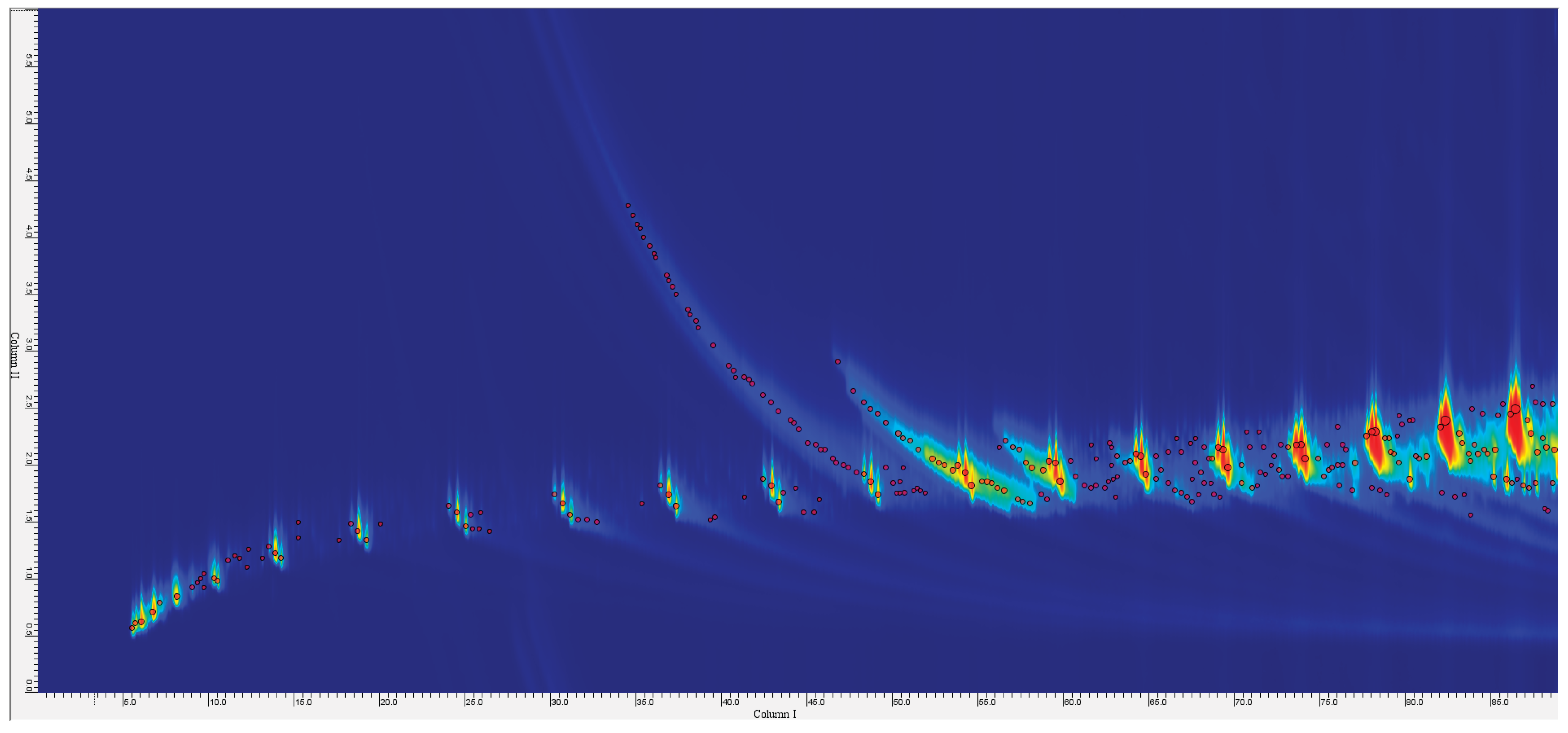
Figure 2.
Comprehensive two-dimensional GC×GC–TOF–MS chromatogram of Sample P2 (oxidized HDPE containing ≈ 6 wt% CaCO₃ filler) pyrolysis oil at 650 °C. (Axes and color scale are as in Figure 1.).
Figure 2.
Comprehensive two-dimensional GC×GC–TOF–MS chromatogram of Sample P2 (oxidized HDPE containing ≈ 6 wt% CaCO₃ filler) pyrolysis oil at 650 °C. (Axes and color scale are as in Figure 1.).
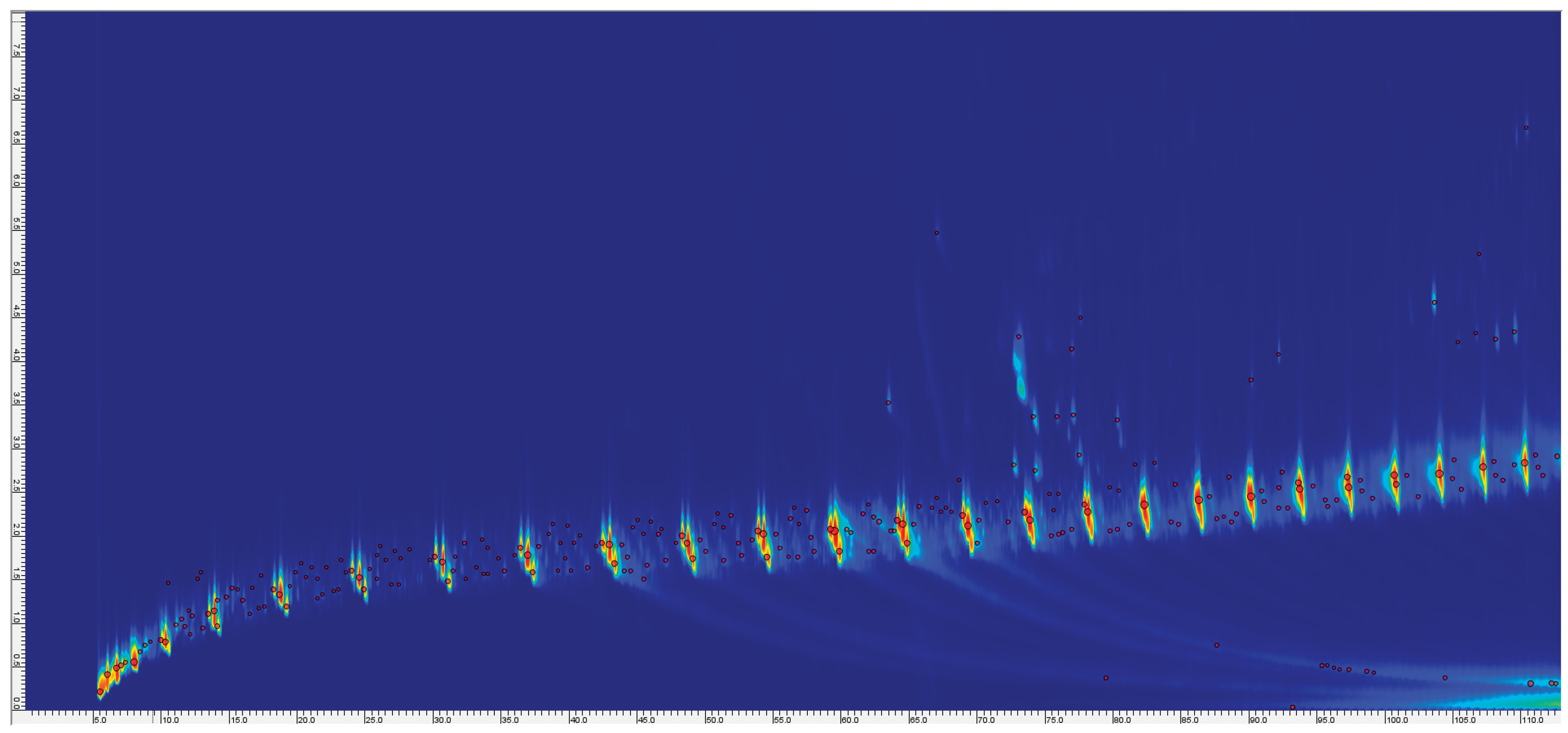
Figure 3.
Comprehensive two-dimensional GC×GC–TOF–MS chromatogram of Sample P3 (polypropylene) pyrolysis oil at 650 °C.
Figure 3.
Comprehensive two-dimensional GC×GC–TOF–MS chromatogram of Sample P3 (polypropylene) pyrolysis oil at 650 °C.
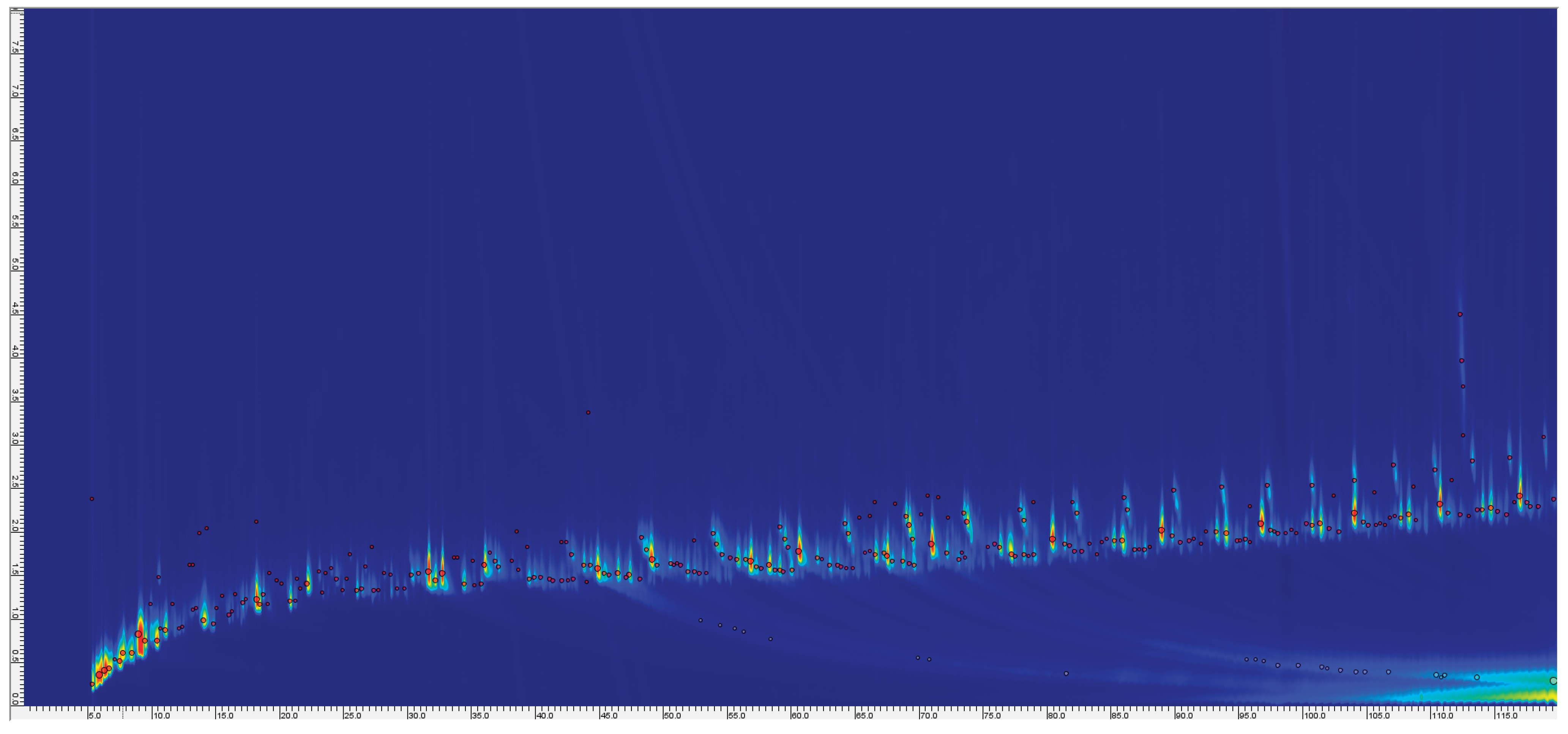
Figure 4.
Comprehensive two-dimensional GC×GC–TOF–MS chromatogram of Sample P4 (isotactic polypropylene) pyrolysis oil at 650 °C.
Figure 4.
Comprehensive two-dimensional GC×GC–TOF–MS chromatogram of Sample P4 (isotactic polypropylene) pyrolysis oil at 650 °C.
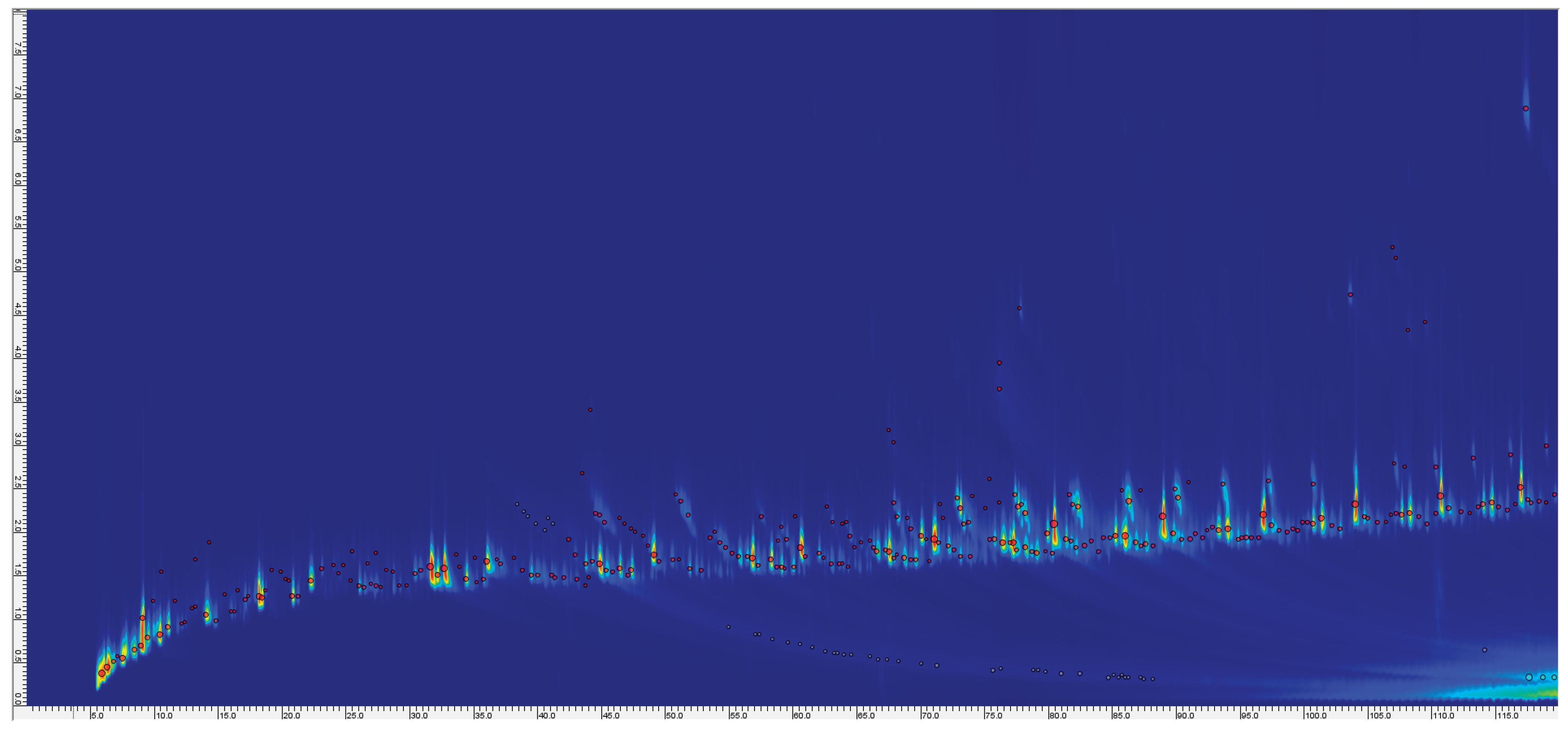
Figure 5.
Comprehensive two-dimensional GC×GC–TOF–MS chromatogram of Sample P5 (oxidized HDPE film with ≈ 10 wt% CaCO₃ filler) pyrolysis oil at 650 °C.
Figure 5.
Comprehensive two-dimensional GC×GC–TOF–MS chromatogram of Sample P5 (oxidized HDPE film with ≈ 10 wt% CaCO₃ filler) pyrolysis oil at 650 °C.
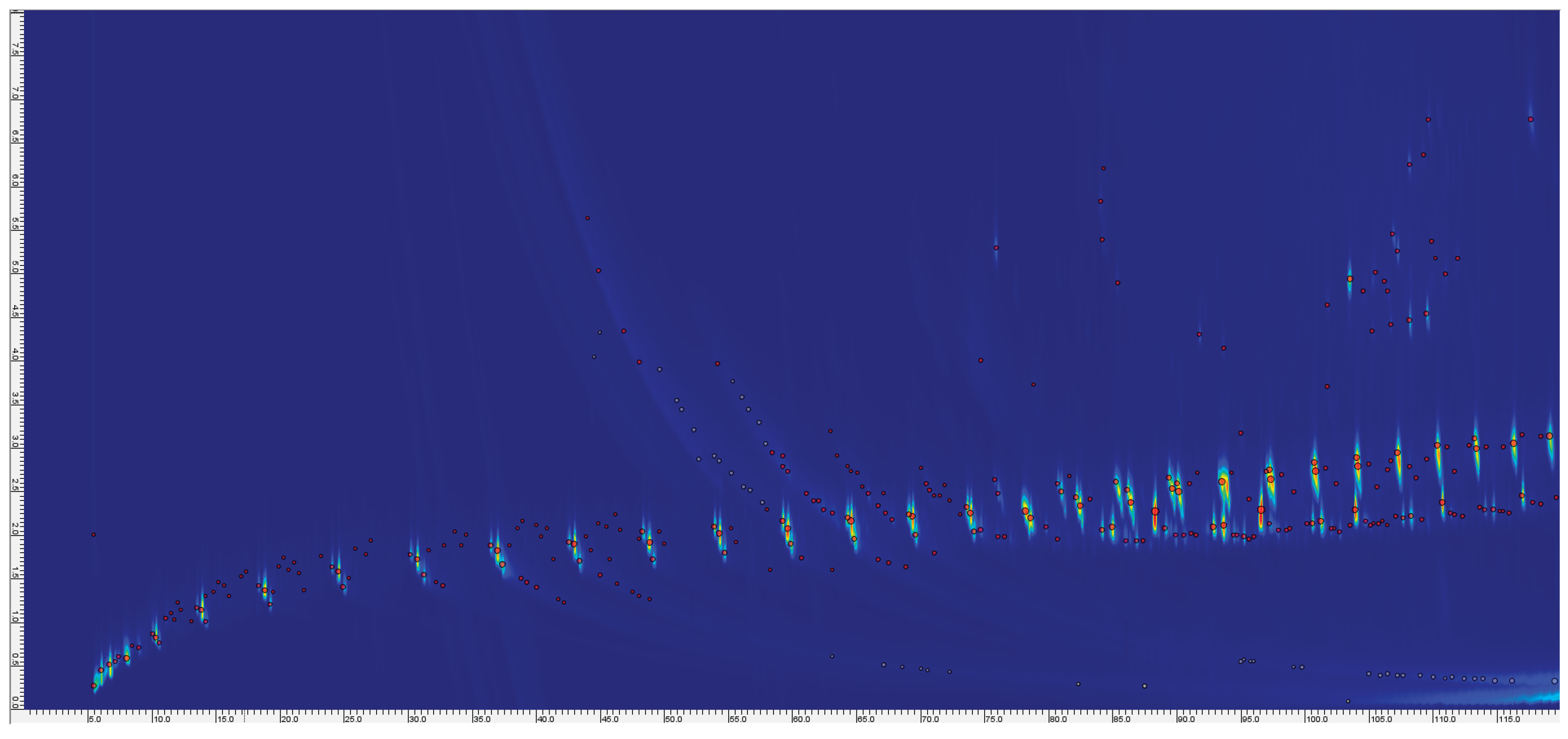
Figure 6.
Comprehensive two-dimensional GC×GC–TOF–MS chromatogram of Sample P6 (mixed polyolefin blend: LDPE + HDPE + PP) pyrolysis oil at 650 °C.
Figure 6.
Comprehensive two-dimensional GC×GC–TOF–MS chromatogram of Sample P6 (mixed polyolefin blend: LDPE + HDPE + PP) pyrolysis oil at 650 °C.
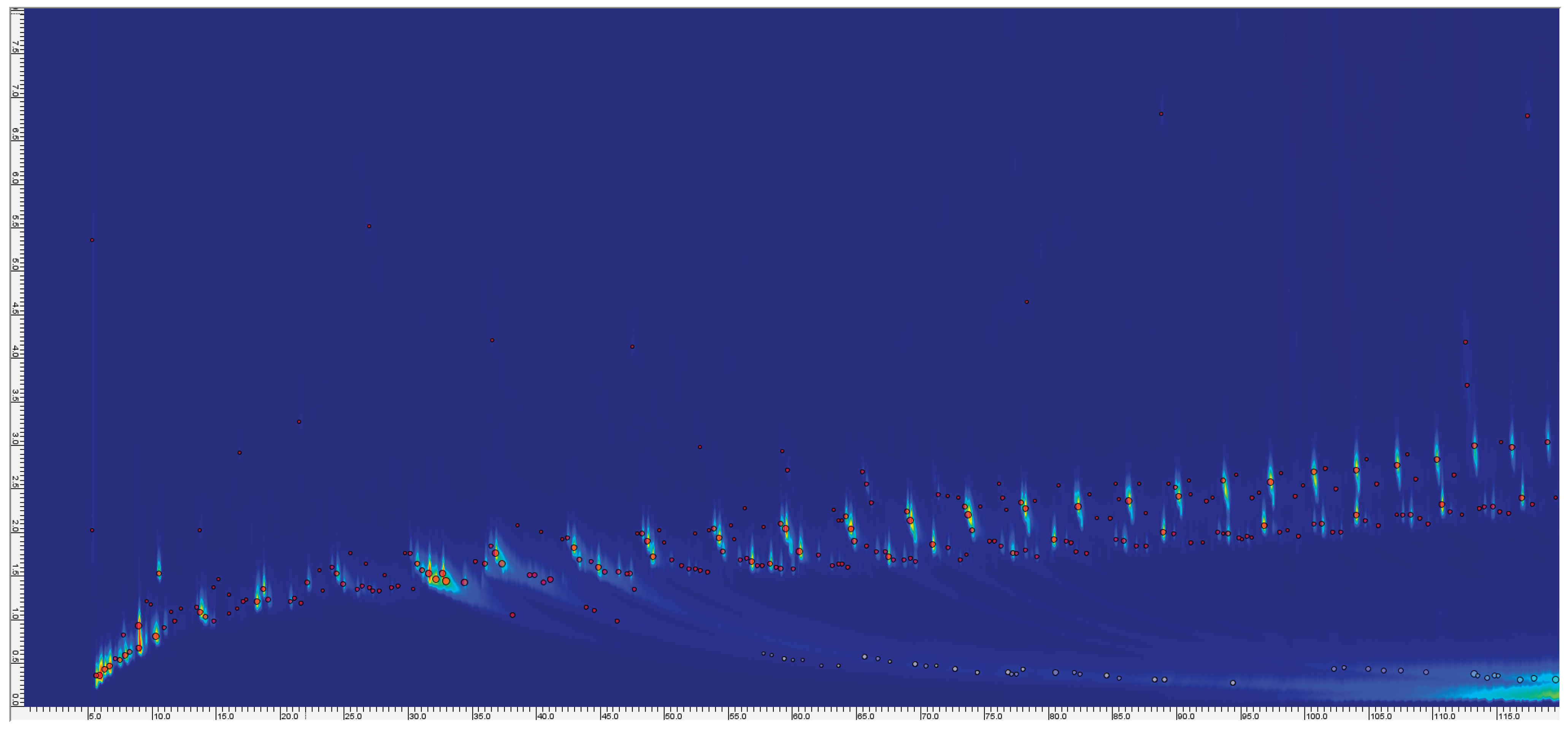
Figure 7.
Three-dimensional surface plot of the comprehensive GC×GC–TOF–MS chromatogram for Sample P6 pyrolysis oil at 650 °C. The x-axis corresponds to first-dimension retention time (non-polar column) and the y-axis to second-dimension retention time (polar column), while peak intensity is depicted by the surface height and color.
Figure 7.
Three-dimensional surface plot of the comprehensive GC×GC–TOF–MS chromatogram for Sample P6 pyrolysis oil at 650 °C. The x-axis corresponds to first-dimension retention time (non-polar column) and the y-axis to second-dimension retention time (polar column), while peak intensity is depicted by the surface height and color.
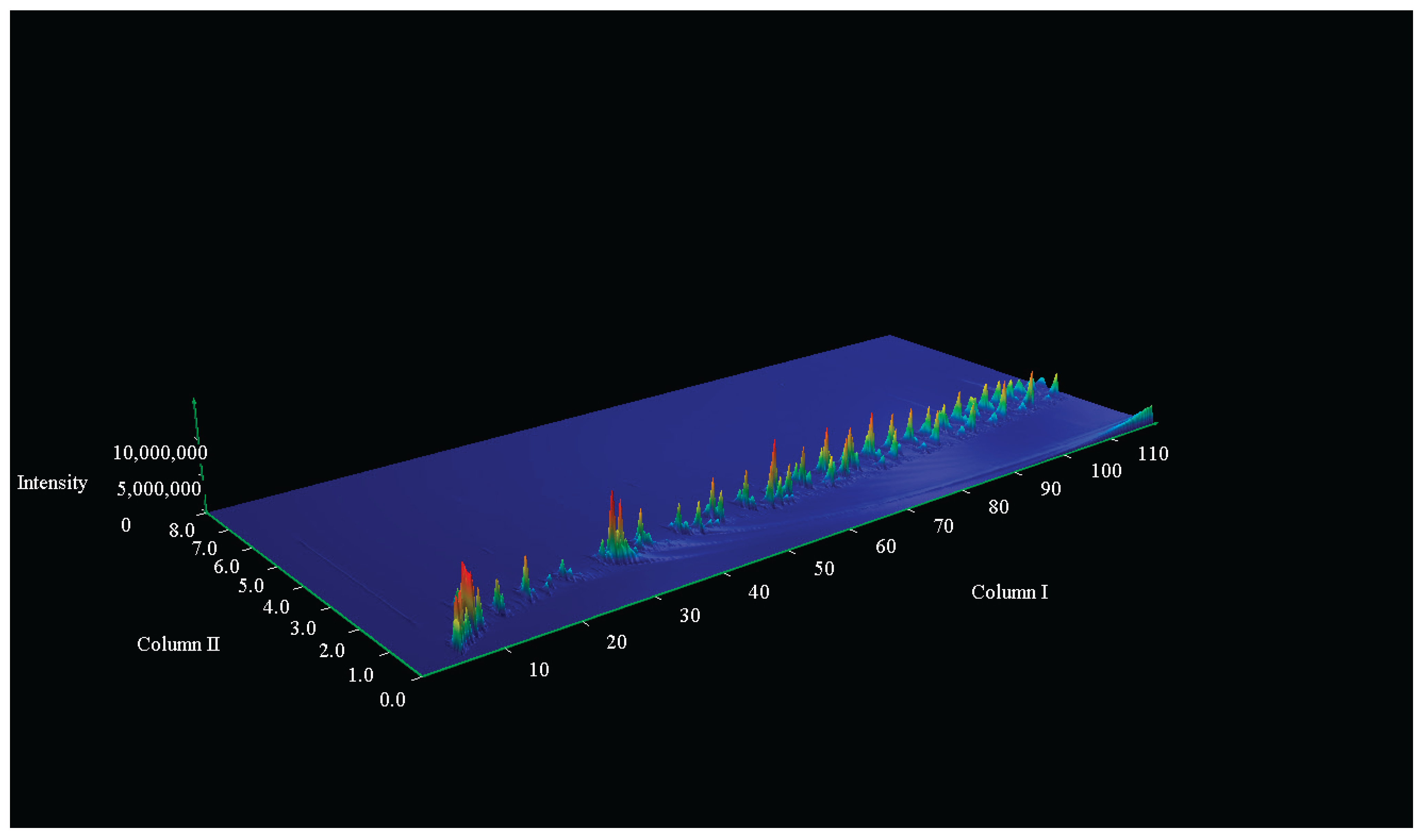
Figure 8.
Group-type composition of pyrolysis oils from samples P1–P6 in the present work (GC×GC–TOF–MS at 650 °C).
Figure 9.
Group-type composition of pyrolysis oils from different plastic waste fractions as reported by Kusenberg et al. (2022).
Figure 9.
Group-type composition of pyrolysis oils from different plastic waste fractions as reported by Kusenberg et al. (2022).
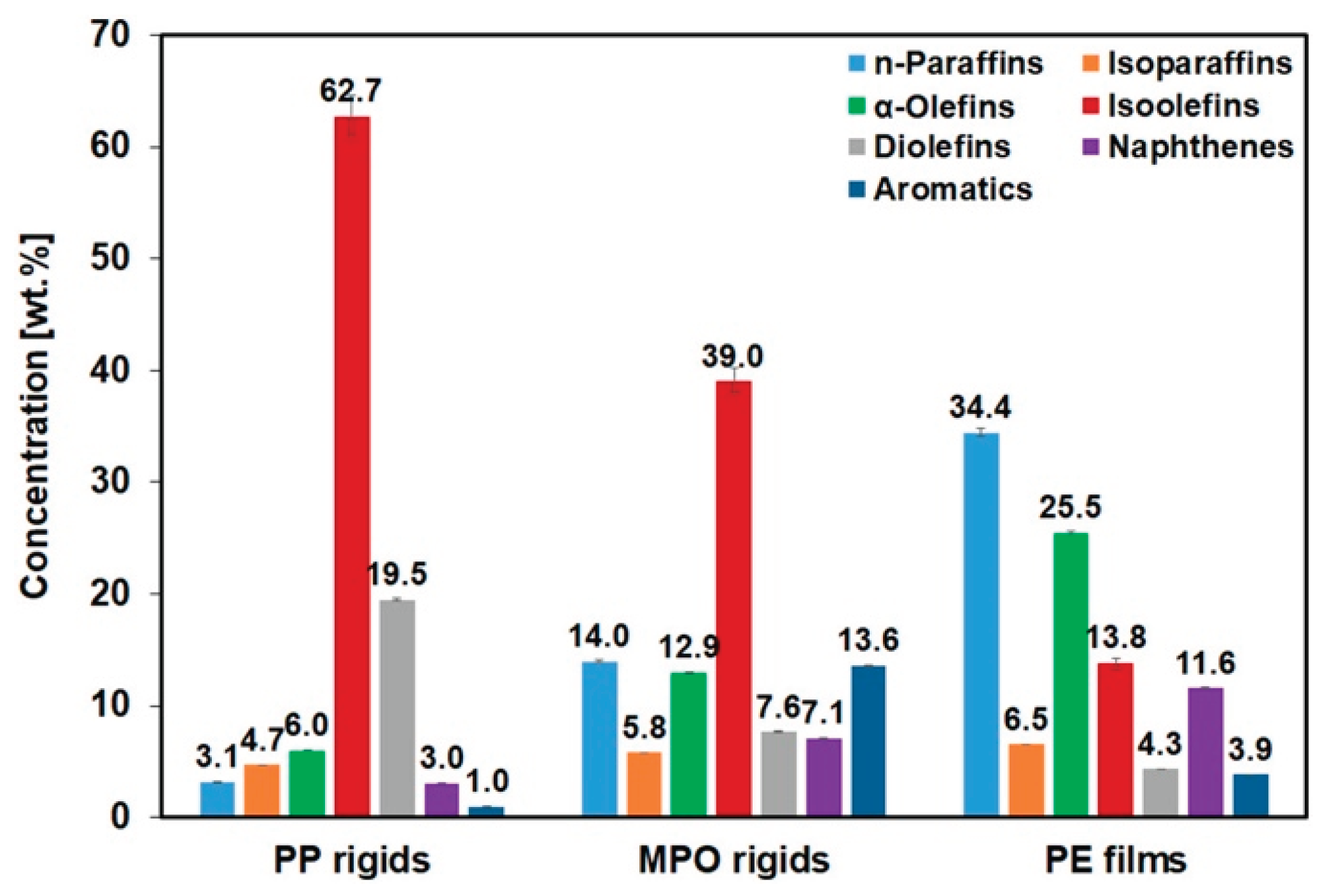

Table 1.
Mass balance before and after pyrolysis of plastic waste samples P1–P6 at 450 °C and 650 °C.
Table 1.
Mass balance before and after pyrolysis of plastic waste samples P1–P6 at 450 °C and 650 °C.
| Name | Mass (mg) Before pyrolysis | Mass (mg) After pyrolysis | Temperature (°C) |
|---|---|---|---|
| P1_450 | 5.517 | 5.544 | 450 |
| P2_450 | 4.582 | 4.611 | 450 |
| P3_450 | 4.27 | 4.36 | 450 |
| P4_450 | 4.029 | 4.027 | 450 |
| P5_450 | 3.992 | 4.032 | 450 |
| P6_450 | 4.464 | 4.495 | 450 |
| P1_650 | 2.611 | 1.452 | 650 |
| P2_650 | 2.085 | 0.274 | 650 |
| P3_650 | 2.577 | 0.477 | 650 |
| P4_650 | 2.409 | 0.395 | 650 |
| P5_650 | 2.083 | 0.596 | 650 |
| P6_650 | 2.121 | 0.389 | 650 |
Table 2.
Semi-volatile compounds (> C₇) identified by GC×GC-TOF-MS in the condensates obtained from each polymer stream (P1–P6) at 650 °C. Only molecules present at ≥ 2 % of the total chromatographic area in at least one sample are listed; blank cells indicate < 2 % or not detected.
Table 2.
Semi-volatile compounds (> C₇) identified by GC×GC-TOF-MS in the condensates obtained from each polymer stream (P1–P6) at 650 °C. Only molecules present at ≥ 2 % of the total chromatographic area in at least one sample are listed; blank cells indicate < 2 % or not detected.
| Compound | P1 | P2 | P3 | P4 | P5 | P6 | |
|---|---|---|---|---|---|---|---|
| Alcohols | |||||||
| 1-Decanol, 2-hexyl- | 35.63 | 13.22 | 2.5 | 4.56 | 17.14 | ||
| 1-Eicosanol | 5.61 | 2.1 | 13.42 | 7.92 | |||
| n-Nonadecanol-1 | 3.16 | 3.37 | |||||
| 2-Hexyl-1-octanol | 2.75 | 3.16 | 5.12 | ||||
| 2-Ethyl-1-dodecanol | 2.24 | ||||||
| 11-Dodecen-1-ol, 2,4,6-trimethyl-, | 11-Dodecen-1-ol, 2,4,6-trimethyl-, | 2.36 | 2.85 | ||||
| 11-Hexadecen-1-ol, (Z)- | 2.36 | ||||||
| 1-Octanol, 2-butyl- | 2.16 | 2.37 | |||||
| 2-Isopropyl-5-methyl-1-heptanol | 2-Isopropyl-5-methyl-1-heptanol | 6.08 | 7.9 | 3.76 | |||
| n-Heptadecanol-1 | 2.54 | ||||||
| Tricosan-2-ol | 12.12 | 13.97 | |||||
| Olefins | |||||||
| 1-Docosene | 9.04 | 5.45 | 4.76 | ||||
| 1,19-Eicosadiene | 4.27 | 9.31 | 9.44 | 2.99 | |||
| 1-Tetracosene | 2.95 | 3.13 | 2.19 | 11 | 2.23 | ||
| 1-Nonadecene | 2.85 | 3.77 | 8.77 | 2.47 | |||
| 1-Heptadecene | 4.21 | ||||||
| 1-Hexacosene | 8.77 | 3.25 | |||||
| 2,4-Dimethyl-1-heptene | 2.36 | ||||||
| Cetene | 2.89 | ||||||
| Nonacos-1-ene | 16.65 | 18.67 | 10.47 | ||||
| Pentacos-1-ene | 3.3 | ||||||
| Esters | |||||||
| Oxalic acid, allyl octadecyl ester | 2.4 | 11.92 | 3.11 | 9 | |||
| Carbonic acid, eicosyl vinyl ester | Carbonic acid, eicosyl vinyl ester | 9.15 | 9.03 | 8.1 | |||
| Oxalic acid, allyl hexadecyl ester | Oxalic acid, allyl hexadecyl ester | 4.95 | |||||
| Oxalic acid, allyl tridecyl ester | Oxalic acid, allyl tridecyl ester | 6.07 | |||||
| Alkenal | |||||||
| cis-4-Decenal | 2.89 | ||||||
| E-15-Heptadecenal | 3.34 | ||||||
| Cycloparaffins | |||||||
| Cyclotetradecane, 1,7,11-trimethyl-4-(1-methylethyl)- | Cyclotetradecane, 1,7,11-trimethyl-4-(1-methylethyl)- | Cyclotetradecane, 1,7,11-trimethyl-4-(1-methylethyl)- | 15.78 | 10.8 | |||
| Paraffins | |||||||
| Nonadecane | 3.05 | 2.78 | |||||
| Alkyne | |||||||
| 1-Octadecyne | 4.19 | 4.72 |
Table 3.
The hydrocarbon composition of the pyrolysis products measured using Py-GC × GC-MS.
| Category | Concentration (area %) | Concentration (area %) | Concentration (area %) | Concentration (area %) | Concentration (area %) | Concentration (area %) |
|---|---|---|---|---|---|---|
| Category | P1 | P2 | P3 | P4 | P5 | P6 |
| Alcohol | 53.52 | 23.92 | 20.59 | 22.12 | 17.75 | 32.09 |
| α-olefines | 25.5 | 46.34 | 26.49 | 25.8 | 35.82 | 34.08 |
| Diolefins | 4.57 | 8 | 1.11 | 1.31 | 4.53 | 2.54 |
| Iso-olefins | 1.51 | 1.83 | 5.75 | 3.73 | 3.03 | 6.07 |
| Naphthenes | 0.27 | 0.94 | 21.56 | 27.29 | 20.34 | 8.8 |
| n-paraffins | 1.8 | 8.67 | 2.64 | |||
| Iso-paraffins | 0.19 | 0.21 | ||||
| Ester | 5.59 | 4.79 | 14.47 | 10.7 | 4.28 | 10.27 |
| Alkyne | 4.31 | 1.34 | 2.9 | 1.81 | 0.72 | 0.64 |
| Oxirane | 2.73 | 1.08 | 0.68 | 1.8 | 5.61 | 0.99 |
| Aromatics | 0.06 | 0.11 | 0.09 | 0.45 | 0.85 | |
| Si | 2.45 | 0.11 | ||||
| Cyclic alcohols | 5.7 | 3.03 | 0.47 | 1 | ||
| Ether | 0.34 | 0.99 | 2.25 | 2.36 |
Table 4.
Head-space VOCs (≤ C₁₄) detected by HT-GC-MS in samples P7–P9 at 650 °C. Compounds are grouped by chemical family; peak-area intensity is coded 1 = low, 2 = medium, 3 = high. Designations: A = additive intentionally present in the original polymer, AD = additive-degradation product, PD = polymer-degradation product, C = external contaminant, deg = secondary degradation.
Table 4.
Head-space VOCs (≤ C₁₄) detected by HT-GC-MS in samples P7–P9 at 650 °C. Compounds are grouped by chemical family; peak-area intensity is coded 1 = low, 2 = medium, 3 = high. Designations: A = additive intentionally present in the original polymer, AD = additive-degradation product, PD = polymer-degradation product, C = external contaminant, deg = secondary degradation.
| Compound name | Peak intensity | Peak intensity | Peak intensity | Classification | Classification | Classification | Classification |
|---|---|---|---|---|---|---|---|
| Compound name | P7 | P8 | P9 | Type | Type | Possible origin | Odorants |
| Hydrocarbons | |||||||
| 10-Heneicosene (c,t) | 1 | PD | Polymer degradation | Polymer degradation | Polymer degradation | ||
| 1-Dodecene | 1 | PD | Polymer degradation | Polymer degradation | Polymer degradation | ||
| 1-Nonadecene | 2 | PD | Polymer degradation | Polymer degradation | Polymer degradation | ||
| 1-Tetradecene | 1 | 3 | PD | Polymer degradation | Polymer degradation | Polymer degradation | |
| 2,4-Dimethyl-1-heptene | 1 | 2 | 1 | C | Polymer degradation | Polymer degradation | Strong pungent plastic odor |
| 3-Dpdecene | 1 | PD | Polymer degradation | Polymer degradation | Polymer degradation | ||
| 3-Eicosene, (E)- | 1 | PD | Polymer degradation | Polymer degradation | Polymer degradation | ||
| Cetene | 1 | 3 | PD | Polymer degradation | Polymer degradation | Polymer degradation | |
| Decane | 1 | 1 | PD | Polymer degradation | Polymer degradation | Polymer degradation | |
| Decane, 4-methyl- | 1 | PD | Polymer degradation | Polymer degradation | Polymer degradation | ||
| Dodecane | 1 | 3 | PD | Polymer degradation | Polymer degradation | Polymer degradation | |
| Dodecane, 2,7,10-trimethyl- | Dodecane, 2,7,10-trimethyl- | 3 | PD | Polymer degradation | Polymer degradation | Polymer degradation | |
| Eicosane, 2-methyl- | 1 | PD | Polymer degradation | Polymer degradation | Polymer degradation | ||
| Heptacosane | 1 | PD | Polymer degradation | Polymer degradation | Polymer degradation | ||
| Heptadecane, 2,6,10,15-tetramethyl- | Heptadecane, 2,6,10,15-tetramethyl- | 1 | AD | Lubricant | Lubricant | ||
| Heptadecane, 4-methyl- | Heptadecane, 4-methyl- | 1 | PD | Polymer degradation | Polymer degradation | Polymer degradation | |
| Heptane, 2,3-dimethyl- | Heptane, 2,3-dimethyl- | 1 | C | Processing aid | Processing aid | ||
| Heptane, 2,4-dimethyl- | Heptane, 2,4-dimethyl- | 3 | C | Processing aid | Processing aid | ||
| Heptane, 4-methyl- | 1 | PD | Polymer degradation | Polymer degradation | Polymer degradation | ||
| Hexadecane | 1 | 1 | PD | Polymer degradation | Polymer degradation | Polymer degradation | |
| Hexadecane, 2,6,11,15-tetramethyl- | Hexadecane, 2,6,11,15-tetramethyl- | 1 | AD | Lubricant | Lubricant | ||
| Hexane, 2,3,5-trimethyl- | Hexane, 2,3,5-trimethyl- | 1 | C | Processing aid | Processing aid | ||
| Nonadecane | 2 | 1 | PD | Polymer degradation | Polymer degradation | Polymer degradation | |
| Octadecane, 2-methyl- | 1 | 1 | 1 | PD | Processing aid | Processing aid | |
| Octane | 1 | PD | Polymer degradation | Polymer degradation | Polymer degradation | ||
| Octane, 4-methyl- | 2 | PD | Polymer degradation | Polymer degradation | Polymer degradation | ||
| Tetradecane | 2 | 1 | 2 | PD | Polymer degradation | Polymer degradation | Polymer degradation |
| Tridecane | 1 | PD | Polymer degradation | Polymer degradation | Polymer degradation | ||
| Undecane | 1 | 3 | PD | Polymer degradation | Polymer degradation | Polymer degradation | |
| Undecane, 4-methyl- | 1 | PD | Polymer degradation | Polymer degradation | Polymer degradation | ||
| α-Methylstyrene | 3 | 2 | 2 | PD | Polymer degradation | Polymer degradation | Polymer degradation |
| Tetradecane, 4-methyl- | Tetradecane, 4-methyl- | 1 | PD | Polymer degradation | Polymer degradation | Polymer degradation | |
| Alcohols | |||||||
| 1-Decanol, 2-hexyl- | 1 | C | Daily chemical products related |
Daily chemical products related |
Daily chemical products related |
||
| 1-Butanol | 1 | C | Cosmetics | Cosmetics | |||
| 1-Octanol, 2,7-dimethyl- | 1-Octanol, 2,7-dimethyl- | 2 | C | Cosmetics / Industrial Solvent | Cosmetics / Industrial Solvent | Camphor-like odor | |
| 1-Octanol, 2-butyl- | 1 | C | Daily chemical products related |
Daily chemical products related |
Daily chemical products related |
||
| 2,2-dimethylphenylmethanol | 1 | 1 | C | Daily chemical products related |
Daily chemical products related |
Daily chemical products related |
|
| 2-Hexyl-1-octanol | 1 | C | Flavor and fragrance agent |
Flavor and fragrance agent |
Flavor and fragrance agent |
||
| 2-Undecanethiol, 2-methyl- | 2-Undecanethiol, 2-methyl- | 1 | C | Daily chemical products related | Daily chemical products related | Pungent and garlic-like odor | |
| Cyclobutanol | 1 | 1 | 1 | C | Daily chemical products related |
Daily chemical products related |
Daily chemical products related |
| Aldehydes and Ketones | Aldehydes and Ketones | ||||||
| 2-Pentenal, 2-methyl- | 1 | C | Flavor and fragrance agent |
Flavor and fragrance agent |
Flavor and fragrance agent |
||
| Decanal | 1 | PD or C | Cosmetics | Cosmetics | |||
| Heptanal | 1 | PD or C | Flavor and fragrance agent |
Flavor and fragrance agent |
Flavor and fragrance agent |
||
| Hexanal | 1 | PD or C | Flavor and fragrance agent |
Flavor and fragrance agent |
Flavor and fragrance agent |
||
| Nonanal | 1 | PD or C | Cosmetics | Cosmetics | |||
| Octanal | 1 | PD or C | Cosmetics | Cosmetics | |||
| Pentanal | 1 | 1 | PD or C | Flavor and fragrance agent |
Flavor and fragrance agent |
Flavor and fragrance agent |
|
| 2-Heptanone, 4,6-dimethyl- | 2-Heptanone, 4,6-dimethyl- | 1 | C | Daily chemical products related |
Daily chemical products related |
Daily chemical products related |
|
| 2-Heptanone, 4-methyl- | 2-Heptanone, 4-methyl- | 1 | C | Flavor and fragrance agent |
Flavor and fragrance agent |
Flavor and fragrance agent |
|
| Acetophenone | 1 | 1 | 1 | C | Daily chemical products related |
Daily chemical products related |
Daily chemical products related |
| Cyclopentanone, 2-(1-methylpropyl)- | Cyclopentanone, 2-(1-methylpropyl)- | 1 | C | Daily chemical products related |
Daily chemical products related |
Daily chemical products related |
|
| Others | |||||||
| 1-Propanol, 2-amino-, (±)- | 1 | C | Industrial solvent/Adhesive | Industrial solvent/Adhesive | Industrial solvent/Adhesive | ||
| 2,3-Epoxybutane | 1 | 1 | C | Pharmaceutical related | Pharmaceutical related | Pharmaceutical related | |
| 2,6-Di-tert-butylbenzoquinone | 2,6-Di-tert-butylbenzoquinone | 1 | AD | Oxidation phosphite additives |
Oxidation phosphite additives |
Oxidation phosphite additives |
|
| 2,6-di-tert-butyl-4-ethylphenol | 1 | AD | Anotioxidate | Anotioxidate | |||
| 2-Aminononadecane | 1 | 1 | 1 | C | Lubricant additive | Lubricant additive | Mild amine odor. |
| 2-Bromo dodecane | 1 | AD | Plasticizer intermediate | Plasticizer intermediate | Plasticizer intermediate | ||
| 2-Butanamine, 3-methyl- | 2-Butanamine, 3-methyl- | 1 | C | Pharmaceutical related | Pharmaceutical related | Strong fishy odor | |
| 2-Ethylacrolein | 1 | C | Processing aid | Processing aid | Pungent and acrid odor | ||
| 2-Octanamine | 1 | C | Daily chemical products related |
Daily chemical products related |
Daily chemical products related |
||
| 2-Pentanamine, 4-methyl- | 1 | 1 | C | Daily chemical products related |
Daily chemical products related |
Daily chemical products related |
|
| 3-(Prop-2-enoyloxy)dodecane | 1 | C | Flavor and fragrance agent |
Flavor and fragrance agent |
Flavor and fragrance agent |
||
| 3,3-Dimethyl-4-methylamino-butan-2-one | 1 | 1 | C | Daily chemical products related |
Daily chemical products related |
Daily chemical products related |
|
| 3,5-di-tert-Butyl-4-hydroxybenzaldehyde | 1 | AD | Irganox 1076 oligomer | Irganox 1076 oligomer | Irganox 1076 oligomer | ||
| Benzene, (1-methoxy-1-methylethyl)- | 1 | C | Daily chemical products related |
Daily chemical products related |
Daily chemical products related |
||
| Benzene, 1,3-bis(1,1-dimethylethyl)- | 1 | 1 | 1 | C | Processing aid | Processing aid | |
| Benzene, 1,3-bis(1-methylethenyl)- | 1 | C | Processing aid | Processing aid | |||
| Benzene, 1-ethynyl-4-methyl- | Benzene, 1-ethynyl-4-methyl- | 1 | C | Processing aid | Processing aid | ||
| Butanal, 3-hydroxy- | 1 | C | Daily chemical products related |
Daily chemical products related |
Daily chemical products related |
||
| Caprolactam | 2 | PD | Processing aid | Processing aid | |||
| Cis-bicyclo[4.2.0]octane | Cis-bicyclo[4.2.0]octane | 1 | 1 | C | Processing aid | Processing aid | |
| Cyclotrisiloxane, hexamethyl- | 1 | 1 | C | Cosmetics/Lubricant | Cosmetics/Lubricant | Cosmetics/Lubricant | |
| Ethanone, 1-(2,3-dihydro-1H-inden-5-yl)- | 1 | C | Daily chemical products related | Daily chemical products related | Pungent odor | ||
| Ethyne, fluoro- | 1 | C | Processing aid | Processing aid | |||
| Furan, 2,5-dihydro-2,5-dimethyl- | Furan, 2,5-dihydro-2,5-dimethyl- | 1 | C | Processing aid | Processing aid | ||
| Hexacosyl acetate | 1 | C | Flavor and fragrance agent |
Flavor and fragrance agent |
Flavor and fragrance agent |
||
| Hydroxylamine, O-decyl | Hydroxylamine, O-decyl | 1 | 1 | C | Processing aid | Processing aid | Ammonia-like odor |
| N-dl-Alanylglycine | 1 | C | Pharmaceutical/Food related |
Pharmaceutical/Food related |
Pharmaceutical/Food related |
||
| n-Hexylmethylamine | 1 | 1 | C | Processing aid | Processing aid | ||
| Pentanamide | C | Pharmaceutical related | Pharmaceutical related | Pharmaceutical related | |||
| Phenol, 2-(3-hydroxy-3-methyl-1-butenyl)-, (Z)- | 1 | C | Daily chemical products related |
Daily chemical products related |
Daily chemical products related |
||
| Phenol, 2,4-bis(1,1-dimethylethyl)- | 1 | 1 | AD | Antioxidant | Antioxidant | ||
| Propanamide | C | Pharmaceutical related | Pharmaceutical related | Pharmaceutical related | |||
| R-(-)-Cyclohexylethylamine | 1 | 1 | 1 | C | Processing aid | Processing aid | Strong ammonia-like odor |
| sec-Butylamine | 1 | C | Processing aid | Processing aid |
Table 5.
Semi-volatile organic compounds (SVOCs) extracted with hexane and identified by GC–MS in samples P7–P9 (650 °C condensates). Compounds are grouped by chemical family; only those contributing ≥ 1 % of the SVOC total-ion area in at least one sample are listed. Peak-area intensity: 1 = low, 2 = medium, 3 = high. Source codes: A = intentional additive, AD = additive-degradation product, PD = polymer-degradation product, C = external contaminant, deg = secondary degradation.
Table 5.
Semi-volatile organic compounds (SVOCs) extracted with hexane and identified by GC–MS in samples P7–P9 (650 °C condensates). Compounds are grouped by chemical family; only those contributing ≥ 1 % of the SVOC total-ion area in at least one sample are listed. Peak-area intensity: 1 = low, 2 = medium, 3 = high. Source codes: A = intentional additive, AD = additive-degradation product, PD = polymer-degradation product, C = external contaminant, deg = secondary degradation.
| Compound name | Peak intensity | Peak intensity | Peak intensity | Classification | Classification |
|---|---|---|---|---|---|
| Compound name | P7 | P8 | P9 | Type | Possible origin |
| Hydrocarbons | |||||
| Cetene | 1 | 2 | PD | ||
| Decane, 4-methyl- | 1 | PD | |||
| Dodecane | 2 | PD | |||
| Dodecane, 2,6,10-trimethyl- | 1 | C | Cosmetic related | ||
| Dodecane, 2,6,11-trimethyl- | 2 | C | Cosmetic related | ||
| Eicosane | 2 | PD | |||
| Heptacosane | 3 | 2 | PD | ||
| Heptadecane, 2,6,10,15-tertamethyl- | 1 | C | Processing aid | ||
| Hexadecane | 1 | 1 | PD | ||
| Hexadecane, 2,6,10,14-tetramethyl- | 1 | C | Processing aid | ||
| Octadecane | 1 | 1 | PD | ||
| Octadecane, 3-ethyl-5-(2-ethylbutyl)- | 1 | C | Processing aid | ||
| Octadecane, 6-methyl- | 1 | 1 | PD | ||
| Octane, 4-methyl- | 1 | PD | |||
| Pentadecane | 2 | PD | |||
| Pentadecane, 3-methyl- | 1 | PD | |||
| Tetradecane | 1 | 1 | PD | ||
| Tetradecane, 2,6,10-trimethyl- | 1 | 2 | C | Cosmetic or pharmaceutical related | |
| Undecane | 2 | PD | |||
| Undecane, 4-methyl- | 2 | PD | |||
| 1-Nonadecene | 2 | 3 | PD | ||
| 1-Octadecene | 3 | PD | |||
| 1-Pentadecene,2-methyl- | 1 | PD | |||
| 17-Pentatriacontene | 1 | 2 | 1 | AD | Lubricant |
| Esters | |||||
| 1-Propene-1,2,3-tricarboxylic acid, tributyl ester | 3 | 2 | 1 | AD | Plasticizer |
| 9-Octadecenoic acid (Z)-, tetradecyl ester | 1 | C | - | ||
| Decanedioic acid, bis(2,2,6,6- tetramethyl-4-piperidinyl) ester |
Decanedioic acid, bis(2,2,6,6- tetramethyl-4-piperidinyl) ester |
Decanedioic acid, bis(2,2,6,6- tetramethyl-4-piperidinyl) ester |
2 | C | Pharmaceutical related |
| Hexadecanoic acid, 1-(hydroxymethyl) -1,2-ethanediyl ester |
Hexadecanoic acid, 1-(hydroxymethyl) -1,2-ethanediyl ester |
1 | C | Cosmetic related or lubricant | |
| Hexadecanoic acid, butyl ester | 1 | 1 | C | Daily chemical products related | |
| Isopropyl myristate | 1 | C | Cosmetic related | ||
| Octadecanoic acid, 2-hydroxy-1,3-propanediyl ester | 3 | 1 | C | Cosmetic related | |
| Octadecanoic acid, 4-hydroxy-, methyl ester | 1 | C | Daily chemical products related | ||
| Octadecanoic acid, butyl ester | 2 | 2 | C | Daily chemical products related | |
| Oleic acid, 3-(octadecyloxy)propyl ester | 2 | 1 | C | Cosmetic related | |
| Oleic acid, eicosyl ester | 1 | 1 | C | Cosmetic related | |
| Oxalic acid, ethyl 2-isopropylphenyl ester | 2 | AD | Plasticizer | ||
| Trichloroacetic acid, pentadecyl ester | 1 | A | Plasticizer | ||
| Alcohols | |||||
| 1,4:3,6-Dianhydro-α-d-glucopyranose | 1 | C | Food related | ||
| 1-Dodecanol, 3,7,11-trimethyl- | 1 | C | Daily chemical products related | ||
| 1-Eicosanol | 2 | C | Daily chemical products related | ||
| 1-Hexadecanol, 2-methyl- | 1 | 2 | 1 | C | Daily chemical products related |
| 1-Octanol, 2,2-dimethyl- | 1 | AD | Plasticizer | ||
| 2,2,6,6-Tetramethyl-4-piperidinol | 1 | C | Pharmaceutical related | ||
| 2-Hexadecanol | 1 | AD | Lubricant | ||
| 2-Methyl-E,E-3,13-Octadecadien-1-ol | 1 | C | Pharmaceutical related | ||
| 3-Hexadecanol | 1 | C | Cosmetic related or surfactant | ||
| 3-Isopropyl-6,7-dimethyltricyclo[4.4.0.0(2,8)] decane-9,10-diol |
3-Isopropyl-6,7-dimethyltricyclo[4.4.0.0(2,8)] decane-9,10-diol |
1 | AD | Plasticizer or flame retardant. | |
| Behenic alcohol | 2 | 1 | C | Cosmetic related or lubricant | |
| Ethanol, 2-(octadecyloxy)- | 1 | 2 | C | Cosmetic related or lubricant | |
| Ethyl iso-allocholate | 1 | 1 | 1 | C | Pharmaceutical related |
| n-Tetracosanol-1 | 2 | 2 | C | Pharmaceutical related | |
| Octacosanol | 1 | 2 | C | Pharmaceutical related | |
| tert-Hexadecanethiol | 1 | 1 | C | Processing aid | |
| α-N-Normethadol | 1 | C | Pharmaceutical related | ||
| Benzene derivatives | |||||
| 1,3-Benzenedicarboxylic acid, bis(2-ethylhexyl) ester | 1 | A | Plasticizer | ||
| 1,3-Diacetylbenzene | 1 | C | Pharmaceutical related | ||
| 1,4-Benzenediol, 2,6-bis(1,1-dimethylethyl)- | 1 | A | Antioxidant | ||
| 3,5-di-tert-Butyl-4-hydroxyacetophenone | 1 | 1 | A | Antioxidant and stabilizer | |
| 4[h]-Pyridone, 1-benzyl-3,5-dichloro-2,6-dimethyl- | 1 | C | Pesticide | ||
| Benzene, 1,1'-(1,1,2,2-tetramethyl-1,2-ethanediyl)bis- | 2 | C | Processing aid | ||
| Benzene, 1,3-bis(1,1-dimethylethyl)- | 1 | AD | Antioxidant | ||
| Benzeneethanol, α-methyl-3-(1-methylethyl)- | 1 | C | Daily chemical products related | ||
| Benzenepropanoic acid, 3,5-bis(1,1-dimethyl ethyl)-4-hydroxy-, octadecyl ester |
Benzenepropanoic acid, 3,5-bis(1,1-dimethyl ethyl)-4-hydroxy-, octadecyl ester |
3 | C | Pharmaceutical related | |
| Benzenmethanol, a,a-dimethyl- | 1 | C | Processing aid | ||
| Benzestrol | 1 | C | Pharmaceutical related | ||
| Diisooctyl phthalate | 1 | 2 | A | Plasticizer | |
| Phenol, 2,4-bis(1,1-dimethylethyl)- | 1 | 2 | 1 | AD | Antioxidant |
| Phenol, 2,6-bis(1,1-dimethylethyl)-4-ethyl- | 1 | AD | Antioxidant | ||
| Phenol, 2,6-di-tert-butyl-4-ethyl- | 1 | AD | Antioxidant | ||
| Phenol, 2-methyl-4-(1,1,3,3-tetramethylbutyl)- | 2 | AD | Antioxidant | ||
| Phenol, 4-(1,1,3,3-tetramethylbutyl)- | 1 | AD | Antioxidant or stabilizer | ||
| Phenol, 4-(1,1-dimethylpropyl)- | 1 | C | Pharmaceutical related | ||
| Phthalic acid, butyl tetradecyl ester | 1 | A | Plasticizer | ||
| p-Octylacetophenone | 1 | C | Cosmetic related | ||
| γ-Chlorobutyrophenone | 1 | C | Surfactant | ||
| Acids, Aldehydes, Amides, Ketones | |||||
| Octadecanoic acid | 2 | C | Daily chemical products related | ||
| cis-13-Eicosenoic acid | 1 | C | Food related | ||
| n-Hexadecanoic acid | 1 | 1 | C | Daily chemical products related | |
| Pterin-6-carboxylic acid | 1 | C | Pharmaceutical related | ||
| 10-Octadecenal | 1 | C | Daily chemical products related | ||
| 5-Octadecenal | 1 | 1 | C | Daily chemical products related | |
| 8-Octadecenal | 1 | C | Daily chemical products related | ||
| E-15-Heptadecenal | 3 | C | Food related | ||
| 13-Docosenamide, (Z)- | 1 | 3 | C | Daily chemical products related | |
| Cis-11-Eicosenamide | 1 | C | Lubricant | ||
| 2,2,7,7Tetramethyltricyclo[6.2.1.0(1,6)] undec-4-en-3-one |
2,2,7,7Tetramethyltricyclo[6.2.1.0(1,6)] undec-4-en-3-one |
1 | C | Pharmaceutical related | |
| 2-Pentanone, 4-hydroxy-4-methyl- | 2 | C | - | ||
| 7,9-Di-tert-butyl-1-oxaspiro(4,5)deca-6,9-diene-2,8-dione | 1 | 2 | 1 | C | Processing aid |
| Others | |||||
| 2-Bromo dodecane | 1 | AD | Plasticizer | ||
| 2-Trifluoroacetoxytridecane | 1 | A | Plasticizer | ||
| Caprolactam | 3 | 1 | PD | Processing aid | |
| Octadecanal, 2-bromo- | 1 | 1 | 1 | AD | Plasticizer or lubricant |
| Octasiloxane, 1,1,3,3,5,5,7,7,9,9,11, 11,13,13,15,15-hexadecamethyl- |
Octasiloxane, 1,1,3,3,5,5,7,7,9,9,11, 11,13,13,15,15-hexadecamethyl- |
1 | A | Lubricant | |
| Octatriacontyl pentafluoropropionate | 1 | 1 | C | Surfactant or lubricant, toxic | |
| Silane, diethylheptyloxyoctadecyloxy- | 1 | 3 | 2 | Processing aid | |
| Triallyl isocyanurate | 1 | AD | Flame retardant or plasticizer | ||
| Tributyl acetylcitrate | 1 | 3 | A | Plasticizer |
Table 6.
Organic migrants detected in aqueous food simulant (10 d / 40 °C) from samples P7–P9. Only compounds with a GC–MS peak intensity ≥ 1 are listed (1 = trace, 2 = moderate, 3 = dominant).
Table 6.
Organic migrants detected in aqueous food simulant (10 d / 40 °C) from samples P7–P9. Only compounds with a GC–MS peak intensity ≥ 1 are listed (1 = trace, 2 = moderate, 3 = dominant).
| Compound Name | Peak Intensity | Peak Intensity | Peak Intensity | Possible origin |
|---|---|---|---|---|
| Compound Name | P7 | P8 | P9 | Possible origin |
| Benzene derivatives | ||||
| 1,2-Dimethoxy-4-(1-methoxy-1-propenyl)benzene | 1,2-Dimethoxy-4-(1-methoxy-1-propenyl)benzene | 1,2-Dimethoxy-4-(1-methoxy-1-propenyl)benzene | 1 | Pharmaceutical related |
| 2,4-Dimethyl-5,6-dimethoxy-8-aminoquinoline | 1 | Pharmaceutical related | ||
| 3,5-di-tert-Butyl-4-hydroxycinnamic acid | 3,5-di-tert-Butyl-4-hydroxycinnamic acid | 2 | Antioxidant and stabilizer | |
| Benzenesulfonamide, N-ethyl-2-methyl- | Benzenesulfonamide, N-ethyl-2-methyl- | 1 | Sweetener in food industry | |
| Benzyl alcohol, α,α-dimethyl-p-isopropyl- | 2 | Cosmetic or Pharmaceutical related | ||
| Ethanone, 1,1'-(1,4-phenylene)bis- | 1 | Plasticizer or UV absorber | ||
| Phenol, 2,6-bis(1,1-dimethylethyl)- | Phenol, 2,6-bis(1,1-dimethylethyl)- | 1 | 1 | Antioxidant |
| p-Octylacetophenone | 2 | 2 | Food industry | |
| Acids, Alcohols, Esters, Ketones | Acids, Alcohols, Esters, Ketones | |||
| Dimethylmuconic acid | 1 | Pharmaceutical related | ||
| 1-(3-Methoxymethyl-2,4,6-trimethylphenyl)ethanol | 1 | |||
| 1,4:3,6-Dianhydro-α-d-glucopyranose | 1,4:3,6-Dianhydro-α-d-glucopyranose | 2 | Food related | |
| Dibutyl itaconate | 1 | Plasticizer | ||
| Furan, 2-[(2-ethoxy-3,4-dimethyl-2-cyclohexen-1-ylidene)methyl]- | 1 | Cosmetic or food related | ||
| 2,5-Cyclohexadiene-1,4-dione, 2,6-bis (1,1-dimethylethyl)- |
2,5-Cyclohexadiene-1,4-dione, 2,6-bis (1,1-dimethylethyl)- |
1 | 1 | Pharmaceutical related |
| 2,5-di-tert-Butyl-1,4-benzoquinone | 2,5-di-tert-Butyl-1,4-benzoquinone | 1 | 1 | Stabilizer |
| 7,9-Di-tert-butyl-1-oxaspiro(4,5)deca-6,9- diene-2,8-dione |
7,9-Di-tert-butyl-1-oxaspiro(4,5)deca-6,9- diene-2,8-dione |
3 | 3 | Processing aid hazardous |
| Others | ||||
| 4-Piperidinol, 2,2,6,6-tetramethyl- | 1 | 3 | Processing aid | |
| Caprolactam | 3 | 2 | 2 | Processing aid |
| Cyclobarbital | 1 | Pharmaceutical related | ||
| Hexasiloxane, 1,1,3,3,5,5,7,7,9,9,11,11-dodecamethyl- | 1 | 1 | 1 | Plasticizer |
| l-Guanidinosuccinimide | 1 | Pharmaceutical related | ||
| Morpholinomethyl urea i | 1 | Corrosion inhibitor or flame retardant. | ||
| Octasiloxane, 1,1,3,3,5,5,7,7,9,9,11,11,13,13,15,15-hexadecamethyl- | 1 | 1 | 1 | Plasticizer or lubricant |
| Pregn-5-ene-3,11,20-trione, cyclic 3,20-bis (1,2-ethanediyl acetal) |
Pregn-5-ene-3,11,20-trione, cyclic 3,20-bis (1,2-ethanediyl acetal) |
Pregn-5-ene-3,11,20-trione, cyclic 3,20-bis (1,2-ethanediyl acetal) |
1 | Pharmaceutical related |
Disclaimer/Publisher’s Note: The statements, opinions and data contained in all publications are solely those of the individual author(s) and contributor(s) and not of MDPI and/or the editor(s). MDPI and/or the editor(s) disclaim responsibility for any injury to people or property resulting from any ideas, methods, instructions or products referred to in the content. |
© 2026 by the authors. Licensee MDPI, Basel, Switzerland. This article is an open access article distributed under the terms and conditions of the Creative Commons Attribution (CC BY) license (http://creativecommons.org/licenses/by/4.0/).
Copyright: This open access article is published under a Creative Commons CC BY 4.0 license, which permit the free download, distribution, and reuse, provided that the author and preprint are cited in any reuse.


