

Submitted:
11 April 2026
Posted:
13 April 2026
You are already at the latest version
Abstract
The long‑term evolution of the Earth–Moon system is traditionally attributed to tidal friction, which transfers angular momentum from Earth’s rotation to the Moon’s orbit. Present‑day measurements show that Earth’s rotational angular‑momentum loss closely matches the Moon’s orbital gain, consistent with this framework. However, deep‑time constraints from fossil growth increments and tidal rhythmites reveal a persistent and significant mismatch between these two quantities over the past 3.2 billion years. At 900 million years ago, Earth’s rotational angular‑momentum loss exceeded the Moon’s orbital gain by ~40 %, and at 3.2 billion years ago, by nearly a factor of three. These discrepancies cannot be reconciled by classical tidal friction, even when accounting for solar tides, ocean‑basin evolution, atmospheric tides, or core–mantle coupling. The Earth exhibited significantly greater flattening in the past than it does today and is projected to approach a near-spherical configuration in approximately 3 billion years. Using empirically fitted histories of the length of day (LOD), number of days per year (DOY), and Earth–Moon distance (DOM), I show that the angular‑momentum imbalance is robust and increases exponentially backward in time. The Dark Matter Field Fluid (DMFF) model provides a natural explanation: Earth loses rotational angular momentum to a pervasive dark‑matter‑like medium, while the Moon’s orbital evolution is driven by DMFF drag and anti‑gravitational effects. The DMFF‑derived equations for LOD, DOY, and DOM match both modern astronomical measurements and deep‑time geological records, including the critical LOD and DOM constraints at 3.2 billion years ago. The angular‑momentum discrepancy is therefore not a flaw in the data but a signature of DMFF physics, revealing a deeper dynamical structure of the Earth–Moon system.
Keywords:
Earth–Moon system
; angular momentum
; tidal friction
; lunar recession
; length of day
; fossil growth increments
; tidal rhythmites
; deep-time geophysics
; orbital evolution
; dark matter field fluid (DMFF)
1. Introduction
The Earth–Moon system is a dynamically coupled pair whose long-term evolution influences tides, climate, biological rhythms, and Earth’s rotational stability. Earth’s rotation is gradually slowing, the Moon is steadily receding, and these coupled changes alter three fundamental planetary parameters: the length of day (LOD), the number of solar days per year (DOY), and the Earth–Moon distance (DOM). Understanding the evolution of these quantities is essential for reconstructing Earth’s past and predicting its future.
The classical tidal-friction model attributes Earth’s rotational deceleration to tidal torques raised by the Moon and Sun, with the lost rotational angular momentum transferred to the Moon’s orbit [1,2,3,4]. Although this model explains many present-day observations, it faces two long-standing challenges. First, the lunar crisis: extrapolating the modern recession rate backward places the Moon inside Earth’s Roche limit within ~1.5 billion years back from present, where it would have been tidally disrupted—contradicting geological evidence [5,6,7]. Second, the angular-momentum conservation problem: the tidal-friction model requires that Earth’s rotational angular-momentum loss must always equal the Moon’s orbital gain. Whether this condition holds over geological time has remained an open question.
In recent work, I developed new equations for LOD, DOY, and DOM based on the Dark Matter Field Fluid (DMFF) model [8], originally proposed in 2004 and presented at the Division of Particles and Fields Meeting of American Physical society [9,10]. These equations match both modern astronomical measurements and deep-time constraints from fossil growth increments and tidal rhythmites.
The present paper extends that work by examining the angular-momentum dynamics of the Earth–Moon system. By combining direct measurements with fossil-fitted histories, I show that the angular-momentum budget implied by geological data cannot be explained by tidal friction alone. In contrast, the DMFF model naturally accounts for the observed imbalance and provides a physically consistent description of Earth–Moon evolution through deep time.
The Earth–Moon system has been evolving for approximately 4.5 billion years. For convenience, in this paper we express its evolutionary timescale and age in billions of years (Ga) using the time variable “TGa”. This notation distinguishes it from the common time variable “t”, which commonly denotes time in such as the second, minute or other specified unit.
2. Present-Day Angular-Momentum Change from Direct Measurements
Earth’s present-day rotational deceleration and the Moon’s orbital recession are measured with exceptional precision using atomic clocks, geodetic observations [11,12,13,14,15,16], and Lunar Laser Ranging (LLR) [17,18]. These measurements provide a direct, model-independent snapshot of the angular-momentum change occurring in the Earth–Moon system today.
2.1. Loss Rate of Earth’s Rotational Angular Momentum
The rotational angular momentum of Earth is
where is the axial moment of inertia and is the angular rotation rate. For Earth’s non-uniform density,
where, M is the mass of the Earth, M = 5.9742 × 1024 kg and r is the radius of the Earth, r = 6371 km.
Differentiating equation (1) gives
Thus, the loss rate of the Earth’s rotation angular momentum is
2.2. Gain Rate of the Moon’s Orbital Angular Momentum
The Moon’s orbital angular momentum is
where, m is the Moon’s mass, m = 7.35 *1022 kg, the G is the gravitational constant, G = 6.674*10-11 m3/(kg * s2), M is the Earth’s mass, M = 5.9742 *1024 kg, R is the distance of the Moon from Earth. Differentiating equation (6) gives
LLR measurements show that the moon is receding from Earth at 3.82 ± 0.07 cm/yr [17].
Yielding the gain rate of Moon’s orbital angular momentum
2.3. Present-Day Comparison
From Eqs. (5) and (9),
This result is consistent with the tidal-friction model. Solar tides contribute ~46% of the lunar tidal torque [2,3], but the near-unity ratio indicates that their effect on the present angular-momentum budget is negligible.
If tidal friction has governed the Earth–Moon system throughout its history, Eq. (10) should hold at all times. The next section tests this expectation using deep-time fossil and tidal-rhythmite data.
3. Deep-Time Angular-Momentum Change from Fossil and Tidal-Rhythmite Histories
Earth’s ancient rotation rate is inferred from two independent archives: biological fossils and tidal rhythmites. Marine organisms such as corals, bivalves, and stromatolites record daily, monthly, and annual growth increments [5,6]. Tidal rhythmites preserve daily tidal cycles, fortnightly spring–neap cycles, monthly lunar cycles, and annual sedimentation variations [7]. These archives provide the only direct empirical record of Earth’s rotation and the Moon’s orbital evolution.
Well-preserved fossil and rhythmite records extend back to ~900 million years from present, with some constraints reaching ~ 3.2 billion years ago [19]. Earlier sediments were largely destroyed by metamorphism, deformation, subduction, and crustal recycling.
3.1. Earth’s Rotational Angular-Momentum Loss over the Past 3.2 Billion Years
Figure 1 shows the evolution of DOY from the formation of the Earth–Moon system to 10 billion years. Figure 1A focuses on the interval from ~3.5 billion years of Earth age to the present, where fossil and rhythmite data was preserved well. Observed values (●) from Wells [5], Sonett [6], Winter [20], and modern measurements align closely with the line calculated by
Where, the exponent is a pure number, however, the time is in billion years or Ga. It is projected that at system inception, Earth had ~1,100 solar days/year. After 1 billion more years, this will drop to ~ 286 days/year.
An excellent study was conducted by Winter and colleagues at the Vrije Universiteit Brussel, who used laser-based techniques to analyze the fossilized shells of Torreites sanchezi Rudist. These organisms grew daily increments similar to tree rings. With sub-daily precision, the team determined that Earth had 372 days per year around 70 million years ago, corresponding to a 23.5-hour length of day. This result matches the prediction of the DMFF formula (11) for that epoch almost perfectly.
Figure 2 shows LOD evolution from the formation of the Earth–Moon system to 10 billion years, fitted by
A crucial independent constraint comes from Eulenfeld et al. [19], who found that at 3.2 billion years ago (corresponding to an Earth age of 1.3 billion years), the LOD was approximately 13 hours. This value closely matches Eq. (12), as shown in Figure 2, providing a strong validation of the DMFF-derived formulation. Recent work by Malinverno and Meyers further reports a length of day of 18.47 hours at 1.4 billion years ago (Earth age 3.1 billion years) [22]. Their study also identifies a LOD of 23.75 hours at 55 million years ago. Together, these findings form a smooth and physically consistent bridge across the large data gap between 3.2 billion years ago and 900 million years ago, as illustrated in Figure 2, and are well reproduced by Eq. (12).
The two different datasets shown in Figure 1 and Figure 2 are originated from the Earth’s rotation slowing, both equations (11) and (12) can be converted to the Earth’s rotation velocity
Where, ω is in rad s-1. Differentiating equation (13) give
And the loss rate of the Earth’s rotation angular momentum is
In the equation (15), the differentiation with respect to time “TGa” is converted to “t “ in second. Therefore, the unit of is .
3.2. Moon’s Orbital Angular-Momentum Gain over the Past 3.2 Ga
Figure 3 shows DOM (center to center) evolution from the formation of the Earth–Moon system to 10 billion years, fitted by
Eulenfeld et al. also found that at 3.2 billion years ago, the Moon’s distance was approximately 70% of its present value (~277,200 km) [19]. This value agrees closely with Eq. (16) with the data uncertainty range, as shown in Figure 3, providing a critical validation of the DMFF-derived formulation. Recent work by Malinverno and Meyers further reports a lunar distance of 50.08 Earth radii (338172 km) at 1.4 billion years ago (Earth age 3.1 billion years) [22]. Their study also identifies a distance of Moon of 60.07 Earth’s radius (382705 km) at 55 million years ago. These findings offer a smooth and physically consistent bridge across the large observational gap between 3.2 billion years ago and 900 million years ago, as illustrated in Figure 3, and are well reproduced by Eq. (16).
It is projected by DMFF model that at the system inception, the Moon’s center-to-center distance from the Earth was about 259316 km which aligns remarkably well with the estimate 250,000 km found in Chaisson & McMillan’s astronomy textbook [24], even though that value was likely a rounded assumption rather than a model-based calculation. The Moon’s distance will increase to 430382 km in the next 1 billion years; the Moon will appear smaller and dimmer. Following equation (7) gives
In the equation (17), the differentiation with respect to time “TGa” is converted to “t “ in second. Therefore, the unit of is .
The above three figures clearly illustrate that the calculated lines by equations (11), (12) and (16) match the fossil and rhythmite data very well, therefore, those three equations are not just theoretical equations from DMFF model, they can also be treated as empirical numerical regression fitting equations regardless of the DMFF model for the time period of 3.2 billion year ago to present.
3.3. Angular-Momentum Dynamics over Earth–Moon History
Figure 4 compares Earth’s rotational angular-momentum loss (red) and the Moon’s orbital gain (blue) from the formation of the Earth–Moon system to 10 billion years. The solid red line BD is calculated by equation (15) for the loss rate of the Earth’s rotation angular momentum, and the solid blue line GI is calculated by equations (17) for the gain rate of the Moon’s orbital angular momentum. Those two solid lines are from observed fact, not model outputs.
Present (4.5 billion years age), between point D and point I,
900 million years ago, between point C and point H,
The loss rate of the Earth’s rotation angular momentum is 40% more than the gain rate of Moon’s orbital angular momentum.
3.2 billion years ago, between point B and point G,
Earth’s loss exceeded the Moon’s gain by nearly a factor of three at 3.2 billion years ago—the same epoch independently constrained by LOD ≈ 13 h and DOM ≈ 277,200 km.
These discrepancies cannot be reconciled by classical tidal friction, even when accounting for solar tides, ocean-basin evolution, atmospheric tides, or core–mantle coupling, such coupling can only redistribute the angular momentum, cannot remove it.
Extrapolating to the system inception between point A and F,
Actually, the loss-to-gain ratio ψ can be expressed analytically by dividing equation (15) by equation (17) as
Figure 5 shows the Loss-to-Gain ratio in the evolution of Earth Moon system. The solid red line is observed from fossils and tidal rhythmites, dashed red lines are natural extrapolating to the beginning A and 10 billion years future E of the Earth-Moon system; the horizonal blue line is the expected 1:1 ratio by tidal friction model, where the observed ratio should be within a reasonable range around it.
The ratio has never followed the tidal-friction expectation in the past and will not do so in the future. The present-day 1:1 loss-to-gain ratio is only a transient coincidence and should not be interpreted as evidence for the tidal-friction model. Given the continuing exponential decline of the ratio, Earth’s rotational angular-momentum loss will soon fall below the Moon’s orbital angular-momentum gain. If the observation favors DMFF model in the future, million years future human generations, please give me a Thumbs-Up. If the Moon’s gain in the future is more than the Earth’s loss, where will the extra gain of the Moon come from?
A common analogy for tidal angular-momentum transfer compares the Earth–Moon system to a gymnast retracting their arms to spin faster and extending their arms outward to spin slower. However, this analogy is fundamentally misleading.
In the gymnast’s case:
- The arms and torso are rigidly connected.
- They rotate with exactly the same angular velocity.
- The system is closed and behaves as a rigid body.
- Angular momentum is conserved internally within the system.
This rigid-body behavior allows angular momentum to be efficiently redistributed.
The Earth–Moon System Is a Soft, Weakly Coupled System
The Earth–Moon system differs fundamentally:
- Earth and Moon are not rigidly connected.
- They rotate at vastly different angular velocities.
- They are separated surface-to-surface by approximately 384,000 km.
- The tidal bulge on Earth is very small.
- The coupling between Earth and Moon is weak and dissipative.
Thus, the Earth–Moon system is not a rigid body but a soft, weakly coupled, deformable system. Consequently, there is no guarantee of direct angular momentum transfer analogous to the gymnast’s case. The gymnast analogy and the Earth–Moon system are therefore incompatible.
4. Rotational Dynamics and Earth’s Geometric Evolution
It is well established that a rotating body—be it a planet, a star, or a fluid mass—undergoes a physical transformation known as rotational flattening. This centrifugal process deforms an ideal sphere into an oblate spheroid, characterized by an equatorial bulge and polar compression. Currently, the Earth completes a rotation every 24 hours (Length of Day, or LOD), resulting in an equatorial radius Re of 6378.140 km and a polar radius Rp of 6356.750 km. Historical data suggests significantly higher rotational velocities in Earth’s past. The length of day was about 13 hours estimated by Eulenfeld et. al. [19]; the DFFM model suggests approximately 11 hours. These higher angular velocities ω would have induced significantly greater flattening than observed today.
Under the Maclaurin Model, assuming uniform mass distribution and relatively low angular velocity, the equatorial and polar radii can be approximated by the following linearized equations:
where Rm is the mean volumetric radius (6371 km). However, Earth’s density is non-uniform, with a core significantly denser than the outer layers. To reconcile the idealized fluid model with empirical geodetic observations, we introduce semi-empirical calibration coefficients to equations (23) and (24):
These simplified linear models maintain high accuracy until the rotation period drops below a threshold of approximately 4.5 hours, where centrifugal forces become a non-negligible fraction of surface gravity. According to the DFFM model, the LOD at the inception of the Earth-Moon system (4.5 billion years ago) was approximately 8 hours. Given that Earth’s mass distribution has remained relatively stable since early differentiation, equations (25) and (26) provide a reliable framework for calculating the Earth’s geometric evolution.
The flattening f of the oblate spheroid is defined by
Figure 6 and Figure 7 illustrate the evolution of Earth’s radii and flattening over time, respectively. Table 1 provides a comparative analysis of these parameters at 3.2 Ga, 900 Ma, and the present.
At 3.2 billion years ago, the equatorial radius Re increased non-linearly by approximately 34.6 km, whereas the polar radius Rp decreased by 69.2 km. Because the reduction in was nearly twice the magnitude of the equatorial expansion, the resulting flattening was roughly five times larger than today. Forward projections based on the current trend indicate that Earth’s flattening will continue to decrease as the rotation rate slows. Under this trajectory, Earth would approach an almost spherical figure in roughly 3 billion years future, at which time the length of day (LOD) would reach ~50 h. For comparison, Venus—whose rotation period is ~243 Earth days—exhibits a nearly perfect spherical shape with radius of 6051.8 km due to its extremely slow spin.
A long-term reduction in planetary flattening carries important tectonic implications. As Earth evolves toward a more spherical geometry, its total surface area decreases. This geometric contraction introduces a global component of compressive stress within the lithosphere. Although plate motions remain the dominant driver of crustal deformation, such background compression may contribute to large-scale fracturing, uplift, and intraplate deformation over geological timescales, could be one of the sources for the earthquakes.
The Himalaya provides a relevant example. Marine sediments at the summit of Mount Everest indicate that the region was submerged 400–500 Ma. Its present uplift rate of 2–4 mm yr−1 is primarily controlled by the convergence of the Indian and Eurasian plates, yet a long-term reduction in Earth’s surface area could act as an additional, though secondary, source of lithospheric compression that modulates regional uplift.
5. Reliability of the Data Extracted from Ancient Fossil and Tidal Rhythmites
5.1. Data in the Range of Present to the 900 Million Years Ago
From the present back to approximately 900 Ma, the geological record provides a robust and internally consistent set of constraints on Earth’s length of day (LOD) and the number of days per year (DOY). Tidal rhythmites from the Neoproterozoic and Phanerozoic are particularly well preserved, consisting of vertically stacked sand–mud couplets whose rhythmic variations directly reflect neap–spring tidal cycles and allow reliable extraction of ancient tidal periods. Their sedimentological origin, depositional environments, and preservation pathways have been extensively documented, and modern analyses—including fast Fourier transform methods—have repeatedly confirmed their tidal nature and cyclicity [25]. The validity of LOD and DOY values derived from these rhythmites has been independently tested through celestial-mechanics self-consistency checks, such as those applied to the ~620 Ma Elatina–Reynella rhythmites, which yield mutually consistent lunar months, days per year, and nodal periods when inserted into tidal equations [26,27]. Numerous reviews further show that tidal rhythmites across this interval preserve a coherent pattern of lunar recession and tidal cyclicity, with multiple well-studied examples from South America, Australia, and other regions providing cross-validated datasets for Earth–Moon system evolution. Together, these records form a reliable empirical foundation for reconstructing LOD and DOY from the present to ~900 Ma, with uncertainties that are well understood and constrained by both sedimentology and orbital dynamics.
5.2. Data Reliability from 900 Ma to 3.2 Ga
Between ~900 Ma and 3.2 Ga, the geological record becomes markedly sparser, yet several key formations provide credible and scientifically defensible constraints on ancient tidal processes. The most important of these is the 3.2 Ga Moodies Group of the Barberton Greenstone Belt [28,29], which preserves the oldest known tidal record on Earth in the form of sandstone–mudstone foreset bundles exhibiting clear diurnal, fortnightly, and monthly cyclicity. Detailed sedimentological and stratigraphic analyses demonstrate that these bundles represent genuine tidal deposits formed in a shallow-marine environment, with rhythmic foreset alternations reflecting semidiurnal tidal currents. Their tidal origin has been recognized since the early 2000s and reaffirmed by more recent multidisciplinary studies, including high-resolution sedimentary logging and scientific drilling that recovered minimally altered Archean coastal strata. These investigations confirm that the Moodies tidal bundles retain primary depositional structures despite their great age, allowing extraction of robust neap–spring periodicities and providing a rare empirical anchor point for deep-time Earth–Moon dynamics. Although uncertainties are inevitably larger than in younger rhythmites, the Moodies dataset remains the most reliable and best-documented tidal archive older than 1 Ga, and it offers a uniquely valuable constraint on LOD and Earth–Moon distance during the Paleoarchean.
5.3. Consistency Between the 3.2 Ga Record and the 0–900 Ma Dataset
A critical test of any deep-time reconstruction of Earth–Moon system evolution is whether the oldest available data align with the well-preserved and densely sampled records of the last 900 Ma. Despite its great age, the 3.2 Ga Moodies tidal record is fully consistent with the long-term trends defined by Neoproterozoic and Phanerozoic rhythmites. When the Moodies-derived LOD and Earth–Moon distance are plotted alongside the 0–900 Ma dataset, the 3.2 Ga point falls directly on the smooth extrapolation of the younger records within reasonable uncertainty bounds. This agreement is non-trivial: the 0–900 Ma rhythmites independently define a monotonic, physically coherent trajectory of lunar recession and rotational deceleration, and the Moodies value—derived from an entirely different geological setting, vastly older rocks, and a distinct sedimentological methodology—matches the expected extension of that curve. The convergence of these two independent datasets strongly suggests that the underlying physical processes governing Earth–Moon tidal evolution were already operating in a manner consistent with later geological intervals. Rather than being an outlier, the 3.2 Ga measurement reinforces the continuity of the long-term trend and provides a deep anchor point that validates the extrapolated behavior inferred from younger, higher-precision rhythmites. This coherence across three billion years of geological time supports the reliability of the Moodies tidal interpretation and strengthens its role as a cornerstone constraint in models of early Earth–Moon dynamics.
5.3.1. Geological Age Precision at 3.2 Ga
1. The Moodies Group is exceptionally well dated for Archean rocks
The tidal bundles come from the Moodies Group of the Barberton Greenstone Belt (South Africa). This unit has been dated repeatedly using:
- U–Pb zircon geochronology
- Stratigraphic correlation
- Multiple independent radiometric constraints
The accepted age is 3.22 Ga, with uncertainties on the order of ±0.01–0.03 Ga in modern studies.
For Archean geology, this is excellent precision.
2. The age is not inferred from tidal cycles
A common misunderstanding is that the age is somehow derived from the tidal laminae themselves. It is not. The age comes from igneous units and detrital zircons, not from the tidal bundles. So, the dating precision is independent of the tidal interpretation.
5.3.2. Reliability of the Tidal Interpretation
1. The 2022–2023 reanalysis greatly improved confidence
Eulenfeld & Heubeck (2022–2023) reexamined the tidal bundles using:
- High-resolution sedimentological logging
- Time-frequency analysis
- Statistical treatment of missing laminae
- Modern understanding of neap–spring cycles
Their analysis yields:
- 30 layers per two neap–spring–neap cycles
- A reconstructed Earth–Moon distance ≈ 70% of today
- A solar day ≈ 13 hours
These values are consistent with independent physical expectations and with atmospheric resonance models [19,30].
2. The laminae are unusually well preserved
The Moodies tidal bundles are:
- Laterally continuous
- Rhythmically laminated
- Not strongly metamorphosed
- Not tectonically overturned or sheared
This is extremely rare for rocks older than 3 Ga.
6. A DMFF-Based Explanation for the Discrepancy
Conservation of angular momentum is a fundamental physical law that must be obeyed. It is widely accepted that tidal friction is the primary driver of the Earth–Moon system’s evolution, a concept first proposed by George Darwin nearly 150 years ago. However, the findings presented in this paper suggest that the mechanisms governing the Earth–Moon system extend far beyond tidal friction, pointing toward a broader and more complex physics that may open the door to new scientific understanding. The DMFF model offers an alternative mechanism. The DMFF model proposes that interstellar space contains a fluid-like dark matter medium that permeates ordinary matter and exerts drag-like torques.
Under DMFF:
- Earth loses rotational angular momentum to the DMFF medium.
- The Moon experiences DMFF drag and an anti-gravitational push, increasing its orbital angular momentum.
- Earth’s loss and the Moon’s gain arise from different mechanisms, not mutual exchange.
- Angular-momentum conservation applies to the combined Earth–Moon–DMFF system.
The DMFF model:
- Fits modern atomic-clock and LLR measurements,
- Reproduces fossil and tidal rhythmite-derived LOD, DOY, and DOM histories,
- Is independently validated using data dated to 3.2 billion years ago, as analyzed by Eulenfeld et al.
- Requires no assumptions about ocean-basin geometry or resonances,
- Naturally resolves the angular-momentum discrepancy.
From the earliest days of physics, scientists have proposed that space is filled with a pervasive medium. The 19th-century ether was imagined as a continuous substance through which light waves propagated, an idea later abandoned after relativity. In the 20th century, this concept evolved into the modern interstellar medium—composed of gas, dust, plasma, and magnetic fields—and eventually into the recognition that most of the universe is dominated by invisible components: dark matter and dark energy. These entities are now understood not as mechanical media but as fundamental contributors to cosmic structure and expansion. Building on this long intellectual trajectory, the Dark Matter Field Fluid (DMFF) model reintroduces a physically meaningful medium permeating all space, but with properties consistent with modern cosmology: a fluid-like dark matter that penetrates baryonic matter, interacts weakly, and provides a mechanism for angular-momentum exchange in systems such as Earth–Moon. The DMFF model is still in an early stage of development and will undoubtedly benefit from further refinement as additional theoretical and observational constraints become available. Other new hypotheses may come out in the future in this subject.
7. Conclusion
Direct measurements and deep-time fossil and rhythmite records show that the Moon’s orbital angular-momentum gain has consistently been smaller than Earth’s rotational angular-momentum loss. This persistent mismatch contradicts the classical tidal-friction model. The Earth exhibited significantly greater flattening in the past than it does today and is projected to approach a near-spherical configuration in approximately 3 billion years.
The DMFF model provides a natural explanation: a dark matter field fluid absorbs Earth’s missing angular momentum while independently driving the Moon’s orbital evolution. The angular-momentum discrepancy is therefore a signature of DMFF physics, revealing a deeper dynamical structure of the Earth–Moon system.
Acknowledgments
I thank Dr. Alberto Malinverno for generously sharing his recent work, which offers important support for this study.
References
- MacDonald, G.J.F. Tidal friction. Reviews of Geophysics 1964, 2, 467–541. [Google Scholar] [CrossRef]
- Munk, W.H.; MacDonald, G.J.F. The Rotation of the Earth: A Geophysical Discussion; Cambridge University Press, 1960. [Google Scholar]
- Lambeck, K. The Earth’s Variable Rotation: Geophysical Causes and Consequences; Cambridge University Press, 1980. [Google Scholar]
- Williams, J.G.; Boggs, D.H. Tides on the Moon: Theory and determination of dissipation. Journal of Geophysical Research: Planets 2015, 120, 689–724. [Google Scholar] [CrossRef]
- Wells, J. Coral growth and geochronometry. Nature 1963, 197, 948. [Google Scholar] [CrossRef]
- Sonett, C.; Kvale, E.; Chan, M.; Demko, T. Late Proterozoic and Paleozoic Tides, Retreat of the Moon, and Rotation of the Earth. Science 1996, 273, 100. [Google Scholar] [CrossRef] [PubMed]
- Walker, J.C.G.; Zahnle, K.J. Lunar nodal tide and distance to the Moon during the Precambrian. Geophysical Research Letters 1986, 13, 537–540. [Google Scholar] [CrossRef] [PubMed]
- Pan, H. New Formulas for Day Length, Solar Days per Year, and Lunar Distance in the Evolving Earth–Moon System. Preprints 2025, 2025080350. [Google Scholar] [CrossRef]
- Pan, H. Application of fluid mechanics to dark matter. Internat. J. Modern Phys. A 2005, 20, 3135. [Google Scholar] [CrossRef]
- Pan, H. The Evolution of the Earth-Moon System Based on the Dark Matter Field Fluid Model. International Journal of Physics 2020, 8, 14–20. [Google Scholar] [CrossRef]
- Mehlstäubler, T.E.; Grosche, G.; Lisdat, C.; Schmidt, P.O.; Denker, H. Atomic clocks for geodesy. Reports on Progress in Physics 2018, 81, 064401. [Google Scholar] [CrossRef]
- Müller, J.; Wu, H. Space-borne clocks for geodetic applications; Institute of Geodesy: Leibniz University Hannover, Germany, 2010. [Google Scholar]
- Tavella, P.; Mitrovica, J.X. Melting ice solves leap-second problem—For now. Nature 2024, 628, 273–274. [Google Scholar] [CrossRef]
- Stephenson, F.R.; Morrison, L.V. Long-term fluctuations in the Earth’s rotation: 700 BC to AD 1980. Philosophical Transactions of the Royal Society of London A 1984, 313, 47–70. [Google Scholar] [CrossRef]
- Stephenson, F.R.; Morrison, L.V. Long-term changes in the rotation of the Earth: 700 BC to AD 1990. Philosophical Transactions of the Royal Society of London A 1995, 351, 165–202. [Google Scholar] [CrossRef]
- Gross, R.S. (2007). Earth rotation variations—Long period. In T. Herring (Ed.), Treatise on Geophysics, Vol. 3: Geodesy (pp. 239–294). Elsevier. [CrossRef]
- Dickey, J.; et al. Lunar Laser Ranging: A Continuing Legacy of the Apollo Program. Science 1994, 265, 482. [Google Scholar] [CrossRef] [PubMed]
- Murphy, T.W.; Adelberger, E.G.; Battat, J.B.R.; et al. APOLLO: Millimeter lunar laser ranging. Classical and Quantum Gravity 2012, 29, 184005. [Google Scholar] [CrossRef]
- Eulenfeld, T.; Heubeck, C. Constraints on Moon’s orbit 3.2 billion years ago from tidal bundle data. Journal of Geophysical Research: Planets 2023, 128, e2022JE007466. [Google Scholar] [CrossRef]
- Winter, N.; Goderis, S.; et al. Subdaily-Scale Chemical Variability in a Torreites Sanchezi Rudist Shell: Implications for Rudist Paleobiology and the Cretaceous Day-Night Cycle. Paleoceanography and Paleoclimatology 2020, 35. [Google Scholar] [CrossRef]
- Kvale, E.; Johnson, H.; Sonett, C.; Archer, A.; Zawistoski, A. Calculating lunar retreat rates using tidal rhythmites. J. Sediment. Res. 1999, 69, 1154. [Google Scholar] [CrossRef]
- Malinverno, A.; Meyers, S. Bayesian Estimation of Past Astronomical Frequencies, Lunar Distance, and Length of Day From Sediment Cycles. Geochemistry, Geophysics, Geosystems 2024, 25. [Google Scholar] [CrossRef]
- Scrutton, C. (1978). P. Brosche, J. Sundermann, (Editors.), Tidal Friction and the Earth’s Rotation. Springer-Verlag, Berlin, pp. 154.
- Chaisson, E.; McMillan, S. Astronomy Today, 1993, Prentice Hall, Englewood Cliffs, NJ 07632.
- Tessier, B. (2022). Tidal rhythmites: Their contribution to the characterization of tidal dynamics and environments. [CrossRef]
- Williams, G. Precambrian length of day and the validity of tidal rhythmitc palcotidal values. Geophysical Research Letters 1997, 24, 421–424, https://agupubs.onlinelibrary.wiley.com/doi/pdfdirect/10.1029/97GL00234. [Google Scholar] [CrossRef]
- Azarevich, V.; Azarevich, M. Lunar recession encoded in tidal rhythmites: A selective overview with examples from Argentina. Geo-Mar Lett 2017, 37, 333–344, https://link.springer.com/article/10.1007/s00367-017-0500-z. [Google Scholar] [CrossRef]
- Eriksson, K.; Simpson, E. Quantifying the oldest tidal record: The 3.2 Ga Moodies Group, Barberton Greenstone Belt, South Africa Available to Purchase. Geology 2000, 28, 831–834. [Google Scholar] [CrossRef]
- Heubeck, H.; Beukes, N.; et al. BASE (Barberton Archean Surface Environments)—Drilling Paleoarchean coastal strata of the Barberton Greenstone Belt. Scientific Drilling 2024, 33, 129–172. [Google Scholar] [CrossRef]
- Heubeck, C.; Blasing, S. Reassessing evidence of Moon–Earth dynamics from tidal bundles at 3.2 Ga (Moodies Group, Barberton Greenstone Belt, South Africa). Sedimentology 2022, 69, 2029–2052. [Google Scholar] [CrossRef]
Figure 1.
DOY evolution over 10 billion years. Observed data points (●) align well with Equation (11). At system inception, Earth had ~1,100 solar days/year. After 1 billion more years, this will drop to ~ 286 days/year.
Figure 1.
DOY evolution over 10 billion years. Observed data points (●) align well with Equation (11). At system inception, Earth had ~1,100 solar days/year. After 1 billion more years, this will drop to ~ 286 days/year.
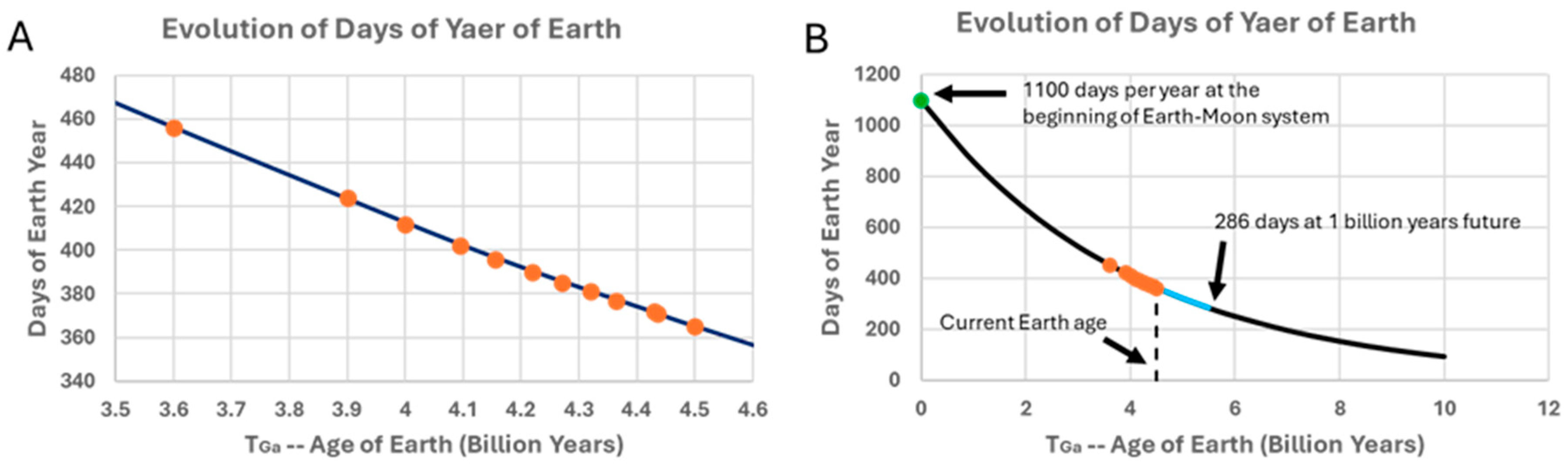
Figure 2.
LOD evolution over 10 billion years. Observed data points ♦) align well with Equation (12). At system inception, Earth had ~ 8 hours length of day. After 1 billion more years, this will increase to 30 hours. Data are from Sonett [6], Kvale [21], Malinverno [22], Winter [20].
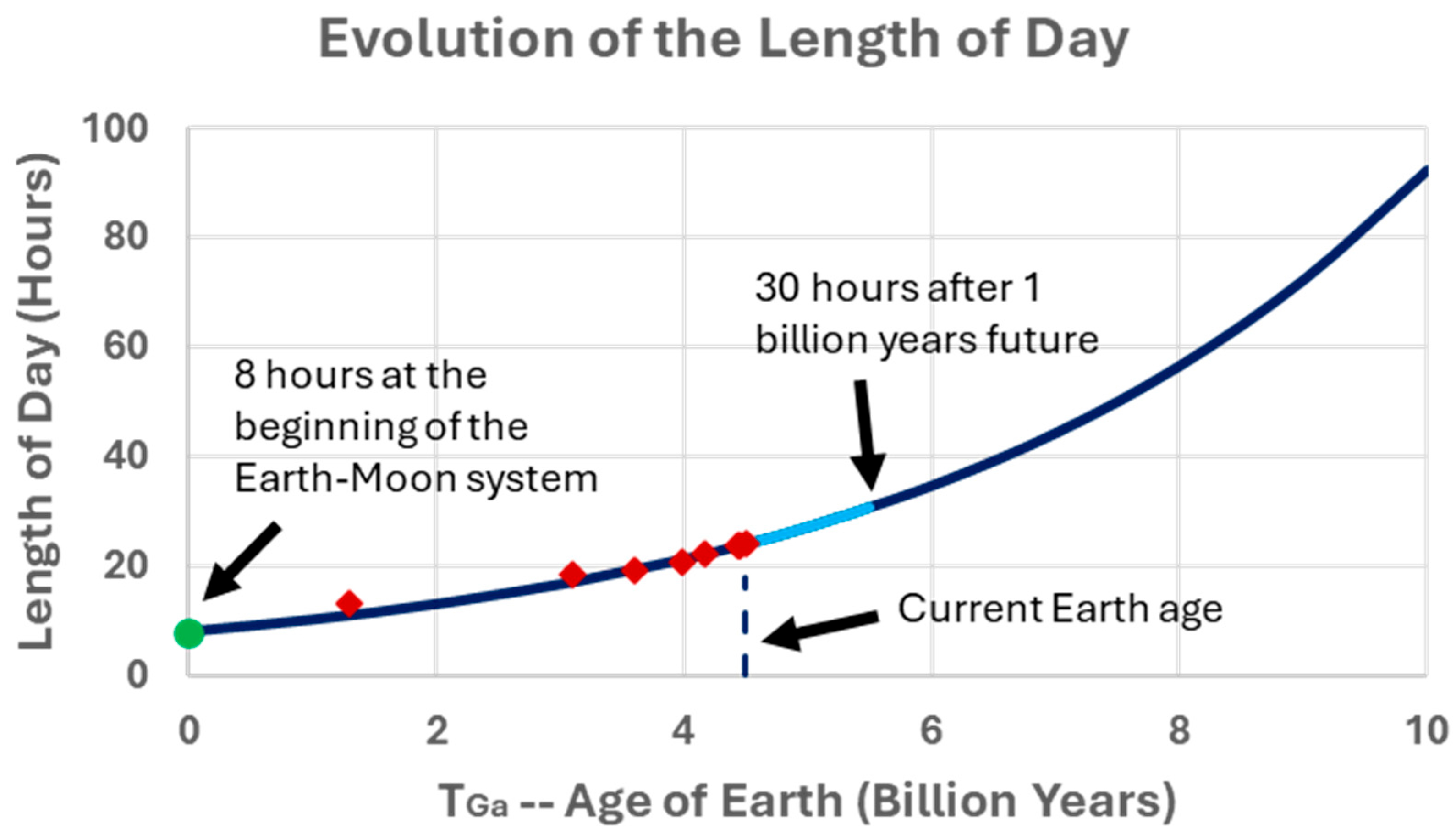
Figure 3.
Moon–Earth distance (center to center) evolution over 10 billion years. The observed data points are marked with (■), the solid line is the calculation values by the equation (16) developed from DMFF model. Data are from Kvale and Eulenfeld [19], Malinverno & Meyers [22], Scrutton [23].
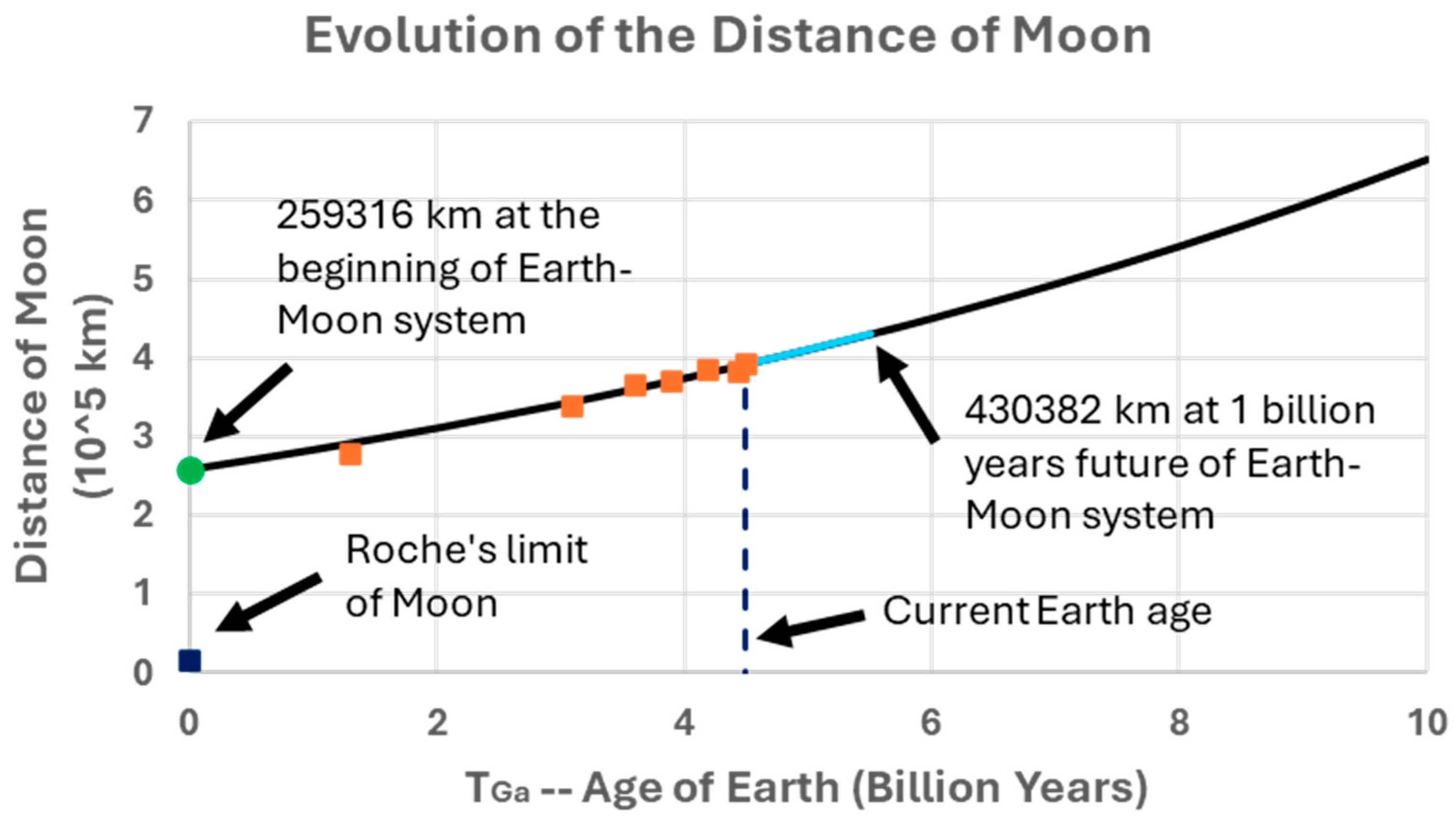
Figure 4.
The loss rate of Earth’s rotation angular momentum and the gain rate of Moon’s orbital angular momentum. The red and blue solid lines (from 1.3 billion years to present) are calculated by equation (15) and (17) respectively. The dashed red and blue lines are extrapolations.
Figure 4.
The loss rate of Earth’s rotation angular momentum and the gain rate of Moon’s orbital angular momentum. The red and blue solid lines (from 1.3 billion years to present) are calculated by equation (15) and (17) respectively. The dashed red and blue lines are extrapolations.
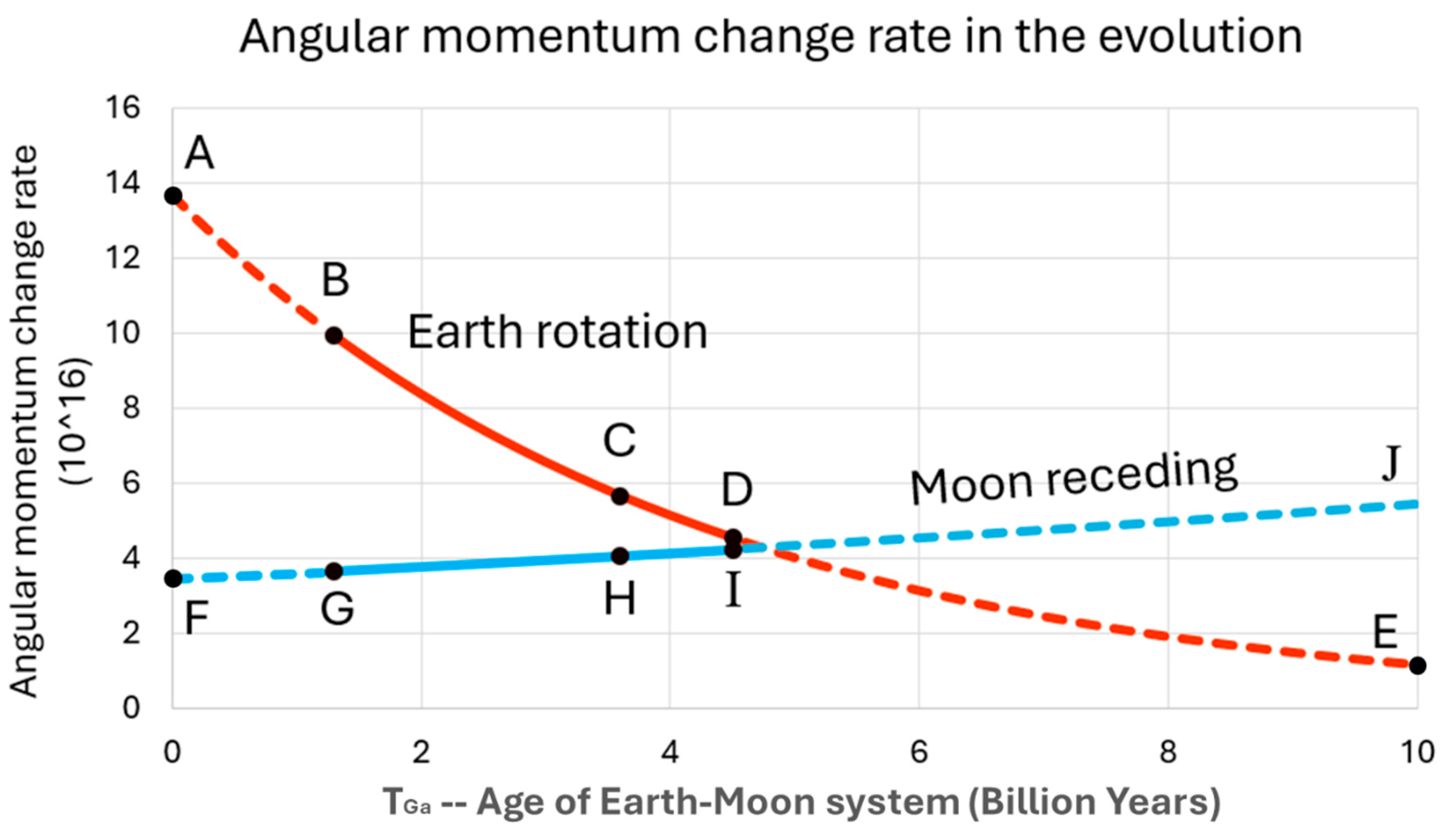
Figure 5.
Loss-to-gain ratio from 3.2 billion years ago to present (solid red) with extrapolations (dashed). Letters B–D mark fossil-derived constraints. The horizontal dashed line marks the 1:1 ratio expected under tidal friction.
Figure 5.
Loss-to-gain ratio from 3.2 billion years ago to present (solid red) with extrapolations (dashed). Letters B–D mark fossil-derived constraints. The horizontal dashed line marks the 1:1 ratio expected under tidal friction.
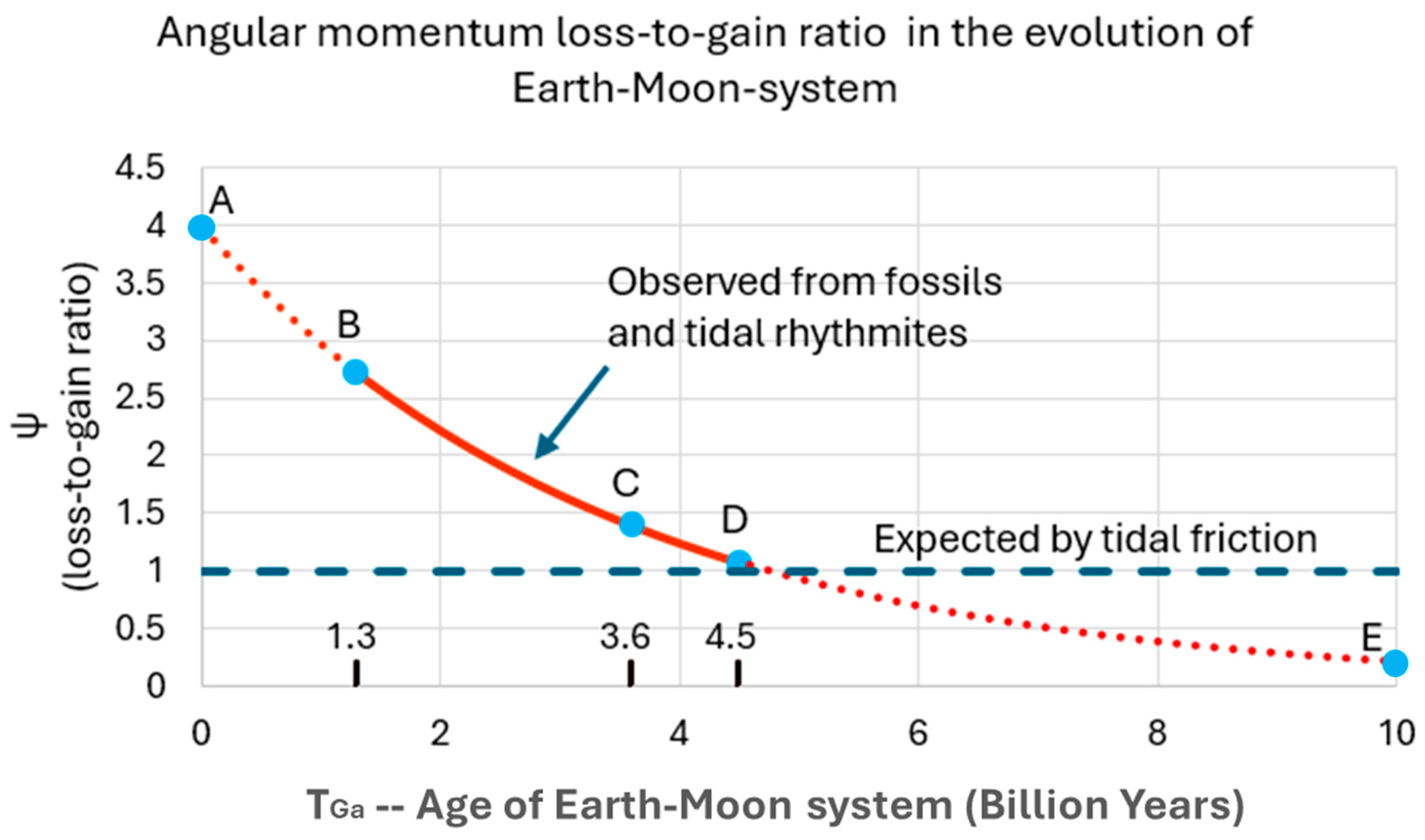
Figure 6.
The evolution of the equatorial radius and polar radius of the Earth.
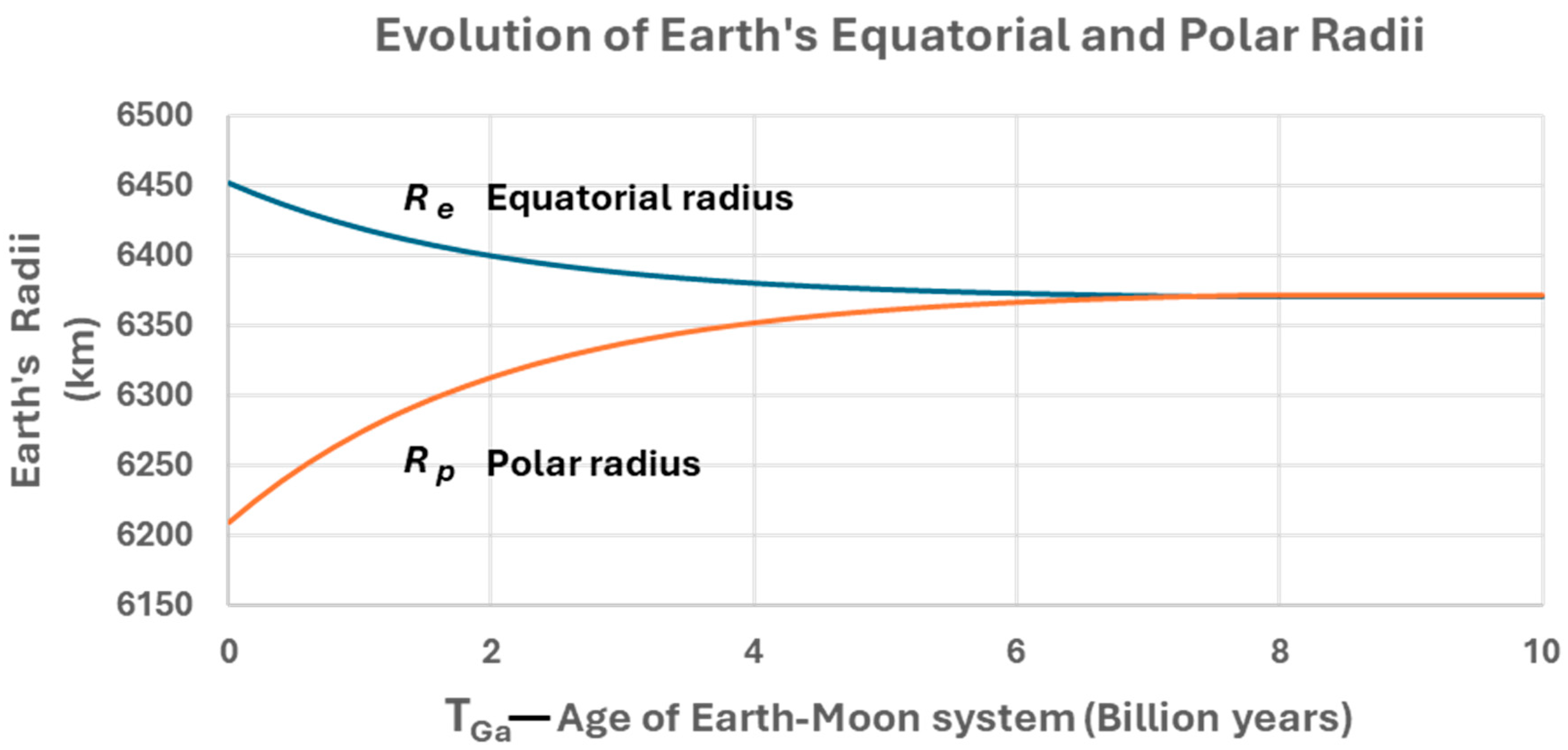
Figure 7.
The evolution of flattening of the Earth.
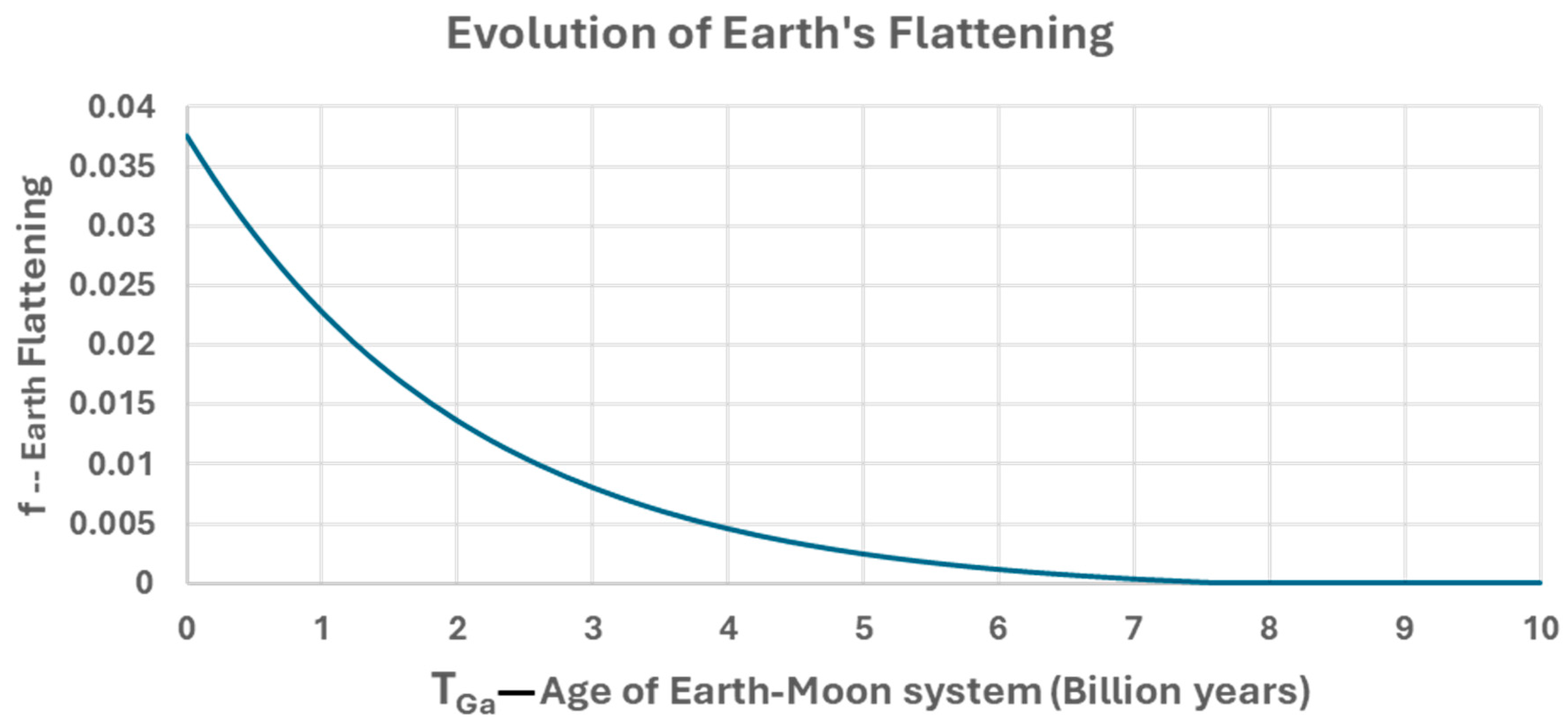

Table 1.
Comparative Geodetic Evolution.
| Equatorial Radius (km) |
Polar Radius (km) |
Re - Rp (km) |
Flattening f |
Flattening ratio (relative to present) | |
|---|---|---|---|---|---|
| Present | 6378.14 | 6356.75 | 21.39 | 0.00335 | 1 |
| 9 Ma | 6383.19 | 6346.65 | 36.54 | 0.00572 | 1.71 |
| 3.2 Ga | 6412.72 | 6287.53 | 125.19 | 0.01952 | 5.82 |
Disclaimer/Publisher’s Note: The statements, opinions and data contained in all publications are solely those of the individual author(s) and contributor(s) and not of MDPI and/or the editor(s). MDPI and/or the editor(s) disclaim responsibility for any injury to people or property resulting from any ideas, methods, instructions or products referred to in the content. |
© 2026 by the authors. Licensee MDPI, Basel, Switzerland. This article is an open access article distributed under the terms and conditions of the Creative Commons Attribution (CC BY) license (http://creativecommons.org/licenses/by/4.0/).
Copyright: This open access article is published under a Creative Commons CC BY 4.0 license, which permit the free download, distribution, and reuse, provided that the author and preprint are cited in any reuse.


