
Submitted:
23 February 2026
Posted:
26 February 2026
You are already at the latest version
Abstract
As organizations navigate rapid digital transformation, leaders must reconcile the cognitive demands of technology with the emotional needs of employees. Drawing on Upper Echelons Theory (UET), Self-Determination Theory (SDT), and paradox theory, this study develops and tests a Cognition–Motivation–Paradox Integration Model (CMPIM) explaining how digital leadership fosters frontline service innovation through dual psychological mechanisms—creative self-efficacy (competence-based cognition) and sense of belonging (relatedness-based emotion). Two multi-wave, time-lagged studies in Malaysia’s hospitality sector (Study 1: N = 370; Study 2: N = 302) reveal that digital leadership enhances service-innovative behavior directly and indirectly through both mechanisms. Findings show that mindfulness serves as a paradoxical boundary condition: it strengthens the cognitive pathway from creative self-efficacy to innovation but weakens the emotional pathway from sense of belonging to innovation, demonstrating a Mindfulness–Innovation Paradox. The findings advance UET by recognizing micro-foundational mechanisms connecting leader cognition to employee innovation, improve SDT by presenting the concept of paradoxical need fulfillment between competence and relatedness, and extends Paradox Theory conceptualize mindfulness as a dual-edged psychological state that concurrently empowers and limits innovation. This integrative framework reframes digital leadership as a paradoxical function of balancing cognitive emphasis and emotional association to sustain innovation in digitally dynamic service organizations.
Keywords:
mindfulness
; digital leadership
; creative self-efficacy
; sense of belonging
; service innovative behaviour
; self-determination theory
Introduction
In the era of digital disruption, innovation has become the core driver of organizational competitiveness, particularly in service-based industries like the hospitality industry. The global hospitality industry is under increasing pressure to amid fast technological transformation, shifting consumer demands and market fluctuations (Buhalis & Leung, 2018; Hjalager, 2010; Mariani & Borghi, 2023). Digital technologies—such as artificial intelligence, automation, and data-driven personalization have transformed how hospitality organizations operate, engage with guests, and generate value (Mariani & Borghi, 2023; Sigala, 2023). Innovation, however, remains a highly discretionary individuals behaviour in the hospitality sector and their willingness to be innovative, adaptive and proactive amid the dynamics of the enterprise (Hu, Horng, & Sun, 2009).
Although digital transformation programs have become commonplace in hospitality organizations, they frequently fail to interpret technological investments into long-term innovation. Organizations navigating digital transformation face a paradox: while technology demands heightened cognitive focus, innovation depends equally on emotional connection. Leaders who manage to integrate digital technologies balance the precision of analysis with the sensitivity of relationships, a duality that remains theoretically underexplored. Current literature postulates that digital leadership nurture organizational innovation by investigating technological adaptation and sensemaking (Benitez, Arenas, Castillo, & Esteves, 2022; El Sawy, Kræmmergaard, Amsinck, & Vinther, 2020). Digital leadership in this view has proved to be a fundamental construct in the interpretation of how leaders navigate digital transformation in fostering innovation (El Sawy, Kræmmergaard, Amsinck, & Vinther, 2020). Digital leaders play a role of sense-makers who interpret technological change in ways that they need to be received and integrated into the organization. Digital leadership embodies the tension between technological control and human empowerment. In hospitality sector of Malaysia, frontline employees in hospitality sector experience significant cognitive and emotional challenges in building innovative behavior due to the fast pace of digital transformation, high emotional demands, and limited empowerment. The orientation of AI systems, data-driven operations and automated booking enhance technostress and cognitive overload, which may hamper employees’ creativity and adaptableness (Borghi, Mariani, Vega, & Wirtz, 2023; Buhalis & Leung, 2018). Furthermore, collectivist culture in the hospitality industry often values customer satisfaction and conformism over risk-taking, discouraging innovative behavior (Hu, Kandampully, & Juwaheer, 2009). frontline employees emotionally face emotional exhaustion and burnout from continuous guest interaction, which dampens their intrinsic motivation and sense of belonging (Li et al., 2022). Workers hesitate to exercise with new service ideas and feel disengaged without strong social support from their teams.
Paradox Theory suggests that effective digital leaders balance them through cognitive and behavioural complexity” (Gao & Gao, 2024; Smith & Lewis, 2011). However, we know far less about the psychological mechanisms that translate leaders’ digital cognition into employees’ innovative behaviors. This gap — the micro-level transmission of leader cognition — constitutes what Upper Echelons Theory (Hambrick & Mason, 1984) has long described as a “black box” between top-level cognition and individual-level action.
To unpack this gap, we integrate Upper Echelons Theory (UET) (Hambrick & Mason, 1984), Self-Determination Theory (SDT) (Ryan & Deci, 2000), and paradox theory (Smith & Lewis, 2011), to develop a Cognition–Motivation–Paradox Integration Model (CMPIM). s Upper Echelons Theory (UET) explains how leaders’ cognitions shape organizational outcomes but leaves unaddressed how those cognitions are psychologically transmitted to employees’ innovation behaviour—the so-called “black box” of micro-foundations (Felin, Foss, & Ployhart, 2015). Similarly, Self-Determination Theory (SDT) assumes that the satisfaction of competence and relatedness needs synergistically enhances intrinsic motivation, but it cannot explain why these needs sometimes conflict under cognitively demanding conditions such as mindfulness. In this context, mindfulness plays a crucial moderating role. Mindful employees sustain focus, regulate stress and nurture reflective decisions, empowering them to respond creatively rather than respond spontaneously (Hyland, Lee, & Mills, 2015). This cognitive clarity improves creative self-efficacy, as mindfulness develops confidence in one’s capability to produce solutions and understand setbacks as learning opportunities (Langer, 1989; Yao, Fan, & Duan, 2024). Moreover, mindfulness fortifies a sense of belonging by promoting relational awareness and empathy, which augments relationship and collective creativity (Fagioli, Pallini, Mastandrea, & Barcaccia, 2023; Koc & Uzun, 2024). Finally, Paradox Theory has predominantly examined organizational-level tensions (e.g., exploration–exploitation) and has yet to theorize how paradoxes manifest within individual psychological states.
Our Cognition–Motivation–Paradox Integration Model (CMPIM) addresses these theoretical blind spots by articulating a cross-level psychological mechanism that connects leaders’ digital cognition to employees’ innovation through dual motivational pathways—competence-based (creative self-efficacy) and relatedness-based (sense of belonging). In addition, the model presents the paradoxical need fulfillment concept implying that mindfulness enhances the competence-related innovation and undermines corresponding relatedness-driven innovation. By doing so, this study extends UET with micro-foundations of cognitive transmission, revises SDT by reclassifying need fulfillment as paradoxical rather than uniformly synergistic, and broadens Paradox Theory to include micro-paradoxical states within individual cognition. Collectively, CMPIM explains when and why digital leadership both enables and constrains innovation—an outcome existing theory cannot simultaneously account for. Based on this rationale, the study addresses the following research questions:
- How does digital leadership effect employees’ service innovative behaviour via creative self-efficacy and sense of belonging?
- How does mindfulness moderate these relationships, potentially enhancing the effects of psychological need fulfilment on innovation?
Theoretical Framework
This study proposes a multilevel model—termed the Cognition–Motivation–Paradox Integration Model (CMPIM)—that explains how digital leadership translates into employees’ service-innovative behavior through cognitive and emotional pathways under paradoxical contextual conditions. The framework assimilates three theoretical lenses, which are the Upper Echelons Theory (UET), Self-Determination Theory (SDT), and Paradox Theory, all of which provide unique, yet complimentary understanding of the interaction between leader cognition, employee motivation, and contextual mindfulness to drive innovation in digital service organizations. Upper Echelons Theory (UET) (Hambrick & Mason, 1984; Hambrick, 2007) asserts that organizational outcomes reflect the cognitive orientations, experiences, and values of top managers. Leaders’ perceptions of uncertainty, technological disruption, and opportunity form the basis of their strategic decisions and organizational performance (Abatecola & Cristofaro, 2020). In digitalized service environments, the digital cognition of leaders, which is defined as openness to technology, adaptive thinking and strategic foresight, influences the interpretation, communication and implementation of technological change throughout the organization (El Sawy et al., 2020). However, as much as UET offers an effective explanation of the impacts of leader cognition on the organization performance, it provides little understanding of how such cognitions are transmitted to employees to the motivational and behavioural effects of employees.
This is an extension of UET as it suggests a cross-level psychological process known as paradoxical cognitive channelling. This idea demonstrates that the flowing effect of leaders on digital cognition to the employee level is mediated by two motivation middle levels, namely, creative self-efficacy (CSE) and sense of belonging (SOB). This two-way or dual pathway facilitates an extension of UET in that its relations leader cognition at the macro level with employee motivation at the micro level, thereby bridging the long-standing black box between cognitive leadership processes and individual innovative behaviour (Felin et al., 2015).
At the micro-motivational level, Self-Determination Theory (SDT) provides a theoretical framework to elucidate how intrinsic motivation triggers when individuals' psychological needs for autonomy, competence, and relatedness are satisfied (Deci, Olafsen, & Ryan, 2017; Ryan & Deci, 2000). When employees perceive that their working conditions allow fulfilling these needs, they develop intrinsic motivation that facilitates creativity and innovation. The digital leaders produce such conditions by providing feedback that is autonomy-supportive, fostering psychologically safe climates and modelling exploratory digital behaviours that promote experimentation. In doing so, employees develop a sense of improved competence (through creative self-efficacy) and belongingness (through relational support) which subsequently motivates service-innovative behaviours.
However, our study expands SDT by introducing the concept of paradoxical need fulfillment, which posits that the psychological needs for competence and relatedness are not always synergistic. These needs may differ in their influence on innovation under some cognitive conditions, especially when the cognitive condition is a high level of mindfulness. expands SDT by introducing the concept of paradoxical need fulfillment, which posits that the psychological needs for competence and relatedness are not always synergistic (Leroy, Anseel, Dimitrova, & Sels, 2013). Though, the similar mindfulness may create a person less emotionally dependent on social connections, lessening the effect of belongingness on innovation (Fagioli, Pallini, Mastandrea, & Barcaccia, 2023). In this way, mindfulness modifies the harmonious relationship between competence and relatedness traditionally seen as such, and creates a paradoxical one where the former promotes and the latter hinders innovation. This challenges SDT's fundamental postulate the homogeneous contribution of the psychological needs to intrinsic motivation but also makes need fulfillment situational and subject to paradoxical fluctuation.
On the contextual level, the Paradox Theory (Smith and Lewis, 2011; Lewis and Smith, 2014) provides a meta-theoretical approach to understand the presence of conflictual and simultaneously interdependent forces in the organizations. Traditional application of the Paradox Theory deal with tensions between exploration and exploitation or stability and change on an organizational or strategic level (Schad, Lewis, Raisch, & Smith, 2016). We extend Paradox Theory to the individual psychological level by conceptualizing mindfulness as a micro-paradoxical state. Mindfulness is both empowering and limiting to innovative behaviour: on the one hand, it enhances cognitive awareness and self-regulation, which develops competence-based innovation, but, it also expands emotional indifference and self-sufficiency, which may weaken the relational processes that nurture collaboration and belonging (Hyland, Lee, & Mills, 2015; Koc & Uzun, 2024). This dual role generates what we call the Mindfulness–Innovation Paradox, where mindfulness acts as both a cognitive facilitator and an emotional inhibitor of innovation. This extension augments Paradox Theory by displaying that paradoxical tensions are not limited to organizational systems but also obvious within individual affect and cognition. Coalescing these the two views, the Cognition-Motivation-Paradox Integration Model (CMPIM) argues that digital leadership is the cognitive force of innovation because it impacts the psychological conditions of employees. Creative self-efficacy and a sense of belonging are motivational processes, which translate cognition of digital leaders into the innovation of employees. Mindfulness balances these relations by nurturing the cognitive-competence (CSE - SIB) and dampening the emotional-relatedness (SOB - SIB) pathways. By doing this, the model puts innovation as a result of active interaction between leader cognition, employee motivation, and contextual paradox.
The present study has three theoretical extensions made using this framework. To start with, it expands UET by surpassing a micro-foundational transmission system describing how cognitive orientations of leaders can impact individual innovative behaviour via two motivational channels. Second, it extends SDT, but implies paradoxical need satisfaction, demonstrating how competence and relatedness need can act contrary to each other in mindfulness, and reconceptualizes the need fulfillment as paradoxical and not necessarily synergistic. Third, it extends Paradox Theory by proving that paradoxical tensions may also develop at the psychological level to make mindfulness a dual-edged state that fosters and suppresses innovation at the same time. Taken together, these extensions provide a better perspective on digital leadership and innovation as the result of paradoxical correspondence of cognition, motivation, and context. The CMPIM, therefore, provides a theoretically-informed, empirically-evidence-based view that replaces the understanding of digital leadership as a paradoxical process of balancing cognitive focus and emotional attachment to maintain innovation in digitally transformed organizations.
Hypotheses Development: Cognitive Pathway via Creative Self-Efficacy
Creative Self-efficacy (CSE) means the individuals’ self-confidence in their ability to do creative tasks under diverse circumstances (Tierney & Farmer, 2002). A high level of creative belief is an indispensable component for employees to cultivate innovative work (Gong et al., 2009). Tierney and Farmer (2002) argue that creative activities are thought-provoking at a certain level of risk that develop inner motivation among employees, vital for innovative tasks. Similarly, individuals with high level of creative abilities perceive less uncertainty at workplace, anticipate risk more effectively and are more likely to engage in innovation. Such employees are triggered to determine innovative behaviour (Gong et al., 2020; Tu, Lu, Choi, & Guo, 2019). Digital leaders who possess authority, offer progressive feedback, and model exploratory behaviour encourage this sense of competence. Workers with higher CSE observe uncertainty as controllable and are more probable to involve in creative experiments that motivates service innovation. Now, we subsequently hypothesize as follows:
H1. Digital leadership positively influences service innovative behaviour.
H2. Digital leadership positively influences creative self-efficacy.
H3. Creative self-efficacy positively influences service innovative behaviour.
H4. Creative self-efficacy mediates the relationship between Digital leadership and service innovative behaviour.
Emotional Pathway: The Mediating Role of Sense of Belonging
Cheng and Kuo (2015) defined that sense of belonging as the sense of attachment or affiliation employees feel to their atmosphere. It may be understood as a general psychological attachment, where people foster a robust association with the place or the environment (Seamon, 2015). So, employees who perceive more psychological association to their jobs, dedicate their more energy toward their creativity and innovation (Mayhew, Ashkanasy, Bramble, & Gardner, 2007). Digital leaders create an environment that supports the nexus nurturing innovative behaviour. Further, SOB as a mediator helps nurture behaviour through motivation to develop innovation (Berisha, Govori, Lajçi, Sonta, & Röhm, 2024; Kousina & Voudouris, 2023). Accordingly, we argue that sense of belonging developed by digital leadership drives employee innovative behaviour: Now, we propose the following hypothesis:
H5. Digital leadership positively influences employees’ sense of belonging.
H6. Sense of belonging positively influences service innovative behaviour.
H7. Sense of belonging mediates the relationship between Digital leadership and service innovative behaviour.
Moderating Role of Employee Mindfulness
Mindfulness involves being consciously alert one’s thoughts, emotions, and actions, indorsing a fixated and peaceful environment at the workplace. Mindfulness provides several psychological and physical benefits (Hyland, Lee, & Mills, 2015), social associations (Koç & Uzun, 2024) and individual performance (Bondar, Bertollo, di Fronso, & Robazza, 2024). The mindful employees are psychological assets of the organization that increase the level of creativity and productivity (Op den Kamp, Tims, Bakker, & Demerouti, 2023). Leroy, Anseel, Dimitrova, and Sels (2013) contend that mindful employees are more attentive and engaged to explore innovative process to accomplish the tasks. In addition, mindfulness is closely related with openness which assist to build creative self-efficacy (Langer, 1989; Yao, Fan, & Duan, 2024), that leads to develop innovative behaviour (Khan, Jaafar, Mubarak, & Khan, 2024). Ergas and Hadar (2023) argue that mindfulness practice is a valuable motion that would additional support to remain engaged to develop innovation. In the same way, mindfulness interfering counter the feelings of isolation, loneliness and improve sense of belonging (Fagioli, Pallini, Mastandrea, & Barcaccia, 2023; Knox-Kazimierczuk, Tosolt, & Lotz, 2024) that stimulate innovation (Carmeli, Dutton, & Hardin, 2015; Shahbaz & Parker, 2022).
H8a: The moderating effect of mindfulness between the nexus of creative self-efficacy and service innovative behaviour; as such the nexus is strengthened when level of mindfulness is high.
H8b: The moderating effect of mindfulness between the nexus of sense of belonging and service innovative behaviour; as such the nexus is strengthened when level of mindfulness is high.
Encompassing this logic, we contend that mindfulness performs as a boundary condition, establishing the positive rapport between CSE and SIB by serving workers regulate their feelings and uphold focus, while its effect on the SOB → SIB linkage is less obvious. Consequently, when mindfulness is high, the indirect effects of digital leadership on SIB via CSE and via SOB should be higher than when mindfulness is high.
H8c: The effect of moderating variable mindfulness between the nexus of digital leadership and innovative behaviour through creative self-efficacy; as such, the mediation is strong when the level of mindfulness is high.
H8d: The effect of moderating variable mindfulness between the nexus of digital leadership and innovative behaviour through sense of belonging; as such, the mediation is strong when the level of mindfulness is high.
Methodology
Study 1: Time-Lagged Mediation Test
To analyse the indirect pathways proposed in H4 and H7, Study 1 used three wave time-lagged research design. The researchers conducted online survey using Data Prolific Service to collect the data from workforces in the hospitality industry of Malaysia. Comparing to other crowdsourcing system like MTurk, Prolific proposes demographically, pre-screened miscellaneous participants and imposes severe self-verification procedures, which decrease the risks of identical responses, careless participants, and fake submissions (Palan & Schitter, 2018). The participants on Prolific also display higher concentration and agreement with directions, mostly in longitudinal or multi-wave studies (Peer et al., 2020). This online survey was collected in three stages, with fourteen days break between each stage; Prior work on service innovative behaviour (SIB) recommends a two-week spacing to capture short-term changes in psychological mechanisms while reducing recall bias (Quade, McLarty, & Bonner, 2020; Rasheed, Hameed, Kaur, & Dhir, 2024).
Sample: In Study 1, data were collected across three waves: Time 1 (digital leadership; N=410, screened to 390), Time 2 (CSE and SOB; N=390, screened to 378), and Time 3 (SIB and demographics; N=378, screened to 370). We employed the participants’ Prolific IDs with unique codes to match the received data from these 3 waves. Of the 370 participants, 47% were male. Further, 37% of employees were aged 20–30, and 36% were aged 31–41. Moreover, 12% had a diploma degree and 36% had graduate degree, and 39% had 6 to 11 years of experience in the hospitality industry. Only full-time employees with at least one-year experience were eligible in this role.
Study 2: Time-Lagged Moderated-Mediation Test
Design and procedure: The study measured the full model of a moderated mediation analysis (H8a–H8d) with a three time-lagged research design. We collected the data for Study 2 and used Prolific platform to collect the data from employees of the hospitality industry in Malaysia. In Study 2, we also collect the data in three phases with four weeks break of each phase. Furthermore, Prolific platform permits for better participant screening based on service status, hospitality industry, Malaysia, and previous job history, confirming that our sample match exactly with the required population of frontline employees in hospitality industry. Numerous previous studies of innovative behaviour also suggested a one-month gap of each phase (Moin, Omar, Wei, Rasheed, & Hameed, 2021; Rasheed et al., 2024) . In Study 2, three waves of data were collected: Time 1 (digital leadership; N=348, screened to 339), Time 2 (CSE and SOB; N=339, screened to 302), and Time 3 (SIB and mindfulness; N=320, screened to 302). Here, we employed the participants’ Prolific IDs with unique codes to match the data received in these three phases.
Sample: Of the 302 participants, female was 53% were. Moreover, 31% of employees were age 20–30, and 42% of employees were age 31–41. Further, 12% had a diploma degree and 38% had master degree, and 38% had 6 to 11 years of experience in the hospitality industry.
Measurement (Study 1 and 2)
To measure the digital leadership (DL) regarding employee’s perception, Informatics Leadership Scale developed by Ulutaş and Arslan (2017) is applied in both studies. Numerous other studies have applied this scale to measure digital leadership (Artüz & Bayraktar, 2021; Batur, Cantaş, & Mahmutoğlu, 2024). This scale has total eighteen items of three dimensions with 6 items of each dimension. These three dimensions such as information, communication and orientation. Followers’ perceptions of their supervisor’s digital behaviour are the most reliable with theory and hypothesized of this research model. In the current study, 6 items of orientation are adapted to measure digital leadership. The purpose for measuring this dimension, specified and represent the digital leadership (Ulutaş & Arslan, 2017). For reliability and validity of this scale, Alpha is calculated as 0.97. CSE was measured through the scale developed by the researchers Tierney and Farmer (2002) with three items in both studies. Sense of belonging was measured by adapting a 4-item scale developed by (Zhao, Lu, Wang, Chau, & Zhang, 2012) in both studies. We then adapted a 6-item scale to measure SIB developed by (Hu et al., 2009) in both studies. The whole scale adapted in both studies based on a five-point Likert scale ranging from 1 (strongly disagree) to 5 (strongly agree). The Mindful Attention Awareness Scale with 15-item to measure employee’s mindfulness developed by Brown and Ryan (2003) in Study 2. In this sample, the value of alpha for was .88. As hospitality industry workers, they should fully aware and consciousness how to attentive, resolve conflict and enhance collaboration with the tourists (Bolm, Zwaal, & Fernandes, 2022; Johnson & Park, 2020). We also controlled demographic variables like gender, age, education, tenure and conscientiousness (a significant personality trait) in the hospitality industry. Measuring conscientiousness, the researcher adapted eight items developed by (Costa Jr, McCrae, & Dye, 1991). Earlier studies shown a strong association between employees’ demographics and SIB (Yidong & Xinxin, 2013). Likewise, previous studies found that workers’ personality traits may envisage innovative behaviour as well as service innovation (Rasheed et al., 2024). We argued that conscientiousness a dominant personality characteristic characterized by accountability, planning, devotion, and self-control is extremely pertinent to the context of the study.
Analyses and Results
We applied numerous approaches to investigate the data and measure the hypotheses. We analyse the descriptive results, missing values, data normality, multivariate outlier, and correlation in the data screening. In specific, in the hospitality industry, we selected full time employees with more than a year of experience. This screening process applied the same standards in both studies. We analysed the data using partial least squares and structural equation modelling (PLS-SEM). Since, PLS-SEM validates the internal consistency through the measurement model and measure the path analysis through SEM. PLS-SEM emphasizes on prediction and estimation, which valuable in making best use of independent variables and dependent variable (Fong & Law, 2013).
Results of Study (1 and Study 2)
Measurement Model
In the first part of both studies, Table 1 and Table 4 displays the reliability of the data, validity of the data, composite reliability (CR), convergent validity (CV). The value of factor loading of each item in both studies is greater than 0.50. Cronbach’s alpha (α) values in Study 1 ranged from 0.798 to 0.919 and in Study 2 ranged from 0.803 to 0.958, CR values in Study 1 ranged from 0.882 to 0.937 and in Study 2 0.872 to 0.961 demonstrate that the scale is reliable. Second, the value of factor loading of each item is greater than 0.70 in both the studies, which shows that each construct is reliable (Hair et al., 2014). Moreover, convergent validity (CV) that measures whether two dissimilar measurement approaches produce similar results for the similar construct (Hair, Hollingsworth, Randolph, & Chong, 2017). The valuation of CV draws from the average variance extracted (AVE) test. The value of AVE for each construct is greater than 0.50 in both the studies, so, the CV of all constructs is acceptable.
Further, for validity assessment, discriminant validity (DV) was developed to test the assessment of one variable which should not correlate with others. Henseler, Ringle, and Sarstedt (2015) suggest Heterotrait–monotrait (HTMTs) ratio of correlations, a more accurate new criterion. The current study used this new technique for creating DV between variables. By means of a more traditional method (as the robust criterion), All values of each constructs are <0.90 in Table 2 and Table 5 (Gold, Malhotra, & Segars, 2001). This test shows each construct is discriminant with each other. Thus, discriminant validity developed in the model. To assess multicollinearity among the predictor constructs, variance inflation factors (VIFs) were examined. All VIF values were below 5.0, indicating that multicollinearity was not a concern in the model. This threshold aligns with recommendations by Rogerson (2001), who suggest that VIF values below 5 represent an acceptable level of collinearity in behavioural and social science research using structural equation modelling approaches.
Structural Model
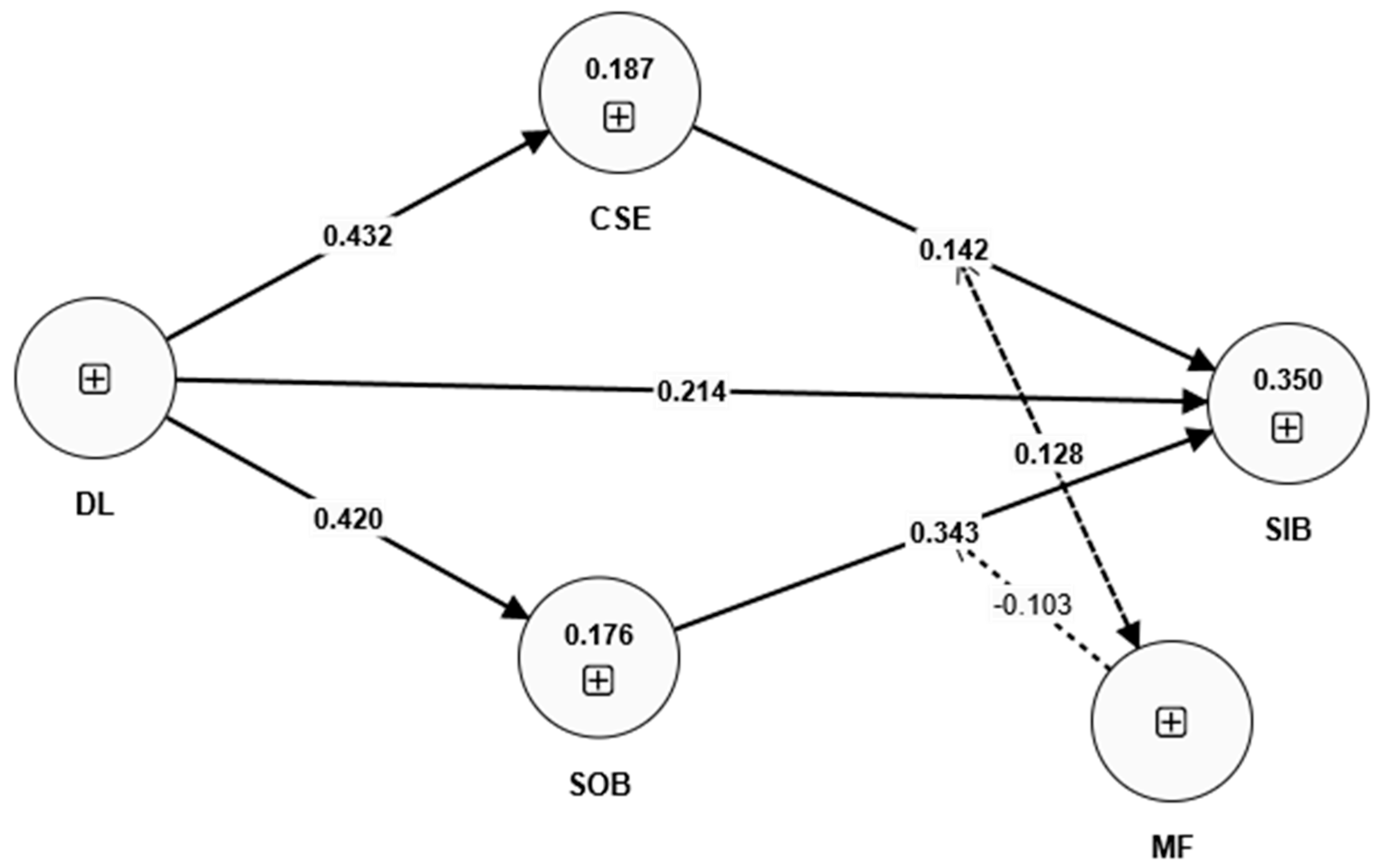
We measure a three-wave time-lagged research path model; the relationship of exogenous constructs and endogenous construct (direct or indirect effect) through Structural equation model show in Figure 2. The direct effect of digital leadership (T1) on SIB (T3) is significant positive —Study 1: β=0.156, p<0.05 and Study 2: β =0.214, p<0.05)—supporting H1. The effect of digital leadership (T1) on the mediator CSE (T3) is significant positive —Study 1: β=0.416, p<0.05 and Study 2: β =0.432, p<0.05—supporting H2; and of sense of belonging (SOB)—Study 1: β=0.35, p<0.05 and Study 2: β=0.42, p<0.05—supporting H5. Moreover, both mediators positively predicted SIB (T3)—CSE (T2): Study 1: β=0.107, p<0.05 and Study 2: β=0.142, p<0.05 (H3); SOB (T2): Study1 β=0.115, p<0.05; Study2 β=0.343, p<0.05 (H6).
Figure 1.
Path Coefficients. Note; DL; digital leadership, CSE; creative self-efficacy, SOB; sense of belonging, SIB; service innovative behaviour.
Figure 1.
Path Coefficients. Note; DL; digital leadership, CSE; creative self-efficacy, SOB; sense of belonging, SIB; service innovative behaviour.
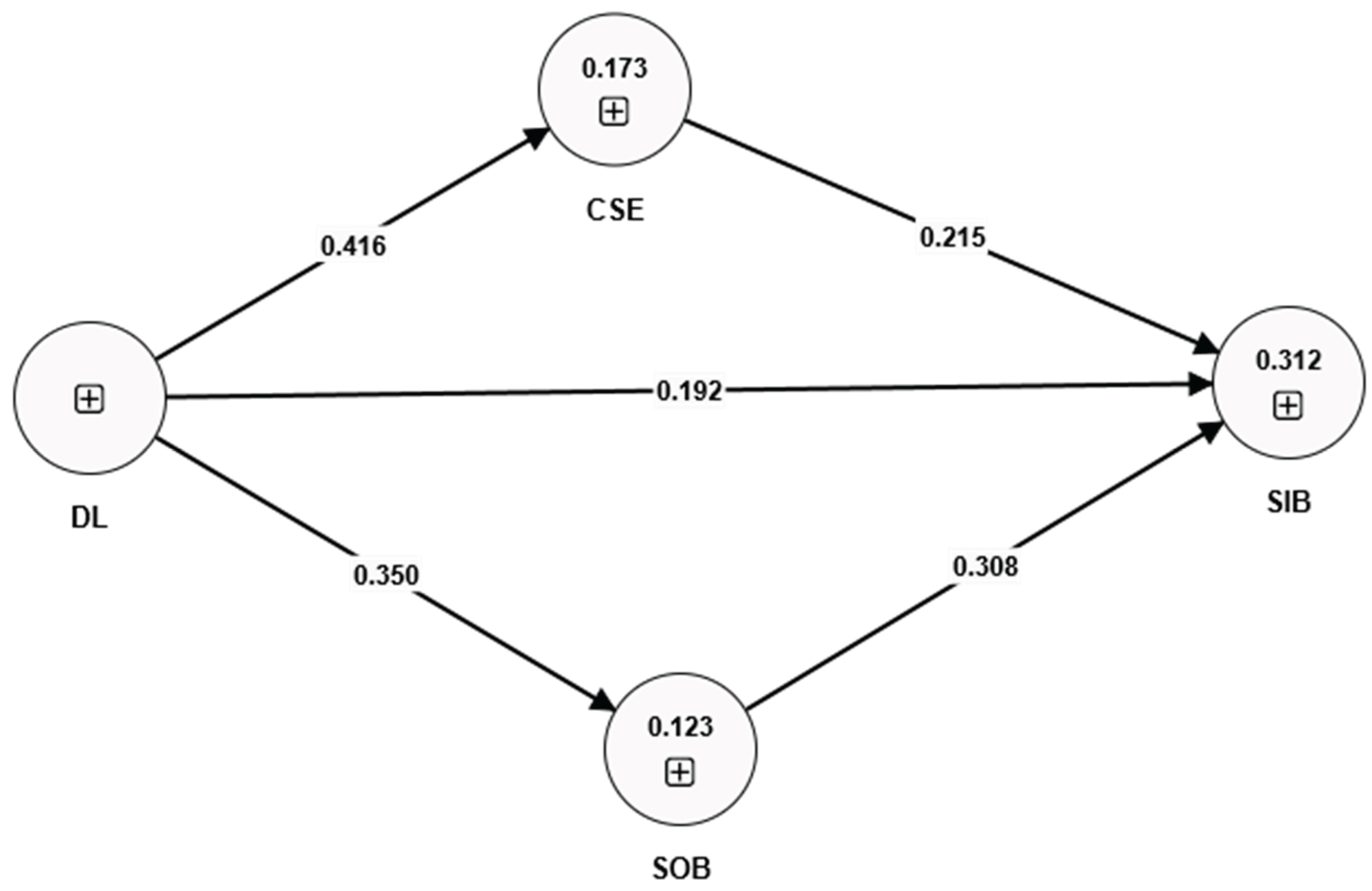
Indirect (mediation) effects: The DL → CSE → SIB specific indirect effect was significant in both studies—Study 1: β = 0.044, p<0.05; Study 2: β=0.061, p<.05—supporting H4. The DL → SOB → SIB indirect effect was likewise significant—Study 1: β=0.04, p<0.05; Study 2: β = β=0.144, p<0.05—supporting H7.
Moderation (Study 2): In Study 2, employee mindfulness significantly moderated mediator–outcome links: MF × CSE → SIB: β=0.128, p<0.05 (H8a). MF × SOB → SIB: β=-0.103, p=0.97>0.05—NOT supporting H8b.
Control: Gender and age were not significant predictors of SIB in either study. Education and tenure showed significant positive associations with SIB in both studies (coefficients reported in Table 3 and Table 6).

Table 3.
Path Coefficients and VIF in Study 1.
| Relationships | Β | T value | P values | f2 | VIF |
|---|---|---|---|---|---|
| T1-DL->T3-SIB | 0.192 | 3.154 | 0.001 | 0.042 | 1.328 |
| T1-DL->T2-CSE | 0.416 | 6.554 | 0 | 0.209 | 1 |
| T1-DL->T2-SOB | 0.350 | 4.566 | 0 | 0.140 | 1 |
| T2-CSE->T3-SIB | 0.215 | 3.305 | 0 | 0.049 | 1.443 |
| T2-SOB->T3-SIB | 0.308 | 4.725 | 0 | 0.106 | 1.422 |
| Gender-> SIB | -0.086 | 1.135 | 0.128 | n/a | 1.05 |
| Age -> SIB | -0.016 | 0.429 | 0.334 | n/a | 1.026 |
| Education -> SIB | 0.403 | 10.133 | 0 | n/a | 1.418 |
| Tenure -> SIB | 0.32 | 8.718 | 0 | n/a | 1.334 |
| T1-DL->T2-CSE->T3-SIB | 0.044 | 2.082 | 0.019 | n/a | n/a |
| T1-DL->T2-SOB ->T3-SIB | 0.040 | 2.139 | 0.016 | n/a | n/a |
Note: N=302. t> 1.64 & p<0.05; T1; Time 1, T2; Time 2, T3; Time 3, DL; digital leadership, CSE; creative self-efficacy, SOB; sense of belonging, SIB; service innovative behaviour, n/a; not applicable.
Table 4.
Constructs Reliability & Validity, Inter Correlation in Study 2.
| α | CR | AVE | T1-DL | T2-CSE | T2-SOB | T3-SIB | MF | CON | Gender | Age | Education | Tenure | |
| T1-DL | 0.92 | 0.938 | 0.715 | 1 | 0.432 | 0.42 | 0.424 | -0.052 | 0.495 | 0.136 | -0.038 | 0.256 | 0.274 |
| T2-CSE | 0.805 | 0.886 | 0.721 | 0.432 | 1 | 0.602 | 0.45 | -0.065 | 0.504 | -0.03 | -0.048 | 0.36 | 0.277 |
| T2-SOB | 0.803 | 0.872 | 0.631 | 0.42 | 0.602 | 1 | 0.519 | 0.007 | 0.816 | 0.002 | -0.04 | 0.407 | 0.358 |
| T3-SIB | 0.915 | 0.934 | 0.703 | 0.424 | 0.45 | 0.519 | 1 | 0.055 | 0.48 | -0.023 | 0.022 | 0.654 | 0.614 |
| T3-MF | 0.958 | 0.961 | 0.652 | -0.052 | -0.065 | 0.007 | 0.055 | 1 | -0.018 | -0.008 | 0.018 | 0.017 | -0.154 |
| CON | 0.876 | 0.906 | 0.618 | 0.495 | 0.504 | 0.816 | 0.48 | -0.018 | 1 | -0.001 | -0.073 | 0.385 | 0.341 |
| Gender | n/a | n/a | n/a | 0.136 | -0.03 | 0.002 | -0.023 | -0.008 | -0.001 | 1 | 0.01 | -0.037 | 0.047 |
| Age | n/a | n/a | n/a | -0.038 | -0.048 | -0.04 | 0.022 | 0.018 | -0.073 | 0.01 | 1 | 0.067 | 0.075 |
| Education | n/a | n/a | n/a | 0.256 | 0.36 | 0.407 | 0.654 | 0.017 | 0.385 | -0.037 | 0.067 | 1 | 0.504 |
| Tenure | n/a | n/a | n/a | 0.274 | 0.277 | 0.358 | 0.614 | -0.154 | 0.341 | 0.047 | 0.075 | 0.504 | 1 |
Note: N=370. T1; Time 1, T2; Time 2, T3; Time 3, DL; digital leadership, CSE; creative self-efficacy, SOB; sense of belonging, MF; mindfulness, SIB; service innovative behavior, n/a; not applicable.
Table 5.
Discriminant Validity (HTMT) in Study 2.
| DL | CSE | SOB | SIB | MF | CON | Gender | Age | Education | |
| CSE | 0.496 | ||||||||
| SOB | 0.472 | 0.738 | |||||||
| SIB | 0.455 | 0.522 | 0.6 | ||||||
| MF | 0.071 | 0.083 | 0.053 | 0.071 | |||||
| CON | 0.541 | 0.593 | 0.963 | 0.529 | 0.053 | ||||
| Gender | 0.141 | 0.055 | 0.034 | 0.024 | 0.026 | 0.024 | |||
| Age | 0.04 | 0.054 | 0.045 | 0.054 | 0.026 | 0.081 | 0.01 | ||
| Education | 0.26 | 0.401 | 0.453 | 0.679 | 0.03 | 0.407 | 0.037 | 0.067 | |
| Tenure | 0.28 | 0.308 | 0.401 | 0.641 | 0.161 | 0.361 | 0.047 | 0.075 | 0.504 |
Note: N=370. T1; Time 1, T2; Time 2, T3; Time 3, DL; digital leadership, CSE; creative self-efficacy, SOB; sense of belonging, SIB; service innovative behaviour.
Table 6.
Path Coefficients and VIF in Study 2.
| Relationships | Β | t values | P values | f2 | VIF |
| T1-DL->T3-SIB | 0.214 | 3.683 | 0 | 0.054 | 1.483 |
| T1-DL->T2-CSE | 0.432 | 7.34 | 0 | 0.229 | 1 |
| T1-DL->T2-SOB | 0.420 | 6.374 | 0 | 0.214 | 1 |
| T2-CSE->T3-SIB | 0.142 | 2.237 | 0.013 | 0.018 | 1.776 |
| T2-SOB->T3-SIB | 0.343 | 5.319 | 0 | 0.108 | 3.65 |
| MF->SIB | 0.063 | 0.775 | 0.219 | 0.006 | 1.027 |
| CON -> SIB | 0.207 | 4.826 | 0 | n/a | 3.345 |
| Gender -> SIB | -0.047 | 0.672 | 0.251 | n/a | 1.044 |
| Age -> SIB | -0.037 | 0.988 | 0.161 | n/a | 1.028 |
| Education -> SIB | 0.465 | 12.728 | 0 | n/a | 1.526 |
| Tenure -> SIB | 0.385 | 10.858 | 0 | n/a | 1.494 |
| T1-DL->T2-CSE->T3-SIB | 0.061 | 2.088 | 0.018 | n/a | n/a |
| T1-DL->T2-SOB->T3-SIB | 0.144 | 3.795 | 0 | n/a | n/a |
| T3-MFxT2-CSE->T3-SIB | 0.128 | 1.724 | 0.042 | n/a | n/a |
| T3-MFxT2-SOB->T3-SIB | -0.103 | 1.3 | 0.097 | n/a | n/a |
Notes: N=370. t> 1.64 & p<0.05; T1; Time 1, T2; Time 2, T3; Time 3, DL; digital leadership, CSE; creative self-efficacy, SOB; sense of belonging, SIB; service innovative behaviour, MF; mindfulness, n/a; not applicable.
Figure 2.
Path Coefficients. Note: DL; digital leadership, CSE; creative self-efficacy, SOB; sense of belonging, SIB; service innovative behaviour, MF; mindfulness.
Figure 2.
Path Coefficients. Note: DL; digital leadership, CSE; creative self-efficacy, SOB; sense of belonging, SIB; service innovative behaviour, MF; mindfulness.
Discussion
The findings of this research provide empirical validation for the proposed Cognition–Motivation–Paradox Integration Model (CMPIM) which elucidates how digital leadership rouses service-innovative behaviour via cognitive, motivational, and paradoxical mechanisms. This study moves beyond prior frameworks by addressing what existing theories cannot explain. Whereas UET clarifies the cognitive foundations of leadership outcomes, it leaves open the micro-foundational pathway linking leader cognition to employee behaviour. SDT assumes that competence and relatedness needs align to enhance motivation, overlooking conditions under which these needs conflict. Paradox Theory has largely examined macro-level tensions, neglecting micro-level paradoxes within cognition. By introducing paradoxical need fulfillment and positioning mindfulness as a dual-edged cognitive state, CMPIM connects leader cognition with employee innovation through simultaneous facilitation and inhibition mechanisms. This cross-level logic reframes digital leadership not as a unidirectional influence but as a paradoxical alignment process between technological foresight and emotional belonging
The CMPIM posits that leaders’ digital cognition—their openness to technology, strategic foresight, and adaptive thinking—serves as the cognitive foundation for innovation (El Sawy et al., 2020). In line with the Upper Echelons Theory (UET), the research indicated that these cognitive orientations cascade down to effect individual behaviour involving the micro-foundational motivational mechanism (Abatecola & Cristofaro, 2020; Hambrick & Mason, 1984). In particular, digital leadership augments two key psychological factors--creative self-efficacy (CSE) and sense of belonging (SOB)--which functions as competence- and relatedness-based motivational pathways explaining leader cognition into employee innovation (Cheng & Kuo, 2015; Gong, Huang, & Farh, 2009; Tierney & Farmer, 2002).
The findings show that both CSE and SOB mediate the connection between digital leadership and innovation supports SDT’s central premise that the satisfaction of the fundamental psychological needs of employees leads to intrinsic motivation and creativity (Deci and Ryan, 2000; Ryan and Deci, 2017). The CMPIM however further expands SDT by the use of paradoxical need fulfillment concept which acknowledges that competence and relatedness needs will not necessarily work synergistically. These needs may become divergent in their impact on innovation under a set of cognitive conditions (the most notable one being an increase in mindfulness). This study demonstrates that mindfulness enhances the CSE - innovation pathway and also weakens the SOB - innovation pathway, the situation we call the Mindfulness-Innovation Paradox. Such duality has a reflection in the Paradox Theory (Lewis & Smith, 2014; Smith & Lewis, 2011), which considers organizational and psychological phenomena to naturally be defined by the tensions between conflicting yet interdependent forces.
The paradoxical impact of mindfulness identified in the present study indicates that cognitive transparency and emotional insensitivity are two constituents that may coexist in people and thereby empowering and limiting innovation at the same time. Mindfulness augments competence-based mechanisms but reduces emotional dependence, weakening the effect of belongingness on innovation (Fagioli, Pallini, Mastandrea, & Barcaccia, 2023; Hyland, Lee, & Mills, 2015; Leroy, Anseel, Dimitrova, & Sels, 2013). By doing that, the CMPIM extends the concept of the Paradox Theory that paradoxical tensions do not necessarily exist on the organizational or strategic levels (Schad, Lewis, Raisch, & Smith, 2016).
On the whole, The CMPIM advances leadership theory by extending UET, enriching SDT, and deepening Paradox Theory. The CMPIM integrative logic, therefore, redesigns digital leadership as a paradox-based process, which necessitates leaders to find a balance between technological foresight and emotional sensibility, balance between cognitive focus and emotional attachment to remain innovative. On management level, CMPIM emphasizes that successful digital leadership does not only emphasize the matters of technological prowess or even visionary qualities but also in psychological coordination. The digital leaders need to build creative confidence among employees by empowering them and providing constructive feedback at the same time promoting the sense of belonging by ensuring that the practices are inclusive (Bai, Lai, & Wong, 2023; Berisha, Govori, Lajçi, Sonta, & Röhm, 2025). Nonetheless, they should be mindful of the paradoxical nature of mindfulness interferences: while mindfulness improves self-control, it can unintentionally reduce social connectedness if not balanced with social engagement (Bolm, Zwaal, & Fernandes, 2022; Byrne & Thatchenkery, 2019). Therefore, the key to effective leadership in the digital world is not to resolve paradox, but to manage and deal with it, to turn the tension between cognition and emotion into a healthy balance that is a source of long-term innovation.
Theoretical Contribution
The study contributes to the current literature on digital leadership, organizational behaviour and employee innovation by providing a multilevel, paradox-based elucidation of how leaders’ cognition and employees’ motivation mutually shape innovation within the digitalized service background. The proposed Cognition-Motivation-Paradox Integration Model (CMPIM) contributes to the Upper Echelons Theory (UET), Self-Determination Theory (SDT), and Paradox Theory by revealing a complicated interaction of the leader cognition, employee psychological mechanism and paradoxical contextual conditions.
First, the study extends the Upper Echelons Theory (UET) by proposing a micro-foundational process through which digital cognition by leaders affects the innovative behaviour of employees on the ground. Although UET usually adopts that organizational outcomes replicate the cognitive orientations and values of leadership (Hambrick and Mason, 1984; Hambrick, 2007), there has been theoretical ambiguity regarding how communication of such cognition to individual-level motivation and behaviour works (Felin, Foss, & Ployhart, 2015). By presenting the concept of paradoxical cognitive channelling, our study validates how digital leaders’ cognitive adaptableness demonstrates in employees’ creative self-efficacy and sense of belonging—two different but interdependent motivational pathways. This cross-level connection connects the macro-level leadership cognitive and the micro-level employee innovation and thereby offers a clearer clarification of how the cognitive frame is conveyed and executed by followers in the setting of digital transformation. Therefore, the study takes UET beyond the scope of its focus at the organizational level and provides a deeper description of cognitive-motivational mechanisms by which digital leadership influences innovative behaviour.
Second, the study extends the Self-Determination Theory (SDT), as it proposes the paradoxical need fulfillment, challenging the assumption that psychological needs of competence and relatedness are necessarily complementary and mutually reinforcing (Deci, Olafsen, & Ryan, 2017; Ryan & Deci, 2000. Under heightened mindfulness, competence and relatedness requires diverge: competence fulfillment (through creative self-efficacy) augments innovation by improving cognitive clarity and self-confidence, while relatedness fulfillment (through sense of belonging) reduces innovation by nurturing emotional ease and social attachment. This paradoxical trend is a revision of the SDT unidimensional perspective on intrinsic motivation by showing that the satisfaction of psychological requirements can generate opposing motivational effects under precise cognitive situations. By doing it, the study expands the explanatory possibilities of SDT, demonstrating that intrinsic motivation is not always adaptive and can become uncertain or even inhibiting in the spots where it is filtered by paradoxical psychological conditions, like mindfulness. This theoretical step provides a more contextualized view of motivation in digitally dynamic and cognitively challenging environments.
Third, our study contributes to the Paradox Theory by showing that paradoxical tensions do not only occur in the organizational structures and fields of strategy but also appear in the individual cognition and influence. The past paradox studies have focused on the macro-level duality like exploration and exploitation or stability and change (Schad et al., 2016; Smith & Lewis, 2011). In this research, the Paradox Theory is developed further, as mindfulness is presented as a micro-paradoxical state, a psychological state that facilitates and limits innovation at the same time. Mindfulness expands cognitive focus and attentional control, which rise the competence-based technique to innovation, but it also improves self-sufficiency and emotional detachment, which decreases the relational approach. This duality represents what this study terms the Mindfulness-Innovation Paradox, the state where the same cognitive clarity that drives creativity can also destroy the social connectedness required to drive collective innovation. By recognizing this paradox at the individual level, our study extends the explanatory scope of Paradox Theory, viewing that paradoxical dynamics may occur within individuals’ cognitive–emotional structures, not just within organizational systems.
Collectively, these contributions formed a new theoretical framework of Cognition-Motivation-Paradox Integration Model (CMPIM) that applies to interpret digital leadership and innovation. The model surpasses the additive and linear views of leadership impact through describing innovation as paradoxical balance between emotional attachment and cognitive focus. It suggests that digital leaders should not nurture innovation through one-dimensional empowerment but by coping with the natural cognitive and affective contradictions in digital workplaces. This reconceptualization places digital leadership as a state of paradoxical cognition-in-action whereby the leaders constantly manipulate between conflicting opposites, clarity and ambiguity, autonomy as collectively, individual mindfulness and collective cohesion, to promote innovation.
Managerial Implications
Our findings deliver a vivacious but robust message for hotel managers: they should facilitate digital technological amalgamation with employees’ competencies. First, they should forefront digital transformation projects, safeguarding the front-line workers through their proficiency and resources compulsory to innovate and acclimatizing altering market trends. Secondly, manager should develop self-confidence by providing employees with low-risk opportunities to enhance the procedure to encourage innovation and thereafter acknowledge their efforts, regardless of the outcome. Urge leaders and supervisors to exemplify “show and tell” enhancements, provide prompt feedback, and see near-misses as opportunities for learning. This daily mentoring develops creative self-confidence and increases the likelihood to promote advance novel service perception among guests. Third, augment a sense of belonging via regular interaction and attending meeting with employees. Implement inclusive rosters, concise shift huddles that ensure every voice is acknowledged and consistent appreciation of contributions—from cleaning to the front desk. Fourth, make a basic "try-learn-improve" sequence and practice staff recommendations and tourist comments to evaluate progress every three weeks to every two months. Fifth, encouraging awareness among workers at a hotel through daily mindfulness training sessions that comprise relaxation methods or meditation might support them better concentration and handle pressure. These steps fortify digital skills and nurture trust in team with culturally diverse backgrounds like Malaysia, which advances tourist experiences, drops errors, and fast constant progress.
Limitations and Future Research Directions
We studied an inclusive moderated mediation model with a three-wave time-lagged research design to examine the rapport between digital leader and service innovative behavior. This study has some limitations. Although three-wave time-lagged study provides more vigorous implications than cross-sectional study, numerous limitations alleviate the results. Initially, generalization is limited. Although our data originate from Malaysia’s service industry, the theoretical mechanisms we propose—cognitive channeling of leadership, paradoxical need fulfillment, and mindfulness as a dual-edged boundary condition—are not context-dependent. These mechanisms are applicable to digitalized organizations globally, including knowledge-intensive industries such as IT services, finance, and education. Future research may validate our model in these domains to strengthen the external validity of the Cognition–Motivation–Paradox Integration Model (CMPIM). Secondly, notwithstanding the time separation of measurements, we depended on self-reports using a five-point scale for the primary dimensions (digital leadership, creative self-efficacy, sense of belonging, mindfulness, and service innovative behavior). Self-reports are susceptible to social desirability and common-method variance (CMV). Researchers argue that CMV is improbable to influence the findings; nonetheless, further efforts should align with supervisor or peer evaluations of innovation, customer feedback, idea-submission records, and operational service KPIs to enhance objectivity. Third, we identified mindfulness as a significant moderating variable, although assessed subjectively. Future research should objectively measure mindfulness using standardized instruments such as the Mindful Attention Awareness Scale or the Five Facet Mindfulness Questionnaire to evaluate workers' mindfulness levels based on their self-assessment surveys.
Fourth, short- to medium-term process are comprised in the timeframe lags (two weeks in Study 1; four weeks in Study 2). They can oversee steady progresses in CSE, SOB, or innovative practices. Additionally, CSE and SOB were measured simultaneously, warning the capability to discuss their time-based sequence. Fifth, data Prolific Service facilitated rigorous pre-screening, we did not distinguish between varying levels of technical intensity across attributes (e.g., high-tech vs. low-tech service activities). Selection of online panel may confine responsiveness when compare with on-site individual demographics.
Reliability might be applied via longitudinal designs to assess digital leadership, psychological mechanisms and innovative behaviour over lengthy timeframes (six to twelve months). It might be likely to recognize the times regular service work when cognitive (CSE) vs. emotional (belonging) pathways become more obvious by via mixed-method techniques, such as merging surveys with interviews or diary studies. To establish how framework affects digital leadership → (CSE/SOB) → SIB procedure, multilevel and cross-level framework essential to assimilate leadership, organizational support, and environment. We further test the moderating effect of mindfulness; though, future study might investigate other significant moderators, like individual traits, leader-member exchange (LMX) and specific characteristics of leaders, which might also influence leadership effectiveness (Bodolica & Spraggon, 2021). Conscientiousness was included as a control variable to account for stable personality differences that could influence service innovative behaviour (Costa Jr et al., 1991). Although it showed a significant effect (β = .206, p < .05), it was not the focus of this study. Future research may examine conscientiousness as a potential moderator in leadership–innovation relationships
Conclusion
This study established and confirmed the Cognition–Motivation–Paradox Integration Model (CMPIM), which elucidates how digital leadership drives service innovation via cognitive and emotional mechanisms serving under paradoxical conditions. Across two multi-wave studies, the findings established that digital leadership augments service-innovative behaviour both directly and indirectly through creative self-efficacy and sense of belonging. However, mindfulness acts as a paradoxical boundary condition—strengthening the competence-based (CSE → innovation) pathway while weakening the relatedness-based (SOB → innovation) pathway—demonstrating the Mindfulness–Innovation Paradox. The CMPIM extends upper echelons theory by viewing micro-foundational transmission mechanisms connecting leader cognition to employee innovation, extends self-determination theory through the concept of paradoxical need fulfillment, and develops paradox theory by conceptualizing mindfulness as a dual-edged psychological state. Empirically, the model accentuates that effective digital leadership needs balancing technological consideration with human connection. In essence, the CMPIM reconstructs digital leadership as a paradoxical process of bringing cognition, motivation, and mindfulness into alignment- turning tension into long-term innovation within the digital organizations.
References
- Abatecola, G.; Cristofaro, M. Hambrick and Mason’s “Upper Echelons Theory”: evolution and open avenues. Journal of Management History 2020, 26(1), 116–136. [Google Scholar] [CrossRef]
- Artüz, S. D.; Bayraktar, O. The effect of relation between digital leadership practice and learning organization on the perception of individual performance. İstanbul Ticaret Üniversitesi Sosyal Bilimler Dergisi 2021, 20(40), 97–120. [Google Scholar] [CrossRef]
- Bai, W.; Lai, I. K. W.; Wong, J. W. C. Memorable tourism experience research: a systematic citation review (2009–2021). Sage Open 2023, 13(4), 21582440231218902. [Google Scholar] [CrossRef]
- Balasubramanian, K.; Ragavan, N. A. What are the key challenges faced by the Malaysian hospitality and tourism industry in the context of industrial revolution 4.0? Worldwide Hospitality and Tourism Themes 2019, 11(2), 194–203. [Google Scholar] [CrossRef]
- Batur, Ö.; Cantaş, Ç.; Mahmutoğlu, C. EXAMINATION OF HIGHER EDUCATION ADMINISTRATORS'INFORMATICS LEADERSHIP. International Online Journal of Education & Teaching 2024, 11(1). [Google Scholar]
- Baumeister, R. F.; Leary, M. R. The need to belong: Desire for interpersonal attachments as a fundamental human motivation. Interpersonal development 2017, 57–89. [Google Scholar]
- Benitez, J.; Arenas, A.; Castillo, A.; Esteves, J. Impact of digital leadership capability on innovation performance: The role of platform digitization capability. Information & Management 2022, 59(2), 103590. [Google Scholar] [CrossRef]
- Berisha, G.; Govori, D.; Lajçi, R.; Sonta, M.; Röhm, T. Innovative work behavior of intrapreneurs: a matter of belonging and support? European Journal of Innovation Management 2024. [Google Scholar] [CrossRef]
- Berisha, G.; Govori, D.; Lajçi, R.; Sonta, M.; Röhm, T. Innovative work behavior of intrapreneurs: a matter of belonging and support? European Journal of Innovation Management 2025, 28(8), 4017–4040. [Google Scholar] [CrossRef]
- Bodolica, V.; Spraggon, M. Leadership in times of organizational decline: a literature review of antecedents, consequences and moderators. International Journal of Organizational Analysis 2021, 29(2), 415–435. [Google Scholar] [CrossRef]
- Bolm, S. L.; Zwaal, W.; Fernandes, M. B. Effects of mindfulness on occupational stress and job satisfaction of hospitality and service workers. Research in Hospitality Management 2022, 12(1), 61–70-61–70. [Google Scholar] [CrossRef]
- Bondar, R. Z.; Bertollo, M.; di Fronso, S.; Robazza, C. Mindfulness to performance enhancement: A systematic review of neural correlates. International Review of Sport and Exercise Psychology 2024, 17(1), 65–93. [Google Scholar] [CrossRef]
- Brown, K. W.; Ryan, R. M. The benefits of being present: mindfulness and its role in psychological well-being. Journal of personality and social psychology 2003, 84(4), 822. [Google Scholar] [CrossRef]
- Buhalis, D.; Leung, R. Smart hospitality—Interconnectivity and interoperability towards an ecosystem. International journal of hospitality management 71 2018, 41–50. [Google Scholar] [CrossRef]
- Byrne, E. K.; Thatchenkery, T. Cultivating creative workplaces through mindfulness. Journal of Organizational Change Management 2019, 32(1), 15–31. [Google Scholar] [CrossRef]
- Cai, Z.; Jiang, J.; Qing, Z.; Guo, X.; Zhang, M.; Lin, Z.; Yin, W. Digital life project: Autonomous 3d characters with social intelligence . In Paper presented at the Proceedings of the IEEE/CVF Conference on Computer Vision and Pattern Recognition, 2024. [Google Scholar]
- Carmeli, A.; Dutton, J. E.; Hardin, A. E. Respect as an engine for new ideas: Linking respectful engagement, relational information processing and creativity among employees and teams. Human Relations 2015, 68(6), 1021–1047. [Google Scholar] [CrossRef]
- Cheng, C.-K.; Kuo, H.-Y. Bonding to a new place never visited: Exploring the relationship between landscape elements and place bonding. Tourism management 46 2015, 546–560. [Google Scholar] [CrossRef]
- Costa, P. T., Jr.; McCrae, R. R.; Dye, D. A. Facet scales for agreeableness and conscientiousness: A revision of the NEO Personality Inventory. Personality and individual Differences 1991, 12(9), 887–898. [Google Scholar] [CrossRef]
- Cummings, T. G. Bennis, Warren G.: Generous Company. In The Palgrave Handbook of Organizational Change Thinkers; Springer, 2021; pp. 183–198. [Google Scholar]
- Deci, E. L.; Olafsen, A. H.; Ryan, R. M. Self-determination theory in work organizations: The state of a science. Annual review of organizational psychology and organizational behavior 4 2017, 19–43. [Google Scholar] [CrossRef]
- Deci, E. L.; Ryan, R. M. The" what" and" why" of goal pursuits: Human needs and the self-determination of behavior. Psychological inquiry 2000, 11(4), 227–268. [Google Scholar] [CrossRef]
- El Sawy, O. A.; Kræmmergaard, P.; Amsinck, H.; Vinther, A. L. How LEGO built the foundations and enterprise capabilities for digital leadership. In Strategic information management; Routledge, 2020; pp. 174–201. [Google Scholar]
- Ergas, O.; Hadar, L. L. Does mindfulness belong in higher education?–an eight year research of students’ experiences. Pedagogy, Culture & Society 2023, 31(3), 359–377. [Google Scholar]
- Fagioli, S.; Pallini, S.; Mastandrea, S.; Barcaccia, B. Effectiveness of a brief online mindfulness-based intervention for university students. Mindfulness 2023, 14(5), 1234–1245. [Google Scholar] [CrossRef] [PubMed]
- Felin, T.; Foss, N. J.; Ployhart, R. E. The microfoundations movement in strategy and organization theory. Academy of Management Annals 2015, 9(1), 575–632. [Google Scholar] [CrossRef]
- Fong, L.; Law, R.; Hair, JF, Jr.; Hult, GTM; Ringle, CM; Sarstedt, M. A Primer on Partial Least Squares Structural Equation Modeling (PLS-SEM). In European Journal of Tourism Research; Sage Publications, 2013; Volume 6, 2, pp. 211–213. ISBN 978-1-4522-1744-4. 307 pp. [Google Scholar]
- Gao, P.; Gao, Y. How does digital leadership foster employee innovative behavior: A cognitive–affective processing system perspective. Behavioral Sciences 2024, 14(5), 362. [Google Scholar] [CrossRef]
- Glomb, T. M.; Duffy, M. K.; Bono, J. E.; Yang, T. Mindfulness at work. In Research in personnel and human resources management; Emerald Group Publishing Limited, 2011; pp. 115–157. [Google Scholar]
- Gold, A. H.; Malhotra, A.; Segars, A. H. Knowledge management: An organizational capabilities perspective. Journal of management information systems 2001, 18(1), 185–214. [Google Scholar] [CrossRef]
- Gong, Y.; Huang, J.-C.; Farh, J.-L. Employee learning orientation, transformational leadership, and employee creativity: The mediating role of employee creative self-efficacy. Academy of Management journal 2009, 52(4), 765–778. [Google Scholar] [CrossRef]
- Gong, Y.; Kim, T.-Y.; Liu, Z. Diversity of social ties and creativity: Creative self-efficacy as mediator and tie strength as moderator. Human Relations 2020, 73(12), 1664–1688. [Google Scholar] [CrossRef]
- Grenier, S.; Gagné, M.; O'Neill, T. Self-determination theory and its implications for team motivation. Applied Psychology 2024, 73(4), 1833–1865. [Google Scholar] [CrossRef]
- Hair, J.; Hollingsworth, C. L.; Randolph, A. B.; Chong, A. Y. L. An updated and expanded assessment of PLS-SEM in information systems research. Industrial management & data systems 2017, 117(3), 442–458. [Google Scholar]
- Hambrick, D. C. Upper echelons theory: An update; Academy of Management Briarcliff Manor, NY 10510, 2007; Vol. 32, pp. 334–343. [Google Scholar]
- Hambrick, D. C.; Mason, P. A. Upper echelons: The organization as a reflection of its top managers. Academy of management review 1984, 9(2), 193–206. [Google Scholar] [CrossRef]
- Henseler, J.; Ringle, C. M.; Sarstedt, M. A new criterion for assessing discriminant validity in variance-based structural equation modeling. Journal of the academy of marketing science 43 2015, 115–135. [Google Scholar] [CrossRef]
- Hjalager, A.-M. A review of innovation research in tourism. Tourism management 2010, 31(1), 1–12. [Google Scholar] [CrossRef]
- Hu, M.-L. M.; Horng, J.-S.; Sun, Y.-H. C. Hospitality teams: Knowledge sharing and service innovation performance. Tourism management 2009, 30(1), 41–50. [Google Scholar]
- Hülsheger, U. R.; Alberts, H. J.; Feinholdt, A.; Lang, J. W. Benefits of mindfulness at work: the role of mindfulness in emotion regulation, emotional exhaustion, and job satisfaction. Journal of Applied psychology 2013, 98(2), 310. [Google Scholar] [CrossRef] [PubMed]
- Hyland, P. K.; Lee, R. A.; Mills, M. J. Mindfulness at work: A new approach to improving individual and organizational performance. Industrial and organizational Psychology 2015, 8(4), 576–602. [Google Scholar] [CrossRef]
- Johnson, K. R.; Park, S. Mindfulness training for tourism and hospitality frontline employees. Industrial and Commercial Training 2020, 52(4), 185–193. [Google Scholar] [CrossRef]
- Kane, G. The technology fallacy: people are the real key to digital transformation. Research-Technology Management 2019, 62(6), 44–49. [Google Scholar] [CrossRef]
- Kane, G. C.; Phillips, A. N.; Copulsky, J.; Andrus, G. How digital leadership is (n't) different. MIT Sloan management review 2019, 60(3), 34–39. [Google Scholar]
- Khan, J.; Jaafar, M.; Mubarak, N.; Khan, A. K. Employee mindfulness, innovative work behaviour, and IT project success: the role of inclusive leadership. Information Technology and Management 2024, 25(2), 145–159. [Google Scholar] [CrossRef]
- Khari, C.; Bali, A. Leader mindfulness and employee innovative work behaviour: a mediated moderation model. European Journal of Innovation Management 2024, 27(3), 962–980. [Google Scholar] [CrossRef]
- Knox-Kazimierczuk, F. A.; Tosolt, B.; Lotz, K. V. Cultivating a sense of belonging in allied health education: an approach based on mindfulness anti-oppression pedagogy. Health Promotion Practice 2024, 25(4), 522–525. [Google Scholar] [CrossRef]
- Koç, M. S.; Uzun, B. The Role of Mindfulness in the Relationship Between Social Interest and Psychological Health. The Journal of Individual Psychology 2024, 80(1), 15–33. [Google Scholar] [CrossRef]
- Kousina, E.; Voudouris, I. The ambidextrous leadership-innovative work behavior relationship in the public sector: The mediating role of psychological ownership. Public Administration Review 2023, 83(6), 1478–1495. [Google Scholar] [CrossRef]
- Kraus, S.; Jones, P.; Kailer, N.; Weinmann, A.; Chaparro-Banegas, N.; Roig-Tierno, N. Digital transformation: An overview of the current state of the art of research. Sage Open 2021, 11(3), 21582440211047576. [Google Scholar] [CrossRef]
- Langer, E. J. Minding matters: The consequences of mindlessness–mindfulness. In Advances in experimental social psychology; Elsevier, 1989; Vol. 22, pp. 137–173. [Google Scholar]
- Leroy, H.; Anseel, F.; Dimitrova, N. G.; Sels, L. Mindfulness, authentic functioning, and work engagement: A growth modeling approach. Journal of Vocational Behavior 2013, 82(3), 238–247. [Google Scholar] [CrossRef]
- Li, J.; Irina, Y. Y.; Yang, M. X.; Chen, S. How needs for belongingness and justice influence social identity and performances: Evidence from the hospitality industry. Journal of Hospitality and Tourism Management 50 2022, 366–374. [Google Scholar] [CrossRef]
- Mariani, M.; Borghi, M. Exploring environmental concerns on digital platforms through big data: the effect of online consumers’ environmental discourse on online review ratings. Journal of Sustainable Tourism 2023, 31(11), 2592–2611. [Google Scholar] [CrossRef]
- Mayhew, M. G.; Ashkanasy, N. M.; Bramble, T.; Gardner, J. A study of the antecedents and consequences of psychological ownership in organizational settings. The Journal of social psychology 2007, 147(5), 477–500. [Google Scholar] [CrossRef]
- Moin, M. F.; Omar, M. K.; Wei, F.; Rasheed, M. I.; Hameed, Z. Green HRM and psychological safety: How transformational leadership drives follower’s job satisfaction. Current issues in Tourism 2021, 24(16), 2269–2277. [Google Scholar] [CrossRef]
- Mollah, M. A.; Choi, J.-H.; Hwang, S.-J.; Shin, J.-K. Exploring a pathway to sustainable organizational performance of South Korea in the digital age: The effect of digital leadership on IT capabilities and organizational learning. Sustainability 2023, 15(10), 7875. [Google Scholar] [CrossRef]
- Neely, B. H., Jr.; Lovelace, J. B.; Cowen, A. P.; Hiller, N. J. Metacritiques of upper echelons theory: Verdicts and recommendations for future research. Journal of management 2020, 46(6), 1029–1062. [Google Scholar] [CrossRef]
- Olafsen, A. H.; Marescaux, B. P.; Kujanpää, M. Crafting for autonomy, competence, and relatedness: A self-determination theory model of need crafting at work. Applied Psychology 2025, 74(1), e12570. [Google Scholar] [CrossRef]
- Op den Kamp, E. M.; Tims, M.; Bakker, A. B.; Demerouti, E. Creating a creative state of mind: Promoting creativity through proactive vitality management and mindfulness. Applied Psychology 2023, 72(2), 743–768. [Google Scholar] [CrossRef]
- Palan, S.; Schitter, C. Prolific. ac—A subject pool for online experiments. Journal of behavioral and experimental finance 17 2018, 22–27. [Google Scholar] [CrossRef]
- Peer, D.; Karp, J. M.; Hong, S.; Farokhzad, O. C.; Margalit, R.; Langer, R. Nanocarriers as an emerging platform for cancer therapy. Nano-enabled medical applications 2020, 61–91. [Google Scholar]
- Pirson, M. A.; Langer, E.; Zilcha, S. Enabling a socio-cognitive perspective of mindfulness: The development and validation of the Langer Mindfulness Scale. Journal of Adult Development 2018, 25(3), 168–185. [Google Scholar] [CrossRef]
- Qu, Y.; Zhou, Q.; Guo, Y.; Yang, H. Differences in destination attachment representations of first-time and repeat tourists. Journal of Travel Research 2025, 64(2), 360–377. [Google Scholar] [CrossRef]
- Quade, M. J.; McLarty, B. D.; Bonner, J. M. The influence of supervisor bottom-line mentality and employee bottom-line mentality on leader-member exchange and subsequent employee performance. Human Relations 2020, 73(8), 1157–1181. [Google Scholar] [CrossRef]
- Rasheed, M. I.; Hameed, Z.; Kaur, P.; Dhir, A. Too sleepy to be innovative? Ethical leadership and employee service innovation behavior: A dual-path model moderated by sleep quality. Human Relations 2024, 77(6), 739–767. [Google Scholar] [CrossRef]
- Reb, J.; Allen, T.; Vogus, T. J. Mindfulness arrives at work: Deepening our understanding of mindfulness in organizations; Elsevier, 2020; Vol. 159, pp. 1–7. [Google Scholar]
- Rogerson, P. A. A statistical method for the detection of geographic clustering. Geographical Analysis 2001, 33(3), 215–227. [Google Scholar] [CrossRef]
- Ryan, R. M.; Deci, E. L. Self-determination theory and the facilitation of intrinsic motivation, social development, and well-being. American psychologist 2000, 55(1), 68. [Google Scholar] [CrossRef]
- Ryan, R. M.; Deci, E. L. Self-determination theory. In Encyclopedia of quality of life and well-being research; Springer, 2024; pp. 6229–6235. [Google Scholar]
- Sagbas, M.; Oktaysoy, O.; Topcuoglu, E.; Kaygin, E.; Erdogan, F. A. The mediating role of innovative behavior on the effect of digital leadership on intrapreneurship intention and job performance. Behavioral Sciences 2023, 13(10), 874. [Google Scholar] [CrossRef]
- Seamon, D. A Geography of the Lifeworld (Routledge Revivals): Movement, Rest and Encounter; Routledge, 2015. [Google Scholar]
- Shahbaz, W.; Parker, J. Workplace mindfulness: An integrative review of antecedents, mediators, and moderators. Human Resource Management Review 2022, 32(3), 100849. [Google Scholar] [CrossRef]
- Sigala, M. User Generated Content in Tourism. In Encyclopedia of Tourism; Springer, 2023; pp. 1–2. [Google Scholar]
- Stylidis, D.; Woosnam, K. M.; Ivkov, M.; Kim, S. S. Destination loyalty explained through place attachment, destination familiarity and destination image. International Journal of Tourism Research 2020, 22(5), 604–616. [Google Scholar] [CrossRef]
- Tierney, P.; Farmer, S. M. Creative self-efficacy: Its potential antecedents and relationship to creative performance. Academy of Management journal 2002, 45(6), 1137–1148. [Google Scholar] [CrossRef]
- Tu, Y.; Lu, X.; Choi, J. N.; Guo, W. Ethical leadership and team-level creativity: Mediation of psychological safety climate and moderation of supervisor support for creativity. Journal of Business Ethics 159 2019, 551–565. [Google Scholar] [CrossRef]
- Ulutaş, M.; Arslan, H. Bilişim liderliği ölçeği: Bir ölçek geliştirme çalışması. Marmara Üniversitesi Atatürk Eğitim Fakültesi Eğitim Bilimleri Dergisi 2017, 47(47), 105–124. [Google Scholar] [CrossRef]
- Vallerand, R. J. Deci and Ryan's self-determination theory: A view from the hierarchical model of intrinsic and extrinsic motivation. Psychological inquiry 2000, 11(4), 312–318. [Google Scholar]
- Wu, R.; Liu, L.-L.; Zhu, H.; Su, W.-J.; Cao, Z.-Y.; Zhong, S.-Y.; Jiang, C.-L. Brief mindfulness meditation improves emotion processing. Frontiers in neuroscience 13 2019, 482990. [Google Scholar] [CrossRef] [PubMed]
- Xu, Y.; Liu, D.; Tang, D. S. Decent work and innovative work behaviour: Mediating roles of work engagement, intrinsic motivation and job self-efficacy. Creativity and Innovation Management 2022, 31(1), 49–63. [Google Scholar] [CrossRef]
- Yao, H.; Fan, Y.; Duan, S. The Effect of Mindfulness on the Promotion of Graduate Students’ Scientific Research Creativity: The Chain Mediating Role of Flow Experience and Creative Self-Efficacy. Journal of Intelligence 2024, 12(3), 24. [Google Scholar] [CrossRef]
- Yidong, T.; Xinxin, L. How ethical leadership influence employees’ innovative work behavior: A perspective of intrinsic motivation. Journal of business ethics 116 2013, 441–455. [Google Scholar] [CrossRef]
- Zhao, L.; Lu, Y.; Wang, B.; Chau, P. Y.; Zhang, L. Cultivating the sense of belonging and motivating user participation in virtual communities: A social capital perspective. International journal of information management 2012, 32(6), 574–588. [Google Scholar] [CrossRef]
- Zia, A.; Memon, M. A.; Mirza, M. Z.; Iqbal, Y. M. J.; Tariq, A. Digital job resources, digital engagement, digital leadership, and innovative work behaviour: a serial mediation model. European Journal of Innovation Management 2024. [Google Scholar] [CrossRef]
Table 1.
Reliability, Validity and Inter Correlations in Study 1.
| α | CR | AVE | DL | CSE | SOB | SIB | Gender | Age | Education | Tenure | |
| T1-DL | 0.919 | 0.937 | 0.712 | 1 | 0.416 | 0.35 | 0.387 | 0.173 | -0.066 | 0.206 | 0.219 |
| T2-CSE | 0.798 | 0.882 | 0.713 | 0.416 | 1 | 0.443 | 0.431 | -0.027 | 0.009 | 0.332 | 0.23 |
| T2-SOB | 0.813 | 0.889 | 0.728 | 0.35 | 0.443 | 1 | 0.468 | 0.037 | -0.021 | 0.365 | 0.33 |
| T3-SIB | 0.909 | 0.930 | 0.687 | 0.387 | 0.431 | 0.468 | 1 | 0.006 | 0.041 | 0.657 | 0.596 |
| Gender | n/a | n/a | n/a | 0.173 | -0.027 | 0.037 | 0.006 | 1 | -0.019 | -0.012 | 0.078 |
| Age | n/a | n/a | n/a | -0.066 | 0.009 | -0.021 | 0.041 | -0.019 | 1 | 0.117 | 0.066 |
| Education | n/a | n/a | n/a | 0.206 | 0.332 | 0.365 | 0.657 | -0.012 | 0.117 | 1 | 0.456 |
| Tenure | n/a | n/a | n/a | 0.219 | 0.23 | 0.33 | 0.596 | 0.078 | 0.066 | 0.456 | 1 |
Note: N=302. T1; Time 1, T2; Time 2, T3; Time 3, DL; digital leadership, CSE; creative self-efficacy, SOB; sense of belonging, SIB; service innovative behavior, n/a; not applicable.
Table 2.
Discriminant Validity (HTMT) in Study 1.
| Constructs | T1-DL | T2-CSE | T2-SOB | T3-SIB | Gender | Age | Education | Tenure |
| T1-DL | ||||||||
| T2-CSE | 0.479 | |||||||
| T2-SOB | 0.392 | 0.549 | ||||||
| T3-SIB | 0.416 | 0.504 | 0.540 | |||||
| Gender | 0.18 | 0.063 | 0.041 | 0.021 | ||||
| Age | 0.07 | 0.01 | 0.034 | 0.051 | 0.019 | |||
| Education | 0.209 | 0.372 | 0.403 | 0.683 | 0.012 | 0.117 | ||
| Tenure | 0.22 | 0.257 | 0.367 | 0.623 | 0.078 | 0.066 | 0.456 |
Disclaimer/Publisher’s Note: The statements, opinions and data contained in all publications are solely those of the individual author(s) and contributor(s) and not of MDPI and/or the editor(s). MDPI and/or the editor(s) disclaim responsibility for any injury to people or property resulting from any ideas, methods, instructions or products referred to in the content. |
© 2026 by the authors. Licensee MDPI, Basel, Switzerland. This article is an open access article distributed under the terms and conditions of the Creative Commons Attribution (CC BY) license (http://creativecommons.org/licenses/by/4.0/).
Copyright: This open access article is published under a Creative Commons CC BY 4.0 license, which permit the free download, distribution, and reuse, provided that the author and preprint are cited in any reuse.


