

Submitted:
24 February 2026
Posted:
26 February 2026
Read the latest preprint version here
Abstract
This study examined the potential of AI-assisted tools to improve English language learning for neurodiverse students (with ADHD, dyslexia, or autism) in low-resource settings in Iran, considering student and teacher perspectives and students’ lan-guage-learning outcomes. The study used a convergent mixed-methods design, and 142 neurodiverse learners and 97 teachers participated through surveys, a 4-week ex-perimental study involving 30 learners (15 AI intervention, 15 controls), and semi-structured interviews with 15 learners, 10 teachers, and five parents. The out-comes were positive: learners stated that they enjoy adaptive features such as multi-modal input and gamification (M=4.2/5) and are motivated by them, and teachers found inclusivity to be important but perceived low confidence (M=2.7/5) because of the training gaps. The AI group showed substantial improvements in vocabulary (+16.3, d=1.21), reading comprehension (+13.3, d=1.05), and oral fluency (+9.2 wpm, d=0.89) compared to controls. Qualitative themes emphasized personalization as em-powerment, as well as obstacles such as infrastructural constraints, exam-based cur-ricula, and cultural cynicism. Recommendations were provided on the transformative power of AI in promoting equity and the need to train teachers and make changes in low-resource schools.
Keywords:
ADHD
; artificial intelligence
; autism
; dyslexia
; English language learning
; neurodiverse learners
1. Introduction
The field of artificial intelligence (AI) has emerged as a more prominent element of the educational process, specifically in the context of teaching and learning a second language (Chen & Tsai, 2023; Isaee & Barjesteh, 2026; Jalilzadeh et al., 2025; Manoochehrzadeh et al., 2025). Adaptive learning platforms, automated feedback systems, and conversational agents have been demonstrated to increase the engagement of the learner, personalization, comprehension and proficiency (Çelik et al., 2024; UNICEF, 2019; Liu, Wang, and Zhang, 2023). AI has become a central focus in second-language learning (SLA) and has been applied to adaptive feedback, automated assessment, and conversational tutors. Research indicates that AI-based systems can improve vocabulary retention, reading comprehension, and learner autonomy (Zawacki-Richter et al., 2022; Chen & Tsai, 2023). Fluency and engagement have also been reported to be improved through intelligent writing assistants and gamified applications (Liu, Wang, & Zhang, 2023). In spite of these developments, the majority of systems remain geared towards a generalized learner profile and little focus has been given to cognitive diversity.
Neurodiverse students, such as those with ADHD, dyslexia, or autism spectrum disorders, have unique obstacles to language learning, including the inability to work with working memory, attention, and phonological processing (Bishop, 2021). Neurodiversity encompasses a continuum of condition, such as ADHD, dyslexia, and autism spectrum disorder, which affect learning differently. These differences can manifest as difficulties with working memory, attention, phonological decoding, or social communication in language classrooms (Bishop, 2021). Simultaneously, individualized pacing, multimodal input, and scaffolded feedback can be highly useful for these learners. In the neurodiversity paradigm (Armstrong, 2022), such variations are seen not as deficits but as differences that can be sustained and capitalized on. Later scholarship builds on this by redefining neurological variation as human diversity rather than impairment (Armstrong, 2022). A combination of these views posits the need for pedagogical models that are flexible, scaffolded, and sensitive to learners’ strengths. The idea of multiple means of representation, expression, and engagement is not new in foundational work on inclusive education, especially in Universal Design for Learning (UDL), which has long emphasized the necessity of multiple means of interaction (CAST, 2018).
The AI-assisted language learning has a transformative promise to neurodiverse learners as it provides individual learning experiences, customizing educational resources to the needs, learning styles, and mastery levels of each student and gives them personalized feedback depending on their performance and learning objectives (Klimova & Chen, 2024; Qiao & Zhao, 2023). The speech recognition software and other assistive technologies have the potential to decrease the cognitive load of students with dysgraphia, dyslexia, and other conditions, thus enhancing productivity (Almgren Back et al., 2024), and systematic reviews of the AI-based assistive technologies in children with neurodevelopmental conditions show promising results in both treatment support and diagnostic accuracy, with multimodal methods reaching detection rates of up to 99.8% in ASD and 97.4% in ADHD (Barua et al., 2025). The use of speech-to-speech and text-to-speech functions by virtual avatars can close the accessibility divide by enabling neurodiverse learners to communicate and learn at their own pace using visual, audio, and textual communication means (Haniya et al., 2019). Nonetheless, the implementation of this potential in low-resource settings is fraught with challenges, as the digital divide poses significant obstacles to the realization of this potential in educational institutions in developing countries (Assefa et al., 2025), and the ethical implications of the application of AI, such as the accuracy of information, algorithmic bias, and privacy of data must be taken into account (Haniya et al., 2019). Although it is very accurate in controlled environments, its use in education practice is highly challenging, which requires supervision, data privacy, and longitudinal measurement (Barua et al., 2025). Thus, it is necessary to conduct additional studies that focus on inclusive development that puts the needs and voices of disadvantaged learners in the center, so that AI could become a means of educational equity and help to reach sustainable development goals (Vinuesa et al., 2020) instead of further dividing high-income and low-resource environments.
The neurodivergent students have started to be investigated in the context of language learning through the use of technology, especially gamification, AR/VR, and multimodal platforms (Çelik, 2025; Namaziandost & Çelik, 2025; Hossain et al., 2024; Belhaj et al., 2025), which show an increase in motivation, task completion, and retention of vocabulary when the instruction is based on learner profiles. AI tools are being tested with neurodiverse populations worldwide. Hossain, Khan, and Rahman (2024) conducted a systematic review and discovered that gamification, adaptive platform, and multimodal input were especially effective in assisting language learning in learners with neurodevelopmental conditions. The use of speech-to-text interventions with dyslexics, emotion-sensitive feedback with autistic learners, and attention trackers as gamified interventions with ADHD students have been promising (Turan et al., 2023; Gaggioli et al., 2022). Although the outcomes are promising, most studies are small-scale or high-resource, which makes them questionable in other settings.
By comparison, studies on language acquisition among neurodiverse students in Iran are few. Inclusion in preschools has been studied (Zoghi, Kazemi, and Pouretemad, 2017), and the EFL teaching of students with autism has been discussed (Golshan, Radfar, and Rezaei, 2019). However, very little has been said regarding the role of AI. Although Iranian researchers have studied AI in e-learning and school administration (Khosravi & Saeedi, 2021; Ghasemi and Jamali, 2022), the interplay between AI and language learning with neurodiversity is a poorly studied topic. In Iran, English language teaching (ELT) is normally defined by teacher-centered practices, exam-based curriculum, and a large number of students in classes (Pishghadam & Derakhshan, 2022). These characteristics pose challenges to all students but have an over-representative negative impact on neurodiverse students who have access to individualized support. Even though inclusion is officially encouraged, approximately 20% of schools are not inclusive according to the requirements (UNICEF, 2019), and the obstacles to inclusion, including stigma, lack of infrastructures, and insufficient training, remain (Human Rights Watch, 2019). Most of the Iranian studies conducted in the past have focused on general inclusion (Soleimani & Jafarzadeh, 2021), and some have also examined language learning among students with autism (Golshan, Radfar, and Rezaei, 2019). Nevertheless, there is practically no research that would relate neurodiversity to AI-assisted pedagogy in Iranian ELT.
In Iran, being a low resource context, inclusive education has been identified at the policy level, and the implementation is hampered by major challenges. According to UNICEF (2019), formal classification of schools as inclusive is only approximately one-fifth, which means that there are infrastructural, teacher training, and inappropriate identification of disabled students. Equally, as Human Rights Watch (2019) points out, children with disabilities, particularly in rural or remote areas, tend to face marginalization because of inaccessible facilities, lack of accommodations, stigma, and the lack of professional training of teachers. There are little empirical studies regarding language learning among neurodiverse students in Iran. As an example, Golshan et al. (2019) discovered that EFL teaching could help students with autism to communicate and interact socially. Zoghi et al. (2017) investigated parental and teacher attitudes towards inclusion at the preschool level and found that parents and teachers supported preparedness and were concerned about it. Wider studies of assistive technologies have identified obstacles in affordability, access, and maintenance (Rahimi & Askari, 2020), which directly affect the viability of technology-based interventions. The use of AI in education has also been studied by Iranian researchers, including e-learning models, teachers’ attitudes, and institutional preparedness (Khosravi & Saeedi, 2021; Ghasemi & Jamali, 2022). Nevertheless, these works do not often take the needs of neurodiverse learners into account. This creates a major gap: how AI can be used to address pedagogical issues and infrastructural constraints in inclusive English language classrooms.
Theoretically, firstly, Universal Design for Learning (UDL) offers a model of designing flexible learning conditions that meet the needs of a wide range of students. It focuses on various modes of representation, expression, and interaction (CAST, 2018). UDL has been applied to create adaptive tools in the context of AI (e.g., providing text-to-speech to dyslexic students, gamified activities to students with ADHD, and visual scaffolds to autistic students). By integrating AI capabilities with UDL principles, the process of teaching a language can move beyond one-size-fits-all approaches toward genuine inclusivity. Secondly, Vygotsky’s sociocultural theory emphasizes the importance of social interaction and scaffolding in learning. The most important aspect of language acquisition is the Zone of Proximal Development (ZPD) where learners do more when they are guided as compared to when they are left on their own. Conversational agents and intelligent tutors can also serve as scaffolding partners, providing customized prompts, corrective feedback, and collaborative conversation. The ability to dynamically adjust scaffolding would offer an opportunity to align AI with Vygotsky’s principles, as neurodiverse learners may need differentiated scaffolding. The neurodiversity paradigm then redefines neurological differences not as deficits but as natural variations in human cognition (Armstrong, 2022). This view rejects deficit models of learning and focuses on strengths-based models. With stigmatization of disability and the preference of conformity over inclusivity in the Iranian setting, neurodiversity has provided a radical alternative to inclusivity in education. The AI tools developed in this paradigm can leverage learners’ specific strengths (e.g., visual thinking, pattern recognition, or hyperfocus) rather than focusing solely on perceived weaknesses.
The paper takes an integrative approach, which unites UDL, sociocultural theory, and the neurodiversity paradigm. UDL offers an accessibility and flexibility framework to ensure that the learning environment is designed to suit a wide range of learners. The sociocultural theory underscores the importance of scaffolding and interaction and positions AI as an ally in meaning-making and collaborative learning. This paper fills the gap, as shown in Figure 1, by focusing on how AI-assisted tools can promote the acquisition of a second language in neurodiverse students in Iran. It explores learners’ and teachers’ perceptions, measures academic performance, and identifies institutional and cultural obstacles to adoption through a mixed-methods approach. By so doing, the study seeks to fill the gap between international knowledge and the reality of Iranian classrooms and to contribute to the broader discourse on inclusive and technology-enhanced learning.
Against the identified gap, the present study investigates how AI-supported tools can support second-language acquisition among neurodiverse students in Iran. Specifically, it explores learner and teacher perceptions, identifies which adaptive features (e.g., multimodal input, flexible pacing, personalized feedback) align with learners’ needs, and examines the cultural and institutional factors that may shape adoption. Therefore, this study seeks to answer the following research questions:
- How do neurodiverse learners and teachers in Iran perceive the potential of AI in language learning?
- What adaptive features of AI (such as multimodal input, flexible pacing, feedback modalities, etc.) are most aligned with the needs of neurodiverse learners in Iran?
- What institutional, cultural, ethical, and technological barriers could impede the implementation of AI-facilitated language learning for neurodiverse students in Iranian educational settings?
2. Materials and Methods
2.1. Research Design
A convergent mixed-methods design (Creswell & Plano Clark, 2018) was adopted to explore the role of AI-supported tools in English language learning for neurodiverse students in Iran. Quantitative and qualitative strands were implemented in parallel, analyzed separately, and then integrated to provide a comprehensive account of both measurable outcomes and participant experiences.
2.2. Participants and Sampling
Participants included learners, teachers, and parents, representing the classroom, institutional, and home perspectives on AI-supported English language learning for neurodiverse students in Iran. Learners were recruited from 20 private language institutions and schools in Tehran and Isfahan, and teacher recruitment was broadened to additional institutes and schools across both provinces to capture various range of experiences with AI use. 142 learners and 97 teachers participated in the quantitative survey phase, while 30 learners formed the experimental trial subsample. The qualitative phase included 15 students, 10 teachers, and 5 parents for triangulation.
Learners. EFL learner participants were recruited from 20 private language institutes and schools in Tehran and Isfahan to represent both technologically enriched and resource-constrained settings. A total of 142 neurodiverse EFL learners aged 10–18 years participated in the quantitative phase of the study. All participants were enrolled in English language courses and could meaningfully engage with instructional materials. All 142 learners completed the baseline survey on engagement and perceptions of AI in language learning. For the experimental trial, a subsample (N=30) was chosen through purposeful sampling. For this subsample, diagnostic confirmation was based on converging evidence from teacher referrals, parental reports, and existing clinical or educational documentation identifying one of three neurodevelopmental conditions: Attention-Deficit/Hyperactivity Disorder (ADHD), dyslexia, or Autism Spectrum Disorder (ASD).
Inclusion criteria. (a) Documented ADHD, dyslexia, or ASD; (b) current enrollment in EFL classes (≥1 academic term); (c) ability to follow basic instructions in English; (d) signed parental consent (for minors).
Exclusion criteria. Co-occurring/ambiguous conditions likely to confound comparisons; English proficiency below A2 (institutional placement); severe behavioral or language impairments that would preclude task completion.
After eligibility screening, 30 learners met the inclusion criteria and formed the experimental subsample: 10 with ADHD, 10 with dyslexia, and 10 with ASD. To ensure baseline comparability, we performed within-condition matching on age, gender, CEFR level (A2–B1), school type, and pretest means (vocabulary, reading, oral fluency). Matching tolerances were set a priori (absolute group differences ≤10% for categorical variables; ≤0.20 SD for continuous variables). Within each condition, matched learners were randomly assigned by an independent researcher to either the AI-supported intervention (n = 15) or control (n = 15). Instructors were blinded to allocation; post-test raters were blinded to group membership. Beyond learners, 97 English language teachers and 7 parents contributed surveys and interviews to triangulate findings across stakeholder groups. Table 1 shows the recruitment, allocation, and analysis process for the experimental subsample, following CONSORT guidelines.
As given in Table 1, a total of 142 learners were screened for eligibility. Thirty learners (10 ADHD, 10 dyslexia, 10 autism) met inclusion criteria and consented to participate. They were allocated to either the AI-supported intervention (n = 15) or control (n = 15). No participants were lost to follow-up, and all were included in the final analysis.
Teachers: The teacher sample comprised 97 EFL instructors took part in from multiple schools and language institutes across Tehran and Isfahan provinces. This pool was necessary to capture a more diverse range of institutional practices, technological readiness levels, and inclusion experiences. Teachers completed a validated survey exploring their perceptions of AI integration, inclusivity, and professional confidence. Participants had between 2 and 25 years of EFL teaching experience (M = 11.4) and represented both urban and suburban institutions. Approximately 55 teachers (57%) reported moderate prior exposure to AI-enhanced pedagogy, while 42 teachers (43%) indicated either high familiarity or limited experience integrating AI in their classrooms.
Parents: To extend the classroom findings into the home context, five parents of neurodiverse learners were invited to participate in the qualitative phase. These parents, representing children across ADHD, dyslexia, and ASD profiles, offered perspectives on their children’s motivation, behavior, and learning engagement during and after the AI-supported intervention.
In addition to the experimental and survey participants, 15 learners, 10 teachers, and 5 parents took part in semi-structured interviews. This qualitative strand provided richer insight into participants’ lived experiences, accessibility issues, and perceived cultural or institutional barriers to AI integration.
2.3. Instruments
2.3.1. Surveys
Two structured surveys were developed, one for teachers and one for learners. Items were adapted from established technology acceptance and engagement scales (Davis, 1989; Teo, 2019). Internal consistency was checked, with Cronbach’s alpha values above .80 for both surveys, indicating strong reliability. For learners, questions were simplified linguistically and supported with visual symbols for accessibility.
2.3.2. Experimental Trial
A subsample of 30 learners (10 with ADHD, 10 with dyslexia, 10 with autism) participated in a four-week trial of an AI-supported English learning application offering adaptive pacing, multimodal input, and personalized feedback. Pre- and post-tests assessed vocabulary, reading comprehension, and oral fluency. System logs tracked task completion and interaction patterns. While the intervention provided clear evidence of short-term effects, its limited duration constrains claims about long-term sustainability.
Vocabulary was assessed using the Vocabulary Levels Test (Schmitt, Schmitt, & Clapham, 2001), reading comprehension through passages adapted from the Cambridge Preliminary English Test, and oral fluency through timed picture-description tasks rated with a 5-point fluency scale. All instruments employed Likert-type or scale-based dimensions to allow comparability across participants.
2.3.3. Interviews
Semi-structured interviews were conducted with 15 students, 10 teachers, and 5 parents. These interviews explored participants’ experiences with AI, perceptions of accessibility, cultural or institutional barriers, and suggestions for improvement. The flexible format allowed participants to share nuanced perspectives that extended beyond survey responses.
2.4. Procedures
Data collection unfolded in four phases. First, institutional ethics approval was obtained from [blinded for peer review], and informed consent was secured from adult participants, and for minors the informed consent was taken from their parents. Simplified information sheets were provided for neurodiverse learners to ensure understanding. Second, baseline surveys were distributed to all learners and teachers, and pre-tests were administered to the trial group. Third, over four weeks, the experimental group engaged with the AI application during two English sessions per week, facilitated by teachers but with minimal intervention. The control group continued with traditional instruction. Fourth, post-tests and follow-up surveys were conducted, followed by interviews with selected learners, teachers, and parents. To control for time-on-task and novelty effects, the control group received equal instructional contact time and comparable teacher attention, albeit through traditional methods rather than AI-supported tools.
2.5. Data Analysis
Quantitative data were analyzed in SPSS. Descriptive statistics summarized demographic and attitudinal responses. Paired-sample t-tests and repeated-measures ANOVA assessed pre-/post-test differences. Effect sizes (Cohen’s d and partial η2) were calculated to provide a stronger indication of impact beyond significance testing. Regression analyses explored predictors of learner outcomes. In addition, outcomes were re-analyzed using ANCOVA with pretest scores as covariates to account for baseline differences. Effect sizes (Cohen’s d with 95% CIs) were calculated for all learning outcomes. A two-way mixed ANOVA was also conducted to examine Group × Time interactions.
Thematic analysis was used to analyze qualitative data that were transcribed (Braun & Clarke, 2021). Deductive categories (related to research questions), and inductive themes (emerging out of data). Transcripts were coded by two researchers who agreed on inter-rater more than 85% of the time. The count of the frequencies was also made to show the number of participants who supported each theme. Thematic analysis was a response to reflexive approach of Braun and Clarke, which stressed on the subjectivity of the researcher as a source of the development of the themes. Coding was a process of reflexive and iterative participation as opposed to reliability testing. Although two researchers were involved, the focus was on collaborative reflexivity as opposed to inter-rater reliability measures.
The process of coding was clearly recorded and involved a series of open coding, categorization and refining of the themes. Figure 2 presents a code-theme map that was actively used to refute emerging interpretations. The results of both strands were triangulated and numerical trends could be understood regarding the lived experiences of the participants.
2.6. Ethical Considerations
The study involving human participants was reviewed and approved by the Institutional Review Board of Islamic Azad University, Ayatollah Amoli Branch, Department of English Language and Literature, Iran (Ref. No. 751/10/2024, Date. 03 October 2024), and conducted in accordance with the ethical standards of the institutional research committee and with the principles of the Declaration of Helsinki and its later amendments.
3. Results
This section presents the findings of the study, organized according to the three research questions. Quantitative and qualitative data are reported separately but interpreted in relation to each research question. Each subsection begins with the relevant research question, followed by descriptive and inferential analyses, supported with tables and interpretive commentary.
3.1. Investigating the First Research Question
To address the first research question (i.e., What are the attitudes of Iranian teachers and neurodiverse learners toward the use of AI in English language teaching?), survey responses from 97 teachers and 142 learners were analyzed. Teachers’ responses captured their readiness and concerns, while learners’ responses focused on motivation and perceived accessibility.
Table 2 shows that teachers generally viewed AI as beneficial for inclusivity (M = 3.9) and student engagement (M = 4.0). However, confidence in using AI was relatively low (M = 2.7), highlighting a professional development gap. Concerns about replacement were minimal, suggesting teachers perceived AI more as a supplement than a threat.
Table 3 indicates that learners responded very positively to AI-assisted learning. Enjoyment received the highest score (M = 4.2), followed by willingness to continue using AI (M = 4.0). These findings suggest that AI tools align well with learner motivation, particularly among students with ADHD and dyslexia, who valued gamification and text-to-speech features, respectively.
3.2. Investigating the Second Research Question
To evaluate the second research question (i.e., Does the use of AI-supported tools improve English language learning outcomes among neurodiverse learners?), pre- and post-test scores from the 30 learners in the AI intervention group were compared with scores from a matched control group.
Table 4 presents learning outcomes with ANCOVA adjustments for baseline pretest scores and effect sizes (Cohen’s d and Hedges’ g with 95% confidence intervals). Results indicated large effects for vocabulary (d = 1.21) and reading comprehension (d = 1.05), and a medium-to-large effect for oral fluency (d = 0.89). Group × Time interactions were significant across all domains (p < .01), confirming that improvements were attributable to the intervention rather than to practice effects or baseline differences. These findings strengthen the claim that AI-supported tools produced substantial academic benefits for neurodiverse learners beyond conventional instruction.
3.3. Investigating the Third Research Question
The third research question (i.e., What challenges and opportunities do teachers, learners, and parents perceive in integrating AI into Iranian language classrooms?) was addressed through thematic analysis of interviews with 15 learners, 10 teachers, and 5 parents. A hierarchical codes-subcodes model is provided in Figure 2.
Table 5 highlights the nuanced experiences of stakeholders. While learners and parents emphasized empowerment and reduced frustration, teachers pointed to professional development needs. Structural challenges such as poor internet access, exam pressure, and resistance from institutions were identified as barriers to widespread adoption.
To illustrate these themes in greater depth, parents described striking changes in learner behavior and attitudes at home. One parent explained, “Before, my son hated English class. With the app, he started reminding me about homework; this never happened before” (Parent, Tehran, child with ADHD). Another parent noted both progress and constraints: “She reads better now, but still feels pressure from exams. I see progress, but school tests do not show it” (Parent, Isfahan, child with dyslexia). Similarly, a parent of a child with autism reported, “My daughter finally enjoys English, she even asks for extra practice at home, which is new for her” (Parent, Tehran, child with autism). These accounts reinforce the theme of personalization as empowerment while also highlighting systemic barriers.
3.4. Integrating Findings
To further integrate quantitative and qualitative findings, a joint display (Table 6) was constructed, aligning outcome data with stakeholder perspectives. This matrix aligns outcomes (e.g., vocabulary gains) with related qualitative themes and quotes, indicating convergence or divergence. For example, vocabulary improvements converged with learner reports of empowerment through multimodal input.
According to Table 6, the joint display illustrates how quantitative outcomes converged with participants’ reported experiences. Vocabulary and reading comprehension gains aligned with learner and parent accounts of improved memory and motivation, while oral fluency improvements corresponded with teacher observations of increased participation. However, the persistence of exam-related pressures and teacher ambivalence introduced partial divergences, highlighting systemic constraints that moderated the impact of the intervention. This integration underscores the value of mixed-methods design in providing a nuanced understanding that neither strand alone could fully capture.
While the joint display highlights how outcomes and lived experiences converged or diverged, it is equally important to ensure that such results were not confounded by differences in exposure or teacher involvement. To address this, we conducted a fidelity analysis that documented session attendance, average minutes on task, the AI features most frequently used, and teacher prompts. These checks allow us to confirm that observed effects reflect the intervention itself rather than artifacts of unequal implementation. Table 7 presents these fidelity indicators for both groups.
As shown in Table 7, both groups maintained high attendance and nearly identical contact time, reducing the likelihood that outcomes were driven by unequal exposure. Experimental group learners engaged most frequently with gamification and text-to-speech functions, confirming that adaptive and multimodal features were central to their experience. Teacher prompts were comparable across groups, suggesting that teacher involvement was balanced. Together, these fidelity checks reinforce the internal validity of the study and support the conclusion that observed gains were attributable to the AI-supported intervention rather than time-on-task or teacher attention.
4. Discussion
This research was aimed at investigating the role of AI-based tools in the language acquisition of neurodiverse students in Iran, focusing on their perceptions, quantifiable learning results, and institutional and cultural factors influencing adoption. The findings of the study were discussed in the light of the research questions and previous research.
In relation to the first research question (i.e., How do neurodiverse learners and teachers in Iran perceive the potential of AI in language learning?), the findings revealed that teachers and learners had quite positive perceptions of AI, but with significant differences in their focus. Educators appreciated AI because of its promise to improve inclusivity and engagement, although they indicated low confidence in their capacity to use AI. Conversely, the learners rated high enjoyment and motivation especially when the AI tools were provided with gamification, multimodal input, or text-to-speech options. These results are in line with the other studies. Kormos et al. (2025) emphasized the role of multimodal and gamified interventions in assisting ADHD and dyslexic students in decreasing cognitive load and improving attention. In the same vein, Belhaj et al. (2025) discovered that neurodiverse students became more persistent in learning with game-based learning when activities were tailored. These findings are reflected in the strong learner enthusiasm in the current study especially among ADHD students who enjoyed gamified aspects.
Teacher ambivalence, in turn, mirrors trends on a larger scale described both in Iran and internationally. Indicatively, Ghasemi and Jamali (2022) discovered that Iranian faculty recognized the potential of AI and indicated training and institutional preparedness gaps. Similarly, Khosravi and Saeedi (2021) reported the indecisiveness of teachers to adopt AI in e-learning because of the absence of pedagogical models. The current research contributes to this body of knowledge by showing that enthusiasm and skepticism co-exist in Iranian ELT, with enthusiasm being based on perceived benefits to the learner and skepticism being based on professional preparedness. Theoretically, the results are consistent with the neurodiversity paradigm (Armstrong, 2022) because learners felt empowered when AI was adjusted to their advantages instead of emphasizing their disadvantages. They also support the concepts of UDL (CAST, 2018), which focus on the numerous ways of engagement and representation. The low self-confidence of teachers, in its turn, signifies a discrepancy between the potential and the actual preparedness that has to be bridged by providing a specific professional development.
In response to the second research question (i.e., Does the use of AI-supported tools improve English language learning achievement among neurodiverse learners?), the experimental trial showed significant improvements in vocabulary, reading comprehension, and oral fluency of learners using the AI-supported application, in contrast to only marginal improvements in the control group. These results indicate that AI can have significant academic value to neurodiverse students in EFL settings. The findings are also in line with the previous research that found quantifiable language gains when using technology-enhanced interventions. According to a systematic review, Dehganzadeh (2020) found that gamification was an effective tool to improve vocabulary acquisition, whereas Hossain et al. (2024) found that multimodal tools helped learners with neurodevelopmental disorders to acquire reading and communication skills. Equally, Golshan, Radfar, and Rezaei (2019) discovered that personalized EFL teaching enhanced social and communicative abilities of Iranian students with autism, which supports the effectiveness of specially designed interventions. This study offers empirical evidence that sociocultural theory is correct by showing that AI-based tools yielded quantifiable improvements within a four-week intervention (Vygotsky, 1978). The AI application was an effective scaffolding partner that helped learners to work above their baseline levels with adaptive prompts and personalized feedback. To illustrate, the speech-to-text and visual scaffolds helped dyslexic learners to improve, whereas interactive features and the ability to stay focused helped ADHD learners to perform better. This supports the UDL focus on the creation of learning environments that are flexible and offer more than one way to success. These are also findings that build up on earlier Iranian studies. Although Pishghadam and Derakhshan (2022) emphasized that ELT is exam-based and in this way, it is a hindrance to learner-centered teaching, the current findings indicate that AI can offset this inflexibility by making teaching personalized. These gains show that AI can provide compensatory and empowering roles and leave remediation behind and proceed to actual skill building in neurodiverse learners.
In terms of the third research question three (i.e., What institutional, cultural, ethical and technological obstacles might hinder the application of AI-facilitated language learning to neurodiverse students in Iran?), the qualitative results identified three mutually related issues, which were teacher ambivalence, infrastructural barriers, and systemic inflexibility in exam-based education. The pedagogical potential of AI was appreciated by teachers, but they frequently showed confusion because of a lack of training. Motivational benefits were identified by learners and parents, but issues of access to the internet, institutional conservativeness, and cultural distrust of technology mitigated these. These obstacles are in line with general accounts of inclusive education in Iran. Both UNICEF (2019) and Human Rights Watch (2019) reported consistent barriers to accessibility, such as poor teacher training, lack of infrastructure, and social stigma. Rahimi and Askari (2020) also found cost and maintenance to be a hindrance to the implementation of assistive technologies, which are also parallel to the barriers to scaling AI tools as also suggested by our results.
One of the contributions of this study is the light that it sheds on the conflict between remediation and empowerment. Instead of thinking of AI as a means to correct deficits, most learners reported that it allowed them to show their strengths, like visual thinking skills, persistence in gamified activities, or better communication in the presence of multimodal input. This difference is important, as it re-positions neurodiverse learners as agents with beneficial abilities, which is in line with the neurodiversity paradigm and provides a re-framing of the inclusion practices in technology-enhanced classrooms. The same tensions have been witnessed internationally. According to Zawacki-Richter et al. (2022), institutional inertia and the lack of training are obstacles to the implementation of AI, though it has pedagogical potential. Liu et al. (2023) also pointed out that the implementation of AI can be hindered by the absence of effective frameworks that can be adopted by teachers even when they realize that AI can be beneficial. The current research is adding to this body of work by demonstrating the dynamics in a particular Middle East setting, in which exam-based curricula make adoption even more difficult. Theoretically, these obstacles emphasize the disconnect between the inclusive models like UDL and the realities of the Iranian classrooms. Although in theory AI can be used to facilitate the UDL call of multiple pathways, systemic rigidity derails such attempts. This problem is also highlighted in the neurodiversity paradigm: the learners felt empowered, but the institutional frameworks were still focused on conformity and standardization, which restricted the scope of neurodiverse strengths that could be identified and exploited. Combined, the results indicate that AI-supported tools have a lot of potential to improve the inclusivity in the Iranian ELT, and their success is not only about technology. Pedagogically, both neurodiversity and AI use training needs to be targeted to teachers to facilitate the gap between theory and practice. Disability stigma should be tackled culturally to provide an encouraging atmosphere to adoption. At the institutional level, the reforms are required to diminish the prevalence of the exam-based pedagogy and create opportunities to adopt the adaptive and learner-centered approaches. The paper also supports the idea that UDL and sociocultural theory are powerful theories to inform the implementation of AI, but it also notes the potential of the neurodiversity paradigm to transform the approach towards remediation to empowerment.
Before drawing the conclusion, several points should be noted. Grounded in our integration of quantitative outcomes and qualitative themes (Table 6) and the fidelity checks (Table 7) that provided enhanced validity, our study showed that AI-aided tools not only enhanced vocabulary, reading comprehension, and fluency, but also that these outcomes were consistent with the experiences of the participants. Furthermore, these outcomes were attained when the conditions of equal exposure and similar teacher attention were met. This rigorous procedure offered a stronger base of interpreting the impact of the intervention. Another strength of the experimental trial was that there was no attrition, as shown in Table 1. The entire sample of intervention and control conditions attended the study, which minimized the possibility of bias due to the absence of data and increased the validity of the obtained results.
5. Conclusions
This study explored how AI-supported tools can contribute to English language learning for neurodiverse students in Iran through a mixed-methods design that combined surveys, an experimental trial, and interviews. The findings showed that AI applications improved vocabulary, reading comprehension, and oral fluency while also fostering engagement and motivation, particularly among students with ADHD and dyslexia. At the same time, teachers expressed limited confidence in using such tools, and systemic barriers, exam-driven curricula, infrastructural gaps, and cultural skepticism were evident.
The study made three key contributions. First, it provided empirical evidence that AI can reduce barriers to second-language learning in low-resource contexts, extending Iranian scholarship on inclusion and connecting it with international debates. Second, it demonstrated how frameworks such as Universal Design for Learning and sociocultural theory can be operationalized through adaptive feedback and multimodal design. Third, and distinctively, it highlighted how learners experienced AI not only as a compensatory tool but as an empowering one, enabling them to engage on their own terms and reframing inclusion from remediation toward recognition of strengths.
In conclusion, this study demonstrated that AI-supported learning can play a transformative role in advancing inclusive language education in Iran. By shifting the focus from remediation to empowerment, AI has the potential to foster equitable participation for neurodiverse students, both in Iran and in comparable educational settings worldwide.
Future research should build on these findings and use larger and more diverse samples that represent both urban and rural settings and various types of educational institutions. Longitudinal designs are suggested to establish whether short term vocabulary, reading comprehension and oral fluency gains can be maintained in the long term. Increased involvement of parents would also be more informative on family-level dynamics and random assignment or linear mixed-effects model could further support causal assertions. Lastly, it is essential to work with AI developers to create culturally sensitive and convenient platforms that would help to make sure that future interventions would respond to the infrastructural issues and capture the lived experiences of neurodiverse learners in Iran and other low-resource contexts.
Author Contributions
Conceptualization, H.I. and H.B.; methodology, H.B.; software, H.I.; validation, H.I., Y.Y.; formal analysis, H.B.; investigation, H.I.; resources, H.I.; data curation, H.I.; writing—original draft preparation, H.I.; writing—review and editing, H.B.; visualization, H.B.; supervision, H.B.; project administration, H.I. All authors have read and agreed to the published version of the manuscript.”.
Funding
This research received no external funding.
Institutional Review Board Statement
The study involving human participants was reviewed and approved by the In-stitutional Review Board of Islamic Azad University, Ayatollah Amoli Branch, De-partment of English Language and Literature, Iran (Ref. No. 751/10/2024, Date. 03 Oc-tober 2024), and conducted in accordance with the ethical standards of the institution-al research committee and with the principles of the Declaration of Helsinki and its later amendments.
Informed Consent Statement
All participants were informed about the purpose, procedures, and voluntary nature of the study prior to data collection. Written informed consent was obtained from all participants. Participants were assured of their right to withdraw at any stage without penalty.
Data Availability Statement
The datasets generated and analyzed during the current study are available from the corresponding author upon reasonable request.
Acknowledgments
The authors gratefully acknowledge the participating students for their cooperation and active engagement in the study.
Conflicts of Interest
The authors declare no conflicts of interest.
Use of AI Tools
The authors disclose the use of generative AI–assisted tools (i.e., Grammarly) during manuscript preparation, strictly for language editing and proofreading to enhance clarity, coherence, and grammatical accuracy.
Abbreviations
The following abbreviations are used in this manuscript:
| UDL | Universal Design for Learning |
| ASD | Autism Spectrum Disorder |
| ZPD | Zone of Proximal Development |
References
- Almgren Bäck, G., Lindeblad, E., Elmqvist, C., & Svensson, I. (2024). Dyslexic students’ experiences in using assistive technology to support written language skills: A five-year follow-up. Disability and Rehabilitation: Assistive Technology, 19(4), 1217-1227. [CrossRef]
- Armstrong, T. (2022). The power of neurodiversity: Unleashing the advantages of your differently wired brain. Da Capo Lifelong Books.
- Assefa, Y., Gebremeskel, M. M., Moges, B. T., Tilwani, S. A., & Azmera, Y. A. (2025). Rethinking the digital divide and associated educational in(equity) in higher education in the context of developing countries: The social justice perspective. International Journal of Information and Learning Technology, 42(1), 1-24. [CrossRef]
- Barua, P. D., Vicnesh, J., Gururajan, R., Oh, S. L., Palmer, E., Acharya, U. R., & Fujita, H. (2025). A systematic review for artificial intelligence-driven assistive technologies to support children with neurodevelopmental disorders. Information Fusion, 109, Article 102458. [CrossRef]
- Belhaj, R., Ali, N. A., & Browlahrouf, I. (2025). Gamified hybrid learning for neurodiverse students: Designing universally accessible instructional models. Journal of New Horizons in Learning, 15(2), 45–63. [CrossRef]
- Bishop, D. V. M. (2021). Why is it so hard to reach agreement on terminology? The case of developmental language disorder (DLD). International Journal of Language & Communication Disorders, 56(6), 1389–1393. [CrossRef]
- Braun, V., & Clarke, V. (2021). One size fits all? What counts as quality practice in (reflexive) thematic analysis? Qualitative Research in Psychology, 18(3), 328–352. [CrossRef]
- CAST. (2018). Universal design for learning guidelines version 2.2. http://udlguidelines.cast.org.
- Çelik, F. (2025). The impact of game-based metaverse on language learning motivation, anxiety, and vocabulary. International Journal of Applied Linguistics, ijal.12858. [CrossRef]
- Çelik, F., Yangın Ersanlı, C., & Arslanbay, G. (2024). Does AI simplification of authentic blog texts improve reading comprehension, inferencing, and anxiety? A one-shot intervention in Turkish EFL context. The International Review of Research in Open and Distributed Learning, 25(3), 287–303. [CrossRef]
- Chen, C. M., & Tsai, Y. H. (2023). Artificial intelligence in language education: Opportunities and challenges. Journal of Computer Assisted Learning, 39(4), 1125–1140. [CrossRef]
- Creswell, J. W., & Plano Clark, V. L. (2018). Designing and conducting mixed methods research (3rd ed.). SAGE.
- Davis, F. D. (1989). Perceived usefulness, perceived ease of use, and user acceptance of information technology. MIS Quarterly, 13(3), 319–340. [CrossRef]
- Dehganzadeh, H. (2020). Investigating effects of digital gamification-based language learning: A systematic review. Journal of English Language Teaching and Learning, 12(26), 145–170. [CrossRef]
- Gaggioli, A., Milani, L., & Riva, G. (2022). Digital technologies and interventions for ADHD: A systematic review. Frontiers in Psychology, 13, 829372. [CrossRef]
- Ghasemi, A., & Jamali, R. (2022). Artificial intelligence in higher education: Opportunities and challenges in the Iranian context. Journal of Educational Technology Development and Exchange, 15(1), 45–61. [CrossRef]
- Golshan, F., Radfar, M., & Rezaei, M. (2019). The efficacy of teaching English as a foreign language to Iranian students with autism spectrum disorder. Iranian Journal of Child Neurology, 13(4), 67–76. [CrossRef]
- Haniya, S., Tzirides, A. O., Montebello, M., Georgiadou, K., Cope, B., & Kalantzis, M. (2019). Maximizing learning potential with multimodality: A case study. World Journal of Educational Research, 6(2), 260-275. [CrossRef]
- Hossain, M. A., Khan, M. J., & Rahman, M. (2024). Educational technologies for students with neurodevelopmental disorders: A systematic review. Review Journal of Autism and Developmental Disorders, 11(2), 145–165. [CrossRef]
- Human Rights Watch. (2019). “Just like other kids”: Lack of access to inclusive quality education for children with disabilities in Iran. https://www.hrw.org/report/2019/10/02/just-other-kids/lack-access-inclusive-quality-education-children-disabilities-iran.
- Isaee, H., & Barjesteh, H. (2026). Exploring teachers’ and learners’ perceptions of AI-supported pedagogical tools in English language teaching. Discover Artificial Intelligence. [CrossRef]
- Jalilzadeh, K., Çelik, F., & Duran, V. (2025). Student perspectives on teacher interpersonal behaviours in ai -mediated higher education: A q methodology study. European Journal of Education, 60(4), e70293. [CrossRef]
- Khosravi, H., & Saeedi, Z. (2021). Artificial intelligence and e-learning: Toward smart education in Iranian schools. International Journal of Emerging Technologies in Learning, 16(24), 150–160. [CrossRef]
- Klimova, B., & Chen, J. H. (2024). The impact of AI on enhancing students’ intercultural communication competence at the university level: A review study. Language Teaching Research Quarterly, 43, 102-120. [CrossRef]
- Kormos, J., Babayigit, S., & Nagy, G. (2025). Neurodevelopmental disorders and foreign language learning: A systematic review of educational interventions. Review Journal of Autism and Developmental Disorders, 12(3), 355–373. [CrossRef]
- Liu, S., Wang, Y., & Zhang, X. (2023). Conversational AI in second language learning: A meta-analysis of learner outcomes. Computer Assisted Language Learning, 36(7), 621–645. [CrossRef]
- Manoocherzadeh, M., Isaee, H., & Barjesteh, H. (2025). Artificial Intelligence in Project-Based Learning: A Systematic Review of Its Role in English Language Acquisition and Pedagogical Innovation. Indonesian Journal of Pedagogy and Teacher Education, 3(3), 81-91. https://ejournal.gomit.id/index.php/ijopate/article/view/502.
- Namaziandost, E., & Çelik, F. (2025). Demystifying the nexus between social support, teacher support and psychological needs fulfilment with peace of mind, achievement emotions and situational motivation in artificial intelligence -integrated language learning. British Educational Research Journal, berj.4191. [CrossRef]
- Pishghadam, R., & Derakhshan, A. (2022). Iranian English language teaching in transition: Challenges and prospects. Innovation in Language Learning and Teaching, 16(5), 478–490. [CrossRef]
- Qiao, Y., & Zhao, L. (2023). Artificial intelligence-based language learning: Illuminating the impact on speaking skills and self-regulation in Chinese EFL context. Frontiers in Psychology, 14, Article 1255594. [CrossRef]
- Rahimi, M., & Askari, A. (2020). Barriers to access and use of assistive technologies for children with disabilities in Iran. Iranian Rehabilitation Journal, 18(2), 121–130. [CrossRef]
- Soleimani, H., & Jafarzadeh, M. (2021). Inclusive education in Iran: A critical review. International Journal of Inclusive Education, 25(7), 803–819. [CrossRef]
- Teo, T. (2019). Students and teachers’ intention to use technology: Assessing their measurement equivalence and structural invariance. Journal of Educational Computing Research, 57(2), 414–439. [CrossRef]
- Turan, Z., Avci, H., & Yildiz, E. P. (2023). Artificial intelligence-based applications for individuals with autism spectrum disorder: A systematic review. Education and Information Technologies, 28(1), 891–915. [CrossRef]
- UNICEF. (2019). Access to inclusive education for children with disabilities in the Islamic Republic of Iran. https://www.unicef.org/iran/reports/access-inclusive-education-children-disabilities.
- Vinuesa, R., Azizpour, H., Leite, I., Balaam, M., Dignum, V., Domisch, S., Felländer, A., Langhans, S. D., Tegmark, M., & Fuso Nerini, F. (2020). The role of artificial intelligence in achieving the Sustainable Development Goals. Nature Communications, 11(1), Article 233. [CrossRef]
- Vygotsky, L. S. (1978). Mind in society: The development of higher psychological processes. Harvard University Press.
- Zawacki-Richter, O., Marín, V. I., Bond, M., & Gouverneur, F. (2022). Systematic review of research on artificial intelligence applications in higher education. International Journal of Educational Technology in Higher Education, 19(1), 1–27. [CrossRef]
- Zoghi, M., Kazemi, F., & Pouretemad, H. (2017). Perspectives on inclusive education of preschool children with autism spectrum disorders and other developmental disabilities in Iran. International Journal of Inclusive Education, 21(5), 518–533. [CrossRef]
Figure 1.
Theoretical Framework for AI for Neurodiverse L2 Learners.
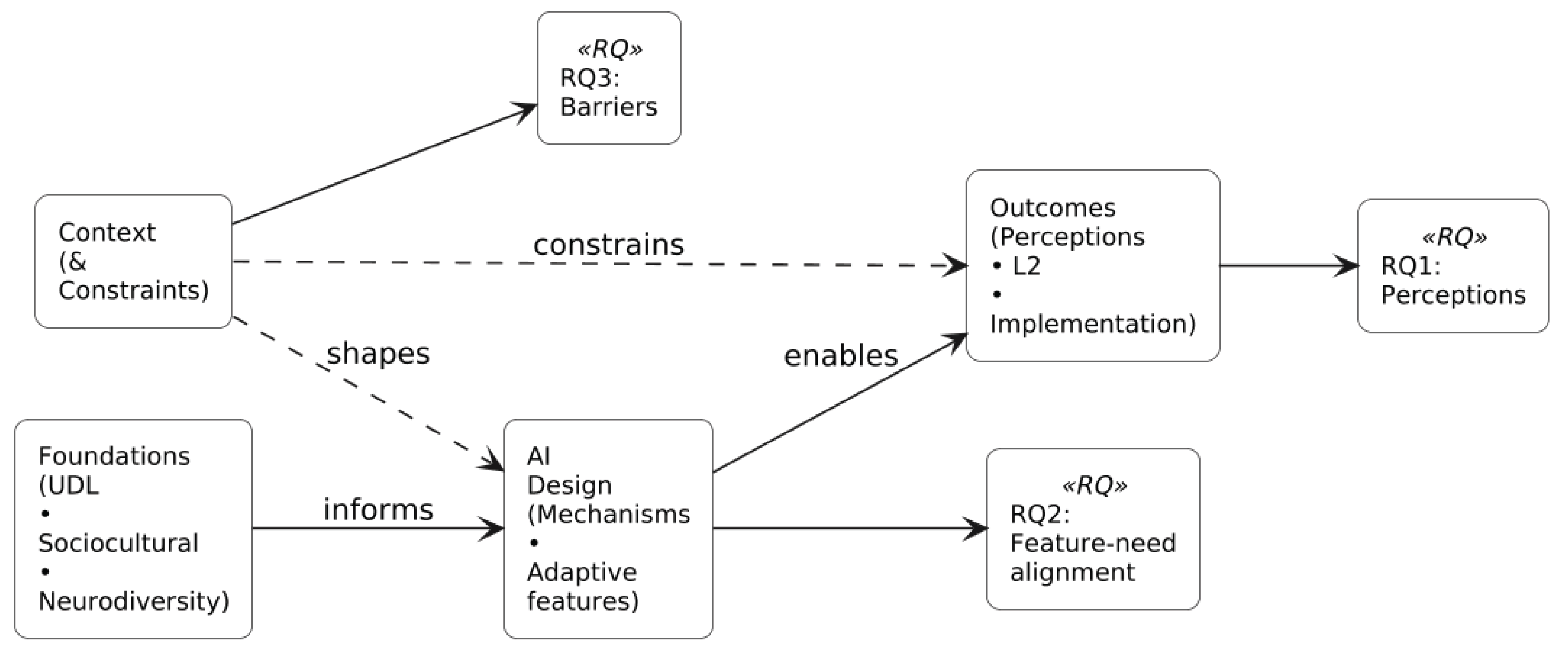
Figure 2.
Hierarchical Codes-Subcodes Model.
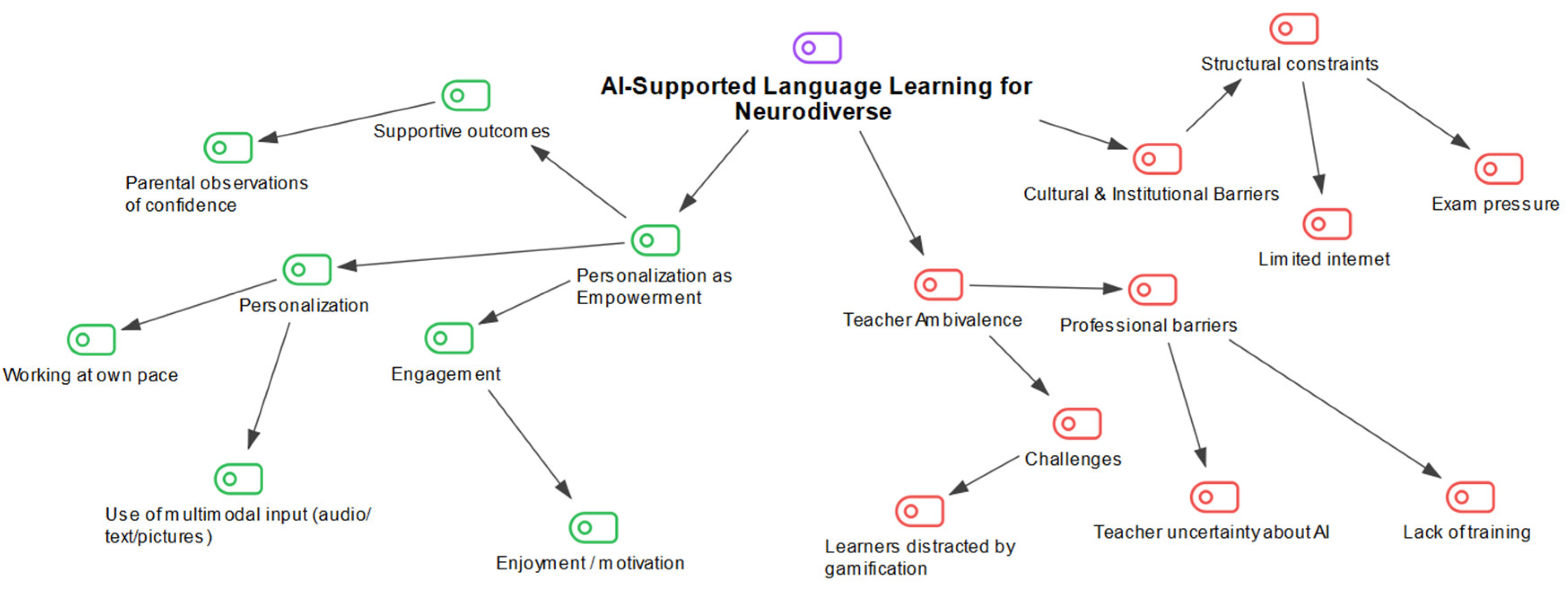

Table 1.
Sampling Procedure.
| Section | Measure | Categories / Description | n (%) | Notes / Procedures |
|---|---|---|---|---|
| Screening | Assessed for eligibility | All screened learners (3 sites) | 142 (100) | 20 private language institutions and schools from Tehran and Isfahan |
| Excluded (total) | Did not meet inclusion / participation criteria | 112 (78.9) | Reasons below (non-exclusive) | |
| No formal diagnosis | 41 (28.9) | Diagnosis required: ADHD, dyslexia, ASD | ||
| Co-occurring/ambiguous conditions | 27 (19.0) | Potential confound for conditionwise comparisons | ||
| Insufficient English proficiency | 26 (18.3) | Below A2 (institutional placement) | ||
| Severe behavioral/language barriers | 18 (12.7) | Would impede task participation | ||
| Eligible pool | Included for matching | Per condition | 30 (21.1) | ADHD: 10; Dyslexia: 10; ASD: 10 |
| Matching | Variables | Age, gender, CEFR (A2–B1), school type, pretests | - | Within-condition nearest-neighbor; tolerances: ≤10% (categorical), ≤0.20 SD (continuous) |
| Allocation | Condition × Arm | Experimental | Control | Total |
| ADHD | 5 | 5 | 10 | |
| Dyslexia | 5 | 5 | 10 | |
| ASD | 5 | 5 | 10 | |
| Subtotal | 15 (50.0%) | 15 (50.0%) | 30 (100%) | |
| Retention | Completed post-test | - | 30 (100) | No attrition |
| Blinding | Integrity measures | Teacher and rater blinding | - | Allocation by independent researcher; coded post-tests |
Abbreviations: ADHD = Attention-Deficit/Hyperactivity Disorder; ASD = Autism Spectrum Disorder; CEFR = Common European Framework of Reference.
Table 2.
Teachers’ Attitudes Toward AI in Language Teaching.
| Survey Item | Mean (SD) |
|---|---|
| AI can improve inclusivity for neurodiverse learners | 3.9 (0.8) |
| I feel confident in using AI tools in my classroom | 2.7 (0.9) |
| AI enhances student engagement | 4.0 (0.7) |
| AI could replace teachers in the future (reverse scored) | 2.2 (1.0) |
Note. N=97.
Table 3.
Learners’ Attitudes Toward AI in Language Learning.
| Survey Item | Mean (SD) |
|---|---|
| I enjoyed learning English with the AI tool | 4.2 (0.7) |
| The AI tool made learning easier for me | 3.8 (0.9) |
| I want to continue using AI for English study | 4.0 (0.8) |
Note. N=142.
Table 4.
Learning Outcomes: Experimental vs. Control Groups.
| Measure | Group | Pre-test Mean (SD) | Post-test Mean (SD) | Gain | ANCOVA F (1,57) | p-value | Cohen’s d [95% CI] | Hedges’ g |
|---|---|---|---|---|---|---|---|---|
| Vocabulary (%) | Exp. | 62.4 (11.3) | 78.7 (9.5) | +16.3 | 18.42 | < .001 | 1.21 [0.72, 1.65] | 1.19 |
| Control | 61.8 (12.0) | 66.2 (11.1) | +4.4 | 0.36 [0.02, 0.66] | 0.35 | |||
| Reading comprehension (%) | Exp. | 58.1 (12.6) | 71.4 (10.8) | +13.3 | 15.87 | < .001 | 1.05 [0.61, 1.47] | 1.03 |
| Control | 57.5 (11.9) | 60.1 (12.2) | +2.6 | 0.22 [-0.10, 0.52] | 0.21 | |||
| Oral fluency (wpm) | Exp. | 48.7 (9.2) | 57.9 (8.4) | +9.2 | 9.74 | < .01 | 0.89 [0.48, 1.26] | 0.87 |
| Control | 49.1 (8.8) | 51.0 (8.7) | +1.9 | 0.21 [-0.12, 0.49] | 0.20 |
Note: ANCOVA controlled for baseline pretest scores. Large effect sizes were observed for vocabulary and reading comprehension in the experimental group.
Table 5.
Themes Emerging from Interviews.
| Theme | Description | Example Quote |
|---|---|---|
| Personalization as Empowerment | AI tools allowed learners to work at their own pace and modality. | “I can listen instead of only reading, and I don’t feel left behind.” (Learner, dyslexia) |
| Teacher Ambivalence | Teachers recognized benefits but lacked training and clarity on implementation. | “I know it helps them, but I don’t know how to guide it.” (Teacher, Tehran) |
| Cultural and Institutional Barriers | Limited resources, exam-driven curricula, and skepticism constrained adoption. | “Our system is about tests and scores, not about adapting for each child.” (Teacher, Isfahan) |
Table 6.
Joint Display of Quantitative Outcomes and Qualitative Themes.
| Outcome | Quantitative Result | Related Qualitative Theme | Example Quote (Learner/Parent/Teacher) | Convergence / Divergence |
|---|---|---|---|---|
| Vocabulary gains | +16.3%, d = 1.21 (large effect) | Personalization as Empowerment | “With pictures and sound, I could remember more words.” (Learner, ADHD) | Convergence (improved outcomes reflected in learner experience) |
| Reading comprehension | +13.3%, d = 1.05 (large effect) | Cultural & Institutional Barriers | “He reads better now, but still feels pressure from exams.” (Parent) | Partial convergence (gains present, but exam system remains a barrier) |
| Oral fluency | +9.2 wpm, d = 0.89 (medium-to-large) | Teacher Ambivalence | “I can see they speak more, but I don’t know how to sustain it.” (Teacher) | Convergence with caution (outcomes positive, but teachers uncertain) |
| Motivation & engagement | High learner enjoyment (M = 4.2/5) | Personalization as Empowerment | “My daughter finally enjoys English, she even asks for extra practice.” (Parent) | Convergence (survey aligns with parental observation) |
Table 7.
Intervention Fidelity and Usage Characteristics.
| Measure | Experimental Group (n = 15) | Control Group (n = 15) |
|---|---|---|
| Average sessions attended | 8 (of 8 total) | 8 (of 8 total) |
| Average minutes per session | 41.2 | 39.7 |
| Features most frequently used | Gamification (73%), Text-to-speech (67%), Adaptive pacing (61%) | Traditional exercises (grammar drills, translation) |
| Teacher prompts per session (avg.) | 9.2 | 9.6 |
| Technical issues reported | 2 minor connectivity issues | 0 |
Note: Logs from the AI application were cross-checked with teacher session reports to ensure fidelity across both groups.
Disclaimer/Publisher’s Note: The statements, opinions and data contained in all publications are solely those of the individual author(s) and contributor(s) and not of MDPI and/or the editor(s). MDPI and/or the editor(s) disclaim responsibility for any injury to people or property resulting from any ideas, methods, instructions or products referred to in the content. |
© 2026 by the authors. Licensee MDPI, Basel, Switzerland. This article is an open access article distributed under the terms and conditions of the Creative Commons Attribution (CC BY) license (http://creativecommons.org/licenses/by/4.0/).
Copyright: This open access article is published under a Creative Commons CC BY 4.0 license, which permit the free download, distribution, and reuse, provided that the author and preprint are cited in any reuse.