

Submitted:
19 February 2026
Posted:
25 February 2026
Read the latest preprint version here
Abstract
For nearly a century, quantum mechanics (QM) has established itself as an
incredibly effective tool for predicting the collective movements and statistical
distributions of particles. However, its predictive success comes with a ma-
jor conceptual cost: the apparent abandonment of local realism. When one
attempts to apply the quantum formalism at the scale of an individual par-
ticle, paradoxes inevitably arise, such as non-locality, state superposition, or
wave-particle duality.
The central thesis of this document is that these paradoxes are not intrinsic
properties of nature, but rather result from an ontological category error. The
current formalism applies ensemble statistical laws designed to describe the
average behavior of a large number of particles to the scale of the individual,
where they are not intended to apply. This undue promotion of statistics to the
rank of instantaneous reality leads to a “magical” interpretation of statistically
balanced phenomena.
This article propose a reconsideration of three pillars of the standard quan-
tum interpretation:
Firstly, we demonstrate that the violation of Bell’s inequalities can be rein-
terpreted locally through the principle of Statistical Identity (shared initial
orientation), which establishes an equivalence between parallel and sequential
measurements, allowing the application of Malus’s law to reproduce the corre-
lations without requiring any non-local influence.
second, we show that interferometry does not reveal a superposition of states,
but rather involves a deterministic geometric transformation of probability dis-
tributions via polarization rotation.
Finally, we challenge the standard postulate of simultaneity in the Young’s
slits. We introduce an “event-by-event” formulation where interference fringes
emerge from temporal correlations preserved by the non-commutativity of av-
eraging, rather than from the interaction of simultaneous fields.
By restoring the distinction between statistical law and individual reality,
this work aims to end “quantum geocentrism” and lay the foundations for a
coherent, local, and realistic Sub-Quantique and Infra-Particules physics.
Keywords:
quantum theory
; quantum mechanics
1. Conceptual Framework: Statistical Identity & Temporal Realism
1.1. Locality and Statistical Identity (Bell’s Theorem)
Our approach relies on the principle of Statistical Identity: "entangled" pairs are treated as particles emitted with an identical hidden variable (orientation) , such that . Under this condition, we propose a fundamental equivalence:
The statistical outcome of two identical particles passing through two spatially separated polarizers ( and ) is indistinguishable from the outcome of a single particle passing through two successive polarizers ( then ).
In a standard sequential setup, the first polarizer acts as a passive selector: it filters the population based on the geometric compatibility of with . It does not "project" or create the state; it reveals it. In the parallel Bell setup, the measurement at on Particle 1 performs this exact same selection. Since Particle 2 shares the identical orientation , the fact that Particle 1 passed reveals that Particle 2 inherently belongs to the subset of orientations compatible with . Consequently, when Particle 2 encounters , its probability of passage is governed by the relative angle , exactly as if it had physically passed through first.
Thus, the correlation in is not the result of an instantaneous influence at a distance, but the direct application of Malus’s Law to a statistically identical doublet, preserving strict locality. The spatial separation of the particles does not break the logical chain of conditional probability established by their common origin.
1.2. Temporal Realism and the Simultaneity Postulate (Young’s Slits)
Standard quantum mechanics describes the field in a double-slit experiment using a single time variable t:
Assuming that the field passes through both slits at the exact same time t is not an experimental result, but a **postulate of simultaneity**. This assumption inherently forces the emergence of interference terms. To avoid this petitio principii, we must treat the events realistically with distinct temporal variables:
By introducing distinct times and , the time dependence does not automatically vanish upon averaging. The persistence of interference relies on the non-commutativity of temporal averaging over a product:
Consequently, the intensity takes a form that explicitly depends on the sum and difference of times.
The non-simplified form (sum of independent impacts):
The simplified form (modulated product):
The interference pattern is modulated by a temporal term involving . This confirms that fringes are not static abstractions but dynamic structures stabilized by temporal correlations.
The disappearance of fringes over extremely long durations (drift) becomes a testable prediction of the finite temporal coherence of the source, rather than a theoretical flaw.
2. Reinterpreting Locality: Malus’s Law and Bell’s Inequalities
2.1. The Standard Quantum Postulate
Quantum physics interprets the violation of Bell’s inequalities as the irrefutable proof of non-locality. According to this view, the existence of a correlation stronger than what classical mechanics would allow implies that particles must “communicate” instantaneously (faster than the speed of light) or be “non-local states” to coordinate their measurement outcomes, even when separated by great distances.
2.2. The Locality Argument (Malus’s Law)
The argument is based on the fact that the standard interpretation ignored the full scope of local probabilistic laws, notably Malus’s Law, when applied to pairs of particles produced with an identical orientation (polarization).
Experiments on Bell’s inequalities can be reinterpreted as only demonstrating the reality of Malus’s Law and that we can create identically oriented (polarized or anti-polarized) particles simultaneously, but without any long-distance interaction.
2.3. Experimental Scenario (4 Detectors: and )
Consider non-polarized source modeled by a uniform distribution , emitting two identical particles photons (identical responses to the same measurements but strictly local, without any distance-related influence) sent to two measurement arms. Photon 1 passes through then . Photon 2 passes through then . We assume we remove detector and .
For Photon 1 (passing through then ), the local probabilities are:
- Probability to pass :
- Probability to pass given that it passed (Malus’s Law):
- Joint probability to pass both (sequential then ):
- Joint probability to pass but be blocked by :
Note: We apply Malus’s law photon by photon to avoid confusion between global transmission probabilities and single-photon passage probabilities. For instance, a photon does not modify its polarization when passing through a polarizer : it is revealed, unlike a beam. Passage of the photon through thus reveals the pre-existing emission polarization of its twin that will pass through and , without any possibility to influence it.
For Photon 2 (passing through then ), the local probabilities are:
Inter-Photon Correlation ( vs ): The calculation of the correlation depends only on the settings of the first detector of Photon 1 () and the first detector of Photon 2 (), and the identical nature of their initial state . We have the trigonometric identities:
Numerically, the probability values are therefore the same regardless of polarizer order :
so we have :
Thus, we have the equalities for identical particles:
Correlation Calculation:
With the standard CHSH combination:
and the angles , , , :
Removing the two duplicate polarizers from and that are behind the first polarizers in the paths will not create non-locality, and it will preserve realism and setting independence, while preserving the same probability of Bell’s violation. This observation fundamentally calls into question all interpretations that Bell’s violations could have proven, such as entanglement (non-locality) or non-realism.
Conclusion: any system with a single particle or twin particles with statistical identity satisfying perfect marginal equilibrium must This leads inevitably to CHSH violations.
2.4. Statistical Identity
Our theoretical framework unifies quantum phenomena under the principle of statistical identity, with profound implications for understanding EPR correlations:
- -
- Bell violations prove statistical identity, not non-locality (Entanglement).
- -
- Quantum correlations emerge from classical geometric constraints.
Statistical identity means that two particles share exactly the same probabilistic properties, without any influence at a distance:
- -
- Same probability distribution
- -
- Same response to any measurement
- -
- Same realization of for each pair
Mathematically:
Emissions possibility: Unpolarized emitters ():
- Random behavior: (null correlations)
- Correlated behavior: , (correlations )
- Anti-correlated behavior: , (correlations )
This result shows that quantum physics predictions are perfectly consistent with locality. The voluntary or involuntary ignorance of the completeness of Malus’s Law led to the supposition that particles communicate with each other. This supposition could be considered unfounded if this reinterpretation of Malus’s Law is adopted. Particles do not need to communicate; they are emitted polarized in the same way (or inversely).
3. Reinterpreting of Superposition: The Interferometer Experiment
3.1. The Standard Quantum Postulate
Standard quantum mechanics interprets the operation of an interferometer (Mach-Zehnder type) by the principle of state superposition. It postulates that a particle entering the device simultaneously places itself in two distinct states (or paths) (e.g., ). The interference fringes at the output are said to result from the interaction of these two superimposed realities when they recombine (the famous "collapse").
3.2. The Realistic Argument (Geometric Transformation)
The realistic approach demonstrates that the interferometer is not a creator of ontological superpositions, but a device performing a geometric rotation of the polarization (or phase) angle, simply transforming the probabilistic distributions according to Malus’s Law.
3.3. Probabilistic Transformation by Geometric Rotation
Consider a polarized source at angle and a detector oriented at angle a and . According to Malus’ law:
3.4. Deterministic and Balanced States
The analysis of angles reveals distinct regimes:
- Deterministic States ():. Maximum tendency toward positive detection.
- Opposite States ():. Maximum tendency toward negative detection.
- Balanced States ():. Equal probabilities between both tendencies.
Intermediate states exhibit a probabilistic advantage ( or ) without absolute determinism.
3.5. The Interferometer Mechanism
The interferometer physically performs a rotation on the angle , transforming probabilistic distributions:
- Transformation from Extreme States to Balanced Marginals:
- Transformation from Balanced Marginals to Extreme States:
3.6. Reproduction of Quantum Statistics
This geometric rotation mechanism perfectly explains interferometric experiment results: - No state superposition necessary, Purely geometric transformations of probabilistic parameters, and Exact reproduction of predicted quantum statistics.
The interferometer thus appears as a device of probabilistic transformation through rotation, rather than a revealer of ontological superpositions, preserving a totally realistic and local interpretation of quantum phenomena.
4. Reinterpreting Wave-Particle Duality (The Young’s Slits)
ℓ : distance from extended source → plane of the slits, L : distance slits → screen, a : effective width of a slit, b : distance between the centers of the two slits, : wavelength (or de Broglie wavelength), x : transverse coordinate on the screen.
4.1. Standard Quantum-Optical Derivation (Reference Model)
This section recalls the standard quantum-optical (or classical wave) derivation of the interference formula, based on the simultaneous superposition of two fields and explicit temporal averaging. It serves as a reference framework against which the event-by-event formulation introduced later will be compared.
We start from two real time-dependent contributions coming from the two “paths”:
where include the spatial dependence (position x) and the path difference .
The detector measures a power averaged over a time window long compared with the period . We denote temporal averaging by . The instantaneous total intensity (real field) is
Averaging gives:
Computation of the terms (time average) and for the cross term, using the identity and the vanishing of the fast oscillating terms:
Collecting terms:
To account for partial coherence (extended source, fluctuations, etc.) one introduces the complex degree of coherence (with modulus ), hence the commonly used form:
Practical remarks:
- the temporal average removes terms like ;
- for a uniform source at large distance, Van Cittert–Zernike gives ;
- experimentally V is measured by .
4.2. Physical Limitations of the Simultaneity Postulate
It should be noted that the temporal average only removes terms such as if one assumes that the events occur simultaneously—meaning the probability field passes through both slits at the exact same time. Under this postulate, the formula is not an independent proof matching experimental results, but rather the logical consequence of the assumption that fields traversing the slits at the same moment must interfere; this is a petitio principii (circular reasoning). While it is logical under this postulate that one cannot simply use , the situation changes if we assume that passages occur at different times: and . In such a case, the standard identity would no longer be applicable, as the averaging process would involve distinct temporal variables :
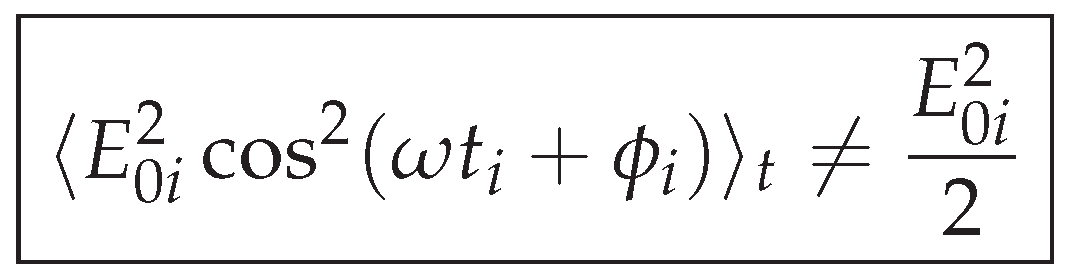
In the standard postulat, the simultaneity assumption is precisely what allows the fast-oscillating terms to vanish, leaving only the static interference pattern. Consequently, a reformulation is necessary, particularly since recent advancements in “Time-Domain Young’s Slit” experiments (e.g., Tirole et al., 2023) have demonstrated that the temporal delay between paths is a determining physical factor in the formation of the pattern, directly challenging the validity of simple temporal averaging.
4.3. New Model: Event-by-Event
Unlike the standard derivation recalled above, the model developed in this paper does not assume simultaneous coexisting fields nor an a priori temporal averaging. The following sections present an alternative event-by-event formulation where modulation arises from temporal correlations of individual emissions rather than from an cross-term.
No temporal averaging is introduced at this stage. The description is strictly event by event.
The contributions associated with the two slits are not assumed simultaneous. We consider two distinct emissions reaching the screen at different times and .
We square each contribution separately at its respective arrival time:
We define the base intensities:
The total intensity detected for an event pair is the sum of the individual impacts:
The simplified form (modulated product):
This formulation explicitly separates:
- diffraction (),
- temporal modulation ,
- relative phase including geometric phase and temporal shift .
4.4. Particular Symmetric Case
Using the trigonometric identity , and defining the sum and difference of times , and we obtain:
This result is obtained without interaction between fields and without any cross-term.
4.5. Role of Time and Randomness
In the single-slit case, a single phase term appears, whose mean can cancel. In the double-slit case, the two conjugate terms and preserve a relative structure protected by the geometric offset.
These conditions cannot be satisfied statistically under temporal noise. Thus, randomness cannot suppress the whole modulation.
4.6. Conclusion
In a single slit, the absence of a relative structure makes the modulation fully vulnerable to temporal noise. In the double slit, the temporary term introduces a robust relative structure, allowing fringes to exist, at least transiently, even in the presence of temporal randomness. Simultaneity is not required; it is the relative geometry of the paths that protects the spatial modulation.
5. Model Validation via Statistical Classical Mechanics
5.1. Virial Relation and Statistical Force Balance
The Virial Theorem establishes a general statistical relation between kinetic and potential energies for bound systems. For a central Coulomb potential , it reads
where brackets denote ensemble or time averages. Using classical expressions, this relation becomes :
Rewriting it in radial form yields the equivalent statistical identity
which formally corresponds to an equality between average centrifugal and electrostatic forces. This relation characterizes a condition of statistical equilibrium and does not rely on the existence of well-defined particle trajectories.
Interpretative Implications.
The emergence of such equilibrium relations from purely statistical considerations highlights a key conceptual point: constraints governing ensemble averages can reproduce structures often interpreted as intrinsically quantum. When these statistical relations are implicitly promoted to ontological statements about individual particles or single events, interpretative paradoxes naturally arise.
Within the present framework, quantum mechanical formalisms are viewed as providing accurate statistical predictions for measurement outcomes, while individual physical events remain local and realist. The appearance of non-locality, superposition, or indeterminism is thus traced back to the attribution of physical reality to quantities that are fundamentally statistical in nature.
6. Conclusions
Quantum Mechanics (QM) describes the collective movements and statistical distributions of particles very well. However, applying it to a single individual particle inevitably leads to measurement problems, seemingly ’magical’ faster than light relations, non-locality, or state duality. The error lies in applying a statistical law of the ensemble -not designed to describe a single individual particle— to the ontological scale of the individual or the application probabilities established based on temporal averages to an instantaneous event; This leads to an erroneous interpretation. Conversely, applying laws such as Malus’s Law for photons (or equivalent laws for other particles) restores realism and locality for each particle while faithfully reproducing the probabilities observed for the entire group:
- -
- A single particle can only pass or fail to pass through a polarizer: it already possesses its polarization upon emission (the polarizer merely reveals it, when the interferometer can alter it), and its passage probability simply follows Malus’s law. An individual particle cannot change its polarization by passing through a polarizer, it is the entire group of particles that collectively polarizes.
- -
- Two twin particles emitted with the same initial orientation can yield the same outcome for a given polarizer and, even when sent separately, exhibit exactly the same passage statistics through two polarizers.
- -
- A group of particles can produce interference-like patterns while each particle remains a localized corpuscle: particle by particle emissions yield individual impacts, whose accumulation forms a structured distribution. In a single slit this structure is destroyed by temporal noise, whereas in the double slit the temporary term provides a relative reference that stabilizes the modulation with no simultaneity is required.
On this basis, it is appropriate and scientifically healthy to reassess long-standing interpretational claims. Just as scientific thought corrected geocentrism when empirical and conceptual grounds required it, so too may physics benefit from re-examining the ontological leaps made when ensemble statistics were promoted to statements about individual instantaneous reality. Ending this “quantum geocentrism” would open the way to rebuilding a coherent, local and realistic conceptual foundation for microscopic physics, one that preserves the empirical success of QM while eliminating unnecessary metaphysical baggage.
6.1. Experimental Tests of Locality
6.2. Bell Experiments: Locality Tested Through Polarization Correlations
To distinguish the local realistic model (based on Malus’s Law and particles produced with an identical initial orientation ) from the non-local quantum model, the following experiments are proposed:
- Test by Alternating Marginals (2 Polarizers Case): In a standard Bell experiment, alternating or manipulating the marginal probability distributions (e.g., on a single branch should lead to the loss of the Bell inequality violation at at 35% of marginal bias). This would validate that the violation is conditioned by the initial probabilities of the local state , and not by an unalterable non-local correlation.
- Test by Alternating Marginals (4 Polarizers Case): Using the four-polarizer scenario ( and ), alternating the marginals should lead to the elimination of inequality violations for the inter-branch correlation (), while retaining the same sequential probabilities for the intra-branch (). Furthermore, if the order of the polarizers is reversed on one of the branches, the sequential passage probabilities should remain identical, demonstrating the independence of the measurement order for the individual particle relative to non-local correlations.
- Prediction regarding Two Physically Distinct Emitters: Set two physically distinct emitters in the same way so that they each produce particles with the same initial orientation . Testing the Bell correlation between a photon from Emitter A and a photon from Emitter B (which are therefore not from the same production pair) should also show a violation of Bell’s inequalities. Such a result would prove that the observed correlation is due to the local nature of the production (the identical initial state ) and not to a non-local entanglement specific to a single pair.
6.3. Young Experiments: Locality Tested through Long-Term Interference
The question of the fundamental role of in fringe formation is not settled by an a priori interpretation, but by a clear experimental criterion based on the long-term particle by particle experiment to observe the asymptotic evolution of fringe visibility, with two experimental outcomes possible:
- Progressive disappearance of fringes at long times. If, as the number of events increases, fringes become less and less discernible until they vanish into statistical noise, then the temporal factor must be identified as the dominant parameter of the modulation. In this case, the fringes do not correspond to a real interaction between two simultaneous waves, but to a transient modulation linked to the temporal correlation of emissions. The most probable theory is that the wave is associated with an internal periodic dynamics (parameterized by ). (E.g.: a sinusoidal internal orbit (orbital frequency w) — energy rotating around an empty center for the photon, and around a confined energy or massive center for the electron.)
- Indefinite persistence of fringes. If, on the contrary, fringes remain perfectly discernible even at very long times, then the modulation cannot be attributed to a transient temporal effect. This implies the existence of a coherent field associated with the particle ( probablythe Vector Potential (consistent with the Aharonov-Bohm effect)), able to interfere with itself when two slits are open, this theory implies a finite “interaction distance”: if the slits are separated beyond the physical extent of the particle’s field, or if another particle is too distant, their respective surroundings fields no longer overlap or correlate. This suggests that interference is not the result of an abstract wave superposition, but an event-wise process governed by the temporal and spatial correlation of the Vector Potential as it traverses the slits.
-
Prediction on phase drift and technical instabilitiesUnless emission is performed at a regular interval corresponding to frequency , one predicts a systematic fringe shift over time. The internal temporal phase eventually causes a spatial drift of the modulation. On macroscopic time scales, this drift produces a constant displacement of fringe positions which, by statistical accumulation, ends up smoothing the distribution.
What experimenters (Bach et al., Tonomura) identify as “technical instabilities” or “environmental drifts” during prolonged recordings could in fact constitute evidence of a fundamental temporal dephasing process. The disappearance of the pattern at “infinite time” would therefore not be an experimental defect, but a confirmation of the event-wise and temporal nature of interference.
Author Contributions
H.C. conceived the research program, developed the theoretical framework, implemented all numerical simulations, and wrote the manuscript. The manuscript dataset is archived and citable via Zenodo: https://doi.org/10.5281/zenodo.17929338.
Acknowledgments
The author acknowledges the use of open-source software packages, the simulation codes and datasets generated during this study are available in the GitHub repository: https://github.com/Young-Simulation/simulation-/actions.
References
- Tirole, R.; et al. Double-slit time diffraction at a time-varying boundary. Nature Physics 2023, 19(3), 399–405. [Google Scholar] [CrossRef]
- Bach, R.; Pope, D.; Liou, S.-H.; Batelaan, H. Controlled double-slit electron diffraction. New Journal of Physics 2013, 15(3), 033018. [Google Scholar] [CrossRef]
- Tonomura, A.; et al. Demonstration of single-electron build-up of an interference pattern. American Journal of Physics 1989, 57(2), 117–120. [Google Scholar] [CrossRef]
- Aspect, A.; Dalibard, J.; Roger, G. Experimental Test of Bell’s Inequalities Using Time-Varying Analyzers. Physical Review Letters 1982, 49(25), 1804–1807. [Google Scholar] [CrossRef]
- Greenberger, D. M.; Horne, M. A.; Zeilinger, A. Going Beyond Bell’s Theorem. In Bell’s Theorem, Quantum Theory and Conceptions of the Universe; Springer, 1989; pp. 69–72. [Google Scholar]
- Mermin, N. D. Extreme quantum entanglement in a superposition of macroscopically distinct states. Physical Review Letters 1990, 65(15), 1838–1840. [Google Scholar] [CrossRef] [PubMed]
- Bell, J. S. On the Einstein Podolsky Rosen Paradox. Physics Physique Fizika 1964, 1(3), 195–200. [Google Scholar] [CrossRef]
- Clauser, J. F.; Horne, M. A.; Shimony, A.; Holt, R. A. Proposed Experiment to Test Local Hidden-Variable Theories. Physical Review Letters 1969, 23(15), 880–884. [Google Scholar] [CrossRef]
- Pan, J.-W.; et al. Violation of Bell inequality with unentangled photons. Science Advances 2025, 11(31), eadr1794. [Google Scholar] [CrossRef] [PubMed]
- Nielsen, M. A.; Chuang, I. L. Quantum Computation and Quantum Information; Cambridge University Press, 2010. [Google Scholar]
- Peres, A. Quantum Theory: Concepts and Methods; Kluwer Academic Publishers, 1993. [Google Scholar]
- Hardy, L. Nonlocality for two particles without inequalities for almost all entangled states. Physical Review Letters 1993, 71(11), 1665–1668. [Google Scholar] [CrossRef] [PubMed]
- Einstein, A.; Podolsky, B.; Rosen, N. Can Quantum-Mechanical Description of Physical Reality Be Considered Complete? Physical Review 1935, 47(10), 777–780. [Google Scholar] [CrossRef]
- Dirac, P. A. M. The Quantum Theory of the Electron. Proceedings of the Royal Society of London. Series A, Containing Papers of a Mathematical and Physical Character 1928, 117(778), 610–624. [Google Scholar] [CrossRef]
- Foldy, L. L.; Wouthuysen, S. A. On the Dirac Theory of Spin 1/2 Particles. Physical Review 1950, 78(1), 29. [Google Scholar] [CrossRef]
- Bohm, D. A Suggested Interpretation of the Quantum Theory in Terms of “Hidden” Variables. I. Physical Review 1952, 85(2), 166–179. [Google Scholar] [CrossRef]
- Aharonov, Y.; Bohm, D. Significance of Electromagnetic Potentials in the Quantum Theory. Physical Review 1959, 115(3), 485–491. [Google Scholar] [CrossRef]
Disclaimer/Publisher’s Note: The statements, opinions and data contained in all publications are solely those of the individual author(s) and contributor(s) and not of MDPI and/or the editor(s). MDPI and/or the editor(s) disclaim responsibility for any injury to people or property resulting from any ideas, methods, instructions or products referred to in the content. |
© 2026 by the authors. Licensee MDPI, Basel, Switzerland. This article is an open access article distributed under the terms and conditions of the Creative Commons Attribution (CC BY) license (http://creativecommons.org/licenses/by/4.0/).
Copyright: This open access article is published under a Creative Commons CC BY 4.0 license, which permit the free download, distribution, and reuse, provided that the author and preprint are cited in any reuse.