
Submitted:
16 February 2026
Posted:
27 February 2026
You are already at the latest version
Abstract
Rural architectural heritage sites in Korea, including rice mills, breweries, and granaries, face an increasing risk of neglect, damage, and demolition. Because most of these structures lack recognition in formal heritage designation systems, their conservation and management are challenging. This study proposes a comprehensive evaluation framework for rural architectural heritage. Based on a literature review and expert consultations, we derived 18 evaluation indicators grouped into six value criteria: historical, architectural/artistic, social/cultural, landscape, economic, and utilitarian values. The Analytic Hierarchy Process (AHP) was employed to determine the relative importance and priority of these indicators. The results indicate that historical value had the highest weight among the six criteria, followed by architectural/artistic and social/cultural values. Among the 18 indicators, “representativeness of the period” ranked highest, followed by “rarity,” “historicity,” and "architectural excellence." However, the indicators associated with economic and utilitarian values received relatively low weights. The framework validated by applying it to 17 rural heritage sites in Buyeo County, a representative rural region in Korea. This study presents a systematic and value-based evaluation framework that reflects the regional and industrial characteristics of rural architectural heritage and provides theoretical and practical implications for its conservation and adaptive reuse.
Keywords:
rural architectural heritage
; conservation
; adaptive reuse
; evaluation indicator
; value-based rational decision making
; analytic hierarchy process
1. Introduction
Since modernization, agricultural facilities such as rice mills, breweries, granaries, as well as rural community facilities including village halls and village communal workshops, have been established and are widely distributed across rural areas in Korea. These facilities not only represent the local history of rural regions and socio-economic transformation of Korea but also embody their identity and sense of place. Furthermore, reflecting the industrial characteristics of agriculture, they constitute rural architectural heritage that possesses diverse values and significance, including historical, architectural, and social [1,2,3].
In the late 20th century, Korea’s industrial structure shifted from a primary-sector-oriented economy, such as agriculture, forestry, and livestock farming, to one dominated by secondary (manufacturing) and tertiary (service) industries. Since the 2000s, rural areas faced a population decline driven by multiple factors, including low birth rates, rapid population aging, and rural-to-urban migration. Under these structural transformations and the ongoing population decline, agriculture and related industries, which are representative industries in rural Korea, have steadily declined. Consequently, many agricultural and rural facilities constructed during the modernization period are abandoned and underutilized, and some buildings face the imminent threat of damage or demolition owing to development projects [4,5].
Buyeo County, a representative rural region in Korea, has a high concentration of rural architectural heritage sites, including rice mills, breweries, factories, warehouses, and community facilities. Buyeo is a historically significant region, as it encompasses the Baekje Historic Areas, a UNESCO World Heritage Site. However, in contrast to Baekje-era heritage sites, which are systematically protected and managed at the national level through World Heritage listings, rural architectural heritage sites of modern and contemporary periods have been largely overlooked, leaving a blind spot in institutional heritage management. Although the Korean government designates a limited number of modern and contemporary architectural heritage sites as “National Registered Cultural Heritage” or “Exceptional Architectural Assets,” most rural architectural heritage sites are not included in official heritage registers, leaving them without systematic management [6,7].
To systematically preserve, manage, and utilize rural architectural heritage, an evaluation system comprising criteria and indicators for selecting and assessing valuable cultural heritage is essential. At the international level, UNESCO has established the Criteria for Selection of World Heritage Sites [8], while the International Council on Monuments and Sites (ICOMOS) and the International Committee for the Conservation of the Industrial Heritage (TICCIH) developed Principles for the Conservation of Industrial Heritage [9]. In addition, organizations such as Historic England and the Australian Heritage Council provide specific guidelines for cultural heritage conservation [10,11].
In South Korea, institutional standards exist under the Act on Conservation and Utilization of Modern and Contemporary Cultural Heritage [12] and the Act on Value Enhancement of Hanok and Other Architectural Assets [13]. However, the existing cultural heritage principles and guidelines in Korea do not include evaluation criteria or indicators tailored to rural architectural heritage sites [14]. Moreover, the evaluation indicators presented in previous studies concentrate on preservation-oriented values, such as historical and artistic values, which limit their ability to adequately assess architectural heritage in terms of utilization and adaptive reuse. Therefore, a more comprehensive evaluation framework specifically designed for rural architectural heritage that integrates preservation and utilization values is imperative.
This study aims to develop a systematic and comprehensive evaluation framework for the conservation and adaptive reuse of rural architectural heritage sites by identifying evaluation indicators and analyzing their relative importance. Specifically, this study seeks to establish comprehensive and integrated evaluation indicators that reflect the regional and industrial characteristics of rural architectural heritage and encompass both preservation and utilization values. This study analyzes the relative importance and priority of the proposed indicators and incorporates indicator-specific weights to facilitate value-based and rational decision-making in heritage selection. Finally, this study aims to empirically validate the proposed framework by applying and assessing the value of rural architectural heritage sites in Korea.
2. Literature Review
2.1. Rural Architectural Heritage
Recent research and international discourse on cultural heritage have increasingly expanded to include rural areas. Studies on cultural heritage in rural areas have primarily focused on architectural heritage, industrial heritage, agricultural heritage, rural landscapes, and vernacular architecture [15,16,17]. However, a precise academic definition of “rural architectural heritage” remains elusive. This study seeks to clarify the concept of “rural architectural heritage” by examining the respective definitions of “rural” and “architectural heritage.” Furthermore, based on a literature review of the concepts and scope of related terms, such as architectural assets, rural industrial heritage, and agricultural heritage, this study analyzes the distinctions between rural architectural heritage and these related concepts and explores their characteristics and scope.
First, the dictionary definition of “rural” refers to non-urban or countryside areas characterized by lower population density and more dispersed settlement patterns than cities. The concept of “rural” refers to both administrative districts or regional divisions and the lives, lifestyles, and economic activities of people living in rural areas which are distinct from urban context [18,19]. Second, “architectural heritage” is broadly defined as buildings and structures that are inherited from the past and have historical importance [20]. According to the World Heritage Convention (1972), UNESCO defines cultural heritage as monuments, buildings, or sites with Outstanding Universal Value (OUV) from historical, artistic, or scientific perspectives [21]. In addition, through the Venice Charter (1964), ICOMOS defines the concept of historic monuments as including not only individual architectural works but also the urban or rural settings. This definition extends to both great masterpieces and more modest works that have acquired cultural significance over time [22].
In Korea, the term “architectural asset” is common, and the Act on Value Enhancement of Hanok and Other Architectural Assets [13] addresses architectural assets. This Act defines architectural assets as buildings, spatial environments, and infrastructure that possess social, economic, and scenic value valid in the present and future, which either have unique historical and cultural value or contribute to promoting national architectural culture and the formation of local identity. In this sense, the concept of architectural assets encompasses not only buildings, but also spatial environments and infrastructure, placing emphasis on their potential as resources for active utilization.
In a study on rural architectural heritage, Olğun and Karatosun [23] defined rural architectural heritage as “a heritage with unique characteristics of rural areas,” and stated, “its importance in terms of conservation is increasing.” They included traditional buildings (houses, warehouses, workshops, and barns), gardens and courtyards, and village squares as examples of rural architectural heritage. Kahraman and Arpacıoğlu [24] explained that rural architecture “involves the structures and environments built by settled societies in rural areas, and rural architecture have different characteristics in each region depending on local materials, climate, geographical features, and lifestyle.” Soykök et al. [25] defined rural architectural heritage as “a repository of agricultural activities, traditional crafts, and rural lifestyles that imparts significant value and meaning to rural areas.”
Terms conceptually related to rural architectural heritage include industrial heritage in rural areas, agricultural heritage, rural landscapes, rural vernacular heritage, and vernacular architecture. Industrial heritage is defined in the Nizhny Tagil Charter (2003) as “the heritage of industrial culture with historical, technological, social, architectural, scientific value” [26]. It broadly refers to industrial products, technologies, and infrastructure that have contributed to modernization, and includes not only tangible buildings and structures but also social and engineering achievements resulting from new technologies [27]. Within this category, rural industrial heritage refers specifically to industrial heritage located in rural areas and is associated primarily with the agriculture, forestry, and livestock industries, including rice mills, sawmills, dairy facilities, agricultural warehouses, and wineries [4].
Agricultural heritage, comprising “agriculture” and “heritage,” is broadly understood as agricultural wisdom and customs, as well as physical buildings and structures transmitted over a long period [28]. It is defined as “the totality of elements that influence sustainable life in rural areas,” including land and facilities, equipment and tools, agricultural technology, farmers’ activities and culture, rural living spaces, and regional landscapes [29]. In addition, modern agricultural heritage focuses on agricultural built structures rather than general agricultural heritage and is defined as “agricultural heritage that combines with the historical, technological aspects related to agriculture in the modern era” [29,30].
According to the ICOMOS-IFLA Principles [16], rural landscapes encompass both tangible and intangible heritage in rural areas, including land, landforms, water resources, infrastructure, vegetation, settlements, rural buildings, vernacular architecture, and the physical, cultural, and environmental settings in a broader sense”. In addition, rural landscapes include cultural values and meanings attributed to landscapes such as cultural knowledge, traditions, customs, community identity, and a sense of belonging.
Vernacular architecture is generally defined as indigenous and traditional buildings constructed in a specific region using local materials, typically by residents without professional intervention [31,32]. Rural vernacular heritage refers to vernacular architecture with heritage value in a rural context. Examples include rural dwellings, barns, rice mills, breweries, granaries, foundries, blacksmith shops, wells, washing places, stone walls, and fences [33,34]. In 1999, ICOMOS established principles for protecting vernacular cultural heritage through the Charter on the Built Vernacular Heritage [17].
Based on a comparative review of these related concepts, this study defines rural architectural heritage as cultural heritage comprising buildings, spatial environments, and structures with historical, artistic, social, landscape, and economic values located in rural areas. Rural architectural heritage reflects both the regional characteristics of rural areas and the industrial attributes of agriculture, thereby distinguishing it from architectural heritage in urban contexts.
2.2. The Value of Architectural Heritage
Since the Athens Charter [35] and the Venice Charter [22], the value of cultural heritage has been discussed primarily in terms of historical, artistic, and scientific values. Depending on the type and characteristics of cultural heritage, additional value dimensions, such as architectural, social, cultural, technological, environmental, and economic values, have been incorporated into heritage discourse [15,36].
Following the UNESCO World Heritage Convention [21], authenticity and integrity have been recognized as core values and essential criteria for heritage assessment. International discussions on architectural heritage have been led mainly by ICOMOS and TICCIH. Early research focused on designated heritage sites such as monuments and buildings with historical traditions. Since the late 20th century, the scope of architectural heritage has expanded to include built heritage, architectural asset, industrial heritage, cultural landscapes, rural landscapes, vernacular architecture, and indigenous heritage. Table 1 summarizes the principles and guidelines related to cultural heritage values established by international organizations such as UNESCO, ICOMOS and TICCIH, as well as heritage organizations in the UK.
In early theoretical studies on heritage value, Riegl (1902) [44] classified the value of heritage as monuments into commemorative and contemporary values; the former includes age and historical value, whereas the latter comprises use-value and newness. From the perspective of cultural resources, Lipe (1984) [45] identified four categories of value: associative/symbolic, informational, aesthetic, and economic values. Throsby (2001) [46] distinguished cultural and economic values into two overarching categories. Cultural value encompasses aesthetic, spiritual, social, historical, symbolic, authentic, and locational values, which are subdivided into use value, non-use value, and beneficial externalities. Similarly, Mason (2002) [47] classified heritage values into socio-cultural and economic values. The former includes historical, cultural/symbolic, social, spiritual/religious, and aesthetic values, while the latter includes use and non-use values. The non-use value was further divided into existence, option, and bequest values [48].
Since the 2000s, scholars such as Throsby [46] and Mason [47] broadly divided heritage values into two categories: socio-cultural and economic values. Other researchers proposed frameworks such as preservation vs. utilization values [49,50] and intrinsic vs. extrinsic values [51,52].
A notable characteristic of recent research on architectural heritage value is the increasing emphasis on economic and utilitarian dimensions, which are now regarded as more significant evaluation criteria than those in earlier studies. Accordingly, the literature contains a wide range of value concepts related to the economic and practical aspects of architectural heritage, such as utilitarian value, use value, utility value, availability, economic feasibility, real estate value, and functional usefulness. Table 2 provides a summary of the architectural heritage values identified in previous studies.
2.3. Evaluating Architectural Heritage Value
The purpose of assessing the value of cultural heritage is to facilitate value-based and rational decision-making for its conservation and sustainable use by recognizing its significance. Specifically, the cultural heritage value assessment provides a basis for determining why a heritage asset is important, what should be preserved, and how it should be utilized. Based on value assessments, governments designate or register heritage assets for protection and establish priorities for their repair, restoration, and revitalization. Similarly, the assessment of architectural heritage value is crucial because it provides a key reference for decision-making related to the conservation, management, and adaptive reuse of heritage assets.
Research on the assessment of architectural heritage value has primarily concentrated on modern architectural heritage, architectural assets, and industrial heritage. These studies derive evaluation criteria or indicators from inherent values, such as historical and architectural values, and employ scientific and analytical methods, such as expert surveys, to analyze the relative importance of these criteria or indicators. Kim and Kim [57] derived 5 conservation value criteria (historical, architectural, social, economic, and urban contextual values) and 20 elements based on expert surveys to evaluate modern architectural heritage. The authors found that social values like symbolism and regionality were the most significant. Choi [58] developed a value assessment framework consisting of ten indicators: five conservation values (historical, academic, artistic, landscape, and utilitarian) and five characteristics (symbolism, rarity, regionality, originality, and context). The results showed that historical, academic, and artistic values ranked highest, whereas landscape and utilitarian values were relatively less important. Park and Sung [49] identified four criteria related to preservation value (historical, aesthetic, socio-cultural, and academic) and two criteria related to utilization value (educational and economic). An importance analysis conducted through expert surveys and pairwise comparisons revealed that preservation values were more important than utilization values at the upper level. At the lower level, historical value ranked highest, followed by sociocultural, aesthetic, academic, educational, and economic values. Nam and Jo [50] proposed 16 evaluation indicators based on 4 criteria: historical value, architectural excellence, regional utility, and collectivity. However, their framework did not incorporate relative weightings among the criteria. Recent studies adopted mixed method approaches that combine qualitative methods, such as focus group interviews (FGI) and grounded theory, with quantitative techniques, including the Analytic Hierarchy Process (AHP) and Delphi method, to enhance objectivity and rationality in evaluation model development. These models were validated through their application to architectural heritage cases.
Hu et al. [52] developed a comprehensive evaluation framework combining Kernel Density Estimation (KDE), the Delphi method, and AHP to assess the architectural heritage in Overseas Chinese New Villages. Their AHP model employed a four-level hierarchical structure consisting of goals, indicators, elements, and factors. The results of the importance analysis revealed that, at the indicator level, ontological value was rated higher than extrinsic value, while at the element level, historical value was the most important, followed by cultural, functional, artistic, scientific, social, and environmental values. The authors verified the evaluation framework by applying it to 247 buildings in the Fujian Region. Similarly, Huang et al. [63], in a study on the cultural value assessment of architectural heritage in Longxing historical and cultural town, Yubei district, Chongqing, China, developed a three-level hierarchical evaluation system for AHP analysis comprising targets, criteria, and indicators. The results based on questionnaire surveys showed that historic value was rated as the most important at the criterion level, followed by artistic/aesthetic value, local/place value, and scientific/technical value. Qiao et al. [64] employed grounded theory to identify the core concepts and components of a value assessment for Tubao architectural heritage in China. Based on a qualitative analysis, they derived 5 evaluation criteria and 14 evaluation indicators and subsequently applied AHP to analyze their relative importance. The results indicated that historical values ranked highest, followed by artistic, scientific, social, and cultural values. Qiao et al. [62] analyzed importance using an AHP method combined with fuzzy control to mitigate the influence of subjective perceptions. Additionally, they derived 4 evaluation criteria and 16 sub-criteria. The authors found that, at the upper level, architectural features were the most important, followed by social contribution, educational outreach, and the surrounding environment. At the lower level, the original appearance, structural integrity, and effective activation were the most important factors. The proposed criteria were validated through their application to 135 modern architectural heritage sites along the South Manchuria Railway in China. Chen et al. [61] developed a value assessment model for urban industrial heritage comprising 8 evaluation criteria and 16 sub-criteria. The AHP results indicated that historical value, followed by artistic, technological, functional, cultural, economic, environmental, and social values were important at the criterion level. The model was validated by applying it to the Fuzhou Shipbuilding industrial heritage site in China.
In summary, previous studies generally assign greater importance to preservation-oriented criteria, such as historical and artistic values, whereas utilization-oriented criteria, including economic, functional, and landscape values, tend to receive lower importance ratings. Nevertheless, analyses of utilization-oriented indicators and elements have identified a wide range of criteria that reflect the characteristics of the modern period, regional architectural and cultural attributes, and the surrounding environmental and landscape context. These include the representativeness of the period, historical significance, regional architectural characteristics, local culture, cultural identity, regional and environmental contexts, collective memory, and community solidarity. Despite these advances, few studies have developed evaluation indicators tailored to rural architectural heritage sites. Moreover, few studies have established a comprehensive evaluation framework that integrates indicator derivation, importance analysis, and empirical validation.
3. Materials and Methods
3.1. Study Area and Research Subjects
The case study area is Buyeo County (gun), which is located in the central–western region of South Korea. Buyeo County covers an area of 624.62 km² and is administratively divided into one town (eup) and 15 townships (myeon) [65]. As a representative rural area in Korea, Buyeo County contains a substantial number of rural architectural heritage sites, including rice mills, breweries, and granaries. Buyeo County was selected as the study area because it exhibits distinct rural characteristics as defined by Korea’s Framework Act on Agriculture, Rural Community, and Food Industry [66]. In addition, the county retains a large number of rural architectural heritage assets and baseline survey data documenting the current status of these assets are available, providing a reliable empirical foundation for this study. The map of the case study area is shown in Figure 1.
Buyeo County is a historically significant region containing the Archaeological Site in Songguk-ri, dating back approximately 2,500 years to the Bronze Age. The county also served as the final capital of the Baekje Kingdom (538–660 CE) during the Three Kingdoms period in the Korean Peninsula [65]. As the Baekje capital, Buyeo County preserves numerous Baekje historical remains, including the Gwanbuk-ri Site, Busosanseong Fortress, the Jeongnimsa Temple Site, the Royal Tombs of Baekje, and the Naseong City Wall. These sites were collectively inscribed on the UNESCO World Heritage List in 2015 under the name “Baekje Historic Areas” [67,68]. Beyond these ancient remains, the county preserves a diverse temporal layer of heritage, spanning the Goryeo and Joseon dynasties to the modern and contemporary eras. However, despite this rich historical density, rural architectural heritage assets, such as rice mills, breweries, and granaries, have received comparatively limited attention when compared with the Baekje Historic Areas World Heritage status. Moreover, many rural architectural heritage sites in Buyeo County are excluded from national and local government heritage registries, leaving an urgent need for systematic identification, evaluation, and management.
This study examines 17 rural architectural heritage sites in Buyeo County. In the process of selecting case study sites, relevant documentary records were reviewed, including the Chungcheongnam-do Modern Cultural Heritage Inventory Project Report [69], the Chungcheongnam-do Architectural Asset Survey and Promotion Implementation Plan Report [70], and modern architectural heritage data collected by the Buyeo-gun Urban Regeneration Center. Additionally, based on preliminary research [7] conducted by the research team, 17 buildings were selected for architectural heritage value assessment and detailed field investigation through site surveys and internal discussions. The primary criteria considered factors such as the physical integrity and the state of conservation and management of each building.
The selected buildings are distributed across six townships in Buyeo County—Kuryong, Gyuam, Seokseong, Oesan, Imcheon, and Chochon—and have diverse functions such as rice mills, breweries, granaries, village warehouses, village halls, residential houses, and commercial buildings. For identification, each building was assigned a unique ID following a “regional initial number” format. Figure 2 illustrates the names and locations of the 17 rural architectural heritage sites in Buyeo County.
3.2. Research Methodology
This study employed a three-step methodological approach: (1) identification of evaluation indicators through a literature review, (2) AHP analysis based on an expert survey, and (3) application and assessment of the indicators through site surveys.
First, evaluation indicators were identified from a comprehensive review of previous studies on architectural heritage values and heritage value assessments. The indicators were validated through expert consultations and internal research deliberations. Next, to analyze the relative importance of the evaluation indicators for rural architectural heritage, an AHP framework was established. A survey was conducted with experts in architecture and cultural heritage.
The AHP was employed as the primary method for relative importance and priority analysis. According to the analytical framework, the indicators were structured into two levels: the first consisting of evaluation criteria and the second comprising evaluation indicators to analyze the relative importance and priority of rural architectural heritage evaluation indicators. The developed evaluation framework was applied to 17 rural architectural heritage sites in Buyeo County for empirical assessment.
3.2.1. Identification of the Evaluation Indicators Based on Literature Review
An initial set of evaluation-related keywords was identified through a comprehensive review of the literature on rural architectural heritage, architectural heritage values, and architectural heritage value assessments. First, 24 keywords were identified: historicity, representativeness of the period, historical events and figures, year of construction, architectural design and style, construction techniques and methods, rarity, integrity, regionality, sense of place, community value, cultural value, sustainability, distinctive landscape, amenity, landmark, surrounding resources, clustering, planning conditions, cost, benefit, location and accessibility, utilization, and ease of management.
To develop comprehensive and balanced evaluation indicators that encompass both preservation and utilization values, these keywords were refined through expert consultations and research deliberations. During this process, redundant indicators were consolidated, indicators unsuitable for rural contexts were screened out, and other indicators were repositioned to fit the AHP hierarchy. Consequently, a final set of 18 evaluation indicators was established: historicity, representativeness of the period, historical events and figures, architectural excellence, rarity, integrity, local identity, sense of place, cultural significance, distinctive landscape, surrounding resources, clustering, planning conditions, cost, benefit, location and accessibility, potential for utilization, and ease of management. The 18 evaluation indicators were reclassified into 6 values criteria according to their characteristics and conceptual attributes: historical value, architectural/artistic value, social/cultural value, landscape value, economic value, and utilitarian value. Figure 3 and Table 3 present the hierarchical structure of the rural architectural heritage value evaluation and the overall value evaluation framework.
3.2.2. Analytic Hierarchy Process (AHP) and Expert Survey
As an evaluation framework for rural architectural heritage, 6 criteria and 18 evaluation indicators were derived through literature reviews, expert consultations, and internal deliberations: historical value, architectural/artistic value, social/cultural value, landscape value, economic value, and utilitarian value. We employed an AHP to analyze the relative importance and priority of the evaluation indicators.
An AHP is a multi-criteria decision-making method that decomposes complex problems into a hierarchical structure and derives relative importance and priorities through pairwise comparisons among evaluation elements at each level [71,72,73]. By transforming complex decision-making processes into quantitative forms, an AHP offers advantages in terms of clarity, simplicity, and analytical utility. Additionally, because the method relies on expert judgment, it enables the derivation of reliable and specialized results with a limited number of respondents [74].
An AHP typically consists of six sequential steps: conceptualizing, structuring, weighting, consistency testing, synthesizing, and feedback [75,76,77].
- Conceptualizing: This step involves defining the decision problem and setting the evaluation goal, thereby establishing the conceptual framework for assessment.
- Structuring: All relevant factors related to the decision problem are organized into a hierarchical structure, starting with the overall goal at the highest level, followed by the evaluation criteria at the intermediate level, and the sub-criteria or evaluation indicators at the lower level.
- Weighting: Relative importance is assessed using a questionnaire designed using pairwise comparisons among the evaluation elements. The results of these comparisons are synthesized to calculate the weight of each element.
- Consistency Testing: The consistency of the respondents’ judgments is verified using the Consistency Index (CI) and Consistency Ratio (CR).
- Synthesizing: The weights of the evaluation criteria are multiplied by the scores of the corresponding sub-criteria or evaluation indicators to calculate the composite scores for each indicator.
- Feedback: Providing information on inconsistencies to respondents with low consistency scores and requesting a re-evaluation to improve the model’s robustness.
An AHP measures the relative importance of evaluation factors through pairwise comparisons. Let represent the evaluation factors and let represent the relative weight of factor . The relative importance of these factors can be estimated through pairwise comparisons. When an evaluator compares evaluation factors at the same level, pairwise comparisons are required. Therefore, we can construct a pairwise comparison matrix , as in Equation (1):
Each element in matrix represents an estimate of the relative importance of element with respect to element . Matrix is a reciprocal matrix satisfying the conditions and , implying that all diagonal elements are equal to 1.
When matrix is multiplied by the weight vector which represents the relative importance of the evaluation factors, we obtain the relationship shown in Equation (2):
If matrix is perfectly consistent, then the maximum eigenvalue is equal to ; that is, the number of evaluation factors. Under this assumption, we can rewrite Equation (2) as Equation (3):
Consistency testing is the process of evaluating the degree of inconsistency in the judgments provided by respondents. As previously noted, if the pairwise comparison matrix is perfectly consistent, then the relationship holds. The CI measures the degree of the maximum eigenvalue deviation from , defined as in Equation (4):
To assess whether the level of inconsistency is acceptable, the CI is compared with the Random Index (RI). The RI represents the average CI values obtained from randomly generated reciprocal matrices of the same order . As the number of evaluation elements increases, the probability of achieving perfect consistency decreases. The ratio of the CI to the corresponding RI is the Consistency Ratio (CR), as shown in Equation (5):
We conduct consistency testing by examining the CR using Datain, an AHP priority analysis program based on Python. In general, a CR value of 0.1 or lower is considered to indicate that respondents have provided consistent judgments. However, many previous studies suggested that a CR value of 0.2 or lower may still provide an acceptable consistency [75,76,77,78,79,80]. Accordingly, responses with a CR value of 0.2 or lower were regarded as consistent and included in the subsequent analysis.
Following the AHP analysis described above, we established a hierarchical structure for the 18 evaluation indicators derived from prior studies, and a questionnaire was designed to analyze their relative importance. The survey targeted experts in architectural and cultural heritage, including professors, researchers, private-sector professionals, and public officials with substantial knowledge and experience in rural areas and architectural heritage. A total of 53 experts participated in the survey. The survey was conducted between July 16 and August 4, 2025, using a mixed-mode approach that combined face-to-face interviews and online questionnaires distributed via email. Of the 53 completed questionnaires, 8 were excluded because of insufficient consistency based on the consistency test, resulting in a final sample of 45 valid responses used for the importance analysis.
Next, we summarized the general characteristics of the 45 respondents. In terms of affiliation, the sample comprised 8 professors (17.8%), 13 researchers (28.9%), 16 private-sector experts (35.6%), 4 public officials (8.9%), and 4 respondents in other categories (8.9%). Regarding fields of expertise, architecture was the most common (33 respondents, 73.3%), followed by urban planning (7 respondents, 15.6%), humanities (3 respondents, 6.7%), economics (1 respondent, 2.2%), and culture (1 respondent, 2.2%). In terms of age, 5 respondents (11.1%) were in their 30s, 17 respondents (37.8%) were in their 40s, 17 respondents (37.8%) were in their 50s, and 6 respondents (13.3%) were aged 60 or older. With respect to professional experience, the largest proportion had more than 20 years of experience (21 respondents, 46.7%), followed by those with 10–19 years (14 respondents, 31.1%), and fewer than 10 years (10 respondents, 22.2%). Of the 45 respondents, 34 (75.6%) reported prior experience with architectural heritage surveys and evaluations. Table 4 provides more details on the characteristics of the survey respondents.
3.2.3. Application and Assessment of Evaluation Indicators Based on Field Surveys
We applied the developed evaluation framework to 17 rural architectural heritage sites in Buyeo County, Chungcheongnam-do, Korea. The assessment was conducted from August 27 to September 3, 2025, by a panel of five experts, including the research team, with extensive experience in architectural and cultural heritage surveys and assessments.
The evaluation drew on field survey findings and supporting documentary and spatial data, including baseline site information, GIS data, land register records, building register records, and land-use planning documents. During the site visits, detailed investigations were carried out using a field survey sheet. The form recorded general building information (ID, name, use, address, location information, building owner, year of construction, architect/builder, site area, gross floor area, and building footprint area) along with qualitative attributes such as heritage characteristics and values, conservation status, management status, and structural alterations to exterior walls and roofs. Table 5 summarizes the building information, heritage characteristics and values, and on-site photographs of the 17 rural architectural heritage sites in Buyeo County.
4. Results
4.1. Weighting Results of the Evaluation Indicators
4.1.1. Weights of the First-Level Criteria
The analysis of the first-level importance weights based on responses from 45 experts indicated that the historical value (0.239) was the most important criterion. This was followed by architectural/artistic value (0.207), social/cultural value (0.206), landscape value (0.144), utilitarian value (0.109), and economic value (0.096). At the first level, the results revealed that preservation-oriented criteria, such as historical value and architectural/artistic value, were prioritized over utilization-oriented criteria, including economic and utilitarian value. Table 6 presents the results of the first-level importance analysis.
4.1.2. Weights of the Second-Level Indicators
The results of the second-level importance analysis of the rural architectural heritage evaluation indicators are summarized as follows. First, among the indicators related to historical value, the representativeness of the period (0.433) ranked highest, followed by historicity (0.315), and historical events and figures (0.252). This result indicates that the extent to which a heritage asset embodies the characteristics and transformations of specific historical periods at the national or rural level is more important than its association with documented historical records, specific events, and figures. Second, for architectural/artistic value, the indicators were rarity (0.392), architectural excellence (0.342), and integrity (0.266). This outcome suggests that the rarity of an architectural heritage asset was regarded as more significant than its architectural or aesthetic excellence or the degree of physical integrity of preservation. Third, regarding social/cultural value, the importance of the indicators was ranked as follows: local identity (0.346), sense of place (0.339), and cultural significance (0.315). This result indicates that the extent to which an asset reflects local identity and distinctiveness is valued more than its association with a sense of place formed through collective experiences and memories or its relevance to local culture, traditional practices and rituals, and community festivals. Fourth, among the indicators related to landscape value, distinctive landscape (0.417) ranked the highest, followed by clustering (0.311) and surrounding resources (0.272). This finding shows that the degree to which architectural heritage harmonizes with its surrounding environment to form a distinctive landscape is considered more significant than the collective characteristics of clustered heritage assets or the availability of nearby resources that can be utilized in conjunction with the site. Fifth, for economic value, the indicators were ranked as benefit (0.446), cost (0.280), and planning conditions (0.274). This result suggests that the expected economic profits or community benefits from the utilization of architectural heritage were prioritized over expected costs, such as repair expenses, rent, operation, and management costs, or external planning conditions. Finally, with respect to utilitarian value, potential for utilization (0.489) ranked the highest, followed by location and accessibility (0.313) and ease of management (0.199). This finding demonstrates that the suitability of architectural heritage for existing or new functions is more significant than locational accessibility or maintenance convenience. Table 7 presents the results of the second-level importance analysis.
4.1.3. Integrated Weights and Priority Rankings
The integrated weights and priority rankings of the 18 evaluation indicators were derived by synthesizing the results of the first- and second-level importance analyses of the rural architectural heritage evaluation framework. The results indicate that the representativeness of the period (0.103) had the highest integrated weight and priority among all the indicators. Other highly ranked indicators include rarity (0.081), historicity (0.075), architectural excellence (0.071), local identity (0.071), sense of place (0.070), cultural significance (0.065), distinctive landscape (0.060), historical events and figures (0.060), and integrity (0.055). Among the 18 evaluation indicators, most of those ranked within the top ten were associated with historical value, architectural/artistic value, and social/cultural value criteria. Among the remaining value criteria, only distinctive landscape, which falls under the landscape value, is included among the top-ranked indicators. These findings suggest that experts place a higher value on the intrinsic or socio-cultural aspects of rural architectural heritage than on its extrinsic or economic aspects. The integrated weights and priority rankings of all 18 evaluation indicators are presented in Table 8 and Figure 4.
4.2. Value Assessment of Rural Architectural Heritage Sites in Buyeo
The value assessment of the 17 rural architectural heritage sites in Buyeo County was conducted through detailed site investigations using survey forms and field surveys. Each of the 18 evaluation indicators was rated on a five-point Likert scale (1–5). These raw scores were multiplied by the integrated weights derived from the importance analysis. The final comprehensive evaluation score for each site was calculated by aggregating the scores assigned by the five experts participating in the assessment.
The results of the assessment indicate that the Former Brewery in Seokseong-ri (S-01) achieved the highest overall score, with a total of 20.356, followed by the Former Post Office and Official Residence in Seokseong-ri (S-02) with 19.840 points. The third-ranked site was the Two-Story Shop in Nonti-ri (K-05) with 17.546, followed by the Won Family Hanok in Bansan-ri (G-02) with 16.856, and the Former Tobacco Cooperative Warehouse in Gugyo-ri (I-01) with 15.981. These findings suggest that sites S-01, S-02, K-05, G-02, and I-01 should be prioritized for the conservation and adaptive reuse of rural architectural heritage in Buyeo County. The complete evaluation results and total scores are presented in Appendix A, and detailed scores for each site are provided in Appendix B.
5. Discussion
5.1. Evaluation Indicator Weighting Results
5.1.1. First-Level Criteria Weights
The first-level importance analysis results revealed that historical value ranked highest among the six value criteria, followed by architectural/artistic value, social/cultural value, landscape value, utilitarian value, and economic value. These results indicate a clear preference for preservation-oriented value criteria over utilization-oriented criteria. Numerous previous studies have similarly emphasized the primacy of preservation-related values in architectural and cultural heritage assessments, which is consistent with this pattern [49,58,61,81].
Notably, the combined weight of the utilization-oriented values, economic and utilitarian, accounts for a non-negligible proportion of the total weight (0.205). In recent years, international heritage discourse, particularly led by organizations such as ICOMOS and TICCIH, has increasingly emphasized sustainable use and socio-economic contribution in heritage conservation. From this perspective, the relatively higher evaluation of utilization-oriented values in this study compared to traditional frameworks can be interpreted as indicating a growing interest in heritage utilization in a broader sense [40,48,82,83].
Nevertheless, Lipe [45] argued that although economic value is important, it cannot function as the sole criterion and should be considered in its interaction with other heritage values. Mason [47] similarly emphasized the need to prevent economic value from unconditionally taking precedence when multiple heritage values come into conflict. Taken together, this study and these scholarly discussions suggest that, in the context of rural architectural heritage, intrinsic and preservation-oriented values are important, while extrinsic and utilization-oriented values play complementary roles in supporting conservation objectives. Consequently, an integrated evaluation approach that balances preservation and utilization is required to assess rural architectural heritage.
A particularly noteworthy finding from the first-level analysis is the relatively high importance assigned to social/cultural value (0.206). Many previous studies tended to rank social/cultural value lower than historical or architectural/artistic value. However, several international guidelines and recent studies highlighted the significance of the social and cultural values of heritage. For example, the ICOMOS-IFLA Principles on rural landscapes [16] and Historic England [43] focus on local heritage, underscoring the significance of social and community-related dimensions. In addition, researchers focusing on modern cultural and architectural heritage in Korea have increasingly recognized social and cultural values as key evaluation dimensions [49,57,60]. In this regard, we can interpret the comparatively high importance of social/cultural value identified in this study as reflecting both the regional characteristics of rural areas and the role of architectural heritage as a socio-cultural asset embedded in rural communities’ collective life. This finding suggests that evaluation frameworks for rural architectural heritage should explicitly account for community-based meanings and social functions along with historical and architectural significance.
5.1.2. Second-Level Indicators Weights
The second-level importance analysis revealed several results. First, within the historical value criterion, the representativeness of the period (0.433) was more significant than historicity (0.315) and historical events and figures (0.252). Rural architectural heritage represents a form of heritage that reflects the social transformation of Korean society and rural areas during the twentieth century following modernization. Official historical records are scarce in many rural areas and clear associations with specific historical events and figures are often difficult to identify. The weighting of the results appears to reflect these inherent characteristics of rural contexts and architectural heritage.
Second, regarding the architectural/artistic value criterion, rarity (0.392) emerged as more significant than architectural excellence (0.342) and integrity (0.266). This finding differs from those of previous studies on architectural heritage, which have typically emphasized architectural excellence and integrity as key value criteria. Rarity reflects the scarcity value of heritage resources. In the rural areas of Korea, many architectural heritage sites such as rice mills have been severely damaged or demolished, resulting in few extant examples. Consequently, evaluators likely recognized the urgent value of the remaining rural architectural heritage sites. This result is consistent with previous studies that highlighted rarity as an important heritage value, including TICCIH [26], Historic England [43], Choi [58], and Uhm et al. [60].
Third, the rankings assigned to the relative importance of social/cultural value indicators were local identity (0.346), sense of place (0.339), and cultural significance (0.315). Although local identity ranked the highest, the three indicators showed only marginal numerical disparities. Local identity evaluates whether a heritage site reflects or contributes to the understanding of the identity and characteristics of a region. The sense of place measures the meaning of a site as shaped by the shared experiences and memories of the local community, while cultural significance relates to the local culture, traditional practices and rituals, and community festivals. The absence of substantial differences among these indicators suggests that all three components of social/cultural value are comparably important.
Fourth, regarding the landscape value criterion, respondents ranked distinctive landscape highest (0.417), followed by clustering (0.311) and surrounding resources (0.272). A distinctive landscape describes how architectural heritage harmonizes with the surrounding environment to form a characteristic rural landscape. The value of rural landscapes as heritage sites is well established in ICOMOS-IFLA [16], and landscape value is also included as an evaluation criterion in Korea’s Act on Value Enhancement of Hanok and Other Architectural Assets. Clustering was evaluated as the second most important indicator, suggesting that the collective value and meaning derived from groups of heritage buildings were more significant than the values of individual structures alone.
Fifth, within the economic value criterion, evaluators rated benefits (0.446) as more significant than costs (0.280). Benefits are the potential economic returns generated through the utilization of architectural heritage, including business revenue and community benefits. Higher expected benefits indicate that conservation and adaptive reuse projects have greater economic value. In contrast, costs include anticipated expenditures, such as acquisition, repair, restoration, rental, and operational maintenance. The prioritization of benefits over costs suggests that people perceive architectural heritage as economically valuable when it generates substantial returns or community benefits, even when significant costs are incurred.
Finally, regarding the utilitarian value criterion, respondents assigned relative weightings to potential for utilization (0.489), location and accessibility (0.313), and ease of management (0.199). The potential for utilization, which assesses whether architectural heritage can maintain its original functions or be repurposed for new uses, emerged as the most critical indicator for practical utilization. Although location/accessibility and ease of management are also important considerations, the evaluators prioritized potential for utilization as the primary determinant within the utilitarian value criterion. Previous studies, including Lee et al. [84], Hwang and Chang [81], Nam and Jo [50], Qiao et al. [62], and Hu et al. [52], consistently emphasized usability.
5.1.3. Integrated Weights and Priority Rankings
The integrated analysis of importance and priority across all 18 evaluation indicators, identified “representativeness of the period” (0.103), a historical value-related indicator, as having the highest priority. This was followed by rarity (0.081), historicity (0.075), architectural excellence (0.071), local identity (0.071), sense of place (0.070), cultural significance (0.065), distinctive landscape (0.060), historical events/figures (0.060), and integrity (0.055). Among the top ten indicators, nine, excluding only distinctive landscape, related to preservation-oriented values, such as historical, architectural/artistic, and social/cultural dimensions. In contrast, indicators associated with utilization-oriented values, including economic, utilitarian, and landscape value criteria, had relatively lower importance and priority than those related to preservation value. This predominance of preservation-oriented values over utilization-oriented values is consistent with the findings and discussions of numerous previous studies [45,47,49,56,57,58,59,61,85].
5.2. Value Assessment of Rural Architectural Heritage Sites in Buyeo
Based on the importance analysis of rural architectural heritage evaluation indicators, 17 rural architectural heritage sites in Buyeo County, Chungcheongnam-do were assessed as a representative case study in rural Korea. The results indicate that S-01 (Former Brewery), S-02 (Former Post Office and Official Residence), K-05 (Two-Story Shop), and G-02 (Won Family Hanok) achieved relatively high comprehensive scores. An examination of the characteristics of these buildings suggests that heritage sites characterized by robust historical value, particularly in terms of historicity and representativeness of the period, or high architectural/artistic value, such as architectural excellence, rarity, and integrity, consistently secured higher scores in the comprehensive assessment.
However, several buildings, including I-01 (Former Tobacco Cooperative Warehouse), G-01 (Former Rice Mill), I-02 (Former Rice Mill and Warehouse), and K-03 (Former Factory), were also identified as important rural architectural heritage sites because of their relatively high scores in economic value, such as benefits and costs, and utilitarian value, such as location and accessibility, potential for utilization, and ease of management. These results demonstrate that the evaluation framework developed in this study places emphasis on preservation-oriented value indicators, including historical, architectural/artistic, and social/cultural values, in determining overall evaluation outcomes. While the assessment partially reflects utilization-oriented value indicators, such as economic, utilitarian, and landscape values, their relatively lower weighting suggests that they are complementary rather than primary determinants in the overall heritage assessment.
6. Conclusion
6.1. Research Summary and Contribution
This study developed a framework to evaluate rural architectural heritage by deriving indicators and analyzing their relative importance. Through an extensive literature review and expert consultations, 18 evaluation indicators were categorized under 6 value criteria: historical, architectural/artistic, social/cultural, landscape, economic, and utilitarian values. Using an expert survey and an AHP analysis, this study quantified the hierarchical importance and priority of these indicators. The practical applicability of the developed framework was validated through an empirical application to 17 rural architectural heritage sites in Buyeo County, Chungcheongnam-do, Korea.
This study contributes to the field by facilitating value-based decision-making and fostering rational judgments in the conservation and adaptive reuse of rural architectural heritage by providing a systematic evaluation framework. In developing the indicators, the framework reflects the regional and industrial characteristics of rural areas and incorporates both preservation- and utilization-oriented values. While prior studies concentrated predominantly on historical and architectural significance, this study expands the evaluation scope to include utilization-related criteria, such as economic and utilitarian values, thereby offering a more comprehensive set of indicators. Given the global paradigm shift in cultural heritage discourse toward recognizing regional specificities and diverse value perspectives, the proposed indicators and framework provide a meaningful foundation for evaluating rural architectural heritage. Finally, unlike many previous studies that only proposed indicator sets, this study not only developed the indicators but also quantified their relative importance, assigned weights, and empirically applied them to case study sites in Buyeo County, thereby demonstrating the framework’s applicability.
6.2. Limitations and Future Research Directions
Despite its contributions, this study has several limitations that warrant future research. First, the evaluation framework was developed based primarily on qualitative indicators. To enhance the objectivity and precision of heritage assessment, future studies should incorporate both quantitative and qualitative indicators to establish a more integrated and balanced evaluation framework. Second, as the indicators were assessed using an expert-centered methodology, the framework may not fully account for the perspectives of residents and other stakeholders.
Finally, the findings of this study may be influenced by the specific characteristics of the Korean rural context and the regional specificities of Buyeo County. Consequently, the direct transferability of the proposed evaluation indicators to rural areas in other countries may be limited. Therefore, future studies should adapt and refine the indicators to reflect the specific characteristics of different regional contexts and types of architectural heritage to further validate their suitability and applicability.
Author Contributions
Conceptualization, W.C., H.C., J.A. and H.L.; methodology, W.C., H.C., J.A. and H.L.; software, W.C.; validation, W.C., H.C., J.A. and H.L.; formal analysis, W.C.; investigation, W.C., H.C., J.A. and H.L.; resources, H.C., J.A. and H.L.; data curation, H.C., J.A. and H.L.; writing-original draft preparation, W.C.; writing-review and editing, H.C., J.A. and H.L.; visualization, W.C. and J.A.; project administration, W.C. and H.C.; fund acquisition, W.C. and H.L. All authors have read and agreed to the published version of the manuscript. .
Funding
This research was funded by Buyeo-gun Urban Regeneration Center Research Project Program: A Study on the Survey and Utilization Plans of Regional Resources in Buyeo County (2025).
Data Availability Statement
The data used to support the findings of this study are available within the article. Additional data or inquiries can be requested from the corresponding author.
Acknowledgments
The authors would like to express their deepest gratitude to the experts who participated in the survey, heritage assessment, and consultation. During the preparation of this study, the authors utilized Datain (a Python-based analysis program) to verify AHP consistency. The authors also thank Editage for English language editing.
Conflicts of Interest
The authors declare no conflicts of interest.
Abbreviations
The following abbreviations are used in this manuscript
| UNESCO | United Nations Educational, Scientific and Cultural Organization |
| ICOMOS | International Council on Monuments and Sites |
| ICATHM | International Congress of Architects and Technicians of Historic Monuments |
| TICCIH | The International Committee for the Conservation of the Industrial Heritage |
| IFLA | International Federation of Landscape Architects |
| DCMS | Department for Digital, Culture, Media & Sport in the UK Government |
| KDI | Korea Development Institute |
| AHP | Analytic Hierarchy Process |
| CI | Consistency Index |
| CR | Consistency Ratio |
| RI | Random Index |
| FGI | Focus Group Interviews |
| KDE | Kernel Density Estimation |
| VBDM | Values-Based Decision Making |
| OUV | Outstanding Universal Value |
| W | Integrated Weight |
| LS | Likert Score |
| WS | Weighted Score |
| CS | Composite Score |
| TCS | Total Composite Score |
| K | Kuryong myeon in Buyeo County |
| G | Gyuam myeon in Buyeo County |
| S | Seokseoung myeon in Buyeo County |
| O | Oesan myeon in Buyeo County |
| I | Imcheon myeon in Buyeo County |
| C | Chochon myeon in Buyeo County |
Appendix A.

Table A1.
Value assessment results of rural architectural heritage sites in Buyeo.
| Indicators | K-01 | K-02 | K-03 | K-04 | K-05 | G-01 | G-02 | S-01 | S-02 | S-03 | O-01 | O-02 | I-01 | I-02 | C-01 | C-02 | C-03 |
| Historicity | 0.903 | 0.828 | 1.054 | 1.054 | 1.656 | 1.430 | 1.656 | 1.807 | 1.882 | 1.054 | 0.753 | 1.054 | 1.205 | 1.129 | 1.054 | 1.054 | 1.054 |
| Representativeness of the Period | 1.759 | 1.449 | 1.863 | 1.966 | 2.173 | 1.863 | 1.966 | 2.380 | 2.173 | 1.656 | 1.242 | 1.656 | 1.863 | 1.966 | 1.759 | 1.759 | 1.656 |
| Historical Events and Figures | 0.422 | 0.542 | 0.723 | 0.542 | 0.723 | 0.663 | 0.783 | 1.024 | 1.024 | 0.542 | 0.422 | 0.482 | 0.663 | 0.542 | 0.542 | 0.542 | 0.542 |
| Architectural Excellence |
0.850 | 0.637 | 1.133 | 0.779 | 1.203 | 1.133 | 1.416 | 1.416 | 1.487 | 0.991 | 0.637 | 0.779 | 1.062 | 0.850 | 0.850 | 0.779 | 1.062 |
| Rarity | 1.136 | 0.730 | 1.298 | 1.055 | 1.623 | 1.298 | 1.298 | 1.785 | 1.785 | 0.893 | 0.893 | 1.298 | 1.461 | 0.974 | 1.136 | 1.055 | 0.974 |
| Integrity | 0.991 | 0.991 | 0.716 | 0.771 | 0.991 | 0.881 | 1.046 | 1.101 | 0.991 | 0.991 | 0.881 | 0.881 | 0.936 | 1.046 | 0.881 | 0.936 | 1.046 |
| Local Identity | 1.283 | 0.855 | 1.283 | 1.140 | 1.283 | 1.283 | 1.354 | 1.639 | 1.497 | 1.212 | 0.855 | 1.212 | 1.426 | 1.283 | 1.283 | 1.283 | 1.212 |
| Sense of Place | 1.257 | 1.257 | 1.048 | 1.117 | 1.257 | 1.048 | 1.048 | 1.536 | 1.536 | 1.048 | 0.978 | 1.257 | 1.117 | 1.187 | 1.048 | 1.048 | 1.117 |
| Cultural Significance | 1.038 | 0.973 | 0.779 | 0.844 | 0.908 | 0.973 | 0.844 | 1.363 | 1.233 | 0.779 | 0.779 | 1.038 | 0.908 | 0.844 | 0.908 | 0.908 | 0.779 |
| Distinctive Landscape |
0.961 | 0.661 | 0.961 | 0.781 | 1.201 | 0.961 | 0.961 | 1.141 | 1.201 | 0.901 | 0.661 | 0.841 | 1.201 | 0.961 | 0.901 | 0.841 | 0.901 |
| Surrounding Resources |
0.588 | 0.588 | 0.588 | 0.627 | 0.509 | 0.627 | 0.588 | 0.705 | 0.744 | 0.705 | 0.744 | 0.627 | 0.627 | 0.666 | 0.431 | 0.431 | 0.470 |
| Clustering | 0.582 | 0.582 | 0.717 | 0.358 | 0.537 | 0.493 | 0.537 | 0.717 | 0.672 | 0.493 | 0.403 | 0.313 | 0.537 | 0.806 | 0.717 | 0.717 | 0.403 |
| Planning Conditions |
0.421 | 0.395 | 0.368 | 0.316 | 0.421 | 0.368 | 0.368 | 0.447 | 0.447 | 0.342 | 0.342 | 0.368 | 0.289 | 0.395 | 0.316 | 0.316 | 0.368 |
| Cost | 0.376 | 0.484 | 0.269 | 0.376 | 0.376 | 0.349 | 0.457 | 0.403 | 0.457 | 0.430 | 0.430 | 0.349 | 0.349 | 0.349 | 0.349 | 0.349 | 0.403 |
| Benefit | 0.599 | 0.557 | 0.599 | 0.514 | 0.685 | 0.599 | 0.728 | 0.771 | 0.728 | 0.685 | 0.599 | 0.685 | 0.728 | 0.728 | 0.557 | 0.557 | 0.728 |
| Location and Accessibility |
0.546 | 0.546 | 0.546 | 0.478 | 0.648 | 0.512 | 0.478 | 0.580 | 0.580 | 0.478 | 0.512 | 0.546 | 0.444 | 0.580 | 0.409 | 0.409 | 0.512 |
| Potential for Utilization |
0.959 | 0.853 | 0.853 | 0.586 | 0.959 | 0.800 | 0.959 | 1.173 | 1.013 | 0.853 | 0.693 | 0.853 | 0.906 | 0.959 | 0.693 | 0.640 | 0.959 |
| Ease of Management | 0.304 | 0.369 | 0.239 | 0.239 | 0.390 | 0.282 | 0.369 | 0.369 | 0.390 | 0.369 | 0.282 | 0.239 | 0.260 | 0.239 | 0.260 | 0.239 | 0.369 |
| Total | 14.975 | 13.296 | 15.034 | 13.542 | 17.546 | 15.562 | 16.856 | 20.356 | 19.840 | 14.419 | 12.105 | 14.477 | 15.981 | 15.503 | 14.093 | 13.861 | 14.554 |
Appendix B
Table B1.
Value assessment results of rural architectural heritage site, K-01(Former Hair Salon in Nonti-ri).
Table B1.
Value assessment results of rural architectural heritage site, K-01(Former Hair Salon in Nonti-ri).
| Indicators |
Integrated Weight (W) |
Expert1 | Expert2 | Expert3 | Expert4 | Expert5 |
Composite Score (CS) |
|||||
|
Likert Score (LS1) |
Weighted Score (WS1) |
Likert Score (LS2) |
Weighted Score (WS2) |
Likert Score (LS3) |
Weighted Score (WS3) |
Likert Score (LS4) |
Weighted Score (WS4) |
Likert Score (LS5) |
Weighted Score (WS5) |
|||
| Historicity | 0.075 | 3.0 | 0.226 | 3.0 | 0.226 | 3.0 | 0.226 | 1.0 | 0.075 | 2.0 | 0.151 | 0.903 |
| Representativeness of the Period | 0.103 | 2.0 | 0.207 | 4.0 | 0.414 | 3.0 | 0.310 | 4.0 | 0.414 | 4.0 | 0.414 | 1.759 |
| Historical Events and Figures | 0.060 | 1.0 | 0.060 | 2.0 | 0.120 | 2.0 | 0.120 | 1.0 | 0.060 | 1.0 | 0.060 | 0.422 |
| Architectural Excellence |
0.071 | 2.0 | 0.142 | 3.0 | 0.212 | 3.0 | 0.212 | 2.0 | 0.142 | 2.0 | 0.142 | 0.850 |
| Rarity | 0.081 | 2.0 | 0.162 | 3.0 | 0.243 | 3.0 | 0.243 | 3.0 | 0.243 | 3.0 | 0.243 | 1.136 |
| Integrity | 0.055 | 3.0 | 0.165 | 4.0 | 0.220 | 3.0 | 0.165 | 4.0 | 0.220 | 4.0 | 0.220 | 0.991 |
| Local Identity | 0.071 | 4.0 | 0.285 | 4.0 | 0.285 | 3.0 | 0.214 | 3.0 | 0.214 | 4.0 | 0.285 | 1.283 |
| Sense of Place | 0.070 | 3.0 | 0.210 | 3.0 | 0.210 | 4.0 | 0.279 | 5.0 | 0.349 | 3.0 | 0.210 | 1.257 |
| Cultural Significance | 0.065 | 3.0 | 0.195 | 4.0 | 0.260 | 2.0 | 0.130 | 3.0 | 0.195 | 4.0 | 0.260 | 1.038 |
| Distinctive Landscape |
0.060 | 3.0 | 0.180 | 3.0 | 0.180 | 3.0 | 0.180 | 4.0 | 0.240 | 3.0 | 0.180 | 0.961 |
| Surrounding Resources |
0.039 | 2.0 | 0.078 | 3.0 | 0.118 | 2.0 | 0.078 | 5.0 | 0.196 | 3.0 | 0.118 | 0.588 |
| Clustering | 0.045 | 3.0 | 0.134 | 1.0 | 0.045 | 3.0 | 0.134 | 4.0 | 0.179 | 2.0 | 0.090 | 0.582 |
| Planning Conditions |
0.026 | 2.0 | 0.053 | 3.0 | 0.079 | 3.0 | 0.079 | 5.0 | 0.132 | 3.0 | 0.079 | 0.421 |
| Cost | 0.027 | 2.0 | 0.054 | 3.0 | 0.081 | 3.0 | 0.081 | 4.0 | 0.108 | 2.0 | 0.054 | 0.376 |
| Benefit | 0.043 | 3.0 | 0.128 | 2.0 | 0.086 | 4.0 | 0.171 | 3.0 | 0.128 | 2.0 | 0.086 | 0.599 |
| Location and Accessibility |
0.034 | 4.0 | 0.136 | 3.0 | 0.102 | 3.0 | 0.102 | 4.0 | 0.136 | 2.0 | 0.068 | 0.546 |
| Potential for Utilization |
0.053 | 3.0 | 0.160 | 3.0 | 0.160 | 4.0 | 0.213 | 5.0 | 0.267 | 3.0 | 0.160 | 0.959 |
| Ease of Management | 0.022 | 2.0 | 0.043 | 3.0 | 0.065 | 3.0 | 0.065 | 4.0 | 0.087 | 2.0 | 0.043 | 0.304 |
| Total | 1.0 | - | 2.619 | - | 3.105 | - | 3.005 | - | 3.385 | - | 2.861 | 14.975 |
Note. Weighted Score (WS) = Likert Score (LS)*Integrated Weight (W), Composite Score (CS) = WS1+WS2+WS3+WS4+WS5, Total Composite Score (TCS) = 14.975.
Table B2.
Value assessment results of rural architectural heritage site, K-02(Former Community Hall in Nonti-ri).
Table B2.
Value assessment results of rural architectural heritage site, K-02(Former Community Hall in Nonti-ri).
| Indicators |
Integrated Weight (W) |
Expert1 | Expert2 | Expert3 | Expert4 | Expert5 |
Composite Score (CS) |
|||||
|
Likert Score (LS1) |
Weighted Score (WS1) |
Likert Score (LS2) |
Weighted Score (WS2) |
Likert Score (LS3) |
Weighted Score (WS3) |
Likert Score (LS4) |
Weighted Score (WS4) |
Likert Score (LS5) |
Weighted Score (WS5) |
|||
| Historicity | 0.075 | 1.0 | 0.075 | 2.0 | 0.151 | 3.0 | 0.226 | 3.0 | 0.226 | 2.0 | 0.151 | 0.828 |
| Representativeness of the Period | 0.103 | 2.0 | 0.207 | 3.0 | 0.310 | 3.0 | 0.310 | 3.0 | 0.310 | 3.0 | 0.310 | 1.449 |
| Historical Events and Figures | 0.060 | 1.0 | 0.060 | 2.0 | 0.120 | 2.0 | 0.120 | 3.0 | 0.181 | 1.0 | 0.060 | 0.542 |
| Architectural Excellence |
0.071 | 1.0 | 0.071 | 2.0 | 0.142 | 2.0 | 0.142 | 2.0 | 0.142 | 2.0 | 0.142 | 0.637 |
| Rarity | 0.081 | 1.0 | 0.081 | 2.0 | 0.162 | 2.0 | 0.162 | 2.0 | 0.162 | 2.0 | 0.162 | 0.730 |
| Integrity | 0.055 | 4.0 | 0.220 | 3.0 | 0.165 | 4.0 | 0.220 | 4.0 | 0.220 | 3.0 | 0.165 | 0.991 |
| Local Identity | 0.071 | 1.0 | 0.071 | 2.0 | 0.143 | 3.0 | 0.214 | 3.0 | 0.214 | 3.0 | 0.214 | 0.855 |
| Sense of Place | 0.070 | 4.0 | 0.279 | 2.0 | 0.140 | 5.0 | 0.349 | 4.0 | 0.279 | 3.0 | 0.210 | 1.257 |
| Cultural Significance | 0.065 | 3.0 | 0.195 | 2.0 | 0.130 | 4.0 | 0.260 | 4.0 | 0.260 | 2.0 | 0.130 | 0.973 |
| Distinctive Landscape |
0.060 | 1.0 | 0.060 | 2.0 | 0.120 | 2.0 | 0.120 | 4.0 | 0.240 | 2.0 | 0.120 | 0.661 |
| Surrounding Resources |
0.039 | 2.0 | 0.078 | 3.0 | 0.118 | 2.0 | 0.078 | 5.0 | 0.196 | 3.0 | 0.118 | 0.588 |
| Clustering | 0.045 | 3.0 | 0.134 | 1.0 | 0.045 | 3.0 | 0.134 | 4.0 | 0.179 | 2.0 | 0.090 | 0.582 |
| Planning Conditions |
0.026 | 3.0 | 0.079 | 3.0 | 0.079 | 3.0 | 0.079 | 4.0 | 0.105 | 2.0 | 0.053 | 0.395 |
| Cost | 0.027 | 5.0 | 0.134 | 2.0 | 0.054 | 3.0 | 0.081 | 5.0 | 0.134 | 3.0 | 0.081 | 0.484 |
| Benefit | 0.043 | 2.0 | 0.086 | 3.0 | 0.128 | 2.0 | 0.086 | 3.0 | 0.128 | 3.0 | 0.128 | 0.557 |
| Location and Accessibility |
0.034 | 4.0 | 0.136 | 3.0 | 0.102 | 3.0 | 0.102 | 4.0 | 0.136 | 2.0 | 0.068 | 0.546 |
| Potential for Utilization |
0.053 | 3.0 | 0.160 | 3.0 | 0.160 | 3.0 | 0.160 | 5.0 | 0.267 | 2.0 | 0.107 | 0.853 |
| Ease of Management | 0.022 | 3.0 | 0.065 | 3.0 | 0.065 | 4.0 | 0.087 | 5.0 | 0.108 | 2.0 | 0.043 | 0.369 |
| Total | 1.0 | - | 2.193 | - | 2.333 | - | 2.930 | - | 3.489 | - | 2.351 | 13.296 |
Note. Weighted Score (WS) = Likert Score (LS)*Integrated Weight (W), Composite Score (CS) = WS1+WS2+WS3+WS4+WS5, Total Composite Score (TCS) = 13.296.
Table B3.
Value assessment results of rural architectural heritage site, K-03(Former Factory in Nonti-ri).
Table B3.
Value assessment results of rural architectural heritage site, K-03(Former Factory in Nonti-ri).
| Indicators |
Integrated Weight (W) |
Expert1 | Expert2 | Expert3 | Expert4 | Expert5 |
Composite Score (CS) |
|||||
|
Likert Score (LS1) |
Weighted Score (WS1) |
Likert Score (LS2) |
Weighted Score (WS2) |
Likert Score (LS3) |
Weighted Score (WS3) |
Likert Score (LS4) |
Weighted Score (WS4) |
Likert Score (LS5) |
Weighted Score (WS5) |
|||
| Historicity | 0.075 | 2.0 | 0.151 | 3.0 | 0.226 | 3.0 | 0.226 | 4.0 | 0.301 | 2.0 | 0.151 | 1.054 |
| Representativeness of the Period | 0.103 | 3.0 | 0.310 | 4.0 | 0.414 | 3.0 | 0.310 | 4.0 | 0.414 | 4.0 | 0.414 | 1.863 |
| Historical Events and Figures | 0.060 | 1.0 | 0.060 | 3.0 | 0.181 | 2.0 | 0.120 | 3.0 | 0.181 | 3.0 | 0.181 | 0.723 |
| Architectural Excellence |
0.071 | 2.0 | 0.142 | 3.0 | 0.212 | 3.0 | 0.212 | 5.0 | 0.354 | 3.0 | 0.212 | 1.133 |
| Rarity | 0.081 | 2.0 | 0.162 | 3.0 | 0.243 | 3.0 | 0.243 | 5.0 | 0.406 | 3.0 | 0.243 | 1.298 |
| Integrity | 0.055 | 3.0 | 0.165 | 3.0 | 0.165 | 2.0 | 0.110 | 4.0 | 0.220 | 1.0 | 0.055 | 0.716 |
| Local Identity | 0.071 | 3.0 | 0.214 | 4.0 | 0.285 | 4.0 | 0.285 | 4.0 | 0.285 | 3.0 | 0.214 | 1.283 |
| Sense of Place | 0.070 | 2.0 | 0.140 | 3.0 | 0.210 | 3.0 | 0.210 | 4.0 | 0.279 | 3.0 | 0.210 | 1.048 |
| Cultural Significance | 0.065 | 1.0 | 0.065 | 3.0 | 0.195 | 2.0 | 0.130 | 3.0 | 0.195 | 3.0 | 0.195 | 0.779 |
| Distinctive Landscape |
0.060 | 3.0 | 0.180 | 3.0 | 0.180 | 3.0 | 0.180 | 5.0 | 0.300 | 2.0 | 0.120 | 0.961 |
| Surrounding Resources |
0.039 | 2.0 | 0.078 | 3.0 | 0.118 | 2.0 | 0.078 | 5.0 | 0.196 | 3.0 | 0.118 | 0.588 |
| Clustering | 0.045 | 3.0 | 0.134 | 3.0 | 0.134 | 4.0 | 0.179 | 4.0 | 0.179 | 2.0 | 0.090 | 0.717 |
| Planning Conditions |
0.026 | 2.0 | 0.053 | 2.0 | 0.053 | 3.0 | 0.079 | 4.0 | 0.105 | 3.0 | 0.079 | 0.368 |
| Cost | 0.027 | 1.0 | 0.027 | 2.0 | 0.054 | 2.0 | 0.054 | 3.0 | 0.081 | 2.0 | 0.054 | 0.269 |
| Benefit | 0.043 | 3.0 | 0.128 | 2.0 | 0.086 | 2.0 | 0.086 | 4.0 | 0.171 | 3.0 | 0.128 | 0.599 |
| Location and Accessibility |
0.034 | 4.0 | 0.136 | 3.0 | 0.102 | 3.0 | 0.102 | 4.0 | 0.136 | 2.0 | 0.068 | 0.546 |
| Potential for Utilization |
0.053 | 3.0 | 0.160 | 2.0 | 0.107 | 2.0 | 0.107 | 5.0 | 0.267 | 4.0 | 0.213 | 0.853 |
| Ease of Management | 0.022 | 1.0 | 0.022 | 2.0 | 0.043 | 2.0 | 0.043 | 4.0 | 0.087 | 2.0 | 0.043 | 0.239 |
| Total | 1.0 | - | 2.328 | - | 3.007 | - | 2.755 | - | 4.157 | - | 2.787 | 15.034 |
Note. Weighted Score (WS) = Likert Score (LS)*Integrated Weight (W), Composite Score (CS) = WS1+WS2+WS3+WS4+WS5, Total Composite Score (TCS) = 15.034.
Table B4.
Value assessment results of rural architectural heritage site, K-04(Former Rice Mill in Geumsa-ri).
Table B4.
Value assessment results of rural architectural heritage site, K-04(Former Rice Mill in Geumsa-ri).
| Indicators |
Integrated Weight (W) |
Expert1 | Expert2 | Expert3 | Expert4 | Expert5 |
Composite Score (CS) |
|||||
|
Likert Score (LS1) |
Weighted Score (WS1) |
Likert Score (LS2) |
Weighted Score (WS2) |
Likert Score (LS3) |
Weighted Score (WS3) |
Likert Score (LS4) |
Weighted Score (WS4) |
Likert Score (LS5) |
Weighted Score (WS5) |
|||
| Historicity | 0.075 | 2.0 | 0.151 | 4.0 | 0.301 | 3.0 | 0.226 | 3.0 | 0.226 | 2.0 | 0.151 | 1.054 |
| Representativeness of the Period | 0.103 | 3.0 | 0.310 | 4.0 | 0.414 | 4.0 | 0.414 | 5.0 | 0.517 | 3.0 | 0.310 | 1.966 |
| Historical Events and Figures | 0.060 | 1.0 | 0.060 | 3.0 | 0.181 | 2.0 | 0.120 | 2.0 | 0.120 | 1.0 | 0.060 | 0.542 |
| Architectural Excellence |
0.071 | 1.0 | 0.071 | 3.0 | 0.212 | 2.0 | 0.142 | 3.0 | 0.212 | 2.0 | 0.142 | 0.779 |
| Rarity | 0.081 | 2.0 | 0.162 | 4.0 | 0.325 | 3.0 | 0.243 | 3.0 | 0.243 | 1.0 | 0.081 | 1.055 |
| Integrity | 0.055 | 2.0 | 0.110 | 4.0 | 0.220 | 2.0 | 0.110 | 4.0 | 0.220 | 2.0 | 0.110 | 0.771 |
| Local Identity | 0.071 | 2.0 | 0.143 | 3.0 | 0.214 | 3.0 | 0.214 | 5.0 | 0.356 | 3.0 | 0.214 | 1.140 |
| Sense of Place | 0.070 | 3.0 | 0.210 | 3.0 | 0.210 | 3.0 | 0.210 | 5.0 | 0.349 | 2.0 | 0.140 | 1.117 |
| Cultural Significance | 0.065 | 2.0 | 0.130 | 3.0 | 0.195 | 2.0 | 0.130 | 4.0 | 0.260 | 2.0 | 0.130 | 0.844 |
| Distinctive Landscape |
0.060 | 2.0 | 0.120 | 3.0 | 0.180 | 2.0 | 0.120 | 4.0 | 0.240 | 2.0 | 0.120 | 0.781 |
| Surrounding Resources |
0.039 | 3.0 | 0.118 | 4.0 | 0.157 | 4.0 | 0.157 | 4.0 | 0.157 | 1.0 | 0.039 | 0.627 |
| Clustering | 0.045 | 1.0 | 0.045 | 1.0 | 0.045 | 2.0 | 0.090 | 3.0 | 0.134 | 1.0 | 0.045 | 0.358 |
| Planning Conditions |
0.026 | 3.0 | 0.079 | 2.0 | 0.053 | 3.0 | 0.079 | 2.0 | 0.053 | 2.0 | 0.053 | 0.316 |
| Cost | 0.027 | 2.0 | 0.054 | 3.0 | 0.081 | 3.0 | 0.081 | 4.0 | 0.108 | 2.0 | 0.054 | 0.376 |
| Benefit | 0.043 | 1.0 | 0.043 | 3.0 | 0.128 | 2.0 | 0.086 | 4.0 | 0.171 | 2.0 | 0.086 | 0.514 |
| Location and Accessibility |
0.034 | 3.0 | 0.102 | 3.0 | 0.102 | 3.0 | 0.102 | 3.0 | 0.102 | 2.0 | 0.068 | 0.478 |
| Potential for Utilization |
0.053 | 2.0 | 0.107 | 2.0 | 0.107 | 2.0 | 0.107 | 4.0 | 0.213 | 1.0 | 0.053 | 0.586 |
| Ease of Management | 0.022 | 1.0 | 0.022 | 3.0 | 0.065 | 2.0 | 0.043 | 3.0 | 0.065 | 2.0 | 0.043 | 0.239 |
| Total | 1.0 | - | 2.035 | - | 3.188 | - | 2.672 | - | 3.748 | - | 1.898 | 13.542 |
Note. Weighted Score (WS) = Likert Score (LS)*Integrated Weight (W), Composite Score (CS) = WS1+WS2+WS3+WS4+WS5, Total Composite Score (TCS) = 13.542.
Table B5.
Value assessment results of rural architectural heritage site, K-05(Two-Story Shop in Nonti-ri).
Table B5.
Value assessment results of rural architectural heritage site, K-05(Two-Story Shop in Nonti-ri).
| Indicators |
Integrated Weight (W) |
Expert1 | Expert2 | Expert3 | Expert4 | Expert5 |
Composite Score (CS) |
|||||
|
Likert Score (LS1) |
Weighted Score (WS1) |
Likert Score (LS2) |
Weighted Score (WS2) |
Likert Score (LS3) |
Weighted Score (WS3) |
Likert Score (LS4) |
Weighted Score (WS4) |
Likert Score (LS5) |
Weighted Score (WS5) |
|||
| Historicity | 0.075 | 5.0 | 0.376 | 4.0 | 0.301 | 4.0 | 0.301 | 4.0 | 0.301 | 5.0 | 0.376 | 1.656 |
| Representativeness of the Period | 0.103 | 4.0 | 0.414 | 4.0 | 0.414 | 4.0 | 0.414 | 5.0 | 0.517 | 4.0 | 0.414 | 2.173 |
| Historical Events and Figures | 0.060 | 1.0 | 0.060 | 3.0 | 0.181 | 2.0 | 0.120 | 4.0 | 0.241 | 2.0 | 0.120 | 0.723 |
| Architectural Excellence |
0.071 | 3.0 | 0.212 | 4.0 | 0.283 | 3.0 | 0.212 | 4.0 | 0.283 | 3.0 | 0.212 | 1.203 |
| Rarity | 0.081 | 4.0 | 0.325 | 4.0 | 0.325 | 4.0 | 0.325 | 5.0 | 0.406 | 3.0 | 0.243 | 1.623 |
| Integrity | 0.055 | 3.0 | 0.165 | 4.0 | 0.220 | 3.0 | 0.165 | 4.0 | 0.220 | 4.0 | 0.220 | 0.991 |
| Local Identity | 0.071 | 4.0 | 0.285 | 4.0 | 0.285 | 3.0 | 0.214 | 4.0 | 0.285 | 3.0 | 0.214 | 1.283 |
| Sense of Place | 0.070 | 4.0 | 0.279 | 4.0 | 0.279 | 3.0 | 0.210 | 4.0 | 0.279 | 3.0 | 0.210 | 1.257 |
| Cultural Significance | 0.065 | 3.0 | 0.195 | 4.0 | 0.260 | 2.0 | 0.130 | 2.0 | 0.130 | 3.0 | 0.195 | 0.908 |
| Distinctive Landscape |
0.060 | 4.0 | 0.240 | 4.0 | 0.240 | 4.0 | 0.240 | 4.0 | 0.240 | 4.0 | 0.240 | 1.201 |
| Surrounding Resources |
0.039 | 2.0 | 0.078 | 3.0 | 0.118 | 2.0 | 0.078 | 4.0 | 0.157 | 2.0 | 0.078 | 0.509 |
| Clustering | 0.045 | 3.0 | 0.134 | 1.0 | 0.045 | 3.0 | 0.134 | 4.0 | 0.179 | 1.0 | 0.045 | 0.537 |
| Planning Conditions |
0.026 | 3.0 | 0.079 | 3.0 | 0.079 | 3.0 | 0.079 | 4.0 | 0.105 | 3.0 | 0.079 | 0.421 |
| Cost | 0.027 | 3.0 | 0.081 | 3.0 | 0.081 | 3.0 | 0.081 | 3.0 | 0.081 | 2.0 | 0.054 | 0.376 |
| Benefit | 0.043 | 4.0 | 0.171 | 3.0 | 0.128 | 3.0 | 0.128 | 3.0 | 0.128 | 3.0 | 0.128 | 0.685 |
| Location and Accessibility |
0.034 | 4.0 | 0.136 | 3.0 | 0.102 | 4.0 | 0.136 | 4.0 | 0.136 | 4.0 | 0.136 | 0.648 |
| Potential for Utilization |
0.053 | 4.0 | 0.213 | 3.0 | 0.160 | 4.0 | 0.213 | 4.0 | 0.213 | 3.0 | 0.160 | 0.959 |
| Ease of Management | 0.022 | 5.0 | 0.108 | 3.0 | 0.065 | 3.0 | 0.065 | 4.0 | 0.087 | 3.0 | 0.065 | 0.390 |
| Total | 1.0 | - | 3.554 | - | 3.566 | - | 3.246 | - | 3.990 | - | 3.191 | 17.546 |
Note. Weighted Score (WS) = Likert Score (LS)*Integrated Weight (W), Composite Score (CS) = WS1+WS2+WS3+WS4+WS5, Total Composite Score (TCS) = 17.546.
Table B6.
Value assessment results of rural architectural heritage site, G-01(Former Rice Mill in Bansan-ri).
Table B6.
Value assessment results of rural architectural heritage site, G-01(Former Rice Mill in Bansan-ri).
| Indicators |
Integrated Weight (W) |
Expert1 | Expert2 | Expert3 | Expert4 | Expert5 |
Composite Score (CS) |
|||||
|
Likert Score (LS1) |
Weighted Score (WS1) |
Likert Score (LS2) |
Weighted Score (WS2) |
Likert Score (LS3) |
Weighted Score (WS3) |
Likert Score (LS4) |
Weighted Score (WS4) |
Likert Score (LS5) |
Weighted Score (WS5) |
|||
| Historicity | 0.075 | 4.0 | 0.301 | 4.0 | 0.301 | 4.0 | 0.301 | 4.0 | 0.301 | 3.0 | 0.226 | 1.430 |
| Representativeness of the Period | 0.103 | 3.0 | 0.310 | 4.0 | 0.414 | 4.0 | 0.414 | 4.0 | 0.414 | 3.0 | 0.310 | 1.863 |
| Historical Events and Figures | 0.060 | 1.0 | 0.060 | 3.0 | 0.181 | 2.0 | 0.120 | 4.0 | 0.241 | 1.0 | 0.060 | 0.663 |
| Architectural Excellence |
0.071 | 2.0 | 0.142 | 4.0 | 0.283 | 3.0 | 0.212 | 4.0 | 0.283 | 3.0 | 0.212 | 1.133 |
| Rarity | 0.081 | 3.0 | 0.243 | 4.0 | 0.325 | 3.0 | 0.243 | 4.0 | 0.325 | 2.0 | 0.162 | 1.298 |
| Integrity | 0.055 | 3.0 | 0.165 | 4.0 | 0.220 | 2.0 | 0.110 | 4.0 | 0.220 | 3.0 | 0.165 | 0.881 |
| Local Identity | 0.071 | 3.0 | 0.214 | 4.0 | 0.285 | 4.0 | 0.285 | 4.0 | 0.285 | 3.0 | 0.214 | 1.283 |
| Sense of Place | 0.070 | 2.0 | 0.140 | 3.0 | 0.210 | 3.0 | 0.210 | 4.0 | 0.279 | 3.0 | 0.210 | 1.048 |
| Cultural Significance | 0.065 | 2.0 | 0.130 | 4.0 | 0.260 | 2.0 | 0.130 | 4.0 | 0.260 | 3.0 | 0.195 | 0.973 |
| Distinctive Landscape |
0.060 | 3.0 | 0.180 | 4.0 | 0.240 | 3.0 | 0.180 | 4.0 | 0.240 | 2.0 | 0.120 | 0.961 |
| Surrounding Resources |
0.039 | 3.0 | 0.118 | 3.0 | 0.118 | 3.0 | 0.118 | 4.0 | 0.157 | 3.0 | 0.118 | 0.627 |
| Clustering | 0.045 | 3.0 | 0.134 | 1.0 | 0.045 | 3.0 | 0.134 | 3.0 | 0.134 | 1.0 | 0.045 | 0.493 |
| Planning Conditions |
0.026 | 3.0 | 0.079 | 3.0 | 0.079 | 2.0 | 0.053 | 3.0 | 0.079 | 3.0 | 0.079 | 0.368 |
| Cost | 0.027 | 1.0 | 0.027 | 3.0 | 0.081 | 3.0 | 0.081 | 4.0 | 0.108 | 2.0 | 0.054 | 0.349 |
| Benefit | 0.043 | 2.0 | 0.086 | 3.0 | 0.128 | 3.0 | 0.128 | 4.0 | 0.171 | 2.0 | 0.086 | 0.599 |
| Location and Accessibility |
0.034 | 3.0 | 0.102 | 3.0 | 0.102 | 3.0 | 0.102 | 3.0 | 0.102 | 3.0 | 0.102 | 0.512 |
| Potential for Utilization |
0.053 | 2.0 | 0.107 | 3.0 | 0.160 | 3.0 | 0.160 | 4.0 | 0.213 | 3.0 | 0.160 | 0.800 |
| Ease of Management | 0.022 | 2.0 | 0.043 | 3.0 | 0.065 | 2.0 | 0.043 | 4.0 | 0.087 | 2.0 | 0.043 | 0.282 |
| Total | 1.0 | - | 2.581 | - | 3.496 | - | 3.025 | - | 3.899 | - | 2.561 | 15.562 |
Note. Weighted Score (WS) = Likert Score (LS)*Integrated Weight (W), Composite Score (CS) = WS1+WS2+WS3+WS4+WS5, Total Composite Score (TCS) = 15.562.
Table B7.
Value assessment results of rural architectural heritage site, G-02(Won Family Hanok in Bansan-ri).
Table B7.
Value assessment results of rural architectural heritage site, G-02(Won Family Hanok in Bansan-ri).
| Indicators |
Integrated Weight (W) |
Expert1 | Expert2 | Expert3 | Expert4 | Expert5 |
Composite Score (CS) |
|||||
|
Likert Score (LS1) |
Weighted Score (WS1) |
Likert Score (LS2) |
Weighted Score (WS2) |
Likert Score (LS3) |
Weighted Score (WS3) |
Likert Score (LS4) |
Weighted Score (WS4) |
Likert Score (LS5) |
Weighted Score (WS5) |
|||
| Historicity | 0.075 | 5.0 | 0.376 | 4.0 | 0.301 | 4.0 | 0.301 | 5.0 | 0.376 | 4.0 | 0.301 | 1.656 |
| Representativeness of the Period | 0.103 | 3.0 | 0.310 | 4.0 | 0.414 | 4.0 | 0.414 | 4.0 | 0.414 | 4.0 | 0.414 | 1.966 |
| Historical Events and Figures | 0.060 | 1.0 | 0.060 | 3.0 | 0.181 | 2.0 | 0.120 | 4.0 | 0.241 | 3.0 | 0.181 | 0.783 |
| Architectural Excellence |
0.071 | 3.0 | 0.212 | 4.0 | 0.283 | 4.0 | 0.283 | 5.0 | 0.354 | 4.0 | 0.283 | 1.416 |
| Rarity | 0.081 | 2.0 | 0.162 | 3.0 | 0.243 | 3.0 | 0.243 | 4.0 | 0.325 | 4.0 | 0.325 | 1.298 |
| Integrity | 0.055 | 4.0 | 0.220 | 4.0 | 0.220 | 4.0 | 0.220 | 4.0 | 0.220 | 3.0 | 0.165 | 1.046 |
| Local Identity | 0.071 | 3.0 | 0.214 | 4.0 | 0.285 | 4.0 | 0.285 | 4.0 | 0.285 | 4.0 | 0.285 | 1.354 |
| Sense of Place | 0.070 | 2.0 | 0.140 | 4.0 | 0.279 | 2.0 | 0.140 | 4.0 | 0.279 | 3.0 | 0.210 | 1.048 |
| Cultural Significance | 0.065 | 1.0 | 0.065 | 4.0 | 0.260 | 2.0 | 0.130 | 3.0 | 0.195 | 3.0 | 0.195 | 0.844 |
| Distinctive Landscape |
0.060 | 2.0 | 0.120 | 4.0 | 0.240 | 3.0 | 0.180 | 4.0 | 0.240 | 3.0 | 0.180 | 0.961 |
| Surrounding Resources |
0.039 | 3.0 | 0.118 | 3.0 | 0.118 | 3.0 | 0.118 | 4.0 | 0.157 | 2.0 | 0.078 | 0.588 |
| Clustering | 0.045 | 3.0 | 0.134 | 2.0 | 0.090 | 3.0 | 0.134 | 3.0 | 0.134 | 1.0 | 0.045 | 0.537 |
| Planning Conditions |
0.026 | 3.0 | 0.079 | 3.0 | 0.079 | 2.0 | 0.053 | 4.0 | 0.105 | 2.0 | 0.053 | 0.368 |
| Cost | 0.027 | 4.0 | 0.108 | 3.0 | 0.081 | 4.0 | 0.108 | 4.0 | 0.108 | 2.0 | 0.054 | 0.457 |
| Benefit | 0.043 | 5.0 | 0.214 | 3.0 | 0.128 | 3.0 | 0.128 | 3.0 | 0.128 | 3.0 | 0.128 | 0.728 |
| Location and Accessibility |
0.034 | 3.0 | 0.102 | 2.0 | 0.068 | 3.0 | 0.102 | 3.0 | 0.102 | 3.0 | 0.102 | 0.478 |
| Potential for Utilization |
0.053 | 5.0 | 0.267 | 3.0 | 0.160 | 4.0 | 0.213 | 3.0 | 0.160 | 3.0 | 0.160 | 0.959 |
| Ease of Management | 0.022 | 5.0 | 0.108 | 3.0 | 0.065 | 3.0 | 0.065 | 3.0 | 0.065 | 3.0 | 0.065 | 0.369 |
| Total | 1.0 | - | 3.010 | - | 3.495 | - | 3.238 | - | 3.889 | - | 3.223 | 16.856 |
Note. Weighted Score (WS) = Likert Score (LS)*Integrated Weight (W), Composite Score (CS) = WS1+WS2+WS3+WS4+WS5, Total Composite Score (TCS) = 16.856.
Table B8.
Value assessment results of rural architectural heritage site, S-01(Former Brewery in Seokseong-ri).
Table B8.
Value assessment results of rural architectural heritage site, S-01(Former Brewery in Seokseong-ri).
| Indicators |
Integrated Weight (W) |
Expert1 | Expert2 | Expert3 | Expert4 | Expert5 |
Composite Score (CS) |
|||||
|
Likert Score (LS1) |
Weighted Score (WS1) |
Likert Score (LS2) |
Weighted Score (WS2) |
Likert Score (LS3) |
Weighted Score (WS3) |
Likert Score (LS4) |
Weighted Score (WS4) |
Likert Score (LS5) |
Weighted Score (WS5) |
|||
| Historicity | 0.075 | 5.0 | 0.376 | 5.0 | 0.376 | 4.0 | 0.301 | 5.0 | 0.376 | 5.0 | 0.376 | 1.807 |
| Representativeness of the Period | 0.103 | 4.0 | 0.414 | 5.0 | 0.517 | 5.0 | 0.517 | 5.0 | 0.517 | 4.0 | 0.414 | 2.380 |
| Historical Events and Figures | 0.060 | 2.0 | 0.120 | 5.0 | 0.301 | 3.0 | 0.181 | 4.0 | 0.241 | 3.0 | 0.181 | 1.024 |
| Architectural Excellence |
0.071 | 3.0 | 0.212 | 5.0 | 0.354 | 3.0 | 0.212 | 5.0 | 0.354 | 4.0 | 0.283 | 1.416 |
| Rarity | 0.081 | 4.0 | 0.325 | 5.0 | 0.406 | 4.0 | 0.325 | 5.0 | 0.406 | 4.0 | 0.325 | 1.785 |
| Integrity | 0.055 | 4.0 | 0.220 | 4.0 | 0.220 | 3.0 | 0.165 | 5.0 | 0.275 | 4.0 | 0.220 | 1.101 |
| Local Identity | 0.071 | 4.0 | 0.285 | 5.0 | 0.356 | 5.0 | 0.356 | 4.0 | 0.285 | 5.0 | 0.356 | 1.639 |
| Sense of Place | 0.070 | 5.0 | 0.349 | 5.0 | 0.349 | 4.0 | 0.279 | 4.0 | 0.279 | 4.0 | 0.279 | 1.536 |
| Cultural Significance | 0.065 | 4.0 | 0.260 | 5.0 | 0.324 | 3.0 | 0.195 | 4.0 | 0.260 | 5.0 | 0.324 | 1.363 |
| Distinctive Landscape |
0.060 | 4.0 | 0.240 | 5.0 | 0.300 | 3.0 | 0.180 | 5.0 | 0.300 | 2.0 | 0.120 | 1.141 |
| Surrounding Resources |
0.039 | 4.0 | 0.157 | 4.0 | 0.157 | 4.0 | 0.157 | 4.0 | 0.157 | 2.0 | 0.078 | 0.705 |
| Clustering | 0.045 | 3.0 | 0.134 | 3.0 | 0.134 | 4.0 | 0.179 | 4.0 | 0.179 | 2.0 | 0.090 | 0.717 |
| Planning Conditions |
0.026 | 3.0 | 0.079 | 3.0 | 0.079 | 3.0 | 0.079 | 4.0 | 0.105 | 4.0 | 0.105 | 0.447 |
| Cost | 0.027 | 3.0 | 0.081 | 4.0 | 0.108 | 3.0 | 0.081 | 3.0 | 0.081 | 2.0 | 0.054 | 0.403 |
| Benefit | 0.043 | 5.0 | 0.214 | 3.0 | 0.128 | 3.0 | 0.128 | 4.0 | 0.171 | 3.0 | 0.128 | 0.771 |
| Location and Accessibility |
0.034 | 4.0 | 0.136 | 3.0 | 0.102 | 4.0 | 0.136 | 4.0 | 0.136 | 2.0 | 0.068 | 0.580 |
| Potential for Utilization |
0.053 | 5.0 | 0.267 | 4.0 | 0.213 | 4.0 | 0.213 | 4.0 | 0.213 | 5.0 | 0.267 | 1.173 |
| Ease of Management | 0.022 | 5.0 | 0.108 | 3.0 | 0.065 | 3.0 | 0.065 | 3.0 | 0.065 | 3.0 | 0.065 | 0.369 |
| Total | 1.0 | - | 3.978 | - | 4.492 | - | 3.750 | - | 4.402 | - | 3.734 | 20.356 |
Note. Weighted Score (WS) = Likert Score (LS)*Integrated Weight (W), Composite Score (CS) = WS1+WS2+WS3+WS4+WS5, Total Composite Score (TCS) = 20.356.
Table B9.
Value assessment results of rural architectural heritage site, S-02(Former Post Office and Official Residence in Seokseong-ri).
Table B9.
Value assessment results of rural architectural heritage site, S-02(Former Post Office and Official Residence in Seokseong-ri).
| Indicators |
Integrated Weight (W) |
Expert1 | Expert2 | Expert3 | Expert4 | Expert5 |
Composite Score (CS) |
|||||
|
Likert Score (LS1) |
Weighted Score (WS1) |
Likert Score (LS2) |
Weighted Score (WS2) |
Likert Score (LS3) |
Weighted Score (WS3) |
Likert Score (LS4) |
Weighted Score (WS4) |
Likert Score (LS5) |
Weighted Score (WS5) |
|||
| Historicity | 0.075 | 5.0 | 0.376 | 5.0 | 0.376 | 5.0 | 0.376 | 5.0 | 0.376 | 5.0 | 0.376 | 1.882 |
| Representativeness of the Period | 0.103 | 4.0 | 0.414 | 5.0 | 0.517 | 4.0 | 0.414 | 4.0 | 0.414 | 4.0 | 0.414 | 2.173 |
| Historical Events and Figures | 0.060 | 2.0 | 0.120 | 5.0 | 0.301 | 3.0 | 0.181 | 4.0 | 0.241 | 3.0 | 0.181 | 1.024 |
| Architectural Excellence |
0.071 | 3.0 | 0.212 | 5.0 | 0.354 | 4.0 | 0.283 | 5.0 | 0.354 | 4.0 | 0.283 | 1.487 |
| Rarity | 0.081 | 4.0 | 0.325 | 5.0 | 0.406 | 4.0 | 0.325 | 5.0 | 0.406 | 4.0 | 0.325 | 1.785 |
| Integrity | 0.055 | 3.0 | 0.165 | 5.0 | 0.275 | 3.0 | 0.165 | 4.0 | 0.220 | 3.0 | 0.165 | 0.991 |
| Local Identity | 0.071 | 4.0 | 0.285 | 5.0 | 0.356 | 4.0 | 0.285 | 4.0 | 0.285 | 4.0 | 0.285 | 1.497 |
| Sense of Place | 0.070 | 5.0 | 0.349 | 5.0 | 0.349 | 4.0 | 0.279 | 4.0 | 0.279 | 4.0 | 0.279 | 1.536 |
| Cultural Significance | 0.065 | 4.0 | 0.260 | 5.0 | 0.324 | 3.0 | 0.195 | 3.0 | 0.195 | 4.0 | 0.260 | 1.233 |
| Distinctive Landscape |
0.060 | 4.0 | 0.240 | 5.0 | 0.300 | 4.0 | 0.240 | 4.0 | 0.240 | 3.0 | 0.180 | 1.201 |
| Surrounding Resources |
0.039 | 4.0 | 0.157 | 4.0 | 0.157 | 4.0 | 0.157 | 5.0 | 0.196 | 2.0 | 0.078 | 0.744 |
| Clustering | 0.045 | 3.0 | 0.134 | 3.0 | 0.134 | 3.0 | 0.134 | 4.0 | 0.179 | 2.0 | 0.090 | 0.672 |
| Planning Conditions |
0.026 | 3.0 | 0.079 | 3.0 | 0.079 | 3.0 | 0.079 | 4.0 | 0.105 | 4.0 | 0.105 | 0.447 |
| Cost | 0.027 | 3.0 | 0.081 | 3.0 | 0.081 | 4.0 | 0.108 | 4.0 | 0.108 | 3.0 | 0.081 | 0.457 |
| Benefit | 0.043 | 4.0 | 0.171 | 3.0 | 0.128 | 3.0 | 0.128 | 4.0 | 0.171 | 3.0 | 0.128 | 0.728 |
| Location and Accessibility |
0.034 | 4.0 | 0.136 | 3.0 | 0.102 | 4.0 | 0.136 | 4.0 | 0.136 | 2.0 | 0.068 | 0.580 |
| Potential for Utilization |
0.053 | 5.0 | 0.267 | 3.0 | 0.160 | 3.0 | 0.160 | 4.0 | 0.213 | 4.0 | 0.213 | 1.013 |
| Ease of Management | 0.022 | 5.0 | 0.108 | 3.0 | 0.065 | 3.0 | 0.065 | 4.0 | 0.087 | 3.0 | 0.065 | 0.390 |
| Total | 1.0 | - | 3.880 | - | 4.467 | - | 3.711 | - | 4.206 | - | 3.577 | 19.840 |
Note. Weighted Score (WS) = Likert Score (LS)*Integrated Weight (W), Composite Score (CS) = WS1+WS2+WS3+WS4+WS5, Total Composite Score (TCS) = 19.840.
Table B10.
Value assessment results of rural architectural heritage site, S-03(Agricultural Cooperative Warehouse in Seokseong-ri).
Table B10.
Value assessment results of rural architectural heritage site, S-03(Agricultural Cooperative Warehouse in Seokseong-ri).
| Indicators |
Integrated Weight (W) |
Expert1 | Expert2 | Expert3 | Expert4 | Expert5 |
Composite Score (CS) |
|||||
|
Likert Score (LS1) |
Weighted Score (WS1) |
Likert Score (LS2) |
Weighted Score (WS2) |
Likert Score (LS3) |
Weighted Score (WS3) |
Likert Score (LS4) |
Weighted Score (WS4) |
Likert Score (LS5) |
Weighted Score (WS5) |
|||
| Historicity | 0.075 | 2.0 | 0.151 | 3.0 | 0.226 | 3.0 | 0.226 | 3.0 | 0.226 | 3.0 | 0.226 | 1.054 |
| Representativeness of the Period | 0.103 | 3.0 | 0.310 | 4.0 | 0.414 | 3.0 | 0.310 | 3.0 | 0.310 | 3.0 | 0.310 | 1.656 |
| Historical Events and Figures | 0.060 | 1.0 | 0.060 | 3.0 | 0.181 | 2.0 | 0.120 | 2.0 | 0.120 | 1.0 | 0.060 | 0.542 |
| Architectural Excellence |
0.071 | 2.0 | 0.142 | 3.0 | 0.212 | 3.0 | 0.212 | 3.0 | 0.212 | 3.0 | 0.212 | 0.991 |
| Rarity | 0.081 | 2.0 | 0.162 | 3.0 | 0.243 | 2.0 | 0.162 | 3.0 | 0.243 | 1.0 | 0.081 | 0.893 |
| Integrity | 0.055 | 4.0 | 0.220 | 4.0 | 0.220 | 3.0 | 0.165 | 4.0 | 0.220 | 3.0 | 0.165 | 0.991 |
| Local Identity | 0.071 | 3.0 | 0.214 | 3.0 | 0.214 | 4.0 | 0.285 | 4.0 | 0.285 | 3.0 | 0.214 | 1.212 |
| Sense of Place | 0.070 | 3.0 | 0.210 | 3.0 | 0.210 | 3.0 | 0.210 | 4.0 | 0.279 | 2.0 | 0.140 | 1.048 |
| Cultural Significance | 0.065 | 2.0 | 0.130 | 3.0 | 0.195 | 2.0 | 0.130 | 2.0 | 0.130 | 3.0 | 0.195 | 0.779 |
| Distinctive Landscape |
0.060 | 4.0 | 0.240 | 3.0 | 0.180 | 3.0 | 0.180 | 3.0 | 0.180 | 2.0 | 0.120 | 0.901 |
| Surrounding Resources |
0.039 | 4.0 | 0.157 | 4.0 | 0.157 | 4.0 | 0.157 | 4.0 | 0.157 | 2.0 | 0.078 | 0.705 |
| Clustering | 0.045 | 3.0 | 0.134 | 1.0 | 0.045 | 3.0 | 0.134 | 3.0 | 0.134 | 1.0 | 0.045 | 0.493 |
| Planning Conditions |
0.026 | 2.0 | 0.053 | 2.0 | 0.053 | 3.0 | 0.079 | 3.0 | 0.079 | 3.0 | 0.079 | 0.342 |
| Cost | 0.027 | 4.0 | 0.108 | 3.0 | 0.081 | 3.0 | 0.081 | 4.0 | 0.108 | 2.0 | 0.054 | 0.430 |
| Benefit | 0.043 | 4.0 | 0.171 | 3.0 | 0.128 | 2.0 | 0.086 | 4.0 | 0.171 | 3.0 | 0.128 | 0.685 |
| Location and Accessibility |
0.034 | 4.0 | 0.136 | 2.0 | 0.068 | 3.0 | 0.102 | 3.0 | 0.102 | 2.0 | 0.068 | 0.478 |
| Potential for Utilization |
0.053 | 5.0 | 0.267 | 2.0 | 0.107 | 2.0 | 0.107 | 4.0 | 0.213 | 3.0 | 0.160 | 0.853 |
| Ease of Management | 0.022 | 4.0 | 0.087 | 3.0 | 0.065 | 3.0 | 0.065 | 4.0 | 0.087 | 3.0 | 0.065 | 0.369 |
| Total | 1.0 | - | 2.951 | - | 2.998 | - | 2.811 | - | 3.258 | - | 2.401 | 14.419 |
Note. Weighted Score (WS) = Likert Score (LS)*Integrated Weight (W), Composite Score (CS) = WS1+WS2+WS3+WS4+WS5, Total Composite Score (TCS) = 14.419.
Table B11.
Value assessment results of rural architectural heritage site, O-01(Former Store in Bangyo-ri).
Table B11.
Value assessment results of rural architectural heritage site, O-01(Former Store in Bangyo-ri).
| Indicators |
Integrated Weight (W) |
Expert1 | Expert2 | Expert3 | Expert4 | Expert5 |
Composite Score (CS) |
|||||
|
Likert Score (LS1) |
Weighted Score (WS1) |
Likert Score (LS2) |
Weighted Score (WS2) |
Likert Score (LS3) |
Weighted Score (WS3) |
Likert Score (LS4) |
Weighted Score (WS4) |
Likert Score (LS5) |
Weighted Score (WS5) |
|||
| Historicity | 0.075 | 1.0 | 0.075 | 3.0 | 0.226 | 2.0 | 0.151 | 2.0 | 0.151 | 2.0 | 0.151 | 0.753 |
| Representativeness of the Period | 0.103 | 2.0 | 0.207 | 3.0 | 0.310 | 2.0 | 0.207 | 2.0 | 0.207 | 3.0 | 0.310 | 1.242 |
| Historical Events and Figures | 0.060 | 1.0 | 0.060 | 2.0 | 0.120 | 2.0 | 0.120 | 1.0 | 0.060 | 1.0 | 0.060 | 0.422 |
| Architectural Excellence |
0.071 | 1.0 | 0.071 | 2.0 | 0.142 | 2.0 | 0.142 | 2.0 | 0.142 | 2.0 | 0.142 | 0.637 |
| Rarity | 0.081 | 1.0 | 0.081 | 3.0 | 0.243 | 2.0 | 0.162 | 3.0 | 0.243 | 2.0 | 0.162 | 0.893 |
| Integrity | 0.055 | 4.0 | 0.220 | 3.0 | 0.165 | 3.0 | 0.165 | 4.0 | 0.220 | 2.0 | 0.110 | 0.881 |
| Local Identity | 0.071 | 1.0 | 0.071 | 3.0 | 0.214 | 2.0 | 0.143 | 4.0 | 0.285 | 2.0 | 0.143 | 0.855 |
| Sense of Place | 0.070 | 2.0 | 0.140 | 3.0 | 0.210 | 2.0 | 0.140 | 5.0 | 0.349 | 2.0 | 0.140 | 0.978 |
| Cultural Significance | 0.065 | 2.0 | 0.130 | 3.0 | 0.195 | 2.0 | 0.130 | 3.0 | 0.195 | 2.0 | 0.130 | 0.779 |
| Distinctive Landscape |
0.060 | 1.0 | 0.060 | 2.0 | 0.120 | 2.0 | 0.120 | 4.0 | 0.240 | 2.0 | 0.120 | 0.661 |
| Surrounding Resources |
0.039 | 4.0 | 0.157 | 4.0 | 0.157 | 4.0 | 0.157 | 4.0 | 0.157 | 3.0 | 0.118 | 0.744 |
| Clustering | 0.045 | 2.0 | 0.090 | 1.0 | 0.045 | 2.0 | 0.090 | 3.0 | 0.134 | 1.0 | 0.045 | 0.403 |
| Planning Conditions |
0.026 | 3.0 | 0.079 | 2.0 | 0.053 | 3.0 | 0.079 | 3.0 | 0.079 | 2.0 | 0.053 | 0.342 |
| Cost | 0.027 | 4.0 | 0.108 | 3.0 | 0.081 | 3.0 | 0.081 | 3.0 | 0.081 | 3.0 | 0.081 | 0.430 |
| Benefit | 0.043 | 2.0 | 0.086 | 3.0 | 0.128 | 2.0 | 0.086 | 4.0 | 0.171 | 3.0 | 0.128 | 0.599 |
| Location and Accessibility |
0.034 | 4.0 | 0.136 | 2.0 | 0.068 | 3.0 | 0.102 | 4.0 | 0.136 | 2.0 | 0.068 | 0.512 |
| Potential for Utilization |
0.053 | 3.0 | 0.160 | 2.0 | 0.107 | 2.0 | 0.107 | 4.0 | 0.213 | 2.0 | 0.107 | 0.693 |
| Ease of Management | 0.022 | 2.0 | 0.043 | 3.0 | 0.065 | 2.0 | 0.043 | 4.0 | 0.087 | 2.0 | 0.043 | 0.282 |
| Total | 1.0 | - | 1.974 | - | 2.648 | - | 2.223 | - | 3.150 | - | 2.110 | 12.105 |
Note. Weighted Score (WS) = Likert Score (LS)*Integrated Weight (W), Composite Score (CS) = WS1+WS2+WS3+WS4+WS5, Total Composite Score (TCS) = 12.105.
Table B12.
Value assessment results of rural architectural heritage site, O-02(Former Brewery in Mansu-ri).
Table B12.
Value assessment results of rural architectural heritage site, O-02(Former Brewery in Mansu-ri).
| Indicators |
Integrated Weight (W) |
Expert1 | Expert2 | Expert3 | Expert4 | Expert5 |
Composite Score (CS) |
|||||
|
Likert Score (LS1) |
Weighted Score (WS1) |
Likert Score (LS2) |
Weighted Score (WS2) |
Likert Score (LS3) |
Weighted Score (WS3) |
Likert Score (LS4) |
Weighted Score (WS4) |
Likert Score (LS5) |
Weighted Score (WS5) |
|||
| Historicity | 0.075 | 1.0 | 0.075 | 4.0 | 0.301 | 3.0 | 0.226 | 3.0 | 0.226 | 3.0 | 0.226 | 1.054 |
| Representativeness of the Period | 0.103 | 3.0 | 0.310 | 4.0 | 0.414 | 3.0 | 0.310 | 3.0 | 0.310 | 3.0 | 0.310 | 1.656 |
| Historical Events and Figures | 0.060 | 1.0 | 0.060 | 3.0 | 0.181 | 2.0 | 0.120 | 1.0 | 0.060 | 1.0 | 0.060 | 0.482 |
| Architectural Excellence |
0.071 | 1.0 | 0.071 | 3.0 | 0.212 | 2.0 | 0.142 | 3.0 | 0.212 | 2.0 | 0.142 | 0.779 |
| Rarity | 0.081 | 2.0 | 0.162 | 4.0 | 0.325 | 3.0 | 0.243 | 4.0 | 0.325 | 3.0 | 0.243 | 1.298 |
| Integrity | 0.055 | 4.0 | 0.220 | 4.0 | 0.220 | 2.0 | 0.110 | 4.0 | 0.220 | 2.0 | 0.110 | 0.881 |
| Local Identity | 0.071 | 3.0 | 0.214 | 3.0 | 0.214 | 4.0 | 0.285 | 4.0 | 0.285 | 3.0 | 0.214 | 1.212 |
| Sense of Place | 0.070 | 5.0 | 0.349 | 3.0 | 0.210 | 3.0 | 0.210 | 4.0 | 0.279 | 3.0 | 0.210 | 1.257 |
| Cultural Significance | 0.065 | 4.0 | 0.260 | 3.0 | 0.195 | 2.0 | 0.130 | 4.0 | 0.260 | 3.0 | 0.195 | 1.038 |
| Distinctive Landscape |
0.060 | 3.0 | 0.180 | 3.0 | 0.180 | 2.0 | 0.120 | 4.0 | 0.240 | 2.0 | 0.120 | 0.841 |
| Surrounding Resources |
0.039 | 4.0 | 0.157 | 2.0 | 0.078 | 4.0 | 0.157 | 4.0 | 0.157 | 2.0 | 0.078 | 0.627 |
| Clustering | 0.045 | 1.0 | 0.045 | 1.0 | 0.045 | 2.0 | 0.090 | 2.0 | 0.090 | 1.0 | 0.045 | 0.313 |
| Planning Conditions |
0.026 | 2.0 | 0.053 | 2.0 | 0.053 | 3.0 | 0.079 | 4.0 | 0.105 | 3.0 | 0.079 | 0.368 |
| Cost | 0.027 | 1.0 | 0.027 | 3.0 | 0.081 | 3.0 | 0.081 | 4.0 | 0.108 | 2.0 | 0.054 | 0.349 |
| Benefit | 0.043 | 4.0 | 0.171 | 3.0 | 0.128 | 2.0 | 0.086 | 4.0 | 0.171 | 3.0 | 0.128 | 0.685 |
| Location and Accessibility |
0.034 | 4.0 | 0.136 | 3.0 | 0.102 | 3.0 | 0.102 | 4.0 | 0.136 | 2.0 | 0.068 | 0.546 |
| Potential for Utilization |
0.053 | 3.0 | 0.160 | 3.0 | 0.160 | 2.0 | 0.107 | 4.0 | 0.213 | 4.0 | 0.213 | 0.853 |
| Ease of Management | 0.022 | 1.0 | 0.022 | 3.0 | 0.065 | 2.0 | 0.043 | 3.0 | 0.065 | 2.0 | 0.043 | 0.239 |
| Total | 1.0 | - | 2.672 | - | 3.163 | - | 2.640 | - | 3.463 | - | 2.539 | 14.477 |
Note. Weighted Score (WS) = Likert Score (LS)*Integrated Weight (W), Composite Score (CS) = WS1+WS2+WS3+WS4+WS5, Total Composite Score (TCS) = 14.477.
Table B13.
Value assessment results of rural architectural heritage site, I-01(Former Tobacco Cooperative Warehouse in Gugyo-ri).
Table B13.
Value assessment results of rural architectural heritage site, I-01(Former Tobacco Cooperative Warehouse in Gugyo-ri).
| Indicators |
Integrated Weight (W) |
Expert1 | Expert2 | Expert3 | Expert4 | Expert5 |
Composite Score (CS) |
|||||
|
Likert Score (LS1) |
Weighted Score (WS1) |
Likert Score (LS2) |
Weighted Score (WS2) |
Likert Score (LS3) |
Weighted Score (WS3) |
Likert Score (LS4) |
Weighted Score (WS4) |
Likert Score (LS5) |
Weighted Score (WS5) |
|||
| Historicity | 0.075 | 2.0 | 0.151 | 4.0 | 0.301 | 3.0 | 0.226 | 4.0 | 0.301 | 3.0 | 0.226 | 1.205 |
| Representativeness of the Period | 0.103 | 3.0 | 0.310 | 4.0 | 0.414 | 3.0 | 0.310 | 4.0 | 0.414 | 4.0 | 0.414 | 1.863 |
| Historical Events and Figures | 0.060 | 1.0 | 0.060 | 4.0 | 0.241 | 2.0 | 0.120 | 3.0 | 0.181 | 1.0 | 0.060 | 0.663 |
| Architectural Excellence |
0.071 | 2.0 | 0.142 | 4.0 | 0.283 | 4.0 | 0.283 | 3.0 | 0.212 | 2.0 | 0.142 | 1.062 |
| Rarity | 0.081 | 3.0 | 0.243 | 4.0 | 0.325 | 3.0 | 0.243 | 5.0 | 0.406 | 3.0 | 0.243 | 1.461 |
| Integrity | 0.055 | 4.0 | 0.220 | 4.0 | 0.220 | 3.0 | 0.165 | 4.0 | 0.220 | 2.0 | 0.110 | 0.936 |
| Local Identity | 0.071 | 3.0 | 0.214 | 4.0 | 0.285 | 4.0 | 0.285 | 5.0 | 0.356 | 4.0 | 0.285 | 1.426 |
| Sense of Place | 0.070 | 2.0 | 0.140 | 4.0 | 0.279 | 3.0 | 0.210 | 4.0 | 0.279 | 3.0 | 0.210 | 1.117 |
| Cultural Significance | 0.065 | 1.0 | 0.065 | 4.0 | 0.260 | 2.0 | 0.130 | 3.0 | 0.195 | 4.0 | 0.260 | 0.908 |
| Distinctive Landscape |
0.060 | 4.0 | 0.240 | 4.0 | 0.240 | 4.0 | 0.240 | 5.0 | 0.300 | 3.0 | 0.180 | 1.201 |
| Surrounding Resources |
0.039 | 3.0 | 0.118 | 4.0 | 0.157 | 3.0 | 0.118 | 4.0 | 0.157 | 2.0 | 0.078 | 0.627 |
| Clustering | 0.045 | 3.0 | 0.134 | 1.0 | 0.045 | 3.0 | 0.134 | 3.0 | 0.134 | 2.0 | 0.090 | 0.537 |
| Planning Conditions |
0.026 | 1.0 | 0.026 | 3.0 | 0.079 | 2.0 | 0.053 | 3.0 | 0.079 | 2.0 | 0.053 | 0.289 |
| Cost | 0.027 | 2.0 | 0.054 | 3.0 | 0.081 | 3.0 | 0.081 | 3.0 | 0.081 | 2.0 | 0.054 | 0.349 |
| Benefit | 0.043 | 3.0 | 0.128 | 3.0 | 0.128 | 4.0 | 0.171 | 4.0 | 0.171 | 3.0 | 0.128 | 0.728 |
| Location and Accessibility |
0.034 | 2.0 | 0.068 | 2.0 | 0.068 | 3.0 | 0.102 | 3.0 | 0.102 | 3.0 | 0.102 | 0.444 |
| Potential for Utilization |
0.053 | 4.0 | 0.213 | 3.0 | 0.160 | 4.0 | 0.213 | 4.0 | 0.213 | 2.0 | 0.107 | 0.906 |
| Ease of Management | 0.022 | 1.0 | 0.022 | 3.0 | 0.065 | 3.0 | 0.065 | 3.0 | 0.065 | 2.0 | 0.043 | 0.260 |
| Total | 1.0 | - | 2.549 | - | 3.631 | - | 3.150 | - | 3.867 | - | 2.785 | 15.981 |
Note. Weighted Score (WS) = Likert Score (LS)*Integrated Weight (W), Composite Score (CS) = WS1+WS2+WS3+WS4+WS5, Total Composite Score (TCS) = 15.981.
Table B14.
Value assessment results of rural architectural heritage site, I-02(Former Rice Mill and Warehouse in Gunsa-ri).
Table B14.
Value assessment results of rural architectural heritage site, I-02(Former Rice Mill and Warehouse in Gunsa-ri).
| Indicators |
Integrated Weight (W) |
Expert1 | Expert2 | Expert3 | Expert4 | Expert5 |
Composite Score (CS) |
|||||
|
Likert Score (LS1) |
Weighted Score (WS1) |
Likert Score (LS2) |
Weighted Score (WS2) |
Likert Score (LS3) |
Weighted Score (WS3) |
Likert Score (LS4) |
Weighted Score (WS4) |
Likert Score (LS5) |
Weighted Score (WS5) |
|||
| Historicity | 0.075 | 2.0 | 0.151 | 4.0 | 0.301 | 3.0 | 0.226 | 3.0 | 0.226 | 3.0 | 0.226 | 1.129 |
| Representativeness of the Period | 0.103 | 3.0 | 0.310 | 4.0 | 0.414 | 4.0 | 0.414 | 4.0 | 0.414 | 4.0 | 0.414 | 1.966 |
| Historical Events and Figures | 0.060 | 1.0 | 0.060 | 3.0 | 0.181 | 2.0 | 0.120 | 2.0 | 0.120 | 1.0 | 0.060 | 0.542 |
| Architectural Excellence |
0.071 | 1.0 | 0.071 | 3.0 | 0.212 | 3.0 | 0.212 | 3.0 | 0.212 | 2.0 | 0.142 | 0.850 |
| Rarity | 0.081 | 1.0 | 0.081 | 3.0 | 0.243 | 3.0 | 0.243 | 3.0 | 0.243 | 2.0 | 0.162 | 0.974 |
| Integrity | 0.055 | 4.0 | 0.220 | 4.0 | 0.220 | 4.0 | 0.220 | 4.0 | 0.220 | 3.0 | 0.165 | 1.046 |
| Local Identity | 0.071 | 3.0 | 0.214 | 4.0 | 0.285 | 4.0 | 0.285 | 4.0 | 0.285 | 3.0 | 0.214 | 1.283 |
| Sense of Place | 0.070 | 3.0 | 0.210 | 4.0 | 0.279 | 3.0 | 0.210 | 4.0 | 0.279 | 3.0 | 0.210 | 1.187 |
| Cultural Significance | 0.065 | 1.0 | 0.065 | 4.0 | 0.260 | 2.0 | 0.130 | 3.0 | 0.195 | 3.0 | 0.195 | 0.844 |
| Distinctive Landscape |
0.060 | 4.0 | 0.240 | 3.0 | 0.180 | 3.0 | 0.180 | 4.0 | 0.240 | 2.0 | 0.120 | 0.961 |
| Surrounding Resources |
0.039 | 4.0 | 0.157 | 3.0 | 0.118 | 3.0 | 0.118 | 4.0 | 0.157 | 3.0 | 0.118 | 0.666 |
| Clustering | 0.045 | 3.0 | 0.134 | 4.0 | 0.179 | 4.0 | 0.179 | 4.0 | 0.179 | 3.0 | 0.134 | 0.806 |
| Planning Conditions |
0.026 | 2.0 | 0.053 | 3.0 | 0.079 | 3.0 | 0.079 | 4.0 | 0.105 | 3.0 | 0.079 | 0.395 |
| Cost | 0.027 | 3.0 | 0.081 | 4.0 | 0.108 | 2.0 | 0.054 | 2.0 | 0.054 | 2.0 | 0.054 | 0.349 |
| Benefit | 0.043 | 3.0 | 0.128 | 4.0 | 0.171 | 3.0 | 0.128 | 4.0 | 0.171 | 3.0 | 0.128 | 0.728 |
| Location and Accessibility |
0.034 | 4.0 | 0.136 | 3.0 | 0.102 | 3.0 | 0.102 | 4.0 | 0.136 | 3.0 | 0.102 | 0.580 |
| Potential for Utilization |
0.053 | 4.0 | 0.213 | 3.0 | 0.160 | 3.0 | 0.160 | 4.0 | 0.213 | 4.0 | 0.213 | 0.959 |
| Ease of Management | 0.022 | 1.0 | 0.022 | 3.0 | 0.065 | 2.0 | 0.043 | 3.0 | 0.065 | 2.0 | 0.043 | 0.239 |
| Total | 1.0 | - | 2.546 | - | 3.558 | - | 3.104 | - | 3.516 | - | 2.779 | 15.503 |
Note. Weighted Score (WS) = Likert Score (LS)*Integrated Weight (W), Composite Score (CS) = WS1+WS2+WS3+WS4+WS5, Total Composite Score (TCS) = 15.503.
Table B15.
Value assessment results of rural architectural heritage site, C-01(Rice Mill and Warehouse in Chuyang-ri).
Table B15.
Value assessment results of rural architectural heritage site, C-01(Rice Mill and Warehouse in Chuyang-ri).
| Indicators |
Integrated Weight (W) |
Expert1 | Expert2 | Expert3 | Expert4 | Expert5 |
Composite Score (CS) |
|||||
|
Likert Score (LS1) |
Weighted Score (WS1) |
Likert Score (LS2) |
Weighted Score (WS2) |
Likert Score (LS3) |
Weighted Score (WS3) |
Likert Score (LS4) |
Weighted Score (WS4) |
Likert Score (LS5) |
Weighted Score (WS5) |
|||
| Historicity | 0.075 | 2.0 | 0.151 | 3.0 | 0.226 | 3.0 | 0.226 | 3.0 | 0.226 | 3.0 | 0.226 | 1.054 |
| Representativeness of the Period | 0.103 | 3.0 | 0.310 | 4.0 | 0.414 | 3.0 | 0.310 | 4.0 | 0.414 | 3.0 | 0.310 | 1.759 |
| Historical Events and Figures | 0.060 | 1.0 | 0.060 | 3.0 | 0.181 | 2.0 | 0.120 | 2.0 | 0.120 | 1.0 | 0.060 | 0.542 |
| Architectural Excellence |
0.071 | 1.0 | 0.071 | 3.0 | 0.212 | 3.0 | 0.212 | 3.0 | 0.212 | 2.0 | 0.142 | 0.850 |
| Rarity | 0.081 | 2.0 | 0.162 | 3.0 | 0.243 | 4.0 | 0.325 | 3.0 | 0.243 | 2.0 | 0.162 | 1.136 |
| Integrity | 0.055 | 3.0 | 0.165 | 4.0 | 0.220 | 3.0 | 0.165 | 3.0 | 0.165 | 3.0 | 0.165 | 0.881 |
| Local Identity | 0.071 | 3.0 | 0.214 | 4.0 | 0.285 | 4.0 | 0.285 | 4.0 | 0.285 | 3.0 | 0.214 | 1.283 |
| Sense of Place | 0.070 | 2.0 | 0.140 | 3.0 | 0.210 | 3.0 | 0.210 | 4.0 | 0.279 | 3.0 | 0.210 | 1.048 |
| Cultural Significance | 0.065 | 2.0 | 0.130 | 3.0 | 0.195 | 2.0 | 0.130 | 4.0 | 0.260 | 3.0 | 0.195 | 0.908 |
| Distinctive Landscape |
0.060 | 3.0 | 0.180 | 3.0 | 0.180 | 3.0 | 0.180 | 4.0 | 0.240 | 2.0 | 0.120 | 0.901 |
| Surrounding Resources |
0.039 | 2.0 | 0.078 | 2.0 | 0.078 | 2.0 | 0.078 | 3.0 | 0.118 | 2.0 | 0.078 | 0.431 |
| Clustering | 0.045 | 2.0 | 0.090 | 4.0 | 0.179 | 3.0 | 0.134 | 4.0 | 0.179 | 3.0 | 0.134 | 0.717 |
| Planning Conditions |
0.026 | 1.0 | 0.026 | 2.0 | 0.053 | 3.0 | 0.079 | 3.0 | 0.079 | 3.0 | 0.079 | 0.316 |
| Cost | 0.027 | 1.0 | 0.027 | 3.0 | 0.081 | 3.0 | 0.081 | 3.0 | 0.081 | 3.0 | 0.081 | 0.349 |
| Benefit | 0.043 | 2.0 | 0.086 | 2.0 | 0.086 | 2.0 | 0.086 | 4.0 | 0.171 | 3.0 | 0.128 | 0.557 |
| Location and Accessibility |
0.034 | 3.0 | 0.102 | 2.0 | 0.068 | 2.0 | 0.068 | 2.0 | 0.068 | 3.0 | 0.102 | 0.409 |
| Potential for Utilization |
0.053 | 2.0 | 0.107 | 2.0 | 0.107 | 2.0 | 0.107 | 4.0 | 0.213 | 3.0 | 0.160 | 0.693 |
| Ease of Management | 0.022 | 2.0 | 0.043 | 2.0 | 0.043 | 2.0 | 0.043 | 4.0 | 0.087 | 2.0 | 0.043 | 0.260 |
| Total | 1.0 | - | 2.142 | - | 3.061 | - | 2.840 | - | 3.441 | - | 2.610 | 14.093 |
Note. Weighted Score (WS) = Likert Score (LS)*Integrated Weight (W), Composite Score (CS) = WS1+WS2+WS3+WS4+WS5, Total Composite Score (TCS) = 14.093.
Table B16.
Value assessment results of rural architectural heritage site, C-02(Village Warehouse in Chuyang-ri).
Table B16.
Value assessment results of rural architectural heritage site, C-02(Village Warehouse in Chuyang-ri).
| Indicators |
Integrated Weight (W) |
Expert1 | Expert2 | Expert3 | Expert4 | Expert5 |
Composite Score (CS) |
|||||
|
Likert Score (LS1) |
Weighted Score (WS1) |
Likert Score (LS2) |
Weighted Score (WS2) |
Likert Score (LS3) |
Weighted Score (WS3) |
Likert Score (LS4) |
Weighted Score (WS4) |
Likert Score (LS5) |
Weighted Score (WS5) |
|||
| Historicity | 0.075 | 2.0 | 0.151 | 3.0 | 0.226 | 3.0 | 0.226 | 3.0 | 0.226 | 3.0 | 0.226 | 1.054 |
| Representativeness of the Period | 0.103 | 3.0 | 0.310 | 4.0 | 0.414 | 3.0 | 0.310 | 4.0 | 0.414 | 3.0 | 0.310 | 1.759 |
| Historical Events and Figures | 0.060 | 1.0 | 0.060 | 3.0 | 0.181 | 2.0 | 0.120 | 2.0 | 0.120 | 1.0 | 0.060 | 0.542 |
| Architectural Excellence |
0.071 | 1.0 | 0.071 | 3.0 | 0.212 | 2.0 | 0.142 | 3.0 | 0.212 | 2.0 | 0.142 | 0.779 |
| Rarity | 0.081 | 2.0 | 0.162 | 3.0 | 0.243 | 3.0 | 0.243 | 3.0 | 0.243 | 2.0 | 0.162 | 1.055 |
| Integrity | 0.055 | 4.0 | 0.220 | 4.0 | 0.220 | 3.0 | 0.165 | 3.0 | 0.165 | 3.0 | 0.165 | 0.936 |
| Local Identity | 0.071 | 3.0 | 0.214 | 4.0 | 0.285 | 4.0 | 0.285 | 4.0 | 0.285 | 3.0 | 0.214 | 1.283 |
| Sense of Place | 0.070 | 2.0 | 0.140 | 3.0 | 0.210 | 3.0 | 0.210 | 4.0 | 0.279 | 3.0 | 0.210 | 1.048 |
| Cultural Significance | 0.065 | 2.0 | 0.130 | 3.0 | 0.195 | 2.0 | 0.130 | 4.0 | 0.260 | 3.0 | 0.195 | 0.908 |
| Distinctive Landscape |
0.060 | 3.0 | 0.180 | 3.0 | 0.180 | 2.0 | 0.120 | 4.0 | 0.240 | 2.0 | 0.120 | 0.841 |
| Surrounding Resources |
0.039 | 2.0 | 0.078 | 2.0 | 0.078 | 2.0 | 0.078 | 3.0 | 0.118 | 2.0 | 0.078 | 0.431 |
| Clustering | 0.045 | 2.0 | 0.090 | 4.0 | 0.179 | 3.0 | 0.134 | 4.0 | 0.179 | 3.0 | 0.134 | 0.717 |
| Planning Conditions |
0.026 | 1.0 | 0.026 | 2.0 | 0.053 | 3.0 | 0.079 | 3.0 | 0.079 | 3.0 | 0.079 | 0.316 |
| Cost | 0.027 | 1.0 | 0.027 | 3.0 | 0.081 | 3.0 | 0.081 | 3.0 | 0.081 | 3.0 | 0.081 | 0.349 |
| Benefit | 0.043 | 2.0 | 0.086 | 2.0 | 0.086 | 2.0 | 0.086 | 4.0 | 0.171 | 3.0 | 0.128 | 0.557 |
| Location and Accessibility |
0.034 | 3.0 | 0.102 | 2.0 | 0.068 | 2.0 | 0.068 | 2.0 | 0.068 | 3.0 | 0.102 | 0.409 |
| Potential for Utilization |
0.053 | 2.0 | 0.107 | 2.0 | 0.107 | 2.0 | 0.107 | 3.0 | 0.160 | 3.0 | 0.160 | 0.640 |
| Ease of Management | 0.022 | 2.0 | 0.043 | 2.0 | 0.043 | 2.0 | 0.043 | 3.0 | 0.065 | 2.0 | 0.043 | 0.239 |
| Total | 1.0 | - | 2.197 | - | 3.061 | - | 2.628 | - | 3.366 | - | 2.610 | 13.861 |
Note. Weighted Score (WS) = Likert Score (LS)*Integrated Weight (W), Composite Score (CS) = WS1+WS2+WS3+WS4+WS5, Total Composite Score (TCS) = 13.861.
Table B17.
Value assessment results of rural architectural heritage site, C-03(Agricultural Cooperative Warehouse in Eungpyeong-ri).
Table B17.
Value assessment results of rural architectural heritage site, C-03(Agricultural Cooperative Warehouse in Eungpyeong-ri).
| Indicators |
Integrated Weight (W) |
Expert1 | Expert2 | Expert3 | Expert4 | Expert5 |
Composite Score (CS) |
|||||
|
Likert Score (LS1) |
Weighted Score (WS1) |
Likert Score (LS2) |
Weighted Score (WS2) |
Likert Score (LS3) |
Weighted Score (WS3) |
Likert Score (LS4) |
Weighted Score (WS4) |
Likert Score (LS5) |
Weighted Score (WS5) |
|||
| Historicity | 0.075 | 2.0 | 0.151 | 3.0 | 0.226 | 3.0 | 0.226 | 3.0 | 0.226 | 3.0 | 0.226 | 1.054 |
| Representativeness of the Period | 0.103 | 3.0 | 0.310 | 4.0 | 0.414 | 3.0 | 0.310 | 3.0 | 0.310 | 3.0 | 0.310 | 1.656 |
| Historical Events and Figures | 0.060 | 1.0 | 0.060 | 3.0 | 0.181 | 2.0 | 0.120 | 2.0 | 0.120 | 1.0 | 0.060 | 0.542 |
| Architectural Excellence |
0.071 | 2.0 | 0.142 | 3.0 | 0.212 | 4.0 | 0.283 | 3.0 | 0.212 | 3.0 | 0.212 | 1.062 |
| Rarity | 0.081 | 2.0 | 0.162 | 3.0 | 0.243 | 2.0 | 0.162 | 3.0 | 0.243 | 2.0 | 0.162 | 0.974 |
| Integrity | 0.055 | 4.0 | 0.220 | 4.0 | 0.220 | 4.0 | 0.220 | 4.0 | 0.220 | 3.0 | 0.165 | 1.046 |
| Local Identity | 0.071 | 3.0 | 0.214 | 3.0 | 0.214 | 4.0 | 0.285 | 4.0 | 0.285 | 3.0 | 0.214 | 1.212 |
| Sense of Place | 0.070 | 3.0 | 0.210 | 3.0 | 0.210 | 3.0 | 0.210 | 4.0 | 0.279 | 3.0 | 0.210 | 1.117 |
| Cultural Significance | 0.065 | 2.0 | 0.130 | 3.0 | 0.195 | 2.0 | 0.130 | 2.0 | 0.130 | 3.0 | 0.195 | 0.779 |
| Distinctive Landscape |
0.060 | 4.0 | 0.240 | 3.0 | 0.180 | 3.0 | 0.180 | 3.0 | 0.180 | 2.0 | 0.120 | 0.901 |
| Surrounding Resources |
0.039 | 2.0 | 0.078 | 2.0 | 0.078 | 3.0 | 0.118 | 3.0 | 0.118 | 2.0 | 0.078 | 0.470 |
| Clustering | 0.045 | 1.0 | 0.045 | 1.0 | 0.045 | 2.0 | 0.090 | 3.0 | 0.134 | 2.0 | 0.090 | 0.403 |
| Planning Conditions |
0.026 | 3.0 | 0.079 | 2.0 | 0.053 | 3.0 | 0.079 | 3.0 | 0.079 | 3.0 | 0.079 | 0.368 |
| Cost | 0.027 | 4.0 | 0.108 | 3.0 | 0.081 | 3.0 | 0.081 | 3.0 | 0.081 | 2.0 | 0.054 | 0.403 |
| Benefit | 0.043 | 4.0 | 0.171 | 3.0 | 0.128 | 3.0 | 0.128 | 4.0 | 0.171 | 3.0 | 0.128 | 0.728 |
| Location and Accessibility |
0.034 | 4.0 | 0.136 | 2.0 | 0.068 | 4.0 | 0.136 | 3.0 | 0.102 | 2.0 | 0.068 | 0.512 |
| Potential for Utilization |
0.053 | 5.0 | 0.267 | 2.0 | 0.107 | 3.0 | 0.160 | 4.0 | 0.213 | 4.0 | 0.213 | 0.959 |
| Ease of Management | 0.022 | 4.0 | 0.087 | 3.0 | 0.065 | 3.0 | 0.065 | 4.0 | 0.087 | 3.0 | 0.065 | 0.369 |
| Total | 1.0 | - | 2.809 | - | 2.919 | - | 2.984 | - | 3.192 | - | 2.650 | 14.554 |
Note. Weighted Score (WS) = Likert Score (LS)*Integrated Weight (W), Composite Score (CS) = WS1+WS2+WS3+WS4+WS5, Total Composite Score (TCS) = 14.554.
References
- Kim, O.C.; Kim, D.H. Rice Mill: From Grains to White Rice; National Folk Museum of Korea: Seoul, Korea, 2023; pp. 72–156. [Google Scholar]
- Choi, Y. Functions and Cultural Heritage Value of Makgeolli Brewery-Focusing on the Case of Chilgok Brewery. Journal of Museum Studies 2018, 34, 99–127. [Google Scholar]
- Moon, M.Y. Rice Mill to Rice Processing Complex: Development of Post Harvest Grain Management and Changes of Rural Society. Journal of Regional Studies 2017, 25, 1–22. [Google Scholar]
- Kang, D.J. An Analysis of System for Industrial Heritage based on Industrial Typology. Journal of Korea Planning Association 2009, 44, 173–191. [Google Scholar]
- Kim, S.K. A Study of the Actual Condition and Utilization Planning of Rice Mill in Korea. Journal of the Korean Institute of Rural Architecture 2004, 6, 1–11. [Google Scholar]
- Lee, G.C; Jin, T.S; Kwon, Y.R. A Study on Improving the Management System for Modern and Contemporary Architectural Heritage; Presidential Commission on Architecture Policy: Seoul, Korea, 2022; pp. 15–88. [Google Scholar]
- Choi, H.; Ahn, J.S.; Chang, W.Y. A Study on the Survey and Utilization Plans of Regional Resources in Buyeo County; Buyeo-gun Urban Regeneration Center: Buyeo, Korea, 2025; pp. 7–64. [Google Scholar]
- UNESCO World Heritage Center. Operational Guidelines for the Implementation of the World Heritage Convention; UNESCO: Paris, France, 2025. [Google Scholar]
- ICOMOS; TICCIH. The Dublin Principles: Joint ICOMOS – TICCIH Principles for the Conservation of Industrial Heritage Sites, Structures, Areas and Landscapes; ICOMOS: Charenton-le-Pont, France, 2011. [Google Scholar]
- Historic England. Conservation Principles, Policies and Guidance for the Sustainable Management of the Historic Environment; Historic England: London, UK, 2008. [Google Scholar]
- Australian Heritage Council. Guidelines for the Assessment of Places for the National Heritage List; Australian Heritage Council: Canberra, Australia, 2009. [Google Scholar]
- Republic of Korea. Act on Conservation and Utilization of Modern and Contemporary Cultural Heritage. 2025. Available online: https://www.law.go.kr/ (accessed on 10 February 2026).
- Republic of Korea. Act on Value Enhancement of Hanok and Other Architectural Assets. 2024. Available online: https://www.law.go.kr/ (accessed on 10 February 2026).
- Lee, G.C.; Lee, M.K. Value Criteria of Modern Buildings for Preservation and Utilization; Architecture & Urban Research Institute: Sejong, Korea, 2017; pp. 9–98. [Google Scholar]
- Cameron, C. Evolving Heritage Conservation Practice in the Twenty-first Century. In Evolving Heritage Conservation Practice in the 21st Century; Cameron, C., Ed.; Springer: Singapore, 2023; pp. 1–17. [Google Scholar]
- ICOMOS. ICOMOS-IFLA Principles Concerning Rural Landscapes as Heritage; ICOMOS: Charenton-le-Pont, France, 2017. [Google Scholar]
- ICOMOS. Charter on the Built Vernacular Heritage; ICOMOS: Charenton-le-Pont, France, 1999. [Google Scholar]
- Oxford University Press. Rural. In Oxford English Dictionary; Oxford University Press: Oxford, UK, 2025; Available online: https://www.oed.com (accessed on 10 February 2026).
- Encyclopædia Britannica. Rural. In Britannica Dictionary; Encyclopædia Britannica: Chicago, USA, 2025; Available online: https://www.britannica.com (accessed on 10 February 2026).
- Cambridge University Press. Architectural Heritage. In Cambridge Academic Content Dictionary; Cambridge University Press: Cambridge, UK, 2025; Available online: https://dictionary.cambridge.org (accessed on 10 February 2026).
- UNESCO. Convention Concerning the Protection of the World Cultural and Natural Heritage; UNESCO: Paris, France, 1972. [Google Scholar]
- ICOMOS. International Charter for the Conservation and Restoration of Monuments and Sites (The Venice Charter 1964); ICOMOS: Charenton-le-Pont, France, 1964. [Google Scholar]
- Olğun, T.N.; Karatosun, M.B. Rural Architectural Heritage Conservation and Sustainability in Turkey: The Case of Karaca Village of Malatya Region. International Journal of Design & Nature and Ecodynamics 2019, 14, 195–205. [Google Scholar] [CrossRef]
- Kahraman, Gülçin; Arpacıoğlu, Ümit. Conservation Problems of Rural Architecture: A Case Study in Gölpazarı, Anatolia. Journal of Design for Resilience in Architecture and Planning 2022, 3, 325–347. [Google Scholar] [CrossRef]
- Soykök Ede, B.; Taş, M.; Taş, N. Sustainable Management of Rural Architectural Heritage Through Rural Tourism: Iznik (Turkey) Case Study. Sustainability 2025, 17, 3520. [Google Scholar] [CrossRef]
- TICCIH. The Nizhny Tagil Charter for the Industrial Heritage; The International Committee for the Conservation of the Industrial Heritage (TICCIH): Edinburgh, Scotland, 2003. [Google Scholar]
- Kang, D.J.; Lee, S.H.; Choi, D.S. An Analysis of Concept and Conservation Methods for Industrial Heritage. Journal of Korea Planning Association 2003, 38, 7–20. [Google Scholar]
- Cambridge University Press. Agricultural Heritage. In Cambridge Dictionary; Cambridge University Press: Cambridge, UK, 2025; Available online: https://dictionary.cambridge.org/ (accessed on 10 February 2026).
- Jeong, G.U.; Kang, D.J. An Analysis on Conservation Issues and Definition of Modern Agricultural Heritage in Korea. Journal of the Korean Society of Rural Planning 2017, 23, 113–133. [Google Scholar] [CrossRef]
- Lee, H.; Seo, Y. A Basic Study on the Preservation and Utilization of Modern Agricultural Heritage in Changwon Area. Journal of Architectural Institute of Korea 2020, 36, 125–134. [Google Scholar] [CrossRef]
- Oxford University Press. Vernacular Architecture. In Oxford English Dictionary; Oxford University Press: Oxford, UK, 2025; Available online: https://www.oed.com (accessed on 10 February 2026).
- Getty Conservation Institute. Art & Architecture Thesaurus Online; Getty Conservation Institute: Los Angeles, USA, 2025; Available online: https://www.getty.edu/ (accessed on 10 February 2026).
- Council of Europe. The Rural Vernacular Habitat, a Heritage in our Landscape; Council of Europe.: Strasbourg, France, 2009. [Google Scholar]
- Wexford County Council. Wexford County Development Plan 2022–2028: Heritage and Conservation; Wexford County Council: Wexford, Ireland, 2022. [Google Scholar]
- ICATHM. The Athens Charter for the Restoration of Historic Monuments; International Congress of Architects and Technicians of Historic Monuments (ICATHM): Athens, Greece, 1931. [Google Scholar]
- LeBlanc, F. From Conservation to Reconstruction: The Influence of World Heritage on Theory and Practice. In Evolving Heritage Conservation Practice in the 21st Century; Cameron, C., Ed.; Springer: Singapore, 2023; pp. 202–206. [Google Scholar]
- Australia ICOMOS. The Burra Charter: The Australia ICOMOS Charter for Places of Cultural Significance; Australia ICOMOS: Burwood, Australia, 1979. [Google Scholar]
- ICOMOS. The Nara Document on Authenticity; ICOMOS: Charenton-le-Pont, France, 1994. [Google Scholar]
- ICOMOS. Xi’an Declaration on the Conservation of the Setting of Heritage Structures, Sites and Areas; ICOMOS: Charenton-le-Pont, France, 2005. [Google Scholar]
- ICOMOS. Principles for the Conservation of Industrial Heritage Sites, Structures, Areas and Landscapes (The Dublin Principles); ICOMOS: Charenton-le-Pont, France, 2011. [Google Scholar]
- Australia ICOMOS. The Burra Charter: The Australia ICOMOS Charter for Places of Cultural Significance, 2013 Revision; Australia ICOMOS: Burwood, Australia, 2013. [Google Scholar]
- DCMS. Principles of Selection for Listed Buildings; Department for Digital, Culture, Media & Sport (DCMS): London, UK, 2018. [Google Scholar]
- Historic England. Local Heritage Listing: Identifying and Conserving Local Heritage; Historic England: London, UK, 2021. [Google Scholar]
- Riegl, A. The Modern Cult of Monuments: Its Character and Its Origin. Oppositions (Original work published 1903). 1982, 25, 21–51. [Google Scholar]
- Lipe, W.D. Value and Meaning in Cultural Resources. In Approaches to the Archaeological Heritage; Cleere, H., Ed.; Cambridge University Press: Cambridge, UK, 1984; pp. 1–11. [Google Scholar]
- Throsby, D. Economics and Culture; Cambridge University Press: Cambridge, UK, 2001; pp. 74–92. [Google Scholar]
- Mason, R. Assessing Values in Conservation Planning: Methodological Issues and Choices. In Assessing the Values of Cultural Heritage; de la Torre, M., Ed.; Getty Conservation Institute: Los Angeles, USA, 2002; pp. 5–30. [Google Scholar]
- Panzera, E. The Socio-Economic Impact of Cultural Heritage: Settings the Scene. In Cultural Heritage and Territorial Identity; Springer: Cham, Switzerland, 2022; pp. 1–41. [Google Scholar]
- Park, J.M.; Sung, J.S. A Study on the Value Criteria and Relative Importance for Conservation of Modern Cultural Heritage. Journal of the Korean Institute of Landscape Architecture 2013, 41, 12–20. [Google Scholar] [CrossRef]
- Nam, J.H.; Jo, H.E. Development of Evaluation Criteria for Investigation and Utilization of Modern Architectural Assets in Gyeonggi and Incheon: Focusing on Modern Architectural Assets Near Railroads. Journal of the Urban Design Institute of Korea 2019, 20, 5–24. [Google Scholar] [CrossRef]
- Nguyen, N.T.; Le, M.S.; Truong, H.P.; Nguyen, P.C. Heritage-Based Evaluation Criteria for French Colonial Architecture on Le Loi Street, Hue, Vietnam. Sustainability 2025, 17, 4753. [Google Scholar] [CrossRef]
- Hu, J.; Wu, H.; Huo, F.; Chen, Z. Recognition and Evaluation of Architectural Heritage Value in Fujian Overseas Chinese New Villages. Buildings 2025, 15, 2336. [Google Scholar] [CrossRef]
- Falkner, A. Without Our Past: A Handbook for the Preservation of Canada’s Architectural Heritage; University of Toronto Press: Toronto, Canada, 1977; pp. 67–86. [Google Scholar]
- Lee, G.G. A Study on the Criteria to Distinguish Reusing or Not of Existing Building. Master’s Thesis, Kon-Kuk University, Seoul, Korea, 1996. [Google Scholar]
- Frey, B.S. The Evaluation of Cultural Heritage: Some Critical Issues. In Economic Perspectives on Cultural Heritage; Hutter, M., Rizzo, I., Eds.; Macmillan: London, UK, 1997; pp. 31–49. [Google Scholar]
- Jung, Y.S. A Study on the Application to Criteria for Conservation of Modern Buildings. Master’s Thesis, Dong-Eui University, Busan, Korea, 2005. [Google Scholar]
- Kim, S.J.; Kim, Y.T. A Study on the Criteria for Conservation Value of Modern Architecture as Culture Heritage. Journal of the Regional Association of Architectural Institute of Korea 2012, 14, 1–8. [Google Scholar]
- Choi, J.N. A Study on the Evaluation Criteria of Modern Industrial Heritage: Focused on the Indicators for Conservation Value Evaluation. Ph.D. Dissertation, Mok-Won University, Daejeon, Korea, 2013. [Google Scholar]
- Song, G.; Yang, C.; Hao, C.; Ran, Y. Application of Value Assessment Weights in Conservation of Modern Architectural Heritage. Indonesian Journal of Electrical Engineering 2014, 12, 8312–8318. [Google Scholar]
- Uhm, M.Y.; Won, J.S.; Bahk, S.H. Analysis of Regional Differences in Evaluation Criteria for Selecting Architectural Assets. Journal of the Korea Academia-Industrial cooperation Society 2024, 25, 239–245. [Google Scholar] [CrossRef]
- Chen, X.; Jiang, L.; Cheng, B.; Zhang, Y.; Shi, X.L.; Zheng, Y.D.; Fu, Y. Evaluating Urban Industrial Heritage Value using Industrial Heritage Matrix Analytic Hierarchy Process Models: A Case Study of Mawei Shipbuilding in Fuzhou City. International review for spatial planning and sustainable development 2024, 12, 99–118. [Google Scholar] [CrossRef]
- Qiao, W.; Pang, S.; Guo, M. Cultural Heritage Evaluation Based on Analytic Hierarchy Process and Fuzzy Control: Case Study of the South Manchuria Railway in China. Buildings 2025, 15, 102. [Google Scholar] [CrossRef]
- Huang, H.; Mat Sulaiman, M.K.A.; Harun, N.Z. Evaluating the Cultural Value of Heritage Buildings Based on Analytic Hierarchy Process. International Journal of Sustainable Development and Planning 2025, 20, 1357–1367. [Google Scholar] [CrossRef]
- Qiao, X.; Liu, X.; Ye, W.; Chen, M. Construction of a Value Evaluation System for Fujian Tubao Architectural Heritage Based on Grounded Theory and the Analytic Hierarchy Process. Buildings 2025, 15, 2265. [Google Scholar] [CrossRef]
- Buyeo County Office (Buyeo-gun). Buyeo County Official Website: Buyeo, Korea, 2025. Available online: https://www.buyeo.go.kr (accessed on 10 February 2026).
- Republic of Korea. Framework Act on Agriculture, Rural Community and Food Industry. 2026. Available online: https://www.law.go.kr/ (accessed on 10 February 2026).
- UNESCO World Heritage Centre. Baekje Historic Areas; UNESCO: Paris, France, 2025; Available online: https://whc.unesco.org/en/list/1477/ (accessed on 10 February 2026).
- Baekje World Heritage Center. Baekje Historic Areas. Baekje World Heritage Center: Daejeon, Korea, 2025. Available online: https://archive.baekje-heritage.or.kr/ (accessed on 10 February 2026).
- Kim, J.D.; Park, J.S.; Lee, S.H.; Oh, J.A.; Woo, J.H.; Yoon, S.W.; Lee, G.W.; Jo, H.S. Chungcheongnam-do Modern Cultural Heritage Inventory Project Report; Chungcheongnam-do Provincial Government: Hongseong, Korea, 2004. [Google Scholar]
- Lee, S.J.; Jo, B.U.; Yoo, Y.N.; Lee, J.I.; Park, C.H.; Kim, G.T. Chungcheongnam-do Architectural Asset Survey and Promotion Implementation Plan Report; Chungnam Institute: Gongju, Korea, 2019. [Google Scholar]
- Saaty, T.L. The Analytic Hierarchy Process: Planning, Priority Setting, Resource Allocation; McGraw-Hill: New York, USA, 1980. [Google Scholar]
- Saaty, T.L. Decision Making with the Analytic Hierarchy Process. International Journal of Services Sciences 2008, 1, 83–98. [Google Scholar] [CrossRef]
- Saaty, T.L.; Vargas, L.G. Models, Methods, Concepts & Applications of the Analytic Hierarchy Process; Springer: New York, USA, 2012; pp. 1–21. [Google Scholar]
- Chang, W.Y.; Kim, S.Y. An Analysis of the Importance of Factors Affecting the Sustainability Operation of Urban Regeneration Anchor Facilities. Journal of the Urban Design Institute of Korea 2025, 26, 115–134. [Google Scholar] [CrossRef]
- Park, H.; Kim, S.Y.; Kim, S.H.; Kim, H.S. AHP Decision Making Characteristic Analysis; Korea Development Institute (KDI): Sejong, Korea, 2013; pp. 4–23. [Google Scholar]
- Oh, J.R. Usefulness of the AHP Method and Weight Calculation Methods. In Theory and Practice of Bureaucratic Power; Daeyoungmunhwasa: Seoul, Korea, 2014; pp. 242–246. [Google Scholar]
- Joo, S.H. Importance Analysis of Success Factors for Urban Regeneration Projects and Policy Implications. Korean Journal of Local Government & Administration Studies 2019, 33, 285–307. [Google Scholar]
- Salomon, V.A.P.; Gomes, L.F.A.M. Consistency Improvement in the Analytic Hierarchy Process. Mathematics 2024, 12, 828. [Google Scholar] [CrossRef]
- Park, Y.J.; Lee, S.W.; Lee, J.G. Comparison of Fuzzy AHP and AHP in Multicriteria Inventory Classification. Sustainability 2020, 12, 9035. [Google Scholar] [CrossRef]
- Kim, S.Y.; Lee, S.W.; Park, S.R.; Shin, Y.E.; An, K.J. Socioeconomic Risks and Their Impacts on Ecological River Health in South Korea: An Application of the Analytic Hierarchy Process. Sustainability 2021, 13, 6287. [Google Scholar] [CrossRef]
- Hwang, S.H.; Chang, Y.F. The Adaptive Indicators and Weighting System for the Reuse of Industrial Heritage. Journal of the Science of Design 2018, 2, 111–120. [Google Scholar]
- ICOMOS. ICOMOS Action Plan: Cultural Heritage and Localizing the Sustainable Development Goals (SDGs); ICOMOS: Charenton-le-Pont, France, 2017. [Google Scholar]
- ICOMOS. Heritage and the Sustainable Development Goals: Policy Guidance for Heritage and Development Actors; ICOMOS: Charenton-le-Pont, France, 2021. [Google Scholar]
- Lee, S.J.; Yang, H.B.; Jang, E.G. Evaluation of Local Capacity for Reusing Industrial Heritage; Korea Research Institute for Human Settlements: Sejong, Korea, 2008; pp. 1–24. [Google Scholar]
- Kang, M.K. Research on Value Judgment of Architectural Assets by Regional Type Classification: Focusing on Architectural Assets in Chungcheongbuk-do. Ph.D. Dissertation, Chung-Buk University, Chungju, Korea, 2024. [Google Scholar]
Figure 1.
Map of the case study area (Buyeo-gun in Chungcheongnam-do Province).
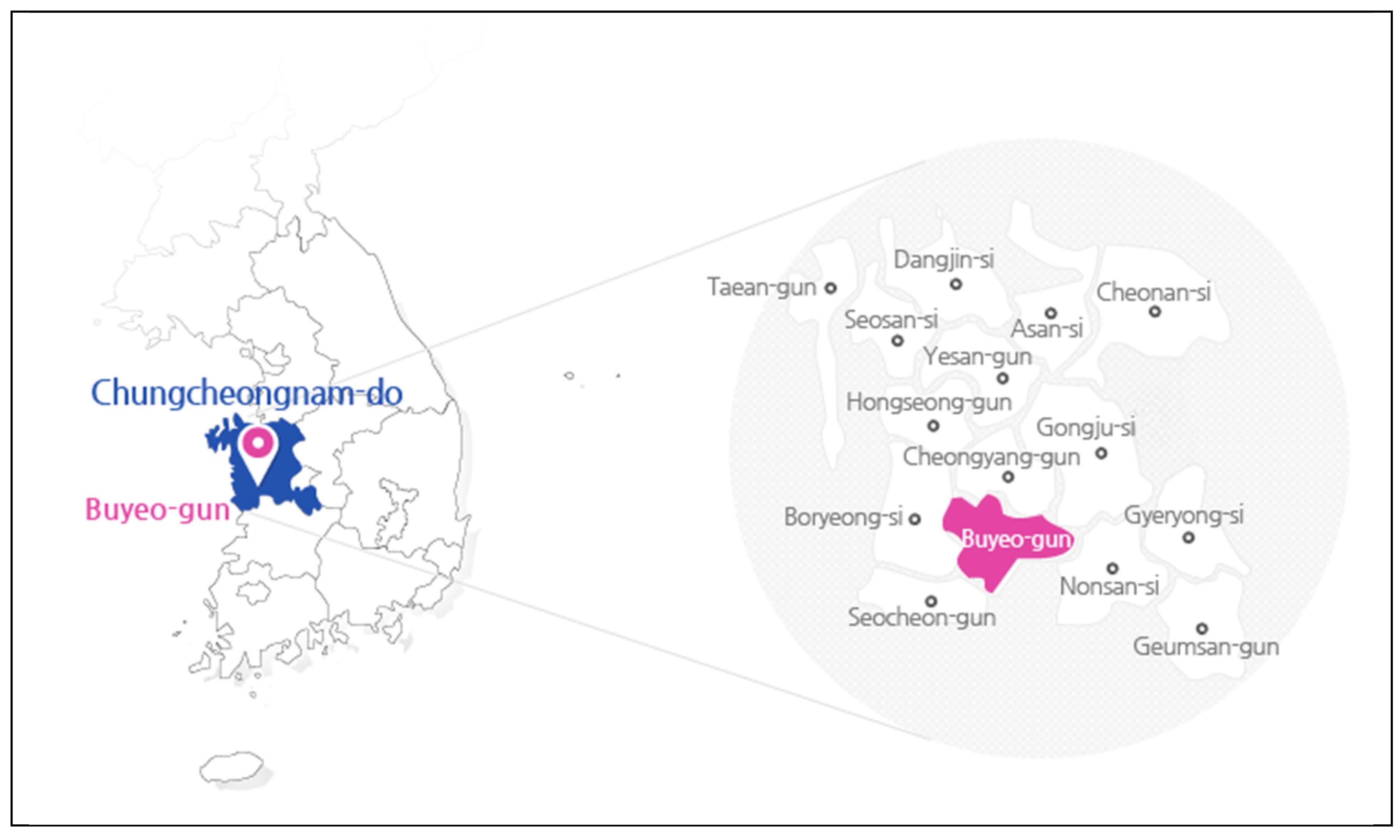
| Year | Author | Types ofValue |
| 1902 | Riegl [44] | age, historical, commemorative, use, newness |
| 1977 | Falkner [53] | historical, architectural, practical |
| 1984 | Lipe [45] | associative/symbolic, informational, aesthetic, economic |
| 1996 | Lee [54] | historical, social, economic |
| 1997 | Frey [55] | monetary, option, existence, bequest, prestige, educational |
| 2001 | Throsby [46] | cultural value (aesthetic, spiritual, social, historical, symbolic, authenticity, locational), economic value (use, non-use, beneficial externalities) |
| 2002 | Mason [47] | socio-cultural value (historical, cultural/symbolic, social, spiritual/religious, aesthetic), economic value (use, non-use, existence, option, bequest) |
| 2005 | Jung [56] | historical, architectural, symbolic, locality, academic, economic, use |
| 2012 | Kim and Kim [57] | historical, architectural, social, economic, urban context |
| 2013 | Choi [58] | historical, academic, artistic, landscape, utilization, symbolic, rarity, locality, uniqueness, context |
| 2013 | Park and Sung [49] | historical, aesthetic, sociocultural, academic, educational, economic |
| 2014 | Song et al. [59] | historical, scientific, artistic, emotional/cultural, environmental, real estate |
| 2017 | Lee and Lee [14] | historical, artistic, technical, landscape, social, cultural |
| 2019 | Nam and Jo [50] | historical, architectural excellence, local utilization, collectivity |
| 2021 | Nguyen et al. [51] | internal criteria (historic, chronological, cultural, social, architectural, technology and construction condition), external criteria (on-site, off-site), feasibility for preservation, originality, new usage |
| 2024 | Uhm et al. [60] | historical, landscape, artistic, socio-cultural, rarity, selectivity/excellence, integrity, authenticity |
| 2024 | Chen et al. [61] | historical, artistic, social, cultural, technological, economic, environmental, functional |
| 2025 | Qiao et al. [62] | architectural features, surrounding environment, social contribution, educational outreach |
| 2025 | Huang et al. [63] | historic, local/place, artistic/aesthetic, scientific/technical |
| 2025 | Qiao et al. [64] | historical, artistic, scientific, social, cultural |
| 2025 | Hu et al. [52] | ontological value (historical, artistic, scientific), extrinsic value (cultural, social, environmental), functional utility |
| Year | Organization | Types ofValue |
| 1931 | ICATHM [35] | historical, artistic, scientific |
| 1964 | ICOMOS [22] | historical, artistic, aesthetic, archaeological, authenticity, integrity |
| 1972 | UNESCO [21] | OUV (Outstanding Universal Value), authenticity, integrity |
| 1979 | ICOMOS [37] | cultural significance (aesthetic, historic, scientific, social) |
| 1994 | ICOMOS [38] | authenticity, artistic, historic, social, scientific |
| 1999 | ICOMOS [17] | cultural, vernacular |
| 2003 | TICCIH [26] | historical, technological, social, architectural, scientific, aesthetic, rarity, archaeological, ecological, integrity, authenticity |
| 2005 | ICOMOS [39] | social, spiritual, historic, artistic, aesthetic, natural, scientific, cultural |
| 2008 | Historic England [10] | evidential value, historical, aesthetic, communal |
| 2011 | ICOMOS [40] | historical, technological, socio-economic, authenticity, completeness, functional integrity |
| 2013 | ICOMOS [41] | cultural significance (aesthetic, historic, scientific, social, spiritual) |
| 2017 | ICOMOS [16] | economic, social, environmental, cultural, spiritual, spatial |
| 2018 | UK DCMS [42] | architectural, historical, group, age and rarity, aesthetic merits, selectivity, national interest, state of repair |
| 2021 | Historic England [43] |
age, rarity, architectural/artistic, group, archaeological, historic, landmark status |
| 2025 | UNESCO [8] | OUV (Outstanding Universal Value), authenticity, integrity |
Figure 2.
Location of architectural heritage sites in Buyeo County.
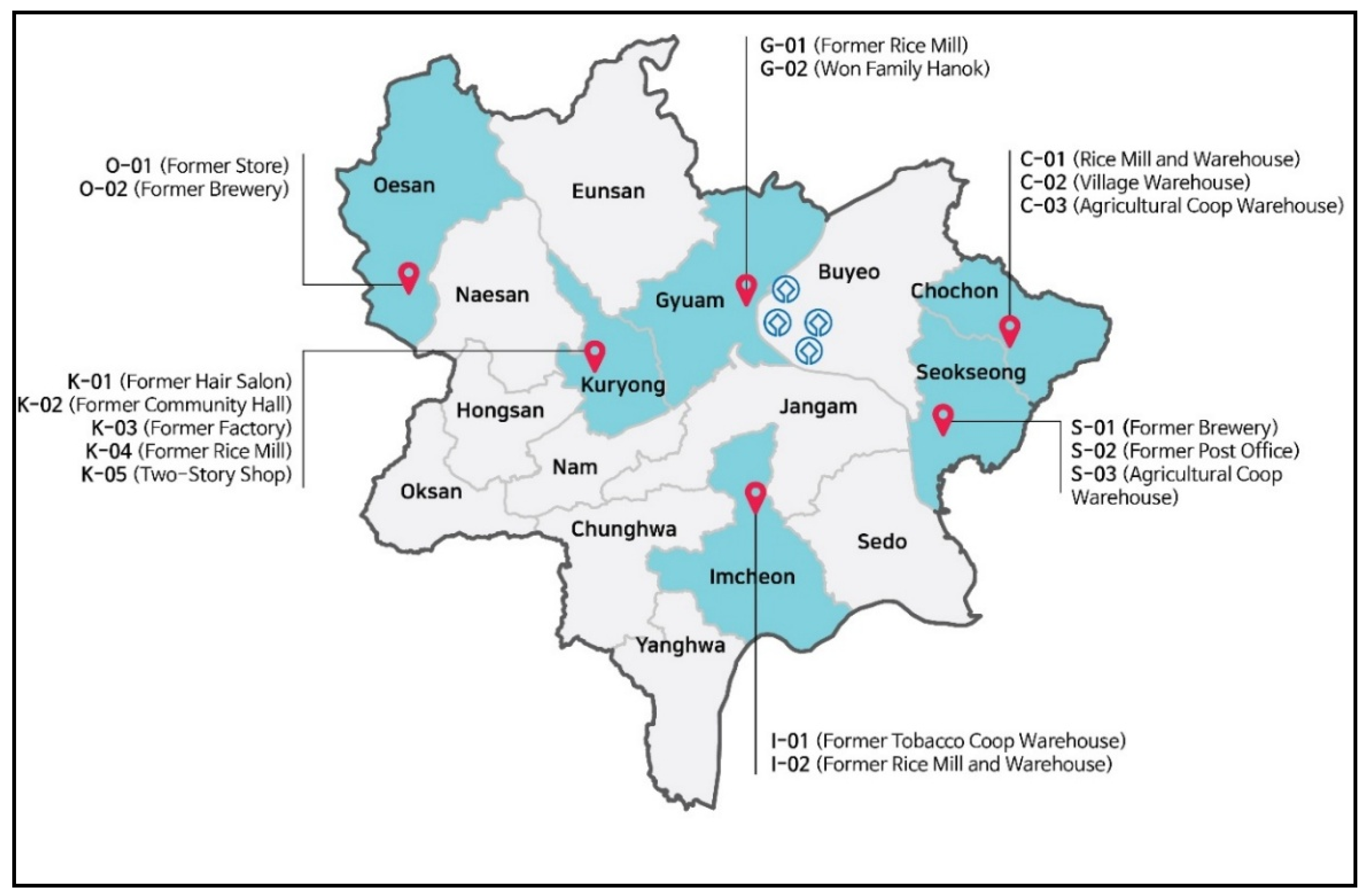
Figure 3.
Hierarchical structure of rural architectural heritage value evaluation.
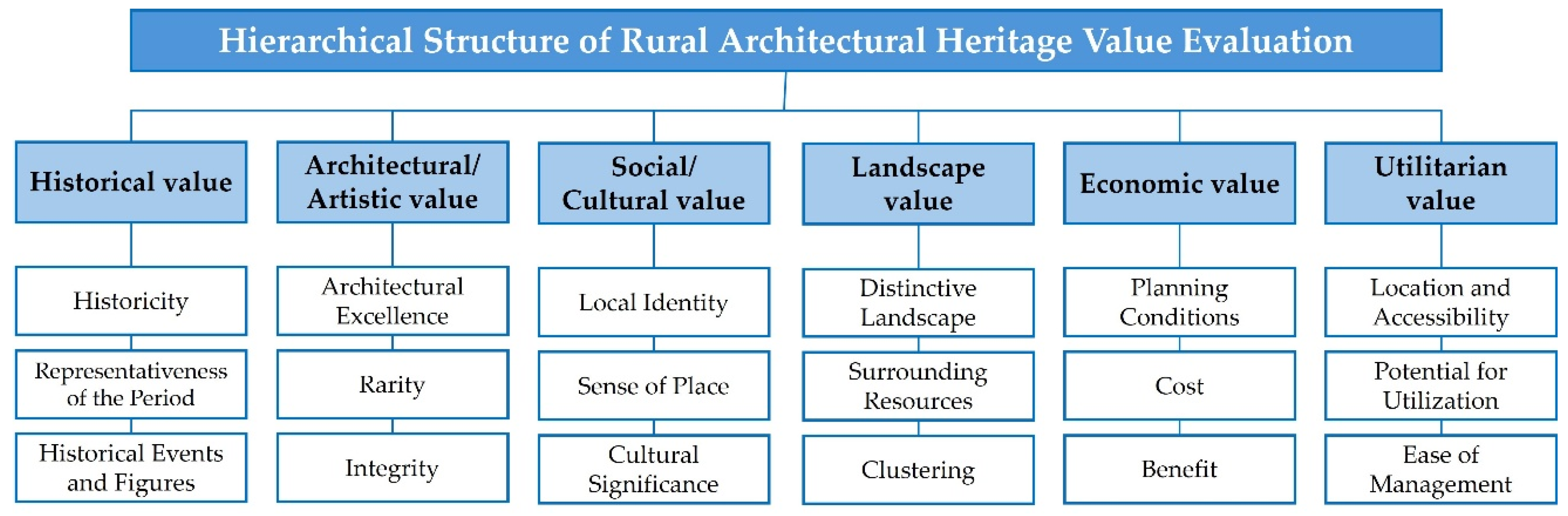
Figure 4.
Integrated weights of indicator level.
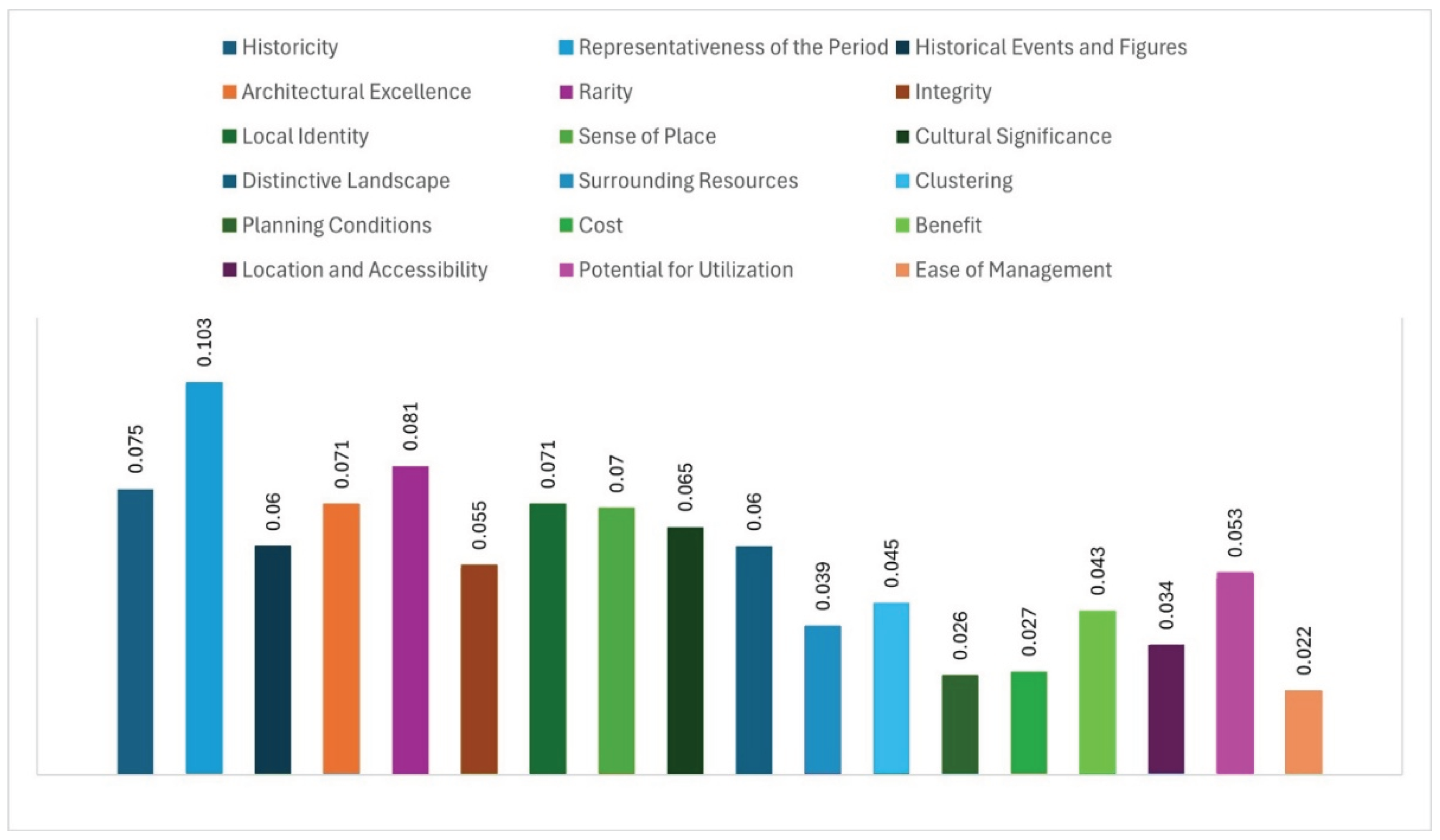
Table 1.
Types of cultural heritage values in international organization documents.
| Year | Organization | Types of Value |
| 1931 | ICATHM [35] | historical, artistic, scientific |
| 1964 | ICOMOS [22] | historical, artistic, aesthetic, archaeological, authenticity, integrity |
| 1972 | UNESCO [21] | OUV (Outstanding Universal Value), authenticity, integrity |
| 1979 | ICOMOS [37] | cultural significance (aesthetic, historic, scientific, social) |
| 1994 | ICOMOS [38] | authenticity, artistic, historic, social, scientific |
| 1999 | ICOMOS [17] | cultural, vernacular |
| 2003 | TICCIH [26] | historical, technological, social, architectural, scientific, aesthetic, rarity, archaeological, ecological, integrity, authenticity |
| 2005 | ICOMOS [39] | social, spiritual, historic, artistic, aesthetic, natural, scientific, cultural |
| 2008 | Historic England [10] | evidential value, historical, aesthetic, communal |
| 2011 | ICOMOS [40] | historical, technological, socio-economic, authenticity, completeness, functional integrity |
| 2013 | ICOMOS [41] | cultural significance (aesthetic, historic, scientific, social, spiritual) |
| 2017 | ICOMOS [16] | economic, social, environmental, cultural, spiritual, spatial |
| 2018 | UK DCMS [42] | architectural, historical, group, age and rarity, aesthetic merits, selectivity, national interest, state of repair |
| 2021 | Historic England [43] |
age, rarity, architectural/artistic, group, archaeological, historic, landmark status |
| 2025 | UNESCO [8] | OUV (Outstanding Universal Value), authenticity, integrity |
Table 2.
Types of architectural heritage values in previous research literature.
| Year | Author | Types of Value |
| 1902 | Riegl [44] | age, historical, commemorative, use, newness |
| 1977 | Falkner [53] | historical, architectural, practical |
| 1984 | Lipe [45] | associative/symbolic, informational, aesthetic, economic |
| 1996 | Lee [54] | historical, social, economic |
| 1997 | Frey [55] | monetary, option, existence, bequest, prestige, educational |
| 2001 | Throsby [46] | cultural value (aesthetic, spiritual, social, historical, symbolic, authenticity, locational), economic value (use, non-use, beneficial externalities) |
| 2002 | Mason [47] | socio-cultural value (historical, cultural/symbolic, social, spiritual/religious, aesthetic), economic value (use, non-use, existence, option, bequest) |
| 2005 | Jung [56] | historical, architectural, symbolic, locality, academic, economic, use |
| 2012 | Kim and Kim [57] | historical, architectural, social, economic, urban context |
| 2013 | Choi [58] | historical, academic, artistic, landscape, utilization, symbolic, rarity, locality, uniqueness, context |
| 2013 | Park and Sung [49] | historical, aesthetic, sociocultural, academic, educational, economic |
| 2014 | Song et al. [59] | historical, scientific, artistic, emotional/cultural, environmental, real estate |
| 2017 | Lee and Lee [14] | historical, artistic, technical, landscape, social, cultural |
| 2019 | Nam and Jo [50] | historical, architectural excellence, local utilization, collectivity |
| 2021 | Nguyen et al. [51] | internal criteria (historic, chronological, cultural, social, architectural, technology and construction condition), external criteria (on-site, off-site), feasibility for preservation, originality, new usage |
| 2024 | Uhm et al. [60] | historical, landscape, artistic, socio-cultural, rarity, selectivity/excellence, integrity, authenticity |
| 2024 | Chen et al. [61] | historical, artistic, social, cultural, technological, economic, environmental, functional |
| 2025 | Qiao et al. [62] | architectural features, surrounding environment, social contribution, educational outreach |
| 2025 | Huang et al. [63] | historic, local/place, artistic/aesthetic, scientific/technical |
| 2025 | Qiao et al. [64] | historical, artistic, scientific, social, cultural |
| 2025 | Hu et al. [52] | ontological value (historical, artistic, scientific), extrinsic value (cultural, social, environmental), functional utility |
Table 3.
Value evaluation framework of rural architectural heritage.
| Criteria | Indicators | Description |
| Historical value | Historicity | Assesses whether the architectural heritage site is associated with historical records or reflects the historical characteristics of the region |
| Representativeness of the Period |
Assesses whether the original function or external appearance represents historical changes in rural areas and possessing symbolic value of a particular period | |
| Historical Events and Figures | Assesses whether the architectural heritage is associated with significant historical events or notable historical figures | |
| Architectural/ Artistic value |
Architectural Excellence |
Assesses architectural quality or aesthetic value, including significant characteristics related to form, materials, style, construction techniques, craftsmanship, and structural systems |
| Rarity | Assesses the rarity value of the architectural heritage. Heritage is considered rare when they were once common in the past but have largely disappeared due to damage or demolition, leaving very few surviving examples today | |
| Integrity | Assesses the integrity of preservation. High integrity indicates that the original form is well preserved or that significant elements remain in good condition | |
| Social/ Cultural value |
Local Identity | Assesses whether the architectural heritage reflects local identity and distinctiveness, or contributes to understanding the social and cultural characteristics of the region |
| Sense of Place | Assesses whether a sense of place has been formed through the shared experiences and collective memories of the local community in relation to the building and its site | |
| Cultural Significance | Assesses whether the heritage embodies tangible or intangible heritage related to local culture, traditional practices, rituals, or community festivals | |
| Landscape value | Distinctive Landscape | Assesses whether the architectural heritage harmonizes with its surrounding environment to form a distinctive local landscape, or functions as a landmark within the area |
| Surrounding Resources |
Assesses whether historical, cultural, tourism, or ecological resources in the surrounding area can be linked and utilized in conjunction with the architectural heritage | |
| Clustering | Assesses whether individual architectural heritage form a cluster, exhibit spatial or functional relationships with others, or generate landscape value through collective presence | |
| Economic value | Planning Conditions | Assesses planning conditions affecting heritage utilization, including zoning, land-use, building use, building coverage ratio, floor area ratio, and height restrictions |
| Cost | Assesses expected costs associated with utilization, such as acquisition costs, rent, renovation, maintenance, and operational expenses. Lower anticipated costs may enhance economic value | |
| Benefit | Assesses potential economic benefits derived from utilization, including project revenue and benefits to residents. Higher expected benefits and returns indicate greater economic value | |
| Utilitarian value | Location and Accessibility |
Assesses location and accessibility, including ease of access by public transport, private vehicles, and pedestrians, as well as travel time |
| Potential for Utilization |
Assesses whether the architectural heritage is suitable and useful for continued use of its original function or for adaptive reuse with new functions or purposes | |
| Ease of Management | Assesses how easily the architectural heritage can be managed by owners, residents, and public authorities, considering factors such as physical condition, aging, and current maintenance status |
Table 4.
Information of Expert survey respondents.
| Category | Number of Respondents | Percentage (%) | |
| Affiliations | Professor | 8 | 17.8 |
| Researcher | 13 | 28.9 | |
| Private-sector expert | 16 | 35.6 | |
| Public official | 4 | 8.9 | |
| Others | 4 | 8.9 | |
| Total | 45 | 100.0 | |
| Field of expertise |
Architecture | 33 | 73.3 |
| Urban Planning | 7 | 15.6 | |
| Humanities | 3 | 6.7 | |
| Economics | 1 | 2.2 | |
| Culture | 1 | 2.2 | |
| Total | 45 | 100.0 | |
| Years of professional experience |
Less than 5 years | 1 | 2.2 |
| 5 ~ 9 years | 9 | 20.0 | |
| 10~14 years | 5 | 11.1 | |
| 15~19 years | 9 | 20.0 | |
| 20 years or more | 21 | 46.7 | |
| Total | 45 | 100.0 | |
Table 5.
List of rural architectural heritage sites in Buyeo County.
| ID | Name | Building Information | Photos |
| K-01 | Former Hair Salon in Nonti-ri |
This two-story building at an intersection has a distinctive form, combining commercial and residential functions. The preservation of the original beauty salon and teahouse interiors showcases the practical local culture of the time | 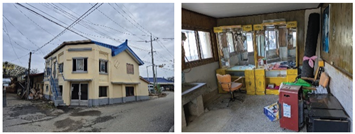 |
| K-02 | Former Community Hall in Nonti-ri |
Reflecting the needs and architectural techniques of rural communities in the 1980s, this village hall was designed as a central hub for community, providing dedicated spaces for meetings and social gatherings. It serves as a physical testament to the changing realities of rural areas | 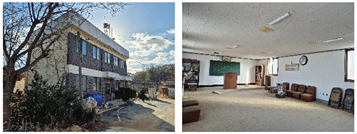 |
| K-03 | Former Factory in Nonti-ri | This factory, built in the late 1970s, consists of multiple buildings. The structures feature a practical design, combining masonry walls with wooden king-post trusses. The facade displays architectural details rarely seen in rural areas, and its naturally weathered appearance creates a distinctive local landscape | 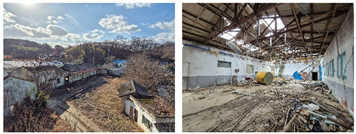 |
| K-04 | Former Rice Mill in Geumsa-ri |
This rice mill, built in the 1970s, has undergone some damage. Key features include high ceilings and windows for milling machinery, along with a simple roof truss supported by masonry walls. The building serves as a significant resource that reflects the period’s village industry while contributing to the rural landscape | 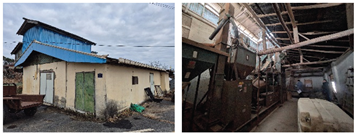 |
| K-05 | Two-Story Shop in Nonti-ri |
Constructed between the 1930s and 1940s, this street-side two-story wooden structure features a dual-purpose layout with a storefront and a residence. As a significant historical resource, it demonstrates the building’s role as a hub of local economic activity within the local market | 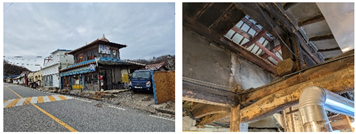 |
| G-01 | Former Rice Mill in Bansan-ri |
Originally constructed as a sawmill, this building utilizes a wooden framework with steel-plate walls to create a large-span interior, topped with roof windows. Although later converted into a rice mill, it remains well-preserved. It holds significant value as industrial heritage, reflecting the history of the area | 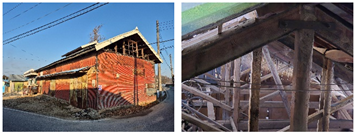 |
| G-02 | Won Family Hanok in Bansan-ri |
Estimated to have been built between the late 19th and early 20th centuries, this modern Hanok residence reflects the village’s evolution into a prosperous agricultural community. This house provides insight into the local socio-economic transitions and the architectural changes over different periods | 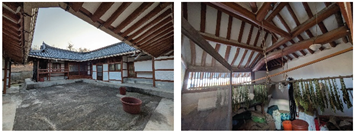 |
| S-01 | Former Brewery in Seokseong-ri |
Established in the 1930s, this site was a local brewery operated under Japanese management. Its functional layout—including the brewing room and the original liquor vats—clearly demonstrates the facility’s operation. It remains a significant industrial heritage site that illustrates the local transition | 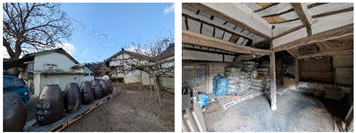 |
| S-02 | Former Post Office and Official Residence in Seokseong-ri |
Constructed in the 1930s, this post office is an example of a rural administrative facility, featuring a unique integrated layout where the office and residence are connected. While the office interior has undergone modifications, the residence remains in its original state, offering architectural and historical value | 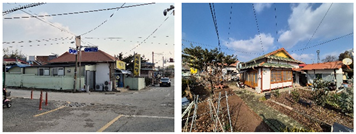 |
| S-03 | Agricultural Cooperative Warehouse in Seokseong-ri | This 1970s warehouse exemplifies a utilitarian design focused on practicality, featuring a masonry structure and double-leaf steel doors for equipment access. The exterior walls preserve historical inscriptions that reflect the evolving rural conditions of the time | 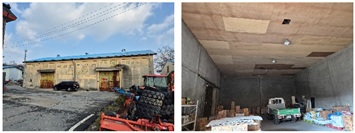 |
| O-01 | Former Store in Bangyo-ri |
Situated at the entrance of a rural village, this 1980s structure serves as a community hub due to its accessibility near the main road’s bus stop. By housing essential services such as a retail store and a beauty salon, it functions as a local social node, reflecting the evolving reality of rural communities | 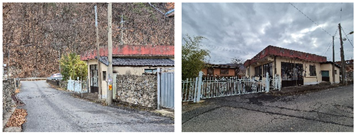 |
| O-02 | Former Brewery in Mansu-ri |
Established in the 1980s, this brewery is an example of the small-scale cottage industry in Buyeo-gun. The building provides valuable insight into the region’s socio-economic history and brewing traditions, featuring a functional interior layout specifically partitioned according to each stage of the brewing process | 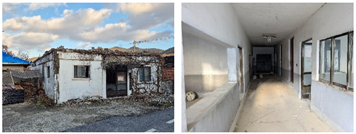 |
| I-01 | Former Tobacco Cooperative Warehouse in Gugyo-ri |
This 1970s tobacco warehouse features a lightweight steel frame finished with corrugated steel siding. It specializes in a large-span open interior, high ceilings, and roof clerestories. Although currently vacant, the building maintains its structural form and integrity, serving as a testament to the period’s industrial heritage | 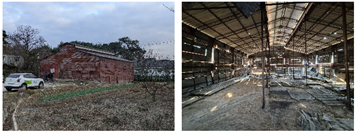 |
| I-02 | Former Rice Mill and Warehouse in Gunsa-ri |
Established in the 1970s, this large-scale rice milling complex reflects the substantial volume of regional rice production through its machinery and expansive warehouses. It illustrates the modernization of rice cultivation and processing within Buyeo-gun’s economy. | 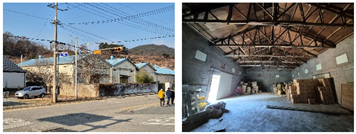 |
| C-01 | Rice Mill and Warehouse in Chuyang-ri |
This 1970s village warehouse features a column-free masonry structure with corrugated metal roofing supported by king-post trusses. By linking two separate warehouse units to a rice mill, the complex illustrates the functional adaptation and transformation of rural storage facilities | 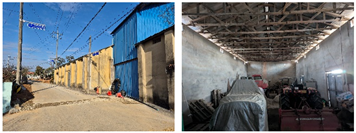 |
| C-02 | Village Warehouse in Chuyang-ri |
This 1970s structure is a representative village warehouse, featuring a column-free masonry structure and corrugated metal roofing supported by king-post trusses. Although modest in scale, it serves as a significant example of how village storage was constructed and managed at the community level | 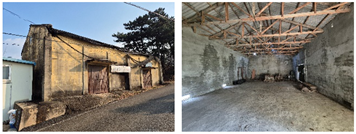 |
| C-03 | Agricultural Cooperative Warehouse in Eungpyeong-ri | This structure exemplifies the typical architectural style of 1970s National Agricultural Cooperative warehouse. Key features include a large-span, column-free interior, red brick masonry construction, and double-leaf steel doors. It serves as a significant model of functional agricultural industrial design from the era. | 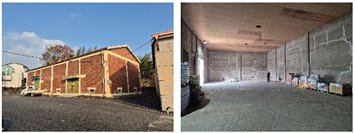 |
Table 6.
Weights and rankings of first-level criteria.
| First-Level Criteria | Weight | Rank |
| Historical value | 0.239 | 1 |
| Architectural/Artistic value | 0.207 | 2 |
| Social/Cultural value | 0.206 | 3 |
| Landscape value | 0.144 | 4 |
| Economic value | 0.096 | 6 |
| Utilitarian value | 0.109 | 5 |
Table 7.
Weights and rankings of second-level indicators.
| First-Level Criteria | Second-Level Indicators | Weight | Rank |
| Historical value | Historicity | 0.315 | 2 |
| Representativeness of the Period | 0.433 | 1 | |
| Historical Events and Figures | 0.252 | 3 | |
| Architectural/Artistic value | Architectural Excellence | 0.342 | 2 |
| Rarity | 0.392 | 1 | |
| Integrity | 0.266 | 3 | |
| Social/Cultural value | Local Identity | 0.346 | 1 |
| Sense of Place | 0.339 | 2 | |
| Cultural Significance | 0.315 | 3 | |
| Landscape value | Distinctive Landscape | 0.417 | 1 |
| Surrounding Resources | 0.272 | 3 | |
| Clustering | 0.311 | 2 | |
| Economic value | Planning Conditions | 0.274 | 3 |
| Cost | 0.280 | 2 | |
| Benefit | 0.446 | 1 | |
| Utilitarian value | Location and Accessibility | 0.313 | 2 |
| Potential for Utilization | 0.489 | 1 | |
| Ease of Management | 0.199 | 3 |
Table 8.
Integrated weights and Priority Rankings.
| Second-Level Indicators | Integrated Weight | Rank |
| Historicity | 0.075 | 3 |
| Representativeness of the Period | 0.103 | 1 |
| Historical Events and Figures | 0.060 | 9 |
| Architectural Excellence | 0.071 | 4 |
| Rarity | 0.081 | 2 |
| Integrity | 0.055 | 10 |
| Local Identity | 0.071 | 5 |
| Sense of Place | 0.070 | 6 |
| Cultural Significance | 0.065 | 7 |
| Distinctive Landscape | 0.060 | 8 |
| Surrounding Resources | 0.039 | 14 |
| Clustering | 0.045 | 12 |
| Planning Conditions | 0.026 | 17 |
| Cost | 0.027 | 16 |
| Benefit | 0.043 | 13 |
| Location and Accessibility | 0.034 | 15 |
| Potential for Utilization | 0.053 | 11 |
| Ease of Management | 0.022 | 18 |
Disclaimer/Publisher’s Note: The statements, opinions and data contained in all publications are solely those of the individual author(s) and contributor(s) and not of MDPI and/or the editor(s). MDPI and/or the editor(s) disclaim responsibility for any injury to people or property resulting from any ideas, methods, instructions or products referred to in the content. |
© 2026 by the authors. Licensee MDPI, Basel, Switzerland. This article is an open access article distributed under the terms and conditions of the Creative Commons Attribution (CC BY) license (http://creativecommons.org/licenses/by/4.0/).
Copyright: This open access article is published under a Creative Commons CC BY 4.0 license, which permit the free download, distribution, and reuse, provided that the author and preprint are cited in any reuse.


