

Submitted:
19 February 2026
Posted:
26 February 2026
You are already at the latest version
Abstract
Background: DanceSport involves intermittent high-intensity efforts that may differ between styles and partners within a dance couple. However, dance-specific relative oxygen uptake (%VO₂max) in elite Standard and Latin dancers remains insufficiently described. Objective: This study aimed to characterize relative oxygen uptake during simulated competition in elite Slovak national team dancers and to examine (i) differences between Latin and Standard styles, (ii) variability across individual dances, and (iii) sex-specific patterns. Methods: Twenty elite dancers (10 couples) were divided into Latin (n = 10) and Standard (n = 10) groups. VO₂max was determined via an incremental treadmill test. During a simulated final round, breath-by-breath gas exchange was recorded using portable spirometry. Relative oxygen uptake (%VO₂max) was calculated for each dance. Style-level differences were analyzed using a two-way ANOVA (Style × Sex), and dance-specific effects were examined using repeated-measures ANOVAs. Results: No significant differences in mean %VO₂max were observed between styles (p = .269), nor were there main effects of Sex or Style × Sex interaction (p > .05). In the Latin group, %VO₂max differed significantly between dances (p < .001), with Jive highest and Rumba lowest, without sex interaction. In the Standard group, a significant Dance × Sex interaction was observed (p < .001). Male dancers showed higher %VO₂max during Quickstep, whereas females exhibited a more uniform intensity profile. Conclu-sions: Oxygen demand in DanceSport is strongly dance-dependent. Latin dances demonstrate comparable relative intensities between sexes, whereas Standard dances show sex-specific metabolic patterns, likely reflecting distinct biomechanical roles within the partnership. These findings support dance-specific and partner-sensitive approaches to physiological monitoring and training design in elite DanceSport.
Keywords:
DanceSport
; oxygen uptake
; VO₂max
; relative intensity
; internal load
; sport physiology
; sex differences
; metabolic demand
; elite athletes
; performance monitoring
1. Introduction
DanceSport is a highly technical and physically demanding discipline that combines endurance, power, coordination, and artistic expression [1]. At the elite level, competitive routines consist of multiple dances performed in sequence, exposing athletes to fluctuating physiological demands. Despite its artistic appearance, DanceSport requires substantial aerobic capacity and should be considered a high-performance sport requiring athletes to sustain high-intensity efforts that rely on both aerobic and anaerobic energy pathways [2,3]. Previous research has established that competitive dance places significant stress on the cardiorespiratory system, with reported lactate concentrations reaching 12.9–13.3 mmol·L⁻¹ and energy expenditures of 16.6 kcal·min⁻¹ in men during Standard style finals [4]. However, most available studies have focused on single dances or averaged routines, reported primarily absolute VO2 values, and included heterogeneous or non-elite samples. Consequently, the physiological demands of DanceSport remain incompletely characterized [5]. To date, no study has comprehensively characterized dance-specific %VO₂max responses across both Standard and Latin disciplines in elite national team dancers. Specifically, there is a lack of comprehensive data regarding relative oxygen uptake (%VO2max) across the distinct dance categories within elite populations, which limits the ability to compare physiological profiles and optimize training prescriptions for Standard versus Latin disciplines [2,6]. This gap is particularly relevant given that Standard and Latin styles differ fundamentally in their movement patterns, hold requirements, and temporal structures, which may elicit distinct metabolic responses [7]. Absolute oxygen uptake is strongly influenced by sex, body composition, and training status [8]. Expressing oxygen uptake relative to individual maximal capacity (%VO2max) allows the assessment of physiological strain in relation to an athlete’s limits. Relative intensity provides a more meaningful framework for sex comparisons, training prescription, and evaluation of fatigue and recovery demands. Standard and Latin DanceSport styles differ markedly in tempo, movement patterns, and biomechanical constraints. Within each style, individual dances vary substantially in speed, rhythm, and energetic characteristics. Nevertheless, it remains unclear whether oxygen demand differs between styles, which specific dances impose the highest relative oxygen cost, and whether these patterns are consistent across sexes. Most studies addressing sex differences in DanceSport physiology describe overall differences in magnitude [9]. Nonetheless, sex may also influence the distribution of physiological load across individual dances, rather than only shifting mean intensity levels. Identifying sex-specific demand profiles may support more individualized training strategies and improved load management. Elite national team dancers represent a highly selected population characterized by extensive technical training, high aerobic capacity, and consistent performance quality. Although sample sizes in such cohorts are necessarily limited, they enable precise within-subject analyses and provide insights directly applicable to high-performance DanceSport practice. The aim of this study was to characterize oxygen uptake during competitive DanceSport in a cohort of elite Slovak national team dancers. Specifically, we sought to examine differences in oxygen uptake between Standard and Latin styles, to identify dance-specific variations in relative oxygen demand within each style, and to determine whether these dance-specific oxygen uptake patterns differ between female and male dancers when expressed relative to individual maximal capacity (%VO2max) obtained during spiroergometric testing. We hypothesized that oxygen uptake would differ between Standard and Latin styles, that individual dances within each style would exhibit distinct relative oxygen demands, and that sex would modulate dance-specific oxygen uptake patterns, particularly in Standard dances.
2. Materials and Methods
2.1. Participant Characteristics
The study included 20 elite adult DanceSport athletes (10 dance couples) representing the Slovak Republic as members of the National Team. All participants held the highest national performance class and were finalists in the Slovak National Championships. Inclusion criteria were: (1) current membership in the Slovak National DanceSport Team, (2) possession of the highest national competitive class, (3) active participation in national and international competitions during the study season, and (4) absence of acute injury at the time of testing. Exclusion criteria included: (1) musculoskeletal injury within the preceding three months that limited full training participation, (2) diagnosed cardiovascular, respiratory, or metabolic disorders, and (3) use of medication that could influence cardiovascular or metabolic responses. The 10 couples (20 athletes) were divided into two groups of five couples each: one group specialized in Latin American dances and the other in Standard dances. The mean age was 24.86 ± 5.00 years in men and 25.17 ± 4.41 years in women. Mean body height was 179.04 ± 3.79 cm (men) and 165.88 ± 3.60 cm (women), and mean body mass was 70.74 ± 6.67 kg (men) and 55.83 ± 5.06 kg (women). All participants provided written informed consent prior to data collection. The study protocol was approved by the Ethics Committee of the Faculty of Physical Education and Sport, Comenius University in Bratislava (No. 4/2024), and was conducted in accordance with the Declaration of Helsinki. A cross-sectional design was employed to assess physiological responses under simulated competitive conditions. The testing protocol was designed to replicate official competition demands: dancers performed their competitive routines in randomized order while continuous breath-by-breath gas exchange was measured using a portable telemetric spirometry system.
2.2. Laboratory Assessment of Maximal Oxygen Uptake
Laboratory testing was conducted at the National Sports Center of the Slovak Republic using an HP Cosmos treadmill (HP Cosmos Sports & Medical GmbH, Germany) combined with a Cosmed spiroergometric system (Cosmed, Rome, Italy). An incremental graded exercise test was performed to determine oxygen uptake (VO₂), carbon dioxide production (VCO2), and maximal oxygen uptake (VO₂max). After standardized preparation and warm-up, participants were fitted with a face mask for baseline respiratory measurements. The test commenced at an initial running speed of 7 km·h⁻¹ with a 0° incline. Treadmill speed was subsequently increased by 0.8 km·h⁻¹ every minute until volitional exhaustion. Ventilatory and gas exchange variables were recorded continuously throughout the test, including at maximal workload. VO₂max was defined as the highest 30-s averaged VO₂ value achieved during the test.
2.3. Gas Exchange Assessment During Simulated Competition
Gas exchange parameters were assessed using a portable telemetric spirometry system (MetaMax 3B-R2, Cortex Biophysik GmbH, Leipzig, Germany), provided by the Slovak DanceSport Federation. The system enabled continuous breath-by-breath measurement of oxygen uptake (VO₂), carbon dioxide production (VCO₂), ventilation (VE), respiratory frequency, and related cardiopulmonary variables during unrestricted movement. Prior to testing, the device was calibrated according to the manufacturer’s guidelines and connected via Bluetooth to MetaSoft Studio software (Cortex Biophysik GmbH) for real-time data acquisition. Participants were provided with sufficient time and space for standardized warm-up and stretching before measurement. Participants were familiarized with the equipment prior to testing to minimize potential movement interference. The testing protocol simulated an official final round. Each athlete completed one simulated competitive round during which gas exchange parameters were continuously recorded. In the Latin group, the round consisted of five dances: Samba, Cha Cha, Rumba, Paso Doble, and Jive. In the Standard group, the round included Waltz, Tango, Viennese Waltz, Foxtrot, and Quickstep. Each dance was performed for 1 min 30 s in accordance with official World DanceSport Federation (WDSF) regulations. Musical tempo was set according to current WDSF competition standards for each dance [7]. During testing, participants wore a lightweight (<600 g) portable unit secured with adjustable chest-back harness straps to allow unrestricted movement, along with a fitted face mask for continuous respiratory monitoring. The simulated competition structure closely replicated official WDSF final-round conditions, thereby enhancing ecological validity.
2.4. Outcome Variables
Relative oxygen uptake (%VO₂max) was calculated as the mean VO₂ during each 1.5-min dance expressed as a percentage of individual VO₂max obtained during the incremental treadmill test. Specifically, %VO₂max was computed as:
where VO₂_dance represents the mean oxygen uptake during a given dance, and VO₂max represents the highest 30-s averaged oxygen uptake achieved during the incremental treadmill test. For style-level comparisons, the mean %VO₂max across the five dances within each athlete’s specialization was calculated and used as the dependent variable in between-group analyses.
2.5. Statistical Analysis
All statistical analyses were performed using jamovi (Version 2.7; The jamovi project, Sydney, Australia) and Statistica (Version 13; TIBCO Software Inc., Palo Alto, CA, USA). Data are presented as means ± standard deviations unless otherwise stated. Normality of residuals was assessed using the Shapiro–Wilk test. For repeated-measures analyses, sphericity was evaluated using Mauchly’s test, and Greenhouse–Geisser corrections were applied when the assumption of sphericity was violated. To examine differences in mean relative oxygen uptake (%VO₂max) between DanceSport styles, a two-way between-subjects ANOVA was conducted with Style (Latin vs Standard) and Sex (female vs male) as fixed factors. The dependent variable was the mean %VO₂max across the five dances within each athlete’s specialization. Dance-specific differences in relative oxygen uptake were assessed separately within the Latin and Standard groups using repeated-measures ANOVAs, with Dance (five dances within each style) as the within-subject factor and Sex as the between-subject factor. In the absence of a significant Dance × Sex interaction, post hoc pairwise comparisons between dances were performed using pooled data. When a significant interaction was detected, simple effects analyses were conducted to examine sex-specific differences. Post hoc comparisons were adjusted using Tukey correction for multiple testing. Effect sizes were reported as partial eta squared (η²ₚ) and interpreted according to conventional benchmarks. Statistical significance was set at α = 0.05.
3. Results
Descriptive statistics for laboratory VO₂max and dance-specific relative oxygen uptake (%VO₂max) across styles and sexes are presented in Table 1.
A two-way between-subject ANOVA (Style × Sex) was conducted to examine differences in mean relative oxygen uptake (%VO₂max) between Latin and Standard groups. No significant main effect of Style was observed, F(1,16) = 1.31, p = .269, η²p = .076. Similarly, neither the main effect of Sex, F(1,16) = 0.06, p = .817, η²p = .003, nor the Style × Sex interaction, F(1,16) = 0.54, p = .472, η²p = .033, reached statistical significance.
3.1. Relative Oxygen Uptake During Latin Dances
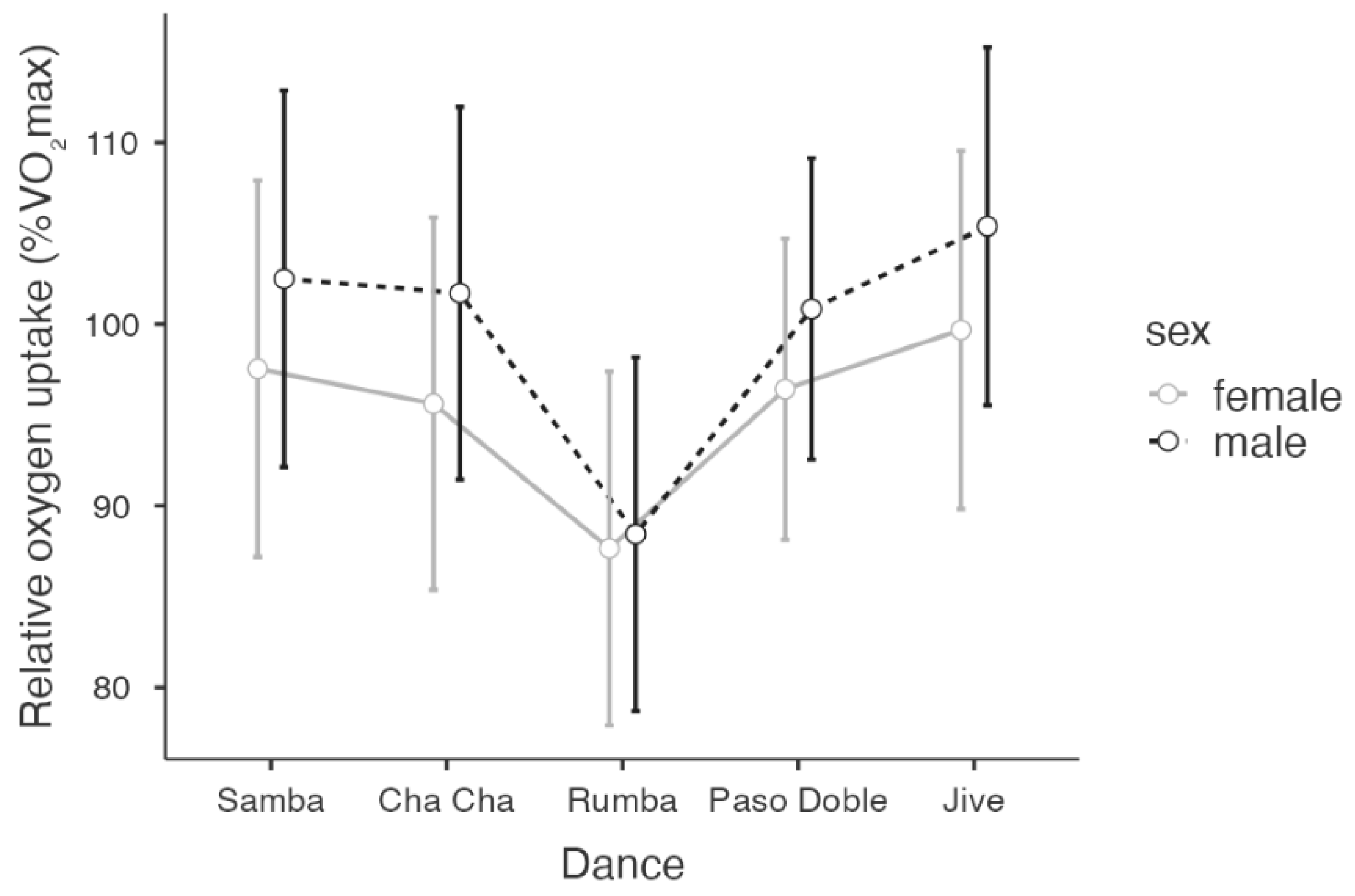
Descriptive statistics for relative oxygen uptake (%VO₂max) during individual Latin dances are presented in Table 2. Overall, Jive and Samba elicited the highest relative intensities, whereas Rumba demonstrated the lowest values across both sexes.
In the Latin group (n = 10), a repeated-measures ANOVA revealed a significant main effect of Dance on relative oxygen uptake (%VO₂max), F(4,32) = 22.45, p < 0.001, η²ₚ = 0.737, indicating substantial variability in physiological demand between individual Latin dances. The effect remained significant after Greenhouse–Geisser correction, confirming robustness against potential violations of sphericity. No significant Dance × Sex interaction was observed, F(4,32) = 0.81, p = 0.526, η²ₚ = 0.092, indicating that the pattern of relative intensity across Latin dances was comparable between female and male dancers. Similarly, no significant main effect of Sex was found, F(1,8) = 0.62, p = 0.455, η²ₚ = 0.072. Post hoc comparisons (Tukey-adjusted) demonstrated that Rumba elicited significantly lower %VO₂max values compared with Samba (p = 0.006), Cha Cha (p < 0.001), Paso Doble (p = 0.001), and Jive (p = 0.001). No other pairwise differences reached statistical significance. Estimated marginal means indicated that Jive produced the highest relative intensity, whereas Rumba consistently represented the lowest physiological demand across both sexes. These dance-specific intensity profiles Figure1 illustrates these dance-specific intensity profiles.
Figure 1.
Estimated marginal means (±95% confidence intervals) of relative oxygen uptake (%VO₂max) across Latin dances in elite national team dancers. Rumba elicited significantly lower values compared with the remaining dances (Tukey-adjusted p < 0.01).
Figure 1.
Estimated marginal means (±95% confidence intervals) of relative oxygen uptake (%VO₂max) across Latin dances in elite national team dancers. Rumba elicited significantly lower values compared with the remaining dances (Tukey-adjusted p < 0.01).
3.2. Relative Oxygen Uptake During Standard Dances
Descriptive statistics for relative oxygen uptake (%VO₂max) during individual Standard dances are presented in Table 3. Relative intensity varied across dances, with Quickstep eliciting the highest values in male dancers, whereas female dancers demonstrated a more uniform intensity profile.
In the Standard group (n = 10), a repeated-measures ANOVA revealed a significant main effect of Dance on relative oxygen uptake (%VO₂max), F(4,32) = 9.38, p < 0.001, η²ₚ = 0.540, indicating substantial variability in physiological demand between individual Standard dances. The effect remained significant after Greenhouse–Geisser correction. Importantly, a significant Dance × Sex interaction was observed, F(4,32) = 8.80, p < 0.001, η²ₚ = 0.524, indicating that relative intensity patterns differed between female and male dancers. In contrast, the main effect of Sex was not significant, F(1,8) = 1.79, p = 0.218, η²ₚ = 0.183. Simple effects analyses (Tukey-adjusted) demonstrated that male dancers exhibited significantly higher %VO₂max during Quickstep compared with Tango, Viennese Waltz, and Foxtrot (all p < 0.05). Additionally, Foxtrot elicited significantly lower %VO₂max values than Viennese Waltz (p < 0.01). In female dancers, no pairwise differences between dances remained statistically significant after correction for multiple comparisons. Estimated marginal means indicated relatively uniform intensity profiles in females (approximately 80–86% VO₂max across dances), whereas males demonstrated greater variability, with Quickstep reaching the highest relative intensity (approximately 96% VO₂max). These sex-specific patterns Figure 2 illustrates these sex-specific patterns. The interaction between Dance and Sex in the Standard group is illustrated in Figure 2, which presents the estimated marginal means of relative oxygen uptake (%VO₂max) across individual Standard dances for female and male dancers.
4. Discussion
The present study demonstrates that relative oxygen uptake varies significantly across individual dances within both Latin and Standard DanceSport. Latin dances exhibited a clearly dance-dependent physiological profile that was consistent between sexes, whereas Standard dances revealed a distinct sex-specific intensity pattern. Thus, the hypothesis that sex would modulate dance-specific oxygen uptake was only partially supported. Sex-specific modulation was evident in Standard dances but not in Latin dances when oxygen uptake was expressed relative to individual maximal capacity. This heterogeneity in physiological responses aligns with previous evidence demonstrating substantial variability in energetic and metabolic demands across DanceSport routines [10]. These findings align with previous research showing that different exercise modalities elicited similar physiological responses under comparable perceived exertion [8]. The elevated relative intensity observed in Jive and Quickstep corroborates evidence that higher tempo and complex movement sequences increase aerobic demand compared with slower dances such as Rumba [4,11]. Values slightly exceeding 100% VO₂max may reflect the use of 30-s averaged peak values during laboratory testing compared with dance-specific averaging procedures. Additional support for tempo-related increases in cardiorespiratory strain has been reported in dance-specific workload analyses [12]. Importantly, Rumba consistently demonstrated the lowest %VO₂max values, confirming substantial metabolic heterogeneity within the Latin style [13]. The significant Dance × Sex interaction observed in Standard dances suggests that male and female dancers may adopt distinct biomechanical execution strategies to meet choreographic demands, particularly during high-intensity dances such as Quickstep. This may reflect partnership dynamics, where male dancers typically generate propulsion and maintain frame stability, potentially increasing relative metabolic demand during high-velocity segments. Evidence from movement analysis and partner interaction research supports the notion that leadership roles and locomotor initiation patterns differ between partners in DanceSport dyads. These findings highlight the interaction between choreographic structure and sex-specific execution patterns in shaping physiological load [11]. Practically, the results indicate that DanceSport should not be considered metabolically homogeneous. Training programs should account for dance-specific metabolic demands, especially the high aerobic requirements of Jive and Quickstep [14]. The observed higher relative oxygen uptake in male dancers during Standard dances, particularly Quickstep, may be explained by sex-specific biomechanical roles within the dance partnership. The male partner typically initiates movement direction, rhythm, and floor progression, generating horizontal propulsion and maintaining frame stability. In contrast, the female partner primarily responds to movement initiation and maintains upper-body positioning, which may involve comparatively lower propulsion demands. In high-tempo dances such as Quickstep, these differences in force generation and locomotor initiation may translate into higher metabolic cost in male dancers. Latin dances are characterized by higher movement frequency and greater involvement of rapid lower-limb actions, which may increase metabolic demand. Conversely, Standard dances emphasize sustained frame maintenance and continuous floor progression [15]. These distinct physiological profiles underscore the necessity for style-specific conditioning protocols to optimize performance and mitigate injury risk in elite DanceSport athletes [16]. These findings support the concept that DanceSport styles should be treated as distinct physiological tasks during training and conditioning. Consequently, periodization strategies must account for the varying metabolic intensities across Latin and Standard disciplines to ensure comprehensive physiological development. Furthermore, the identification of sex-specific metabolic responses in Standard dances indicates that conditioning programs should be individualized to address the distinct physiological roles and biomechanical demands placed on male and female partners within the dance couple [17]. Individual dances within the same style showed markedly different relative oxygen demands, demonstrating that these styles are physiologically heterogeneous. While absolute oxygen uptake is influenced by sex-related physiological characteristics, relative measures provide insight into how closely dancers operate to their individual limits [4]. The elite national team sample ensured high technical proficiency and reduced performance variability, thereby strengthening the internal validity of the observed metabolic differences across dance styles [18]. Repeated-measures designs enabled robust within-subject comparisons despite a limited sample size, and the homogeneous nature of the elite cohort minimized confounding variables related to technical proficiency [19]. The large effect sizes observed for dance-specific comparisons suggest robust physiological variability despite the modest cohort size. However, between-subject effects and interaction terms may have been underpowered, and null findings, particularly regarding sex differences in Latin dances, should therefore be interpreted cautiously. An a priori power analysis was not conducted due to the limited availability of elite national team dancers; therefore, the results, particularly interaction effects, should be interpreted with caution. Although the small sample size reflects the elite nature of the cohort and limits generalizability to non-elite dancers, future research should aim to replicate these findings across larger and more heterogeneous cohorts to determine whether the observed sex-specific metabolic patterns and dance-specific intensity profiles are consistent across different competitive levels and age groups [20]. Only oxygen uptake was examined; however, future studies should integrate additional physiological and biomechanical variables such as heart rate variability, blood lactate concentration, and kinematic analysis to provide a more comprehensive understanding of the physiological demands and mechanical efficiency associated with DanceSport performance [21]. Integrating these additional measures would allow for a more precise evaluation of the metabolic pathways utilized during high-intensity segments and the specific contributions of anaerobic endurance to overall performance capacity [12].
5. Conclusions
The present findings demonstrate that oxygen demand in DanceSport is primarily dance-dependent and exhibits sex-specific patterns in the Standard style, whereas Latin dances show comparable relative intensities between sexes. While no overall differences were observed between styles, substantial variability emerged within individual dances, confirming the heterogeneous and intermittent physiological nature of DanceSport. Importantly, male and female dancers perform simultaneously within the same partnership during competition, executing identical choreographic sequences. Despite this shared performance context, the results indicate that relative metabolic strain may differ between partners in specific Standard dances, particularly in high-intensity events such as Quickstep. This suggests that physiological load distribution within a dance couple is not necessarily symmetrical and should be considered when designing conditioning programs. Relative oxygen uptake (%VO₂max) proved to be a robust indicator of physiological strain, revealing meaningful differences in metabolic load distribution across dances and between partners. These findings support the need for dance-specific and sex-sensitive approaches to physiological monitoring and training design in elite national team dancers. Future research should incorporate larger sample sizes and longitudinal designs to determine the generalizability of these results and to examine the long-term impact of style-specific and partner-sensitive training interventions on performance outcomes.
Supplementary Materials
The following supporting information can be downloaded at the website of this paper posted on Preprints.org, The anonymized raw dataset supporting the results of this study is available in the Supplementary Materials (Excel file).
Author Contributions
Conceptualization, S.K. and M.C.; methodology, S.K. and M.C.; software, S.K.; validation, S.K. and M.C.; formal analysis, S.K.; investigation, M.C., M.Š., V.P., A.C., and P.O.; resources, M.C.; data curation, M.C., M.Š., V.P., and A.C.; writing—original draft preparation, S.K.; writing—review and editing, S.K. and M.C.; visualization, S.K.; supervision, S.K.; project administration, M.C.; funding acquisition, M.C. All authors have read and agreed to the published version of the manuscript.
Funding
This research was funded by the Scientific Grant Agency of the Ministry of Education, Research, Development and Youth of the Slovak Republic and the Slovak Academy of Sciences (VEGA), grant number 1/0512/25. The APC was funded by the same grant.
Institutional Review Board Statement
The study was conducted in accordance with the Declaration of Helsinki and approved by the Ethics Committee of the Faculty of Physical Education and Sport, Comenius University in Bratislava (No. 4/2024; approved on 4 April 2024).
Informed Consent Statement
Informed consent was obtained from all subjects involved in the study.
Data Availability Statement
The anonymized raw data supporting the findings of this study are available in the Supplementary Materials.
Acknowledgments
The authors would like to thank the Slovak DanceSport Federation for providing the portable spirometry equipment used during data collection. During the preparation of this manuscript, the authors used Microsoft Copilot for language editing and stylistic improvement. The authors have reviewed and edited the output and take full responsibility for the content of this publication.
Conflicts of Interest
The authors declare no conflicts of interest. The funders had no role in the design of the study; in the collection, analyses, or interpretation of data; in the writing of the manuscript; or in the decision to publish the results.
Abbreviations
The following abbreviations are used in this manuscript:
| ANOVA | Analysis of Variance |
| CI | Confidence Interval |
| GG | Greenhouse–Geisser |
| RM-ANOVA | Repeated-Measures Analysis of Variance |
| SD | Standard Deviation |
| VE | Minute Ventilation |
| VO₂ | Oxygen Uptake |
| VO₂max | Maximal Oxygen Uptake |
| VCO₂ | Carbon Dioxide Production |
| WDSF | World DanceSport Federation |
References
- Effects of Education Programs on Dance Sport Performance in Youth Dancers. European Journal of Contemporary Education 2019, 8. [CrossRef]
- Igor, S.; Huang, D.; Olesia, K.; Andrii, D. SPECIFIC CHARACTERISTICS OF STABILITY OF FUNCTIONAL PROVISION OF SPECIAL WORKING CAPACITY OF DANCE ATHLETES. Sport Science and Human Health 2022, 7. [CrossRef]
- Liiv, H.; Jürimäe, T.; Mäestu, J.; Purge, P.; Hannus, A.; Jürimäe, J. Physiological Characteristics of Elite Dancers of Different Dance Styles. European Journal of Sport Science 2012, 14. [CrossRef]
- Pilch, W.; Tota, Ł.; Pokora, I.; Mateusz, G.; Piotrowska, A.; Olga, C.; Zuziak, R.; Czerwińska-Ledwig, O. Energy Expenditure and Lactate Concentration in Sports Dancers in a Simulated Final Round of the Standard Style Competition. Human Movement 2017, 18, 62. [CrossRef]
- Kuliś, S.; Sienkiewicz-Dianzenza, E.; Stupnicki, R. Anaerobic Endurance of Dance Sport Athletes. Biomedical Human Kinetics 2020, 12, 141. [CrossRef]
- Maciejczyk, M.; Feć, A. Evaluation of Aerobic Capacity and Energy Expenditure in Folk Dancers. Human Movement 2013, 14, 76. [CrossRef]
- Soronovych, I.; Mu, C.; Huang, D.; Дяченкo, А. SYSTEMATIC APPROACH TO THE IMPLEMENTATION OF MODELING AS A FEATURE OF MANAGING THE FUNCTIONAL CAPABILITIES AMONG QUALIFIED DANCE ATHLETES. Sport Science and Human Health2021, 5, 149. [CrossRef]
- Moreira-Reis, A.; Maté-Muñoz, J.L.; Hernández-Lougedo, J.; García-Fernández, P.; Elvar, J.R.H.; Pleguezuelos, E.; Carbonell, T.; Alva, N.; Garnacho-Castaño, M.V. Similar Slow Component of Oxygen Uptake and Ventilatory Efficiency between an Aerobic Dance Session on an Air Dissipation Platform and a Constant-Load Treadmill Test in Healthy Women. Biology 2022, 11, 1646. [CrossRef]
- Liu, X.; Liu, Y.; Pan, D.; Weng, X. How Expressive Ties Energize Competitive Performance in DanceSport Dyads: Unraveling the Role of Athlete Engagement in an Innovatively Applied Actor-Partner Interdependence Mediation Model. Frontiers in Psychology 2024, 15. [CrossRef]
- Beck, S.; Redding, E.; Wyon, M. Methodological Considerations for Documenting the Energy Demand of Dance Activity: A Review. Frontiers in Psychology 2015, 6, 568. [CrossRef]
- Zaletel, P. A Time Motion and Analysis of Partnering Skills in Latin-American Dance Using a Semi-Automatic Tracking System: A Case Study. Journal of Anthropology of Sport and Physical Education 2020, 4, 3. [CrossRef]
- Moreira-Reis, A.; Maté-Muñoz, J.L.; Hernández-Lougedo, J.; García-Fernández, P.; Pleguezuelos-Cobo, E.; Carbonell, T.; Alva, N.; Garnacho-Castaño, M.V. Cardiorespiratory, Metabolic and Muscular Responses during a Video-Recorded Aerobic Dance Session on an Air Dissipation Platform. International Journal of Environmental Research and Public Health 2020, 17, 9511. [CrossRef]
- Massidda, M.; Cugusi, L.; Ibba, M.; Tradori, I.; Calò, C.M. Energy Expenditure during Competitive Latin American Dancing Simulation. Medical Problems of Performing Artists2011, 26, 206. [CrossRef]
- Shaw, J.W.; Springham, M.; Brown, D.D.; Mattiussi, A.M.; Pedlar, C.R.; Tallent, J. The Validity of the Session Rating of Perceived Exertion Method for Measuring Internal Training Load in Professional Classical Ballet Dancers. Frontiers in Physiology 2020, 11. [CrossRef]
- Sanders, D.J.; Walker, A.; Prior, K.E.; Poyssick, A.N.; Arent, S.M. Training Demands and Physiological Profile of Cross-Disciplined Collegiate Female Dancers. The Journal of Strength and Conditioning Research 2019, 35, 2316. [CrossRef]
- Twitchett, E. Physiological Demands of Performance in Classical Ballet and Their Relationships with Injury and Aesthetic Components., 2009.
- Brocherie, F.; Billaut, F.; Deldicque, L. Editorial: Sex Differences in Sport Performance. Frontiers in Sports and Active Living 2023, 5. [CrossRef]
- Faulkner, E. Choreography-Specific Cross-Training and Conditioning Programs. Physical Medicine and Rehabilitation Clinics of North America 2020, 32, 103.
- Djafari, Y.; Arshi, A.R.; Rajabi, H. Hierarchical Clustering Approach to Movement Smoothness and Temporal Adaptation in Rhythmic Step Aerobics Training in Middle Aged Women. Scientific Reports 2025, 15. [CrossRef]
- Yu, H.; Teo, E.W.; Tan, C.C.; Chang, J.; Liu, S. Exploring the Factors Associated with Professional and Non-Professional Dancer Well-Being: A Comprehensive Systematic Review. Frontiers in Psychology 2025, 16.
- Volkova, V.G.; Räisänen, A.M.; Benson, L.C.; Ferber, R.; Kenny, S. Systematic Review of Methods Used to Measure Training Load in Dance. BMJ Open Sport & Exercise Medicine2023, 9.
Figure 2.
Estimated marginal means (±95% confidence intervals) of relative oxygen uptake (%VO₂max) across Standard dances in elite national team dancers. A significant Dance × Sex interaction was observed, with male dancers demonstrating higher relative intensity during Quickstep and selected other dances, whereas female dancers exhibited a more uniform intensity profile.
Figure 2.
Estimated marginal means (±95% confidence intervals) of relative oxygen uptake (%VO₂max) across Standard dances in elite national team dancers. A significant Dance × Sex interaction was observed, with male dancers demonstrating higher relative intensity during Quickstep and selected other dances, whereas female dancers exhibited a more uniform intensity profile.
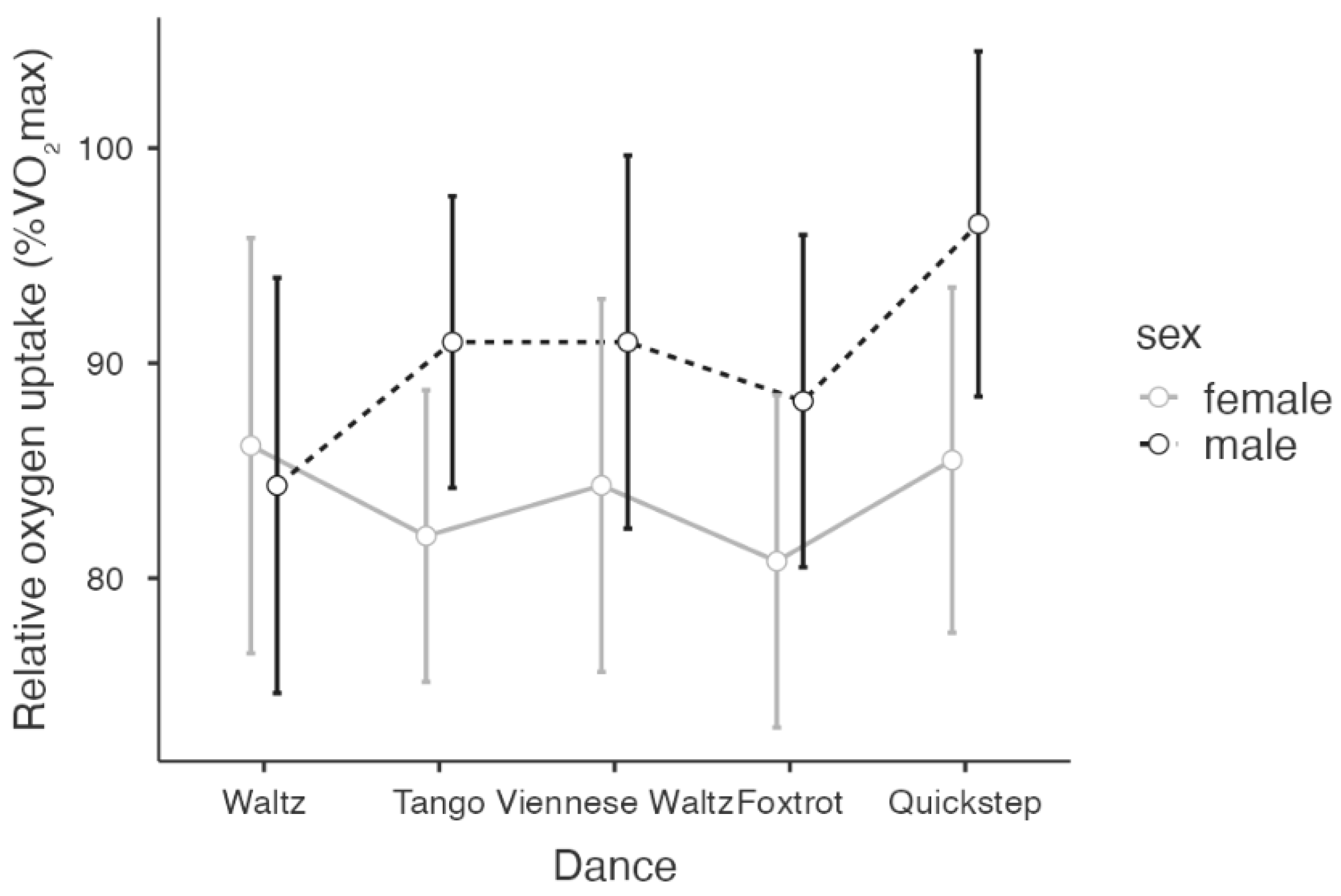

Table 1.
Descriptive statistics for laboratory VO₂max and dance-specific relative oxygen uptake (%VO₂max) in the Latin (n = 10) and Standard (n = 10) groups.
Table 1.
Descriptive statistics for laboratory VO₂max and dance-specific relative oxygen uptake (%VO₂max) in the Latin (n = 10) and Standard (n = 10) groups.
| Variable | Sex | Mean ± SD | 95% CI |
| %VO₂max – Latin | Female | 95.4 ± 8.0 | 85.5–105.3 |
| Male | 99.8 ± 9.6 | 87.8–111.7 | |
| %VO₂max – Standard | Female | 93.5 ± 11.2 | 79.6–107.4 |
| Male | 91.3 ± 11.3 | 77.3–105.2 | |
| VO₂max (ml·kg⁻¹·min⁻¹) – Laboratory (Latin test) | Female | 46.2 ± 5.3 | 39.7–52.7 |
| Male | 50.6 ± 2.6 | 47.4–53.8 | |
| VO₂max (ml·kg⁻¹·min⁻¹) – Laboratory (Standard test) | Female | 44.8 ± 3.6 | 40.3–49.3 |
| Male | 50.4 ± 2.5 | 47.3–53.5 |
Values are presented as mean ± standard deviation (SD) and 95% confidence intervals (CI). VO₂max was determined during incremental treadmill testing. Relative oxygen uptake during dance is expressed as a percentage of individual VO₂max.
Table 2.
Relative oxygen uptake (%VO₂max) during individual Latin dances in elite Slovak DanceSport athletes (n = 10).
Table 2.
Relative oxygen uptake (%VO₂max) during individual Latin dances in elite Slovak DanceSport athletes (n = 10).
| Style | Dance | Female (Mean ± SD) | 95% CI | Male (Mean ± SD) | 95% CI |
| Latin | Samba | 97.5 ± 9.0 | 86.4–108.7 | 102.5 ± 11.0 | 88.8–116.2 |
| Cha Cha | 95.6 ± 8.5 | 85.0–106.2 | 101.7 ± 11.2 | 87.8–115.6 | |
| Rumba | 87.6 ± 8.8 | 76.7–98.6 | 88.4 ± 10.1 | 75.9–100.9 | |
| Paso Doble | 96.4 ± 7.3 | 87.3–105.5 | 100.8 ± 8.7 | 90.0–111.6 | |
| Jive | 99.7 ± 8.7 | 88.8–110.5 | 105.4 ± 10.3 | 92.6–118.2 |
Values are presented as mean ± standard deviation (SD) and 95% confidence intervals (CI). Relative oxygen uptake is expressed as a percentage of individual VO₂max obtained during incremental treadmill testing n = 5 females and 5 males.
Table 3.
Relative oxygen uptake (%VO₂max) during individual Standard dances in elite Slovak DanceSport athletes (n = 10).
Table 3.
Relative oxygen uptake (%VO₂max) during individual Standard dances in elite Slovak DanceSport athletes (n = 10).
| Style | Dance | Female (Mean ± SD) | 95% CI | Male (Mean ± SD) | 95% CI |
| Standard | Waltz | 86.2 ± 7.2 | 77.2–95.1 | 84.3 ± 11.1 | 70.5–98.1 |
| Tango | 82.0 ± 4.7 | 76.1–87.8 | 91.0 ± 8.0 | 81.0–101.0 | |
| Viennese Waltz | 84.3 ± 4.8 | 78.4–90.3 | 91.0 ± 10.9 | 77.5–104.5 | |
| Foxtrot | 80.8 ± 4.9 | 74.7–86.8 | 88.2 ± 9.4 | 76.6–99.9 | |
| Quickstep | 85.5 ± 7.0 | 76.8–94.2 | 96.5 ± 8.5 | 85.9–107.0 |
Values are presented as mean ± standard deviation (SD) and 95% confidence intervals (CI). Relative oxygen uptake is expressed as a percentage of individual VO₂max obtained during incremental treadmill testing. n = 5 females and 5 males.
Disclaimer/Publisher’s Note: The statements, opinions and data contained in all publications are solely those of the individual author(s) and contributor(s) and not of MDPI and/or the editor(s). MDPI and/or the editor(s) disclaim responsibility for any injury to people or property resulting from any ideas, methods, instructions or products referred to in the content. |
© 2026 by the authors. Licensee MDPI, Basel, Switzerland. This article is an open access article distributed under the terms and conditions of the Creative Commons Attribution (CC BY) license (http://creativecommons.org/licenses/by/4.0/).
Copyright: This open access article is published under a Creative Commons CC BY 4.0 license, which permit the free download, distribution, and reuse, provided that the author and preprint are cited in any reuse.


