
Submitted:
18 February 2026
Posted:
24 February 2026
You are already at the latest version
Abstract
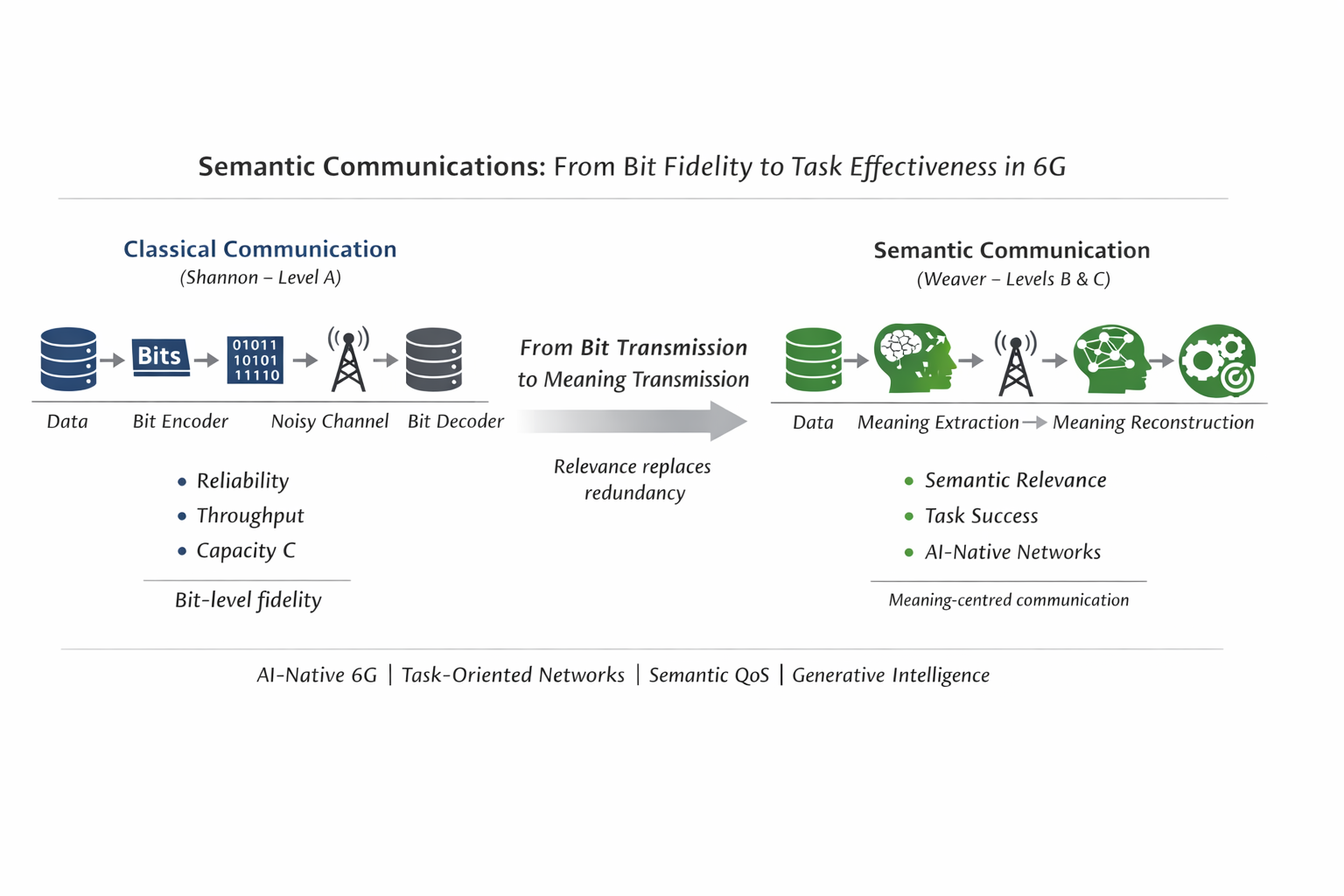
The evolution of future Internet and sixth-generation (6G) networks is driving a paradigm shift from classical bit-centric communication toward meaning-aware and task-oriented communication models. Traditional information theory, while fundamental for ensuring reliable symbol transmission, does not account for semantic relevance or task effectiveness, which are critical for emerging applications such as autonomous systems, immersive services, and ultra-low-latency communications. This article presents a comprehensive review of Semantic Communications (SemCom) from a future Internet perspective. The review systematically analyses representative extensions of classical information theory aimed at quantifying semantic information, including semantic information measures, semantic channel capacity, and semantic rate–distortion formulations. In addition, the main mathematical and computational frameworks enabling practical semantic communication systems are examined, including the Information Bottleneck principle, learning-based end-to-end communication architectures, and reinforcement learning approaches for task-oriented optimization under network constraints. The review further discusses the role of semantic metrics, contextual modelling, and task-driven performance evaluation in the design of semantic-aware communication systems. The analysis identifies key open challenges, particularly the lack of a unified theoretical framework, the need for robust and context-aware semantic performance metrics, and the integration of semantic awareness into network-level design. Overall, this review highlights Semantic Communications as a promising paradigm for future Internet and 6G networks, where communication efficiency is increasingly determined by semantic relevance and task effectiveness rather than bit-level fidelity alone.
Keywords:
semantic communications
; Shannon information theory
; deep joint source–channel coding
; generative semantic communications
; task-oriented communications
; future internet and 6G networks
Copyright: This open access article is published under a Creative Commons CC BY 4.0 license, which permit the free download, distribution, and reuse, provided that the author and preprint are cited in any reuse.


