

Submitted:
20 February 2026
Posted:
27 February 2026
You are already at the latest version
Abstract
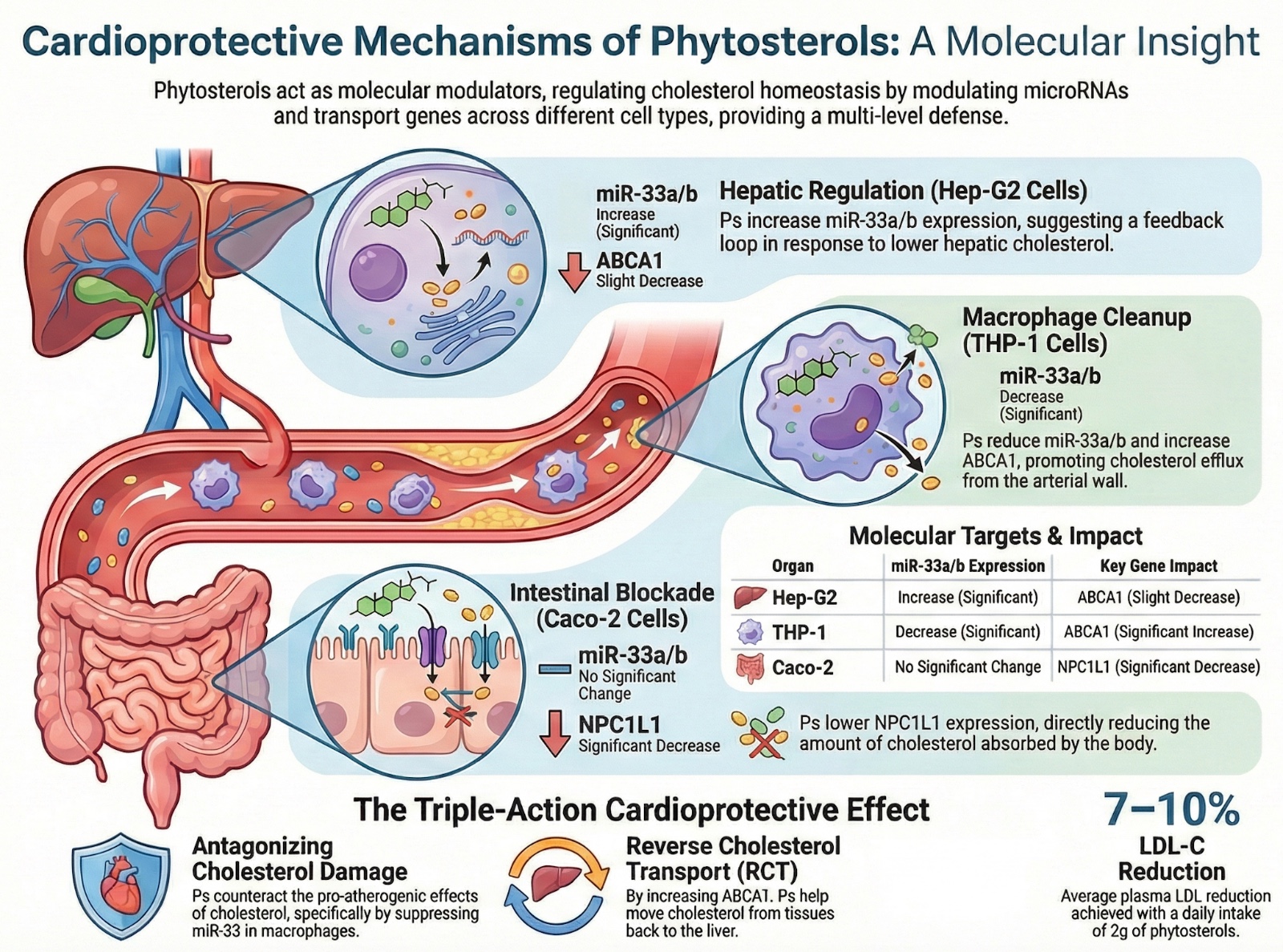
Background/ Objectives: Phytosterols (Ps), plant-derived bioactive compounds not synthesized by the organism, reduce intestinal cholesterol absorption and, when consumed regularly, lower plasma cholesterol concentrations. MicroRNAs (miRNAs) are small non-coding RNAs that regulate post-transcriptional gene expression and participate in various physiological processes, with their dysregulation being associated with diseases. Among them, miR-33a/b, intronic microRNAs (miRNAs) located within the sterol regulatory element-binding protein 2 and 1 genes (SREBP-2 and -1), respectively, have recently been shown to regulate lipid homeostasis in concert with their host genes. However, there is a scarcity of studies on the interaction between Ps and miRNAs. We aimed at evaluating the effects of Ps on the expression of miR-33a/b and genes related to cholesterol transport (ABCA1, ABCG1, NPC1L1, ABCG5, ABCG8) in hepatocytes (Hep-G2), enterocytes (Caco-2), and macrophages (THP-1). Methods: Hep-G2, Caco-2, and THP-1 cells were treated with β-sitosterol (Ps), cholesterol (Ch), Ps+Ch (25 µM/24 h), or culture medium only (control). Total RNA, including miRNAs, was extracted with TRIzol™ and the expression of miRNAs was analyzed by RT-qPCR using the Poly-A tailing protocol and the 2-ΔΔCt method. Comparisons were made using ANOVA or Kruskal-Wallis (p < 0.05). Results: Ps increased miR-33a/b in Hep-G2 (p <0.001), while Ch reduced their expression. In THP-1, Ch elevated miR-33a/b (p <0.005) and Ps reduced them, with a concomitant increase in ABCA1. In Caco-2, no significant changes were observed. Conclusions: Ps distinctly modulate miR-33a/b in hepatocytes and macrophages, suggesting a role in cholesterol homeostasis and reverse cholesterol transport. These findings reinforce the cardioprotective potential of phytosterols.
Keywords:
phytosterols
; miR-33a
; miR-33b
; ABCA1
; cholesterol transport
Copyright: This open access article is published under a Creative Commons CC BY 4.0 license, which permit the free download, distribution, and reuse, provided that the author and preprint are cited in any reuse.


