
Submitted:
19 February 2026
Posted:
20 February 2026
You are already at the latest version
Abstract
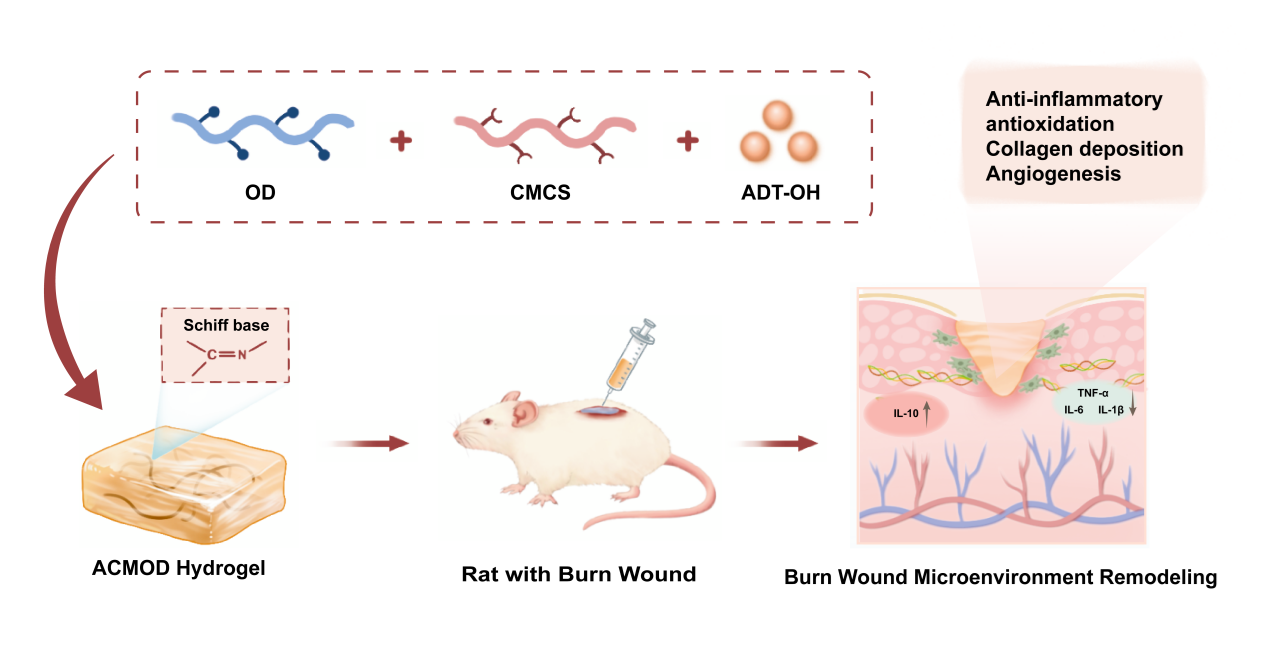
Background: Polysaccharide-based dynamic hydrogels are promising for wound management due to their biocompatibility, injectability, and tunable biofunctionality. The integration of therapeutic gasotransmitter donors offers a strategy to modulate the wound microenvironment. Objectives: This study aimed to develop an injectable, self-healing carbohydrate hydrogel capable of sustained hydrogen sulfide (H₂S) release for burn wound therapy, and to evaluate its physicochemical properties, in vivo efficacy, and mechanism of action. Methods: A dynamic hydrogel (ACMOD) was fabricated via Schiff-base crosslinking between oxidized dextran (OD) and carboxymethyl chitosan (CMCS), incorporating the H₂S donor ADT-OH. Rheological and recovery tests characterized its mechanical and self-healing properties. Efficacy and mechanisms were assessed in a rat full-thickness burn model, analyzing wound closure, histology, oxidative stress, macrophage polarization, angiogenesis, and collagen deposition. Results: ACMOD exhibited shear-thinning, rapid self-healing, and strong tissue adherence. Sustained H₂S release from ACMOD significantly accelerated wound closure and improved tissue regeneration compared to controls. Mechanistically, H₂S attenuated oxidative stress, promoted a pro-regenerative M2 macrophage phenotype, enhanced angiogenesis via VEGF upregulation, and fostered organized collagen deposition and extracellular matrix remodeling. Conclusions: This work demonstrates a versatile, carbohydrate-based dynamic hydrogel platform that synergizes polymer network dynamics with bioactive H₂S delivery to effectively promote burn wound healing. The findings underscore the potential of polysaccharide hydrogels with integrated gasotransmitter release for regenerative therapy and biomaterials applications.
Keywords:
oxidized dextran
; carboxymethyl chitosan
; hydrogen sulfide delivery
; self-healing hydrogel
; burn wound healing
; microenvironment remodeling
Copyright: This open access article is published under a Creative Commons CC BY 4.0 license, which permit the free download, distribution, and reuse, provided that the author and preprint are cited in any reuse.


