
Submitted:
15 February 2026
Posted:
25 February 2026
You are already at the latest version
Abstract
The detection of SF₆ decomposition products is essential for diagnosing insulation faults in gas-insulated switchgear. Using first-principles density functional theory, this study investigates the adsorption behavior of five characteristic gases (H₂S, SO₂, SOF₂, SO₂F₂, and SF₆) on pristine and vanadium-doped graphene/MoS₂ (GMV) heterostructures to evaluate their potential for gas sensing applications. Pristine graphene/MoS₂ exhibits weak physisorption toward all target molecules, with low adsorption energies and negligible charge transfer, indicating insufficient sensitivity for practical use. To address this limitation, a V-doped graphene/MoS₂ heterostructure is proposed, wherein vanadium atoms are incorporated into the graphene lattice to introduce active centers and modulate interfacial charge transfer. The results demonstrate that H₂S, SO₂, and SOF₂ preferentially adsorb atop the V site via local covalent interactions, with significantly enhanced adsorption energies (up to −0.388 eV for SO₂) and shortened distances. In contrast, SO₂F₂ and SF₆ adsorb near electron-depleted carbon regions driven by electrostatic attraction. Charge density difference and Bader charge analyses reveal pronounced charge redistribution upon SO₂ and SF₆ adsorption, while density of states analysis confirms orbital hybridization near the Fermi level, suggesting possible chemical bond formation. Notably, adsorption of SO₂ and SF₆ substantially reduces the density of states at near Fermi level, indicating a measurable modulation of surface conductivity. These findings establish V-doped graphene/MoS₂ as a promising sensing material for selective detection of SF₆ decomposition products, offering a viable strategy for advancing online monitoring technologies in power systems.
Keywords:
SF6
; adsorption properties
; Graphene/MoS2 heterostructure
; DFT
1. Introduction
Sulfur hexafluoride (SF₆), the primary insulating medium used in Gas-insulated switchgear (GIS), exhibits exceptional chemical stability, arc-quenching capability, and resistance to decomposition [1]. Nevertheless, insulation defects—such as metallic protrusions, loose contacts leading to floating potentials, insulation aging, and chemical corrosion—may arise during manufacturing, transportation, installation, and maintenance [2,3,4,5,6]. These defects distort the internal electric field and trigger partial discharge, arcing, or localized overheating, which subsequently induce decomposition of SF₆ into low-fluorine sulfides (e.g., SF₄, SF₃) [7]. These unstable intermediates undergo irreversible reactions with trace impurities (e.g., H₂O, O₂) in the gas atmosphere, forming stable byproducts including H₂S, SO₂, SOF₂, and SO₂F₂ [8]. The accumulation of such decomposition products not only reduces the SF₆ concentration but also generates acidic compounds upon hydrolysis (e.g., SO₂, H₂S), which corrode metallic components and solid insulation materials. These processes collectively degrade the dielectric performance of GIS and may precipitate severe insulation failures, posing significant risks to the secure and stable operation of power grids.
Accumulating evidence suggests that the composition and concentration of SF₆ decomposition products are closely correlated with specific types of insulation defects, offering a viable pathway for condition assessment of GIS [8]. In engineering practice, however, the decomposition products are typically present at trace levels and involve multiple gas species, rendering their accurate detection technically challenging. Gas sensor technology, which relies on gas-sensitive materials that transduce adsorption-induced changes in electrochemical properties into measurable electrical signals (e.g., resistance variation), has emerged as a promising approach for quantitative and qualitative analysis of SF₆ byproducts [9,10]. This method enables rapid detection, miniaturized instrumentation, and compatibility with automated online monitoring systems. Nonetheless, conventional gas sensors suffer from inherent limitations including poor selectivity toward single gas components, pronounced cross-sensitivity, and insufficient long-term stability. Moreover, the complex and uncommon nature of SF₆ decomposition products necessitates the development of gas sensors specifically tailored to these characteristic species.
Nanomaterial-based gas sensors have garnered considerable research interest owing to their ultracompact dimensions and low power consumption [11,12,13,14,15,16]. Heterostructures composed of graphene and molybdenum disulfide (MoS₂) have demonstrated enhanced sensitivity toward target gas molecules through interfacial charge transfer modulation [17,18,19,20,21,22]. Despite these advances, no systematic investigation has been reported to date on the gas-sensing performance of graphene/MoS₂ heterostructures toward SF₆ and its typical decomposition products.
In this work, we systematically explore the adsorption properties of graphene/MoS₂ heterostructures toward SF₆ and its primary decomposition gases (SO₂, H₂S, SOF₂, and SO₂F₂) using density functional theory (DFT) calculations. Our results indicate that pristine graphene exhibits weak adsorption and poor selectivity toward these molecules, while sole modulation of the MoS₂ component or structure fails to concurrently achieve optimized sensing responses for multiple target gases. To overcome these limitations, we propose—for the first time—the precise incorporation of vanadium (V) atoms into the graphene lattice, a strategy distinct from conventional doping of the MoS₂ layer or random heterointerface modification. This design confers dual functionality upon the vanadium dopants: they serve as active centers that modulate interfacial charge transfer to amplify electrical signal variations induced by gas adsorption, and simultaneously act as specific recognition sites that substantially enhance the selective adsorption of sulfur- and oxygen-containing decomposition products. Importantly, this approach preserves the intrinsic high-conductivity network of graphene while establishing synergistic coupling with the semiconducting properties of MoS₂. Collectively, these features enable the directional tuning and systematic optimization of the overall gas-sensing performance of the heterostructure, offering a promising pathway for advanced SF₆ decomposition product detection.
2. Materials and Methods
In this paper, we explored the geometric optimization, charge distribution, density of states (DOS), and other related properties of Graphene/Mos2 heterostructure with five kinds of gas molecule (SF6, H2S, SO2, SOF2, SO2F2) based on first-principles, using the DFT in the Vienna Ab initio Simulation Package (VASP) software, which is based on the plane-wave pseudopotential method. The electron exchange and correlation were described by the Perdew-Burke-Ernzerhof (PBE) function of the generalized gradient approximation (GGA) based on density functional theory (DFT). The core electron and valence electron were treated using the Projected Augmented Wave method (PAW). Van der Waals (vdW) interactions were corrected for using the Grimme’s DFT-D3 method [23,24,25,26]. The cutoff energy was set as 500 eV. The Monkhorst-Pack k-grid was chosen as 4 × 4 × 1. We set vacuum about 15 Å to avoid the interaction from adjacent unit. For the system energy calculation, The energy tolerance accuracy, maximum force, and displacement were set as 1×10⁻⁵ Ha, 2×10⁻³ Ha/Å and 5×10⁻³ Å [27,28,29,30,31,32,33]. The Bader charge analysis method is utilized to determine the charge transfer and distribution within the system. All calculations incorporate spin polarization. The adsorption energy (Eads) is defined as equation (1):
Eads=Egas/sub-Esub-Egas
Where Egas/sub, Esub and Egas represent the total energy of the whole adsorption system, the energy of adsorption substrate and the energy of isolated gas molecules before the adsorption, respectively. According to this formula, the larger the absolute value of the adsorption energy calculated, the greater the energy difference before and after the adsorption process. Generally, this indicates a stronger adsorption effect.
The charge density difference (Δρ) is calculated as Equation (2):
Δρ=ρgas/sub-ρsub-ρgas
Where ρgas/sub is the total charge density of the whole adsorption system, ρsub andρgas are the charge density of adsorption substrate and isolated one gas molecule, respectively.
Based on Mulliken charge analysis, the charge transfer (QT) between gas molecules and adsorption substrate was calculated by following equation:
QT = Qads - Qiso
Where Qads and Qiso are total charges of molecule before and after adsorption, respectively.
3. Results and Discussion
3.1. Adsorbing Characteristics of G/MoS2 Interface for Target Gases
To obtain the adsorption characteristics of G/MoS2 to the SF₆ decomposition gas products, the structures of G/MoS2 and gas molecules were initially optimized. The G/MoS2 was established based on the 3×3 × 1 supercell structure of monolayer MoS2 and the 4 × 4 × 1 supercell structure of graphene with lattice mismatch about 2%, as shown in Figure 1. The Mo-S bond length is 2.42 Å and that of C-C is 1.41 Å. The optimized distance between MoS2 interlayer and graphene interlayer is 3.42 Å, which is in good accordance with experimentally research [34] and this distance demonstrate that vdW force exists in this heterostructure.
The models of SF6 and the four typical decomposition gases (H2S, SO2, SOF2, SO2F2) were optimized, as shown in Figure 2. It is can be observed from Figure 2 (e) that there are six F atoms are symmetrical around a S atom in the form of regular octahedral structure in the SF6 molecule. The bond angels of F-S-F are 90.55° and the bond lengths of F-S are 1.60 Å. The H2S molecule appears a high symmetrical “V” shape with an angel of 91.76° between two S-H bonds and a length of 1.35 Å S-H bond, as shown in Figure 2 (a). The shape of SO2 and H2S seem to be like, but it shows in Figure 2 (b) that the angel of two O-S bonds is 120.12° and the length of O-S bond is 1.46 Å. The SOF2 molecule present tetrahedral structure and symmetrical about the O-S bond. The angel between the O-S bond and F-S bond is 106.55°, the length of O-S bond is 1.43 Å and that of the F-S bond is 1.64 Å. As shown in Figure 2 (d), SO2F2 is symmetric with respect to the perpendicular bisector of the line connecting either the two O atoms or the two F atoms. The bond angels of O-S-F, O-S-O and F-S-F are 108.28°, 124.98° and 95.72°, respectively. The bond lengths of O-S and F-S are 1.42 Å and 1.57 Å, respectively. We have confirmed that these calculations give very close results to published data [35].
The adsorption models were obtained by position the SF6 and other four decomposition gas molecules close to the surface of the optimized G/MoS2 heterostructure model and the initial distances are about 3 Å. The structure of these adsorption systems were optimized, with the K-point selected as 3×3×1 grids at the Gamma point. After these structure optimization, static calculations were conducted. These accurate adsorption energies were ultimately obtained from the static calculations. On those basis, other calculations were carried out to obtain more parameters characterizing the adsorption properties. In this paper, parameters such as density of states and charge difference density were selected for calculation. The paper considered the different adsorption positions and directions of each gas at the G/MoS2 interface, and selected the most stable adsorption structure from the calculation results for analysis. After structural optimization and static calculation, the adsorption energies and minimum distances corresponding to the adsorption models of each gas molecule and G/MoS2 were obtained and are shown in Table 1. In Table 1, the minimum distance is the shortest distance between the atoms of the adsorbed gas molecule and the surface atoms of G/MoS2. Figure 3 presents the stable adsorption configurations of five gas molecules on G/MoS2.
The corresponding adsorption parameters, including adsorption distance (D), adsorption energy Ead, and charge transfer QT, are summarized in Table 1. A positive charge transfer value indicates that electrons are transferred from gas molecules to the adsorption substrate, while a negative value indicates that electrons are transferred from the adsorption substrate to the gas molecules. By comparing the adsorption energies, the distances and charge transfer value between the five gas molecules and G/MoS2, it is found that the adsorption between the five gas molecules and G/MoS2 in this calculation is all relatively weak physical adsorption. Therefore, while the intrinsic graphene/MoS₂ heterostructure offers a fundamental platform for gas adsorption, its limited adsorption strength, weak charge transfer, and insufficient selectivity toward SF₆ decomposition products render it inadequate for reliable gas-sensing applications. To overcome these intrinsic bottlenecks, heteroatom doping—particularly with transition metals—has emerged as an effective strategy to modulate the local electronic structure, enhance chemical reactivity, and introduce gas-specific recognition sites.
3.2. Adsorbing Characteristics of V-Doped G/MoS2 (GMV) for Target Gases
In this section, we focus on V-doped graphene/MoS₂ heterostructures. Vanadium is selected due to its unfilled d orbitals, moderate electronegativity, and proven catalytic activity in sulfur-containing gas interactions. We first establish the stable configurations of V-doped graphene and its heterostructure with MoS₂, followed by a systematic analysis of the adsorption behavior, charge transfer, and electronic response toward SO₂, H₂S, SOF₂, and SO₂F₂.
Figure 4(a) top view showing the atomic-scale structure of the V-doped graphene layer. The doping site (V1) and its surrounding carbon atoms (C1–C31) within the graphene lattice are explicitly labeled. The vanadium atom forms covalent bonds with three adjacent carbon atoms, exhibiting bond lengths of approximately 1.88 Å for V1–C21 and V1–C26, and 1.96 Å for V1–C25. These bond lengths are significantly larger than the intrinsic C–C bond length in pristine graphene (1.41 Å), indicating pronounced local lattice distortion induced by V doping. This configuration corresponds to the lowest-energy stable doping site, with all atomic positions fully relaxed via density functional theory calculations. Figure 5(b) side view illustrating the layered stacking relationship of the V-doped graphene/MoS₂ heterostructure. The bottom layer comprises monolayer MoS₂, where S and Mo atoms adopt a trigonal prismatic coordination. The top layer consists of V-doped monolayer graphene, in which a vanadium atom substitutes a carbon atom and is incorporated into the graphene lattice. The optimized interlayer distance is approximately 3.58 Å, suggesting the formation of a stable heterojunction governed by van der Waals interactions. The vertical distance between the V atom and the graphene layer is approximately 1.52 Å, while that between the V atom and the MoS₂ layer is approximately 2.06 Å. Bader charge analysis indicates that approximately 0.398 e is transferred from the V atom to the MoS₂ layer. Concurrently, about 0.933 e is transferred to the graphene layer, with the majority (approximately 0.831 e) accumulated on the C21, C25, and C26 atoms.
Figure 5 presents the optimized geometric configurations of H₂S, SO₂, SOF₂, SO₂F₂, and SF₆ adsorbed on the V-doped graphene/MoS₂ heterostructure surface, all of which were obtained via density functional theory (DFT) calculations with full atomic relaxation to the lowest-energy states. Analysis of the top and side views reveals that H₂S, SO₂, and SOF₂ molecules preferentially adsorb in the vicinity of the V doping site, confirming that the vanadium atom serves as an active center that substantially enhances the heterostructure’s affinity toward sulfur-containing decomposition products. In contrast, SO₂F₂ and SF₆ molecules tend to adsorb near the positively charged carbon atoms (C18, C22, C23, and C27) induced by charge transfer, this behavior is attributed to the sulfur atoms in SO₂F₂ and SF₆ being surrounded by highly electronegative oxygen or fluorine atoms, rendering them locally electron-deficient and thereby facilitating electrostatic attraction with the electron-depleted carbon sites. Specifically, the H₂S molecule is stably adsorbed with its sulfur atom oriented toward the vanadium atom and its two hydrogen atoms pointing toward the graphene surface, resulting in a slight tilt of the molecular plane relative to the substrate, and an adsorption height of approximately 2.03 Å. The SO₂ molecule adopts an orientation nearly parallel to the graphene surface, with an adsorption height of 2.34 Å. The SOF₂ molecule anchors via its sulfur atom atop the vanadium dopant, exhibiting an inverted tetrahedral configuration and positioned approximately 2.18 Å above the graphene layer. For SO₂F₂, two fluorine atoms and one oxygen atom are located above the electron-depleted carbon atoms C22, C23, and C27, respectively, corresponding to an adsorption height of about 3.02 Å. The SF₆ molecule is arranged such that three fluorine atoms point toward C18, C22, and C23, respectively, with the entire molecule situated approximately 2.85 Å above the graphene layer. The adsorption heights of the five gas molecules follow the order: SO₂F₂ > SF₆ > SO₂ > SOF₂ > H₂S. Compared with the pristine (undoped) graphene/MoS₂ heterostructure, the adsorption distances for all gas molecules except SO₂F₂ are significantly reduced, with the most pronounced decreases observed for H₂S, SO₂, and SOF₂. These results demonstrate that V doping not only introduces specific recognition sites for gas molecules but also effectively tailors the adsorption behavior via modulation of the surface charge distribution, thereby establishing a robust structural foundation for subsequent analyses of charge transfer mechanisms and gas-sensing response performance.
Table 2 summarizes the adsorption energy, adsorption distance (), and Bader charge transfer () for five characteristic SF6 decomposition products adsorbed on the V-doped graphene/MoS2 heterostructure (GMV) surface. The calculated results reveal two distinct adsorption regimes depending on the molecular species. H2S, SO2 and SOF2 preferentially adsorb atop the vanadium dopant site via local covalent bonding, forming stable configurations with relatively short adsorption distances (2.03 Å, 2.34 Å and 2.18 Å, respectively). In contrast, SO2F2, and SF6 tend to adsorb in the vicinity of positively charged carbon atoms (e.g., C18, C22, C23, C27) induced by charge redistribution, with the adsorption driving force primarily originating from electrostatic attraction and van der Waals interactions, accompanied by adsorption distances of 3.03 Å, and 2.85 Å, respectively. Notably, all five gas molecules exhibit adsorption energies within a moderate range (-0.224 to -0.380 eV), indicating physisorption or weak chemisorption.
Based on charge density files computed using the VASP, further analyses were conducted with the assistance of the vaspkit code to generate the charge density difference plots for the V-doped MoS₂ system before and after the adsorption of H₂S, SO₂, SOF₂, SO₂F₂, and SF₆ gas molecules, as depicted in Figure 6. Using the Z-axis lattice parameter of the GMV supercell as a reference, the ordinate in Figure 6 represents the distance along this direction. The plane-averaged charge density difference plots (Figure 6(a), 6(c), 6(e), 6(g), and 6(i)) reveal significant charge redistribution at the interface between GMV and all adsorbed gas molecules except H₂S, suggesting a strong interaction between these molecules and the GMV substrate. This is further corroborated by the three-dimensional isosurface plots (Figure 6(b), 6(d), 6(f), 6(h), and 6(j)), where purple and cyan regions denote electron accumulation and depletion, respectively.
Notably, substantial electron accumulation is observed around the adsorbed gas molecules. A particularly pronounced electron accumulation is evident on the GMV surface following SO₂F₂ adsorption, which may indicate a like-charge repulsion effect, potentially limiting its adsorption capability. Collectively, these charge transfer characteristics are consistent with the trends in adsorption energy and adsorption configurations reported earlier.
By comparing the total density of states (TDOS) of the GMV system after gas adsorption with the projected density of states (PDOS) of the adsorbed gas molecules, the influence of the adsorbed gas molecules on the electronic properties of the adsorption system can be elucidated. A comparison of the density of states for GMV adsorbed with H₂S, SO₂, SOF₂, SO₂F₂, and SF₆ molecules is presented in Figure 7, where the Fermi level is indicated by a dashed line. Figure 7(c) and (f) present the total density of states (TDOS) of the GMV system after SO₂ and SF₆ adsorption, along with the projected density of states (PDOS) of the corresponding gas molecules. The analysis reveals that the PDOS of the 2p orbitals of these gas molecules exhibit pronounced peaks near the Fermi level, which hybridize or interact with the TDOS of the adsorption system, suggesting the possible formation of chemical bonds between the gas molecules and the substrate. This observation indicates strong adsorption of SO₂ and SF₆ on GMV, consistent with the previously discussed adsorption energies, geometric configurations, and charge density difference analyses. In contrast, as illustrated in Figure 7(b), the PDOS of H₂S, SOF2 and SO2F2 have a negligible impact on the electronic structure of GMV near the Fermi level, implying weak adsorption of these gases on GMV, which aligns with the aforementioned findings. Furthermore, compared to the TDOS of pristine GMV, a significant reduction in the density of states near the Fermi level is observed upon SO₂ and SF₆ adsorption, indicating that gas adsorption modulates the electronic structure of the substrate, potentially influencing its surface conductivity.
4. Conclusions
Herein, the adsorption behavior and electronic properties of five characteristic SF₆ decomposition gases, namely H₂S, SO₂, SOF₂, SO₂F₂, and SF₆, on pristine and vanadium-doped graphene/MoS₂ heterostructures are systematically investigated via first-principles density functional theory (DFT). Computational results reveal that the pristine graphene/MoS₂ heterostructure exhibits weak physical adsorption toward all the aforementioned gas molecules, characterized by low adsorption energies and minimal charge transfer, which are insufficient to meet the sensitivity and selectivity requirements for gas-sensing applications. By incorporating vanadium atoms into the graphene lattice to construct V-doped graphene/MoS₂ heterostructures, their adsorption performance is significantly enhanced. The introduction of V atoms forms localized active centers within the graphene layer, effectively modulating the interfacial charge distribution. It is found that H₂S, SO₂, and SOF₂ molecules preferentially adsorb at the top sites of V atoms through localized covalent interactions, with markedly increased adsorption energies (reaching -0.388 eV for SO₂) and shortened adsorption distances. Notably, the adsorption of SO₂ and SF₆ is accompanied by significant interfacial charge redistribution and orbital hybridization, indicating strong interactions between these molecules and the substrate. In contrast, SO₂F₂ and SF₆ are primarily adsorbed at the electron-deficient carbon regions induced by V doping, with electrostatic interactions dominating the adsorption driving force. Density of states (DOS) analysis further confirms that the 2p orbitals of SO₂ and SF₆ hybridize with the substrate's DOS near the Fermi level, leading to a substantial reduction in the DOS at the Fermi level, which implies detectable changes in surface conductivity. In conclusion, the V-doped graphene/MoS₂ heterostructure demonstrates differentiated adsorption responses and enhanced electronic coupling characteristics toward SF₆ decomposition gases, particularly exhibiting promising sensitivity potential in the detection of SO₂ and SF₆. This study provides a theoretical foundation for the design of novel gas sensors for SF₆ decomposition products and the realization of online monitoring of GIS insulation status.
Author Contributions
Conceptualization, A. Z., J. A, X. L., Y. C., K. L., and X. D.; methodology, T. L.; software, A. Z.; validation, X.C.; formal analysis, A. Z.; investigation, A. Z.; resources, A. Z.; data curation, A. Z.; writing—original draft preparation, A. Z.; writing—review and editing, A. Z.; visualization, A. Z.; supervision, A. Z.; project administration, A. Z.; funding acquisition, A. Z, Tingting. L., X. C. All authors have read and agreed to the published version of the manuscript.
Funding
This research was funded by the National Natural Science Foundation of China (NSFC), grant number 12304092, the Natural Science Basic Research Plan in Shaanxi Province of China, grant number 2023-JC-YB-032, the 2025 Basic and Vocational Education Practical Research Project of Xianyang Normal University, grant number sjxm202574, the Natural Science Basic Research Program of Shaanxi Province, grant number 2025JC-YBQN-097, Chongqing New Youth Innovation Talent Program, grant number CSTB2024NSCQ-QCXMX0086, National-level Undergraduate Innovation Training Program, grant number 202510722028; The Natural Science Basic Research Program of Shaanxi Province, grant number 2024JC-YBQN-0020; the Scientific Research Program of Shaanxi Province Education Department, grant number 24JK0702.
Data Availability Statement
Not applicable.
Acknowledgments
We would like to thank all the co-authors for their contributions to this work.
Conflicts of Interest
The authors declare that they have no known competing financial interests or personal relationships that could have appeared to influence the work reported in this paper.
References
- Khan, B.; et al. Analysis of the dielectric properties of R410A Gas as an alternative to SF6 for high-voltage applications. High Voltage 2019, 4, 41–48. [Google Scholar] [CrossRef]
- Tsai, W.-T. The decomposition products of sulfur hexafluoride (SF6): Reviews of environmental and health risk analysis. Journal of Fluorine Chemistry 2007, 128, 1345–1352. [Google Scholar] [CrossRef]
- Malik, N.; Qureshi, A. A Review of Electrical Breakdown in Mixtures of SF6 and Other Gases. IEEE Trans. Elect. Insul. 1979, EI-14, 1–13. [Google Scholar] [CrossRef]
- Xiao, S.; Zhang, X.; Tang, J.; Liu, S. A review on SF 6 substitute gases and research status of CF 3 I gases. Energy Reports 2018, 4, 486–496. [Google Scholar] [CrossRef]
- Vanbrunt, R. J. Production rates for oxyfluorides SOF2, SO2F2, and SOF4 in SF6 corona discharges. J. RES. NATL. BUR. STAN. 1985, 90, 229. [Google Scholar] [CrossRef]
- Dervos, C. T.; Vassiliou, P. Sulfur Hexafluoride (SF6 ): Global Environmental Effects and Toxic Byproduct Formation. Journal of the Air & Waste Management Association 2000, 50, 137–141. [Google Scholar]
- Dibeler, V. H.; Mohler, F. L. Dissociation of SF6, CF4, and SiF4 by electron impact. J. RES. NATL. BUR. STAN. 1948, 40, 25. [Google Scholar] [CrossRef]
- Zhong, L.; et al. Theoretical study of the chemical decomposition mechanism and model of Sulfur hexafluorid (SF6) under corona discharge. Journal of Fluorine Chemistry 2019, 220, 61–68. [Google Scholar] [CrossRef]
- Luo, C.; et al. Transition Metal (Co, V, W, Zr) Single-Atom Decorated Biphenylene for Enhancing the Sensing Performance of SF6 Decomposition Molecules. Langmuir 2024, 40, 9490–9500. [Google Scholar] [CrossRef]
- Zeng, F.; Li, H.; Cheng, H.; Tang, J.; Liu, Y. SF6 decomposition and insulation condition monitoring of GIE: A review. High Voltage 2021, 6, 955–966. [Google Scholar] [CrossRef]
- Zhang, W.; Gui, Y.; Yang, Y.; Tang, C. A hybrid nanogenerator based on wind energy harvesting for powering self-driven sensing systems. Journal of Cleaner Production 2023, 429, 139550. [Google Scholar] [CrossRef]
- Shao, Y.; et al. Core-sheath structured CNT@Ni-CNT fiber-based multifunctional fabric with high-sensitivity, wide-range strain sensing, and enhanced electromagnetic shielding absorption. Chemical Engineering Journal 2025, 512, 162358. [Google Scholar] [CrossRef]
- Wang, Y.; Gui, Y.; He, S.; Yang, J. Hybrid nanogenerator driven self-powered SO2F2 sensing system based on TiO2/Ni/C composites at room temperature. Sensors and Actuators B: Chemical 2023, 377, 133053. [Google Scholar] [CrossRef]
- Gui, Y.; Wang, Y.; He, S.; Yang, J. Self-powered smart agriculture real-time sensing device based on hybrid wind energy harvesting triboelectric-electromagnetic nanogenerator. Energy Conversion and Management 2022, 269, 116098. [Google Scholar] [CrossRef]
- Chen, Y.; et al. Integrated design and optimization of magnetically actuated self-sensing flexible gripper with fast response, high stability, and high payload-to-weight ratio. Sci. China Technol. Sci. 2025, 68, 1920206. [Google Scholar] [CrossRef]
- He, S.; Gui, Y.; Wang, Y.; Yang, J. A self-powered β-Ni(OH)2/MXene based ethanol sensor driven by an enhanced triboelectric nanogenerator based on β-Ni(OH)2@PVDF at room temperature. Nano Energy 2023, 107, 108132. [Google Scholar] [CrossRef]
- Ma, H.; et al. Humidity sensing characteristics of graphene and MoS2 as well as their heterostructures with different stacking configurations. [CrossRef]
- Cho, B.; et al. Chemical Sensing of 2D Graphene/MoS2 Heterostructure device. ACS Appl. Mater. Interfaces 2015, 7, 16775–16780. [Google Scholar] [CrossRef]
- Ghayyem, F.; Kiakojouri, A.; Frank, I.; Nadimi, E. Gas Sensing Properties of Graphene/MoS₂/Graphene Lateral Heterostructure: A First Principles Investigation. IEEE Sensors J. 2024, 24, 36334–36341. [Google Scholar] [CrossRef]
- Alzate-Carvajal, N.; Luican-Mayer, A. Functionalized Graphene Surfaces for Selective Gas Sensing. ACS Omega 2020, 5, 21320–21329. [Google Scholar] [CrossRef]
- Bag, A.; Lee, N.-E. Gas sensing with heterostructures based on two-dimensional nanostructured materials: a review. J. Mater. Chem. C 2019, 7, 13367–13383. [Google Scholar] [CrossRef]
- Baloglu, A. B.; et al. GRAPHENE/BN VAN DER WAALS HETEROSTRUCTURES FOR ENHANCED TOXIC GAS SENSING.
- Li, B.; Zhang, N.; Lei, Y.; Zhu, M.; Yang, H. Graphene/Chalcogenide Heterojunctions for Enhanced Electric-Field-Sensitive Dielectric Performance: Combining DFT and Experimental Study. Nanomaterials 2026, 16, 128. [Google Scholar] [CrossRef] [PubMed]
- Fang, Q.; et al. van der Waals graphene/MoS2 heterostructures: tuning the electronic properties and Schottky barrier by applying a biaxial strain. Mater. Adv. 2022, 3, 624–631. [Google Scholar] [CrossRef]
- Foruzan, E.; Akmal, A. A. S.; Niayesh, K.; Lin, J.; Sharma, D. D. Comparative study on various dielectric barriers and their effect on breakdown voltage. High Voltage 2018, 3, 51–59. [Google Scholar] [CrossRef]
- Grimme, S.; Antony, J.; Ehrlich, S.; Krieg, H. A consistent and accurate ab initio parametrization of density functional dispersion correction (DFT-D) for the 94 elements H-Pu. The Journal of Chemical Physics 2010, 132, 154104. [Google Scholar] [CrossRef]
- Hartmann, G.; Lee, M.; Hwang, G. S. Structural, electronic and adsorption properties of monolayer 2H-MoS2 on graphene substrates: A computational study. Inorganic Chemistry Communications 2019, 106, 135–138. [Google Scholar] [CrossRef]
- Wei, H.; Gui, Y.; Kang, J.; Wang, W.; Tang, C. A DFT Study on the Adsorption of H2S and SO2 on Ni Doped MoS2 Monolayer. Nanomaterials 2018, 8, 646. [Google Scholar] [CrossRef]
- Zou, Y.; et al. Charge Transfer in Graphene-MoS2 Vertical Heterostructures Tuned by Stacking Order and Substrate-Introduced Electric Field. ACS Appl. Mater. Interfaces 2024, 16, 30589–30597. [Google Scholar] [CrossRef]
- Cao, Q.; et al. Controllable Graphene/MoS2 Heterointerfaces by Perpendicular Surface Functionalization. Angew Chem Int Ed 2024, 63, e202415922. [Google Scholar] [CrossRef]
- Miao, H.; et al. DFT analysis of the sensitivity of graphene/MoS2 heterostructures toward H2CO. Vacuum 2023, 214, 112182. [Google Scholar] [CrossRef]
- Zhang, W.; et al. Effects of vertical strain and electrical field on electronic properties and Schottky contact of graphene/MoSe2 heterojunction. Journal of Physics and Chemistry of Solids 2021, 157, 110189. [Google Scholar] [CrossRef]
- Liu, X.; Li, Z. Electric Field and Strain Effect on Graphene-MoS2 Hybrid Structure: Ab Initio Calculations. J. Phys. Chem. Lett. 2015, 6, 3269–3275. [Google Scholar] [CrossRef]
- Pierucci, D.; et al. Band Alignment and Minigaps in Monolayer MoS2 -Graphene van der Waals Heterostructures. Nano Lett. 2016, 16, 4054–4061. [Google Scholar] [CrossRef]
- Li, B.; Zhou, Q.; Peng, R.; Liao, Y.; Zeng, W. Adsorption of SF6 decomposition gases (H2S, SO2, SOF2 and SO2F2) on Sc-doped MoS2 surface: A DFT study. Applied Surface Science 2021, 549, 149271. [Google Scholar] [CrossRef]
Figure 1.
Geometric structure of optimized G/MoS2 heterostructure, (a) vertical view (b) side view.
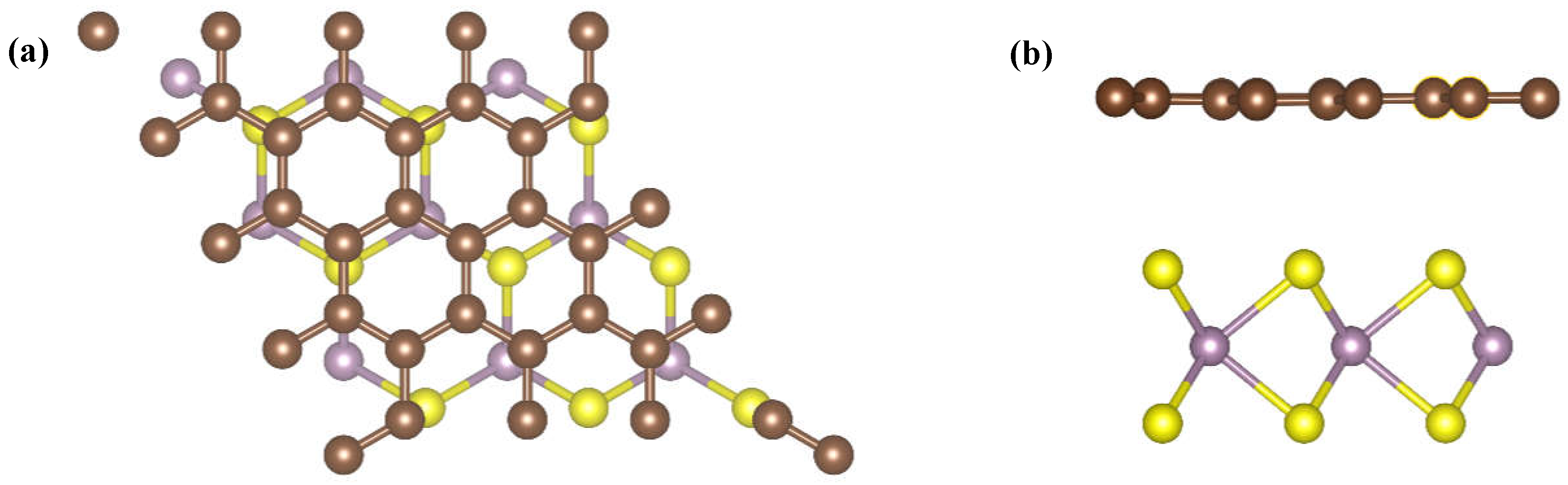
Figure 2.
Optimized molecular structure of H2S, SO2, SOF2, SO2F2 and SF6.
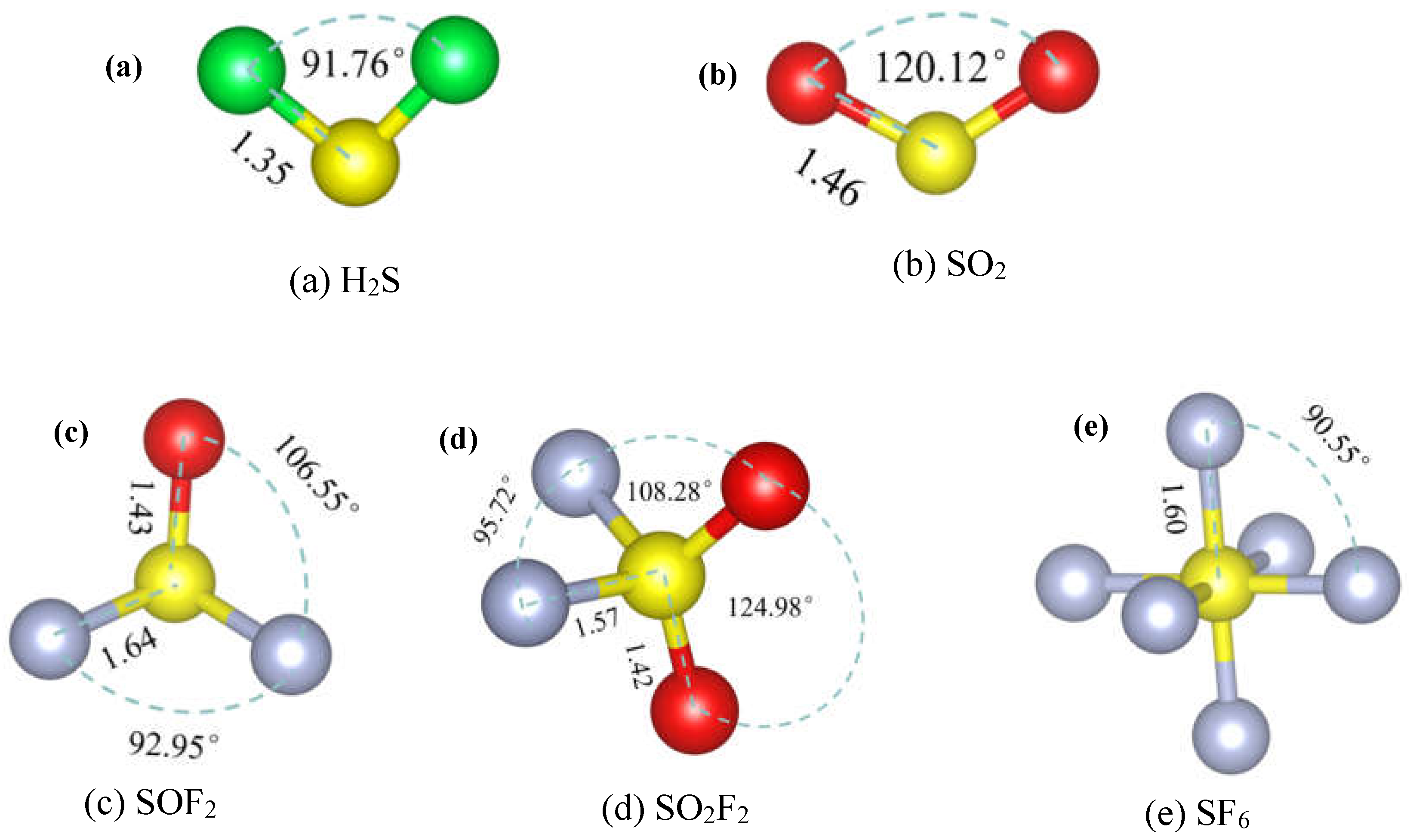
Figure 3.
Adsorption structure of G/MoS2 interface for H2S, SO2, SOF2, SO2F2 and SF6.
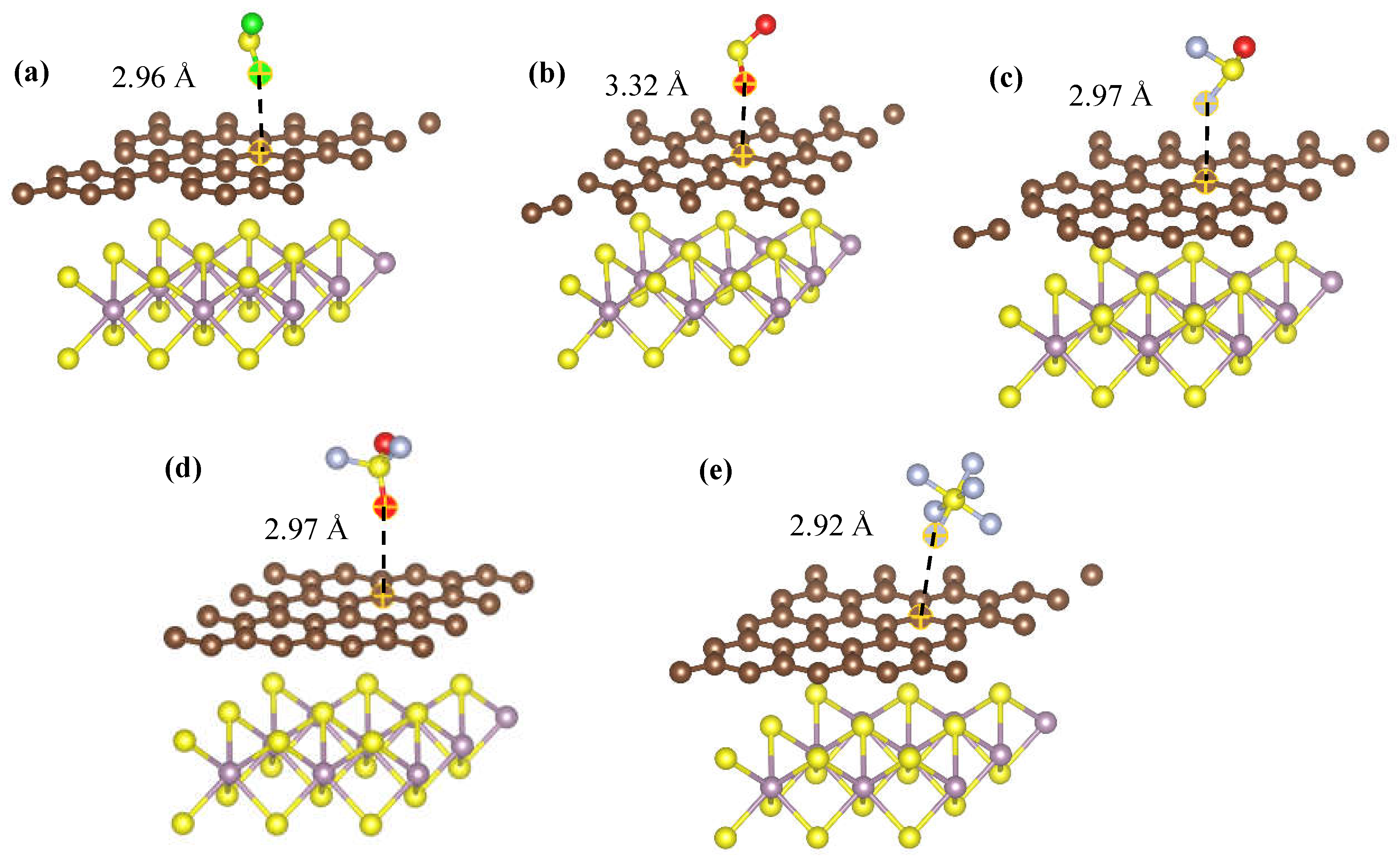
Figure 4.
Optimized geometric configurations of the V-doped graphene/MoS₂ heterostructure. (a) top view, (b) side view.
Figure 4.
Optimized geometric configurations of the V-doped graphene/MoS₂ heterostructure. (a) top view, (b) side view.
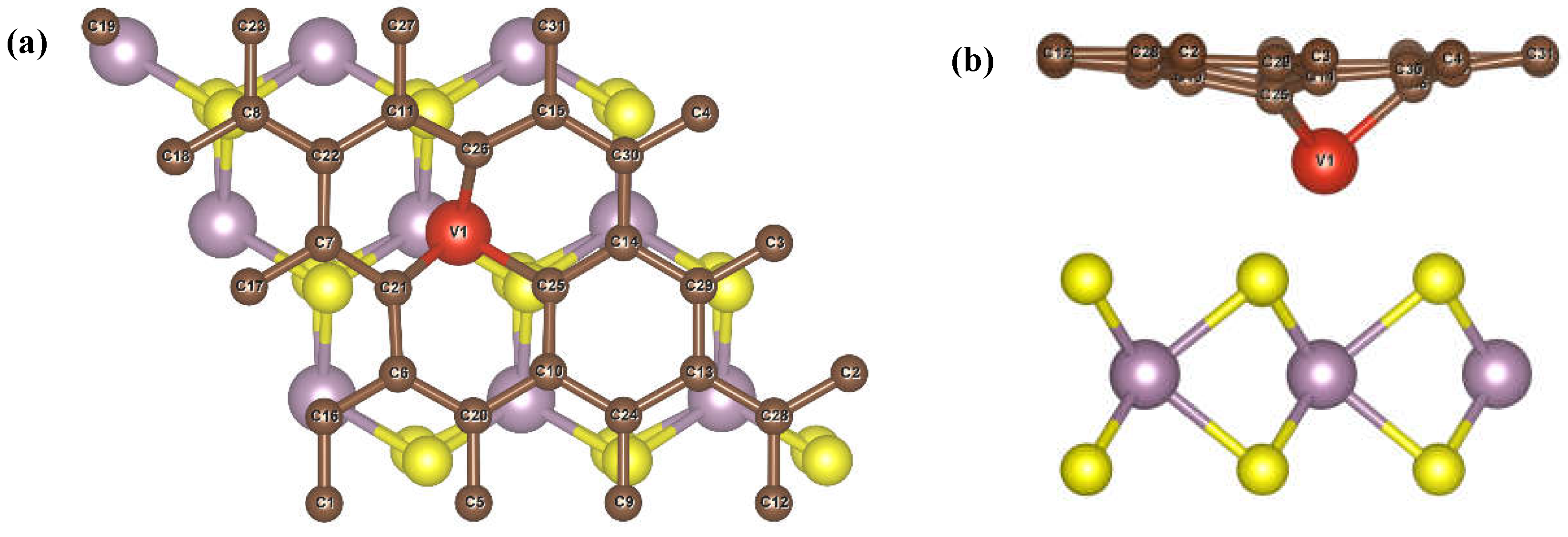
Figure 5.
Optimized geometric configurations for the adsorption of five characteristic SF₆ decomposition products on the V-doped graphene/MoS₂ heterostructure: (a, b) H₂S, (c, d) SO₂, (e, f) SOF₂, (g, h) SO₂F₂, and (i, j) SF₆. Top views are shown in (a), (c), (e), (g), and (i), while the corresponding side views are presented in (b), (d), (f), (h), and (j).
Figure 5.
Optimized geometric configurations for the adsorption of five characteristic SF₆ decomposition products on the V-doped graphene/MoS₂ heterostructure: (a, b) H₂S, (c, d) SO₂, (e, f) SOF₂, (g, h) SO₂F₂, and (i, j) SF₆. Top views are shown in (a), (c), (e), (g), and (i), while the corresponding side views are presented in (b), (d), (f), (h), and (j).
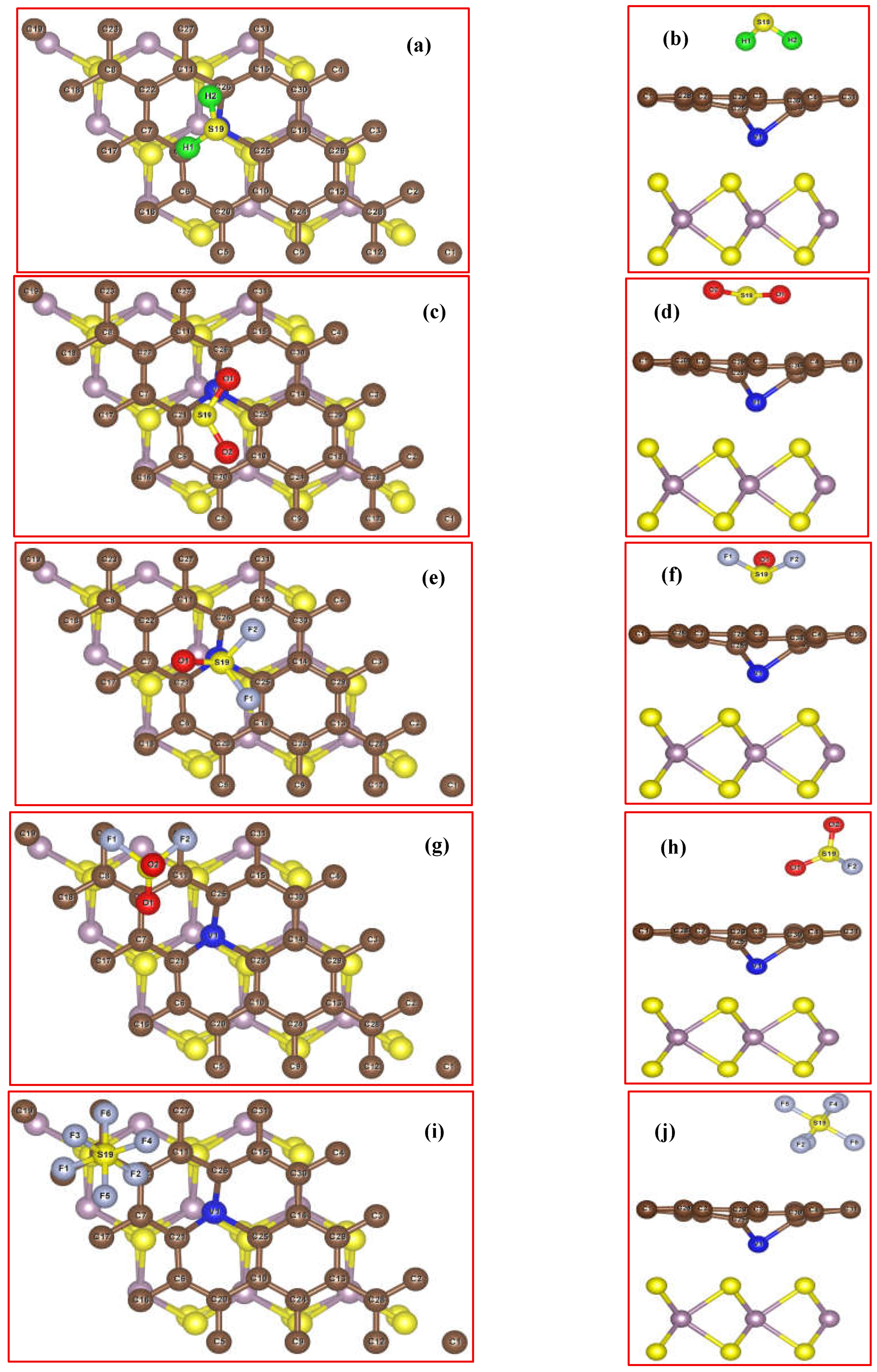
Figure 6.
Plane⁃averaged differential charge density (DCD) for (a) H2S, (c) SO2, (e) SOF2, (g) SO2F2 and (i) SF6 adsorbed on Co-doped G/MoS2 (GMV) surface. The (b), (d), (f), (h) and (i) show the top views of 0.006 eÅ-3 DCD isosurfaces.
Figure 6.
Plane⁃averaged differential charge density (DCD) for (a) H2S, (c) SO2, (e) SOF2, (g) SO2F2 and (i) SF6 adsorbed on Co-doped G/MoS2 (GMV) surface. The (b), (d), (f), (h) and (i) show the top views of 0.006 eÅ-3 DCD isosurfaces.
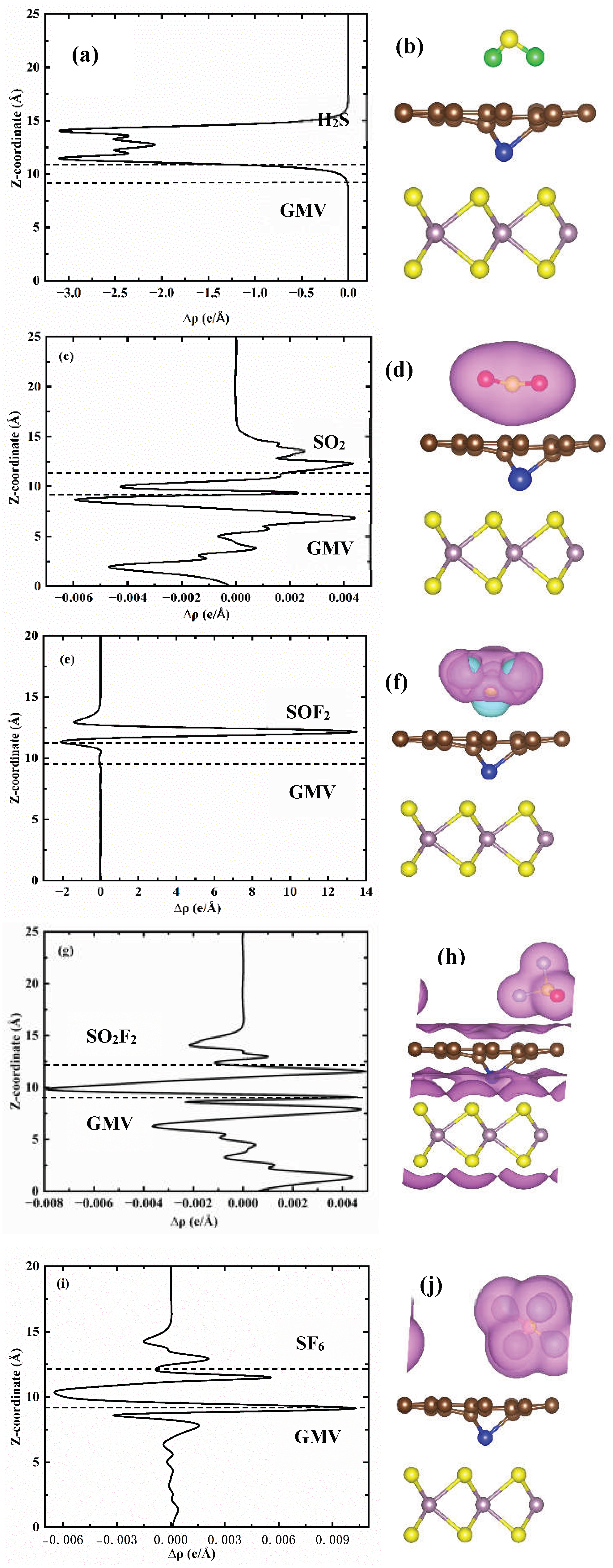
Figure 7.
The TDOS of the GMV and GMV surface with H2S, SO2, SOF2, SO2F2, SF6 gas molecules, and the PDOS of the adsorbed gas molecules.
Figure 7.
The TDOS of the GMV and GMV surface with H2S, SO2, SOF2, SO2F2, SF6 gas molecules, and the PDOS of the adsorbed gas molecules.
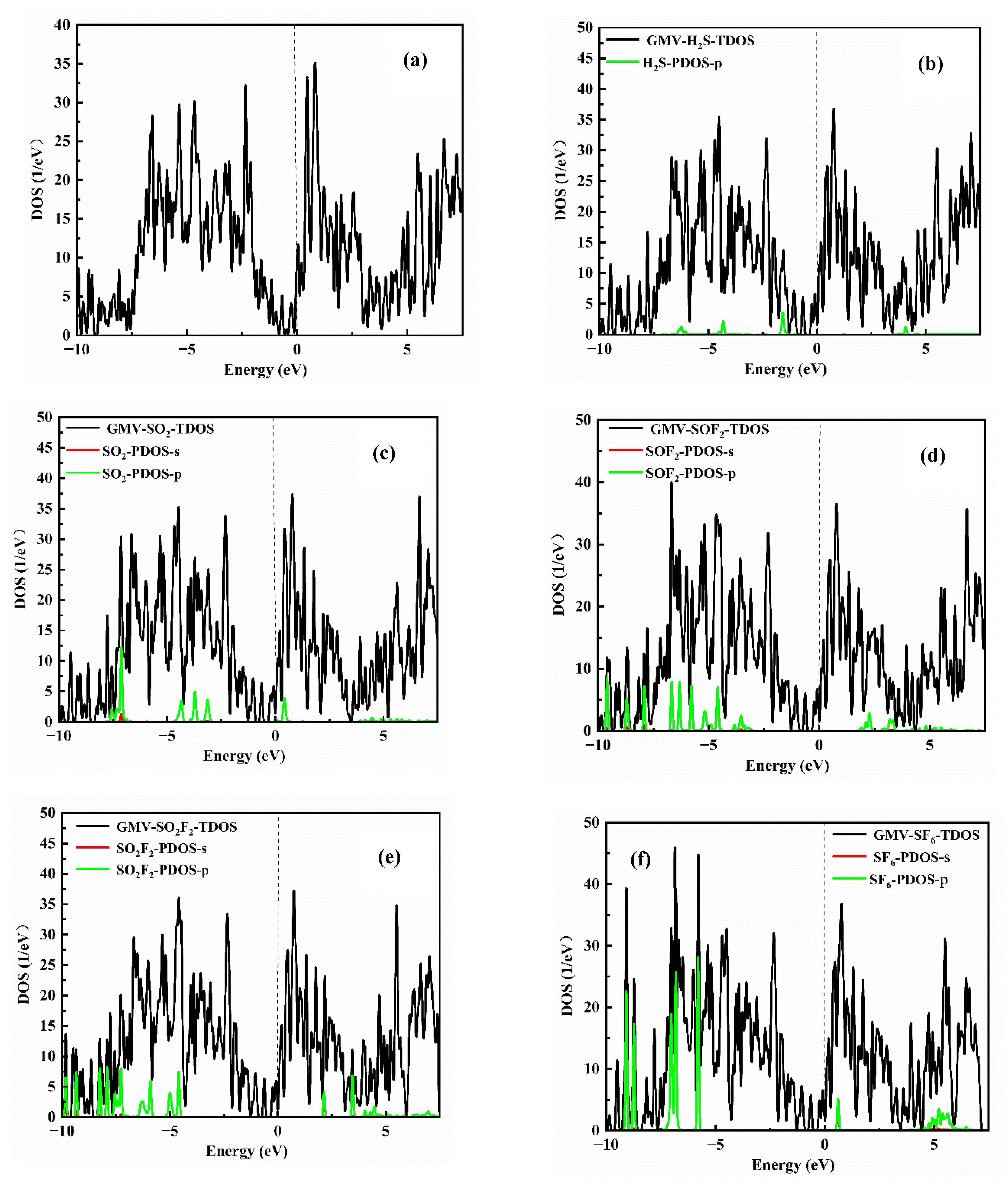

Table 1.
Adsorption energy, distance and charge transfer between SF6 decomposition gas and G/MoS2 heterostructure.
Table 1.
Adsorption energy, distance and charge transfer between SF6 decomposition gas and G/MoS2 heterostructure.
| Species | Ead/eV | D /Å | ∆Q/e |
|---|---|---|---|
| G/MoS2-H2S | -0.196 | 2.96 | -0.01 |
| G/MoS2-SO2 | -0.181 | 3.32 | -0.05 |
| G/MoS2-SOF2 | -0.141 | 2.97 | -0.01 |
| G/MoS2-SO2F2 | -0.164 | 2.97 | 0.02 |
| G/MoS2-SF6 | -0.241 | 2.92 | -0.02 |
Table 2.
Adsorption energy, distance and charge transfer between SF6 decomposition gas and V-doped G/MoS2 heterostructure.
Table 2.
Adsorption energy, distance and charge transfer between SF6 decomposition gas and V-doped G/MoS2 heterostructure.
| Species | Ead/eV | D /Å | ∆Q/e |
|---|---|---|---|
| GMV-H2S | -0.241 | 2.03 | 0.01 |
| GMV-SO2 | -0.380 | 2.34 | -0.06 |
| GMV-SOF2 | -0.317 | 2.18 | -0.027 |
| GMV-SO2F2 | -0.268 | 3.03 | -0.017 |
| GMV-SF6 | -0.224 | 2.85 | -0.021 |
Disclaimer/Publisher’s Note: The statements, opinions and data contained in all publications are solely those of the individual author(s) and contributor(s) and not of MDPI and/or the editor(s). MDPI and/or the editor(s) disclaim responsibility for any injury to people or property resulting from any ideas, methods, instructions or products referred to in the content. |
© 2026 by the authors. Licensee MDPI, Basel, Switzerland. This article is an open access article distributed under the terms and conditions of the Creative Commons Attribution (CC BY) license (http://creativecommons.org/licenses/by/4.0/).
Copyright: This open access article is published under a Creative Commons CC BY 4.0 license, which permit the free download, distribution, and reuse, provided that the author and preprint are cited in any reuse.


