
Submitted:
14 February 2026
Posted:
17 February 2026
You are already at the latest version
Abstract
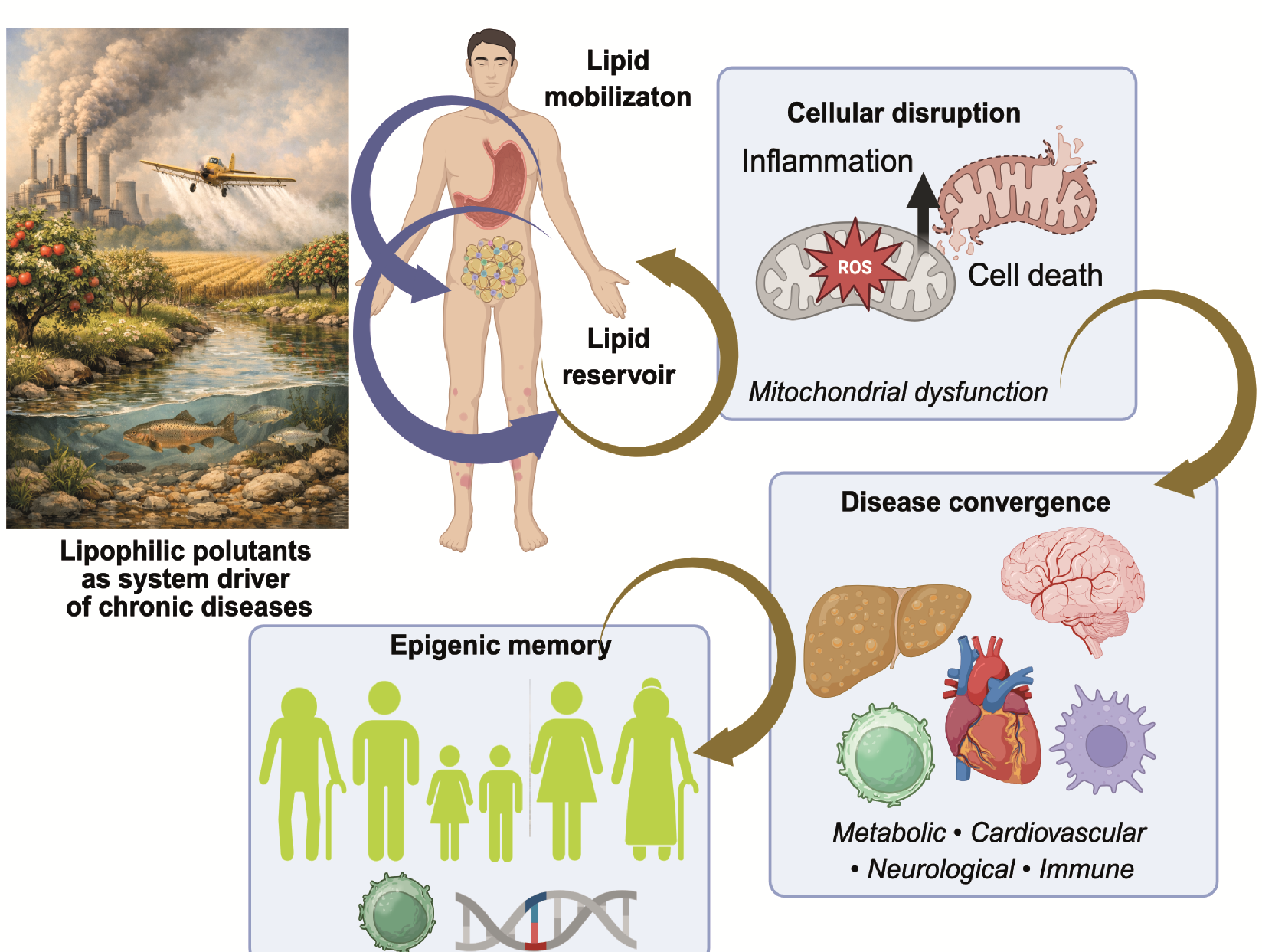
Background Lipophilic environmental contaminants—including persistent organic pollutants (POPs), PFAS, PCBs, and PAHs - exert a long-term biological influence that cannot be explained by acute toxicity alone. Their extreme hydrophobicity drives high-affinity sequestration within lipid-rich tissues, such as adipose depots, myelin sheaths, and endocrine glands, creating "internal reservoirs" with biological half-lives measured in decades. These reservoirs fuel continuous, low-grade endogenous exposure and sequential absorption of hydrophilic species, persisting regardless of ongoing environmental contact. Scope of Review This article integrates toxicokinetic modeling with modern multi-omics evidence to update Zeliger’s model of lipophilicity-driven chronic disease. We examine how these diverse compounds activate a conserved set of biological injury pathways, regardless of their specific chemical structure. Specifically, we analyze the convergence of nuclear receptor disruption, mitochondrial dysfunction (amplified ROS production), calcium dysregulation, neuroimmune activation, and persistent epigenetic remodeling. Major Conclusions Lipophilic pollutants function as a unified category of systemic toxicants that reorganize cellular and metabolic systems. The identified mechanistic signatures provide a systems-level explanation for the epidemiological links between pollutant burdens and metabolic syndrome, cardiovascular morbidity, neurodegeneration, and cross-generational epigenetic effects. These findings validate the use of "total oxidative stress" as a predictor for non-communicable disease onset and support a paradigm shift toward mixture-based regulation and exposomic biomarkers for early detection.
Keywords:
lipophilic toxicants
; persistent organic pollutants
; PFAS
; endocrine disruption
; mitochondrial dysfunction
; toxicokinetics
; exposmics
; systems toxicology
; chronic disease
; total oxidative stress
; human evolution
Copyright: This open access article is published under a Creative Commons CC BY 4.0 license, which permit the free download, distribution, and reuse, provided that the author and preprint are cited in any reuse.


