
Submitted:
15 February 2026
Posted:
16 February 2026
You are already at the latest version
Abstract
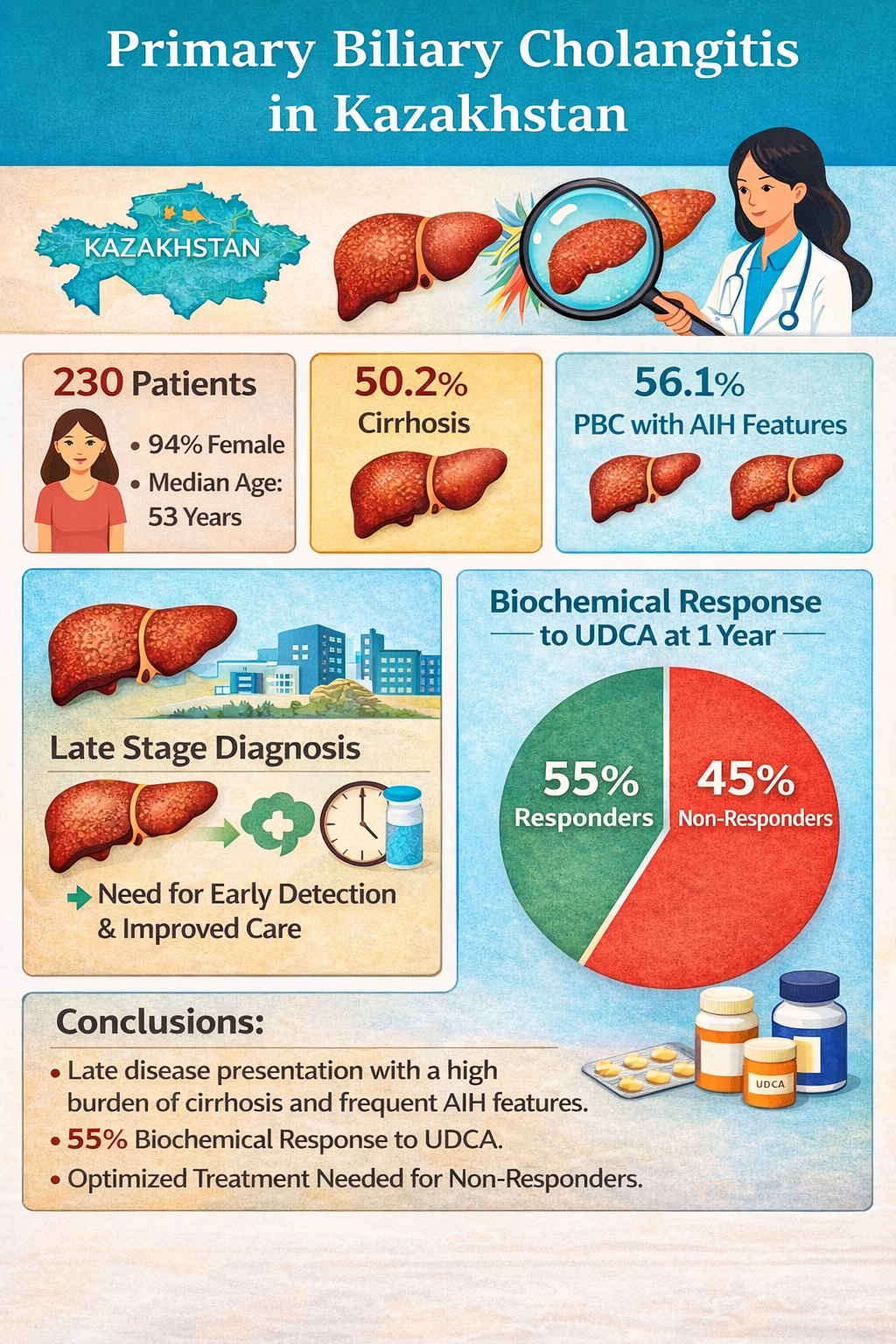
Background/Objectives: Primary biliary cholangitis (PBC) is a chronic immune-mediated cholestatic liver disease with increasing global prevalence. However, the data from Central Asia are lacking. We aimed to describe the clinical, serological, and treatment characteristics of PBC patients in Kazakhstan. Methods: This was a multicenter retrospective observational study across seven hepatology centers in Kazakhstan, including adults diagnosed with PBC between 2014 and 2022. Clinical presentation, laboratory parameters, autoimmune comorbidities, liver disease severity, and ursodeoxycholic acid (UDCA) treatment response were assessed. Biochemical response at 1 year was evaluated using Paris-1 and Barcelona criteria. Results: A total of 230 patients were included; 93.9% were female and 91.3% were of Asian ethnicity, with a median age at diagnosis of 53 years. Cirrhosis was present in 50.2% at diagnosis. PBC with AIH features was identified in 56.1% of patients and was associated with higher rates of cirrhosis, portal hypertension complications, ANA positivity, and higher elastography indices compared with isolated PBC. Overall, approximately 55% of patients achieved a biochemical response to UDCA at 1 year, with similar response rates between PBC and PBC with AIH features groups. Conclusions: This first comprehensive study of PBC in Kazakhstan demonstrates late disease presentation with a high burden of cirrhosis and frequent AIH features. Despite advanced disease, about half of patients achieved biochemical remission on UDCA. These findings underscore the need for earlier diagnosis and optimized management strategies for PBC in Kazakhstan and similar settings in Central Asia.
Keywords:
primary biliary cholangitis
; autoimmune hepatitis
; epidemiology
; Kazakhstan
Copyright: This open access article is published under a Creative Commons CC BY 4.0 license, which permit the free download, distribution, and reuse, provided that the author and preprint are cited in any reuse.


