

Submitted:
01 April 2026
Posted:
02 April 2026
You are already at the latest version
Abstract
Upper troposphere (UT) humidity records are crucial for climate studies. Pseudo-monthly averaging limited just to nighttime measurement is applied to maximize temporal representativeness and enhance the lidar signal, providing WVMR profiles up to 16 km. This study evaluates 11 years (2013–2023) of water vapor mixing ratio (WVMR) profiles from a UV Raman lidar (Lid1200) at Réunion Island against MLS-Aura satellite retrieval, ERA5 reanalysis, and GRUAN-processed M10 radiosondes. The results show a systematic dry shift in MLS of up to 30% above 12 km, particularly during the wet season. Lidar exhibits a slight downward shift in WVMR, around 5% lower than ERA5 throughout the UT, with the largest deviations present above 14 km and greater variability during the wet season, Lidar calibration-related challenges during the dry season result in drier-than-ERA5 WVMR profiles (up to 10%). Additionally, comparisons with GRUAN-processed radiosonde reveal a substantial dry shift relative to the lidar, exceeding 30% above 12 km. We investigate the GNSS-based lidar calibration effect by applying an alternative calibration method. This produces higher WVMR values, revealing an ERA5 dry shift relative to lidar, increasing with altitude at the UT up to 25%. These measurements complement the global effort in monitoring and validating the tropical and subtropical upper tropospheric humidity.
Keywords:
upper tropospheric humidity
; pseudo-monthly
; Raman lidar
; MLS-Aura
; ERA5 reanalysis
; GRUAN-analyzed radiosondes
; water vapor mixing ratio
1. Introduction
Tropical and subtropical upper tropospheric water vapor plays a central role in climate feedback and the radiative energy balance (IPCC report of 2023). Small variations in humidity at these altitudes can have a disproportionately large impact on outgoing longwave radiation, making upper tropospheric moisture one of the most sensitive amplifiers of climate change.
The Global Climate Observing System (GCOS) identifies upper-air water vapor as an Essential Climate Variable and prioritizes the reduction in observational gaps through improved data quality and long-term measurement capabilities (WMO report of 2022). Improved observations also help to constrain stratosphere–troposphere exchange processes, refine representations of moist convection in models, and reduce uncertainties in climate sensitivity projections [1,2,3,4,5].
A variety of techniques exist for measuring atmospheric water vapor—including in situ, ground-based, airborne, and satellite remote sensing [5,6,7]. Among these, spaceborne observations can provide global coverage across multiple atmospheric layers, but few satellite instruments can reliably retrieve information related to the vertical distribution of water vapor in the upper troposphere (UT) with sufficient accuracy and vertical resolution [8,9,10].
The Microwave Limb Sounder (MLS) [11], aboard NASA’s Aura satellite, is a reliable instrument for retrieving water vapor information in the UT and lower stratosphere (LS). Despite its broad coverage and long-term continuity, MLS retrievals remain affected by uncertainties under humid and dynamically variable upper tropospheric conditions. Comparisons with independent datasets [9,10,12,13] provide valuable insights into satellites’ performance. This study contributes to these ongoing evaluation efforts by examining 11 years (2013–2023) worth of MLS data over a subtropical site.
In situ measurements from radiosondes provide valuable reference data, although instruments equipped with capacitive sensors are generally unreliable in the UT. Frost point hygrometers, such as the Cryogenic Frost point Hygrometer (CFH), offer superior accuracy, with uncertainties of 2–4% in the tropical lower troposphere, 5–9% near the tropopause, and approximately 10% at 28 km [14,15]. CFHs have been used to assess tropical humidity variability and trends [16], and to validate satellite-derived upper-tropospheric water vapor [14]. Nevertheless, their high cost and sensitivity to spatiotemporal mismatches limit their routine deployment. Operational radiosondes, if robust against harsh conditions—as demonstrated by GCOS Reference Upper-Air Network (GRUAN)-certified instruments [17]—represent a promising alternative. However, such data have only been available at Réunion Island since November 2019 and could not be previously validated (as far as we know). In this study, we examine 4 years (2019–2023) worth of GRUAN-analyzed Meteomodem M10 radiosondes’ humidity in the UT.
Representing humidity in the UT remains a major challenge for atmospheric models [18]. ERA5 [19], the fifth-generation reanalysis from the European Centre for Medium-Range Weather Forecasts (ECMWF), provides long-term global information on upper tropospheric moisture. However, its uncertainties in this region can be questioned when compared to assimilated radiosondes and satellites data. The hourly ERA5 dataset on 37 pressure levels [20] will also be examined in the UT within the present study, as it is available at the subtropical site for the same period.
Airborne in situ measurements further complement remote sensing. The IAGOS (In-service Aircraft for a Global Observing System; http://www.iagos.org, last accessed on 30 March 2026) database provides H2O observations from passenger aircraft, capturing strong vertical and temporal variability in the UT/LS over the extratropical Northern Hemisphere. However, these observations mainly cover North America, the North Atlantic, and Europe (40–60°N), and are not available over the Reunion Island region [21].
The NDACC network (https://ndacc.larc.nasa.gov/, last accessed on 30 March 2026) was supposed to monitor the middle atmosphere [22]. The UTLS section was identified as poorly covered, while radiosondes and GNSS-RO has their error increasing in this region, and space observations having limitation down to the stratosphere or having law resolution. Raman lidar was supposed to be a potential candidate. Preliminary investigations show that Ground-based Raman lidars offer a highly reliable reference for upper-tropospheric water vapor, providing high vertical resolution and continuous WVMR profiles suitable for trend studies. For examples: lidars such as that at Zugspitze (Germany) [23], Table Mountain Facility (United States) [24,25], Tor Vergata (Italy) [26], and Observatory of Haute Province (France) [27], can reach UT altitudes, up to the lower tropopause in mid-latitude regions limits. Most of these systems are contributing to NDACC [22]; which is characterised as a high-quality global atmospheric-sounding network. However the range is not fully satisfactory and based on the experiences developed at Observatory of Haute-Provence and with a preliminary system at La Reunion on the both existing Rayleigh lidar systems, a specific system was designed for water vapor having a bigger telescope (1.2 m diameter), two powerful lasers and located at high altitude at Maïdo Observatory (2160 m a.s.l) since 2013 [28]. This system monitors water vapor from the surface to the LS and simultaneously measures stratospheric and mesospheric temperatures. Campaigns conducted since 2013 [26,29,30] demonstrated the lidar’s ability to detect WVMR as low as a few ppmv in the UT/LS and to reach subtropical UT/LS altitudes through extended Raman integration [30]. To increase further the altitude range, and based on the simulations made by Verémes and Coworkers [30], it appears that larger lidar shots average using several consecutive periods of measurements will allow to further increase the altitude range. Following this approach, and based on monthly averaging of night-time lidar like periods hereafter named pseudo-monthly, we evaluate upper tropospheric WVMR profiles retrieved by the Lid1200 over 11 years (2013–2023). This temporal screening enables comparisons with MLS retrievals, ERA5 outputs, and GRUAN-analysed radiosondes over the UT above Reunion Island. The objective of this study are to assess the reliability of these multi water vapor datasets in the UT in addition to evaluatingthe Lid1200 dataset. Furtur works would test the eventual applicability of the former datasets to climate and atmospheric studies,. Section 2 presents the Materials and Methods including the Lid1200 lidar and the additional datasets used in this study, Section 3 describes the comparison main results, and Section 4 presents the discussions including an alternative lidar calibration before the conclusions.
2. Materials and Methods
2.1. The Lid1200 Lidar
The Raman lidar has been operating at the Maïdo Observatory on Réunion Island (21°S, 55.4°E) since 2012 [28]. The system was later upgraded (2013) to operate at a 355 nm emission wavelength, which provides more efficient Raman detection than the former 532 nm configuration [26]. Laser pulses are generated by two Quanta Ray Nd:Yag lasers operating at 30 Hz. The dual-laser configuration significantly increases the emitted power; both lasers are synchronized using a pulse-generator module with a timing uncertainty below 20 ns. Each laser emits 375 mJ per pulse with a duration of 9 ns, and the beams are combined using a polarization cube.
The transmitter and receiver share a coaxial geometry. This configuration minimizes parallax effects, enables measurements down to near the surface, and facilitates optical alignment. Backscattered photons are collected by a Newtonian telescope with a 1200 mm primary mirror, from which the system derives its designation “Lid1200.”.
Because Raman scattering from water vapor is much weaker than elastic backscatter, minimizing fluorescence sources in the detection chain is essential. Optical fibers are known to induce fluorescence that can introduce systematic biases in Raman measurements [31]; since also coupling losses exist, no fiber is used in the system. Instead, an optical box is placed directly after the telescope to spectrally separate the Raman and Rayleigh returns. A diaphragm field stop at the entrance of this separation unit enables an adjustable field of view (FOV) ranging from 3 to 0.5 mrad. During routine operations, an FOV of 2 mm (0.5 mrad) is selected to reduce background light and prevent photomultiplier saturation from strong low-altitude elastic scattering.
The spectral selection consists of a series of dichroic beam splitters and interference filters that separate the backscattered signal into its Raman and elastic components. Signal detection is performed using Hamamatsu miniature photomultiplier tubes (PMTs), and data acquisition relies on Licel transient recorders operating in photon-counting mode [30].
In addition to routine observations, the Lid1200 system has participated in five intensive measurement campaigns, during which increased sampling frequency enabled extensive testing of various optical configurations. These efforts led to the selection of the current operational setup, as detailed in [26].
The overlap function is nearly identical for both Raman and elastic channels, allowing water vapor profiles to be retrieved down to near the surface. Water vapor mixing ratio profiles are derived from the ratio of Raman backscatter signals detected at 408 nm (water vapor; [31]) and 387 nm (nitrogen; [32]). These signals—recorded as photon counts per altitude bin per laser shot—are corrected for background noise, adjusted for the differential atmospheric transmission T(z), and scaled by a calibration coefficient C.
The full processing chain, including uncertainty characterization and determination of the effective vertical resolution, is described in [30,32], including the uncertainty associated with calibration using collocated GNSS-integrated water vapor (IWV) measurements retrieved via the GNSS TRIMBLE-NETR9 (MAIG, http://rgp.ign.fr/STATIONS/#MAIG, last access: 30 March 2026) reciever which is in operation at the Maido observatory since 2013. IWV is retrieved from the Zenithal Wet Delay ZWD which is the atmospheric propagation delay experienced by GNSS signals due mainly to water vapor abundance. ZWD is converted into IWV, using surface temperature and empirical formulas [33] where the surface pressure and temperature come from a meteorological station collocated with the lidar. The GNSS IWV uncertainty results from the uncertainty on the total delay (ZTD), provided by Gipsy-Oasis, as well as from the uncertainty of the pressure and temperature sensors of the meteorological station (determined according to the sensor’s datasheet). GNSS IWV accuracy is approximately 1 mm, corresponding to relative uncertainties of 6–18% depending on season and total atmospheric water vapor content [34].
Under routine operating conditions, the lidar system described in [26] provides water vapor profiles up to ~15 km. The primary limitations affecting retrievals near the tropopause and the detection of fine-scale UTLS structures—particularly in the presence of horizontal advection—arise from statistical uncertainties inherent to photon-counting detection. These uncertainties scale with the square root of the measured signal and depend on both vertical filtering and temporal averaging. Background noise also imposes significant constraints, which is why water vapor measurements from this Raman lidar are limited to nighttime periods.
The native vertical resolution of the lidar measurements is 15 m. To reduce high-frequency noise, the profiles are smoothed using a low-pass filter based on a Blackman window, which provides sharp spectral filtering. Because noise increases with altitude, the number of smoothing points is increased with height to compensate for the reduced signal-to-noise ratio (SNR). The NDACC community has adopted two standard methods for defining the effective vertical resolution of lidar profiles: (i) the full width at half maximum (FWHM) of the finite impulse response [35], and (ii) the cut-off frequency of the digital filter, the latter being applied to the lid1200 data. Using the number of points employed in the Blackman filter at each altitude level, the corresponding vertical resolutions range from approximately 100–200 m in the lower troposphere, to about 500 m in the mid-troposphere, and around 600 m in the upper troposphere.
Longer temporal averaging of the Raman signals increases the lidar signal-to-noise ratio and therefore extends the usable altitude range of the WVMR profiles. Vérèmes et al., 2019 [30] demonstrated that a 10-min integration typically provides reliable water vapor retrievals up to approximately 14 km, while 40-min integrations allow the profiles to reach even higher altitudes. Following the same principle, we apply a pseudo-monthly integration strategy in which Raman signals are accumulated over several successive nighttime periods within each month, yielding a total integration time of at least 1920 min. Figure 1 shows an example of one night WVMR profile which reaches about 14 km alongside the pseudo monthly WVMR for the same month which in turn reaches more than 16 km. This newly built, pseudo-monthly dataset provides more suitable basis for comparisons with satellite measurements, and climatological studies. To improve further the robustness of the comparisons, all lidar data points with relative uncertainty exceeding 30% are excluded. Using this approach, we produce 100 pseudo-monthly WVMR profiles for the period 2013–2023, each with a vertical extent determined by its total accumulated signal.
2.2. Microwave Limb Sounder MLS
The Earth Observing System Microwave Limb Sounder (EOS MLS; hereafter MLS), operating since July 2004 on the Aura spacecraft, measures microwave radiances from the limb, which are inverted to obtain profiles of temperature, geopotential height, cloud ice, and several trace gases, including the water vapor mixing ratio from the UT (316 h.Pa) to the stratosphere [11]. MLS retrievals are spaced horizontally by 165 km (1.5°) along the orbit track to roughly 15 orbits per day [36]. The maximum global retrieval rate is 3494 profiles per day providinga near-global spatial coverage from −82° to +82° latitude. The recommended useful vertical range extends from 316 and 0.00215 hPa, with a vertical resolution of approximately 1.5 km at 316 hPa, 3.5 km at 4.64 hPa, and degrading to 15 km above 0.1 hPa.
The present study uses Version 5 in the Level 2 Geophysical Product (L2GP) files (MLS-Aura_L2GP-H2O_v05-00-c01) of water vapor retrievals publicly available from the Goddard Spaceflight Center DAAC at https://mls.jpl.nasa.gov/(last access 30 March 2026). Further information about this version is provided in the MLS v5.0 Data Quality Document (https://mls.jpl.nasa.gov/data/v5-0_data_quality_document.pdf; last accessed 30 March 2026). We follow the recommended vertical range for data use, 316–0.001 hPa.
Biases in Aura MLS are well characterized globally, with multiple validation studies for water vapor [9,13,37,38,39,40,41]
No previous studies have validated the multi years record of MLS over Reunion island. Here we focus on evaluating WVMR profiles over the 10–16 km altitude range, corresponding to a vertical resolution of approximately 1.1 km, and a maximum horizontal shift of ~4° from the Maïdo Observatory (lidar location). To enable comparison with the Lid1200 observations, only nocturnal MLS overpasses collocated with the lidar site —typically around 21:00–22:00 local time— are considered. From these, 76 pseudo-monthly MLS WVMR profiles were generated for comparison with coincident lidar measurements between 2013 and 2023. Two examples, a single night WVMR profile and the pseudo monthly WVMR for the same month over the subtropical upper troposphere site from both lidar and MLS are presented in Figure 2.
2.3. ERA5 Re-Analysis
ERA5 is the fifth generation of the atmospheric meteorological reanalysis produced by the European Centre for Medium-Range Weather Forecasts (ECMWF), operational since 2016 [19]. ERA5 benefits from a decade of developments in model physics, core dynamics and data assimilation to guide and adjust the outputs of interactive models. ERA5 used dataset [20] has significanlty enhanced horizontal resolution of 31 km (0.25°), compared to 80 km for the previous reanalysis (ERA-Interim), hourly output over 37 pressure levels, and provides a detailed publicly available record of the global atmosphere from 1979 onward (and with less frequent data between 1950–1979). The uncertainty of tropospheric humidity samples, mainly due to random errors, decreases over time. Relative spread is lowest near the surface (5%), but around 15% for specific humidity at 300 h.Pa since 2015 [19].
WVMR is calculated from the specific humidity variable at the ERA5 grid point closest to the lidar location (Maido Observatory). To match the lidar observations, data are selected with a maximum horizontal (spatial) drift of 0.1° and the best temporal coincidence with nighttime lidar measurements. Using this approach, 91 pseudo-monthly ERA5 WVMR profiles were retrieved for the 2013–2023 period to enable direct comparison with the Lid1200 profiles. Two examples of WVMR profiles, a single lidar-like night and a pseudo-monthly lidar-like month, from both ERA5 and lidar are presented in Figure 3.
2.4. GRUAN-Processed Meteomodem M10 Radiosondes
Balloon-borne radiosondes provide local humidity profiles above the launch site, although spatial collocation with fixed-point measurements can be affected by wind speed and direction at altitudes where the ballons drifts. To approximate the location of the lidar, we used data from the Gillot meteorological station (also referred to as Chaudron in the data files, WMO code 61980) in Saint-Denis (20.9°S, 55.5°E, 46 m asl) where Meteomodem Co. (www.meteomodem.com, Ury 77760, France, url is last accessed: 30 March 2026) M10 radiosondes are regularly launched at midnight and midday. To ensure reference-quality, and hence better climate-quality measurements, this station’s radiosonde dataset benefit from regular processing, coordinated by GRUAN [42] which provide well-calibrated water vapor measurements. For M10 radiosondes, a few corrections are applied to meet GRUAN standards [42]; these corrections are detailed in Dupont et al., (2020) [43] and include: (1) calibration adjustments; (2) corrections for slow sensor response, particularly at extreme humidity; (3) compensation for relative humidity sensor dependence on temperature gradients; and (4) time-lag corrections at cold temperatures which affects measurements in regions with strong relative humidity gradients.
WVMR profiles used in the present study are retrieved from the corrected relative humidity (all GRUAN corrections applied) [43], together with air temperature and pressure levels from the M10 radiosondes midnight launches. Between November 2019 and December 2023, 41 GRUAN-processed M10 WVMR profiles were retrieved and compared with coincident lidar measurements at the pseudo-monthly scale. Figure 4 shows two examples: a single midnight launch WVMR profile and the pseudo-monthly profile from both lidar and GRUAN-processed M10 in the UT.
3. Results
A central challenge of this study is the limited number of true nocturnal lidar-like satellite overpasses suitable for direct comparison of WVMR profiles. The pseudo-monthly WVMR dataset generated from Lidar, MLS, ERA5, and GRUAN nocturnal observations, helps overcome this limitation. This temporal aggregation maximizes the number of usable MLS overpasses and improves the robustness of comparisons in the upper troposphere, while taking advantage of the lidar’s capability to probe water vapor at higher altitudes through long-duration Raman signal accumulation. All comparisons are performed with respect to the Raman Lidar, and relative differences are used to characterize the uncertainties of each dataset. Inevitably, gaps occur in the pseudo-monthly time series, mainly during periods without valid observations (due to instrument downtime, COVID-19 related disruptions, or profiles failing the quality criteria with relative errors > 30%).
3.1. LIDAR vs. MLS-Aura
Relative differences between the Lid1200 lidar and MLS WVMR profiles were examined over the 10–16 km altitude range, where both instruments provide robust measurements. For each month, all MLS observations coincident with nighttime lidar measurements were averaged to form a representative pseudo-monthly profile. Over the 2013–2023 period, this procedure yielded 76 pairs of lidar–MLS pseudo-monthly profiles, all interpolated to the MLS vertical resolution.
The median relative difference in WVMR between the Lid1200 lidar and MLS over the 11-year period is shown in Figure 5 (black dashed line), together with the 95% confidence interval of the variability (blue shading). Confidence bounds were calculated as ±2 times the pseudo–standard error, normalized by the square root of the number of contributing profile pairs in each altitude bin. Differences are smallest between 11 and 12 km, while the lidar reports values up to 30% higher at altitudes above this layer. The spread increases above 14 km, consistent with reduced lidar sensitivity and the coarser MLS vertical resolution at higher altitudes. This dry MLS shift in the UT is consistent with previous investigations [9,38], and similar magnitudes have been reported over Reunion Island in earlier shorter term lidar–satellite comparisons (e.g., [26]).
We next investigate the temporal evolution of the relative differences (Lid1200—MLS) over the entire period at two representative altitude levels (Figure 6); at 11.3 km and 13.7 km, where the median shift exhibits different magnitudes (Figure 5). Significant interannual variability is observed. At 13 km (blue bars), the relative differences indicate a dominant MLS dry shift (Lid1200 > MLS). At 11 km (red bars), differences are also substantial but show a more stable trend around 0%, although occasional extreme peaks persist. The dominant MLS dry shift is evident at both altitudes during 2018 and 2019.
Some gaps in the time series correspond to periods with insufficient MLS and lidar observations to generate a representative pseudo-monthly pair (only a single night of observation during a given month for example).
To further investigate seasonal influences, the analysis was separated into two main subtropical seasons: a dry season (May–September) and a wet season (October–April). The relative differences exhibit a distinct structure during the wet season (Figure 7a) with a clear MLS dry shift, reaching up to 40% between 12 and 14 km. This may reflect improved lidar sensitivity under moister conditions, which reduces calibration-related limitations and enhances the effective lidar performance in the UT. The MLS dry shift is also observed during the dry season (Figure 7c) across most upper tropospheric altitudes, except near 11 km where the relative differences show a slightly more stable trend around 0%. The smaller magnitude of MLS dry shift with respect to lidar during the dry season could be attributed to mutual complications in water vapor measurements under drier conditions. Figure 7b and Figure 7d show median WVMR profiles during the wet and dry seasons, respectively. All analyses are based on the 2013–2023 (11 years) period.
3.2. LIDAR vs. ERA5
The relative differences between Lid1200-derived WVMR and ERA5 reanalysis were also evaluated on a pseudo-monthly basis over the subtropical site. For each month, ERA5 hourly profiles coincident with nighttime lidar measurements were averaged to construct a representative pseudo-nightly profile, then a pseudo-monthly one. The comparison focuses on the 10–16 km altitude range. Over the 2013–2023 period, a total of 91 pseudo-monthly WVMR profiles were produced. The overall lidar-to-ERA5 shift is summarized by the median of the 91 relative-difference profiles. ERA5 shows a small wet shift reaching approximately 5% (Figure 8). We further examine the temporal evolution of the relative differences (Lid1200—ERA5), at two representative altitude levels (Figure 9); 11 km and 14 km where the median shift differs slightly (Figure 8). Positive values indicate a dry shift in ERA5 (Lid1200 > ERA5) while negative values indicate a wet shift (Lid1200 < ERA5). At 14 km (blue bars), relative differences indicate a dominant ERA5 dry bias after 2018, but enhanced variability prior to 2018 reduces the overall median shift to approximately 0% (Figure 8). At 11 km, Lid1200 values were mostly drier than ERA5 until 2021, after which the shift reverses slightly resulting in a small Lid1200 dry shift of up to 5% relative to ERA5.
The analysis was further separated into the two dominant subtropical seasons, revealing distinct patterns in the relative differences between Lid1200 and ERA5. During the wet season (Figure 10a), a small ERA5 dry shift of approximately 5% persisits at upper altitudes above 14 km. This shift may be attributed to model assumptions in ERA5 in the UT, while the variability of the shift is generally larger below 14 km, where Lid1200 values tend to be drier than ERA5 (up to 10%). This variability may reflect calibration-related lidar uncertainties. The effect is more pronounced during the dry season (Figure 10c), throughout most of the profile. Figure 10b and Figure 10d show the seasonal median WVMR profiles for the wet and dry seasons, respectively. All analyses are based on the 2013–2023 (11 years) period.
3.3. Lid1200 vs. GRUAN-Processed M10 Radiosondes
The relative differences between Lid1200-derived WVMR and GRUAN-processed M10 radiosondes were also evaluated on a pseudo-monthly basis. For each month, all GRUAN midnight soundings coincident with nighttime lidar measurements were averaged. The comparison focuses on the 10–16 km altitude range over the 2019–2023 period, during which 41 pseudo-monthly profiles were retrieved. The lidar shift relative to GRUAN is defined as the median of all relative-difference profiles. Below 12 km, Lid1200 exhibits a small dry shift with respect to radiosondes, approximately 10% (Lidar < GRUAN). Above 12 km, the shift is reversed to approximately 20% (Lidar > GRUAN) at 14 km and up to 40% at 16 km (Figure 11). We further investigate the temporal evolution of the relative differences at two representative altitudes, 11 and 14 km.
Above 12 km, GRUAN radiosondes exhibits a pronounced dry shift relative to lidar in both seasons (Figure 12, blue bars). Seasonal stratification reveals clear differences between the wet and dry periods (Figure 13). Below 12 km, the shift is reversed (Lid1200 < GRUAN M10) with approximately 10% during the wet season (Figure 13a) while the enhanced variability (Figure 12, red bars) reduces the overall median shift to approximately 0% during drier conditions (Figure 13c). Enhanced column humidity may increase Raman backscatter strength, reducing calobration-related limitations and hence improving upper-tropospheric WVMR values which explains the larger than radiosondes shift above 12 km. Meanwhile, spatial mismatch between the radiosonde ascent and the lidar location—especially when trajectories drift toward the southwest Indian Ocean—can also amplify discrepancies during wet conditions and justify the wetter than lidar shifts below 12 km.
4. Discussion
Our results show a satellite MLS and GRUAN-processed M10 upper-tropospheric dry shift relative to Lid1200 WVMR profiles at pseudo-monthly timescales. However, Lid1200 remains slightly drier than ERA5. A central question is: How accurate is Raman lidar observations of the upper tropospheric water vapor using UV (355 nm emission as with Lid1200) over the subtropics?
One possible source of uncertainty is aerosol-induced fluorescence, as previoulsy discuessed by Chouza et al., (2022) [44] at the same site with the same lidar. This effect can produce wet lidar values, and may partially explain MLS and GRUAN-processed M10 dry shifts. Even if Raman lidars were influenced by aerosols, it would still be drier than ERA5.
Another consideration is the spatial representativity of GRUAN radiosondes. The launch site at Saint-Denis airport may be sufficiently distant, and radiosonde drift could carry measurements toward the ocean, sampling vertical profiles not fully collocated with the lidar. To investigated this, we analyzed radiosonde trajectories between 10 and 16 km altitude (Figure 14). Trajectories predominantly drift up to 100 km toward the East/Southern East from the launch site. A comparative analysis separating GRUAN M10 soundings into “near” and “far” drift classes relative to the lidar location was performed. The classes are defined based on directional analysis to determine the direction of each trajectory (between 10 and 16 km) relative to the lidar site. Using the dot product formula, we compute the angle indicates the direction of the trajectory relative to the lidar location. If the angle was less than 90 degrees (π/2 radians), the trajectory was classified as “Toward lidar or Near” indicating that the balloon was moving in the general direction of the l site. If the angle was 90 degrees or more, the trajectory was classified as “Away from OPAR or Far” indicating that the balloon was moving away from the OPAR site (Figure 15). This study was possible only at a pseudo-nightly scales, as radiosondes trajectories may be differently classified within the same month. Comparing the Lid1200 shift relative to radiosondes for both classes doesn’t reveal significant effect of horizontal or vertical drift on the relative shift, especially above 13 km (Figure 16). While below 13 km, lidar wet shift is more clear relative to near radiosondes (Figure 16c), while the overall shift is reduced down to 0% when far radiosondes observations are compared (Figure 16a), this is thought to be influenced by the ocean effects on radiosondes observations.
Another interpretation is that the Raman lidar may not be significantly affected by fluorescence, and therefore does not exhibit a wet bias. In this scenario, MLS is really dry in the UT, consistent with previous studies [24,41]. The MLS dry shift is consistent with results from a measurement campaign over the Reunion in 2013 [26], where around 16 km (100 hpa), MLS shwed a significantly dry shift of 30–40% relative to lidar. We agree with Dionisi et al., (2015), who suggested that this feature may be caused both by the different instrumental sampling geometries and by a systematic MLS bias in the upper tropospher due to its limited vertical resolution across the very sharp transition between the dry stratosphere and the moist troposphere [45]. MLS dry shift is possibly related to the influence of clouds, but the present study assumes collocation with lidar operational times where clear skies (no low/convective clouds) are mostly dominant during night [46]. Cirrus clouds presence influence on MLS measurements is another possibility which needs further investigations the present study doesn’t handle.
GRUAN-processed M10 radiosondes haven’t been compared to lidar over the Reunion Island before (as far as we know), but previous studies have reported upper tropospheric dry shift (up to 10%) relative to lidar on the midlatitude at finer time scales (hourly) [47]. Vaisala radiosondes RS92 is reported drier than lidar over the midlatitude [27], and drier than Lid1200 over the Reunion UT, during the MALICCA campaign in 2013 [26].
Elevation differences between the GNSS receiver site and the nearest ERA5 grid point over Reunion Island has to be accounted when evaluating integrated water vapor (IWV) as shown by the study of [48]. They reported differences of up to 12 kg m−2 attributable to this elevation mismatch, with ERA5 being wetter than GNSS. The Lid1200 dataset, being calibrated with IWV from GNSS, appears slightly drier than ERA5, but this very small shift (5%) at the UT might not forcely be linked with IWV differences between ERA5 and GNSS.
Following the lidar limitations, the present study is carried out during mostly clear sky conditions (no low clouds or convective clouds), so the parameterization of convective transport schemes of ERA5 is not expected to have such a significant influence on ERA5 shifts. Furthermore, the ERA5 detected shift is too small (within 5%) indicating a very good consistency with the operational lidar dataset over the Reunion Island.
From the other side, multiple investigations have reported that ERA5 underestimates relative humidity under ice-supersaturation conditions, which are more frequent at UT altitudes. Comparisons with IAGOS observations confirm that ERA5 tends to produce drier relative humidity with respect to ice values at these altitudes [47], prompting several correction approaches [49,50].
However, our current operational Lid1200 dataset appears slightly drier than ERA5, as demonstrated in Section 3.2, especially during the dry season. These results highlight the importance of assessing the sensitivity of Raman lidar UT retrievals to calibration methodology. To address this, we generated a new lidar WVMR dataset, using an alternative calibration method, which is detailled in the following sub-section. Most comparisons are subsequently revisited with respect to this new dataset.
4.1. Alternative Lid1200 Calibration
In this section, we present a novel calibration strategy, building upon the methodology introduced by Alraddawi et al., (2025) [47]. Unlike the conventional approach, which relies on collocated GNSS-derived Integrated Water Vapor (IWV) content as an external calibration reference [30], our method instead uses the ERA5 reanalysis WVMR product as the calibration reference. Specifically, the method focus on a narrow altitude band between 4 and 6 km to derive the calibration coefficients. The selection of this altitude range is motivated by prior comparative analyses. By examining ERA5 midnight profiles against GRUAN-processed M10 radiosonde launches over Reunion Island, we identified the 4–6 km layer as the altitude range showing the strongest agreement and the smallest bias between the two datasets.
The calibration procedure begins with the construction of lidar-like pseudo-nightly ERA5 profiles. These profiles are extracted from the ERA5 hourly dataset, which is available on 37 pressure levels [20], by selecting only nighttime data coincident with lidar observations. The resulting pseudo-nightly ERA5 product serves as the external calibration reference.
Following the framework proposed by Alraddawi et al., (2025) [47], nightly calibration factors are first derived and statistically analyzed to identify stable calibration periods. These factors are then generalized and applied to calibrate the entire 2013–2023 lidar nighttime dataset.
The resulting calibration coefficients are comparable in magnitude to those obtained using the conventional GNSS-based approach described by Vérèmes et al., (2019) [30].
Figure 17 presents a comparison between the generalized calibration factors derived using the GNSS-based method [30]. and those obtained with the ERA5-based approach [45]. This comparison highlights the overall consistency between the two calibration strategies while providing insight into their respective uncertainties and performance under similar atmospheric conditions.
Using the calibrated nightly dataset, pseudo-monthly profiles are constructed, enabling a comparative analysis similar to that presented in Section 3. This newly developed dataset—referred to as Lid1200 new in the accompanying figures—is then evaluated alongside established datasets, including ERA5, and GRUAN-processed M10 radiosondes.
Our results indicate that the WVMR datasets remain broadly consistent regardless of the calibration method applied. However, the Lid1200 new dataset, exhibits slightly higher WVMR values compared to the operational Lid1200 dataset. This difference is illustrated in Figure 18, where the median profiles of both datasets are compared.
Lidar WVMR can be calibrated with respect to a limited portion of a vertically resolved reference profile. In principle, a single point observation of WVMR at an altitude where the overlap functions are sufficiently known and stable can be sufficient for calibration.
The Lid1200 new calibration does not rely on total column water vapor, which is dominated by the lower troposphere. Instead, it use a limited portion of the ERA5 profile as a reference for calibration. In particular, the statistical method (as in [51]) adopted to derive a single calibration factor over periods of several months reduces the influence of individual profile-to-profile variability or specific vertical features of the model. Lid1200 new calibration used a limited altitude range between 4 and 6 km, choosed being the part of ERA5 where the data are best agreed with GRUAN, and less influenced by the the elevation difference between the lidar site and the nearest ERA5 grid point. Moreover, it is important to remind that ERA5 is not a profiling instrument, upper-tropospheric humidity in the model is therefore not necessarily constrained by observations in the same way as in the lower troposphere, where most assimilated data are available. Observing the UT water vapor by the model is problematic, similar studies at the tropical/subtropical UT is still rare, where the current study takes place.
It is important to consider the above listed perspectives, to avoid circular reasonning and get more clarity, and hence particularly allow independant comparison of Lid1200 new and ERA5 profiles in the upper troposphere, as in a similar previous study carried out over the parisian region [47].
4.2. Lid1200-New vs. ERA5
Returning to Section 3.2, the median shift of Lid1200 [30] relative to ERA5 didn’t exceed 5% in the UT with the lidar being slightly drier than ERA5 at those altitudes (Figure 8). Performing the same comparison using this time the Lid1200 new dataset, we find that the newly developed lidar profiles are wetter than ERA5 across the entire UT layer (Figure 19). Consequently, a clear ERA5 dry bias is revealed throughout the UT, reaching up to 20%.
Upper tropospheric ERA5 dry bias over midlatitudes has been reported at many occasions, motivating many correction efforts [49,50]. Comparisons with lidar WVMR calibrated in the same manner as Lid1200 new dataset showed ERA5 dry shift (up to 20%) relative to lidar in the midlatitude UT region [47], the study also discussed the potential for partial correction/validation using IAGOS-MOZAIC observations which are unfortunately not available for the southern subtropical site considered in the present work.
The seasonal analysis confirms the observed ERA5 dry shift reaching up to 20% relative to the Lid1200 new lidar, with the shift increasing with altitude during the dry season (Figure 20c). This can be attributed to the known under-estimation of upper tropospheric humidity by ERA5, as discussed earlier within this section. Furthermore, the enhanced calibration applied in the Lid1200 new dataset increases lidar-retrieved water vapor in the UT, generating higher values compared to ERA5. This improvement effectively addresses the calibration-related limitations previously observed during the dry season (Figure 10c) with the original calibration method.
4.3. Lid1200 New vs. GRUAN-M10 Processed
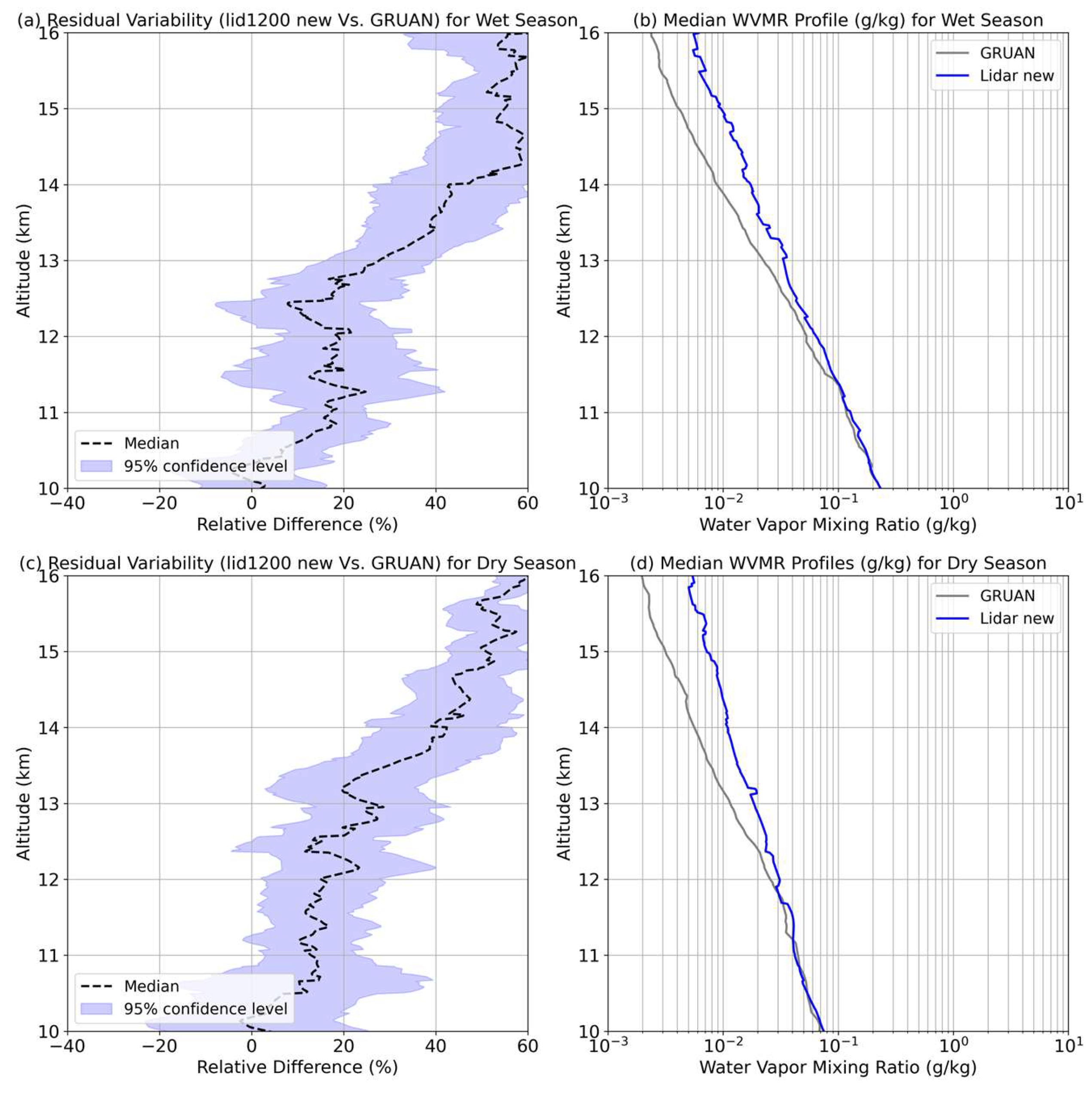
The pseudo-monthly GRUAN-M10 processed dataset exhibits a more pronounced dry shift relative to Lid1200 new over the entire UT altitudes, up to 20% below 13 km, andexceeding 40% at the higher layers (Figure 21). Compared to the operational Lid1200 [30], the Lid1200 new dataset shows more pronounced wet shift relative to GRUAN-processed M10, over the entire UT, with nearly no layers where Lid1200 new is drier than GRUAN regardless the season (Figure 22).
This comparison indicates that a portion of the dry shift observed in operational lidar product relative to GRUAN-M10 (Figure 11) may be attributable to the GNSS-based calibration strategy, which can generate lidar WVMR profiles that are drier than reality due to limitations in GNSS reliability at this subtropical site. Previous studies have also reported a GNSS dry bias over the Reunionisland when compared to radiosonde measurements [52].
The seasonal analyse results (Figure 22) at higher UT altitudes (14–16 km), might be influenced by sampling limitations. In particular, the study period (2019–2023) has many missed months (COVID-19, lidar downtimes), in addition to the reduced nomber of compared pairs with altitude (from 41 pair at 10 km to 15 pair at 16 km). We recommand further analyses with longer periods before concluding/discussing similar shift (>40%).
4.4. Perspectives and Futur Horizons
Lidar measurements are inherently limited by the system’s ability to operate under suitable ambient conditions. As a result, the observations are neither continuous nor regularly sampled. In the present study, we make use of the available 11-year dataset of Raman lidar observations and compare it with the corresponding long-term datasets from MLS and ERA5 over upper-tropospheric altitudes, where observations are already rare and difficult to obtain.
The pseudo-monthly approach was therefore adopted as a practical way to increase the signal-to-noise ratio while maximizing the use of the available lidar observations. However, this approach is limited by the reduced sampling. For example, during MLS/lidar comparison: the pseudo-monthly scaling is considered only when at least three lidar-like MLS overpasses occur during the considered month. Therefore, months with insufficient sampling are already omitted from the comparisons.
Additionally, due to lidar observational constraints, the effective sample size decreases with altitude. For this reason, the analysis is limited to 16 km, as most of the pseudo-monthly lidar profiles reach this altitude. For example, the number of pair profiles range from 76 at 10 km to 73 at 16 km for the MLS–lidar comparison.
Generally, the acheived spatiotemporal coincidence is sufficient for the comparisons, having strictly similar sampling. However, the represntaivness of pseudo-monthly (of all compared datasets including ERA5) could be questionned for trends studies. In particular, future work will assess the sensitivity of trend analyses derived from lidar, lidar-like MLS/ERA5/GRUAN-M10 pseudo-monthly datasets, and compare them with the full nocturnal monthly datasets from MLS and ERA5. This will help evaluate whether the current dataset can be reliably used for meaningful climatological studies.
The Lid1200 new WVMR dataset provides a valuable long-term record of upper tropospheric humidity since 2013. Followoing the GRUAN requirements, it’s very useful to develop alternative universal calibration methods to keep the dataset under quality controle and help detecting/investigating the eventual anomalies of lidar system.
Many of the perspectives discussed above could be further explored in future measurements campaigns planned over Reunion Island which would allow to further testing the impact of different calibration strategies and improving spatial and temporal collocation with GRUAN processing radiosondes. This study lays the groundwork for such investigations by providing a comprehensive statistical analysis and highlighting open questions regarding lidar calibration, dataset shifts, and intercomparison with satellite and reanalysis.
The analytical method presented could be applied to other lidar systems and sites. It would be particularly interesting to have similar systems with comparable performance at multiple subtropical sites, especially with the upcoming deployment of satellites measuring water vapor in the UTLS.
5. Conclusions
Valuable information on upper tropospheric humidity can be obtained at global scales from satellites such as MLS, reanalysis such as ECMWF-ERA5, and more locally from radiosondes (GRUAN), and Raman Lidar. However, accurate measurements of WVMR in the UT remain challenging, particularly in less studied subtropical regions.
In this study, 11 years of WVMR profiles derived by these different datasets were analysed and statistically compared over Reunion island from 2013 to 2023. A pseudo monthly screening approach was applied to the Lidar observations to enhance the signal and extend WVMR retrievals into the subtropical UT. This approach also mitigates the limited number of collocated MLS overpasses at smaller scales, and a consistent comparison methodology was applied across all datasets.
The multi-dataset comparison at pseudo-monthly scale shows the following key results:
- MLS: A pronounced dry shift relative to lidar is observed, reaching up to 30% in the upper troposphere, particularly above 12 km and during the wet season. This dry bias is consistent with previous studies, [26,41] which also reported significant MLS underestimation of upper-tropospheric WVMR compared to lidar.
- ERA5: Better agreement with lidar is clearly reported, meanwhile, the operational Lid1200 lidar dataset [30] shows a small dry shift relative to ERA5, generally below 5%, and up to 10% during the dry season. Using the newly calibrated Lid1200 new dataset [47], ERA5 exhibits a clear dry shift of up to 20% in the upper troposphere, particularly above 14 km. Similar ERA5 dry biases have been previously reported over midlatitude regions [47,49,50].
- GRUAN-processed M10 radiosondes exhibits a pronounced dry shift relative to Lid1200, particularly above 13 km. This shift is apparently not affected by potential mismatches due to radiosondes drifts, which can reach up to 100 km from the launch site. Below 13 km, lidar is slightly drier (5–10%), this bias might be partially caused by the GNSS-based calibration, as GNSS IWV measurements over Reunion Island have been previously reported to be drier than radiosondes [52]. This hypothesis would further explain why no lidar dry shift relative to GRUAN-processed M10 radiosondes is observed when the Lid1200 new dataset (calibrated differently) was compared.
In conclusion, the pseudo-monthly screening improved the capacity of Raman lidar technique to describe subtropical upper troposphere WVMR, with comparable magnitudes to MLS, ERA5 and GRUAN-processed M10 datasets, regardless the calibration strategy.,
An alternative universal calibration method has the benefit to keep the lidar dataset under quality controle and help detecting/investigating the eventual anomalies of lidar system.
An upcoming measurement campaign might help to further refine and extend the analysis to broader atmospheric conditions (like cirrus presence) over this important subtropical region.
This 11-year record comparison provides a basis for futur work, to assess the sensitivity of trend analyses derived from lidar, lidar-like MLS/ERA5/GRUAN pseudo-monthlys, and compare them with the full nocturnal monthly MLS/ERA5/GRUAN datasets. This will help evaluate whether the current pseudo-monthly lidar dataset can be reliably used for meaningful climatological studies.
Author Contributions
Conceptualization, P.K.; methodology, D.A. and A.H.; software, G.P. and H.V.; validation, P.K. and D.A.; formal analysis, D.A.; investigation, D.A., A.H. and M.S.; resources, P.K.; data curation, D.A. and G.P.; writing—original draft preparation, D.A.; writing—review and editing, J.-L.B., F.M., A.H., A.I. and A.S.; visualisation, D.A.; supervision, P.K.; project administration, P.K.; funding acquisition, P.K. All authors have read and agreed to the published version of the manuscript.
Funding
This project has received funding from the Horizon Europe Research and Innovation Actions program under Grant Agreement N°101056885 through the BeCoM (Better Contrail Mitigation) project and from the French government (BPI) in the frame of France 2030 under Grant DOS0182433/00 for the CONTRAILS project.
Data Availability Statement
ERA5 data set are publicly available at: https://cds.climate.copernicus.eu/datasets/reanalysis-era5-pressure-levels?tab=download, last access: 30 March 2026, GRUAN-analysed M10 radiosondes dataset is from the IPSL climserv data server. MLS data are publicly available at: https://acdisc.gesdisc.eosdis.nasa.gov/data/Aura_MLS_Level2/ML2H2O.005/, last access: 11 February 2026,.
Acknowledgments
The authors would like to thank the technical and IT staff of the lid1200 lidar. the authors would like to thank also Milena Martic (Grodien Strato co.) for the lidar expertise. The authors acknowledge the support of the European Commission through the REALISTIC project (GA 101086690), the ANR through the OBS4CLIM project (ANR-21-ESRE-0013), and CNES through the projects EarthCARE, AOS, and EXTRASAT. The authors also acknowledge the support of OPAR (Observatoire de Physique de l’Atmosphère à la Réunion) and OSU-Réunion (Observatoire des Sciences de l’Univers à La Réunion, UAR 3365), funded by CNRS (INSU), Météo-France, and Université de La Reunion.
Conflicts of Interest
The authors declare no conflicts of interest.
References
- L. Qian, J. Rao, R. Ren, C. Shi, et S. Liu, « Enhanced stratosphere-troposphere and tropics-Arctic couplings in the 2023/24 winter », Commun Earth Environ, vol. 5, no 1, p. 631, oct. 2024. [CrossRef]
- A. Gettelman et Q. Fu, « Observed and Simulated Upper-Tropospheric Water Vapor Feedback », Journal of Climate, vol. 21, no 13, p. 3282-3289, juill. 2008. [CrossRef]
- A. E. Dessler, Z. Zhang, et P. Yang, « Water-vapor climate feedback inferred from climate fluctuations, 2003–2008 », Geophysical Research Letters, vol. 35, no 20, p. 2008GL035333, oct. 2008. [CrossRef]
- R. Colman et B. J. Soden, « Water vapor and lapse rate feedbacks in the climate system », Rev. Mod. Phys., vol. 93, no 4, p. 045002, nov. 2021. [CrossRef]
- X. Wang et A. E. Dessler, « The response of stratospheric water vapor to climate change driven by different forcing agents », Atmos. Chem. Phys., vol. 20, no 21, p. 13267-13282, nov. 2020. [CrossRef]
- V. Wulfmeyer et al., « A review of the remote sensing of lower tropospheric thermodynamic profiles and its indispensable role for the understanding and the simulation of water and energy cycles », Reviews of Geophysics, vol. 53, no 3, p. 819-895, sept. 2015. [CrossRef]
- N. Kämpfer, Monitoring Atmospheric Water Vapour: Ground-Based Remote Sensing and In-situ Methods, vol. 10. Springer Science & Business Media, 2012.
- E. J. Fetzer et al., « Comparison of upper tropospheric water vapor observations from the Microwave Limb Sounder and Atmospheric Infrared Sounder », J. Geophys. Res., vol. 113, no D22, p. 2008JD010000, nov. 2008. [CrossRef]
- W. G. Read et al., « Aura Microwave Limb Sounder upper tropospheric and lower stratospheric H2 O and relative humidity with respect to ice validation », J. Geophys. Res., vol. 112, no D24, p. 2007JD008752, déc. 2007. [CrossRef]
- W. G. Read et al., « The SPARC Water Vapor Assessment II: assessment of satellite measurements of upper tropospheric humidity », Atmos. Meas. Tech., vol. 15, no 11, p. 3377-3400, juin 2022. [CrossRef]
- J. W. Waters et al., « The Earth observing system microwave limb sounder (EOS MLS) on the aura Satellite », IEEE Transactions on Geoscience and Remote Sensing, vol. 44, no 5, p. 1075-1092, mai 2006. [CrossRef]
- S. M. Davis et al., « Validation of SAGE III/ISS Solar Water Vapor Data With Correlative Satellite and Balloon-Borne Measurements », JGR Atmospheres, vol. 126, no 2, p. e2020JD033803, janv. 2021. [CrossRef]
- M. I. Hegglin et al., « SPARC Data Initiative: Comparison of water vapor climatologies from international satellite limb sounders », JGR Atmospheres, vol. 118, no 20, oct. 2013. [CrossRef]
- H. Vömel, D. E. David, et K. Smith, « Accuracy of tropospheric and stratospheric water vapor measurements by the cryogenic frost point hygrometer: Instrumental details and observations », J. Geophys. Res., vol. 112, no D8, p. 2006JD007224, avr. 2007. [CrossRef]
- H. Vömel, T. Naebert, R. Dirksen, et M. Sommer, « An update on the uncertainties of water vapor measurements using cryogenic frost point hygrometers », Atmos. Meas. Tech., vol. 9, no 8, p. 3755-3768, août 2016. [CrossRef]
- M. Fujiwara et al., « Seasonal to decadal variations of water vapor in the tropical lower stratosphere observed with balloon-borne cryogenic frost point hygrometers », J. Geophys. Res., vol. 115, no D18, p. 2010JD014179, sept. 2010. [CrossRef]
- R. J. Dirksen et al., « Managing the transition from Vaisala RS92 to RS41 radiosondes within the Global Climate Observing System Reference Upper-Air Network (GRUAN): a progress report », Geoscientific Instrumentation, Methods and Data Systems, vol. 9, no 2, p. 337-355, 2020.
- D. Sperber et K. Gierens, « Towards a more reliable forecast of ice supersaturation: concept of a one-moment ice-cloud scheme that avoids saturation adjustment », Atmospheric Chemistry and Physics, vol. 23, no 24, p. 15609-15627, 2023.
- H. Hersbach et al., « The ERA5 global reanalysis », Quarterly Journal of the Royal Meteorological Society, vol. 146, no 730, p. 1999-2049, 2020.
- H. Hersbach et al., « ERA5-hourly data on model levels, ECMWF [data set] ». 2023.
- P. Konjari et al., « Technical note: Water vapour climatologies in the extra-tropical upper troposphere and lower stratosphere derived from a synthesis of passenger and research aircraft measurements », Atmos. Chem. Phys., vol. 25, no 7, p. 4269-4289, avr. 2025. [CrossRef]
- M. De Mazière et al., « The Network for the Detection of Atmospheric Composition Change (NDACC): history, status and perspectives », Atmospheric Chemistry and Physics, vol. 18, no 7, p. 4935-4964, avr. 2018. [CrossRef]
- L. Klanner et al., « A powerful lidar system capable of 1 h measurements of water vapour in the troposphere and the lower stratosphere as well as the temperature in the upper stratosphere and mesosphere », Atmos. Meas. Tech., vol. 14, no 1, p. 531-555, janv. 2021. [CrossRef]
- T. Leblanc, I. McDermid, et T. Walsh, « Ground-based water vapor Raman lidar measurements up to the upper troposphere and lower stratosphere for long-term monitoring », Atmospheric Measurement Techniques, vol. 5, no 1, p. 17-36, 2012.
- D. N. Whiteman et al., « Airborne and Ground-Based Measurements Using a High-Performance Raman Lidar », Journal of Atmospheric and Oceanic Technology, vol. 27, no 11, p. 1781-1801, nov. 2010. [CrossRef]
- D. Dionisi et al., « Water vapor observations up to the lower stratosphere through the Raman lidar during the Maïdo Lidar Calibration Campaign », Atmospheric Measurement Techniques, vol. 8, no 3, p. 1425-1445, 2015.
- O. Bock et al., « Accuracy assessment of water vapour measurements from in-situ and remote sensing techniques during the DEMEVAP 2011 campaign at OHP », Atmospheric Measurement Techniques Discussions, vol. 6, no 2, p. 3439-3509, 2013.
- J.-L. Baray et al., « Maïdo observatory: a new high-altitude station facility at Reunion Island (21° S, 55° E) for long-term atmospheric remote sensing and in situ measurements », Atmospheric Measurement Techniques, vol. 6, no 10, p. 2865-2877, oct. 2013. [CrossRef]
- P. Keckhut et al., « Introduction to the Maïdo Lidar Calibration Campaign dedicated to the validation of upper air meteorological parameters », JARS, vol. 9, no 1, p. 094099, avr. 2015. [CrossRef]
- H. Vérèmes et al., « Validation of the water vapor profiles of the raman lidar at the maïdo observatory (Reunion Island) calibrated with global navigation satellite system integrated water vapor », Atmosphere, vol. 10, no 11, p. 713, 2019.
- V. Sherlock, A. Garnier, A. Hauchecorne, et P. Keckhut, « Implementation and validation of a Raman lidar measurement of middle and upper tropospheric water vapor », Applied Optics, vol. 38, no 27, p. 5838-5850, 1999.
- P. Keckhut, M.-L. Chanin, et A. Hauchecorne, « Stratosphere temperature measurement using Raman lidar », Applied optics, vol. 29, no 34, p. 5182-5186, 1990.
- T. R. Emardson et H. J. P. Derks, « On the relation between the wet delay and the integrated precipitable water vapour in the European atmosphere », Meteorological Applications, vol. 7, no 1, p. 61-68, mars 2000. [CrossRef]
- T. Ning et al., « The uncertainty of the atmospheric integrated water vapour estimated from GNSS observations », Atmos. Meas. Tech., vol. 9, no 1, p. 79-92, janv. 2016. [CrossRef]
- T. Leblanc et al., « Proposed standardized definitions for vertical resolution and uncertainty in the NDACC lidar ozone and temperature algorithms – Part 1: Vertical resolution », Atmos. Meas. Tech., vol. 9, no 8, p. 4029-4049, août 2016. [CrossRef]
- N. J. Livesey, W. Van Snyder, W. G. Read, et P. A. Wagner, « Retrieval algorithms for the EOS Microwave limb sounder (MLS) », IEEE Transactions on Geoscience and Remote Sensing, vol. 44, no 5, p. 1144-1155, mai 2006. [CrossRef]
- A. Lambert et al., « Validation of the Aura Microwave Limb Sounder middle atmosphere water vapor and nitrous oxide measurements », J. Geophys. Res., vol. 112, no D24, p. 2007JD008724, déc. 2007. [CrossRef]
- H. Vömel et al., « Validation of Aura Microwave Limb Sounder water vapor by balloon-borne Cryogenic Frost point Hygrometer measurements », J. Geophys. Res., vol. 112, no D24, p. 2007JD008698, déc. 2007. [CrossRef]
- G. Berthet, J.-B. Renard, M. Ghysels, G. Durry, B. Gaubicher, et N. Amarouche, « Balloon-borne observations of mid-latitude stratospheric water vapour: comparisons with HALOE and MLS satellite data », J Atmos Chem, vol. 70, no 3, p. 197-219, sept. 2013. [CrossRef]
- D. F. Hurst et al., « Validation of Aura Microwave Limb Sounder stratospheric water vapor measurements by the NOAA frost point hygrometer », JGR Atmospheres, vol. 119, no 3, p. 1612-1625, févr. 2014. [CrossRef]
- X. Yan, J. S. Wright, X. Zheng, N. J. Livesey, H. Vömel, et X. Zhou, « Validation of Aura MLS retrievals of temperature, water vapour and ozone in the upper troposphere and lower–middle stratosphere over the Tibetan Plateau during boreal summer », Atmospheric Measurement Techniques, vol. 9, no 8, p. 3547-3566, août 2016. [CrossRef]
- D. J. Seidel et al., « Reference Upper-Air Observations for Climate: Rationale, Progress, and Plans », Bulletin of the American Meteorological Society, vol. 90, no 3, p. 361-369, mars 2009. [CrossRef]
- J.-C. Dupont, M. Haeffelin, J. Badosa, G. Clain, C. Raux, et D. Vignelles, « Characterization and corrections of relative humidity measurement from Meteomodem M10 radiosondes at midlatitude stations », Journal of Atmospheric and Oceanic Technology, vol. 37, no 5, p. 857-871, 2020.
- F. Chouza et al., « The impact of aerosol fluorescence on long-term water vapor monitoring by Raman lidar and evaluation of a potential correction method », Atmospheric Measurement Techniques, vol. 15, no 14, p. 4241-4256, juill. 2022. [CrossRef]
- T. Leblanc, I. S. McDermid, et T. D. Walsh, « Ground-based water vapor raman lidar measurements up to the upper troposphere and lower stratosphere for long-term monitoring », Atmospheric Measurement Techniques, vol. 5, no 1, p. 17-36, janv. 2012. [CrossRef]
- J. Durand, E. Lees, O. Bousquet, J. Delanoë, et F. Bonnardot, « Cloud Radar Observations of Diurnal and Seasonal Cloudiness over Reunion Island », Atmosphere, vol. 12, no 7, p. 868, juill. 2021. [CrossRef]
- D. Alraddawi et al., « Calibration of Upper Air Water Vapour Profiles Using the IPRAL Raman Lidar and ERA5 Model Results and Comparison to GRUAN Radiosonde Observations », Atmosphere, vol. 16, no 3, p. 351, mars 2025. [CrossRef]
- E. Lees, O. Bousquet, D. Roy, et J. L. D. Bellevue, « Analysis of diurnal to seasonal variability of Integrated Water Vapour in the South Indian Ocean basin using ground-based GNSS and fifth-generation ECMWF reanalysis (ERA5) data », Quart J Royal Meteoro Soc, vol. 147, no 734, p. 229-248, janv. 2021. [CrossRef]
- S. Hofer, K. Gierens, et S. Rohs, « How well can persistent contrails be predicted? An update », Atmos. Chem. Phys., vol. 24, no 13, p. 7911-7925, juill. 2024. [CrossRef]
- K. Wolf, N. Bellouin, O. Boucher, S. Rohs, et Y. Li, « Correction of temperature and relative humidity biases in ERA5 by bivariate quantile mapping: Implications for contrail classification », EGUsphere, vol. 2023, p. 1-38, 2023.
- C. Hoareau, P. Keckhut, A. Sarkissian, J.-L. Baray, et G. Durry, « Methodology for water monitoring in the upper troposphere with Raman lidar at the Haute-Provence Observatory », Journal of Atmospheric and Oceanic Technology, vol. 26, no 10, p. 2149-2160, 2009.
- P. Bosser, J. Van Baelen, et O. Bousquet, « Routine Measurement of Water Vapour Using GNSS in the Framework of the Map-Io Project », Atmosphere, vol. 13, no 6, p. 903, juin 2022. [CrossRef]
Figure 1.
Lidar WVMR profile (in g/kg). (Left panel): signle-night profile for 18 September 2023. (Right panel): pseudo-monthly profile pf September 2023. Shaded areas indicate the lidar profile uncertainty.
Figure 1.
Lidar WVMR profile (in g/kg). (Left panel): signle-night profile for 18 September 2023. (Right panel): pseudo-monthly profile pf September 2023. Shaded areas indicate the lidar profile uncertainty.
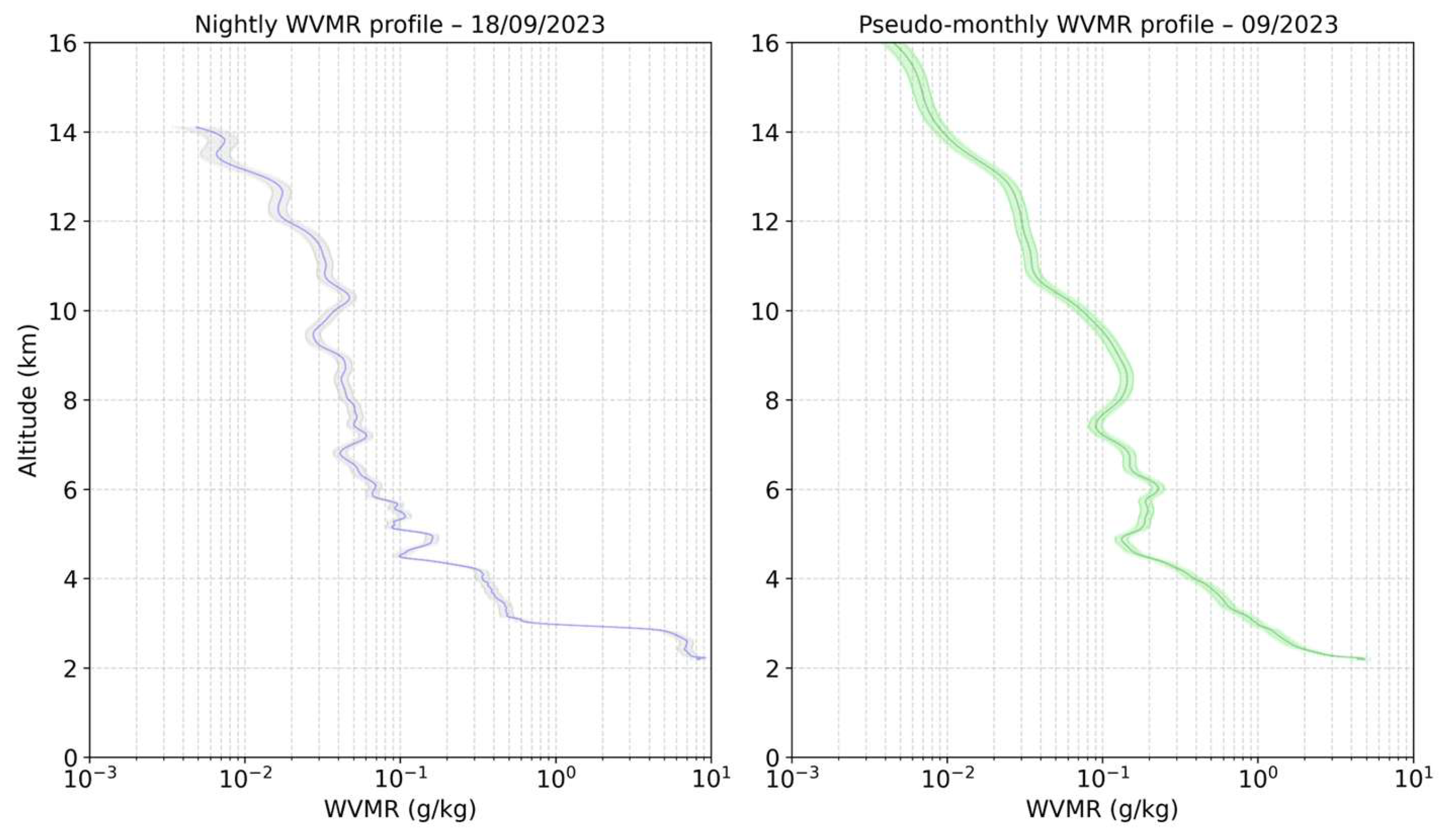
Figure 2.
WVMR profiles (in g/kg) from lidar and MLS-Aura Satellite over 10–16 km. (Left panel): signle-night profile for 18 September 2023. (Right panel): pseudo-monthly profile pf September 2023. Shaded areas indicate the lidar profile uncertainty. The MLS profile uncertainty are <5% mostly.
Figure 2.
WVMR profiles (in g/kg) from lidar and MLS-Aura Satellite over 10–16 km. (Left panel): signle-night profile for 18 September 2023. (Right panel): pseudo-monthly profile pf September 2023. Shaded areas indicate the lidar profile uncertainty. The MLS profile uncertainty are <5% mostly.
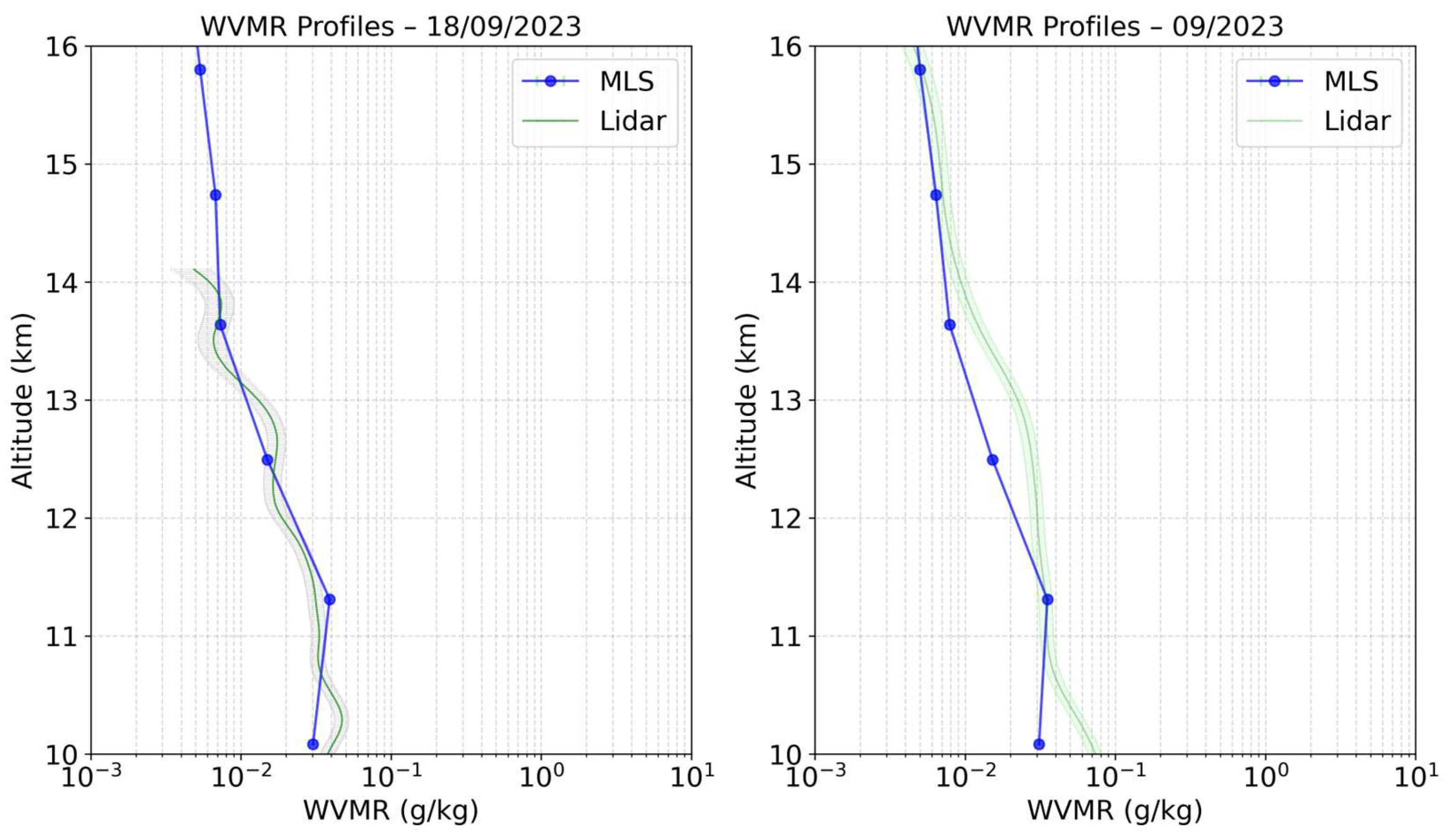
Figure 3.
WVMR profiles (in g/kg) from ERA5 and lidar over 10–16 km. (Left panel): lidar-like night profile for 18 September 2023. (Right panel): pseudo-monthly profile for September 2023, Shaded areas indicate the lidar WVMR error.
Figure 3.
WVMR profiles (in g/kg) from ERA5 and lidar over 10–16 km. (Left panel): lidar-like night profile for 18 September 2023. (Right panel): pseudo-monthly profile for September 2023, Shaded areas indicate the lidar WVMR error.
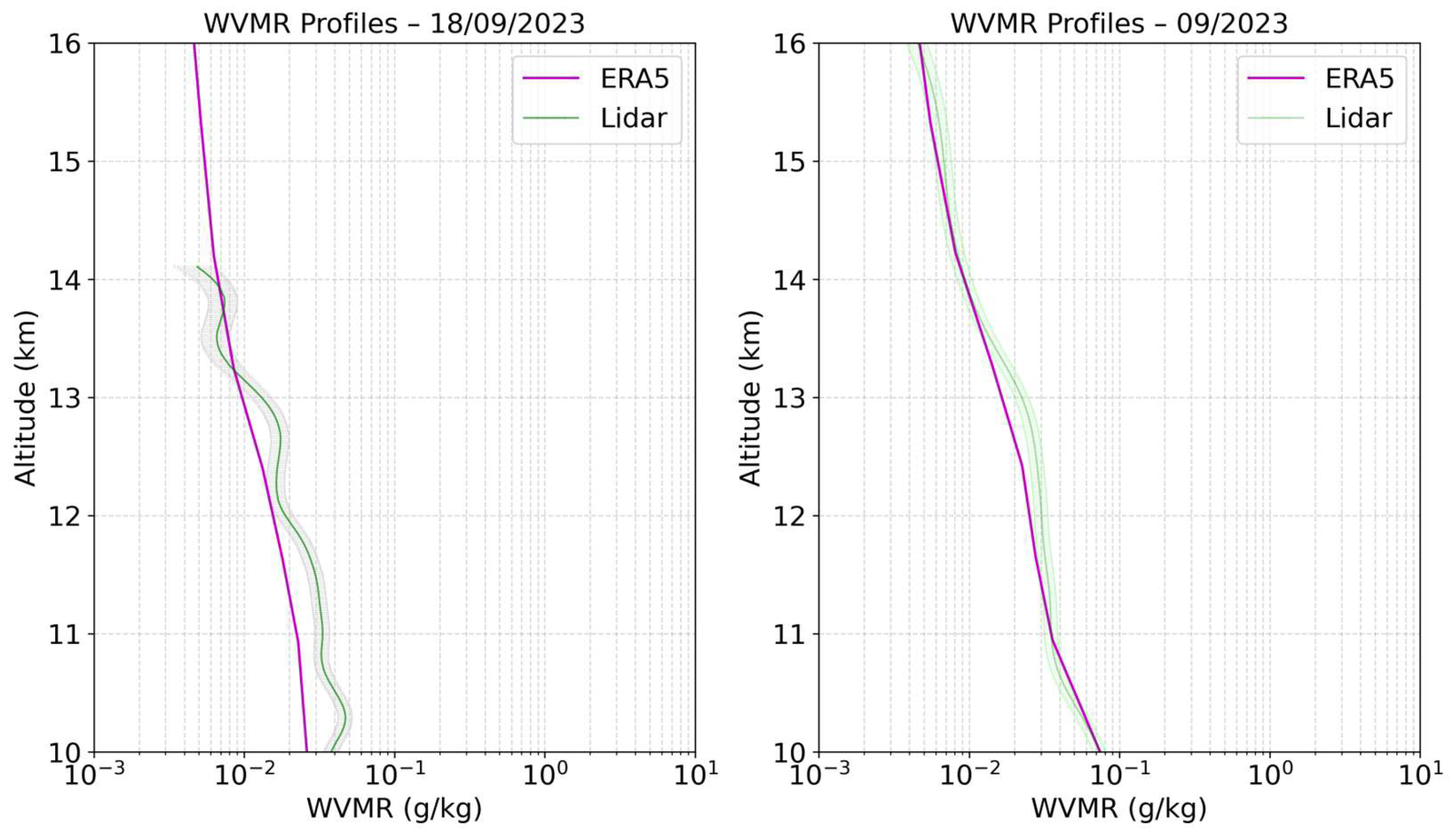
Figure 4.
WVMR profiles (in g/kg) from both lidar and GRUAN-processed M10 radiosonde over 10–16 km. (Left panel): single night profile for 18 September 2023, (Right panel): pseudo-monthly profile for September 2023. Shaded areas indicate lidar WVMR error.
Figure 4.
WVMR profiles (in g/kg) from both lidar and GRUAN-processed M10 radiosonde over 10–16 km. (Left panel): single night profile for 18 September 2023, (Right panel): pseudo-monthly profile for September 2023. Shaded areas indicate lidar WVMR error.
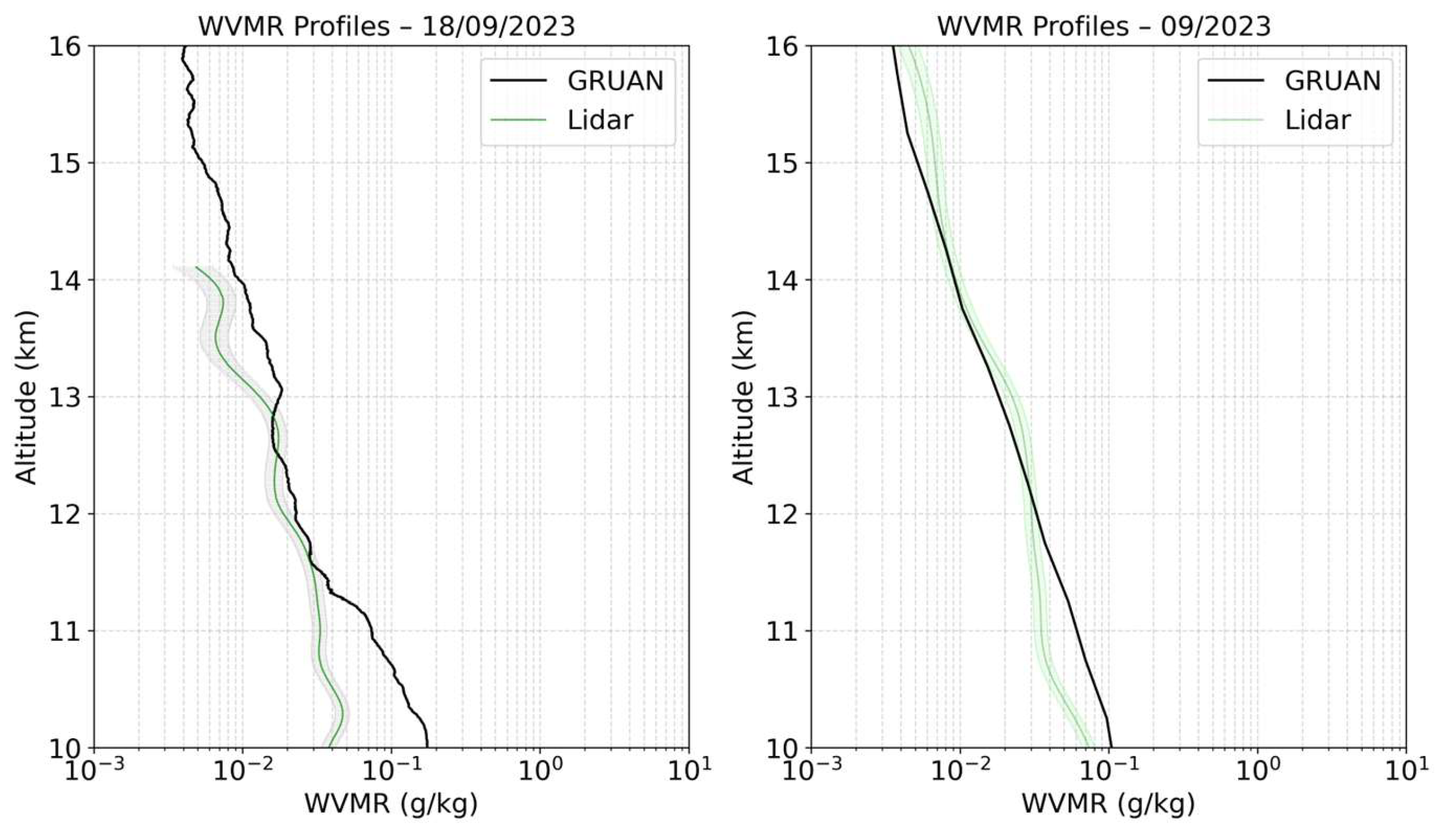
Figure 5.
Median relative shift (%) of Lid1200 WVMR with respect to MLS over 76 compared pseudo-monthly profile pairs from 2013 to 2023. Shaded areas indicate the 95% confidence interval of the relative error.
Figure 5.
Median relative shift (%) of Lid1200 WVMR with respect to MLS over 76 compared pseudo-monthly profile pairs from 2013 to 2023. Shaded areas indicate the 95% confidence interval of the relative error.
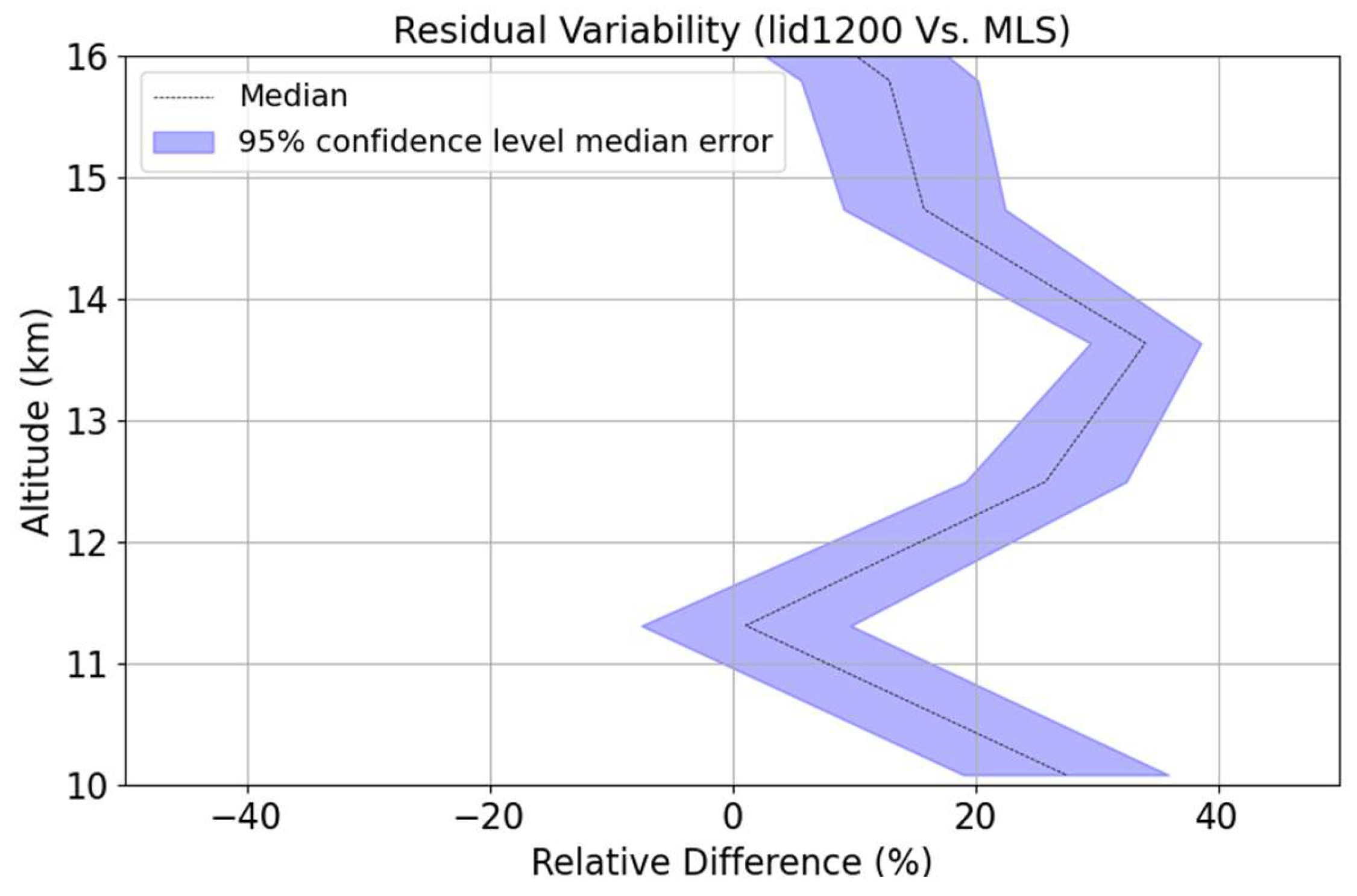
Figure 6.
Temporal evolution of relative differences (%) between Lid1200 and MLS (Lid1200—MLS) at 13 km (blue) and 11 km (red) from 2013 to 2023. Positive values indicate that Lid1200 reports higher WVMR than MLS. Gaps correspond to months with insufficient coincident observations.
Figure 6.
Temporal evolution of relative differences (%) between Lid1200 and MLS (Lid1200—MLS) at 13 km (blue) and 11 km (red) from 2013 to 2023. Positive values indicate that Lid1200 reports higher WVMR than MLS. Gaps correspond to months with insufficient coincident observations.
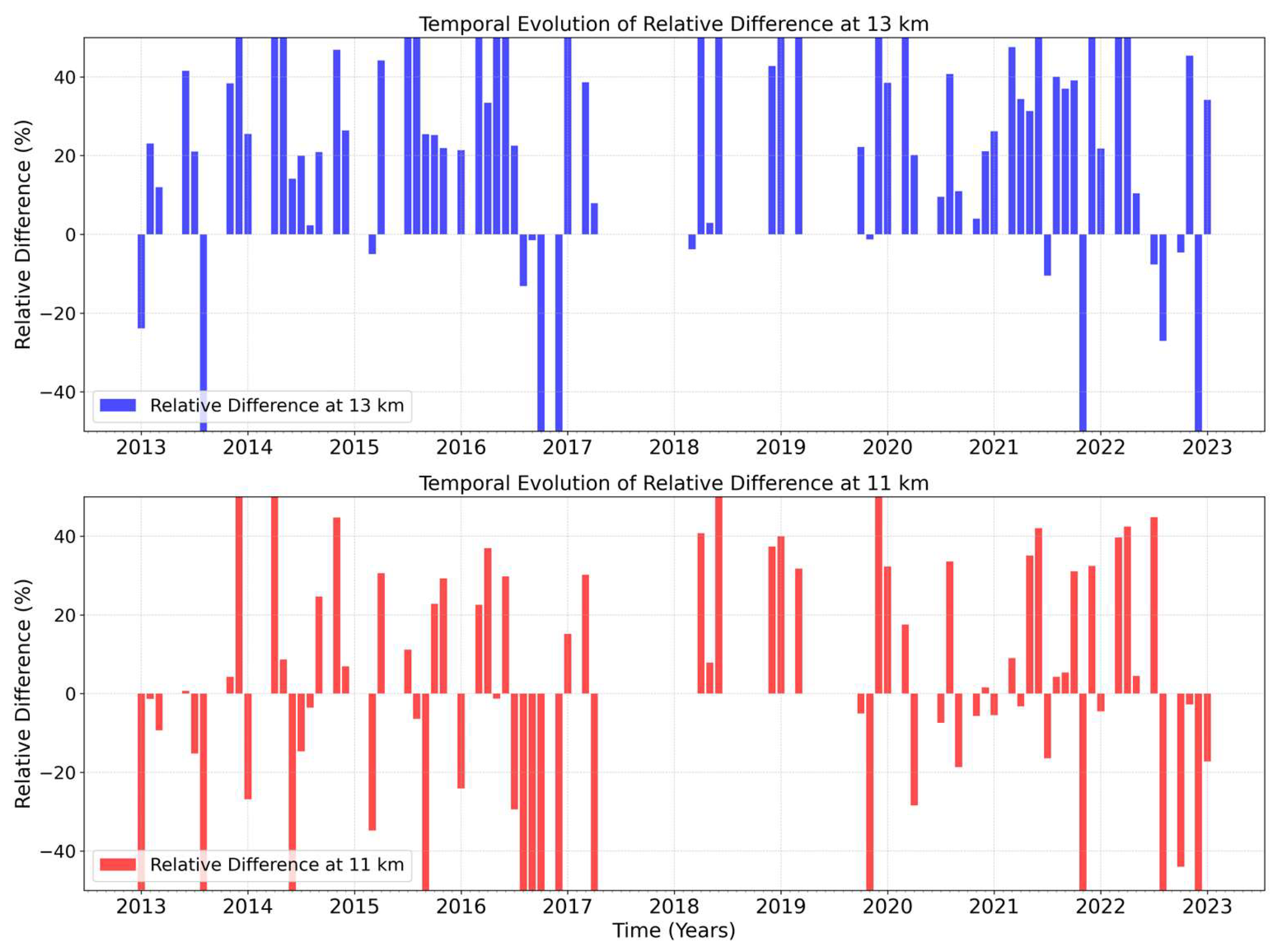
Figure 7.
Seasonal comparison of Lid1200 WVMR relative to MLS over the 2013–2023 period. (a) Median relative lidar to MLS shift (%) during wet season months (October–April); (b) Median WVMR profile (g/kg) during the wet season; (c) Median relative shift (%) during dry season months (May-September); (d) Median WVMR profile (g/kg) during the dry season. Shaded areas indicate the 95% confidence interval of the median relative error.
Figure 7.
Seasonal comparison of Lid1200 WVMR relative to MLS over the 2013–2023 period. (a) Median relative lidar to MLS shift (%) during wet season months (October–April); (b) Median WVMR profile (g/kg) during the wet season; (c) Median relative shift (%) during dry season months (May-September); (d) Median WVMR profile (g/kg) during the dry season. Shaded areas indicate the 95% confidence interval of the median relative error.
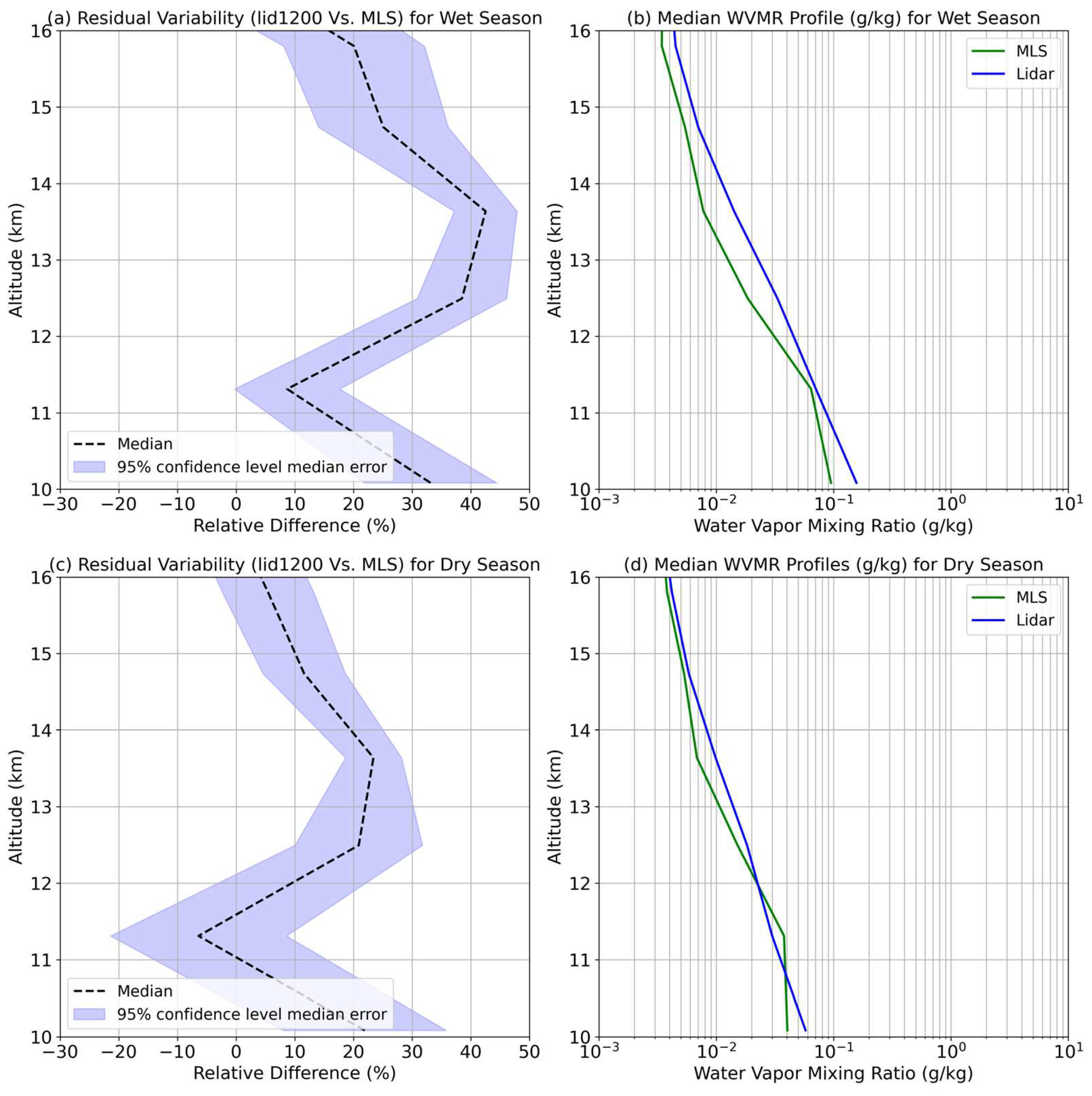
Figure 8.
Median relative bias (%) of Lid1200 WVMR with respect to ERA5 over 91 pseudo-monthly profiles from 2013 to 2023. Shaded areas indicate the 95% confidence interval of the relative error.
Figure 8.
Median relative bias (%) of Lid1200 WVMR with respect to ERA5 over 91 pseudo-monthly profiles from 2013 to 2023. Shaded areas indicate the 95% confidence interval of the relative error.
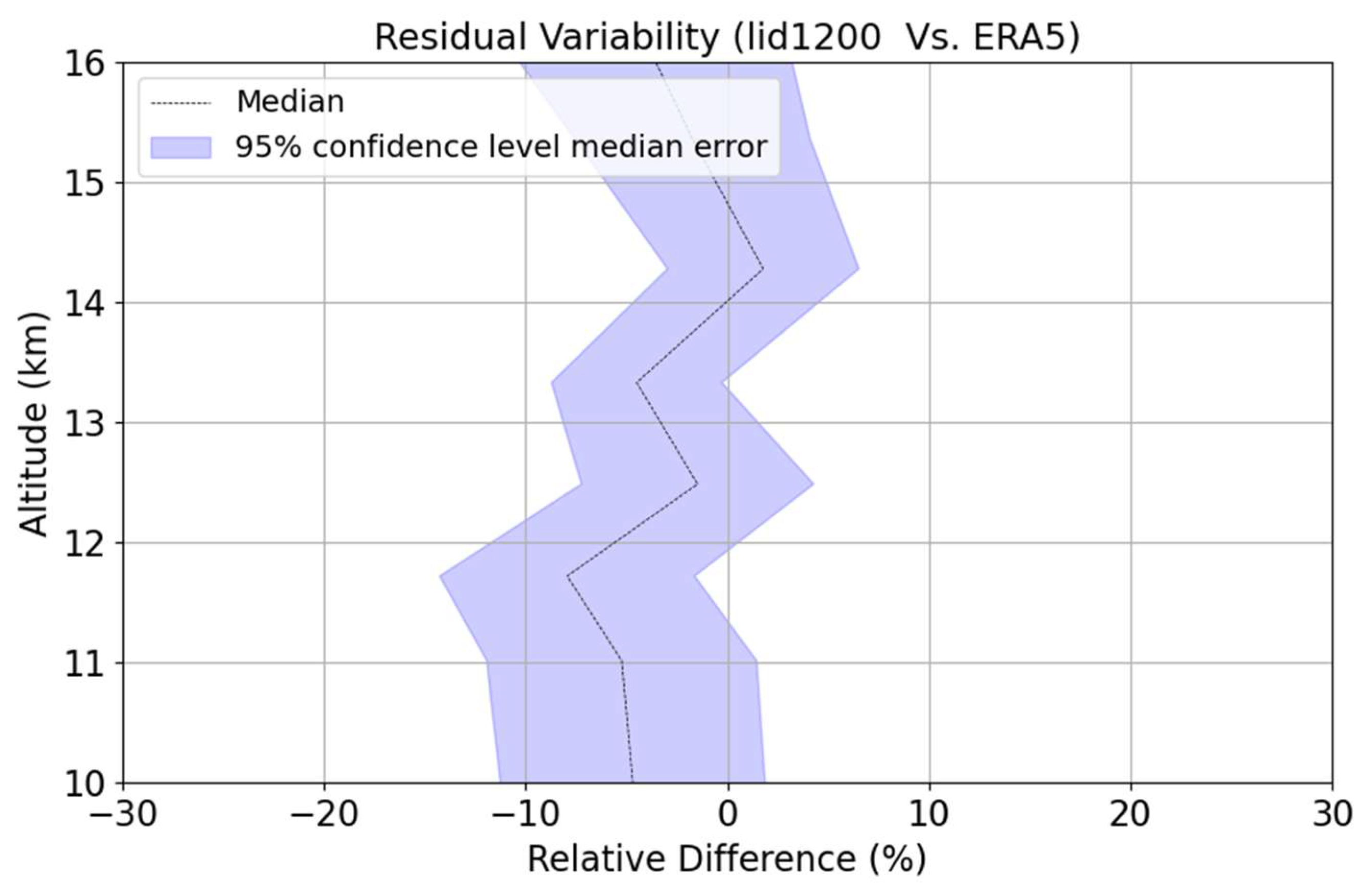
Figure 9.
Temporal evolution of relative differences (%) between Lid1200 and ERA5 (Lid1200—ERA5) at 14 km (blue) and 11 km (red) from 2013 to 2023. Positive values indicate that Lid1200 reports higher WVMR than ERA5. Gaps correspond to months with insufficient lidar observations.
Figure 9.
Temporal evolution of relative differences (%) between Lid1200 and ERA5 (Lid1200—ERA5) at 14 km (blue) and 11 km (red) from 2013 to 2023. Positive values indicate that Lid1200 reports higher WVMR than ERA5. Gaps correspond to months with insufficient lidar observations.
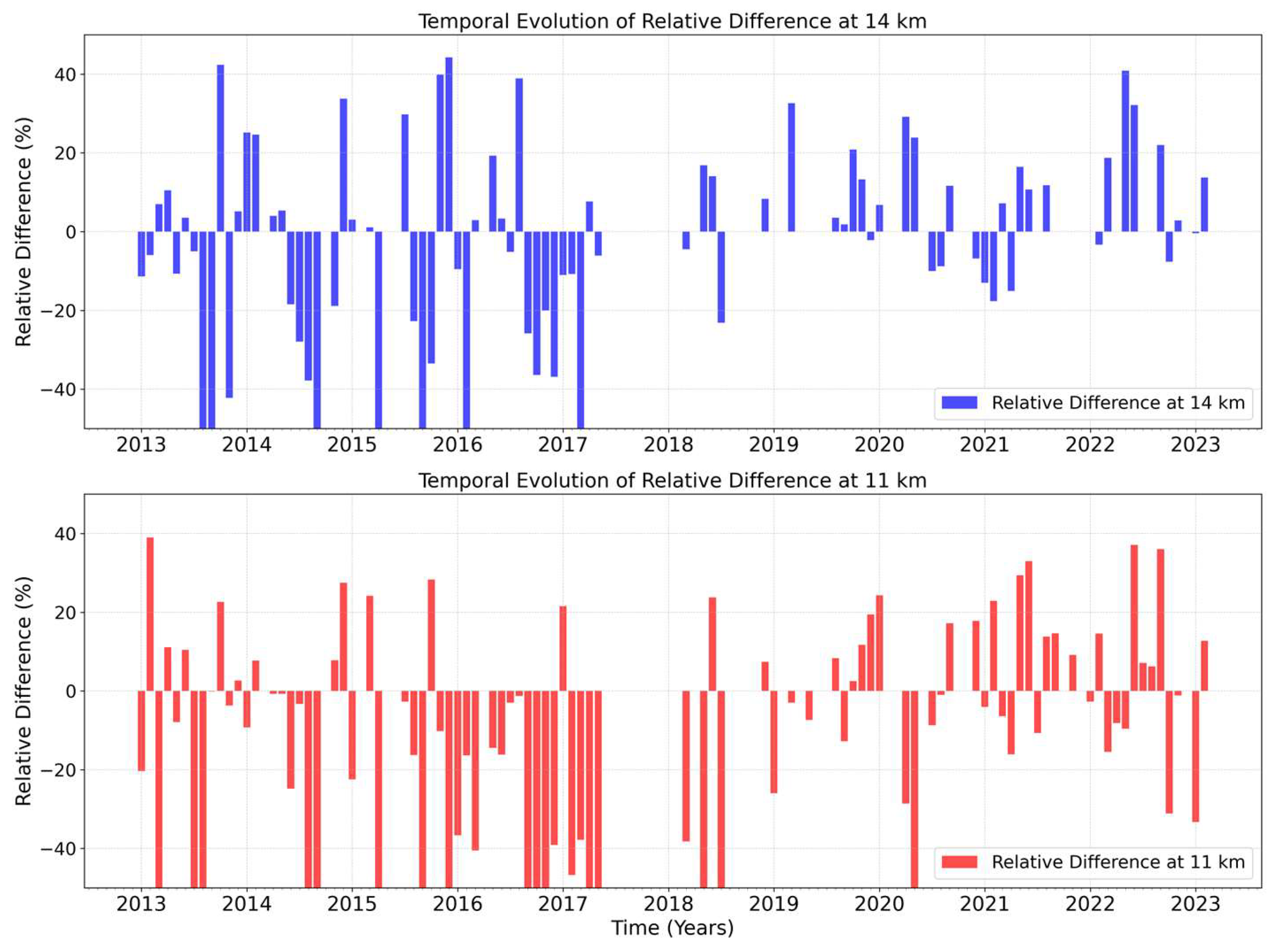
Figure 10.
Seasonal comparison of Lid1200 WVMR relative to ERA5 over the 2013–2023 period. (a) Median relative shift (%) during wet season months (October–April); (b) Median WVMR profile (g/kg) during the wet season; (c) Median relative shift (%) during dry season months (May–September); (d) Median WVMR profile (g/kg) during the dry season. Shaded areas indicate the 95% confidence interval of the median relative error.
Figure 10.
Seasonal comparison of Lid1200 WVMR relative to ERA5 over the 2013–2023 period. (a) Median relative shift (%) during wet season months (October–April); (b) Median WVMR profile (g/kg) during the wet season; (c) Median relative shift (%) during dry season months (May–September); (d) Median WVMR profile (g/kg) during the dry season. Shaded areas indicate the 95% confidence interval of the median relative error.
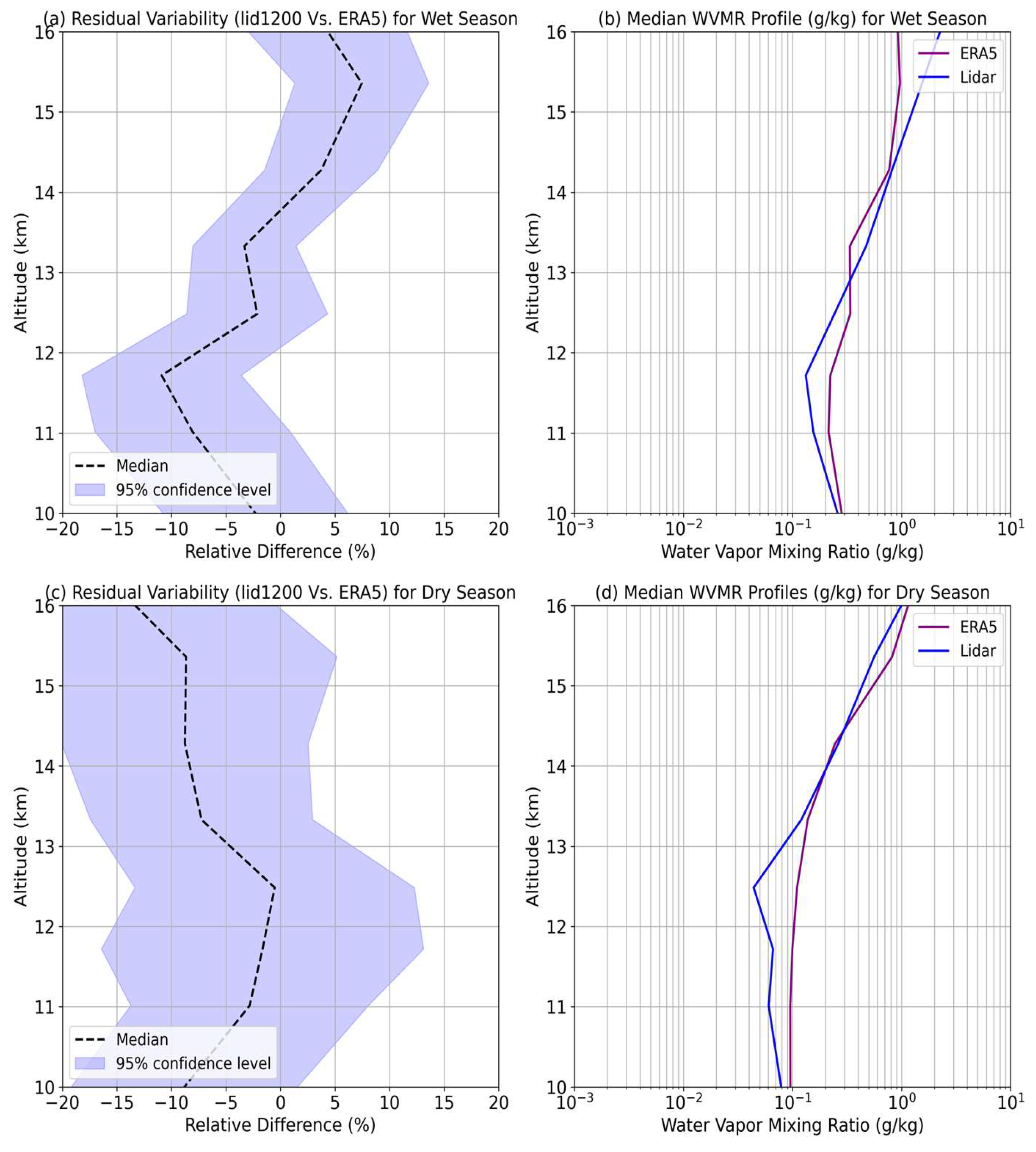
Figure 11.
Median relative shift (%) of Lid1200 WVMR with respect to GRUAN processed M10, radiosondes over 41 pseudo-monthly profiles from 2019 to 2023). Shaded areas indicate the 95% confidence interval of the relative error.
Figure 11.
Median relative shift (%) of Lid1200 WVMR with respect to GRUAN processed M10, radiosondes over 41 pseudo-monthly profiles from 2019 to 2023). Shaded areas indicate the 95% confidence interval of the relative error.
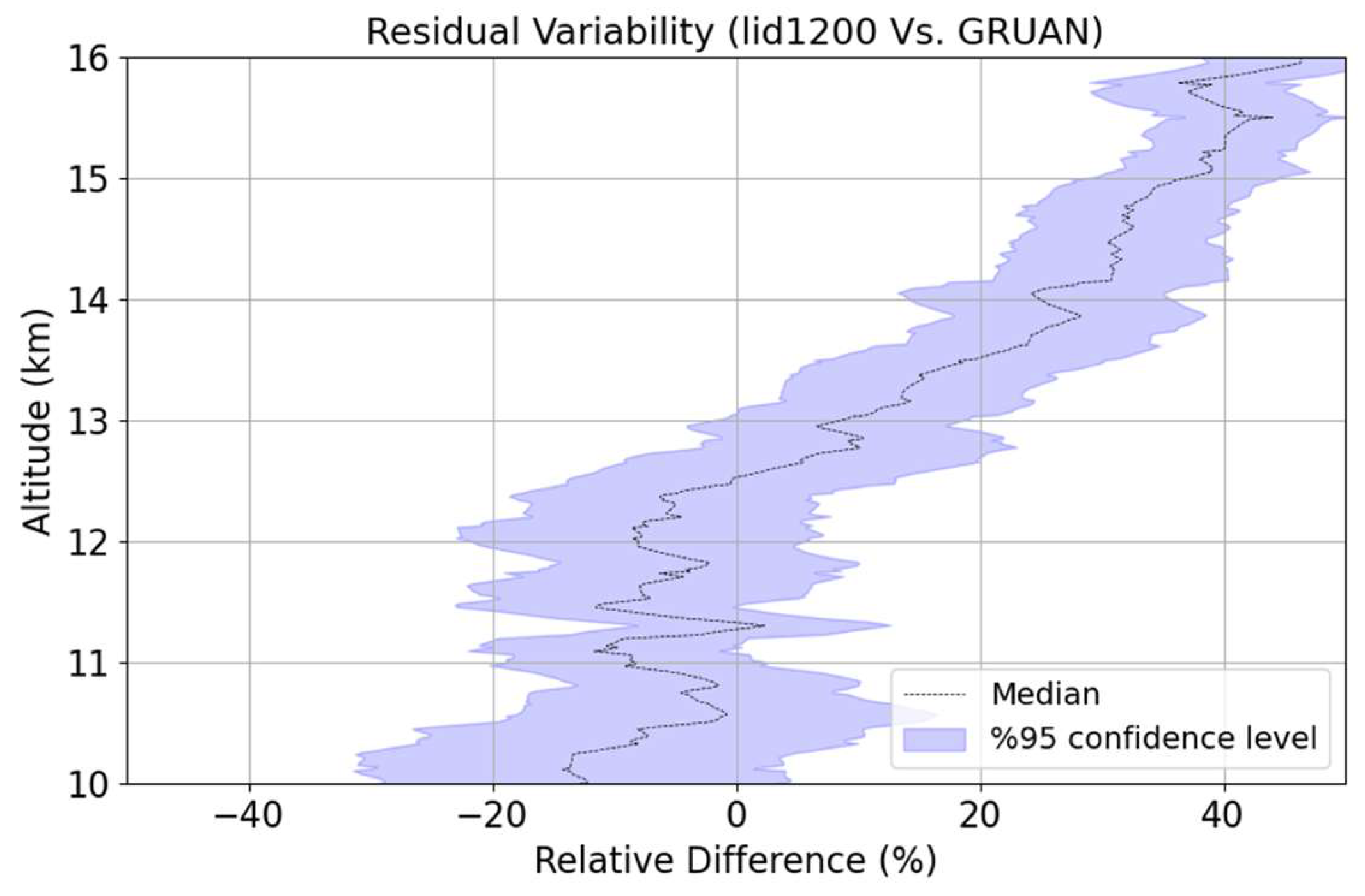
Figure 12.
Temporal evolution of relative differences (%) between Lid1200 and GRUAN processed M10 (Lid1200—GRUAN) at 14 km (blue) and 11 km (red) from 2019 to 2023. Positive values indicate that Lid1200 reports higher WVMR. Gaps correspond to months with insufficient lidar observations.
Figure 12.
Temporal evolution of relative differences (%) between Lid1200 and GRUAN processed M10 (Lid1200—GRUAN) at 14 km (blue) and 11 km (red) from 2019 to 2023. Positive values indicate that Lid1200 reports higher WVMR. Gaps correspond to months with insufficient lidar observations.
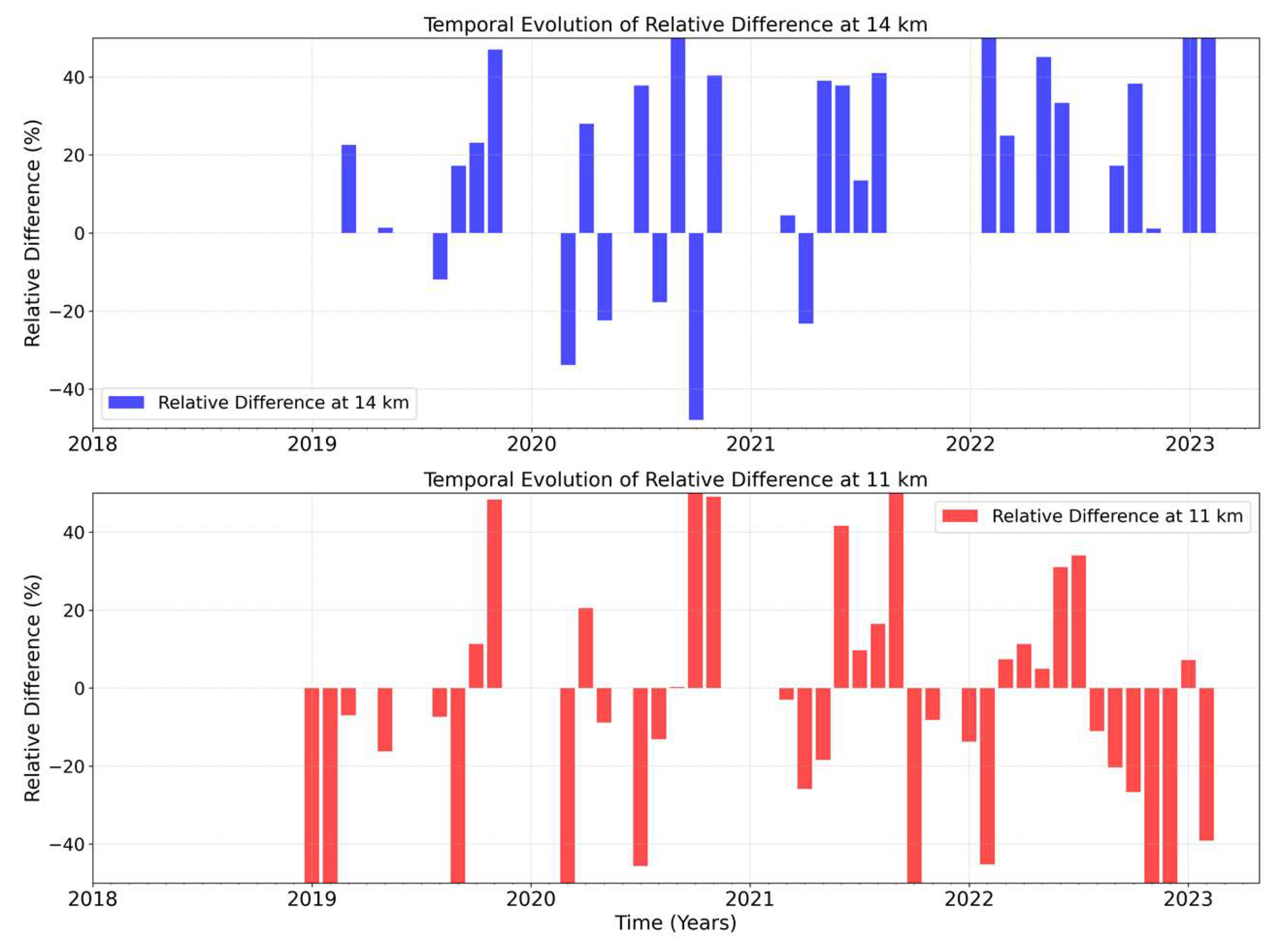
Figure 13.
Seasonal comparison of Lid1200 WVMR relative to GRUAN-processed M10 radiosondes. (a) Median relative shift of Lid1200 relative to radiosondes (%) during wet season months (October–April). (b) Median WVMR profile (g/kg) during the wet season. (c) Median relative Lid1200 shift (%) during the dry season months (May–September). (d) Median WVMR profile (g/kg) during the dry season. Shaded areas indicate the 95% confidence interval of the median relative error.
Figure 13.
Seasonal comparison of Lid1200 WVMR relative to GRUAN-processed M10 radiosondes. (a) Median relative shift of Lid1200 relative to radiosondes (%) during wet season months (October–April). (b) Median WVMR profile (g/kg) during the wet season. (c) Median relative Lid1200 shift (%) during the dry season months (May–September). (d) Median WVMR profile (g/kg) during the dry season. Shaded areas indicate the 95% confidence interval of the median relative error.
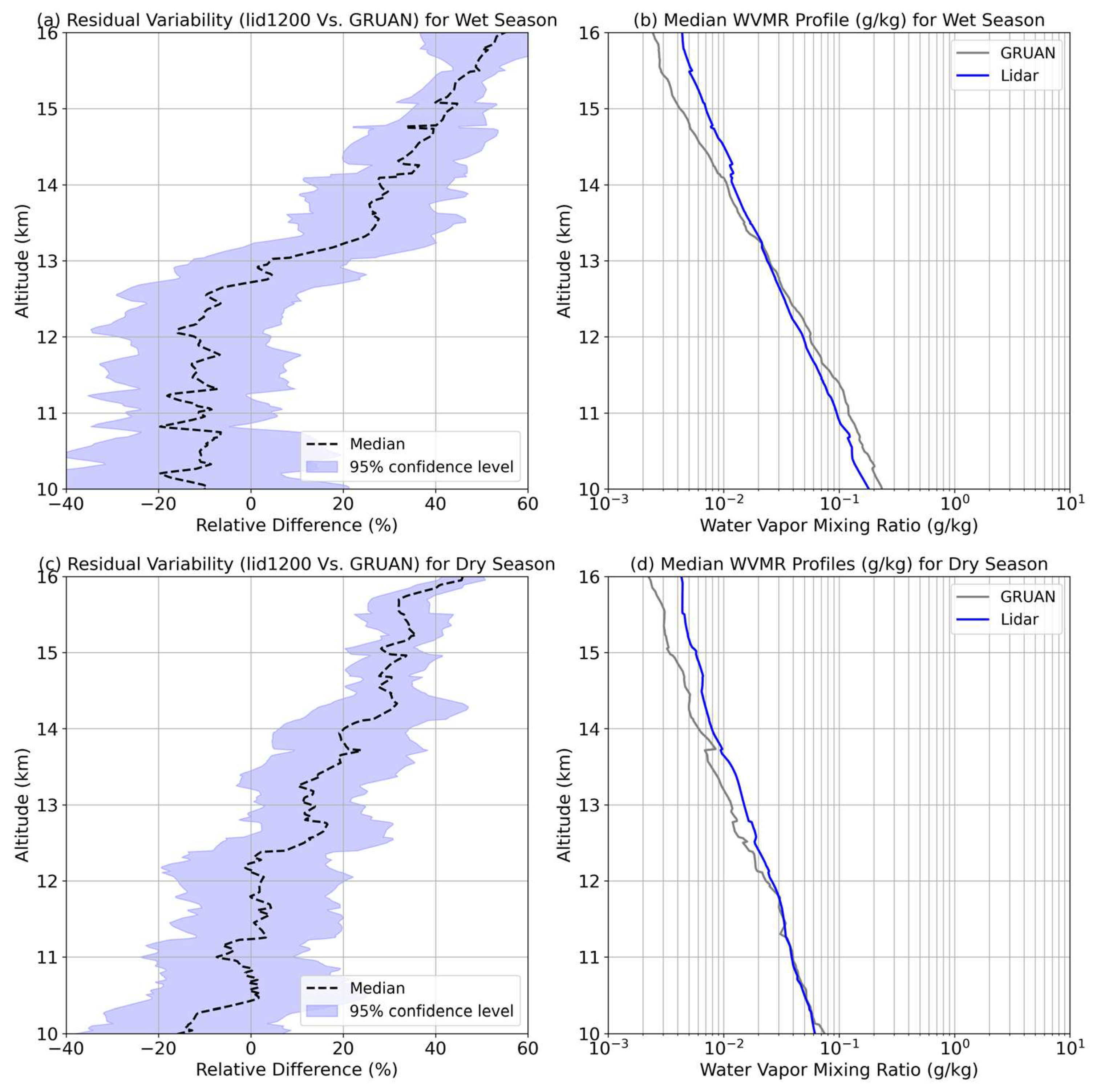
Figure 14.
Trajectories of GRUAN M10 radiosondes launched from Saint-Denis airport (red point on the Réunion Island) at altitudes between 10 and 16 km. The color of each trajectory respresents altitude. The red dashed circle indicates a 100 km radius around the launch site. The blue triangle marks the Maido observatory (Lid1200 location).
Figure 14.
Trajectories of GRUAN M10 radiosondes launched from Saint-Denis airport (red point on the Réunion Island) at altitudes between 10 and 16 km. The color of each trajectory respresents altitude. The red dashed circle indicates a 100 km radius around the launch site. The blue triangle marks the Maido observatory (Lid1200 location).
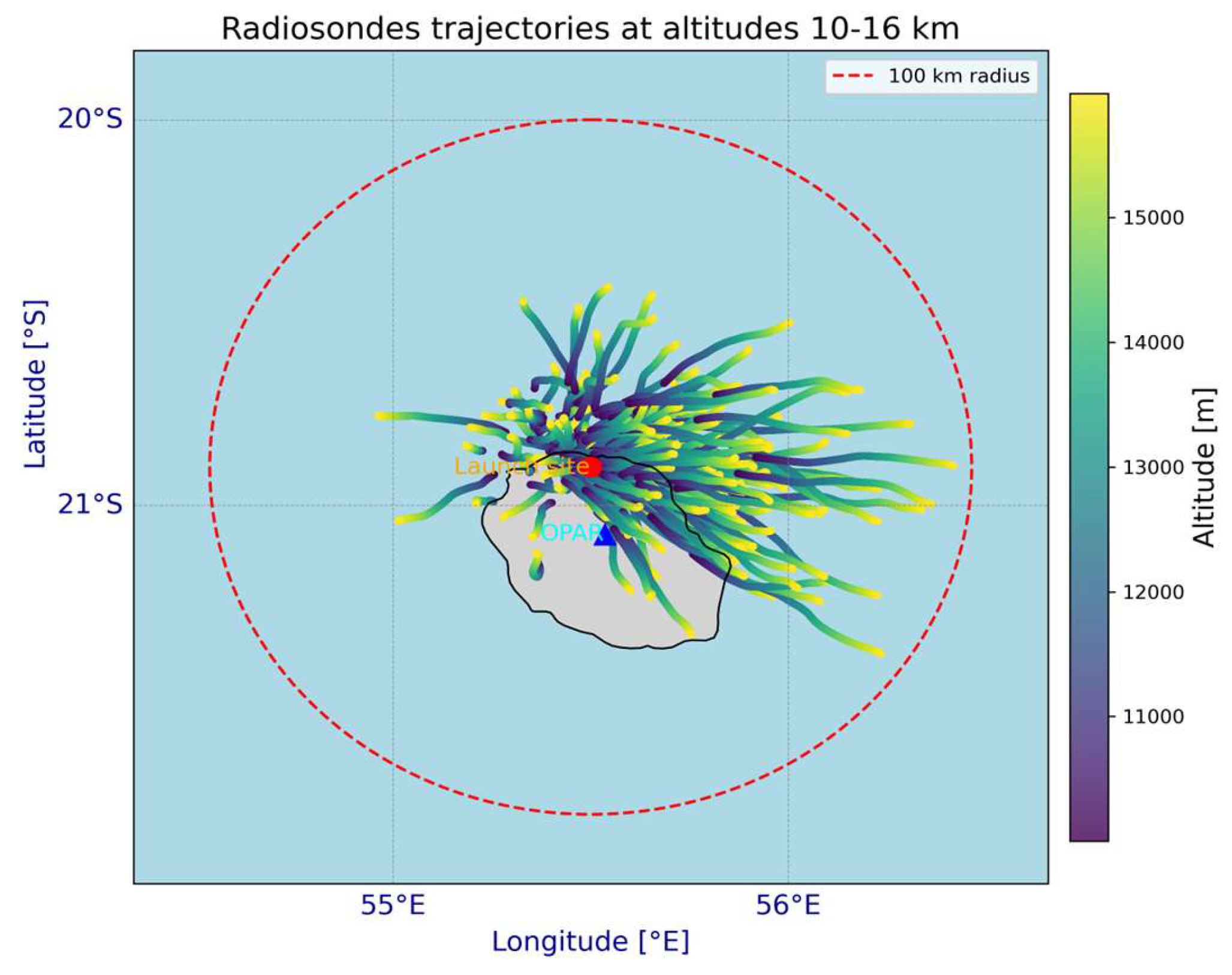
Figure 15.
Trajectories of GRUAN M10 radiosondes launched from Saint-Denis airport (red point on the Réunion Island) at altitudes between 10 and 16 km. Orange trajectories respresent radiosondes drifts in the opposite direction relative to Lid1200 location, classified as ‘Far’. Blue trajectories indicates radiosonde drifts towards Lid1200 site classified as ‘Near’. The red dashed circle indicates a 100 km radius around the launch site. The blue triangle marks the Maido observatory (Lid1200 location).
Figure 15.
Trajectories of GRUAN M10 radiosondes launched from Saint-Denis airport (red point on the Réunion Island) at altitudes between 10 and 16 km. Orange trajectories respresent radiosondes drifts in the opposite direction relative to Lid1200 location, classified as ‘Far’. Blue trajectories indicates radiosonde drifts towards Lid1200 site classified as ‘Near’. The red dashed circle indicates a 100 km radius around the launch site. The blue triangle marks the Maido observatory (Lid1200 location).
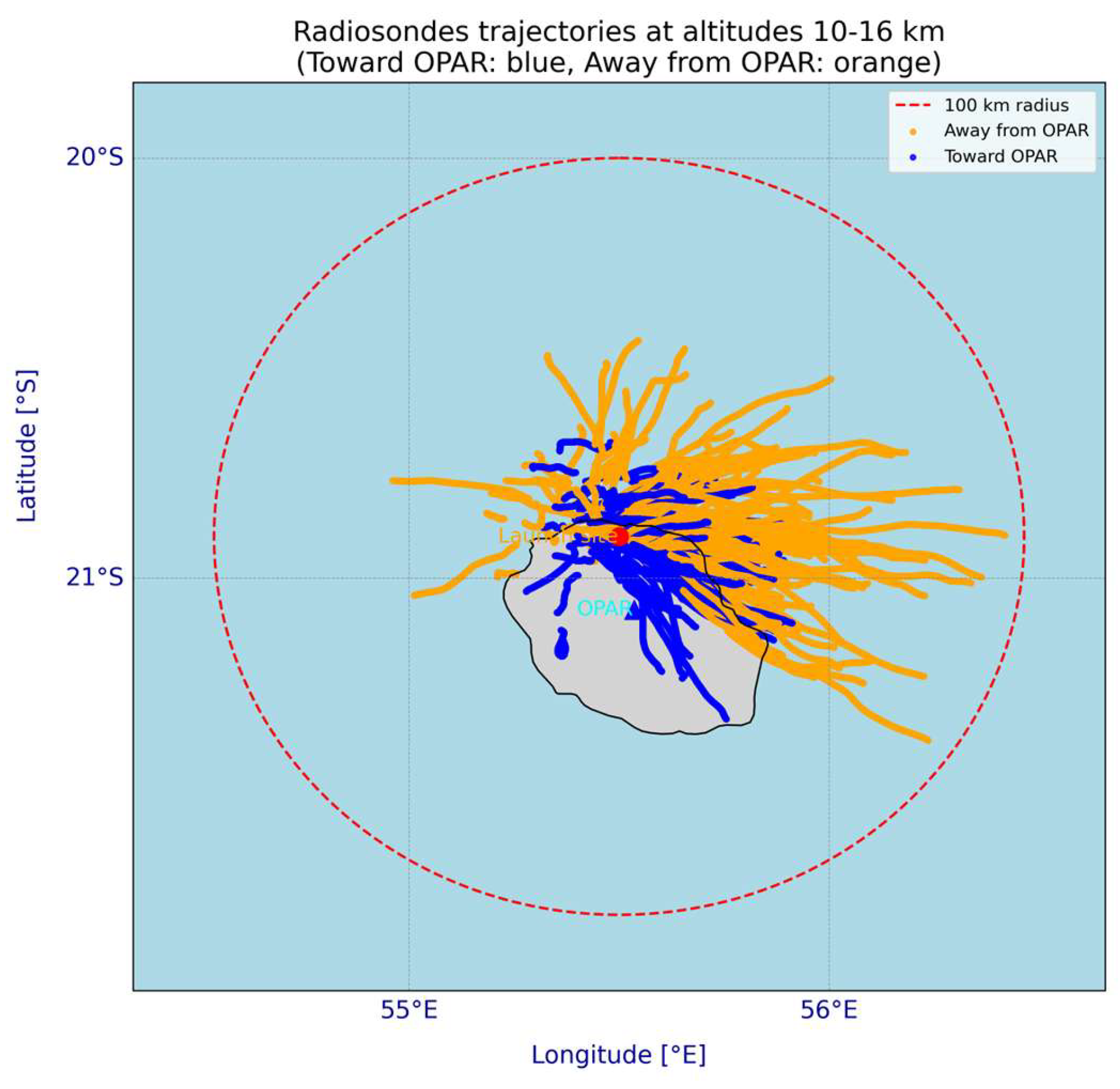
Figure 16.
Spatial comparison of Lid1200 WVMR relative to GRUAN-processed M10 radiosondes. (a) Median relative shift of Lid1200 relative to radiosondes drifted far away from the lidar location towards the ocean (%). (b) Median WVMR profile (g/kg) for the dates of far drifted radisondes. (c) Median relative Lid1200 shift (%) relative to near radiosondes. (d) Median WVMR profile (g/kg) for dates of radiosondes drifted towards the lidar site (near). Shaded areas indicate the 95% confidence interval of the median relative error.
Figure 16.
Spatial comparison of Lid1200 WVMR relative to GRUAN-processed M10 radiosondes. (a) Median relative shift of Lid1200 relative to radiosondes drifted far away from the lidar location towards the ocean (%). (b) Median WVMR profile (g/kg) for the dates of far drifted radisondes. (c) Median relative Lid1200 shift (%) relative to near radiosondes. (d) Median WVMR profile (g/kg) for dates of radiosondes drifted towards the lidar site (near). Shaded areas indicate the 95% confidence interval of the median relative error.
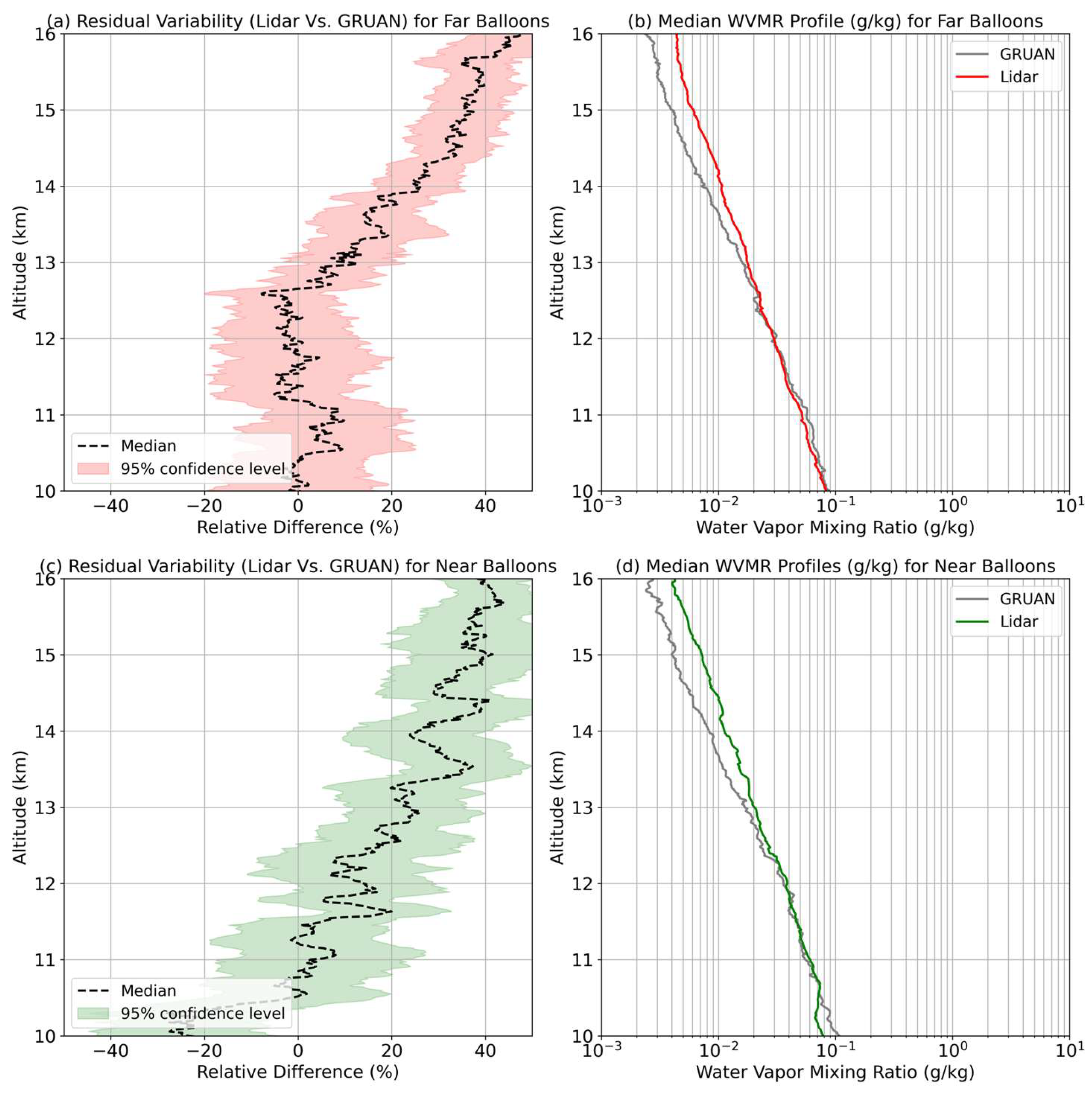
Figure 17.
Nightly calibration factors used to derive generalised calibration coefficients over the 2013–2023 period, obtained using the methods of Vérèmes et al., (2019) [30] (gray bars, annotated in dark blue) and Alraddawi et al., (2025) [47] (green bars, annotated in orange). The plot shows the median calibration factors for each stable period, together with their associated uncertainties. Error bars (wiskers) represent the 95% confidence intervals.
Figure 17.
Nightly calibration factors used to derive generalised calibration coefficients over the 2013–2023 period, obtained using the methods of Vérèmes et al., (2019) [30] (gray bars, annotated in dark blue) and Alraddawi et al., (2025) [47] (green bars, annotated in orange). The plot shows the median calibration factors for each stable period, together with their associated uncertainties. Error bars (wiskers) represent the 95% confidence intervals.
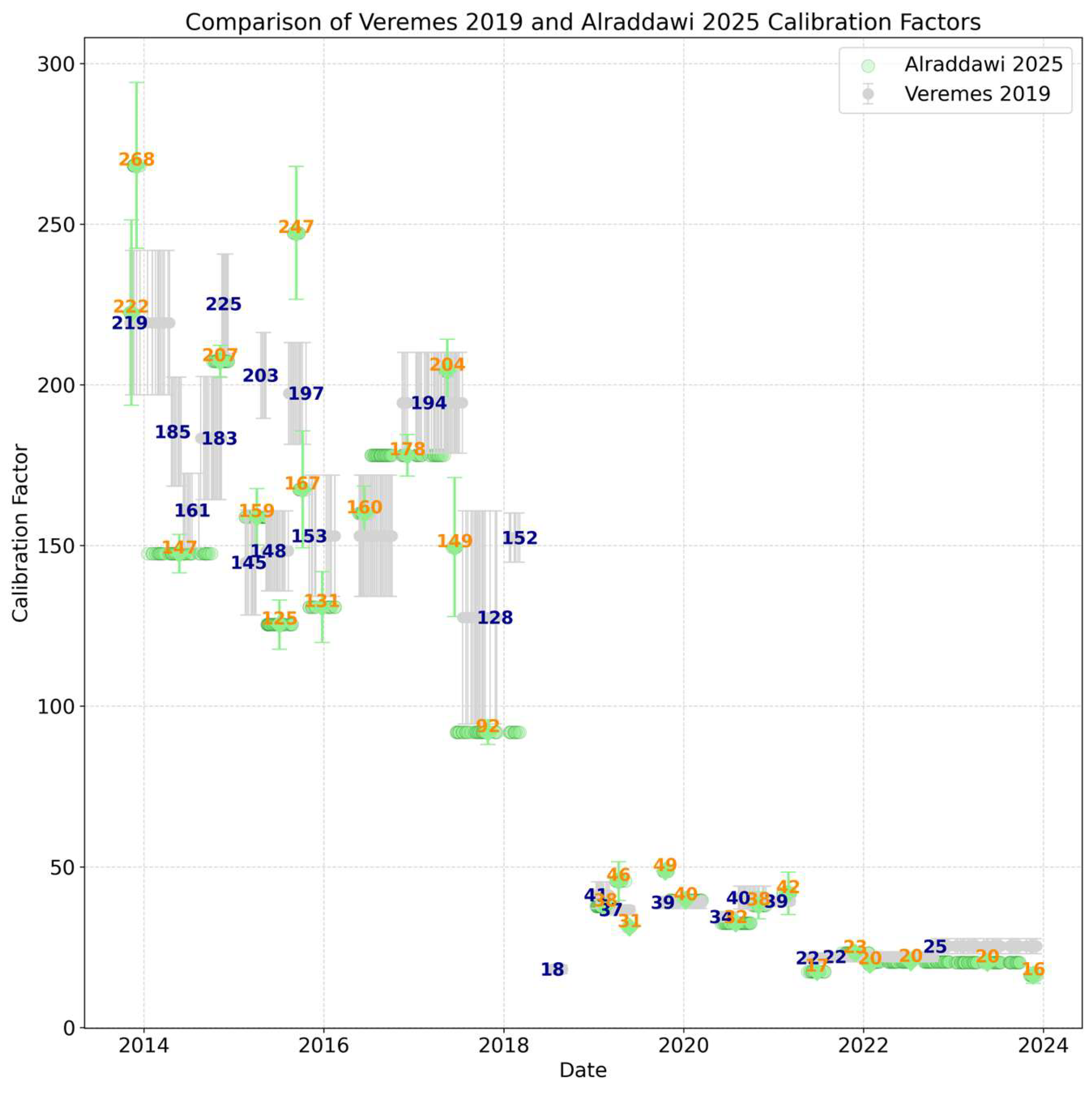
Figure 18.
Median WVMR profile (in g/kg) over the 2013–2023 period derived from the two calibration methods: the operational Lid1200 dataset calibrated with GNSS IWV [30], and the new alternative ERA5-based calibration [47].
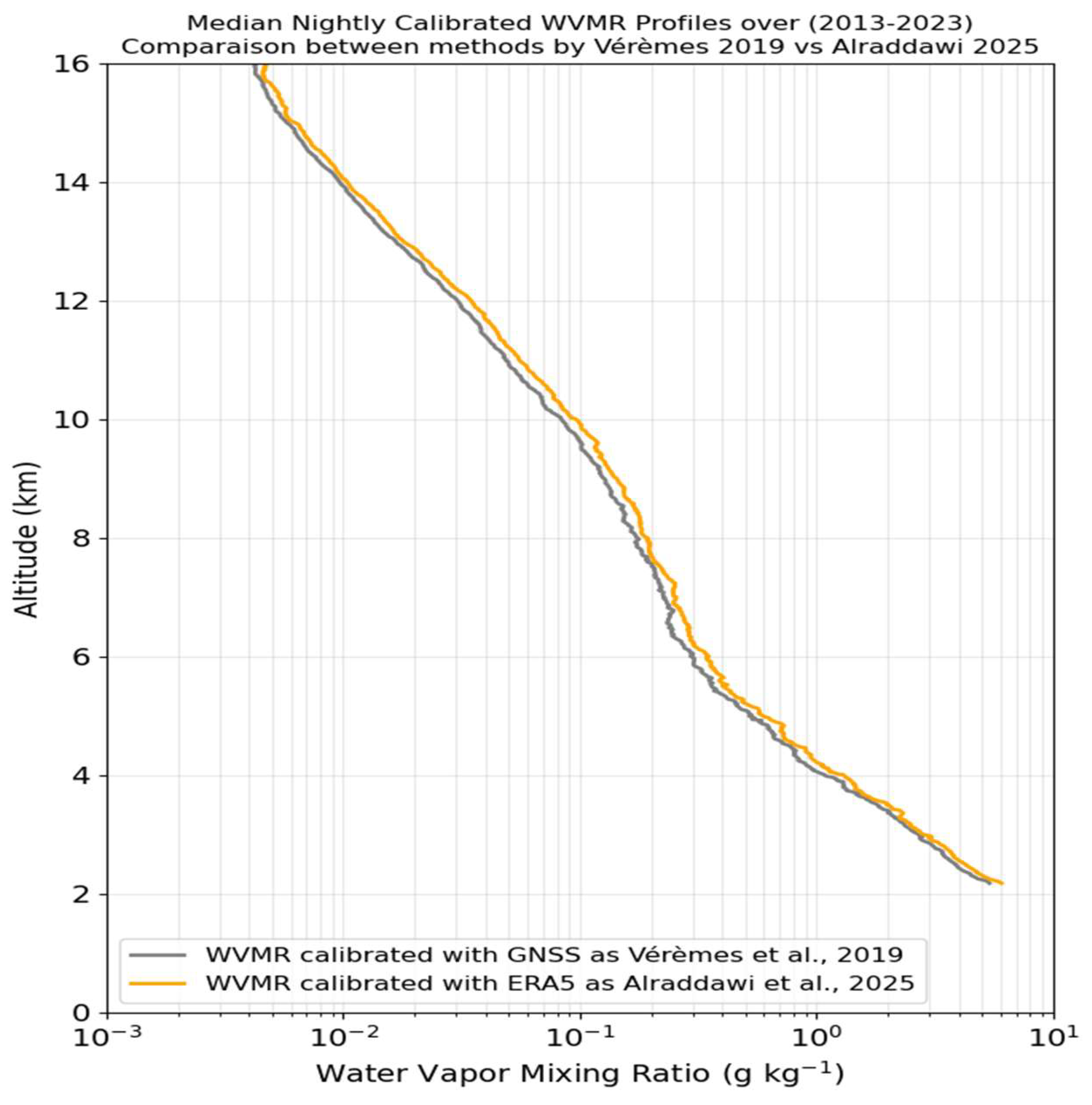
Figure 19.
Median relative shift (%) of the Lid1200 new dataset relative to ERA5 over the 2013–2023 period. Shaded areas indicate the 95% confidence intervals of the relative error.
Figure 19.
Median relative shift (%) of the Lid1200 new dataset relative to ERA5 over the 2013–2023 period. Shaded areas indicate the 95% confidence intervals of the relative error.
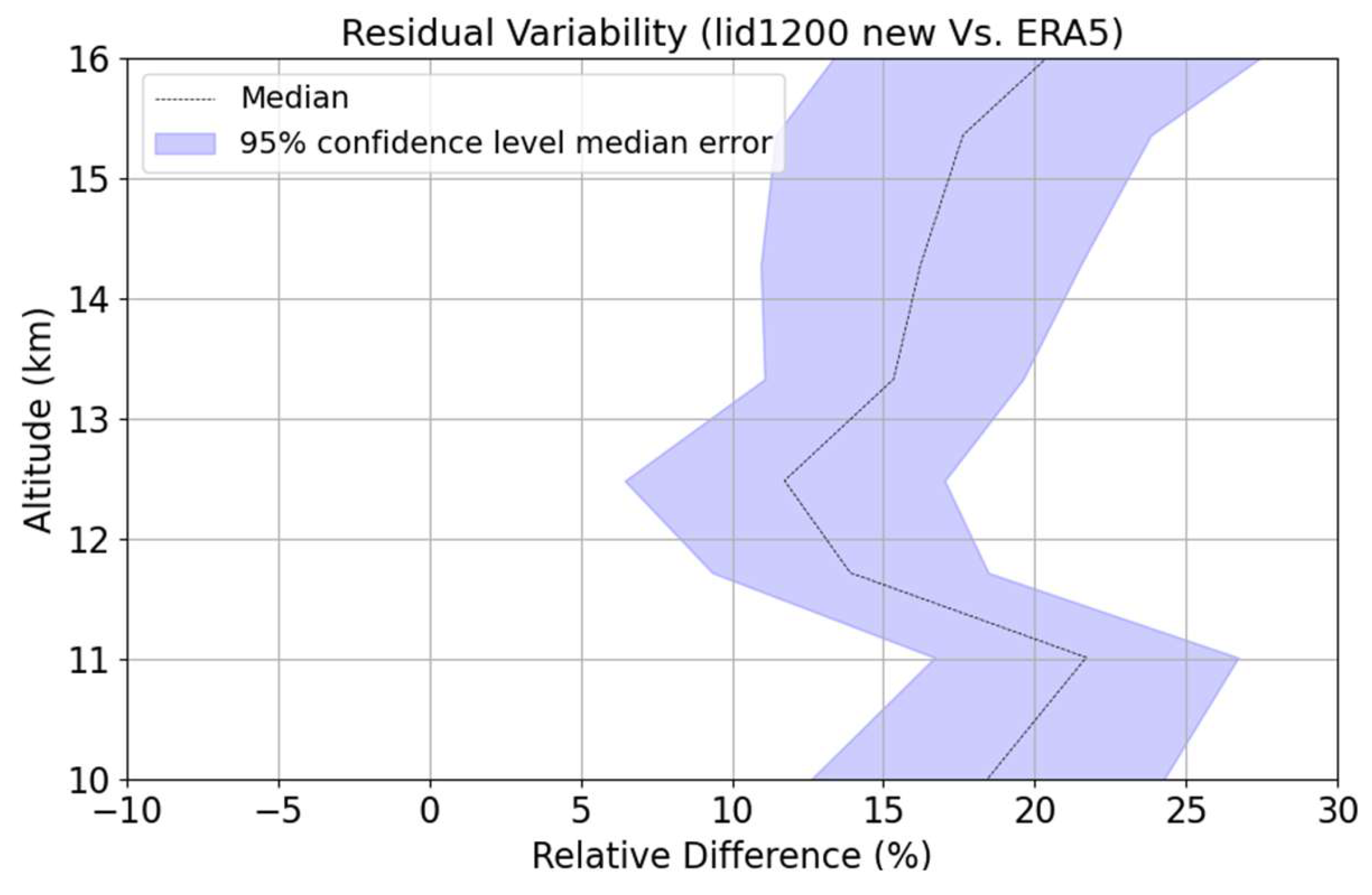
Figure 20.
(a) Median Lid1200 new WVMR relative shift (%) relative to ERA5 during the wet season; (b) Median WVMR profile during the wet season (g/kg); (c) Median Li1200 new WVMR relative shift (%) relative to ERA5 during the dry season; (d) Median WVMR profile during the dry season (g/kg), all over the 2013 to 2023 study period. Shaded areas indicate the 95% confidence intervals of the median error.
Figure 20.
(a) Median Lid1200 new WVMR relative shift (%) relative to ERA5 during the wet season; (b) Median WVMR profile during the wet season (g/kg); (c) Median Li1200 new WVMR relative shift (%) relative to ERA5 during the dry season; (d) Median WVMR profile during the dry season (g/kg), all over the 2013 to 2023 study period. Shaded areas indicate the 95% confidence intervals of the median error.
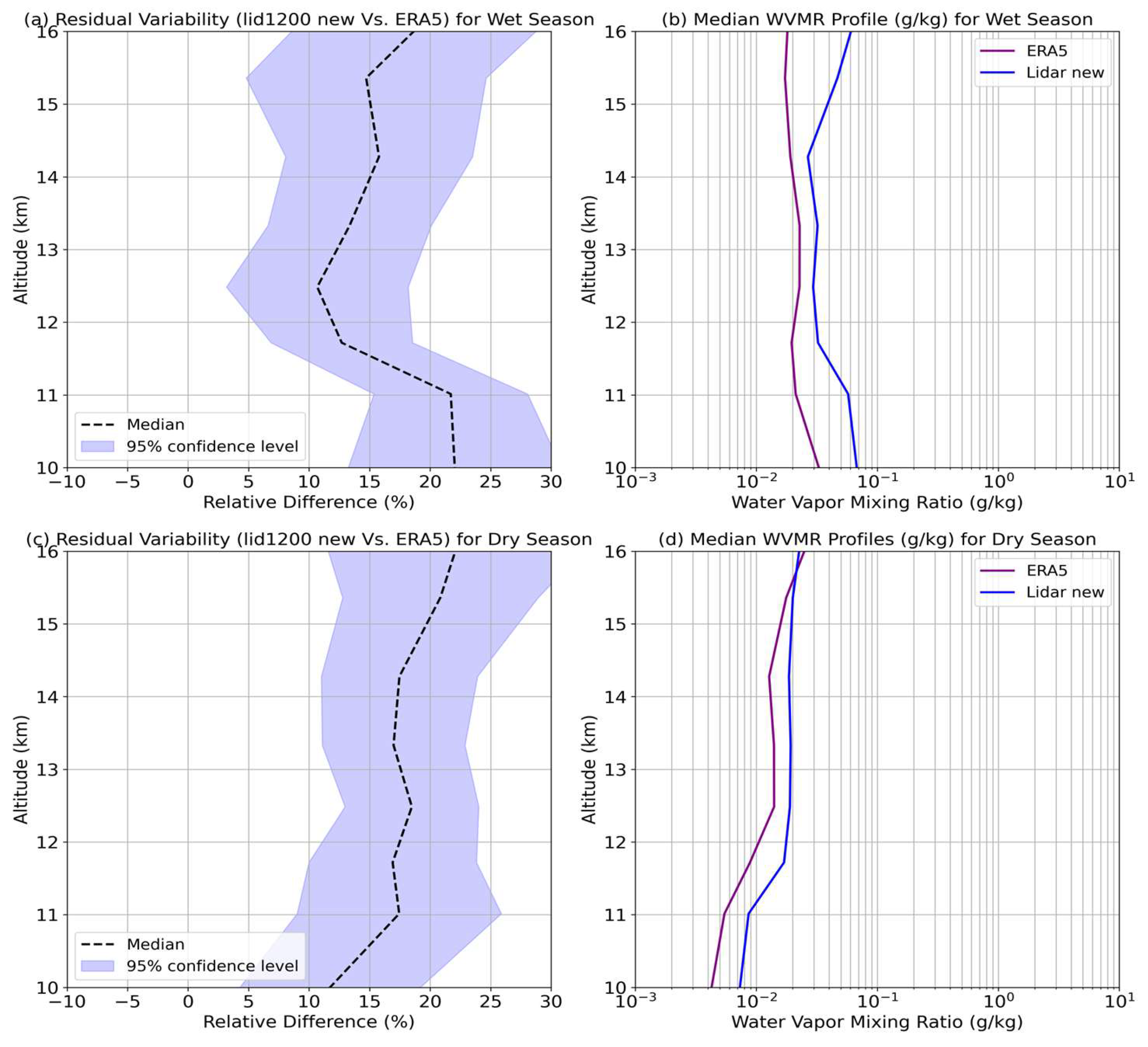
Figure 21.
Median relative shift (%) of the Lid1200 new WVMR profiles relative to GRUAN-processed M10 radiosondes, based on 41 pseudo-monthly profiles from 2019 to 2023. Shaded areas indicate the 95% confidence intervals of the relative error.
Figure 21.
Median relative shift (%) of the Lid1200 new WVMR profiles relative to GRUAN-processed M10 radiosondes, based on 41 pseudo-monthly profiles from 2019 to 2023. Shaded areas indicate the 95% confidence intervals of the relative error.
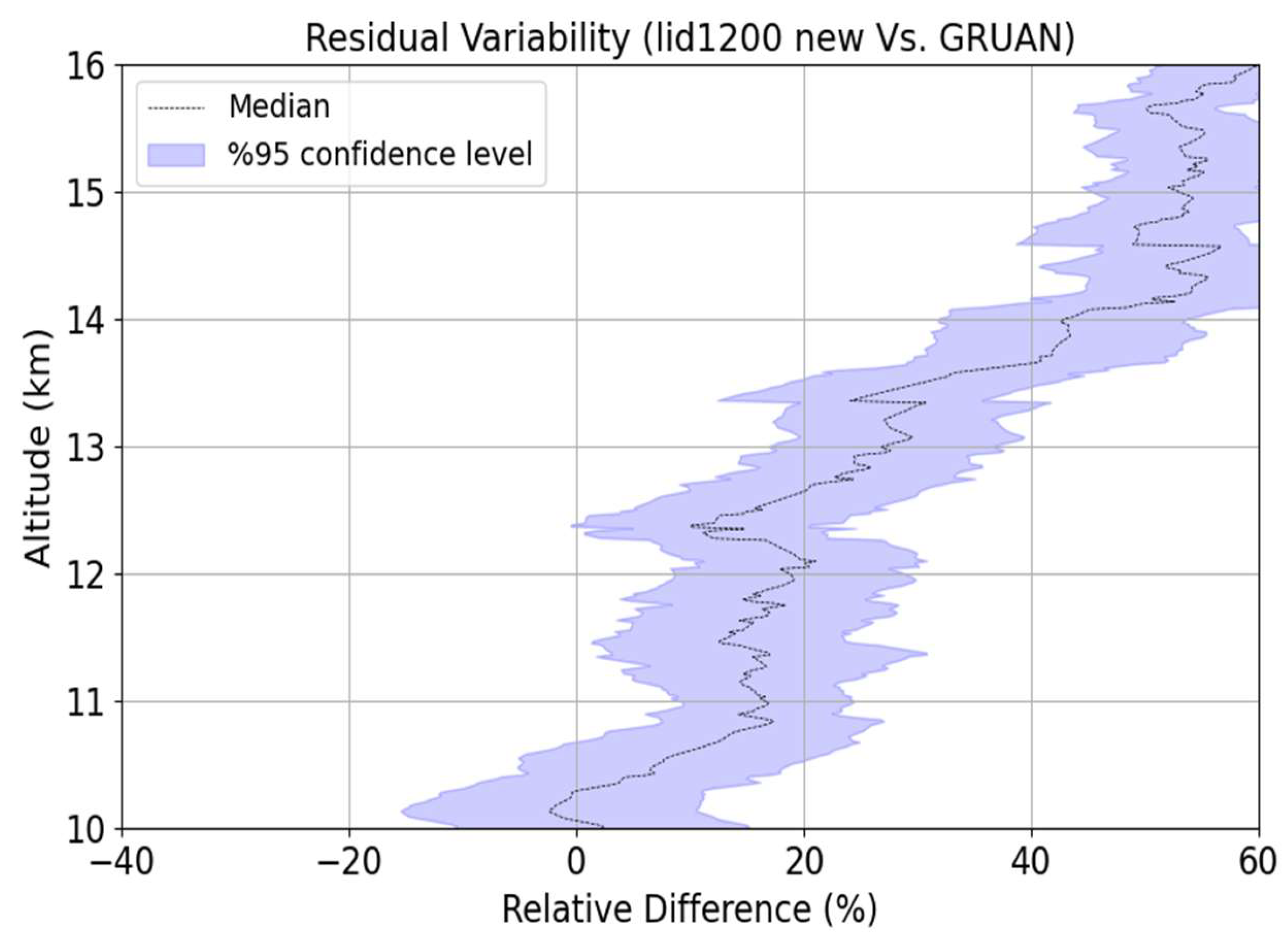
Figure 22.
(a) Median Lid1200 new WVMR relative shift (%) relative to GRUAN-processed M10 radiosondes during the wet season; (b) Median WVMR profile during the wet season (g/kg); (c) Median Li1200 new WVMR relative shift (%) during the dry season; (d) Median WVMR profile during the dry season (g/kg), all over the 2019 to 2023 study period. Shaded areas indicate the 95% confidence intervals of the median error.
Figure 22.
(a) Median Lid1200 new WVMR relative shift (%) relative to GRUAN-processed M10 radiosondes during the wet season; (b) Median WVMR profile during the wet season (g/kg); (c) Median Li1200 new WVMR relative shift (%) during the dry season; (d) Median WVMR profile during the dry season (g/kg), all over the 2019 to 2023 study period. Shaded areas indicate the 95% confidence intervals of the median error.
Disclaimer/Publisher’s Note: The statements, opinions and data contained in all publications are solely those of the individual author(s) and contributor(s) and not of MDPI and/or the editor(s). MDPI and/or the editor(s) disclaim responsibility for any injury to people or property resulting from any ideas, methods, instructions or products referred to in the content. |
© 2026 by the authors. Licensee MDPI, Basel, Switzerland. This article is an open access article distributed under the terms and conditions of the Creative Commons Attribution (CC BY) license (http://creativecommons.org/licenses/by/4.0/).
Copyright: This open access article is published under a Creative Commons CC BY 4.0 license, which permit the free download, distribution, and reuse, provided that the author and preprint are cited in any reuse.