

Submitted:
14 February 2026
Posted:
26 February 2026
You are already at the latest version
Abstract
Emerging energy- efficient unit operations are fundamental and essential for extending shelf-life, preservation of nutritional quality and ensuring microbial safety but also re-ducing the environmental footprint and achieving the one Health approach. The aim of this review is to present recent advancements in energy efficiency and renewable energy technologies powered by solar, wind, biomass, and hybrid energy sources and their role in sustainable food industry practices. A holistic approach to Sustainable Food Systems and a Critical Strategy to Enhance Sustainable Agriculture and food will be thoroughly dis-cussed. Case studies of energy efficiency in the meat, dairy and fruit and vegetable sector will be outlined. Focus will also be given on the revolutionization of Post-Harvest Pack-aging as an energy-Efficient Approach for Fresh Produce Preservation Focusing on Sus-tainable Packaging Solutions. Artificial Intelligence and Advanced Food Processing Tech-niques for Enhanced Food Safety, Quality, and Security will also be described briefly. Fi-nally, the challenges in Implementation of Policy Frameworks and Regulations will be discussed and future Horizons with Leveraging Energy-Efficient Technologies for a Sus-tainable Food Industry will be drawn.
Keywords:
renewable energy
; sustainable agriculture
; post-harvest packaging
; advanced food processing
1. Introduction to Energy Efficiency in the Food Industry
The food sector represents a complex global network spanning the entire lifecycle of a product from primary cultivation and industrial processing to logistics and final consumption. This diverse ecosystem comprises of a broad spectrum of stakeholders, ranging from independent agricultural producers to large multinational entities managing supply chains at a global level [1]. Food production is a primary driver of resource utilization. Agriculture alone accounts for 70% of the world’s freshwater withdrawals, making it the leading consumer of our planet’s liquid assets [2]. In addition, the food supply chain is remarkably energy-intensive, accounting for nearly 30% of total global energy use [3]. The majority of energy consumption in the food supply chain is concentrated in sourcing and processing. Sourcing, in particular, generates the highest carbon footprint due to direct emissions. When combined with packaging, these industrial stages account for a staggering 72% of energy consumption and 86% of greenhouse gas (GHG) emissions in the EU [4]. Modern food systems are facing several challenges related to energy use and current infrastructure hand in hand with the growing global population and the changing demands from consumers [5]. Today’s consumers opt for healthier, more sustainable choices. At the same time, companies must adopt new technologies while tackling issues like food safety, waste, and social fairness [1]. Global policies are shifting toward GHG reduction due to climate change and shrinking fossil fuel supplies. Although solar and wind power are popular alternatives, the world still depends on fossil fuels for 80% of its total energy needs. Furthermore, fossil-fueled plants continue to produce 50% of the world’s electricity [6]. The food industry’s energy footprint is as diverse as its products, with requirements fluctuating significantly between sectors and regions. In response to the climate crisis and rising costs, the rational use of energy is no longer optional-it is a core necessity. To address global food security and environmental targets, the industry is shifting toward a circular model that prioritizes resource efficiency. By cutting down on energy waste at every stage of the supply chain, the sector can better balance productivity with environmental responsibility [1,7].
The push for environmental sustainability is driven by the critical necessity of climate action [8]. While differing in scope and governance level, frameworks such as the Paris Agreement, the EU Green Deal, the Net-Zero Industry Act, and the UN Sustainable Development Agenda collectively signal a policy shift toward decarbonization, resource efficiency, and long-term environmental resilience [9,10]. Consequently, businesses face intensifying pressure from a diverse group of stakeholders-including regulators, investors, and consumers-to decarbonize their supply chains. This shift is embodied in the paradigm of Sustainable Supply Chain Management (SCM), which balances economic viability with social and environmental health. Central to this evolution is “green logistics,” a strategy focused on minimizing energy use, emissions, and waste across the entire distribution network [11].
To reach these goals, the food industry must adopt a multi-faceted approach. Key strategies include refining process control, advancing product design, and optimizing packaging to maximize resource efficiency. Furthermore, integrating renewable energy and circular economy models-specifically through recycling and reuse-can significantly lower the sector’s environmental footprint. Ultimately, driving these systemic changes requires a unified effort from policymakers, industry leaders and consumers alike [1].
Life cycle assessment (LCA) has emerged as a critical framework for evaluating the environmental impact of food items. This perspective has spurred significant research into “food miles,” distribution logistics, waste valorization, and the influence of dietary habits [4].
Traditional methods widely utilized within the food industry such drying and canning/sterilization are responsible for significant energy consumption and losses, over-processing for the treated products and require large volumes of water for the operations. Alongside the high energy demands, such processes result in nutrient losses and products of inferior quality – intensively processed. Therefore, the need to shift to alternative processing methods that are more sustainable and environmental-friendly whilst maintaining quality is of paramount importance.
This paper focuses on describing approaches to achieve energy efficiency in the food industry, focusing on the transition from conventional heat-intensive processing to emerging methods, processes, and concepts that reduce energy demand while maintaining food safety and quality. It highlights non-thermal technologies and smart system innovations as key drivers of a more sustainable and low-carbon food sector.
2. Integrating Renewable Energy Sources in Food and Agriculture: A Holistic Approach and a Critical Strategy to Sustainable Food Systems
The Earth’s ecosystems are degraded by the intensive usage of fertilizers, pesticides, energy, water, and machinery in global supply chains hence causing an increase of the pressure on planetary boundaries [12,13,14]. Food production causes approximately one-third of the global greenhouse gas (GHG) emissions [15,16,17].
Transformation of agriculture and improvement of socio-economic sustainability could arise from Alternative Food Systems (AFSs) as reported by Cristiano[18]. These systems could extend beyond ecological practices while leading to enhancement of social equity and bringing together producers and consumers [12,19]. Community Supported Agriculture (CSA) is one of these systems, where a community jointly finances and shares food production is among and members actively participate in the distribution of local and organic crops [20].
A Holistic and Integrated Life Cycle Sustainability Assessment (HILCSA) has been applied to a CSA in Leipzig, Germany by Pries et al. [21]analyzing CSA benefits and impacts by a novel integrative approach by employing and assessing seven different fruits and vegetables produced by the CSA.
Development of The Holistic and Integrated Life Cycle Sustainability Assessment (HILCSA) was carried out by Zeug et al. [22,23,24,25] following the ISO 14040 and 14044 guidelines of Life Cycle, Assessment (LCA). The combination of the three dimensions of social LCA (S-LCA), environmental LCA (E-LCA), and life cycle costing (LCC) is taken into account.
Of course, some negative factors should also be considered mentioning the challenges of CSAs compared to conventional food systems. It has been reported that balancing transformative targets, social cohesion, and economic viability might cause organizational instability [26].
Moreover, reduction of the carbon footprint of food supply chains (CFFSC) could arise from the implementation of technology innovation and renewable energy by adoption of precision agriculture, smart logistics, and energy-efficient processing [27,28]. A low-carbon alternative to fossil fuel dependence could arise from integration of renewable energy—solar, wind, and biomass—across the whole food production system including storage, and distribution[29,30,31]. Smart refrigeration systems and refrigerated diesel traction systems [32], electric vehicles, and AI-driven energy route optimization –constitute some of the efficient technologies in processing and transportation used with potential for emission reduction [30,33]. Of course, these innovations could be halted by economic, infrastructural, and policy constraints of developing countries [34,35].
Ashraf and Javed [36]applied robust econometric methods including FMOLS, DOLS, and PMG estimators, and found that significantly reduction of CFFSC could come from technological innovation, and specifically through improvements in production and distribution efficiency.
An integrated management approach to the Water-Energy-Food-Ecosystems (WEFE) nexus can enhance resource optimization and climate adaptation as described in the case of Cameroon [37]. Of course, the aim is to achieve Sustainable Development Goals (SDGs), including those related to poverty alleviation (SDG 1), zero hunger (SDG 2), affordable clean water and energy (SDGs 6 & 7), and economic growth (SDG 8) [38] but how this could be feasible if climate change is affected and disruptions are implemented? The WEFE is deeply interconnected, and constitutes interdependent components of the global ecosystem [31,39,40,41,42,43,44,45]. Figure 1 shows a conceptual framework of the Water–Energy–Food–Ecosystem nexus, highlighting how renewable energy and sustainable agri-food systems contribute to enhanced synergies while reducing trade-offs between these closely linked industries.
Critical linkages between the WEF nexus and planetary public health have been established as reported by [46,47,48]. Disadvantages are the lack of institutional capacity, stakeholder engagement mechanisms, and contextual adaptability [49,50].
Renewable energy-based systems for reduction of carbon emissions include drying referring to systems that utilize solar, wind, or biomass energy for thermal or convective drying- driven processes without fossil fuel reliance [51,52,53,54]. Madhu [42] also reported on the integration of intelligent control mechanisms such as the Internet of Things (IoT), artificial intelligence (AI), and computational fluid dynamics (CFD) for real-time monitoring and optimization incorporating thermal energy storage, particularly phase change materials (PCMs).
Hybrid solar dryers (HSDs) combine solar power with ancillary power sources, including heat pumps, biomass, geothermal, Liquefied Petroleum Gas (LPG), electricity, and wind power constituting a recent advancement [55].
3. Energy Efficiency in the Livestock and Animal Farming
While livestock production plays a vital role in supporting global livelihoods, it is also a major source of GHG emissions, highlighting that urgent action is required for the implementation of more sustainable management practices. With reference to the global meat production, an increase is noted, although consumers nowadays are shifting to more healthy dietary patterns. Animal-based products account for approximately 40% of global protein intake, and the growing demand for meat poses significant challenges for the sector, especially when dealing with waste management practices [58]. While socio-economic development and technological advancement have driven substantial growth in production, this expansion has simultaneously intensified environmental pressures. Industrialized farming systems seek to enhance sustainability through technological and managerial improvements; however, they have also emerged as major sources of environmental pollution [59].
Livestock energy requirements include the production of the animal feeds. This encompasses primary activities related to crop cultivation and feed additive production. Key inputs include water, energy, fertilizers, and pesticides, while the main outputs are feed materials that are subsequently transported to the milk production stage [60]. As an example, in the bovine sector, food losses occur at multiple stages of the supply chain, originating from the primary production to the final consumption. As the sector continues to grow, substantial quantities of by-products including hides, bones, whey, offal, blood, and manure are generated. Although such by-products are often undervalued, they still present both a waste management challenge and a significant opportunity for resource recovery according to circular economy practices. Moreover, these undervalued materials exhibit high potential in terms of potential valorisation across a range of sectors, including pharmaceuticals, cosmetics, dietary supplements, and animal feed production [58].
Currently, the majority of biogas feedstocks are derived from crops, including dedicated energy crops, crop residues, and sequential crops. However, animal manure represents the largest untapped potential source of biogas within the European Union. It is estimated that more than 1.4 billion tons of manure originated from animal farming operations on an annual basis during the period 2016-2019 (EU-27) [61], necessitating appropriate management to prevent adverse environmental impacts such as water and air pollution and soil contamination. Anaerobic digestion captures methane emissions that would otherwise be released into the atmosphere, enabling their conversion into renewable energy and thereby substituting fossil-based energy sources [62]. In addition, the residual by-product of the digestion process, known as digestate, can be applied as a nutrient-rich fertilizer, replacing mineral fertilizers derived from fossil resources [63]. Consequently, biomethane production from manure residues is increasingly promoted as a circular economy solution that supports the livestock sector in reducing its environmental footprint, generates renewable energy using existing gas infrastructure, and creates additional income opportunities for farmers [64]. Numerous studies have demonstrated that biogas production from dairy and other organic wastes can significantly reduce greenhouse gas emissions [65,66,67,68,69]. This contributes to the sustainability of the animal farming sector by enhancing resource efficiency and offering both environmental and economic benefits. Life cycle assessment studies indicate that manure-based anaerobic digestion can reduce GHG emissions by approximately 70% when compared with the conventional manure storage systems, mainly via methane capture and energy substitution, as long as the whole operation is effectively controlled, especially the management of the digestate. Beyond emission mitigation, anaerobic digestion supports nutrient recycling by giving back to agricultural soils the nitrogen and phosphorus, thereby enhancing circular nutrient flows [58,70]. Such approaches align with the concept of “waste-to-energy” and are closely associated with the principles of a circular economy [71,72]. However, the high capital investment required for anaerobic digestion systems, together with the technical expertise needed for their operation and maintenance, often favors off-site waste treatment and biogas production [73]. Alternatively, this challenge can be addressed through the deployment of small-scale, modular waste-to-biogas technologies installed on-site and managed remotely via cloud-based and digital platforms by external waste management providers. Waste-to-energy solutions applicable for different types of dairy farms include biodigesters, electricity generation systems, and heat recovery systems that supply hot water, space heating, or drying processes. In addition, absorption cooling systems can be employed to provide refrigeration using recovered thermal energy, such as exhaust heat, as the driving source. These systems can also be integrated with other renewable energy sources, including solar and wind technologies, and complementary energy conversion devices. The implementation of such technological solutions is expected to improve both waste and energy management practices, thereby directly supporting progress toward several Sustainable Development Goals, notably SDG 7 (Affordable and Clean Energy), SDG 12 (Responsible Consumption and Production), and SDG 13 (Climate Action) [72]. In addition, farms can generate electricity for on-site use through the installation of photovoltaic (PV) systems or wind turbines. While PV and wind technologies produce electricity during daylight hours and periods of wind availability, respectively, their generation profiles may not always align with farm electricity demand. This mismatch can be mitigated through energy storage solutions such as batteries; however, battery systems may not always be necessary, as thermal energy stored in hot water can also serve as an effective energy reservoir to meet on-farm water heating requirements [74].
Finally, the valorization of wastewater generated from cattle farming represents an important component of sustainable livestock management. The water footprint is commonly classified into three main components, with cattle farming wastewater contributing directly to the grey water footprint, as it contains pollutants that must be treated or diluted to prevent environmental degradation [75]. A thorough understanding and reduction of this footprint are therefore essential for enhancing water sustainability and supporting the achievement of Sustainable Development Goal 6 (Clean Water and Sanitation). A substantial share of water used in cattle farming ends up as wastewater containing high concentrations of organic matter, nutrients, and pathogens [76], however, when appropriately treated—through processes such as anaerobic digestion, solid–liquid separation, and nutrient recovery—this wastewater can be transformed into a valuable source of reusable water. The recovered fraction from manure and slurry, which can contain water as high as 85%, can then be reused for non-potable applications, including irrigation, cleaning operations, and cooling systems [58].
In dairy farming, the integration of digital twin (DT) technology with artificial intelligence (AI), offers substantial potential to advance sustainable dairy farming. Within this framework, the combined DT and edge AI approach is structured around three key capabilities: accurate traceability for monitoring carbon emissions, adaptability to heterogeneous farm conditions, and broad accessibility across farms with varying production systems and resource constraints. Such integrated platforms enable farmers and other stakeholders to virtually assess management strategies, predict production outcomes, and improve their overall performance across a range of scenarios, with the support of AI-systems. In contrast, conventional Internet of Things and cloud-based architectures typically rely on continuous connectivity and provide predominantly batch-level insights, which can create a mismatch between measured data and verifiable on-farm emission reductions [77].
Collection of farm data in real-time is critical and directly supports sustainability. In this regard, sensors and communication networks can be valuable tools [78]. Sensors capable of directly measuring or supporting the estimation of GHG emissions are fundamental to emissions accounting and carbon traceability in dairy systems. In dairy barns, commercially available gas sensors can detect methane, carbon dioxide, ammonia, hydrogen, and volatile organic compounds, enabling the quantification of gas concentrations and, when combined with complementary data, the estimation of emission fluxes. Biometric and environmental sensing technologies further support sustainable dairy management by enabling continuous monitoring of animal health, welfare, productivity, and environmental conditions [79]. Wearable and non-wearable sensors capture behavioral and physiological indicators—such as rumination, feeding behavior, activity levels, body temperature, and respiration rate—allowing early detection of health or welfare issues that would otherwise reduce production efficiency and increase GHG intensity [80,81]. Camera-based systems using computer vision can estimate body condition and body weight, while unmanned aerial vehicles provide monitoring solutions for grazing systems [82]. As sensing technologies advance, automated monitoring of individual feed intake across large herds is becoming increasingly feasible, enabling more precise estimation of animal-level emissions given the strong link between diet and GHG production [83]. Environmental sensors measuring barn microclimate, air quality, and pasture conditions provide critical inputs for farm management and whole-farm GHG models [84].
Automated feeding systems provide nutrition tailored to the specific needs of each animal, thereby improving feed efficiency and overall health [85]. In this regard, farm digitalization through the adoption of Precision Livestock Farming (PLF) technologies plays a crucial role, while simultaneously enhancing the environmental and economic sustainability of livestock production systems. By optimizing feed use and reducing waste, these systems contribute to enhanced environmental sustainability through lower resource consumption, reduced nutrient losses, and decreased GHG emissions [86].
4. Energy Efficiency in the Dairy Sector
Due to its high energy demand and carbon intensity, the dairy industry has received a lot of attention, among the other food sectors. Approximately 9% of the total energy consumption and carbon emissions within the food industry sectors result from the production of dairy products [87]. Operations within the dairy system start from the dairy farming including cow management, milk harvesting, and manure handling. These activities require inputs such as fuel, electricity, and refrigerants, and generate outputs in the form of raw milk and beef, which are transferred to the processing stage [88]. The processing stage involves the processing, packaging, and transportation of dairy products and requires various energy inputs, primarily fuel and electricity. At the end of the chain, the consumption stage also requires energy sources including the transportation for product purchase, food storage and preparation, food waste management, and packaging disposal. These activities rely on energy sources such as fuel, electricity, and natural gas [89].
Typical energy requirements in dairy farms include electricity for equipment operation and lighting, as well as thermal energy for refrigeration to preserve milk and for hot water used in equipment cleaning and sterilization. Additional thermal energy demands may arise from air conditioning systems and, in some cases, drying processes [72]. Following the primary production of raw milk at the farm level, milk is transported to dairy processing facilities where it undergoes a series of operations to produce finished products. Energy consumption in dairy manufacturing primarily arises from the use of electricity and fuels, which is mainly required for processes such as refrigeration, packaging, homogenization, standardization, milk pumping, and plant automation, whereas heat treatment processes predominantly rely on steam generated through fossil fuel combustion [74]. Processing of raw milk requires 0.8 to 1.9 MJ of energy per kilogram, with the exact value based on the type of product and production size [74], whilst, the associated GHG of cheese is 5.9 kg of CO2-Eq/kg when compared with the one of peanut butter which is much less (0.17 kg of CO2-Eq/kg) [88]. In addition, processing facilities incorporate Clean-In-Place (CIP) systems for cleaning internal equipment surfaces and may also include on-site wastewater treatment processes or discharge effluents to external treatment facilities [90]. CIP operations represent a major source of energy consumption in the dairy industry, largely due to the stringent hygiene standards required. The elevated temperatures used during pasteurization promote the adhesion of milk residues to processing equipment, thereby requiring extended cleaning cycles with hot water and detergents to achieve effective sanitation. As a result, the substantial energy demand of CIP operations is primarily associated with the thermal energy required to heat cleaning solutions [91]. CIP technologies are therefore pivotal in improving operational efficiency, as optimized CIP systems can reduce not only energy consumption but also water use and the volume of wastewater generated [92]. The implementation of energy-efficient CIP systems has been shown to reduce cleaning costs by approximately 35% and cleaning-related energy use by up to 40% [74].
Post-processing and during transportation, fresh dairy products require controlled storage and transportation conditions, due to their high perishability. Typically, optimal temperatures are maintained between 0 and 2 °C to preserve product quality and ensure food safety until consumer purchase [74]. Within the food industry, cold-chain operations exert a substantial environmental impact, accounting for approximately 1% of global CO₂ emissions, while refrigeration activities worldwide are responsible for around 15% of total electricity consumption [93]. At the consumption stage, energy use is primarily associated with transportation from retail outlets to households and with refrigeration. In addition, food waste at the consumption stage, which is estimated in around 19%, results in significant indirect energy losses, as all energy invested in production, transportation, and refrigeration is effectively wasted when products are discarded [94]. Globally, an estimated 1.13 million tons of food are wasted each day, corresponding to an average of 178 g per capita per day [95].
Several established practices adopted by dairy manufacturers can substantially reduce energy consumption, including the installation of heat recovery systems, the use of energy-efficient equipment, improved insulation of heating and cooling process units, optimization of combustion efficiency in steam and hot-water boilers, and the repair of steam leakages. In parallel, increasing attention has been directed toward emerging technologies aimed at further reducing energy use in dairy processing classified into thermal and non-thermal processing technologies [96]. Among emerging thermal approaches, microwave (MW) and radio-frequency (RF) processing are considered particularly promising, as both utilize electromagnetic energy to achieve rapid, volumetric heating and overcome conventional heat transfer limitations, resulting in higher heating rates, However, the high capital costs associated with MW and RF systems necessitate a clearly defined value proposition for successful industrial implementation. While these technologies offer potential benefits in terms of improved product quality, large-scale commercial adoption remains limited [74]. Non-thermal alternatives proposed to replace conventional heat treatments include ultrasound (US), high-pressure processing (HPP), and pulsed electric fields (PEF) [97]. Ultrasound-assisted milk pasteurization has demonstrated promising outcomes with respect to both microbial safety and energy efficiency [98,99]. HPP is increasingly applied in the food industry, particularly for high-value products, whilst PEF has also been proposed as an efficient processing technology [100]. In general, non-thermal technologies more broadly offer advantages in preserving milk nutrients with lower energy consumption compared to conventional thermal treatments [101]. These non-thermal emerging technologies will be described in detail later on. Nevertheless, the economic viability and performance of non-thermal processes must be critically assessed under industrially relevant conditions to substantiate their proposed benefits.
To maximize the efficiency of the cold chain and reduce GHG emissions, carbon-free refrigeration solutions should be adopted at all stages of transportation and storage [74]. The food quality within the supply chain is primarily linked to cold-chain logistics. Current trends highlight the increased potential of IoT to provide constant monitoring and automated control on the food products [102]. At the retail stage, the use of refrigerated display cabinets with enclosed doors is recommended, as these systems provide improved temperature control and can achieve energy savings of up to 68% compared with conventional open-display refrigeration units [74].
In the dairy sector, losses commonly arise from animal health issues, microbial spoilage, and the expiration of products with limited shelf life, leading to considerable economic issues and environmental impacts. Furthermore, the dairy industry generates high volumes of products from secondary streams such as whey, buttermilk, skim milk, and milk fat residues—which are poorly utilized or completely discarded. Upcycling of these materials and using them in other sectors such as in food, nutraceutical, cosmetic, and feed applications can significantly reduce waste and enhance sustainability whilst offering an additional profit for the dairy industry [58]. Circular economy principles, grounded in the waste hierarchy, offer pathways to reduce waste generation and enhance valorization through reuse, recycling, and recovery strategies [103]. Among the principal waste streams in dairy processing is whey; however, avoidable losses—including leakages, spillages, product spoilage, and effluents from equipment cleaning—also represent significant sources of waste. With respect to waste valorization, biotechnological approaches have demonstrated considerable potential for converting dairy by-products into high-value outputs, including biopharmaceutical compounds, whey-based food products, and bioplastics [104]. In addition, dairy processing residues can serve as feedstocks for bioenergy production. For instance, dairy waste streams may be utilized for ethanol production via yeast fermentation, while high-strength effluents can be treated through anaerobic digestion to recover methane. Both ethanol and biogas can be used on-site as supplementary fuel sources, thereby reducing reliance on external energy inputs. Furthermore, emerging bio electrochemical systems offer additional opportunities to generate electricity from dairy waste by exploiting microbial catalysts, contributing to enhanced energy recovery and circular resource use [74,105].
The dairy industry is widely regarded as a rapid adopter of technological innovation and automation, driven by the need for enhanced control and management across the entire supply chain. Several Industry 4.0 technologies have been identified as key enablers of the transition toward Dairy Industry 4.0, including robotics, the Internet of Things (IoT), blockchain, big data, 3D printing, and artificial intelligence. In addition, complementary technologies such as digital twinning, machine vision, machine learning, and advanced sensor systems are increasingly recognized for their potential to further accelerate the shift from traditional dairy operations to a fully integrated Dairy Industry 4.0 model [106]. For instance, AI-driven optimization and IoT-based sensing systems enhance the recovery and valorization of whey, allowing for the extraction of valuable compounds for food, nutritional, and pharmaceutical applications. IoT-enabled equipment supports continuous quality monitoring, while blockchain technologies improve traceability and strengthenconsumer confidence. In parallel, digital twin systems enable the predictive modeling of the production processes which in turn reduces material loss and overall enhances operational efficiency [107]. These solutions empower dairy and beef producers to adopt circular principles within their operations. By turning agricultural by-products into resources, the sector can significantly improve its environmental footprint [58]. Nevertheless, several economic and social barriers must be addressed to enable the widespread adoption of Industry 4.0 technologies in the dairy sector. These challenges include inadequate infrastructure, particularly in developing regions where internet connectivity remains limited, especially in rural areas. Insufficient financial resources to support the implementation of Industry 4.0 initiatives represent another significant constraint, notably for small-scale dairy farmers and producers [108].
5. Energy Efficiency in the Fruit and Vegetable Sector
The environmental impact of food arising from the global fruits and vegetable value chain is significant due to growth, harvesting and transportation and the resources (land, water) and energy required often from fossil fuels [109,110,111].
Greenhouse gas emissions constituting approx. 40 gigatonnes of CO2 equivalent in 2021 (IEA, 2022) are also generated from the use of synthetic fertilizers and pesticides in fruit and vegetable production. A high food also contributes to global greenhouse gas emissions [56,111,112].
Citrus cultivation involves pesticide and fertilizers addition, leading to soil contamination and accumulation of toxic elements [113,114]. Considerable amounts of irrigation water are required by citrus orchards affecting the current climate change conditions hence operating as highly intensive systems [115,116,117].
Contribution to greenhouse emissions also comes from processing such as cleaning, packaging, transportation, consumption, and waste disposal, which is energy-demanding since long transport distances are required especially from intercontinental value chains [118,119].
Different Life Cycle Assessment (LCA) studies have focused on preharvest processing evaluating the environmental impacts of citrus cultivation across Italy, Spain, Nigeria, Mexico with no integration of pre- and post-harvest impacts holistically, with limitations into ecological hotspots across the global fruit and vegetable value chain [29,52,120,121,122]. However, Crenna et al. [110]applied a holistic approach by identifying ecological hotspots and establishing citrus as a model system from South Africa to the Netherlands for assessment of the sustainability of perishable, globally traded commodities. They highlighted cultivation dominating water-use impacts (99%), accounting for 68% of freshwater ecotoxicity due to chemical inputs amongst the culprits along with overseas shipment affecting largely photochemical ozone formation and marine eutrophication in the post-harvest stages.
Valorization of bioactive compounds from the utilization of fruit and vegetable wastes leads to animal feed and bioethanol production [123]. Some of the waste management strategies for extraction of valuable bioactive compounds include enzymatic hydrolysis, anaerobic digestion for biogas production, and fermentation for production of organic acids and natural colorants [124]. Some other techniques mentioned by Dhar et al. [125]include eco-friendly extraction techniques such as supercritical and subcritical fluid extraction, enzyme-assisted extraction, microwave- and ultrasound-assisted methods, and pulsed electric field processing.
Controlled environment agriculture (CEA), comprising both greenhouse and vertical farming would solve the problems and challenges of the fruit and vegetable industry. CEA technology research focuses on modelling/simulation, energy, lighting and sensors as reported by Huang et al. [126].
Magnetic field-assisted technologies such as Oscillating Magnetic Field (OMF), Pulsed Magnetic Field (PMF), Static Magnetic Field (SMF) employed in drying and freezing of fruits and vegetables could affect on process efficiency and product quality (Islam et al. 2025).
Moreover, solar-radiofrequency (RF) hybrid systems could reduce the carbon footprint of food processing as reported by Jiang et al. [127] for salmeterol vegetable. This could be applied to heat-sensitive or seasonal products.
It is also worth mentioning the effect of antibacterial packaging as an intelligent postharvest preservation method of fruits and vegetables in reducing postharvest food losses[128].
Finally, ultrasound-assisted extraction (UAE) has been employed as a green and efficient method for the recovery of anthocyanins from fruit and vegetable waste [129]. Other methods could also be used such as microwave-assisted, enzyme-assisted, supercritical-fluid extraction, pulsed electric filed showing higher extraction yields and lower extraction time [130].
Consumption of anthocyanin-rich foods has increased lately due to their health benefits (Mannino et al., 2021). These valuable compounds are derived from the agro-industrial fruit and vegetable waste by recycling [131].
6. An Energy-Efficient Strategy for Enhancing Fresh Produce Preservation Through Sustainable Post-Harvest Food Packaging
6.1. Factors Contributing to Post-Harvest Losses in Fruit and Vegetable Supply Chains
Owing to their substantial nutritional benefits, fruits and vegetables are fundamental to human diets and hold an important place in agricultural production systems. Beyond their dietary importance, these commodities make substantial contributions to economic development, environmental sustainability, and the promotion of public health on a global scale. At the global level, fresh production represents an important segment of agricultural output and roles a critical role in supplying markets and meeting the nutritional demands of populations worldwide[132].
International Food organizations have consistently emphasized the importance of have consistently highlighted the significance of boosting fruit and vegetable demand due to their numerous health benefits, particularly in reducing the risk of various diseases. Fruits and vegetables products are abundant in essential nutrients and bioactive compounds, offering energy, carbohydrates, minerals, organic acids, dietary fiber, carotenoids, vitamins (such as vitamins A, B6, B12, and C), amino acids (including thiamine, riboflavin, and niacin), antioxidants, water, phytochemicals, and other components that enhance health and immunity[133]. Due to their high phytochemical content and relatively low levels of fat, sugar, and sodium, regular consumption of these foods has been linked to the prevention of several chronic noncommunicable diseases (NCDs)[134].
Consequently, nutritional guidelines frequently recommend consuming a diverse and colorful diet to ensure the intake of widespread range of vitamins, minerals, and phytochemicals that collectively contribute to overall health. International dietary guidelines recommend a minimum daily intake of fruits and vegetables; however, evidence indicates that their actual availability and consumption remain insufficient in many parts of the world[135]. This discrepancy is largely attributed to significant postharvest losses, which continue to limit the effective availability of fruits and vegetables compared to the recommended intake levels.
Postharvest losses refer to decline in both the amount and quality of agricultural goods; from the time they are harvested until they are consumed. Figure 2 shows the factors contributing to postharvest losses throughout the supply chain.
These losses are raised serious challenge to global food security, as they directly undermine its core dimensions, including food availability, accessibility, utilization, and stability. In fact, the magnitude of postharvest losses is strongly influenced by weaknesses in supply chain management, limited managerial capacity, logistical constraints, technological limitations, and insufficient skills and knowledge among stakeholders [136]. In addition to threatening food security, postharvest losses represent a significant economic burden across agri-food systems. From an economic standpoint, maximum amounts of postharvest losses have been represented in livestock goods such as milk, meat, fish, and eggs, followed by fruits and vegetables [137].Additionally, Post-harvest waste increases the carbon footprint primarily by requiring repeated agricultural production and associated upstream inputs to compensate for lost production, thereby increasing cumulative greenhouse gas emissions from fertilizer use, on-farm energy consumption, cold-chain operations, and transportation fuel per unit of final food consumed[134].
Losses of fresh fruits and vegetables occur at various parts during the supply chain, including harvesting, postharvest handling, processing and packaging, storage due to inadequate practices and infrastructure, transportation, distribution, and consumption. Postharvest losses are driven by a combination of physiological, mechanical, environmental, and biological factors, including pests and diseases[138]. Among these, biological factors are recognized as the leading contributors to postharvest losses in fruits and vegetables. the reasons of postharvest losses can be broadly classified into primary and secondary factors. Temperature is the most critical primary factor influencing postharvest life, as exposure to inappropriate temperatures during harvesting, handling, transportation, and marketing accelerates respiration and metabolic activity, leading to rapid quality deterioration[139]. Lower storage temperatures can reduce respiration and water loss in fruits and vegetables while also preventing microbial development, leading to longer storage life[140]. Water loss is another key physiological issue, resulting in weight loss, shriveling, softening, and overall quality decline, which negatively affects consumer acceptance. In addition, mechanical damage during handling and transportation further reduces both the marketable quality and quantity of fresh produce [141]. So, Proper storage, including low temperature, relative humidity between 90% and 95%, suitable gas composition, adequate air circulation, and careful stacking, reduces Adverse biochemical reactions such as sprouting, rotting, greening, and firmness, thereby limiting postharvest losses and the associated carbon footprint from additional production and logistics [134].
Microbial factors represent a major source of postharvest losses in fruits and vegetables. Fresh produce, particularly fruits and vegetables, is highly perishable, and its quality can deteriorate rapidly during postharvest handling, transportation, storage, and marketing processes [140]. The pronounced perishability of these commodities is largely attributed to their high-water content, which creates favorable conditions for rapid decay caused by fungi and bacteria. Among microbial agents, fungal pathogens are considered the most common and spoilage, infecting abroad range of host plants and accounting for a substantial proportion of both physical and economic losses of fresh fruits and vegetables during storage and transportation [142]. The principal fungal genera associated with postharvest losses include Alternaria, Aspergillus, Colletotrichum, Botrytis, Monilinia, Diplodia, Penicillium, Rhizopus, Phomopsis, Mucor, and Sclerotinia, along with bacterial genera such as Pseudomonas and Erwinia [143]. Fruits are particularly susceptible to fungal infections due to their low pH, high moisture levels, and rich nutrient elements. These fungi induce various forms of fruit rot and may also produce mycotoxins, rendering affected fruits unsafe for consumption. In contrast, vegetables tend to be more vulnerable to bacterial contamination because their relatively higher pH provides a more favorable environment for bacterial growth. Additionally, ethylene gas released by certain fruits and vegetables can accelerate ripening and promote rapid deterioration in nearby produce when proper segregation practices are not applied. This interaction further exacerbates postharvest losses by shortening shelf life and compromising overall produce quality[137].
6.2. Impact of Post- Harvest Losses
Postharvest losses exert substantial economic and environmental consequences and play a vital task in influencing the carbon footprint of food matrixes. Food loss and waste directly impact nutritional outcomes, income generation, economic growth, and efforts to reduce hunger and poverty. From an economic perspective, postharvest losses reflect inefficiencies and structural weaknesses within value chains and food matrixes, leading to a decline in the financial value captured by stakeholders involved in production, handling, and distribution processes [144]. Moreover, in an increasingly globalized food market, losses occurring in one region can influence food availability and price stability in other parts of the world through international trade linkages, thereby amplifying their broader economic impact [145].
Beyond the economic consequences, post-harvest waste significantly contributes to environmental degradation and increased carbon footprint. Food that is produced but not consumed involves substantial inputs of energy, water, soil resources, biodiversity, and agricultural inputs, all of which are effectively wasted when losses occur [146]. The production of food that ultimately remains uneaten results in unnecessary greenhouse gas emissions, particularly carbon dioxide, generated throughout cultivation, processing, transportation, and storage stages, without delivering any nutritional benefit to society. Additionally, the decomposition of discarded fruits and vegetables emits methane and carbon dioxide into the atmosphere, further exacerbating climate change and environmental pollution [147].
These environmental impacts are closely linked to the resource- and cost-intensive nature of agricultural production. Farming is a laborious and time-consuming job. that requires substantial financial investment at every stage, including land acquisition, fertilizer application, irrigation, harvesting, and transportation to markets, particularly in market-oriented production systems. Beyond these measurable resource losses, post-harvest waste also contributes to the degradation of natural landscapes, ecosystem services, and the depletion of valuable production resources [140]. Given these high production costs, farmers must recover their investments and secure profitability, highlighting the vital tasks of effective post-harvest management in reducing food loss across the entire supply process, starting at the farm and ending with the consumer, without negatively affecting product quality [148].
6.3. Reducing the Post-Harvest Losses
A broad spectrum of both basic and advanced technological strategies has been introduced to decline postharvest losses in fruits and vegetables, incorporating mechanical, chemical, and microbiological methods across agricultural production and food processing systems. As technologies and methodologies continue to advance, industries progressively refine, optimize, and replace outdated and less efficient practices with more effective postharvest management strategies.
Zero Energy Cool Chambers (ZECC) play to increasing the shelf life and preserving the quality of horticultural produce by reducing storage temperatures by approximately 10–15 °C while maintaining relative humidity levels close to 95%. Nevertheless, the rapid removal of zone heat through immediate pre-cooling after harvest remains essential to hinder accelerated deterioration. Although most postharvest storage methods rely on low-temperature conditions, maintaining such environments consistently throughout the supply chain presents considerable challenges, particularly in developing countries [149].
Additionally, solar drying has emerged as an effective method for extending the shelf life of fruits. In addition to reducing transportation costs, this approach helps alleviate seasonal supply surpluses and contributes to improved nutritional quality[150]. Given that fresh produce may contain up to 95% moisture, it provides favorable conditions for enzymatic activity and microbial growth. The fundamental objective of drying is therefore to decline moisture content to levels that inhibit enzymatic reactions and microbial growth; however, excessive moisture removal can result in increased brittleness and compromised textural integrity of the product[143].
In this context, recent advances in postharvest packaging have increasingly emphasized energy-efficient and sustainable solutions as central components of fresh produce preservation systems. Innovative packaging materials and designs that optimize gas exchange, maintain high humidity, and reduce dependence on active refrigeration contribute not only to extending shelf life but also to lowering energy consumption across the postharvest supply chain. The integration of low-energy storage technologies with sustainable packaging, such as biodegradable materials, passive modified atmosphere packaging, and recyclable containers, has demonstrated significant potential to reduce food losses while simultaneously decreasing greenhouse gas emissions associated with cold storage, transportation, and packaging waste ([151]. Furthermore, the combined application of ripening inhibitors, elevated CO₂ concentrations, reduced O₂ levels, and edible wax coatings is commonly employed to improve the storage life of fresh produce [152]. Finally, several chemical formulations have been investigated to regulate ethylene concentrations by maintaining levels below the physiological threshold required to induce ripening. Ethylene absorbents such as calcium chloride (CaCl₂) and potassium permanganate (KMnO₄) demonstrate substantial commercial potential when used in controlled storage environments; however, access to such technologies remains limited for many small-scale producers due to technical and economic constraints [153].
6.3.1. Chemical Methods
Chemical treatments are extensively applied to mitigate postharvest losses in fruits and vegetables through the control of microbial spoilage, pest infestation, and physiological processes associated with ripening and senescence. It is analyzed that approximately 20–30% of annual agricultural production is lost due to pests, plant diseases, and weeds, a factor that has driven the widespread use of pesticides to safeguard produce quality and yield [154]. These chemical agents include insecticides, fungicides, rodenticides, herbicides, and biopesticides, each designed to target specific sources of deterioration. Among them, chemical fungicides are particularly critical because of their strong antifungal activity, which effectively suppresses the growth of spoilage fungi on fruit and vegetable surfaces. In dried fruit products, fumigants such as methyl and ethyl formate, and in decisive fields ethylene oxide, are commonly employed to control mold development and insect infestation. Furthermore, preservatives including sulfur dioxide, benzoic acid, propionic acid, sorbic acid, and ascorbic acid are widely incorporated into processed fresh products, especially fruit juices, to prevent the proliferation of yeasts and molds. Despite their effectiveness in delaying decay and extending shelf life, inappropriate or excessive application of these chemicals has been contributed to detrimental effects on human health and the environment, including water contamination and an increased risk of neurological disorders and cancer, underscoring the necessity of strict regulation and compliance with maximum residue limits [155].
Beyond conventional pesticides, plant growth regulators and hormone-based treatments are increasingly utilized to manage postharvest ripening and senescence. Among these, 1-methylcyclopropene (1-MCP) is recognized as one of the most effective and widely adopted postharvest treatments for climacteric fruits. By binding to ethylene receptors, 1-MCP inhibits ethylene perception and signal transduction, thereby delaying ripening and senescence while largely preserving fruit quality[156]. Other hormone-related compounds, such as gibberellic acid, cytokinins, indole-3-acetic acid, methyl jasmonate, salicylic acid, and melatonin, are also applied to regulate physiological and biochemical processes during storage and distribution[157,158]. In addition, ethylene scavengers such as potassium permanganate are used to maintain ethylene concentrations at optimal levels, whereas compounds like maleic hydrazide are applied in specific commodities to induce or modulate ripening.
6.3.2. Innovative Methods
6.3.2.1. Ultrasound Technique
Ultrasound technique has appeared as a novel energy-efficient perspective for the preservation of fruit- and vegetable-based food products. Its application is associated with reduced flavor degradation, improved processing uniformity, enhanced product quality, and lower reliance on chemical preservatives, while maintaining relatively low energy requirements. As an environmentally friendly technology, ultrasound contributes to food safety enhancement and reduced carbon emissions by minimizing processing intensity and shortening treatment times [159].
Ultrasound operates through high-frequency acoustic waves generated by transducers that convert electrical energy into mechanical vibrations. These waves can be applied either directly or through devices such as sonotrodes and ultrasonic water baths, allowing flexible integration into food processing operations. Ultrasonic treatments have demonstrated effectiveness across multiple preservation stages, including filtration, freezing and crystallization, thawing, brining, drying, foaming and defoaming, extraction, and degassing. In fruit and vegetable-based systems, these effects are primarily attributed to cavitation phenomena, which enhance mass transfer, disrupt microbial cells, and facilitate enzyme inactivation[160].
Advanced ultrasound-based techniques, such as manosonication and manothermosonication, integrate ultrasonic waves with elevated pressure and, in some cases, moderate heat to enhance microbial and enzymatic inactivation at lower temperatures than conventional thermal treatments. The combined effects of cavitation, shear forces, and localized microstreaming disrupt cell membranes, denature enzymes, and accelerate mass transfer, thereby improving process efficiency while minimizing thermal degradation of sensitive food components. As a result, ultrasound-assisted processes have been increasingly employed for enzyme inactivation, controlled crystallization, degassing during packaging, and the exploitation of bioactive compositions, including essential oils from plant matrices [151].
6.3.2.2. Pulsed Electric Field (PEF) Technique
Pulsed electric field (PEF) technique is an innovative non-thermal processing approach increasingly applied in food processing to reduce postharvest losses while maintaining product quality and safety. The method is distinguished by its short treatment times, continuous mode of operation, and relatively low energy requirements, which have contributed to its growing interest as an energy-efficient alternative to conventional thermal technologies. PEF operates by applying high-intensity electric pulses that disrupt the integrity of cellular membranes, leading to enhanced microbial inactivation and improved shelf life with minimal impact on nutritional and sensory attributes [161].
PEF has been widely adopted in the food and beverage industry, particularly for the preservation of fruit and vegetable juices, where it effectively improves microbiological safety without inducing significant thermal damage. By reducing processing time and energy consumption, PEF supports lower greenhouse gas emissions and contributes to carbon footprint reduction across food processing systems. However, the adoption of PEF at an industrial scale is constrained by economic and technical factors. High equipment costs, limited efficacy against certain microbial spores and enzymatic activity, and the potential generation of by-products during electrolysis have restricted its widespread use in commercial food preservation. Addressing these limitations is important for expanding the role of PEF in sustainable and energy-efficient food preservation strategies [162].
6.3.2.3. High-Pressure Processing Technology
High-pressure processing (HPP) is recognized as a cutting-edge non-thermal preservation technology, particularly for large-scale applications. The technique operates at pressures, depending on the type of homogenizer and, in some cases, supercritical fluids employed. The primary function of HPP is microbial inactivation, while simultaneously offering benefits in food structural engineering, preserving both texture and compositional integrity[163]. During processing, packaged food products are placed inside an external container and automatically loaded into a high-pressure vessel, which is then sealed. Water is typically used as the pressure-transmitting medium and is introduced from one or both sides of the vessel. Once the target pressure is reached, the pumping ceases, and no additional electrical input is required to maintain the isostatic pressure throughout the holding period. This approach ensures uniform pressure distribution, in contrast to conventional thermal processes that are subject to temperature gradients, thereby guaranteeing consistent treatment of all molecules within the vessel ([164].
Its advantages include effective microbial inactivation without compromising sensory attributes or nutritional quality, making it an energy-efficient alternative to traditional thermal methods. By inactivating microorganisms through isostatic pressure rather than heat, HPP maintains food safety and quality while decreasing energy consumption and related to greenhouse gas emissions, thereby supporting sustainable food preservation and lowering the carbon footprint relative to conventional thermal techniques [165]. Sampedro et al. (2014) reported that HPP and PEFs generate higher initial CO2 emissions relative to traditional thermal pasteurization, with HPP producing up to 773,000 kg CO2 per year versus 90,000 kg for thermal processing. Nevertheless, the improved shelf life and declined fresh products spoilage associated with these methods may compensate for the higher initial emissions [166].
6.3.2.4. Cold Plasma Technology
In recent years, cold plasma has been recognized as a potential non-thermal technique in food preservation, as it is capable of generating various reactive compounds at atmospheric or low pressure. These reactive agents, such as reactive oxygen species (ROS), reactive nitrogen species (RNS), charged particles, and UV photons, work together to disrupt microbial cell walls and membranes, leading to oxidative stress, damage to lipids and proteins, changes in DNA, and structural disintegration, ultimately leading to irreversible loss of cell viability and inactivation of spoilage microorganisms and pathogens. The generation and action of these species depend on plasma source parameters, gas composition, and treatment conditions, which influence the types and concentrations of reactive agents produced. ROS and RNS have been identified as the main active agents in cold plasma microbicidal action, causing cell wall rupture, intracellular component oxidation, and inhibition of microbial replication[167]. Additionally, postharvest losses in fruits and vegetables, cold plasma treatment reduces microbial spoilage and physiological degradation without the need for elevated temperatures, thereby increasing the shelf life of produce while keeping nutritional and sensory value. Moreover, cold plasma’s operation at room or near-room temperatures with minimal energy inputs offers an environmentally efficient alternative to energy-intensive thermal technologies, potentially reducing cumulative energy request and associated greenhouse gas emissions by decreasing reliance on refrigeration and prolonged heating during storage and distribution[168].
6.3.3. Physical Methods
In addition to chemical strategies, the most widely applied physical methods for the postharvest preservation of perishable products include temperature and humidity regulation, controlled and modified atmosphere packaging(MAP), radiation-based techniqe petroleum-based plastic packaging, and wax-based coatings ([169]).
6.3.3.1. Temperature Regulation
Low-temperature storage is a primary method for keeping fruits and vegetables fresh after they are harvested. Fresh and minimally processed produce requires chilled conditions to suppress microbial proliferation and reduce enzymatic activity. Lower storage temperatures slow key physiological processes, including respiration and ethylene production, thereby contributing to the preservation of quality and market value of horticultural commodities. Consequently, precooling is commonly employed as a standard postharvest practice in the fresh produce industry due to its cost-effectiveness, simplicity, and operational feasibility. Despite its advantages, exposure to excessively low temperatures or prolonged cold storage may induce chilling injury, particularly in perishable originating from tropical and subtropical [170].
Refrigeration is the most widely used postharvest temperature-control method, operating by continuously removing heat to maintain low temperatures. At 4–10 °C, metabolic and enzymatic activities in fruits and vegetables are slowed, delaying ripening, senescence, and textural degradation. Low temperatures also suppress spoilage microorganisms, including psychrotrophic bacteria such as Pseudomonas fluorescens and Pseudomonasmarginalis, by reducing metabolic rates and inhibiting enzyme functions required for growth. Additionally, enzymatic activity, for example polygalacturonase involved in cell wall softening, is slowed, helping preserve texture and quality. By controlling both microbial proliferation and physiological degradation, refrigeration effectively extends shelf life and minimizes postharvest losses while maintaining nutritional and sensory attributes[171].
6.3.3.2. Regulation of Heat and Humidity
Short-term heating is one of the oldest and most frequently applied methods for preserving food, primarily used to reduce microbial load and inhibit enzyme activity. Although excessive heat can negatively affect nutritional quality, flavor, texture, and color of perishable produce, carefully controlled short-duration treatments, such as brief hot water immersion, are effective in suppressing surface microorganisms and limiting enzymatic browning in fresh fruits and vegetables. Owing to their simplicity and reduced reliance on chemical preservatives, these treatments are increasingly adopted as energy-efficient strategies that enhance food safety while minimizing environmental impact [171].
Precise regulation of relative humidity during postharvest storage plays a critical mechanistic task in preserving fruits and vegetables by directly effecting water relations, metabolic activity, and microbial dynamics. By reducing the vapour pressure deficit between the produce surface and the surrounding atmosphere, moisture loss through transpiration is minimized, which helps maintain cellular turgor, membrane integrity, and enzymatic stability, thereby slowing respiration and senescence processes. At the same time, optimized humidity conditions limit the proliferation of spoilage microorganisms which growth is strongly governed by water activity, reducing microbial-induced deterioration. The combined suppression of physiological dehydration and microbial spoilage significantly lowers postharvest losses, decreasing the need for prolonged refrigeration, repeated handling, and replacement production. As a result, energy consumption across storage and distribution stages is reduced, leading to a measurable decline in associated greenhouse gas emissions and contributing to a lower carbon footprint within postharvest supply chains[172].
6.3.3.3. Irradiation
The application of irradiation serves as an efficient physical preservation strategy to enhance shelf life and safeguard the quality of fruits and vegetables, while offering a viable alternative to chemical treatments whose use may be restricted. Among irradiation methods, ultraviolet (UV) radiation is widely applied in postharvest preservation, primarily through direct surface sterilization and the induction of defense responses in fresh produce. In particular, non-ionizing UV-C radiation is usually utilized for both whole and minimally processed fruits and vegetables, as it effectively decontaminates produce surfaces without leaving chemical residues [173].
Gamma irradiation, a form of ionizing radiation, is widely used to preserve minimally processed fruits and vegetables. Its strong penetration allows it to destroy microorganisms by disrupting their DNA, effectively lowering microbial counts. Foods exposed to this treatment remain non-radioactive and safe to eat. Although the industrial maximum dose is set at 10 kGy (Codex), smaller doses are usually enough to meet specific preservation objectives.[174]. Pathogenic microorganisms can be eliminated at doses ranging from 1 to 5 kGy, whereas lower doses (0.2–0.5 kGy) are impressive in postponing fruit ripening and senescence. For instance, a dose of 2 kGy has been reported as optimal for preserving the microbiological quality of minimally processed carrots and lettuce, significantly reducing colonies of Bacillus cereus, Cronobacter sakazakii, Staphylococcus aureus, and Klebsiella spp[175].
Beyond microbial inactivation, ionizing radiation preserves fruits and vegetables without significantly increasing product temperature, making it an energy-efficient technology suitable for quality-sensitive commodities. The method requires relatively low energy input, leaves no chemical residues, inhibits sprouting, slows senescence, and can be easily integrated into available postharvest systems. Consequently, ionizing radiation has been widely adopted for the preservation of spices, herbs, condiments, and selected fresh produce [176].
However, the broader application of irradiation in postharvest systems remains limited, largely due to the high capital costs associated with irradiation facilities and persistent reservations among consumers. These concerns are frequently linked to misunderstandings about the effects of irradiation on food safety and quality, particularly the assumption that treated products become radioactive or nutritionally altered. Limited public familiarity with the technology has contributed to cautious consumer responses and reduced market acceptance of irradiated foods[7].
6.4. Role of Packaging Technologies in Reducing Postharvest Losses
The postharvest losses associated with fruits and vegetables pose a considerable obstacle within the global food supply chain, resulting in profound economic detriment and suboptimal utilization of natural resources. Furthermore, these losses contribute a significant role in the escalation of greenhouse gas emissions associated with production, transportation, storage, and disposal, thereby increasing the overall carbon footprint of horticultural Products[177]. Among the various strategies developed to mitigate postharvest losses, packaging operates a critical role by keeping fresh produce from mechanical damage, physiological deterioration, microbial spoilage, and environmental stresses during handling, transportation, and storage [178].
Traditional packaging systems have been effective in extending shelf life; however, growing concerns regarding environmental sustainability have shifted research emphasis is directed towards groundbreaking packaging technologies that not only safeguard quality but also reduce environmental repercussions. In this context, petroleum-based plastic packaging, modified atmosphere packaging (MAP), controlled atmosphere (CA) storage, and emerging bio-based solutions such as edible coatings and films have gained considerable attention as tools for decreasing postharvest losses while lowering the carbon footprint of fresh produce[146].
6.4.1. Petroleum-Based Plastic Packaging
Packaging materials play a crucial role in the preservation of fruits and vegetables throughout the postharvest continuum. Among the common materials, petroleum-based plastics are the most widespread utilized due to their low cost, versatility, light weight, and favorable mechanical and barrier properties. Common petroleum-derived polymeric materials used in food packaging include polypropylene (PP), low-density polyethylene (LDPE), linear low-density polyethylene (LLDPE), high-density polyethylene (HDPE), polystyrene (PS), polyamide (nylon) ,polyethylene terephthalate (PET), polyvinyl chloride (PVC), and polyvinylidene chloride (PVDC) [179].
Despite their effectiveness in preserving produce quality, petroleum-based plastics pose serious environmental concerns. These materials are largely non-biodegradable and only partially recyclable, leading to persistent environmental pollution. In addition, the depletion of petroleum oil reserves and the carbon-intensive nature of plastic production have prompted stricter environmental regulations worldwide, resulting in increasing restrictions on their use and stimulating interest in environmentally friendly and biodegradable alternative [178]. Therefore, the growing demand for sustainable packaging solutions is particularly evident in the fresh produce sector, where both environmental protection and consumer health are major concerns.
Despite being associated with fossil resource depletion and carbon-intensive manufacturing, petroleum-based plastics still operate an important task in maintaining fresh produce during transportation due to their higher barrier and mechanical properties. By providing low gas and moisture permeability as well as high resistance to mechanical stress, these materials can significantly reduce moisture loss, mechanical damage, and microbial spoilage, thereby extend shelf life and maintain product quality. Consequently, the reduction in postharvest losses can prevent the unnecessary waste of agricultural inputs, energy, and resources already embedded in food production. Life cycle assessment (LSA) studies indicate that packaging systems that substantially reduce transportation-related losses, such as reusable polypropylene crates, which were reported to decrease citrus losses by over 60% through better handling of vibration and load stress, may offset a portion of their embedded environmental impacts, leading to a overal reduction in the total carbon footprint of fresh produce supply chains under certain conditions [180].
However, the reliance on conventional petroleum-based plastics in fresh-cut produce remains a concern due to their environmental impact, despite their effective preservation of quality. Recent study by Corinne et al. (2025) comparing traditional polypropylene (PP) packaging with biodegradable polylactic acid (PLA) for fresh- fennel (Foeniculum vulgare Mill.) demonstrated that PLA can maintain product quality over 10 days of storage at 4 °C, preserving color (higher H° values), sensory acceptability, and firmness, with only slightly higher weight loss (1–2%) compared to PP. These results indicate that biodegradable packaging materials can provide preservation performance comparable to conventional plastics while offering a more sustainable and environmentally friendly alternative, supporting the transition toward low-waste, renewable packaging solutions in the fresh produce sector [181].
6.4.2. Biodegradable Plastic Mulches as a Low-Carbon Strategy
Beyond food packaging applications, the same design principles underlying bio-based and functional films, including the use of renewable polymers, bioactive compounds, and environmentally benign additives, can be extended to agricultural systems. In particular, biodegradable polymer films developed for packaging purposes have inspired the formulation of plastic films for soil coverage, commonly referred to as mulching materials. Mulching materials can be broadly classified into organic mulches, such as straw, crop residues, and compost, and inorganic mulches, including gravel, paper, and plastic films. Among these, plastic film mulching has been extensively adopted in modern agriculture due to its effectiveness in improving soil temperature, moisture retention, and crop yield. So, when applied at the soil–atmosphere interface, these films not only perform physical barrier functions but also influence soil microclimate, biological activity, and greenhouse gas dynamics [182]. Despite its agronomic benefits, conventional plastic film mulching, predominantly based on polyethylene (PE), has raised serious environmental concerns. Residual plastic accumulation in agricultural soils and the energy-intensive processes required for film production, and disposal contribute to environmental degradation and greenhouse gas (GHG) emissions during their life cycle. These concerns have prompted increasing interest in alternative mulching materials that align with sustainable agriculture and low-carbon development goals. For this reason, biodegradable plastic mulches (BDPs) have appeared as an effective alternative to conventional PE mulches. Designed to degrade in situ through microbial activity, BDPs aim to maintain the agronomic benefits of plastic mulching while mitigating plastic residue pollution and potentially reducing the carbon footprint of agricultural production systems [183].
Beyond their environmental compatibility, recent studies indicate that BDPs can substantially reduce the overall carbon footprint of crop production when increased on a life-cycle basis. Although the production phase of biodegradable mulches may involve relatively higher energy inputs compared to PE films, their performance during crop growth and, most notably, their end-of-life degradation in soil significantly decrease total GHG emissions [184]. For instance, LCA show that BDPs like starch or PLA/PBAT blends can achieve up to 81% lower global warming potential (GWP) in some cases, primarily from biogenic carbon credits and avoided disposal emissions. Moreover, yield-scaled carbon footprints are generally lower under both PE and BDP systems compared to no-mulch systems, indicating improved carbon efficiency per unit of agricultural output [185]. The reduction of GHG emissions associated with biodegradable mulches is driven by multiple mechanisms, including the elimination of film collection and disposal processes, improved soil hydrothermal conditions that enhance crop productivity, reduced nitrous oxide (N₂O) and methane (CH₄) emissions from soil, and potential increases in soil organic carbon sequestration through microbial mineralization[186].
The agronomic suitability and climate-mitigation potential of biodegradable plastic mulches (BDPs) strongly depend on their ability to retain mechanical integrity throughout the growing season while undergoing controlled biodegradation thereafter. To balance cost, field durability, and biodegradability, BDPs are typically manufactured with minimal thickness, ensuring adequate mechanical performance during crop growth and rapid mineralization post-harvest [187]. Field studies indicate that mulch degradation commonly initiates within 2–3 months after application and can exceed 90% under irrigated conditions within 4–6 months, although degradation rates vary substantially with local climatic conditions. Temperature and precipitation are the dominant environmental drivers, with higher temperatures accelerating microbial activity and biodegradation following a Q10-type response, and increased precipitation promoting moisture-driven mineralization processes [188]. Consequently, warmer and wetter environments tend to induce faster degrade of mulch functionality, whereas cooler or drier climates prolong film stability. These climate-dependent degradation dynamics are critical for evaluating the life-cycle GHG performance of biodegradable mulches, as they directly influence in-field functionality, end-of-life emissions, and overall carbon footprint [189]. When integrated into agricultural systems, such climate-responsive degradation behavior supports the dual objective of maintaining agronomic benefits while reducing plastic residues and GHG emissions, strengthening the task of biodegradable mulches as an important component of low-carbon and sustainable crop production systems [190]. Representative examples of biodegradable and conventional mulching materials, their polymer compositions, greenhouse gas impacts, and underlying mitigation mechanisms are summarized in Table 1.
6.4.3. Modified Atmosphere Packaging (MAP)
Modified Atmosphere Packaging (MAP) is a commonly employed method for maintaining the quality and prolonging the shelf life of fruits and vegetables. This approach involves changing the gas composition around the produce, usually by lowering oxygen (O₂) levels and raising carbon dioxide (CO₂) levels. These adjustments help to reduce metabolic processes, lower the respiration rate, minimize oxidative stress, slow tissue aging, and decrease ethylene production, which collectively postpones the ripening and aging of the produce[200].
In addition to gas composition, MAP importantly enhances moisture maintain, which is often more critical for keeping produce quality than precise O₂ and CO₂ concentrations. Packaging also acts as a physical barrier, reducing exposure to external pathogens and environmental pollutants. Two main approaches are employed in MAP systems: passive and active modification. Passive MAP operates on the natural respiration of the produce and the gas permeability of the packaging film to analyze equilibrium within the package. This equilibrium is influenced by the metabolic activity of the produce, polymer film permeability, storage temperature, and relative humidity. Passive MAP is generally more economical and widely used [200]. In contrast, active MAP involves the deliberate substitution or removal of gases inside the package or the utilization of gas absorbers and scavengers to obtain a specific initial gas composition, typically involving nitrogen (N₂), oxygen, and carbon dioxide. The influence of active MAP associates on the produce’s respiration rate, gas composition, and the permeability of the packaging material. The application of MAP has been shown to significantly extend shelf life; for example, the storage life of cherries has been increased to approximately 30–40 days under optimized MAP conditions. In recent research by Jianchao et al. (2025) with Sweet Cherry (Prunus avium L.), optimized LDPE-based MAP (PE30) established a favorable gas element (7.0–7.7% O₂ and 3.6–3.9% CO₂), effectively maintaining fruit quality attributes while suppressing respiration and oxidative damage through enhanced antioxidant enzyme activity during refrigerator storage. By reducing agriculture waste and prolonging shelf life, MAP indirectly contributes to a reduction in the carbon footprint associated with postharvest [201].
6.4.4. Controlled Atmosphere (CA) Storage
Controlled Atmosphere (CA) storage is a well-established method for preserving fruits and vegetables, having been utilized for over 200 years. Unlike modified atmosphere packaging (MAP), CA storage based on the continuous and precise regulation of oxygen and carbon dioxide concentrations within a hermetically sealed storage environment [201].
From a mechanistic perspective, the respiration rate and metabolic activity of fresh produce are strongly dependent on the CO₂ to O₂ ratio, which directly influences ripening, senescence, and quality degradation. By optimizing this gas composition, CA storage suppresses respiration and delays physiological aging, thereby extending storage life and maintaining product quality. This increased shelf life leads to a reduction in food waste, which is a chief source of greenhouse gas emissions in the food supply chain. Consequently, CA storage indirectly contributes to carbon footprint reduction by preventing the loss of agricultural inputs, energy, and resources already invested during production, harvesting, and transportation. Research conducted by Gürbüz Güneş et al. [202] demonstrated the critical role of gas composition in controlled atmosphere storage of cranberries (Vaccinium macrocarpon Aiton) at 3 °C. increased CO₂ levels significantly reduced bruising, physiological breakdown, decay, respiration rate, and weight loss, thereby lowering overall fruit losses. An atmosphere containing 30% CO₂ and 21% O₂ was identified as optimal for quality preservation. In contrast, extreme O₂ conditions (2%, 70% O₂, or 100% N₂) promoted anaerobic metabolism, leading to increased accumulation of fermentation goods as acetaldehyde, ethanol, and ethyl acetate. While total phenolic and flavonoid contents were preserved under CA conditions, the ~45% extend in total antioxidant activity observed in fruits stored in air was suppressed, indicating that CO₂/O₂ balance regulates not only physical deterioration but also key biochemical pathways.
However, CA storage is associate with higher operational costs compared to MAP and may pose challenges related to prolonged low-oxygen conditions, which can promote anaerobic respiration and increase the risk of physiological disorders or anaerobic pathogen growth. Despite these limitations, CA storage remains a valuable and increasingly optimized technology for long-term preservation of fresh products. With ongoing advancements in sensor accuracy, automation, and energy-efficient gas management systems, CA storage is increasingly aligned with sustainable postharvest strategies aimed at enhancing food safety while reducing the overall carbon footprint of fresh produce supply chains[203].
6.4.5. Edible Coatings
Within the broader framework of eco-friendly and sustainable food packaging, edible films and coatings have emerged as biodegradable, renewable alternatives to conventional fossil-based materials. Edible coatings represent an emerging low-energy intervention in postharvest preservation by shifting preservation control from macro-scale environmental regulation to micro-scale surface-level modulation. Unlike conventional preservation technologies that rely on continuous energy input to modify storage atmospheres or temperature, edible coatings function through passive regulation of mass transfer at the produce–environment interface. By selectively change gas diffusivity and water vapor permeability at the fruit or vegetable surface, these coatings modulate respiration kinetics and oxidative pathways with minimal external energy demand [178].
This mechanism has been quantitatively demonstrated by Rojas-Graü et al. (2008), who reported that alginate and gellan-based edible coatings reduced respiration rates of fresh-cut Fuji apples, solely through surface-level modulation of gas diffusion and moisture. Additionally, the coatings, crosslinked with calcium chloride and supplemented with N-acetylcysteine, delayed ethylene production to below 50 μl L⁻¹ throughout storage, while uncoated apples produced ethylene from the first day that stabilize internal O₂ and CO₂ gradients, reduce ripening metabolic fluxes. Consequently, the preserved quality per unit of energy consumed is improved, highlighting a direct pathway through which edible coatings contribute to carbon footprint reduction in fresh produce systems[204]. Supporting the effectiveness of polysaccharide-based edible coatings, Khodaei et al. (2021) showed that strawberries coated with polysaccharides such carboxymethyl cellulose (CMC), low methoxyl pectin (LMP), Persian gum (PG), and tragacanth gum (TG) maintained acceptable quality for 16 days at 4 °C, with CMC-coated fruits losing only ~3.65% weight and TG-coated samples showing ~32.66% decay, compared to rapid deterioration in uncoated controls. By extending shelf-life, these coatings reduce the need for intensive refrigeration and frequent handling, which can lower refrigerator-chain energy use and associated carbon emissions, enhancing the sustainability of postharvest supply chains [205].
Furthermore, the incorporation of bioactive compounds within edible coatings introduces a targeted food safety function that minimizes reliance on energy-intensive decontamination methods. Antimicrobial and antioxidant agents embedded in the coating matrix act locally at the produce surface, suppressing microbial growth and oxidative degradation without the need for thermal or chemical interventions. For example, Sánchez-González et al. (2011) reported that chitosan coatings enriched with thyme essential oil reduced surface microbial populations (Listeria monocytogenes, Escherichia coli and Staphylococcus aureus) on fresh-cut lettuce by 1.5–2.2 log CFU g⁻¹, effectively replacing repeated chlorine washing cycles [206]. Similarly, recent research confirms the efficacy of Aloe vera–based coatings in delaying postharvest deterioration without relying on energy-intensive storage interventions. In research by Buthane (2025), Aloe vera gel coatings (15–45%) applied after harvest significantly reduced weight loss, delayed color development, and maintained firmness, titratable acidity, chlorophyll content, total phenolics, and antioxidant activity during 18 days of shelf life under room conditions. The most concentrated coating (45% AVG) was particularly effective in suppressing rapid ripening and quality loss, demonstrating that surface-level bio-based coatings can stabilize physiological processes and extend shelf life even in the absence of refrigeration or controlled atmosphere, thereby reducing dependence on energy-demanding postharvest technologies[207].
6.4.6. Edible Films
Edible films are pre-formed, thin layers or sheets that are synthesized separately and subsequently applied to food products as wraps or interlayers, whereas edible coatings are directly formed on the surface of fruits and vegetables by dipping, spraying, or similar application methods. This fundamental difference in application distinguishes edible films as stand-alone packaging materials, while edible coatings function as in situ protective layers on produce surfaces [176].
Edible films are predominantly formulated from naturally derived biomacromolecules that are biodegradable, biocompatible, and generally recognized as safe (GRAS) by regulatory organization such as the FDA. These biomacromolecules can be widely classified into three categories: hydrocolloids (including polysaccharides and proteins), lipid-based components (such as fatty acids, waxes, and acylglycerols), and composite systems that combine two or more material classes to optimize functional performance. In recent years, increasing attention has been focused on the development of edible films derived from agro-industrial by-products. These materials offer the dual advantage of utilizing renewable waste streams and imparting functional properties to the films [186,192]. Polysaccharide-rich residues, such as apple peels, citrus pomace, and grape skins, provide excellent film-forming capacity; while naturally occurring pigments and volatile compounds can contribute to desirable color and flavor characteristics. It has been reported that fruit processing industries generate substantial quantities of residues, many of which remain underutilized due to their limited commercial value. For instance, apple processing alone produces several thousand tons of peel annually, and seeds from fruits such as avocado, grape, mango, and jackfruit have been shown to contain phenolic concentrations approximately 10–20% higher than those found in the corresponding fruit pulp. The valorization of such by-products for edible film production represents a cost-effective and sustainable strategy that adds value to food waste while reducing reliance on petroleum-based packaging. When by-products are rich in lipids or contain poorly water-soluble polymers, selective extraction of functional compounds using food-grade solvents may be employed to enhance film uniformity and performance[157,181].
Polysaccharide and protein-based matrices primarily rely on extensive intermolecular hydrogen bonding and, in some cases, electrostatic interactions to form a continuous and cohesive network upon solvent removal. These interactions restrict molecular mobility and create dense polymeric structures that effectively limit oxygen and carbon dioxide diffusion, thereby reducing oxidative reactions and respiration rates when applied to fresh produce. In contrast, lipid-based components contribute to film functionality through a fundamentally different mechanism. Due to their hydrophobic nature, lipids disrupt the continuity of aqueous pathways within the biopolymer matrix, increasing barrier for water vapor diffusion. As a result, moisture transfer is significantly reduced, which is particularly advantageous for high-moisture foods. For example, in arabinoxylan-based edible films, incorporation of hydrophobic lipid fractions significantly reduces water vapor permeability by disrupting aqueous diffusion pathways and increasing tortuosity. Specifically, composite films containing hydrogenated lipids achieved the lowest WVP values and exhibited water contact angles exceeding 90°, indicative of enhanced hydrophobicity similar to synthetic LDPE films, while lipid domain sizes around 0.54 µm further increased resistance to moisture transfer[208]. However, excessive lipid content may lead to phase separation and reduced mechanical integrity, underscoring the importance of controlled lipid incorporation. So, interfacial compatibility between these phases, often improved through emulsifiers or fine dispersion techniques, determines the homogeneity and stability of the final film.
Furthermore, bioactive compounds naturally present in fruit peels and seeds may act as natural cross-linking agents through hydrogen bonding or covalent interactions with biopolymer chains, leading to increased mechanical strength and thermal stability. Simultaneously, functional additives such as natural antioxidants, antimicrobial agents, plant-based compounds, essential oils, bioactive peptides, and probiotics impart active packaging functionality, extending food shelf life through inhibition of lipid oxidation and microbial growth and reducing physiological deterioration. A bioactive edible film was developed by Tatsaporn et al. (2022) using Opuntia ficus-indica mucilage and the probiotic Enterococcus faecium FM11-2 to enhance food preservation and promote health. The mucilage contained 0.47 ± 0.06 mg/g total sugars, 0.33 ± 0.06 mg AGE/mL phenolics, 0.14 mg/mL vitamin C, and exhibited 35.51 ± 1.88% DPPH scavenging activity. The films showed 0.19–0.24% moisture, 30.66–59.41% water solubility, and 0.15–1.5 g·mm/m²·min·kPa water vapor permeability, depending on the plasticizer (sorbitol or glycerol). Sorbitol enhanced mechanical properties (tensile strength 44.71 ± 0.78 MPa, Young’s modulus 113.22 ± 0.23 MPa, elongation at break 39.47 ± 0.61%) by improving polymer chain interactions. The optimal formulation (cactus mucilage, gelatin, glycerol, and probiotic) formed a hydrogen-bonded polysaccharide–protein network that reduced moisture and oxygen migration while supporting probiotic viability, preserving fresh-cut apple quality. This bioactive film demonstrates a dual function: protecting food via barrier and structural effects, and delivering health-promoting probiotics with reduced refrigeration frequency and energy use, contributing to lower carbon emissions, highlighting Opuntia-based films as a sustainable, functional, and low-carbon packaging strategy [209].
6.4.7. Application of Nanotechnology for the Reduction of Postharvest Losses
A significant share of global food losses originates from the limited shelf life of products during post-harvest handling and distribution. Accordingly, packaging optimization has become a central strategy for food waste reduction and environmental sustainability. While conventional packaging mainly offers physical protection, nanotechnology-enabled packaging provides advanced functionalities, including improved oxygen with moisture barriers and antimicrobial properties. These features extend shelf life, reduce food reprocessing, lower energy demand in cold-chain logistics, and decrease CO₂-equivalent emissions[210].
Nanotechnology applied to post-harvest management entails the manipulation of materials at the nanoscale (1–100 nm), leading to improved physicochemical characteristics, including increased surface-area-to-volume ratios and distinct morphologies. When incorporated at low concentrations into edible coatings, nanoparticles interact effectively with polymer matrices, significantly extending fruit shelf life beyond that achieved with conventional coatings. These additions also improve mechanical strength, barrier performance, and thermal stability. Nanoparticles are broadly categorized as organic and inorganic, with research primarily focused on inorganic types due to their superior thermal stability, including metals and metal oxides (e.g., Ag, Au, TiO₂, ZnO, CuO, Fe₂O₃), carbon-based materials, and mineral fillers. In parallel, lipid-based nanoparticles, such as liposomes, solid lipid nanoparticles, nano emulsions, and exosomes, have gained attention because of their ease of formulation, high bioavailability, and strong encapsulation capacity. These systems are particularly suitable for edible coatings and films, which play as the first barrier against microbial contamination and moisture loss, two key determinants of fruit and vegetable shelf life[210].
Research by Farahanian et.al [211]shows that incorporating nanomaterials into polymeric packaging matrices substantially enhances protective performance and shelf-life extension. For instance, polypropylene films containing 0, 1, and 3% nano-bentonite were evaluated for fresh-cut lettuce under modified atmosphere storage at 4 °C for 12 days. Compared with control films, nanocomposite films significantly improved physicochemical, microbial, and sensory quality. Lettuce packaged with 1% nano-bentonite maintained acceptable quality until day 5, while 3% nano-bentonite extended quality retention to day 9, whereas control samples deteriorated rapidly. Microbial analysis further confirmed lower mold and yeast counts in nanocomposite-treated samples. Overall, nano-bentonite incorporation extended lettuce shelf life by at least 4–5 days without relying on energy-intensive preservation methods.
In another study, the combined application of plasma-activated water (PAW) washing and polyethylene nanocomposite films containing nano clay was investigated for the post-harvest preservation of citrus fruits (sweet lemon) under ambient storage conditions. The synergistic use of PAW and nanocomposite films led to a significant reduction in microbial growth, lower decay rates, improved weight retention, and enhanced firmness over a five-month storage period. Treated samples exhibited the lowest spoilage incidence and the highest quality stability, indicating that combined plasma-based and nanocomposite packaging approaches can effectively extend the shelf life and quality of citrus fruits without requiring energy-intensive preservation technologies [212]. Beyond technological performance, shelf-life extension directly influences consumer behavior and food waste generation. Yu and Roe [213] demonstrated, using consumer survey data, that longer shelf life, especially for perishable fruits and vegetables, significantly increases the probability of full consumption. Reduced time pressure enables better storage and consumption decisions, leading to measurable reductions in household food waste.
LCA is a critical tool for improving the environmental effectiveness of nanocomposite packaging across the full life cycle, particularly regarding global warming potential (GWP). However, comprehensive LCA studies remain limited. A systematic review by Nizam et al. [214] covering 71 LCA studies found that environmental impacts are largely driven by base polymer materials, while the direct contribution of nanofillers is generally minor. The review also highlighted incomplete modeling of nanoparticle-related flows and the lack of standardized life cycle inventory data, limiting accurate GWP assessment. These gaps underscore the need for harmonized methodologies and improved datasets for nanomaterial evaluation.
Nanobubbles (<200 nm) represent an emerging post-harvest technology with strong potential for shelf-life extension and carbon footprint reduction. Their high stability and large surface area enhance washing and disinfection efficiency without chemical additives or additional energy inputs. Reactive oxygen species–containing nanobubbles (e.g., O₃, H₂O₂) effectively suppress microbial growth, inhibit ethylene production, slow respiration and ripening, and reduce moisture and nutrient losses. Replacing chlorinated washing with micro–nanobubble water further eliminates carbon-intensive chemicals, collectively reducing energy demand and greenhouse gas emissions through the fresh produce supply chain [215].
In parallel, Nano sensors form a core component of intelligent packaging systems by providing real-time checking of physicochemical and biological changes. These sensors convert metabolic or microbial signals into optical or electrochemical outputs, supporting quality management and waste reduction. Ethylene monitoring is a key application, as ethylene serves as a primary indicator of fruit ripening. For example, sensors based on palladium nanoparticle-decorated porous ZnO nanosheets achieved detection limits as low as 10 ppb and accurately distinguished mango ripening stages, preventing over storage and premature spoilage [216].
Biosensing Nano sensors further enable early spoilage detection through selective biological interactions. For example, an electronic sensor based on multiwalled carbon nanotubes (MWCNTs) was developed to monitor ethylene production in bananas. With nanotube diameters of 11.3 nm and lengths of 10 μm, the sensor accurately captured changes in ethylene emission during ripening, with sensor responses increasing from 3.2% on day one to approximately 7% on day three before declining, corresponding to ripening progression and onset of spoilage. This technology enables accurate ripeness prediction, prevents excessive storage, and reduces food waste and greenhouse gas emissions associated with replacement production and logistics. The study represents a successful integration of nanotechnology and intelligent packaging for precise quality management and enhanced supply chain sustainability[217].
Among the most widely used sensors in intelligent packaging are nanoscale time–temperature indicators (TTIs). These devices operate based on irreversible chemical or physical reactions that gradually respond to temperature changes. Typically, TTIs consist of pigments or Nano sensing materials embedded in temperature-sensitive polymer matrices, translating cumulative thermal exposure into an optical signal, such as a color change. The principal benefit of this mechanism based on its ability to provide accurate information on the product’s temperature history, allowing assessment of whether improper thermal conditions have occurred and whether spoilage risk exists. Such information is critical for cold-chain management, as appropriate temperature control prevents excessive energy use in refrigeration systems and consequently reduces energy-related greenhouse gas emissions[218]. The nanomaterials employed in TTIs, their response mechanisms, target products, and associated environmental benefits in terms of waste and emission reduction are summarized in Table 2.
Although nano sensors offer numerous benefits, their widespread use is hindered by the high costs of production, long-term stability issues, potential nanoparticle migration into food, and regulatory concerns related to consumer and environmental safety. However, recent advances in nanomaterial design and performance optimization, along with continued safety- and function-oriented research, support the promising integration of nano sensors into sustainable, safe, and commercially viable intelligent packaging systems, contributing to low-carbon and environmentally friendly food supply chains[210].
7. Utilizing Artificial Intelligence and Innovative Food Processing Methods to Improve Food Safety, Quality, and Security.
In recent decades, food safety, quality, and security have emerged as major worldwide challenges due to population growth, globalized supply chains, and increased complexity in food systems. Food safety protects public health from biological, chemical, and pathogenic hazards, food quality reflects sensory and nutritional attributes, and food security ensures adequate availability, accessibility, and safety of food. Although distinct, these interrelated dimensions collectively determine food system stability, and failure in any one can compromise the entire system[176].
Simultaneously, the environmental effectiveness of food systems, particularly greenhouse gas emissions and rising carbon footprints, have become critical concerns. Food production, processing, storage, and transport significantly contribute to global emissions, while overproduction, food waste, inefficient energy use, and extended supply chains intensify resource depletion and climate change. Consequently, achieving food safety, quality, and security requires integrating environmental sustainability. Key priorities include reducing energy and resource use, minimizing food waste, and limiting greenhouse gas emissions, as inefficient water, material, and energy use, along with poor supply chain and logistics management, increase costs, fuel consumption, and environmental impacts, ultimately threatening long-term food system sustainability[214]. Despite technological advances, food systems still face challenges including complex global supply chains, limited real-time contamination monitoring, inconsistent quality standards, increasing food waste, resource scarcity, climate change, and labor shortages. Traditional food safety and quality management approaches remain largely reactive and lack predictive and preventive capabilities. Consequently, innovative strategies such as food valorization, transforming waste into value-added products, have gained attention for sustainability, but their successful implementation requires advanced tools to ensure product safety and quality [157].
In this context, artificial intelligence (AI) operates an essential task in enhancing food security by improving supply chain optimization through the Forecasting the impacts of severe weather conditions or logistical constraints, providing Preventive management. AI-driven predictive analytics also facilitate the identification of surplus food and its redirection to redistribution channels, reducing food loss and spoilage. Furthermore, the integration of AI with Internet of Things (IoT) technologies and machine learning in precision agriculture supports improved crop performance under variable environmental conditions and increases resource-use efficiency [224]. At a broader level, AI technologies, including machine learning (ML), natural language processing (NLP), computer vision (CV), and reinforcement learning (RL), have emerged as transformative drivers within food systems. By enabling real-time analysis of large-scale datasets, these technologies provide scalable solutions for hazard identification, process monitoring, and risk reduction across different stages of the food system. Key applications include contamination detection, predictive risk management, and improved traceability through integration with blockchain. The composition of artificial intelligence, Internet of Things, and blockchain enhances data integration, transparency, efficiency, and security throughout food systems. Each of these will be briefly described in the following sections[225].
7.1. Foundational Concepts of AI
Artificial intelligence has become an essential tool in addressing the complex issues related to food safety, quality, and security. It offers advanced solutions for detection, prevention, and management at every stage of the food supply chain. Beyond its function in monitoring and identifying hazards, AI greatly enhances the effectiveness of modern food processing techniques such as high-pressure processing (HPP), ultrasound technology, and pulsed electric fields (PEF). These methods are crucial for ensuring the safety of food and extending its shelf life. By leveraging these technologies, the food industry can achieve more accurate oversight, improve quality assurance practices, and implement proactive measures, all of which are vital for complying with international food standards. The upcoming sections will delve into the main AI methodologies and illustrate their synergetic impact on the overall management of food safety, quality, and security[226]. The environmental and sustainability implications of AI-based approaches applied across food safety, quality, and security are summarized in Table 3.
Artificial intelligence constitutes a comprehensive technological framework that integrates multiple complementary approaches to address food safety, quality, security, and valorization challenges across the entire food system. Machine learning (ML) serves as a foundational component by providing the analysis of large-scale datasets obtained from environmental sensors, production records, and historical supply chain data to detect contamination events, spoilage patterns, and quality deviations, while also optimizing critical processing parameters in advanced processing. In parallel, ML-driven innovations support emerging solutions such as nanotechnology-based packaging, where intelligent models enhance barrier properties, shelf-life stability, and safety through continuous monitoring of temperature, humidity, and storage conditions, while identifying opportunities for converting food waste into value-added products.
Building on these capabilities, deep learning (DL), especially convolutional neural networks, enables high-precision visual inspection by detecting physical defects, microbial contamination, discoloration, and textural irregularities that are often Subtle to human operators, thereby ensuring consistency across production batches and preventing unsafe products from entering the market[224].
Natural language processing (NLP) further complements ML and DL by extracting actionable insights from unstructured textual sources, including inspection reports, regulatory documents, and consumer feedback, allowing for real-time identification of emerging risks and quality concerns. Computer vision (CV) automates quality inspection and plays a critical role in valorization by estimating the appropriateness of by-products for reuse in the production of functional ingredients, dietary fibers, or bioactive compounds. Additionally, big data analytics integrates information from agricultural practices, environmental conditions, and logistics operations to enhance food security by predicting safety risks and supply chain disruptions[227].
The Internet of Things (IoT) strengthens these AI-based frameworks through real-time data acquisition using smart sensors and RFID technologies, enabling continuous monitoring, predictive maintenance, and end-to-end traceability. AI-powered sensors facilitate rapid detection of biological and chemical contaminants, while robotics and automation reduce human intervention, improve hygiene, and enhance the efficiency of sorting, processing, and valorization workflows (Figure3). Finally, blockchain technology provides immutable and decentralized records that reinforce transparency and traceability through the supply chain. Together, these interconnected AI technologies establish a robust, proactive, and sustainable food framework that enhances safety, maintains quality, strengthens food security, and maximizes resource recovery within a circular economy framework[225].
7.2. Application of ML Models
Machine learning (ML) significantly enhances food systems by enabling emerging checking, prediction, and risk reduction tools that improve food safety, quality, and security. To clearly define the contribution of ML, it is important to identifying between their respective functions and challenges. In the food safety and quality control, ML offers automated and predictive approaches that enhance and optimize traditionally labor-intensive processes. By analyzing large and complex datasets, ML models can distinguish patterns and anomalies associated with contamination, spoilage, pesticide residues, and microbial proliferation. This capability enables real-time monitoring and early detection of potential hazards, supporting timely interventions and reducing the incidence of foodborne illnesses. Moreover, ML supports supply chain optimization by maintaining appropriate storage and transport conditions for perishables, thereby preserving quality and reducing postharvest losses. From a food security perspective, ML analyses of historical, environmental, and consumer-generated data allow prediction of pathogen outbreaks and identification of supply chain disruptions before threatening food availability [228].
Within food safety, supervised learning models such as support vector machines (SVMs), decision trees, and artificial neural networks are widely employed to identify patterns associated with microbial contamination, chemical residue persistence, and biotoxins. Through the analysis of excellent-dimensional datasets and the extraction of informative properties, these models facilitate early detection of contamination events and operate a crucial pattern in preventing foodborne illnesses. For instance, in a study aimed at detecting contamination of the green mussel Perna viridis with diarrhetic shellfish poisoning (DSP) toxins, a non-destructive technique based on near-infrared (NIR) spectroscopy in the wavelength range of 950–1700 nm was developed. Then, spectral data were subjected to second-derivative (D2) preprocessing to reduce noise and mitigate light scattering effects before being input into an SVM model optimized using a Bayesian optimization algorithm (BO-SVM). Results obtained from 50 repetitions of random testing demonstrated that the proposed model obtained an amount accuracy of 99.97% in discriminating between contaminated and uncontaminated samples, underscoring the exceptional capability of SVM-based models in detecting biotoxins in seafood products [238].
While supervised learning approaches such as support vector machines (SVMs), decision trees, and neural networks enable highly accurate and targeted contamination detection, particularly when applied to labeled datasets, the complexity and volume of data within food systems often result in the presence of unlabeled or partially labeled data. Under these circumstances, unsupervised learning methods become essential, as they are capable of uncovering hidden patterns, detecting anomalies, and identifying potential risks of contamination or spoilage without relying on prior labeling [239].
Clustering algorithms, such as K-means, can identify data points that deviate from typical patterns, thereby supporting preliminary detection of contamination or spoilage. For example, K-means clustering was applied to microbial profiles and successfully identified bacterial contamination with 95% accuracy. In addition, techniques such as Principal Component Analysis (PCA) and clustering algorithms have been employed to analyze environmental sensor data related to food storage, detecting deviations from normal conditions. In another investigation on perishable foods, the DBSCAN algorithm was used to forecast spoilage risk based on temperature and humidity data, contributing to the optimization of storage conditions and the reduction of spoilage rates [240].
Beyond their conventional applications in food safety and quality, clustering methods are increasingly used to categorize foods based on nutritional content. For instance, a recent study utilized K-means and DBSCAN to group foods according to protein, calories, fat, and carbohydrate content, analyzing clustering performance using the Davies–Bouldin Index (DBI) and Silhouette Score. Results indicated that K-means outperformed DBSCAN, with K-means (k = 3) achieving a DBI of 0.694930 and a Silhouette Score of 0.538921, compared to DBSCAN (eps = 0.75, min_samples = 4) which reached a DBI of 0.345466 and a Silhouette Score of 0.492831. These findings demonstrate that K-means can provide more precise clustering, enabling tailored nutritional recommendations based on individual requirements [240]. Finally, unsupervised learning applied to large-scale supply chain datasets can anticipate risks associated with disruptions in food supply and distribution. Such applications support informed decision-making and effective planning, thereby enhancing supply chain resilience and contributing to overall food security.
7.3. Application of RL Models
Reinforcement learning (RL) plays a vital role in maintaining food safety, quality, and security by enhancing decision-making processes in dynamic and intricate settings, such as food processing and supply chain operations. In RL, agents learn through trial and error to achieve optimal outcomes, a characteristic that facilitates process automation, minimizes errors, and enhances operational efficiency in the food products. By leveraging RL, systems can continuously adapt and refine their strategies to maintain safety standards, improve product quality, and optimize food security[241].
In addition, reinforcement learning (RL) models, including Q-Learning and Deep Q-Networks (DQN), perform a crucial function in enhancing food safety by extending compliance monitoring and contamination detection. These algorithms can continuously observe processing equipment in real time, identifying capability malfunctions or contamination risks before they compromise food safety [237]. Predictive maintenance represents a key application of RL, ensuring that machinery operates correctly and remains hygienic, thereby minimizing the likelihood of foodborne illnesses and preventing contamination caused by equipment failure. RL-based training platforms also provide food safety with the opportunity to practice responding to realistic contamination, enhancing their ability to implement protocols effectively. Research indicates that applying RL in both training and monitoring subjects can improve response times by approximately 30% and increase adherence to safety regulations by 15%.[242]. Furthermore, RL algorithms facilitate automation in food recall processes by providing rapid detection of contaminated products, which decreases public health risks and the overall impression of recalls by nearly 25% ([237].
The application of RL not only helps maintain food quality but also significantly lowers energy consumption for refrigeration and lighting, thereby reducing greenhouse gas emissions and the carbon footprint associated with the supply chain. Studies have demonstrated that optimizing cold storage processes with RL models can decrease CO₂ emissions by 15–20% while simultaneously extending the shelf life of food products [243]. This combined advantage not only lowers operational expenses but also significantly fosters the environmental sustainability of the food supply chain.
7.4. Application of DL Models
Deep learning (DL), as an advanced subfield of artificial intelligence, leverages multilayer neural networks to model complex and nonlinear patterns within large-scale, heterogeneous, and multi-source datasets. This capability has established deep learning (DL) as an essential tool for improving food safety, quality control, and the security of the food supply chain. Frameworks like convolutional neural networks (CNNs), recurrent neural networks (RNNs/LSTM), and generative models such as generative adversarial networks (GANs) and variational autoencoders (VAE/TVAE) support the examination of spectral, biological, physicochemical, image-derived, and temporal data, thus facilitating effective risk monitoring throughout the entire food supply chain[241].
One of the critical applications of DL in food safety and quality assurance lies in the accurate distinguishing of raw materials and the prevention of errors arising from misclassification, an issue of particular importance for products with high nutritional and therapeutic value. In this regard, a study focusing on medicine–food homologous (MFH) products demonstrated that reliance solely on expert sensory evaluation may lead to inconsistency and subjective bias. To address this limitation, a non-destructive framework combining near-infrared (NIR) spectroscopy with deep learning models was proposed. To overcome the scarcity of labeled data, an NIR-GAN was developed to generate high-quality synthetic spectral data. This framework was evaluated on a dataset comprising 47 MFH plant species and achieved an identification accuracy of 98.57%, highlighting the strong potential of DL and GAN-based augmentation in assurance the quality and safety of food–medicine raw materials[244].
The importance of generative models and data augmentation in food safety has also been prominently demonstrated in addressing spoilage in processed food products. In a recent investigation involving chicken and pork sausages, a machine learning framework was developed to classify spoilage severity based on sensory, physicochemical, and microbiological properties. To address challenges related to limited sample size and class imbalance, a tabular variational autoencoder (TVAE) was employed to create high-fidelity synthetic data, and its performance was compared with conventional oversampling techniques such as SMOTE and ADASYN. the results indicated that models trained on GAN/TVAE-generated synthetic data and evaluated on real-world samples achieved the highest predictive accuracy. Specifically, for chicken sausage spoilage prediction, the Gradient Boosting model attained an accuracy of 97%, whereas for pork sausage, the Random Forest model obtained the highest accuracy of 95%. These findings clearly demonstrate that generative model–based data augmentation substantially enhances the robustness and generalizability of spoilage prediction models [245]. Beyond predictive performance, the study also ensured model transparency through the integration of explainable artificial intelligence (XAI) techniques, including SHAP and LIME. Explainability analyses revealed that variables such as sampling time, CO concentration, pH, and specific microbial species, particularly Lactobacillus curvatus and Leuconostoc carnosum, were among the most impressive factors in spoilage prediction. These insights underscore the role of DL and ML not only in accurate prediction but also in advancing the understanding of spoilage mechanisms and supporting evidence-based decision-making[225].
While generative models and data augmentation enhance predictive performance by addressing limited and imbalanced datasets, deep learning architectures such as Convolutional Neural Networks (CNNs) complement these approaches by automatically extracting meaningful features from image- and sensor-based data, further improving accuracy and reliability in food safety and quality control applications. Their ability to automatically extract meaningful features from raw data without manual feature engineering has rendered CNNs highly effective tools in food safety, quality control, and supply chain security, particularly in contexts where traditional human-based evaluation is limited in accuracy, speed, consistency, and scalability [227].
In the food safety, CNNs play a central role in automated visual inspection of food products, providing the detection of contaminants, physical defects, and anomalies that are difficult or even impossible to identify with the naked eye. By analyzing subtle variations in color, texture, shape, and surface patterns, these networks facilitate the early detection of spoilage, microbial contamination, or physical damage. result indicates that CNN-based systems can enhance the accuracy of surface defect and anomaly detection to 95–99%, while substantially reducing human error in quality control processes [246]. Recent advancements in CNN architectures, particularly the development of real-time object detection models such as YOLO, have simultaneously improved accuracy and processing speed in industrial applications. For example, an enhanced YOLOv5s model was developed by replacing standard convolutional units with BottleneckCSP-small modules and integrating depthwise–separable and partial convolutions (PConv). The incorporation of a Squeeze-and-Excitation Network (SENet) attention mechanism during feature extraction further improved the model’s adaptive channel weighting and precise localization of defective regions. The enhanced model obtained classification accuracies of 98.3%, 98.6%, and 98.5% for healthy, damaged, and blemished fruits, respectively. In comparison, a lightweight version without attention mechanisms achieved an average accuracy of 95.6%, while the addition of SENet increased the mean accuracy to 96.5%. Moreover, the proposed model demonstrated improved stability, higher processing speed, and faster convergence across Precision, Recall, and mean Average Precision (mAP) metrics, highlighting the potential of lightweight CNNs for non-destructive inspection in the food industry [247].
Beyond quality control, CNNs play a pivotal role in food fraud detection and product authenticity verification. Analysis of packaging and labeling images using CNNs allows the identification of mislabeling and counterfeit products. Reports indicate that CNN-based approaches can achieve over 97% accuracy in detecting labeling discrepancies, thereby enhancing supply chain transparency and consumer trust [248].
While CNNs are primarily applied to spatial and visual data, there is many challenges in food system. One fundamental challenge in food security is accurately forecasting crop yields across spatial and temporal scales, as production is directly influenced by climatic, environmental, and managerial factors. Remote sensing data, due to its broad spatial and temporal coverage, provides a valuable tool for continuous monitoring of climatic variables; however, these data are often noisy and subject to inherent errors, which can compromise prediction accuracy. To address this, a hybrid framework combining Ensemble Empirical Mode Decomposition (EEMD) and long short-term memory (LSTM) was developed to forecast the yields of four strategic crops, wheat, peas, lentils, and, barley through all cites in Iran. the results demonstrated that EEMD-based noise reduction significantly enhanced LSTM predictive performance for most crops. For barley, lentils, and peas, the EEMD–LSTM combination markedly outperformed the baseline LSTM model. Specifically, for lentils, prediction errors decreased by 15.7% in MAE, 13.8% in RMSE, and the Pearson correlation coefficient (PCC) improved by 8%. Although the effect of EEMD on wheat yield prediction was statistically smaller, RMSE was still reduced by approximately 42%, underscoring the importance of noise reduction for model stability. Spatial analysis revealed geographic variability in the framework’s effectiveness, with the greatest improvement for barley observed in northwestern Iran, while gains were more limited in other regions, highlighting the necessity of accounting for regional climatic characteristics in deep learning–based forecasting models [249].
Complementing predictive models based on visual and temporal data, effective food safety and security management also relies on the systematic analysis of textual information generated by regulatory, industrial, and consumer-related sources. In this regard, Natural Language Processing (NLP), as a core branch of artificial intelligence, plays an increasingly important role in enhancing food safety, food quality, and food security, particularly through the automated analysis of large volumes of textual data. Such data include public health reports, regulatory documents, consumer complaints and feedback, social media posts, food labels, and food composition databases. By extracting meaningful knowledge from these heterogeneous and unstructured text sources, NLP enables real-time monitoring of food safety hazards, early identification of emerging risks, and improved compliance with safety regulation throughout the food supply chain [224]. From a food quality perspective, NLP facilitates continuous monitoring of consumer perceptions associated with sensory attributes, including taste, texture, odor, and material packaging, thereby supporting quality assurance processes and alignment with market expectations and regulatory requirements.
Natural language processing (NLP) has become an essential tool in modern food systems due to the massive volume and continuous expansion of food-related data. Traditional approaches to food categorization and nutritional quality evaluation rely heavily on manual processes, which are not only labor-intensive and time-consuming but also prone to inconsistency. To address these limitations, a large-scale study applied pre-trained language models in combination with supervised machine learning techniques to automatically classify food products and estimate their nutritional quality using label information from more than 91,000 items collected from the University of Toronto Food Label Information and Price Databases in 2017 and 2020. Food products were categorized according to Health Canada’s Table of Reference Amounts (TRA), encompassing 24 main categories and 172 subcategories. Nutritional quality assessment was conducted using the Food Standards Australia New Zealand (FSANZ) nutrient profiling model, with food labels manually annotated and validated by trained nutrition experts. Unstructured textual information from food labels was transformed into compact semantic representations using a customized pre-trained Sentence-BERT model. These representations were then utilized by supervised learning algorithms, including Elastic Net, k-nearest neighbors, and XGBoost, to perform both multiclass classification and regression tasks. Among the evaluated methods, the combination of pre-trained language embeddings with XGBoost achieved outstanding performance, reaching classification accuracies of 0.98 for TRA major categories and 0.96 for subcategories, significantly surpassing traditional bag-of-words models. In predicting FSANZ nutritional scores, the proposed approach obtained an R² value of 0.87 and a mean squared error (MSE) of 14.4, outperforming bag-of-words-based models, which showed lower predictive accuracy. Although models relying on structured nutrition facts yielded the highest overall performance, pre-trained language models demonstrated stronger generalizability when applied to external datasets. [250].
7.5. Application of CV Models
Computer Vision (CV) is a key artificial intelligence technology that plays an increasingly important role in improving food safety, quality, and security throughout the food supply chain. By integrating advanced imaging techniques with machine learning algorithms, CV-based systems enable automated visual inspection and real-time monitoring in various stages of food production and processing. These systems can identify contaminants, physical defects, and quality irregularities in fruits, vegetables, and processed food products with high precision. As a result, computer vision enhances inspection efficiency and consistency while minimizing reliance on manual labor, reducing human error, and lowering operational costs[251].
The capabilities of CV in automated inspection have been demonstrated across multiple food matrices. For instance, in a study analyzing chicken sausage quality, imaging analysis was employed alongside conventional proximate, biochemical, and microbiological assays to predict critical quality parameters. Using MATLAB-based image analysis and calibration models developed in The Unscrambler X software, traits such as color indices (L*, a*, b*), pH, drip loss, cooking loss, moisture, dry matter, crude protein (CP), ether extract, ash, thiobarbituric acid reactive substances (TBARS), peroxide value (POV), free fatty acid (FFA), and microbial counts (total coliforms, total viable count, total yeast and mold count) were evaluated. Medium correlations were observed between L* values and a* (r = 0.28), b* (r = 0.29), and pH (r = 0.31), while CP exhibited a moderate correlation (r = 0.29) with a*. Although predictive accuracy for a*, CP, and ether extract was lower, the study demonstrated that image-based technologies could potentially replace conventional laboratory analyses in meat processing for rapid and cost-effective quality assessment [252].
Similarly, CV has been successfully integrated into the inspection of frozen fruits. A study on strawberries stored in cold rooms revealed that slowed ripening could promote fungal growth, reducing both edibility and nutritional quality. Using surface texture and bright-field imaging with the MTMID segmentation algorithm and SSFI-YOLO deep learning model, fungal contamination was detected with mean Average Precision (mAP) of 71%, a precision confidence of 84%, a precision-recall curve of 70%, and an F1 score of 64%. The model could detect individual seeds in just 11.3 ms under optimal lighting conditions. Subsequent microbial and molecular analyses, including PCR-based ITS testing, confirmed the presence of Botrytis cinerea. ICP-MS analysis demonstrated significant nutritional degradation in mouldy strawberries, with magnesium decreasing from 348.104 mg/100 g to 100.833 mg/100 g, potassium from 684.011 mg/100 g to 520.107 mg/100 g, and calcium from 96.243 mg/100 g to 38.471 mg/100 g. These results highlight how CV-enabled inspection not only identifies visual defects but also serves as a proxy for underlying biochemical and microbial changes[253].
In addition to conventional RGB-based inspection systems, advanced computer vision approaches such as hyperspectral imaging (HSI) have further expanded the capability of automated food quality analyzing by enabling the non-destructive evaluation of internal and compositional attributes. In a recent study on pumpkin quality assessment, hyperspectral imaging was successfully employed to rapidly predict moisture content, starch content, and sensory quality of pumpkin slices. Using Multiple Scatter Correction (MSC) preprocessing combined with Ridge regression, the developed models achieved high predictive performance, with coefficients of determination for cross-validation (R²cv) of 0.968 for moisture content and 0.869 for starch content, and corresponding root mean square errors (RMSEcv) of 1.142 and 0.365, respectively. Furthermore, the predicted moisture and starch values enabled indirect estimation of sensory quality, yielding a strong correlation of 0.934 with sensory scores obtained from cooking experiments. Spatial distribution maps of moisture, starch, and sensory quality were also generated, demonstrating the ability of CV-enabled hyperspectral systems to capture heterogeneity and spatial variation in food quality attributes. These findings highlight the potential of CV-based imaging technologies to support real-time, accurate, and non-invasive monitoring of food quality, complementing on-line inspection systems and reducing reliance on labor-intensive laboratory analyses[254].
Beyond product inspection, CV systems facilitate continuous, real-time monitoring of production environments, ensuring hygiene, safety, and regulatory compliance. Guo et al. [255] reported grading accuracies of 95.0% for Medjool date surface quality and 98.6% for oyster shape using embedded machine vision, outperforming manual inspection. CV-integrated cameras can further monitor equipment operation and hygiene standards, providing immediate feedback for corrective actions, thus reducing contamination risks and preventing substandard products from entering the market.
7.6. Integration of Internet of Things (IoT) and Robotics
Within modern food systems, the Internet of Things (IoT) serves as a critical enabler for data-driven artificial intelligence applications by providing continuous streams of sensory information from the physical environment. Through the deployment of smart sensors and RFID-based technologies, IoT infrastructures capture real-time conditions such as temperature and humidity across storage, transportation, and processing stages. This uninterrupted flow of data supports proactive decision-making, helping to prevent quality deterioration, microbial growth, and product losses before they occur.
The importance of IoT becomes even more pronounced in emerging food processing techniques, including cold plasma and pulsed light treatments, where precise control of processing conditions is essential. In such systems, sensor outputs are directly linked to AI-based control mechanisms, allowing operational parameters to be dynamically adjusted during processing. For example, real-time measurements of plasma intensity can trigger automated modifications to treatment settings, ensuring effective microbial inactivation while maintaining the sensory and nutritional integrity of food products.[241].
The combination of advanced sensors and AI algorithms also plays an essential role in the real-time detection of microbial contamination. Smart sensors powered by AI are capable of identifying pathogens such as Salmonella and E. coli, allowing unsafe products to be intercepted before reaching consumers and thereby significantly reducing the risk of foodborne illnesses. The integrating advanced sensors with machine learning models can accurately predict food quality and safety. For example, a study employing TinyML and a multispectral sensor (AS7265x) reported that neural network models could predict the shelf life of freshly packaged dates with a coefficient of determination of R2=0.951, while also estimating moisture (R2=0.941), tannin (R2=0.909), and total soluble solids (R2=0.893) with high accuracy. The study further indicated that vacuum packaging and modified atmosphere packaging containing 20% CO₂ could extend product shelf life at 5 °C up to 43 ± 2.39 days, highlighting the capacity of intelligent systems to optimize both the safety and quality of food products[256].
In addition, IoT systems significantly increase traceability and transparency across the food supply chain, from table to fork, enabling the rapid distinguishing and isolation of contaminated batches, an essential requirement for food safety and security. Blockchain technology enhances IoT by enabling a decentralized and tamper-proof ledger that ensures secure data recording and transaction management across the supply chain. By recording every transaction and movement of food products on a distributed ledger, blockchain enables end-to-end traceability, including detailed information on product origin, processing history, and handling conditions, thereby facilitating the swift identification of contamination sources. Implementations of blockchain- and RFID-based traceability systems in livestock production have demonstrated the capacity to process over 1,100 transactions per second, with response times of approximately 0.21 seconds for 2,500 users and only marginally higher delays (0.32–0.38 seconds) for 5,000 users. These performance results confirm the high efficiency of such systems in rapidly identifying contamination sources while simultaneously enhancing consumer trust [257]. Moreover, blockchain prevents food fraud through tamper-proof product records, enables real-time environmental monitoring via IoT integration, improves supply chain coordination, supports efficient recall management, enhances consumer trust through transparent access to product information, and facilitates secure data sharing and collaboration among stakeholders.
Robotics and AI-driven automation perform an essential role in food valorization, precision agriculture, and quality assurance. Intelligent robotic systems are applied in targeted pesticide spraying, automated harvesting, and precision processing, reducing human contact and contamination risks. In food valorization, AI-powered robotics ensure consistent quality and safety through automated sorting, grading, and processing of by-products, while smart sanitation systems monitor hygiene compliance in processing environments. Advances in robotics and additive manufacturing have also enabled the production of customized and multi-colored foods. Studies on SCARA robotic arms demonstrate that integrating a reversal valve synchronized with robotic arm movements in SCARA-based 3D food printers enables collaborative two-color printing with high positional accuracy. The results showed that post-processing printed pancakes at 180 °C for 20 minutes led to only ~45% quality loss, highlighting the feasibility of multi-colored 3D-printed foods such as customized cookies and illustrating the convergence of AI, robotics, and 3D printing in food innovation [258].
Furthermore, by optimizing resource utilization, minimizing food loss and waste, reducing energy consumption, and improving logistics efficiency, the integrated use of IoT, AI, robotics, 3D printing, and blockchain directly lowers greenhouse gas emissions across the food supply chain, thereby significantly decreasing the overall carbon footprint of food production and distribution systems.
8. A Global Study on the Challenges in Implementation of Policy Frameworks and Regulations
The adoption of energy efficient and sustainable post-harvest packaging technol-ogies has been increasingly influenced by advancements in nanotechnology, particularly in applications aimed at preserving fresh produce. Nanoparticle based packaging enhances antimicrobial activity and barrier properties, improving shelf life and decreasing post-harvest losses. However, global adoption is limited by regulatory and safety concerns. Nanomaterials such as silver, zinc oxide, and titanium dioxide can migrate into food under specific conditions (for example, temperature, pH, packaging composition), posing risks of bioaccumulation, oxidative stress, and long-term cytotoxicity. Consequently, comprehensive toxicological analyzing, strict approval procedures, and adherence to good manufacturing practices (GMP) are required, delaying commercialization. Regulatory fragmentation further impedes integration of nano enabled packaging into global supply chains. While the United States Food and Drug Administration (FDA) and the European Food Safety Authority (EFSA) have safety frameworks, no globally harmonized definitions, standardized analyzing, or labeling requirements exist. For instance, the European Union (EU) mandates nanomaterial labeling, whereas other regions rely on case-by-case approvals, creating uncertainty for manufacturers, limiting consumer awareness, and constraining international scalability[259].
Combining nanoparticle-based packaging with AI and IoT monitoring can enhance its effectiveness. Real-time sensor data enables dynamic environmental control, spoilage risk prediction, and storage optimization. This convergence allows post-harvest management to transition from static preservation to data driven, responsive systems, improving shelf life, product quality, regulatory compliance, and sustainability across global food chains [241].
Despite increasing policy attention to AI in food safety and sustainability, effective implementation remains constrained by interrelated technical, institutional, and regulatory barriers. AI systems depend on high-quality, standardized, and representative data; however, data scarcity and fragmentation, particularly in developing regions, reduce model robustness and weaken regulatory oversight. Limited algorithmic generalizability, difficulties in integrating AI with legacy food safety infrastructures, and the opacity of deep learning models further hinder compliance with requirements for accountability, auditability, and legal liability. These technical challenges are reinforced by unresolved ethical and legal issues, including data privacy and ownership, algorithmic bias, and inadequate frameworks for informed consent. At the same time, high implementation costs, uncertain returns on investment (ROI), and shortages of skilled personnel constrain institutional capacity, widening the gap between global AI policy ambitions and local-level adoption [260]. AI deployment also entails environmental trade-offs. Energy-intensive model training, data center operations, and hardware production increase carbon dioxide (CO₂) emissions, while AI-enabled optimization of resource use, logistics, demand forecasting, and food waste reduction can mitigate environmental pressures and partially offset these impacts. Addressing these challenges requires AI systems to comply with national and international food safety regulations (for example, FDA Food Safety Modernization Act (FSMA) and the General Data Protection Regulation (GDPR)) while ensuring ethical, secure data handling. AI must be transparent, traceable, and interpretable, with human oversight, to support regulatory decision making without replacing accountability. Neglecting these requirements risks legal, operational, and ethical failures, undermining regulatory credibility and public trust in AI driven food systems [225].
9. Future Horizons: Leveraging Energy-Efficient Technologies for a Sustainable Food Industry
Sustainable food systems of the future are expected to evolve through the meaningful integration of data-driven intelligence and novel material-based solutions, and energy efficiency within a cohesive operational framework. Post-harvest losses remain among the most energy-inefficient parts of the food supply chain, where inefficiencies in storage, packaging, monitoring, and decision-making directly translate into resource waste and intensified environmental pressures. Addressing these challenges requires a decisive paradigm shift from isolated technological interventions toward integrated, intelligent, and energy-aware systems. Within this future perspective, artificial intelligence serves as the central intelligence governing energy and resource flows across the food system. While AI has demonstrated substantial potential in improving food safety, quality assessment, and supply chain optimization, its long-term effectiveness depends on overcoming fundamental structural limitations. Fragmented data ecosystems, non-standardized sensor outputs, and limited interoperability with legacy infrastructures not only undermine model reliability but also increase energy consumption through redundant data processing. Consequently, future research must prioritize the development of standardized, interoperable, and low-energy data architectures, enabling AI-driven systems to deliver accurate, energy-optimized decisions in complex post-harvest environments. In this context, edge AI and distributed learning frameworks represent critical research directions for reducing reliance on centralized, energy-intensive computation while preserving real-time responsiveness.
Beyond computational efficiency, the scientific robustness and sustainability of AI-enabled food systems depend on explainability, fairness, and decision reliability. Black-box models pose significant risks in high-stakes post-harvest applications, where biased or erroneous outputs may trigger unnecessary interventions, increase energy demand, or compromise food quality. Advancing explainable artificial intelligence (XAI) approaches that explicitly link model predictions to physical, biological, and material processes is therefore essential. Such transparency supports trustworthy, verifiable, and energy-conscious decision-making. Moreover, longitudinal studies assessing the cumulative impacts of AI adoption on energy consumption patterns, operational practices, and sustainability outcomes remain a critical research gap.
Within this intelligent ecosystem, sustainable packaging technologies should not be viewed as standalone solutions but rather as integral components of AI-driven decision-support systems. Future packaging systems function as active physical interfaces that both generate high-resolution environmental and quality-related data and respond dynamically to AI-guided control strategies. This shift enables a transition from rigid, energy-intensive preservation protocols toward adaptive, condition-based management approaches, in which cooling intensity, atmospheric control, and protective interventions are applied only when warranted by the actual physiological state of the product. The convergence of nanotechnology, smart materials, and embedded sensing capabilities further strengthens this integration, transforming packaging into a fully embedded cyber–physical subsystem within the food supply chain. In such systems, AI-guided decisions simultaneously minimize product losses and optimize energy use across storage, transportation, and distribution stages. Packaging thus evolves from a passive energy consumer into an active regulator and reducer of energy demand.
Additionally, the convergence of artificial intelligence, sustainable packaging, and material innovation must be situated within the framework of a smart circular economy. In this paradigm, material selection, packaging design, storage strategies, and logistical decisions are informed by data-driven intelligence and lifecycle energy assessments. Future research priorities should therefore emphasize industrial scalability, comprehensive cost–benefit analyses, and rigorous evaluation of energy impacts to ensure that technological innovations translate into tangible sustainability gains beyond the conceptual level.
Ultimately, In the long term, the future of the food industry is centered on the creation of integrated, smart, and energy-efficient food systems. In these systems, artificial intelligence serves as the primary decision-making tool, while sustainable packaging acts as the practical implementation component. These advancements have the potential to significantly decrease post-harvest losses, reduce energy consumption, and improve global food security, all while contributing to the achievement of the United Nations Sustainable Development Goals.
Conclusions
The global food system is increasingly constrained by rising energy demands, population growth, and climate-induced environmental pressures, necessitating systemic and mechanistic interventions to ensure sustainability, productivity, and food security. In primary agriculture, the substitution of fossil fuels with renewable energy parts, including solar, biomass, and Agri-voltaic systems, facilitates mechanized operations while concurrently mitigating greenhouse gas emissions, thereby establishing a foundation for downstream energy optimization.
In energy-intensive sectors such as livestock, dairy, and meat processing, the implementation of smart energy management systems, automation, and circular economy strategies enhances feed-to-product conversion efficiency, enables waste heat recovery, and reduces operational expenditures. These measures usually improve environmental performance and strengthen supply chain resilience against energy volatility. For horticultural commodities, post-harvest losses are addressed through the integration of precision agriculture, renewable-powered storage, and advanced packaging technologies, which preserve quality, extend shelf life, and synchronize with energy-efficient logistics.
Digital innovations, including artificial intelligence, the Internet of Things (IoT), blockchain, and machine learning (ML), serve as integrative mechanisms that connect production, processing, and distribution, enabling real-time monitoring, predictive modeling, and adaptive resource allocation across the supply chain. Nevertheless, the scalability and effectiveness of these interventions remain contingent upon high capital requirements, technical complexity, regulatory constraints, and unequal stakeholder access, highlighting the critical role of coordinated policy frameworks, standardized implementation protocols, and capacity-building initiatives.
Therefore, the mechanistic integration of renewable energy, smart management practices, and digital technologies provides a coherent pathway toward low-carbon, resilient, and efficient food systems. Future research should focus on quantifying the environmental, economic, and social impacts of integrated interventions, developing scalable and cost-effective solutions, and optimizing trade-offs between food and energy production. Through aligned technological innovation, regulatory support, and multi-stakeholder collaboration, the global food sector can concurrently achieve productivity, sustainability, and equity, thereby addressing the dual imperatives of climate change mitigation and food security for a growing population.
Author Contributions
All authors contributed equally.
Funding
No funding was obtained.
Institutional Review Board Statement
n/a.
Informed Consent Statement
n/a.
Data Availability Statement
n/a.
Conflicts of Interest
All authors declare no Conflicts of Interest.
Declaration of generative AI and AI-assisted technologies in the writing process
The authors ZT and FP utilized ChatGPT (OpenAI, San Francisco, USA) for assistance in language editing and improving the manuscript’s readability. The authors remain fully responsible for the accuracy, originality, and integrity of the content.
References
- Corigliano, O.; Algieri, A. A comprehensive investigation on energy consumptions, impacts, and challenges of the food industry. Energy Conversion and Management: X 2024, 23, 100661. [CrossRef]
- Nations, U. The United Nations World Water Development Report 2024: Water for Prosperity and Peace. 2024.
- Ma, N.; Zhang, Y.; Zhang, R.; Zhang, W.; Li, X. Comprehensive review of food-energy-water nexus at the community scale. J. Clean. Prod. 2023, 420, 138311. [CrossRef]
- Miserocchi, L.; Franco, A.; Testi, D. Strategies for energy sustainability in food systems: a bottom-up approach to industrial energy use. Sustainable Energy Technologies and Assessments 2025, 84, 104711. [CrossRef]
- Michel, M.; Eldridge, A.L.; Hartmann, C.; Klassen, P.; Ingram, J.; Meijer, G.W. Benefits and challenges of food processing in the context of food systems, value chains and sustainable development goals. Trends Food Sci. Technol. 2024, 153, 104703. [CrossRef]
- Clairand, J.-M.; Briceno-Leon, M.; Escriva-Escriva, G.; Pantaleo, A.M. Review of energy efficiency technologies in the food industry: Trends, barriers, and opportunities. IEEE Access 2020, 8, 48015–48029. [CrossRef]
- Castell-Perez, M.E.; Moreira, R.G. Irradiation and consumers acceptance. Innov. Food Sci. Emerg. Technol. 2020, 122.
- Mackay, S.; Hales, R.; Hewson, J.; Addis, R.; Mackey, B. Addressing climate inaction as our greatest threat to sustainable development. Global Environmental Change 2025, 91, 102969. [CrossRef]
- Khalique, A.; Wang, Y.; Ahmed, K. Europe’s environmental dichotomy: The impact of regulations, climate investments, and renewable energy on carbon mitigation in the EU-22. Energy Policy 2025, 198, 114498. [CrossRef]
- Commission, E. Proposal for a REGULATION OF THE EUROPEAN PARLIAMENT AND OF THE COUNCIL on establishing a framework of measures for strengthening Europe’s net-zero technology products manufacturing ecosystem (Net Zero Industry Act). 2023.
- De Souza, E.; Kerber, J.; Bouzon, M.; Rodriguez, C. Performance evaluation of green logistics: Paving the way towards circular economy. Cleaner Logistics and Supply Chain 2022, 3, 100019. [CrossRef]
- Michel-Villarreal, R.; Hingley, M.; Canavari, M.; Bregoli, I. Sustainability in alternative food networks: A systematic literature review. J. Sustain. 2019, 11, 859. [CrossRef]
- Rockstrom, J.; Steffen, W.; Noone, K.; Persson, A.; Chapin, F.S.; Lambin, E.F.; Lenton, T.M.; Scheffer, M.; Folke, C.; Schellnhuber, H.J. A safe operating space for humanity. Nat. 2009, 461, 472–475. [CrossRef]
- Wood, R.; Lenzen, M.; Dey, C.; Lundie, S. A comparative study of some environmental impacts of conventional and organic farming in Australia. Agric. Syst. 2006, 89, 324–348. [CrossRef]
- Crippa, M.; Solazzo, E.; Guizzardi, D.; Monforti-Ferrario, F.; Tubiello, F.N.; Leip, A. Food systems are responsible for a third of global anthropogenic GHG emissions. Nat. Food. 2021, 2, 198–209. [CrossRef]
- Poore, J.; Nemecek, T. Reducing food’s environmental impacts through producers and consumers. Sci. 2018, 360, 987–992. [CrossRef]
- Tubiello, F.N.; Karl, K.; Flammini, A.; Gütschow, J.; Obli-Layrea, G.; Conchedda, G.; Pan, X.; Qi, S.Y.; Halldórudóttir Heiðarsdóttir, H.; Wanner, N. Pre-and post-production processes along supply chains increasingly dominate GHG emissions from agri-food systems globally and in most countries. Earth Syst. Sci. 2021, 2021, 1–24.
- Cristiano, S. Organic vegetables from community-supported agriculture in Italy: Emergy assessment and potential for sustainable, just, and resilient urban-rural local food production. J. Clean. Prod. 2021, 292, 126015. [CrossRef]
- Gugerell, C.; Sato, T.; Hvitsand, C.; Toriyama, D.; Suzuki, N.; Penker, M. Know the farmer that feeds you: a cross-country analysis of spatial-relational proximities and the attractiveness of community supported agriculture. Agric. 2021, 11, 1006. [CrossRef]
- Carlson, L.A.; Bitsch, V. Applicability of transaction cost economics to understanding organizational structures in solidarity-based food systems in Germany. J. Sustain. 2019, 11, 1095. [CrossRef]
- Pries, M.; Zeug, W.; Thrän, D. Holistic and integrated life cycle sustainability assessment of community supported agriculture: A case study of school catering in Leipzig, Germany. Clean. Responsible Consum. 2025, 100372. [CrossRef]
- Zeug, W.; Bezama, A.; Thrän, D. Towards a holistic and integrated Life Cycle Sustainability Assessment of the bioeconomy: Background on concepts, visions and measurements; UFZ Discussion Paper: 2020.
- Zeug, W.; Bezama, A.; Thrän, D. A framework for implementing holistic and integrated life cycle sustainability assessment of regional bioeconomy. Int. J. Life Cycle Assess. 2021, 26, 1998–2023. [CrossRef]
- Zeug, W.; Bezama, A.; Thrän, D. Life cycle sustainability assessment for sustainable bioeconomy, societal-ecological transformation and beyond. In Progress in life cycle assessment 2021; Springer: 2023; pp. 131–159.
- Zeug, W.; Yupanqui, K.R.G.; Bezama, A.; Thrän, D. Holistic and integrated life cycle sustainability assessment of prospective biomass to liquid production in Germany. J. Clean. Prod. 2023, 418, 138046. [CrossRef]
- Antoni-Komar, I.; Rommel, M.; Posse, D.; Wittkamp, M.; Paech, N. Stable Schools in der Solidarischen Landwirtschaft. Ein transdisziplinäres Setting zur Förderung organisationaler Stabilität. 2021.
- Pakseresht, A.; Yavari, A.; Kaliji, S.A.; Hakelius, K. The intersection of blockchain technology and circular economy in the agri-food sector. Sustain. Prod. Consum. 2023, 35, 260–274. [CrossRef]
- Thamarai, P.; Deivayanai, V.; Saravanan, A.; Vickram, A.; Yaashikaa, P. Carbon mitigation in agriculture: Pioneering technologies for a sustainable food system. Trends Food Sci. Technol. 2024, 147, 104477. [CrossRef]
- Cerutti, A.K.; Beccaro, G.L.; Bruun, S.; Bosco, S.; Donno, D.; Notarnicola, B.; Bounous, G. Life cycle assessment application in the fruit sector: state of the art and recommendations for environmental declarations of fruit products. J. Clean. Prod. 2014, 73, 125–135. [CrossRef]
- Miklautsch, P.; Woschank, M. A framework of measures to mitigate greenhouse gas emissions in freight transport: systematic literature review from a Manufacturer’s perspective. J. Clean. Prod. 2022, 366, 132883. [CrossRef]
- Molajou, A.; Afshar, A.; Khosravi, M.; Soleimanian, E.; Vahabzadeh, M.; Variani, H.A. A new paradigm of water, food, and energy nexus. Environ. Sci. Pollut. Res. 2023, 30, 107487–107497. [CrossRef]
- ROSSETTI, A.; FABRIS, F.; MARINETTI, S.; MINETTO, S. The EU road refrigerated transport: current GHG footprint of transport refrigeration unit and projected impact of sustainable technologies. Int. J. Refrig. 2026. [CrossRef]
- Meyer, T. Decarbonizing road freight transportation–A bibliometric and network analysis. Transp. Res. D: Transp. Environ. 2020, 89, 102619. [CrossRef]
- Camel, A.; Belhadi, A.; Kamble, S.; Tiwari, S.; Touriki, F.E. Integrating smart Green Product Platforming for carbon footprint reduction: The role of blockchain technology and stakeholders influence within the agri-food supply chain. Int. J. Prod. Econ. 2024, 272, 109251. [CrossRef]
- Lin, B.; Guan, C. Assessing consumption-based carbon footprint of China’s food industry in global supply chain. Sustain. Prod. Consum. 2023, 35, 365–375. [CrossRef]
- Ashraf, J.; Javed, A. The Role of Technological Innovation and Renewable Energy in Sustainable Development: Reducing the Carbon Footprint of Food Supply Chains. Sustain. Dev. 2026, 34, 91–103. [CrossRef]
- Zama, N.I.; Lan, F.; Zama, E.F.; Baninla, Y. Exploring the water-energy-food-ecosystem nexus for climate-resilient and adaptation in developing economies. J. Environ. Sci. 2026, 1–15. [CrossRef]
- Raimi, D.; Campbell, E.; Newell, R.G.; Prest, B.; Villanueva, S.; Wingenroth, J. Global energy outlook 2022: turning points and tension in the energy transition. Resources for the Future: Washington, DC, USA 2022.
- Abera, W.; Getaneh, Y.; Balcha, Y.; Assefa, T.; Mulatu, C.A.; Ebrahim, G.Y.; Tesfaye, M.; Dawit, M.; Abebe, W.B.; Taye, M.T. Framing water–energy–food–ecosystem (WEFE) nexus interactions in the Tana-Beles Sub-basin of Ethiopia. In Proceedings of the Sustainability Nexus Forum, 2024; p. 2. [CrossRef]
- Albrecht, T.R.; Crootof, A.; Scott, C.A. The Water-Energy-Food Nexus: A systematic review of methods for nexus assessment. Environ. Res. Lett. 2018, 13, 043002. [CrossRef]
- Hoff, H. Understanding the nexus. background paper for the bonn2011 nexus conference: the water, energy and food security nexus. 2011.
- Madhu, B. Advances in renewable energy-based drying systems for food materials: A comprehensive review of innovations, smart integration, and sustainability. J. Food Process Eng. 2025, 48, e70207. [CrossRef]
- Meraj, G.; Singh, S.K.; Kanga, S.; Islam, M.N. Modeling on comparison of ecosystem services concepts, tools, methods and their ecological-economic implications: A review. Model. Earth Syst. Environ. 2022, 8, 15–34. [CrossRef]
- Skoczko, I. Energy Efficiency Analysis of Water Treatment Plants: Current Status and Future Trends. Energies 2025, 18, 1086. [CrossRef]
- Zhang, C.; Chen, X.; Li, Y.; Ding, W.; Fu, G. Water-energy-food nexus: Concepts, questions and methodologies. J. Clean. Prod. 2018, 195, 625–639. [CrossRef]
- Hejnowicz, A.; Thorn, J.; Giraudo, M.; Sallach, J.; Hartley, S.; Grugel, J.; Pueppke, S.; Emberson, L. Appraising the water-energy-food nexus from a sustainable development perspective: a maturing paradigm? Earth’s Future 2022, 10, e2021EF002622. [CrossRef]
- Rai, P.K. Role of water-energy-food nexus in environmental management and climate action. Energy Nexus J. 2023, 11, 100230. [CrossRef]
- Sanchez-Zarco, X.G.; Ponce-Ortega, J.M. Water-energy-food-ecosystem nexus: An optimization approach incorporating life cycle, security and sustainability assessment. J. Clean. Prod. 2023, 414, 137534. [CrossRef]
- Mooren, C.E.; Munaretto, S.; La Jeunesse, I.; Sievers, E.; Hegger, D.L.T.; Driessen, P.P.J.; Hüesker, F.; Cirelli, C.; Canovas, I.; Mounir, K. Water–energy–food–ecosystem nexus: how to frame and how to govern. Sustain. Sci. 2025, 1–22. [CrossRef]
- Sievers, E.; Canovas, I.; Kristensen, D.; Hüesker, F. Assessing to act: A water-energy-food-ecosystem (WEFE) nexus governance assessment for the Inkomati-Usuthu river basin in South Africa. Environ. Sci. Policy. 2025, 164, 103986. [CrossRef]
- Alhijazi, A.A.K.; Almasri, R.A.; Alloush, A.F. A hybrid renewable energy (solar/wind/biomass) and multi-use system principles, types, and applications: a review. J. Sustain. 2023, 15, 16803. [CrossRef]
- du Plessis, M.J.; van Eeden, J.; Goedhals-Gerber, L.L. The carbon footprint of fruit storage: a case study of the energy and emission intensity of cold stores. J. Sustain. 2022, 14, 7530.
- IRENA, I.R.E.A. Renewable energy statistics 2022; International Renewable Energy Agency IRENA: 2022.
- Kong, D.; Wang, Y.; Li, M.; Liang, J. A comprehensive review of hybrid solar dryers integrated with auxiliary energy and units for agricultural products. Energy 2024, 293, 130640. [CrossRef]
- Rashid, F.L.; Hammoodi, K.A.; Al Maimuri, N.M.; Abdalrahem, M.K.; Ashour, A.M.; Bouabidi, A.; Kadhim, S.A.; Aryanfar, Y.; Chibani, A. Recent advancements in hybrid solar dryer: A comprehensive review of integration strategies, performance enhancements, and applications. International Communications in Heat and Mass Transfer 2026, 171, 110042. [CrossRef]
- Garnett, T. Fruit and vegetables & UK greenhouse gas emissions: exploring the relationship. Food Clim. Res. Netw., Univ. Surrey 2006.
- Habashy, M.M.; Li, L.; Angulo-Mosquera, L.S.; Bayar, B.; Abubackar, H.N.; Keskin, T.; Gungormusler, M.; Al Noman, M.A.; Lohar, A.K.; Chavan, P.R. Application of various microalgal species for lipid production: Biotechnological and engineering aspects. 3 Biotech 2026, 16, 67. [CrossRef]
- Terpou, A.; Arvaniti, O.; Afratis, N.; Zahariadis, T. Sustainability challenges in the bovine sector and the implementation of waste management policies within the EU framework. Food Chem. Adv. 2025, 101129. [CrossRef]
- Lin, L.; Mennig, P.; Villalba, R.; Sauer, J. Navigating Sustainability Transitions in China’s Dairy Sector: Insights from a Multi-Dimensional Driver Analysis. Journal of Agriculture and Food Research 2026, 102723. [CrossRef]
- Eurostat. Farm data needed for agri-environmental reporting. 2011.
- Köninger, J.; Lugato, E.; Panagos, P.; Kochupillai, M.; Orgiazzi, A.; Briones, M.J. Manure management and soil biodiversity: Towards more sustainable food systems in the EU. Agric. Syst. 2021, 194, 103251. [CrossRef]
- Piadeh, F.; Offie, I.; Behzadian, K.; Rizzuto, J.P.; Bywater, A.; Córdoba-Pachón, J.-R.; Walker, M. A critical review for the impact of anaerobic digestion on the sustainable development goals. J. Environ. Manag. 2024, 349, 119458. [CrossRef]
- Hidalgo, D.; Martín-Marroquín, J.M.; Corona, F.; Verdugo, F. Waste-Derived Fertilizers: Conversion Technologies, Circular Bioeconomy Perspectives and Agronomic Value. Agron. 2025, 15, 2167. [CrossRef]
- Magnolo, F.; Candel, J.; Speelman, S. Biomethane from manure in the RePowerEU: A critical perspective on the scale-up of renewable energy production from the livestock sector. Energy Res. Soc. Sci. 2024, 118, 103793. [CrossRef]
- Marin, D.F.C.; Rodrigues, C.V.; Maintinguer, S.I. Maximizing biogas production from expired dairy products: A two-stage anaerobic digestion approach. Int. J. Hydrogen Energy 2025, 100, 173–183. [CrossRef]
- Meegoda, J.N.; Chande, C.; Bakshi, I. Biodigesters for sustainable food waste management. Int. J. Environ. Res. Public Health 2025, 22, 382. [CrossRef]
- Møller, H.B.; Sørensen, P.; Olesen, J.E.; Petersen, S.O.; Nyord, T.; Sommer, S.G. Agricultural biogas production—climate and environmental impacts. J. Sustain. 2022, 14, 1849. [CrossRef]
- Scott, A.; Blanchard, R. The role of anaerobic digestion in reducing dairy farm greenhouse gas emissions. J. Sustain. 2021, 13, 2612. [CrossRef]
- Zaks, D.P.; Winchester, N.; Kucharik, C.J.; Barford, C.C.; Paltsev, S.; Reilly, J.M. Contribution of anaerobic digesters to emissions mitigation and electricity generation under US climate policy. Environ. Sci. Technol. 2011, 45, 6735–6742. [CrossRef]
- Chojnacka, K.; Moustakas, K. Anaerobic digestate management for carbon neutrality and fertilizer use: A review of current practices and future opportunities. Biomass Bioenergy 2024, 180, 106991. [CrossRef]
- Aslan, N.; Salman, O.; Konakci, R.; Akan, A.P. Circular economy approach to promote sustainable energy from waste. Sustainable Futures 2025, 10, 101238. [CrossRef]
- Villarroel-Schneider, J.; Höglund-Isaksson, L.; Mainali, B.; Martí-Herrero, J.; Cardozo, E.; Malmquist, A.; Martin, A. Energy self-sufficiency and greenhouse gas emission reductions in Latin American dairy farms through massive implementation of biogas-based solutions. Energy Convers. Manag. 2022, 261, 115670. [CrossRef]
- Marefat, A.; Golzary, A.; Takahashi, F.; Huisingh, D. Financial feasibility and optimization of anaerobic digestion systems for sustainable waste management: A comprehensive global analysis. Clean. Environ. Syst. 2025, 100339. [CrossRef]
- Malliaroudaki, M.I.; Watson, N.J.; Ferrari, R.; Nchari, L.N.; Gomes, R.L. Energy management for a net zero dairy supply chain under climate change. Trends Food Sci. Technol. 2022, 126, 153–167. [CrossRef]
- Wöhler, L.; Niebaum, G.; Krol, M.; Hoekstra, A.Y. The grey water footprint of human and veterinary pharmaceuticals. Water Res. X. 2020, 7, 100044. [CrossRef]
- Vasmara, C.; Martini, A. Transforming Livestock and Aquaculture Waste into Renewable Energy and Materials—A Review. J. Sustain. 2025, 17, 10590. [CrossRef]
- Feng, C.; Reed, K.F.; Giordano, J.O.; You, F. Precision decarbonization for clean dairy farming with digital twin and edge intelligence. Nexus 2025, 2. [CrossRef]
- Mansoor, S.; Iqbal, S.; Popescu, S.M.; Kim, S.L.; Chung, Y.S.; Baek, J.-H. Integration of smart sensors and IOT in precision agriculture: trends, challenges and future prospectives. Front. Plant Sci. 2025, 16, 1587869. [CrossRef]
- Mahato, S.; Neethirajan, S. Integrating artificial intelligence in dairy farm management− biometric facial recognition for cows. Information Processing in Agriculture 2024. [CrossRef]
- Lee, M.; Seo, S. Wearable wireless biosensor technology for monitoring cattle: A review. Animals 2021, 11, 2779. [CrossRef]
- Li, T.; Ruirui, Z.; Zhao, H.; Linhuan, Z.; Xu, G.; Tongchuan, Y.; Wang, W. Advancements in Intelligent Monitoring Technologies for Behavioral, Physiological, and Biomarker Analysis in Cattle Health: A Review. Agric. 2025, 16, 39.
- Ma, W.; Sun, Y.; Qi, X.; Xue, X.; Chang, K.; Xu, Z.; Li, M.; Wang, R.; Meng, R.; Li, Q. Computer-vision-based sensing technologies for livestock body dimension measurement: a survey. J. Sens. 2024, 24, 1504. [CrossRef]
- Papadopoulos, G.; Papantonatou, M.-Z.; Uyar, H.; Kriezi, O.; Mavrommatis, A.; Psiroukis, V.; Kasimati, A.; Tsiplakou, E.; Fountas, S. Economic and Environmental Benefits of Digital Agricultural Technological Solutions in Livestock Farming: A Review. Smart Agric. Technol. 2025, 100783. [CrossRef]
- Tangorra, F.M.; Buoio, E.; Calcante, A.; Bassi, A.; Costa, A. Internet of Things (IoT): Sensors application in dairy cattle farming. Animals: An Open Access Journal from MDPI 2024, 14, 3071. [CrossRef]
- Dayoub, M.; Shnaigat, S.; Tarawneh, R.A.; Al-Yacoub, A.N.; Al-Barakeh, F.; Al-Najjar, K. Enhancing animal production through smart agriculture: Possibilities, hurdles, resolutions, and advantages. Ruminants 2024, 4, 22–46. [CrossRef]
- Dell’Unto, D.; Selvaggi, R.; Pappalardo, G.; Cortignani, R. Adoption of precision livestock farming devices in the dairy cattle sector: An assessment based on agroeconomic modelling. Sci. Total Environ. 2025, 1002, 180555. [CrossRef]
- Miserocchi, L.; Franco, A.; Testi, D. A novel approach to energy management in the dairy industry using performance indicators and load profiles: Application to a cheese dairy plant in Tuscany, Italy. Energy 2024, 310, 133240. [CrossRef]
- Milani, F.; Nutter, D.; Thoma, G. Invited review: Environmental impacts of dairy processing and products: A review. J. Dairy Sci. 2011, 94, 4243–4254. [CrossRef]
- Li, S.; Zhang, M.; Hou, L.; Gong, B.; Chen, K. A framework for cost-effectiveness analysis of greenhouse gas mitigation measures in dairy industry with an application to dairy farms in China. J. Environ. Manag. 2024, 370, 122521. [CrossRef]
- Pant, K.J.; Cotter, P.D.; Wilkinson, M.G.; Sheehan, J.J. Towards sustainable Cleaning-in-Place (CIP) in dairy processing: Exploring enzyme-based approaches to cleaning in the Cheese industry. Compr. Rev. Food Sci. Food Saf. 2023, 22, 3602–3619. [CrossRef]
- van Asselt, A.J.; Huellemeier, H.A.; Schuten, H.J.; Augustin, W. Is cleaning in place (CIP) ready for the future?-A critical assessment. Food and Bioproducts Processing 2025. [CrossRef]
- Fan, M.; Phinney, D.M.; Heldman, D.R. The impact of clean-in-place parameters on rinse water effectiveness and efficiency. J. Food Eng. 2018, 222, 276–283. [CrossRef]
- Wu, J.; Liu, G.; Marson, A.; Fedele, A.; Scipioni, A.; Manzardo, A. Mitigating environmental burden of the refrigerated transportation sector: Carbon footprint comparisons of commonly used refrigeration systems and alternative cold storage systems. J. Clean. Prod. 2022, 372, 133514. [CrossRef]
- Wibisono, D.A.S.; Saw, C.-Y.; Wu, T.-Y.; Chau, C.-F. Advancing industrial food byproduct management: strategies, technologies, and Progress in waste reduction. Process. 2025, 13, 84. [CrossRef]
- Chen, C.; Chaudhary, A.; Mathys, A. Nutritional and environmental losses embedded in global food waste. Resources, Conservation and Recycling 2020, 160, 104912. [CrossRef]
- Dingee, C.J.M.; Prestes, A.A.; Pimentel, T.C.; Schwinden, P.E. Current Insights into Thermal and Non-Thermal Technologies Used to Mediate Milk and Dairy Products Processing. Process. 2025, 13, 3403.
- Radhakrishnan, M.; Maqsood, S.; Siliveru, K. Emerging non-thermal technology applications for sustainable food processing. 2023, 7, 1190320. [CrossRef]
- Prempeh, N.Y.A.; Nunekpeku, X.; Murugesan, A.; Li, H. Ultrasound in the Food Industry: Mechanisms and Applications for Non-Invasive Texture and Quality Analysis. Foods 2025, 14, 2057. [CrossRef]
- Rathnayake, P.Y.; Kim, S.; Yu, R.; Nam, C.; Park, S.-Y.; Hwangbo, S.; Yong, H.I. Application of thermo-cylindrical type focused-ultrasound as novel milk pasteurization: microbial inactivation, immunoglobulin G retention, and physicochemical characteristics. Ultrason. Sonochem. 2025, 107615. [CrossRef]
- Šalaševičius, A.; Uždavinytė, D.; Visockis, M.; Ruzgys, P.; Šatkauskas, S. Effect of pulsed electric field (PEF) on bacterial viability and whey protein in the processing of raw milk. Appl. Sci. 2021, 11, 11281. [CrossRef]
- Pegu, K.; Arya, S.S. Non-thermal processing of milk: Principles, mechanisms and effect on milk components. Journal of Agriculture and Food research 2023, 14, 100730. [CrossRef]
- Duman, E.; Aydoğan, E. Enhancing Traceability and Reliability in Cold Chain Logistics Through Hyperledger Fabric and IoT. Appl. Sci. 2025, 15, 12149. [CrossRef]
- Kirchherr, J.; Yang, N.-H.N.; Schulze-Spüntrup, F.; Heerink, M.J.; Hartley, K. Conceptualizing the circular economy (revisited): an analysis of 221 definitions. Resources, conservation and recycling 2023, 194, 107001. [CrossRef]
- Selmi, H.; Presutto, E.; Spano, G.; Capozzi, V.; Fragasso, M. Valorising Whey: From Environmental Burden to Bio-Based Production of Value-Added Compounds and Food Ingredients. Foods 2025, 14, 3646. [CrossRef]
- Ganta, A.; Bashir, Y.; Das, S. Dairy wastewater as a potential feedstock for valuable production with concurrent wastewater treatment through microbial electrochemical technologies. Energies 2022, 15, 9084. [CrossRef]
- Hassoun, A.; Tarchi, I.; Aït-Kaddour, A. Leveraging the potential of fourth industrial revolution technologies to reduce and valorize waste and by-products in the dairy sector. Curr. Opin. Green Sustain. Chem. 2024, 47, 100927. [CrossRef]
- Roumeliotis, C.; Dasygenis, M.; Lazaridis, V.; Dossis, M. Blockchain and digital twins in smart industry 4.0: The use case of supply chain-a review of integration techniques and applications. Des. J. 2024, 8, 105. [CrossRef]
- Costa, F.; Frecassetti, S.; Rossini, M.; Portioli-Staudacher, A. Industry 4.0 digital technologies enhancing sustainability: Applications and barriers from the agricultural industry in an emerging economy. J. Clean. Prod. 2023, 408, 137208. [CrossRef]
- Cassani, L.; Gomez-Zavaglia, A. Sustainable food systems in fruits and vegetables food supply chains. Front. nutr. 2022, 9, 829061. [CrossRef]
- Crenna, E.; Hischier, R.; Defraeye, T.; Onwude, D. Ecological hotspots of the journey of a South African citrus fruit.
- Lake, I.; Abdelhamid, A.; Hooper, L.; Bentham, G.; Boxall, A.; Draper, A.; Fairweather-Tait, S.; Hulme, M.; Hunter, P.; Nichols, G. Food and Climate change: A review of the effects of climate change on food within the remit of the Food Standards Agency. Food Standards Agency 2010.
- Cassou, E.; Constantino, L.; Hou, X.; Jain, S.; Messent, F.; Morales, X.; Carlo, J.; Pascual, G.; De, F.; Thapa, D. Nigeria food smart country diagnostic. 2020.
- Burchardt, J.; Frédeau, M.; Hadfield, M.; Herhold, P.; O’Brien, C.; Pieper, C.; Weise, D. Supply chains as a game-changer in the fight against climate change. Boston Consulting Group 2021.
- Triantafyllidis, V.; Zotos, A.; Kosma, C.; Kokkotos, E. Environmental implications from long-term citrus cultivation and wide use of Cu fungicides in Mediterranean soils. Water Air Soil Pollut. 2020, 231, 218. [CrossRef]
- Bazrafshan, O.; Zamani, H.; Etedali, H.R.; Dehghanpir, S. Assessment of citrus water footprint components and impact of climatic and non-climatic factors on them. Sci. Hortic. 2019, 250, 344–351. [CrossRef]
- Vincent, C.; Morillon, R.; Arbona, V.; Gómez-Cadenas, A. Citrus in changing environments. In The genus citrus; Elsevier: 2020; pp. 271–289.
- Xu, X.; Jain, A. Food production generates more than a third of manmade greenhouse gas emissions–a new framework tells us how much comes from crops, countries and regions. The Conversation 2021.
- Onwude, D.; Bahrami, F.; Shrivastava, C.; Berry, T.; Cronje, P.; North, J.; Kirsten, N.; Schudel, S.; Crenna, E.; Shoji, K. Physics-driven digital twins to quantify the impact of pre-and postharvest variability on the end quality evolution of orange fruit. Resources, conservation and recycling 2022, 186, 106585. [CrossRef]
- Wu, W.; Beretta, C.; Cronje, P.; Hellweg, S.; Defraeye, T. Environmental trade-offs in fresh-fruit cold chains by combining virtual cold chains with life cycle assessment. Appl. Energy 2019, 254, 113586. [CrossRef]
- Beccali, M.; Cellura, M.; Iudicello, M.; Mistretta, M. Resource consumption and environmental impacts of the agrofood sector: life cycle assessment of Italian citrus-based products. Environ. Manag. 2009, 43, 707–724. [CrossRef]
- Cabot, M.I.; Lado, J.; Clemente, G.; Sanjuán, N. Towards harmonised and regionalised life cycle assessment of fruits: A review on citrus fruit. Sustain. Prod. Consum. 2022, 33, 567–585. [CrossRef]
- Pernollet, F.; Coelho, C.R.; van Der Werf, H.M. Methods to simplify diet and food life cycle inventories: accuracy versus data-collection resources. J. Clean. Prod. 2017, 140, 410–420. [CrossRef]
- Venkidasamy, B.; Samynathan, R.; Ramasamy, P.; Kumar, M.S.; Thiruvengadam, M.; Khayrullin, M.; Shariati, M.A.; Nile, A.S.; Nile, S.H. Unveiling novel applications of fruit pomace for sustainable production of value-added products and health benefits: A review. Food Biosci. 2024, 61, 104533. [CrossRef]
- Ashokkumar, V.; Flora, G.; Venkatkarthick, R.; SenthilKannan, K.; Kuppam, C.; Stephy, G.M.; Kamyab, H.; Chen, W.-H.; Thomas, J.; Ngamcharussrivichai, C. Advanced technologies on the sustainable approaches for conversion of organic waste to valuable bioproducts: Emerging circular bioeconomy perspective. Fuel 2022, 324, 124313. [CrossRef]
- Dhar, P.; Raj, B.J.R.; Dasarathy, A.K.; Das, P.; Singhe, S.; Palanivelu, E.; Sinha, A.; Puppala, R.; Abate, L. Bioactive Compounds From Agri-Food By-Products: Advancements in Environmental Sustainability and Bioeconomic Progress. Eng. rep. 2026, 8, e70539. [CrossRef]
- Huang, I.Y.; Beacham, A.M.; Vickers, L.H.; Mu, H.; Tremma, O.; Maritan, E.; Kaczorowska-Dolowy, M.; Monaghan, J.M. Drivers, barriers and grower perspectives of innovation adoption in the UK controlled environment agriculture sector. Smart Agric. Technol. 2025, 101748. [CrossRef]
- Jiang, Y.; Zhang, R.; Hao, Y. Integrating solar driven solutions for food processing and urban environment:: Economic and thermal evaluation of radiofrequency assisted pasteurization and reflective coating technologies for Cooling and Heat Island Mitigation. J. Sol. Energy 2026, 307, 114317. [CrossRef]
- Liu, Y.; Li, Q.; Yu, W.; Wang, T.; Ren, D.; Wu, X.; Xu, D. Environment-responsive antibacterial paper based on polyvinyl alcohol (PVA)/SiO2 coating for on-demand ClO2 release in fruit preservation. Int. J. Biol. Macromol. 2025, 149574. [CrossRef]
- Sharma, P. Ultrasonication-Assisted Extraction of Anthocyanins from Fruit and Vegetable Waste. Food Humanity 2025, 100713. [CrossRef]
- Constantin, O.E.; Istrati, D.I. Extraction, quantification and characterization techniques for anthocyanin compounds in various food matrices—a review. Hortic. 2022, 8, 1084. [CrossRef]
- Diaconeasa, Z.; Iuhas, C.I.; Ayvaz, H.; Mortas, M.; Farcaş, A.; Mihai, M.; Danciu, C.; Stanilă, A. Anthocyanins from agro-industrial food waste: geographical approach and methods of recovery—a review. Plants 2022, 12, 74. [CrossRef]
- Haider, I.; Choubey, V.K. Identifying fruit and vegetable losses and waste causing factors in supply chain towards achieving sustainable consumption and production. J. Environ. Sustain. 2025, 27, 19553–19582. [CrossRef]
- Twum-Dei, B.; Lutterodt, H.E.; Annan, R.A.; Aduku, L.N.E. Study protocol: post-harvest losses of fruits and vegetables and their relationship with the nutritional status of women and children. Front. Public Health 2025, 13, 1654786. [CrossRef]
- Narenthiran, N.; Prasanna, P.; Poongkundran, T.; Anbuudayasankar, S.; Narassima, M.; Aravind, P. An analysis of various factors influencing postharvest losses of the fruit and vegetable supply chain. Int. J. Postharvest Technol. Innov. 2020, 7, 295–318.
- Bechoff, A.; Shee, A.; Mvumi, B.M.; Ngwenyama, P.; Debelo, H.; Ferruzzi, M.G.; Nyanga, L.K.; Mayanja, S.; Tomlins, K.I. Estimation of nutritional postharvest losses along food value chains: A case study of three key food security commodities in sub-Saharan Africa. Food Secur. 2022, 14, 571–590. [CrossRef]
- Zisengwe, A.T. Exploration of the effects of postharvest handling of fruits and vegetables along fresh produce chains using logistics and computer modelling: A case study in Zimbabwe: A thesis submitted in partial fulfilment of the requirements for the degree of Master of Science at Lincoln University. Lincoln University, 2019.
- Mohan, A.; Krishnan, R.; Arshinder, K.; Vandore, J.; Ramanathan, U. Management of postharvest losses and wastages in the Indian tomato supply chain—a temperature-controlled storage perspective. J. Sustain. 2023, 15, 1331. [CrossRef]
- Panghal, A.; Yadav, D.; Khatkar, B.S.; Sharma, H.; Kumar, V.; Chhikara, N. Post-harvest malpractices in fresh fruits and vegetables: food safety and health issues in India. Nutr. Food Sci. 2018, 48, 561–578. [CrossRef]
- Zainalabidin, F.A.; Sagrin, M.S.; Azmi, W.N.W.; Ghazali, A.S. Optimum postharvest handling-effect of temperature on quality and shelf life of tropical fruits and vegetables. J. Trop. Resour. Sustain. Sci. 2019, 7, 23–30. [CrossRef]
- John, A.; Isaac, W.-A.; Daley, O.; Kahramanoğlu, İ. Biological and environmental factors affecting postharvest quality of fruits and vegetables. In Postharvest physiology and handling of horticultural crops; CRC Press: 2023; pp. 36–64.
- Liu, F.; Hai, M.; Mei, B.; Yi, L.; Xie, S. How does mechanical damage affect the preservability of postharvest fruits and vegetables? LWT 2025, 118781. [CrossRef]
- Bist, N.S.; Bist, P. Role of microorganisms in post-harvest loss of agricultural products: A review. Sustain. Agric. Res. Agric. 2020, 2, 01–04. [CrossRef]
- Gao, Q.; Zhang, Y.; Gao, C.; Li, H.; Cheng, Y.; Qian, X.; Zhang, L.; Liu, J.; Ogunyemi, S.O.; Guan, J. The microbial diversity in relation to postharvest quality and decay: organic vs. conventional pear fruit. Foods 2023, 12, 1980. [CrossRef]
- Sani, M.; Kadau, R.; Sani, R.; Danwanka, H. Analysis of socio-economic characteristics and post-harvest loss storage facilities used by vegetable crops value chain actors in adamawa state, nigeria. Niger. J. Agric. Agric. Technol. 2023, 3, 210–229. [CrossRef]
- Murthy, D.S.; Gajanana, T.; Sudha, M.; Dakshinamoorthy, V. Marketing and post-harvest losses in fruits: its implications on availability and economy. Indian J. Agric. Econ. 2009, 64.
- Boschiero, M.; Zanotelli, D.; Ciarapica, F.E.; Fadanelli, L.; Tagliavini, M. Greenhouse gas emissions and energy consumption during the post-harvest life of apples as affected by storage type, packaging and transport. J. Clean. Prod. 2019, 220, 45–56. [CrossRef]
- Chandrasekaran, M.; Ranganathan, R. Modelling and optimisation of Indian traditional agriculture supply chain to reduce post-harvest loss and CO2 emission. Ind. Manag. Data Syst. 2017, 117, 1817–1841. [CrossRef]
- Prasad, K.; Singh, S.; Bhattocharjee, P.; Rudrapaul, J.; Kumar, U.; Yadav, S.K.; Maurya, S.; Mani, A. Impact of climate change on postharvest quality of vegetables. In Advances in Research on Vegetable Production Under a Changing Climate Vol. 2; Springer: 2023; pp. 341–363.
- Singh, S.; Singh, A.; Joshi, H.; Lata, K.; Bagle, B.; More, T. Effect of zero energy cool chamber and post-harvest treatments on shelf-life of fruits under semi-arid environment of Western India. Part 1. Ber fruits. J. Food Technol. 2010, 47, 446–449. [CrossRef]
- Barzigar, A.; Hosseinalipour, S.; Mujumdar, A.S. Toward sustainable post-harvest practices: A critical review of solar and wind-assisted drying of agricultural produce with integrated thermal storage systems. Dry. Technol. 2025, 43, 1463–1494. [CrossRef]
- Rajapakshe, P.; Rathnasinghe, N.; Guruge, K.; Nilmini, R.; Jayasinghe, R.; Karunaratne, V.; Wijesena, R.; Priyadarshana, G. Strategies to minimize post-harvest waste of fruits and vegetables: Current solutions and future perspectives. J. Future Foods 2025. [CrossRef]
- Chandel, A.; Chauhan, O. Postharvest Handling, Packaging and Storage of Fruits and Vegetables. In Fruits and Vegetables Technologies: Postharvest Processing and Packaging; Springer: 2025; pp. 57–102.
- Fatima, F.; Basit, A.; Younas, M.; Shah, S.T.; Sajid, M.; Aziz, I.; Mohamed, H.I. Trends in potassium permanganate (ethylene absorbent) management strategies: towards mitigating postharvest losses and quality of mango (Mangifera indica L) fruit. Food Bioprocess Technol. 2023, 16, 2172–2183. [CrossRef]
- Mari, M.; Torres, R.; Casalini, L.; Lamarca, N.; Mandrin, J.F.; Lichou, J.; Larena, I.; De Cal, M.A.; Melgarejo, P.; Usall, J. Control of post-harvest brown rot on nectarine by Epicoccum nigrum and physico-chemical treatments. J. Sci. Food Agric. 2007, 87, 1271–1277. [CrossRef]
- Singh, P.; Singh, M.K.; Kumar, V.; Kumar, M.; Malik, S. Effect of physico-chemical treatments on ripening behavior and post-harvest quality of Amrapali mango (Mangifera indica L.) during storage. J. Environ. Biol. 2012, 33, 227.
- Carlomagno, A.; Bonghi, C.; Montanaro, G.; Ferrandino, A.; Rasori, A.; Nuzzo, V.; Novello, V. The Role of Naphthaleneacetic Acid and 1-Methylcyclopropene in Preventing Preharvest Berry Dropping in Vitis vinifera L. Plants 2025, 14, 280. [CrossRef]
- Méndez, T.; Jara-Villacura, V.; Parra-Palma, C.; Morales-Quintana, L. Postharvest Biology and Quality Preservation of Vasconcellea pubescens: Challenges and Opportunities for Reducing Fruit Losses. Hortic. 2025, 11, 1165. [CrossRef]
- Mwelase, S.; Adeyemi, J.O.; Fawole, O.A. Recent advances in postharvest application of exogenous phytohormones for quality preservation of fruits and vegetables. Plants 2024, 13, 3255. [CrossRef]
- Yıldız, G.; Yildiz, G. Insights into Ultrasound-Assisted Postharvest Preservation: Metabolic, Structural, and Quality Changes in Strawberries During Storage. Food Bioprocess Technol. 2025, 1–16.
- Dore, A.; Molinu, M.G.; Venditti, T.; D’hallewin, G. Use of high-intensity ultrasound to increase the efficiency of imazalil in postharvest storage of citrus fruits. Food Bioprocess Technol. 2013, 6, 3029–3037. [CrossRef]
- Gao, X.; Wang, Z.; Sun, G.; Zhao, Y.; Tang, S.; Zhu, H.; Li, Z. Pulsed Electric Field (PEF) Technology for Preserving Fruits and Vegetables: Applications, Benefits, and Comparisons. Food Rev. Int. 2025, 1–26. [CrossRef]
- Yan, B.; Li, J.; Liang, Q.-C.; Huang, Y.; Cao, S.-L.; Wang, L.-H.; Zeng, X.-A. From laboratory to industry: The evolution and impact of pulsed electric field technology in food processing. Food Rev. Int. 2025, 41, 373–398. [CrossRef]
- De, S.; Banerjee, S.; Banerjee, S. Managing postharvest losses of vegetables and fruits: A methodological review. Recent Adv. Food, Nutr. Agric. 2024, 15, 138–162.
- Goraya, R.K.; Singla, M.; Kaura, R.; Singh, C.B.; Singh, A. Exploring the impact of high pressure processing on the characteristics of processed fruit and vegetable products: a comprehensive review. Crit. Rev. Food Sci. 2025, 65, 3856–3879. [CrossRef]
- Hu, K.; Peng, D.; Wang, L.; Liu, H.; Xie, B.; Sun, Z. Effect of mild high hydrostatic pressure treatments on physiological and physicochemical characteristics and carotenoid biosynthesis in postharvest mango. Postharvest Biol. Technol. 2021, 172, 111381. [CrossRef]
- Sampedro, F.; McAloon, A.; Yee, W.; Fan, X.; Geveke, D. Cost analysis and environmental impact of pulsed electric fields and high pressure processing in comparison with thermal pasteurization. Food Bioprocess Technol. 2014, 7, 1928–1937. [CrossRef]
- Jia, S.; Zhang, N.; Ji, H.; Zhang, X.; Dong, C.; Yu, J.; Yan, S.; Chen, C.; Liang, L. Effects of atmospheric cold plasma treatment on the storage quality and chlorophyll metabolism of postharvest tomato. Foods 2022, 11, 4088. [CrossRef]
- Punia Bangar, S.; Trif, M.; Ozogul, F.; Kumar, M.; Chaudhary, V.; Vukic, M.; Tomar, M.; Changan, S. Recent developments in cold plasma-based enzyme activity (browning, cell wall degradation, and antioxidant) in fruits and vegetables. Compr. Rev. Food Sci. Food Saf. 2022, 21, 1958–1978. [CrossRef]
- Zhang, H.; Mahunu, G.K.; Castoria, R.; Apaliya, M.T.; Yang, Q. Augmentation of biocontrol agents with physical methods against postharvest diseases of fruits and vegetables. Trends Food Sci. Technol. 2017, 69, 36–45. [CrossRef]
- Xiao, Y.; Xie, L.; Li, Y.; Li, C.; Yu, Y.; Hu, J.; Li, G. Impact of low temperature on the chemical profile of sweet corn kernels during post-harvest storage. Food Chem. 2024, 431, 137079. [CrossRef]
- Sęczyk, Ł.; Ozdemir, F.A.; Kołodziej, B. In vitro bioaccessibility and activity of basil (Ocimum basilicum L.) phytochemicals as affected by cultivar and postharvest preservation method–Convection drying, freezing, and freeze-drying. Food Chem. 2022, 382, 132363. [CrossRef]
- Yang, L.; Wang, X.; He, S.; Luo, Y.; Chen, S.; Shan, Y.; Wang, R.; Ding, S. Heat shock treatment maintains the quality attributes of postharvest jujube fruits and delays their senescence process during cold storage. J. Food Biochem. 2021, 45, e13937. [CrossRef]
- Li, N.; Chen, F.; Cui, F.; Sun, W.; Zhang, J.; Qian, L.; Yang, Y.; Wu, D.; Dong, Y.; Jiang, J. Improved postharvest quality and respiratory activity of straw mushroom (Volvariella volvacea) with ultrasound treatment and controlled relative humidity. Sci. Hortic. 2017, 225, 56–64. [CrossRef]
- Singh, S.; Pal, R. Ionizing radiation treatment to improve postharvest life and maintain quality of fresh guava fruit. Radiat. Phys. Chem. 2009, 78, 135–140. [CrossRef]
- Rahman, M.; Islam, M.; Begum, S.; Ali, M.; Sutradhar, B.; O’neil, V.; Hossain, M.; Nandwa, C. Scientific opinion on the standards and regulations of irradiated food. J. Nutr. Food Sci 2018, 8.
- Kundu, S.; Sharma, C.; Pathak, P.; Saxena, J.; Gautam, S. Revolutionizing Post-Harvest Packaging: Energy-Efficient Approach for Fresh Produce Preservation. In Energy Efficient Technologies for Food Safety, Quality, and Security; IGI Global Scientific Publishing: 2025; pp. 139–194.
- Elik, A.; Yanik, D.K.; Istanbullu, Y.; Guzelsoy, N.A.; Yavuz, A.; Gogus, F. Strategies to reduce post-harvest losses for fruits and vegetables. Strateg. 2019, 5, 29–39. [CrossRef]
- Opara, U.L. A review on the role of packaging in securing food system: Adding value to food products and reducing losses and waste. Afr. J. Agric. Res. 2013, 8, 2621–2630.
- ZHOU, H.; KAWAMURA, S.; KOSEKI, S.; KIMURA, T. Comparative quality changes of fresh-cut melon in bio-based and petroleum-based plastic containers during storage. J. Bio-Env. Con 2016, 54, 93–99. [CrossRef]
- Alzubi, E.; Kassem, A.; Noche, B. A comparative life cycle assessment: polystyrene or polypropylene packaging crates to reduce citrus loss and waste in transportation? J. Sustain. 2022, 14, 12644. [CrossRef]
- Giacondino, C.; De Bruno, A.; Boninsegna, M.A.; Piscopo, A. Effect of bio-based and petroleum-based plastic packaging on quality changes of fresh-cut fennel. Eur. Food Res. Technol. 2025, 1–11. [CrossRef]
- Lee, J.G.; Cho, S.R.; Jeong, S.T.; Hwang, H.Y.; Kim, P.J. Different response of plastic film mulching on greenhouse gas intensity (GHGI) between chemical and organic fertilization in maize upland soil. Sci. Total Environ. 2019, 696, 133827. [CrossRef]
- Lokesh, K.; Matharu, A.S.; Kookos, I.K.; Ladakis, D.; Koutinas, A.; Morone, P.; Clark, J. Hybridised sustainability metrics for use in life cycle assessment of bio-based products: resource efficiency and circularity. Green Chem. 2020, 22, 803–813. [CrossRef]
- Hao, Y.; Min, J.; Ju, S.; Zeng, X.; Xu, J.; Li, J.; Wang, H.; Shaheen, S.M.; Bolan, N.; Rinklebe, J. Possible hazards from biodegradation of soil plastic mulch: Increases in microplastics and CO2 emissions. J. Hazard. Mater. 2024, 467, 133680. [CrossRef]
- Dada, O.I.; Liyanage, T.U.H.; Chi, T.; Yu, L.; DeVetter, L.W.; Chen, S. Towards sustainable agroecosystems: A life cycle assessment review of soil-biodegradable and traditional plastic mulch films. Environ. Sci. Ecotechnology 2025, 100541. [CrossRef]
- Chen, Q.; Hu, N.; Zhang, Q.; Sun, H.; Zhu, L. Effects of biodegradable plastic film mulching on the global warming potential, carbon footprint, and economic benefits of garlic production. Agron. 2024, 14, 504. [CrossRef]
- Briassoulis, D.; Giannoulis, A. Evaluation of the functionality of bio-based plastic mulching films. Polym. Test. 2018, 67, 99–109. [CrossRef]
- Reid, E.; Samuelson, M.; Blanco-Canqui, H.; Drijber, R.; Kadoma, I.; Wortman, S. Biodegradable and biobased mulch residues had limited impacts on soil properties but reduced yield of the following crop in a low fertility soil. Renew. Agric. Food Syst. 2022, 37, 490–503. [CrossRef]
- Xue, Y.; Zhao, F.; Sun, Z.; Bai, W.; Zhang, Y.; Zhang, Z.; Yang, N.; Feng, C.; Feng, L. Long-term mulching of biodegradable plastic film decreased fungal necromass C with potential consequences for soil C storage. Chemosphere 2023, 337, 139280. [CrossRef]
- Zhang, S.; Lövdahl, L.; Grip, H.; Tong, Y.; Yang, X.; Wang, Q. Effects of mulching and catch cropping on soil temperature, soil moisture and wheat yield on the Loess Plateau of China. Soil Tillage Res. 2009, 102, 78–86. [CrossRef]
- Chen, B.; Cui, J.; Dong, W.; Yan, C. Effects of biodegradable plastic film on carbon footprint of crop production. Agric. 2023, 13, 816. [CrossRef]
- Du, Y.-L.; Cao, Y.; Lu, F.; Li, F.; Cao, Y.; Wang, X.-L.; Wang, Y.-Z. Biodegradation behaviors of thermoplastic starch (TPS) and thermoplastic dialdehyde starch (TPDAS) under controlled composting conditions. Polym. Test. 2008, 27, 924–930. [CrossRef]
- Broeren, M.L.; Kuling, L.; Worrell, E.; Shen, L. Environmental impact assessment of six starch plastics focusing on wastewater-derived starch and additives. Resources, Conservation and Recycling 2017, 127, 246–255. [CrossRef]
- Kaya-Celiker, H.; Mallikarjunan, P.K. Agricultural Applications of Biodegradable Films. In Edible Films and Coatings; CRC Press: 2016; pp. 567–602.
- Mendonça, S.R.; Ávila, M.C.R.; Vital, R.G.; Evangelista, Z.R.; de Carvalho Pontes, N.; dos Reis Nascimento, A. The effect of different mulching on tomato development and yield. Sci. Hortic. 2021, 275, 109657. [CrossRef]
- Warner, J.; Zandstra, J. Biodegradable Polymer Mulches in Bell Pepper Production 2004. 2004.
- Ghimire, S.; Wszelaki, A.L.; Moore, J.C.; Inglis, D.A.; Miles, C. The use of biodegradable mulches in pie pumpkin crop production in two diverse climates. Hortic. Sci. 2018, 53, 288–294. [CrossRef]
- Moore-Kucera, J.; Cox, S.B.; Peyron, M.; Bailes, G.; Kinloch, K.; Karich, K.; Miles, C.; Inglis, D.A.; Brodhagen, M. Native soil fungi associated with compostable plastics in three contrasting agricultural settings. Appl. Microbiol. Biotechnol. 2014, 98, 6467–6485. [CrossRef]
- Jiang, C.; Wang, Q.; Wang, H.; Tao, Y.; Lu, J.; Pan, G.; Du, J.; Wang, H. Structurally robust, hydrophobicity and multifunctional black cellulose/lignin-based mulch film for green agriculture. Ind. Crops Prod. 2024, 219, 118911. [CrossRef]
- Batziakas, K.G.; Singh, S.; Ayub, K.; Kang, Q.; Brecht, J.K.; Rivard, C.L.; Pliakoni, E.D. Reducing postharvest losses of spinach stored at nonoptimum temperatures with the implementation of passive modified atmosphere packaging. Hortic. Sci. 2020, 55, 326–335. [CrossRef]
- Cui, J.; Jia, X.; Wang, W.; Fan, L.; Zhao, W.; He, L.; Xu, H. Effects of Modified Atmosphere Packaging on Postharvest Physiology and Quality of ‘Meizao’Sweet Cherry (Prunus avium L.). Agron. 2025, 15, 1774. [CrossRef]
- Gunes, G.; Liu, R.H.; Watkins, C.B. Controlled-atmosphere effects on postharvest quality and antioxidant activity of cranberry fruits. J. Agric. Food Chem. 2002, 50, 5932–5938. [CrossRef]
- Iloejesi, C.O.; Beckingham, L.E. Assessment of geochemical limitations to utilizing CO2 as a cushion gas in compressed energy storage systems. Environ. Eng. Sci. 2021, 38, 115–126. [CrossRef]
- Rojas-Graü, M.; Tapia, M.; Rodríguez, F.; Carmona, A.; Martin-Belloso, O. Alginate and gellan-based edible coatings as carriers of antibrowning agents applied on fresh-cut Fuji apples. Food Hydrocoll. 2007, 21, 118–127. [CrossRef]
- Khodaei, D.; Hamidi-Esfahani, Z.; Rahmati, E. Effect of edible coatings on the shelf-life of fresh strawberries: A comparative study using TOPSIS-Shannon entropy method. NFS Journal 2021, 23, 17–23. [CrossRef]
- Laura, S.; Chiralt, A. Antimicrobial activity of polysaccharide films containing essential oils. 2011.
- Buthane, K.B.; Satekge, T.K.; Mafeo, T.P.; Buthelezi, N.M.D. Effectiveness of Aloe vera Gel Coating on the Shelf Life of Cherry Tomato (Solanum lycopersicum Var. cerasiforme) Fruit Subjected to Preharvest Bagging. Hortic. Sci. 2025, 60, 959–966. [CrossRef]
- Péroval, C.; Debeaufort, F.; Despré, D.; Voilley, A. Edible arabinoxylan-based films. 1. Effects of lipid type on water vapor permeability, film structure, and other physical characteristics. J. Agric. Food Chem. 2002, 50, 3977–3983. [CrossRef]
- Todhanakasem, T.; Boonchuai, P.; Itsarangkoon Na Ayutthaya, P.; Suwapanich, R.; Hararak, B.; Wu, B.; Young, B.M. Development of bioactive Opuntia ficus-indica edible films containing probiotics as a coating for fresh-cut fruit. Polym. J. 2022, 14, 5018. [CrossRef]
- Peng, B.; Qi, X.; Qiao, L.; Lu, J.; Qian, Z.; Wu, C.; Xue, Z.; Kou, X. Nanocomposite-Enabled Next-Generation Food Packaging: A Comprehensive Review on Advanced Preparation Methods, Functional Properties, Preservation Applications, and Safety Considerations. Foods 2025, 14, 3688. [CrossRef]
- Farahanian, Z.; Zamindar, N.; Goksen, G.; Tucker, N.; Paidari, S.; Khosravi, E. Effects of nano-bentonite polypropylene nanocomposite films and modified atmosphere packaging on the shelf life of fresh-cut iceberg lettuce. Coat. J. 2023, 13, 349. [CrossRef]
- Shokohi, T.; Shahab Lavasani, A.; Dastmalchi, F.; Zarei, H.; Hajizadeh, K. Production of plasma activated-water and clay/nanocomposite low density polyethylene film and application in post-harvest preservation of citrus fruit. Int. J. Food Prop. 2026, 29, 2602295. [CrossRef]
- Yu, Y.; Roe, B.E. Shelf Life, Consumption Uncertainty, and Food Waste. Consumption Uncertainty, and Food Waste (August 6, 2023) 2023.
- Nizam, N.; Hanafiah, M.; Woon, K. A content review of Life Cycle Assessment of nanomaterials: current practices, challenges, and future prospects. Nanomaterials 11, 3324. 2021. [CrossRef]
- Babu, K.S.; Amamcharla, J.K. Generation methods, stability, detection techniques, and applications of bulk nanobubbles in agro-food industries: A review and future perspective. Crit. Rev. Food Sci. 2023, 63, 9262–9281. [CrossRef]
- Jin, Z.; Wang, D.-C.; Xie, W.-J.; Ding, Y.; Li, J. Highly sensitive ethylene sensors based on ultrafine Pd nanoparticles-decorated porous ZnO nanosheets and their application in fruit ripeness detection. Process. 2023, 11, 1686. [CrossRef]
- Shaalan, N.M.; Ahmed, F.; Kumar, S.; Melaibari, A.; Hasan, P.M.; Aljaafari, A. Monitoring food spoilage based on a defect-induced multiwall carbon nanotube sensor at room temperature: Preventing food waste. ACS omega 2020, 5, 30531–30537. [CrossRef]
- Pandian, A.T.; Chaturvedi, S.; Chakraborty, S. Applications of enzymatic time–temperature indicator (TTI) devices in quality monitoring and shelf-life estimation of food products during storage. J. Food Meas. Charact. 2021, 15, 1523–1540. [CrossRef]
- Lanza, G.; Perez-Taborda, J.A.; Avila, A. Improving Temperature Adaptation for Food Safety: Colorimetric Nanoparticle-Based Time–Temperature Indicators (TTIs) to Detect Cumulative Temperature Disturbances. Foods 2025, 14, 742. [CrossRef]
- Adiani, V.; Gupta, S.; Variyar, P.S. A simple time temperature indicator for real time microbial assessment in minimally processed fruits. J. Food Eng. 2021, 311, 110731. [CrossRef]
- Saenjaiban, A.; Singtisan, T.; Suppakul, P.; Jantanasakulwong, K.; Punyodom, W.; Rachtanapun, P. Novel color change film as a time–temperature indicator using polydiacetylene/silver nanoparticles embedded in carboxymethyl cellulose. Polym. J. 2020, 12, 2306. [CrossRef]
- Jia, H.; Wu, C.; Huang, M.; Zhu, Q.; Zhang, M. TTI and pH-responsive dual colorimetric sensor arrays combined with a cascaded deep learning approach for dynamic monitoring of freshness of fresh-cut fruits. Food Chem. 2025, 145495. [CrossRef]
- Lee, J.H.; Koo, Y.K.; Cho, H.W.; Cha, H.J.; Shin, D.U.; Oh, T.G.; Lee, S.J. Cysteine-loaded pH-responsive liposome/gold nanoparticles as a time-temperature indicator with instantaneous color change. Innov. Food Sci. Emerg. Technol. 2021, 73, 102794. [CrossRef]
- Kudashkina, K.; Corradini, M.G.; Thirunathan, P.; Yada, R.Y.; Fraser, E.D. Artificial Intelligence technology in food safety: A behavioral approach. Trends Food Sci. Technol. 2022, 123, 376–381. [CrossRef]
- Dhal, S.B.; Kar, D. Leveraging artificial intelligence and advanced food processing techniques for enhanced food safety, quality, and security: a comprehensive review. Discov. appl. sci. 2025, 7, 75. [CrossRef]
- Singh, P.; Pandey, V.K.; Singh, R.; Negi, P.; Maurya, S.N.; Rustagi, S. Substantial enhancement of overall efficiency and effectiveness of the pasteurization and packaging process using artificial intelligence in the food industry. Food Bioprocess Technol. 2025, 18, 1125–1140. [CrossRef]
- Ding, H.; Tian, J.; Yu, W.; Wilson, D.I.; Young, B.R.; Cui, X.; Xin, X.; Wang, Z.; Li, W. The application of artificial intelligence and big data in the food industry. Foods 2023, 12, 4511. [CrossRef]
- Scherer, M.; Milczarski, P. Machine-learning-based carbon footprint management in the frozen vegetable processing industry. Energies 2021, 14, 7778. [CrossRef]
- Liang, Y.; Li, J. Computer vision-based food calorie estimation: dataset, method, and experiment. arXiv preprint arXiv:1705.07632 2017.
- Wimalasiri, C.; Sahoo, P.K. Vision-Based Approach for Food Weight Estimation from 2D Images. arXiv preprint arXiv:2405.16478 2024.
- MV D, P. Deep Learning-based Food Calorie Estimation Method in Dietary Assessment: An Advanced Approach using Convolutional Neural Networks. Int. J. Adv. Comput. Sci. Appl. 2024, 15.
- Yildiz, M.B.; Yasin, E.T.; Koklu, M. Fisheye freshness detection using common deep learning algorithms and machine learning methods with a developed mobile application. Eur. Food Res. Technol. 2024, 250, 1919–1932. [CrossRef]
- Tunny, S.S.; Kurniawan, H.; Amanah, H.Z.; Baek, I.; Kim, M.S.; Chan, D.; Faqeerzada, M.A.; Wakholi, C.; Cho, B.-K. Hyperspectral imaging techniques for detection of foreign materials from fresh-cut vegetables. Postharvest Biol. Technol. 2023, 201, 112373. [CrossRef]
- Tapia-Mendez, E.; Cruz-Albarran, I.A.; Tovar-Arriaga, S.; Morales-Hernandez, L.A. Deep learning-based method for classification and ripeness assessment of fruits and vegetables. Appl. Sci. 2023, 13, 12504. [CrossRef]
- Guo, Z.; Zhang, Y.; Wang, J.; Liu, Y.; Jayan, H.; El-Seedi, H.R.; Alzamora, S.M.; Gómez, P.L.; Zou, X. Detection model transfer of apple soluble solids content based on NIR spectroscopy and deep learning. Comput. Electron. Agric. 2023, 212, 108127. [CrossRef]
- He, M.; Li, C.; Cai, Z.; Qi, H.; Zhou, L.; Zhang, C. Leafy vegetable freshness identification using hyperspectral imaging with deep learning approaches. Infrared Phys. Technol. 2024, 138, 105216. [CrossRef]
- Kumaran, M.S.; Keerthika, V.; Reddy, P.S.; Rajendra, A. Rural Ecosystem Monitoring in Food Security Analysis Based on Sustainable Agriculture: Artificial Intelligence Application. Remote Sens. Earth Syst. Sci. 2025, 8, 56–64. [CrossRef]
- Liu, Z.; Liu, Y.; Jiang, W.; Xiong, J.; Qiao, F. Rapid detection of diarrhetic shellfish poisoning toxins in Perna Viridis using NIS and D2-BO-SVM classifier. Eur. Food Res. Technol. 2023, 249, 2433–2445. [CrossRef]
- Chaudhry, M.; Shafi, I.; Mahnoor, M.; Vargas, D.L.R.; Thompson, E.B.; Ashraf, I. A systematic literature review on identifying patterns using unsupervised clustering algorithms: A data mining perspective. Symmetry 2023, 15, 1679. [CrossRef]
- Nurulhikmah, F.; Abdi, D.N.E. Classification of Foods Based on Nutritional Content Using K-Means and DBSCAN Clustering Methods. Teknika 2024, 13, 481–486. [CrossRef]
- Wu, M.; Liu, W.; Zheng, S. Intelligent food safety: a prediction model based on attention mechanism and reinforcement learning. Appl. Artif. Intell. 2024, 38, 2379731. [CrossRef]
- Allik, B.; Shedleski, F.; Hsu, C. Learning Control Actions for Guided Projectiles Using the Proximal Policy Optimization (PPO) Algorithm. 2022.
- Aboutorab, H.; Hussain, O.K.; Saberi, M.; Hussain, F.K. A reinforcement learning-based framework for disruption risk identification in supply chains. Future Gener. Comput. Syst. 2022, 126, 110–122. [CrossRef]
- Yang, Y.; Qiu, C.; Zhou, D.; Qin, Y.; Li, M.; Zhai, D.; Li, P.; Cheng, X. NIR-GAN: A spectral data augmentation framework for medicine-food homologous herb identification. J. Food Compos. Anal. 2025, 108328. [CrossRef]
- Ince, V.; Bader-El-Den, M.; Esmeli, R.; Maurya, L.; Sari, O.F. Predicting spoilage intensity level in sausage products using explainable machine learning and GAN-Based data augmentation. Food Bioprocess Technol. 2025, 18, 9647–9674. [CrossRef]
- Hosseinzadeh, A.; Shahin, M.; Lopez, E.C.; Chen, F.F.; Maghanaki, M. Performance evaluation of CNN models for steel surface defect detection in lean manufacturing. Manuf. Lett. 2025, 44, 1266–1273. [CrossRef]
- Qadri, S.A.A.; Huang, N.-F.; Wani, T.M.; Bhat, S.A. Advances and challenges in Computer Vision for Image-based plant disease detection: a Comprehensive Survey of Machine and Deep Learning approaches. IEEE Trans. Autom. Sci. Eng. 2024, 22, 2639–2670. [CrossRef]
- Magdas, D.A.; Hategan, A.R.; David, M.; Berghian-Grosan, C. The Journey of Artificial Intelligence in Food Authentication: From Label Attribute to Fraud Detection. Foods 2025, 14, 1808. [CrossRef]
- Asadollah, S.B.H.S.; Kheyruri, Y.; Sharafati, A.; Hameed, A.S. Climate-responsive crop forecasting: an EEMD-LSTM fusion approach for improved strategic crop yield simulation. Acta Geophys. 2026, 74, 42. [CrossRef]
- Hu, G.; Ahmed, M.; L’Abbé, M.R. Natural language processing and machine learning approaches for food categorization and nutrition quality prediction compared with traditional methods. Am. J. Clin. Nutr. 2023, 117, 553–563. [CrossRef]
- Rahul, K.; Kumar, Y.; Gupta, R.P.; Arora, N.; Kumar, S.; Kulshrestha, V.M. Role of computer vision Technologies in Food Industries: Food quality solution. Int. J. Environ. Sci. 2025, 11, 2025.
- Rahman, M.; Hashem, M.; Mustari, A.; Goswami, P.; Hasan, M.; Rahman, M. Predict the quality and safety of chicken sausage through computer vision technology. Meat Res. 2023, 3. [CrossRef]
- Jayakrishna, S.; Ganesh, S.S.; Das, U.; Babu, S.; Jayaker, P.A. Slowing down the ripening process of frozen strawberries activates Botrytis Cinerea and Rhizopus mycelium fungus: Inspect through AI-based SSFI model. Postharvest Biol. Technol. 2026, 232, 113984. [CrossRef]
- Zhao, G.; Xu, Z.; Tang, L.; Li, X.; Dai, Z.; Xie, Z.; Jiang, Y.; Wu, Y.; Zhang, P.; Wang, Q. Research on rapid determination methods for main compositions and sensory quality of pumpkins based on hyperspectral imaging technology. J. Food Compos. Anal. 2025, 138, 107028. [CrossRef]
- Guo, Z.; Zhang, M.; Lee, D.-J.; Simons, T. Smart camera for quality inspection and grading of food products. J. Electron. 2020, 9, 505. [CrossRef]
- Mohammed, M.; Srinivasagan, R.; Alzahrani, A.; Alqahtani, N.K. Machine-learning-based spectroscopic technique for non-destructive estimation of shelf life and quality of fresh fruits packaged under modified atmospheres. J. Sustain. 2023, 15, 12871. [CrossRef]
- Ojugo, A.A.; Ejeh, P.O.; Odiakaose, C.; Eboka, A.O.; Emordi, F.U. Improved distribution and food safety for beef processing and management using a blockchain-tracer support framework. Int. J. Informatics Commun. Technol 2023, 12, 205. [CrossRef]
- Pan, J.; Chen, X.; Tian, H.; Khin, M.N.; Aziz, T.; Shami, A.; Mohamed, R.A.E.H.; Mohamed, A.A.; Cui, H.; Lin, L. An Innovative Approach for Multi-Colored 3D Printed Food: Assembling a Reversal Valve to a Selective Compliance Assembly Robot Arm 3D Printer. J. Food Process Eng. 2025, 48, e70117. [CrossRef]
- Stretz, H.; Kiss, A.; Mealio, K.; Ayeni, O. Regulatory and environmental issues of nanotechnology safety. In Nanotechnology Safety; Elsevier: 2025; pp. 59–76.
- Polo, L. A Supply Chain Approach Highlighting the Use of Artificial Intelligence and Computer Vision to Improve the Efficiency of Food Supply Chains in the United States. Int. Multidiscip. Res. J. 2025, 7.
Figure 1.
Conceptual Framework of the Water–Energy–Food–Ecosystem Nexus Incorporating Renewable Energy and Sustainable Agri-Food Systems.
Figure 1.
Conceptual Framework of the Water–Energy–Food–Ecosystem Nexus Incorporating Renewable Energy and Sustainable Agri-Food Systems.
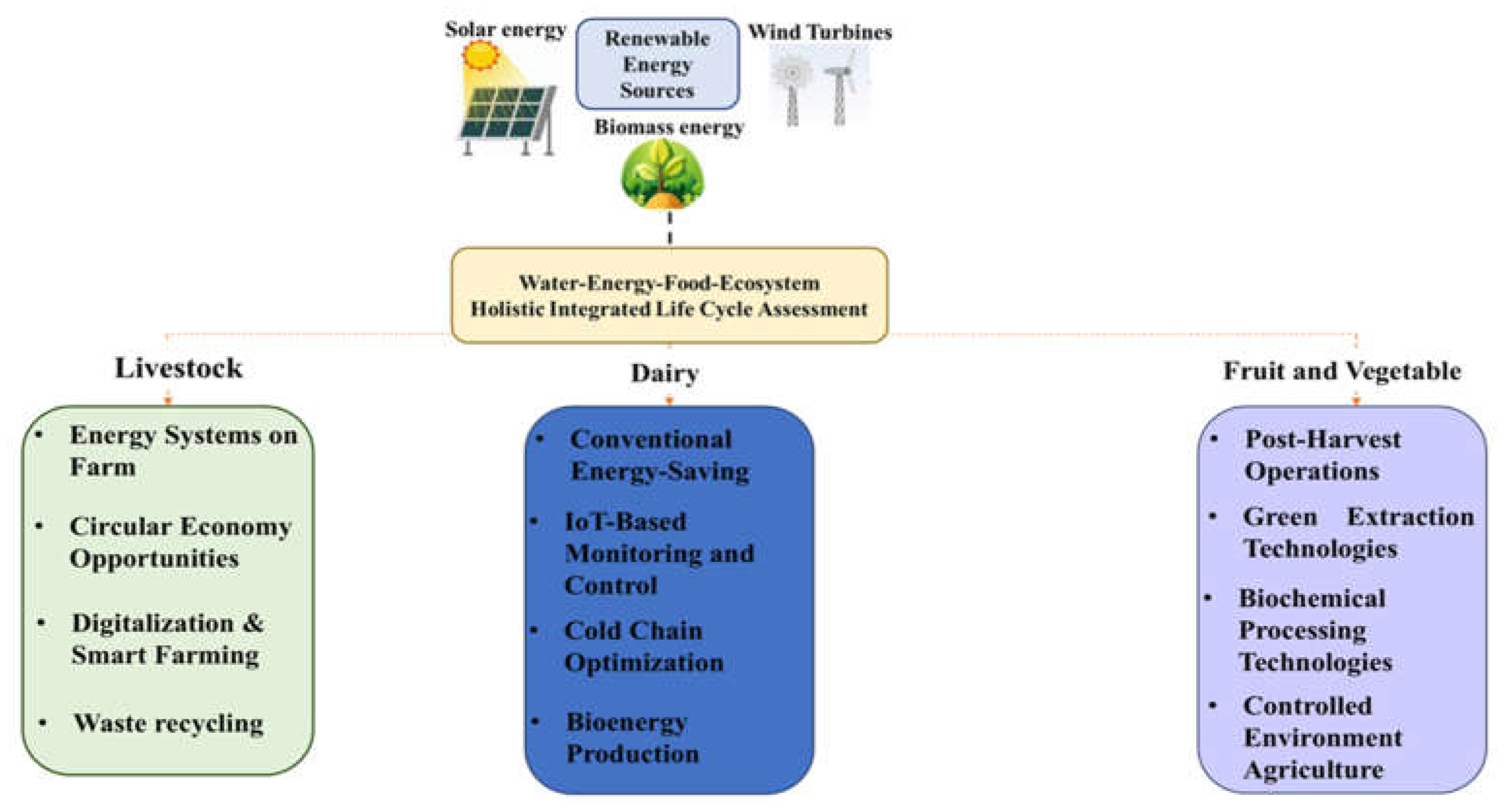
Figure 2.
Reasons of postharvest losses during the supply chain.
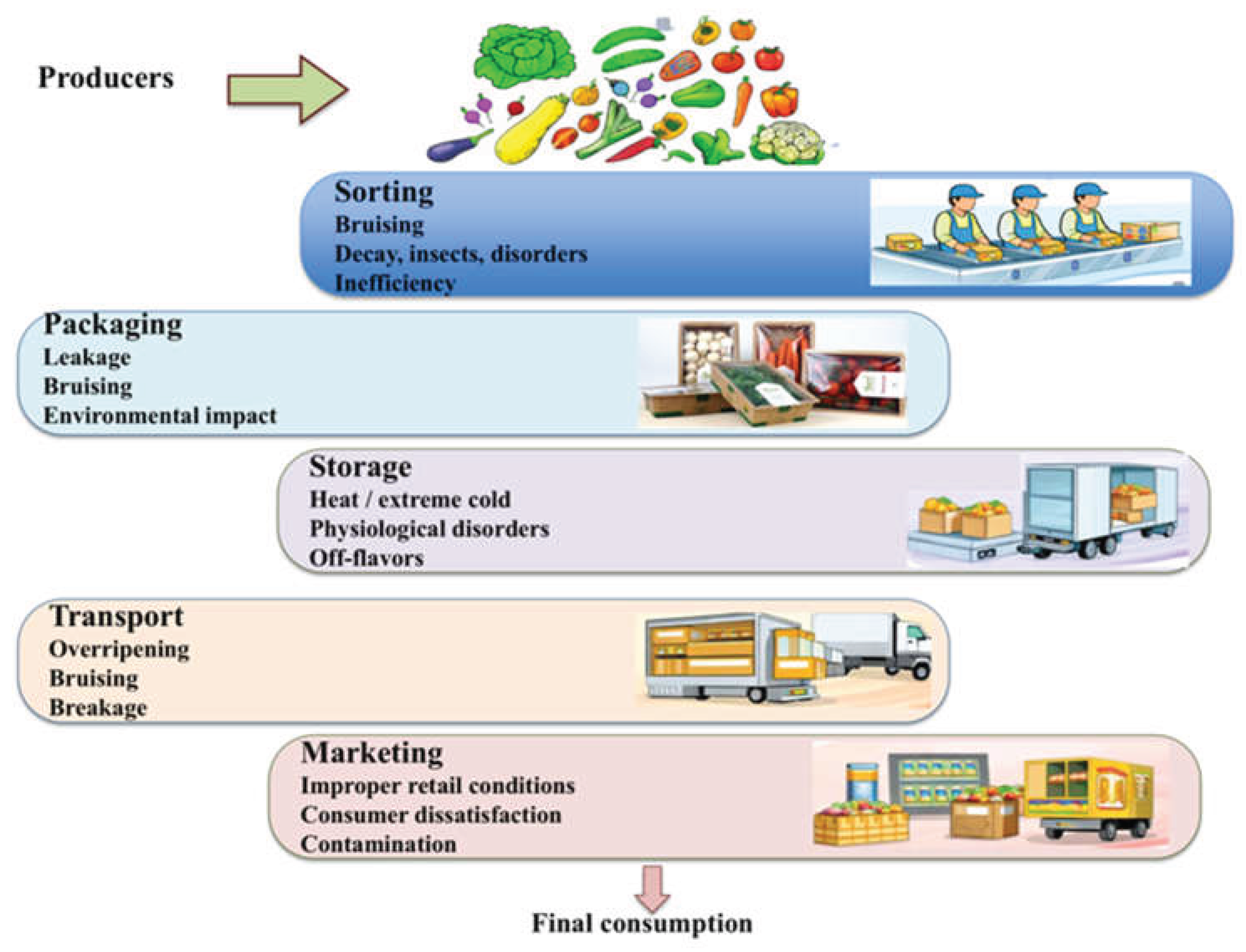
Figure 3.
Architecture of AI-enabled predictive food systems integrating multi-source data, intelligent analytics, and real-time risk mitigation mechanisms.
Figure 3.
Architecture of AI-enabled predictive food systems integrating multi-source data, intelligent analytics, and real-time risk mitigation mechanisms.
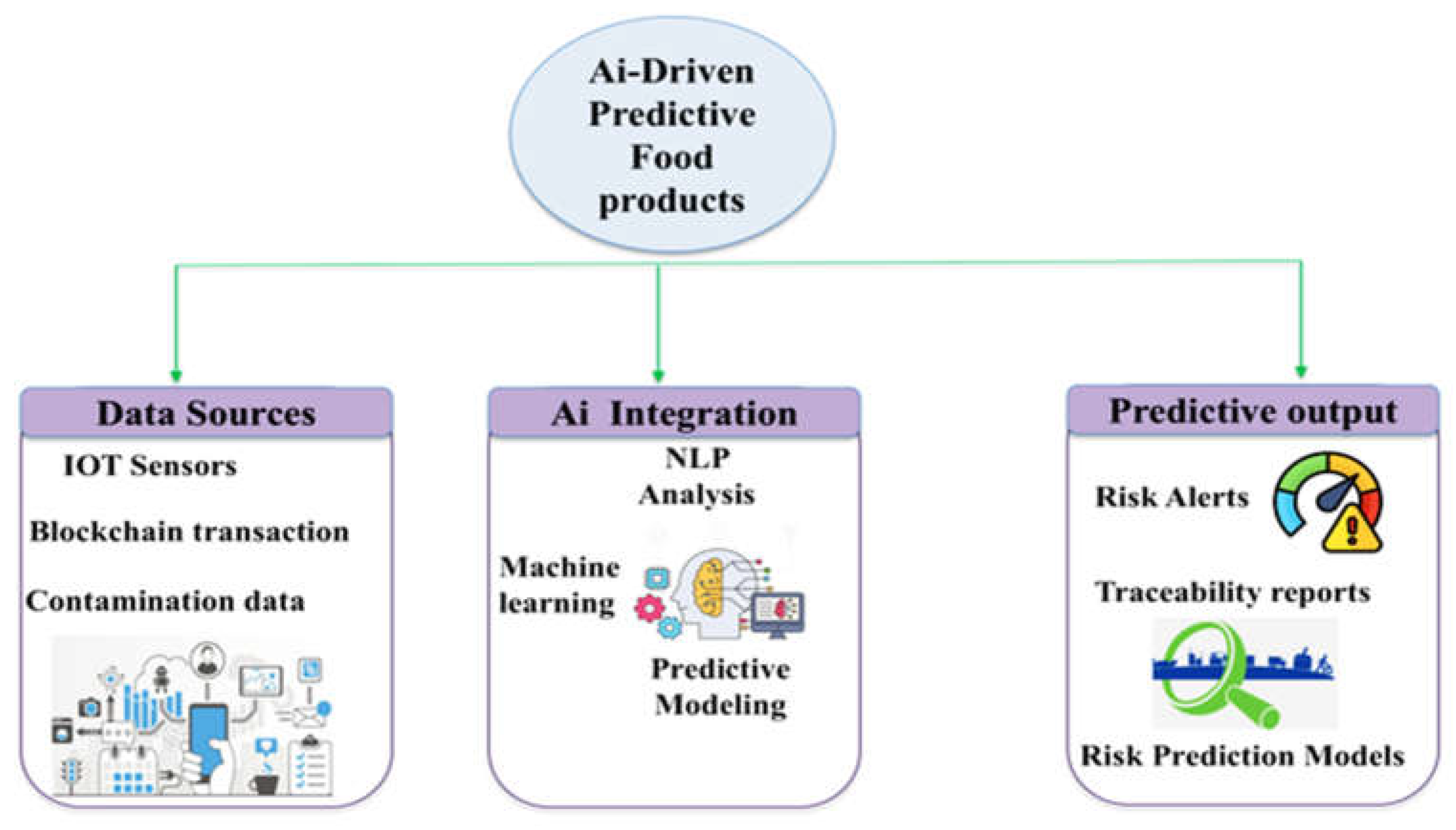

Table 1.
GHG–related mechanisms of different mulch film types.
| Mulching material | Integrated effect on GHG emissions and main mitigation mechanism | Reference |
|---|---|---|
| Biodegradable plastic mulch (BDM) formulated from polybutylene adipate-co-terephthalate (PBAT) and polylactic acid (PLA) | Higher production GHG, lower crop growth and waste disposal GHG; area-scale similar to PE and yield-scale lower than no-mulch; avoiding plastic residue, and maintaining crop productivity. | [191] |
| Mulch made from thermoplastic starch (TPS) and mulch made from thermoplastic dialdehyde starch (TPDAS) | Biodegrades faster than chemically modified TPDAS under controlled composting; microbial degradation occurs in three phases with actinomycete strains (Micromonospora, Nocardia, Streptomycete), reducing plastic persistence in compost and mitigating end-of-life emissions. | [192] |
| Virgin starch or reclaimed starch mulch | Achieving a reduction in greenhouse gas emissions of up to 80% and a decrease in non-renewable energy use by as much as 60% on a per-weight basis when compared to petrochemical-derived LDPE and polypropylene. Additionally, it results in energy savings ranging from 10 to 200 megajoules per square meter annually. | [193] |
| TPS + Polycaprolactone (PCL (mulch | Biodegradation; Bio-based carbon reduces GHG; Soil moisture & temperature regulation; reduces yield-scaled emissions; No disposal required. | [194] |
| TPS + PBAT + PLA mulch film | Biodegradation; reduces plastic residue; Soil moisture modulation; Seasonal growth & yield effects (increase to 33–34% in fall-winter); Color-dependent microclimate regulation; Lower GHG via bio-based carbon. | [195] |
| Starch + PLA mulch film | Biodegradation into CO₂ and water; Renewable carbon reduces GHG; Improved yield and quality; Eliminates end-of-season disposal. | [196] |
| Starch and polyester biodegradable mulch | Reducing plastic residue and releasing short-term CO₂; lowering carbon footprint; Maintaining weed control with occasional mulch splitting. |
[197] |
| biodegradable Cellulose mulch | Rapid fungal biodegradation by Aspergillus and Penicillium (Trichocomaceae); Eliminates end-of-season removal, landfill and incineration emissions; Cellulose-based renewable carbon lowers fossil CO₂ footprint; Maintains weed suppression without persistent plastic residues; No significant change of bulk soil microbial community structure. | [198] |
| Cellulose paper substrate + Sodium lignosulfonate–Fe complex (black layer) + cellulose acetate (hydrophobic layer) biodegradable film | Replaces fossil-based plastic with bio-based carbon; eliminates end-of-season removal and disposal emissions; black surface enhances soil heat retention and crop growth, reducing yield-scaled carbon. | [199] |
Table 2.
Application of nanomaterials in TTIs for the Reduction of Postharvest Losses.
| Nanomaterial | TTI Response Mechanism | Target Product | Brief Description | Environmental Implications | Reference | |||||||||
|---|---|---|---|---|---|---|---|---|---|---|---|---|---|---|
| AgNPs (Silver Nanoparticles) | Concentration-Dependent aggregation; geometry changes | General fruits | Colorimetric response correlates with cumulative temperature, allowing real-time monitoring of cold chain conditions | Reduction in food loss and waste (FLW); improved cold chain efficiency; decreased life-cycle GHG emissions per unit product | [219] | |||||||||
| Ammonium per sulphate (APS)+Na₂CO₃+Phenol | Oxidation of phenol (free radical-mediated) | pineapple, pomegranate, jackfruit | TTI color change correlates with microbial growth; allows rapid estimation of microbial spoilage under temperature abuse conditions | Uses common chemicals; no toxic residues reported; low environmental impact | [220] | |||||||||
| Polydiacetylene / Silver nanoparticles (PDA/AgNPs) | Thermally induced PDA backbone conformational change enhanced by AgNP thermal conductivity | General fruits | PDA/AgNPs incorporated into a CMC film exhibit a color change that is dependent on both time and temperature, with the overall color variation corresponding to the temperature exposure history | Low AgNP concentration; biopolymer (CMC) matrix reduces nanoparticle release; relatively low environmental risk | [221] | |||||||||
| Gelatin-templated gold nanoparticles (AuNPs) | Temperature-dependent AuNP growth and aggregation in gelatin nanoreactor causing LSPR-based color development | Fresh fruits and vegetables | Gold nanoparticles embedded in polymeric matrices allow sustained TTI response over extended storage at elevated temperature |
gelatin -based, no additional chemical reducers required; environmentally friendly and low toxicity | [219] | |||||||||
| pH-dependent AuNP formation from HAuCl₄ | pH changes due to CO₂ content; In-situ AuNP formation | Fresh fruits (mango, kiwi) | Dual responsive TTI detecting both pH changes and temperature to track freshness | Improved prediction of shelf-life; reduced FLW; optimized supply chain management; lower life-cycle GHG emissions | [222] | |||||||||
| Cysteine-loaded pH-responsive liposome / gold nanoparticles (Cys-pRL/AuNPs) | Enzymatic acidification (GOx/Glu) induces pH-triggered cysteine release, causing AuNP aggregation and LSPR-based | Perishable foods (fruit, vegetables) | Liposome, AuNP system coupled with GOx/Glu enables instantaneous and irreversible color change within a narrow pH range, improving TTI response sharpness compared to conventional pH dyes | Uses biocompatible lipids and low AuNP loading; minimal chemical waste; suitable for smart food packaging | [223] | |||||||||
Table 3.
Environmental and sustainability impacts of AI-based methods in food systems.
| Data Type (Experimental / Real-World) | Models and Methods | Model Category | Application in Food / Agriculture | Relevance to Greenhouse Gas Emissions / Carbon Footprint | Reference |
|---|---|---|---|---|---|
| Real-world industrial data from frozen vegetable production lines (onion, cauliflower, broccoli) | k-means, Canopy, Expectation-Maximization (EM)+ k-Nearest Neighbors (KNN), Multi-Layer Perceptron (MLP), Random Forest, SVM | ML models | Optimization and management of production processes to achieve low-emission output | Direct impact: reduces energy consumption per ton of product and carbon dioxide emissions | [228] |
| 2,978 food images with real volume and mass annotations | Faster R-CNN + GrabCut | CV & DL models | Calorie estimation from food images | Indirect: enables portion control and reduces over-serving, which in turn leads to a reduction in food waste | [229] |
| 2,380 images of 14 food types with varying portions and containers | Faster R-CNN + MobileNetV3 | CV & DL models | Non-contact food weight estimation | Indirect: Supports portion management and reduction of food waste | [230] |
| Top-view and side-view food images | Faster R-CNN + GrabCut | CV & DL models | Automated dietary monitoring | Indirect (behavioral): Reduction in over consumption and food wastage | [231] |
| Real images of fish eyes | DL: VGG19, SqueezeNet ML: kNN, Random Forest (RF), SVM, Logistic Regression (LR), Approximate Nearest Neighbor (ANN) | CV, DL & ML models | Fish freshness classification | Indirect: the prevention of food spoilage and the reduction of protein waste, which in turn contribute to lowering the overall carbon footprint. | [232] |
| Real-world industrial HSI data (VNIR, SWIR, Fluorescence) | Partial Least Squares Discriminant Analysis (PLS-DA) + Successive Projections Algorithm (SPA), Sequential Forward Selection (SFS), Interval Partial Least Squares (iPLS) | ML models | Detection of foreign materials in fresh-cut vegetables | Indirect (industrial): Enhancing food safety while reducing the rejection of edible products, thereby contributing to waste reduction | [233] |
| Large image dataset of 32 fruits and vegetables | MobileNetV2 (two separate models) | CV & DL models | Classification of fruit/vegetable type and ripeness | Indirect: Reduction of food waste through optimized harvest and consumption timing | [234] |
| Real NIR spectral data from apples | Autoencoder (AE) + IoT integration | Application of DL models | Internal quality control (Soluble Solids Content) | Indirect (industrial): Minimization of measurement errors and product rejection | [235] |
| Real HSI data from spinach and Chinese cabbage | CNN, LSTM, CNN-LSTM + LR, RF, SVM | ML & DL models | Vegetable freshness assessment | Indirect: Reducing spoilage along the supply chain | [236] |
| Real-world agricultural and ecosystem monitoring data | Reinforcement Radial Gaussian Encoder, Adversarial Boltzmann Temporal Neural Networks, and machine learning feature extraction. | RL + ML models | Monitoring food security and sustainable agriculture in rural regions | Direct and critical: optimizes sustainable food production and ecosystem stability, contributing to waste reduction and lower greenhouse gas emissions | [237] |
Disclaimer/Publisher’s Note: The statements, opinions and data contained in all publications are solely those of the individual author(s) and contributor(s) and not of MDPI and/or the editor(s). MDPI and/or the editor(s) disclaim responsibility for any injury to people or property resulting from any ideas, methods, instructions or products referred to in the content. |
© 2026 by the authors. Licensee MDPI, Basel, Switzerland. This article is an open access article distributed under the terms and conditions of the Creative Commons Attribution (CC BY) license.
Copyright: This open access article is published under a Creative Commons CC BY 4.0 license, which permit the free download, distribution, and reuse, provided that the author and preprint are cited in any reuse.


