
Submitted:
15 February 2026
Posted:
16 February 2026
You are already at the latest version
Abstract
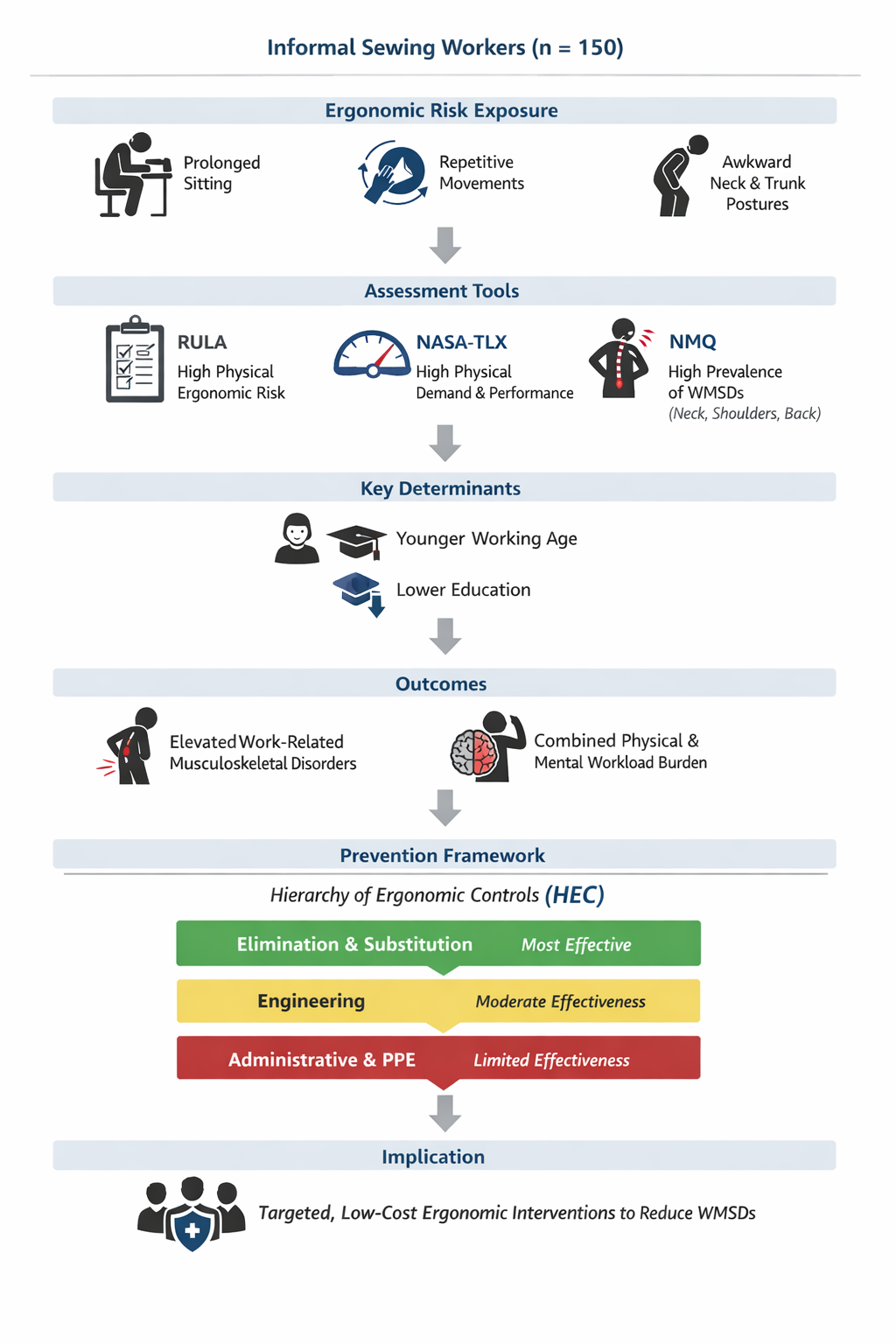
Background: Informal sewing workers are widely exposed to ergonomic and work-load-related risks but remain largely excluded from formal occupational health protection, particularly in low- and middle-income countries. This study aimed to assess ergonomic risk factors, mental workload, and work-related musculoskeletal disorders (WMSDs) among informal sewing workers and to develop preventive guidelines based on the Hier-archy of Ergonomic Controls (HEC). Methods: A mixed-methods study was conducted among 150 informal sewing workers in Ubon Ratchathani Province, Thailand. Quantita-tive data were collected using a structured questionnaire, the Rapid Upper Limb Assess-ment (RULA), the Nordic Musculoskeletal Questionnaire (NMQ), and the NASA Task Load Index (NASA-TLX). Associations between sociodemographic characteristics, ergo-nomic risks, and WMSDs were analyzed using chi-square tests and correlation analysis. Qualitative data were obtained through a focus group discussion with key stakeholders to develop ergonomic control strategies guided by the HEC framework. Results: The majority of participants were female and middle-aged, with widespread exposure to high-risk er-gonomic conditions, including prolonged sitting, repetitive tasks, and awkward postures. A high prevalence of WMSDs was observed, particularly in the neck, shoulders, and back. Younger workers and those with lower educational attainment experienced significantly higher ergonomic risk exposure and WMSD prevalence. NASA-TLX results indicated that physical demand and performance pressure were the main contributors to overall work-load. Application of the HEC framework showed that elimination and substitution con-trols were the most effective strategies for reducing ergonomic risks, followed by engi-neering controls, while administrative measures and personal protective equipment were less effective. Conclusions: Informal sewing workers face substantial ergonomic and mental workload risks that contribute to a high burden of WMSDs. Prioritizing high-er-order ergonomic controls, integrating workload management, and implementing community-based ergonomic interventions are essential to improving occupational health and reducing inequities among informal workers.
Keywords:
informal workers
; sewing workers
; ergonomics
; work-related musculoskeletal disorders
; mental workload
; NASA-TLX
; Rapid Upper Limb Assessment
; hierarchy of ergonomic controls
; occupational health
Copyright: This open access article is published under a Creative Commons CC BY 4.0 license, which permit the free download, distribution, and reuse, provided that the author and preprint are cited in any reuse.


