
Submitted:
13 February 2026
Posted:
14 February 2026
You are already at the latest version
Abstract
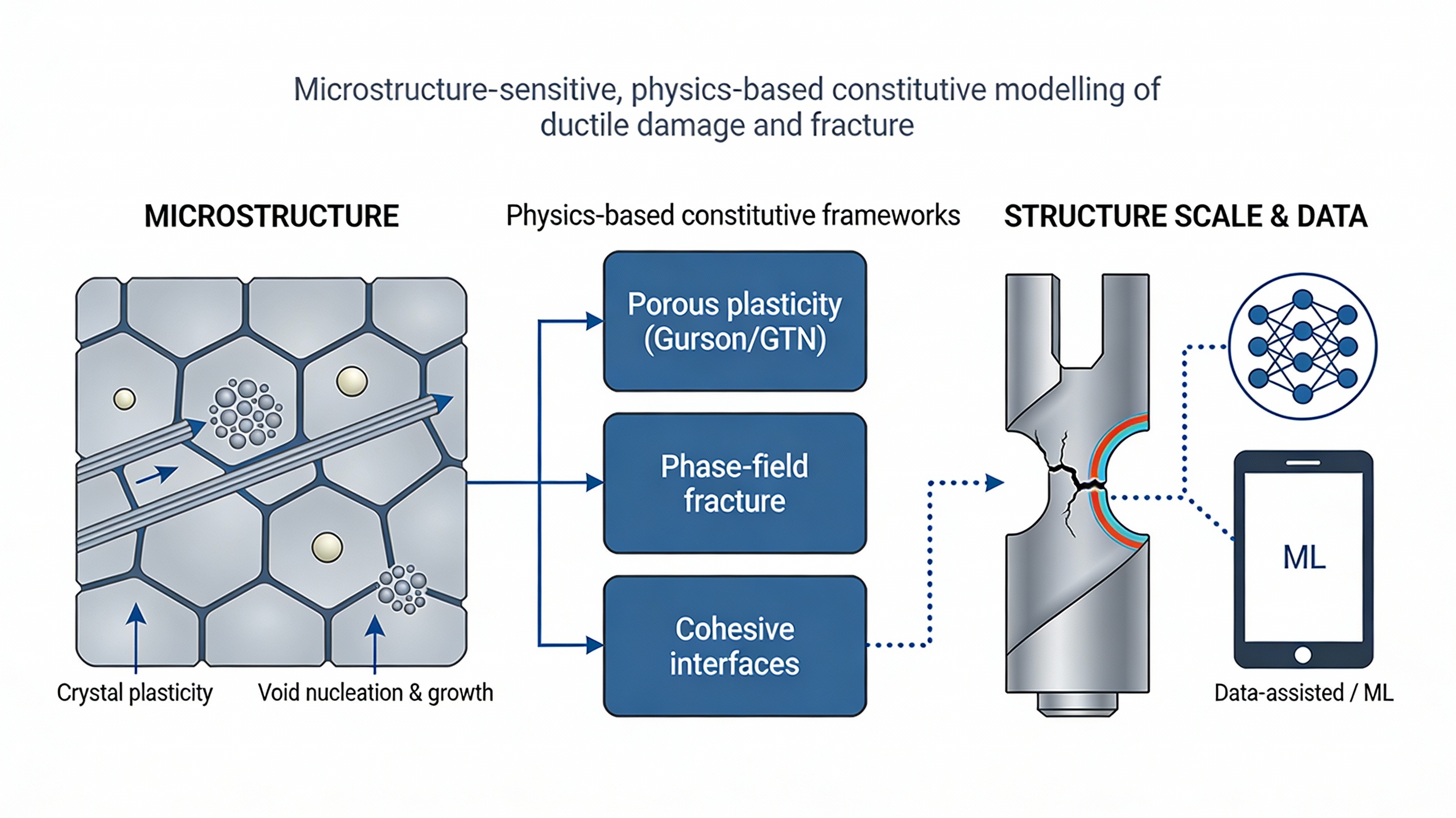
Physics-based constitutive modelling remains a cornerstone for predicting ductile damage and fracture in metallic materials, particularly where microstructural mechanisms govern macroscopic response. Over the past two decades, a wide range of crystal plasticity, porous plasticity, and void-based fracture models have been proposed to capture deformation localisation, void growth, and coalescence under complex loading paths. However, these developments are often presented in isolation, obscuring their shared physical assumptions and limiting their transferability across material systems and length scales.This article provides a microstructure-sensitive perspective on constitutive modelling of ductile damage and fracture, with particular emphasis on crystal plasticity-based frameworks, void growth and coalescence mechanisms, and interface-driven fracture. Rather than attempting an exhaustive review, this review highlights unifying concepts, modelling trade-offs, and recurring challenges related to parameter identifiability, scale bridging, and predictive robustness. It further clarifies how physics-based constitutive descriptions can be systematically integrated into modern fatigue and fracture assessments and situate these developments relative to emerging data-assisted and machine-learning-enhanced modelling strategies.By reframing established constitutive models within a coherent physical narrative, this perspective aims to support more transparent model selection, improve interpretability, and guide future developments in multiscale damage and fracture modelling of metallic materials.
Keywords:
crystal plasticity
; ductile damage
; void growth
; parameter identification
; microstructure-sensitive modelling
; data-driven constitutive models
1. Introduction
Ductile fracture prediction in metallic materials remains a grand challenge in computational mechanics despite decades of progress. The underlying physics, viz. void nucleation at second-phase particles, plastic deformation based void growth under triaxial stress states, and coalescence leading to macroscopic crack formation, are well-established [1,2]. Yet translating this understanding into predictive constitutive models capable of handling arbitrary loading paths, microstructural heterogeneity, and scale transitions continue to test the limits of current frameworks [3,4,5,6,7,8,9].
Purely phenomenological approaches to ductile damage, while computationally expedient, suffer from fundamental limitations. Uncoupled damage models, which post-process stress-strain histories to evaluate accumulated damage, fail to capture the bi-directional coupling between evolving porosity and plastic deformation (see for example [3,10,11,12,13] and references there in). Empirical fracture criteria calibrated to specific stress states often lose predictive capability under non-proportional loading or when extrapolated beyond calibration regimes [14,15,16,17]. These shortcomings are not merely academic, they translate directly into conservative design practices, excessive safety factors, and limited confidence in damage-tolerant structural assessments.
Microstructure-sensitive constitutive modelling offers a physics-grounded alternative by explicitly representing the mechanisms that govern local stress and strain redistribution. Crystal plasticity finite element method (CPFEM) provides the natural carrier for these physical descriptions, resolving crystallographic slip, texture evolution, and grain-scale heterogeneity that drive damage initiation [18,19,20,21,22,23,24,25]. When coupled with void growth mechanics or phase-field regularisation, these frameworks can span from intragranular void nucleation to macroscopic crack propagation within a unified thermomechanical description [19,26,27,28,29,30,31].
However, this sophistication comes at a cost. The proliferation of material parameters, often 15-25 constants for coupled crystal plasticity-damage models, raises fundamental questions about parameter identifiability, uniqueness, and experimental accessibility [32,33,34,35,36,37,38,39]. Scale bridging from microscale representative volume elements (RVEs) to component-level predictions remains computationally prohibitive for many practical applications. Moreover, recent experimental evidence reveals that individual void growth rates exhibit stochastic variability not captured by stress-state-based models, suggesting missing physics in current formulations (see [3] and references there in).
This paper does not attempt an exhaustive taxonomy of ductile damage models. Instead, it synthesises microstructure-sensitive constitutive approaches with three aims: (i) clarify the underlying physical foundations and shared assumptions in crystal plasticity-based damage frameworks, (ii) identify persistent challenges in parameter identification and scale transfer that limit predictive robustness, and (iii) contextualise how physics-based models should evolve to accommodate emerging data-assisted methodologies without abandoning mechanistic interpretability.
The remainder of this paper is structured as follows. Section 2 establishes crystal plasticity as the foundational framework for microstructure-sensitive damage modelling, discussing slip-based plasticity, parameter identification challenges, and the role of localisation in damage precursors. Section 3 examines void growth and coalescence constitutive descriptions, from classical porous plasticity to modern crystal plasticity-informed formulations. Section 4 addresses interface- and grain boundary-driven fracture mechanisms, highlighting when cohesive zone models supplement or replace continuum damage descriptions. Section 5 synthesises recurring issues in parameter identifiability, scale bridging, and predictive uncertainty that constrain model applicability. Finally, Section 6 provides an outlook on data-assisted physics-based frameworks, delineating where machine learning genuinely augments mechanistic models versus where it risks obscuring physical insight.
2. Crystal Plasticity Foundations for Damage Modelling
Crystal plasticity provides the natural kinematic and constitutive backbone for microstructure-sensitive damage descriptions. Unlike isotropic plasticity formulations that homogenise material response at the continuum scale, CPFEM resolves crystallographic slip on specific slip systems, capturing orientation-dependent yield, hardening anisotropy, and strain localisation that governs damage initiation and evolution [18,24,40,41,42,43].
Figure 1 summarises the hierarchical structure of physics-based constitutive frameworks for ductile damage and fracture, emphasising how microstructural mechanisms, constitutive representations, and structural-scale assessments are connected within a single modelling narrative. At the lowest level, crystal plasticity resolves crystallographic slip, texture evolution, and grain-scale localisation, providing the kinematic backbone upon which void nucleation and growth, interface decohesion, and other damage mechanisms act [19,25,44]. These mechanisms are then coarse-grained into continuum-scale descriptions, including porous plasticity models for void growth and coalescence [19,45,46], cohesive zone laws for grain and phase boundaries [47,48,49], and phase-field formulations for crack initiation and propagation [26,27,28,29,30,31,50,51]. At the highest level, these constitutive building blocks feed into fatigue and fracture assessment procedures, enabling microstructure-sensitive predictions of crack initiation, growth, and final failure under engineering loading scenarios.
2.1. Crystal Plasticity as a Carrier of Physical Mechanisms
The multiplicative decomposition of the deformation gradient into elastic and plastic components, , enables tracking of lattice rotation, slip system activity, and texture evolution throughout deformation [19,20,52,53,54]. Plastic deformation accumulates through resolved shear stress on slip systems α:
where and are the slip direction and slip plane normal. The evolution of slip rates typically follows power-law viscoplasticity or rate-independent formulations with slip system strength evolving through hardening laws that encode dislocation interactions [19,24,54].
This framework naturally embeds damage precursors. Localisation of plastic slip, driven by soft grain orientations, grain boundary constraints, or stress concentrations near particles, creates heterogeneous strain fields that nucleate voids and drive subsequent growth [13,18,26,40,41,53]. Dislocation density-based formulations further couple stored energy and geometrically necessary dislocation (GND) density to fatigue indicator parameters (FIPs), enabling prediction of crack initiation sites without phenomenological damage variables [41,55,56,57].
2.2. Parameter Identification: The Hidden Bottleneck
Crystal plasticity models for damage prediction typically require 8-30 parameters governing slip system strength, hardening, and rate sensitivity, plus additional parameters for damage coupling [32,35,58,59,60,61]. Inverse identification from macroscopic tests (uniaxial tension, simple shear) suffers from non-uniqueness, i.e. multiple parameter sets can reproduce global stress-strain curves while predicting qualitatively different local strain fields [36,58].
nanoindentation load-displacement curves and residual surface topography [32,58], digital image correlation (DIC) of grain-scale strain fields [36], and high-resolution diffraction contrast tomography (DCT) for in-situ orientation tracking [3]. Optimisation schemes (such as genetic algorithms, trust-region-reflective methods, response surface methodology) have improved robustness [32,58,62], yet parameter sensitivity and correlation remain poorly characterised for most material systems.
Crucially, parameters calibrated at small strains may not extrapolate to large deformations relevant for damage. Hardening laws calibrated to monotonic loading often misrepresent cyclic behaviour [40,63]. Void-free calibration neglects the coupling between porosity evolution and matrix constitutive response[19]. These issues underscore that parameter identification and model validation are inseparable aspects of constitutive development.
2.3. Role of Slip, Hardening, and Localisation
Crystal plasticity's value for damage modelling lies in its ability to predict where and when deformation localises. Slip band formation (concentrated plastic shear on persistent slip systems), creates displacement gradients that drive void nucleation at second-phase particles [18,27]. Grain boundary misorientation governs slip transmission, with high-angle boundaries acting as barriers that amplify stress concentrations and trigger interface decohesion [41,49].
Hardening models directly influence damage predictions. Saturation hardening at large strains promotes strain localisation and earlier coalescence onset [64,65]. Dislocation density-based models with GND contributions capture size effects and gradient-driven hardening that delays void growth in small grains [41]. These mechanistic connections justify why crystal plasticity is not merely a high-fidelity kinematic description, but a necessary framework for capturing the multiscale physics of ductile damage.
2.4. Why CP Is the Natural Backbone for Damage and Fracture Models
The integration of damage mechanisms into crystal plasticity takes multiple forms. Coupled porous crystal plasticity models modify the yield surface and flow rule to account for void volume fraction evolution [19], extending Gurson-type approaches to anisotropic matrices. Phase-field damage formulations couple crystallographic slip with gradient-regularised crack representations, enabling simulation of transgranular and intergranular fracture competition [26,27]. Cohesive zone elements at grain boundaries capture interface-dominated failure [66].
What unifies these approaches is the recognition that crystal plasticity provides the constitutive substrate, i.e. the description of plastic deformation kinematics and stress redistribution, upon which damage mechanisms operate. Void growth rates depend on local stress triaxiality and Lode parameter, both of which are strongly modulated by crystal orientation and neighbouring grain constraints [3,64,65]. Crack propagation follows crystallographic planes, with growth rates sensitive to Schmid factors and slip system activity [27,55]. These dependencies cannot be captured by isotropic plasticity frameworks, justifying the added complexity of crystal-level resolution.
3. Void Growth and Coalescence: Constitutive Descriptions
The Rice-Tracey analysis of spherical void growth in an infinite matrix under remote triaxial stress established that void growth rate scales exponentially with stress triaxiality [1,2]:
where is void radius, is hydrostatic stress, and is von Mises equivalent stress. This foundational result, derived from limit analysis of rigid-perfectly-plastic materials, captures the first-order effect: tensile hydrostatic stress dramatically accelerates void enlargement.
3.1. Gurson Model and Extensions
Gurson's micromechanical analysis of a spherical void in a finite unit cell provided a yield function that couples void volume fraction f to macroscopic plastic flow [67,68]:
The Tvergaard-Needleman (GTN) modifications introduced adjustable parameters to improve agreement with cell calculations and an effective porosity to model coalescence-induced softening [68,69]. While phenomenological, the GTN model became the workhorse for engineering ductile fracture predictions due to its relatively simple structure and coupling to standard plasticity [10,70].
However, limitations are well-documented. The parameters are not universal, they vary with stress state, hardening, and even geometry [70,71]. The model struggles at low stress triaxiality where shear-dominated failure occurs [14,72]. Void shape evolution, critical for predicting coalescence onset, is not captured [68]. These shortcomings motivated extensions: the Gologanu-Leblond-Devaux (GLD) model for ellipsoidal voids [68], shear-modified Gurson models incorporating Lode-dependence [72], and gradient-enriched formulations for size effects [67,71,73].
3.2. Void Growth in Crystal Plasticity Frameworks
Single crystal simulations reveal profound orientation effects absent in isotropic models. Yerra et al. [64] showed that voids in FCC crystals oriented for multiple slip grow twice as fast as hard orientations under uniaxial tension. At low triaxiality, void shape evolution diverges significantly between orientations. Coalescence onset, identified by transition to uniaxial straining in the ligament, occurs at different strain levels depending on crystal orientation, with variations up to 40% [64,65]. Further crystal plasticity simulations of void growth confirm strong orientation and hardening sensitivity, even under nominally identical macroscopic loading [12].
These findings expose the inadequacy of isotropic porous plasticity for polycrystals with strong texture or large grains. Recent work couples’ crystal plasticity constitutive laws with void evolution, either through homogenisation of voided single crystals [19] or direct simulation of voids within crystal plasticity FE frameworks [13,18,26,52,74]. The latter enables tracking of void nucleation at particles, orientation-dependent growth, and shear-driven void coalescence in heterogeneous microstructures [18,42,75].
3.3. Transition from Growth to Coalescence
Void coalescence, i.e. the onset of plastic flow localisation in inter-void ligaments, marks the terminal stage before macroscopic fracture [64,68]. The GTN model approximates this through effective porosity, which artificially accelerates porosity growth beyond a critical value [67,70]. More sophisticated approaches identify coalescence through bifurcation analysis (Rice criterion) or FE cell calculations showing strain path changes [64,68].
In crystal plasticity settings, coalescence becomes orientation- and slip-system-dependent [64,65]. Internal necking between voids occurs preferentially on slip systems with high Schmid factors in the ligament. Atomistic simulations suggest critical inter-void spacing for coalescence onset is approximately one void radius, with void interaction accelerating growth when ligaments thin to this threshold [76].
3.4. Variational and Porous CP Frameworks
Variational formulations of porous plasticity provide thermodynamically consistent damage evolution laws [46]. At crystal plasticity level, by extending the Gurson yield surface into crystal plasticity through orientation-dependent slip system flow, porous CP models predict intragranular ductile failure with microstructural fidelity [19]. The framework accommodates void nucleation, growth, and coalescence within individual grains, enabling simulation of damage accumulation in complex loading scenarios without ad-hoc damage criteria.
3.5. Strengths and Limitations
Physics-based void growth models excel at capturing first-order stress-state dependencies and providing mechanistic connections between microstructure and failure. However, recent experimental evidence reveals unexplained heterogeneity. Vaughan et al. [3] tracked individual void growth in Al-2219 using in-situ X-ray computed tomography and laboratory-DCT, finding that void growth rates varied stochastically in ways not predicted by local stress triaxiality or crystal orientation [3]. This suggests additional factors, possibly local dislocation density fields or particle-matrix interface properties (govern void evolution) representing an important gap in current constitutive descriptions. Complementary numerical reviews emphasise similar complexity in void nucleation, growth, and coalescence across different metal systems [77].
4. Interface- and Microstructure-Driven Fracture
While void-based ductile damage dominates failure in many engineering alloys, interface-driven fracture mechanisms become critical in materials with weak grain boundaries, bicrystals, or coherent precipitate structures [54,78,79]. Understanding when and how fracture transitions from transgranular (through grains) to intergranular (along boundaries) requires constitutive descriptions distinct from porous plasticity.
4.1. Bicrystal and Interface Fracture as Limiting Cases
Molecular dynamics simulations of Al-Si bicrystal interfaces reveal that interfacial cracks propagate in a brittle manner regardless of crystal orientation [66]. Normal traction-separation curves extracted from atomistic simulations provide cohesive zone model (CZM) parameters, (peak traction, critical separation, and fracture energy) that calibrate continuum interface elements [66,80]. Exponential CZM laws show better correlation with MD data than bilinear forms, though differences in fracture toughness predictions remain small [66].
These bicrystal studies establish limiting cases: when interface strength is sufficiently low relative to matrix flow stress, fracture localises to the boundary irrespective of plastic anisotropy in adjacent grains. This limiting behaviour guides constitutive choices for grain boundary fracture in polycrystals [80].
4.2. Cohesive vs Constitutive Descriptions
Cohesive zone models represent fracture through traction-separation laws along predefined surfaces (grain boundaries, phase boundaries) [51,80]. They avoid the mesh dependence of continuum damage by introducing a length scale (cohesive zone size) tied to fracture process zone dimensions. For interfacial fracture, CZMs can be calibrated from lower-length-scale simulations (MD, phase-field) or experiments (DCB tests) ) [51,54,80].
Continuum damage models, by contrast, represent fracture through degradation of bulk constitutive response [29,30,50]. Phase-field approaches regularise sharp crack surfaces via a diffuse damage variable evolving according to variational principles [29,30,50]. These methods excel for arbitrary crack paths and nucleation but require careful treatment of length scale coupling when combined with crystal plasticity [29,30,50]. Recent constrained phase-field formulations for polycrystals further demonstrate how crack paths and fracture modes emerge from grain-level constraints [28].
The choice between cohesive and constitutive representations depends on whether fracture paths are known apriori. For intergranular fracture in polycrystals with weak boundaries, cohesive elements along grain faces provide computationally efficient descriptions. For transgranular fracture or situations where crack path selection is outcome-dependent, phase-field or nonlocal damage formulations offer greater flexibility [26,27,29].
4.3. Lessons for Polycrystals and Heterogeneous Alloys
Crystal plasticity simulations with explicit grain boundary representations reveal competition between transgranular and intergranular fracture modes. At room temperature with pristine boundaries, transgranular cracking dominates as plastic slip concentrates in soft grains. At elevated temperatures with grain boundary oxidation or embrittlement, intergranular fracture becomes favourable as boundary cohesive strength degrades[81,82].
This competition can be modelled by assigning distinct failure criteria to grain interiors (plasticity-driven parameters or stored energy) versus boundaries (cohesive traction-separation) [80]. Molecular dynamics-informed boundary separation energies, accounting for temperature and environmental effects, enable prediction of fracture mode transitions without empirical fitting [83].
For dual-phase alloys (e.g., Ti-6Al-4V with α/β phases), interface-driven damage interacts with void-based mechanisms. Voids nucleate at α/β boundaries due to strain incompatibility, then grow under triaxial loading [18]. Cohesive interfaces can represent boundary decohesion while porous crystal plasticity governs void growth within phases [19]. This hierarchical approach, distinct mechanisms at distinct structural features, provides a physically grounded framework for complex microstructures, yet requiring careful identification of parameters involved through experiments.
5. Identifiability, Scale Bridging, and Predictive Robustness
Physics-based constitutive models for ductile damage embody substantial mechanistic sophistication, yet their predictive robustness hinges on practical considerations often under-discussed in the literature: parameter identifiability, scale transfer from RVEs to component-scale predictions, and uncertainty quantification.
5.1. Why Parameter Identifiability is the Hidden Bottleneck
Crystal plasticity damage models involve 15-25 parameters: slip system strengths, hardening moduli, rate sensitivity exponents, void nucleation stress/strain thresholds, initial porosity, and coalescence criteria [19,32,58]. Inverse identification from macroscopic experiments yields non-unique solutions, distinct parameter sets reproducing identical global stress-strain curves yet diverging in local predictions [36,58,61].
This non-uniqueness is not mathematical pedantry; it directly impacts damage predictions. Slip system hardening parameters control strain localisation, which determines void nucleation sites [18]. Coalescence porosity shifts predicted failure strain by 20-30% in GTN models [10,70]. When parameters are fitted to undamaged material response only, and are then extrapolated to damaged regimes, errors compound [19,61].
Recent identification strategies mitigate but do not eliminate these issues [32,36,58,62]. Multi-objective optimisation combining load-displacement curves, surface topography, and DIC strain fields constrain parameter spaces [36,58]. Bayesian calibration with uncertainty quantification acknowledges remaining ambiguity [84]. However, experimental data richness, requiring in-situ measurements, multi-axial loading, and microstructural characterisation, limits accessibility for most material systems.
5.2. Sensitivity to Microstructural Assumptions
RVE-based damage predictions depend critically on statistical descriptors of microstructure: grain size distribution, texture intensity, void spacing, and second-phase particle characteristics [18,85,86]. Small RVEs (<50 grains) exhibit ergodicity violations under inelastic deformation, with damage accumulation sensitive to specific grain arrangements [85].
Convergence studies for damage metrics (fracture strain, crack initiation life) require larger RVEs than for elastic or plastic homogenisation [85,86]. This computational burden motivates reduced-order models or machine learning surrogates, but both introduce new approximations whose validity must be established [87,88].
Texture effects compound these challenges. Rolled alloys with strong cube texture localise strain differently than random polycrystals, shifting void nucleation patterns [18]. Crystallographic texture in titanium alloys determines whether dwell fatigue (load hold) accelerates or retards crack initiation [55,56]. These sensitivities mean that constitutive models calibrated on one microstructural condition may not transfer to material variants without re-calibration.
5.3. Implications for Fatigue and Long-Term Integrity Prediction
Fatigue life prediction using fatigue indicator parameters (FIPs) computed from crystal plasticity simulations has demonstrated promise for high-cycle and low-cycle regimes [41,55,56,57]. However, fatigue lives scatter by orders of magnitude for nominally identical specimens, which is driven by microstructural variability that must be captured statistically [41,63].
Identifiability issues cascade into fatigue predictions. Slip system strength parameters control maximum FIP values, which enter S-N curves through power-law correlations [41,63]. Small parameter variations propagate to factor-of-two changes in predicted fatigue life [41,63]. Combined with uncertainty in FIP-to-life calibration curves, predictive confidence bands widen to the point where model utility for design becomes questionable.
For structural integrity assessments, predicting remaining life of in-service components, digital twin frameworks attempt to fuse physics-based models with monitoring data [84]. Yet model updating requires knowing which parameters to adjust based on observed response, re-encountering identifiability limitations [84]. Bayesian updating can propagate parameter uncertainty through damage predictions, but computational cost for complex CPFEM models remains prohibitive [84].
6. Outlook: Toward Data-Assisted Physics-Based Frameworks
The confluence of high-fidelity experimental datasets (synchrotron tomography, high-resolution DIC, in-situ testing) and machine learning algorithms offers opportunities to address persistent limitations in physics-based damage modelling. However, realising these opportunities requires disciplined integration that preserves physical interpretability and thermodynamic consistency.
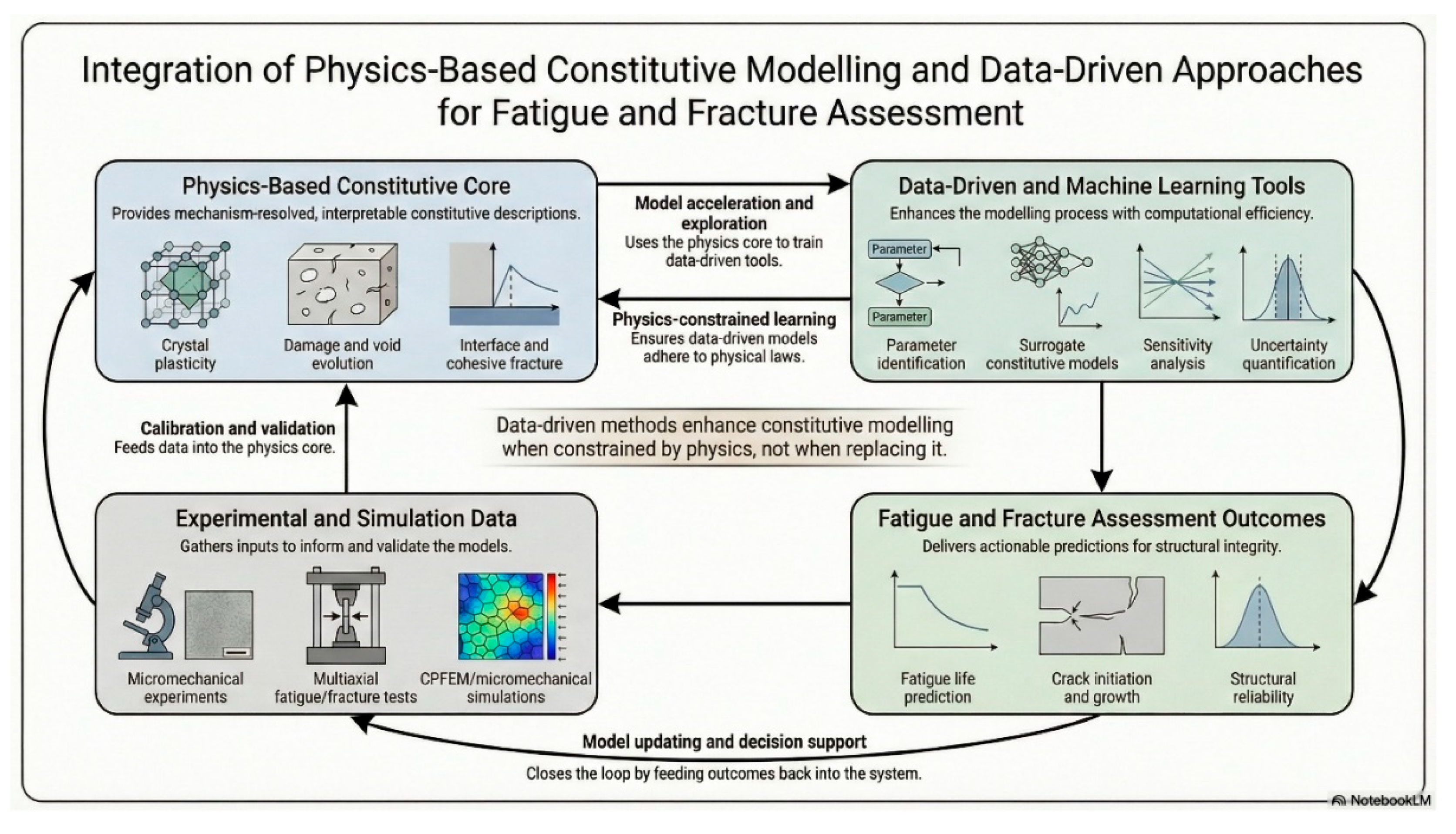
Figure 2 schematically illustrates how physics-based constitutive frameworks for ductile damage can be integrated with data-driven tools to create hybrid, microstructure-sensitive workflows for fatigue and fracture assessment. On the physics side, crystal plasticity, porous plasticity, and interface-fracture models generate mechanistically grounded predictions of local fields, damage indicators, and crack evolution across relevant length scales. These simulations provide structured data and prior knowledge that inform machine-learning surrogates, inverse identification schemes, and uncertainty quantification frameworks, which in turn accelerate multiscale calculations and enable real-time or near-real-time structural integrity assessments. Figure 2 highlights how digital twin concepts can sit on top of this hierarchy, updating surrogate models with monitoring data while remaining anchored to thermodynamically consistent damage evolution laws derived from the underlying physics-based constitutive descriptions.
6.1. Where ML Actually Helps (and Where It Doesn't)
Machine learning excels at three tasks relevant to constitutive modelling: surrogate model acceleration, inverse parameter identification, and discovering functional forms from data [87,88,89,90]. Gaussian process regression with physics-informed constraints can learn constitutive mappings (invariants → stress) that enforce objectivity, symmetry, and thermodynamic consistency [87]. These surrogates enable real-time digital twin updating or Monte Carlo uncertainty propagation infeasible with full CPFEM [88].
For parameter identification, ML-driven optimisation (genetic algorithms, Bayesian optimisation) navigates high-dimensional spaces more efficiently than gradient-based methods, particularly for non-convex objectives with local minima [58,62]. Neural networks can learn inverse maps (stress-strain curves → CP parameters) from databases of virtual experiments, though uniqueness issues persist [89].
Black-box neural networks trained purely on stress-strain data without constraints may violate thermodynamic principles: they predict non-convex free energies, asymmetric stress tensors, or energy dissipation under cyclic loading [87,91]. Extrapolation beyond training data becomes unreliable without embedded physics [87]. For damage predictions, inherently involving large strain regimes, localisation, and softening outside typical calibration conditions, pure data-driven models lack robustness.
6.2. Hybrid Physics-ML Strategies, Not Replacement
The most promising developments combine explicit physics with data-driven components [87,88,90,91]. Physics-informed neural networks (PINNs) embed governing PDEs as loss function terms, ensuring solutions respect conservation laws. For constitutive modelling, representing stress as a linear combination of integrity basis tensors (derived from representation theory) guarantees frame-indifference and material symmetry, while ML learns the scalar coefficient functions [87].
Hybrid frameworks allocate physics to well-understood aspects (kinematics, objectivity, hardening evolution) and ML to uncertain or intractable components (void nucleation statistics, coalescence criteria, interfacial properties) [87,88]. This division of labour maintains interpretability: engineers can interrogate learned nucleation models or adjust physics-based void growth laws independently.
For digital twin applications in structural integrity, hybrid approaches update surrogate models with sensor data while anchoring predictions to physics-based damage evolution [84]. Model discrepancy terms capture systematic errors in constitutive assumptions, guiding where physics should be refined versus where statistical correction suffices [84].
6.3. How Physics-Based Models Should Evolve Responsibly
Integrating data-driven methods into constitutive frameworks requires methodological rigour to avoid regressing toward empiricism. Three principles should guide development:
1. Preserve thermodynamic structure: Any learned constitutive component must satisfy Clausius-Duhem inequality, convexity of dissipation potentials, and appropriate symmetries [29,87,90]. Variational formulations provide natural templates for enforcing these constraints [29,50].
2. Quantify uncertainty: Bayesian ML methods (Gaussian processes, variational inference) provide predictive distributions, not point estimates [84,87]. Propagating parameter and model-form uncertainty through damage predictions yields confidence bounds essential for decision-making [84].
3. Maintain falsifiability: Physics-based models make testable predictions about new scenarios (different stress states, microstructures, loading rates). Hybrid models must retain this property, i.e. predictions should fail gracefully when physics is wrong, not hide errors in learned corrections [88].
The future of ductile damage modelling lies not in abandoning decades of micromechanical insight for neural networks, but in leveraging data to address identifiability bottlenecks, accelerating multiscale calculations, and guide experimental campaigns. This synthesis (physics for extrapolation, data for precision) promises to deliver the predictive robustness demanded by damage-tolerant design while preserving the mechanistic transparency necessary for materials innovation.
7. Conclusions
Physics-based constitutive modelling of ductile damage and fracture has matured into a sophisticated multiscale enterprise, spanning crystal plasticity kinematics, micromechanical void growth theories, and interface fracture mechanics. This perspective has synthesised these developments through a unifying lens: microstructure-sensitive frameworks that resolve crystallographic slip, stress triaxiality, and localisation as the carriers of damage physics.
Several key insights emerge. First, crystal plasticity is not merely a high-fidelity descriptor of anisotropic yield, but the necessary kinematic substrate for damage modelling in heterogeneous microstructures. Void growth rates, coalescence onset, and crack propagation directions all depend on orientation-specific slip activity that isotropic plasticity cannot represent. Second, parameter identifiability (not algorithmic sophistication) limits predictive robustness. Non-unique inverse solutions, sensitivity to microstructural assumptions, and extrapolation from calibration to damaged regimes introduce uncertainties that must be acknowledged and quantified. Third, scale bridging from RVEs to components remains computationally prohibitive without surrogate modelling, yet ensuring these surrogates preserve essential physics presents ongoing challenges.
The outlook toward data-assisted modelling is cautiously optimistic. Machine learning offers genuine opportunities for parameter identification, surrogate acceleration, and uncertainty quantification, provided physics constraints are rigorously enforced. Hybrid frameworks that embed thermodynamic structure while learning uncertain components represent the responsible path forward, avoiding regression toward empiricism while addressing practical bottlenecks.
Ultimately, predictive modelling of ductile damage requires humility: acknowledging that current constitutive frameworks omit physics at times (stochastic void growth [3], dynamic recrystallisation, hydrogen embrittlement effects) while resisting the temptation to paper over gaps with flexible but opaque data-driven models. Progress demands tighter integration of advanced characterisation (4D tomography, DCT, correlative microscopy), theory (variational principles, homogenisation), and computation (FFT-CP, phase-field, ML surrogates), a synthesis that honours the physical complexity of ductile fracture while delivering the quantitative predictions which engineering design demands.
Author Contributions
Conceptualisation, M.A.S.; methodology, M.A.S.; writing original draft preparation, M.A.S.; review and editing.
Acknowledgments
This research received no external funding.
Conflicts of Interest
The author declares no conflict of interest.
References
- Rice, J. R.; Tracey, D. M. On the Ductile Enlargement of Voids in Triaxial Stress Fields. J. Mech. Phys. Solids 1969, vol. 17, 201–217. [Google Scholar] [CrossRef]
- Rice, J. R.; Tracey, D. M. “Computational Fracture Mechanics,” in Numerical and Computer Methods in Structural Mechanics; Academic Press: New York, 1973; pp. 585–623. [Google Scholar]
- Vaughan, M. W.; et al. The mechanistic origins of heterogeneous void growth during ductile failure. Acta Mater. 2024, vol. 274(no. 44), 119977. [Google Scholar] [CrossRef]
- Dunne, F. P. E.; Rugg, D.; Walker, A. Lengthscale-dependent, elastically anisotropic, physically-based hcp crystal plasticity: Application to cold-dwell fatigue in Ti alloys. Int. J. Plast. 2007, vol. 23(no. 6), 1061–1083. [Google Scholar] [CrossRef]
- Yamakov, V.; Wolf, D.; Salazar, M.; Phillpot, S. R.; Gleiter, H. Length-scale effects in the nucleation of extended dislocations in nanocrystalline Al by molecular-dynamics simulation. Acta Mater. 2001, vol. 49, 2713–2722. [Google Scholar] [CrossRef]
- Siddiq, M. A. Modelling of crystal plasticity effects in the fracture of a metal/ceramic interface-bridging the length scales; Universit{ä}tsbibliothek der Universit{ä}t Stuttgart, 2006. [Google Scholar]
- Wei, Q.; Pan, Z. L.; Wu, X. L.; Schuster, B. E.; Kecskes, L. J.; Valiev, R. Z. Microstructure and mechanical properties at different length scales and strain rates of nanocrystalline tantalum produced by high-pressure torsion. Acta Mater. 2011, vol. 59(no. 6), 2423–2436. [Google Scholar] [CrossRef]
- Shveykin, A.; Romanov, K.; Trusov, P. Some Issues with Statistical Crystal Plasticity Models: Description of the Effects Triggered in FCC Crystals by Loading with Strain-Path Changes. Materials 2022, vol. 15(no. 19). [Google Scholar] [CrossRef]
- Kanjarla, K.; Van Houtte, P.; Delannay, L. Assessment of plastic heterogeneity in grain interaction models using crystal plasticity finite element method. Int. J. Plast. 2010, vol. 26(no. 8), 1220–1233. [Google Scholar] [CrossRef]
- Brito, J. P. Ductile fracture prediction using a coupled damage model; University of Coimbra: Coimbra, 2018. [Google Scholar]
- a Srivastava and a Needleman, Porosity evolution in a creeping single crystal. Model. Simul. Mat. Sci. Eng. 2012, vol. 20(no. 3), 035010. [CrossRef]
- Christodoulou, P. G. Role of crystal orientation and void location on void growth in polycrystalline metals. University of California Santa Barbara: Santa Barbara, 2023; Available online: https://escholarship.org/uc/item/7ft5x4dj#supplemental.
- Asim, U. B.; Siddiq, M. A.; Demiral, M. E. Void growth in high strength aluminium alloy single crystals: a CPFEM based study. Model. Simul. Mat. Sci. Eng. 2017, vol. 25(no. 3), 035010. [Google Scholar] [CrossRef]
- Akşen, T. A.; Şener, B.; Esener, E.; Kocabıçak, Ü.; Fırat, M. Fracture forming limit curve prediction by ductile fracture models. Procedia Structural Integrity 2024, vol. 61, 268–276. [Google Scholar] [CrossRef]
- C. Smith, A. Ziccarelli, M. Terashima, A. Kanvinde, and G. Deierlein, A stress-weighted ductile fracture model for steel subjected to Ultra Low Cycle Fatigue. Eng. Struct. 2021, vol. 245, 112964. [CrossRef]
- Park, N.; Huh, H.; Lim, S. J.; Lou, Y.; Kang, Y. S.; Seo, M. H. Fracture-based forming limit criteria for anisotropic materials in sheet metal forming. Int. J. Plast. 2017, vol. 96, 1–35. [Google Scholar] [CrossRef]
- Ma, H.; Xu, W.; Jin, B. C.; Shan, D.; Nutt, S. R. Damage evaluation in tube spinnability test with ductile fracture criteria. Int. J. Mech. Sci. 2015, vol. 100, 99–111. [Google Scholar] [CrossRef]
- Khadyko, M.; Frodal, B. H.; Hopperstad, O. S. Modelling ductile fracture in an Al alloy with crystal plasticity models. Materials Research Proceedings 2024, vol. 41, 2190–2199. [Google Scholar] [CrossRef]
- Siddiq, A. A porous crystal plasticity constitutive model for ductile deformation and failure in porous single crystals. International Journal of Damage Mechanics 2019, vol. 28(no. 2), 233–248. [Google Scholar] [CrossRef]
- A. Siddiq and T. E. Sayed, A thermomechanical crystal plasticity constitutive model for ultrasonic consolidation. Comput. Mater. Sci. 2012, vol. 51(no. 1). [CrossRef]
- A. Siddiq and S. Rahimi, A multiscale constitutive model for intergranular stress corrosion cracking in type 304 austenitic stainless steel. J. Phys. Conf. Ser. 2013, vol. 451(no. 1). [CrossRef]
- A. A. Salem, S. R. Kalidindi, and S. L. Semiatin, Strain hardening due to deformation twinning in α-titanium: Constitutive relations and crystal-plasticity modeling. Acta Mater. 2005, vol. 53(no. 12), 3495–3502. [CrossRef]
- D. Depriester, J. patrick Goulmy, and L. Barrallier, Slip identification from HR-DIC/EBSD: Incorporating Crystal Plasticity constitutive laws. Int. J. Solids Struct. 2024, vol. 305, 113077. [CrossRef]
- Christie, P.; Siddiq, M. A.; Asim, U. B.; McMeeking, R. M.; Kartal, M. E. Crystal plasticity based constitutive model for deformation in metastable β titanium alloys. Model. Simul. Mat. Sci. Eng. 2024, vol. 32(no. 5), 55023. [Google Scholar] [CrossRef]
- Asim, U.; Siddiq, A.; McMeeking, R.; Kartal, M. A Multiscale Constitutive Model for Metal Forming of Dual Phase Titanium Alloys by Incorporating Inherent Deformation and Failure Mechanisms. Model. Simul. Mat. Sci. Eng. 2021, 1–35. [Google Scholar] [CrossRef]
- Rezwan, A. A.; Aragon, N. K.; de Oca Zapiain, D. M.; Lim, H. Coupled phase field damage and crystal plasticity analysis of intragranular fracture: The role of crystallographic orientation and voids. Int. J. Plast. 2025, vol. 191, 104372. [Google Scholar] [CrossRef]
- Lucarini, S.; Dunne, F. P. E.; Martínez-Pañeda, E. An FFT-based crystal plasticity phase-field model for micromechanical fatigue cracking based on the stored energy density. Int. J. Fatigue 2023, vol. 172, 107670. [Google Scholar] [CrossRef]
- Xue, F.; Le Cheng, T.; Lei, Y.; Wen, Y. H. Phase-field framework with constraints and its applications to ductile fracture in polycrystals and fatigue. npj Computational Materials 2022, 2022 8:1, vol. 8(no. 1), 18. [Google Scholar] [CrossRef]
- C. Miehe, S. Teichtmeister, and F. Aldakheel, Phase-field modelling of ductile fracture: A variational gradient-extended plasticity-damage theory and its micromorphic regularization. Philosophical Transactions of the Royal Society A: Mathematical, Physical and Engineering Sciences 2016, vol. 374(no. 2066). [CrossRef] [PubMed]
- C. Miehe, F. Aldakheel, and S. Teichtmeister, Phase-field modeling of ductile fracture at finite strains: A robust variational-based numerical implementation of a gradient-extended theory by micromorphic regularization. Int. J. Numer. Methods Eng. 2017, vol. 111(no. 9), 816–863. [CrossRef]
- D. Agius, P. O’Toole, C. Wallbrink, Z. Sterjovski, C. H. Wang, and G. B. Schaffer, Integrating phase field and crystal plasticity finite element models for simulations of titanium alloy Ti-5553. JPhys Materials 2021, vol. 4(no. 4). [CrossRef]
- Shahmardani, M.; Vajragupta, N.; Hartmaier, A. Robust Optimization Scheme for Inverse Method for Crystal Plasticity Model Parametrization. Materials 2020 2020, Vol. 13, vol. 13(no. 3). [Google Scholar] [CrossRef]
- Zhang, Y.; Van Bael, A.; Andrade-Campos, A.; Coppieters, S. Parameter identifiability analysis: Mitigating the non-uniqueness issue in the inverse identification of an anisotropic yield function. Int. J. Solids Struct. 2022, vol. 243, 111543. [Google Scholar] [CrossRef]
- J. Kuhn, J. Spitz, P. Sonnweber-Ribic, M. Schneider, and T. Böhlke, Identifying material parameters in crystal plasticity by Bayesian optimization. Optimization and Engineering 2022, vol. 23(no. 3), 1489–1523. [CrossRef]
- A. Siddiq and S. Schmauder, Crystal plasticity parameter identification procedure for single crystalline material during deformation. Journal of Computational and Applied Mechanics 2006, vol. 7, 1–15.
- A. Guery, F. Hild, F. Latourte, and S. Roux, Identification of crystal plasticity parameters using DIC measurements and weighted FEMU. Mechanics of Materials 2016, vol. 100, 55–71. [CrossRef]
- L. Yang, L. Wang, L. Li, X. Zheng, and S. Chang, An advanced parameter identification method for the crystal plasticity constitutive model based on a hybrid surrogate model. Mater. Today Commun. 2025, vol. 44, 112019. [CrossRef]
- D. J. Savage, Z. Feng, and M. Knezevic, Identification of crystal plasticity model parameters by multi-objective optimization integrating microstructural evolution and mechanical data. Comput. Methods Appl. Mech. Eng. 2021, vol. 379, 113747. [CrossRef]
- Nguyen, P. T. N.; Abbès, F.; Lecomte, J. S.; Schuman, C.; Abbès, B. Inverse Identification of Single-Crystal Plasticity Parameters of HCP Zinc from Nanoindentation Curves and Residual Topographies. Nanomaterials 2022, vol. 12(no. 3), 300. [Google Scholar] [CrossRef] [PubMed]
- Castelluccio, G. M.; McDowell, D. L. Microstructure-sensitive small fatigue crack growth assessment: Effect of strain ratio, multiaxial strain state, and geometric discontinuities. Int. J. Fatigue 2015, vol. 82, 521–529. [Google Scholar] [CrossRef]
- Castelluccio, G. M.; Musinski, W. D.; McDowell, D. L. Recent developments in assessing microstructure-sensitive early stage fatigue of polycrystals. Curr. Opin. Solid State Mater. Sci. 2014, vol. 18(no. 4), 180–187. [Google Scholar] [CrossRef]
- B. H. Frodal, S. Thomesen, T. Børvik, and O. S. Hopperstad, On the coupling of damage and single crystal plasticity for ductile polycrystalline materials. Int. J. Plast. 2021, vol. 142. [CrossRef]
- Bong, H. J.; Jeong, W.; Min, K. M.; Kim, C.; Lee, J.; Lee, M. G. Crystal plasticity model for predicting ductile fracture in cast Al alloy. Int. J. Mech. Sci. 2025, vol. 304, 110697. [Google Scholar] [CrossRef]
- I. Eipert, G. Sivaswamy, R. Bhattacharya, M. Amir, and P. Blackwell, Improvement in ductility in commercially pure titanium alloys by stress relaxation at room temperature. Key Eng. Mater. 2014, vol. 611, 92–98. [CrossRef]
- K. Weinberg, A. Mota, and M. Ortiz, A variational constitutive model for porous metal plasticity. Comput. Mech. 2006, vol. 37, 142–152. [CrossRef]
- A. Siddiq, R. Arciniega, and T. El Sayed, A variational void coalescence model for ductile metals. Comput. Mech. 2012, vol. 49(no. 2), 185–195. [CrossRef]
- A. Siddiq and S. Schmauder, Interface fracture analyses of a bicrystal niobium/alumina specimen using a cohesive modelling approach. Model. Simul. Mat. Sci. Eng. 2006, vol. 14(no. 6). [CrossRef]
- Giusti, R.; Lucchetta, G. Cohesive Zone Modeling of the Interface Fracture in Full-Thermoplastic Hybrid Composites for Lightweight Application. Polymers 2023 2023, Vol. 15, vol. 15(no. 22). [Google Scholar] [CrossRef]
- You, J. H.; et al. Fiber push-out study of a copper matrix composite with an engineered interface: Experiments and cohesive element simulation. Int. J. Solids Struct. 2009, vol. 46(no. 25), 4277–4286. [Google Scholar] [CrossRef]
- C. Miehe, M. Hofacker, L. M. Schänzel, and F. Aldakheel, Phase field modeling of fracture in multi-physics problems. Part II. Coupled brittle-to-ductile failure criteria and crack propagation in thermo-elastic-plastic solids. Comput. Methods Appl. Mech. Eng. 2015, vol. 294, 486–522. [CrossRef]
- L. Chen and R. de Borst, Phase-field regularised cohesive zone model for interface modelling. Theoretical and Applied Fracture Mechanics 2022, vol. 122, 103630. [CrossRef]
- E. Ogosi, A. Siddiq, U. Bin Asim, and M. E. Kartal, Crystal plasticity based study to understand the interaction of hydrogen, defects and loading in austenitic stainless-steel single crystals. Int. J. Hydrogen Energy 2020, vol. 45(no. 56), 32632–32647. [CrossRef]
- Asim, U. B.; Siddiq, M. A.; Kartal, M. Representative Volume Element (RVE) based Crystal Plasticity study of Void Growth on Phase Boundary in Titanium alloys. Comput. Mater. Sci. 2019, vol. 161, 346–350. [Google Scholar] [CrossRef]
- Siddiq, A.; Schmauder, S.; Ruehle, M. Niobium/alumina bicrystal interface fracture: A theoretical interlink between local adhesion capacity and macroscopic fracture energies. Eng. Fract. Mech. 2008, vol. 75(no. 8), 2320–2332. [Google Scholar] [CrossRef]
- Arcidiacono, F.; Rahimi, S. A surface integrity-informed crystal-plasticity based modelling of fatigue crack initiation in aerospace-grade Ti-6Al-4V. Materials Science and Technology (United Kingdom) 2025. [Google Scholar] [CrossRef]
- Liu, Y.; Zhang, X.; Oskay, C. A comparative study on fatigue indicator parameters for near-α titanium alloys. Fatigue Fract. Eng. Mater. Struct. 2023, vol. 46(no. 1), 271–294. [Google Scholar] [CrossRef]
- C. K. Hansen, G. F. Whelan, and J. D. Hochhalter, Interpretable machine learning for microstructure-dependent models of fatigue indicator parameters. Int. J. Fatigue 2024, vol. 178. [CrossRef]
- Nguyen, P. T. N.; Abbès, F.; Lecomte, J. S.; Schuman, C.; Abbès, B. Inverse Identification of Single-Crystal Plasticity Parameters of HCP Zinc from Nanoindentation Curves and Residual Topographies. Nanomaterials 2022, Vol. 12, vol. 12(no. 3). [Google Scholar] [CrossRef]
- Frydrych, K.; Papanikolaou, S. Unambiguous Identification of Crystal Plasticity Parameters from Spherical Indentation. Crystals (Basel) 2022, vol. 12(no. 10). [Google Scholar] [CrossRef]
- Siddiq, A.; Schmauder, S. Simulation of hardening in high purity niobium single crystals during deformation. Steel Grips: Journal of Steel and Related Materials 2005, vol. 3(no. 4), 281–286. [Google Scholar]
- M. A. Siddiq, G. Sivaswamy, S. Rahimi, and B. Wynne, Microstructure-Sensitive Damage in Dual-Phase Ti-5553 Alloy: Effects of Stress State and alpha/beta Interfacial Mechanics. International Journal of Damage Mechanics 2026, vol. (Submitted), 1–31.
- Gallardo-Basile, F. J.; et al. Application of a nanoindentation-based approach for parameter identification to a crystal plasticity model for bcc metals. Materials Science and Engineering: A 2023, vol. 881, 145373. [Google Scholar] [CrossRef]
- B. J. Schäfer, P. Sonnweber-Ribic, H. ul Hassan, and A. Hartmaier, Micromechanical Modelling of the Influence of Strain Ratio on Fatigue Crack Initiation in a Martensitic Steel-A Comparison of Different Fatigue Indicator Parameters. Materials 2019, Vol. 12, vol. 12(no. 18). [CrossRef]
- Yerra, S. K.; Tekog̃lu, C.; Scheyvaerts, F.; Delannay, L.; Van Houtte, P.; Pardoen, T. Void growth and coalescence in single crystals. Int. J. Solids Struct. 2010, vol. 47(no. 7–8), 1016–1029. [Google Scholar] [CrossRef]
- C. Ling, B. Tanguy, J. Besson, S. Forest, and F. Latourte, Void growth and coalescence in triaxial stress fields in irradiated FCC single crystals. Journal of Nuclear Materials 2017, vol. 492, 157–170. [CrossRef]
- X. R. Zhuo, A. Ma, and H. G. Beom, Cohesive zone representation of interfacial fracture in aluminum-silicon bimaterials. Comput. Mater. Sci. 2019, vol. 169. [CrossRef]
- Wen, J.; Huang, Y.; Hwang, K. C.; Liu, C.; Li, M. The modified Gurson model accounting for the void size effect. Int. J. Plast. 2005, vol. 21(no. 2), 381–395. [Google Scholar] [CrossRef]
- Pardoen, T.; Hutchinson, J. An extended model for void growth and coalescence. J. Mech. Phys. Solids 2000, vol. 48, 2467–2512. [Google Scholar] [CrossRef]
- Tvergaard, V. Material failure by void growth to coalescence. Advances in applied Mechanics 1990, vol. 27(no. 1), 83–151. [Google Scholar]
- “Numerical implementation and analysis of a porous plasticity model for ductile damage prediction.” Accessed: Feb. 03, 2026. [Online]. Available: https://open.metu.edu.tr/handle/11511/89746.
- I. Holte, C. F. Niordson, K. L. Nielsen, and V. Tvergaard, Investigation of a gradient enriched Gurson-Tvergaard model for porous strain hardening materials. European Journal of Mechanics, A/Solids 2019, vol. 75, 472–484. [CrossRef]
- J. Zhou et al., “On the Extension of the Gurson-Type Porous Plasticity Models for Prediction of Ductile Fracture under Shear-Dominated Conditions,” Int. J. Solids Struct., vol. 51, no. 18, p. 3273, Sep. 2014, Accessed: Feb. 03, 2026. [Online]. Available: https://ideaexchange.uakron.edu/mechanical_ideas/15. [CrossRef]
- Monchiet, V.; Cazacu, O.; Charkaluk, E.; Kondo, D. Macroscopic yield criteria for plastic anisotropic materials containing spheroidal voids. Int. J. Plast. 2008, vol. 24(no. 7), 1158–1189. [Google Scholar] [CrossRef]
- P. Christie, M. A. Siddiq, R. M. McMeeking, and M. E. Kartal, Interaction of defects, martensitic transformation and slip in metastable body centred cubic crystals of Ti-10V-2Fe-3Al: A study via crystal plasticity finite element methods (CPFEM). International Journal of Damage Mechanics 2025, vol. 34(no. 1), 157–185. [CrossRef]
- P. F. Gao, M. Y. Fei, M. Zhan, and M. W. Fu, Microstructure- and damage-nucleation-based crystal plasticity finite element modeling for the nucleation of multi-type voids during plastic deformation of Al alloys. Int. J. Plast. 2023, vol. 165, 103609. [CrossRef]
- R. E. Rudd, E. T. Seppälä, L. M. Dupuy, and J. Belak, Void coalescence processes quantified through atomistic and multiscale simulation. Journal of Computer-Aided Materials Design 2007 2007, 14:3, vol. 14(no. 3), 425–434. [CrossRef]
- Wciślik, W.; Lipiec, S. Voids Development in Metals: Numerical Modelling. Materials 2023 2023, Vol. 16, vol. 16(no. 14). [Google Scholar] [CrossRef] [PubMed]
- C. Kohnle, O. Mintchev, D. Brunner, and S. Schmauder, Fracture of metal/ceramic interfaces. Comput. Mater. Sci. 2000, vol. 19(no. 1–4), 261–266. [CrossRef]
- A. Siddiq, S. Schmauder, and Y. Huang, Fracture of bicrystal metal/ceramic interfaces: A study via the mechanism-based strain gradient crystal plasticity theory. Int. J. Plast. 2007, vol. 23(no. 4), 665–689. [CrossRef]
- E. H. Glaessgen, E. Saether, D. R. Phillips, and V. Yamakov, Multiscale modeling of grain-boundary fracture: Cohesive zone models parameterized from atomistic simulations. Collection of Technical Papers - AIAA/ASME/ASCE/AHS/ASC Structures, Structural Dynamics and Materials Conference, 2006; vol. 2, pp. 959–970. [CrossRef]
- P. Liu, Z. Chen, X. Zhao, J. Dong, and H. Jiang, A Crystal Plasticity Phase-Field Study on the Effects of Grain Boundary Degradation on the Fatigue Behavior of a Nickel-Based Superalloy. Materials 2025, vol. 18(no. 14), 3309. [CrossRef]
- Y. Bai, R. Zhang, C. Cui, Z. Zhou, X. Tao, and Y. Zhou, Temperature-driven plasticity fluctuations mechanism and grain boundary deformation response of Ni-based wrought superalloy. J. Mater. Sci. Technol. 2026, vol. 268(no. 8), 139–153. [CrossRef]
- R. Dingreville, D. Aksoy, and D. E. Spearot, A primer on selecting grain boundary sets for comparison of interfacial fracture properties in molecular dynamics simulations. Sci. Rep. 2017, vol. 7(no. 1), 8332. [CrossRef]
- S. Li and F. Brennan, Digital twin enabled structural integrity management: Critical review and framework development. Proceedings of the Institution of Mechanical Engineers Part M: Journal of Engineering for the Maritime Environment 2024, vol. 238(no. 4), 707–727. [CrossRef]
- Sencu, R. M.; et al. Generation of micro-scale finite element models from synchrotron X-ray CT images for multidirectional carbon fibre reinforced composites. Compos. Part A Appl. Sci. Manuf. 2016, vol. 91, 85–95. [Google Scholar] [CrossRef]
- Talreja, R.; Singh, C. V. Multiscale Modeling for Damage Analysis. In Multiscale Modeling and Simulation of Composite Materials and Structures; 2008; pp. 529–578. [Google Scholar] [CrossRef]
- J. N. Fuhg and N. Bouklas, On physics-informed data-driven isotropic and anisotropic constitutive models through probabilistic machine learning and space-filling sampling. Comput. Methods Appl. Mech. Eng. 2022, vol. 394, 114915. [CrossRef]
- I. B. C. M. Rocha, P. Kerfriden, and F. P. van der Meer, Machine learning of evolving physics-based material models for multiscale solid mechanics. Mechanics of Materials 2023, vol. 184. [CrossRef]
- A. Hussain, A. H. Sakhaei, and M. Shafiee, Machine learning-based constitutive modelling for material non-linearity: A review. Mechanics of Advanced Materials and Structures 2024. [CrossRef]
- A. Ostadrahimi, A. Teimouri, K. Upadhyay, and G. Li, Physics-informed data-driven constitutive modeling of compressible, nonlinear soft materials under multiaxial cyclic loading. Int. J. Mech. Sci. 2026, vol. 312, 111250. [CrossRef]
- M. Mahmoudabadbozchelou, M. Caggioni, S. Shahsavari, W. H. Hartt, G. Em Karniadakis, and S. Jamali, Data-driven physics-informed constitutive metamodeling of complex fluids: A multifidelity neural network (MFNN) framework. J. Rheol. (N Y. N. Y). 2021, vol. 65(no. 2), 179–198. [CrossRef]
Figure 1.
Schematic overview of physics-based constitutive frameworks for ductile damage and fracture in metallic materials, highlighting the linkage between microstructural mechanisms (crystal plasticity and void nucleation/growth), constitutive representations (porous plasticity, cohesive zone, and phase-field formulations), and macroscopic structural response including fatigue and fracture assessments.
Figure 1.
Schematic overview of physics-based constitutive frameworks for ductile damage and fracture in metallic materials, highlighting the linkage between microstructural mechanisms (crystal plasticity and void nucleation/growth), constitutive representations (porous plasticity, cohesive zone, and phase-field formulations), and macroscopic structural response including fatigue and fracture assessments.
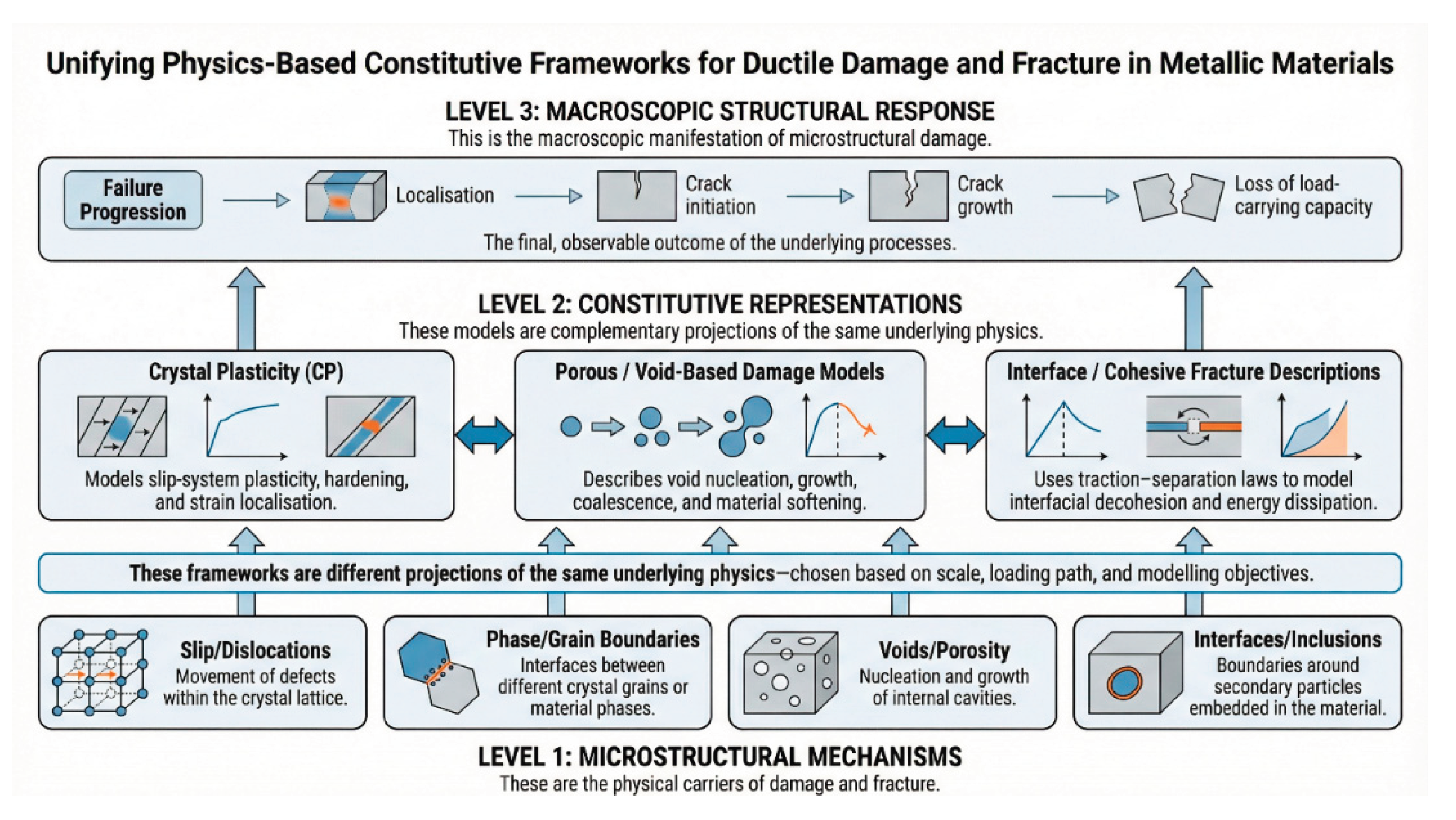
Figure 2.
Conceptual framework for integrating physics-based constitutive modelling with data-driven approaches in fatigue and fracture assessment of metallic materials, showing how crystal plasticity, porous plasticity, and interface fracture models interface with machine-learning-based surrogates, inverse identification tools, and digital twin infrastructures for uncertainty-aware structural integrity predictions.
Figure 2.
Conceptual framework for integrating physics-based constitutive modelling with data-driven approaches in fatigue and fracture assessment of metallic materials, showing how crystal plasticity, porous plasticity, and interface fracture models interface with machine-learning-based surrogates, inverse identification tools, and digital twin infrastructures for uncertainty-aware structural integrity predictions.
Disclaimer/Publisher’s Note: The statements, opinions and data contained in all publications are solely those of the individual author(s) and contributor(s) and not of MDPI and/or the editor(s). MDPI and/or the editor(s) disclaim responsibility for any injury to people or property resulting from any ideas, methods, instructions or products referred to in the content. |
© 2026 by the author. Licensee MDPI, Basel, Switzerland. This article is an open access article distributed under the terms and conditions of the Creative Commons Attribution (CC BY) license.
Copyright: This open access article is published under a Creative Commons CC BY 4.0 license, which permit the free download, distribution, and reuse, provided that the author and preprint are cited in any reuse.


