
Submitted:
13 February 2026
Posted:
14 February 2026
You are already at the latest version
Abstract
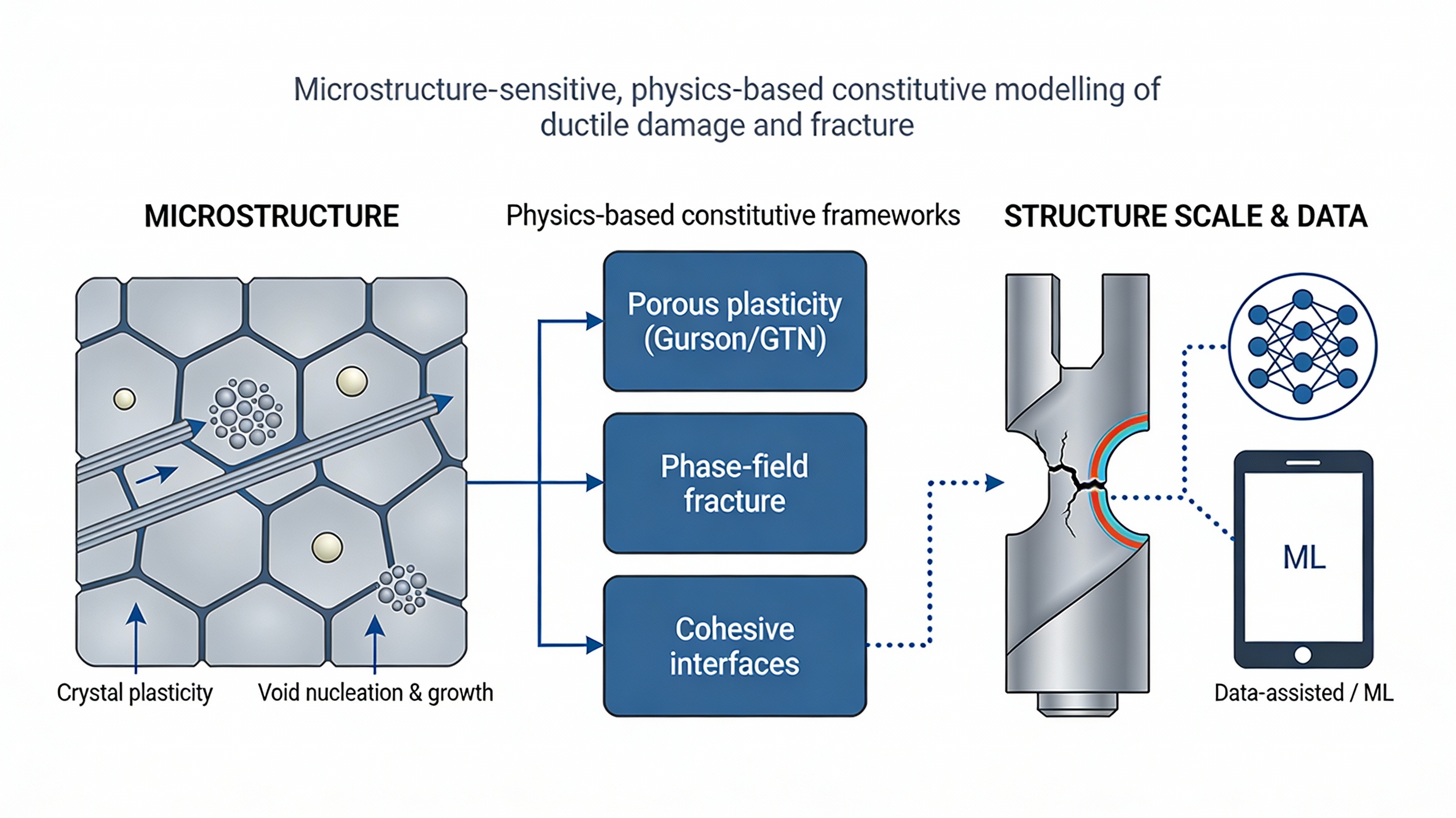
Physics-based constitutive modelling remains a cornerstone for predicting ductile damage and fracture in metallic materials, particularly where microstructural mechanisms govern macroscopic response. Over the past two decades, a wide range of crystal plasticity, porous plasticity, and void-based fracture models have been proposed to capture deformation localisation, void growth, and coalescence under complex loading paths. However, these developments are often presented in isolation, obscuring their shared physical assumptions and limiting their transferability across material systems and length scales.This article provides a microstructure-sensitive perspective on constitutive modelling of ductile damage and fracture, with particular emphasis on crystal plasticity-based frameworks, void growth and coalescence mechanisms, and interface-driven fracture. Rather than attempting an exhaustive review, this review highlights unifying concepts, modelling trade-offs, and recurring challenges related to parameter identifiability, scale bridging, and predictive robustness. It further clarifies how physics-based constitutive descriptions can be systematically integrated into modern fatigue and fracture assessments and situate these developments relative to emerging data-assisted and machine-learning-enhanced modelling strategies.By reframing established constitutive models within a coherent physical narrative, this perspective aims to support more transparent model selection, improve interpretability, and guide future developments in multiscale damage and fracture modelling of metallic materials.
Keywords:
crystal plasticity
; ductile damage
; void growth
; parameter identification
; microstructure-sensitive modelling
; data-driven constitutive models
Copyright: This open access article is published under a Creative Commons CC BY 4.0 license, which permit the free download, distribution, and reuse, provided that the author and preprint are cited in any reuse.


