
Submitted:
14 February 2026
Posted:
14 February 2026
You are already at the latest version
Abstract
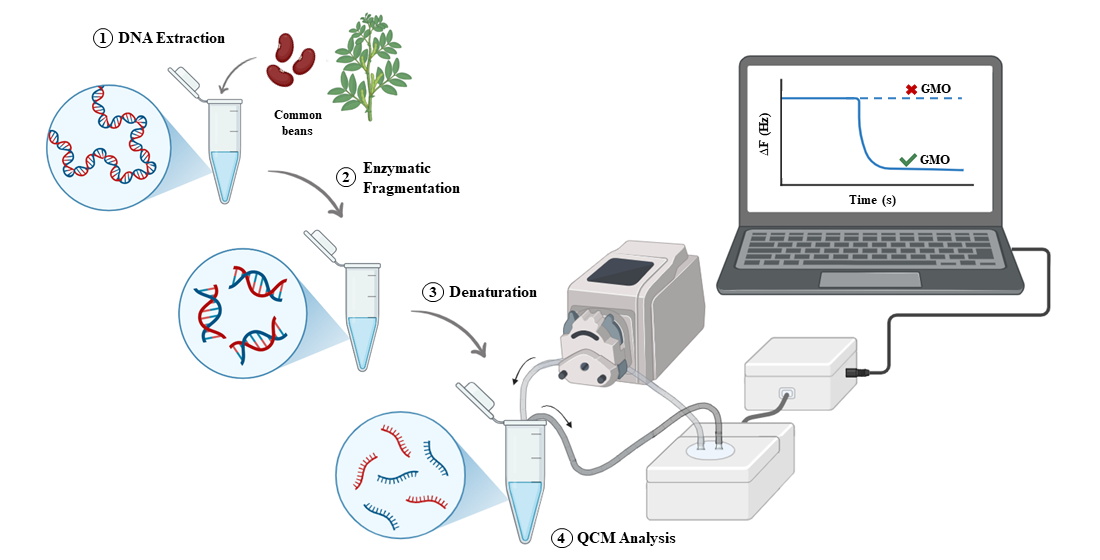
A quartz crystal microbalance-based biosensor for the specific detection of the first transgenic common bean (Phaseolus vulgaris L.) cultivar (BRS FC401 RMD) with resistance to bean golden mosaic virus (BGMV) was developed. The immobilization chemistry relies on the strong bond between the thiolated probe and the gold electrode surface. The probe sequence is internal to a region of the BGMV rep gene that was introduced into the common bean genome. The sensor's analytical performance was determined using synthetic oligonucleotides. Real samples of transgenic and wild-type bean seeds were also tested. Sample pretreatment consisted only of enzymatic fragmentation, followed by a thermal denaturation step combined with blocking oligonucleotides. Different biosensor regeneration approaches were studied. Immobilization showed good reproducibility (CV% of 5.8%). The biosensor proved specific for both synthetic oligonucleotides and non-amplified genomic DNA. A linear detection range of 0–1.4 ng/µL was observed, with a detection limit of 0.18 ng/µL. Three sequential detections were performed without loss of surface activity. The results demonstrate the biosensor's potential for direct, real-time, label-free detection of DNA samples for field screening of transgenic common bean cultivars.
Keywords:
bean golden mosaic virus
; biosensor
; common bean
; genetically modified organism
; immobilization
; quartz crystal microbalance
; regeneration
Copyright: This open access article is published under a Creative Commons CC BY 4.0 license, which permit the free download, distribution, and reuse, provided that the author and preprint are cited in any reuse.


