

Submitted:
13 February 2026
Posted:
13 February 2026
Read the latest preprint version here
Abstract
Elementary particles exhibit intrinsic phase recurrences, so each can serve as a reference clock. From this perspective, Rovelli's ``timeless'' viewpoint is best read not as denying time, but as denying the fundamentality of any preferred external time coordinate: time persists as internal cyclic variables carried by particles, covariantly modulated by energy exchange and relativistic transformations. Macroscopic flow arises from records and thermodynamic coarse-graining. Intrinsic temporal periodicity, supported by theoretical and phenomenological results published in previous works, constitutes the fundamental principle at the base of Elementary Cycles Theory, which may be regarded as a minimal, purely four-dimensional string-like framework.
Keywords:
Rovelli’s relational time
; internal times
; cyclic time dynamics
; emergent arrow of time
; relativistic covariance
; foundations of physics
; foundations of quantum mechanics
; particle physics
; undulatory mechanics
; concept of time
; philosophy of time
; general relativity
; time in general relativit
Introduction
— Definition of relativistic clock —
We experience time as a flow, yet we define it operationally by counting cycles of clocks. Clocks are, by definition, periodic phenomena:
“By a [relativistic] clock we understand anything characterized by a phenomenon passing periodically through identical phases so that we must assume, by the principle of sufficient reason, that all that happens in a given period is identical with all that happens in an arbitrary period”.(Einstein, 1910), [1]
Because we cannot access the past or the future directly, time is necessarily defined by assuming the existence of a physical process that reliably passes “ periodically through identical phases”, so that the duration of a cycle is preserved in time.
— Definition of time axis —
Modern metrology implements this idea by defining the second as the duration of a prescribed number of periods of the radiation associated with the 133Cs hyperfine transition, observed in its reference frame:
We associate to the 133Cs atomic clock a cyclic (angular) variable of period (the clock hand), named atomic clock’s Internal Cyclic (IC) proper-time ,
The ordinary time coordinate used by an observers is then obtained operationally by counting these recurrences:
This operational viewpoint carries a simple message: time is not accessed directly, but through (i) the existence of periodic phenomena and (ii) the ability to count their cycles via persistent records.
— Elementary particles as elementary clocks —
The tight link between time and periodic phenomena is not merely philosophical: it is rooted in fundamental physics. In the undulatory formulation of quantum theory, since de Broglie introduction of the concept of matter waves, we associates to any isolated particle of mass m a persistent, proper-time recurrence of Compton period in its rest frame:
In the same spirit, Penrose emphasizes:“To each isolated parcel of energy [elementary particle] with a proper mass m one may associate a periodic phenomenon of [Compton] periodicity measured, of course, in the rest frame of the particle.”.L. de Broglie (1924), [2]
“For there is a clear sense in which any individual stable massive particle plays a role as a virtually perfect clock. [...] Any stable massive particle behaves as a very precise quantum clock, which ticks away with [Compton periodicity].”.R. Penrose (2011), [3]
— Particle’s Internal Cyclic proper-time —
This suggests that we can associate the particle’s linear proper-time with an internal clock hand (phase), i.e. a cyclic (angular) variable of period (e.g. the rest frame wave function has the form ), named here particle’s IC proper-time:
— Relativistic transformations —
More generally, away from the rest frame, relativistic transformations of the particle’s proper time yields the relativistic time coordinate :
e.g. as the effect of a Lorentz transformation where is the Lorentz factor. Correspondingly, the particle’s proper-time periodicity is associated in that frame as an instantaneous time periodicity T whose rate is locally modulated along the particle’s evolution by its energy, exactly as for a relativistic clock,
Thus elementary particles can be regarded as relativistic clocks of nature: their ticking rates transform covariantly under changes of reference frame and are dynamically modulated by interactions through energy exchange. The “phase harmony” condition remains always satisfied throughout the evolution, [4,5,6,7,8,9,10,11,12,13,14,15,16],
— Particle’s Internal Cyclic time —
In this sense elementary particles play a role conceptually analogous to the 133Cs atomic clock: each particle can, in principle, be used to define the relativistic time coordinate .
In Rovelli’s terminology one may speak of an “internal time” for each constituent. Here however we emphasize that, for quantum matter, these “internal times” have a cyclic character. Indeed, in quantum mechanics time enters the dynamics as the argument of a phasor (e.g.). Accordingly, for the i-th particle of local energy we can introduce an angular “clock-hand” variable of instantaneous period locally modulated by the particle’s energy ,
which we call the particle’s IC time.
The IC time is fully determined by the particle’s IC proper-time through relativistic transformations and interactions, in the same way in which the instantaneous period is determined from the Compton time :
Therefore, the universality of these elementary internal clocks is ultimately fixed by the universality of particle masses through the Compton relation .
— Massless particles and gravity —
Massless particles play a special role in this picture. A photon has no rest frame and its Compton time is infinite: “a photon would take until eternity before its internal ’clock’ gets even to its first ’tick’!”, R. Penrose (2011), [3]. In spite of its “frozen” internal Compton clock, a photon still carries a well-defined phase evolution in any chosen inertial frame. Thus it can be treated as a relativistic clock with an IC time . For instance, a photon with constant energy is a periodic phenomenon of persistent ticking rate .
For a massive particle upper value of the instantaneous recurrence is bounded by the Compton recurrence , since . For massless particles, instead, no such upper bound exists and its time recurrence can become arbitrary large as . In this sense, low-energy light provides the closest operational analogue to an “external” time reference within a purely clock-based description. Being the long-range mediator of interactions, electromagnetic radiation supplies natural reference signals for comparing phases and synchronizing clocks, suggesting a relational picture in which photons carry phase information that mediates mutual modulations of massive clocks [4,8].
Finally, independently of whether gravity is quantized in terms of gravitons, General Relativity teaches that gravitational fields act precisely by redshifting energies, hence by modulating local ticking rates. Gravity induces covariant time-dependent modulations of the elementary recurrences, which is the aspect of gravity relevant for our discussion of time flow — in [4,8] we have provided a similar geometrodynamical description, in terms of clocks modulations, for the electromagnetic interaction.
Internal times and general covariance:
Remarkably, the use of particles’ IC times described above, is naturally motivated by General Relativity. As also pointed out by Rovelli, [17], in generally covariant dynamics there is no preferred coordinate time with invariant physical status, see also [18,19,20]. Consequently, evolution is most naturally formulated relationally, in terms of correlations among observables serving as internal clocks. This provides additional motivation for our framework, whereby the microscopic clock degrees of freedom are identified with the particles’ IC times (e.g., ) and their mutual correlations.
Relational Description of Evolution from Particles’ Internal Cyclic Times
The central thesis of this paper is that the ordinary time axis t (or τ) is an auxiliary parameter, while the physically relevant temporal information is fully captured by the IC times (or ) and by their relational correlations. This perspective may also be relevant to the problem of time in quantum gravity, [17,21,22].
Figure 1.
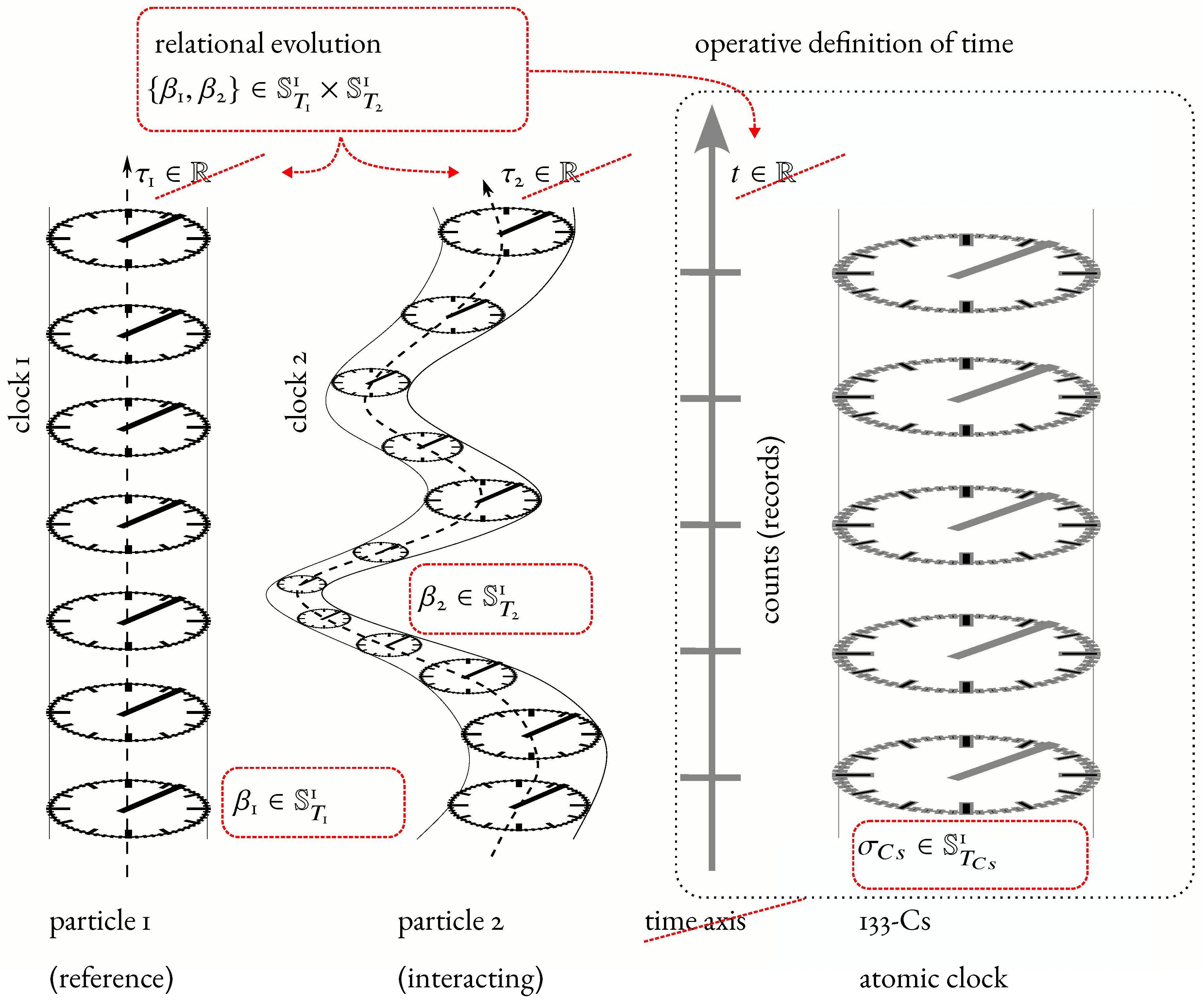
Relational evolution from internal cyclic times. In the quantum description, each particle is an elementary clock with internal time of cyclic character (phase recurrence/clock hand) (left). The physical evolution can be relationally described by correlations between the internal times , without introducing an independent external time parameter. Interactions appear as modulations of the internal periodicity (clock 2). The usual time coordinate is dispensable and can be operationally defined by counting cycles (right) of the 133Cs atomic clock with period , or, in principle, of the rest particle of quantum recurrences (clock 1).
— Rovelli’s general structure of the dynamical systems —
Rovelli’s relational construction [21,22] can be restated in a form that is particularly transparent for fundamental physics. Instead of a macroscopic reference clock and a modulated pendulum [21], we consider two elementary particles (elementary clocks): particle 1 serving as a reference (e.g. a massive particle at rest, so that ) while particle 2 is modulated by motion and/or interactions through energy exchange, see Fig.(1).
By following Rovelli’s line, [21,22], let denote their phase readings, where each is the angular variable parametrizing the cyclic evolution of the i-th clock, i.e. the particle’ IC time. The physical content of the dynamics is the set of allowed pairs , i.e. a curve in the two-dimensional “event space” . This curve can be read symmetrically as “clock 2 versus clock 1” or vice versa; no preferred background time is required, Fig.(1).
In fact, such a relational evolution can be selected by a reparametrization-invariant variational principle on the constraint surface
where H denotes the relativistic Hamiltonian constraint implementing the absence of a preferred evolution parameter , and are the phase-space coordinates of the i-th particle, [21,22]. The corresponding action may be written as
— From timeless construction to particles’ Internal Cyclic Times —
Rovelli’s choice of two periodic phenomena (a reference clock and a pendulum) is natural, but it also highlights a subtle point: by selecting a clock within the description one has already introduced, implicitly, a cyclic notion of time, i.e. the IC time of the clock (or of the pendulum, by considering time modulations). At the purely classical level one may argue that explicitly periodic systems are not strictly necessary1. The same relational construction can be implemented using any pair of monotonic parameters extracted from the evolution (linear variables in suitable regimes), yielding a curve in an “event space”.
The situation becomes qualitatively different once the fundamental quantum nature of matter is taken seriously. Every physical system is inevitably decomposed into elementary constituents (as in the Standard Model, plus gravity), and elementary particles are not generic classical degrees of freedom: they are elementary clocks. Therefore, when quantum systems are described relationally, “clock” degrees of freedom are not merely an illustrative choice: they are necessarily built into the description through the phases of the elementary constituents. In the quantum description, a formulation in terms of internal clocks is essentially unavoidable, because every elementary particle described in terms of undulatory mechanics is a clock.
Since every physical system is fundamentally composed by elementary particles, i.e. clocks, the conceptual distinction becomes sharp. Rovelli’s thesis [17,21,22] is often summarized as “timeless physics” — and sometimes paraphrased (too strongly) as “time does not exist” [25,26,27]. In our reading, the formalism supports a milder and more physical statement: the external relativistic time axis is an auxiliary parameter, but time inevitably persists as IC times carried by elementary particles, which are the only fundamental physical parameter relevant for the evolution:
Time Flow and the Entropic Arrow from Ensembles of Interacting Elementary Particles
We extend the previous result to generic many-body systems. If the universe is ultimately composed of elementary particles (as in the Standard Model, plus gravity), and if each elementary particle carries an intrinsic recurrence (an internal phase acting as an elementary clock), then the evolution of any physical system can, in principle, be described relationally in terms of correlations of IC times (and their relativistic modulations due to interactions, including gravitational redshift), without introducing a preferred external time coordinate, and the usual notion of time flow, with its irreversibility, emerges from statistics.
In this sense the system’s evolution can be viewed as a very complex “calendar” of coupled cycles whose fundamental periods are continuously reshaped (modulated) by interactions.
— Clockwork universe —
Although Rovelli’s construction considers clocks or pendulums as illustrative cases, a relational description of evolution in terms of elementary cycles is implicit in the undulatory formulation of matter (and, more generally, in the Hamilton-Jacobi optomechanical analogy [4,5,7,23,24]): the fundamental constituents behave as relativistic clocks whose recurrences are set and locally modulated by energy (including gravitational redshift). We therefore inhabit a universe of interacting, modulated clocks. Importantly, describing a system in terms of its elementary clocks does not imply that the system (or the universe) evolves periodically: complex many-body phenomena, including phase mixing and chaos, arise precisely from coupling and modulation of the individual clock phases.
A single isolated clock is perfectly cyclic. With two clocks of incommensurate periods, , the combined phase point does not close and instead explores the phase space ergodically. In interacting ensembles, energy exchange continuously modulates the local periods, e.g. via thermal collisions, generically producing non-periodic and potentially chaotic many-clock dynamics.
— Relational description of many-particles —
The generalization of Rovelli’s argument given above to many-particles still merely shifts the description to relational variables , with , while any background time coordinate remains auxiliary. The evolution of a interacting ensemble of particles is still described in a relational way in terms of the (chaotically modulated) IC times of the elementary clocks , where the external time axis becomes auxiliary.
— Cycles counting from thermodynamics —
What remains to be explained is not “motion” or “change”, but the familiar experience of time flow and the apparent irreversibility of macroscopic processes, together with the possibility to count time cycles of a clock, i.e. to have records (degrees of freedom that store information about correlations and can be read out reliably).
As correctly shown by Rovelli, [17,21,22], thermodynamics provides exactly such a mechanism: macroscopic variables act as stable pointers, and entropy production correlates the creation of records with coarse-graining and loss of microscopic phase information. It is in this sense that an “entropic time” (or, in Rovelli’s terminology, “thermal time”) emerges: a monotonic parameter associated with the growth of accessible records and with the increase of entropy in typical nonequilibrium evolutions.
This means that one may still choose a reference clock and use it operationally to label evolution by means an external time axis (or ) obtained by counting clock cycles, but again this choice is a convention rather than a fundamental ingredient:
— Irreversible time flow from statistic —
From the perspective of elementary clocks, coarse-graining means that most microscopic phase relations of an ensemble become practically inaccessible. Interactions continuously reshuffle energies, and therefore modulate the ticking rates, producing a progressive scrambling of relative phases. For an observer who can only access macroscopic records, this phase mixing manifests as an effectively irreversible evolution toward the most probable macroscopic configurations.
Consider an ensemble initially prepared in such a way that all particles have the same energy (the same periodicity), and let the particles interact undergoing elastic scattering (as in dilute gas at finite temperature, i.e. particles with non vanishing kinetic energies). Microscopically, each particle of energy carries an IC time , while thermal collisions randomly redistribute energy and thus chaotically modulate individual ticking rates . From the initial conditions, the ensemble evolves for statistical reasons toward a Maxwell-Boltzmann distribution in energy and, correspondingly, to a chaotic distribution of ticking rates. The approach to equilibrium is overwhelmingly likely because the equilibrium macrostate occupies an astronomically larger region of phase space than the initial low-entropy configurations.
This highlights the conceptual distinction at the core of our proposal between the fundamental internal cyclic times of the particles and the macroscopic entropic time. The internal cyclic time is the fundamental physical microscopic variable of cyclic character carried by each particle. The entropic time is a macroscopic, effectively monotonic parameter emerging from coarse-graining and from the statistics of many interacting clocks, i.e. from the formation of records and the typical increase of entropy.
The IC times of the elementary particles are the only physically relevant temporal coordinates (the external time axis can be dropped) while the entropic time, characterizing time flow, has a mathematical origin, emerging from the statistical description of the phases of the elementary clocks constituting the system.
Consider to reverse the orientation of the internal phase evolution of each clock (e.g. from clockwise to anticlockwise). This means that we are reversing the IC times of all the particles constituting the system. But this global inversion of the microscopic times do not, by itself, mean to invert the flow of time (i.e., the “entropic time”) and recover the initial low-entropy macrostate in which all clock have the same period (same energy). The system, through the chaotic thermal collisions, will evolve anyway toward the Maxwell-Boltzmann distribution in energy. Therefore, the inversion of the IC time in each particle (or in a single particle2) does not generically reverse the macroscopic arrow of time.
The extreme improbability of returning to the initial ordered configuration is not a dynamical prohibition at the level of individual clocks; it is a statistical statement about the relative measure of microstates compatible with the macroscopic constraints (i.e., it is overwhelmingly unlikely that the ensemble will spontaneously reassemble into a state where all particles share the same energy). This explains why reversing the microscopic IC times does not, in general, reverse the macroscopic arrow: one may invert the internal phase evolution of the constituents, yet the entropic arrow remains effectively unchanged. In this sense the observed irreversibility, and the practical impossibility of “traveling backward in time”, is a mathematical consequence of statistics, while the underlying dynamical laws remain consistent with time-reversal at the microscopic level.
Minimal String-Inspired Model from Elementary Cycles Theory
The present “internal-clock” viewpoint invites a brief comparison with String Theory. Historically, Veneziano’s dual amplitude and the associated Regge behavior motivated the dual-resonance program. Nambu, Nielsen, and Susskind (among others) then recognized the underlying string interpretation, leading to the worldsheet picture and the Nambu?Goto (area) action. In that framework one introduces embedding fields mapping a two-dimensional worldsheet into a D-dimensional target spacetime, [28,29,30]. Quantum consistency of the standard bosonic/superstring selects critical target dimensions: e.g. for the bosonic string.
The compact coordinate characterizes the string nature of the theory, yielding harmonic mode expansions, tower-like spectra and the Virasoro algebra — for open strings it lies on an interval with boundary conditions. However, a formulation based on a single compact proper parameter was believed to give a “static” model. This motivated the introduction of the non-compact coordinate , playing the role of a worldsheet proper-time parameter, and explicitly describing time dynamics.
Our relational description of the flow of time suggests, however, that one can consistently identify the compact parameter of String Theory with the particle’s with internal proper-time and still retain the nontrivial notion fo dynamical evolution. From this viewpoint, introducing an additional non-compact worldsheet paramenter acting as proper-time is not essential. The relevant dynamics are encoded relationally in the correlations among internal clocks, i.e. in the relativistic transformations . In this sense, the string structure reduces to Elementary Cycles Theory (ECT), [4,5,6,7,8,9,10,11,12,13,14,15,16], as minimal, purely four-dimensional construction in which time dynamics emerges relationally from the particles’ internal clocks, e.g. [9,14,15]:
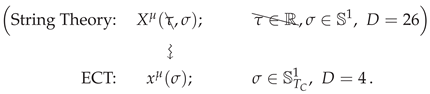
For this reason, ECT inherits interesting good mathematical properties of ordinary String Theory, without introducing (problematic) extra target-space dimensions. For instance, the Virasoro algebra reduces to the ordinary algebra of the ladder operators , where second quantization is implicit in the condition of intrinsic periodicity, [4,5]: . Also, by assuming the internal compact proper-time on an Anti de Sitter geometry, one obtains realistic prediction of the hadronic mass spectrum, [15,31,32,33]. Furthermore, in the ECT formalism the classical to quantum correspondence of AdS/CFT becomes manifest [15]. The physical consistency and phenomenological viability of ECT have been tested across 22 peer-reviewed papers, e.g. [6,7,8,9,14,15,16], briefly summarized in the Supplemental Material.
These remarks are intended as an analogy: ECT and String Theory address different aims and are different frameworks.
— Geometrodynamical description of interactions —
Finally, we report that the same clock-based viewpoint suggests a unified geometrodynamical description of interactions as local phase modulations of the internal recurrences: gauge effects correspond to organized rephasings (holonomies), parallel to the gravitation redshift of relativistic clocks’ ticking rates, [4,8].
Conclusions
Building on Rovelli’s relational viewpoint, we have shown that dynamics can be formulated entirely in terms of the internal cyclic times carried by elementary particles. These are the physically meaningful temporal coordinates, while the usual external relativistic time parameter can be regarded as auxiliary. Macroscopic, effectively irreversible (“entropic”) time then emerges statistically, through coarse graining and the accumulation of records.
This addresses a common objection to ECT [4,5,6,7,8,9,10,11,12,13,14,15,16]: how can coherent dynamics arise if particles obey intrinsic temporal periodicity (compact internal times with periodic boundary conditions)? As for any clock, the relevant physical information is encoded within a single period, with interactions appearing as dynamical modulations. This perspective naturally suggests a minimal, purely four-dimensional “string-like” description in which the compact worldsheet parameter is identified with the particle’s internal clock, without requiring an additional non-compact worldsheet time to represent evolution. As established in previous work, the constraint of intrinsic time periodicity act as a quantization condition reproducing standard quantum mechanics and quantum phenomenology, and support a unification-oriented interpretation of interactions as geometrical modulations of internal cyclic times.
Appendix A. Main Implications in Theoretical Physics and Phenomenology
The relational picture developed in this paper in terms of the particles’ IC times is not a purely conceptual exercise, but it allows the possibility a powerful novel formalism in fundamental physics and phenomenology, as proven in previous academic publications, see for instance [4,5,6,7,8,9,10,11,12,13,14,15,16].
Appendix B. Short Review of Elementary Cycles Theory
If each elementary constituent is a clock, then the relevant physical information is fully encoded in one cycle and its covariant modulations: “all that happens in a given period is identical with all that happens in an arbitrary period” [1]. Motivated by this, ECT, [4,5,6,7,8,9,10,11,12,13,14,15,16], treats the IC times as compact coordinates with Periodic Boundary Conditions (PBCs) [16], similarly to the “cyclic” extra-dimension of the Kaluza-Klein theory [34,35], with local compactification length dynamically modulated by energy exchange, in order to consistently reproduce dynamics.
— Quantum foundations from intrinsic time periodicity —
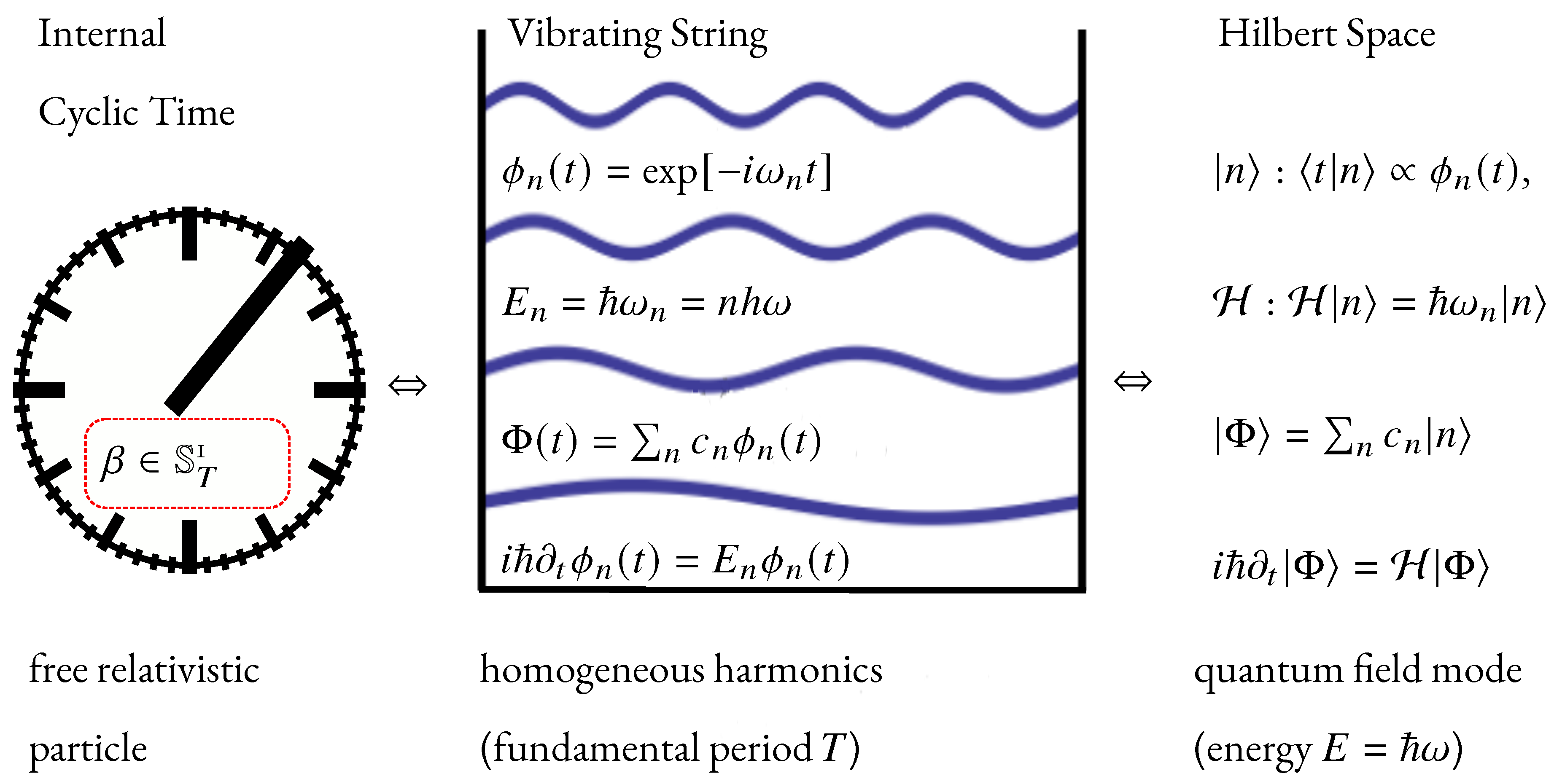
In this paper we deliberately refrain from addressing foundational issues in Quantum Mechanics (QM), in order to keep the focus on time and its flow. We only recall a few relevant results established in our previous works: standard quantum phenomenology can be understood as the manifestation of intrinsic temporal recurrences (or ) of elementary particles implemented as a constraint (i.e. via temporal PBCs), in a way that precisely parallels, in all the fundamental aspects, the three main quantization prescriptions: canonical quantization [7,8,10,14,15,16], second quantization [6,7,8,9,14,15,16], and the path-integral formulation [8,9,10,11,15,16]. For instance, by assuming intrinsic periodicity of the internal time, for a free relativistic particle we directly get (Fourier) the Planck energy spectrum and the second quantization spectrum of a field mode (up to a phase twist/vacuum energy), , with (positive and negative frequencies), Fig.(2).
Figure A1.
Schematic illustration of the correspondence between intrinsic time periodicity, vibrating string, and the Hilbert-space formulation of QM. A free relativistic particle is represented as an elementary clock with internal cyclic time of period T (left), implying periodic dynamics in the field description that admits a discrete harmonic expansion with frequencies and thus a quantized energy spectrum (center). The same complete set of harmonics can be therefore mapped to a Hilbert-space basis , with state and Schrödinger evolution generated by (right), a dictionary illustrating how cyclic internal time leads naturally to discretization and standard QM notation, [4,5,6,7,8,9,10,11,12,13,14,15,16] (canonical commutation relations are also implicit in the constraint of intrinsic periodicity [7]).
— Correspondence with Canonical Quantum Mechanics —
In general, see for instance [7], for every sympathetic physical system, the intrinsic periodicity of the internal times, directly implies Dirac’s quantization rules: the Schrödinger evolution is in the cyclic dynamics, Hilbert space naturally emerges from decomposition in complete sets of “stringy” eigenstates resulting from the PBCs, and the canonical commutation relations in terms of the Hilbert operators are a direct mathematical consequence of the intrinsic time periodicity, [7]:
where and are the Poisson’s brackets.
In this view, quantization is not an axiom but the spectral discretization induced by intrinsic periodicity, resulting in a “stringy” description , Fig.(2), where and the target spacetime is naturally the ordinary four-dimensional spacetime: with , e.g.[9]. The constraint of IC proper-time (or the IC time), acting as exact quantization condition, can account for the whole quantum and classical-relativistic dynamics of the particles [4,5,6,7,8,9,10,11,12,13,14,15,16].
— Entanglement —
The intrinsic-periodicity constraint introduces a classical, topological form of long-range correlation that accommodates Bell’s “non-locality” requirement, [36], in a precise sense: for an unperturbed (interaction-free) clock, recurrence implies that the phase at one event fixes the phase at events separated by integer multiples of the period, provided the system remains isolated from interactions. At the same time, elementary clocks are locally modulated by interactions (e.g.gravity or electromagnetism) through energy exchange, so any change in the recurrence is generated causally within the light cone, in agreement with Einstein’s locality, [37]. Within ECT, this mechanism has been shown to reproduce quantum entanglement and the standard quantum violation of Bell/CHSH inequalities from the underlying cyclic classical mechanics, where Bell’s and Einstein’s views are finally conciliated, [5].
— Condensed matter —
These ideas also motivate applications in condensed matter, where thermal noise can be viewed as a continual reshuffling of the particles’ recurrence regimes. In practice, temperature and the Boltzmann constant introduces a characteristic Euclidean (imaginary-time) periodicity , which we name “thermal time”: it is the natural time scale of finite-temperature field theory and Matsubara formulations [12,13]. It is interesting to note that, in Matsubara theory, the thermal system is quantized by imposing periodicity in Euclidean time by means of PBCs (with period ), [38,39]. This is structurally analogous to the quantization prescription in ECT by intrinsic Minkowskian recurrences imposed as constraint (PBCs).
Operationally, controls the damping of Minkowskian phase coherence: the oscillatory factor is accompanied, in the thermal setting, by the Boltzmann weight , encoding the probability for a constituent to maintain a persistent recurrence .
From this viewpoint, a many-body system is governed by the competition between the mean Minkowskian recurrence of its constituents and the thermal Euclidean time . In the low-temperature regime, , equivalently , thermal reshuffling is weak and the system is characterized by the intrinsic cyclic dynamics that remain phase-coherent. In analogy with Huygens-like synchronization of coupled pendulum clocks or metronomes, the internal clocks can effectively lock into a common recurrence,
reproducing the collective quantum phenomena typically occurring at low-temperatures and characterized by long-range coherence and robust periodic order, [10,11,12,13,14]. Quantum dynamics are in general the manifestations of the intrinsic IC times of the constituents.
In the opposite regime, (i.e. ), high frequency thermal collisions, and the consequent fast reshuffling of the cyclic behavior compared to the characteristic minkowskian periodicity , rapidly destroys the internal cyclic dynamics characterizing QM toward an effectively classical behavior, where the entropic arrow dominates the phenomenology of time flow. In Refs. [11,12,13] we showed how this competition between Euclidean and Minkowskian periodicities provides a quantitative route to the quantum-to-classical transition, with direct implications, for instance, in superconductivity, which can be formally derived in all its fundamental aspects as a direct consequence of intrinsically cyclic dynamics of the charge carriers.
The internal clocks associated with elementary particles typically tick far faster than the temporal resolution of today?s best timekeepers (at the level of s, in effective timing sensitivity), and are therefore not directly accessible in ordinary laboratory conditions (with notable exceptions such as neutrinos). For example, the electron?s Compton period s. Much like a die rolled too rapidly to resolve individual faces, such ultra-fast cyclic dynamics can only be accessed through its statistical outcomes, which precisely reproduces standard QM outcomes, as proven in ECT results [4,5,6,7,8,9,10,11,12,13,14,15,16].
Remarkably, carbon nanotubes provide an effective analogue to the particles’ internal clocks: their compactified spatial circumference can simulate the particles? intrinsic cyclic time, rescaling the recurrences of elementary particles to experimentally accessible time scales. This accounts for key electronic properties of nanotubes and offers a concrete arena in which deviations from the purely statistical (QM) regime: potential signatures of physics beyond standard QM, could, in principle, become observable to experiments, [12,13].
References
- A. Einstein, Arch. Sci. Phys. Natur. 29 (1910).
- L. d. Broglie, The London, Edinburgh, and Dublin Philosophical Magazine and Journal of Science 47, 446 (1924).
- R. Penrose, “Cycles of Time. An Extraordinary View of The Universe,” (Knopf, New York, 2011) Chap. 2.3.
- D. Dolce, Electromagnetism as U(1) holonomy from phase harmony and Fermi-Walker transport, (Under review: Annals of Physics) .
- D. Dolce, Quant. Stud. Math. Found. 12, 26 (2025). [CrossRef]
- D. Dolce, Annals of Physics 457, 169398 (2023a). [CrossRef]
- D. Dolce, Annals of Physics 448, 169182 (2023b).
- D. Dolce, Annals of Physics 327, 1562 (2012a), arXiv:1110.0315 . arXiv:1110.0315. [CrossRef]
- D. Dolce, International Journal of Quantum Foundations 8, 125 (2022). arXiv:2106.05167.
- D. Dolce, in Beyond Peaceful Coexistence: The Emergence of Space, Time and Quantum, edited by I. Licata (2016) pp. 93–135.
- D. Dolce, EJTP. 12, 29 (2016b). arXiv:1606.01918.
- D. Dolce and A. Perali, Eur. Phys. J. Plus 130, 41 (2015). arXiv:1403.7037.
- D. Dolce and A. Perali, Found.Phys. 44, 905 (2014). arXiv:1307.5062.
- D. Dolce, EPL 102, 31002 (2013). arXiv:1305.2802. [CrossRef]
- D. Dolce, Annals of Physics 327, 2354 (2012b). arXiv:1110.0316. [CrossRef]
- D. Dolce, Found. Phys. 41, 178 (2011). arXiv:0903.3680v5.
- C. Rovelli, Class. Quant. Grav. 10, 1549 (1993). [CrossRef]
- M. B. Altaie, D. Hodgson, and A. Beige, Frontiers in Physics 10 (2022). [CrossRef]
- D. N. Page and W. K. Wootters, Phys. Rev. D 27, 2885 (1983). [CrossRef]
- E. Moreva, M. Gramegna, G. Brida, L. Maccone, and M. Genovese, Physical Review D 96 (2017). [CrossRef]
- C. Rovelli, Found.Phys. 41, 1475 (2011). arXiv:0903.3832.
- C. Rovelli, Physical Review D 65 (2002). [CrossRef]
- A. Fasano, S. Marmi, S. Marmi, et al., Analytical mechanics: an introduction (Oxford University Press on Demand, 2006).
- J. Masoliver and A. Ros, European journal of physics 31, 171 (2009). [CrossRef]
- J. Barbour, B. Z. Foster, and N. O. Murchadha, Classical and Quantum Gravity 19, 3217 (2002). [CrossRef]
- J. Barbour, The End of Time: The Next Revolution in Physics (Oxford University Press, 2001).
- J. Barbour, (2009) . arXiv:0903.3489.
- T. E. Regge, Il Nuovo Cimento (1955-1965) 14, 951 (1959). [CrossRef]
- G. Veneziano, Nuovo Cimento 57, 190 (1968). [CrossRef]
- In The birth of string theory; A. Cappelli, E. Castellani, F. Colomo, and P. Di Vecchia, eds., The birth of string theory (Cambridge Univ. Press, Cambridge, UK, 2012).
- A. Chodos, R. L. Jaffe, K. Johnson, C. B. Thorn, and V. F. Weisskopf, Phys. Rev. D 9, 3471 (1974). [CrossRef]
- S. S. Afonin, The European Physical Journal C 71 (2011). [CrossRef]
- L. Susskind, Journal of Mathematical Physics 36, 6377 (1995). [CrossRef]
- T. Kaluza, Sitzungsber. Preuss. Akad. Wiss. Berlin (Math. Phys. ) 1921, 966 (1921).
- O. Klein, Z. Phys. 37, 895 (1926). [CrossRef]
- A. Aspect, P. Grangier, and G. Roger, Phys. Rev. Lett. 49, 91 (1982). [CrossRef]
- J. S. Bell, Physics Physique Fizika 1, 195 (1964). [CrossRef]
- J. I. Kapusta and C. Gale, Finite-temperature field theory: Principles and applications, Cambridge Monographs on Mathematical Physics (Cambridge University Press, 2011).
- J. Zinn-Justin, (2000), hep-ph/0005272 .
| 1 | In general, however, the Hamilton-Jacobi optomechanical analogy states that every Hamiltonian system has a dual undulatory description and therefore a formulation in terms of instantaneous recurrences modulated by the energy. This suggests that the thesis of this paper has also a more general validity, directly rooted in classical mechanics, [4,5,7,23,24]. |
| 2 | Inverting the time coordinate in a single clock, doesn’t implies to invert the other, as every particle has its own IC time. In ECT this inversion corresponds to pass from particle to antiparticle description, allowing Feynman interpretation of antiparticle. |
Disclaimer/Publisher’s Note: The statements, opinions and data contained in all publications are solely those of the individual author(s) and contributor(s) and not of MDPI and/or the editor(s). MDPI and/or the editor(s) disclaim responsibility for any injury to people or property resulting from any ideas, methods, instructions or products referred to in the content. |
© 2026 by the authors. Licensee MDPI, Basel, Switzerland. This article is an open access article distributed under the terms and conditions of the Creative Commons Attribution (CC BY) license (http://creativecommons.org/licenses/by/4.0/).
Copyright: This open access article is published under a Creative Commons CC BY 4.0 license, which permit the free download, distribution, and reuse, provided that the author and preprint are cited in any reuse.