

Submitted:
13 February 2026
Posted:
13 February 2026
You are already at the latest version
Abstract
Perovskite oxide photoanodes are attractive for alkaline water oxidation but are commonly limited by interfacial recombination and sluggish charge transfer. Here we enhance anisotropic SrTiO3 (STO) photoelectrodes via Al doping and identify an optimal composition at 4% Al. In 0.1 M NaOH (pH 13) under simulated AM 1.5G illumination, 4% Al:STO exhibits the highest transient/steady photocurrent and the best LSV performance among all samples, together with a markedly reduced interfacial impedance, indicating accelerated charge extraction and transfer. High-resolution XPS confirms Al incorporation and reveals suppressed Ti3+-related defect states with modified oxygen-associated surface species, consistent with mitigated trap-assisted recombination. Band-structure analysis shows a negative shift in flat-band potential and slight band-gap narrowing after Al doping, providing more favorable carrier energetics. Steady-state and time-resolved photoluminescence further demonstrate strong PL quenching and prolonged carrier lifetime for 4% Al:STO. ECSA analysis suggests increased electrochemically accessible surface sites at the optimal doping level. Overall, moderate Al doping synergistically tunes defects, band energetics, and interfacial kinetics to improve STO photoanodes for solar water splitting.
Keywords:
photoanodes
; Al-doped SrTiO3 catalysts
; defect engineering
; anisotropic crystals
1. Introduction
Photoelectrochemical water splitting represents a promising pathway for sustainable hydrogen production, driving extensive research into semiconductor photocatalysts such as metal oxides [1], transition metal hydroxides [2], and metal chalcogenides [3]. Perovskite-type semiconductors, particularly strontium titanate (SrTiO3), have garnered significant attention due to their exceptional electronic, optical, and photocatalytic properties, making them highly attractive for applications such as hydrogen evolution, carbon dioxide reduction, and environmental remediation [4,5,6]. The photocatalytic efficiency of SrTiO3, however, is often constrained by its electronic structure and the inherent recombination of photo-generated charge carriers [7,8]. To address these limitations, various strategies, including doping with metal ions, have been explored to enhance the catalytic performance and stability of SrTiO3 [9,10,11]. Among these, aluminum doping (Al3+) has shown considerable promise, demonstrating a positive impact on both the electronic properties and photocatalytic behavior of SrTiO3 by modifying its band structure, reducing charge recombination, and improving overall efficiency.
The introduction of Al3+ ions into SrTiO3 can result in the substitution of Ti4+ ions in the crystal lattice, leading to the formation of oxygen vacancies and altering the electronic properties of the material. The created oxygen vacancies can act as active sites for charge carrier separation and surface reaction processes [12]. Al3+ doping has been shown to replace Ti3+, a common recombination center for charge carriers, which helps reduce the electron-hole recombination rate, thereby improving the material’s photoelectrochemical properties [11,13]. Studies have also demonstrated that Al3+ doping can narrow the band gap, increase light absorption, and improve charge separation efficiency [13]. Previous studies have shown that Al3+ doping can significantly improve the photocatalytic hydrogen evolution performance by introducing new impurity states in the valence and conduction bands, thereby enhancing light absorption and reducing recombination. For instance, Sakata et al. demonstrated that Na+ doping in SrTiO3 could optimize its photocatalytic properties [14], while Domen et al. reported that Al3+ doping in SrTiO3 resulted in an increase in quantum efficiency for water splitting [15]. Zhao et al. applied density functional theory (DFT) to demonstrate that the electronic structure of Al-doped SrTiO3 is influenced by the relative positioning of Al3+ ions and oxygen vacancies, with Al3+ ions near oxygen vacancies being particularly effective in suppressing defects [16]. Moreover, Su et al. highlighted how uniform Al3+ doping increases surface oxygen vacancies, which significantly enhance charge carrier separation and migration, ultimately improving photocatalytic water splitting efficiency [17]. Thus, controlling the concentration of Al3+ is vital for optimizing the photocatalytic performance of SrTiO3.
On the other hand, the crystal anisotropy is important in influencing the photocatalytic performance of SrTiO3. The unique directional properties of anisotropic crystals can provide enhanced charge transport and facilitate faster reaction kinetics in PEC processes [18]. The synthesis of anisotropic SrTiO3, combined with Al3+ doping, can offer a novel approach to enhancing the photo-electrocatalytic activity by not only improving the material’s structural stability but also optimizing its electronic and surface properties.
This study lies in the development of a simple yet effective one-step hydrothermal method for Al3+ doping, which could provide a scalable approach for producing SrTiO3 based photoelectrodes. Furthermore, it will provide new insights into how Al3+ doping can address the challenges faced by SrTiO3 based catalysts, particularly in enhancing their photo-electrocatalytic efficiency. By focusing on the anisotropic nature of SrTiO3 and its interaction with Al3+ ions, this study will offer a deeper understanding of the doping mechanism and its impact on the material’s photocatalytic behavior, laying the groundwork for designing more efficient perovskite-based photoelectrodes for sustainable hydrogen production.
2. Experimental Section
2.1. Chemical Reagents
Titanium tetrachloride (TiCl4), strontium chloride hexahydrate (SrCl2·6H2O), aluminum nitrate nonahydrate (Al(NO3)3·9H2O), potassium hydroxide (KOH), ethylene glycol and deionized water were purchased from Aladdin Industrial Corporation (Aladdin, Shanghai, China). FTO conductive glasses were obtained from Xinke Experimental Supplies Sales Center (Shenyang, China). All chemicals possessed in the experiments were analytical grade (AR) were used without further purification. All aqueous solutions were prepared using deionized water with a resistivity greater than18.25 MΩ·cm.
2.2. Synthesis of Pristine SrTiO3 and Al-Doped SrTiO3
The pristine SrTiO3 and Al-doped SrTiO3(Al-STO) samples in this experiment were synthesized via a one-step hydrothermal method. First, 2 g of ethylene glycol was uniformly mixed with 35 mL of deionized water and stirred in an ice bath. After thorough mixing, 0.265 mL of TiCl4 was rapidly added to the ethylene glycol aqueous solution in a fume hood. The beaker was sealed, and the mixture was stirred on a magnetic stirrer in the ice bath for 0.5 hours. Subsequently, 64 mg of SrCl2·6H2O and the corresponding molar ratios (0%, 2%, 3%, 4%, 5%, and 6%) of Al(NO3)3·9H2O were dissolved in 10 mL of deionized water, and the solution was stirred to ensure complete dissolution.
The above two solutions were then mixed thoroughly and stirred for an additional 0.5 hour. A 3 mol/L KOH solution was prepared and added, with 30 mL of this solution introduced into the mixed solution while adjusting the pH to the desired value. The resulting mixture was transferred to a Teflon-lined autoclave and placed in a hydrothermal reactor. The reaction was carried out at 180 °C for 48 hours, followed by natural cooling. The product was washed until neutral, then dried in an air-drying oven. After complete drying, the samples were finely ground to obtain pristine SrTiO3 and Al-doped SrTiO3 (with x% Al) powders.
2.3. Photoelectrode Fabrication
The Al-doped SrTiO3 (Al-STO) photoelectrodes were prepared by drop-casting the Al-STO slurry onto indium tin oxide (ITO) conductive glass substrates. First, the Al-STO powder was dispersed in a mixture of ethanol and deionized water to form a uniform slurry. The slurry was then sonicated for 30 minutes to ensure proper dispersion of the particles. The prepared slurry was drop-cast onto the ITO glass, and the resulting thin film was dried at 60 °C for 2 hours. After drying, the photoelectrode was further annealed at 500 °C for 2 hours to improve the crystallinity and stability of the Al-doped SrTiO3 film. The final Al-STO photoelectrode, with a uniform and dense film structure, was ready for electrochemical characterization and photoelectrochemical (PEC) testing.
2.4. Characterization
The crystal structures of the Al doped STO were investigated using X-ray diffraction (XRD) with a Bruker AXS D8 diffractometer, operating in the 2θ range from 20° to 90° at a scan rate of 5° min−1, employing Cu Kα radiation (λ = 0.154 nm). The chemical compositions of Fe, La, O, and Cu were analyzed through X-ray photoelectron spectroscopy (XPS) with a KRATOS Ultra DLD spectrometer, with calibration performed using the C 1s peak at 284.8 eV. The surface morphology of the samples was examined with a scanning electron microscope (SEM, ZEISS Gemini 300) and an optical metallographic microscope (OLYMPUS-BX51M). To enhance conductivity for SEM imaging, samples were sputter-coated with a 60-second deposition at a current of 10 mA using a Quorum SC7620 sputter coater. Further investigation of the microstructure and elemental distribution was carried out using high-resolution transmission electron microscopy (HR-TEM, FEI Tecnai F30), and elemental mapping was performed using an energy dispersive X-ray spectrometer (EDS, Oxford Xplore 80 mm2). UV-visible diffuse reflectance spectra of samples were collected with a Shimadzu UV-2600 spectrophotometer.
2.5. Photoelectrochemical (PEC) Measurements
The PEC performance was assessed in a typical three-electrode setup, where the as-prepared electrode acted as the working electrode, an Ag/AgCl electrode served as the reference, and a Pt foil (1 cm×1cm) was used as the counter electrode, all immersed in a 0.1 M NaOH solution (pH = 13). A 300 W Xe lamp provided simulated AM 1.5G solar light for illumination. Linear sweep voltammetry (LSV) was conducted between -0.5 and 0.5 V versus the reversible hydrogen electrode (RHE) at a scanning rate of 2 mV·s-1. Electrochemical impedance spectroscopy (EIS) was performed under illumination, spanning a frequency range of 0.1 Hz to 100 kHz with an AC amplitude of 10 mV. To analyze the semiconductor characteristics, Mott-Schottky measurements were conducted at 500 Hz. The Mott-Schottky equation is as follows:
where the charge carrier density (ND) can be derived from the linear fit slope, where V represents the applied bias, Vfb is the flat-band potential, and k is the Boltzmann constant. The temperature is denoted by T, while C, A, and e correspond to the measured capacitance, electrode area, and elementary charge, respectively. Additionally, ε0 and εᵣ indicate the vacuum permittivity and relative dielectric constant. Based on these parameters, ND can be calculated using the following equation.
Incident photon-to-current efficiency (IPCE) measurements were performed at 0.6 V vs. RHE under monochromatic light of wavelengths 420, 475, 550, and 650 nm to investigate wavelength-dependent photoconversion. IPCE was calculated using the following equation:
where λ, P, and J refer to the monochromatic light wavelength (nm), incident light intensity (mW·cm−2), and photocurrent density (mA·cm−2), respectively. Transient photocurrent response was recorded under chopped light (30 second intervals) to examine charge carrier dynamics. Long-term stability was evaluated by monitoring the photocurrent over a continuous illumination period of 4 hours. Cyclic voltammetry (CV) measurements were performed between 1.0 and 1.1 V vs. RHE at different scan rates (20–120 mV·s−1) to investigate interfacial charge transfer kinetics.
3. Results and Discussion
3.1. Structural and Morphological Characteristics
The synthesis of Al-doped SrTiO3 catalysts follows a one-step hydrothermal process as depicted in Figure 1. During this stage, the aluminum ions are introduced into the SrTiO3 crystal structure, leading to the formation of the Al-doped SrTiO3 material. The dopant concentration is controlled by adjusting the molar ratio of aluminum to strontium in the precursor (0%, 2%, 3%, 4%, 5%, and 6%) in the solution.
XRD patterns and SEM images (Figure 2) provide insights into the structural and morphological characteristics of the samples, which are crucial in understanding the effects of aluminum (Al) doping on the material’s properties. Figure 2a shows the XRD patterns of pristine STO and 4% Al-doped STO. Both patterns exhibit characteristic diffraction peaks corresponding to the cubic perovskite structure of STO, as indexed by the JCPDS standard (No. 035-0734) [19]. These peaks are clearly observed at 2θ values of approximately 22.7°, 32.1°, 39.3°, and 46.4°, which correspond to the (001), (011), (111), and (002) crystal planes of STO. Notably, no additional peaks associated with secondary phases or impurities are observed in the XRD pattern of the Al-doped STO, indicating successful incorporation of Al3+ into the STO lattice without phase separation. The diffraction pattern of the 4% Al-doped STO sample shows a slight shift in the peak positions compared to the pristine STO, suggesting that Al3+ ions have substituted Ti4+ in the crystal lattice. The shift is likely due to the smaller ionic radius of Al3+ compared to Ti4+, leading to slight changes in the crystal structure, including a decrease in the lattice constant [12].
The SEM image of pristine STO (Figure 2b) reveals an octadecahedral morphology, with uniform particle sizes. This typical morphology reflects the intrinsic growth of STO under the synthesis conditions. The SEM image of the 2% Al-doped STO (Figure 2c) shows noticeable changes in morphology. The particles begin to exhibit a more elongated, rod-like shape compared to the octadecahedral particles in the undoped sample. This transformation is likely due to the influence of Al3+ doping, which can alter the crystal growth direction and induce anisotropy in the material. The rod-like particles may enhance the material’s surface area and catalytic activity, potentially improving its photo-electrochemical performance. The SEM image of the 4% Al-doped STO (Figure 2d) ) shows a further evolution in the morphology. The particles become more elongated and irregular in shape, with some particles aggregating into clusters. This morphological change suggests that higher Al doping concentrations may lead to more significant alterations in the crystal growth process. It is possible that excessive Al3+ doping could disrupt the crystal structure, leading to agglomeration of particles, which may negatively affect the material’s performance.
3.2. Textural Properties
Figure 3 shows the N2 adsorption-desorption isotherms of pristine SrTiO3 (STO, Figure 3a) and 4% Al-doped STO (Figure 3b), together with the corresponding BJH pore size distribution curves (insets). Both samples exhibit a pronounced increase in N2 uptake at high relative pressures (p/p0 ~ 0.9-1.0), which is characteristic of capillary condensation in mesopores and/or interparticle voids formed by nanoparticle aggregation. In addition, the presence of a hysteresis loop (most evident in the high-p/p0 region) suggests a mesoporous texture rather than a purely nonporous solid [20]. Compared with pristine STO, the 4% Al-doped STO shows a lower overall N2 uptake across the measured pressure range, indicating a reduction in accessible pore volume and/or specific surface area after Al incorporation. This trend is consistent with the morphological evolution observed by SEM (Figure 2), where Al doping promotes tighter particle packing and partial aggregation, thereby decreasing the fraction of open voids that contribute to N2 adsorption at high p/p0. Notably, despite the difference in uptake, both isotherms maintain similar qualitative features, implying that the introduction of Al does not fundamentally change the pore formation mode, but mainly adjusts the extent of porosity.
The BJH pore size distribution curves (insets) further confirm a broad distribution spanning the mesoporous regime (2–50 nm) and extending toward larger pore widths, which is typical for porous architectures dominated by interparticle spaces rather than well-ordered intrinsic mesopores. For both STO and 4% Al-doped STO, the distribution is centered in the several-to-tens of nanometers range, suggesting that the pore network is primarily constructed by the packing of anisotropic nanoparticles. After Al doping, the pore size distribution becomes slightly less intense in the mesoporous region, which agrees with the reduced adsorption capacity and supports the conclusion that Al doping leads to decreased mesopore volume.
3.3. Chemical States and Defect Evolution
Figure 4 summarizes the high-resolution XPS spectra of Ti 2p (Figure 4a) and O 1s (Figure 4b) for pristine STO and 4% Al-doped STO, together with the Al 2p spectrum of 4% Al:STO (Figure 4c). These spectra provide direct evidence that Al is successfully introduced into STO and that the near-surface defect chemistry is modified after doping. In the Ti 2p region (Figure 4a), both samples show the characteristic Ti 2p3/2 and Ti 2p1/2 doublet associated with Ti4+ in perovskite SrTiO3, indicating that the dominant Ti species remains Ti4+ after Al incorporation. Importantly, the pristine STO spectrum contains an additional low-binding-energy component attributed to Ti3+ (deconvoluted Ti3+ 2p3/2 and Ti3+ 2p1/2 features), suggesting partial reduction of Ti and the presence of defect-related Ti3+ centers. After introducing 4% Al, the relative intensity of the Ti3+ contribution is clearly suppressed while the Ti4+ doublet remains essentially unchanged in position and line shape. This observation indicates that Al doping effectively decreases the concentration of Ti3+ species at the surface/near-surface region. Because Ti3+ sites in STO are widely recognized as deep trap states and recombination centers, their suppression is expected to be beneficial for charge separation and interfacial charge transport, thereby contributing to improved photoelectrochemical behavior [21].
The O 1s spectra (Figure 4b) can be deconvoluted into three components centered in the typical ranges for (i) lattice oxygen (Olat), (ii) oxygen vacancies species and (iii) surface-adsorbed oxygen species (e.g., hydroxyls/chemisorbed oxygen). For pristine STO, the O 1s envelope shows a dominant lattice-oxygen peak along with discernible higher-binding-energy contributions associated with defect/adsorbed oxygen. After Al doping, the overall O 1s line shape changes, and the fraction of the defect-related oxygen component becomes more pronounced relative to pristine STO. This trend suggests that Al incorporation is accompanied by the formation (or increased exposure) of oxygen-deficient environments and surface-active oxygen species. Such oxygen vacancies can act as shallow donors and facilitate interfacial adsorption of water molecules, which is advantageous for photoelectrochemical water splitting [22].
Figure 4c further verifies the presence of Al in 4% Al:STO. The Al 2p signal is weak, consistent with a low dopant concentration, but can still be fitted into components corresponding to Al–O bonding (Al3+) and a minor metallic Al-like contribution. The dominant Al–O component indicates that Al is mainly present in an oxidized state and is incorporated as Al3+ species rather than forming a separate metallic phase. Combined with the XRD results (no detectable impurity phases), the XPS evidence supports successful Al introduction without generating crystalline Al-containing byproducts. The XPS results demonstrate that 4% Al doping simultaneously (i) suppresses Ti3+-related defect states and (ii) modulates oxygen-associated surface species/oxygen vacancies. This coupled regulation is expected to reduce bulk/surface recombination while enhancing catalytically relevant surface sites, thereby providing a plausible chemical basis for the improved photoelectrochemical performance for Al-doped STO.
3.4. Photoelectrochemical Performance and Charge-Transfer Kinetics
Figure 5 summarizes the PEC responses of pristine STO and Al-doped STO photoelectrodes under alkaline conditions. The chopped-light transient photocurrent (Figure 5a) show prompt and reversible current switching for all samples, indicating efficient photoresponse and negligible capacitive artifacts. Al doping significantly increases the photocurrent density compared to pristine STO, with the 4% Al:STO electrode delivering the highest and most stable steady-state photocurrent during repeated on/off cycles. The existence of an optimum at 4% suggests that moderate Al incorporation enhances charge separation and transport, whereas higher dopant levels likely introduce excess defect scattering or recombination pathways that diminish the photocurrent.
The LSV curves collected under AM 1.5G illumination (Figure 5b) further corroborate this trend. All Al-doped electrodes exhibit higher photocurrents than STO across the entire potential range, evidencing enhanced photoanodic activity. Notably, 4% Al:STO achieves the largest photocurrent density and reaches a given current density at a lower applied bias relative to STO, indicating improved reaction kinetics and reduced interfacial losses. Beyond 4% Al, the photocurrent decreases, consistent with a transition from beneficial electronic modulation to over-doping effects that aggravate carrier recombination and impede charge transport.
To distinguish photo-driven current from dark electrochemical contributions, Figure 5c compares LSV responses of STO and 4% Al:STO under illumination and in the dark. Both samples display substantial photocurrent enhancement upon illumination compared with in the absence of light, confirming that the observed current originates predominantly from photogenerated carriers. Importantly, the illuminated current of 4% Al:STO is markedly higher than that of STO at the same bias, demonstrating improved carrier utilization and surface charge-transfer efficiency. This enhancement is consistent with the XPS analysis (Figure 4), where Al doping suppresses Ti3+ related defect states (recombination centers) while modulating oxygen-related surface species, together favoring more efficient separation and interfacial transport of photogenerated charges.
EIS Nyquist plots (Figure 5d) provide further insight into charge-transfer kinetics. The semicircle diameter decreases upon Al doping, indicating a reduced charge-transfer resistance (Rct) at the semiconductor/electrolyte interface and faster interfacial carrier extraction [23]. Among all samples, 4% Al:STO exhibits the smallest semicircle, in agreement with its highest photocurrent response in Figure 5a,b. At higher Al contents, the impedance increases again, consistent with the reduced PEC activity and implying less favorable transport and/or enhanced recombination under over-doping conditions. The equivalent circuit fitting (Figure 5d, inset) supports the conclusion that Al doping primarily optimizes interfacial charge-transfer processes rather than merely increasing capacitive charging.
3.5. Band Structure and Charge Recombination
Figure 6 summarizes the band-structure modulation induced by Al doping in STO. The Mott–Schottky plots (Figure 6a) show positive slopes for both samples, confirming n-type behavior, and the extracted flat-band potential shifts from ca. −0.551 V vs NHE for pristine STO to ca. −0.624 V vs NHE for 4% Al:STO, indicating an energetically more favorable electron level after doping and thus a larger driving force for interfacial electron transfer [20]. UV–vis absorption spectra (Figure 6b, inset) reveal that both materials remain wide-band-gap semiconductors with dominant UV absorption; however, the Tauc analysis (Figure 6b) indicates a slight band-gap narrowing from ~3.37 eV (STO) to ~3.26 eV (4% Al:STO), implying a modest extension of the absorption edge and potentially increased carrier generation under illumination [24]. Consistently, valence-band XPS (Figure 6c) shows a small shift of the valence-band maximum from ~2.46 eV (STO) to ~2.51 eV (4% Al:STO, relative to Fermi Level), evidencing dopant-induced redistribution of the near-surface electronic structure. Combining the VBM positions with the optical band gaps yields the band-edge alignment depicted in Figure 6d (CBM ~ −0.90 eV for STO and ~ −0.76 eV for 4% Al:STO), supporting that Al incorporation tunes both band edges and interfacial energetics. Overall, the more negative flat-band potential together with the slightly narrowed band gap provides a coherent basis for the enhanced PEC activity of 4% Al:STO, where performance improvements are attributed primarily to more favorable carrier energetics and charge-transfer efficiency rather than a dramatic increase in visible-light absorption [25].
Figure 7 probes charge-recombination behavior by steady-state and time-resolved photoluminescence (PL). As shown in Figure 7a, pristine STO exhibits a much stronger and broader emission band in the visible region, whereas the PL intensity of 4% Al:STO is markedly quenched over the entire wavelength range. Because PL originates from radiative recombination of photogenerated electron–hole pairs, this pronounced quenching indicates that Al doping effectively suppresses recombination and/or reduces emissive trap centers, thereby enabling more carriers to be extracted to the electrolyte, consistent with the enhanced photocurrent response (Figure 5). Notably, the reduced PL also agrees with the XPS analysis (Figure 4), where the Ti3+ contribution is diminished after Al incorporation, suggesting fewer deep-level recombination centers.
Time-resolved PL further supports this conclusion. The decay profiles in Figure 7b reveal a slightly slower relaxation for 4% Al:STO compared with pristine STO, implying a prolonged average lifetime of the photoexcited carriers. The longer-lived excited-state population suggests improved charge separation and decreased nonproductive recombination in the doped sample, which can be rationalized by dopant-induced electronic modulation and defect reconfiguration. Collectively, the steady-state PL quenching together with the prolonged transient lifetime demonstrate that 4% Al doping alleviates charge recombination in STO, providing a kinetic basis for the reduced interfacial resistance (EIS) and the superior PEC activity.
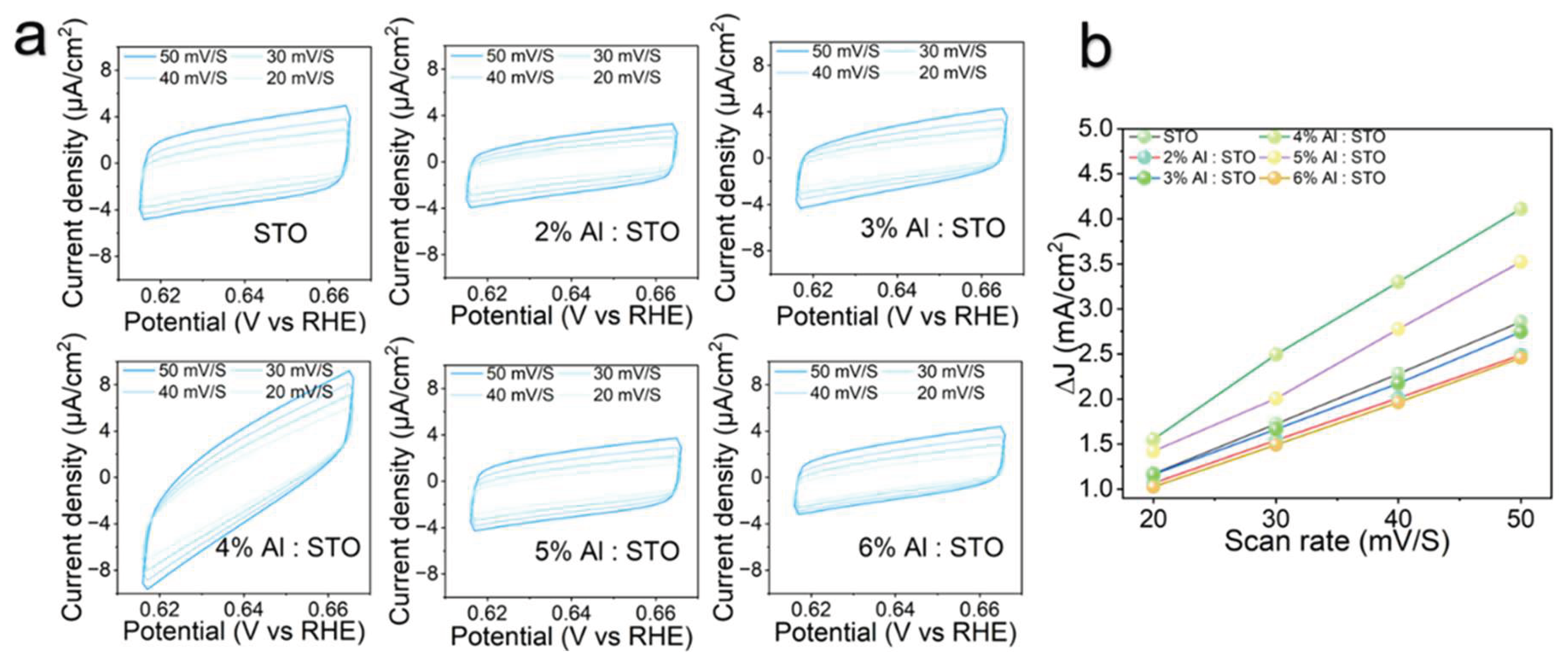
Figure 8 further clarifies the origin of the recombination suppression by probing the interfacial charge-accumulation behavior and electrochemically active surface area (ECSA) of the STO electrodes [26]. The CV curves collected in a non-Faradaic window (0.61–0.67 V vs RHE) at different scan rates (Figure 8 a) show quasi-rectangular shapes for all samples, indicating that the response is dominated by capacitive charging rather than by pronounced redox peaks. With increasing scan rate (20–50 mV s−1), the enclosed CV area and current density increase accordingly, and this increase becomes more prominent after Al doping, reflecting enhanced interfacial capacitance and faster charge accommodation at the semiconductor/electrolyte interface.
To quantify this behavior, the capacitive current difference (ΔJ) extracted from CV is plotted as a function of scan rate (Figure 6b). The slopes of these linear fits are proportional to the double-layer capacitance (Cdl) and thus to ECSA under identical electrolyte and measurement conditions. Among all compositions, 4% Al:STO exhibits the largest slope, indicating the highest Cdl/ECSA, whereas pristine STO shows the smallest value and the higher-doped samples (5–6%) show reduced slopes relative to 4% Al:STO. The maximized ECSA at 4% Al doping implies a larger density of electrochemically accessible surface sites and a more effective electrode/electrolyte contact area, which benefits PEC performance by (i) providing more surface reaction sites for hole consumption, thereby decreasing the probability of surface electron–hole recombination, and (ii) facilitating interfacial charge transfer by lowering local current density per site. This ECSA trend is consistent with the PEC activity maximum (Figure 5) and the reduced charge-transfer resistance from EIS, supporting that the superior performance of 4% Al:STO arises not only from tuned electronic structure/defect states (Figure 4, Figure 5, Figure 6 and Figure 7) but also from improved interfacial kinetics enabled by an enlarged electrochemically active surface.
4. Conclusions
In summary, Al-doped anisotropic SrTiO3 photoelectrodes were successfully prepared and systematically evaluated toward PEC water oxidation in alkaline electrolyte. Compared with pristine STO, Al incorporation markedly enhances the photocurrent response, and an optimum performance is achieved at 4% Al doping. Electrochemical analyses demonstrate that 4% Al:STO delivers higher photoanodic activity and faster interfacial charge transfer, as evidenced by the reduced charge-transfer resistance and enlarged light–dark photocurrent gap. XPS confirms the effective incorporation of Al and reveals suppressed Ti3+ related defect states together with tuned oxygen-related surface species, indicating a favorable defect reconfiguration. Band-structure analysis shows that Al doping slightly narrows the band gap and shifts the flat-band potential to more negative values, providing more favorable carrier energetics for interfacial reactions. Steady-state and transient PL further verify significantly reduced radiative recombination and prolonged carrier lifetime for 4% Al:STO. Overall, these results demonstrate that moderate Al doping simultaneously optimizes defect chemistry, band energetics, and interfacial kinetics in STO, offering an effective strategy to design high-performance perovskite oxide photoanodes for solar-driven water splitting.
Author Contributions
Z.L.: conceptualization, writing the original draft. X.R.: review and editing, formal analysis. J.M.: investiga-tion, visualization. X.Y.: supervision, writing—review and editing, funding acqui-sition. All authors have read and agreed to the published version of the manuscript.
Funding
This research was funded by the National Natural Science Foundation of China (No.51974086) and the Fundamental Research Funds for the Central Universities (N25YJS003).
Data Availability Statement
The obtained data will be available from the corresponding author upon reasonable request.
Acknowledgments
Appreciate to the Analytical and Testing Center at Northeastern University for their characterization support. We would also like to thank Jilong Gao from Shiyanjia Lab (www.shiyanjia.com) for conducting the XPS analysis.
Conflicts of Interest
The authors declare no conflicts of interest.
References
- Masoumi, Z.; Tayebi, M.; Kolaei, M.; Lee, B.-K. Efficient and stable core-shell α–Fe2O3/WS2/WOx photoanode for oxygen evolution reaction to enhance photoelectrochemical water splitting. App. Catal. B: Environ. 2022, 313, 121447. [Google Scholar] [CrossRef]
- Duan, W.J.; Han, J.C.; Yang, S.; Wang, Z.M.; Yu, Q.B.; Zhan, Y.Q. Understanding CO2 adsorption in layered double oxides synthesized by slag through kinetic and modelling techniques. Energy 2024, 297, 131303. [Google Scholar] [CrossRef]
- Joy, R.; Meena, B.; Kumar, M.; Jospeh, M.; Joseph, S.; Subrahmanyam, C.; Haridas, S. Exploring the role of ZnS as passivation layer on SrTiO3/Bi2S3 heterojunction photoanode for improved solar water splitting. Catal. Today 2024, 433, 114669. [Google Scholar] [CrossRef]
- Wang, W.; Xu, M.; Xu, X.; Zhou, W.; Shao, Z. Perovskite Oxide Based Electrodes for High-Performance Photoelectrochemical Water Splitting. Angew. Chem. Int. Ed. 2019, 59(1), 136–152. [Google Scholar] [CrossRef]
- Avcıoǧlu, C.; Avcıoǧlu, S.; Bekheet, M.F.; Gurlo, A. Photocatalytic Overall Water Splitting by SrTiO3: Progress Report and Design Strategies. ACS Appl. Energy Mater. 2023, 6(3), 1134–1154. [Google Scholar] [CrossRef]
- Liu, Y.; Huang, H.; Xue, L.; Sun, J.; Wang, X.; Xiong, P.; Zhu, J. Recent advances in the heteroatom doping of perovskite oxides for efficient electrocatalytic reactions. Nanoscale 2021, 13(47), 19840–19856. [Google Scholar] [CrossRef] [PubMed]
- Chen, M.; Li, S.; Zhong, S.; Zhou, X.; Ge, Y.; Luo, J.; Zhou, X.; Zhou, X.; Zhong, Y. Al-SrTiO3 decorated with non-noble metal co-catalyst NC-W2N for boosting photocatalytic overall water splitting via enhancing interfacial redox activity and charge separation. J. Alloy. Compd. 2023, 947, 169515. [Google Scholar] [CrossRef]
- Lv, S.; Pei, M.; Liu, Y.; Si, Z.; Wu, X.; Ran, R.; Weng, D.; Kang, F. A strategy to construct a highly active CoxP/SrTiO3(Al) catalyst to boost the photocatalytic overall water splitting reactions. Nanoscale 2022, 14(6), 2427–2433. [Google Scholar] [CrossRef]
- Wang, Q.; Hisatomi, T.; Ma, S.S.K.; Li, Y.; Domen, K. Core/Shell Structured La- and Rh-Codoped SrTiO3 as a Hydrogen Evolution Photocatalyst in Z-Scheme Overall Water Splitting under Visible Light Irradiation. Chem. Mater. 2014, 26(14), 4144–4150. [Google Scholar] [CrossRef]
- Cao, D.; Zhang, J.; Wang, A.; Yu, X.; Mi, B. Fabrication of Cr-doped SrTiO3/Ti-doped α-Fe2O3 photoanodes with enhanced photoelectrochemical properties. J. Mater. Sci. Technol. 2020, 56, 189–195. [Google Scholar] [CrossRef]
- Zhang, Y.; Wang, Z.-H.; Li, W.; Ding, P.C.; Wang, M.M.; Tang, Y.Y.; Lin, H.Y.; Peng, Y.; Wang, M.Y.; Zheng, Z.; Yang, S.; Dai, S.; Zhang, X.; Liu, P.F.; Yang, H.G. Al3+-Dependent Anisotropic Facet Tailoring on SrTiO3 Single Crystal for Photocatalytic Overall Water Splitting. Angew. Chem. Int. Ed. 2025, 64(30), p. e202508114. [Google Scholar] [CrossRef]
- Qin, Y.L.; Fang, F.; Xie, Z.Z.; Lin, H.W.; Zhang, K.; Yu, X.; Chang, K. La,Al-Codoped SrTiO3 as a Photocatalyst in Overall Water Splitting: Significant Surface Engineering Effects on Defect Engineering. ACS Catal. 2021, 11(18), 11429–11439. [Google Scholar] [CrossRef]
- Li, R.; Takata, T.; Zhang, B.; Feng, C.; Wu, Q.; Cui, C.; Zhang, Z.; Domen, K.; Li, Y. Criteria for Efficient Photocatalytic Water Splitting Revealed by Studying Carrier Dynamics in a Model Al-doped SrTiO3 Photocatalyst. Angew. Chem. Int. Ed. 2023, 62(49), p. e202313537. [Google Scholar] [CrossRef]
- Sakata, Y.; Miyoshi, Y.; Maeda, T.; Ishikiriyama, K.; Yamazaki, Y.; Imamura, H.; Ham, Y.; Hisatomi, T.; Kubota, J.; Yamakata, A.; Domen, K. Photocatalytic property of metal ion added SrTiO3 to Overall H2O splitting. Appl. Catal. A-Gen. 2016, 521, 227–232. [Google Scholar] [CrossRef]
- Ham, Y.; Hisatomi, T.; Goto, Y.; Moriya, Y.; Sakata, Y.; Yamakata, A.; Kubota, J.; Domen, K. Flux-mediated doping of SrTiO3 photocatalysts for efficient overall water splitting. J. Mater. Chem. A 2016, 4(8), 3027–3033. [Google Scholar] [CrossRef]
- Zhao, Z.; Goncalves, R.V.; Barman, S.K.; Willard, E.J.; Byle, E.; Perry, R.; Wu, Z.; Huda, M.N.; Moulé, A.J.; Osterloh, F.E. Electronic structure basis for enhanced overall water splitting photocatalysis with aluminum doped SrTiO3 in natural sunlight. Energ. Environ. Sci 2019, 12(4), 1385–1395. [Google Scholar] [CrossRef]
- Su, Z.Y.; Fang, F.; Li, X.; Han, W.J.; Liu, X.L.; Chang, K. Synergistic surface oxygen defect and bulk Ti3+ defect engineering on SrTiO3 for enhancing photocatalytic overall water splitting. J. Colloid Interface Sci. 2022, 626, 662–673. [Google Scholar] [CrossRef] [PubMed]
- Mu, L.; Zhao, Y.; Li, A.; Wang, S.; Wang, Z.; Yang, J.; Wang, Y.; Liu, T.; Chen, R.; Zhu, J.; Fan, F.; Li, R.; Li, C. Enhancing charge separation on high symmetry SrTiO3 exposed with anisotropic facets for photocatalytic water splitting. Energ. Environ. Sci 2016, 9(7), 2463–2469. [Google Scholar] [CrossRef]
- Tan, H.; Zhao, Z.; Zhu, W.-B.; Coker, E.N.; Li, B.; Zheng, M.; Yu, W.; Fan, H.; Sun, Z. Oxygen Vacancy Enhanced Photocatalytic Activity of Pervoskite SrTiO3. ACS Appl. Mater. Interfaces 2014, 6(21), 19184–19190. [Google Scholar] [CrossRef]
- Zhu, D.D.; Zhou, Q.X. Nitrogen doped g-C3N4 with the extremely narrow band gap for excellent photocatalytic activities under visible light. Appl. Catal. B: Environ. 2021, 281, 119474. [Google Scholar] [CrossRef]
- Ran, X.; Bai, Y.; Zeng, H.; Zhang, J.; Fu, H.; An, X.; Yang, X. Manipulating Oxygen Vacancy in SrTiO3 Nanoparticles to Achieve Enhanced Photoelectrochemical Performance in Water Splitting. ACS Appl. Nano Mater. 2024, 7(23), 27543–27554. [Google Scholar] [CrossRef]
- Wong, C.P.P.; Lai, C.W.; Lee, K.M.; Pan, G.T.; Huang, C.M.; Yang, T.C.K.; Juan, J.C. Enhanced Conductivity Boosts the Cathodic Performance of Aluminium-Doped SrTiO3 in Rechargeable Alkaline Zinc Battery. J. Electrochem. Soc. 2021, 168(8), p. 080530. [Google Scholar] [CrossRef]
- Zhang, Y.; Xu, L.; Liu, B.; Wang, X.; Wang, T.; Xiao, X.; Wang, S.; Huang, W. Engineering BiVO4 and Oxygen Evolution Cocatalyst Interfaces with Rapid Hole Extraction for Photoelectrochemical Water Splitting. ACS Catal. 2023, 13(9), 5938–5948. [Google Scholar] [CrossRef]
- Mo, G.L.; Jin, Y.K.; Deng, Y.J.; Zhang, C.H.; Liu, J.B.; Niu, Q.Y.; Gao, X.Y.; Bi, Y.B.; Chen, H.Y.; Li, P. Band-Gap Engineering of Isoreticular Hydrogen-Bonded Organic Frameworks for Boosting Photocatalytic Hydrogen Evolution. In Angew. Chem. Int. Ed.; 2026. [Google Scholar]
- Luo, Y.; Deng, B.; Pu, Y.; Liu, A.; Wang, J.; Ma, K.; Gao, F.; Gao, B.; Zou, W.; Dong, L. Interfacial coupling effects in g-C3N4/SrTiO3 nanocomposites with enhanced H2 evolution under visible light irradiation. App. Catal. B: Environ. 2019, 247, 1–9. [Google Scholar] [CrossRef]
- Zhang, Y.; Li, Y.; Ni, D.; Chen, Z.; Wang, X.; Bu, Y.; Ao, J.P. Improvement of BiVO4 Photoanode Performance During Water Photo-Oxidation Using Rh-Doped SrTiO3 Perovskite as a Co-Catalyst. Adv. Funct. Mater. 2019, 29(32), p. 1902101. [Google Scholar] [CrossRef]
Figure 1.
Schematic diagram of the preparation of Al-doped STO nanoparticles.
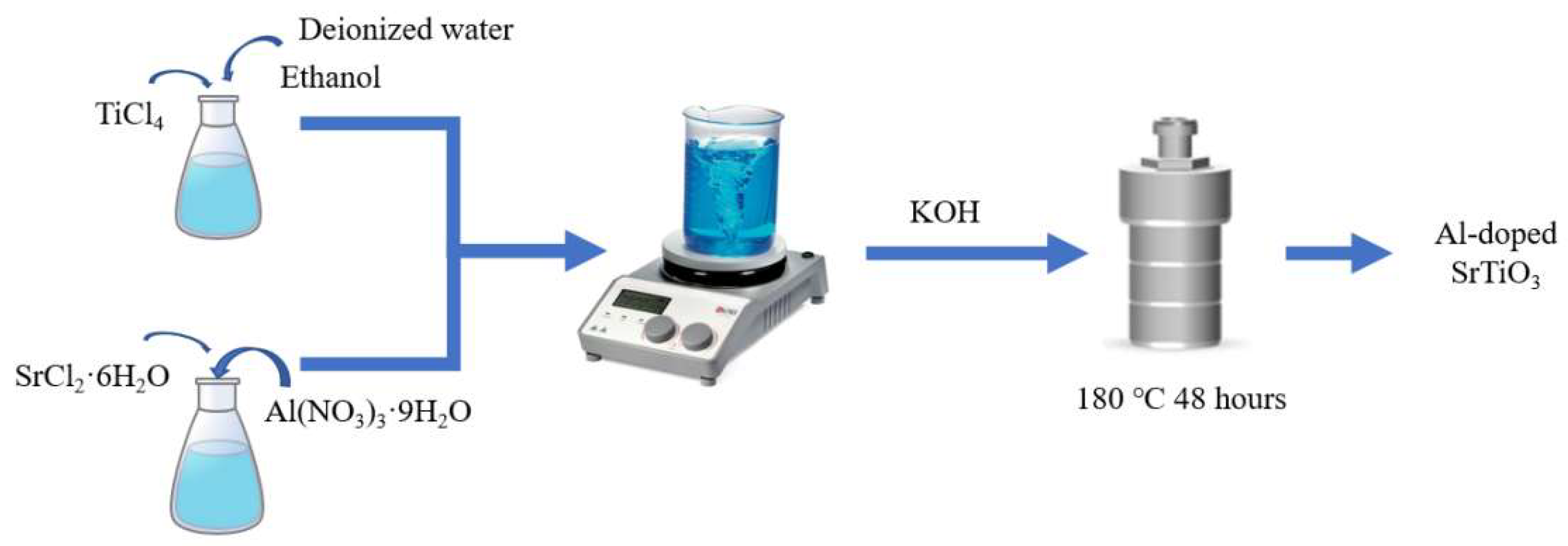
Figure 2.
(a) XRD patterns of STO and 4% Al-doped STO; (b) SEM image of pristine STO; (c) SEM image of 2% Al-doped STO; (d) SEM image of 4% Al-doped STO.
Figure 2.
(a) XRD patterns of STO and 4% Al-doped STO; (b) SEM image of pristine STO; (c) SEM image of 2% Al-doped STO; (d) SEM image of 4% Al-doped STO.
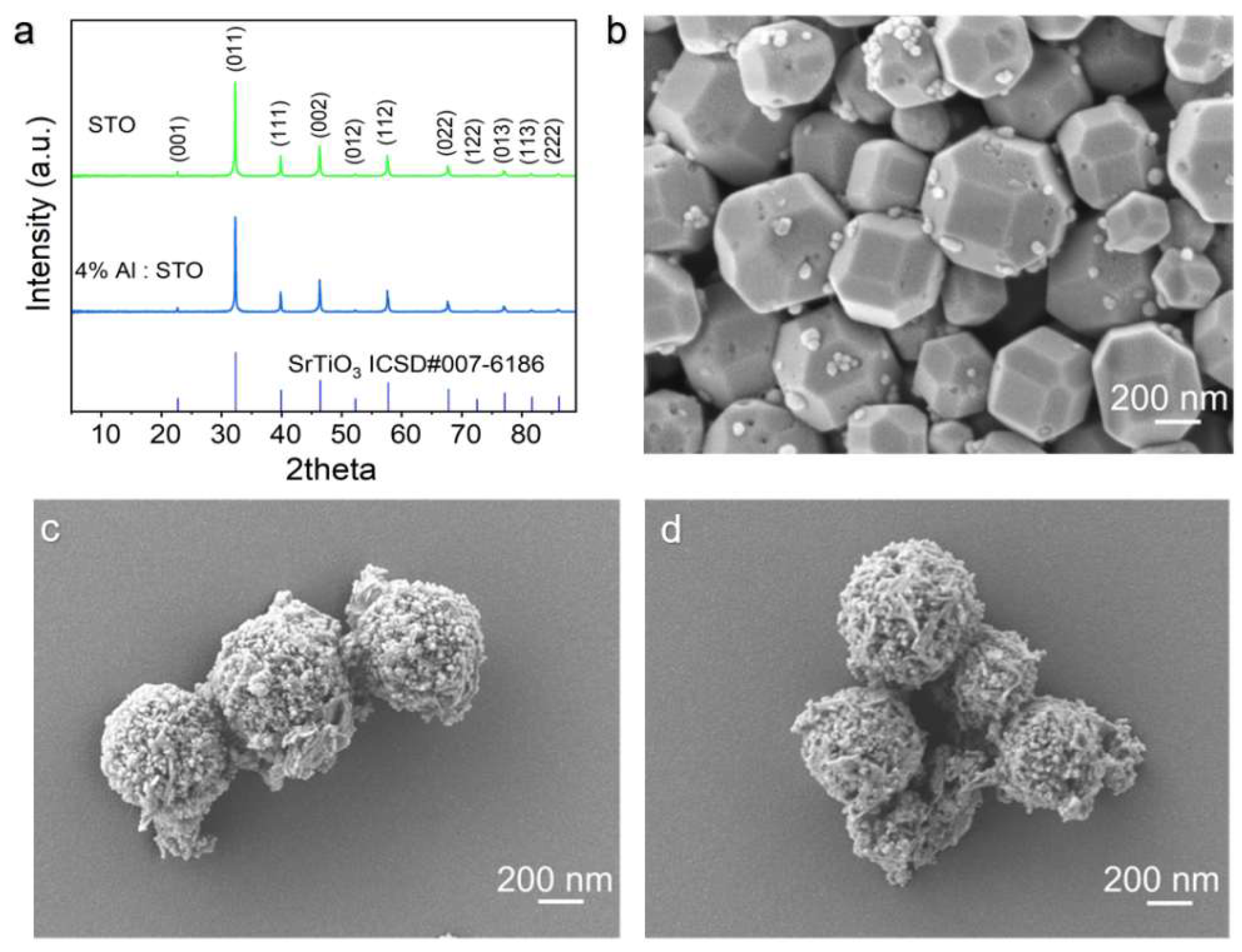
Figure 3.
(a) N2 adsorption isotherms of STO; (b) N2 adsorption isotherms of 4% Al-doped STO. The inset images show the BJH pore size distribution curve.
Figure 3.
(a) N2 adsorption isotherms of STO; (b) N2 adsorption isotherms of 4% Al-doped STO. The inset images show the BJH pore size distribution curve.
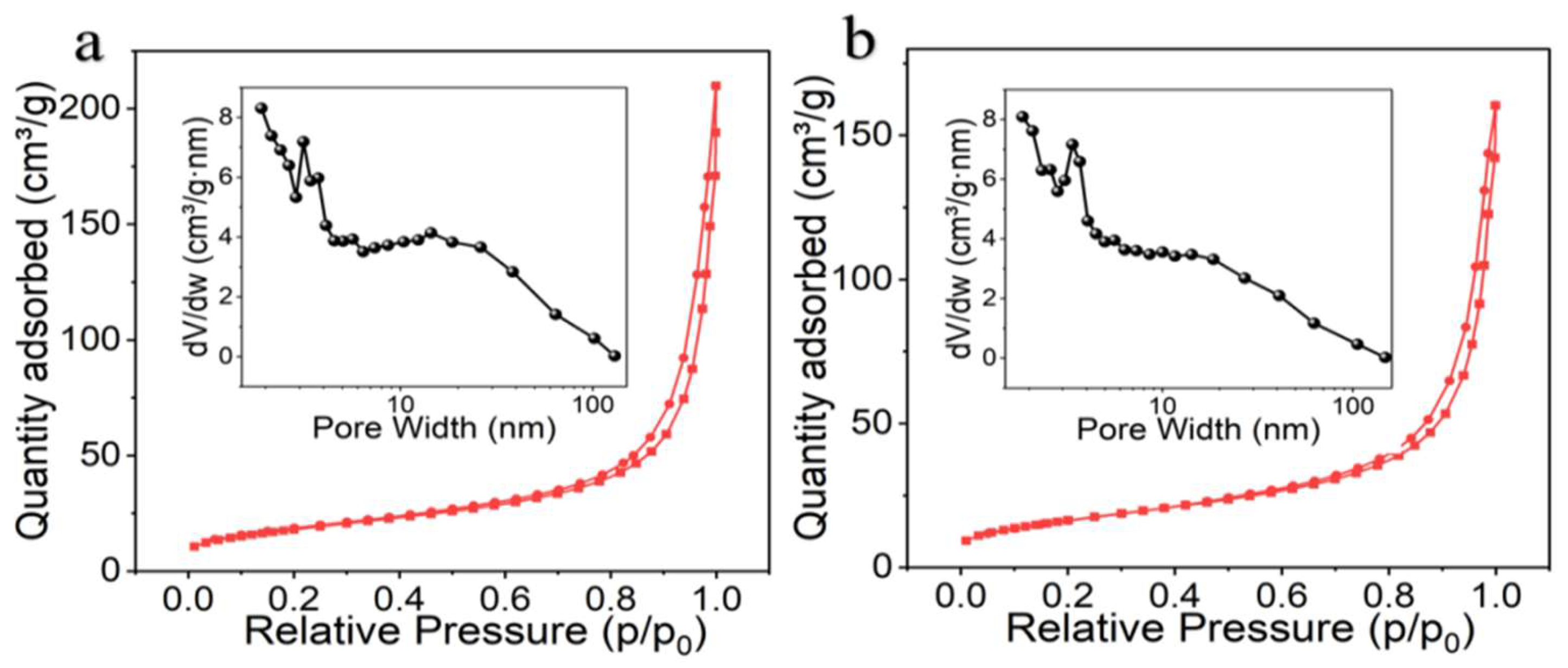
Figure 4.
High-resolution XPS spectra of (a) Ti, (b) O for pristine STO and 4% Al-doped STO, and (c) Al for 4% Al-doped STO.
Figure 4.
High-resolution XPS spectra of (a) Ti, (b) O for pristine STO and 4% Al-doped STO, and (c) Al for 4% Al-doped STO.
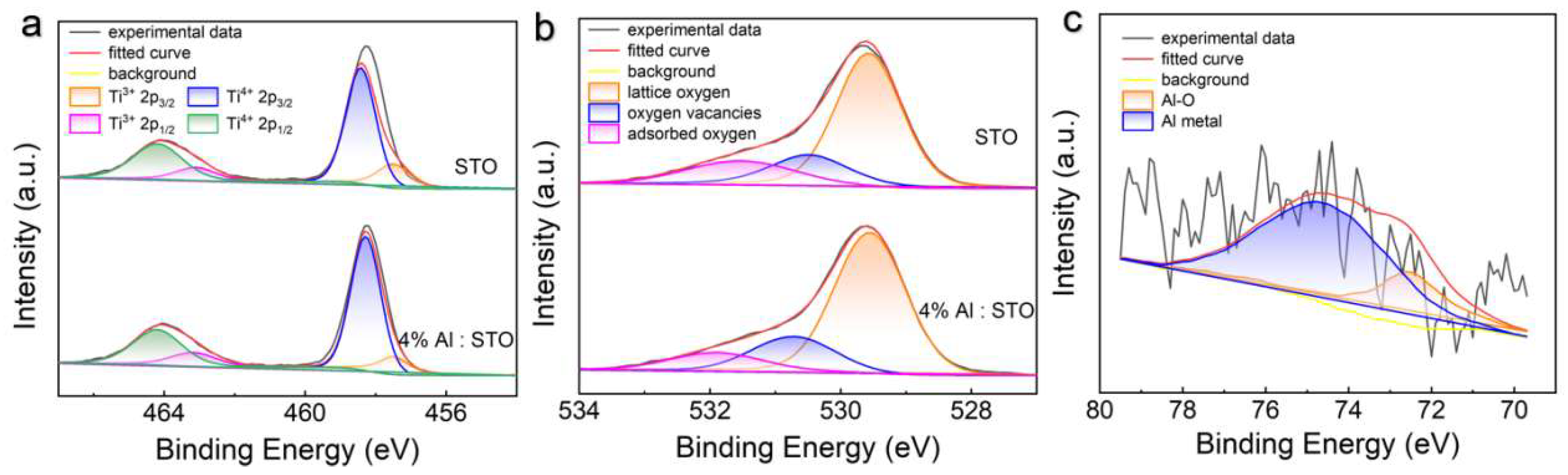
Figure 5.
(a) Transient photocurrent density curves, (b) LSV curves under illumination for STO and x% Al-doped STO; (c) LSV curves of STO and 4% Al-doped STO under illumination and dark conditions; (d) Equivalent circuits and EIS Nyquist plots for STO and x% Al-doped STO.
Figure 5.
(a) Transient photocurrent density curves, (b) LSV curves under illumination for STO and x% Al-doped STO; (c) LSV curves of STO and 4% Al-doped STO under illumination and dark conditions; (d) Equivalent circuits and EIS Nyquist plots for STO and x% Al-doped STO.
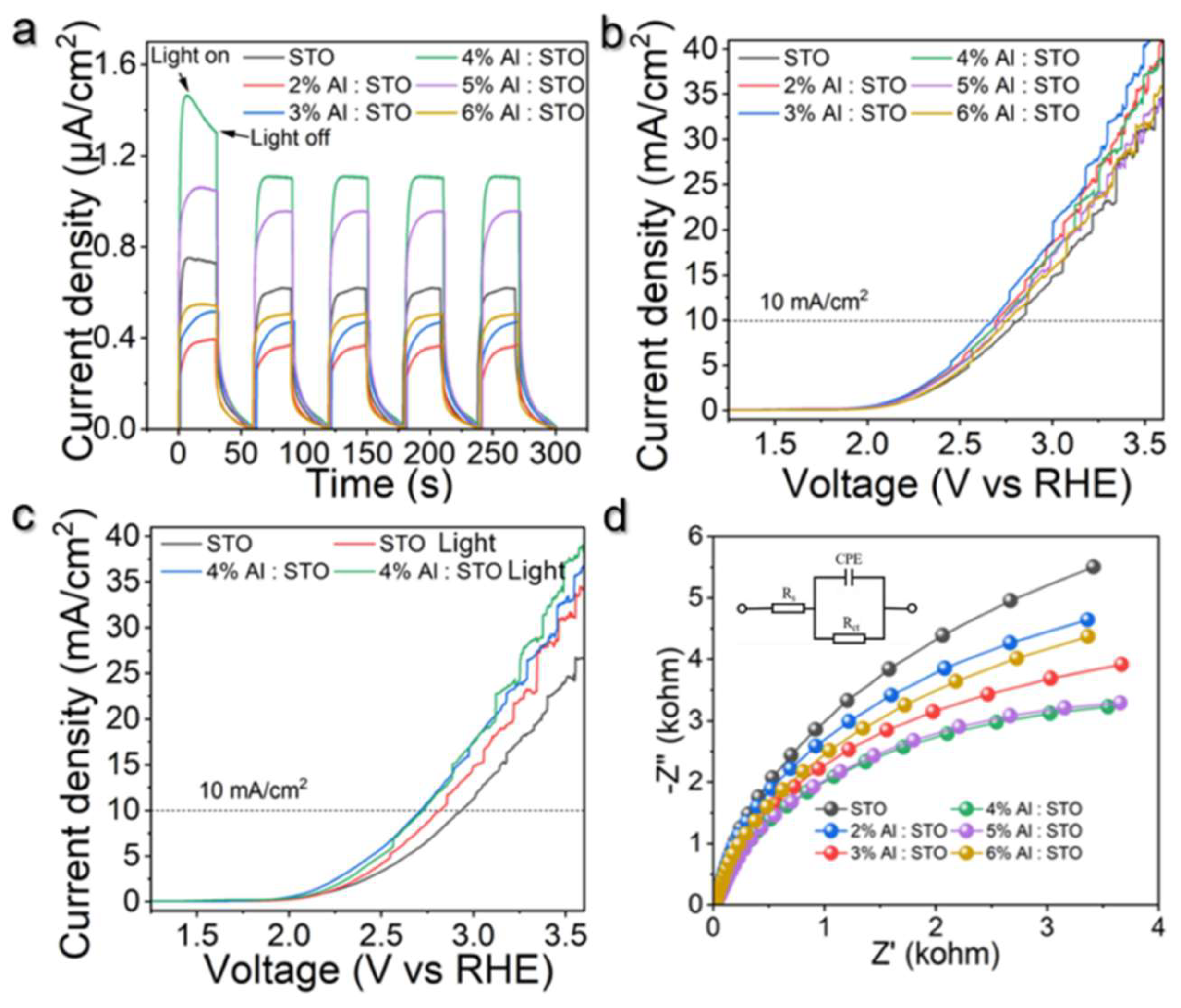
Figure 6.
(a) Mott-Schottky plots, (b) Tauc plots with the inset showing the UV-Vis absorption spectra, (c) XPS valence band spectra, and (d) Schematic diagrams of band gap structures for pristine STO and 4% Al-doped STO.
Figure 6.
(a) Mott-Schottky plots, (b) Tauc plots with the inset showing the UV-Vis absorption spectra, (c) XPS valence band spectra, and (d) Schematic diagrams of band gap structures for pristine STO and 4% Al-doped STO.
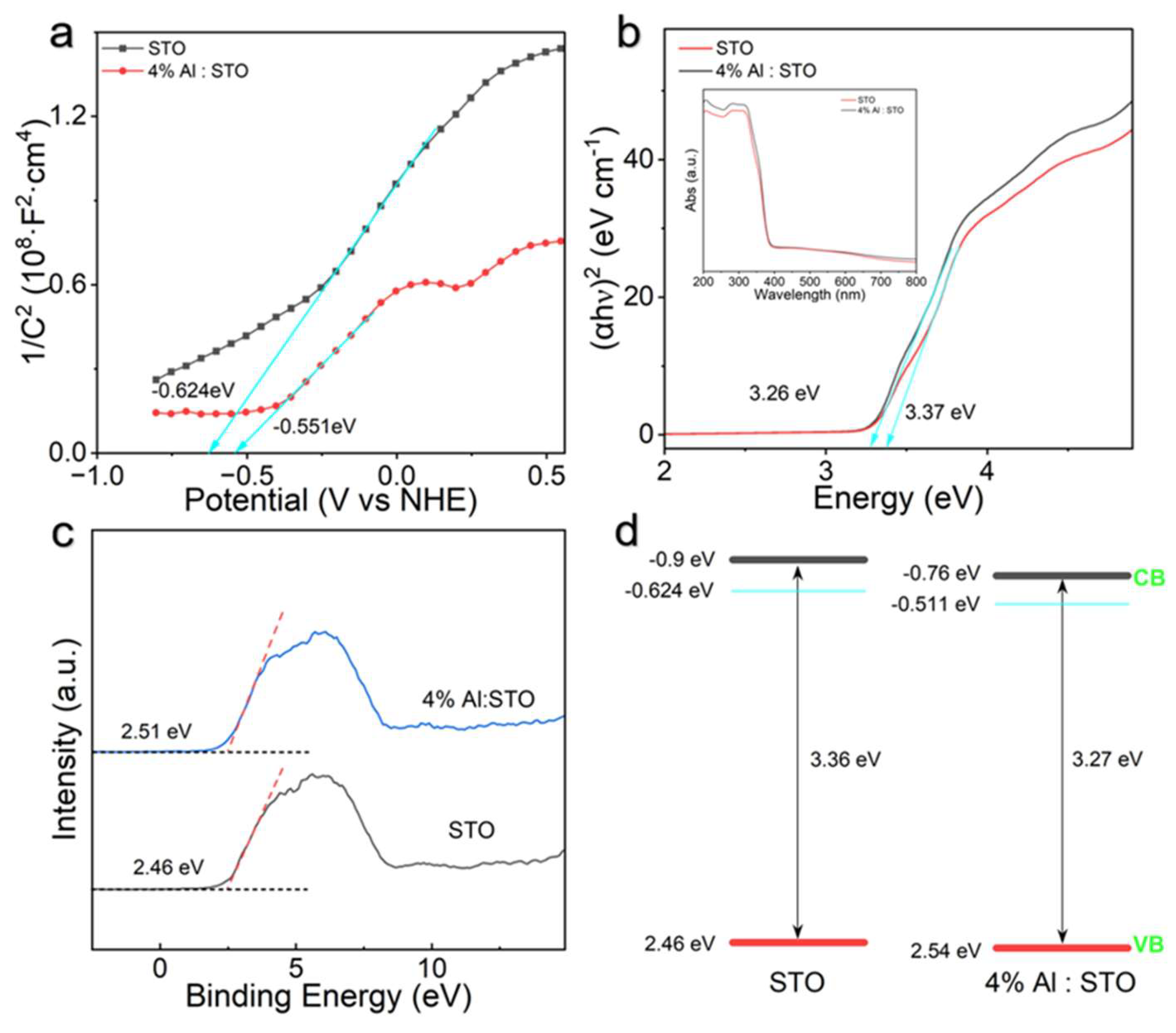
Figure 7.
(a) Steady-state photoluminescence spectra and (b) transient photoluminescence spectra of pristine STO and 4% Al-doped STO.
Figure 7.
(a) Steady-state photoluminescence spectra and (b) transient photoluminescence spectra of pristine STO and 4% Al-doped STO.
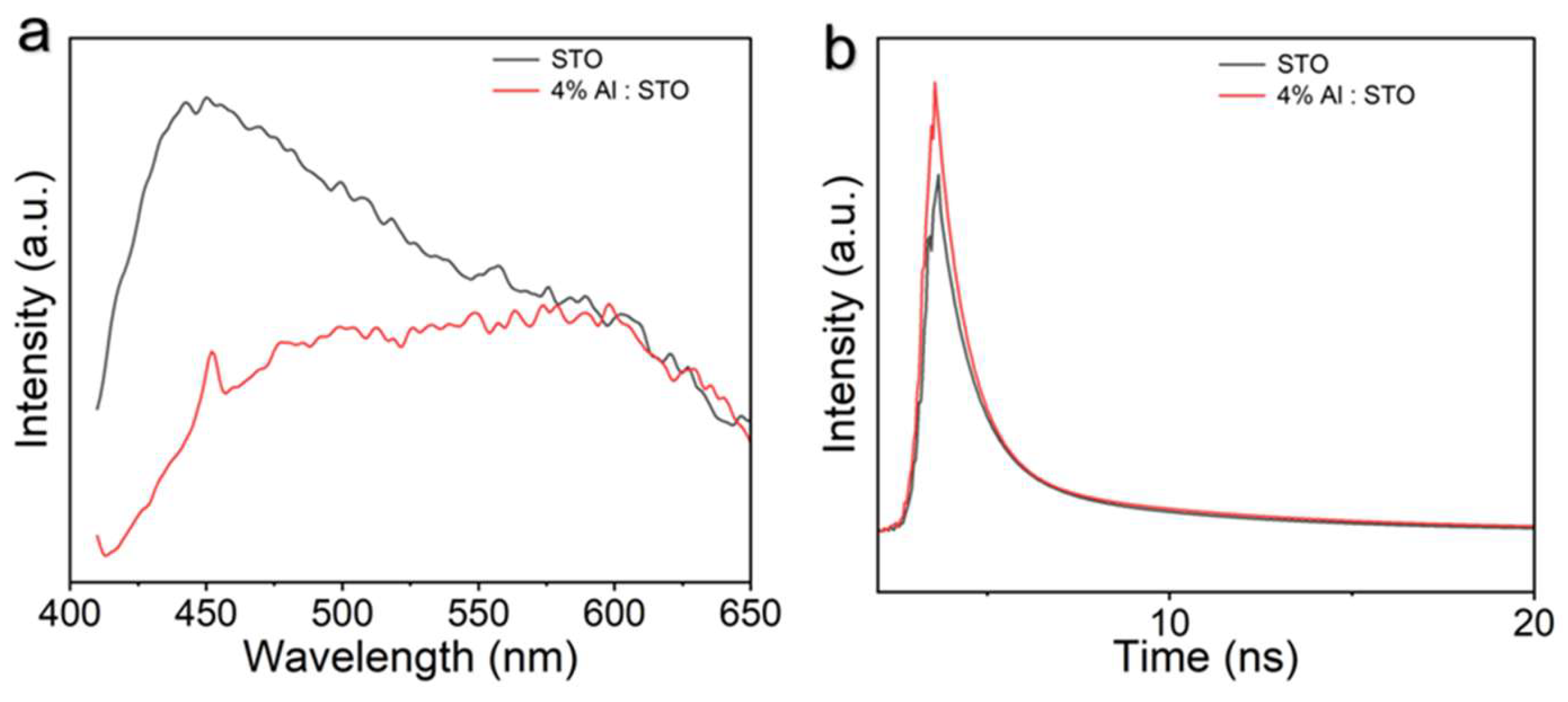
Figure 8.
(a) Cyclic voltammetry curves and (b) electrochemically active surface area slopes from cyclic voltammetry for different SrTiO3 samples.
Figure 8.
(a) Cyclic voltammetry curves and (b) electrochemically active surface area slopes from cyclic voltammetry for different SrTiO3 samples.
Disclaimer/Publisher’s Note: The statements, opinions and data contained in all publications are solely those of the individual author(s) and contributor(s) and not of MDPI and/or the editor(s). MDPI and/or the editor(s) disclaim responsibility for any injury to people or property resulting from any ideas, methods, instructions or products referred to in the content. |
© 2026 by the authors. Licensee MDPI, Basel, Switzerland. This article is an open access article distributed under the terms and conditions of the Creative Commons Attribution (CC BY) license (http://creativecommons.org/licenses/by/4.0/).
Copyright: This open access article is published under a Creative Commons CC BY 4.0 license, which permit the free download, distribution, and reuse, provided that the author and preprint are cited in any reuse.


