Preprint
Brief Report

This version is not peer-reviewed.

Should Conservation Cut-In Wind Speed Be Tailored to Site-Specific Conditions? Insights from Bat Activity Patterns at Windfarms in Northern Portugal

Submitted:

12 February 2026

Posted:

13 February 2026

You are already at the latest version

Abstract

Wind energy stands as one of the most technologically mature renewable sources, playing a pivotal role in the mitigation of greenhouse gas emissions. However, wind farms and associated infrastructures increase collision risk for flying organisms. Implementing higher cut-in speeds is a proven mitigation strategy to significantly decrease wildlife mortality rates, particularly for bat species, by preventing turbine operation during low-wind periods of high activity. The suggested, non-standard, increased cut-in speed for wind turbines is generally 5.0 m/s. To test the effectiveness of cut-in speed increase, bat activity was monitored at three wind farms in northern Portugal (Gevancas, Azinheira and Dom João e Feirão), using ultrasonic acoustic detection, to characterize spatial and temporal activity patterns and assess the potential risk associated. Monitoring was carried out at fixed stations, at heights of 55m above ground level during seven consecutive nights per month, from march to October. Wind speed data were recorded concurrently using anemometers mounted on meteorological towers. Contradicting cut-in speed recommendations, the results show that 90% of bat activity occurred at wind speeds above the current mitigation thresholds (5.0 m/s.). Since turbine operation coincides with peak bat activity, it is imperative to implement site-specific mitigation strategies, such as optimized cut-in speeds, to minimize mortality risk.

Keywords: 
;  ;  ;  ;  ;  

1. Introduction

Wind energy production is one of the strategies contributing to reduce human-induced greenhouse gas emissions; by decreasing the dependency from fossil fuels [1]. However, its spatial positioning should be planned within a rigorous ecological framework [2]. Indeed, wind turbines may cause barrier effects, disturbance and displacement of species, habitat loss and fragmentation, apart from casualties of birds and bats [3]. To minimize impacts on wildlife, it is important to use optimal sitting strategies for wind turbines, for example by avoiding sensitive habitats [4] or by keeping minimum distances from raptor nests and bat roosts [5].
Bats are long-lived, low fecundity mammals and, therefore, may be particularly vulnerable to large-scale sustained mortality events, such as those resulting from wind turbines [6]. As global wind energy development expands to meet energy demands [7] and mitigate climate change [8], it is essential to manage these impacts, especially since several species of bats are endangered and most provide crucial ecosystem services (i.e, pest control, pollination, plant dispersion) [9].
Effective positioning of wind farms is a promising approach to reduce impacts on bats, but because many species’ habitat requirements exhibit temporal variation over the annual cycle, it remains a challenging task [10]. A promising approach to mitigate on-site impacts on bats is to increase the cut-in wind speed— the threshold at which a wind turbine starts rotating and generating power (usually circa 3m/s) - to higher wind speeds. Even if there is no single, universal "standard" cut-in speed for conservation, it often involves increasing this value to 5.0 m/s (sometimes to higher values) [11]. Since bats exhibit peak flight activity at low wind speeds, this adjustment is considered to significantly reduce their risk of collision, while the resulting energy production losses remain modest [12].
Drawing on data from three wind farms in northern Portugal, we assess the wind speeds at 55 meters above ground associated with peak bat activity, to evaluate whether regular curtailment thresholds align with local activity patterns. Objectives include debating whether general rules associated with curtailing turbine operation results in effective lowering of bat mortality risk or if they should be tailored to specific locations and periods.

2. Materials and Methods

2.1. Study Area

This study was conducted in three wind farms located in mainland north and central Portugal, Gevancas windfarm (Serra do Alvão), Dom João e Feirão windfarm (Serra de Montemuro) and Azinheira windfarm (Serra do Viso), from 2017 to 2025, combining historical monitoring datasets with additional field surveys.

2.2. Estimating Wind Speeds

According to the Portuguese national authority for nature conservation (ICNF- Institute for Nature Conservation and Forests) and UNEP/EUROBATS guidelines, approximately 90% of bat activity near ground level occurs at wind speeds up to 3m/s [26]. However, this threshold refers to near- ground conditions and cannot be directly applied to turbine rotor height (bat impact zone). Therefore, bat activity was monitored at 55 m above ground level, encompassing both near-ground flight paths and the lower turbine rotor-swept zone. Due the impossibility of collecting wind speed at this height, the wind speed measurements were obtained from anemometers NRG S1 [13] placed in nearby meteorological towers or wind turbines (at 45m or 85m, respectively). To relate this regulatory reference value to bat activity and wind conditions, wind speed at 55m was extrapolated using the wind profile power law [14]. This procedure aims to translate a ground- level management threshold to the height at which wind turbines operate (bat impact zone). To calculate the wind speed at 55m, the wind power law or Hellmann power law was applied [14]:
μ ( z ) = μ ( Z r e f ) ( z Z r e f )
where:
  • μ(z) is the estimated wind speed at the desired height at 55 m
  • μ(Zref) is the known wind speed at the reference height at 45m (meteorological towers) or 85m (wind turbines);
  • Z is the target height for wind speed estimation (55m);
  • Zref is the reference height at which wind speed is known (45m or 85m);
  • α is the roughness factor corresponding to moderately rough terrain typical of mountainous rural landscapes with shrub and forest cover, which characterize the study areas (0.18).

2.3. Bat Activity Monitoring

Bat activity recording was carried out using fixed monitoring points at 55 meters. For this purpose, meteorological towers at each wind farm were used to mount the equipment (automatic detectors Song Meter SM4BAT FS and microphones SMM-U2 Ultrasonic Microphone) [15,16], configured specifically for the targeted bat community. Bat activity was systematically monitored for seven consecutive nights each month, from March to October, totalling 56 nights of sampling (each night, recordings began at sunset and continued until sunrise). Wind speed values at each sampling point were obtained from anemometers installed on the meteorological towers (at 45m) or at the wind turbine (85m) (see please 2.2). The collected parameters allowed an analysis of the influence of wind speed on bat activity (measured by the number of bat passes/hour).

2.4. Data Processing

The identification of acoustic recordings collected were carried out using Kaleidoscope Pro® sound (Wildlife Acoustics Inc.) using the AutoID function to identify species or groups of species, followed by manual checking in order to detect possible mistakes [17,18]. The pulse identification, if necessary, was based on [19,20]. The number of bat passes detected per unit of time (bat passes/hour) was used for evaluating the patterns of activity. The cumulative bat activity, as a function of wind speed at 55 meters, was used to determine the wind speeds corresponding to 80% and 90% of total bat activity, considered thresholds for cut-in wind speeds of the wind turbines at each wind farm. To assess the influence of wind speed on bat activity patterns recorded at 55 meters, a Generalized Linear Mixed Model (GLMMs) were implemented, considering the random effects associated with the windfarm and month of the year. As the data consisted of counts, the Poisson distribution with a canonical (logarithmic) link function was found to be the most suitable. All statistical analyses were performed using the R statistical software and the lme4 package [21].

3. Results

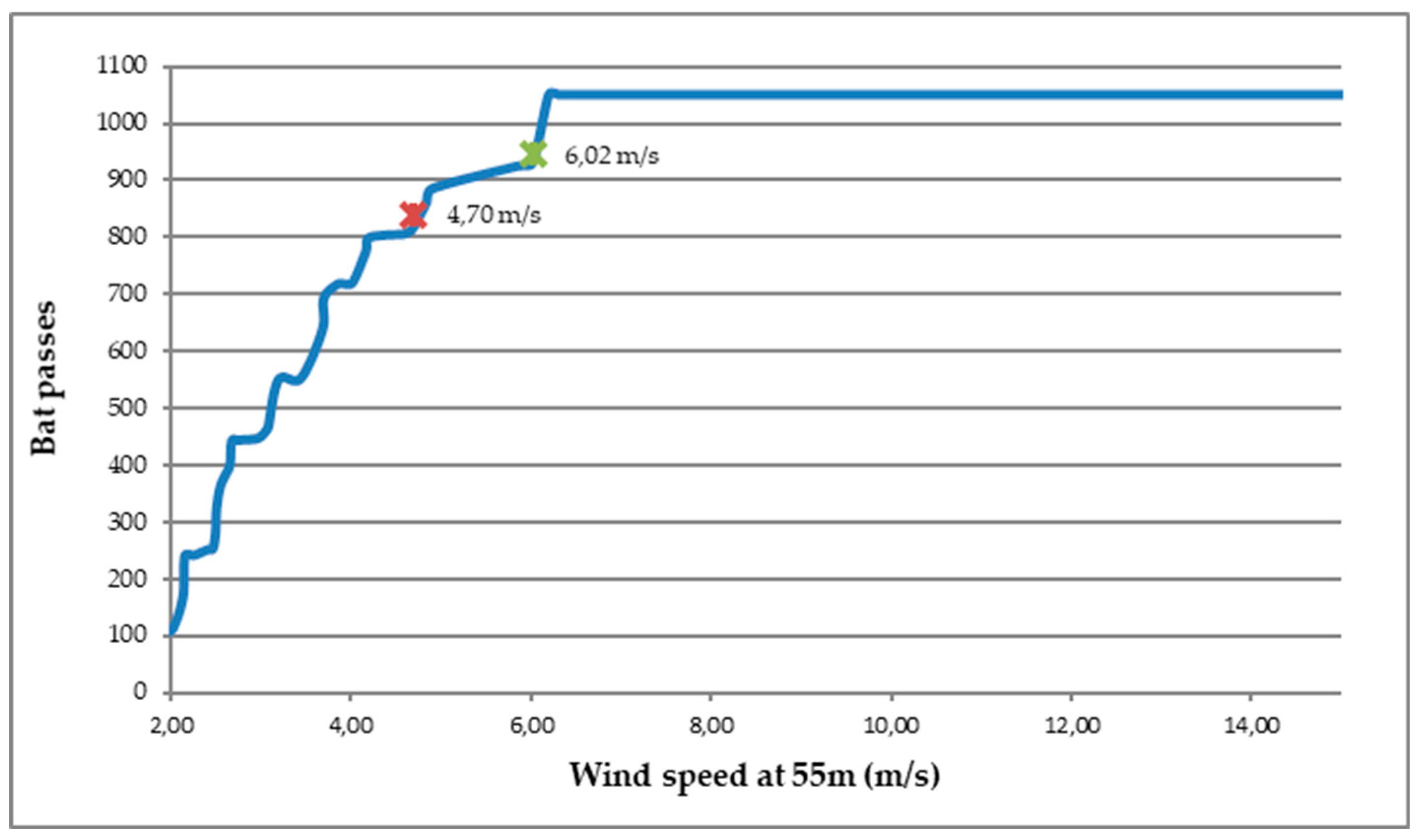
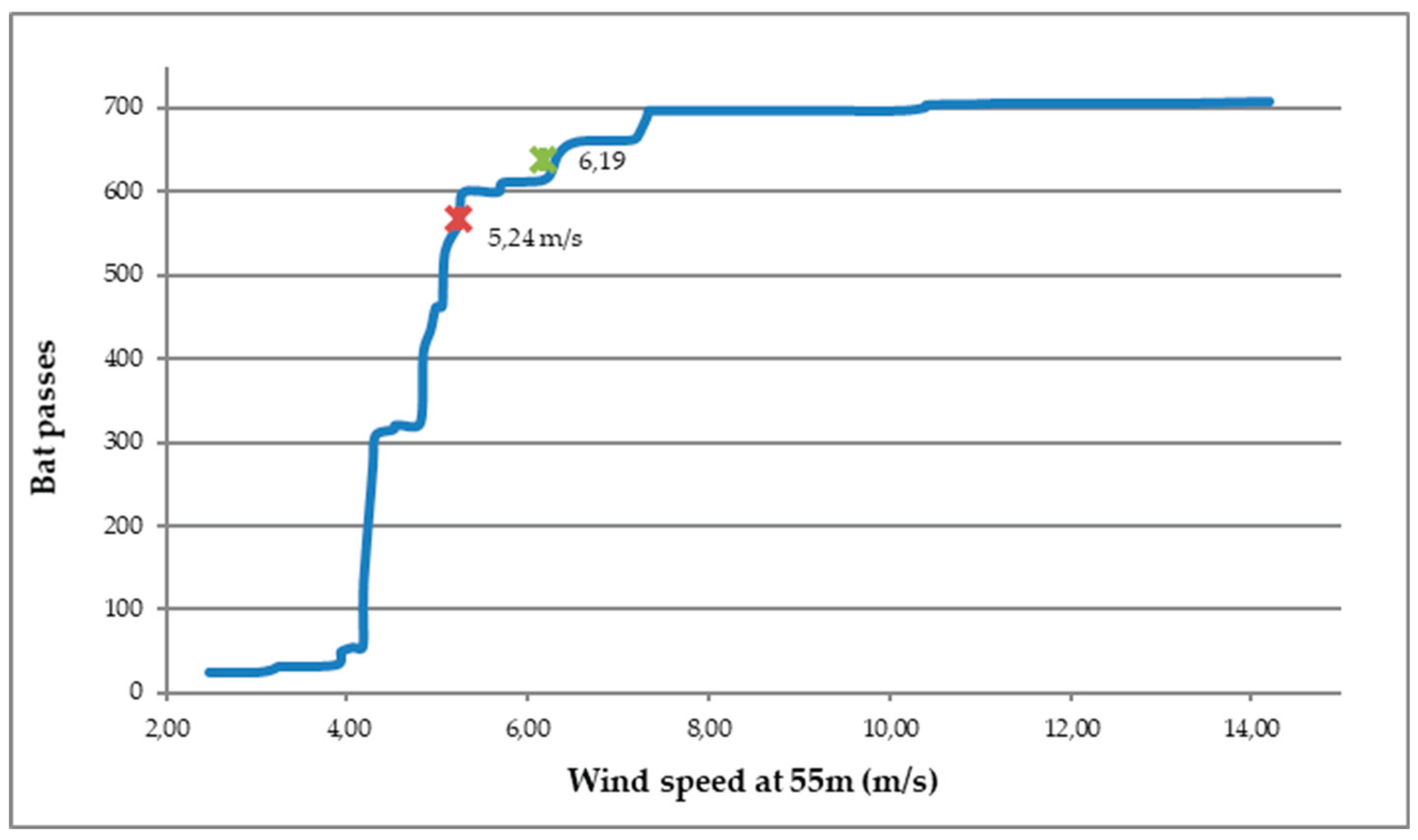
The relationship between bat activity and wind speed differed across wind farms. At Gevancas (Figure 1), 80% to 90% of cumulative bat activity at 55m occurred at wind speeds up to 8.87 m/s. At the Azinheira (Figure 2), 80% of cumulative bat activity at 55m occurred at wind speeds up to 4.70 m/s, and 90% occurred at wind speed of up to 6.02 m/s. Finally, at Dom João e Feirão (Figure 3), 80% of the cumulative bat activity at 55 m occurred at wind speeds up to 5.24 m/s and 90% occurred at wind speeds up to 6.19 m/s.
The mixed-effects model depicts the random influence of time (month; σ² = 1.66) and location (wind farm; σ² = 0.23) in the patterns of bat activity observed. Even when considering the previous randomness, bat activity decreased significantly with increasing wind speed (β = −0.48 ± 0.01 SE, z = −30.93, p < 0.001) (Table 1).

4. Discussion

The results of this study demonstrate that bat activity is strongly influenced by wind speed, with higher activity occurring under low wind conditions. This pattern aligns with previous studies reporting reduced bat activity at higher wind speed [12,22]. However, the wind speed thresholds encompassing most bat activity differed substantially among the three wind farms, highlighting the importance of local ecological and landscape factors in mediating this relationship [23]. In fact, the substantial variation observed among wind farms suggests that the relationship between bat activity and wind speed is strongly site- dependent, probably reflecting differences in bat community composition, habitat structure, prey availability, and proximity to landscape features such as forest edges and watercourses [23,24]. Studies have proven that wind farms located in more complex and heterogeneous landscapes tend to concentrate higher bat activity, which can increase collision risk [23].
The risk of bat collisions with wind turbines is directly related to both activity levels and turbine operation [12,24]. Although most activity occurs up to wind speeds of 9m/s, bats tend to be more active under moderate wind speeds conditions (below 6–7m/s). Windmills typically begin operating at wind speeds above 3m/s, coinciding with the wind speed at which bat activity is highest. Therefore, the periods of greatest risk occur when turbines are active and bat activity is high [25].
Based on UNEP/EUROBATS guidelines and related scientific reports, the recommended wind speed threshold to trigger a cut-in-speed (curtailment) for wind turbines to protect bats is typically around 5 m/s (from 3 to 6.5 m/s), but with no clear indication on the heights associated [26]. Anyway, the risk of collision is highest for taller turbines and, therefore, mitigation must be tailored to the rotor-swept zone, especially when bat activity is high at the nacelle height. [26]. Additionally, current thresholds for wind speed emerge from approximately 90% of bat activity near ground level (5m) occurring under such low-wind conditions [11]. However, bat activity at ground level is associated with a low risk zone, whereas the heights at which turbine rotors operate correspond to areas of real risk of collision [27]. This threshold therefore does not account for the vertical gradient in wind speed and bat activity and its implication for turbine related mortality. By translating this reference value to turbine relevant heights, our results suggest that a uniform cut- in speed may not adequately capture site specific risk conditions [28]. In some cases, applying generalized thresholds could even lead to an unnecessary energy production loss [29].
Overall, these findings emphasize the need for adaptive, site-specific mitigation strategies at wind farms. Rather than relying on uniform curtailment thresholds, management measures should be informed by local bat activity patterns and wind conditions. Such tailored approaches have the potential to enhance bat conservation outcomes while maintaining wind energy efficiency and sustainability. Importantly, this approach does not aim to predict bat activity at rotor height, but rather to contextualize regulatory thresholds within turbine operational conditions, ensuring that mitigation measures are effective where the risk of mortality is real. These results also highlight the need for robust preconstruction studies at proposed wind farm sites. Gathering detailed, specific data on bat activity and wind speed profiles is essential to effectively determine the most appropriate cut-in speeds and implemented mitigation measures that maximize bat protection while minimizing energy production loss.

5. Conclusions

Given the variation in results across the studied windfarms, the authors advocate that turbine cut-in speeds should not be pre-defined or standardized, but rather adjusted based on prior studies and site-specific data to effectively reduce bat mortality risk. This study provides empirical support by moving beyond uniform curtailment thresholds, underscoring the importance of integrating site-specific ecological data into wind farm planning and management.

Acknowledgments

This work is supported by National Funds by FCT – Portuguese Foundation for Science and Technology, under the projects UID/04033/2025: Centre for the Research and Technology of Agro-Environmental and Biological Sciences (https://doi.org/10.54499/UID/04033/2025) and LA/P/0126/2020 (https://doi.org/10.54499/LA/P/0126/2020).

References

  1. Rahman, A.; Murad, S. W.; Mohsin, A. K. M.; Wang, X. Does renewable energy proactively contribute to mitigating carbon emissions in major fossil fuels consuming countries? Journal of Cleaner Production 2024, 452, 142113. [Google Scholar] [CrossRef]
  2. Josimović, B.; Cvjetić, A.; Furundžić, D. Strategic Environmental Assessment and the precautionary principle in the spatial planning of wind farms–European experience in Serbia. Renewable and Sustainable Energy Reviews 2021, 136, 110459. [Google Scholar] [CrossRef]
  3. Katzner, T. E.; Nelson, D. M.; Marques, A. T.; Voigt, C. C.; Lambertucci, S. A.; Rebolo, N.; Murgatroyd, M. Impacts of onshore wind energy production on biodiversity. Nature Reviews Biodiversity 2025, 1–14. [Google Scholar] [CrossRef]
  4. Balotari-Chiebao, F.; Santangeli, A.; Piirainen, S.; Byholm, P. Wind energy expansion and birds: Identifying priority areas for impact avoidance at a national level. Biological Conservation 2023, 277, 109851. [Google Scholar] [CrossRef]
  5. Toman, M. A., Griffin, J., & Lempert, R. J. (2008). Impacts on U.S. energy expenditures and greenhouse-gas emissions of increasing renewable-energy use: technical report. Rand Corp.
  6. IPCC. Intergovernmental Panel on Climate Change Special Report Renewable Energy Sources and Climate Change MitigationCambridge University Press; Cambridge, UK, 2011. [Google Scholar]
  7. Ghanem, S. J.; Voigt, C. C. Chapter 7 - Increasing Awareness of Ecosystem Services Provided by Bats; Brockmann, H. J., Roper, T. J., Naguib, M., Mitani, J. C., Simmons, L. W., Eds.; ScienceDirect; Academic Press, 1 January 2012; Available online: https://www.sciencedirect.com/science/article/abs/pii/B9780123942883000071.
  8. Northrup, J. M.; Wittemyer, G. Characterising the impacts of emerging energy development on wildlife, with an eye towards mitigation Ecol. Lett. 2013, 16, 112–125. [Google Scholar] [CrossRef]
  9. Arnett, E. B.; Huso, M. M.; Schirmacher, M. R.; Hayes, J. P. Altering turbine speed reduces bat mortality at wind-energy facilities. Frontiers in Ecology and the Environment 2010, 9(4), 209–214. [Google Scholar] [CrossRef]
  10. Raposeira, H.; Horta, P.; Heleno, R.; Rebelo, H. Changing with the times: Seasonal environmental gradients unveil dynamic bat assemblages and vulnerability. Ecology and Evolution 2023, 13(7), e10246. [Google Scholar] [CrossRef]
  11. Adams, E. M.; Gulka, J.; Williams, K. A. A review of the effectiveness of operational curtailment for reducing bat fatalities at terrestrial wind farms in North America. PLoS One 2021, 16(11), e0256382. [Google Scholar] [CrossRef]
  12. Ellerbrok, J. S.; Farwig, N.; Peter, F.; Voigt, C. C. Forest bat activity declines with increasing wind speed in proximity of operating wind turbines. Global Ecology and Conservation 2024, 49, e02782. [Google Scholar] [CrossRef]
  13. NRG Systems. NRG S1 anemometer: Technical product sheet. 2019. Available online: https://www.nrgsystems.com/assets/resources/NRG_S1_Tech_Product_Sheet_2023_V1.pdf.
  14. Bañuelos-Ruedas, F.; Angeles-Camacho, C.; Rios-Marcuello, S. Analysis and validation of the methodology used in the extrapolation of wind speed data at different heights. Renewable and Sustainable Energy Reviews 2010, 14(8), 2383–2391. [Google Scholar] [CrossRef]
  15. Wildlife Acoustics; Inc. Song Meter SM4BAT FS User Guide (June 4, 2025 ed.); 2025; Available online: https://www.wildlifeacoustics.com/.
  16. Wildlife Acoustics. SMM-U2 Ultrasonic Microphone [Apparatus]. 2022. Available online: https://www.wildlifeacoustics.com/.
  17. López-Baucells, A; Torrent, L; Rocha, R; Bobrowiec, PE; Palmeirim, JM; Meyer, CF. Stronger together: combining automated classifiers with manual post-validation optimizes the workload vs reliability trade-off of species identification in bat acoustic surveys. Eco Inform 2019, 49, 45–53. [Google Scholar] [CrossRef]
  18. Rydell, J; Nyman, S; Eklöf, J; Jones, G; Russo, D. Testing the performances of automated identification of bat echolocation calls: a request for prudence. Ecol Ind 2017, 78, 416–420. [Google Scholar] [CrossRef]
  19. Russ, J. Bat Calls of Britain and Europe; Pelagic Publishing: London, United Kingdom, 2021. [Google Scholar]
  20. Rainho A, Amorim F, Marques JT, Alves P, y Rebelo H (2011) Chave de identificaçao de vocalizações dos morcegos de Portugal continental. Versão electrónica de 5 de junio de2011.
  21. Bates, D.; Mächler, M.; Bolker, B.; Walker, S. Fitting Linear Mixed-Effects Models Using lme4. Journal of Statistical Software 2015, 67(1), 1–48. [Google Scholar] [CrossRef]
  22. Barré, K.; Froidevaux, J. S.; Sotillo, A.; Roemer, C.; Kerbiriou, C. Drivers of bat activity at wind turbines advocate for mitigating bat exposure using multicriteria algorithm-based curtailment. Science of the Total Environment 2023, 866, 161404. [Google Scholar] [CrossRef]
  23. Rnjak, D.; Janeš, M.; Križan, J.; Antonić, O. Reducing bat mortality at wind farms using site-specific mitigation measures: A case study in the Mediterranean region, Croatia. Mammalia 2023, 87(3), 259–270. [Google Scholar] [CrossRef]
  24. Lloyd, J. D.; Butryn, R.; Pearman-Gillman, S.; Allison, T. D. Seasonal patterns of bird and bat collision fatalities at wind turbines. Plos one 2023, 18(5), e0284778. [Google Scholar] [CrossRef]
  25. Guest, E. E.; Stamps, B. F.; Durish, N. D.; Hale, A. M.; Hein, C. D.; Morton, B. P.; Weaver, S. P.; Fritts, S. R. An Updated Review of Hypotheses Regarding Bat Attraction to Wind Turbines. Animals 2022, 12(3), 343. [Google Scholar] [CrossRef]
  26. Barré, K.; Froidevaux, J. S.; Leroux, C.; Mariton, L.; Fritze, M.; Kerbiriou, C.; Roemer, C. Over a decade of failure to implement UNEP/EUROBATS guidelines in wind energy planning: A call for action. Conservation Science and Practice 2022, 4(11), e12805. [Google Scholar] [CrossRef]
  27. Hartmann, S. A.; Hochradel, K.; Greule, S.; Günther, F.; Luedtke, B.; Schauer-Weisshahn, H.; Brinkmann, R. Collision risk of bats with small wind turbines: Worst-case scenarios near roosts, commuting and hunting structures. Plos one 2021, 16(6), e0253782. [Google Scholar] [CrossRef]
  28. Peterson, T.; Rusk, A.; Byrne, C.; Aghababian, S.; Edwards, S. Acoustic exposure reveals variation in curtailment effectiveness at reducing bat fatality at wind turbines. Ecosphere 2025, 16(5), e70277. [Google Scholar] [CrossRef]
  29. Maclaurin, G.; Hein, C.; Williams, T.; Roberts, O.; Lantz, E.; Buster, G.; Lopez, A. National-scale impacts on wind energy production under curtailment scenarios to reduce bat fatalities. Wind Energy 2022, 25(9), 1514–1529. [Google Scholar] [CrossRef]
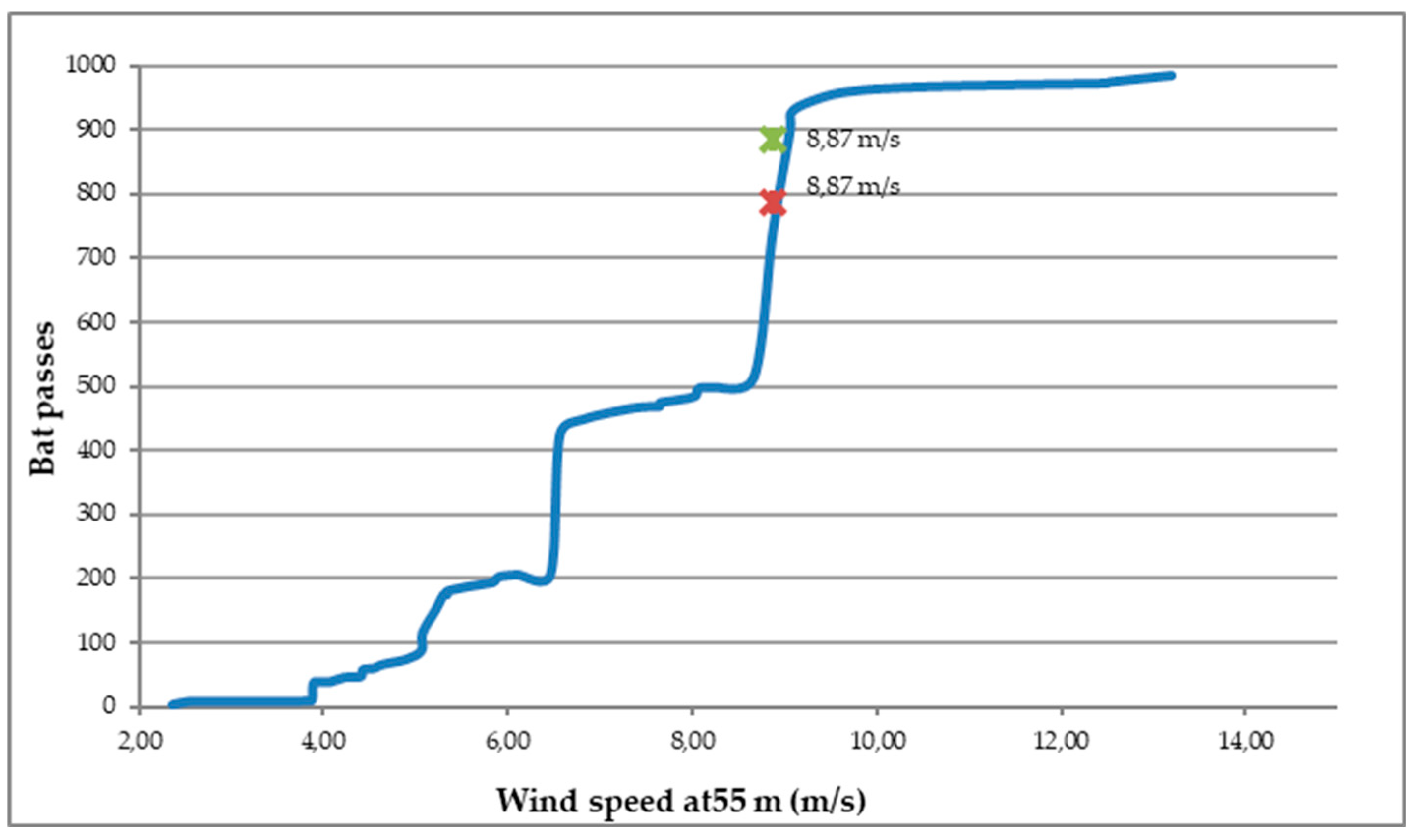
Figure 1. Cumulative bat activity (Bat passes) as a function of wind speed at 55m at the Gevancas wind farm (Serra do Alvão). Blue line – cumulative bat activity; red cross – wind speed at 80% of cumulative bat activity; green cross – wind speed at 90% of cumulative bat activity.
Preprints 198721 g001
Figure 2. Cumulative bat activity (Bat passes) as a function of wind speed at 55m at the Azinheira Wind Farm (Serra do Viso). Blue line – cumulative bat activity; red cross – wind speed at 80% of cumulative bat activity; green cross – wind speed at 90% of cumulative bat activity.
Preprints 198721 g002
Figure 3. Cumulative bat activity (Bat passes) as a function of wind speed at 55 meters at the Dom João and Feirão Wind Farm (Serra de Montemuro). Blue line – cumulative bat passes; red cross – wind speed at 80% of cumulative bat activity; green cross – wind speed at 90% of cumulative bat activity.
Preprints 198721 g003
Table 1. Results og the Generalized Linear Mixed Model (GLMM) relating the bat activity with wind speed (m/s), considering the different locations (windfarm) and times of the year (month).
Random effects
Group Variance Std. Dev
Month 1.6577 1.2875
Windfarm 0.2273 0.4767
Fixed effects
Estimate Std. Error z value Pr(>|z|)
Intercept 4.33745 0.54545 8.415 < 0.001***
Wind (m/s) -0.47786 0.01497 -30.931 <0.001***
Disclaimer/Publisher’s Note: The statements, opinions and data contained in all publications are solely those of the individual author(s) and contributor(s) and not of MDPI and/or the editor(s). MDPI and/or the editor(s) disclaim responsibility for any injury to people or property resulting from any ideas, methods, instructions or products referred to in the content.
Copyright: This open access article is published under a Creative Commons CC BY 4.0 license, which permit the free download, distribution, and reuse, provided that the author and preprint are cited in any reuse.
Prerpints.org logo

Preprints.org is a free preprint server supported by MDPI in Basel, Switzerland.

Subscribe

Disclaimer

Terms of Use

Privacy Policy

Privacy Settings

© 2026 MDPI (Basel, Switzerland) unless otherwise stated