

Submitted:
12 February 2026
Posted:
13 February 2026
You are already at the latest version
Abstract
Wind energy stands as one of the most technologically mature renewable sources, playing a pivotal role in the mitigation of greenhouse gas emissions. However, wind farms and associated infrastructures increase collision risk for flying organisms. Implementing higher cut-in speeds is a proven mitigation strategy to significantly decrease wildlife mortality rates, particularly for bat species, by preventing turbine operation during low-wind periods of high activity. The suggested, non-standard, increased cut-in speed for wind turbines is generally 5.0 m/s. To test the effectiveness of cut-in speed increase, bat activity was monitored at three wind farms in northern Portugal (Gevancas, Azinheira and Dom João e Feirão), using ultrasonic acoustic detection, to characterize spatial and temporal activity patterns and assess the potential risk associated. Monitoring was carried out at fixed stations, at heights of 55m above ground level during seven consecutive nights per month, from march to October. Wind speed data were recorded concurrently using anemometers mounted on meteorological towers. Contradicting cut-in speed recommendations, the results show that 90% of bat activity occurred at wind speeds above the current mitigation thresholds (5.0 m/s.). Since turbine operation coincides with peak bat activity, it is imperative to implement site-specific mitigation strategies, such as optimized cut-in speeds, to minimize mortality risk.
Keywords:
1. Introduction
2. Materials and Methods
2.1. Study Area
2.2. Estimating Wind Speeds
- μ(z) is the estimated wind speed at the desired height at 55 m
- μ(Zref) is the known wind speed at the reference height at 45m (meteorological towers) or 85m (wind turbines);
- Z is the target height for wind speed estimation (55m);
- Zref is the reference height at which wind speed is known (45m or 85m);
- α is the roughness factor corresponding to moderately rough terrain typical of mountainous rural landscapes with shrub and forest cover, which characterize the study areas (0.18).
2.3. Bat Activity Monitoring
2.4. Data Processing
3. Results
4. Discussion
5. Conclusions
Acknowledgments
References
- Rahman, A.; Murad, S. W.; Mohsin, A. K. M.; Wang, X. Does renewable energy proactively contribute to mitigating carbon emissions in major fossil fuels consuming countries? Journal of Cleaner Production 2024, 452, 142113. [Google Scholar] [CrossRef]
- Josimović, B.; Cvjetić, A.; Furundžić, D. Strategic Environmental Assessment and the precautionary principle in the spatial planning of wind farms–European experience in Serbia. Renewable and Sustainable Energy Reviews 2021, 136, 110459. [Google Scholar] [CrossRef]
- Katzner, T. E.; Nelson, D. M.; Marques, A. T.; Voigt, C. C.; Lambertucci, S. A.; Rebolo, N.; Murgatroyd, M. Impacts of onshore wind energy production on biodiversity. Nature Reviews Biodiversity 2025, 1–14. [Google Scholar] [CrossRef]
- Balotari-Chiebao, F.; Santangeli, A.; Piirainen, S.; Byholm, P. Wind energy expansion and birds: Identifying priority areas for impact avoidance at a national level. Biological Conservation 2023, 277, 109851. [Google Scholar] [CrossRef]
- Toman, M. A., Griffin, J., & Lempert, R. J. (2008). Impacts on U.S. energy expenditures and greenhouse-gas emissions of increasing renewable-energy use: technical report. Rand Corp.
- IPCC. Intergovernmental Panel on Climate Change Special Report Renewable Energy Sources and Climate Change MitigationCambridge University Press; Cambridge, UK, 2011. [Google Scholar]
- Ghanem, S. J.; Voigt, C. C. Chapter 7 - Increasing Awareness of Ecosystem Services Provided by Bats; Brockmann, H. J., Roper, T. J., Naguib, M., Mitani, J. C., Simmons, L. W., Eds.; ScienceDirect; Academic Press, 1 January 2012; Available online: https://www.sciencedirect.com/science/article/abs/pii/B9780123942883000071.
- Northrup, J. M.; Wittemyer, G. Characterising the impacts of emerging energy development on wildlife, with an eye towards mitigation Ecol. Lett. 2013, 16, 112–125. [Google Scholar] [CrossRef]
- Arnett, E. B.; Huso, M. M.; Schirmacher, M. R.; Hayes, J. P. Altering turbine speed reduces bat mortality at wind-energy facilities. Frontiers in Ecology and the Environment 2010, 9(4), 209–214. [Google Scholar] [CrossRef]
- Raposeira, H.; Horta, P.; Heleno, R.; Rebelo, H. Changing with the times: Seasonal environmental gradients unveil dynamic bat assemblages and vulnerability. Ecology and Evolution 2023, 13(7), e10246. [Google Scholar] [CrossRef]
- Adams, E. M.; Gulka, J.; Williams, K. A. A review of the effectiveness of operational curtailment for reducing bat fatalities at terrestrial wind farms in North America. PLoS One 2021, 16(11), e0256382. [Google Scholar] [CrossRef]
- Ellerbrok, J. S.; Farwig, N.; Peter, F.; Voigt, C. C. Forest bat activity declines with increasing wind speed in proximity of operating wind turbines. Global Ecology and Conservation 2024, 49, e02782. [Google Scholar] [CrossRef]
- NRG Systems. NRG S1 anemometer: Technical product sheet. 2019. Available online: https://www.nrgsystems.com/assets/resources/NRG_S1_Tech_Product_Sheet_2023_V1.pdf.
- Bañuelos-Ruedas, F.; Angeles-Camacho, C.; Rios-Marcuello, S. Analysis and validation of the methodology used in the extrapolation of wind speed data at different heights. Renewable and Sustainable Energy Reviews 2010, 14(8), 2383–2391. [Google Scholar] [CrossRef]
- Wildlife Acoustics; Inc. Song Meter SM4BAT FS User Guide (June 4, 2025 ed.); 2025; Available online: https://www.wildlifeacoustics.com/.
- Wildlife Acoustics. SMM-U2 Ultrasonic Microphone [Apparatus]. 2022. Available online: https://www.wildlifeacoustics.com/.
- López-Baucells, A; Torrent, L; Rocha, R; Bobrowiec, PE; Palmeirim, JM; Meyer, CF. Stronger together: combining automated classifiers with manual post-validation optimizes the workload vs reliability trade-off of species identification in bat acoustic surveys. Eco Inform 2019, 49, 45–53. [Google Scholar] [CrossRef]
- Rydell, J; Nyman, S; Eklöf, J; Jones, G; Russo, D. Testing the performances of automated identification of bat echolocation calls: a request for prudence. Ecol Ind 2017, 78, 416–420. [Google Scholar] [CrossRef]
- Russ, J. Bat Calls of Britain and Europe; Pelagic Publishing: London, United Kingdom, 2021. [Google Scholar]
- Rainho A, Amorim F, Marques JT, Alves P, y Rebelo H (2011) Chave de identificaçao de vocalizações dos morcegos de Portugal continental. Versão electrónica de 5 de junio de2011.
- Bates, D.; Mächler, M.; Bolker, B.; Walker, S. Fitting Linear Mixed-Effects Models Using lme4. Journal of Statistical Software 2015, 67(1), 1–48. [Google Scholar] [CrossRef]
- Barré, K.; Froidevaux, J. S.; Sotillo, A.; Roemer, C.; Kerbiriou, C. Drivers of bat activity at wind turbines advocate for mitigating bat exposure using multicriteria algorithm-based curtailment. Science of the Total Environment 2023, 866, 161404. [Google Scholar] [CrossRef]
- Rnjak, D.; Janeš, M.; Križan, J.; Antonić, O. Reducing bat mortality at wind farms using site-specific mitigation measures: A case study in the Mediterranean region, Croatia. Mammalia 2023, 87(3), 259–270. [Google Scholar] [CrossRef]
- Lloyd, J. D.; Butryn, R.; Pearman-Gillman, S.; Allison, T. D. Seasonal patterns of bird and bat collision fatalities at wind turbines. Plos one 2023, 18(5), e0284778. [Google Scholar] [CrossRef]
- Guest, E. E.; Stamps, B. F.; Durish, N. D.; Hale, A. M.; Hein, C. D.; Morton, B. P.; Weaver, S. P.; Fritts, S. R. An Updated Review of Hypotheses Regarding Bat Attraction to Wind Turbines. Animals 2022, 12(3), 343. [Google Scholar] [CrossRef]
- Barré, K.; Froidevaux, J. S.; Leroux, C.; Mariton, L.; Fritze, M.; Kerbiriou, C.; Roemer, C. Over a decade of failure to implement UNEP/EUROBATS guidelines in wind energy planning: A call for action. Conservation Science and Practice 2022, 4(11), e12805. [Google Scholar] [CrossRef]
- Hartmann, S. A.; Hochradel, K.; Greule, S.; Günther, F.; Luedtke, B.; Schauer-Weisshahn, H.; Brinkmann, R. Collision risk of bats with small wind turbines: Worst-case scenarios near roosts, commuting and hunting structures. Plos one 2021, 16(6), e0253782. [Google Scholar] [CrossRef]
- Peterson, T.; Rusk, A.; Byrne, C.; Aghababian, S.; Edwards, S. Acoustic exposure reveals variation in curtailment effectiveness at reducing bat fatality at wind turbines. Ecosphere 2025, 16(5), e70277. [Google Scholar] [CrossRef]
- Maclaurin, G.; Hein, C.; Williams, T.; Roberts, O.; Lantz, E.; Buster, G.; Lopez, A. National-scale impacts on wind energy production under curtailment scenarios to reduce bat fatalities. Wind Energy 2022, 25(9), 1514–1529. [Google Scholar] [CrossRef]
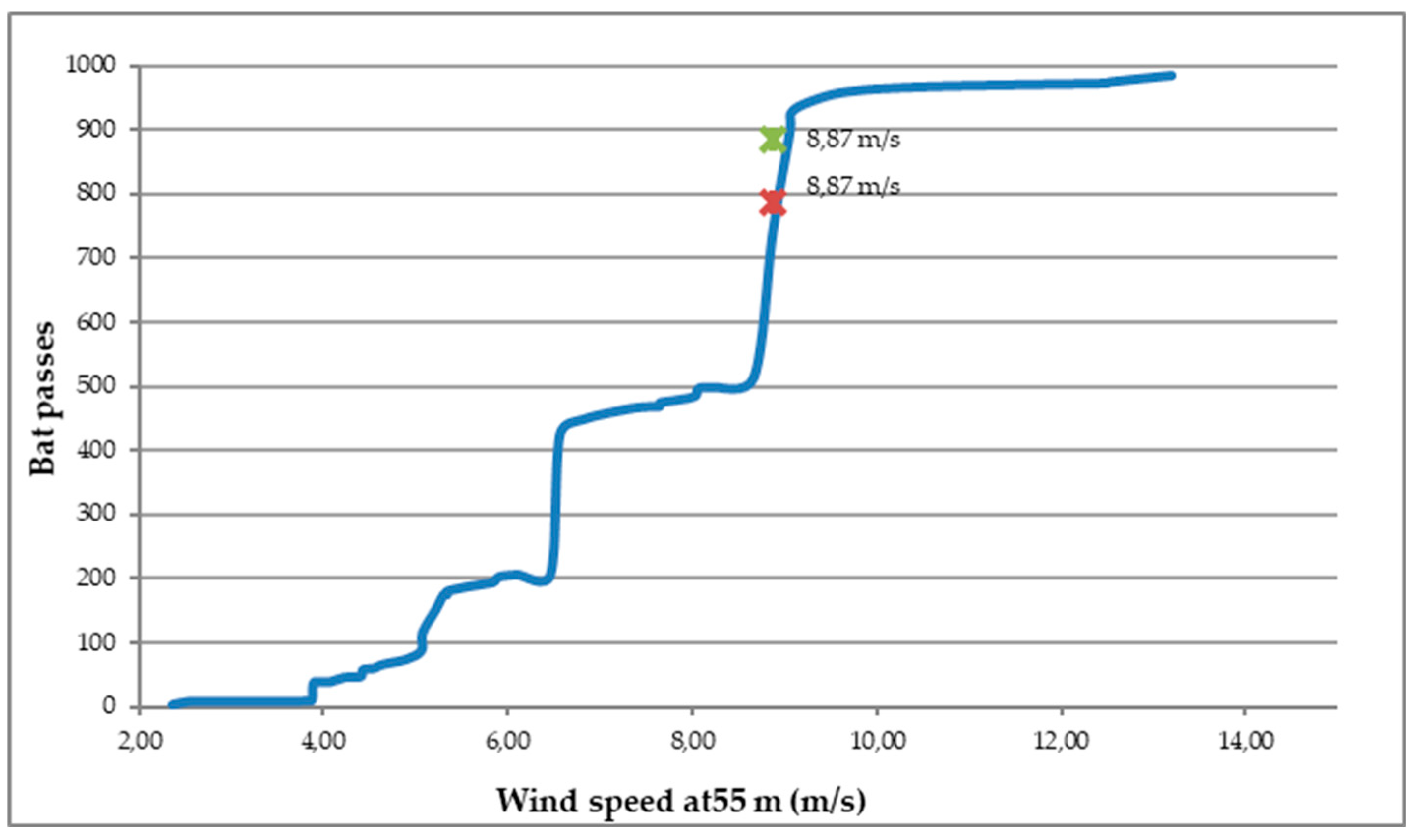
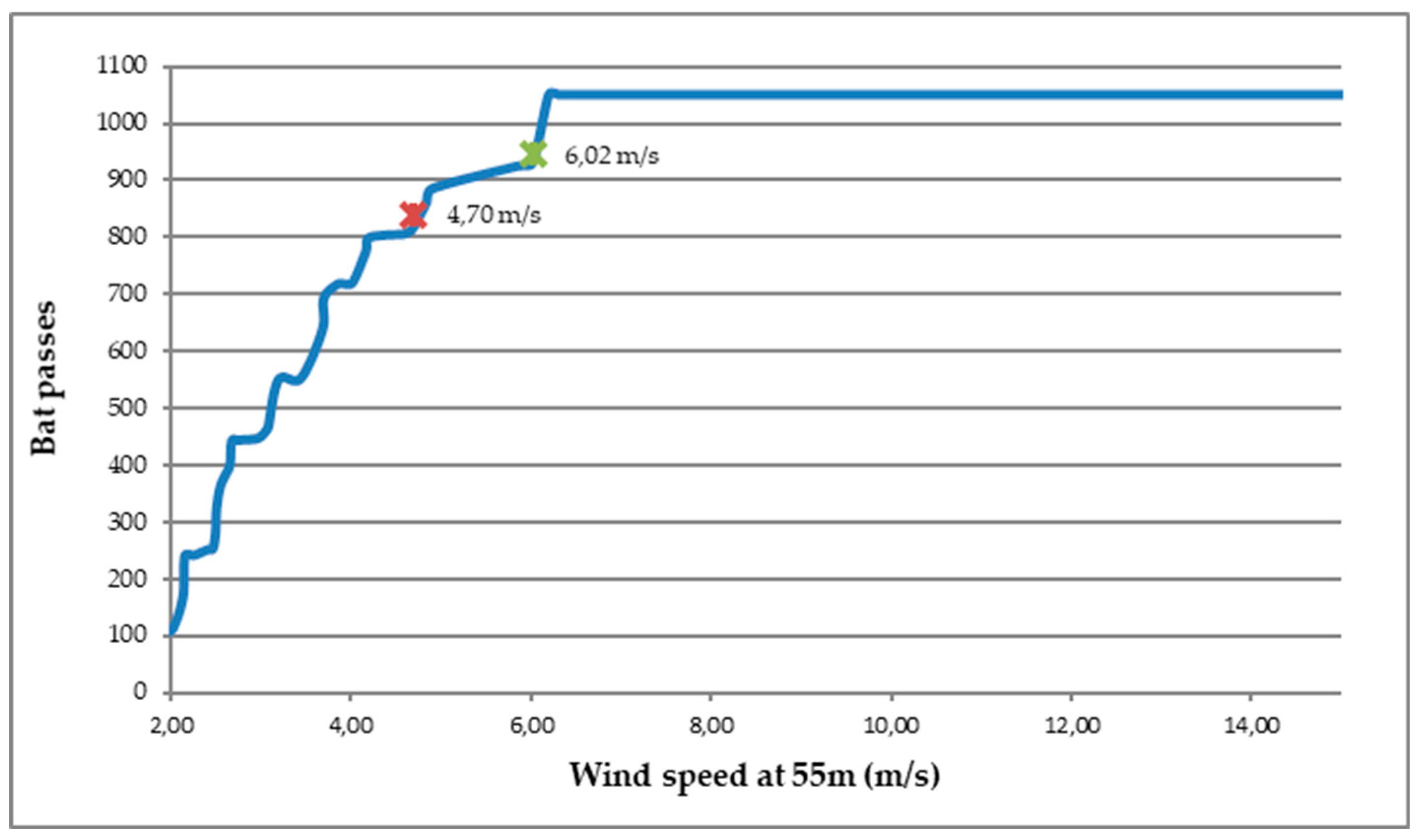
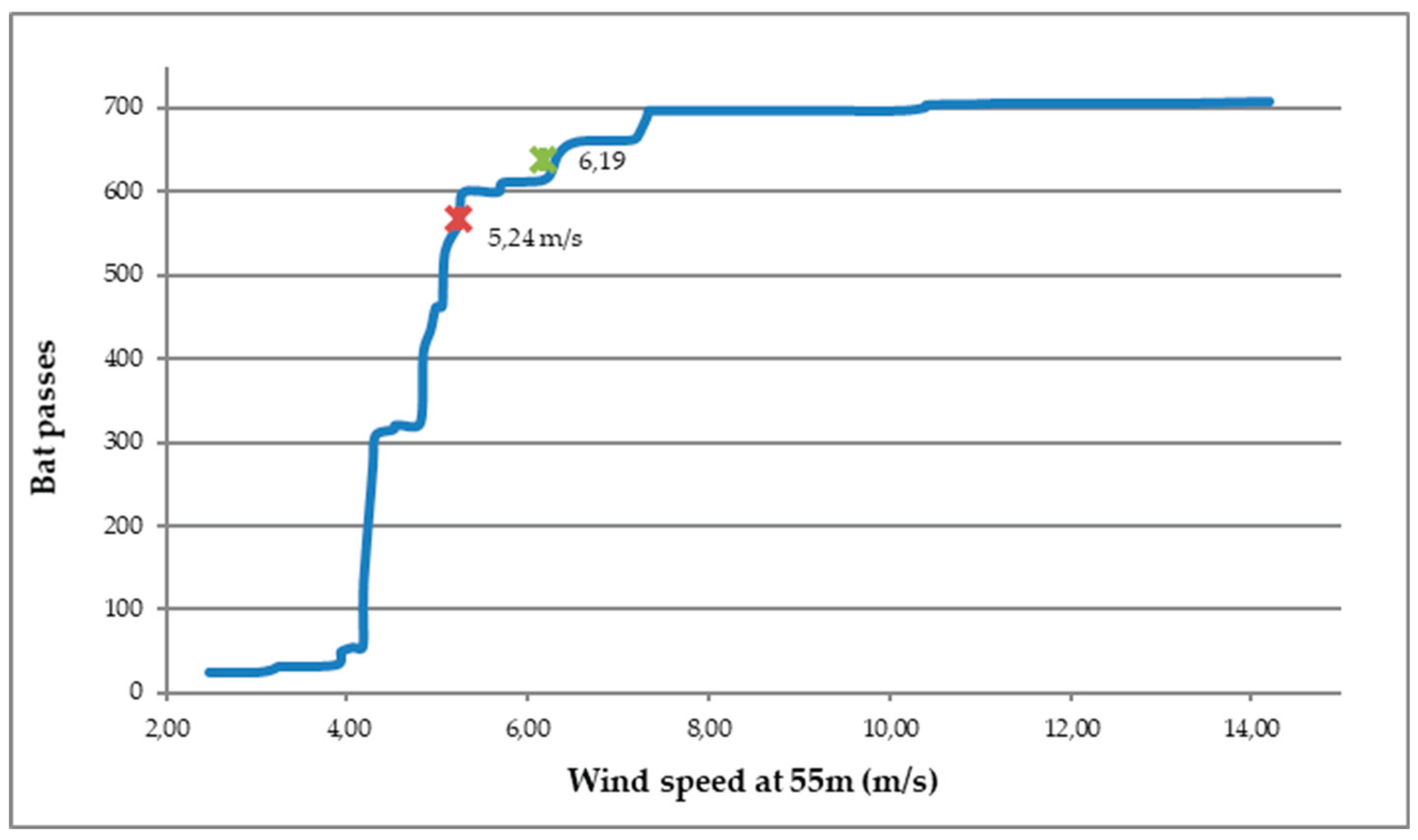

| Random effects | ||||
| Group | Variance | Std. Dev | ||
| Month | 1.6577 | 1.2875 | ||
| Windfarm | 0.2273 | 0.4767 | ||
| Fixed effects | ||||
| Estimate | Std. Error | z value | Pr(>|z|) | |
| Intercept | 4.33745 | 0.54545 | 8.415 | < 0.001*** |
| Wind (m/s) | -0.47786 | 0.01497 | -30.931 | <0.001*** |
Disclaimer/Publisher’s Note: The statements, opinions and data contained in all publications are solely those of the individual author(s) and contributor(s) and not of MDPI and/or the editor(s). MDPI and/or the editor(s) disclaim responsibility for any injury to people or property resulting from any ideas, methods, instructions or products referred to in the content. |
© 2026 by the authors. Licensee MDPI, Basel, Switzerland. This article is an open access article distributed under the terms and conditions of the Creative Commons Attribution (CC BY) license (http://creativecommons.org/licenses/by/4.0/).


