

Submitted:
12 February 2026
Posted:
12 February 2026
You are already at the latest version
Abstract
Eleven resin cements, used as core build-up materials in this study, were evaluated via the following measurements: (a) push-out force between root dentin and fiber post; (b) pull-out force between core build-up material and fiber post; (c) shear bond strength of resin cement to root dentin; (d) flexural strength of resin cement; and (e) flexural modulus of elasticity of resin cement. All tests were performed at two time periods: after 1-day storage in water (Base) and after 20,000 thermocycles (TC 20k). For the push-out test, single-rooted human premolars were used to create simulated cavities. The specimens were sectioned horizontally perpendicular to their long axes into 2-mm slices. These slices were then subjected to push-out test to determine the bond strength between human root dentin, resin cement layer, and the fiber post. There were no significant differences in bond strength between Base and TC 20k. Therefore, surface pretreatments of multiple substrates with universal adhesives for fiber post cementation could ensure not only strong, but also durable, adhesion over time.
Keywords:
shear bond strength
; universal adhesive
; fiber post
; resin luting materials
; root dentin
; durability
1. Introduction
Where natural-looking teeth and a confident smile are non-negotiable outcomes, most aesthetic-centric tooth restorations are currently inclined towards fiber posts and resin cores. Compared with traditional cast metal posts, fiber posts have a modulus of elasticity similar to that of dentin. This is clinically advantageous because it reduces the occurrence of root canal fractures [1−6]. In endodontically treated teeth without an adequate ferrule, lost ferrule portions can be restored with resin cores. However, the resin core build-up procedure can be cumbersome because different substrates require different surface treatment agents: a silane coupling agent for the cured composite resin (the restored portion of the ferrule) and an acid monomer-containing treatment agent for the natural root dentin structure [7−10].
Recently developed resin cements have overcome the major hurdle of requiring different surface treatment agents for different substrates when used as a core build-up material. These updated resin cements can be applied to all types of substrates and were shown to exhibit strong adhesion to root canal dentin. In addition, they no longer require one surface treatment agent for root canal dentin and another different one for the cured composite resin (restored portion of the ferrule). Other improvements which favor their pragmatic use as a core build-up material include possessing excellent mechanical strength to withstand occlusal bite forces during mastication [11−14].
Fiber posts are typically reinforced with E-glass or S-glass fibers. Known for their high tensile strength, excellent flexibility and biocompatibility, these fibers are embedded within a polymeric resin matrix, typically epoxy or methacrylate polymer, to create a composite material with an elastic modulus ranging from 16 to 40 GPa [4]. In addition to their aesthetic appeal, fiber posts offer several advantages such as high impact resistance, high shock absorption capacity, increased fatigue resistance, and reduced root fracture risk [15]. In endodontically treated teeth, fiber posts are traditionally bonded to the root canal surface using resin cement and a silane primer, thereby forming an integrated dentin-post adhesive system.
Recently, a new version of adhesive system categorized as a “universal” adhesive has been shown in market. A universal adhesive system is a single-step procedure that can be applied to teeth substrates in clinical conditions. This single-step adhesive system can then be applied to bond to restorative materials in many cases: such as zirconia, metal, and various ceramic materials without pretreating by a priming agent [16−21].
In our previous studies, we focused on the impact of the flexural properties of resin cements as core build-up materials on bonding performance. We investigated the relationships between the flexural strength or flexural modulus of elasticity of core build-up materials and their shear bond strength to root dentin, as well as with the retentive force of dental restorative materials (e.g., dental post and lithium disilicate ceramic) [21,22]. In a more recent study, our focus progressed to the impact of universal adhesives on long-term bonding durability. In the absence of hydrofluoric acid (HF) pretreatment, Tokuyama Universal Bond II ? a universal adhesive ? showed significantly higher shear bond strength to lithium disilicate (LDS) ceramic than other bonding agents after 20,000 thermocycles [23]. For LDS, long-term bonding durability could be maintained by pre-treating with Tokuyama Universal Bond II instead of the hazardous HF.
In this study, a simplified procedure using “universal adhesives” was applied to fiber posts, root dentin substrates, and updated core build-up materials that have emerged in the market. At two time periods, after 1-day storage (Base) and after 20,000 thermocycles (TC 20k), this study measured the following fiber post cementation-related values: (a) push-out force between root dentin and fiber post; (b) pull-out force between core build-up material and fiber post; (c) shear bond strength of resin cement to root dentin; (d) flexural strength of resin cement; and (e) flexural modulus of elasticity of resin cement.
Three hypotheses were tested in this study: (1) One or more values of (b), (c), (d), and (e) would correlate with value (a); (2) “Universal adhesives” could provide durable bonding among root dentin, fiber posts, and core build-up materials, and this bonding would not be influenced by the time period (Base versus TC 20k); (3) Tokuyama Universal Bond II would be confirmed as an effective “universal adhesive” for diverse core build-up materials, luting cements, and fiber posts.
2. Materials and Methods
Table 1 to 3 list the manufacturers and compositions of all materials used in this study.
TEGDMA: Triethyleneglycol dimethacrylate , Bis-GMA: Bisphenol A diglycidylmethacrylate, MDP: 10-Methacryloyloxydecyl dihydrogen phosphate, HEMA: 2-Hydroxymethacrylate PMMA: poly(methyl methacrylate), 4-META: 4-methacryloxyethyl trimellitate anhydride, MMA: methyl methacrylate, TBB: Tri-n-butylborane.
All procedures were performed in accordance with the manufacturers’ instructions. For light activation, a light-curing unit (G-Light Prima II, GC, Tokyo, Japan) was used. Before each application to the materials, light irradiance was checked using a radiometer (Demetron, Kerr, Danbury, CT, USA). During the experiment, light irradiance was maintained at 450 mW/cm2. Human premolars and molars, extracted for orthodontic reasons, were used. After extraction, the tooth was immediately stored in cold distilled water at about 4°C for 1 or 2 months before using. The research protocol of this study was approved by the Ethics Committee of Okayama University Graduate School of Medicine, Dentistry and Pharmaceutical Sciences and Okayama University Hospital (No. 1901-036). A single operator performed all the procedures according to the manufacturers’ instructions. For each test and time period, ten specimens were prepared for each resin cement.
2.1. Push-out Test
Simulated cavities were prepared using extracted single-rooted human premolars with K reamers (new Endo K Reamers, Shofu, Kyoto, Japan; 25 mm length, Sizes 10 and 15), K-files (new Endo K-Files, Shofu, Kyoto, Japan; 25 mm length, Sizes 25 and 30) and a Peeso reamer (new Endo Peeso Reamer, Shofu, Kyoto, Japan; 16 mm length, Size 6) according to the conventional methods. Root canals of the simulated cavities were cleaned with a 3−6% sodium hypochlorite solution (Antiformin, Nippon Shika Yakuhin, Shimonoseki, Japan) for 1 min, followed by a 3% EDTA solution (SMEARCLEAN, Nippon Shika Yakuhin, Shimonoseki, Japan) for 1 min.
Root dentin surfaces were pretreated with universal adhesives according to each manufacturer’s instructions (Table 2).
2-HEMA:Hydroxyethylmethacrylate, MDP: 10-methacryloyloxydecyl dihydrogen phos-phate, Bis-GMA: Bisphenol A diglycidylmethacrylate, 4-MET: 4-methacryloxyethyl trimellitic acid, MTU-6: 6-methacryloxyhexyl 2-thiouracil-5-carboxylate, γ-MPTES: 3-(triethoxysilyl) propyl methacrylate, VTD: 6-(4-vinylbenzyl-n-propyl) amino-1,3,5-triazine-2,4-dithione, MMA: methyl methacrylate, γ -MPTS: 3-methacryloxypropyl trimethoxy silane.
Similarly, the surface of each fiber post (Table 3) was treated with the respective system’s universal adhesive according to the manufacturers’ instructions in Table 2. For Ivoclar Vivadent’s Monobond Plus and Kerr Dental’s OptiBond eXTRa Universal adhesives which had no recommended post system, BeautiCore FiberPost (diameter: 1.6 mm; Shofu, Kyoto, Japan; Table 3) was used as the post system.
A resin cement paste of the respective systems listed in Table 1 was filled into the post space, and the pre-treated fiber post was placed in the root canal. The resin pastes were light-irradiated twice, 20 sec each time, from the occlusal surface of the post using a light-curing unit (G-Light Prima II, GC, Tokyo, Japan). Test specimens obtained were stored in 37°C water for 24 hr, and then the coronal portion of each specimen was removed using a low-speed precision cutter (IsoMet, Buehler, Lake Bluff, IL, USA). Each root canal specimen was sectioned horizontally perpendicular to the long axis of the specimen into 2-mm slices (Figure 1) at a crosshead speed of 0.5 mm/min using a universal testing machine (5565, Instron, Canton, MA, USA) to determine the bond strength between human dentin, the resin cement layer, and the fiber post ? which constituted the integrated dentin-post adhesive system.
All failed specimens were checked with a light microscope (SMZ-10, Nikon, Tokyo, Japan) to determine the nature of their fractures [21−23].
2.2. Pull-out Test
Each post was pretreated with a universal adhesive according to the manufacturers’ instructions in Table 2. For Ivoclar Vivadent’s Monobond Plus and Kerr’s OptiBond eXTRa Universal adhesives which had no instructed post procedure system, BeautiCore FiberPost (Diameter: 1.6 mm; Shofu, Kyoto, Japan; Table 3) was utilized as the post procedure system.
Each resin core build-up material was filled in a Teflon mold (Upper diameter: 8 mm, bottom diameter: 3.6 mm, height: 5 mm) set on a glass plate pre-coated with Vaseline. Then, each post was inserted at the center of the Teflon mold using a retainer and cured in four overlapping sections, with each section cured for 20 X 4 sec. in Figure 1
Specimens thus obtained were mounted on a universal testing machine (5565, Instron, Canton, MA, USA), and pull-out force was applied at a crosshead speed of 0.5 mm/min (n=10/group) in Figure 1. As each post differed in its external form, the maximum failure load was expressed in Newton (N). After the pull-out force testings, all failed specimens were checked with a light microscope (50 X; Measurescope MM-II, Nikon, Tokyo, Japan) to determine the status of their fracture modes. Three categories of fractured mode were evaluated: (1) adhesive failure at the interface between post and resin core material; (2) cohesive failure within the resin core material; and (3) combination of adhesive and cohesive failures on the same surface or a mixed failure [21].
2.3. Shear Bond Strength of Resin Cement to Root Dentin
Specimens were getted from human premolars and molars, embedded in slow-polymelizin epoxy resin (EpoFix Resin, Struers, Copenhagen, Denmark) with their buccal surfaces up, and wet-ground with silicon carbide abrasive papers up to 320 grit until a superficial dentin area of at least 4 mm diameter was exposed. A split Teflon mold having a cylindrical hole (Diameter: 3.6 mm, height: 2 mm) was fixed to the prepared dentin surface in a mounting apparatus. The Teflon mold was filled with resin cement paste after applying its corresponding treatment agent to the dentin surface according to the manufacturers’ instructions in Table 2. Light irradiation was performed to harden the cement paste (20 sec each from two directions). After 24-hr storage in 37℃ distilled water, the specimens were subjected to a shear force using a universal testing machine (Autograph DCS-2000, Shimadzu, Kyoto, Japan) at a crosshead speed of 0.5 mm/min. The force was transmitted via a flat (blunt) 1-mm-thick shearing blade at a perpendicular direction to the load. Stress at failure was calculated and recorded as the shear bond strength value. All failed specimens were analyzed using a light microscope (SMZ-10, Nikon, Tokyo, Japan) to determine the nature of their fractures [21−23].
2.4. Flexural Strength and Flexural Modulus of Elasticity of Resin Cement
Test specimens of respective resin cements (n=10/group) were prepared using a Teflon mold (25×2×2 mm). Each resin paste was light-irradiated in three overlapping sections, with each section irradiated for 20 sec. Both sides of the specimen were light-irradiated in the same way. After 24-hr storage in 37℃ distilled water, the specimens were subjected to flexural properties testing via a three-point loading upon the specimens with a 20-mm span and at a loading rate of 0.5 mm/min using a universal testing machine (5565, Instron, Canton, MA, USA) as outlined in ISO 9917-2:1998. Their flexural strength and flexural modulus of elasticity values were then calculated (Series IX software, Instron, Canton, MA, USA).
2.5. Scanning Electron Microscope (SEM) Observations
Following the pull-out tests, fractured surfaces of specimens were randomly selected for observation using a scanning electron microscope (SEM; JSM-IT800 SHL, Jeol, Tokyo, Japan), which operated at an accelerating voltage of 5 kV. To prevent charging occurring at the specimen surface, a thin film of osmium was deposited using an osmium coater (Neoc-STB, Meiwafosis, Tokyo, Japan).
2.6. Statistical Analysis
Statistical analyses were analysed using the software package, Statistica 9.1 (StatSoft, OK, USA). Analyses of variance (two-way ANOVA) with Tukey’s HSD for post-hoc comparison were used to analyse the data obtained for push-out force, pull-out force, shear bond strength to root dentin, flexural strength, and flexural modulus of elasticity (p<0.05).
Any possible correlations between push-out force and pull-out force, between push-out force and shear bond strength to root dentin, between push-out force and flexural strength, and between push-out force and flexural modulus of elasticity were evaluated (Spearman; p<0.05). Analyses were conducted using SPSS version 19 (Chicago, IL, USA). In addition, based on the results of the correlation analysis previously conducted between the two results, multiple linear regression analyses were performed using the three independent factors of push-out force, pull-out force, and flexural modulus of elasticity. Level of significance was performed at p<0.05.
3. Results
3.1. Push-out Test
Push-out force data and their statistical analysis results are given in Table 4.
*: S: Significant difference (p < 0.05), NS: Not significant difference (p > 0.05), #: Superscript letters represent groups with no significant difference (a-d, e-h, Tukey HSD procedure), p > 0.05, TC 20k: after 20,000 thermocycles, n=10, Adh: Number of adhesive failure modes after failure 10).
The push-out force of many post-core systems did not change significantly with time (p>0.05, except MultiCore Flow and NX3 systems). The 1-day time period yielded the higher mean data. SI-300381 system showed the highest values at both time periods (after 1-day storage and after TC 20k), while MultiCore Flow system exhibited lower values at both time periods.
On failure mode, no adhesive fractures were observed. Overall, the proportion of adhesive failures for all systems was similar at both time periods.
3.2. Pull-Out Test for Pretreatment with Manufacturers’ Recommended Agents
Pull-out force data and their statistical analysis results are given in Table 5.
*: S: Significant difference (p < 0.05), NS: Not significant difference (p > 0.05), #: Superscript letters represent groups with no significant difference (a-i, j-s, Tukey HSD procedure), p > 0.05, TC 20k: after 20,000 thermocycles, n=10, Adh: Number of adhesive failure modes after failure 10).
The pull-out force of many post-core systems did not change significantly with time (p>0.05, except MultiCore Flow and NX3 systems). The 1-day time period yielded the higher mean data, except UniFil Core EM. BeautiLink SA Automix showed the highest values at the 1-day and TC 20k time periods.
On failure mode, no adhesive fractures were observed. Overall, the proportion of adhesive failures was the same at both time periods.
3.3. Pull-Out Test for Pretreatment with Tokuyama Universal Bond II
When Tokuyama Universal Bond II was used as the sole pretreatment agent, the pull-out force data and their statistical analysis results are given in Table 6.
*: S: Significant difference (p < 0.05), NS: Not significant difference (p > 0.05), #: Superscript letters represent groups with no significant difference (a-i, j-r, Tukey HSD procedure), p > 0.05, TC 20k: after 20,000 thermocycles, n=10, Adh: Number of adhesive failure modes after failure 10).
The pull-out force of many post-core systems did not change significantly with time (p>0.05, except UniFil Core EM, MultiCore Flow and NX3 systems). All systems showed values exceeding 30 MPa even after TC 20k.
On failure mode, no adhesive fractures were observed. Overall, the proportion of adhesive failures was the same at both time periods.
Based on the results in Table 6, Tokuyama Universal Bond II pretreatment produced higher pull-out force values for all post-core systems at both time periods. These results clearly confirmed that the bonding effectiveness of Tokuyama Universal Bond II was extended to and applicable upon other manufacturers’ post-core systems.
3.4. Statistical Comparisons between Two Pretreatment Agents
When pretreated with Tokuyama Universal Bond II, all post-core systems used in this study showed values exceeding 30 MPa even after TC 20k. Significant difference was observed only when pretreatment with the manufacturer’s recommended agent yielded values below 30 MPa (Table 7).
TC 20k: after 20,000 thermocycles, S: Significant difference (p < 0.05), NS: Not significant difference (p > 0.05).
3.5. Shear Bond Strength to Root Dentin
Shear bond strength data and their statistical analysis results are given in Table 8.
*: S: Significant difference (p < 0.05), NS: Not significant difference (p > 0.05), #: Superscript letters represent groups with no significant difference (a-e, f-i, Tukey HSD procedure), p > 0.05, TC 20k: after 20,000 thermocycles, n=10, Adh: Number of adhesive failure modes after failure 10).
The shear bond strength of many core build-up materials did not change significantly with time (p>0.05, except NX3 and BeautiLink SA Automix). The 1-day time period yielded the higher mean data, except for MultiCore Flow. Clearfil DC Core Automix ONE showed the highest values at both time periods.
On failure mode, no adhesive fractures were observed. Overall, the proportion of adhesive failure modes was the same at both time periods.
3.6. Flexural Strength
Flexural strength data of core build-up materials and their statistical analysis results are given in Table 9.
*: S: Significant difference (p < 0.05), NS: Not significant difference (p > 0.05), #: Superscript letters represent groups with no significant difference (a-i, j-s, Tukey HSD procedure), p > 0.05, TC 20k: after 20,000 thermocycles, n=10, Adh: Number of adhesive failure modes after failure 10).
The 1-day time period yielded the higher mean data. Approximately half of the results showed a statistically significant decrease after TC 20k (p<0.05). At both time periods, ESTECORE Hand Type showed the highest values amongst the core build-up materials.
3.7. Flexural Modulus of Elasticity
Flexural modulus of elasticity data of core build-up materials and their statistical analysis results are given in Table 10.
*: S: Significant difference (p < 0.05), NS: Not significant difference (p > 0.05), #: Superscript letters represent groups with no significant difference (a-h, i-r, Tukey HSD procedure), p > 0.05, TC 20k: after 20,000 thermocycles, n=10, Adh: Number of adhesive failure modes after failure 10).
Nearly all the core materials did not show a statistically significant decrease after TC 20k (p>0.05). Similar to flexural strength data, ESTECORE Hand Type showed the highest values at both time periods.
3.8. SEM Observations
Representative SEM images of fractured surfaces after pull-out testing are shown in Figure 2.
The lower-magnification SEM images showed cohesive failure pattern at the interface between the post (Tokuyama FR Post) and core material (ESTECEM II Plus). In other words, the post surface was chemically bonded to the core build-up material through universal adhesive pretreatment.
3.9. Correlations
For all core build-up materials at both time periods (n=22), relationships are shown in Table 11.
4. Discussion
The post and core system comprises the root canal dentin surface, core build-up material and the post surface, thereby producing two adhesive interfaces. Given the strong trend towards the use of fiber posts and resin cores for tooth restorations, a diverse range of products from myriad manufacturers have emerged to cater to this unabating demand. Therefore, the long-term durability of fiber post cementation should not just focus on the versatility and ease of use of universal adhesives for multiple substrates within the two adhesive interfaces, it should further explore the possibility of a singular, general-purpose universal adhesive that could be applied on other manufacturers’ post and core systems to yield the same effective bonding.
In this study, the impact of universal adhesives on fiber post cementation with resin cores was investigated by measuring the push-out force, pull-out force, shear bond strength, flexural strength and flexural modulus of elasticity. In addition, Tokuyama Universal Bond II was applied as a universal adhesive on other manufacturers’ post and core systems and investigated thereof for its bonding effectiveness.
4.1. Correlation Between Push-out Force and Pull-out Force (Table 11 and Figure 3)
When a body, an object or a material is pushed or pulled, a push force or pull force is a force generated upon an object arising from the object’s or body’s interaction with another object. If an object is in motion, an external push or pull may change the state or the direction of motion of that object [3]. Therefore, not only does a push or pull force produce motion in an object, it also has direction ? which means that force is a vector quantity. If the directions of the force and moving object are opposite, then the magnitude of the net force acting on the object is decreased.
Change in the state of motion in an object or body is usually explained by the speed and direction of the acting force. In this study, a strong correlation was found between the push-out and pull-out values (r = 0.656, p = 0.0009, y = 1.25x + 4.13; n=22). This high correlation is understandable, given that the same pretreatment agents, fiber posts, and core build-up materials were used for both push-out and pull-out tests.
4.2. Correlation Between Push-out Force and Flexural Modulus of Elasticity or Flexural Strength (Table 11 and Figure 4)
Flexural strength of the core build-up materials had no strong correlation with the push-out force (r=0.409, p=0.058; close to a significant correlation). However, flexural modulus of elasticity had a significant correlation (r=0.475, p=0.025) with push-out force.
Displacement of the post due to push-out is thought to be more influenced by the elastic modulus — which determines how well the interface can withstand deformation — than by the core material’s own mechanical strength (flexural strength). This would account for the elastic modulus to be more significantly correlated with the push-out force.
Elastic modulus describes the relative stiffness of a material within its elastic range of deformation. Natural hard tissues have a range of intrinsic stiffness or modulus values. Addition of restorative materials of different moduli can affect the overall stiffness of the restored tooth, and interfacial stresses are generated as a result. Therefore, the clinical outcome of a restored tooth is closely related to the matching of elastic modulus values. If the modulus mismatch is too great, interfacial stress may arise from thermal, mechanical, or shrinkage strain in the material. For this reason, core build-up material should have high elastic modulus similar to that of tooth structure (dentin) to withstand the forces of mastication and polymerization shrinkage stresses. To predict the clinical outcome of post and core restorations, it is hence vital to determine the elastic modulus values of core build-up materials [3].
4.3. Correlation Between Push-out Force and Shear Bond Strength (Table 11)
Push-out force did not correlate with shear bond strength (p>0.10). After push-out testing, only a small amount of core material adhered to the post. Since the majority of the root canal wall-core build-up material interface showed clear delamination failure, the effect of tooth structure adhesion appeared minimal, suggesting no correlation. This result could be due to pretreatment by universal adhesives. It was possible that the adhesive systems marketed by various manufacturers as “universal adhesives” failed to achieve the strong bond required for root canal dentin, such as that needed for bonding to core build-up materials or fiber posts.
4.4. Correlations among Push-out Force, Pull-out Force, and Flexural Strength or Flexural Modulus of Elasticity (Figure 4 and Figure 5)
Both push-out force and pull-out force showed significant correlations with the flexural strength (Push-out Force (N) = 0.353 Pull-out Force (N) - 0.05 Flexural Strength (MPa) + 12.285, n=22, p=0.005) and flexural modulus of elasticity (Push-out Force (N) = 0.300 Pull-out Force (N) + 0.165 Flexural Modulus (GPa) + 11.995, n=22, p=0.0009) of the core build-up materials. These correlations indicated that the flexural strength and flexural modulus of core build-up materials significantly influenced the retentive force between root canal wall and fiber posts (Figure 2). These correlations also supported the first hypothesis, notwithstanding that push-out force and shear bond strength to root dentin were not correlated.
In addition, these significant correlations suggested that by measuring the flexural strength and flexural modulus of core build-up materials, especially the flexural modulus, the push-out force between root canal dentin and fiber post could be predicted. This finding indicated that clinical outcome prediction is possible without the use of valuable human premolars. This finding also partially supported the second hypothesis. When core build-up materials of optimal flexural modulus values are used, strong bonding could be delivered by universal adhesives for the entire post and core system.
Apart from the properties of core build-up materials, a weak or strong retention is inextricably dependent on the surrounding characteristics. In the oral cavity, water (as the major component of saliva) causes a major role in filler-matrix bond failures in resin-based materials. It causes filler elements to leach out. It induces filler failures and filler-matrix drop-out, thereby compromising the matrix material because debonded fillers may act as stress concentrators and significantly multiply the number of potential crack growing. In addition, water has a plasticizing effect on the matrix.
Apart from water, many failures in practice occur because of thermal stress, especially at the root dentin-core interface and core-pretreated post interface. Due to the double factors both water immersion and thermal stress, microleakage occurs and weaks interfacial friction, eventually resulting in resin core build-up material failure [4].
4.5. Versatility of Universal Adhesives
Unlike the root dentin substrate which had a uniform composition (taken into consideration the differences that exist between individuals), each post presented a different composition as seen in Table 3 of this study. There were differences in terms of post material (quartz fiber versus glass fiber), matrix composition, and hence polymerization contraction stress ? which is dependent on the chemical composition of the resin matrix and which affects interfacial bonding. Apart from the fiber post, bonding performance is also affected by the universal adhesive and filler content of the core build-up material [22].
In this study, the bonding performance results in Table 4 and Table 5 were not only clinically acceptable, but remained stable and consistent from Base time period to TC 20k time period. Therefore, the second hypothesis was fully accepted because the universal adhesives could provide durable bonding among root dentin, fiber post and core build-up material, whereby this bonding was not influenced by the time period.
It is noteworthy that the results on the universal adhesives in this study highlighted their contribution to the treatment of traumatized teeth. Not only are they easy to use and convenient, the universal adhesives could provide good bonding results among different substrates and interfaces, which augur well for the success and longevity of dental restorations.
4.6. Applicability of Tokuyama Universal Bond II as General-Purpose Universal Adhesive
When Tokuyama Universal Bond II was used as a pretreatment agent on other manufacturers’ post and core systems, comparable ? and oftentimes better ? bond strength results were obtained for the post-core systems investigated in this study (Table 5 and Table 6). These results suggested that a two-bottle bonding agent was reliable and consistent in attaining durable bond strength between fiber posts and core build-up materials.
In two-bottle pretreatment agents, hydrolysis of the silane coupling agent in the product before mixing the two components is difficult to occur. Hydrolysis of the silane coupling agent proceeds only when the two components are mixed during use, resulting in the formation of silanol groups. As a result, the number of silanol groups that can condense and react with a fiber post is higher than that of one-component pretreatment agents. The strong chemical bonding to the fiber posts in this study thus helped to prevent decrease in retentive force during durability tests [23,24]. This suggestion was confirmed from the SEM image which showed the core build-up material adhering firmly to the fiber post and penetrating the fibers (Figure 2).
Amongst the post-core systems investigated in this study, highest pull-out force values were recorded for ESTECEM II Plus /Tokuyama FR Post at both time periods. Moreover, these values were significantly higher than the other post and core systems. Two reasons were thought to contribute to their superior bonding performance. The first reason was that the flexural strength and flexural modulus of the core material were significantly higher than the rest. The second was that post surface pretreatment with Tokuyama Universal Bond II had a greater effect on the retentive force of the post, as explained in the preceding paragraph [22,23].
And then, the adhesive performance of Tokuyama Universal Bond II is attributed to the effects of the new functional monomer, New 3D-SR monomer, which contributes to its storage stability at room temperature and its resistance to hydrolysis and degradation of γ-MPTES [3-(triethoxysilyl) propyl meth-acrylate].
Beyond the present manufacturer-recommended use, results of this study was shown that its future application could be expanded to be a general-purpose pretreatment agent for bonding ability between fiber posts and core build-up materials. Based on the above, the third hypothesis of this study was accepted.
4.7. Limitations
This study presents results obtained under limited in vitro conditions. In fact, the materials used in this study are actually employed in the oral cavity. Further measurements simulating thermal changes and occlusal forces within the oral environment are necessary.
5. Conclusions
Universal adhesives were not only convenient and easy to use across multiple types of substrates, they were effective in achieving strong adhesion among root canal dentin, resin core build-up materials and fiber posts. The bonding was also stable and durable as there were no significant differences in bonding performance between Base and TC 20k.
Author Contributions
Conceptualization, M.I.; Methodology, M.I.; Software, Y.M; Validation, M.O. and Y.M.; Formal Analysis, M.I. and Y.M.; Investigation, M.I.; Resources, T.M.; Data Duration, M.I.; Writing — Original Draft Preparation, M.I.; Writing — Review and Editing, T.M. and A.T.; Visualization, Y.M. and K.Y.; Supervision, A.K. and T.M.; Project Administration, M.I.; Funding Acquisition, M.I.
Funding
This research received no external funding.
Institutional Review Board Statement
The Ethics Committee of Okayama University Graduate School of Medicine, Dentistry and Pharmaceutical Sciences and Okayama University Hospital (No. 1901-036).
Informed Consent Statement
Not applicable.
Data Availability Statement
The data presented in this study are available from the corresponding author, M.I., upon reasonable request.
Conflicts of Interest
The authors declare no conflicts of interest.
References
- Dental Materials, Properties and Manipulation, 9th ed.; Powers, J.M., Wataha, J.C., Eds.; Mosby Elsevier: St. Louis, MI, USA, 2008; p. pp. 203−204. [Google Scholar]
- Sidoli, G.E.; King, P.A.; Setchell, D.J. An in vitro evaluation of a carbon fiber based post and core system. J. Prosthet. Dent. 1997, 78, 5−9. [Google Scholar] [CrossRef]
- Combe, E.C.; Shaglouf, A.-M.S.; Watts, D.C.; Wilson, N.H.F. Mechanical properties of direct core build-up materials. Dent. Mater. 1999, 15, 158−165. [Google Scholar] [CrossRef]
- Pest, L.B.; Cavalli, G.; Bertani, P.; Gagliani, M. Adhesive post-endodontic restorations with fiber posts: push-out tests and SEM observations. Dent. Mater. 2002, 18, 596−602. [Google Scholar]
- Gutierrez, M.F.; Sutil, E.; Malaquias, P.; de Paris Matos, P.; de Souza, L.M.; Reis, A.; Perdigao, J.; Loguercio, A.D. Effect of self-curing activators and curing protocols on adhesive properties of universal adhesives bonded to dual-cured composites. Dent. Mater. 2017, 33, 775−787. [Google Scholar] [CrossRef]
- Phillips’ Science of Dental Materials, 13th ed.; Shen, C., Rawls, H.R., Esquivel-Upshaw, J.F., Eds.; Mosby Elsevier: St. Louis, MI, USA, 2022; p. pp. 202−232. [Google Scholar]
- Seefeld, F.; Wenz, H.J.; Ludwig, K.; Kern, M. Resistance to fracture and structural characteristics of different fiber reinforced post systems. Dent. Mater. 2007, 23, 265−271. [Google Scholar] [CrossRef] [PubMed]
- Yenisey, M.; Kulunk, S. Effect of chemical surface treatments of quartz and glass fiber posts on the retention of a composite resin. J. Prosthet. Dent. 2008, 99, 38−45. [Google Scholar] [CrossRef]
- Torres-Sanchez, C.; Montoya-Salazar, V.; Cordoba, P.; Velez, C.; Guzman-Duran, A.; Gutierrez-Perez, J.L.; Torres-Lagares, D. Fracture resistance of endodontically treated teeth restored with glass fiber reinforced posts and cast gold post and cores cemented with three cement. J. Prosthet. Dent. 2013, 110, 127−133. [Google Scholar] [CrossRef] [PubMed]
- Tsujimoto, A.; Barkmeier, W.W.; Takamizawa, T.; Wilwerding, T.M.; Latta, M.A.; Miyazaki, M. Interfacial characteristics and bond durability of universal adhesive to various substrates. Oper. Dent. 2017, 42, e59–e70. [Google Scholar] [CrossRef] [PubMed]
- Ona, M.; Wakabayashi, N.; Yamazaki, T.; Takaichi, A.; Igarashi, Y. The influence of elastic modulus mismatch between tooth and post and core restorations on root fracture. Int. Endod. J. 2013, 46, 47−52. [Google Scholar] [CrossRef]
- ThanNaing, S.; Abdou, A.; Sayed, M.; Sumi, Y.; Tagami, J.; Hiraishi, N. Dentin anti-demineralization potential of surface reaction-type pre-reacted glass-ionomer filler containing self-adhesive resin cement. Clin. Oral Investig. 2022, 26, 1333–1342. [Google Scholar] [CrossRef]
- Tian, T.; Tsoi, J.K.-H.; Matinlinna, J.P.; Burrow, M.F. Aspects of bonding between resin luting cements and glass ceramic materials. Dent. Mater. 2014, 30, e147−e162. [Google Scholar] [CrossRef] [PubMed]
- Hooshmand, T.; van Noort, R.; Keshvad, A. Storage effect of a pre-activated silane on the resin to ceramic bond. Dent. Mater. 2004, 20, 635−642. [Google Scholar] [CrossRef]
- Tian, T.; Tsoi, J.K.-H.; Matinlinna, J.P.; Burrow, M.F. Aspects of bonding between resin luting cements and glass ceramic materials. Dent. Mater. 2014, 30, e147−e162. [Google Scholar] [CrossRef] [PubMed]
- Yoshihara, K.; Nagaoka, N.; Sonoda, A.; Maruo, Y.; Makita, Y.; Okihara, T.; Irie, M.; Yoshida, Y.; Van Meerbeek, B. Effectiveness and stability of silane coupling agent incorporated in “universal” adhesives. Dent. Mater. 2016, 32, 1218−1225. [Google Scholar] [CrossRef]
- Gutierrez, M.F.; Sutil, E.; Malaquias, P.; de Paris Matos, P.; de Souza, L.M.; Reis, A.; Perdigao, J.; Loguercio, A.D. Effect of self-curing activators and curing protocols on adhesive properties of universal adhesives bonded to dual-cured composites. Dent. Mater. 2017, 33, 775−787. [Google Scholar] [CrossRef]
- Dyer, S.; Walton, T.R.; Pegoraro, A.A. E-glass and S-glass fiber reinforced posts: physical properties and clinical performance. J. Prosthet. Dent. 2004, 92, 447−453. [Google Scholar]
- Luhrs, A.-K.; Pongprueksa, P.; De Munck, J.; Geurtsen, W.; Van Meerbeek, B. Curing mode affects bond strength of adhesively luted composite CAD/CAM restorations to dentin. Dent. Mater. 2014, 30, 281−291. [Google Scholar] [CrossRef]
- Madrigal, E.L.; Tichy, A.; Hosaka, K.; Ikeda, M.; Nakajima, M.; Tagami, J. The effect of curing mode of dual-cure cements on bonding performance of universal adhesives to enamel, dentin and various restorative materials. Dent. Mater. J. 2021, 40, 446−454. [Google Scholar] [CrossRef]
- Irie, M.; Maruo, Y.; Nishigawa, G.; Yoshihara, K.; Matsumoto, T. Flexural strength of resin core build-up materials: Correlation to root dentin shear bond strength and pull-out force. Polym. 2020, 12, 2947. [Google Scholar] [CrossRef] [PubMed]
- Irie, M.; Okada, M.; Maruo, Y.; Nishigawa, G.; Matsumoto, T. Shear bond strength of resin luting materials to lithium disilicate ceramic: Correlation between flexural strength and modulus of elasticity. Polym. 2023, 15, 1128. [Google Scholar] [CrossRef]
- Irie, M.; Okada, M.; Maruo, Y.; Nishigawa, G.; Matsumoto, T. Long-term bonding performance of one-bottle vs. two-bottle bonding agents to lithium disilicate ceramics. Polym. 2024, 16, 2266. [Google Scholar] [CrossRef] [PubMed]
- Available online: ://tokuyama-dental.eu/en/shop/bonding-agents-adhesives/15312-universal-bond-ii.
Figure 1.
Schematic illustration of push-out test.
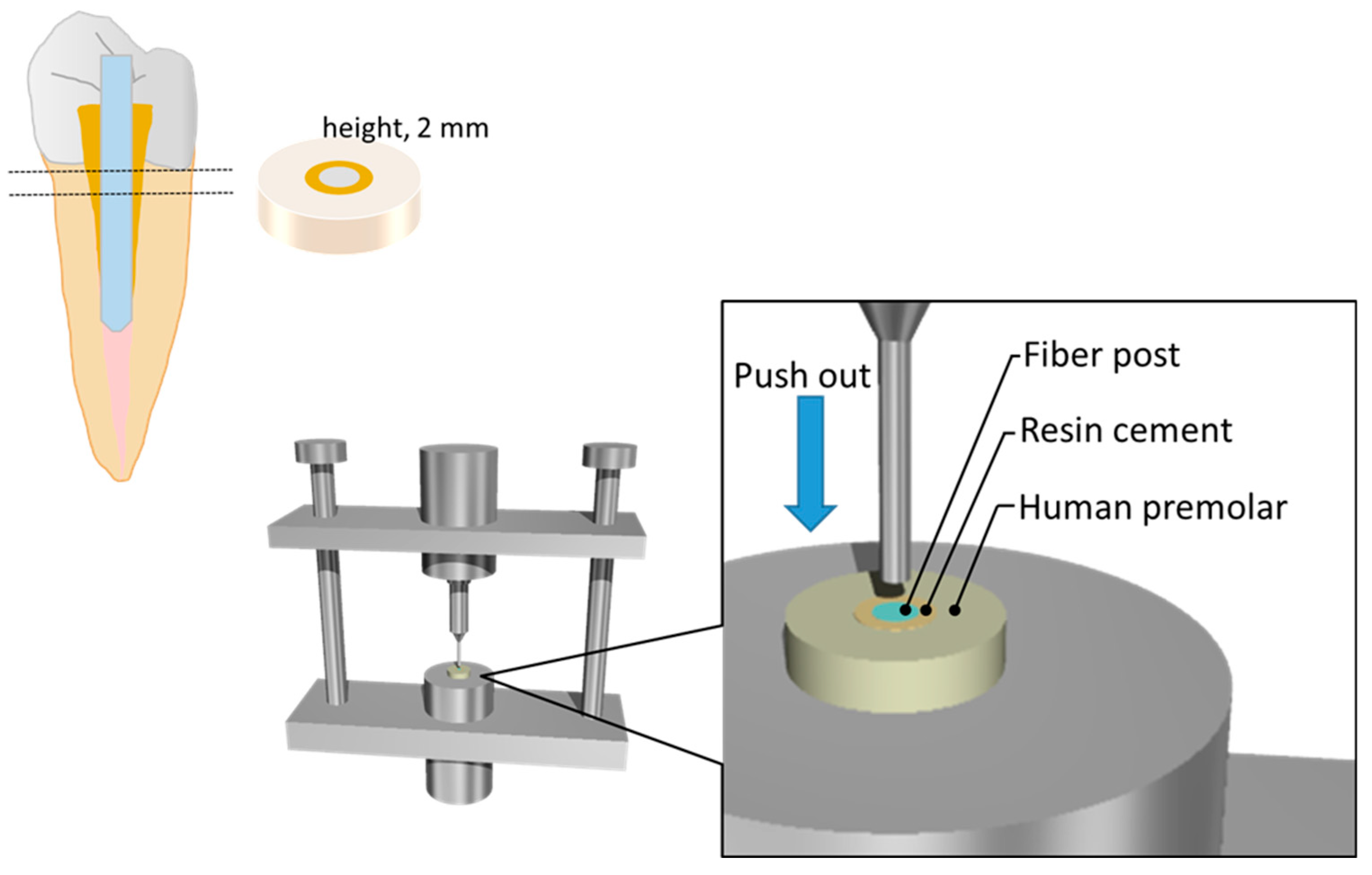
Figure 2.
Left: Close-up image of core build-up material adhering to the fiber post. Right: SEM image of core build-up material adhering firmly to the fiber post and penetrating the fibers.
Figure 2.
Left: Close-up image of core build-up material adhering to the fiber post. Right: SEM image of core build-up material adhering firmly to the fiber post and penetrating the fibers.
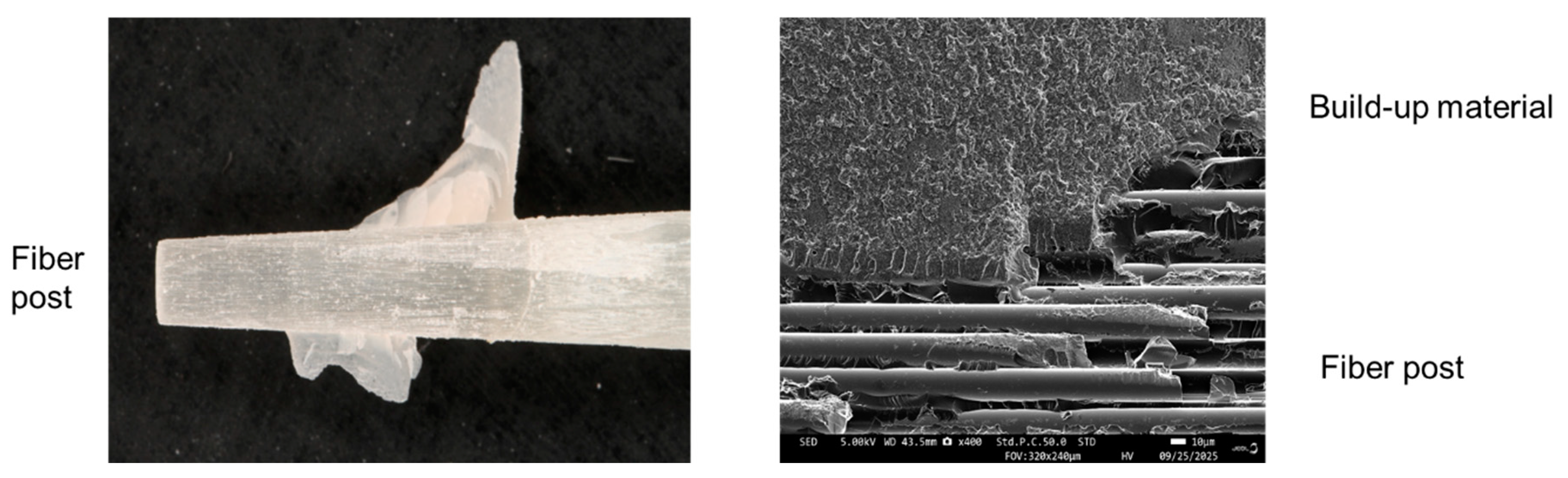
Figure 3.
Relationship between push-out force and pull-out force.
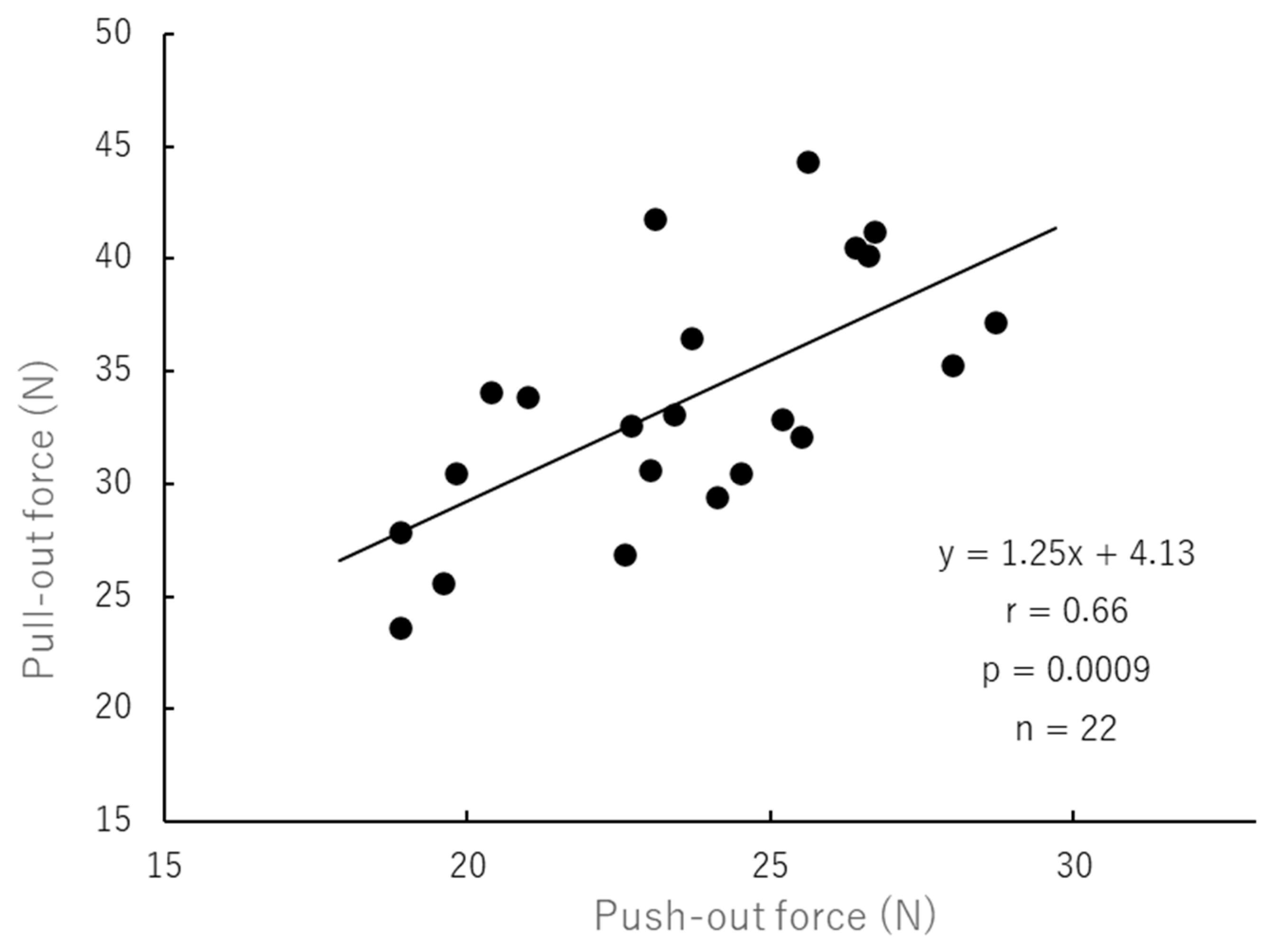
Figure 4.
Relationships among push-out force, pull-out force and flexural strength.
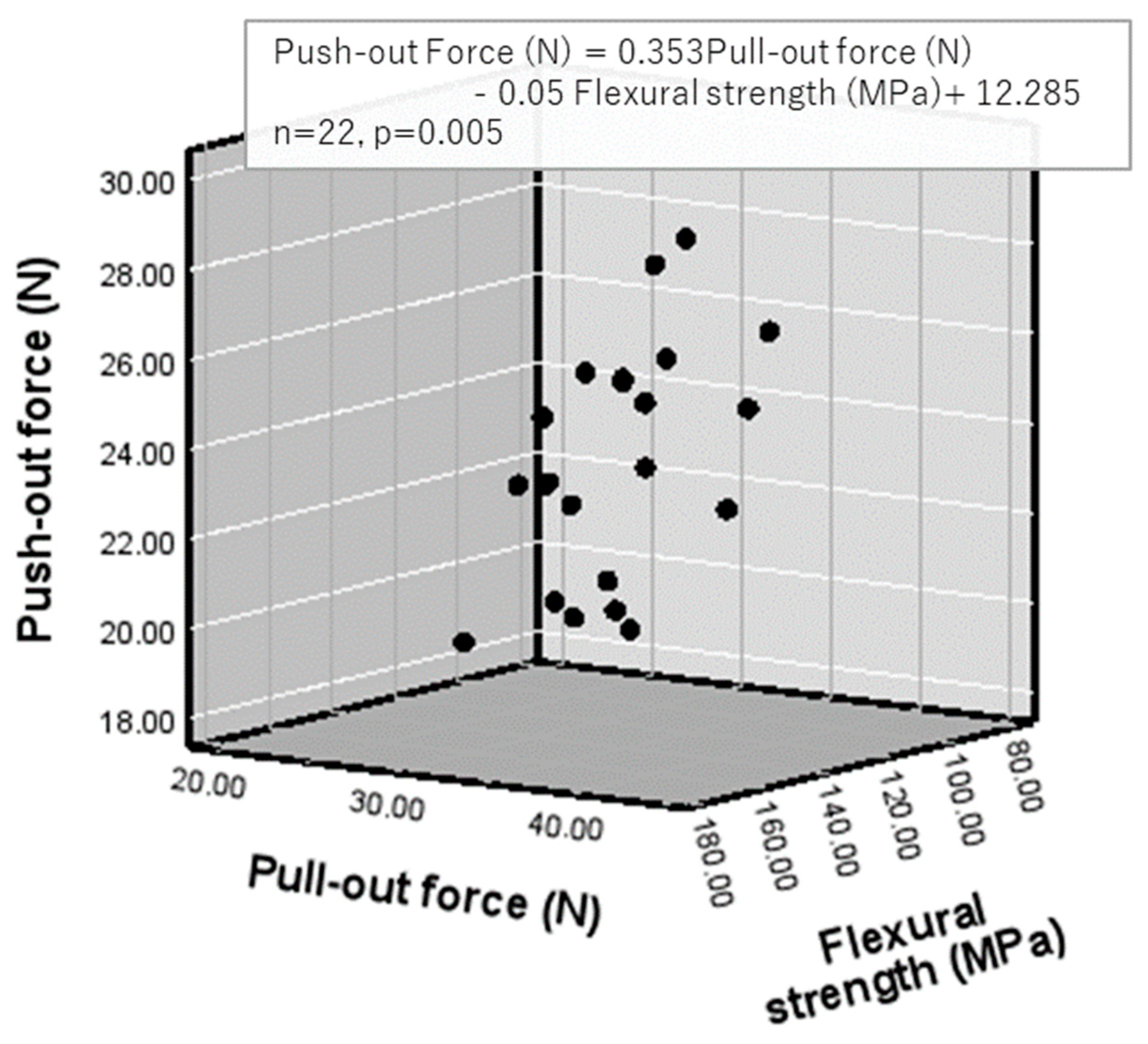
Figure 5.
Relationships among push-out force, pull-out force and flexural modulus.
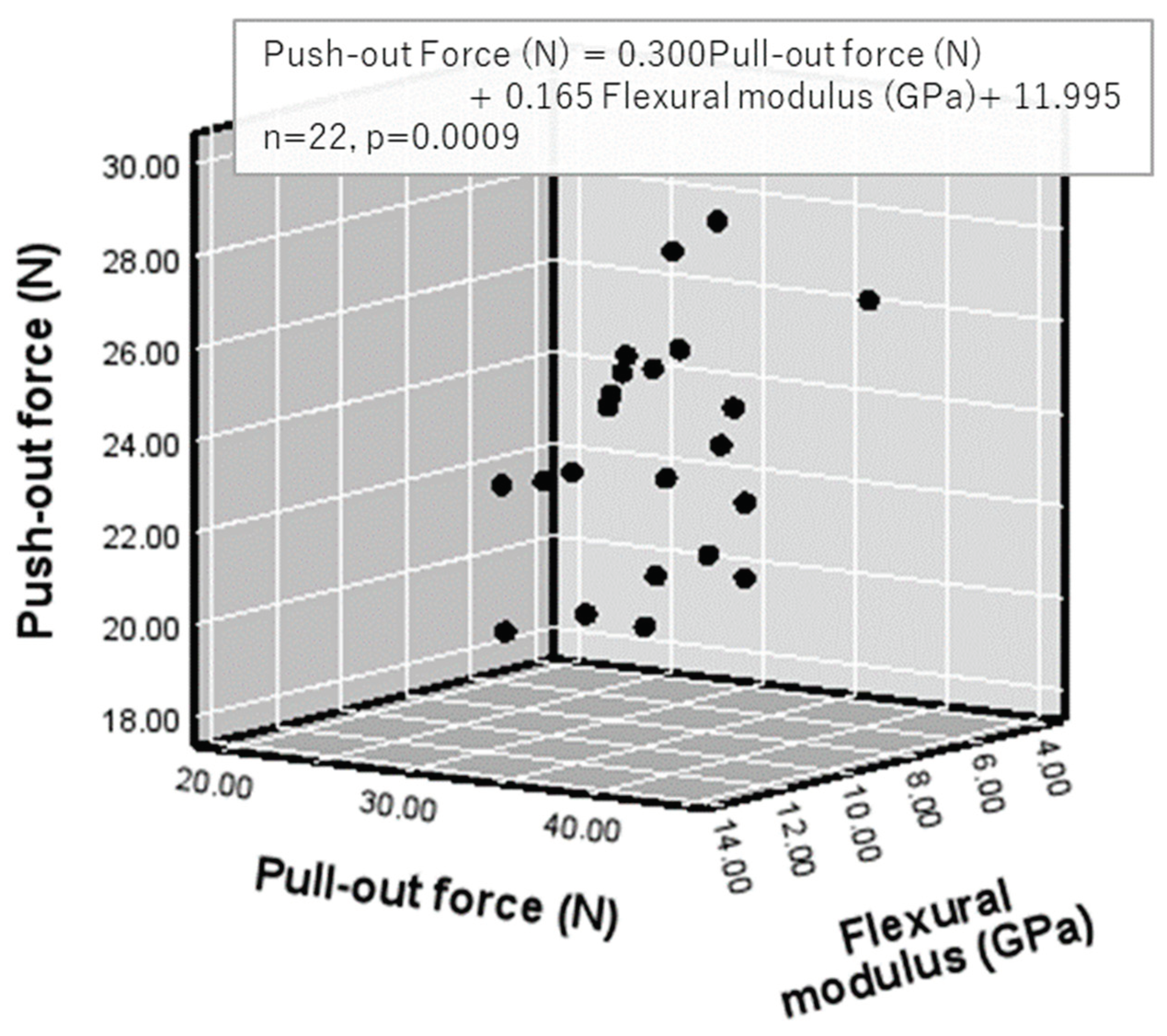

Table 1.
Core build-up materials used in this study.
| Product | Composition | Manufacturer | Batch No. |
| RelyX Universal Resin Cement | Surface treated glass powder filler, Phosphate ester monomer, TEGDMA, DiurethaneDimethacrylate, Silica filler, Initiator, Titanium Dioxide | Solventum, Seefeld, Germany | 11531204 |
| Clearfil DC Core Automix ONE | Bis-GMA, TEGDMA, Hydrophilic aliphatic dimethacrylate, Hydrophobic aromatic dimethacrylate, Silanated barium glass filler, Silanated colloidal silica, Colloidal silica, dl-Camphor Quinone, Aluminum oxide filler, Initiators, Accelerators, Pigments. Filler content: 74 wt.%, 52 vol.%. | Kuraray Noritake Dental, Tainai, Niigata, Japan | 8L06384 |
| ESTECORE | Bis-GMA, TEGDMA, Bis-MPEPP, Silica-Zirconia Filler, Camphorquinone, Peroxide, Radial amplifier, Others, Filler content: 75 wt.% | Tokuyama Dental, Tokyo, Japan | U295 |
| ESTECEM II Plus | Paste A: Bis-GMA, TEGDMA, Bis-MPEPP, Silica-Zirconia Filler Paste B: Bis-GMA, TEGDMA, Bis-MPEPP, Silica-Zirconia Filler, Camphorquinone, Peroxide, Filler content: 74 wt.%. |
Tokuyama Dental, Tokyo, Japan |
A09719 |
| UniFil Core EM | UDMA, Dimethacrylate, Fluoroaluminosilicate glass, Iron oxide, Dibenzoyl peroxide, Butylated hydroxytoluene, Filler content: 75 wt.% | GC, Hasunuma, Itabashi, Tokyo, Japan | 2302201 |
| MultiCore Flow | Ytterbium trifluoride, Bis-GMA, UDMA, TEGDMA, Dibenzoyl peroxide, Filler content: 70 wt. %, 46 vol. %, The particle size ranges from 0.04 to 25 µm. | Ivoclar Vivadent AG, Schaan, Liechtenstein | ZO7ZCY |
| BeaitiLink SA | Paste A: Zirconium silicate filler, Bis-GMA, Phosphonic acid monomer, Carboxylic acid monomer, Polymerization initiator, Others Paste B: Glass powder filler (S-PRG filler), UDMA, Polymerization initiator, Pigments, Others Filler content: approximately 60 wt.% |
Shofu, Kyoto, Japan |
122303 |
| NX3 | Barium Aluminoborosilicate glass, Ytterbium trifluoride, Fumed Silica, TEGDMA, UDMA, EBPADMA, Initiator, Stabilizer, Filler content: 67.5 wt.%, 43.3 vol.% | Kerr, Orange CA, USA |
A172592 |
| Core-X flow | Urethane Dimethacrylate, Di- & Tri-functional Methacrylates, Barium Boron, Fluoroaluminosilicate Glass, Camphorquinone (CQ) Photoinitiator, Photoaccelerators, Silicon Dioxide, Benzoyl Peroxid | DENTSPLY Caulk, Milford | DE 19963 |
| SI-300381 | Paste A: Fluoroboroaluminosilicate glass, Bis-GMA, TEGDMA, Polymerization initiator, Pigments, Others Paste B: Fluoroboroaluminosilicate glass, Bis-GMA, TEGDMA, Polymerization initiator, Others |
Shofu, Kyoto, Japan | 250517D |
| i-TFC system Post Resin | Dimethacrylates, Silica, Barium glass filler, Photoinitiators, Stabilizer, Others Filler content: 67 wt.% | SUN MEDICAL, Moriyama, Japan | MX13 |
TEGDMA: Triethyleneglycol dimethacrylate , Bis-GMA: Bisphenol A diglycidylmethacrylate, MDP: 10-Methacryloyloxydecyl dihydrogen phosphate, HEMA: 2-Hydroxymethacrylate PMMA: poly(methyl methacrylate), 4-META: 4-methacryloxyethyl trimellitate anhydride, MMA: methyl methacrylate, TBB: Tri-n-butylborane.
Table 2.
Universal adhesives used in this study.
| Adhesive | Batch No. | Composition | Manufacturer | Surface treatment |
| Scotchbond Universal Plus Adhesive | 8846013 | Brominated dimethacrylate, HEMA, Silane Treated Silica, Vitrabond Copolymer, MDP, Initiators, MPTES,Ethanol, Water | 3M, Seefeld, Germany | Scotchbond Universal Plus Adhesive (20 s) – air (5 s) |
| CLEAFIL Universal Bond Quick 2 | AH0023 | 3-Methacryloxypropyl trimethoxysilane, MDP, Ethanol |
Kuraray Noritake Dental, Tainai, Niigata, Japan | CLEAFIL CERAMIC PRIMER PLUS (1-2 s) – air (5 s) |
| G-Cem One Multi Primer | 2104221 | Vinyl silane, Phosphate ester monomer, Thiophosphate ester monomer, Methacrylic ester, Ethanol |
GC, Hasunuma, Itabashi, Tokyo, Japan | G-Cem One Multi Primer (10 s) – air (5 s) |
| Tokuyama Universal Bond II (A+B) | Bond A: 0011 Bond B: 0510 |
Liquid A: Phosphoric acid monomer (New 3D-SR monomer), MTU-6, HEMA, Bis-GMA, TEGDMA, Acetone, Others. Liquid B: γ-MPTES, Borate, Peroxide, Acetone, Ethanol, Water, Others |
Tokuyama Dental, Tokyo, Japan | Tokuyama Universal Bond II Mix (Liquid A + Liquid B, 1-2 s) – air (5 s) |
| Monobond Plus | ZO1LG8 | Phosphoric acid monomer, Silane methacylate, Ethanol | Ivoclar Vivadent AG, Schaan, Liechtenstein | Monobond Plus (60 s) – air |
| BeautiBond Xtreme | 042347 | Acetone, Water, Bis-GMA, TEGDMA, Phosphoric ester monomer, Silane coupling agent, Initiator, Others | Shofu, Kyoto, Japan | BeautiBond Xtreme (20 s) – air |
| OptiBond eXTRa Universal | Primer: 8199022 Adhesive: 8181793 |
HEMA, dimethacrylate monomers, tri-functional methacrylate monomer, Ethanol, Photo-initiator, Bariumaluminosilicate filler, Silica, Sodium hexafluorosilicate | Kerr, Orange CA, USA | OptiBond eXTRa Adhesive (15 s) – air (5 s) – LED light (5 s) |
| Prime&Bond universal | DE 19963 | Phosphoric acid modified acrylate resin, Multifunctional acrylate,, Bifunctional acrylate, Acidic acrylate, Isopropanol, Water, Initiator, Stabilizer | DENTSPLY Caulk, Milford |
Endodontic post cementation 1. Apply mixture of Prime&Bond universal & Dentsply Self cure Activator post surface 2. Leave it undisturbed for 10 sec. and dry naturally Post Cementation Core-X flow into the post space and immediately insert the post into the post space. Light-cure from every aspect using a light-curing unit to fix the post: Halogen for 20 sec. |
| SI-303062 | Primer A: 250317 Primer B: 250314 |
Primer A: Acetone, Distilled water, Bis-GMA, Carboxylic acid monomer, TEGDMA, Phosphonic acid monomer, others Primer B: Distilled water, Acetone, initiator |
Shofu, Kyoto, Japan |
Preparation of the post Apply SHOFU Porcelain Primer to the post in one layer with a disposable brush. Leave it undisturbed for 10 sec. and dry naturally Pretreatment of post space Primer A and Primer B in equal amounts and apply the mixture onto the entire adhesive surface of the post space. Leave undisturbed for 10 sec. Air dry with gentle air for 3 sec and then dry with stronger air to dry the surface sufficiently. Light-cure with a light-curing unit: Halogen for 10 sec. Post Cementation Fill SI-300381 Paste into the post space and immediately insert the post into the post space. Light-cure from every aspect using a light-curing unit to fix the post: Halogen for 20 sec. |
| i-TFC Luminous Bond II | Bond: FW1, Catalyst blush: ES1 |
Bond: Methacrylic acid esters (4-META, others), Acetone, water, others Catalyst blush: Aromatic amines, aromatic sulfinates |
SUN MEDICAL, Moriyama, Japan | Mix (Bond + Catalyst prush, 5 sec) – air (10 sec) – LED light (20 sec) |
2-HEMA:Hydroxyethylmethacrylate, MDP: 10-methacryloyloxydecyl dihydrogen phos-phate, Bis-GMA: Bisphenol A diglycidylmethacrylate, 4-MET: 4-methacryloxyethyl trimellitic acid, MTU-6: 6-methacryloxyhexyl 2-thiouracil-5-carboxylate, γ-MPTES: 3-(triethoxysilyl) propyl methacrylate, VTD: 6-(4-vinylbenzyl-n-propyl) amino-1,3,5-triazine-2,4-dithione, MMA: methyl methacrylate, γ -MPTS: 3-methacryloxypropyl trimethoxy silane.
Table 3.
Fiber posts used in this study.
| Product (Diameter) | Composition | Manufacturer | Batch No. |
| RelyX FiberPost (1.6 mm) | Glass fibers, Composite resin matrix | Solventum, Seefeld, Germany | 306831603 |
| Tokuyama FR Post (1.6 mm) | Glass fibers, Colpolymer Bis-GMA resin | Tokuyama Dental, Tokyo, Japan | 1604251 |
| GC Fiber Post (1.6 mm) | Glass fibers,Metacrylate | GC, Tokyo, Japan | 1609021 |
| Clearfil AD Fiber Post (1.6 mm) | Glass fibers, Colpolymer Bis-GMA and Methacrylic acid monomer | Kuraray Noritake Dental, Tainai, Niigata, Japan | 7U0001 |
| BeautiCore FiberPost (1.6 mm) | Glass fiber, Copolymer of Bis-GMA and Methacrylic ester monomer | Shofu, Kyoro, Japan | 41601 |
| i-TFC Luminous Fiber II (1.6 mm) | Glass components: Borosilicate glass, barium oxide, and others Resin component: Dimethacrylate and diacrylate copolymer, others |
SUN MEDICAL, Moriyama, Japan | EL1S |
Table 4.
Push-out force data of core build-up systems (N, Mean (S.D.), Adh.).
| Core build-up systems: Resin cement / Pretreating agent / Fiber-post | Time | t-Test * | |
| Base (1-day) | TC 20k | ||
| RelyX Universal Resin Cement / Scotchbond Universal Plus Adhesive / RelyX Fiber Post |
19.8 (4.2, 0) ab# | 19.6 (3.1, 0) e | NS |
| Clearfil DC Core Automix ONE / Clearfil Universalbond Quick 2 + Clearfil Porcelain Bond Activator / Cleafil AD Fiber Post | 24.5 (5.3, 0) abc | 23.0 (4.3, 0) efgh | NS |
| UniFil Core EM / G-Premio BOND + G-Premio BOND DCA / GC Fiber Post | 23.4 (4.6, 1) abc | 20.4 (2.4, 0) ef | NS |
| ESTECEM II / Tokuyama Universal Bond II (A+B) / Tokuyama FR Post |
26.7 (3.6, 0) c | 23.1 (3.9, 0) efgh | NS |
| ESTECORE Hand Type / Tokuyama Universal Bond II (A+B) / Tokuyama FR Post |
26.4 (2.9, 0) c | 25.6 (3.2, 0) efg | NS |
| MultiCore Flow / Monobond Plus / BeautiCore Fiber | 23.7 (5.0, 0) abc | 18.9 (2.7, 0) e | S |
| NX3 / OptiBond XTR + Porcelain Primer (Shofu) / BeautiCore Fiber | 26.6 (4.9, 0) c | 18.9 (3.2, 0) e | S |
| BeautiLink SA Automix + BeautiBond Xtreme, BeautiCore FiberPost | 25.2 (3.6, 0) bc | 24.1 (3.1, 0) efgh | NS |
| SI-303062 (A + B) / SI-300381 / Post pretreated by BeautiBond Xtreme / BeautiCore FiberPost | 28.7 (2.7, 0) d | 28.0 (2.6, 0) h | NS |
| core-X flow / Prime&Bond universal + Self cure Activator / FluoroPost | 25.5 (4.9,0) bc | 22.6 (4.7, 0) efgh | NS |
| i-TFC system Post Resin / i-TFC Luminous Bond II / i-TFC Luminous Fiber II | 21.0 (4.2, 0) abc | 22.7 (4.2, 0) efgh | NS |
*: S: Significant difference (p < 0.05), NS: Not significant difference (p > 0.05), #: Superscript letters represent groups with no significant difference (a-d, e-h, Tukey HSD procedure), p > 0.05, TC 20k: after 20,000 thermocycles, n=10, Adh: Number of adhesive failure modes after failure 10).
Table 5.
Pull-out force data between core build-up materials and fiber posts (N, mean (S.D.), Adh.).
Table 5.
Pull-out force data between core build-up materials and fiber posts (N, mean (S.D.), Adh.).
| Materials / Fiber post (each manufacturer's recommended pretreatment agent) | Time | t-Test * | ||
| Base (1-day) | TC 20k | |||
| RelyX Universal Resin Cement / RelyX Fiber Post (Scotchbond Universal Plus Adhesive) | 30.5 (2.7, 0) abcde | 25.6 (3.1, 0) jk | S | |
| Clearfil DC Core Automix ONE / Clearfil AD Fiber Post (Clearfil Universalbond Quick 2) | 30.5 (3.5, 0) abcde | 30.6 (4.7, 0) jklno | NS | |
| UniFil Core EM / GC Fiber Post (G-Premio BOND + G-Premio BOND DCA) | 33.1 (5.0, 0) cdef | 34.1 (5.0, 0) mnopq | NS | |
| ESTECEM II / Tokuyama FR Post (Tokuyama Universal Bond II) | 41.2 (3.4, 0) hi | 41.8 (2.5, 0) s | NS | |
| ESTECORE Hand Type / Tokuyama FR Post (Tokuyama Universal Bond II) | 40.5 (3.7, 0) hi | 44.3 (3.3, 0) s | NS | |
| MultiCore Flow / BeautiCore Fiber (Monobond Plus) | 36.5 (1.5, 0) ghi | 23.6 (2.7, 0) j | S | |
| NX3 / BeautiCore Fiber (OptiBond XTR + Porcelain Primer) | 40.2 (4.5, 0) ghi | 27.9 (4.6, 0) jklmn | S | |
| BeautiLink SA Automix / BeautiCore FiberPost (BeautiBond Xtreme) | 32.9 (2.3, 0) bcdef | 29.4 (3.9, 0) jklm | NS | |
| SI-303062 / BeautiCore FiberPost (BeautiBond Xtreme) | 37.2 (3.5, 0) fghi | 35.3 (3.3, 0) nopqr | NS | |
| core-X flow / FluoroPost (Prime&Bond universal + Self cure Activator) | 32.1 (4.1, 0) bcdef | 26.9 (3.4, 0) jkl | NS | |
| i-TFC system Post Resin / i-TFC Luminous Fiber II (i-TFC Luminous Bond II) | 33.9 (4.0, 0) cdef | 32.6 (5.0, 0) lmnop | NS | |
*: S: Significant difference (p < 0.05), NS: Not significant difference (p > 0.05), #: Superscript letters represent groups with no significant difference (a-i, j-s, Tukey HSD procedure), p > 0.05, TC 20k: after 20,000 thermocycles, n=10, Adh: Number of adhesive failure modes after failure 10).
Table 6.
Pull-out force data for pretreatment with Tokuyama Universal Bond II (N, mean (S.D.), Adh.).
Table 6.
Pull-out force data for pretreatment with Tokuyama Universal Bond II (N, mean (S.D.), Adh.).
| Materials / Fiber post (pretreated by Tokuyama Universal Bond II) | Time | t-Test * | ||
| Base (1-day) | TC 20k | |||
| RelyX Universal Resin Cement / RelyX Fiber Post | 34.2 (4.5, 0) abcd | 38.2 (4.7, 0) lmnopq | NS | |
| Clearfil DC Core Automix ONE / Clearfil AD Fiber Post | 34.7 (4.5, 0) abcde | 35.5 (3.0, 0) jklmno | NS | |
| UniFil Core EM / GC Fiber Post | 38.0 (4.0, 0) bcdefgh | 32.7 (2.8, 0) jkl | S | |
| ESTECEM II / Tokuyama FR Post | 41.2 (3.4, 0) fghi | 41.8 (2.5, 0) pqr | NS | |
| ESTECORE Hand Type / Tokuyama FR Post | 40.5 (3.7, 0) efghi | 44.3 (3.3, 0) r | NS | |
| MultiCore Flow / BeautiCore FiberPost | 42.5 (1.2, 0) hi | 36.9 (5.5, 0) klmnopq | S | |
| NX3 / BeautiCore FiberPost | 39.0 (2.6, 0) defghi | 32.3 (1.7, 0) jkl | S | |
| BeautiLink SA Automix / BeautiCore FiberPost | 35.8 (4.1, 0) abcdefg | 32.0 (3.1, 0) jk | NS | |
| SI-303062 / BeautiCore FiberPost | 38.0 (4.0, 1) bcdefgh | 35.0 (3.7, 0) jklmno | NS | |
| core-X flow / FluoroPost | 35.7 (2.9, 0) abcdef | 32.8 (4.4, 0) jkl | NS | |
| i-TFC system Post Resin / i-TFC Luminous Fiber II | 33.2 (3.8, 0) abcd | 30.1 (5.8, 0) j | NS | |
*: S: Significant difference (p < 0.05), NS: Not significant difference (p > 0.05), #: Superscript letters represent groups with no significant difference (a-i, j-r, Tukey HSD procedure), p > 0.05, TC 20k: after 20,000 thermocycles, n=10, Adh: Number of adhesive failure modes after failure 10).
Table 7.
Comparison of the means (t-Test) of pull-out force data between two pretreatment agents (manufacturer-recommended adhesive versus Tokuyama Universal Bond II).
Table 7.
Comparison of the means (t-Test) of pull-out force data between two pretreatment agents (manufacturer-recommended adhesive versus Tokuyama Universal Bond II).
| RelyX Universal Resin Cement | Clearfil DC Core Automix ONE | UniFil Core EM | ESTECEM II | |||||||
| Base | TC 20k | Base | TC 20k | Base | TC 20k | Base | TC 20k | |||
| NS | S | NS | NS | NS | NS | NS | NS | |||
| ESTECORE Hand Type | MultiCore Flow | NX3 | BeautiLink SA Automix | |||||||
| Base | TC 20k | Base | TC 20k | Base | TC 20k | Base | TC 20k | |||
| NS | NS | NS | S | NS | S | NS | NS | |||
| SI-303062 | core-X flow | i-TFC system Post Resin | ||||||||
| Base | TC 20k | Base | TC 20k | Base | TC 20k | |||||
| NS | NS | NS | S | NS | NS | |||||
TC 20k: after 20,000 thermocycles, S: Significant difference (p < 0.05), NS: Not significant difference (p > 0.05).
Table 8.
Shear bond strength data between root dentin and core build-up materials (MPa, mean (S.D.), Adh.).
Table 8.
Shear bond strength data between root dentin and core build-up materials (MPa, mean (S.D.), Adh.).
| Materials / Pretreating agent | Time | t-Test * | |
| Base (1-day) | TC 20k | ||
| RelyX Universal Resin Cement / Scotchbond Universal Plus Adhesive | 22.3 (3.9, 0) cd | 19.2 (3.4, 0) fghi | NS |
| Clearfil DC Core Automix ONE / Clearfil Universalbond Quick 2 | 23.7 (3.7, 0) de | 22.8 (2.9, 0) hij | NS |
| UniFil Core EM / G-Premio BOND + G-Premio BOND DCA | 18.0 (4.1, 0) abc | 19.0 (3.3, 0) fghi | NS |
| ESTECEM II / Tokuyama Universal Bond II | 22.0 (2.4, 0) bcd | 20.3 (2.0, 0) fghi | NS |
| ESTECORE Hand Type / Tokuyama Universal Bond II | 22.5 (3.5, 0) cd | 21.6 (2.2, 0) fghi | NS |
| MultiCore Flow / Monobond Plus | 21.2 (2.8, 0) abcd | 21.5 (3.3, 0) fghi | NS |
| NX3 / OptiBond XTR | 22.5 (3.0, 0) cd | 16.8 (2.3, 0) fg | S |
| BeautiLink SA Automix / BeautiBond Xtreme | 28.0 (4.3, 0) e | 19.9 (2.4, 0) fghi | S |
| SI-303062 / BeautiBond Xtreme | 21.0 (2.6, 0) abcd | 18.6 (1.9, 0) fghi | NS |
| core-X flow / Prime&Bond universal + Self cure Activator | 20.7 (4.2, 0) abcd | 18.1 (2.4, 0) fgh | NS |
| i-TFC system Post Resin / i-TFC Luminous Bond II | 17.8 (2.9, 0) abc | 16.4 (3.3, 0) f | NS |
*: S: Significant difference (p < 0.05), NS: Not significant difference (p > 0.05), #: Superscript letters represent groups with no significant difference (a-e, f-i, Tukey HSD procedure), p > 0.05, TC 20k: after 20,000 thermocycles, n=10, Adh: Number of adhesive failure modes after failure 10).
Table 9.
Flexural strength data of core build-up materials (MPa, mean (S.D.)).
| Materials | Time | t-Test * | |
| Base (1-day) | TC 20k | ||
| RelyX Universal Resin Cement | 117.5 (7.0) c | 108.8 (8.8) kl | NS |
| Clearfil DC Core Automix ONE | 140.6 (9.6) efgh | 140.9 (8.6) pqr | NS |
| UniFil Core EM | 153.6 (11.4) i | 151.2 (12.1) rs | NS |
| ESTECEM II | 162.1 (11.7) i | 146.4 (10.1) qr | S |
| ESTECORE Hand Type | 172.2 (10.2) i | 153.9 (13.3) rs | S |
| MultiCore Flow | 142.1 (9.1) fgh | 126.3 (8.2) mno | S |
| NX3 | 123.7 (9.8) cd | 97.9 (8.7) k | S |
| BeautiLink SA Automix | 128.9 (5.3) cdef | 101.7 (9.3) k | S |
| SI-303062 | 133.3 (6.4) defg | 132.2 (5.8) mnopq | NS |
| core-X flow | 136.0 (9.7) defg | 128.0 (10.6) mnop | NS |
| i-TFC system Post Resin | 139.4 (6.4) efgh | 143.6 (9.0) pqr | S |
*: S: Significant difference (p < 0.05), NS: Not significant difference (p > 0.05), #: Superscript letters represent groups with no significant difference (a-i, j-s, Tukey HSD procedure), p > 0.05, TC 20k: after 20,000 thermocycles, n=10, Adh: Number of adhesive failure modes after failure 10).
Table 10.
Flexural modulus data of core build-up materials (GPa, mean (S.D.)).
| Materials | Time | t-Test * | |
| Base (1-day) | TC 20k | ||
| RelyX Universal Resin Cement | 4.27 (0.41) a | 4.24 (0.28) i | NS |
| Clearfil DC Core Automix ONE | 8.43 (0.55) cde | 10.57 (1.10) nop | S |
| UniFil Core EM | 11.12 (0.92) fg | 11.26 (0.52) pq | NS |
| ESTECEM II | 12.42 (1.79) g | 10.72 (0.67) op | S |
| ESTECORE Hand Type | 13.80 (1.35) h | 12.52 (0.59) r | NS |
| MultiCore Flow | 8.44 (0.47) cde | 7.77 (0.81) kl | NS |
| NX3 | 5.97 (0.49) b | 5.90 (0.46) j | NS |
| BeautiLink SA Automix | 8.49 (0.95) cde | 7.91 (0.86) kl | NS |
| SI-303062 | 8.97 (0.77) de | 9.27 (0.96) mn | NS |
| core-X flow | 8.86 (0.82) de | 9.75 (0.77) mno | NS |
| i-TFC system Post Resin | 7.35 (0.52) c | 7.92 (0.35) kl | NS |
*: S: Significant difference (p < 0.05), NS: Not significant difference (p > 0.05), #: Superscript letters represent groups with no significant difference (a-h, i-r, Tukey HSD procedure), p > 0.05, TC 20k: after 20,000 thermocycles, n=10, Adh: Number of adhesive failure modes after failure 10).
Table 11.
Correlations with push-out force in Table 4 (n=22).
Disclaimer/Publisher’s Note: The statements, opinions and data contained in all publications are solely those of the individual author(s) and contributor(s) and not of MDPI and/or the editor(s). MDPI and/or the editor(s) disclaim responsibility for any injury to people or property resulting from any ideas, methods, instructions or products referred to in the content. |
© 2026 by the authors. Licensee MDPI, Basel, Switzerland. This article is an open access article distributed under the terms and conditions of the Creative Commons Attribution (CC BY) license (http://creativecommons.org/licenses/by/4.0/).
Copyright: This open access article is published under a Creative Commons CC BY 4.0 license, which permit the free download, distribution, and reuse, provided that the author and preprint are cited in any reuse.


