

Submitted:
11 February 2026
Posted:
14 February 2026
You are already at the latest version
Abstract
Circular economy development is about a system-level change towards significantly enhanced circularity and sustainability encompassing both biological and technical cycles. CE business models can be applied by companies to enhance the circularity of own operations as well as of the whole supply chain. In addition, they enable broad collaboration and partnerships at the system level. CE and associated approaches are also increasingly part of the sustainability reporting requirements within the EU. This study aimed at exploring, discovering, analysing and synthetizing the integration of circular economy business models into sustainability reporting by the three largest bioproduct companies in Finland. A qualitative research method was applied using the Annual Reports of the three companies as materials. The results suggest that all three companies report multiple approaches related to circular supply models, supply chains and inputs; and resource recovery. However, only a few approaches are reported related to product use/life extension, and no approaches were reported related to sharing and sharing platforms and product-as-a-service and product-service systems. All three companies have started reporting practices that take the EU operational environment into account.
Keywords:
circular economy
; business model
; sustainability reporting
; bioproduct
; company
; Finland
1. Introduction
1.1. Circular Economy and Circular Economy Business Models
The circular economy (CE) is about (1) a system in which materials and products are kept in circulation using multiple processes such as maintenance, refurbishment, reuse, remanufacturing and recycling; (2) decoupling economic activity from the consumption of finite resources; (2) tackling global challenges such as waste, biodiversity loss and climate change; (4) comprehensive transformation of the take-make-waste system including e.g., resource management and making and use of products; and (5) consideration of the limits of the planet [1]. Previous regional study identified, for example, the following approaches related to CE management, assessment and reporting that were perceived as important by companies [2]:
- Continuous reporting of CE as a part of online communication of companies (i.e., sustainability and responsibility reporting);
- Circularity and reporting that covers the whole supply and value chain;
- CE strategies and principles (the 10Rs);
- New business models, innovations and ecosystems;
- Systems and life cycle thinking;
- Recovery and recycling of materials;
- Recycled content in products and share of renewable raw materials; and
- Digitalization and data management.
CE business models [1] are based on three principles driven by design: (1) circulate products and materials [3]; (2) eliminate waste and pollution [4]; and regeneration of nature [5]. The circulation of products and materials at their highest value encompasses both technical (e.g., repair, reuse, remanufacturing and recycling of products) and biological (e.g., circularity of biodegradable materials) cycles with special emphasis on design for circularity and keeping materials in use as products, components or raw materials in a way that retains associated intrinsic value [3]. The idea of the elimination of waste and pollution is to promote a system level change to promote long-term resilience with strong emphasis on design (materials need to re-enter the system at the end of use) due to the finite resources of the planet [4]. The regeneration of nature is about emulation of natural systems (natural systems such as forest regenerate themselves and there is no waste); support of natural processes and ecosystems (e.g., keeping products and materials in use to reduce the need for land to source virgin raw materials); moving from extraction to regeneration (e.g., practices that increase biodiversity and rebuild soils); and allowing more room for nature to thrive (e.g., [5].
Circular business models are based on the three principles of CE, and they are designed to create and capture value by keeping products and materials in use at their highest value (e.g., repair, rental, pay-per-use and refurbishment) [6]. This study focused on the following CE business models: (1) circular supply models, supply chain and inputs (e.g., use of bio-based and recyclable materials including replacement of other materials); (2) resource recovery (e.g., recovery of usable resources from by-products and waste including production of secondary raw materials); (3) product use/life extension (extension of product use/life through repair, reprocessing, upgrading and resale); (4) sharing and sharing platforms (e.g., increased utilisation of existing products and increased usage rates through collaborative models for access, usage or ownership); and (5) product as a service and product service systems (e.g., ownership of the product remains with the producer/supplier and product use/services are provided instead of products to increase resource productivity) [7,8,9]. Circular business models are characterised by the following aspects [6]:
- Redesigning how businesses create and capture value (circulation of materials is not just add-on process to business-as-usual);
- Turning outputs into inputs (e.g., upcycling, waste-to-value and returning of materials to the biosphere in the biological cycle);
- Flow of resources through the economy and decoupling of economic activity from the extraction of raw materials including reduction of reliance on finite resources;
- Extension of product life (e.g., maintenance, remanufacturing, resale, reuse and refill);
- Selling access to products (not ownership); and
- Multiple environmental (e.g., reduced pressure on and regeneration of nature) and economic (e.g., new revenue streams) benefits as well as improvement of resilience (e.g., future proofing) and brand value (e.g., market differentiation).
1.2. Operational Environment at the EU and National Level
1.2.1. EU Level
The European Green Deal aims at transforming the EU into a modern and resource-efficient economy with special emphasis on, for example, (1) decoupling economic growth from resource use; (2) CE and sustainable use of resources; (3) new and sustainable business models (e.g., based on sharing and renting); (4) circular bioeconomy; (5) sustainable products, services and solutions; (6) knowledge and skills related to sustainable development; and (7) measures to advance the quantity and quality of forested area (e.g., the enhancement of the resilience of forests, the restoration of degraded forests and the preservation and restoration of ecosystems and biodiversity) [10,11,12,13]. In addition, there are many focus areas related to CE and bioproduct sector such as the following examples [12,13]:
- Durable, reusable, and repairable products;
- Reusable and recyclable packaging;
- Biodegradable and bio-based plastics;
- Carbon capture, storage and utilization;
- Digitalisation to enhance the availability of information (e.g., electronic product passports that include details about the origin and composition of the product, repair and dismantling possibilities, and end of life handling);
- The creation of markets for secondary raw materials with mandatory recycled content (for example for packaging and construction materials); and
- Wood construction sector: (1) design of new buildings and renovation, use and construction of buildings in accordance with CE; and (2) the integration of CE aspects into all phases of construction (e.g., digitalization and resource efficiency); and (3) recycling and reuse of materials in the construction and renovation of buildings.
The circular economy action plan promotes transition to a circular economy including focus on, for example, (1) the entire life cycle products; (2) sustainable products and design of sustainable products; (3) circular economy processes and industrial symbiosis; (4) sectors that use most resources and have high circularity potential (e.g., packaging, construction, buildings and plastics); (5) product durability, reusability, upgradability and reparability; (6) recycled content in products and resource efficiency; (7) remanufacturing and recycling; and (8) digitalisation of product information (e.g., digital product passports) [14,15]. The European ecodesign approach promotes circular and environmentally sustainable products including focus on enhanced circularity rate of material use and specific requirements related to, for example, circularity, durability, reusability, repairability, recyclability, recovery of materials, upgradability, remanufacturing and reusability [16,17]
The overall promotion of sustainable products at the EU level encompasses multiple aspects related to CE such as circular business models and ecodesign to achieve higher circularity [18]. In addition, the EU taxonomy includes a specific environmental objective about transitioning to a CE and associated specific requirements for activities such as (1) enhanced durability, reparability, upgradability or reusability of products (e.g., design and manufacturing activities); (2) prolonging of the use of products (e.g., reuse, design for longevity, re-purposing, remanufacturing, disassembly, repair, upgrades and sharing of products); (3) enhanced recyclability of products (e.g., recyclability of individual materials in products); and (4) increased use of by-products and secondary raw materials [19].
The European approach to safe and sustainable by design (e.g., by industry and SMEs) related to new and existing materials and chemicals highlights guiding (re)design principles including, for example, (1) consideration of whole life cycles (e.g., use of reusable packaging in the whole supply chain); (2) use of renewable sources (e.g., use of circular and renewable feedstocks); (3) material efficiency (e.g., selection of processes and materials that minimise waste generation); and (4) design for end of life (e.g., selection of materials that are more durable, have longer life, require less maintenance, easy to sort and separate, valuable after use and fully biodegradable) [20].
The EU Bioeconomy Strategy emphasizes the role of bioeconomy as the renewable segment of CE and highlights, for example, the following focus areas and elements: (1) sustainable and circular bioeconomy (e.g., sustainable and circular bio-based innovations and solutions); (2) new business models based on the valuation of forestry ecosystem services; (3) environmental performance information (e.g., labels, standards, public procurement and footprints); (4) the development of biobased, recyclable and biodegradable substitutes to fossil-based materials (e.g., the replacement of non-sustainable materials in construction and packaging with bio-based materials); (5) the renewal of industries and modernisation of primary production systems; (6) the mobilisation of stakeholders to promote the development and deployment of sustainable biobased solutions; (7) measures to address ecosystem and land degradation; (8) the protection of the environment and the enhancement of biodiversity; and (9) actions related to understanding the ecological boundaries of the bioeconomy (e.g., good practices to operate the bioeconomy within safe ecological limits) [21,22,23].
1.2.1. National Level
The advancement of CE in Finland is about (1) an economic model for the future that keeps products and materials in use for a long time; (2) production of economic well-being within the limits of the carrying capacity of the planet; (3) addressing challenges related to excessive use of natural resources, climate change and biodiversity loss; (4) systemic societal change and application of multiple steering methods; (5) sustainable and efficient use of materials including long-term circulation of materials (e.g., repair, sharing, leasing, rental sevices and servicification of products); (6) sustainable design and business models; (7) innovations and digital solutions that promote CE; (8) circular practices, investment in CE transition and sustainable and resource-wise solutions encompassing all organisations; (9) new production processes based on CE and increased value of bio-based and recycled materials and side streams in production; and (10) increased amount of CE products and services in the market and development of CE services for everyday life [24,25,26].
The main focus areas and elements of the Finnish bioeconomy strategy encompass, for example, the following: (1) CE business models; (2) the potential of new products and processes due to compliance with the principles of the CE; (3) planning and operating models in accordance with CE; (4) ‘Doing More from Less’ principle of the circular economy; (5) the extension of the life cycle of products; (6) the development of business ecosystems based on side and waste streams; (7) utilisation and development of digital market places for side and waste streams; (8) connection to the digitalisation of the CE (e.g., platforms, data, development programmes and experiments); (9) demonstration and equipment investments that promote circular bioeconomy and CE; and (10) the ability of society to act within the limits of the planet’s carrying capacity [27]. In addition, the strategy highlights the importance of the following aspects [27]:
- New approaches and expertise for the design of materials, material systems and products;
- The design of products made of bio-based materials in a way that considers the possibility of finding new uses for the components of the products, material connections and differences, and possibilities for clean recycling of materials;
- The sustainability of the raw material base and the reduction of the overconsumption of natural resources (e.g., the utilisation of side and waste streams);
- Resource-efficient use of materials (e.g., endues-processes) and reduction of dependence on non-renewable raw materials; and
- Recycling of materials (that were used as raw materials to manufacture the products) in the same or other value chain and recycling of bio-based materials and products in a way that increases value added.
This study aimed at exploring, discovering, analysing and synthetizing the integration of circular economy business models into sustainability reporting by the three largest bioproduct companies in Finland.
2. Materials and Methods
This study aimed at exploring, discovering, analysing and synthetizing the approaches related to the CE business models [7,8,9] in the sustainability reports of major bioproduct companies in Finland. The CE business models used to explore, identify, analyze and synthesize approaches that were related to these business models in the online sustainability reports of bioproduct companies. The CE business models comprise the following: (1) circular supply models, supply chains and inputs; (2) resource recovery; (3) product use/life extension; (4) sharing and sharing platforms; and (5) product-as-a-service and product-service systems. The focus of this study was mainly on the circulation of materials and products; circular supply models, supply chains and inputs; product use/life extension; and resource recovery (aspects related to energy efficiency and renewable energy were excluded from the analysis).
This study focused on the three largest bioproduct companies (industrial scale actors) in Finland and particularly on their online Annual Reports which are the textual and qualitative materials of this study. The companies were StoraEnso, UPM and MetsäGroup. Similar approach has been applied in a previous study [28]. This study bridges a clear gap in research and there are no similar studies covering this sector in Finland. In general, this study applied a qualitative research approach [Figure 1] taking into account the following key aspects and elements; (1) the idea that the purpose of the study needs to be the basis for design of the research approach; (2) the applied approach is open to discovery and new insights and understandings; (3) deductive, inductive and abductive reasoning (e.g., improvements and guidance); (4) collection and analysis of qualitative and textual online information (i.e., sustainability reports); (5) analytical organization and synthesis of information including critical inquiry, evaluation research and content analysis; (6) analysis, description and interpretation; (7) construction of patterns and categories; and (8) final summative synthesis, statements and assertion development (e.g., declarative statements of summative synthesis and summative statements including linkages) [29,30,31,32].
3. Results
3.1. Stora Enso
There were many approaches related to circular supply models, supply chains and inputs in the Annual Report [33] encompassing (1) the design for circular business models that includes circular sourcing and involves procuring products and services that align with CE principles; (2) the alignment of strategy with CE principles and circularity as a focus area in the sustainability agenda; (3) business relationships and partnerships to advance CE; (4) product innovation as drivers of CE; (5) the creation of value in a CE based on renewable and fiber-based products and solutions; and (6) wood-based and renewable products that support CE and provide alternatives to fossil-based products. In addition, the following approaches were identified:
- The assessment of circularity and resource use impacts including the entire value chain (sourced raw materials, resource inflows and outflows, produced products, end-of-life products and waste);
- The design of products to be functional and valuable throughout their life cycles (e.g., reuse and recycling of wood-products at the end of their life cycles);
- The application of the principle of cascading use of wood to ensure that all parts of harvested trees, forestry residuals, and industrial side streams are used in the most environmentally and economically efficient way (before being used as energy); and
- The identification of CE opportunities in the downstream value chain (growing customer demand for sustainable products and solutions).
The identified approaches related to resource recovery comprised (1) enhancement of resource and material efficiency; (2) recycling through strategic partnerships, use of recycled materials (packaging and paper) and investments in recycling infrastructure; (3) transformation of side streams and process residuals into new products (e.g., through innovation and research) and utilisation of secondary raw materials (e.g., use of recycled fiber in new products); (4) partnerships and collective initiative to advance collection, sorting and recycling infrastructure for recyclable products; and (5) enhancement of collection, sorting and recycling of post-consumer packaging and paper materials. In addition, the following approaches were identified:
- On-site beverage carton recycling facility that detaches fibers from polymers and aluminium (fibers are recycled into cartonboard materials);
- Recovery and recycling of non-fiber fraction of the cartons in a dedicated partner facility;
- Continuous and active participation in cross-industry alliance to develop tools and guidelines for the packaging industry to improve the recyclability of fiber-based packaging; and
- Measures to ensure that the value of renewable materials is prioritized (collection, sorting and recycling of materials) including direction of recycled content towards the highest-value applications.
The identified approaches related to product use/life extension included (1) the promotion of the design of mixed-use, adaptable and flexible buildings through mass timber products (e.g., prefabricated and lightweight elements that are designed for adaptability to future needs); and (2) collaboration with value chain partners to enhance the application of the cascading principle to polymers (e.g., in barrier layers). No approaches were identified related to sharing and sharing platforms and product-as-a-service and product-service systems. Other identified approaches related to circular supply models, supply chains and inputs and resource recovery are presented in Table 1.
3.2. UPM
The identified approaches related to circular supply models, supply chains and inputs in the Annual Report [34] encompassed (1) integration of CE and sustainability into innovation including new ideas and development of new business and products from renewable raw materials (to meet the growing need for more sustainable materials); (2) promotion of CE and material efficiency including focus on approaches to reduce, renew, reuse, recycle and recover; (3) circular bioeconomy-adapted products and solutions and implementation of a circular bioeconomy based on renewal; reduction; and reuse; (4) use of wood and wood-based side streams and residues in a way that creates most value; and (5) commitment to a circular bioeconomy through the use of recovered materials from production processes and development of utilisation and recycling options for side streams and residues. In addition, the following approaches were identified:
- Sustainability as a design principle and key driver for products considering (1) recyclability; (2) sustainable fibre sourcing; (3) replacement of fossil-based materials and raw materials (e.g., bioplastics and biochemicals) with renewable alternatives (e.g., substitution of plastic packaging with fibre-based solutions);
- Work with multiple stakeholders to enhance circularity (e.g., the development of a circular business model in the self-adhesive label industry); and
- Active efforts to find partners to co-create circular innovations related to the use and valorisation of side streams.
The identified approaches related to resource recovery comprised (1) support of CE through use of side streams; residues and materials recovered after product use; (2) active improvement of the circularity of product life cycles through the use of recovered materials; (3) promotion of recyclability throughout the value chain and use of recycled materials in products; (4) implementation of a circular bioeconomy based on recycling and recovery; and (5) maximisation of the utilisation of materials and side streams and minimisation of waste (e.g., no process waste to landfill by 2023). In addition, the following approaches were identified:
- Circular bioeconomy and resource efficiency as solutions to address resource scarcity and to provide sustainable solutions;
- Actions to promote the recyclability of and recycled content in packaging (e.g., plastic packaging);
- The development of packaging solutions that are recyclable and/or compostable; and
- Use of recovered paper as a raw material in graphic paper production (sourced from suppliers such as waste management companies, printing houses and local authorities).
The identified approaches related to product use/life extension included requirements related to durability and performance for (1) timber and plywood used in construction applications; (2) plywood used in vehicles; (3) timber used in log houses and buildings; (4) paper used in long-term applications (e.g., archiving) or labels for specific end uses; and (5) development of sustainable packaging including the enhancement of the performance of fibre-based packaging In addition, the following approaches were identified:
- Recycled content in products including (1) sawn timber (can be processed into multiple end-use products because it is at the beginning of the value chain); and (2) plywood and veneer (can be reused e.g., in construction and repurposed as a raw material for secondary products after initial use).
No approaches were identified related to sharing and sharing platforms and prod-uct-as-a-service and product-service systems. Other identified approaches related to circular supply models, supply chains and inputs and resource recovery are presented in Table 2.
3.3. MetsäGroup
The identified approaches related to circular supply models, supply chains and inputs in the Annual Report [35] encompassed the advancement and commitment to CE including (1) introduction of new products based on production side streams; (2) efficient use of side streams; (3) production of recyclable products; (4) reduction of the share of burned wood material; (5) resource efficiency and efficient use of scarce resources; (6) achievement of product functionality through minimal use of resources across the product life cycle; (7) minimization of packaging materials in product packaging; and (8) measures to ensure high post-use recyclability of packaging materials. In addition, the following approaches were identified:
- Operations that follow CE principles including (1) keeping natural resources used by society in use for as long as possible and as valuable as possible; (2) safeguarding the renewal capacity of nature; and (3) minimisation of waste and emissions;
- Development and identification of new CE and forest-based bioeconomy business concepts in cooperation with partners;
- Contribution to CE at the international and European levels through participation in initiatives and networks including focus on enhanced recycling and keeping products longer in use; and
- Commitment to the national CE green deal including (1) promotion of a low-carbon CE; and (2) target of commercialization of 3 new important products or solutions based on side streams by 2035 (by the company or its partners).
The identified approaches related to resource recovery comprised (1) reuse of all production side streams (elimination of all landfill waste) including enhanced utilisation rate of recycled materials; (2) enhancement of the resource efficiency of wood use through the development of new purposes for production side streams jointly with partners; (3) construction of a demo plant for industrial upgrading, refining and recovery of lignin (in partnership with a chemical industry company); (4) and (5) advanced closed chemical cycle in which water and chemicals are recycled and returned to the process for reuse In addition, the following approaches were identified:
- Recycling and reuse of products and packaging materials (most are recycled or reused) in accordance with local recycling systems including, for example, separation of toilet paper (sludge) from waste water and its use (e.g., making of soil); and
- Utilisation of most production side streams including use of wood-based waste, sludge, ashes and lime (e.g., soil improvement, landscaping, fertilisers and chemicals industry applications).
The identified approaches related to product use/life extension included product durability and repairability related to LVL (structural laminated veneer lumber) products including (1) design and production to manufacture very durable construction materials; (2) possibility to dismantle and reuse in other purposes; (3) moving of entire buildings in cooperation with customers; (4) design service life up to a 100 years; (5) suitability for repair construction (strong and lightweight material); and (6) reuse and recycling as primary options at the end-of-life phase (instead of inceneration). In addition, the following approaches were identified:
- Reuse and recycling of products and packaging materials (most are reused or recycled);
- The reuse of all production side streams including design based on CE and identification of purpose for all process waste; and
- R&D related to (1) new raw materials; and (2) durable packaging based on bio-based and recycled raw materials.
No approaches were identified related to sharing and sharing platforms and prod-uct-as-a-service and product-service systems. Other identified approaches related to circular supply models, supply chains and inputs and resource recovery are presented in Table 3.
4. Discussion
4.1. CE Business Models
The findings suggest that all three companies report multiple approaches related to circular supply models, supply chains and inputs such as design for circular business models and circularity; alignment with CE principles; business relationships and partnerships to advance CE and circular business models; the integration of CE into innovations including co-creation with partners; the development and identification of new CE and forest-based bioeconomy business concepts in cooperation with partners; the production of recyclable products; and product functionality based on minimal use of resources across the product life cycle.
In addition, multiple approaches were reported related to resource recovery encompassing, for example, the transformation of side streams and process residuals into new products; measures to enhance resource efficiency and recycling; the improvement of the circularity of product life cycles through the use of recovered materials; reuse of all production side streams including enhanced utilisation rate of recycled materials; the enhancement of the resource efficiency of wood use through the development of new purposes for production side streams jointly with partners;
Only a few approaches were reported related to product use/life extension including, for example, the promotion of the design of mixed-use, adaptable and flexible buildings through mass timber products that are designed for adaptability to future needs; and reuse of products, packaging materials and all production side streams including design based on CE. In addition, reporting included product durability and repairability related to LVL products covering e.g., (1) design and production to manufacture very durable construction materials; (2) possibility to dismantle and reuse in other purposes; (3) design service life up to a 100 years; (4) suitability for repair construction; and (5) reuse and recycling as primary options at the end-of-life phase.
Reporting also encompassed requirements related to durability and performance for (1) timber and plywood used in construction applications; (2) plywood used in vehicles; (3) timber used in log houses and buildings; (4) paper used in long-term applications or labels for specific end uses; and (5) development of sustainable packaging.
All three companies have started reporting in accordance with the EU policy and legal environment including, for example, the incorporation of resource use and CE aspects in their annual reports. However, the work has only started regarding the integration of all CE business models, strategies, principles and metrics. Future research should focus on the integration and evolution of CE as a part of sustainability reporting by companies and other organisations.
Previous sectoral study acknowledged that quite a number of approaches were identified that were related to the circular supply models, supply chains and inputs, and there were many approaches for resource recovery. However, only a few approaches were identified that were related to product use/life extension, sharing and sharing platforms, and product-as-a-service and product-service systems [28]. Other previous study noted that (1) forerunner forest product companies benefit from proactive, self-organised and strategic approaches to sustainability management (e.g., life cycle thinking and material efficiency) covering all dimensions of sustainability and from an integrated approach to sustainability (e.g., the integration of sustainability principles into all operations) considering the overall EU operational environment; and (2) many companies are not taking advantage of local industrial ecology and symbiosis opportunities, life cycle thinking, utilisation of waste and efficient recycling and recovery of materials [36].
In addition, it has been noted that (1) business model innovation for circularity and sustainability is fragmented (i.e., there is a need for enhanced integration between circularity and sustainability) despite the fact that its becoming fundamental to sustain competitive advantage of companies [37]; (2) sustainability reports can support the transition of organisations towards more CE models (e.g., their content can monitor, measure, establish goals and communicate related to the transition) [38]; and (3) the essential elements of circular business models encompass resource efficiency strategies, closing of product and material loops within a broader value chain network and extension of the useful life of products and parts [39].
The promotion of sustainable circular business model innovation requires focus on, for example, multiple levels of system innovation (systems perspective considering the entire system); re-design of business ecosystems; drivers and trends at the ecosystem level; and understanding value to partners and stakeholders [40]. One study recognized that organizations increasingly build on business model innovation to reinvent their business models in circular and sustainable ways [41].
Moreover, circular business models need to be supported by skilled entrepreneurs, and they are typically based on circularity and biowaste conversion including measures related to cascading, recycling, upcycling and recovery [42]. The strategic assets for value creation utilised by novel circular-bioeconomy companies comprise circular and renewable resources; technological innovations; and partnerships (currently business models are mainly based on traditional practices based on the use of renewable resources and resource efficiency) [43]. New, dynamic, integrated and eco-innovative business models that contribute to CE (e.g., circularity and cascading use) and valorise waste streams and by-products are needed to promote more sustainable use of all renewable [44].
4.2. Circular Bioeconomy
Previous research on the characteristics of a circular bioeconomy is relevant to this study because it reflects multiple relevant elements of the overall operational environment of bioproduct companies and has some implications for the design and development of CE business models in the context of sustainability reporting. All three companies report multiple approaches related to the circular bioeconomy such as circular bioeconomy-adapted products and solutions and implementation of a circular bioeconomy based on renewal; reduction; and reuse; commitment to a circular bioeconomy through the use of recovered materials from production processes and development of utilization and recycling options for side streams and residues; the application of the principle of cascading use of wood; the implementation of a circular bioeconomy based on recycling and recovery; and circular bioeconomy and resource efficiency as solutions to address resource scarcity and to provide sustainable solutions.
It has been noted that the bioeconomy needs to be considered as a part of CE strategy and associated larger perspectives including integration into the development and implementation of CE measures as well as engagement of all key stakeholders (thus circular bioeconomy refers to the application of CE to biological products, materials and resources) [45]. Previous studies have also acknowledged, for example, that circular bioeconomy is:
- Focused on change of production and consumption to replace the business-as usual model including the increase of the use of renewable non-fossil raw materials and products in a sustainable, resource-efficient and circular way [48].
- About more efficient management of bio-based renewable resources through the integration of CE principles into the bioeconomy including the application of business models by novel circular-bioeconomy companies [43].
The shift from linear to circular bioeconomy requires new business models and business model innovations require focus on, for example, multiple levels of action; other actors (typically from different sectors) seeking synergies; and value co-creation based on combined organisational and technological innovations [51]. CE business models can advance circular bioeconomy through, for example, design and use of bio-based and recyclable materials as circular inputs and supply to replace traditional materials as well as resource recovery including industrial symbiosis, recycling, upcycling, downcycling, by-products, value of embedded materials and secondary raw materials [7,8]. There are multiple innovative circular bioeconomy business models that are based on e.g., industrial ecology, recycling and sustainable procurement [52].
Whilst European bioeconomy strategies increasingly highlight circular bioeconomy to promote more resource-efficient use of biomass, more focus is needed on circular product design and cascading including reuse, recycling and end-of-life of bio-based products. [53] The promotion of CE and circularity in the context of a sustainable bioeconomy requires focus on (1) sustainable end-of-life options (e.g., reuse, recycling, recovery and reduction); (2) the whole biomass value chain; (3) the application of the principles of circularity (e.g., design to eliminate waste, use of residues and resource efficiency); (4) the cascading use of bio-based materials and biomass; (5) sustainability and life cycle assessment (e.g., products and materials); and (6) biodegradability, separation and quality of residues and compostability [54].
In addition, it has been noted that (1) comprehensive sustainability (as defined by the UN SDGs) in the context of bioeconomy means the consideration of the natural limits of planetary boundaries, ecosystem services and closing of material cycles in the use of primary biomass as raw material [55]; (2) circular bioeconomy can be advanced through support of SME-driven innovation; entrepreneurial networks and ecosystems; and development of skills including the establishment of an overall enabling environment [56]; and (3) the transition to a sustainable bio-based circular economy requires appropriate accompanying measures related to drivers, barriers and the entire value chain [57].
The sustainability of bioeconomy requires the integration of CE strategies including focus on e.g., sustainable production and use of biomass as well as recycling of bio-based products [58]. In addition, the achievement of a successful circular bioeconomy requires business models that are designed for circularity and currently and the archetypes of such business models encompass, for example, innovation towards bio- and renewable resources; the establishment of biorefineries; exchange of resources; the optimization of resource use and efficiency; and the recovery of value from waste [59].
It has also been noted that (1) the achievement of a real circular bioeconomy requires the design of products for a CE (e.g., life cycle perspective on wood-based products and processes as well as easy separation of materials and avoidance of harmful substances) and cooperation between potential users of recovered materials and CE actors that organize material collection and recovery to enhance the circulation of products and materials [60]; and (2) the advancement of circular bioeconomy requires cascading use of biomass; the use of secondary materials in production; use of residues, co-products and wastes; and efficient use of natural re-sources in accordance with CE principles [61].
Companies should (1) integrate CE into strategies and governance (e.g., plans and targets) to gain the associated potential to create value; (2) carry piloting and demon-stration of circular business solutions; (3) integrate CE into communication; and (4) enhance collaboration covering the whole value chain [62]. In addition, successful circular bioeconomy requires innovative business models encompassing focus on, for example, product-service- and take back-systems; cascading; upcycling; reduction of material leakage and closing, slowing and narrowing resource flows [63].
Funding
This research received no external funding.
Institutional Review Board Statement
Not applicable.
Informed Consent Statement
Not applicable.
Data Availability Statement
Research data is available from the author upon request.
Conflicts of Interest
The author declares no conflicts of interest.
References
- Ellen McArthur Foundation. What is the meaning of a circular economy and what are the main principles? Available online: https://www.ellenmacarthurfoundation.org/topics/circular-economy-introduction/overview (accessed on 12 January 2026).
- Husgafvel, R. Company Perspectives on Circular Economy Management, Assessment and Reporting in the Kymenlaakso Region in Finland. Sustainability 2024, 16, 20. [Google Scholar] [CrossRef]
- Ellen McArthur Foundation. Circulate products and materials. Available online: https://www.ellenmacarthurfoundation.org/circulate-products-and-materials (accessed on 12 January 2026).
- Ellen McArthur Foundation. Eliminate waste and pollution. Available online: https://www.ellenmacarthurfoundation.org/eliminate-waste-and-pollution (accessed on 19 January 2026).
- Ellen McArthur Foundation. Regenerate nature. Available online: https://www.ellenmacarthurfoundation.org/regenerate-nature (accessed on 19 January 2026).
- Ellen McArthur Foundation. Circular business models: Rethinking how value is created. Available online: https://www.ellenmacarthurfoundation.org/articles/circular-business-models-rethinking-how-value-is-created (accessed on 12 January 2026).
- OECD. Business Models for the Circular Economy: Opportunities and Challenges for Policy; OECD Publishing: Paris, France, 2019. [Google Scholar] [CrossRef]
- Lacy, P.; Long, J.; Spindler, W. The Circular Economy Handbook. Realizing the Circular Advantage; Palgrave Macmillan: London, UK, 2020. [Google Scholar] [CrossRef]
- Antikainen, R.; Baudry, R.; Gössnitzer, A.; Karppinen, T.K.M.; Kishna, M.; Montevecchi, F.; Müller, F.; Pinet, C.; Uggla, R. Circular Business Models: Product-Service Systems on the way to Circular Economy. European Network of the Heads of Environment Protection Agencies (EPA Network)—Interest Group on Green and Circular Economy. 2021. Available online: https://epanet.eea.europa.eu/reports-letters/reports-and-letters/circular_business_models_interest-group-green-and-circular-economy.pdf (accessed on 19 January 2026).
- The EU Green Deal. Available online: https://commission.europa.eu/strategy-and-policy/priorities-2019-2024/european-green-deal_en (accessed on 22 January 2026).
- The European Green Deal A growth strategy that protects the climate. Available online: https://ec.europa.eu/stories/european-green-deal/ (accessed on 22 January 2026).
- Communication from the Commission to the European Parliament, the European Council, the European Economic and Social Committee and the Committee of the Regions. The European Green Deal. COM/2019/640 final. Available online: https://eur-lex.europa.eu/legal-content/EN/TXT/?uri=COM%3A2019%3A640%3AFIN (accessed on 22 January 2026).
- Delivering the European Green Deal. On the path to a climate-neutral Europe by 2050. Available online: https://commission.europa.eu/strategy-and-policy/priorities-2019-2024/european-green-deal/delivering-european-green-deal_en (accessed on 22 January 2026).
- Circular economy action plan. Available online: https://environment.ec.europa.eu/strategy/circular-economy-action-plan_en (accessed on 22 January 2026).
- Communication from the Commission to the European Parliament; the Council; the European Economic and Social Committee and the Committee of the Regions. A new Circular Economy Action Plan For a cleaner and more competitive Europe.COM/2020/98 final. Available online: https://eur-lex.europa.eu/legal-content/EN/TXT/?qid=1583933814386&uri=COM:2020:98:FIN (accessed on 22 January 2026).
- Ecodesign for Sustainable Products Regulation. Making sustainable products in the EU the norm. Available online: https://commission.europa.eu/energy-climate-change-environment/standards-tools-and-labels/products-labelling-rules-and-requirements/ecodesign-sustainable-products-regulation_en (accessed on 22 January 2026).
- Regulation (EU) 2024/1781 of the European Parliament and of the Council of 13 June 2024 establishing a framework for the setting of ecodesign requirements for sustainable products, amending Directive (EU) 2020/1828 and Regulation (EU) 2023/1542 and repealing Directive 2009/125/EC (Text with EEA relevance). PE/106/2023/REV/1. Available online: https://eur-lex.europa.eu/legal-content/EN/TXT/?uri=CELEX:32024R1781 (accessed on 22 January 2026).
- Communication from the Commission to the European Parliament; the Council; the European Economic and Social Committee and the Committee of the Regions. On making sustainable products the norm. COM/2022/140 final. Available online: https://eur-lex.europa.eu/legal-content/EN/TXT/?uri=CELEX:52022DC01 (accessed on 22 January 2026).
- Regulation (EU) 2020/852 of the European Parliament and of the Council of 18 June 2020 on the establishment of a framework to facilitate sustainable investment, and amending Regulation (EU) 2019/2088. PE/20/2020/INIT. Available online: https://eur-lex.europa.eu/legal-content/EN/TXT/?uri=CELEX:32020R0852 (accessed on 22 January 2026).
- Commission Recommendation (EU) 2022/2510 of 8 December 2022 establishing a European assessment framework for ‘safe and sustainable by design’ chemicals and materials. C/2022/8854. Available online: https://eur-lex.europa.eu/legal-content/EN/TXT/?uri=CELEX:32022H2510 (accessed on 22 January 2026).
- Bioeconomy strategy. Available online: https://research-and-innovation.ec.europa.eu/research-area/environment/bioeconomy/bioeconomy-strategy_en (accessed on 22 January 2026).
- European Commission. Directorate-General for Research and Innovation, A sustainable bioeconomy for Europe – Strengthening the connection between economy, society and the environment – Updated bioeconomy strategy. Publications Office. 2018. Available online: https://data.europa.eu/doi/10.2777/792130 (accessed on 22 January 2026).
- European Commission. Directorate-General for Research and Innovation, Bioeconomy – The European way to use our natural resources – Action plan 2018. In Publications Office; 2018; Available online: https://data.europa.eu/doi/10.2777/79401.
- Circular economy Finland. Available online: https://kiertotaloussuomi.fi/en/ (accessed on 30 January 2026).
- Ministry of Employment and the Economy Government Resolution on the Strategic Programme for Circular Economy. Ministry of the Environment Resolution. 8 April 2021. Available online: https://ym.fi/documents/1410903/42733297/Government+resolution+on+the+Strategic+Programme+for+Circular+Economy+8.4.2021.pdf/309aa929-a36f-d565-99f8-fa565050e22e/Government+resolution+on+the+Strategic+Programme+for+Circular+Economy+8.4.2021.pdf?t=1619432219261 (accessed on 30 January 2026).
- Circular Economy Green Deal. How to join. Ministry of the Environment. Ministry of Economic Affairs. Available online: https://ym.fi/documents/1410903/42733297/Circular+Economy+Green+Deal+(3).pdf/fa0aaab5-7b0e-50d0-827b-4651a0f71caf/Circular+Economy+Green+Deal+(3).pdf?t=1719807286009 (accessed on 30 January 2026).
- The Finnish Bioeconomy Strategy. Sustainably towards higher value added. Publications of the Finnish Government 2022/5. ISBN pdf: 978-952-383-579-5. Available online: https://julkaisut.valtioneuvosto.fi/bitstream/handle/10024/163969/VN_2022_5.pdf?sequence=4&isAllowed=y (accessed on 30 January 2026).
- Husgafvel, R. Circular Economy Development in the Shipping Sector in Finland. Sustainability 2025, 17, 5394. [Google Scholar] [CrossRef]
- Saldana, J. Fundamentals of Qualitative Research; Oxford University Press: Oxford, UK, 2011; pp. 3–30. ISBN -10:0199737959. [Google Scholar]
- Saldaña, J. The Coding Manual for Qualitative Researchers, 2nd ed.; Sage Publications: London, 2013; p. 1-260. [Google Scholar]
- Wilkinson, D.; Birmingham, B. Using research instruments. A guide for researchers. In RoutledgeFalmers; Taylor & Francis Group: London and New York, 2003; pp. 67–88. [Google Scholar]
- Schreier, Margrit. Qualitative Content Analysis in Practice. First edition. London: SAGE Publications, 2012. Print.
- Stora Enso Annual Report 2024. Available online: https://www.storaenso.com/-/media/documents/download-center/documents/annual-reports/2024/storaenso_annual_report_2024.pdf (accessed on 6 February 2026).
- UPM Annual Report 2024. Available online: https://www.upm.com/investors/reports-and-presentations/annualreport/ (accessed on 6 February 2026).
- Metsä Group Annual Review 2024. Available online: https://www.metsagroup.com/globalassets/metsa-group/documents/investors/financial-reporting/annual-reports/2024/metsa-group-annual-review-2024.pdf (accessed on 6 February 2026).
- Husgafvel, R.; Watkins, G.; Linkosalmi, L.; Dahl, O. Review of sustainability management initiatives within Finnish forest products industry companies—Translating Eu level steering into proactive initiatives. Resources, Conservation and Recycling 2013, 76, 1–11. [Google Scholar] [CrossRef]
- Pieroni, M. P. P.; McAloone, T. C.; Pigosso, D. C. A. Business model innovation for circular economy and sustainability: A review of approaches. Journal of Cleaner Production 2019, 215, 198–216. [Google Scholar] [CrossRef]
- Ibáñez- Forés, V.; Martínez-Sánchez, V.; Valls-Val, K.; Bovea, M.D. Sustainability reports as a tool for measuring and monitoring the transition towards the circular economy of or-ganisations: Proposal of indicators and metrics. Journal of Environmental Management 2022, 320, 115784. [Google Scholar] [CrossRef]
- Nußholz, J.L.K. Circular Business Models: Defining a Concept and Framing an Emerging Research Field. Sustainability 2017, 9, 1810. [Google Scholar] [CrossRef]
- Antikainen, M.; Valkokari, K. Framework for sustainable circular business model innovation. Technol. Innov. Manag. Rev. 2016, 6, 5–12. Available online: http://timreview.ca/article/1000. [CrossRef]
- Brenner, B.; Drdla, D. Business Model Innovation toward Sustainability and Circularity—A Systematic Review of Innovation Types. Sustainability 2023, 15, 11625. [Google Scholar] [CrossRef]
- Donner, M.; Radić, I.; Erraach, Y.; El Hadad-Gauthier, F. Implementation of Circular Business Models for Olive Oil Waste and By-Product Valorization. Resources 2022, 11, 68. [Google Scholar] [CrossRef]
- D’Amato, D.; Veijonaho, S.; Toppinen, A. Towards sustainability? Forest-based circular bioeconomy business models in Finnish SMEs. Forest Policy and Economics 2020, 110, 101848. [Google Scholar] [CrossRef]
- Donner, M.; Verniquet, A.; Broeze, J.; Kayser, K.; De Vries, H. Critical success and risk factors for circular business models valorizing agricultural waste and by-products. Resour. Conserv. Recycl. 2021, 165, 105236. [Google Scholar] [CrossRef]
- Naudet, P.M.; Marrazzo, G. The Governance of Circular Bioeconomy, Practices and Lessons Learnt from European Regions; ACR+: Brussels, Belgium, 2021; p. 45. Available online: https://circulareconomy.europa.eu/platform/sites/default/files/2021_acr_circular_governance_of_bioeconomy_0.pdf (accessed on 9 February 2026).
- Buruleanu, C.L.; Chléirigh, L.N.; Bhaird, M.N.a.; Curran, T.P.; Reinmuth, E.; Bîzoi, M. Weaving Knowledge, Innovation, and Learning: A Transdisciplinary Pathway to Circular Bioeconomy Through BioBeo. Sustainability 2025, 17, 6541. [Google Scholar] [CrossRef]
- Tan, E.C.D.; Lamers, P. Circular Bioeconomy Concepts—A Perspective. Front. Sustain. 2021, 2, 701509. [Google Scholar] [CrossRef]
- Hetemäki, L.; Hanewinkel, M.; Muys, B.; Ollikainen, M.; Palahí, M.; Trasobares, A. Leading the way to a European circular bioeconomy strategy. In From Science to Policy 5; European Forest Institute: Joensuu, Finland, 2017; pp. 7–9. [Google Scholar]
- Mesa, J.A.; Sierra-Fontalvo, L.; Ortegon, K.; Gonzalez-Quiroga, A. Advancing circular bioeconomy: A critical review and assessment of indicators. Sustain. Prod. Consum 2024, 46, 324–342. [Google Scholar] [CrossRef]
- Srivastav, A.L.; Bagherian, A.; Ghosh, D. The circular bioeconomy: pathways to sustainability and resource optimization. Clean Techn Environ Policy 2025, 27, 815–832. [Google Scholar] [CrossRef]
- Donner, M.; Vries, H. How to innovate business models for a circular bioeconomy? Bus. Strategy Environ. 2021, 30, 1932–1947. [Google Scholar] [CrossRef]
- Donner, M.; de Vries, H. Innovative Business Models for a Sustainable Circular Bioeconomy in the French Agrifood Domain. Sustainability 2023, 15, 5499. [Google Scholar] [CrossRef]
- Stegmann, P; Londo, M.; Junginger, M. The circular bioeconomy: Its elements and role in European bioeconomy clusters, Resources. Conservation & Recycling 2020, 6, 100029. [Google Scholar] [CrossRef]
- Gomez San Juan, M.; Bogdanski, A.; Dubois, O. 2019. Towards sustainable bioeconomy - Lessons learned from case studies; FAO: Rome, Italy, 2019; pp. 73–93. [Google Scholar]
- Kircher, M.; Maurer, K.-H.; Herzberg, D. KBBE: The knowledge-based bioeconomy: Concept, status and future prospects. EFB Bioeconomy J. 2022, 2, 100034. [Google Scholar] [CrossRef]
- Vajda, B.; Drăgan, G.; Vajda, L.; Gáspár, M.-M.; Bagoly, M.L. The Role of Entrepreneurial Clusters in Advancing Circular Bioeconomy and Innovation: A Case Study from Romania. Sustainability 2025, 17, 3787. [Google Scholar] [CrossRef]
- Gottinger, A.; Ladu, L.; Quitzow, R. Studying the Transition towards a Circular Bioeconomy—A Systematic Literature Review on Transition Studies and Existing Barriers. Sustainability 2020, 12, 8990. [Google Scholar] [CrossRef]
- Kardung, M.; Cingiz, K.; Costenoble, O.; Delahaye, R.; Heijman, W.; Lovrić, M.; van Leeuwen, M.; M’Barek, R.; van Meijl, H.; Piotrowski, S.; et al. Development of the Circular Bioeconomy: Drivers and Indicators. Sustainability 2021, 13, 413. [Google Scholar] [CrossRef]
- Salvador, R.; Barros, M.V.; Pieroni, M.; Lopes Silva, D.A.; Freire, F.; De Francisco, A.C. Overarching Business Models for a Circular Bioeconomy: Systematising archetypes. Sustainable Production and Consumption 2023, 43, 349–362. [Google Scholar] [CrossRef]
- Antikainen, R.; Dalhammer, C.; Hildén, M.; Judl, J.; Jääskeläinen, T.; Kautto, P.; Koskela, S.; Kuisma, M.; Lazarevic, D.; Mäenpää, I.; Ovaska, J-P.; Peck, P.; Rodhe, H.; Temmes, A.; Thidell, Å. Renewal of forest based manufacturing towards a sustainable circular bioeconomy. Reports of the Finnish Environment Institute 13/2017. Available online: https://helda.helsinki.fi/handle/10138/186080 (accessed on 9 February 2026).
- Philp, J.C.; Winickoff, D.E. Realising the circular bioeconomy. In OECD Science, Technology and Industry Policy Papers; OECD Publishing: Paris, 2018; Volume No. 60. [Google Scholar] [CrossRef]
- Ellen MacArthur Foundation, Completing the Picture: How the Circular Economy Tackles Climate Change. Available online: https://www.ellenmacarthurfoundation.org/completing-the-picture (accessed on 9 February 2026).
- Salvador, R.; Puglieri, F.N.; Halog, A.; de Andrade, F.G.; Piekarski, C.M.; De Francisco, A.C. Key aspects for designing business models for a circular bioeconomy. Journal of Cleaner Production 2021, 278, 124341. [Google Scholar] [CrossRef]
Figure 1.
Research approach and logic.
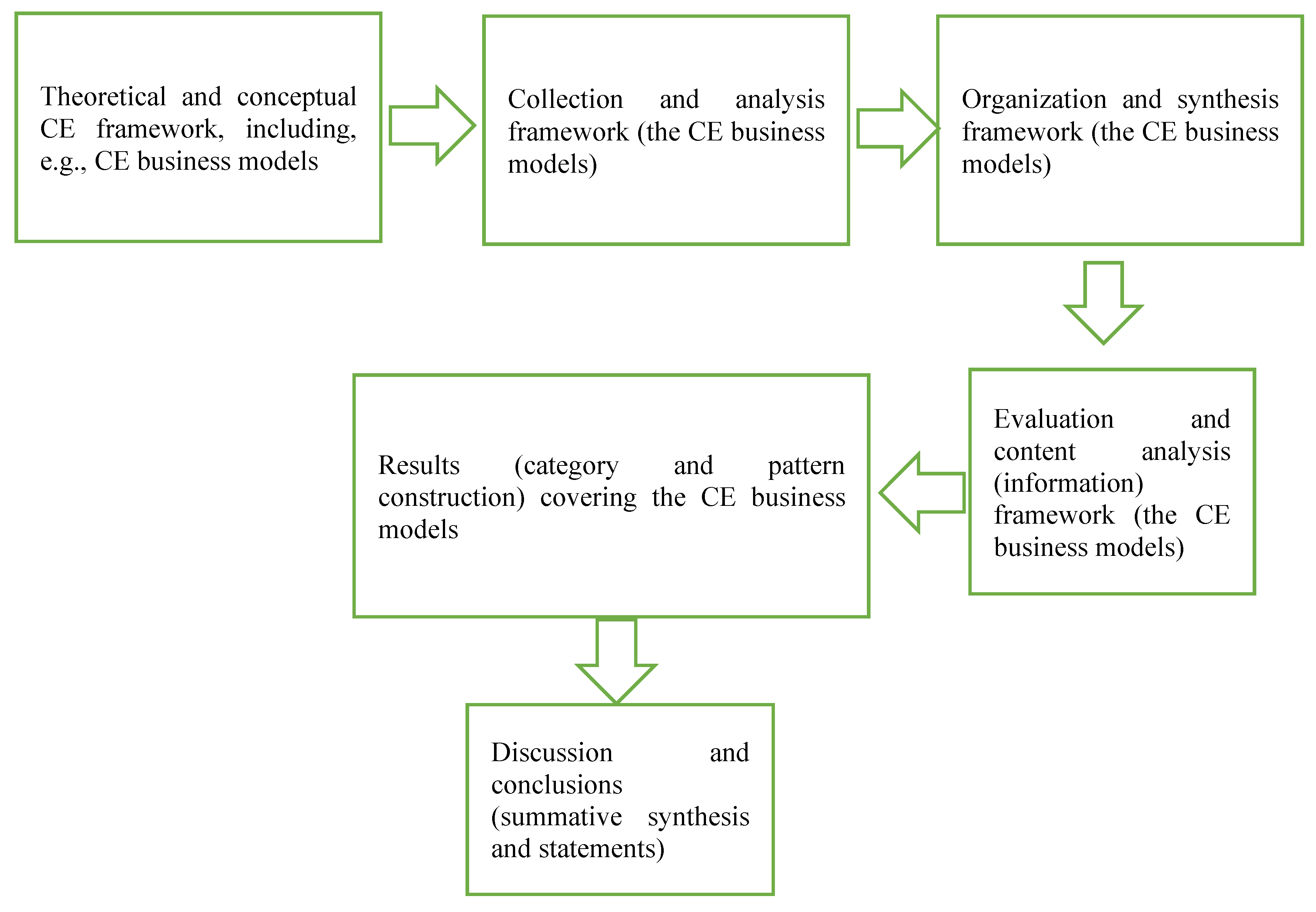

Table 1.
The other identified approaches related to the CE business models.
| CE Business Models | Other Identified Approaches Related to the CE Business Models [33] |
|---|---|
| Circular supply models, supply chains and inputs |
Target to enhance circular product design aiming at achieving 100% technical recyclability of products by 2030 (94% of the products were technically recyclable at the end of 2024) The Circularity Guidelines that (1) cover full materials chain and all geographies; and (2) outline commitment to contributing to a CE and addressing associated opportunities and positive impacts The Circularity Guidelines that encompass the following focus areas: (1) design for renewable and recycled materials; (2) reduction of the use of virgin material; (3) a commitment to using fewer resources to produce a product; and (4) designing out waste The Circularity Guidelines that promote circularity through (1) commitment to use renewable forest-based (virgin and recycled fiber); (2) efficient use of raw materials; (3) creation of business opportunities from process residuals and by-products; and (4) seeking partnerships with stakeholders and customers to introduce new renewable products to the market Design of products that are functional and create value throughout their lifecycles (based on customer needs and relationships) The integration of design for recyclability into product design Advancement of material circularity through transformation of used paper-based packaging into new paper-based materials Involvement in an innovation project which aims at (1) developing a construction product made from recycled wood material; (2) enhancing the circular utilisation of wood in construction; and (3) reduction of resource consumption and waste Metrics related to resource inflows covering both biological and technical process raw materials used for products and packaging (e.g., secondary, reused or recycled materials) The materials used in products and packaging (e.g., wood, starch and recycled paper and board) are renewable (92% in 2024) Application of life cycle assessment (LCA) and Environmental Product Declarations (EPD) to assess product-related impacts and resource flows Sustainable forest management and forest certification (PEFC & FSC) |
| Resource recovery |
The Circularity Guidelines that promote circularity through (1) reduction of process residuals; (2) reuse of fiber; and (3) significant reduction of waste to landfills Utilisation of process-related residuals and waste (ash, sludge, chips, and wood waste) from all own units including, for example, (1) new approaches and products; (2) pulp manufacturing; (3) landscaping; (4) agricultural use; (5) landfill construction; (6) road construction; and (7) brick and cement manufacturing Metrics related resource outflows including (1) recyclable content in products and packaging of products; (2) the amount of waste diverted from disposal (e.g., preparation for reuse, recycling and other recovery operations); (3) amount and share of non-recycled waste; and (4) amount of hazardous waste Waste reduction in line with the EU Waste Hierarchy Assessment of chemicals before purchase and use to ensure that circularity requirements are adequately addressed (including substitution of dangerous chemicals and engagement with suppliers to find alternative products) Water use efficiency including (1) process water minimization; (2) reuse and recycling (including metrics); (3) recycling (back into the environment); (4) optimization of water use; (5) treatment of waste water; (6) investments in technology and equipment; and (7) metrics related to e.g., water withdrawals, discharges and consumption |
Table 2.
The other identified approaches related to the CE business models.
| CE Business Models | Other Identified Approaches Related to the CE Business Models [34] |
|---|---|
| Circular supply models, supply chains and inputs |
Application of the Sustainable Product Design concept to (1) integrate consideration of circularity covering full product life cycles; (2) ensure a sustainable product life cycle approach; (3) develop new products and services that contribute to the UN SDGs; and (4) ensure that all new products and services have a proven sustainability value proposition Use of the UPM Product Stewardship Standard to ensure (1) sustainable product design; (2) sustainable product life cycle approach and product life cycle management (e.g., sustainability covering their full life cycles and sustainability claims); and (3) that new products and services contribute to the UN SDGs Application of the UPM Product Stewardship Standard approach based on six life cycle steps: (1) design; (2) materials; (3) production; (4) distribution; (5) use; and (6) circularity Production of renewable products and materials including (1) use of sustainable and renewable feedstocks; (2) creation of value from renewable and recyclable materials; and (3) manufacturing of products from side streams, residues or recovered materials Consideration of all aspects of sustainability (starting from the early stages of product development) Sustainable product design considering circularity covering full product life cycles Use of multiple tools to evaluate the sustainability factors of each lifecycle step (e.g., material selection, production, use, reuse, recycling) covering the whole design process (e.g., LCA, recyclability and biodegradability tests and a screening tool for the mapping of the UN SDGs and environmental impacts) Requirements related to recyclability and biodegradability of products Metrics related to resource inflows including secondary materials (share and amount of recovered paper), fibres, raw materials and indirect materials Use of some fibrous residues in brick manufacturing or as soil amendment materials Use of ash (by-product and waste) in multiple applications (e.g., soil stabilisation, fertiliser, raw material for the production of paper fillers, cement industry and replacement of caustic soda) Measures to find innovative uses for by-products such as (1) lignin (e.g., replacement of a part of the fossil-based phenol used in plywood production); and (2) lime (e.g., liming agent and pH adjustment) Use of self-adhesive label waste as a resource for pulp, paper and other fibre-based products or PET products Wrapping and shipping of products in packaging that is increasingly made of post-industrial plastics Joint (1) product development to develop a concept tyre that is partly based on renewable functional fillers; and (2) enhancement of the utilisation of secondary raw materials in earth construction Sustainable supply chain (e.g., instructions on supply chain management and procurement practices) comprising supplier requirements such as environmental performance and reporting Reporting on direct and indirect upstream and downstream impacts (e.g., virgin materials replaced, material recycling, recovered paper, water uptake, composting, landfilling and hazardous waste for special treatment) Sustainable forest management and forest certification (PEFC and FSC) |
| Resource recovery |
Targets related to waste such as (1) zero process waste to landfills (or to incineration without energy recovery) by 2030; (2) recycling or recovery of all non-hazardous process waste; and (3) contribution to waste prevention, waste recycling and energy recovery from waste Application of testing tools related to recyclability and biodegradability Waste management including appropriate sorting of waste and research related to waste recycling options Continuous development work related to the recycled nutrients and zero solid process waste to landfill targets at multiple sites Recyclability of and recycled content in products including paper (depending on local infrastructure for national collection and recovery systems); (2) pulp (can be processed into multiple paper grades and other pulp-based products because it is at the beginning of the processing chain); and (3) converting materials (e.g., development of a circular solution that enables customers to turn their label liner waste into new raw materials) Metrics related to resource outflows including (1) by-products and waste (e.g., recycling, composting and temporary storage); and (2) main by-product and waste streams (fibrous residues, ash and green liquer dregs) Recoverable sidestreams (e.g., lignin and crude tall oil) that can be used as raw materials in new wood-based businesses Metrics related to (1) water withdrawal, outflow and consumption; (2) recycled and reused water; and (3) water intensity Metrics related to (1) nutrients used at effluent treatment from recycled sources; (2) non-recycled waste; and (3) hazardous waste Collaboration in research projects to quantify the use and generation of microplastics (CE related to water in industrial processes) Improvement of water recycling systems (e.g., increasement of the collection and recovery capacity of irrigation and rainwater and enhancement of sludge management) Water recycling and reuse (e.g., recirculation multiple times and tracking of water-use efficiency) Use of recycled nutrients in wastewater treatment plants including tests related to the use of recycled nutrients in effluent treatment Separation of sludge (dewatering of biosludge and primary sludge) to improve the utilisation options of sludges Development of recycling options for lime kiln electrostatic precipitator dust Modification of the sludge drying system to increase the share of treated phosphorous sludge for utilisation |
Table 3.
The identified approaches related to the CE business models.
| CE Business Models | Identified Approaches Related to the CE Business Models [35] |
|---|---|
| Circular supply models, supply chains and inputs |
Promotion and development of industrial symbioses with other business areas and complex and network of companies (e.g., bioproduct mills) to create promote CE and resource use synergies based on the ecosystem concept (ecosystem companies of different sizes and at different development stages convert production side streams into valuable products) Business that is (1) in line with the principles of sustainability; and (2) based on resource-wise production of products from renewable wood to replace fossil-based materials Goal to be a forerunner in operational and ecological sustainability Sustainability targets (2030) including, for example, (1) fossil-free raw materials and packaging; (2) reduction of process water use; and (3) process waste delivered to landfills Use of side streams in line with CE including (1) finding multiple new purposes (including with partners) for forest industry side streams, bark, sawdust, sludge, ashes and lignin; (2) utilisation of fibre-based side streams from paperboard mills in animal bedding (renewable alternative for peat); and (3) exploration of upgrading Maintenance of material cycle including the addition of primary raw materials (fresh fibre) to the cycle (due to lack of means to achieve complete reuse and recycling of materials) Use of primary renewable resources in line with CE principles based on regenerative forestry Reduction of water use through the development of production processes and introduction of new technologies Utilisation of some of the emissions as raw material (e.g., odorous gases are processed into sulphuric acid) Metrics related to material inflows including (1) share of renewable and recyclable raw materials and packaging materials; and (2) amount of recycled fibre Metrics related to water and marine resources including (1) total water reused and recycled; (2) total water consumption; (3) water withdrawals and consumption; (4) water intensity; and (5) wastewater discharges Wrapping solutions based on recycled plastics and reduction of microplastics (provision of products based on renewable raw materials as alternatives to plastic packaging) Forest certification (PEFC and FSC) Regenerative and sustainable forest management (e.g., implementation of regenerative forestry principles) Production of (1) material-efficient wood products for buildings; (2) raw materials for recyclable products (e.g., paper, paperboard and other circular bioeconomy products); and (3) recyclable packaging material for food and food service packaging (e.g., lightweight fresh fibre paperboard) Joint sustainability targets with partner suppliers Assessment of the sustainability of suppliers as part of the supplier selection process and during cooperation Development of new wood construction solutions jointly with customers Development of new commercialised products from industrial side streams Investment in companies that develop new products from side streams (that are currently used as energy) R&D related to the use of side streams to develop fossil-free alternatives |
| Resource recovery |
Continuous improvement of material cycles and resource efficiency Resource efficiency including (1) full utilisation of all raw material; (2) avoidance of waste in production (e.g., the goal is to use all production side streams); (3) use of production side streams and waste as materials; (4) continuous improvement of production processes and new mill investments; (5) enhanced efficiency of water use to support CE R&D and services to increase the recyclability of products Joint identification of new applications related to production side streams with partners Active measures (e.g., research and joint projects) related to green liquor dregs to find (1) an industrial application (e.g., soil improvement); (2) recycling options (e.g., cement production); and (3) a sustainable use (one of the most challenging process waste to utilise) Process development and the adoption of new techniques to increase water recycling and reduce water use in production processes Metrics related to material outflows including by-products (e.g., fertilization, soil improvement and industrial use) and use and disposal of waste (e.g., material utilisation and landfilling of process, other non-hazardous and hazardous waste) Metrics related to resource use and CE including (1) non-recycled waste; (2) waste use and disposal; and (3) hazardous waste Metrics and targets related to resource efficiency and sustainable production (e.g., reduction of process water use) Development of and measures to ensure the recyclability and compostability of paperboards |
Disclaimer/Publisher’s Note: The statements, opinions and data contained in all publications are solely those of the individual author(s) and contributor(s) and not of MDPI and/or the editor(s). MDPI and/or the editor(s) disclaim responsibility for any injury to people or property resulting from any ideas, methods, instructions or products referred to in the content. |
© 2026 by the author. Licensee MDPI, Basel, Switzerland. This article is an open access article distributed under the terms and conditions of the Creative Commons Attribution (CC BY) license.
Copyright: This open access article is published under a Creative Commons CC BY 4.0 license, which permit the free download, distribution, and reuse, provided that the author and preprint are cited in any reuse.


