
Submitted:
09 March 2026
Posted:
11 March 2026
You are already at the latest version
Abstract
Kin-Selection has traditionally been viewed as a stabilizing force explaining when, and to what degree it can be adaptive for benefits to be shifted among relatives. As such, it is not usually considered a potential accelerant of evolutionary change. Yet benefits conferred on relatives — particularly from parents to offspring — may function more as forward-looking investments than simple transfers. When seen in this light, Kin-Selection emerges as a potential catalyst for rapid phenotypic change. Drawing on concepts from both evolutionary biology and economics, this article introduces the concept of “fitness capital”— traits enhanced by altruistic investment that increase an individual’s capacity to acquire resources for further investment — and shows how overlapping generations and assortative mating can generate cascading, multigenerational effects. These dynamics amplify correlations between parental altruism, offspring ability, lineage-level investment, and traits reflecting fitness capital, creating conditions for runaway increases in both altruism and capacity to invest. By recasting kin-directed altruism as a driver of cumulative social and evolutionary change, the proposed synthesis highlights a novel pathway through which populations may evolve greater investment, social complexity, and phenotypic stratification. It also indicates new perspectives on parent-offspring conflict, costly signalling, sexual selection, and Green-Beard effects.
Keywords:
kin-selection
; human capital
; inclusive fitness
; parental investment
; altruism
; mate choice
; assortative mating
; green beard
1. Introduction
Selfish genes sometimes prosper by promoting
compassion. As Hamilton showed, a gene can spread by making its bearer act
altruistically toward relatives, provided the cost to the actor is outweighed
by the benefit to the recipient — if the benefit is appropriately discounted by
relatedness. The simplest version of this logic, known as Hamilton’s rule,
established the concept of inclusive fitness (Hamilton, 1963; 1964). This
proved to be one of the most powerful extensions of Darwinian thinking in the
modern era (Dawkins, 2004), giving rise to the gene’s-eye-view of evolution
(Dawkins, 1996; Hamilton, 1996). Kin-selection is a major mechanism for
explaining why altruism can evolve in a competitive world otherwise red in
tooth and claw and has illuminated phenomena ranging from patterns of social
organization such as the evolution of eusociality (Bourke, 2011) to
intragenomic conflict (Haig, 2001). However, its role is usually cast as
stabilizing rather than as a factor in runaway evolutionary dynamics.
Explanations for the rapid evolution of extreme traits more often invoke sexual
selection (Fisher, 1930), arms races (Dawkins & Krebs, 1979), or a dramatic
environmental event causing geographic isolation (Eldredge & Gould, 1972).
The present article reinforces the argument that, under certain conditions that
are likely satisfied in many contexts in nature where kin-selected traits have
evolved, they can be expected to catalyse rapid phenotypic changes in a certain
type of trait (Hawkes, 1983).
That type of trait is one that can be modified by
altruistic forms of investment wherever such modification enhances the capacity
of the individual to, in turn, invest and thereby improve the same trait in
others. Evidence of such investment is widespread. Many varieties of birds, for
instance, provide sustained care for their relatives in ways that enhance their
future reproductive success, usually in the form of food provisioning (e.g.,
McKinnon et al., 2024). In many types of mammals, such as dolphins,
impressive hunting tactics and techniques are transmitted from parent to
offspring, with evidence of deliberate and instructed practice (e.g., Krützen et
al., 2005). In primates, maternal care, grooming, and coalitionary support
create durable advantages for offspring in social hierarchies (Silk, 2007). In
humans, parental choices about nutrition, education, and socialization may
systematically shape children’s life chances, with effects potentially
multiplying across generations (Sowell, 2016). Across these and many other
species, altruism is often not an act with transient effect on the recipient’s
wellbeing but may be seen as a strategic allocation problem with cumulative
consequences.
Below we consider that, under special (but
psychobiologically plausible) conditions, investments in kin have the potential
to cascade across overlapping generations, accumulating like a form of “fitness
capital” within lineages. To explore this, we develop a unified framework
linking Hamilton’s kin-selection logic with Becker’s theory of parental
investment from economics. Here, the present thesis
draws heavily on analyses and concepts from Becker (1993, 1996) along with
relevant textbooks (Friedman, 1962; Jaffe et al., 2019). This
integration suggests how parental allocation decisions can generate strong
correlations between ability, altruism, and fitness capital, particularly under
assortative mating. Recasting Hamiltonian altruism as
a moderator of intergenerational investment may have implications for
evolutionary theory. Whereas standard kin-selection analyses typically treat
altruistic acts as generating immediate fitness transfers, investment in fitness
capital can generate compounding intergenerational returns and elevate the
long-term reproductive value of descendants. Such dynamics may generate runaway
increases in investment, stratification of lineages, and feedback between
altruism and productive capacity. They may also help to explain phenomena often
attributed solely to other mechanisms, such as sexual selection for “good
genes” or ornamental traits. On this view, kin selection may operate not only
as a mechanism simply calibrating helping among relatives, but also as a force
capable of amplifying phenotypic evolution when altruistic behaviour builds
durable fitness capital in kin.
2. Investment and Fitness Capital
We begin with three premises. First, we assume a
species in which Hamilton’s logic already applies. That is, one where
individuals exist in a system where genes for altruistic behaviours can persist
if the benefit they confer on relatives, weighted by relatedness, exceeds the
cost to the actor. Second, we extend the notion of “benefit” to include not
only direct gains to a recipient’s fitness but also indirect gains, such as
improvements in traits that enhance the recipient’s later success, inclusive of
the capacity to confer similar benefits on others. This is intended as an
evolutionary analogue of the economic concept of human capital —
characteristics like skills, knowledge, health, or attractiveness that increase
an individual’s productivity (Becker, 2002). Human capital is a sort of
“capital” because it can be built up through investment (e.g., training,
nutrition, education) and because greater stocks of it tend to yield higher
returns, whether in allowing higher wages to be earned or by enhancing
wellbeing through richer consumption opportunities (e.g., being able to read
allows more benefit to be derived from books). Finally, we assume that there is
an appreciable, additive genetic variance directly determining every
characteristic described (e.g., altruism) except fitness capital.
For present purposes, we generalize this idea
beyond humans. For any species, we may define a stock of fitness capital
as characteristics that improve an animal’s ability to secure resources,
survive, and reproduce. Just as in economics, fitness capital can be increased
by investment and affects the individual’s future wellbeing and fitness.
Fitness capital can be manifested through both direct and indirect parental
effects. Maternal effects and transgenerational plasticity provide direct
pathways: nutrient provisioning, epigenetic modifications, or early-life
experiences can enhance offspring survival, growth, and reproductive potential
(Marshall & Uller, 2007; Mousseau & Fox, 1998). More broadly, niche
construction illustrates how parents and lineages modify environments
(physical, social, or cultural) in ways that increase the returns to offspring
traits over time. Examples range from cooperative breeding networks in birds
and mammals to the transmission of knowledge and tools in humans (Laland et
al., 2016; Odling-Smee et al., 2003). Together, these mechanisms show that
fitness capital is both genetically and environmentally mediated.
2.1. Fitness Capital and Effective Relatedness
Becker’s models of altruism provide a useful
starting point for our present purposes. He assumed that an individual’s
utility depends not only on their own consumption but also on the wellbeing of
others they care about – especially their own offspring. Consider a simple
scenario where each adult has only one child and an income , which can be spent either on their own
consumption, , or on investment, , in their child’s fitness capital. For example,
where is the parent’s utility from consumption, is the benefit to the child from investment, and is an altruism parameter representing the weight
the parent places on the child’s wellbeing. Since , the parent’s first-order condition for optimal
investment is found by differentiating with respect to :
Applying the chain rule to the first term
where . Since , we obtain
The derivative of the second term is
Setting the first order condition to zero for a
maximum, we find
or, more simply,
This means that parents invest until the marginal
utility cost to themselves equals the weighted marginal benefit to their child.
Hamilton’s rule provides a biological analogue in that it argues altruism may
evolve if:
or, put in marginal terms,
where is relatedness, is the marginal gain in offspring fitness, and is the marginal cost to the parent’s fitness. These
ideas can be unified if we treat Becker’s altruism weight as equivalent to relatedness , if utility is measured in the same “currency” as
fitness. To make this mapping explicit, let us introduce as a conversion factor which scales marginal
utility into marginal fitness. This acknowledges that not all parental
investments that feel rewarding (in utility terms) translate perfectly into
genetic returns. Some activities may raise subjective wellbeing without
affecting survival or reproduction, while others may have strong fitness
consequences. Formally, let the marginal fitness cost of reducing parental
consumption be
Substituting into (1) gives:
Thus, the effective relatedness governing
altruistic investment is given by
which captures both the biological fact of genetic
relatedness () and the psychological or economic fact of how
strongly a given investment in the child’s wellbeing translates into fitness
outcomes. To clarify, is genetic relatedness
(as from Hamilton), represents the
psychological motivation to be altruistic, and is a factor converting
the psychological rewards of being altruistic into fitness units. In economics,
it is standard practice to convert different units of value — such as utility,
consumption, or wellbeing — into a common metric so that marginal costs and
benefits can be meaningfully compared in optimization problems (Jaffe et
al., 2019; Santos et al., 2022). We adopt a similar approach here by
translating parental valuation of offspring outcomes into expected effects on
fitness. This allows the framework of altruistic parental investment to be
formally linked to Hamilton’s rule: the effective weight a parent places on a
child’s outcome combines both the genetic relatedness and the degree to which
increases in the child’s wellbeing translate into reproductive success. In this
way, we can integrate economic and evolutionary perspectives while maintaining a
consistent scale for the parent’s decision-making.
In sum, the Becker and Hamilton perspectives are
likely looking at related phenomena from different perspectives. The two can be
bridged with the concept of fitness capital and a scaling factor for
translating utility into fitness. This permits us to say that, if there are
forms of fitness capital that can be enhanced through investment, then parental
altruism need not operate as only a direct transfer of benefits to
offspring (or other kin): for example, shifting consumption from the parent to
consumption by the child. Instead, parents may weigh against their own
consumption the opportunity to invest in ways that improve their children’s
underlying traits or capacities. This means that investment decisions should
scale with both genetic relatedness and the reliability of wellbeing cues as
predictors of fitness outcomes. Put another way, this distinction is the
difference between giving a fish to eat and teaching how to fish: parents may
not be motivated merely to help offspring now — they could be responding
to cues that help them to build the fitness capital in their offspring and
yield higher fitness later. In some species of
birds, for example, parents can be thought of as doing more than just feeding
their chicks for their immediate survival, but also to enhance feather
development, because brighter, well-formed plumage can improve future mating
prospects (e.g., Ligon & Hill, 2010). We have, of course, oversimplified in
the sense that many goods and services parents can provide for their young are
likely to affect both children’s current wellbeing and future fitness. Between
hypothetical extremes of goods that are purely for the child’s consumption and
those that are purely investments in their later potential, we may imagine a
continuum that is captured by . Benefits that lean
towards the investment extreme will correspond to a higher . Thus, more
altruistic parents will tend to invest a higher fraction of their budget on
their children, and this could be favoured if this investment is adjudicated
appropriately given effective relatedness.
2.2. Overlapping Generations and the Legacy of Altruism
An important question in economics is “and then
what happens?”. This is because the short- and long-run impact of decisions can
be quite different, whether in magnitude, direction, or both. Answering this
question brings us to the heart of the present thesis, and to do so we follow
Becker (1991). Let the child’s fitness capital during the next time period be
described by a production function:
where is parental investment and is the child’s baseline level of fitness capital.
This is to say that describes how an individual’s eventual fitness
potential emerges from the interaction between what it starts out with and with
how much this is boosted by their parents’ investment. More investment always
helps, but there are diminishing returns. Each additional bit of investment
matters less than the last bit. Put another way, encodes the “efficiency
curve” by which parental effort is transformed into offspring fitness. Many
biological examples may be given of this. For instance, in passerine birds,
investment may be the number of food items brought to chicks in the nest, while
represents the chick’s
size and condition. then represents how
these meals translate into growth and fledging success, with this being large
at first but making less of a difference when very large amounts of food have
already been provided. In mammals, investment might be thought of as lactation.
In longer lived organisms, such as elephants, this may take forms including
teaching and transmitting skills by setting examples and facilitating learning
opportunities. In each case, the key principle is that parents can push their
offspring’s ultimate capacity to acquire and invest resources. When an
adult, the child’s “income” then follows from its fitness capital, such as:
where can be thought of as a “wage rate” that represents
the strength with which capital determines income. Or, more generally, income
may be thought of as any increasing function of . Either way, we are assuming that differences in
the total budget that individuals earn to then spend on their own consumption
and investment are only explained by differences in capital. This means that
parents with more income are generally going to invest more income in their
offspring, even if altruism is equal. So, variation among individuals in income
at any given time is here determined by their developed capabilities which in
turn flows from differences in the capital of their parents (Figure 1).
We also assume inter-individual differences in how
altruistic parents are and that they pass on their altruism to offspring:
where represents genetic and potentially epigenetic and
cultural transmission of altruism, such as with representing the heritability or persistence of
altruism across generations, ranging from zero to perfect, .
The parent’s optimization problem at time is to spend their budget across consumption and
investment in a way that maximises their utility. So, selecting the amount to
invest in offspring is an optimization problem of the form:
To find this, we differentiate with respect to
using the chain rule for the first term the
derivative of is times the derivative of , which is . For the second term (), we treat as a constant with respect to . Thus, the first order condition is
which, if we set equal to zero () to find the optimum, gives
which states that the marginal utility lost from
foregoing a unit of personal consumption, , equals the marginal altruism-weighted gain from
investing that same unit in the offspring, . At equilibrium, the parent allocates its
resources so that these terms are balanced. The key implication is that, at any
given period (e.g., ), a parent will invest more if they are more
altruistic (), if they have higher capital themselves (), and if their own parents invested more () in them (because that increased their ). Lineages of more altruistic parents therefore
invest more, and the more that they invest, the more capital their children
accumulate. The more capital their children have, the larger their future
incomes and budgets will be for investment in their own offspring (higher leads to greater ). Hence, rising capital of subsequent generations is driven by increases in equilibrium investment and capital of the preceding generation. With equation 2, this dynamic produces a positive feedback loop:
with lineages with higher altruism systematically choose to make higher levels of investment, generating children with greater human or fitness capital, and transmit above-average altruism (Figure 2). This induces a positive correlation between altruism and capital, both in cross-sectional snapshots and over time. This is a Becker-based insight, but it can be reinterpreted in Hamiltonian terms by translating utility into fitness units and altruism anchored in effective relatedness.
If parental investments produce benefits that can compound across multiple generations (investment in a child increases their capital and thereby raises the fitness of the grandchildren they produce), then the discounted sum of benefits flowing from investment will be larger than that of any single period. Put in marginal terms, this is equivalent to multiplying the right side of equation 3 by some variable representing the present value of these future benefits. To express this as a symbol, suppose that parent values their descendants’ fitness with a discount factor or , which we will assume is positive. This discounts the effect on utility of a parent from the fitness of each generation separated from the parent in time when he or she makes their investment decision. We do this because, while relatedness coefficients also attenuate this contribution (each descendant generation would be less related in sexually reproducing organisms), it can be helpful to distinguish altruism () from discounting () for the following reasons. Altruism here reflects the strength of preference a parent places on descendant outcomes, while the discount factor reflects the fact that the benefit to more distant descendants occurs later in time and passes through additional demographic filters, which may attenuate their effect on current fitness. Thus, its inclusion here may not be redundant with relatedness, capturing causes of temporal decay other than genetic dilution. Then parental utility is
and maximised when
So, in “fitness units”, this can be written as
with the Hamilton weight being
This formulation shows that the effective Hamiltonian weight governing investment behaviour depends not only on genetic relatedness but also on psychological altruism and the extent to which fitness returns compound across generations. Thus, a single-period Hamiltonian calculation may significantly under-predict investment when multi-generational returns are large. Greater overlap between generations (less discounting or higher ) tightens the link from Becker’s economic framework where individuals are concerned about the impact of their current decisions on posterity to Hamilton’s biological one. The more that a parent’s actions today influence their child’s future reproduction and survival, the larger the effective Hamiltonian weight. We may think of this as a parent’s inclusive-fitness horizon: the further ahead they look (e.g., valuing not only their child’s fitness a little but a lot, as well as additionally being concerned with that of their grandchildren, and beyond), the greater the effective overlap and the stronger the incentive to invest becomes. In short, the same first-order conditions subsume Becker’s altruistic investment with Hamilton’s inclusive fitness logic: , . Overlapping generations, through the discount factor , extend the weight parents place on the benefits of current investment for future fitness. This predicts a positive coevolutionary correlation between altruism and fitness capital, given transmission of altruism is genetically based and that there are diminishing returns in .
Although the model tracks one cohort per period, it effectively captures overlapping-generation dynamics in a causal sense. This is because each parent’s investment in and influences the reproductive capacity of descendants. Terms like “overlapping generations” and “lineage-level feedback” refer to causal persistence across generations, not literal simultaneous co-occurrence of multiple cohorts. The geometric sum in quantifies this cumulative inclusive fitness impact, reconciling simple recursion with biologically interpretable and meaningful multigenerational feedback. For readers preferring the overlapping-generation logic to be fully explicit, a minimal model is presented in Appendix A. This demonstrates the same first order conditions and that intergenerational feedbacks naturally arise through recursive inheritance of capital and altruism.
2.2.1. Numerical Illustration: Investment Cascades Versus Static Benefits
To illustrate the dynamic consequences of investment cascades, consider the production function introduced earlier for the evolution of fitness capital:
where parental investment increases the offspring’s stock of fitness capital and existing capital contributes to future capital formation.
For the purposes of illustration, we adopt a convenient linear approximation consistent with these assumptions:
where represents the lineage’s stock of fitness capital in generation , denotes parental investment in that generation, captures persistence or compounding of existing capital, measures the productivity of investment. This specification satisfies the qualitative properties of the model: investment increases future capital () and existing capital contributes to future capital (). Because capital carries forward between generations, changes in investment can have persistent downstream consequences. To illustrate, suppose that most lineages invest each generation, but one lineage temporarily increases investment to in generation 3. Let the parameters be and , with initial fitness capital . Table 1 shows the resulting trajectories between a lineage that has received a one-off exogenous boost to investment in the 3rd generation (the “shock” lineage) compared to the counterfactual (baseline) without this boost.
Although the higher investment occurs only once, the lineage that receives the additional investment maintains a persistent advantage because the additional capital created in generation 3 feeds forward into subsequent generations. This illustrates the central mechanism of investment cascades: when parental investment modifies a stock of fitness-relevant capital that persists through time, even temporary differences in investment can generate lasting divergence between lineages. This contrasts with standard kin-selection models, where altruism typically confers one-period fitness benefits that dissipate once the recipient reproduces. In the investment framework, the same altruistic act modifies a persistent capital stock, generating compounding divergence across generations that standard one-period applications of Hamilton’s rule overlook.
2.3. Ability, Altruism, and Investment
Becker (1991) extended his framework by considering the possibility that parents invest in their children according to the efficiency with which each child translates that investment into future capital. Even if parents are equally altruistic toward each child, they need not invest equally but may allocate resources according to the expected returns from each child. The same idea can be applied in an evolutionary framework. Sexual reproduction and genetic variation mean that offspring can differ in their intrinsic capacities for translating parental investment into traits related to fitness. Some individuals may grow faster, achieve greater size, be more resistant to parasites, or demonstrate greater capacity to learn skills and use knowledge. If parents can detect and act on cues for these prospective differences, we should expect them to make the necessary adjustments. Although Becker did not originally consider its interaction with altruism, we can extend the production function described in 2.1 like so:
where remains parental investment, is the offspring’s baseline endowment of fitness at birth (e.g., health, size, immunity), and represents the offspring’s ability to convert investment into fitness (essentially a multiplier of parental efforts). In words, ability acts like an “efficiency weight”. If two siblings, one with ability and the other , each receive the same amount of, say, food (), but , then the sibling with will translate food into more reproductive potential. The utility function of the parent who must choose how they will invest in two children with differing ability, and , is
Assuming that the altruistic coefficient is the same across all children, and given our assumptions, if parents invest until the rate of returns in each child are the same then that will imply that (unless progressively more investment produces sufficiently drastic diminished or negative returns). Or, supposing parents have offspring, a fixed budget of investment resources, they must decide how to allocate their resources across children:
where is the ability of child . Taking the first order condition with respect to (investment in child ):
Since and , we get:
which implies that, for every child :
For two children, and , the optimal allocation requires that
or, assuming altruism is constant,
As , if, say, , then to make marginal returns from each child equal implies (unless returns to investment fall so fast that the equality is reversed). This implies that the optimal allocation will generally favour children with higher ability because the marginal benefit of investing in them (in terms of future fitness capital) is greater even if parents are equally altruistic toward each of their children (see Figure 3). The important point here is that ability does more than simply arrange patterns of investment within families. It can accelerate the overall process of capital accumulation. It can be expected to do this through two channels. The first may be referred to as “Roy-model sorting amplification” (after Roy, 1951). Because the marginal return of investing in a higher ability child will remain higher than the cost for longer, parents can achieve higher levels of returns (and smarter children overall) if they invest accordingly. If parents preferentially invest in offspring who appear to have higher ability, then those children will accumulate disproportionately more capital over time. This feedback loop produces a self-reinforcing sorting process, where high-ability individuals become both the most invested-in and the most capital-rich (so have the most to invest).
The second is related to the complementarity between ability and investment (Figure 4). If ability not only raises returns to investment but also amplifies the effectiveness of previously accumulated capital, then ability and capital interact multiplicatively. For example, perhaps a child who is cognitively gifted and learns faster than expected also gets taught more, and if they are taught more then they learn faster. This produces accelerating differences in outcomes across siblings within and between families.
Together, sorting and complementarity mean that ability, altruism, and capital can be expected to become rapidly correlated within the population. In other words, signals of higher ability draw more investment, and the higher ability amplifies the effect of that investment. If ability and altruism are heritable, then parents who are more altruistic towards higher ability children will generate lineages where ability and capital accumulate together, and these lineages will in turn reinforce the apparent payoff to altruism.
In summary, adding ability to the model generates the following predictions: (1) parents should preferentially invest in children who signal higher ability, (2) because ability accelerates the accumulation of capital, even small initial differences may snowball into larger disparities over time, and (3) this creates a natural correlation between ability, capital, and the expression of altruism. The strength of the correlation between ability, investment, and fitness capital can weaken if abilities are poorly detectable by parents, if investment has very strong diminishing returns, or if environmental shocks randomly reduce the translation of investment into fitness. Nevertheless, under plausible assumptions, families that achieve this alignment will tend to flourish disproportionately.
2.3.1. Illustration: Ability Complementarity and Investment Cascades
The preceding discussion emphasized that offspring may differ in their ability to convert parental investment into increases in fitness capital. We can illustrate the consequences of this heterogeneity (and the resulting cascades) with a concrete numerical example. Let generations be indexed by . Suppose offspring fitness capital in the next generation is determined by the production function
where denotes baseline fitness capital (set to 1.0), denotes parental investment, and represents the offspring’s ability to translate that investment into future reproductive success, and with to ensure diminishing marginal returns. We then set for numerical examples (qualitative results do not depend on the exact value) to ensure diminishing returns in investment,
while the multiplicative ability parameter creates complementarity: the marginal return to investment increases with ability.
The marginal effect of investment on fitness capital is
Parents choose investment according to the Becker–Hamilton first-order condition
where denotes parental consumption and represents the benefit generated for the offspring. For simplicity, assume the benefit to the parent is proportional to offspring fitness capital so that . Normalizing parameters so that the marginal cost equals one (equivalent to setting ), parents invest until
Substituting the marginal return gives
Solving for optimal investment, we obtain
Higher-ability offspring therefore receive greater optimal investment.
Table 2 illustrates the resulting outcomes for three ability levels (), assuming .
The exponent generates a strong response of optimal investment to ability, illustrating how even modest heterogeneity can produce large divergence in fitness capital across lineages through investment. When this process repeats across generations — especially if ability is partially heritable — the divergence can expand into lineage-level stratification. Combined with persistent variation in parental altruism or assortative mating, these dynamics generate strong population-level correlations between ability, investment received, and fitness capital.
2.4. Parenting Synergies and Mate Choice
We have so far examined how altruism and fitness capital can reinforce each other across generations through altruism’s directing of parental investment. A further channel may come from mate choice. The more consequential parental investment becomes for offspring outcomes, the more important mate choice becomes beyond merely contributing genes. In any species where individuals invest in kin in ways receptive to the sorts of feedback we have described, such as where it is rewarding to see relatives do well, it is unlikely that mates are chosen at random with respect to traits such as altruism or the capacity to obtain and command resources (whether through “good genes”, markers of fitness capital, or both). In a variety of animals, investments in children are also not made solely by one parent in isolation but by both, and these investments plausibly interact to produce the fitness of the offspring that result.
Becker (1973, 1974) analysed how human capital shapes partner choice in marriage markets. We can build on this framework, linking it explicitly to altruism as considered so far. Following Becker’s treatment of marriage markets, consider a model in which each male and female adult has two key traits. Firstly, they vary in their altruism, denoted by for individual (where means male and means female). As before, this measures how much weight they put on their child’s wellbeing relative to their own consumption. Secondly, they have “fitness” capital . A “household” (i.e., marriage or cooperative breeding pair) forms between two adults, () and (), to produce a combined income:
where is a non-decreasing function reflecting the productive complementarity between reproductive partners.
If we think of the household as the decision-making unit, the effective altruism of it will be:
For instance, this might be a simple average, or a function that gives extra weight to couples who are both altruistic. The couple then must decide how much of their income to consume themselves and how much to invest in their offspring :
where is the utility from consumption, which is constrained by the budget , and is the payoff to the offspring from parental investment, which can be measured in the same units as utility or fitness as discussed 2.1. Assuming parents both consume much the same under optimal conditions () for simplicity, the first order conditions are:
This means that the marginal cost of giving up consumption equals the marginal benefit of investing in the child, scaled by the altruism of the breeding pair. Meanwhile, the child’s human capital during the next period will be
where investment increases offspring capital and parental capital raises the resources available for that investment. This implies that, at equilibrium, higher household altruism or parental capital leads to greater investment and higher offspring capital.
We next assume “supermodularity” between male and female characteristics. In other words, their joint efforts of each parent are force multipliers of one another, particularly their fitness capital:
If the household income produced by a breeding pair is greater than the sum of its parts, this makes it rational for males and females to seek each other out and mate based on matching features. Assuming also that males and females are free to choose their partners then, at equilibrium, the male with the highest level of capital will pair with the female with the highest level, the male with the second highest level with the female having the second highest level, and so on, down the line. Such positive assortative mating (hereinafter PAM for brevity) on would then raise the correlation between and , hence raising income variation and the average income of the most productive households. Evidence for positive assortative mating (i.e., choosing mates because they match in some characteristic) is widespread in nature, for examples, see Class & Dingemanse, 2022). At equilibrium, this generates correlations between partners’ traits and increases the variance and average of household income. Since equilibrium investment rises when income increases, higher- couples invest more, so of the children rises too via this budget pathway.
Note that the correlations produced by this process arise between fitness capital and genes influencing the altruism parameter (), rather than changes in genealogical relatedness (). Positive assortative mating therefore links productive traits with altruistic investment preferences, while relatedness itself remains determined by pedigree structure. It is also important to note that unless and are already correlated, positive assortative mating on would not directly raise . If how altruistic parents are is independent of their capital, the distribution of altruism throughout the population should remain unchanged. By contrast, suppose partners choose their mates on the basis of altruism (i.e., how much they expect their partners will care about investing in their jointly produced offspring). This is not a difficult assumption to motivate: an individual wanting to spend more on their children than consume themselves would likely want to find a like-minded partner to mate with so that there is less conflict about how the household budget is allocated. Meanwhile, relatively selfish couples would be happier together because that produces more income to spend on themselves. This would directly make and positively correlated, and so there will be a higher average and higher variation in household altruism than random mating. Because the optimal investment in offspring rises with higher household altruism, high- couples invest disproportionately more of their income, raising their children’s even if their incomes remain the same. As we are assuming transmission of altruism (is an increasing function of ), then high- couples produce children with more altruism and more capital. In other words, if couples prefer to mate based on altruism in one generation, then this will create and/or increase the correlation between altruism and capital in the next generation. Alternatively expressed, let the covariance between household altruism and offspring fitness at generation be:
The change in the covariance between altruism and fitness capital can be decomposed into the pathways through which altruism affects offspring capital. This can be expressed in an equation of the manner pioneered by Price (1970) as follows,
where positive assortative mating based on altruism makes and so increases the correlation (this feedback process is depicted in Figure 5), while positive assortative mating based on capital only affects , whose sign already mirrors whatever correlation already exists between altruism and human capital. If mates select each other on both altruism and human capital (or ability), this should produce the most rapid stratification of human capital within the population, leading to extreme combinations of all traits.
This feature opens the door to an important dynamic in evolutionary biology, originally described by Fisher (1930). Whereas the Becker model proposes people mate for reasons of supermodularity that make seeking out partners with similarly high levels of ability, capital, or (as we have considered, altruism) because it is optimal from the standpoint of utility, once there is a correlation between altruism and preferences for altruism, this sets the stage for potentially runaway sexual selection. To see how, consider Lande’s (1981) model of the joint evolution of a trait with preferences for that trait in partners . From Lande’s analysis, if both have a genetic basis, and if these are positively correlated (), positive feedback can ensue when
where represents genetic variance for trait , is the genetic covariance between the trait and preference for that trait, is the strength with which preference for trait confers a mating advantage to individuals higher in this trait, and represents the strength of stabilizing selection pushing the trait back towards some natural optimum. So, the larger the genetic covariance is between trait and preference, the more that selection favouring an increase in the trait also increases strength of preference for that trait, and vice versa. Larger makes sexual selection stronger for a given level of covariance between trait and preference (), a larger increases the required needed for runaway to occur. When a trait variance is large relative to covariance with preference, stronger sexual selection pressures are needed to build the coupling. Strong natural selection also resists exaggerated . This builds the covariance between preference and the trait, leading to exaggerated traits and stronger preferences. As with the model so far considered, Lande-like runaway selection does not in itself require new genetic variation to arise: the runaway process comes from restructuring the patterns of correlation (linkage disequilibrium) between preference and trait throughout the population, increasingly concentrating genes for extremes in these features in more extraordinary individuals (Dawkins, 1976). It is easy to see that a closely analogous structure can arise through the interaction of altruism and fitness capital. PAM combined with altruistic investment generates correlations between genes influencing altruism and the fitness capital of offspring. In effect, fitness capital functions analogously to the trait , while altruistic preferences for investing in offspring act similarly to preference . As these correlations accumulate across generations, investment in high-capital lineages becomes increasingly concentrated, creating a feedback process structurally like Fisher–Lande runaway dynamics.
In summary, if fitness capital, ability, or altruism have a strong genetic component, they may quickly become genetically correlated through the investment and mating decisions of parents. If these mating decisions are made based on supermodularity or utility-maximising considerations (e.g., choosing a wife or husband because they are altruistic), any innate sexual preference for any of these traits (e.g., finding a wife or husband sexually attractive because they are altruistic) could in turn drive runaway evolution of these correlated traits. In other words, mating initially based on supermodularity may be a pump-priming or ignition system that gets the engine of runaway sexual selection of these traits going (Figure 6), and this may extend the evolution of these traits to beyond what would otherwise be optimal. Likewise, a preference for partners based on “good genes” (if a marker for ability), could fan the flames of marriages motivated by supermodularity of altruism or human capital as these would become correlated through the rational investment decisions of preceding generations.
It is worth emphasizing that the present analysis follows the classic approach to runaway sexual selection, as pioneered by Fisher (1930) and formalized by Lande (1981). In this tradition, the focus is on identifying conditions under which traits and preferences can covary positively across generations, generating self-reinforcing feedbacks, rather than on explicitly iterating full generational dynamics. In our model, these feedbacks are captured by the covariance between parental altruism and offspring fitness capital (). PAM on altruism ensures , demonstrating a mechanism by which more altruistic households produce children with both greater altruism and higher fitness capital. Similarly, PAM on fitness capital influences , amplifying variation in household investment potential. As in Fisher and Lande, these equilibrium-based covariances indicate the potential conditions for accelerating correlations between traits and preferences, without asserting that trait divergence is inevitable or unbounded. In this sense, our “runaway” description refers to self-reinforcing increases in correlations across generations, consistent with the logic of the locus classicus of this literature (to see an example of how these conditions could be explicitly formalized for mate choice and altruism complementarity generate covariation, see Appendix B).
To round off this discussion of mate choice, it is worth addressing a point related to the nature versus nurture determination of fitness capital. A perhaps intuitive objection to the above is that parents may often use investment to compensate in children lacking good genes. For example, if there is a sibling that requires more resources to grow to the same size than another, redirecting some of the food provided by the parents from the latter towards the former may be wisest – especially if there are diminishing returns to such investment as intensified by the effect of ability. There might be important implications for mate choice dynamics hinging on whether investment and ability generally function more as substitutes in this way or as complements (i.e., where more ability leads to higher returns on investment, as assumed so far). If and parents match based on altruism, high-θ households make larger investments, and target more of this investment to higher- children. Selection will then favour genotypes carrying both high and high , leading to positive covariance building between altruism, ability, and fitness capital. If instead extra investment helps low- offspring catch up more than it propels high- individuals, potentially weakening or even reversing the correlation between altruism and ability. We may still expect higher levels of fitness capital to accumulate in high altruistic yet low ability lineages, so the correlation between and capital may remain positive, but the correlation between altruism and ability would be lessened or even become negative.
If instead parents match directly based on ability – as many models of mate choice assume they do if this is a stand in for “good genes” (Hamilton, 2001)– then we should find good genes concentrated in high- households. If , such that even large investments earn bigger returns in high- individuals, then it will be rational for even parents with moderate altruism to bias their investment in high- offspring. That selection on returns should pull altruism upward in high-a lineages because high ability offspring benefit most from more altruism. This should generate a positive linkage over time between ability and altruism despite the fact mates are choosing each other solely based on good genes. If instead , high levels of investment are not needed as much in high- lineages to reach high levels of fitness capital. So, selection pressure on altruism is weakened within those lineages. This may still result in a strong correlation between ability and fitness capital, a weak altruism-fitness capital link, and perhaps a negligible or negative correlation between ability and altruism.
Finally, if partners choose based on manifest fitness capital, , then this is effectively mating based indirectly on whatever trait mix produces high fitness capital. If , then, this means there is a straightforward route towards a positive three-way correlation between altruism, ability, and fitness capital. If instead either cues signalling capital function as a direct readout of ability or there are such strong diminishing returns to investment that , then PAM on manifest could weaken or slow linkages between altruism and human capital because altruism is less important or negligible. More realistically, investment and ability are unlikely to be strong substitutes in a species where altruistic investment operates and only compensate for each other partially. Even if is only mildly positive, we would expect selection, then, to favour ability but drive the system towards a positive correlation between ability and altruism through greater returns on investment in higher- offspring.
2.5. Altruism-Based Mating and Green Beard Effects
While the processes considered so far increase correlations between altruism and investment, they do not necessarily push altruistic behaviour beyond what would normally be predicted by an inclusive-fitness interpretation of Hamilton’s rule. However, they do create conditions whereby specific genes may be favoured to push investment to levels beyond what would be advantageous to the rest of the genome based on relatedness between individuals. This is because PAM on altruism may be especially conducive to the evolution of “supergenes” (Hamilton, 1996) or “Green Beards” (Dawkins, 1976). This refers to how a hypothetical gene can be favoured by selection for directing altruistic behaviour of the organism carrying it towards another individual likely carrying the same gene (regardless of the chances the two individuals are likely to share other genes). To evolve and spread, Green Beards require the gene to (1) produce a recognizable effect (the green beard), (2) make its bearers recognize that trait in others, and (3) cause its bearer to preferentially direct benefit to those individuals (Dawkins, 1982).
We have assumed genetic variation influencing willingness to invest in offspring (altruism) and later supposed that this may become linked to genetic variation for preference to mate with individuals who also display cues of altruism towards offspring. If there is a genetic variant that combines (1) unusually high altruism with (2) desiring of unusually high altruism in a partner, then positive assortative mating on altruism could reinforce their connection and spread. In other words, instead of a literal green beard, such a gene could recognize itself in other bodies through the behavioural or cognitive cues related to altruism and preference for altruistic partners (which we have supposed might exist for reasons already explored). By choosing to mate with an especially altruistic partner and direct a large amount of own investment to the offspring of that, this gene is likely helping itself. Put another way, as far as the result of the genome is concerned, optimal investment in offspring (or the wider kin-network) is determined by . But from the standpoint of the genetic variant for noticeably higher altruism, the probability that offspring also carry that allele approaches one.
Assuming simplified genetics and breeding (haploid and one offspring per mating), we can proceed to illustrate the above point by presuming the qualitative conclusions hold in more complicated models. Consider an allele , which codes for unusually high parental investment in offspring, with an allele , which codes for the non or usual altruistic investment. When an -carrier provides parental help to a recipient offspring, the actor pays the cost (this reduces the actor’s direct reproductive fitness), and the recipient offspring obtains a benefit to their own survival or fecundity (all quantities mentioned here are being measured as marginal expected offspring equivalents). We assume baseline random mating in the population gives a frequency of allele , and that the offspring inherits the allele of one randomly chosen parent. So, if parents are and , then it has a fifty per cent probability of carrying (and likewise for ); if both parents have , then it certainly inherits , and if both parents have , its probability of inheriting it is zero. This means mating with another -carrier increases the probability of offspring carrying .
Next, imagine parents select mates via preference (the sexual green beard) such that carriers of a preference allele (which we will assume is tightly linked to or comes part of the same package by inheritance) prefer to mate with partners who they judge to also be good parents – that is, parents carrying allele . Let’s say, then, that the probability that an -carrier mates with another -carrier partner is
where is how much more probable it is above some baseline frequency that an meets and matches with another (this may be thought of as an assortment coefficient). If mating were random, then .
We may expect the number of -copies in the next generation that are caused by an -carrier’s actions. Spread occurs when the expected gain from altruistic investment exceeds the neutral expectation. We have supposed that the offspring has a baseline fifty per cent chance of inheriting the allele from an -parent, and from this must be subtracted the cost of performing the altruistic act of investment . So, there is a direct lost equal to . The benefit is an indirect increase caused to the offspring’s fitness, . So, ordinarily, the question would be whether this is greater than . But here is the crucial twist: that benefit will more often be delivered to offspring that carry when the actor mates assortatively with another . When both partners have probability of , both parents might have , so the offspring assuredly inherits . When the actor mates with an -partner (), the offspring inherits with a probability of fifty percent. So, the probability that the recipient offspring carries A (conditional on the actor being an -carrier) is
which simplifies to
Therefore, the expected indirect genetic benefit to the actor from increasing his or her offspring’s success by is:
The allele will increase in frequency when the indirect gain is greater than the direct loss, which is:
which can be multiplied by two to simplify and rearranged to into the Hamilton form:
So, the term is the extra inclusive fitness advantage to the allele because carriers preferentially mate with other carriers and invest in joint offspring. This may be thought of as the “sexual green beard bonus”, with the standard Hamilton rule for the rest of the genome applying with . The larger becomes for gene , the easier it becomes for the benefit to outweigh the costs. Even if the benefit of altruistically investing some amount in offspring is insufficient to justify it based on the standard Hamilton’s rule, may be strong enough to drive escalation from the standpoint of the altruistic genes if the effect of assortative mating is strong (the amount of extra assortative mating required to overcome the “baseline shortfall” is ). This illustrates how assortative mating on altruistic parental behaviour can create gene-specific relatedness exceeding genealogical relatedness, allowing altruistic alleles to spread even when their effects would not be favoured under the standard genome-wide Hamilton rule.
3. Discussion
By connecting Hamilton’s insight with an adjusted Becker’s Human Capital framework, we can see how kin-selection may be a more potent driving force of evolutionary change than previously recognized. Central to this proposal are two constructs (1) fitness capital – that is, an adaptive characteristic of an individual that can be built up by investment from others, and which contributes to how many resources the individual can later acquire and invest in others – and (2) altruism defined here as the degree to prefer to invest in kin. Such investment may constitute anything from simply sourcing and providing infants with more food rather than eating it themselves, to spending time and attention transmitting knowledge (e.g., teaching foraging skills) or even constructing tools or other extended phenotypes to pass on for the benefit of their children when they mature. Whether manifest in brain or brawn, the critical feature is that the trait being invested in improves proportional to investment, and that there is potential for the trait to build cumulatively. In a species where parents are motivated to invest altruistically in their offspring, genetic variation promoting altruism will tend to become correlated with prowess in acquiring resources for investment. Lineages that are more altruistic invest more in descendants. These descendants inherit both higher altruism and greater fitness capital, giving them more resources and motivation to invest in the next generation.
Other factors may act as force multipliers of this general effect such as when there the feedback guiding the parental decisions is psychological. Given generations overlap, altruistic parents may find it rewarding to observe signs that their children prosper, and so investing efforts can become reinforced accordingly. This extends the time horizons over which investment in a lineage can feedback to affect the motivation of parents, grandparents, and so forth. Another amplifier arises when mate choice is assortative on altruism. A male strongly motivated to invest in his children benefits by pairing with a female who is similarly motivated, and vice versa. Partnerships based on shared altruism increase the value placed on offspring investment and simultaneously command greater resources. As a result, descendants of these pairings inherit both higher altruism and higher fitness capital, further intensifying the cascade.
The decision to match and mate positively based on altruism or capital may initially be purely practical: matching based on either or both likely represent an unbeatable or stable strategy if they are complements in the total “utility” each couple jointly produces because, under such an arrangement, no partner can benefit from splitting and “remarrying” with another willing partner. If there is also genetic variation affecting preferences for partner characteristics indicating or correlated with altruism, then the process of assortative mating would build the correlation between genes for higher altruism and genes for preferring altruistic partners. This produces precisely the conditions that can make mate choice become a self-reinforcing amplifier of the process (i.e., Fisher’s runaway effect), potentially leading to sexual selection for signals of willingness to invest highly in offspring.
Another interesting complication we considered was genes in children affecting how receptive they are to their parents’ investments. We summarized this as “ability” and it also likely accelerates the process of altruism and fitness capital becoming linked. Parents should generally invest more in abler children because this yields higher overall returns than investing evenly across offspring. Although under some assumptions ability and investment may act like substitutes, it seems the most straightforward implication is that ability, altruism, and fitness capital all become positively intercorrelated. This means an increase in selection for or mating advantage of one of these characteristics will induce increase in the other characteristics as well.
The recursiveness of these forces is one of two critical features for understanding the implications of cascading fitness capital. The other is their complementarity in building adaptive fitness. Rank-ordered pairings of the varieties described, such as pairing mates high in the same attributes (whether capital or altruism) or by pairing higher ability with higher investment in the same bodies of offspring, maximizes both the total and average level of the resulting traits, compared to what would be produced from random sorting or negative sorting. Such arranging also increases variation, since pairing large multipliers produces disproportionately large outputs, while pairing smaller multipliers together produces little change. The outcome is greater disparity between lowest and highest levels of fitness capital across lineages. Thus, although the processes we have described do not assume any genetic change at the loci affecting the traits involved, it can produce large levels of phenotypic change and variation exposed to selection resulting from decisions parents make given the circumstances we have assumed. In this sense, it is like the “spatial sorting” effect described by Shine, Brown, & Phillips (2011a). An example of this is the invasive population of cane toads in Australia. Because leg length determines their rate of dispersal, genes for long legs tend to find themselves in bodies further out from where they were first introduced, while genes for the shortest legs tend to be left behind. This means that the longest legged toads naturally mate with each other, because that reflects a statistical bias automatically generated by the differences in speed of movement as the invasion proceeds to enter new territory. The result is an extreme skew in the distribution of leg length, much like what is predicted here for fitness capital and altruism. A parallel point about positive assortative mating potentially interacting with spatial sorting to build phenotypic variance has also been appreciated (Shine, Brown, & Phillips, 2011b). The processes we have considered likewise may generate large amounts of phenotypic change and variation and predict both a higher average level of altruistic effort toward kin and a more unequal distribution of fitness capital than would be predicted by simplistic interpretations of Hamilton’s rule. Although the model shows how phenotypic change can occur without shifts in allele frequencies, in practice genetic evolution will likely follow wherever greater fitness capital confers significant Darwinian advantage. If the advantage is strong, our framework identifies mechanisms by which phenotypic change — whether in fitness capital or parental altruism — could rise explosively.
One such consequence arises from the Fisher-Lande-like dynamics of assortative mating on altruism because these create ideal conditions for a distinctive form of Green Beard effect. When a preference allele is linked to an altruism allele, assortative mating allows carriers to preferentially pair with altruists and invest in those carrying the same gene, with the children carrying the green beard enjoying extra investment from both parents. Mathematically, the impact of this mechanism can be expressed as an additional positive term, added to the usual benefit in Hamilton’s rule. This “assortative mating bonus” allows elevated levels of altruism to spread in situations where conventional pedigree-based relatedness would not be sufficient. In nature, this mechanism may be vulnerable to cheaters, but, unlike other forms of Green Beards, we might expect it to be less vulnerable to recombination splitting the link between the green beard expression and preference or costs of detecting the green beard because, in this case, sexual selection would be continuously acting to mitigate these factors.
Previous research has shown that multi-generational effects, vertical cultural transmission, spatial population structure, and ecological interactions can shape the evolution of social traits and investment behaviours (e.g., Brown et al., 2009; Lehmann, 2008; Mullon & Lehmann, 2017; Van Cleve & Akçay, 2014). For instance, Mullon and Lehmann (2017) examine gene–culture co-evolution in family-structured populations, highlighting how vertically transmitted cultural information interacts with genetically determined learning behaviours. Their analysis demonstrates that vertical transmission can modestly increase adaptive information and constrain evolutionary branching, emphasizing kin structure in cultural evolution. While conceptually related, this framework focuses on cultural knowledge rather than direct fitness capital or altruistic traits, and it does not consider assortative mating or amplification of trait covariance across generations.
Lehmann (2008) investigated the evolution of niche-constructing traits whose phenotypic effects extend beyond the actor’s lifespan. By modelling spatially subdivided populations and the future fitness consequences of environmental modifications, he showed that selection can favour traits influencing subsequent generations. This resonates with our focus on multi-generational feedbacks, but our model emphasizes direct behavioural traits—altruism, parental investment, and mate choice—while avoiding the complexity of environmental or spatial dynamics. This simplification allows clearer predictions regarding trait covariance, amplification of altruism, and potential runaway selection.
Van Cleve and Akçay (2014) explore how behavioural responsiveness, genetic relatedness, and synergistic interactions jointly shape social evolution. Their results illustrate that these factors can produce feedbacks not easily captured by simple assortment indices. While our model shares the goal of understanding interaction-driven trait evolution, it abstracts from ecological or reciprocal dynamics to isolate heritable links among parental investment, mate choice, and offspring fitness capital, providing a tractable mechanism for generating positive correlations and potential runaway dynamics.
The main advantage of our framework is its combination of simplicity, interpretability, and predictive clarity. By linking parental investment, assortative mating, and heritable traits, it predicts: (i) the emergence of positive correlations between altruism and fitness capital, (ii) amplification of these correlations via assortative mating on altruism or ability, and (iii) conditions under which these mechanisms may generate runaway evolution, without requiring complex spatial or ecological modelling. Moreover, by bridging Becker’s economic models of parental investment with biological models of inclusive fitness and sexual selection (Hamilton, Fisher, Lande), it provides a unified perspective on multi-generational feedbacks. In sum, while prior work has explored gene–culture co-evolution, social synergy, and niche construction, our model identifies a parsimonious pathway by which behavioural traits, parental investment, and mate choice interact to generate accelerating evolutionary dynamics. By focusing on heritable variation, investment decisions, and mating preferences, it reproduces qualitative effects observed in previous studies while allowing transparent derivation of covariances, correlations, and potential for runaway evolution. This simplicity facilitates causal interpretation and generates broadly applicable, empirically testable predictions, including positive three-way correlations among altruism, ability, and offspring fitness.
3.1. Evidence and Implications
The present approach is compatible with existing formal approaches to kin selection. For example, the method outlined by Taylor and Frank (1996) shows how kin-selection models can be constructed by expressing evolutionary change in terms of marginal fitness effects of behavioural strategies. In such formulations, altruistic behaviours are usually treated as generating direct fitness benefits to recipients. The investment interpretation proposed here extends this approach by explicitly recognizing that altruistic acts may alter the recipient’s future productive capacity rather than providing an immediate fitness increment. Similarly, the formalization of inclusive fitness developed by Grafen (2009) interprets organisms as behaving as if they maximize an inclusive fitness objective. In the present model, parental investment decisions can be viewed as part of such an optimization process, where individuals allocate resources in ways that maximize inclusive fitness through the accumulation of fitness-relevant capital in relatives. Finally, recent ideas considering synergy and assortment in inclusive fitness dynamics (e.g., Jaffe, 2016), point to how interactions between social behaviours and population structure can generate strong evolutionary feedbacks. The investment processes explored here provide another mechanism through which such feedback may arise, particularly when altruistic investment interacts with ability differences or assortative mating.
All this is to say that the dynamics we have considered do not invalidate the classic Hamilton calculus, but it does mean that the variables involved may not be as obvious from observation as a naïve application of Hamilton’s rule would suggest. For instance, the benefit caused by altruistic acts, when seen as investment in fitness capital, may require inclusion of multigenerational and indirect returns – not only on the recipient’s survival or fecundity. The cost to the altruist is not simply the risk or effort involved, but the opportunity costs that can be moderated by the wider effects of the decision on the parent’s economy. This could include complementarities between what the parent is doing and with what the partner, and how this combines to determine their offspring’s fitness. Finally, the relatedness should be understood as what we have referred to as “effective relatedness”, because assortative mating and behavioural correlations can increase the probability that altruistic alleles interact with copies of themselves. This point is illustrated by the opportunity this system creates for otherwise rare “Green Beard” effects, which means genes that have an evolutionary incentive to invest more in the offspring produced by such a mating than the rest of the genome should prefer.
For similar reasons, replicating cultural elements (“memes”) may evolve that promote the selection of highly altruistic mates and encourage unusually high investment in offspring. All we need assume is that parents with such a “memetic parasite” are also more likely to install that meme in the children they invest so heavily in. More generally, we would expect that cultural and other epigenetic factors promoting investment in kin and relevant genetic aspects to become related and coevolve, as culture represents a significant channel through which much investment in human abilities flows. At minimum, kin-selection provides a strong rationale for Becker’s assumption of altruism and explains why relatedness should determine its parameters. The present analysis is consistent with evolutionary and cultural influences on altruism are likely mutually reinforcing, rather than mutually exclusive or antagonistic in human society. This contrasts with some earlier criticisms of attempts to apply kin-selection to understanding human behaviour. These often proceed as though evidence (or even the logical possibility of) cultural factors favouring an altruistic trait negate or preclude kin-selection interpretations (for example, see Gould, 1977, pp. 255-258).
The cascading effects described in this model also have implications for the concept of reproductive value. Reproductive value summarizes the expected long-term genetic contribution of individuals or classes within a structured population. In the present framework, investment raises an offspring’s stock of fitness capital, which in turn increases their expected reproductive success and the resources available to invest in subsequent generations. Fitness capital therefore acts as a determinant of reproductive value: individuals with greater fitness capital possess a higher expected downstream contribution to the gene pool. The discounting structure used in our model provides a bridge to this notion, in that the parameter governing how strongly parents weight the future effects of their investment effectively produces a discounted sum of downstream benefits across generations. Because fitness capital compounds through successive investments, this process resembles the reproductive-value weighting commonly used in kin-selection models. In structured population analyses, the fitness effects of altruistic acts are weighted by the reproductive values of the individuals who receive them (e.g., Taylor & Frank, 1996; Wild & Scott, 2023). In our model, the discount factor () together with the accumulation of fitness capital performs a closely analogous role by weighting the long-run consequences of investment across descendants, where effectively increases the survival and fecundity components of the recipient’s reproductive value ( acts as a reproductive-value weighted sum of downstream benefits analogous to a reproductive-value–weighted sum of effects in kin-selection models). A useful distinction, however, is that in many kin-selection formulations reproductive value is treated as an exogenous or determined by the demographic structure of the population and therefore treated as fixed parameters when analysing behavioural strategies (e.g., Wild & Scott, 2023). In the present framework, we allow behavioural investment to alter the stock of fitness capital possessed by descendants, thereby influencing their expected long-term reproductive contribution. Reproductive value is therefore partly endogenous to investment decisions, in the sense that investment cascades can be interpreted as mechanisms that amplify the long-run reproductive consequences of altruistic acts. A short illustration of this connection is provided in Appendix C.
More generally, Section 2.4 shows that assortative mating on parental altruism generates correlations between altruism and fitness capital through the investment channel, while assortative mating on capital amplifies these correlations through the resource channel. Crucially, altruism-based mate choice can create such correlations even when altruism and capital are initially unrelated. Altruistic households invest more in offspring, magnifying ability differences into fitness outcomes and generating positive correlations between parental altruism and offspring productivity traits. When assortative mating occurs on both altruism and ability, the process becomes super-accelerating: high-ability offspring receive disproportionately high investment from altruistic parents, compounding fitness capital across generations. This runaway investment dynamic suggests that “good genes” preferences may sometimes arise as byproducts of altruism-driven investment rather than from genetic quality signals alone.
If altruistic behaviour functions partly as investment in fitness capital, we should observe parental behaviours that improve the long-term productive abilities of offspring rather than merely increasing their immediate survival. If this distinction is valid, the models predict that parental effort devoted to investment should exceed what would be expected from simple relatedness-based heuristics. Measuring this directly is difficult, since the line between “gift” and “investment” is blurred. What is more tractable is to examine resources that parents are motivated to acquire: when parents are experimentally provided with additional resources, their energy and time for investment should increase even if the precise channels are harder to track. For example, it has been documented that meerkats will sometimes capture and disable (but not kill) prey items and release them close to their infants for them to apparently practice hunting (Thornton & McAuliffe, 2006). Initially, pups are presented with dead scorpions, then live individuals that have had their stingers disabled and, finally, live scorpions with intact stingers. This behaviour appears to increase offspring competence rather than merely their immediate survival probability, suggesting that the adult is investing in the offspring’s future productive capacity rather than providing a simple nutritional transfer. The immediate cost to the adult meerkat is non-trivial, including risks of the prey escaping, and therefore represent an investment in prey-handling skills beyond simply feeding the young (Thornton & Raihani, 2008). Providing meerkat mothers with plenty of dead food to eat might increase the chances she will reserve more of the live prey she encounters for her offspring to build their hunting capacities rather than eat them herself instead. Comparable behaviours have been described in other mammals, such as big cats bringing injured prey to cubs to practice hunting (Eaton, 1968; Thornton & Raihani, 2010). Similar examples of pedagogical investment are summarized in Table 3, with some of the most vivid examples provided by birds of prey, where adult raptors have been observed apparently training their offspring in aerial hunting techniques by dropping live, often injured prey near the juveniles to practice strikes (Kross & Nelson, 2013). Comparisons between wild-reared juvenile raptors and captive-born individuals released into the wild (lacking parental such investment efforts) reveal the wild-reared juveniles develop vital hunting behaviours earlier and enjoy higher survival rates (Brown & Collopy, 2006).
Fitness capital can have social dimensions. The social clans of spotted hyena are strictly organized into dominance hierarchies, where offspring inherit social rank directly below their mother. This matrilineal rank inheritance strongly determines lifetime reproductive success in females, with clear continuity across generations. Such effects appear strongly facilitated by the high-ranking mothers supporting their daughters in competitive interactions with conspecifics and thus represents an investment in a sort of “fitness capital” through affecting social standing within clans, physical health, and epigenetic patterning (Laubach et al., 2019).
From this follows the prediction that experimental boosts to parental resources should yield compounding effects over generations. This is because these additional resources increase the effective “income” of the parents, which should increase reserves available for investment. Children should acquire greater fitness capital, and grandchildren disproportionately so, as the lineage accumulates advantages. Crucially, if the cascade is sustained, these lineages should also evolve to become more altruistic, as we predict that lineages with more to invest and lineages with higher altruism tend to become intertwined (a caveat is that the strength of this effect depends on the shape of the returns-to-investment function: if returns to capital are strongly diminishing, the effect may be modest; if returns are constant or convex, the compounding will be much stronger). A flip side to such “silver spoon” effects is the notion of “adversity cascades”, whereby adverse impacts on a lineage in a single generation may have profound consequences for behaviour and survival generations later. Conversely, when historical links between resources and genes become abruptly decoupled, the distribution of fitness capital should shift. Historical episodes such as mass migration, famine, epidemic disease, or war may temporarily weaken the link between inherited capital, mate choice, and altruism. For one or more generations, assortative matching based on these traits may be disrupted, leading to less skewed distributions of capital and weaker correlations between altruism and resources.
A further prediction concerns variation among offspring. Higher-ability offspring should attract greater investment, even if parents show no explicit preference in terms of altruism per se. This aligns with widespread observations. For example, in many mammals, “runts” receive less postnatal care (Clutton-Brock, 1991), while in birds, weaker hatchlings are often fed less, with parents apparently being indifferent to them being effectively culled by their stronger siblings (Mock & Forbes, 2022). Experimental manipulations of cues associated with ability could directly test whether such signals alter parental investment decisions. It should be noted that previous theories already make this prediction (Olson et al., 2008). What may be novel here is the added prediction that this should also be observed across couples: families with higher ability children should also tend to invest more in them than families with lower ability children. Experiments where couples with are effectively made to “adopt” low ability young should invest in them less than if given high ability young to raise.
In humans, if ability is operationalized through measures such as IQ or related cognitive tests, the model intersects with findings from behavioural genetics. Psychometric traits often show heritability estimates of roughly 50%, while variation attributable to the shared family environment is small (often 0–10%) (discussed further in Roy & Roy, 2018). This pattern has sometimes been taken to imply that parental investment has little influence beyond genes (e.g., Caplan, 2011). However, the present model suggests an alternative interpretation: if parental altruism and investment strategies have been under stronger historical selection than cognitive ability genes, then variation in investment behaviour may already be compressed within a narrow range in modern populations. At equilibrium, most observed variation in fitness capital will then appear to stem from ability, even though investment differences — especially at the tails of the distribution — can have profound consequences for descendants.
The classic model of parental investment by Smith and Fretwell (1974) provides insight into the trade-off between offspring size and number, assuming that each unit of investment yields the same marginal fitness return. While touching on similar issues to the present thesis, their framework applies most directly to species producing many small offspring with minimal postnatal care. More recent refinements, such as Johnson et al. (2024), have shown that incorporating indirect reproductive costs that scale nonlinearly with offspring traits can substantially modify predicted investment patterns. Building on these ideas, the present model explicitly considers heterogeneity in offspring ability as a multiplier of parental investment returns, allowing for differential allocation even when parents are equally altruistic toward all offspring. Unlike the previous frameworks, our approach captures intergenerational feedback whereby investment, ability, and capital accumulation reinforce each other over time, and extends naturally into domains of mate choice and signalling. This produces testable predictions that are not addressed by earlier models: for example, parents should preferentially invest in offspring with higher ability, leading to lineages that accumulate disproportionately more capital, and small initial differences in ability or investment can snowball into larger disparities across generations. In this way, our model retains the simplicity of the foundational Smith–Fretwell logic while highlighting novel mechanisms by which parental investment can interact with offspring traits to shape evolutionary trajectories.
3.2. Limitations
Can the processes we have considered here be expected to push investment indefinitely high? In principle, escalation may be rapid, but there are realistic constraints to consider. Ever more extreme levels of parental investment may, for instance, be resisted if they require changes that sacrifice other fitness components. In the same way that the sheer size of egg produced by kiwi bird or the head size of human foetuses are likely near limits balanced against the capacity of mothers to produce such infants, limits imposed by constraints may be less elastic to selection than altruism. Thus, as with other potential drivers of runaway evolution (e.g., Dawkins & Krebs, 1979), there may be direct costs of rising investment in terms of viability, energy, time, or other factors that curtail the process. Another obvious limitation is environmental resources. For example, we can imagine a predator evolving to specialize in hunting ever larger prey because both hunting skills and meat are the sorts of resources that can be concentrated and invested in offspring. But it such a predator may find it increasingly less worthwhile as such prey become scarcer, or if this induces overwhelming counter-adaptations on the part of the prey species, or if it falls victim to its own success if it drives the over-exploited prey species extinct. For these and other reasons, we have assumed diminishing returns on investment in fitness capital.
A yet more interesting theoretical limitation was that we did not consider the role of altruism, ability, or capital in decisions about the quantity of children to have. On the one hand, there may be quantity–quality trade-offs, where higher-ability parents decide to invest more in fewer children (e.g., Becker, 1991), while lower-ability parents produce more children with less investment. This might produce a trade-off resembling an r–K distribution of traits in humans (e.g., Eysenck and Gudjonsson, 1989). On the other hand, having more successful children may also increase how much parents value their reproductive success. If so, then this may be a pressure in the other direction, encouraging high-altruism couples to produce more children overall. Modelling variation in family size along these lines would also make it clearer why the parent’s own “consumption” cannot be treated as irrelevant in a Darwinian model: even when parents have only one child at a time, resources reserved for their own well-being may contribute indirectly to the survival of additional children in the future, or serve as a buffer against risk if current offspring die. Thus, modelling a division between “consumption” and “investment” remains defensible (cf. Trivers, 1974; Kaplan, 1996). It is tempting to speculate that, if high-altruism couples tend to produce fewer offspring with high per-child investment, while low-altruism couples produce many offspring with little investment, such divergence in life-history strategies could resemble disruptive selection within the population. In principle, such dynamics might reduce gene flow between extremes and thereby contribute to conditions favourable for reproductive isolation (cf. Lande, 1981; Maynard Smith, 1966).
We have also not considered how the same predictions may play out within a wider kin-network, (cousins, nephews and nieces, etc.), much less when the genetic relatedness among such networks departs from the standard r=.5 assumed for parents and offspring. Finally, different types of mating structure may be important. For example, systems without monogamy, or where not all of one sex get paired (e.g., more adult males than females are available for mating), or truncated, soft versus hard selection regimes. Any of these aspects may reveal conditions under which altruism is less reliable connected with capital, potentially weakening the recursive dynamic and other conclusions.
3.3. Extensions
The discussion turns here to speculative extensions and future directions. We have so far assumed that parents act based on accurate knowledge about the characteristics of others, such as their partner’s altruism and offspring ability. While the present model did not address deception or signalling, the logic extends naturally into these domains, offering testable hypotheses. Introducing errors or deceptive signalling may mean selection favouring altruism can be expected to weaken or otherwise become more complicated as investment no longer reliably translates into transgenerational returns. In particular, a disconnect between altruism ability and actual relatedness raises opportunities for exploitation and parasitism. Haig’s (1997; 2001) Intergenomic Conflict theory, for example, may make the following prediction in situations where there is paternal uncertainty. Paternally-imprinted genes might be expected to program offspring to inflate their apparent ability — or play up issues of equity — to better extract resources from the mother and her partner, who may or may not be the actual father. Meanwhile, maternally imprinted genes should want optimal allocation in agreement with the mother’s genetic perspective. Exaggerated signals that investment in a particular child are especially effective may work because they hijack parental responsiveness to this as a reward signal. Further thought is required to clarify whether the resulting pressures on parents to be discerning is enough to nullify this exploitation, or if some other result is likely to emerge from an arms race between children obscuring their ability and parents striving to allocate their scarce resources efficiently.
The same logic may explain why parent birds parasitized by cuckoos have often been observed behaving as if strongly motivated to continue feeding cuckoo chicks even when they have grown enormous (Krüger, 2007a). A classic interpretation is that this is despite the cuckoo’s enormous rate of growth, and due to the parents responding slavishly to especially salient stimuli the cuckoo chick has evolved to convey (Rojas Ripari et al., 2021). Based on the present model, it may be partly because the cuckoo bird’s accelerated development mimics high ability that explains the parasitized bird’s behaviour: they may have been selected to respond with more investment to this as a sign that of underlying ability in their own offspring, inadvertently benefiting the cuckoo. Species where parents pattern their investment in this way may be especially vulnerable to parasitism by cuckooing. This may explain why most cuckoos parasitize species that are smaller than or similarly sized to themselves (Krüger, 2006b). In the exceptions where the cuckoo grows to a smaller adult size than the parasitized species, they nonetheless grow at faster rates when young (e.g., Kleven et al., 1999).
The present thesis may have applications to understanding so-called “handicap” signals as well (Zahavi, 1975). Conceivably, animals can be selected to pay high costs to transmit honest signals of their underlying qualities because they advertise their underlying qualities, such as having good genes. A classic example is gazelle stoting in response to predators like leopards, with the idea being that the healthiest can afford to jump the highest in this way, thereby displacing the predator’s efforts to target whichever individuals cannot afford to advertise their vigour in this way – even though all gazelle would be faster at putting distance between themselves and the leopard by simply running away instead (Dawkins, 1976). Crucially, Grafen (1990) showed that such a signalling system is stable only when the cost of signal strength is proportional to the underlying quality it is supposed to indicate. The kind of cascading investment process we have been considering may naturally set up such a set of conditions for costly signalling of either ability or altruism. This is because these characteristics can be expected to correlate over time with earnings on our model, thus making signals costing a given amount of earnings being disproportionately cheaper for more altruistic individuals to afford, and we have seen why there may be advantages to conveying such signals to prospective mates. Our model could be extended to predict, for example, that a highly altruistic predator may signal its quality as a parent by tackling more dangerous or elusive prey than they would otherwise choose (serving as a trophy to impress potential mates or rivals). Obviously, there may be reasons for preferring high ability and capital individuals, but this approach could explain why costly or handicapped signalling of these attributes might be expected to evolve.
Finally, something may be said about other types of altruism to close this survey of potential implications of the general model. Recall our assumption that returns in a child diminish incrementally as more is invested. On Becker’s analysis of human behaviour, this means there is a point at which parents might become motivated to allocate some of their investment in that of the capital of unrelated children. This is because, if combined with the assumption of efficient capital markets, lending investment in this way to non-relatives means that this may yield higher returns later when the non-relatives grow up and effectively repay the loan to the descendants who made the loan. Obviously, the assumption of perfect capital markets does not hold well in most biological systems including the ancestral environments of human beings. However, an extension of the foundational concepts of Trivers (1971; 2002) and Axelrod and Hamilton (1981) on altruism among non-relatives to include fitness capital may be workable provided that the unrelated children invested in are likely to interact cooperatively with the offspring of the parents investing. The age-old problem for altruism based mutual reciprocation is how to reinforce repayment (Ridley, 1997). In Becker’s case, this can be done through contracts, while in the biological case reciprocal altruism relies on effective deterrence of defection. In some cases, it may be plausible that parents who have had a proven history of cooperation with individuals in another lineage might expect their own children and the children of the unrelated lineage to also cooperate, in a way substituting for a contract and the need to directly enforce it. Further modelling may be needed to develop this point, but it is intuitive that the present value of cooperating now might be enhanced if it is felt that the “shadow of the future” extends across overlapping generations. For example, in addition to having higher than average relatedness to other lionesses within a pride, each mother lioness has some level of certainty that their offspring will grow up to later rely on the skills and cooperation of the offspring of other mothers in the pride. This is one way that altruism for kin might influence the evolution of altruism in other forms.
Another potential implication is, more generally, the effect of practice on competence. If partners in cooperation improve in their capacity to provide benefits through the practice of reciprocal altruism, then this may have implications that have been underappreciated. Previous models have considered what happens with tit-for-tatters find each other and avoid defectors: in the same way that binding altruism with investment leads to higher variance and average fitness capital, non-random association and repeated mutually beneficial interactions by cooperators (another type of altruism) might magnify average levels of cooperation. Simply basing cross lineage investment on track record might be enough to justify an enlightened cooperative behaviour based on far-sighted self-intertest or “Benselfishness” (Dennett, 2003). More generally, it may be worth further considering how conclusions from traditional models of reciprocal altruism are affected when reasonable assumptions are about fitness capital are included. For instance, when the magnitude of benefits from cooperative exchanges are improved with practice, such where the nature of relationships is not solely a matter of “you scratch my back, and I will scratch yours” but where cooperation makes individuals become better at scratching backs and perhaps more reliant on others so that their own backs get scratched. On this view, individuals may not only be motivated to cooperate by the prospect of punishment for failing to reciprocate, but also from seeing such mutual backscratching as a sort of investment process. In other words, early cooperative exchanges may not only build trust by establishing a track record by also by making each partner more valuable to the other as their skills can be expected to rise. Modelling by Becker on the social effects on activities has found there can be dramatic swings between different steady states of behaviour when many individuals become involved and this could be a rich area for further research to explore (general examples are given in Becker, 1996).
Taken together, these extensions suggest that reciprocal altruism, when considered with fitness capital, might not only be about short-term exchanges but about long-run investments that shape both competence and interdependence across generations. This perspective invites new models that may reveal thresholds or tipping points in the evolution of cooperation. Related ideas have been explored in models emphasizing synergistic benefits from cooperation. For example, Extended Inclusive Fitness Theory (Jaffe, 2016) shows that assortment among cooperators combined with synergistic returns can generate strong evolutionary feedbacks favouring cooperation. The perspective developed here suggests a complementary mechanism. Rather than synergy arising solely from interactions among contemporaries, cooperative behaviour may also generate compounding benefits across generations when it increases the stock of fitness capital available to descendants. Exploring how synergistic cooperation and investment cascades interact may therefore provide a useful direction for future theoretical work.
4. Conclusion
If altruism can be understood as motivating investments in fitness capital, then its evolutionary significance may be more profound than previously appreciated. Investment cascades can bind the capacity to acquire resources with the motivation to invest them in kin, thereby increasing both average altruism and fitness capital. Such dynamics may interact with mating systems and other evolutionary forces to shape how individuals cooperate and compete. This preliminary synthesis of ideas from evolutionary biology and economics not only points to novel empirical predictions but is rich with implications that can be further explored to build a richer understanding of how perhaps some of the strongest and intimate social bonds have been, and are being, evolved.
Appendix A
In the main text, we described parental investment and its intergenerational consequences using a single-period optimization framework. To make the overlapping logic explicit, we can formalize a two-stage life cycle where parents coexist with their offspring for a time and where offspring inherit both fitness capital and parental altruism. This appendix provides a brief illustration of this dynamic.
Let the population be indexed by discrete time steps t. Each generation consists of individuals who receive fitness capital from their parents, earn income , allocate a share of income () to altruistic investment in offspring , and transmit genes for altruism to the next generation. The variable summarizes health, skills, or embodied ability that enhance income and survival and can be increased through parental investment
where is the rate of depreciation (aging, obsolescence, random mutation), is the parental investment, >0 captures transmission efficiency, and governs diminishing returns. Investment depends on altruism and parental resources . Substituting, we obtain the recursion:
Let individual fitness, depend on income retained for own reproduction and survival:
where represents the direct contribution of fitness capital to reproductive success or longevity. The change in mean altruism across generations follows the standard covariance (from Price equation):
where the first term represents selection on altruism and the second transmission effects. Using A1 and A2, altruism evolves when investment benefits () generate heritable fitness advantages through offspring success. Differentiating A1 with respect to :
Thus, altruism increases offspring capital whenever . Iterating A1 forward shows that altruism has compounding effects:
When altruism is heritable, the positive cross-generational covariance is
and so amplifies both traits over time, generating intergenerational feedback between altruism and fitness capital. To find the steady state (), equation A1 produces
This condition implies that the equilibrium amount of fitness capital and heritable altruism that individuals maintain in the population rises when parents invest a larger share of their income in offspring, when investment is more efficiently transmitted, or when existing capital erodes slowly. The more strongly returns diminish (γ < 1), the less sensitive the equilibrium is to changes in investment or efficiency. Higher equilibrium altruism () increases steady state capital () provided that . The system is locally stable if the derivative of the RHS of A1 with respect to satisfies the following:
This ensures convergence to the steady state feedback loop, rather than runaway escalation or extinction.
Equations A1 to A5 formalize the model in the text of section 2.3. They show how altruism raises investment, which enhances offspring capital, which in turn raises both income and fitness. Heritable variation in altruism and the investible trait of fitness capital become positively correlated across generations.
During the first period, they are reproductively mature adults, making decisions about their own consumption and investment in their offspring. In the second period, they survive to observe the outcomes of their investment, contributing to overlapping generation effects. Altruism is heritable. Let denote an individual’s fitness capital at time encompassing both heritable traits and the effects of parental investment. Parental utility is assumed to depend on their own consumption and wellbeing of their offspring, weighted by altruism , and a discount factor reflecting the parent’s time horizon over future fitness returns.
Appendix B
In the main text, we showed that assortative mating on altruism, ability or fitness capital can generate intergenerational covariances that are mutually reinforcing. This appendix formalizes that mechanism to clarify conditions under which a runaway process can emerge. Let each individual in generation be characterized by a pair of traits (, ), where represents altruism and is fitness capital. From Appendix A, the offspring’s fitness capital evolves as:
Assume that altruism is heritable such that the expected altruism of offspring is an increasing function of the average altruism of the parents:
where measures regression to the population means due to imperfect transmission. The parameter can be interpreted as an inverse measure of heritability (where higher means weaker inheritance). Let mates pair assortative based on altruism, such that covariance between altruism of mating partners is
where captures the strength of assortative mating ( indicates PAM on altruism). Taking expectations over mating pairs, the average altruism of couples is:
Thus, assortative mating increases between-family variance in altruism, which in turn magnifies the variance in offspring investment in capital. From (B1), the sensitivity of offspring capital to parental altruism is
Hence, the covariance between altruism and offspring capital at is approximately:
PAM on altruism () raises , and therefore increases the covariance . This strengthens the cross generational link between altruism and fitness capital. Because altruism is itself heritable (equation B2), this positive covariance feeds back into the next generation’s variance and mean altruism. The approximate recursion for the covariance is:
Whenever the second term is positive and sufficiently large relative to the first, decay term )( )), the covariance grows over time:
This implies that altruistic, high capital lineages increasingly assort and amplify both traits across generations in a self-reinforcing process. If we define such an amplification factor as equal to the ratio
Runaway selection occurs when , that is, when the joint inheritance and assortative pairing on altruism and capital lead to ever-increasing covariances between the traits. From B7, this condition is satisfied when:
In other words, runaway amplification occurs when the marginal productivity of altruism in generating offspring fitness capital, weighted by the variance in altruism, exceeds the dampening effects of imperfect transmission and capital depreciation. Thus, strong heritability, efficient investment transmission, and positive assortative mating on altruism together favour cumulative growth in both altruism and capital. This parallels the Fisher runaway selection idea, but here operates through parental investment and mate choice rather than ornament and preference.
This mechanism predicts the coevolution of altruism, ability, and mate preferences that reinforce one another across generations. Couples high in altruism invest more, producing offspring with higher fitness capital, who are in turn more altruistic and more attractive as mates to other altruists. This creates a feedback loop that raises both mean altruism and capital in the population. Equation (B10) formalizes the threshold condition for this process. When violated (e.g., through weak heritability, strong depreciation, or low assortative mating), the system instead converges to a stable equilibrium as described in Appendix A (Appendix B thereby complements Appendix A by explicitly deriving the conditions under which intergenerational feedback between altruism and capital — mediated by assortative mating — leads to self-reinforcing or “runaway” evolutionary dynamics).
Appendix C
Reproductive value () summarizes the expected long-term genetic contribution of an individual or class within a structured population. In such models, the fitness consequences of an action are weighted not only by relatedness but also by the reproductive value of the individuals who receive those benefits.
To see how this relates to the present framework, consider the stream of benefits generated by parental investment . Let denote the expected fitness contribution (incorporating survival and fecundity) produced in generation by a lineage whose stock of fitness capital is . If parents weight the future consequences of their actions with a discount factor , the total expected value of an investment can be written as the discounted sum
Because fitness capital evolves according to the production function
investment in the present period influences not only the immediate benefit but also the future trajectory of fitness capital and the resulting stream of downstream benefits.
This structure parallels the formal role of reproductive value in kin-selection analyses. In standard formulations (e.g., Grafen 2009; Taylor & Frank 1996), the evolutionary effect of an altruistic act is obtained by weighting fitness effects by the reproductive value of the individuals who receive them. Formally, if denotes the reproductive value of descendants in generation , the total evolutionary contribution of an action can be written as
where represents the change in fitness at that generation. In the present model, the effect of investment on long-run fitness can be written as
This expression shows that the consequences of investment depend on how changes in investment propagate through the lineage’s future stock of fitness capital. The term weights fitness effects occurring in later generations, while increases in fitness capital raise the expected survival and fecundity of descendants. Thus, the investment cascade described in the main text can be interpreted as a process that modifies the reproductive value of lineages through strategic investment. Rather than replacing standard kin-selection logic, this framework highlights how altruistic acts may influence evolutionary outcomes by altering the future reproductive value of the individuals who benefit from them.
References
- Axelrod, R.; Hamilton, W. D. The evolution of co-operation. Science 1981, 211, 1390–1396. [Google Scholar] [CrossRef]
- Becker, G. S. A theory of marriage: Part I. Journal of Political economy 1973, 81(4), 813–846. [Google Scholar] [CrossRef]
- Becker, G. S. A theory of marriage: Part II. Journal of political Economy 1974, 82(2(Part 2), S11–S26. [Google Scholar] [CrossRef]
- Becker, G. S. A Treatise on the Family: Enlarged Edition; Harvard university press, 1993. [Google Scholar]
- Becker, G. S. Accounting for Tastes; Harvard University Press, 1996. [Google Scholar]
- Becker, G. S. Human capital. The concise encyclopedia of economics 2002, 2, 1–12. [Google Scholar]
- Bourke, A. F. The validity and value of inclusive fitness theory. Proceedings of the Royal Society B: Biological Sciences 2011, 278(1723), 3313–3320. [Google Scholar] [CrossRef] [PubMed]
- Brown, J. L.; Collopy, M. W.; Gott, E. J.; Juergens, P. W.; Montoya, A. B.; Hunt, W. G. Wild-reared aplomado falcons survive and recruit at higher rates than hacked falcons in a common environment. Biological Conservation 2006, 131(3), 453–458. [Google Scholar] [CrossRef]
- Brown, S. P.; West, S. A.; Diggle, S. P.; Griffin, A. S. Social evolution in micro-organisms and a Trojan horse approach to medical intervention strategies. Philosophical Transactions of the Royal Society B: Biological Sciences 2009, 364(1533), 3157–3168. [Google Scholar] [CrossRef]
- Caplan, B. Selfish Reasons to Have More Kids; Basic Books, 2011. [Google Scholar]
- Class, B.; Dingemanse, N. J. (Eds.) Assortative mating for quantitative traits: Mechanisms, estimation, and evolutionary consequences [Special issue] 2022, (4), 35.
- Clutton-Brock, T. H. The evolution of parental care. In Princeton University Press.; 1991. [Google Scholar]
- Dawkins, R. The Selfish Gene; Oxford; Oxford University Press, 1976. [Google Scholar]
- Dawkins, R. The Extended Phenotype; Oxford; W. H. Freeman, 1982. [Google Scholar]
- Dawkins, R.; Krebs, J. R. Arms races between and within species. Proceedings of the Royal Society of London. Series B. Biological Sciences 1979, 205(1161), 489–511. [Google Scholar] [CrossRef] [PubMed]
- Dawkins, R. A Devil’s Chaplain; Houghton Mifflin Harcourt, 2004. [Google Scholar]
- Eaton, R.L. The predatory sequence, with emphasis on killing behavior and its ontogeny, in the cheetah (Acinonyx jubatus Schreber). Zeitschrift für Tierpsychologie 1968, 27, 492–504. [Google Scholar] [CrossRef]
- Eldredge, N.; Gould, S. J. Punctuated equilibria: an alternative to phyletic gradualism. Models in paleobiology 1972, 82, 115. [Google Scholar]
- Eysenck, H. J.; Gudjonsson, G. H. The Causes and Cures of Criminality.; New York; Plenum Press, 1989. [Google Scholar]
- Fisher, R. A. The Genetical Theory of Natural Selection.; Oxford; Clarendon Press, 1930. [Google Scholar]
- Friedman, M. Price Theory; University of Chicago Press, 1962. [Google Scholar]
- Gould, S. J. Ever Since Darwin.; New York; Norton, 1977. [Google Scholar]
- Grafen, A. Biological signals as handicaps. Journal of Theoretical Biology 1990, 144(4), 517–546. [Google Scholar] [CrossRef] [PubMed]
- Gibson, Q. A.; Mann, J. Early social development in wild bottlenose dolphins: sex differences, individual variation and maternal influence. Animal Behaviour 2008, 76(2), 375–387. [Google Scholar] [CrossRef]
- Haig, D. Parental antagonism, related asymmetries, and genomic imprinting. Proceedings of the Royal Society of London. Series B: Biological Sciences 1997, 264, 1657–1662. [Google Scholar] [CrossRef]
- Haig, D. Genomic Imprinting and Kinship; Rutgers University Press; New Brunswick, 2001. [Google Scholar]
- Hamilton, W. D. The evolution of altruistic behavior. The American Naturalist 1963, 97, 354–356. [Google Scholar] [CrossRef]
- Hamilton, W. D. The genetical evolution of social behaviour. II. Journal of Theoretical Biology 1964, 7, 17–52. [Google Scholar] [CrossRef]
- Hamilton, W. D. Narrow Roads of Gene Land: The Collected Papers of W.D. Hamilton. In Evolution of Social Behaviour; Oxford; Oxford University Press, 1996; Volume 1. [Google Scholar]
- Hamilton, W. D. Narrow Roads of Gene Land: The Collected Papers of W.D. Hamilton. In Evolution of Sex; Oxford; Oxford University Press, 2001; Volume 2. [Google Scholar]
- Hawkes, K. Kin selection and culture. American Ethnologist 1983, 10(2), 345–363. [Google Scholar] [CrossRef]
- Jaffe, K. Extended inclusive fitness theory: synergy and assortment drives the evolutionary dynamics in biology and economics. SpringerPlus 2016, 5(1), 1092. [Google Scholar] [CrossRef] [PubMed]
- Jaffe, S.; Minton, R.; Mulligan, C. B.; Murphy, K. M. Chicago Price Theory; Princeton University Press, 2019. [Google Scholar]
- Johnson, D. W.; Chhor, J. T.; Shelley, C. E.; Siegfried, E. J. Indirect costs of reproduction and the tradeoff between offspring size and number: a framework illustrated by fitness costs and benefits of ovarian fluid. Evolution 2024, 78(7), 1248–1260. [Google Scholar] [CrossRef] [PubMed]
- Kaplan, H. A theory of fertility and parental investment in traditional and modern human societies. Yearbook of Physical Anthropology 39 1996, 91–135. [Google Scholar] [CrossRef]
- Kitowski, I. Play behaviour and active training of Montagu’s harrier (Circus pygargus) offspring in the post-fledging period. Journal of Ethology 2005, 23(1), 3–8. [Google Scholar] [CrossRef]
- Kleven, O.; Moksnes, A.; Røskaft, E.; Honza, M. Host species affects the growth rate of cuckoo (Cuculus canorus) chicks. Behavioral Ecology and Sociobiology 1999, 47(1), 41–46. [Google Scholar] [CrossRef]
- Kross, S. M.; Nelson, X. J. Factors influencing the behavioural development of juvenile New Zealand Falcons (Falco novaeseelandiae). Emu-Austral Ornithology 2013, 113(1), 84–87. [Google Scholar] [CrossRef]
- Krüger, O. Cuckoos, cowbirds and hosts: adaptations, trade-offs and constraints. Philosophical Transactions of the Royal Society B: Biological Sciences 2007a, 362(1486), 1873–1886. [Google Scholar] [CrossRef]
- Krüger, O. Cuckoos, cowbirds and hosts: adaptations, trade-offs and constraints. Philosophical Transactions of the Royal Society B: Biological Sciences 2007b, 362(1486), 1873–1886. [Google Scholar] [CrossRef]
- Krützen, M.; Mann, J.; Heithaus, M. R.; Connor, R. C.; Bejder, L.; Sherwin, W. B. Cultural transmission of tool use in bottlenose dolphins. Proceedings of the National Academy of Sciences 2005, 102(25), 8939–8943. [Google Scholar] [CrossRef]
- Laland, K. N.; Feldman, M. W. Niche construction: The neglected process in evolution; Princeton University Press, 2003. [Google Scholar]
- Laland, K.; Odling-Smee, J.; Endler, J. Niche construction, sources of selection and trait coevolution. Interface Focus 2017, 7(5), 20160147. [Google Scholar] [CrossRef] [PubMed]
- Lande, R. Models of speciation by sexual selection on polygenic traits. Evolution 35 1981, 293–305. [Google Scholar] [CrossRef]
- Laubach, Z. M., Faulk, C. D., Dolinoy, D. C., Montrose, L., Jones, T. R., Ray, D., ... & Holekamp, K. E. Early life social and ecological determinants of global DNA methylation in wild spotted hyenas. Molecular Ecology 2019, 28(16), 3799–3812. [CrossRef]
- Lehmann, L. The adaptive dynamics of niche constructing traits in spatially subdivided populations: evolving posthumous extended phenotypes. Evolution 2008, 62(3), 549–566. [Google Scholar] [CrossRef]
- Ligon, R. A.; Hill, G. E. Sex-biased parental investment is correlated with mate ornamentation in eastern bluebirds. Animal Behaviour 2010, 79(3), 727–734. [Google Scholar] [CrossRef] [PubMed]
- Marshall, D. J; Uller, T. When is a maternal effect adaptive? Oikos 2007, 116(12), 1957–1963. [Google Scholar] [CrossRef]
- Maynard Smith, J. Sympatric speciation. American Naturalist 1966, 100(916), 637–650. [Google Scholar] [CrossRef]
- McKinnon, R. A.; Hedlin, E.; Hawkshaw, K.; Mathot, K. J. Food supplementing peregrine falcon (Falco peregrinus tundrius) nests increases reproductive success with no change in mean parental provisioning rate. Royal Society Open Science 2024, 11(9), 240576. [Google Scholar] [CrossRef]
- Mock, D. W.; Forbes, L. S. Parental care in birds. Current Biology 2022, 32(1), R42–R53. [Google Scholar] [CrossRef] [PubMed]
- Mousseau, T. A.; Fox, C. W. The adaptive significance of maternal effects. Trends in ecology & evolution 1998, 13(10), 403–407. [Google Scholar]
- Mullon, C.; Lehmann, L. Invasion fitness for gene–culture co-evolution in family-structured populations and an application to cumulative culture under vertical transmission. Theoretical Population Biology 116 2017, 33–46. [Google Scholar] [CrossRef]
- Olson, V. A.; Liker, A.; Freckleton, R. P.; Szekely, T. Parental conflict in birds: comparative analyses of offspring development, ecology and mating opportunities. Proceedings of the Royal Society B: Biological Sciences 2008, 275(1632), 301–307. [Google Scholar] [CrossRef]
- Price, G.R. Selection and covariance. Nature 1970, 227, 520–521. [Google Scholar] [CrossRef]
- Roatti, V.; Cowlishaw, G.; Huchard, E.; Carter, A. Social network inheritance and differentiation in wild baboons. Royal Society open science 2023, 10(5). [Google Scholar] [CrossRef]
- Ridley, M. The Origins of Virtue; Penguin UK, 1997. [Google Scholar]
- Rojas Ripari, J. M.; Ursino, C. A.; Reboreda, J. C.; De Mársico, M. C. Tricking parents: a review of mechanisms and signals of host manipulation by brood-parasitic young. Frontiers in Ecology and Evolution 2021, 9, 725792. [Google Scholar] [CrossRef]
- Roy, A. D. Some thoughts on the distribution of earnings. Oxford Economic Papers 1951, 3, 135–156. [Google Scholar] [CrossRef]
- Roy, D.; Roy, B. A red queen model of personality. Evolution, Mind and Behaviour 2018, 16(1), 1–36. [Google Scholar] [CrossRef]
- Ruckstuhl, K. E.; Sosa, S.; Clutton-Brock, T. Associations between lifetime fitness and social bonds in female red deer. Royal Society Open Science 2026, 13(1). [Google Scholar] [CrossRef]
- Santos, M., Monteiro, A. L., Biz, A. N., Guerra, A., Cramer, H., Canuto, V., ... & Zimmermann, I. Guidelines for utility measurement for economic analysis: the Brazilian policy. Value in Health Regional Issues 2022, 31, 67–73. [CrossRef] [PubMed]
- Shine, R.; Brown, G. P.; Phillips, B. L. An evolutionary process that assembles phenotypes through space rather than through time. Proceedings of the National Academy of Sciences 2011, 108(14), 5708–5711. [Google Scholar] [CrossRef]
- Shine, R.; Brown, G. P.; Phillips, B. L. Reply to Lee: Spatial sorting, assortative mating, and natural selection. Proceedings of the National Academy of Sciences 2011, 108(31), E348–E348. [Google Scholar] [CrossRef]
- Slack, C. Social Learning and the Development of Social Foraging Behavior in Golden Lion Tamarins (Leontopithecus rosalia). Master’s thesis, Clemson University, Clemson University Digital Repository, 2014. [Google Scholar]
- Smith, C. C.; Fretwell, S. D. The optimal balance between size and number of offspring. The American Naturalist 1974, 108(962), 499–506. [Google Scholar] [CrossRef]
- Sowell, T. Wealth, Poverty and Politics; Hachette UK, 2016. [Google Scholar]
- Taylor, P. D.; Frank, S. A. How to make a kin selection model. Journal of theoretical biology 1996, 180(1), 27–37. [Google Scholar] [CrossRef]
- Thornton, A.; McAuliffe, K. Teaching in wild meerkats. Science 2006, 313(5784), 227–229. [Google Scholar] [CrossRef]
- Thornton, A.; Raihani, N. J. The evolution of teaching. Animal behaviour 2008, 75(6), 1823–1836. [Google Scholar] [CrossRef]
- Thornton, A.; Raihani, N. J. Identifying teaching in wild animals. Learning & Behavior 2010, 38(3), 297–309. [Google Scholar] [CrossRef]
- Trivers, R. L. The evolution of reciprocal altruism. The Quarterly Review of Biology 1971, 46, 35–57. [Google Scholar] [CrossRef]
- Trivers, R. L. Parent-offspring conflict. American Zoologist 1974, 14, 249–264. [Google Scholar] [CrossRef]
- Trivers, R. Natural Selection and Social Theory: Selected papers of Robert Trivers; Oxford University Press, 2002. [Google Scholar]
- Uller, T. Developmental plasticity and the evolution of parental effects. Trends in ecology & evolution 2008, 23(8), 432–438. [Google Scholar]
- Van Cleve, J.; Akçay, E. Pathways to social evolution: reciprocity, relatedness, and synergy. Evolution 2014, 68(8), 2245–2258. [Google Scholar] [CrossRef]
- Wild, G.; Scott, T. How to make an inclusive-fitness model. Proceedings of the Royal Society B: Biological Sciences 2023, 290. [Google Scholar]
- Zahavi, A. Mate selection—a selection for a handicap. Journal of Theoretical Biology 1975, 53, 205–214. [Google Scholar] [CrossRef]
Figure 1.
Income effect on investment. Line CB represents the budget line for a parent choosing between investing in their child or spending on their own consumption (if they spent all their resources on consumption, this would be equal to line AB and zero investment; if all they did was invest, this would result in zero consumption and AC level of investment). The optimal mix is given where the budget line is tangent to the parent’s indifference curve (), corresponding to investment level. Assuming the shape of the indifference curve is unchanged, increasing the parent’s total budget from CB to DE would indicate a greater level of optimal investment.
Figure 1.
Income effect on investment. Line CB represents the budget line for a parent choosing between investing in their child or spending on their own consumption (if they spent all their resources on consumption, this would be equal to line AB and zero investment; if all they did was invest, this would result in zero consumption and AC level of investment). The optimal mix is given where the budget line is tangent to the parent’s indifference curve (), corresponding to investment level. Assuming the shape of the indifference curve is unchanged, increasing the parent’s total budget from CB to DE would indicate a greater level of optimal investment.
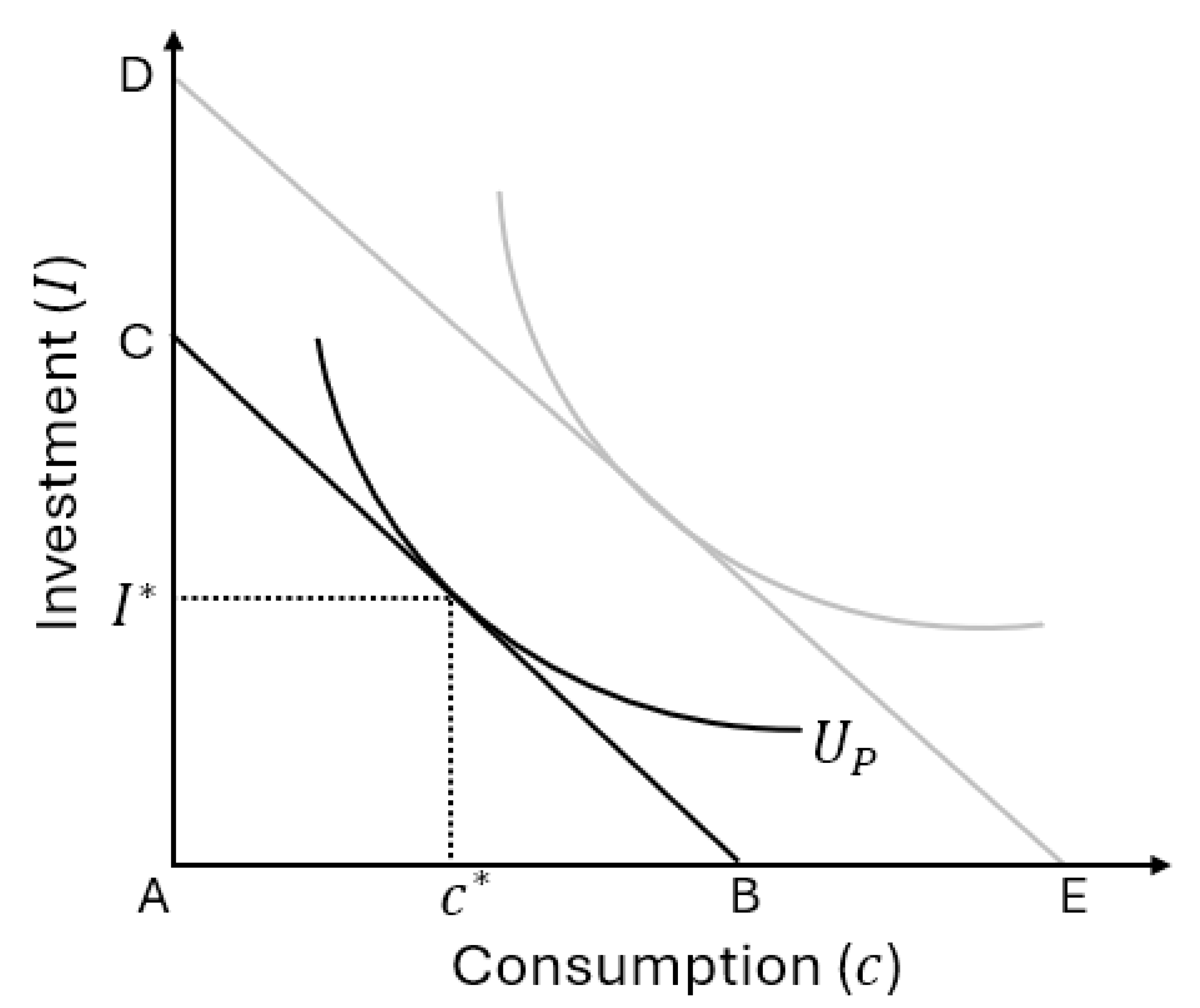
Figure 2.
Hypothetical relationship between parent and offspring characteristics. Parents with higher fitness capital earn more income, which means that they invest more in their offspring’s fitness capital. Higher parental altruism tends to be inherited by the offspring, as well as increases the fraction of income earned going towards investment. Red arrows depict genetic transmission from parent to offspring (measured by its heritability), solid arrows with pluses represent positive causal effects of behaviour, and the dotted line represents where these effects, if recurring over generations, produce a correlation. .
Figure 2.
Hypothetical relationship between parent and offspring characteristics. Parents with higher fitness capital earn more income, which means that they invest more in their offspring’s fitness capital. Higher parental altruism tends to be inherited by the offspring, as well as increases the fraction of income earned going towards investment. Red arrows depict genetic transmission from parent to offspring (measured by its heritability), solid arrows with pluses represent positive causal effects of behaviour, and the dotted line represents where these effects, if recurring over generations, produce a correlation. .
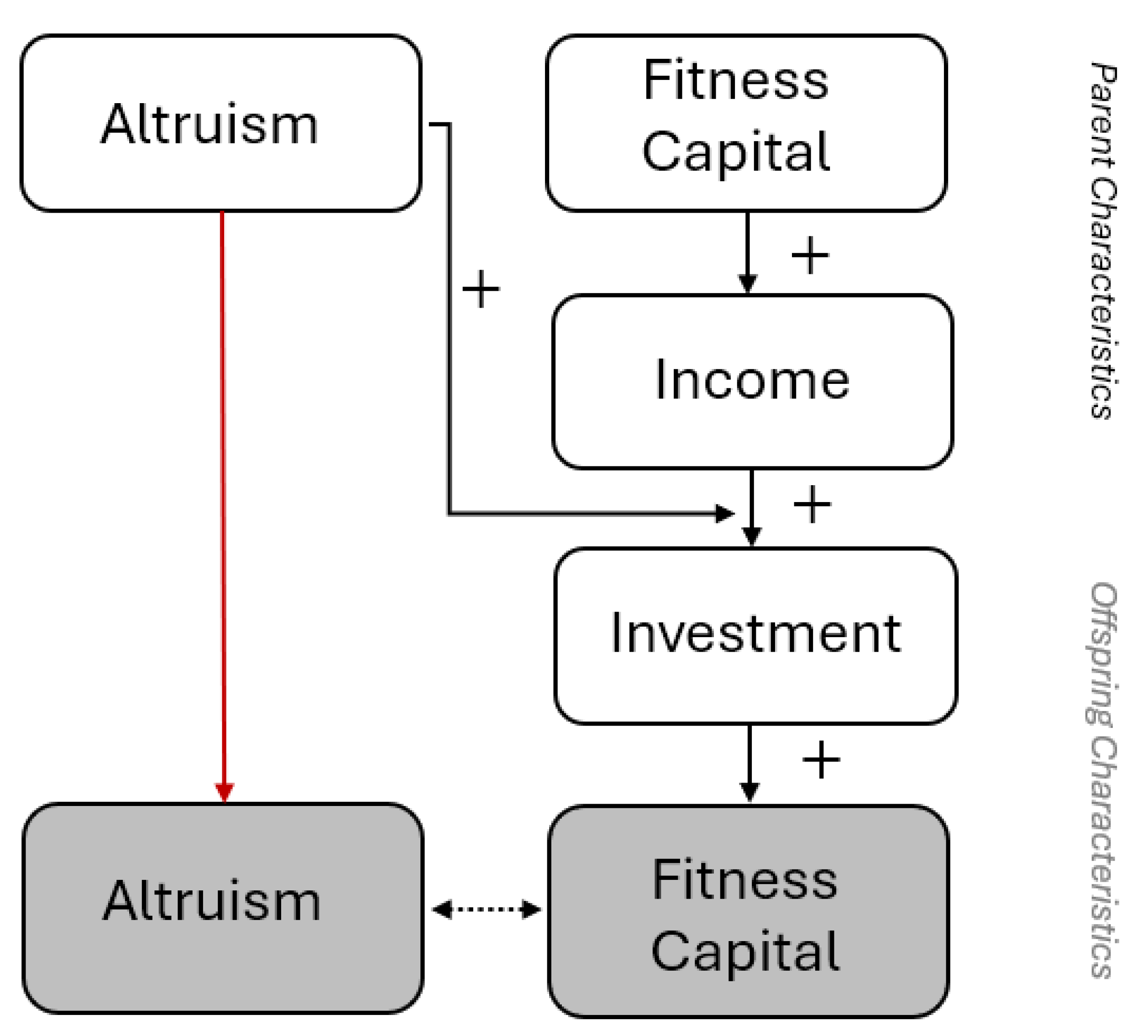
Figure 3.
Different levels of investment in kin depending on individual differences in ability. Lines and show diminishing marginal utility of investment for a high and low ability recipient of investments, respectively. It is rational to invest up until the point until the incremental benefit produced from investing another unit of resources is balanced against the marginal benefit that could be obtained from spending it instead on consumption. This means it is optimal to invest more in the high ability child despite equal altruism.
Figure 3.
Different levels of investment in kin depending on individual differences in ability. Lines and show diminishing marginal utility of investment for a high and low ability recipient of investments, respectively. It is rational to invest up until the point until the incremental benefit produced from investing another unit of resources is balanced against the marginal benefit that could be obtained from spending it instead on consumption. This means it is optimal to invest more in the high ability child despite equal altruism.
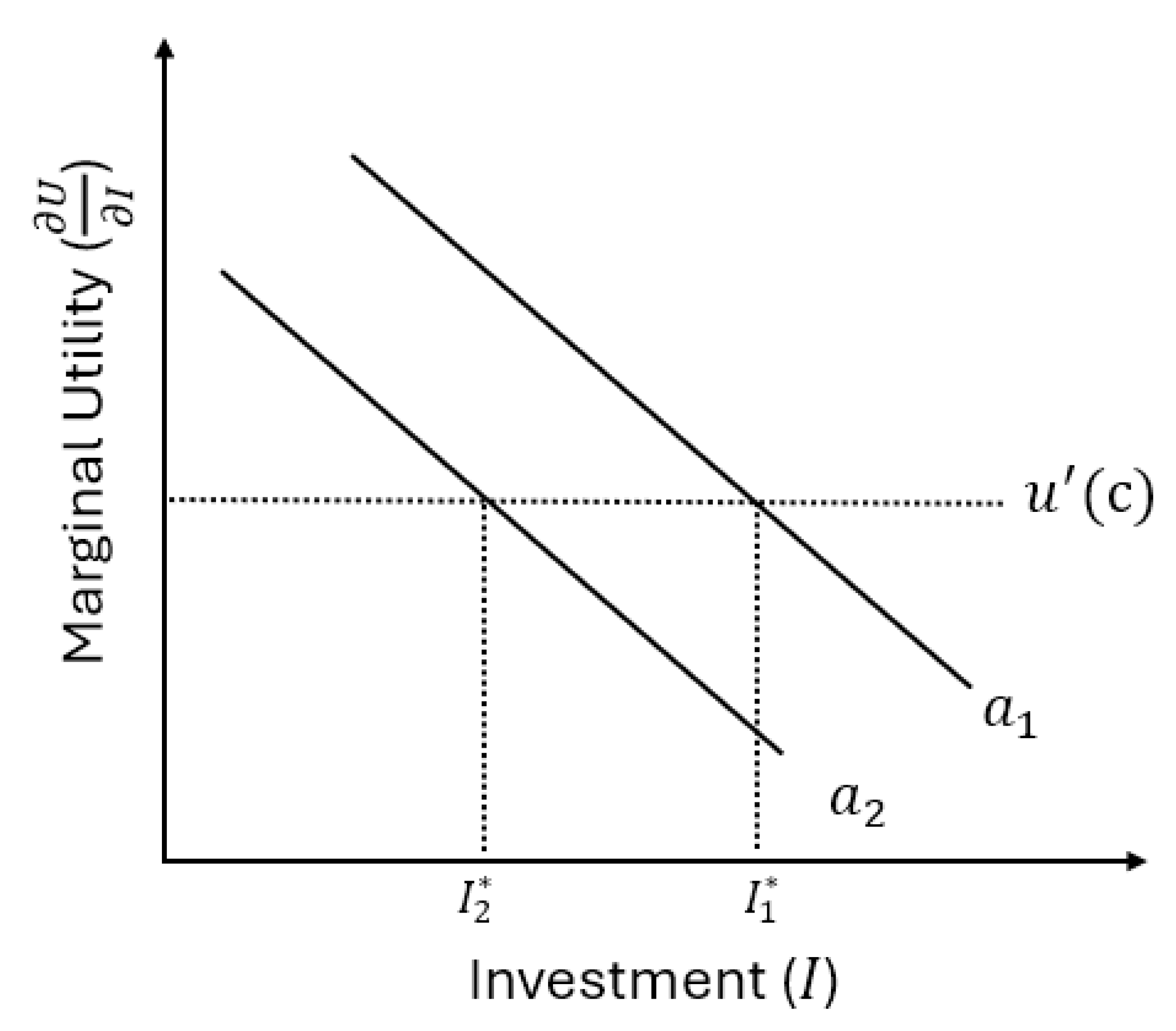
Figure 4.
Hypothetical relationship between parent and offspring characteristics highlighting the role of ability. Ability is integrated with the same relationships depicted in Figure 2. Offspring tend to inherit ability from parents, while the child’s ability both enhances the effect of the parental investment and induces more of that investment. Red arrows depict genetic transmission from parent to offspring, solid arrows with pluses represent positive causal effects of behaviour, and the dotted line represents where these effects, if recurring over generations, produce a correlation. .
Figure 4.
Hypothetical relationship between parent and offspring characteristics highlighting the role of ability. Ability is integrated with the same relationships depicted in Figure 2. Offspring tend to inherit ability from parents, while the child’s ability both enhances the effect of the parental investment and induces more of that investment. Red arrows depict genetic transmission from parent to offspring, solid arrows with pluses represent positive causal effects of behaviour, and the dotted line represents where these effects, if recurring over generations, produce a correlation. .
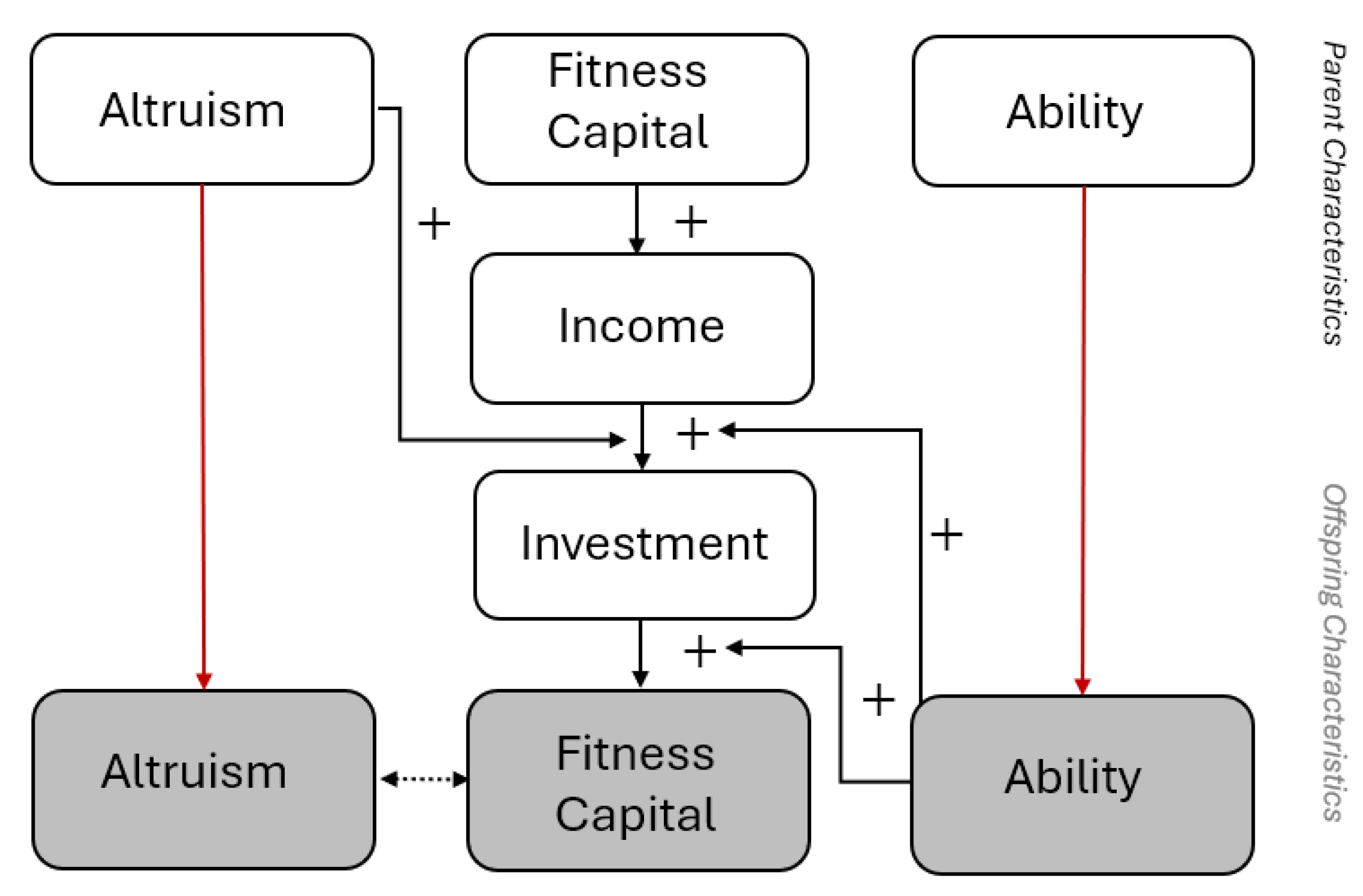
Figure 5.
Positive Assortative Mating on Altruism. Purple and blue boxes represent characteristics of parent A and parent B, who unite to produce a “household” that earns income and invests in their offspring (whose characteristics are shaded in grey). Parents with more fitness capital earn more income and so tend to invest more in the fitness capital of offspring. If such couples are more altruistic, a greater proportion of whatever they earn gets invested. The process tends to increase the correlation between altruism and fitness capital, which implies that, if more altruistic parents choose more altruistic partners, couples will tend to become correlated in altruism and fitness capital. Red arrows depict genetic transmission from parent to offspring, solid arrows with pluses represent positive causal effects of behaviour, and the dotted line represents where these effects, if recurring over generations, produce a correlation. .
Figure 5.
Positive Assortative Mating on Altruism. Purple and blue boxes represent characteristics of parent A and parent B, who unite to produce a “household” that earns income and invests in their offspring (whose characteristics are shaded in grey). Parents with more fitness capital earn more income and so tend to invest more in the fitness capital of offspring. If such couples are more altruistic, a greater proportion of whatever they earn gets invested. The process tends to increase the correlation between altruism and fitness capital, which implies that, if more altruistic parents choose more altruistic partners, couples will tend to become correlated in altruism and fitness capital. Red arrows depict genetic transmission from parent to offspring, solid arrows with pluses represent positive causal effects of behaviour, and the dotted line represents where these effects, if recurring over generations, produce a correlation. .
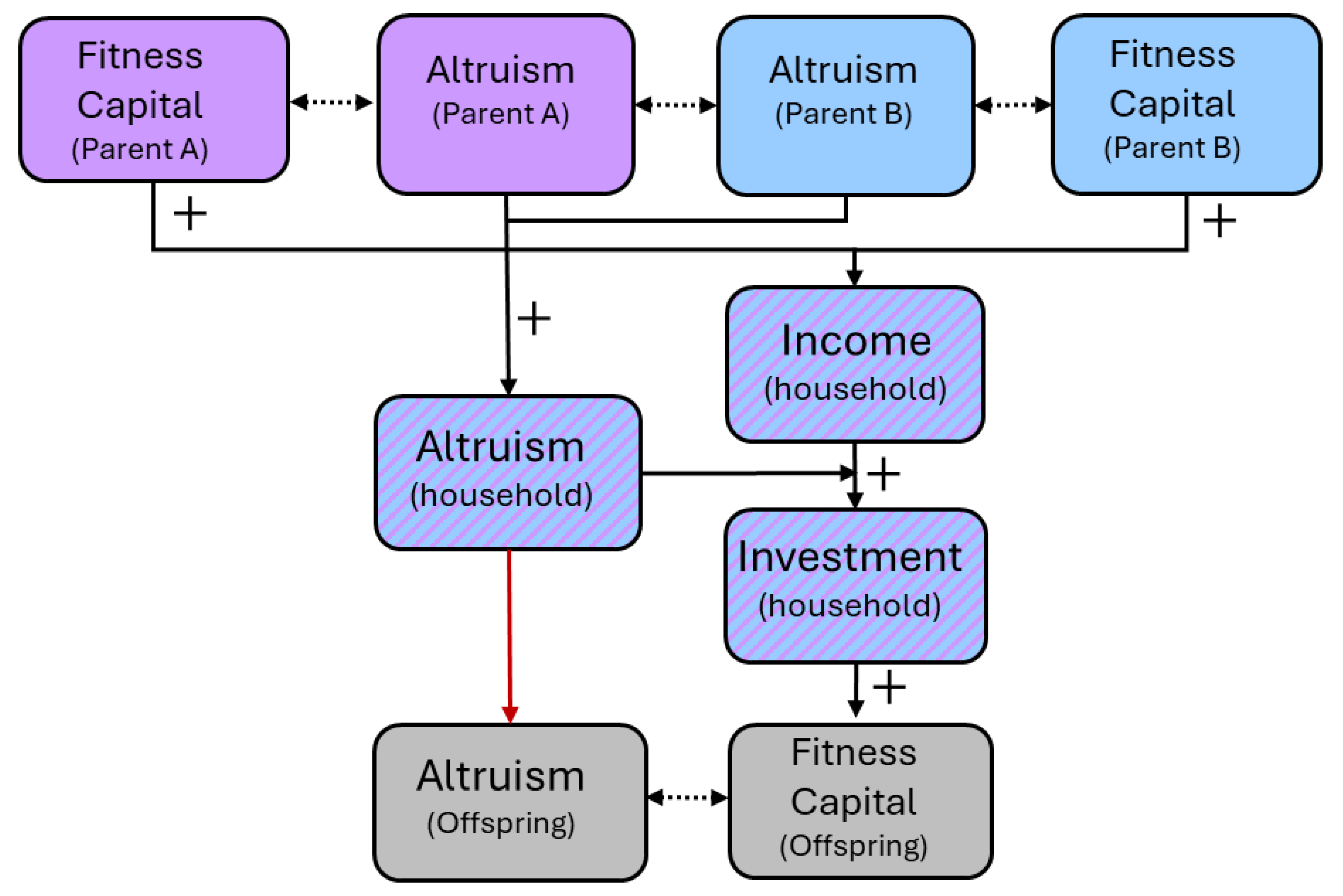
Figure 6.
PAM on altruism and preconditions for runaway sexual selection. Parents sort based on altruism because of similar characteristics have complementarities in household production (e.g., couples earn disproportionately more working together if they are both high on altruism). If there are genetic components affecting this preference () and these traits (z), this can increase their correlation in subsequent next generations (linkage disequilibrium) and so raise covariance between trait and preference. Red arrows depict genetic transmission from parent to offspring, solid arrows with pluses represent positive causal effects of behaviour, and the dotted line represents where these effects, if recurring over generations, produce a correlation. .
Figure 6.
PAM on altruism and preconditions for runaway sexual selection. Parents sort based on altruism because of similar characteristics have complementarities in household production (e.g., couples earn disproportionately more working together if they are both high on altruism). If there are genetic components affecting this preference () and these traits (z), this can increase their correlation in subsequent next generations (linkage disequilibrium) and so raise covariance between trait and preference. Red arrows depict genetic transmission from parent to offspring, solid arrows with pluses represent positive causal effects of behaviour, and the dotted line represents where these effects, if recurring over generations, produce a correlation. .
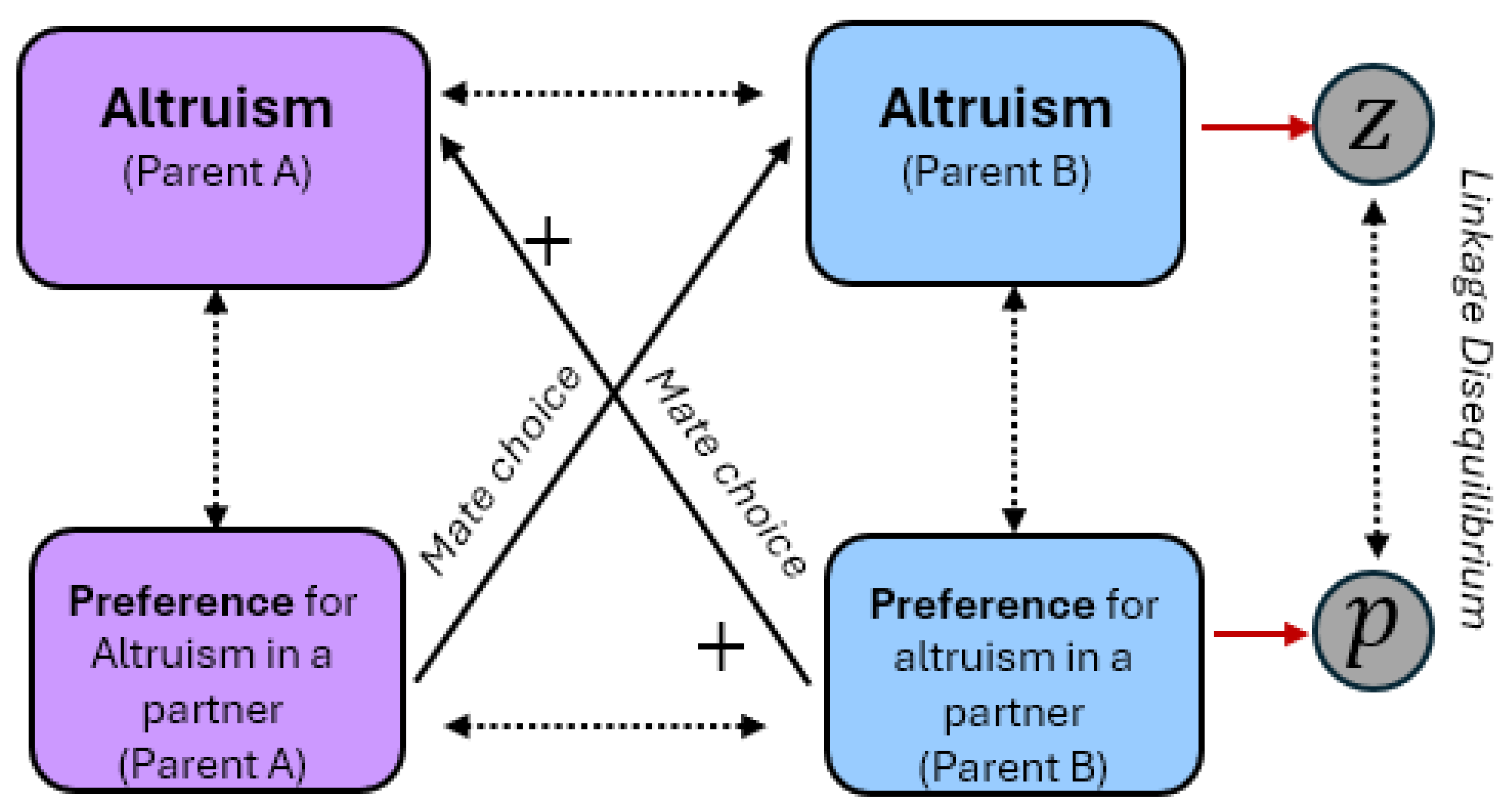

Table 1.
Temporary investment shock: one-period vs compounding fitness capital.
| Generation |
Investment (baseline) |
Fitness Capital (baseline) | Investment (shock lineage) |
Fitness Capital (shock lineage) |
| 1 | 0.2 | 1.00 | 0.2 | 1.00 |
| 2 | 0.2 | 1.20 | 0.2 | 1.20 |
| 3 | 0.2 | 1.42 | 0.4 | 1.52 |
| 4 | 0.2 | 1.66 | 0.2 | 1.77 |
| 5 | 0.2 | 1.93 | 0.2 | 2.05 |
| 6 | 0.2 | 2.23 | 0.2 | 2.36 |
Note. Values represent relative fitness capital indices (higher = greater lineage reproductive potential).
Table 2.
Ability complementarity: optimal investment and fitness outcomes.
| Ability () | Optimal investment () | Resulting fitness capital () |
| 0.5 | 0.01 | 1.02 |
| 1.0 | 0.33 | 1.41 |
| 1.5 | 2.49 | 4.12 |
Note: , marginal cost normalized to 1.
Table 3.
Examples of Fitness Capital in Nature.
| Species | Form of Fitness Capital | Method of Investment | Source |
| Meerkat (Suricata suricata) |
Skills in handling difficult and dangerous prey items. |
Providing pups with prey of progressive more difficulty to practice. | Thornton and Raihani (2008) |
| Golden Tamarin (Leontopithecus rosalia) | Skills handling prey items and other food sources. |
Adults use calls to alert foraging juveniles to food sources that the adults have detected (but not captured). | Slack (2014) |
| New Zealand Falcon (Falco novaeseelandiae), Montagu’s Harrier (Circus pygargus) |
Prey capture skills |
Parents drop injured live prey for offspring to practice catching and killing. | Kross and Nelson (2013), Kitowski (2005) |
| Rock Ant (Temnothorax albipennis) |
Spatial/route knowledge for colonies |
Leader walks four times slower to food sources to facilitate social learning in others. | Thornton and Raihani (2008) |
| Baboon (Papio spp.) |
Social network inheritance and grooming bonds | Mother baboons scaffold the social networks and opportunities for interactions for their daughters. Possibly inadvertent. | Roatti et al., (2023) |
| Red Deer (Cervus elaphus) |
Social status | Social bonds between mother deer. |
Ruckstuhl et al., (2026) |
| Spotted Hyena (Crocuta crocuta) |
Social rank | Mothers support daughters in agonistic interactions to help ensuring their offspring win conflicts and gain in standing. | Laubach et al., (2019) |
| Bottlenose Dolphin (Tursiops spp.) | Adeptness in tool use for foraging | Mothers instruct daughters in how to use sponges as a tool to probe the seafloor for prey. | Gibson and Mann (2008) |
Disclaimer/Publisher’s Note: The statements, opinions and data contained in all publications are solely those of the individual author(s) and contributor(s) and not of MDPI and/or the editor(s). MDPI and/or the editor(s) disclaim responsibility for any injury to people or property resulting from any ideas, methods, instructions or products referred to in the content. |
© 2026 by the author. Licensee MDPI, Basel, Switzerland. This article is an open access article distributed under the terms and conditions of the Creative Commons Attribution (CC BY) license.
Copyright: This open access article is published under a Creative Commons CC BY 4.0 license, which permit the free download, distribution, and reuse, provided that the author and preprint are cited in any reuse.