
Submitted:
10 February 2026
Posted:
11 February 2026
You are already at the latest version
Abstract
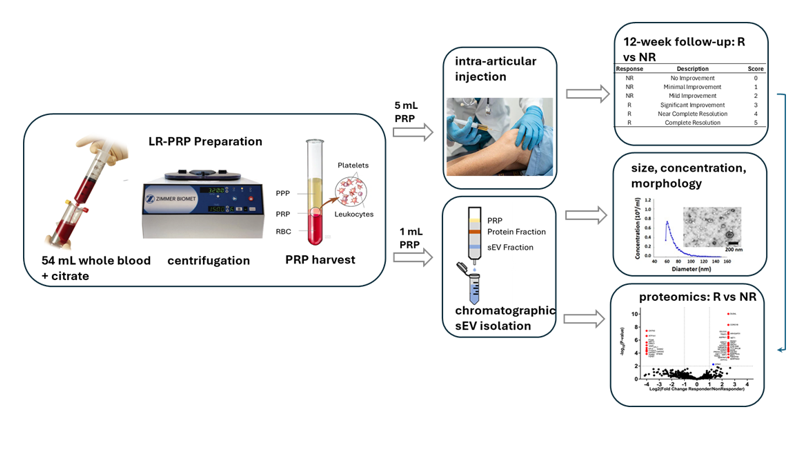
Intra-articular injection of autologous Platelet Rich-Platelet Plasma (PRP) is commonly employed as a non-surgical option for treating early-stage knee osteoarthritis (OA). Placebo-controlled clinical trials show sustained improvements in knee pain and function in most, but not all patients. Although several hypotheses have been put forward, the reasons for inconsistent responses remain unclear. Exosomes, a class of lipid membrane-bound extracellular otherwise known as small extracellular vesicles (sEVs), are a prominent component of PRP. sEVs are thought to mediate many of PRP’s therapeutic effects by carrying complex molecular cargos that regulate gene expression when taken up by cells in osteoarthritic joints. We hypothesized that patient-to-patient variations in sEV protein content correlate with patient responses to PRP. To test this, we compared the proteomes of PRP-derived sEVs from 3 patients who reported significant improvement in symptoms from baseline to 12 weeks post-injection (responders) versus 3 who did not (non-responders). 48 proteins identified by mass spectrometry were significantly different between Responders and Non-Responders. Taken together, these findings indicate that a patient’s responsiveness to PRP treatment could be associated with EV protein cargo composition.
Keywords:
osteoarthritis
; platelet-rich plasma
; extracellular vesicles
; proteomics
Copyright: This open access article is published under a Creative Commons CC BY 4.0 license, which permit the free download, distribution, and reuse, provided that the author and preprint are cited in any reuse.


