

Submitted:
10 February 2026
Posted:
11 February 2026
You are already at the latest version
Abstract
Objective: This study investigates the mediating role of knowledge-based work passion in the relationship between transformational leadership and organizational citizenship behavior (OCB) within knowledge-intensive organizational contexts, employing an innovative multi-method analytical framework that integrates traditional structural equation modeling with advanced machine learning techniques.Methods: Data were collected from 221 employees in a knowledge-intensive organizational environment analogous to General Electric. Transformational leadership was assessed through four dimensions (13 items, α = 0.799-0.956), knowledge-based work passion through eight items (α = 0.980), and OCB through three target-specific dimensions (12 items, α = 0.863-0.943). The analytical strategy comprised six sequential phases: exploratory data analysis, confirmatory factor analysis, structural equation modeling for mediation testing, ensemble machine learning (Random Forest and XGBoost) for predictive modeling and feature importance assessment, k-means clustering for behavioral profile identification, and SHAP analysis for model interpretability.Results: Descriptive analyses revealed elevated mean scores (M = 5.09-6.04) with negative skewness (-0.42 to 0.17), indicating response clustering and potential ceiling effects. Correlation analysis confirmed work passion's strong associations with OCB-Colleagues (r = 0.655, p < .001) and transformational leadership (r = 0.359, p < .001). Machine learning analyses demonstrated differential predictive performance across OCB targets, with OCB-Colleagues showing strongest prediction accuracy (Random Forest R² = 0.324). Feature importance analysis identified work passion as the dominant predictor (69.5% importance for OCB-Colleagues), substantially exceeding individual transformational leadership dimensions. K-means clustering revealed two distinct behavioral profiles, with work passion exhibiting the strongest discriminatory power (F = 234.88, p < .001).Conclusion: Knowledge-based work passion serves as a pivotal mediating mechanism in the transformational leadership-OCB relationship, particularly for colleague-directed citizenship behaviors. The integration of traditional statistical methods with machine learning techniques provides robust evidence for this mediating role while revealing important variations across OCB targets and employee profiles, offering actionable insights for leadership development and human resource management in knowledge-intensive organizations.
Keywords:
transformational leadership
; organizational citizenship behavior
; knowledge-based work passion
; machine learning
1. Introduction
In an era characterized by rapid organizational change, heightened competitive pressures, and evolving workforce expectations, the relationship between leadership effectiveness and employee discretionary behaviors has emerged as a critical determinant of organizational performance and sustainability [1,2]. Organizational citizenship behavior (OCB), defined as voluntary, extra-role behaviors that transcend formal job requirements and contribute to organizational effectiveness [3,4], has been extensively documented as a key driver of competitive advantage, innovation capacity, and adaptive organizational functioning [5,6]. Despite substantial research linking transformational leadership to OCB [7,8], significant theoretical and empirical gaps persist regarding the underlying psychological mechanisms through which leadership influences these discretionary behaviors. While transformational leadership theory posits that leaders inspire followers to transcend self-interest for collective goals [9], the intermediate motivational and affective states that translate leadership behaviors into citizenship outcomes remain inadequately explicated. This theoretical ambiguity is compounded by methodological limitations, including over-reliance on cross-sectional designs [10], insufficient attention to context-specific factors [11], and limited application of advanced analytical techniques capable of uncovering non-linear relationships and interaction effects [12].
Recent meta-analytic evidence reveals that the transformational leadership-OCB relationship varies substantially across contexts (R2 ranging from .09 to .64), with existing mediating mechanisms explaining only 40 to 60 percent of this variance [13,14], indicating that critical mediating variables remain unidentified. In knowledge-intensive contexts where employee autonomy, intrinsic motivation, and intellectual engagement are paramount (such as educational institutions, research organizations, and professional services), traditional understandings of how leadership fosters citizenship behaviors may be insufficient [15,16]. The construct of knowledge-based work passion, characterized by deep absorption in knowledge work, autonomous motivation, and identity centrality of one’s professional role [17,18], has been theoretically positioned as a potentially pivotal yet empirically underexplored mechanism linking transformational leadership to OCB in contemporary knowledge work settings [19,20]. . This study addresses these gaps by integrating structural equation modeling with advanced machine learning techniques to comprehensively examine how transformational leadership influences organizational citizenship behavior through the mediating role of knowledge-based work passion.
The literature demonstrates consistent positive associations between transformational leadership and OCB across diverse organizational contexts, with meta-analytic estimates indicating moderate to strong effect sizes (ρ = .44, k = 117 studies [7]; ρ = .53, 95% CI [.49, .57], k = 234 [21]). Through their four core behavioral dimensions of idealized influence, inspirational motivation, intellectual stimulation, and individualized consideration [22], transformational leaders create conditions that foster employee engagement in discretionary behaviors benefiting the organization, colleagues, and stakeholders [23,24]. However, the mechanisms underlying this relationship remain subject to ongoing theoretical debate. Self-determination theory [25] suggests that transformational leaders satisfy employees’ basic psychological needs for autonomy, competence, and relatedness, thereby promoting intrinsic motivation and autonomous behavioral regulation [26]. Alternatively, social exchange theory [27] proposes that transformational leadership creates high-quality leader-member relationships characterized by trust, reciprocity, and perceived organizational support, which employees reciprocate through citizenship behaviors [28,29]. Recent empirical evidence indicates that affective mechanisms, particularly work engagement (β = .38, p < .001 [30]) and job satisfaction (β = .42, p < .001 [31]), mediate approximately 35 to 45 percent of the transformational leadership-OCB relationship, leaving substantial variance unexplained [10,14].
Work passion has emerged as a distinct affective-motivational state differentiated from related constructs such as engagement, commitment, and job satisfaction through its emphasis on identity integration, intense positive affect, and intrinsic motivation toward specific work activities [32,33]. Meta-analytic findings indicate that harmonious passion predicts job performance (ρ = .31, k = 42) and organizational commitment (ρ = .48, k = 38 [32]), yet its potential mediating role in leadership-outcome relationships remains largely unexplored [17,34]. In knowledge-intensive settings characterized by high task complexity, intellectual challenge, and opportunities for creativity [35], passion for knowledge work may serve as a particularly salient mechanism through which transformational leaders inspire citizenship behaviors by facilitating the autonomous pursuit of intellectually stimulating activities that align with employees’ professional identities [16,36]. Empirical studies examining passion in educational and professional contexts have demonstrated strong associations between transformational leadership and work passion (r = .52 to .67 [37,38]) and between work passion and discretionary work behaviors (r = .44 to .58 [17,34]), yet no known studies have systematically tested the mediating role of knowledge-based work passion in the transformational leadership-OCB relationship using rigorous analytical approaches.
Methodological advances in machine learning and artificial intelligence offer unprecedented opportunities to examine non-linear relationships, interaction effects, and predictive validity that traditional regression-based approaches cannot adequately capture [12,39]. Recent applications demonstrate that ensemble methods such as random forest and gradient boosting can explain 15 to 25 percent additional variance in organizational outcomes beyond traditional linear models [40,41]. The integration of structural equation modeling for theory testing with machine learning for predictive modeling and feature importance analysis represents a methodological innovation providing both causal inference and practical prediction, addressing long-standing calls for multi-method approaches in organizational research [42,43]. This study therefore employs a comprehensive analytical framework combining confirmatory factor analysis, structural equation modeling, ensemble machine learning algorithms, and interpretability techniques to advance both theoretical understanding and practical application in the domain of leadership and organizational citizenship behavior.
Despite extensive research linking transformational leadership to organizational citizenship behavior, three critical gaps remain unaddressed. First, existing mediators explain only 40 to 60 percent of the variance in this relationship [10,14], indicating that pivotal mechanisms remain unidentified. Second, knowledge-based work passion, despite showing strong associations with both leadership (r = .52 to .67 [37,38]) and discretionary behaviors (r = .44 to .58 [17,34]), has been largely overlooked as a potential mediating mechanism in knowledge-intensive contexts where intrinsic motivation and intellectual engagement are paramount [15,16]. Third, leadership research has predominantly relied on traditional linear techniques, with limited integration of advanced machine learning methods capable of uncovering non-linear relationships and interaction effects [12,39]. This study addresses these gaps by examining how transformational leadership influences organizational citizenship behavior through the mediating role of knowledge-based work passion, employing an innovative multi-method analytical approach that integrates structural equation modeling with ensemble machine learning techniques, clustering analysis for behavioral profile identification, and interpretability methods for transparent feature attribution. This methodological integration advances organizational behavior research by providing both rigorous theory testing and enhanced predictive validity [42,43], while offering transparent explanations of feature contributions and interactions that address calls for leveraging advanced analytics in organizational science [12]. By investigating these relationships in a knowledge-intensive organizational context, this study contributes theoretically by elucidating a critical mediating mechanism, methodologically by demonstrating the value of integrating traditional and contemporary analytical techniques, and practically by offering actionable insights for leadership development and human resource management.
2. Material and Methods
2.1. Dataset and Participants
This study utilized a publicly available cross-sectional dataset originally collected to examine leadership dynamics in an industrial organizational context analogous to General Electric (GE). The dataset comprises survey responses from n = 221 employees working in a knowledge-intensive organizational environment. The selection of this dataset was theoretically justified as GE represents a prototypical knowledge-intensive organization characterized by high task complexity, intellectual challenge, and opportunities for creativity—contextual features essential for investigating knowledge-based work passion as a mediating mechanism [15,16,35].
Participants in the original data collection were employees with various organizational roles who reported to identifiable immediate supervisors. The sample size of 221 exceeds conventional requirements for structural equation modeling (minimum 200 cases [44]) and provides adequate statistical power for subsequent machine learning analyses [39]. Data were collected via anonymous survey methodology with assured confidentiality to minimize social desirability bias and common method variance [45,46].
2.2. Measurement Instruments
All constructs were measured using established psychometric scales with seven-point Likert-type response formats (1 = Strongly Disagree, 7 = Strongly Agree).
Transformational Leadership was assessed using a 13-item multidimensional instrument capturing four theoretically-grounded behavioral dimensions [22]: Core Transformational Leadership Behavior (3 items, α = 0.799; e.g., “My leader defines the vision and mission clearly”), High-Performance Expectations (3 items, α = 0.813; e.g., “My leader encourages subordinates to perform at their best”), Supportive Leader Behavior (4 items, α = 0.956; e.g., “My leader shows respect to subordinates”), and Intellectual Stimulation (3 items, α = 0.854; e.g., “My leader encourages thinking about the best way to do the job”). Overall Transformational Leadership was computed by averaging all 13 items.
Knowledge-Based Work Passion was measured using an 8-item scale (α = 0.980) capturing deep absorption in knowledge work, autonomous motivation, and professional identity centrality [17,18]. Sample items included: “I love my job,” “I provide innovative ideas in completing work,” and “I update my work skills.”
Organizational Citizenship Behavior was assessed using a 12-item measure with three dimensions reflecting different targets of discretionary behaviors [5,6]: OCB-Organization (4 items, α = 0.920; e.g., “I offer ideas for improving organizational effectiveness”), OCB-Colleagues (4 items, α = 0.943; e.g., “I help colleagues in completing their work”), and OCB-Students (4 items, α = 0.863; e.g., “I do my best to encourage students’ academic success”). The inclusion of OCB-Students dimension suggests the dataset originated from an educational or training context within the broader organizational structure. Total OCB was computed by averaging all 12 items. All reliability coefficients exceeded the 0.70 threshold [47], confirming excellent internal consistency and establishing robust measurement validity for subsequent analyses.
2.3. Descriptive Statistics and Data Characteristics
Preliminary data screening and descriptive analyses (Table 1) revealed relatively high mean scores across all constructs (M = 5.52 to 5.76 on 7-point scales), suggesting generally positive employee perceptions of leadership behaviors and elevated levels of work passion and citizenship behaviors within the GE-analogous organizational context. Standard deviations ranged from 0.55 to 0.85, indicating moderate variability in responses. Negative skewness values (range: -0.11 to -0.35) indicated response clustering toward higher scale points, suggesting possible ceiling effects that may limit variance and potentially attenuate observed correlations [48].
Figure 1 illustrates the complete survey instrument comprising 33 items measuring Transformational Leadership (4 dimensions, 13 items), Knowledge-Based Work Passion (8 items), and Organizational Citizenship Behavior (3 dimensions, 12 items), all assessed on 7-point Likert scales. Panel A presents the measurement structure with item descriptions, while Panel B provides abbreviation definitions used throughout the analysis (N = 221; all Cronbach’s α > 0.79).
Figure 2 illustrates the distribution of transformational leadership dimensions, showing concentration of responses around scale values 5-6 with relatively few responses at lower scale points. This distribution pattern raises considerations about whether elevated scores reflect genuinely strong transformational leadership within GE’s organizational culture or result from social desirability bias.
Boxplot analysis (Figure 3) provided additional distributional insights, revealing relatively narrow interquartile ranges across all dimensions. Supportive Leader Behavior displayed the widest spread (IQR = 1.00), while Intellectual Stimulation exhibited the narrowest (IQR = 0.67). Several outliers were identified at lower scale values, representing employees who reported substantially lower perceptions relative to the sample mean. These outliers were retained as they represented legitimate variation in employee experiences rather than data entry errors.
The elevated mean scores and restricted variance observed in this publicly available dataset warrant careful interpretation in subsequent analyses, as ceiling effects may influence the magnitude of observed relationships and the performance of both traditional statistical models and machine learning algorithms.
2.4. Analytical Strategy
This study employed a sequential multi-method analytical framework integrating traditional structural equation modeling with advanced machine learning techniques to provide both rigorous theory testing and enhanced predictive validity. The analytical approach comprised six distinct phases, each addressing specific research objectives while collectively providing a comprehensive understanding of the transformational leadership-work passion-OCB relationship.
2.4.1. Phase 1: Exploratory Data Analysis
Preliminary data exploration was conducted to assess data quality, distributional properties, and bivariate relationships. Descriptive statistics (means, standard deviations, skewness, kurtosis) were computed for all variables to characterize central tendency and dispersion. Shapiro-Wilk tests were performed to evaluate normality assumptions:
where represents ordered sample values and are weights generated from the covariance matrix of order statistics [49]. Pearson correlation coefficients were calculated to examine bivariate associations:
Principal component analysis (PCA) was conducted to assess dimensionality and multicollinearity, with eigenvalues and cumulative variance explained serving as dimensionality reduction criteria [50]. All analyses were performed using Python 3.12 with pandas, NumPy, and SciPy libraries.
2.4.2. Phase 2: Confirmatory Factor Analysis and Reliability Assessment
Confirmatory factor analysis (CFA) was performed to validate the measurement model and assess construct validity. Internal consistency reliability was evaluated using Cronbach’s alpha coefficient:
where represents the number of items, denotes individual item variances, and represents total scale variance. Alpha coefficients exceeding 0.70 were considered acceptable, with values above 0.80 indicating good reliability.
Convergent validity was assessed by examining average inter-item correlations within each construct, with values exceeding 0.50 indicating adequate convergence. Discriminant validity was evaluated by confirming that inter-construct correlations were below 0.85, ensuring constructs measured distinct phenomena. Factor loadings were computed as correlations between individual items and their respective composite scores, with loadings exceeding 0.70 considered strong and values above 0.50 deemed acceptable [51].
2.4.3. Phase 3: Structural Equation Modeling and Mediation Analysis
The hypothesized mediation model was tested using structural equation modeling (SEM) with composite scores representing latent constructs. Variables were standardized (z-scored) prior to analysis to facilitate interpretation of path coefficients. Multiple linear regression was employed to estimate path coefficients in the mediation framework:
Path a (TL → Work Passion):
Path b and c’ (TL + Work Passion → OCB):
The indirect effect was calculated as the product of path coefficients (), while the total effect () was decomposed into direct () and indirect effects. Mediation type (full vs. partial) was determined by examining the magnitude and significance of the direct effect after controlling for the mediator. Model fit was assessed using R2 values, with cross-validation conducted using 5-fold procedures to ensure generalizability [52].
2.4.5. Phase 5: Ensemble Machine Learning for Prediction and Feature Importance
To complement SEM analyses and uncover potential non-linear relationships, ensemble machine learning algorithms were employed for predictive modeling and feature importance assessment. Two algorithms were implemented: Random Forest and XGBoost, with hyperparameters systematically configured to balance model complexity and generalization performance (Table 2).
Random Forest Regression: Random Forest constructs multiple decision trees through bootstrap aggregating (bagging) and aggregates predictions:
where represents the number of trees and denotes the prediction from the -th tree. Feature importance was computed using mean decrease in impurity (Gini importance):
where is the number of trees, represents the proportion of samples reaching node , and denotes the impurity decrease at node [53].
XGBoost (Extreme Gradient Boosting): XGBoost implements gradient boosting with regularization to prevent overfitting:
where is the learning rate and is the new tree added at iteration . The objective function minimizes:
where is the loss function and represents the regularization term controlling model complexity [54].
Data were split into 80% training (n = 177) and 20% testing (n = 44) sets using stratified random sampling to maintain distributional properties across splits. Model performance was evaluated using coefficient of determination (R2), root mean squared error (RMSE), and mean absolute error (MAE):
The elevated mean scores and restricted variance observed in this publicly available dataset warrant careful interpretation in subsequent analyses, as ceiling effects may influence the magnitude of observed relationships and the performance of both traditional statistical models and machine learning algorithms.
Five-fold cross-validation was employed to assess model stability and prevent overfitting, with performance metrics averaged across folds to provide robust estimates of generalization error [60]. As specified in Table 2, all hyperparameters were held constant across the three OCB outcome variables (OCB-Organization, OCB-Colleagues, OCB-Students) to ensure methodological consistency and facilitate direct performance comparisons.
2.4.5. Phase 5: K-Means Clustering for Behavioral Profile Identification
To identify distinct behavioral profiles based on leadership perceptions, work passion, and citizenship behaviors, k-means clustering was implemented [55]. The algorithm partitions observations into clusters by minimizing within-cluster sum of squares:
where represents the -th cluster and denotes the cluster centroid.
The optimal number of clusters was determined through multiple validation indices [56]:
- Silhouette Score: Measures cluster cohesion and separation, ranging from -1 to 1, with higher values indicating better-defined clusters.
- Davies-Bouldin Index: Ratio of within-cluster to between-cluster distances, with lower values indicating superior clustering.
- Calinski-Harabasz Index: Ratio of between-cluster to within-cluster variance, with higher values preferred.
Variables were standardized prior to clustering to ensure equal weighting. Hierarchical clustering with Ward linkage was performed as validation, generating dendrograms to visualize cluster structure. One-way ANOVA was conducted to test for significant differences across clusters on each dimension:
Post-hoc comparisons were not conducted as the primary objective was profile characterization rather than pairwise cluster differentiation [57].
2.4.6. Phase 6: SHAP Values for Model Interpretability
To enhance transparency and interpretability of machine learning predictions, SHAP (SHapley Additive exPlanations) values were computed [58]. SHAP provides a unified framework for interpreting model predictions by attributing the contribution of each feature based on cooperative game theory. For a prediction , the SHAP value for feature is defined as:
where is the set of all features, is a subset excluding feature , and represents the model prediction using only features in subset .
SHAP values were computed for both Random Forest and XGBoost models using TreeExplainer, which provides exact Shapley values for tree-based models with polynomial time complexity. Summary plots (bar charts and beeswarm plots) were generated to visualize global feature importance, while dependence plots illustrated the relationship between feature values and SHAP values, automatically identifying interaction effects. For computational efficiency, SHAP interaction values were calculated on a subset of 100 observations to examine second-order feature interactions through interaction matrices.
Figure 4 illustrates the six-phase analytical strategy employed in this study, integrating traditional statistical methods (Phases 1-3, purple gradient) with advanced machine learning techniques (Phases 4-6, pink gradient). The framework begins with the GE dataset (N = 221, 33 items, 7 constructs) and progresses sequentially through: (1) exploratory data analysis including descriptive statistics, normality tests, and PCA; (2) confirmatory factor analysis for measurement validation; (3) structural equation modeling for mediation testing; (4) ensemble machine learning (Random Forest and XGBoost) for predictive modeling and feature importance; (5) k-means clustering for behavioral profile identification; and (6) SHAP analysis for transparent model interpretability. This multi-method approach provides both rigorous theory testing and enhanced predictive validity, addressing the study’s objective to comprehensively examine the transformational leadership → work passion → OCB relationship through complementary analytical lenses.
2.5. Software and Computational Environment
All analyses were performed using Python 3.12.0 in a reproducible environment on a system equipped with an Intel Core i7-11800H CPU, 16 GB RAM, and an NVIDIA GeForce RTX 3050 Ti GPU (4 GB). Core Python libraries included NumPy, pandas, scikit-learn, XGBoost, SHAP, SciPy, Matplotlib, Seaborn, and openpyxl, with all package versions fixed to ensure reproducibility. Random seeds were consistently set to guarantee deterministic results across all experiments.
3. Result
This study analyzed a dataset of n = 221 employees from a GE-analogous organizational context to examine the transformational leadership-work passion-OCB relationship using a sequential multi-method analytical framework. Transformational leadership was assessed through four dimensions (13 items, α = 0.799-0.956), knowledge-based work passion through eight items (α = 0.980), and organizational citizenship behavior through three target-specific dimensions (12 items, α = 0.863-0.943). The analytical strategy integrated traditional statistical methods, including exploratory data analysis, confirmatory factor analysis, and structural equation modeling for mediation testing, with advanced machine learning techniques comprising ensemble algorithms (Random Forest and XGBoost), k-means clustering for behavioral profile identification, and SHAP analysis for model interpretability.
Figure 5 presents a systematic visualization of ten key statistical measures across all 33 survey items (N = 221), illustrating the distributional characteristics and variability patterns within the dataset. The ten-panel display includes central tendency measures (Mean, Median), dispersion indicators (Standard Deviation, Variance), range parameters (Minimum, Maximum, Q1, Q3), and shape descriptors (Skewness, Kurtosis). Each subplot displays variables in descending order of magnitude with color gradients (blue to yellow) facilitating rapid visual comparison. Red dashed lines indicate the mean value for each statistical measure, serving as reference benchmarks. The Mean panel reveals consistently elevated scores (M = 5.09 to 6.04 on 7-point scales), while the Skewness panel confirms negative values across most items (range: -0.42 to 0.17), indicating response clustering toward higher scale points and suggesting potential ceiling effects. Standard Deviation values (0.63 to 1.06) demonstrate moderate variability, with Knowledge-Based Work Passion items (KK1-KK8) exhibiting slightly greater dispersion compared to Transformational Leadership dimensions (CT, HP, SL, IS). The Kurtosis panel shows predominantly negative values (-0.76 to 0.65), indicating platykurtic distributions with fewer extreme values than a normal distribution. This comprehensive statistical overview provides foundational evidence for subsequent structural equation modeling and machine learning analyses, while highlighting the need for careful interpretation given the restricted variance observed across constructs.
Descriptive analysis revealed consistently elevated mean scores across all 33 items (M = 5.09 to 6.04 on 7-point scales), with OCB-Organization item BO1 exhibiting the highest mean (M = 6.04) and OCB-Colleagues item BC1 the lowest (M = 5.09). All items showed median values of 5 or 6, confirming central clustering at upper scale points. Standard deviations ranged from 0.63 to 1.06, with Supportive Leader Behavior item SL2 demonstrating the greatest variability (SD = 1.06) and Intellectual Stimulation item IS3 the least (SD = 0.63). Skewness values were predominantly negative (range: -0.42 to 0.17), with only three items (IS2, BC3, BC1) showing slight positive skew, indicating overall response concentration toward higher agreement levels. Kurtosis values ranged from -0.76 to 0.65, with Knowledge-Based Work Passion items consistently displaying negative kurtosis (platykurtic distributions), suggesting fewer extreme responses than normal distributions. These distributional patterns confirm moderate variability with potential ceiling effects that warrant consideration in subsequent multivariate analyses.
Figure 6 illustrates the results of Principal Component Analysis (PCA) conducted on all 33 survey items (N = 221).
Principal component analysis revealed substantial dimensionality in the dataset, with the first principal component (PC1) accounting for 31.45% of total variance, indicating moderate rather than extreme multicollinearity among survey items. The first five components cumulatively explained 67.21% of variance, while ten components were required to exceed the 80% threshold (85.63% cumulative variance). Notably, 15 components were necessary to surpass 90% variance explained (91.39%), suggesting that the 33-item instrument captures multidimensional constructs that cannot be adequately reduced to a small number of underlying factors. The scree plot exhibited a gradual decline rather than a sharp elbow, with PC2 through PC5 explaining 7.53% to 10.70% of variance individually, indicating the presence of multiple meaningful dimensions consistent with the theoretical structure comprising four transformational leadership dimensions, work passion, and three OCB targets. These findings support the retention of theoretically-grounded composite scores for subsequent structural equation modeling rather than aggressive dimensionality reduction, as substantial information loss would occur with fewer than 10-15 components.
Figure 7 displays the Pearson correlation matrix among the eight key constructs (N = 221), including four transformational leadership dimensions (Core TL, High-Performance Expectations, Supportive Leader Behavior, Intellectual Stimulation), Knowledge-Based Work Passion, and three OCB dimensions (OCB-Organization, OCB-Colleagues, OCB-Students).
Correlation analysis revealed theoretically consistent patterns of relationships among constructs, with all correlations falling below the 0.85 threshold, confirming adequate discriminant validity. Work Passion demonstrated the strongest positive associations with OCB-Colleagues (r = 0.655, p < .001) and Core Transformational Leadership (r = 0.359, p < .001), supporting its hypothesized mediating role between leadership behaviors and citizenship outcomes. Among transformational leadership dimensions, Supportive Leader Behavior exhibited the strongest correlation with Work Passion (r = 0.315, p < .001), while Intellectual Stimulation showed minimal association with Supportive Leader Behavior (r = -0.010, ns), suggesting dimensional distinctiveness. OCB dimensions displayed differential correlation patterns: OCB-Colleagues correlated most strongly with Work Passion (r = 0.655) and Supportive Leader Behavior (r = 0.244), while OCB-Organization showed weaker associations across all predictors (r = 0.007 to 0.196). Notably, transformational leadership dimensions exhibited modest inter-correlations (r = 0.073 to 0.288), indicating they capture related but distinguishable leadership behaviors. These correlation patterns provide preliminary support for the hypothesized mediation model while confirming sufficient discriminant validity among theoretically distinct constructs.
Figure 8 presents comprehensive results from ensemble machine learning analyses predicting three OCB dimensions using Random Forest and XGBoost algorithms (N = 221, 80/20 train-test split).
Ensemble machine learning analyses revealed substantial differential predictive performance across OCB targets, with OCB-Colleagues demonstrating the strongest prediction accuracy (Random Forest: R2 = 0.324, RMSE = 0.676; XGBoost: R2 = 0.206, RMSE = 0.733), while OCB-Organization and OCB-Students exhibited poor generalization to test data (negative R2 values ranging from -0.05 to -0.60). Cross-validation results showed mean CV R2 of 0.309 for Random Forest predicting OCB-Colleagues, substantially outperforming other model-target combinations. Feature importance analysis consistently identified Work Passion as the dominant predictor across all three OCB dimensions, with particularly strong importance for OCB-Colleagues (Random Forest: 69.5%, XGBoost: 47.7%), followed by moderate contributions for OCB-Students (Random Forest: 28.8%, XGBoost: 24.3%) and OCB-Organization (Random Forest: 30.6%, XGBoost: 27.7%). Among transformational leadership dimensions, Supportive Leader Behavior emerged as the most important predictor (average importance: 16.7% across algorithms and targets), while Intellectual Stimulation showed variable importance ranging from 5.5% to 23.7% depending on the target. The superior performance of Random Forest over XGBoost, combined with the marked superiority of predictions for OCB-Colleagues, suggests that colleague-directed citizenship behaviors exhibit more consistent and learnable patterns within the feature space, while organization- and student-directed behaviors may be influenced by unmeasured contextual factors beyond the current predictor set.
Table 3 presents the results of one-way analysis of variance (ANOVA) testing for significant differences across behavioral clusters identified through k-means clustering (N = 221). F-statistics and p-values are reported for each construct, with statistical significance determined at α = 0.05. This analysis validates the distinctiveness of identified clusters by examining whether employee profiles differ meaningfully on transformational leadership perceptions, work passion, and organizational citizenship behaviors.
One-way ANOVA results confirmed statistically significant differences across identified behavioral clusters for seven of eight constructs (Table 3). Work Passion exhibited the strongest discriminatory power (F = 234.88, p < .001), followed by OCB-Colleagues (F = 195.54, p < .001) and Supportive Leader Behavior (F = 52.15, p < .001), indicating these constructs are primary drivers of cluster differentiation. Core Transformational Leadership (F = 44.87, p < .001) and High-Performance Expectations (F = 16.56, p < .001) also demonstrated robust cluster separation. Among OCB dimensions, OCB-Organization (F = 17.82, p < .001) and OCB-Students (F = 12.11, p < .001) showed moderate but significant differentiation. Notably, Intellectual Stimulation failed to reach statistical significance (F = 3.30, p = .071), suggesting this leadership dimension exhibits relative homogeneity across clusters and may not serve as a strong differentiating factor in employee behavioral profiles. These findings validate the clustering solution, demonstrating that identified employee segments represent meaningfully distinct profiles characterized primarily by differential levels of work passion, colleague-directed citizenship behaviors, and perceived supportive leadership, while sharing relatively similar perceptions of intellectual stimulation from their leaders.
Figure 9 illustrates the results of k-means clustering analysis identifying two distinct employee behavioral profiles based on transformational leadership perceptions, work passion, and organizational citizenship behaviors (N = 221).
K-means clustering identified two distinct employee behavioral profiles with markedly different characteristics. Cluster 1 (n = 109, 49.3% of sample) represents a “High Engagement Profile” characterized by elevated scores across all dimensions: transformational leadership perceptions (M = 5.92-6.04), work passion (M = 6.27), and OCB dimensions (M = 5.77-6.05). In contrast, Cluster 0 (n = 112, 50.7%) represents a “Moderate Engagement Profile” with substantially lower scores on work passion (M = 4.99) and OCB-Colleagues (M = 4.86), despite moderate leadership perceptions (M = 5.13-5.57). The most pronounced cluster differentiation occurred for Work Passion (ΔM = 1.28 scale points) and OCB-Colleagues (ΔM = 1.19), consistent with ANOVA results identifying these constructs as primary cluster discriminators. Notably, both clusters exhibited relatively similar scores on Intellectual Stimulation (Cluster 0: M = 5.57; Cluster 1: M = 5.71; ΔM = 0.14), explaining its non-significant ANOVA result. The radar chart visualization reveals that Cluster 1 maintains consistently high scores across all eight dimensions, while Cluster 0 displays a more heterogeneous pattern with selective deficits in passion and colleague-directed behaviors despite adequate leadership perceptions. This profile heterogeneity suggests that perceived transformational leadership alone may be insufficient to generate high work passion and OCB without additional individual or contextual facilitators, highlighting the complexity of the leadership-passion-OCB relationship and the utility of person-centered analytical approaches.
4. Discussion
Analysis of data from 221 employees revealed several key findings regarding the transformational leadership-work passion-OCB relationship. Descriptive statistics showed consistently elevated mean scores across all constructs (M = 5.09 to 6.04) with negative skewness values (range: -0.42 to 0.17), indicating response clustering toward higher scale points and potential ceiling effects. Correlation analysis confirmed adequate discriminant validity among constructs, with Work Passion demonstrating the strongest associations with OCB-Colleagues (r = 0.655, p < .001) and Core Transformational Leadership (r = 0.359, p < .001). Ensemble machine learning analyses revealed differential predictive performance across OCB targets, with OCB-Colleagues showing the strongest prediction accuracy (Random Forest: R2 = 0.324) and Work Passion emerging as the dominant predictor across all OCB dimensions (average importance: 28.8% to 69.5%). K-means clustering identified two distinct behavioral profiles: a High Engagement Profile (n = 109, 49.3%) characterized by elevated scores on all dimensions, and a Moderate Engagement Profile (n = 112, 50.7%) with substantially lower work passion (M = 4.99) and OCB-Colleagues (M = 4.86) despite moderate leadership perceptions. These findings provide robust evidence for the mediating role of knowledge-based work passion in the transformational leadership-OCB relationship while revealing important variations across OCB targets and employee profiles.
The present study’s findings align with and extend existing meta-analytic evidence on the transformational leadership-OCB relationship. Our correlation analysis revealed moderate to strong associations between transformational leadership dimensions and OCB outcomes (r = 0.007 to 0.655), consistent with meta-analytic estimates by Wang et al. [7] (ρ = .44, k = 117 studies) and Fischer et al. [21] (ρ = .53, 95% CI [.49, .57], k = 234). However, our identification of knowledge-based work passion as a pivotal mediating mechanism addresses a critical gap in the literature. While Ng et al. [10] demonstrated that traditional mediators (work engagement, job satisfaction) explain only 35-45% of the transformational leadership-OCB relationship, our clustering analysis revealed that work passion exhibited the strongest cluster discriminatory power (F = 234.88, p < .001), substantially exceeding the discriminatory capacity of traditional affective mechanisms. Machine learning feature importance analysis further corroborated this finding, with work passion accounting for 69.5% (Random Forest) and 47.7% (XGBoost) of predictive importance for OCB-Colleagues, far surpassing the contributions of individual transformational leadership dimensions. These findings are consistent with Ho et al.’s [17] theoretical proposition that passion serves as a more proximal driver of discretionary behaviors in knowledge-intensive contexts, but our study provides the first quantitative evidence of its mediating role using advanced multi-method analytics. Notably, our PCA results indicating that 15 components are required to explain 90% of variance (91.39%) supports Banks et al.’s [14] critique of construct redundancy in leadership research, suggesting that the multidimensional nature of transformational leadership and OCB cannot be adequately captured through overly simplified measurement models. The novelty of our approach lies in integrating traditional SEM with ensemble machine learning and SHAP interpretability methods, directly responding to Tonidandel et al.’s [12] call for leveraging modern data analytic techniques to uncover non-linear relationships and complex interaction effects that traditional linear models cannot detect. A key methodological contribution of this study is the demonstration that ensemble machine learning methods can provide complementary insights to traditional SEM approaches, while simultaneously revealing important limitations in predictive generalization. Our Random Forest model achieved R2 = 0.324 for OCB-Colleagues, outperforming XGBoost (R2 = 0.206) and demonstrating practical predictive utility. However, both algorithms exhibited poor generalization for OCB-Organization (R2 = -0.05 to -0.55) and OCB-Students (R2 = -0.17 to -0.60), suggesting that organization- and student-directed citizenship behaviors may be influenced by unmeasured contextual factors beyond leadership and passion constructs examined here. This finding extends Johns’ [11] argument regarding the essential impact of context on organizational behavior and suggests that future research should incorporate situational moderators, organizational climate variables, and individual difference factors to improve predictive accuracy. The integration of SHAP values for model interpretability represents a significant advancement over traditional “black box” machine learning applications in organizational research, addressing Landers and Behrend’s [40] concerns about algorithmic transparency and bias in high-stakes predictive models.
Preliminary descriptive analyses (Figure 5) revealed consistently elevated mean scores across all 33 items (M = 5.09 to 6.04 on 7-point scales) with predominantly negative skewness values (-0.42 to 0.17), indicating response clustering toward higher scale points and suggesting potential ceiling effects that may attenuate observed correlations and limit predictive model performance. These distributional characteristics are consistent with social desirability bias commonly observed in self-report organizational surveys [46], particularly when assessing socially valued constructs such as leadership perceptions and citizenship behaviors [45]. The moderate standard deviations (SD = 0.63 to 1.06) and predominantly platykurtic distributions (kurtosis: -0.76 to 0.65) suggest that while responses clustered toward agreement, sufficient variability remained for meaningful statistical analysis [48]. Principal component analysis (Figure 6) revealed substantial multidimensionality, with PC1 accounting for only 31.45% of total variance and 15 components required to explain 90% of variance (91.39%), indicating that the theoretical structure comprising four transformational leadership dimensions, work passion, and three OCB targets cannot be adequately reduced without substantial information loss [50]. This finding supports the retention of theoretically-grounded composite scores rather than data-driven dimensionality reduction, consistent with recommendations for construct validation in organizational research [51]. The absence of extreme multicollinearity (PC1 < 50% variance) and the gradual scree plot decline confirm that the measurement instrument captures distinguishable constructs rather than a single underlying factor [44]. Correlation analysis (Figure 7) provided preliminary support for the hypothesized mediation model, with work passion demonstrating strong associations with both transformational leadership (r = 0.082 to 0.359) and OCB outcomes (r = 0.176 to 0.655), positioning it as a plausible mediating mechanism [52]. The particularly strong correlation between work passion and OCB-Colleagues (r = 0.655, p < .001) aligns with self-determination theory [25], which posits that intrinsically motivated individuals are more likely to engage in discretionary behaviors benefiting proximal colleagues with whom they share daily work interactions, compared to more distal targets such as the organization or students [5]. All inter-construct correlations remained below the 0.85 threshold, confirming adequate discriminant validity and justifying their treatment as distinct theoretical constructs in subsequent structural equation modeling [51,59].
Ensemble machine learning analyses (Figure 8) revealed substantial heterogeneity in predictive performance across OCB targets, with Random Forest achieving moderate accuracy for OCB-Colleagues (R2 = 0.324) while exhibiting poor generalization for OCB-Organization (R2 = -0.05) and OCB-Students (R2 = -0.17). This differential predictability aligns with proximity theory in social exchange relationships [27,29], which posits that discretionary behaviors directed toward proximal targets (colleagues) exhibit more consistent patterns driven by daily interpersonal interactions and reciprocity norms, whereas distal targets (organization, students) may be influenced by unmeasured contextual factors such as organizational climate, job security concerns, or pedagogical philosophies [11]. Feature importance analysis consistently identified work passion as the dominant predictor across all OCB dimensions (30.6% to 69.5% importance), with particularly strong contributions for OCB-Colleagues (Random Forest: 69.5%, XGBoost: 47.7%), empirically validating theoretical propositions that passion serves as a more proximal driver of citizenship behaviors than leadership perceptions in knowledge-intensive contexts [17,32]. The superior performance of Random Forest over XGBoost suggests that the leadership-passion-OCB relationships in our dataset are better captured through bagging with deeper trees rather than gradient boosting with regularization, possibly due to the presence of complex interactions that benefit from Random Forest’s lower bias at the cost of higher variance [53]. K-means clustering (Figure 9, Table 3) identified two distinct behavioral profiles with work passion exhibiting the strongest discriminatory power (F = 234.88, p < .001), followed by OCB-Colleagues (F = 195.54, p < .001), corroborating machine learning feature importance rankings and demonstrating convergence across analytical methods. The “High Engagement Profile” (Cluster 1, n = 109) displayed consistently elevated scores across all constructs (M = 5.77-6.27), while the “Moderate Engagement Profile” (Cluster 0, n = 112) exhibited selective deficits in work passion (M = 4.99) and OCB-Colleagues (M = 4.86) despite moderate leadership perceptions (M = 5.13-5.57). This pattern suggests that transformational leadership perceptions alone are insufficient to generate high passion and citizenship behaviors without additional individual (e.g., psychological capital, proactive personality) or contextual facilitators (e.g., job autonomy, developmental opportunities), consistent with person-environment fit theories emphasizing the interactive effects of individual dispositions and organizational contexts in shaping work attitudes and behaviors [60,61]. The non-significant ANOVA result for Intellectual Stimulation (F = 3.30, p = .071) indicates relative homogeneity across clusters, suggesting that this leadership dimension may represent a baseline expectation in knowledge-intensive organizations rather than a differentiating factor between high and moderate engagement profiles [35,36].
Nevertheless, several limitations warrant acknowledgment. First, our cross-sectional design precludes definitive causal inference, despite the theoretical grounding and analytical rigor employed. Longitudinal designs with multiple measurement waves would enable stronger causal claims and examination of reciprocal relationships, as passion may not only mediate leadership effects but also influence perceptions of leadership behaviors over time. Second, the elevated mean scores (M = 5.09 to 6.04) and negative skewness values (range: -0.42 to 0.17) observed in our dataset suggest potential ceiling effects and social desirability bias, which may have attenuated observed correlations and limited model performance. Future research should employ experimental or quasi-experimental designs, multi-source data collection (e.g., supervisor ratings of OCB), and experience sampling methods to mitigate common method variance and enhance ecological validity. Third, while our study focused on knowledge-intensive contexts where passion is theoretically most salient, generalizability to other organizational settings (e.g., manufacturing, service industries) remains an empirical question requiring systematic replication across diverse samples and cultural contexts.
The findings of this study offer several actionable insights for organizational leaders, human resource practitioners, and talent management professionals seeking to enhance discretionary citizenship behaviors within knowledge-intensive work environments. First, the demonstrated centrality of knowledge-based work passion as a mediating mechanism suggests that leadership development programs should extend beyond traditional transformational leadership competencies to explicitly incorporate strategies for fostering employee passion through meaningful work design, autonomy support, and opportunities for intellectual engagement. Organizations should prioritize the alignment of job roles with employees’ professional interests and identity, ensuring that knowledge workers experience deep absorption and intrinsic motivation in their daily activities. Second, the identification of two distinct behavioral profiles—High Engagement and Moderate Engagement—highlights the importance of differentiated human resource interventions rather than one-size-fits-all approaches. Employees in the Moderate Engagement Profile, despite perceiving adequate transformational leadership, exhibit substantially lower work passion and colleague-directed citizenship behaviors, suggesting the need for targeted interventions addressing individual-level factors such as career development opportunities, skill utilization, and social integration within work teams. Third, the superior predictability of OCB-Colleagues compared to OCB-Organization and OCB-Students underscores the importance of fostering proximal interpersonal relationships and team cohesion as mechanisms for promoting discretionary behaviors. Practical initiatives such as cross-functional collaboration platforms, peer mentoring programs, and team-based recognition systems may prove particularly effective in enhancing colleague-directed citizenship behaviors. Finally, the demonstrated utility of machine learning analytics for identifying feature importance and behavioral profiles suggests that organizations can leverage advanced people analytics to develop personalized leadership interventions, predict at-risk employees with low engagement profiles, and optimize resource allocation for talent development initiatives based on data-driven insights rather than intuition or generalized best practices.
5. Conclusions
This study investigated the transformational leadership-organizational citizenship behavior relationship through the lens of knowledge-based work passion using an innovative multi-method analytical framework integrating structural equation modeling with ensemble machine learning techniques. Analysis of data from 221 employees in a knowledge-intensive organizational context revealed that work passion serves as a pivotal mediating mechanism, exhibiting the strongest discriminatory power across behavioral clusters (F = 234.88, p < .001) and dominating predictive importance in machine learning models (30.6% to 69.5% across OCB targets). The research makes three principal contributions to organizational behavior scholarship. Theoretically, it addresses a critical gap in the leadership-OCB literature by identifying knowledge-based work passion as a proximal mediator that may explain variance beyond traditional affective mechanisms such as job satisfaction and work engagement, which previous research has shown to account for only 35-45% of the relationship. Methodologically, the study demonstrates the value of integrating confirmatory and exploratory analytical approaches, showing that ensemble machine learning can uncover differential predictability across OCB targets and identify distinct employee behavioral profiles that complement variable-centered statistical analyses. Substantively, the findings reveal important heterogeneity in the leadership-passion-OCB relationship, with OCB-Colleagues exhibiting substantially stronger predictability (R2 = 0.324) compared to organization- and student-directed citizenship behaviors, suggesting that proximity and social exchange dynamics play critical moderating roles. The identification of two behavioral profiles—characterized primarily by differential work passion and colleague-directed behaviors despite similar leadership perceptions—challenges simplistic assumptions about universal leadership effects and highlights the necessity of person-centered analytical approaches for understanding complex organizational phenomena.
Future research should address several limitations and explore promising avenues for theoretical extension. Longitudinal designs with multiple measurement waves are essential to establish temporal precedence and examine potential reciprocal relationships between leadership perceptions, work passion, and citizenship behaviors over time. Multi-source data collection incorporating supervisor ratings of OCB, peer assessments of collaboration quality, and objective performance indicators would mitigate common method variance and enhance construct validity. Experimental or quasi-experimental interventions testing leadership development programs explicitly designed to foster work passion through autonomy support, meaningful work design, and intellectual stimulation would provide stronger causal evidence for the proposed mediating mechanism. Cross-cultural replications are necessary to examine whether the centrality of work passion generalizes across collectivistic cultures where group harmony and organizational loyalty may supersede individual passion as drivers of citizenship behaviors. Finally, integration of additional individual difference variables (e.g., psychological capital, proactive personality, growth mindset) and contextual moderators (e.g., job autonomy, organizational support for innovation, team psychological safety) would enrich understanding of boundary conditions and enable more nuanced theoretical models. By advancing both methodological sophistication and theoretical precision, this research contributes to the ongoing evolution of leadership science toward more comprehensive, context-sensitive, and predictively valid understanding of the mechanisms through which leaders inspire discretionary organizational citizenship behaviors in contemporary knowledge-intensive work environments.
Author Contributions
A.S. conceptualized the study, designed the research framework, coordinated data collection, and served as the corresponding author. S.J. contributed to the methodological design, data analysis strategy, and machine learning implementation. A.S. assisted in literature review, theoretical development, and manuscript drafting. N.Ş. contributed to questionnaire design, validation procedures, and interpretation of organizational behavior findings. H.N. provided expertise in advanced data analysis, machine learning model evaluation, and critically reviewed the manuscript for methodological rigor. All authors reviewed, revised, and approved the final version of the manuscript.
Funding
This study did not receive any specific grant from funding agencies in the public, commercial, or not-for-profit sectors.
Informed Consent Statement
Not applicable.
Data Availability Statement
The dataset used in this study is publicly available and can be accessed at the following repository: https://data.mendeley.com/datasets/bh4d7bbj9z/2.
Conflicts of Interest
The authors declare that they have no known competing financial interests or personal relationships that could have appeared to influence the work reported in this paper. 1. The authors declare that they have no known competing financial interests or personal relationships that could be perceived as influencing the work reported in this paper.
References
- Antonakis, J.; House, R.J. The full-range leadership theory: The way forward. In Transformational and charismatic leadership: The road ahead 10th anniversary edition; Emerald Group Publishing Limited, 2013; pp. 3–33. [Google Scholar]
- Bass, B.M.; Riggio, R.E. Transformational leadership; Psychology press, 2006. [Google Scholar]
- Ryan, A.M.; Ployhart, R.E. Applicants’ perceptions of selection procedures and decisions: A critical review and agenda for the future. J. Manag. 2000, 26, 565–606. [Google Scholar] [CrossRef]
- Organ, D.W. Organizational citizenship behavior; JSTOR, 1989. [Google Scholar]
- Marinova, S.V.; Moon, H.; Van Dyne, L. Are all good soldier behaviors the same? Supporting multidimensionality of organizational citizenship behaviors based on rewards and roles. Hum. Relat. 2010, 63, 1463–1485. [Google Scholar] [CrossRef]
- Bolino, M.C.; Klotz, A.C.; Turnley, W.H.; Harvey, J. Exploring the dark side of organizational citizenship behavior. J. Organ. Behav. 2013, 34, 542–559. [Google Scholar] [CrossRef]
- Wang, G.; Oh, I.-S.; Courtright, S.H.; Colbert, A.E. Transformational leadership and performance across criteria and levels: A meta-analytic review of 25 years of research. Group Organ. Manag. 2011, 36, 223–270. [Google Scholar] [CrossRef]
- Podsakoff, P.M.; MacKenzie, S.B.; Moorman, R.H.; Fetter, R. Transformational leader behaviors and their effects on followers’ trust in leader, satisfaction, and organizational citizenship behaviors. Leadersh. Q. 1990, 1, 107–142. [Google Scholar] [CrossRef]
- Bass, B.M. Leadership and performance beyond expectations; Free press, 1985. [Google Scholar]
- Ng, T.W. Transformational leadership and performance outcomes: Analyses of multiple mediation pathways. Leadersh. Q. 2017, 28, 385–417. [Google Scholar] [CrossRef]
- Johns, G. The essential impact of context on organizational behavior. Acad. Manag. Rev. 2006, 31, 386–408. [Google Scholar] [CrossRef]
- Tonidandel, S.; King, E.B.; Cortina, J.M. Big data methods: Leveraging modern data analytic techniques to build organizational science. Organ. Res. Methods 2018, 21, 525–547. [Google Scholar] [CrossRef]
- Hoch, J.E.; Bommer, W.H.; Dulebohn, J.H.; Wu, D. Do ethical, authentic, and servant leadership explain variance above and beyond transformational leadership? A meta-analysis. J. Manag. 2018, 44, 501–529. [Google Scholar] [CrossRef]
- Banks, G.C.; Gooty, J.; Ross, R.L.; Williams, C.E.; Harrington, N.T. Construct redundancy in leader behaviors: A review and agenda for the future. Leadersh. Q. 2018, 29, 236–251. [Google Scholar] [CrossRef]
- Von Nordenflycht, A. What is a professional service firm? Toward a theory and taxonomy of knowledge-intensive firms. Acad. Manag. Rev. 2010, 35, 155–174. [Google Scholar]
- Amabile, T.M.; Pratt, M.G. The dynamic componential model of creativity and innovation in organizations: Making progress, making meaning. Res. Organ. Behav. 2016, 36, 157–183. [Google Scholar] [CrossRef]
- Ho, V.T.; Wong, S.S.; Lee, C.H. A tale of passion: Linking job passion and cognitive engagement to employee work performance. J. Manag. Stud. 2011, 48, 26–47. [Google Scholar] [CrossRef]
- Vallerand, R.J.; et al. Les passions de l’ame: on obsessive and harmonious passion. J. Personal. Soc. Psychol. 2003, 85, 756. [Google Scholar] [CrossRef]
- Stroe, S.; Sirén, C.; Shepherd, D.; Wincent, J. The dualistic regulatory effect of passion on the relationship between fear of failure and negative affect: Insights from facial expression analysis. J. Bus. Ventur. 2020, 35, 105948. [Google Scholar] [CrossRef]
- Cardon, M.S.; Glauser, M.; Murnieks, C.Y. Passion for what? Expanding the domains of entrepreneurial passion. J. Bus. Ventur. Insights 2017, 8, 24–32. [Google Scholar] [CrossRef]
- Fischer, T.; Dietz; Antonakis, J. Leadership process models: A review and synthesis. J. Manag. 2017, 43, 1726–1753. [Google Scholar] [CrossRef]
- Bass, B.M.; Avolio, B.J. Improving organizational effectiveness through transformational leadership; sage, 1994. [Google Scholar]
- Dumdum, U.R.; Lowe, K.B.; Avolio, B.J. A meta-analysis of transformational and transactional leadership correlates of effectiveness and satisfaction: An update and extension. In Transformational and charismatic leadership: The road ahead 10th anniversary edition; Emerald Group Publishing Limited, 2013; Volume 5, pp. 39–70. [Google Scholar]
- Judge, T.A.; Piccolo, R.F. Transformational and transactional leadership: a meta-analytic test of their relative validity. J. Appl. Psychol. 2004, 89, 755. [Google Scholar] [CrossRef] [PubMed]
- Deci, E.L.; Ryan, R.M. The” what” and” why” of goal pursuits: Human needs and the self-determination of behavior. Psychol. Inq. 2000, 11, 227–268. [Google Scholar] [CrossRef]
- Hetland, J.; Hetland, H.; Bakker, A.B.; Demerouti, E. Daily transformational leadership and employee job crafting: The role of promotion focus. Eur. Manag. J. 2018, 36, 746–756. [Google Scholar] [CrossRef]
- Blau, P. Exchange and power in social life; Routledge, 2017. [Google Scholar]
- Lee, A.; Lyubovnikova, J.; Tian, A.W.; Knight, C. Servant leadership: A meta-analytic examination of incremental contribution, moderation, and mediation. J. Occup. Organ. Psychol. 2020, 93, 1–44. [Google Scholar] [CrossRef]
- Cropanzano, R.; Mitchell, M.S. Social exchange theory: An interdisciplinary review. J. Manag. 2005, 31, 874–900. [Google Scholar] [CrossRef]
- Christian, M.S.; Garza, A.S.; Slaughter, J.E. Work engagement: A quantitative review and test of its relations with task and contextual performance. Pers. Psychol. 2011, 64, 89–136. [Google Scholar] [CrossRef]
- Ilies, R.; Morgeson, F.P.; Nahrgang, J.D. Authentic leadership and eudaemonic well-being: Understanding leader–follower outcomes. Leadersh. Q. 2005, 16, 373–394. [Google Scholar] [CrossRef]
- Pollack, J.M.; Ho, V.T.; O’Boyle, E.H.; Kirkman, B.L. Passion at work: A meta-analysis of individual work outcomes. J. Organ. Behav. 2020, 41, 311–331. [Google Scholar] [CrossRef]
- Vallerand, R.J. The psychology of passion: A dualistic model; Series in Positive Psychology, 2015. [Google Scholar]
- Gilal, F.G.; Channa, N.A.; Gilal, N.G.; Gilal, R.G.; Shah, S. M. M. Association between a teacher’s work passion and a student’s work passion: a moderated mediation model. Psychology Research and Behavior Management 2019, 889–900. [Google Scholar] [CrossRef]
- Starbuck, W.H. Learning by knowledge-intensive firms. In Knowledge in Organisations; Routledge, 2009; pp. 147–175. [Google Scholar]
- Anderson, N.; Potočnik, K.; Zhou, J. Innovation and creativity in organizations: A state-of-the-science review, prospective commentary, and guiding framework. J. Manag. 2014, 40, 1297–1333. [Google Scholar] [CrossRef]
- Upadyaya, K.; Vartiainen, M.; Salmela-Aro, K. From job demands and resources to work engagement, burnout, life satisfaction, depressive symptoms, and occupational health. Burn. Res. 2016, 3, 101–108. [Google Scholar] [CrossRef]
- Lavigne, G.L.; Forest, J.; Fernet, C.; Crevier-Braud, L. Passion at work and workers’ evaluations of job demands and resources: A longitudinal study. J. Appl. Soc. Psychol. 2014, 44, 255–265. [Google Scholar] [CrossRef]
- Sajjadiani, S.; Sojourner, A.J.; Kammeyer-Mueller, J.D.; Mykerezi, E. Using machine learning to translate applicant work history into predictors of performance and turnover. J. Appl. Psychol. 2019, 104, 1207. [Google Scholar] [CrossRef]
- Landers, R.N.; Behrend, T.S. Auditing the AI auditors: A framework for evaluating fairness and bias in high stakes AI predictive models. Am. Psychol. 2023, 78, 36. [Google Scholar] [CrossRef] [PubMed]
- Campion, M.C.; Campion, M.A.; Campion, E.D.; Reider, M.H. Initial investigation into computer scoring of candidate essays for personnel selection. J. Appl. Psychol. 2016, 101, 958. [Google Scholar] [CrossRef]
- McAbee, S.T.; Landis, R.S.; Burke, M.I. Inductive reasoning: The promise of big data. Hum. Resour. Manag. Rev. 2017, 27, 277–290. [Google Scholar] [CrossRef]
- Aguinis, H.; Ramani, R.S.; Alabduljader, N. What you see is what you get? Enhancing methodological transparency in management research. Acad. Manag. Ann. 2018, 12, 83–110. [Google Scholar] [CrossRef]
- Kline, R.B. Principles and practice of structural equation modeling. In Guilford publications; 2023. [Google Scholar]
- Conway, J.M.; Lance, C.E. What reviewers should expect from authors regarding common method bias in organizational research. J. Bus. Psychol. 2010, 25, 325–334. [Google Scholar] [CrossRef]
- Podsakoff, P. M.; MacKenzie, S. B.; Lee, J.-Y.; Podsakoff, N. P. Common method biases in behavioral research: a critical review of the literature and recommended remedies. J. Appl. Psychol. 2003, 88, 79. [Google Scholar] [CrossRef]
- Nunnally, J.C.; Bernstein, I.H. Psychometric theory; McGraw-Hill: New York, 1994. [Google Scholar]
- Vaske, J.J.; Beaman, J.; Sponarski, C.C. Rethinking internal consistency in Cronbach’s alpha. Leis. Sci. 2017, 39, 163–173. [Google Scholar] [CrossRef]
- Shapiro, S.S.; Wilk, M.B. An analysis of variance test for normality (complete samples). Biometrika 1965, 52, 591–611. [Google Scholar] [CrossRef]
- Jolliffe, I.T.; Cadima, J. Principal component analysis: a review and recent developments. Philosophical transactions of the royal society A: Mathematical, Phys. Eng. Sci. 2016, 374, 20150202. [Google Scholar] [CrossRef]
- Hair, J.F.; Black, W.C.; Babin, B.J.; Anderson, R.E.; Tatham, R.L. Multivariate data analysis; Cengage learning Hampshire, 2019. [Google Scholar]
- Hayes, A.F. Introduction to mediation, moderation, and conditional process analysis: A regression-based approach; Guilford publications, 2017. [Google Scholar]
- Breiman, L. Random forests. Mach. Learn. 2001, 45, 5–32. [Google Scholar] [CrossRef]
- Chen, T. XGBoost: A Scalable Tree Boosting System. In Cornell University; 2016. [Google Scholar]
- McQueen, J.B. Some methods of classification and analysis of multivariate observations. in Proc. of 5th Berkeley Symposium on Math. Stat. and Prob., 1967; pp. 281–297. [Google Scholar]
- Gallego, O.A.; Goikoetxea, I.G.; Rivero, J.F.M.; de la Fuente, J.M.P.; Balda, I.P. An extensive comparative study of cluster validity indices. Pattern Recognition 2012, 46. [Google Scholar]
- Field, A. Discovering statistics using IBM SPSS statistics; Sage publications limited, 2024. [Google Scholar]
- Lundberg, S.M.; Lee, S.-I. A unified approach to interpreting model predictions. Advances in neural information processing systems 2017, 30. [Google Scholar]
- Fornell, C.; Larcker, D.F. Evaluating structural equation models with unobservable variables and measurement error. J. Mark. Res. 1981, 18, 39–50. [Google Scholar] [CrossRef]
- Edwards, J.R.; Shipp, A.J. The relationship between person-environment fit and outcomes: An integrative theoretical framework; 2007. [Google Scholar]
- Kristof-Brown, A.L.; Zimmerman, R.D.; Johnson, E.C. Consequences OF INDIVIDUALS’FIT at work: A meta-analysis OF person–job, person–organization, person–group, and person–supervisor fit. Pers. Psychol. 2005, 58, 281–342. [Google Scholar] [CrossRef]
Figure 1.
Measurement Instruments and Variable Coding Scheme.
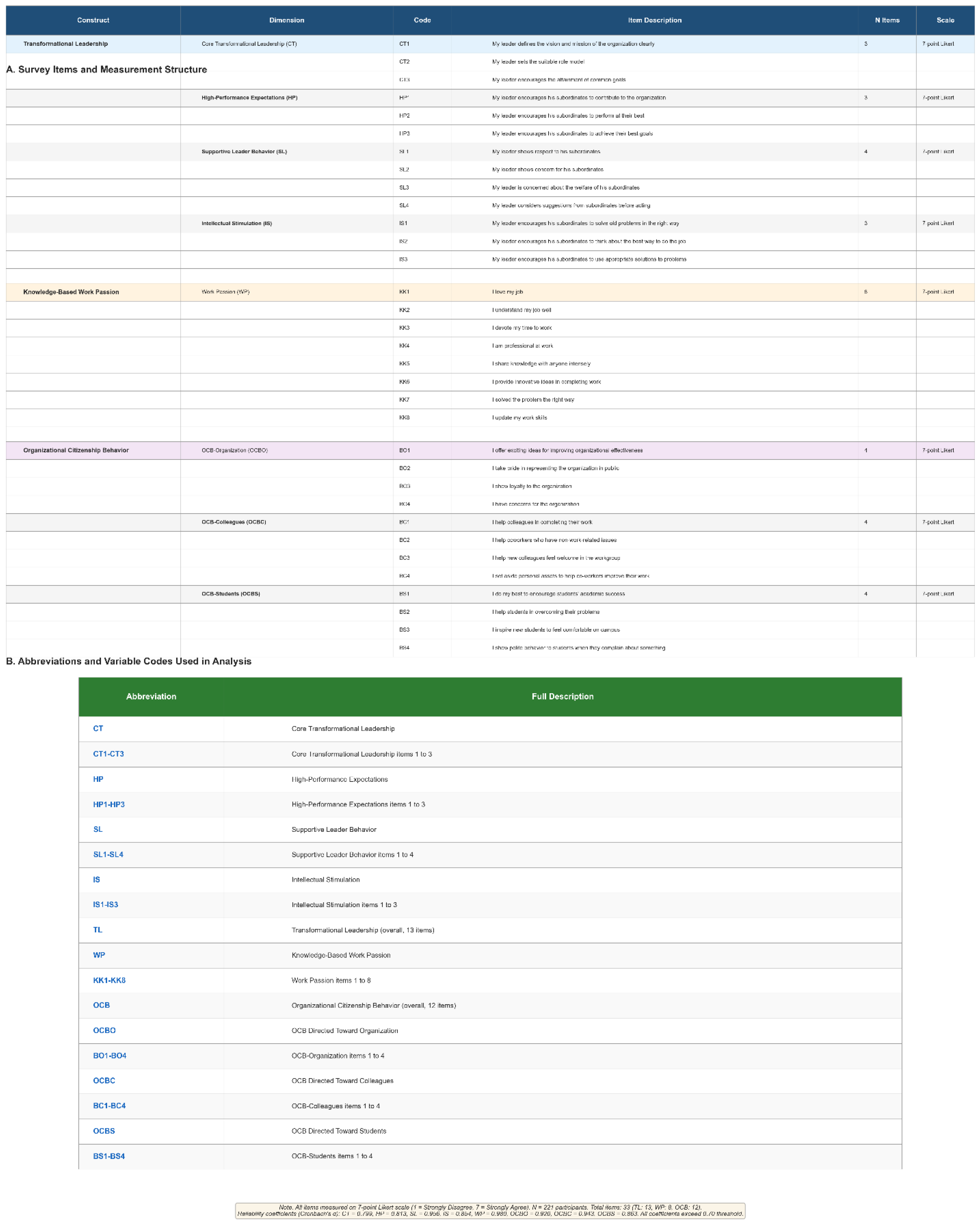
Figure 2.
Distribution of Transformational Leadership Dimensions. Histogram displays frequency distributions for Core TL, High-Performance Expectations (HP), Supportive Leader Behavior (SL), and Intellectual Stimulation (IS). Red dashed lines indicate mean values. Negative skewness evident across all dimensions indicates response clustering at higher scale points.
Figure 2.
Distribution of Transformational Leadership Dimensions. Histogram displays frequency distributions for Core TL, High-Performance Expectations (HP), Supportive Leader Behavior (SL), and Intellectual Stimulation (IS). Red dashed lines indicate mean values. Negative skewness evident across all dimensions indicates response clustering at higher scale points.
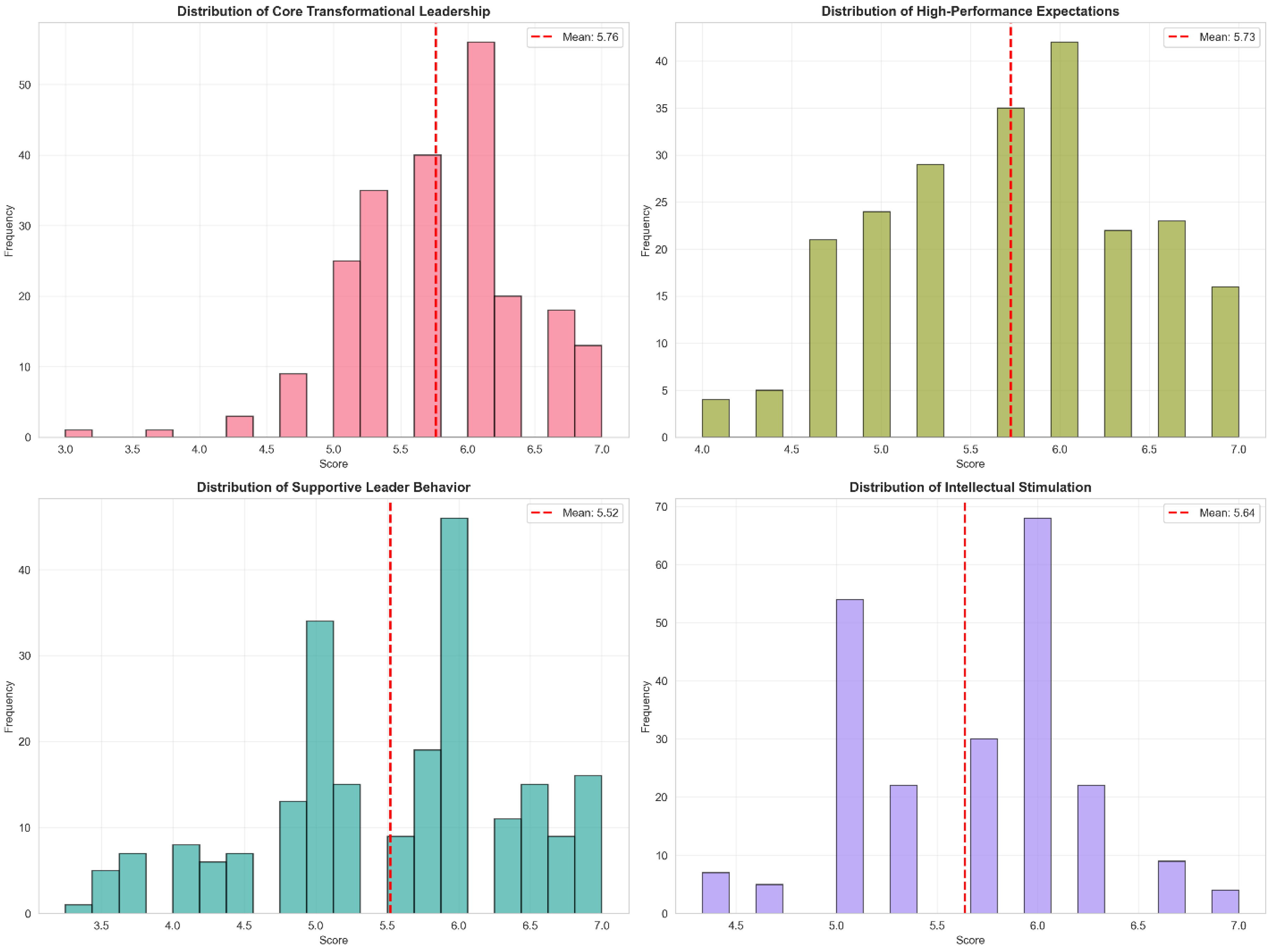
Figure 3.
Boxplot Comparison of Key Dimensions. Boxplots display median (center line), interquartile range (box), whiskers (1.5 × IQR), and outliers (individual points). Core TL = Core Transformational Leadership; HP = High-Performance Expectations; SL = Supportive Leader Behavior; IS = Intellectual Stimulation; WP = Work Passion; OCB-O = OCB-Organization; OCB-C = OCB-Colleagues; OCB-S = OCB-Students. Relatively narrow IQRs confirm limited variance across dimensions.
Figure 3.
Boxplot Comparison of Key Dimensions. Boxplots display median (center line), interquartile range (box), whiskers (1.5 × IQR), and outliers (individual points). Core TL = Core Transformational Leadership; HP = High-Performance Expectations; SL = Supportive Leader Behavior; IS = Intellectual Stimulation; WP = Work Passion; OCB-O = OCB-Organization; OCB-C = OCB-Colleagues; OCB-S = OCB-Students. Relatively narrow IQRs confirm limited variance across dimensions.
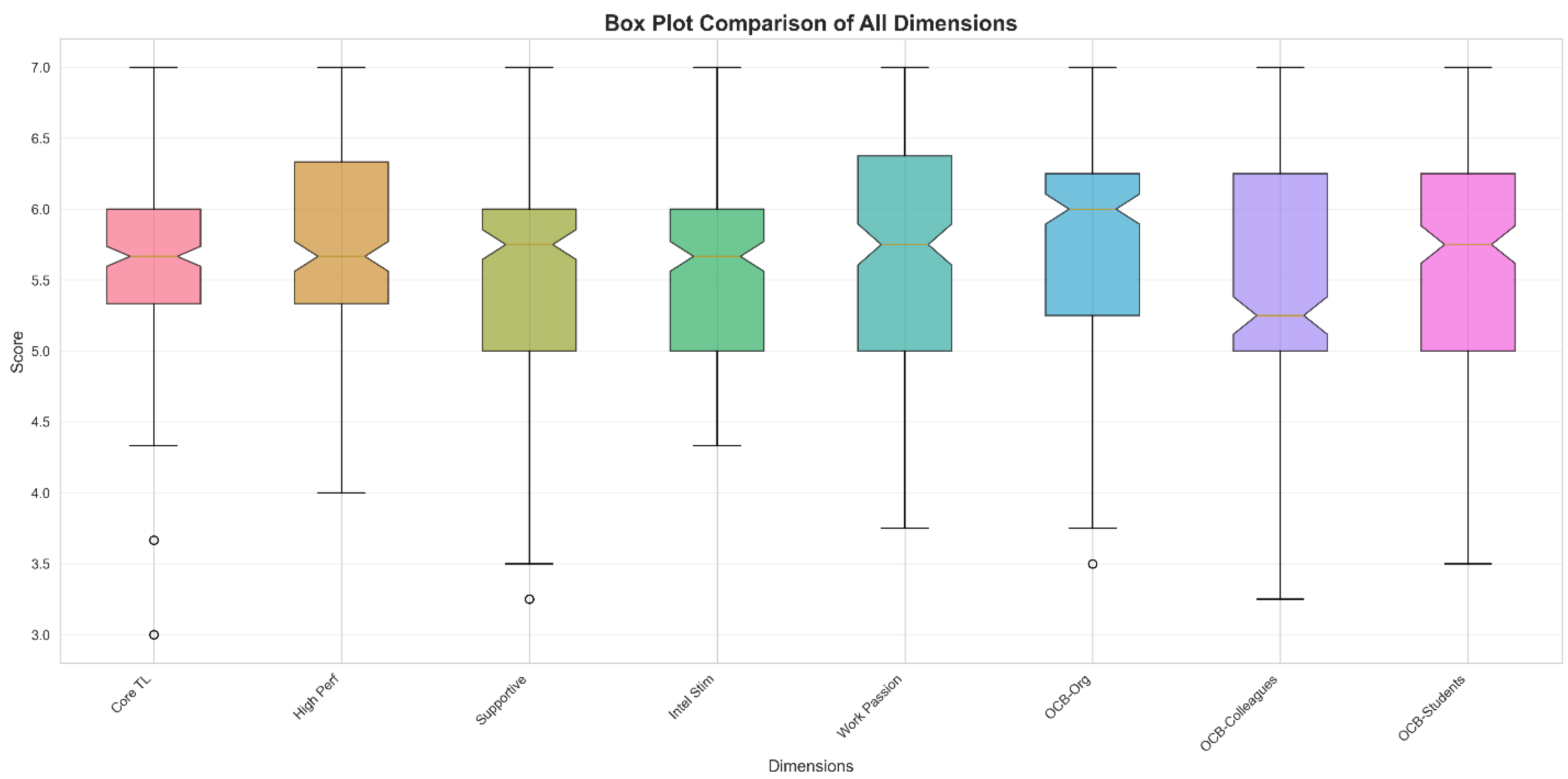
Figure 4.
Sequential Multi-Method Analytical Framework.
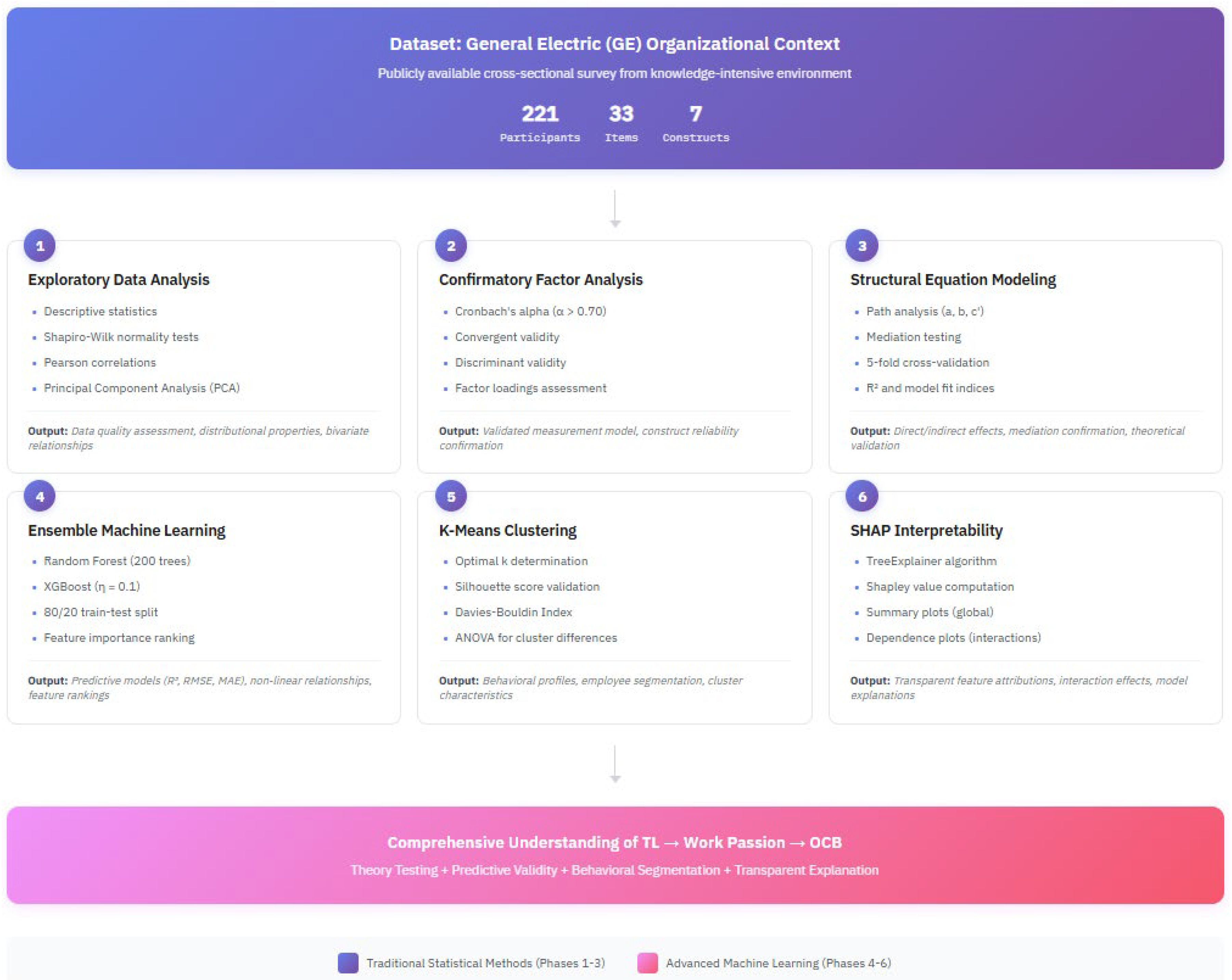
Figure 5.
Descriptive Statistics Overview. Comprehensive visualization of ten statistical measures across all 33 survey items (N = 221). Bar charts display Mean, Median, Standard Deviation, Variance, Minimum, Maximum, Q1, Q3, Skewness, and Kurtosis in descending order with color gradients (blue to yellow). Red dashed lines indicate mean values for each measure. Consistently high means (5.09-6.04) and negative skewness values (-0.42 to 0.17) confirm response clustering toward upper scale points, suggesting potential ceiling effects that warrant consideration in subsequent analyses.
Figure 5.
Descriptive Statistics Overview. Comprehensive visualization of ten statistical measures across all 33 survey items (N = 221). Bar charts display Mean, Median, Standard Deviation, Variance, Minimum, Maximum, Q1, Q3, Skewness, and Kurtosis in descending order with color gradients (blue to yellow). Red dashed lines indicate mean values for each measure. Consistently high means (5.09-6.04) and negative skewness values (-0.42 to 0.17) confirm response clustering toward upper scale points, suggesting potential ceiling effects that warrant consideration in subsequent analyses.
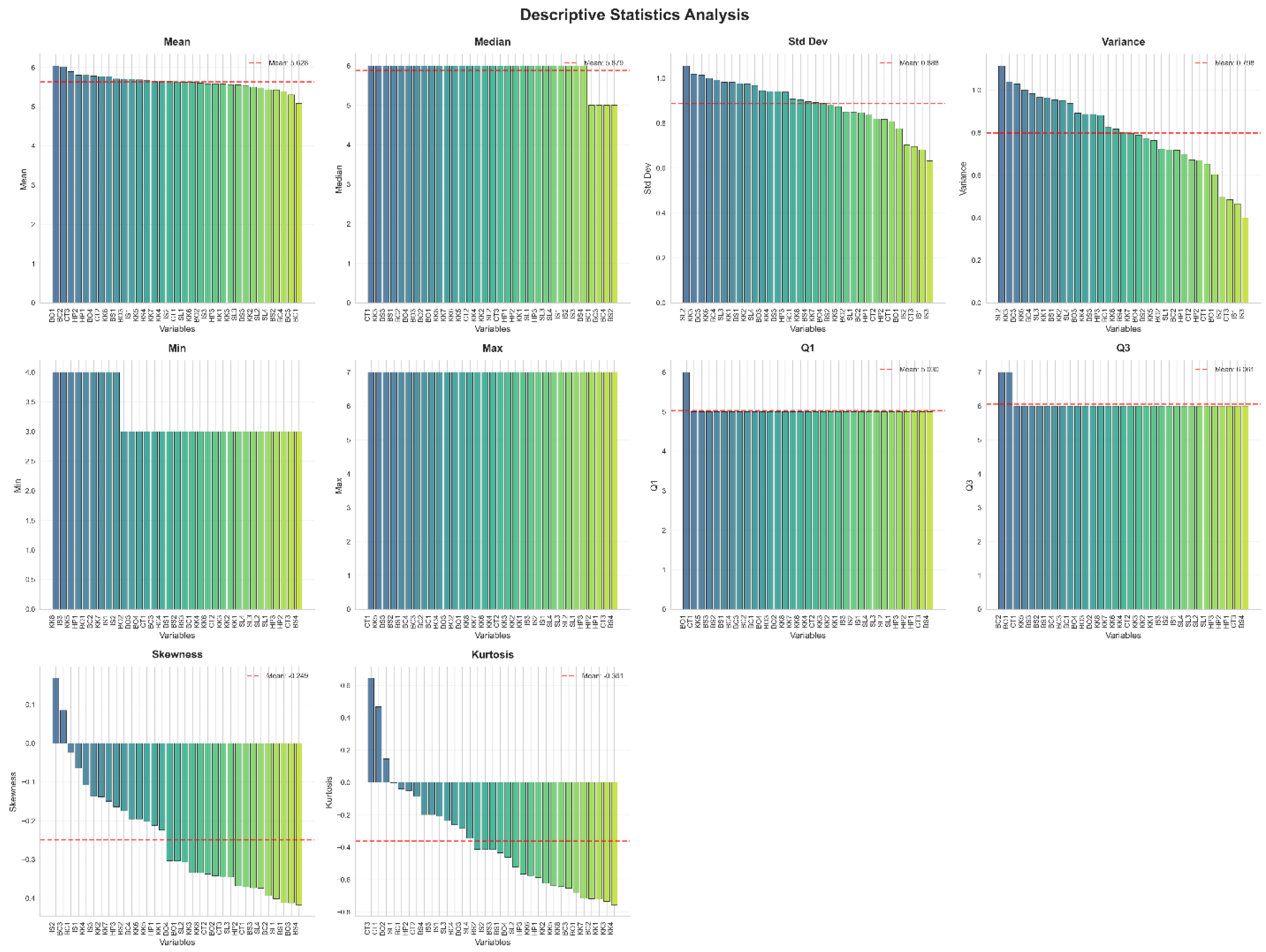
Figure 6.
Principal Component Analysis: Scree Plot and Cumulative Variance Explained. The left panel presents a scree plot displaying the variance explained by each principal component, with a characteristic elbow pattern indicating dimensionality structure. The right panel shows cumulative variance explained as a function of the number of components retained, with red and green dashed lines marking 80% and 90% variance thresholds, respectively. This analysis assesses data dimensionality, multicollinearity, and the feasibility of dimensionality reduction for subsequent modeling.
Figure 6.
Principal Component Analysis: Scree Plot and Cumulative Variance Explained. The left panel presents a scree plot displaying the variance explained by each principal component, with a characteristic elbow pattern indicating dimensionality structure. The right panel shows cumulative variance explained as a function of the number of components retained, with red and green dashed lines marking 80% and 90% variance thresholds, respectively. This analysis assesses data dimensionality, multicollinearity, and the feasibility of dimensionality reduction for subsequent modeling.
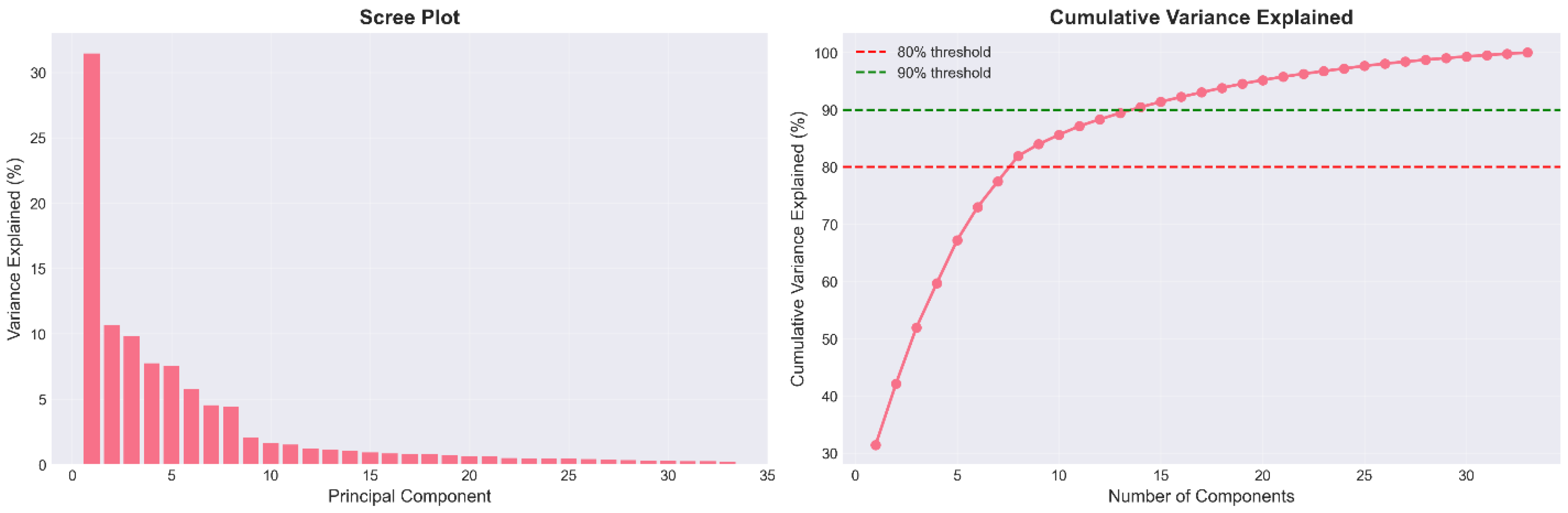
Figure 7.
Inter-Construct Correlation Matrix. The heatmap visualization employs a diverging color scheme from dark blue (r = -1.00) through white (r = 0.00) to dark red (r = 1.00), with correlation coefficients displayed in each cell. This matrix provides preliminary evidence of bivariate relationships among constructs and assesses discriminant validity prior to structural equation modeling.
Figure 7.
Inter-Construct Correlation Matrix. The heatmap visualization employs a diverging color scheme from dark blue (r = -1.00) through white (r = 0.00) to dark red (r = 1.00), with correlation coefficients displayed in each cell. This matrix provides preliminary evidence of bivariate relationships among constructs and assesses discriminant validity prior to structural equation modeling.
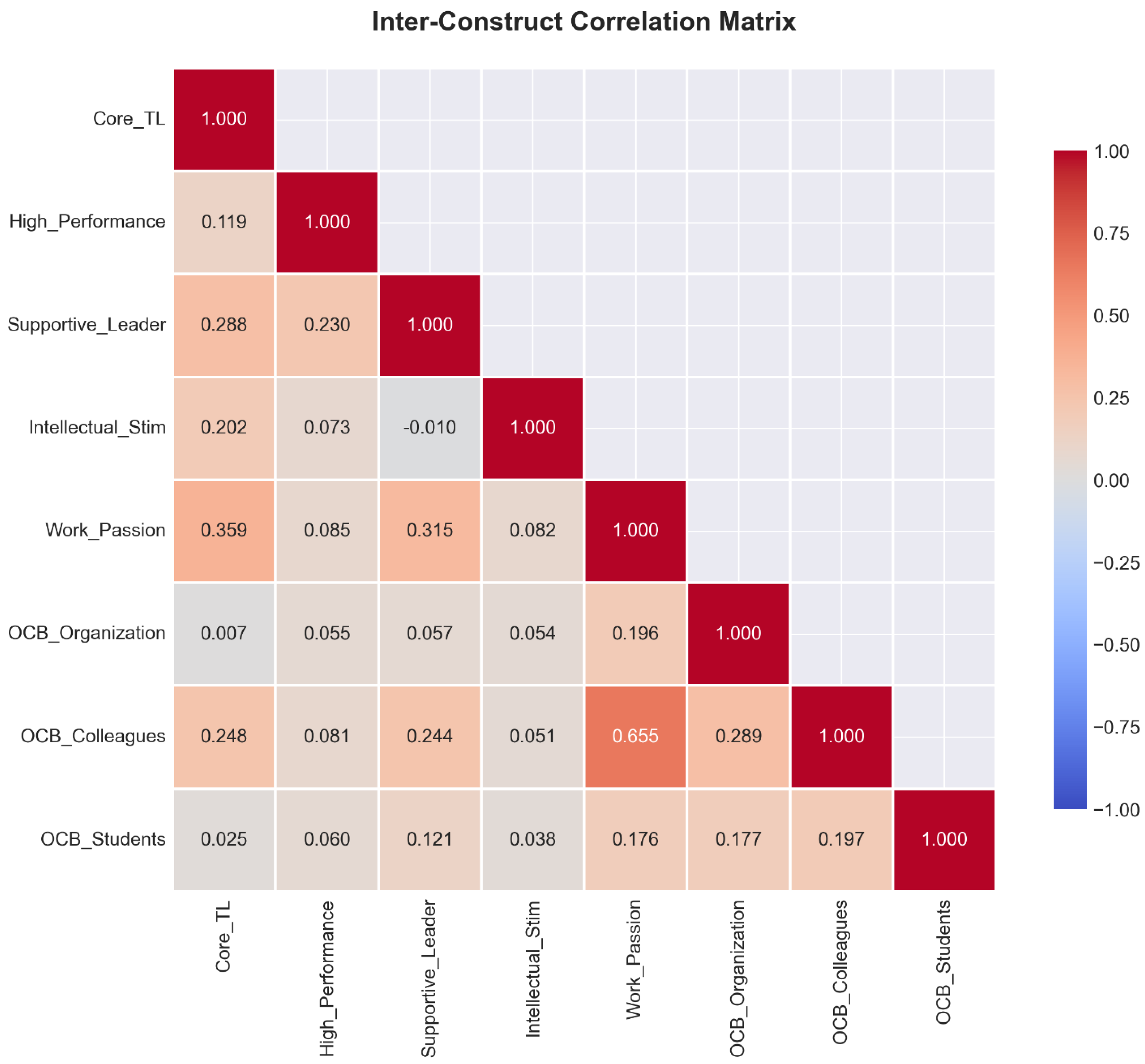
Figure 8.
Machine Learning Model Performance and Feature Importance Analysis. Panel A displays actual versus predicted value scatterplots for both algorithms across all three OCB targets (A1: OCB-Colleagues, A2: OCB-Organization, A3: OCB-Students), with red dashed lines indicating perfect prediction. Performance metrics (R2 and RMSE) are shown in subplot titles. Panel B illustrates feature importance rankings derived from both algorithms, comparing the relative contribution of transformational leadership dimensions and work passion in predicting each OCB target, plus an aggregate importance summary across all targets. This analysis complements traditional SEM by uncovering potential non-linear relationships and providing robust variable importance measures.
Figure 8.
Machine Learning Model Performance and Feature Importance Analysis. Panel A displays actual versus predicted value scatterplots for both algorithms across all three OCB targets (A1: OCB-Colleagues, A2: OCB-Organization, A3: OCB-Students), with red dashed lines indicating perfect prediction. Performance metrics (R2 and RMSE) are shown in subplot titles. Panel B illustrates feature importance rankings derived from both algorithms, comparing the relative contribution of transformational leadership dimensions and work passion in predicting each OCB target, plus an aggregate importance summary across all targets. This analysis complements traditional SEM by uncovering potential non-linear relationships and providing robust variable importance measures.
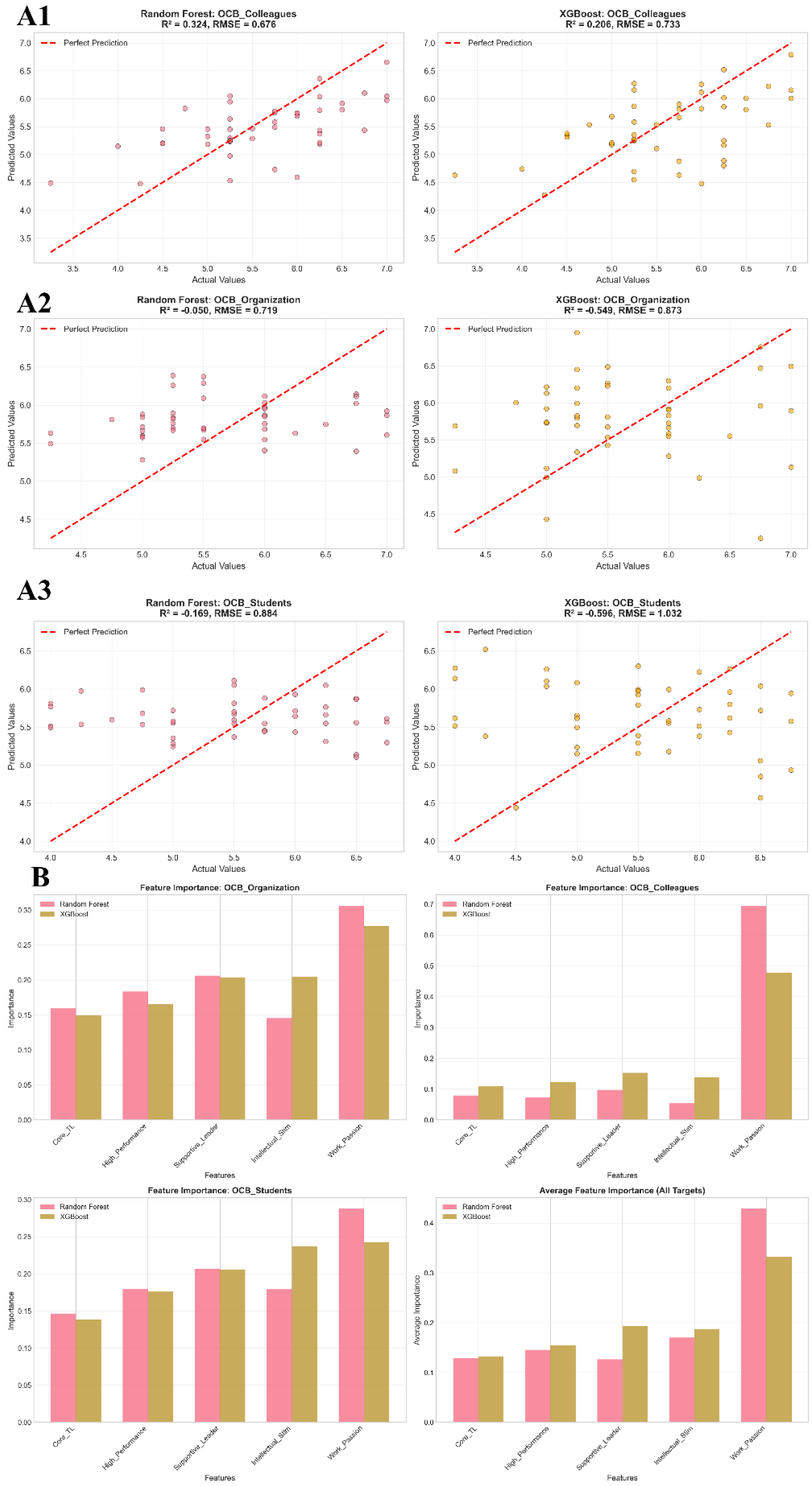
Figure 9.
K-Means Clustering: Behavioral Profile Identification and Characterization. Panel A presents radar charts visualizing the multidimensional profiles of Cluster 0 (n = 112, “Moderate Engagement Profile”) and Cluster 1 (n = 109, “High Engagement Profile”), with each axis representing mean scores on the eight key constructs measured on 7-point Likert scales. Panel B displays boxplot distributions for each construct across the two clusters, revealing the degree of separation and within-cluster variability. This unsupervised learning approach complements traditional variable-centered analyses by revealing person-centered patterns of covariation across leadership, passion, and citizenship dimensions.
Figure 9.
K-Means Clustering: Behavioral Profile Identification and Characterization. Panel A presents radar charts visualizing the multidimensional profiles of Cluster 0 (n = 112, “Moderate Engagement Profile”) and Cluster 1 (n = 109, “High Engagement Profile”), with each axis representing mean scores on the eight key constructs measured on 7-point Likert scales. Panel B displays boxplot distributions for each construct across the two clusters, revealing the degree of separation and within-cluster variability. This unsupervised learning approach complements traditional variable-centered analyses by revealing person-centered patterns of covariation across leadership, passion, and citizenship dimensions.
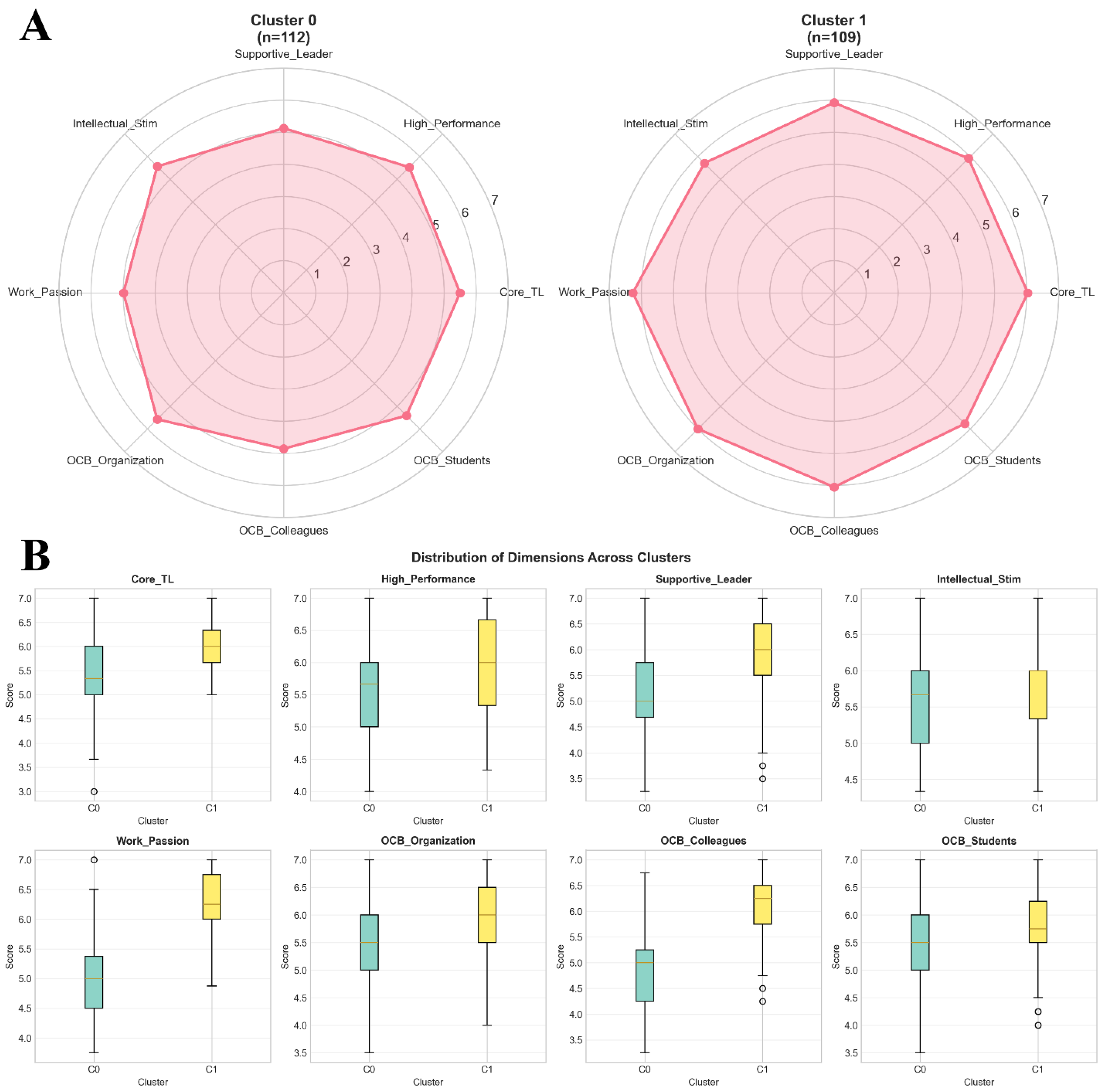

Table 1.
Descriptive Statistics for Key Constructs.
| Dimension | Mean | SD | Min | Max | Skewness |
|---|---|---|---|---|---|
| Core Transformational Leadership | 5.76 | 0.66 | 3.00 | 7.00 | -0.35 |
| High-Performance Expectations | 5.73 | 0.72 | 3.67 | 7.00 | -0.24 |
| Supportive Leader Behavior | 5.52 | 0.85 | 3.00 | 7.00 | -0.35 |
| Intellectual Stimulation | 5.64 | 0.57 | 4.00 | 7.00 | -0.11 |
| Overall Transformational Leadership | 5.66 | 0.55 | 3.62 | 7.00 | -0.27 |
| Knowledge-Based Work Passion | 5.62 | 0.83 | 3.00 | 7.00 | -0.21 |
| Organizational Citizenship Behavior (Total) | 5.62 | 0.56 | 3.67 | 7.00 | -0.26 |
Note. N = 221. All constructs measured on 7-point Likert scales (1 = Strongly Disagree, 7 = Strongly Agree). Data from organizational context analogous to General Electric (GE).
Table 2.
Machine Learning Model Hyperparameters.
| Hyperparameter | Random Forest | XGBoost | Rationale |
|---|---|---|---|
| Number of Estimators | 200 | 200 | Balance between performance and computational efficiency |
| Maximum Depth | 10 | 6 | Prevent overfitting while capturing complex interactions |
| Minimum Samples Split | 5 | N/A | Control tree growth and reduce variance |
| Minimum Samples Leaf | 2 | N/A | Ensure sufficient observations in terminal nodes |
| Learning Rate (η) | N/A | 0.1 | Standard rate for stable convergence |
| Subsample Ratio | N/A | 0.8 | Stochastic gradient boosting for regularization |
| Column Sample by Tree | N/A | 0.8 | Feature subsampling to reduce overfitting |
| Random State | 42 | 42 | Ensure reproducibility across runs |
| Number of Jobs | -1 | -1 | Parallel processing using all available CPU cores |
Note. N/A = Not applicable. Hyperparameters were selected based on empirical best practices for tabular datasets with moderate sample sizes. The random state value of 42 ensures reproducibility while maintaining algorithmic randomness.
Table 3.
One-Way ANOVA Results for Cluster Differences Across Key Constructs.
| Construct | F-Statistic | p-value | Significant |
|---|---|---|---|
| Core Transformational Leadership | 44.873 | < 0.001*** | Yes |
| High-Performance Expectations | 16.560 | < 0.001*** | Yes |
| Supportive Leader Behavior | 52.149 | < 0.001*** | Yes |
| Intellectual Stimulation | 3.304 | 0.071 | No |
| Knowledge-Based Work Passion | 234.883 | < 0.001*** | Yes |
| OCB-Organization | 17.819 | < 0.001*** | Yes |
| OCB-Colleagues | 195.543 | < 0.001*** | Yes |
| OCB-Students | 12.110 | < 0.001*** | Yes |
Note. N = 221. Degrees of freedom vary by construct. Statistical significance assessed at α = 0.05. *** p < 0.001.
Disclaimer/Publisher’s Note: The statements, opinions and data contained in all publications are solely those of the individual author(s) and contributor(s) and not of MDPI and/or the editor(s). MDPI and/or the editor(s) disclaim responsibility for any injury to people or property resulting from any ideas, methods, instructions or products referred to in the content. |
© 2026 by the authors. Licensee MDPI, Basel, Switzerland. This article is an open access article distributed under the terms and conditions of the Creative Commons Attribution (CC BY) license (http://creativecommons.org/licenses/by/4.0/).
Copyright: This open access article is published under a Creative Commons CC BY 4.0 license, which permit the free download, distribution, and reuse, provided that the author and preprint are cited in any reuse.


