

Submitted:
09 February 2026
Posted:
11 February 2026
You are already at the latest version
Abstract
This mixed-methods study explores the emotional and relational dimensions of dyadic dialogue between early childhood educators - specifically between kindergarten teachers and assistants. Grounded in theoretical perspectives from dialogic pedagogy and developmental and organizational psychology, the study conceptualizes emotional dialogue as a reflective, co-constructed process through which educators express, respond to, and make meaning of emotional experiences in their daily professional lives.The sample included 60 early childhood teachers (30) and assistants (30) from Israeli kindergartens. The qualitative component included thematic analysis of authentic professional conversations, conducted in a structured setting designed to simulate naturally occurring dialogue. This analysis identified five key dimensions of emotional dialogue: (1) emotional awareness and expression, (2) Fostering acceptance, (3) emotional containment and resolution of negative emotions, (4) positive affect, appreciation and respect, and (5) negative affect - hostility or emotional distance. The quantitative analysis explored associations between emotional dialogue and a range of psychological, interpersonal, and environmental variables, using the CLASS framework (Pianta et al., 2008).Findings revealed that emotionally attuned dialogue is positively associated with educators’ cognitive empathy, attachment orientations, and psychological control, as well as their subjective and interpersonal professional experiences - such as professional self-efficacy, job satisfaction, sense of coherence, evaluation of the assistant’s professional performance, quality of team functioning, and observed quality of classroom climate. These results highlight the potential value of fostering emotional dialogue within early childhood teams as a pathway to enhancing educational quality and professional well-being.
Keywords:
dyadic emotional dialogue
; early childhood education
; teacher–assistant relationships
; educational climate
; relational processes
1. Introduction
High-quality relationships between early childhood educators and children are central to children’s emotional, social, and cognitive development. Educators’ emotional support, acceptance, and positive affect promote children’s sense of safety and belonging (Hamre & Pianta, 2007). Increasingly, research highlights that educators’ well-being and their workplace relationships shape not only child outcomes but also educators’ well-being and their capacity to sustain high-quality practice (Zinsser & Curby, 2014; Zinsser et al., 2016, 2019).
Yet one relational layer remains understudied: the dyadic relationships between teachers and assistants. Despite their centrality to ECE practice, these interactions receive little systematic attention in research and policy (Cumming & Wong, 2019; Cumming et al., 2021). Leading measurement tools—such as CLASS (Pianta et al., 2008) and the ECERS/ITERS rating scales (Harms et al., 2014, 2017)—focus mainly on adult–child interactions, with only limited or indirect reference to staff–staff relationships. Nonetheless, empirical evidence demonstrates that staff relationships and work environments shape the quality of classroom interactions and the emotional climate experienced by children (Lower & Cassidy, 2007; Whitaker et al., 2015).
Drawing on organizational psychology, particularly Leader–Member Exchange (LMX) theory (Graen & Uhl-Bien, 1995) and dialogic and care-ethics perspectives (Buber, 1970; Noddings, 1984; Burbules, 1993), emotional dialogue between educators can be understood as a relational process through which trust, mutual recognition, and emotional presence are enacted. In early childhood settings, teacher–assistant relationships are inherently asymmetrical: teachers typically hold formal authority for pedagogical leadership and decision-making, whereas assistants provide complementary emotional, practical, and instructional support. This role asymmetry shapes the relational dynamics of daily interactions, including how emotional dialogue is initiated, expressed, and negotiated within the dyad.
Emotional dialogue includes short exchanges in which educators jointly make sense of emotionally significant events, regulate tension, or offer reassurance. These moments form part of what may be described as an "invisible infrastructure" of educational climate: the interpersonal layer shaping educators’ functioning, team resilience, and the atmosphere experienced by children.
In early childhood settings, where work is emotionally intensive, the relational quality of teacher–assistant interactions is particularly consequential. Teacher–assistant dyads share responsibility for daily routines, transitions, and child support. Their collaboration, trust, and emotional reciprocity influence both children’s experiences and educators’ well-being. Prior research in Israel highlights the anchoring emotional role of assistants for teachers and the impact of teachers’ feedback and emotional expression on assistants’ motivation, professional identity, and organizational citizenship behaviors (Oplatka & Eizenberg, 2007; Studni & Oplatka, 2022). Multinational reports echo these findings, emphasizing the need to strengthen collaboration and relational competence in heterogeneous ECEC teams (OECD, 2019, 2020). Taken together, these insights indicate a conceptual and empirical gap: intra-staff emotional dialogue remains underexamined, despite its potential relevance to educational climate. The present study addresses this gap by examining emotional and interpersonal processes in teacher–assistant dialogue and exploring their associations with educators’ psychological characteristics, workplace experiences, and observed classroom climate. Figure 1 describes the study’s conceptual model, positioning emotional dialogue as a mediating process linking educators’ psychological and interpersonal characteristics, their subjective work experiences, and the classroom climate.
1.1. Humanistic Dialogue in Early Childhood Education: Philosophical Foundations and Pedagogical Implications
Dialogue occupies a central place in humanistic educational thought as a relational, ethical, and epistemological practice that enables shared inquiry, mutual recognition, and the co-construction of meaning (Burbules, 1993; Freire, 1970). Research on dialogic pedagogy demonstrates that such interaction promotes joint reasoning and learning (Howe & Abedin, 2013; Mercer & Howe, 2012). In early childhood settings, where care, emotion, and relationships are integrated into everyday pedagogy, dialogue is not merely a communication strategy but a mode of being-with-others.
Buber’s philosophy of dialogue, particularly the I–Thou relation (Buber, 1970), frames authentic encounter as grounded in presence, openness, and the recognition of the other as a unique subject. In Education (Buber, 2002), he extends this stance into a pedagogical ethic of inclusion and confirmation, which Gordon (2011) interprets as an attuned form of listening. Similarly, Noddings’ (1984, 2005) ethic of care conceptualizes educational relations as rooted in receptivity, empathy, and responsiveness. Studies inspired by care ethics show how caring relations shape early childhood practice (Goldstein, 1998) and how “professional love” constitutes an essential dimension of relational pedagogy (Page, 2018).
Complementary perspectives from Vella (2002) and Haase (2019) emphasize the creation of relational safety, respect, and curiosity through dialogic engagement. These insights have been applied and discussed in ECE contexts: White (2015) highlights the pedagogical value of attuned, dialogic communication with infants, while Johansson and Emilson (2010) stress intersubjectivity and dialogic listening in preschool practice. Across these scholars, dialogue is conceptualized as an ethical stance that shapes educators’ attentiveness, relational presence, and emotional availability.
Within this theoretical framing, dyadic emotional dialogue is understood as a relational space in which professional meaning, affective attunement, and mutual ethical responsibility, are enacted. These dyadic encounters extend beyond task coordination to include reciprocal listening, emotional presence, and trust, shaping relational patterns and the emotional tone of the classroom. In this sense, emotional dialogue is not simply a communication skill but a pedagogical and ethical stance that informs everyday interactions in early childhood teams.
1.2. Situating Emotional Dialogue Among Educators Within the Educational Climate Framework
The two most common observational assessment tools used to assess early childhood educational quality are the Classroom Assessment Scoring System (CLASS, Pianta et al., 2008) and the Environmental Rating Scales (ITERS for infants and ECERS for preschool; Harms et al., 1998, 2003, 2017). Both sets of tools primarily emphasize child-focused process indicators. CLASS captures emotional support, classroom organization, and instructional support, yet affords minimal attention to teacher–teacher or teacher–assistant relationships. ECERS and ITERS historically included structural and process dimensions related to the physical environment and routines, with only partial attention to staff interaction. Although the ECERS-R/ITERS-R editions incorporated a Parents and Staff subscale, it was removed in ECERS-3/ITERS-3 to streamline observations (Harms et al., 2014, 2017), further narrowing the focus on staff dynamics.
Nonetheless, research consistently shows that staff relationships influence classroom tone and the broader educational climate. The Parents and Staff domain in earlier rating scales captured meaningful aspects of organizational climate and leadership (Lower & Cassidy, 2007). Studies by Jennings (2015a) and Zinsser et al. (2016) similarly demonstrate how daily emotional exchanges and relational well-being among educators shape the lived experience of classrooms. These interactional processes, including emotional support, conflict resolution, and empathic communication, help define the emotional climate but, as mentioned, remain underrepresented in dominant quality frameworks. Emotional dialogue may therefore serve as an important relational mechanism through which staff climate is enacted and sustained, shaping the emotional tone that is ultimately experienced by children.
1.3. Emotional Dialogue as an Underexamined Relational Dimension of Educational Climate
Research increasingly emphasizes educator well-being and emotional competence as central to educational quality. For example, it has been found that emotional support among colleagues predicts reduced burnout (Whitaker et al., 2015), and that teachers’ emotion regulation and responsiveness are linked to higher classroom quality (Buettner et al., 2016). Conversely, systemic stressors, including workload, low compensation, and emotional demands, undermine well-being (Whitebook et al., 2016; Zinsser et al., 2016), thereby contributing indirectly to negative classroom climate through educators’ diminished capacity to maintain emotion regulation (Jeon et al., 2016a). Jennings and Greenberg’s (2009) prosocial classroom model conceptualizes educators’ social–emotional competence, including empathy and relational skills, as foundational to classroom emotional climate. These relational competencies enable attuned, supportive interactions not only with children but also within staff teams, shaping the micro-ecology of the classroom.
From a relational–developmental perspective, such findings underscore why educator–educator interactions warrant closer examination. Attachment theory, extended to adult professional contexts, highlights how secure or insecure orientations shape emotional availability, trust, conflict management, and co-regulation within teams (Mikulincer & Shaver, 2007; Harms, 2011). Vygotsky’s sociocultural theory underscores the centrality of mediated interaction, joint meaning-making, and dialogic scaffolding in learning processes (Vygotsky, 1978). Bronfenbrenner’s ecological systems theory (1979, 2005) further situates these interactions at the microsystem (between educators), mesosystem (as they affect children in classrooms), and macrosystem (as they shape organizational structures), linking staff relationships to both child experience and educational climate. Together, these frameworks position staff relationships not as peripheral, but as core components of the learning environment.
Within this conceptual landscape, a growing body of research points to emotional dialogue as a mechanism through which supportive professional relationships are enacted. Authentic listening and dialogic presence constitute meaningful forms of relational emotional work (McLaughlin, 2000), while professional dialogue has been shown to cultivate relational trust (Deakins, 2007). Studies of teacher–child interaction demonstrate that emotionally attuned dialogue supports co-regulation and shapes classroom tone (Karjalainen et al., 2019; Spilt et al., 2021). Applied to educator–educator interactions, these insights suggest that dyadic emotional dialogue may play a meaningful role in shaping the educational climate. Such exchanges are conceptualized here as ethical, relational practices that embody values of mutuality, care, and co-responsibility central to early childhood education. In this sense, dyadic emotional dialogue represents a relational process through which educational climate is actively constructed and lived in everyday practice, highlighting the role of interpersonal processes alongside broader organizational conditions.
These insights suggest that relational patterns among educators constitute a potentially central component of the educational climate, one that has received comparatively less explicit attention than structural conditions or teacher–child interactions. To deepen understanding of how such patterns operate within staff teams, it is useful to consider organizational frameworks that conceptualize dyadic relationships as a core element of professional functioning.
1.4. Dyadic Dialogue in Early Childhood Teams: An Organizational Psychology Perspective Informed by LMX Theory
Leader–Member Exchange (LMX) theory conceptualizes leadership as a set of differentiated dyadic relationships, each uniquely constructed and evolving over time through ongoing interaction, and characterized by varying degrees of trust, reciprocity, and support (Graen & Uhl-Bien, 1995). High-quality LMX has been consistently linked to positive employee outcomes, including higher job satisfaction, organizational commitment, role clarity, and performance (Gerstner & Day, 1997; Dulebohn et al., 2012; Martin et al., 2016). Recent research also indicates that LMX quality can benefit leaders’ well-being—such as through greater positive affect, higher daily efficacy (Richter-Killenberg & Volmer, 2022), and lower job stress (Bernerth & Hirschfeld, 2016).
The kindergarten context relies on close collaboration between a qualified head teacher and an assistant that may lack formal training. This asymmetry creates both interdependence and emotional load. Assistants often provide emotional and practical support, buffering teacher isolation (Oplatka & Eizenberg, 2007), while teachers’ emotional expression influences assistants’ motivation and organizational citizenship behaviors. Qualitative research on kindergarten staff dynamics indicates that teachers’ motivational practices toward assistants are embedded in relational and emotional processes, including expressions of appreciation, professional empowerment, and interpersonal outreach. These findings highlight that the ways emotions are expressed, managed, or withheld within everyday staff interactions play a meaningful role in the processes through which teachers motivate assistants and fill-in teachers (Studni & Oplatka, 2022).
Research in Israel underscores the emotional significance of these relationships. Beginning teachers frequently rely on assistants for mentoring and daily support, helping alleviate professional isolation (Aizenberg & Oplatka, 2019; Oplatka & Eizenberg, 2007). Supportive organizational climates and strong leader–member relationships predict resilience and reduced burnout (Raviv & Shwartz-Asher, 2024; Zadok et al., 2024). Internationally, the OECD Teaching and Learning International Survey (TALIS) - Starting Strong reports persistent disparities in training and support between teachers and assistants, emphasizing the need for targeted professional learning to strengthen collaborative capacity (OECD, 2019, 2020).
LMX thus provides a useful lens for understanding how dyadic relationships shape emotional support and communicative patterns within educational teams. Beyond routine professional demands, the importance of leaders’ emotional responsiveness to staff becomes especially salient during periods of heightened uncertainty, stress, or disruption. In discussions of educational leadership during the COVID-19 pandemic, scholars emphasized the need for leaders to attend to teachers’ experiences of loneliness, frustration, and emotional overload, and to support emotion management as schools reopened (Oplatka & Crawford, 2021). Likewise, research on early childhood educators’ experiences during Israel’s October 7th war highlights how agility and adaptive leadership supported educators in coping with pervasive instability and emotional strain, underscoring the role of relational and leadership resources within teams (Nissim & Naifels, 2025).
Taken together, these insights suggest that dyadic collaboration in early childhood teams is sustained through ongoing emotional and dialogic exchanges embedded in everyday practice. From this perspective, emotional dialogue may be understood as a relational space through which core LMX-related qualities—such as trust, mutual support, and professional recognition—are enacted, negotiated, and reinforced over time.
1.5. Psychological Dimensions of Dyadic Emotional Dialogue
These organizational insights also point to the psychological foundations that shape how educators perceive, interpret, and respond within interactions that carry emotional, relational, and professional significance. Building on these perspectives, psychological constructs such as empathy, attachment, and psychological control further illuminate how individual dispositions shape emotional patterns in dyadic staff interactions.
Rogers (1967/1995, 1975) framed empathy as a stance of nonjudgmental, attentive presence. Empathy is associated with responsiveness in human-service professions (Miller et al., 1988), relationship-oriented leadership (Mahsud et al., 2010), and affective coordination in teams (Cropanzano et al., 2017). In education, empathy is considered a major contributor to positive teacher–child relationships, prosocial climate, and inclusive pedagogy (Warren, 2018; Tettegah & Anderson, 2007). In early childhood, empathy enhances communication with children and families (Boyer, 2010; Peck et al., 2015). Jennings and Greenberg (2009) and Jennings (2015b) highlight educators’ own emotional competence, including empathy, as foundational for collaborative staff relationships and classroom climate.
Attachment theory explains how early relational experiences give rise to internal working models of self and other, shaping expectations and behavior in later relationships (Bowlby, 1969/1982). In professional contexts, attachment orientations have been associated with tendencies related to trust, conflict management, and emotional communication (Keller, 2003; Harms, 2011; Doverspike et al., 1997). In early childhood education, attachment-related tendencies have also been linked to educators’ caregiving judgments and sensitivity toward others (Horppu & Ikonen-Varila, 2004). Taken together, these perspectives suggest that attachment orientations may inform how educators engage in emotionally meaningful exchanges with colleagues, potentially contributing to patterns of emotional availability and responsiveness within teacher–assistant dialogue.
On the opposite side, psychological control, described as pressuring others through guilt, shame, or conditional approval (Barber, 1996), may also manifest in professional hierarchies. Extending this construct to educator–educator relationships suggests that higher psychological control may undermine collaboration, dialogue quality, and classroom climate, especially when exerted by formally senior staff.
These psychological orientations do not operate in isolation; they are expressed in the moment-to-moment patterns of emotional dialogue—shaping how educators listen, validate, negotiate tension, and co-construct meaning in their daily interactions.
1.6. Study Objectives
Building on perspectives from education, developmental psychology, and organizational psychology, the present study explores dyadic emotional dialogue between early childhood educators, identifying key themes in structured conversations and examining associations between dialogue quality, educators’ psychological characteristics, subjective work experiences, and the observed classroom climate. The study is guided by one qualitative and three quantitative questions, which informed both the data collection and the analytical procedures.
Qualitative Research Question
RQ1. What emotional and interpersonal themes characterize the everyday work-related conversations between kindergarten teachers and assistants, as they reflect on positive and negative emotional events from their daily work?
This question was explored using thematic analysis of recorded and transcribed conversations.
Quantitative Research Questions
RQ2. How is the quality of teacher–assistant emotional dialogue associated with their psychological and interpersonal characteristics (cognitive empathy, psychological control and attachment orientations)?
RQ3. To what extent is the quality of teacher–assistant emotional dialogue associated with the observed quality of classroom climate (using CLASS dimensions)?
RQ4. To what extent is the quality of teacher–assistant emotional dialogue associated with educators’ subjective work experiences (e.g., professional self-efficacy, satisfaction, sense of coherence, and relationship quality)?
2. Methods
The present study adopts a mixed-methods analytic strategy characterized by interpretive integration between qualitative and quantitative components. Rather than treating qualitative and quantitative components as parallel or sequential phases, the study integrates them at the level of conceptualization and interpretation. The qualitative analysis served to articulate and refine the construct of dyadic emotional dialogue as it is enacted in educators’ everyday professional interactions, while the quantitative analyses examined how this relational construct is associated with psychological characteristics, subjective work experiences, and observed classroom climate. This form of integration aligns with interpretive and construct-oriented approaches to mixed-methods research, in which qualitative findings provide conceptual grounding and meaning for quantitative associations, particularly when investigating complex relational processes (Creswell & Plano Clark, 2018). Integration was thus achieved through iterative movement between qualitative insights and quantitative patterns, especially in the interpretation of findings and the discussion of possible relational mechanisms.
2.1. Participants
Participants were 60 kindergarten teachers and assistant teachers (30 of each group) from public secular kindergartens in central and northern Israel, serving children aged 4–6 (demographics in Table S1, Supplementary Materials). All participants were women employed by the Ministry of Education, and informed consent was obtained from all. Teachers’ mean age was 42.16 years (range = 28–59), and assistants’ mean age was 48.80 years (range = 28–63). Professional experience ranged from 1 to over 25 years, with teachers relatively evenly distributed across experience levels and assistants more concentrated in the 6–10 and 16–20 years experience ranges. On average, teacher–assistant dyads had worked together for 3.95 years (range = 1–13).
Regarding education, 50% of teachers held a bachelor’s degree and 50% a master’s degree, whereas assistants’ educational backgrounds were more diverse: 40% had not completed a high-school diploma, 46.7% held a high-school diploma, and 13.3% had post-secondary or academic training. Most teachers (90%) and assistants (70%) were married. Teachers primarily identified as secular or traditional (53.3% and 36.7%, respectively), while assistants were predominantly traditional (63.3%).
2.2. Measures
2.2.1. Dyadic Conversations
This study used The Dyadic Emotional–Pedagogical Dialogue Scale (DEPDS) that was developed by the first author specifically for the present study. The DEPDS is an analytic scale designed to capture and assess the extent to which teachers and assistants engage in emotionally attuned, reflective dialogue about pedagogical events and daily experiences. The scale draws conceptually and procedurally on the Autobiographical Emotional Event Dialogue (AEED; Koren-Karie et al., 2003), originally developed to assess parent-child discussion, and represents an adaptation of this approach to the professional context of teacher–assistant dyads.
Before each session, participants independently completed a preparation form describing a pleasant and an unpleasant work-related event. During the structured conversation, each described two events (one positive, one negative), yielding four discussed events per dyad. This format facilitated the co-construction of authentic narratives and enabled observation of mutual emotional attunement. All conversations were recorded, transcribed, and verified for accuracy.
An initial qualitative analysis yielded five thematic dimensions capturing the emotional and relational meanings constructed in dyadic dialogue: Emotional Awareness and Expression; Fostering Acceptance; Emotional Containment and Resolution of Negative Emotions; Positive Affect, Appreciation, and Respect; and Hostility (reverse-coded). In addition, task focus was operationalized as a complementary dialogic–regulatory dimension capturing the extent to which participants remained engaged with the emotional task of the dialogue, rather than drifting away from it, independent of the dialogic content itself.
Following their qualitative grounding, these dimensions were subsequently operationalized for structured coding, allowing for the calculation of role-specific mean scores for teachers and assistants. Mean scores were computed separately for each dimension, as well as for an overall emotional dialogue score for each role. In addition, dyadic emotional coherence was assessed at the dyadic level using a dedicated scale encompassing shared focus, narrative attunement, and overall dialogic coherence. Fifteen conversations (50%) were double-coded. When discrepancies of ≥2 points (on a 1–9 scale) occurred, raters reached consensus through discussion. Inter-rater reliability (ICC) was .95 for teachers and .94 for assistants. Internal consistency was acceptable (α = .75 teacher scales, α = .82 assistant scales).
2.2.2. Structured Observations
Classroom quality was assessed using the Classroom Assessment Scoring System K–3 (CLASS K–3; Pianta et al., 2008), which comprises ten 7-point observational scales organized into three theoretically derived domains: Emotional Support (Positive Climate, Negative Climate, Teacher Sensitivity, Regard for Student Perspectives); Classroom Organization (Behavior Management, Productivity, Instructional Learning Formats); and Instructional Support (Concept Development, Quality of Feedback, Language Modeling).
In the present study, analyses focused on the three domain-level scores rather than the individual scales. This decision was guided by both theoretical and empirical considerations. Conceptually, the domain structure reflects the core relational and pedagogical processes underlying classroom quality and aligns with the study’s focus on broader emotional and organizational dimensions of the educational climate. Methodologically, domain scores are the most commonly used and validated level of interpretation in CLASS-based research, demonstrating greater stability and reliability than individual scale scores, particularly in studies with modest sample sizes (Pianta et al., 2008; Hamre et al., 2013).
Two trained coders conducted the classroom observations. Inter-rater reliability was examined on 22 observation cycles (14.7%), and discrepancies of two points or greater were resolved through joint discussion to reach consensus. Inter-rater reliability (ICC) estimates were: Emotional Support = .78; Classroom Organization = .69; Instructional Support = .80. Internal consistency coefficients were: Emotional Support = .83; Classroom Organization = .92; Instructional Support = .88. Consistent with these findings, previous large-scale applications of the CLASS framework have reported acceptable to good internal consistency for the three domain scores, with Cronbach’s α values ranging from approximately .77 to .89 across Emotional Support, Classroom Organization, and Instructional Support (Hamre et al., 2007).
2.2.3. Self-Report Questionnaires
Psychological characteristics. This study used three instruments to measure psychological characteristics of kindergarten teachers and assistants. Cognitive Empathy, measured with the Perspective Taking subscale of the Interpersonal Reactivity Index (IRI; Davis, 1983). The 7 items were rated on a 5-point scale. In the present study, internal reliability was α = .73 for teachers and α = .75 for assistants. Previous research has demonstrated satisfactory psychometric properties for the IRI, including good internal consistency for the Perspective Taking subscale (Cronbach’s α = .77) and acceptable test–retest reliability across the four IRI subscales (ranging from .62 to .71; Davis, 1983).
Attachment Perceptions, were assessed using the Experiences in Close Relationships—Relationship Structures questionnaire (ECR-RS; Fraley et al., 2011), adapted to include the teacher–assistant relationship as an additional target. Items (54 total) were rated on a 6-point scale. Internal consistency across targets ranged from α = .53 to .90. The scale is grounded in established attachment theory and validated in Israeli samples (e.g., Mikulincer & Florian, 2000).
Psychological Control was measured using an adapted Hebrew version of Soenens et al.’s (2005) Parental Psychological Control Scale, reformulated to reflect general interpersonal dynamics. Eleven items describing intrusive, guilt-inducing, or controlling strategies were selected. Internal consistency was high (teachers: α = .82; assistants: α = .86).
work-related perceptions. This study used two instruments to measure work-related perceptions of kindergarten teachers and two instruments to measure work-related perceptions of assistants. Professional Self-Efficacy and Job Satisfaction of teachers was assessed using items from Fisher and Serrousi’s (2018) validated Hebrew questionnaire. Seventeen relevant items evaluated perceived competence in pedagogical, organizational, and teamwork domains (1–5 scale). Although the original structure includes three factors, this pattern was not replicated; therefore, a unified scale score was used (α = .91).
Teacher’s Evaluation of Assistant’s Functioning was measured using an adapted version of Guberman and Tuval’s (2006) questionnaire based on formal assistant role definitions. Eleven items with the strongest psychometric properties were selected. Internal consistency was α = .88.
As for Assistants, their Relationship with the Teacher, was derived from Guberman and Tuval’s (2006) questionnaire. Only items loading on the Human Relations factor were used (initially 7 items; one removed for technical reasons). Internal reliability for the final 6 items was α = .73.
Finally, assistants Sense of Coherence and Job Satisfaction was assessed based on Antonovsky’s (1987) SOC framework and a Hebrew adaptation by Guberman and Tuval (2006). Nine items were used (eight SOC items and one job-satisfaction item), rated 1–7. Internal consistency for the SOC items was α = .76.
2.3. Analytic Strategy
Building on the study’s integrative analytic approach, qualitative thematic analysis was used to identify core dimensions of dyadic emotional dialogue, followed by structured quantitative coding to examine associations between these dialogic dimensions and psychological, interpersonal, and classroom-level variables.
2.3.1. Qualitative Data Analysis
Qualitative analysis focused on identifying the emotional and relational meanings constructed within dyadic conversations between kindergarten teachers and assistants. The analysis followed a reflexive thematic analysis approach (Braun & Clarke, 2006), combining inductive attention to participants’ meaning-making with theoretically informed sensitivity to emotional, dialogic, and relational processes.
All conversations were transcribed verbatim and read repeatedly to support familiarization with the data. Initial coding was conducted at the semantic level, capturing expressions of emotional awareness, validation, containment, affective tone, and dialogic engagement. Through an iterative process of reviewing and refining codes, broader thematic patterns were identified, resulting in five core dimensions of emotional dialogue.
Throughout the analytic process, reflexive attention was given to the researchers’ theoretical positioning and assumptions regarding emotional dialogue as a relational practice. Analytic rigor was supported through systematic documentation of coding decisions, ongoing comparison across conversations, and iterative refinement of themes to ensure coherence and conceptual clarity.
2.3.2. Quantitative Data Analysis
Following the qualitative grounding of the dialogic dimensions, structured quantitative coding was applied to the full dataset to examine associations between emotional dialogue and psychological, interpersonal, and classroom-level variables. Mean scores were calculated for each emotional dialogue dimension separately for teachers and assistants, as well as for overall role-specific emotional dialogue scores and dyadic emotional coherence.
Given the modest sample size and non-normal distributions, non-parametric Spearman correlation analyses were used. Partial correlations were conducted where theoretically warranted to control for relevant background variables. Classroom climate variables were examined at the domain level using CLASS scores.
All quantitative analyses were conducted using SPSS. Statistical significance was interpreted cautiously, with emphasis placed on the pattern and coherence of associations rather than isolated coefficients, in line with the exploratory and relational focus of the study.
2.3.3. Integration of Qualitative and Quantitative Analyses
Integration occurred primarily at the level of interpretation. Qualitative findings informed the conceptualization of emotional dialogue and provided meaning for the quantitative associations, while quantitative patterns situated the qualitatively derived dimensions within broader psychological, relational, and classroom-level contexts. Rather than seeking direct convergence, the study adopted an interpretive integration approach, with integration achieved mainly in the interpretation of findings and discussion of possible relational mechanisms.
3. Results
3.1. Qualitative Results: Thematic Analysis of Emotional Dialogue
This section presents the qualitative findings derived from the thematic analysis of dyadic conversations between kindergarten teachers and assistants, focusing on how educators jointly construct emotional meanings around positive and negative events from their daily work. The analysis identified five recurring dimensions of emotional dialogue, reflecting distinct yet interrelated emotional and relational processes enacted within the dyad. These dimensions are presented below, each illustrated through representative excerpts that capture the interactional and affective qualities of the dialogue.
3.1.1. Emotional Awareness and Expression
This theme captures how teachers and assistants articulated emotional experiences with clarity, depth, and contextual grounding. High-quality exchanges included richly differentiated emotions tied to specific events, along with reflections on others’ perspectives and relational meanings. Such descriptions conveyed authenticity and emotional presence, often revealing how participants made sense of the event and its implications for their work.
For example, one teacher described a child’s recurring separation distress and her own layered emotional reaction: “Leo’s mother said he cries every Wednesday… but if I’m there, he wants to come. I felt warmth and appreciation, mixed with sadness for his struggle… It touched me deeply.”
Her account goes beyond naming emotion, offering an interpretation that acknowledges the child’s experience and her connection to him.
In another conversation, a teacher reflected on a moment of kindness during outdoor play: “A little girl fell, and Eden ran to bring her a chair for her leg… it filled my heart. I felt joy, excitement, pride. just amazement at her understanding. It moved me to tears.” The assistant responded warmly, “There are so many moments like that in the kindergarten!”—creating a shared sense of meaning around the positive emotional climate of their work.
3.1.2. Fostering Acceptance
Fostering acceptance involved moments when the listener created a safe and supportive space in which the other could speak freely, without judgment. Teachers often facilitated this through gentle prompts, steady eye contact, and allowing ample time for assistants to gather their thoughts. Subtle gestures—small nods, soft verbal affirmations, and patient silence—signaled openness and helped the assistant feel that her emotions were welcome.
In one dyad, the assistant initially hesitated to begin her story. After the teacher encouraged her to recall an experience and gave her the space and nonverbal encouragement she needed, the assistant was able to articulate a deeply meaningful memory: “I felt like I needed to hug him from every direction… it was hard for all of us, but I didn’t give up. He felt he could handle it because we had built trust… That’s what gives me satisfaction.”
This shift from uncertainty to confident expression highlights how relational acceptance and supportive presence can enable authentic emotional disclosure and strengthen relational closeness.
3.1.3. Emotional Containment and Resolution of Negative Emotions
This theme reflects how dyads responded to distress, frustration, or hurt in ways that acknowledged the emotion while helping to regulate and transform it. Containment involved offering emotional steadiness, validating feelings, and reframing situations to restore perspective and agency. These conversations often concluded with shared meaning-making that reinforced the team’s values and sense of purpose.
In one exchange, an assistant spoke about feeling hurt when parents criticized her sick leave in the class WhatsApp group: “The parents complained when I was sick… it really upset me. No one asked how I was.” The teacher responded with empathy and broader context, explaining that she had spoken with the parents, understood their stress, and recognized the limits of what could be changed: “I know it’s upsetting, but we need to keep it in perspective. They’re stressed too, and there’s only so much we can influence. What truly matters is the work we’re doing with the children.” She concluded with a reaffirmation of their joint mission: “I won’t let our children grow up with these attitudes. We continue to teach them respect, tolerance, and emotional inclusion.”
The assistant echoed this commitment: “Exactly. We keep passing these values on to them.”
This interaction demonstrates how emotional containment, perspective-taking, and shared values can transform negative emotion into renewed professional meaning.
3.1.4. Positive Affect, Appreciation, and Respect
This theme encompasses expressions of warmth, enjoyment, gratitude, and mutual recognition. Dyads often conveyed positive affect through tone, humor, and affirming comments, creating an atmosphere that reinforced professional identity and strengthened relational bonds.
One teacher contrasted the loneliness she had felt in a previous year with the sense of partnership she now experienced: “Last year I felt completely alone… but this year you do these small things that mean so much—helping, noticing me, celebrating with me. You make me feel seen, like I matter.” These expressions of appreciation were not limited to task collaboration but extended to emotional presence and sensitivity, deepening trust and relational satisfaction.
In another instance, a teacher described how the assistant supported children during a holiday celebration: “You noticed the kids who didn’t participate… and helped them. I was busy, and you saw what I couldn’t. It warmed my heart. You complete me that way.” The assistant replied simply, “I do it from the heart, with love.”
These exchanges highlight how mutual appreciation reinforces a positive relational climate that sustains educators’ well-being and collaborative functioning.
3.1.5. Hostility
Hostility emerged in moments marked by criticism, impatience, or dismissive responses that restricted emotional openness and undermined reciprocity. These interactions contrasted sharply with the more collaborative exchanges, generating tension and discomfort.
In one dyad, a teacher initiated a conversation with direct reproach about the assistant’s handling of a parent interaction: “The mother told me you refused to take the project money… You should have accepted it. Otherwise, it reflects poorly on us.” Feeling blamed, the assistant attempted to defend herself: “It’s not that I didn’t want to take it… I was just afraid the money would get lost because I’m not here tomorrow.”
Despite this explanation, the tone of the exchange remained accusatory, with the teacher interrupting and reasserting disappointment. The assistant’s voice remained constrained, suggesting reduced emotional safety. Rather than serving as a space for reflection or joint problem-solving, the dialogue took on the quality of a reprimand—limiting autonomy, silencing nuance, and reinforcing a sense of unequal power.
Such moments revealed how patterns of blame can swiftly erode openness and diminish the potential for collaborative emotional processing.
3.1.6. Integrative Summary of the Qualitative Phase
Across dyads, emotional dialogue varied widely along the five themes. Some conversations displayed rich emotional awareness, mutual acceptance, and constructive handling of difficult emotions, reinforcing relational closeness and shared purpose. Others revealed tension, blame, or constrained expression, highlighting vulnerabilities in the relational infrastructure of the team. The patterns observed in these emotional exchanges formed the basis for the quantitative analyses that followed, examining associations between emotional dialogue, educators’ psychological characteristics, and classroom climate.
3.2. Quantitative Results
3.2.1. Preliminary Analyses
Descriptive statistics and skewness values for all variables appear in the Supplementary Materials (Table S2). As for associations between the study’s main variables and background and demographic factors, teachers’ experience correlated with perspective-taking (r (30) = .49, p < .01), with assistants’ attachment to the teacher (r (25) = .40, p = .04), and with assistants’ positive affect appreciation and respect in dialogue (r (27) = .39, p = .04). Teachers’ number of children correlated with self-efficacy (r (30) = .43, p = .02), and assistants’ experience in the current kindergarten correlated with sense of coherence (r (28) = .47, p < .01).
3.2.2. Hypothesis 1 – The Relationship Between Psychological and Interpersonal Characteristics and the Dyadic Emotional Dialogue
To test Hypothesis 1, we computed Spearman correlations between psychological/interpersonal characteristics and indices of dyadic emotional dialogue. For the analyses involving teachers’ cognitive empathy, we report partial Spearman correlations that control for teachers’ years of experience; all other correlations are zero-order. Significant correlation coefficients are presented in Table 1.
As can be seen in the table, teachers’ cognitive empathy was positively associated with several aspects of assistants’ emotional dialogue, including emotional expression, positive affect, and dyadic emotional coherence. These associations indicate that teachers’ capacity to adopt others’ perspectives was linked to more emotionally coherent and expressive dialogue on the part of assistants.
With respect to attachment orientations, teachers’ hostility in dialogue was negatively associated with multiple attachment relationships, including attachment to a partner, to a close friend, and to the assistant, as well as with the assistant’s attachment to the teacher. This pattern suggests that more secure attachment orientations were related to lower levels of hostile or adversarial dialogue.
A different pattern emerged for psychological control. Teachers’ psychological control was associated with less supportive patterns of assistants’ emotional dialogue, including lower emotional containment, reduced positive affect, higher levels of hostility, as well as with a lower overall emotional-dialogue score. In contrast, assistants’ psychological control was not significantly associated with any dimension of emotional dialogue.
3.2.3. Hypothesis 2 – The Relationship Between Emotional Dialogue and the Educational Climate
To examine the second hypothesis, Spearman correlations were calculated between the components of emotional dialogue and dimensions of the classroom climate. Descriptive statistics and correlation coefficients are presented in Table 2.
Emotional support was positively associated with teachers’ fostering acceptance and emotional containment, as well as with assistants’ emotional expression. Classroom organization showed positive associations with teachers’ fostering acceptance, emotional containment, and assistants’ emotional expression. Instructional support was positively associated with assistants’ emotional containment. Higher mean levels of emotional support, classroom organization, and instructional support were each positively associated with the overall teacher emotional dialogue score, with stronger associations for emotional support and classroom organization.
3.2.4. Hypothesis 3 – The Relationship Between Emotional Dialogue and Educators’ Subjective Work Experiences
To examine the third hypothesis, Spearman correlations were calculated between the components of emotional dialogue and educators' subjective work experiences (see Table 3).
Several aspects of emotional dialogue were associated with educators’ subjective work experiences. Teachers’ emotional containment and positive affect in dialogue were positively associated with their sense of professional self-efficacy. Teachers’ positive affect was also associated with higher levels of assistants’ sense of coherence. Assistants’ emotional expression was positively related both to teachers’ professional self-efficacy and to teachers’ evaluations of assistants’ functioning. In addition, assistants’ task focus was positively associated with their job satisfaction, and higher overall levels of assistants’ emotional dialogue were related to more favorable evaluations of their functioning by teachers.
Patterns of hostile dialogue were consistently associated with less positive work-related experiences. Teachers’ hostility was associated with less favorable evaluations of assistants’ functioning and with lower relationship quality as perceived by assistants. Similarly, assistants’ hostility was associated with lower sense of coherence and with lower job satisfaction.
After controlling for the number of children in the kindergarten, teachers’ professional efficacy remained marginally positively correlated with assistants’ emotional expression. No other significant correlations were observed after controlling for this variable. Furthermore, after controlling for assistants’ experience in the current kindergarten, assistants' sense of coherence was positively correlated with assistant Fostering acceptance, dyadic emotional coherence in dialogue, and negatively correlated with assistant hostility.
4. Discussion
The study examined the emotional and interpersonal characteristics of dyadic dialogue among kindergarten teachers and assistants and investigated how these may relate to educators’ psychological and interpersonal characteristics, subjective work experiences, and classroom climate. Although the findings should be interpreted cautiously due to methodological and contextual limitations, they offer preliminary insights into the meaning of emotional communication within early childhood educator teams and raise questions that may be valuable for future investigations. Conceptually, the present study contributes to existing accounts of educational climate by foregrounding emotional dialogue among educators as a relational process through which classroom climate may be enacted in early childhood settings.
4.1. Possible Mechanisms: Direct and Indirect Pathways
The pattern of associations observed in the study suggests several possible relational pathways through which dyadic emotional dialogue may be linked to processes operating at the individual, team, and classroom levels. At the individual level, educators’ psychological characteristics appeared to be reflected in the quality of emotional dialogue enacted within the dyad, which in turn was associated with educators’ professional self-efficacy, sense of coherence, and job-related experiences. At the team level, emotionally attuned and affirming dialogue was associated with more supportive patterns of collaboration and mutual evaluation. At the classroom level, components of emotional dialogue were positively related to external ratings of classroom climate, particularly in the domains of emotional support and classroom organization.
These patterns resonate with person-centered research showing that early childhood teachers differ in their configurations of professional background, process quality, and job attitudes (Jeon et al., 2016b), suggesting that emotional dialogue may interact with individual and contextual characteristics in shaping relational processes within teams and classrooms.
From a sociocultural and ecological perspective, it is reasonable to consider that children may be indirectly influenced by the relational atmosphere created through educators’ interactions, even when they are not directly involved in these exchanges. Emotional dialogue among educators may support the relational and emotional conditions under which educator–child interactions take place, for example by shaping educators’ emotional availability, responsiveness, and capacity for co-regulation. In this sense, dyadic emotional dialogue between educators may contribute to the quality of direct relational processes within educator–child interactions. At a broader ecological level, dyadic emotional dialogue among educators may also influence children indirectly by shaping the broader relational climate of the classroom, rather than through direct interactional pathways (Bandura, 1986; Bronfenbrenner, 1979, 2005; Vygotsky, 1978). At the same time, such interpretations remain speculative and underscore the need for future research that directly examines child-level outcomes alongside educator dialogue.
4.2. Practical Considerations: Supporting Emotional Dialogue in Early Childhood Teams
While the study’s findings are preliminary, they may offer initial considerations for those involved in educator preparation and professional development. Supporting educators in developing relational and emotional competencies such as listening, validation, and emotional expression may contribute to stronger team cohesion and to the creation of emotionally supportive learning environments. These considerations align with the growing recognition that educators’ internal emotional world—and the relational resources available within the team—shape their interactions with both colleagues and children.
Several intervention programs offer relevant insights into how emotional and relational capacities may be cultivated within educational contexts, even when their primary outcomes are assessed at the level of children rather than educators. For example, the Roots of Empathy program (Schonert-Reichl, 2012) illustrates how sustained modeling of empathic interactions within the classroom can support the development of emotional understanding and perspective-taking, with educators playing a central mediating role in these relational processes. Similarly, INSIGHTS into Children’s Temperament (McClowry et al., 2010) underscores the importance of educators’ attunement to emotional and temperamental differences in shaping classroom interactions and reducing dysregulation, in part through shifts in teachers’ interpretive and regulatory practices. In contrast, approaches such as the Compassionate Mind framework (Maratos et al., 2019) and models of reflective supervision (Heffron & Murch, 2010) explicitly focus on adults’ emotional regulation, relational awareness, and reflective capacity, providing structured contexts for emotionally attuned dialogue among practitioners. Considered together, this body of work points to the relevance of emotionally attuned and reflective processes as relational resources within educational teams, whether embedded in pedagogical practice or supported through professional frameworks. Such processes may be particularly salient for understanding how educators navigate emotional demands and sustain relational functioning in their daily work, especially in light of evidence linking SEL-focused supports to greater resilience in the face of emotional strain (Sandilos et al., 2020).
Professional frameworks such as reflective supervision and professional learning communities (PLCs) already acknowledge the value of collaborative dialogue for educator growth (Sheridan et al., 2009; Thornton & Cherrington, 2019). The current findings suggest that incorporating explicit attention to emotional dialogue within these structures may be beneficial, especially when done in culturally sensitive and context-specific ways. Such an emphasis may also enhance the use of existing organizational resources— including reflective forums and collaborative professional structures—by deepening their relational and emotional dimensions, and by supporting educators’ professional agency and capacity to draw on their own relational resources, rather than relying primarily on external interventions.
Beyond these broad considerations, the observational framework developed for this study offers a practical way to describe and examine emotional dialogue as it is elicited within structured yet practice-proximal dyadic conversations among teachers and assistants. Although preliminary and requires further validation, the measure enables more systematic attention to the processes through which educators listen, respond, and co-construct emotional meaning in their daily work. Such structured attention to emotional communication may support future research, inform reflective supervision, and help early childhood teams cultivate more intentional and relationally attuned professional practices.
In this light, the study proposes viewing early childhood teaching teams, even when operating as small, semi-autonomous dyads, as holding untapped potential for dialogic learning. Emotional dialogue can serve not only as a means for coping with daily challenges but also as an embedded context for professional growth, reinforcing theories of situated learning and reflective practice (Lave & Wenger, 1991; Schön, 2017). By grounding reflection in immediate, lived experiences, emotionally attuned dialogue may represent a practice-based pathway for strengthening both individual and relational capacities within early childhood teams.
4.3. Early Childhood Education Settings as a System of Relational Dialogue
The findings of this study may be further illuminated when viewed through the broader lens of humanistic education, in which dialogue is understood not merely as a pedagogical technique, but as a foundational ethical and philosophical value. Humanistic educational traditions, as articulated by scholars such as Noddings (1984), place intrinsic worth, dignity, and equality at the center of educational practice. From this perspective, dialogue constitutes an essential component of both the aims and the processes of education. Accordingly, the capacity for emotionally attuned, respectful, and responsive communication among adults working together in early childhood settings may be understood as central to fostering an educational culture grounded in care, mutual recognition, and ethical commitment.
This orientation is especially significant in early childhood education, where children, by virtue of their young age, occupy a structurally less empowered position. Dialogic traditions, as reflected in the writings of Buber (1970) and Freire (1970), emphasize that respectful and open dialogue is possible and essential with every human being, regardless of age or role. Within this tradition, educators’ dialogic dispositions toward one another—understood as relational orientations enacted in everyday interaction rather than stable individual traits—may form part of the broader relational ethic that permeates the preschool environment. Although speculative, it is reasonable to suggest that educators who engage in reflective and emotionally attuned dialogue with colleagues may be more inclined to adopt dialogic, responsive, and respectful stances toward children as well.
In the same vein, the ability to engage in emotional dialogue among educators may also reflect, and potentially reinforce, similar orientations toward other relationships within the educational ecology, including those with parents and the wider community. This holistic view aligns with Bronfenbrenner’s (1979, 2005) ecological systems theory, which conceptualizes early childhood settings as constellations of interrelated subsystems. From this perspective, emotional dialogue among educators may be understood as one relational layer through which educational climate is enacted and experienced across multiple levels of the system.
This relational–ecological perspective is echoed in progressive educational traditions such as Reggio Emilia (Rinaldi, 2021), which emphasize democratic participation, shared reflection, and sustained collaboration among educators. Research within this tradition highlights the importance of dialogic, attentive, and inclusive pedagogical cultures that enable educators to co-construct meaning with children and with one another (Dahlberg et al., 2014; Moss, 2018). Viewed through this lens, early childhood settings may be understood as systems of interdependence in which the quality of interpersonal connections among educators plays a meaningful role in shaping everyday practice. Over time, emotionally attuned dialogue has the potential to move professional relationships beyond routine coordination toward deeper forms of dialogical engagement characterized by trust, shared responsibility, and mutual respect (Burbules & Bruce, 2001).
Building on this view of emotional dialogue as a potential “invisible infrastructure” of educational climate, the work of Andy Hargreaves on the emotional geographies of teaching offers a complementary lens for understanding why dyadic staff interactions matter. From this perspective, educators’ professional relationships are shaped not only by formal roles and responsibilities, but also by emotional distances and proximities—patterns of closeness, trust, vulnerability, and guardedness that are continually negotiated in everyday work (Hargreaves, 2001). In teacher–assistant dyads, structural asymmetry may intensify these emotional geographies: it can enable care, support, and mutual reliance, while also generating dependency, caution, or emotional distancing. Emotional dialogue may be viewed as a relational practice through which these “geographies” are either softened or widened—by fostering recognition, validation, and shared meaning, or, conversely, by reproducing blame, withdrawal, or emotional closure. This framing situates dyadic emotional dialogue within broader accounts of professional capital and collaborative cultures, in which relational trust and collective capacity constitute central resources for sustaining quality in contexts characterized by emotional intensity, relational complexity, and ongoing professional demands (Hargreaves & Fullan, 2012).
4.4. Limitations, Future Directions, and Concluding Remarks
Several limitations should be acknowledged. The study draws on a modest sample from a specific cultural and organizational context, which may constrain the generalizability of the findings. Its correlational, cross-sectional design identifies associations among variables but does not establish causality or capture trajectories of change over time. Although some demographic and background factors were considered, other unmeasured variables (e.g., the level of administrative support, staffing stability, or community stressors) may also have influenced the results. Finally, the observation-based analytic tool for emotional dialogue, which draws on audio-recorded and transcribed dyadic interactions rather than self-report alone, was developed for this research and thus warrants further validation across contexts.
While based on a small, context-specific sample and an observational tool developed for the purposes of this research, the findings open several promising avenues for future inquiry. Future studies might explore whether such dialogue affects children’s emotional and social development, either directly or through its influence on educator behavior. Intervention research could examine the effects of professional development programs that explicitly address emotional communication within teams. In addition, efforts to validate and refine tools for observing emotional dialogue may support more systematic investigation. Comparative research could also shed light on cultural variations in how emotional dialogue is enacted and understood.
The current study aims to open a space for thinking about emotional dialogue as a relational resource in early childhood education. If further substantiated, this perspective may deepen understanding of collaboration, care, and professionalism in educational teams, and contribute to broader efforts to foster emotionally responsive and relationally grounded educational environments. Beyond its findings, the study also offers a methodological contribution: the Dyadic Emotional–Pedagogical Dialogue Scale provides a practical observation-based analytic framework for assessing emotional communication within early childhood teams and can support both future research and professional development.
Supplementary Materials
The following supporting information can be downloaded at the website of this paper posted on Preprints.org.
Author Contributions
M.P. designed the study, collected and analyzed the data, and wrote the manuscript. A.K. and Y.Z. contributed to conceptual development and supervised the study. All authors have read and agreed to the published version of the manuscript.
Funding
This research received no external funding.
Ethics Approval
Ethical approval was obtained from the University’s Institutional Review Board (approval #106/19) and from the Department of Education Chief Scientist Office, as required for studies conducted within the Israeli official education system (approval #10369).
Informed Consent Statement
Informed consent was obtained from all subjects involved in this study.
Conflicts of Interest
The authors declare no conflicts of interest.
Acknowledgments
The author gratefully acknowledges the kindergarten teachers and assistants who participated in this study and shared their professional experiences with openness and trust. Appreciation is also extended to members of the Early Childhood Research Laboratory at the University of Haifa for their collegial support, scholarly exchange, and logistical assistance throughout the study. Special thanks are due to Noga Efroni, Tslil Shilderman, and Noy Shmulevitz for their valuable assistance with data collection, transcription, and materials processing. The author also thanks colleagues who provided thoughtful feedback during the development of this manuscript.
References
- Aizenberg, M.; Oplatka, I. From professional isolation to effective leadership: Preschool teacher-directors’ strategies of shared leadership and pedagogy. Teachers and Teaching 2019, 25, 994–1013. [Google Scholar] [CrossRef]
- Antonovsky, A. Unraveling the mystery of health: How people manage stress and stay well; Marks, D. F., Ed.; SAGE Publications Ltd, 2002; pp. 127–139. [Google Scholar] [CrossRef]
- Bandura, A. Social foundations of thought and action: A social cognitive theory; Prentice-Hall, 1986. [Google Scholar]
- Barber, B. K. Parental psychological control: Revisiting a neglected construct. Child Development 1996, 67, 3296–3319. [Google Scholar] [CrossRef]
- Bernerth, J. B.; Hirschfeld, R. R. The subjective well-being of group leaders as explained by the quality of leader–member exchange. The Leadership Quarterly 2016, 27, 697–710. [Google Scholar] [CrossRef]
- https://doi.org/10.1016/j.leaqua.2016.04.003. [CrossRef]
- Bowlby, J. Attachment and loss: Vol. 1. Attachment, 2nd ed.; Basic Books, 1969/1982. [Google Scholar]
- Boyer, W. Empathy development in teacher candidates. Early Childhood Education Journal 2010, 38, 313–321. [Google Scholar] [CrossRef]
- Braun, V.; Clarke, V. Using thematic analysis in psychology. Qualitative research in psychology 2006, 3, 77–101. [Google Scholar] [CrossRef]
- Bronfenbrenner, U. The ecology of human development: Experiments by nature and design; Harvard University Press, 1979. [Google Scholar]
- Bronfenbrenner, U. Developmental ecology through space and time: A future perspective. Moen, P., Elder, G. H., Jr., Lüscher, K., Eds.; In Examining lives in context: Perspectives on the ecology of human development; American Psychological Association, 1995; pp. 619–647. [Google Scholar] [CrossRef]
- Buber, M. I and Thou; Kaufmann, W., Translator; Charles Scribner’s Sons, 1970; (Original work published 1923). [Google Scholar]
- Buber, M. Education (R. G. Smith, Trans.). In Between Man and Man; Routledge, 2002; pp. 98–122, (Original work published 1926). [Google Scholar]
- Buettner, C. K.; Jeon, L.; Hur, E.; Garcia, R. E. Teachers’ social–emotional capacity: Factors associated with teachers’ responsiveness and professional commitment. Early Education and Development 2016, 27, 1018–1039. [Google Scholar] [CrossRef]
- Burbules, N. C. Dialogue in teaching: Theory and practice; Teachers College Press, 1993. [Google Scholar]
- Creswell, J. W.; Plano Clark, V. L. Revisiting mixed methods research designs twenty years later. Handbook of mixed methods research designs 2023, 1, 21–36. [Google Scholar]
- Burbules, N. C.; Bruce, B. C. Theory and research on teaching as dialogue. Richardson, V., Ed.; In Handbook of research on teaching, 4th Edition; Washington, DC; American Educational Research Association, 2001; pp. 1102–1121. [Google Scholar]
- Cropanzano, R.; Dasborough, M. T.; Weiss, H. M. Affective events and the development of leader-member exchange. Academy of Management Review 2017, 42, 233–258. [Google Scholar] [CrossRef]
- Cumming, T.; Wong, S. Towards a holistic conceptualisation of early childhood educators’ work-related well-being. Contemporary Issues in Early Childhood 2019, 20, 265–281. [Google Scholar] [CrossRef]
- Cumming, T.; Wong, S.; Logan, H. Early childhood educators’ well-being, work environments and ‘quality’: Possibilities for changing policy and practice. Australasian Journal of Early Childhood 2021, 46, 50–65. [Google Scholar] [CrossRef]
- Dahlberg, G.; Moss, P.; Pence, A. Beyond quality in early childhood education and care: Languages of evaluation; Routledge, 2013. [Google Scholar] [CrossRef]
- Davis, M. H. Measuring individual differences in empathy: Evidence for a multidimensional approach. Journal of Personality and Social Psychology 1983, 44, 113–126. [Google Scholar] [CrossRef]
- Deakins, E. The role of meaningful dialogue in early childhood education leadership. Australian Journal of Early Childhood 2007, 32, 38–46. [Google Scholar] [CrossRef]
- Doverspike, D.; Hollis, L.; Justice, A.; Polomsky, M. Correlations between leadership styles as measured by the Least Preferred Co-Worker scale and adults' attachment styles. Psychological Reports 1997, 81, 1148–1150. [Google Scholar] [CrossRef]
- Dulebohn, J. H.; Bommer, W. H.; Liden, R. C.; Brouer, R. L.; Ferris, G. R. A meta-analysis of antecedents and consequences of leader-member exchange: Integrating the past with an eye toward the future. Journal of management 2012, 38, 1715–1759. [Google Scholar] [CrossRef]
- Freire, P. Pedagogy of the oppressed; Herder and Herder, 1970. [Google Scholar]
- Fisher, Y.; Seroussi, K. Leading an excellent preschool: what is the role of self-efficacy? Quality Assurance in Education 2018, 26, 430–445. [Google Scholar] [CrossRef]
- Fraley, R. C.; Heffernan, M. E.; Vicary, A. M.; Brumbaugh, C. C. The experiences in close relationships – Relationship structures questionnaire: A method for assessing attachment orientations across relationships. Psychological Assessment 2011, 23, 615–625. [Google Scholar] [CrossRef]
- Gerstner, C. R.; Day, D. V. Meta-analytic review of leader–member exchange theory: Correlates and construct issues. Journal of Applied Psychology 1997, 82, 827–844. [Google Scholar] [CrossRef]
- Goldstein, L. S. More than gentle smiles and warm hugs: Applying the ethic of care to early childhood education. Journal of Research in Childhood Education 1998, 12, 244–261. [Google Scholar] [CrossRef]
- Gordon, M. Listening as embracing the other: Martin Buber’s philosophy of dialogue. Educational Theory 2011, 61, 207–219. [Google Scholar] [CrossRef]
- Graen, G. B.; Uhl-Bien, M. Relationship-based approach to leadership: Development of leader–member exchange (LMX) theory of leadership over 25 years. The Leadership Quarterly 1995, 6, 219–247. [Google Scholar] [CrossRef]
- Guberman, E.; Tuval, C. The Training Course for Kindergarten Assistants - an Evaluation Study.; Jerusalem, Israel; The David Yelin College of Education, 2006. [Google Scholar]
- Haase, D. Dialogue education: A learning-centered pedagogy. Christian Education Journal: Research on Educational Ministry 2019, 16, 359–368. [Google Scholar] [CrossRef]
- Hamre, B. K.; Pianta, R. C. Learning opportunities in preschool and early elementary classrooms. Pianta, R. C., Cox, M. J., Snow, K. L., Eds.; In School readiness and the transition to kindergarten in the era of accountability; Brookes Publishing, 2007; pp. 49–83. Available online: https://psycnet.apa.org/record/2007-03648-004.
- Hamre, B. K.; Pianta, R. C.; Mashburn, A. J.; Downer, J. T. Building a science of classrooms: Application of the CLASS framework in over 4,000 U.S early childhood and elementary classrooms.; Foundation for Child Development, 2007. [Google Scholar]
- Hargreaves, A. Emotional geographies of teaching. Teachers college record 2001, 103, 1056–1080. [Google Scholar] [CrossRef]
- Hargreaves, A.; Fullan, M. Professional capital: Transforming teaching in every school; Teachers College Press, 2012. [Google Scholar]
- Harms, P. D. Adult attachment styles in the workplace. Human Resource Management Review 2011, 21, 285–296. [Google Scholar] [CrossRef]
- Harms, T.; Clifford, R. M.; Cryer, D. Early childhood environment rating scale–revised (ECERS–R); Teachers College Press, 1998. [Google Scholar]
- Harms, T.; Cryer, D.; Clifford, R. M. Infant/toddler environment rating scale–revised (ITERS–R); Teachers College Press, 2003. [Google Scholar]
- Harms, T.; Clifford, R. M.; Cryer, D. Early Childhood Environment Rating Scale, third edition (ECERS-3); New York, NY; Teachers College Press, 2014. [Google Scholar]
- Harms, T.; Cryer, D.; Clifford, R. M.; Yazejian, N. Infant/Toddler Environment Rating Scale, third edition (ITERS-3).; New York, NY; Teachers College Press, 2017. [Google Scholar]
- Horppu, R.; Ikonen-Varila, M. Mental models of attachment as a part of kindergarten student teachers' practical knowledge about caregiving. International Journal of Early Years Education 2004, 12, 231–243. [Google Scholar] [CrossRef]
- Howe, C.; Abedin, M. Classroom dialogue: A systematic review across four decades of research. Cambridge Journal of Education 2013, 43, 325–356. [Google Scholar] [CrossRef]
- Jeon, L.; Hur, E.; Buettner, C. K. Child-care chaos and teachers’ responsiveness: The indirect associations through teachers’ emotion regulation and coping. Journal of School Psychology 2016a, 59, 83–96. [Google Scholar] [CrossRef]
- Jeon, L.; Buettner, C. K.; Hur, E. Preschool teachers’ professional background, process quality, and job attitudes: A person-centered approach. Early Education and Development 2016b, 27, 551–571. [Google Scholar] [CrossRef]
- Jennings, P. A.; Greenberg, M. T. The prosocial classroom: Teacher social and emotional competence in relation to student and classroom outcomes. Review of educational research 2009, 79, 491–525. [Google Scholar] [CrossRef]
- Jennings, P. A. Early childhood teachers’ well-being, mindfulness, and self-compassion in relation to classroom quality and attitudes towards challenging students. Mindfulness 2015a, 6, 732–743. [Google Scholar] [CrossRef]
- Jennings, P. A. Mindfulness for teachers: Simple skills for peace and productivity in the classroom; W. W. Norton, 2015b. [Google Scholar]
- Johansson, E.; Emilson, A. Toddlers’ life in Swedish preschool. International Journal of Early Childhood 2010, 42, 165–179. [Google Scholar] [CrossRef]
- Karjalainen, S.; Hanhimäki, E.; Puroila, A.-M. Dialogues of joy: Shared moments of joy between teachers and children in early childhood education settings. International Journal of Early Childhood 2019, 51, 129–143. [Google Scholar] [CrossRef]
- Keller, T. Parental images as a guide to leadership sensemaking: An attachment perspective on implicit leadership theories. The Leadership Quarterly 2003, 14, 141–160. [Google Scholar] [CrossRef]
- Koren-Karie, N.; Oppenheim, D.; Haimovich, Z.; Etzion-Carasso, A. Dialogues of 7-year-olds with their mothers about emotional events: Development of a typology. Emde, R. M., Wolf, D. P., Oppenheim, D., Eds.; In Revealing the inner worlds of young children: The MacArthur Story Stem battery and parent-child narratives; Oxford University Press, 2003; pp. 338–354. [Google Scholar]
- Lave, J.; Wenger, E. Situated learning: Legitimate peripheral participation; Cambridge university press, 1991. [Google Scholar]
- Lower, J. K.; Cassidy, D. J. Child-care work environments: The relationship with learning environments. Journal of Research in Childhood Education 2007, 22, 189–204. [Google Scholar] [CrossRef]
- Mahsud, R.; Yukl, G.; Prussia, G. E. Leader empathy, ethical leadership, and relations-oriented behaviors as antecedents of subordinate attitudes and organizational citizenship behavior. Journal of Managerial Psychology 2010, 25, 561–577. [Google Scholar] [CrossRef]
- Maratos, F. A.; Montague, J.; Ashra, H.; Welford, M.; Wood, W.; Barnes, C.; Gilbert, P. Evaluation of a compassionate mind training intervention with school teachers and support staff. Mindfulness 2019, 10, 2245–2258. Available online: https://link.springer.com/content/pdf/10.1007/s12671-019-01185-9.pdf. [CrossRef]
- Martin, R.; Guillaume, Y.; Thomas, G.; Lee, A.; Epitropaki, O. Leader–member exchange (LMX) and performance: A meta-analytic review. Personnel psychology 2016, 69, 67–121. [Google Scholar] [CrossRef]
- McClowry, S. G.; Snow, D. L.; Tamis-LeMonda, C. S.; Rodriguez, E. T. Testing the efficacy of INSIGHTS on student disruptive behavior, classroom management, and student competence in inner city primary grades. School mental health 2010, 2, 23–35. Available online: https://link.springer.com/content/pdf/10.1007/s12310-009-9023-8.pdf. [CrossRef] [PubMed]
- McLaughlin, C. The emotional challenge of listening and dialogue. Pastoral Care in Education 2000, 18, 16–20. [Google Scholar] [CrossRef]
- Mercer, N.; Howe, C. Explaining the dialogic processes of teaching and learning: The value and potential of sociocultural theory. Learning, Culture and Social Interaction 2012, 1, 12–21. [Google Scholar] [CrossRef]
- Mikulincer, M.; Florian, V. Exploring individual differences in reactions to mortality salience: Does attachment style regulate terror management mechanisms? Journal of Personality and Social Psychology 2000, 79, 260–273. [Google Scholar] [CrossRef]
- Mikulincer, M.; Shaver, P. R. Attachment in adulthood: Structure, dynamics, and change.; New York, N.Y; Guilford Press, 2007. [Google Scholar]
- Miller, K. I.; Stiff, J. B.; Ellis, B. H. Communication and empathy as precursors to burnout among human service workers. Communications Monographs 1988, 55, 250–265. [Google Scholar] [CrossRef]
- Moss, P. Alternative narratives in early childhood: An introduction for students and practitioners; Routledge, 2018. [Google Scholar] [CrossRef]
- National Association for the Education of Young Children. Professional standards and competencies for early childhood educators; Position statement, 2020; https://www.naeyc.org/resources/position-statements/professional-standards-competencies.
- Nissim, Y.; Naifels, E. Early childhood educators: anchors amidst chaos. Agility and adaptive leadership in Israel’s October 7th war. Journal of Early Childhood Teacher Education 2025, 46, 323–344. [Google Scholar] [CrossRef]
- Noddings, N. Caring: A feminine approach to ethics and moral education; University of California Press, 1984. [Google Scholar]
- Noddings, N. The challenge to care in schools: An alternative approach to education, 2nd ed.; Teachers College Press, 2005. [Google Scholar]
- OECD. Providing quality early childhood education and care: Results from the Starting Strong Survey 2018 (TALIS); OECD Publishing, 2019. [Google Scholar] [CrossRef]
- OECD. Building a high-quality early childhood education and care workforce: Further results from the Starting Strong Survey 2018 (TALIS); OECD Publishing, 2020. [Google Scholar] [CrossRef]
- Oplatka, I.; Eizenberg, M. The perceived significance of the supervisor, the assistant, and parents for career development of beginning kindergarten teachers. Teaching and Teacher Education 2007, 23, 339–354. [Google Scholar] [CrossRef]
- Oplatka, I.; Crawford, M. Principal, let’s talk about emotions: some lessons COVID-19 taught us about emergency situations and leadership. International Journal of Leadership in Education 2021, 25, 162–172. [Google Scholar] [CrossRef]
- Page, J. Characterising the principles of professional love in early childhood care and education. International Journal of Early Years Education 2018, 26, 125–141. [Google Scholar] [CrossRef]
- Peck, N. F.; Maude, S. P.; Brotherson, M. J. Understanding preschool teachers’ perspectives on empathy: A qualitative inquiry. Early Childhood Education Journal 2015, 43, 169–179. [Google Scholar] [CrossRef]
- Pianta, R. C. Enhancing relationships between children and teachers; American Psychological Association, 1999. [Google Scholar] [CrossRef]
- Pianta, R. C.; La Paro, K. M.; Hamre, B. K. Classroom assessment scoring system™: Manual K-3; Paul H. Brookes Publishing Co, 2008; https://psycnet.apa.org/record/2007-18799-000.
- Raviv, A.; Shwartz-Asher, D. Fostering resilience: The impact of supportive organizational culture on mitigating burnout in early childhood educators. European Early Childhood Education Research Journal 2024, 32, 865–878. [Google Scholar] [CrossRef]
- Richter-Killenberg, S.; Volmer, J. How leaders benefit from engaging in high-quality leader-member exchanges: a daily diary study. Journal of Managerial Psychology 2022, 37, 605–623. [Google Scholar] [CrossRef]
- Rinaldi, C. dialogue with Reggio Emilia: Listening, researching and learning; Routledge, 2021. [Google Scholar]
- https://doi.org/10.4324/9780367854539. [CrossRef]
- Rogers, C. R. On becoming a person: A therapist’s view of psychotherapy; Houghton Mifflin, 1967/1995. [Google Scholar]
- Rogers, C. R. Empathic: An unappreciated way of being. The Counseling Psychologist 1975, 5, 2–10. [Google Scholar] [CrossRef]
- Russell, S.; Bird, A. L.; Herbert, J. S. A clinical-community comparison of parent-child emotion conversations about the past and the anticipated future. The Journal of early adolescence 2024, 44, 853–881. [Google Scholar] [CrossRef]
- Sandilos, L.; Goble, P.; Schwartz, S. Burnout and teacher–child interactions: the moderating influence of SEL interventions in head start classrooms. Early Education and Development 2020, 31, 1169–1185. [Google Scholar] [CrossRef]
- Schön, D. A. The reflective practitioner: How professionals think in action; Routledge, 2017. [Google Scholar] [CrossRef]
- Schonert-Reichl, K. A.; Smith, V.; Zaidman-Zait, A.; Hertzman, C. Promoting children’s prosocial behaviors in school: Impact of the “Roots of Empathy” program on the social and emotional competence of school-aged children. School Mental Health 2012, 4, 1–21. [Google Scholar] [CrossRef]
- Sheridan, S. M.; Edwards, C. P.; Marvin, C. A.; Knoche, L. L. Professional development in early childhood programs: Process issues and research needs. Early education and development 2009, 20, 377–401. [Google Scholar] [CrossRef]
- Shulman, L. S. Knowledge and teaching: Foundations of the new reform. Harvard Educational Review 1987, 57, 1–22. [Google Scholar] [CrossRef]
- Soenens, B.; Vansteenkiste, M.; Luyten, P.; Duriez, B.; Goossens, L. Maladaptive perfectionistic self-representations: The mediational link between psychological control and adjustment. Personality and individual differences 2005, 38, 487–498. [Google Scholar] [CrossRef]
- Soenens, B.; Vansteenkiste, M. A theoretical upgrade of the concept of parental psychological control: Proposing new insights on the basis of self-determination theory. Developmental Review 2010, 30, 74–99. [Google Scholar] [CrossRef]
- Spilt, J. L.; Bosmans, G.; Verschueren, K. Teachers as co-regulators of children’s emotions: A descriptive study of teacher–child emotion dialogues in special education. Research in Developmental Disabilities 2021, 112, 103894. [Google Scholar] [CrossRef]
- Studni, M.; Oplatka, I. Emotion management among kindergarten teachers in their motivational interactions with their staff. International Journal of Leadership in Education 2022, 25, 429–447. [Google Scholar] [CrossRef]
- Tettegah, S. Y.; Anderson, C. J. Pre-service teachers’ empathy and cognitions: Statistical analysis of text data by graphical models. Contemporary Educational Psychology 2007, 32, 48–82. [Google Scholar] [CrossRef]
- Thornton, K.; Cherrington, S. Professional learning communities in early childhood education: A vehicle for professional growth. Professional Development in Education 2019, 45, 418–432. [Google Scholar] [CrossRef]
- Vella, J. Learning to Listen, Learning to Teach: The Power of Dialogue in Educating Adults, Rev. ed.; Jossey-Bass, 2002. [Google Scholar]
- Vygotsky, L. S. Mind in society: The development of higher psychological processes; Harvard University Press, 1978. [Google Scholar]
- Warren, C. A. Empathy, teacher dispositions, and preparation for culturally responsive pedagogy. Journal of Teacher Education 2018, 69, 169–183. [Google Scholar] [CrossRef]
- Whitaker, R. C.; Dearth-Wesley, T.; Gooze, R. A. Workplace stress and the quality of teacher–children relationships in Head Start. Early Childhood Research Quarterly 2015, 30, 57–69. [Google Scholar] [CrossRef]
- https://doi.org/10.1016/j.ecresq.2014.08.008. [CrossRef]
- White, E. J. Introducing dialogic pedagogy: Provocations for the early years; Routledge, 2015. [Google Scholar] [CrossRef]
- Whitebook, M.; McLean, C.; Austin, L. J. E. Early Childhood Workforce Index – 2016. Center for the Study of Child Care Employment, University of California, Berkeley. 2016. Available online: https://cscce.berkeley.edu/projects/early-childhood-workforce-index-2016/.
- Zadok, I.; Nissan, M.; Vischerer-Chechik, T. The childcare director’s role in preventing burnout: A positive-psychological examination of the caregivers’ lived experience. Journal of Early Childhood Teacher Education 2024, 45, 522–537. [Google Scholar] [CrossRef]
- Zinsser, K. M.; Shewark, E. A.; Denham, S. A.; Curby, T. W. A mixed-method examination of preschool teacher beliefs about social–emotional learning and relations to observed emotional support. Infant and Child Development 2014, 23, 471–493. [Google Scholar] [CrossRef]
- Zinsser, K. M.; Curby, T. W. Understanding preschool teachers’ emotional support as a function of center climate. SAGE Open 2014, 4, 2158244014560728. [Google Scholar] [CrossRef]
- Zinsser, K. M.; Christensen, C. G.; Torres, L. She's supporting them; who's supporting her? Preschool center-level social-emotional supports and teacher well-being. Journal of School Psychology 2016, 59, 55–66. [Google Scholar] [CrossRef] [PubMed]
- Zinsser, K. M.; Zulauf, C. A.; Das, V. N.; Silver, H. C. Utilizing social-emotional learning supports to address teacher stress and preschool expulsion. Journal of Applied Developmental Psychology 2019, 61, 33–42. [Google Scholar] [CrossRef]
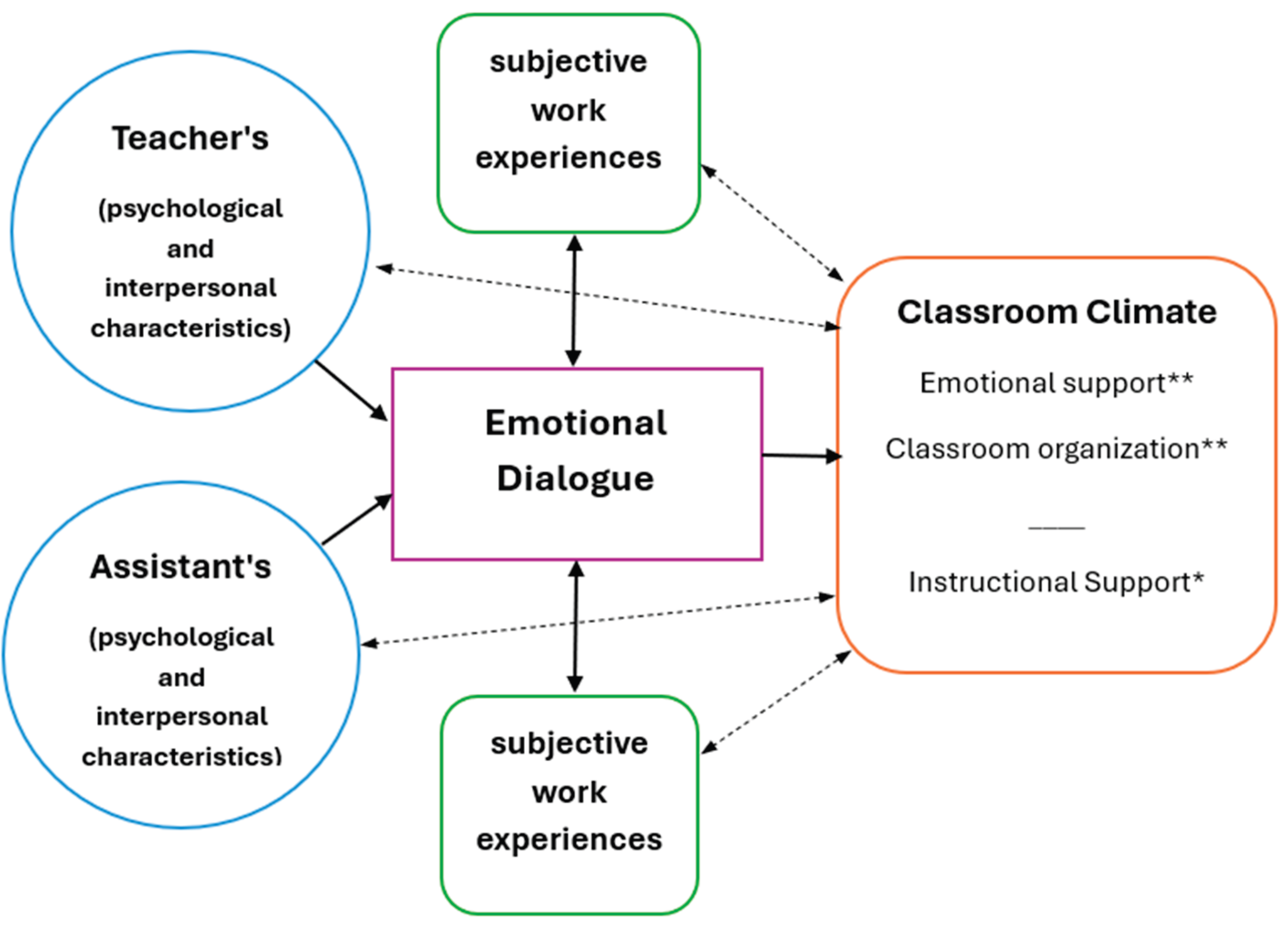

Table 1.
Correlations Between Psychological Characteristics and Emotional Dialogue.
| Dialogue dimention | Teacher Cognitive Empathy | Teacher Psychological Control | Attachment |
|---|---|---|---|
| Assistant dialogue | |||
| Emotional expression | .53 ** | — | — |
| Positive affect | .42 * | –.42 * | — |
| Dyadic emotional coherence | .43 * | — | — |
| Emotional containment | — | –.46 ** | — |
| Hostility | — | .42* | — |
| Overall emotional dialogue | — | –.39* | — |
| Teacher dialogue | |||
| Hostility | — | — | –.52** (T to partner) |
| Hostility | — | — | –.42* (T to friend) |
| Hostility | — | — | –.50** (T to assistant) |
| Hostility | — | — | –.45* (A to teacher) |
Note. Values are Spearman correlations. Coefficients in the Teacher Cognitive Empathy column are partial (controlling for teachers’ years of experience). All other coefficients are zero-order. All tests are two-tailed. Due to occasional missing data, sample sizes varied slightly across analyses (N = 26–29). * p < .05; ** p < .01.
Table 2.
Correlations between emotional dialogue and the educational climate.
| Dialogue dimension | Emotional Support | Classroom Organization | Instructional Support |
|---|---|---|---|
| Assistants | |||
| Emotional Expression | .45* | .37* | — |
| Emotional Containment | — | — | .38* |
| Teachers | |||
| Fostering Acceptance | .58** | .63** | — |
| Emotional Containment | .41* | .49** | — |
| Overall Emotional Dialogue | .59** | .61** | .37* |
Note. Values are Spearman’s ρ. Correlations (two-tailed). N = 29. * p < .05; ** p < .01; *** p < .001.
Table 3.
Spearman and Partial Correlations Between Dialogue Variables and Subjective Work Experiences (N = 29).
Table 3.
Spearman and Partial Correlations Between Dialogue Variables and Subjective Work Experiences (N = 29).
| Dialogue dimention | Teacher Efficacy | T Evaluation of Assistant |
Assistant Coherence | Assistant Job Satisfaction | Assistant Relationship |
|---|---|---|---|---|---|
| Zero-order correlations | |||||
| T emotional containment | .37* | — | — | — | — |
| T positive affect | .42* | — | .37* | — | — |
| T hostility | — | –.44* | — | — | –.40* |
| A emotional expression | .38* | .48** | — | — | — |
| A hostility | — | — | –.49** | –.51** | — |
| A task focus | — | — | — | .42* | — |
| A overall emotional dialogue | — | .40* | — | — | — |
| Partial correlations (controlling for n of children) | |||||
| A emotional expression | .35† | — | — | — | — |
| Partial correlations (N = 29) (controlling for A’s experience in current kindergarten) | |||||
| T emotional expression | — | — | .45* | — | — |
| A enabling & acceptance | — | — | .39* | — | — |
| A hostility | — | — | –.51** | — | — |
| Dyadic Emotional coherence | — | — | .38* | — | — |
Note. T = Teacher; A = Assistant. Values are Spearman’s ρ. † p < .1; * p < .05; ** p < .01.
Disclaimer/Publisher’s Note: The statements, opinions and data contained in all publications are solely those of the individual author(s) and contributor(s) and not of MDPI and/or the editor(s). MDPI and/or the editor(s) disclaim responsibility for any injury to people or property resulting from any ideas, methods, instructions or products referred to in the content. |
© 2026 by the authors. Licensee MDPI, Basel, Switzerland. This article is an open access article distributed under the terms and conditions of the Creative Commons Attribution (CC BY) license (http://creativecommons.org/licenses/by/4.0/).
Copyright: This open access article is published under a Creative Commons CC BY 4.0 license, which permit the free download, distribution, and reuse, provided that the author and preprint are cited in any reuse.


