

Submitted:
09 February 2026
Posted:
09 February 2026
You are already at the latest version
Abstract
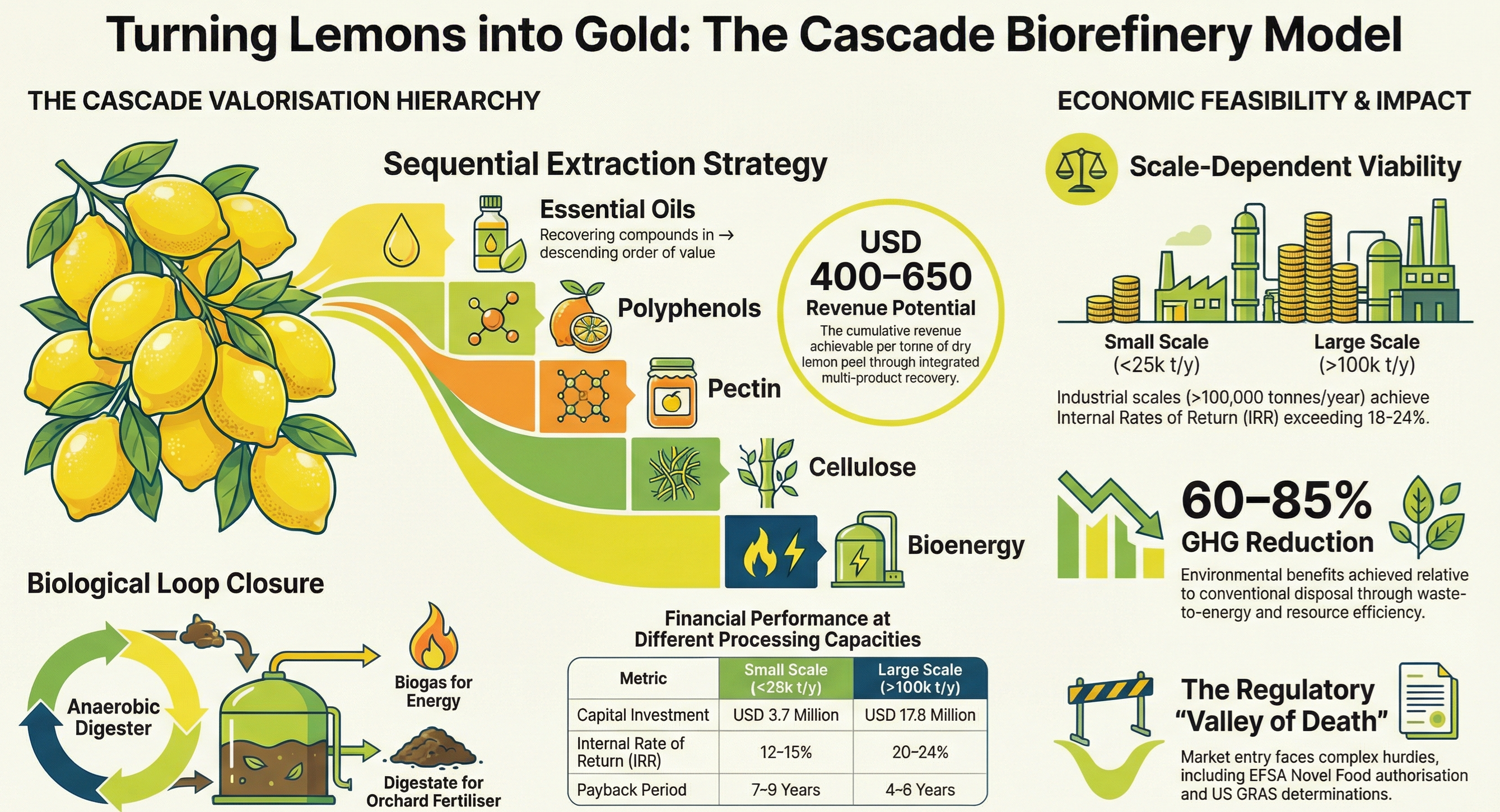
This review examines implementation dimensions of integrated lemon biorefinery systems, including cascade valorisation design, circular-economy integration, life-cycle assessment, techno-economic feasibility, and regulatory frameworks. Bibliometric analysis of Web of Science data (2015–2025) reveals exponential growth in citrus-biorefinery research, with lemon representing a burgeoning subset. Techno-economic assessments indicate that cascade biorefineries recovering essential oils, pectin, polyphenols, nanocellulose, and bioenergy can achieve cumulative revenues of USD 400–650 per tonne of dry peel. Whilst small-scale units (<500 tonnes/year) struggle to achieve viability, industrial simulations demonstrate Internal Rates of Return exceeding 18% at processing scales above 100,000 tonnes annually (2025 basis). Life-cycle assessments confirm environmental benefits, with greenhouse gas reductions of 60–85% relative to conventional disposal. Critical success factors include adopting green extraction technologies to preserve bioactive integrity and mitigating D-limonene inhibition in downstream anaerobic digestion. These findings establish lemon biorefineries as technically mature, economically viable pathways for circular bioeconomy transitions, provided regulatory hurdles—Novel Foods authorisation (EU) and GRAS determination (US)—are effectively navigated.
Keywords:
lemon biorefinery
; citrus waste valorisation
; cascade extraction
; circular bioeconomy
; pectin recovery
; D-limonene
; nanocrystalline cellulose
; Life Cycle Assessment (LCA)
; Techno Economic Analysis (TEA)
; industrial symbiosis
Copyright: This open access article is published under a Creative Commons CC BY 4.0 license, which permit the free download, distribution, and reuse, provided that the author and preprint are cited in any reuse.


