

Submitted:
09 February 2026
Posted:
10 February 2026
You are already at the latest version
Abstract
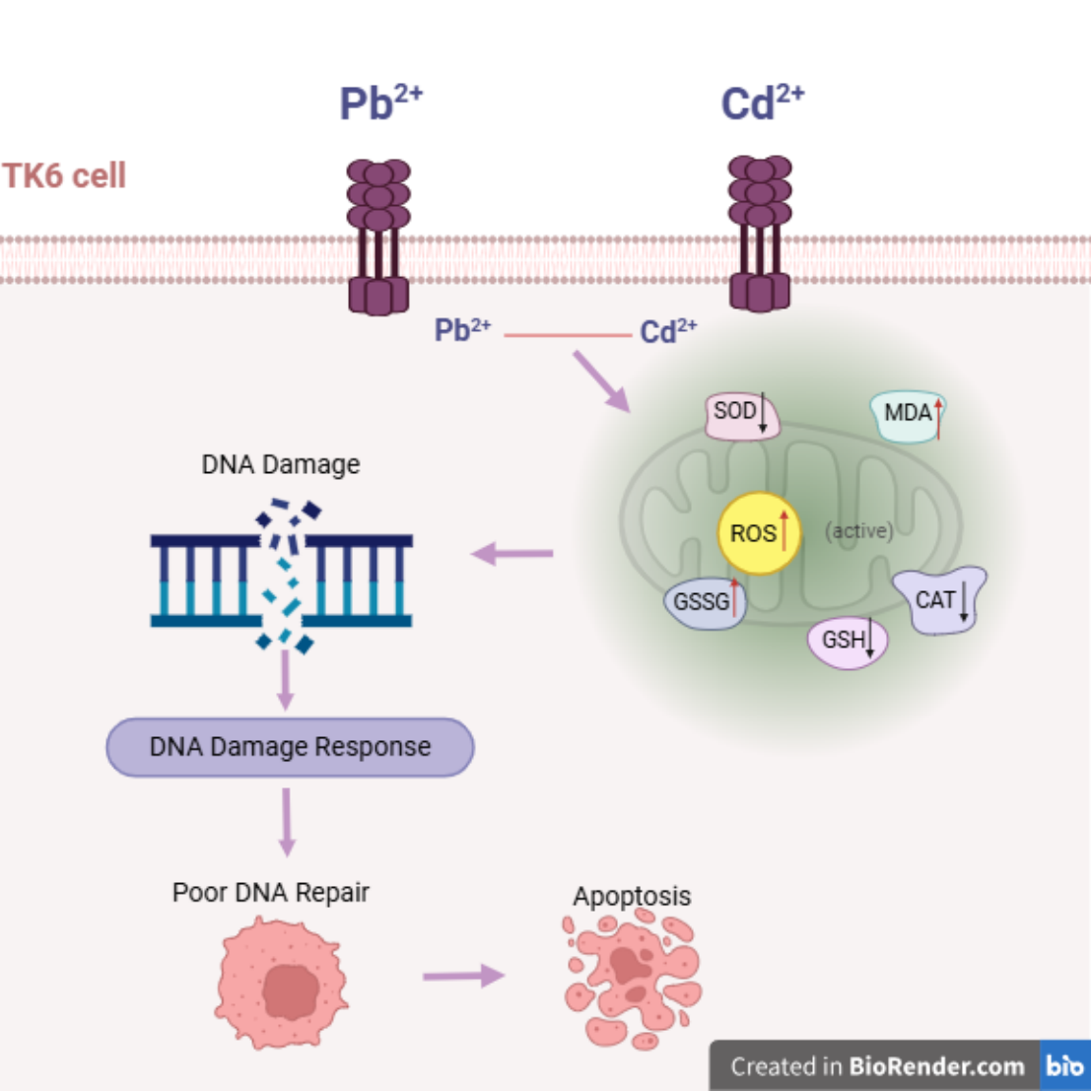
Lead (Pb) and cadmium (Cd) are common environmental pollutants. Our previous population study revealed a significant positive association between Pb and Cd exposure and the micronuclei frequency among lead smelting workers. However, the underlying mechanisms remain unclear. In this study, human lymphoblastoid TK6 cells were used to investigate the genotoxicity and its mechanisms induced by individual or combined exposure to Pb and Cd. Pb and Cd exposure, alone or in combination, triggered oxidative stress, as evidenced by reduced antioxidant enzyme activity (GSH, SOD and CAT) and increased content of ROS and GSSG. Both metals also induced pronounced DNA damage, as showed by elevated Tail DNA% in Comet assay and γ-H2AX fluorescence intensity. Inhibition of the DNA repair proteins, including BRCA1, CtIP, RAD52, and XRCC2, indicating impaired DNA repair capacity. Notably, Pb and Cd co-exposure produced an antagonistic effect, modulating oxidative stress indicators, cell-cycle arrest, DNA damage markers, DNA repair pathway proteins, and apoptosis-related proteins (Bax, Bcl-2, Bax/Bcl-2, Caspase-3). These findings demonstrate that Pb and Cd induce oxidative stress, DNA damage, and inhibition of DNA repair in TK6 cells. Our study provides new insights into the mechanisms of heavy metal–induced genotoxicity and identifies potential molecular targets for intervention.
Keywords:
lead exposure
; cadmium exposure
; oxidative stress
; DNA damage
; DNA repair
; apoptosis
Copyright: This open access article is published under a Creative Commons CC BY 4.0 license, which permit the free download, distribution, and reuse, provided that the author and preprint are cited in any reuse.


