

Submitted:
09 February 2026
Posted:
10 February 2026
You are already at the latest version
Abstract
Functional antibody-dependent enhancement (ADE) represents a fundamental and con-text-dependent characteristic of antiviral antibody responses, reflecting the dual capacity of antibodies to mediate both neutralization and Fc receptor–dependent enhancement of infection. In flavivirus research, this duality complicates interpretation of conventional serological metrics and limits the reliability of single-parameter correlates of immunity. Over the past decade, functional ADE assays have evolved from specialized mechanistic tools into integrated assessment platforms supporting translational immunology, vaccine evaluation, and immune landscape analysis. These platforms combine Fcγ receptor–relevant target-cell systems, standardized viral inputs, dilution-series–based profiling, quantitative enhancement metrics, and quality-control frameworks to enable reproducible and interpretable functional measurements across cohorts and laboratories. This review synthesizes the development, standardization, and global dissemination of functional ADE platforms and emphasizes their role as immune assessment infrastructures rather than isolated experimental assays. Key design principles governing biological relevance, analytical robustness, and inter-site transferability are discussed, together with their im-plications for contextual interpretation of antibody function in populations with diverse exposure and vaccination histories. Emerging directions integrating functional ADE pro-filing with systems immunology, immunogenomics, and computational modeling are highlighted as pathways toward translational interpretation and preparedness-oriented decision-making. By positioning ADE platforms within broader immune assessment frameworks, this review underscores their value for mechanistic inquiry, vaccine evalua-tion, and population-level surveillance in the absence of definitive correlates of protection.
Keywords:
antibody-dependent enhancement (ADE)
; flavivirus immunity
; Fc gamma receptor (FcγR)
; functional immunoassays
; immune assessment platform
; vaccine evaluation
; translational immunology
; systems immunology
; serological profiling
; correlates of protection
1. Introduction
Flaviviruses—including dengue virus (DENV), Zika virus (ZIKV), Japanese encephalitis virus (JEV), yellow fever virus (YFV), and West Nile virus (WNV)—continue to impose substantial and recurrent public health burdens across endemic regions and increasingly in areas experiencing vector expansion. Despite decades of progress in vaccinology, seroepidemiology, and clinical management, a persistent challenge in flavivirus immunology is that antibody quantity and binding breadth do not necessarily translate into protective function. In particular, the same antibody repertoire can mediate potent neutralization under one set of biological conditions yet facilitate enhanced infection under another. This functional ambiguity is a clinically challenge for DENV, where sequential infections with heterologous serotypes and cross-reactive antibodies are associated with increased risk of severe disease [1,2]. As a result, flavivirus vaccine development and evaluation require more than measurements of neutralizing antibody titers: they require functional platforms capable of interrogating Fc-dependent biology and the conditions under which antibodies shift from protective to potentially pathogenic activity. Notably, despite extensive research efforts, validated correlates of protection remain limited [1,2] for most flavivirus vaccines and natural infections, particularly in populations with complex immune histories. Functional assessment platforms therefore play a critical role in contextualizing serological measurements rather than serving as direct proxies for protection.
Antibody-dependent enhancement (ADE) is a well-described phenomenon in which virus–antibody complexes promote infection of Fc receptor (FcR)-expressing cells through Fc-mediated uptake, thereby increasing viral entry, replication, and/or downstream inflammatory consequences. In the flavivirus field, ADE is frequently discussed as a single entity, yet it encompasses multiple mechanistic layers: the formation and stoichiometry of immune complexes; Fcγ receptor engagement (including receptor density, affinity, and polymorphisms); intracellular routing and endosomal processing; and the innate immune context of the target cell. Early human immunological studies and reviews highlighted the central role of antibody quality, Fcγ receptor engagement, and cross-reactive immunity in shaping dengue disease outcomes and vaccine performance [3]. These frameworks emphasized that protection and enhancement represent context-dependent functional states rather than fixed antibody properties [3,6,7]. This mechanistic complexity has two practical consequences. First, no single assay format can represent all dimensions of ADE biology. Second, assays that are not explicitly designed with Fc-dependent cell biology in mind can generate readouts that are difficult to interpret or reproduce across laboratories. These realities have driven a gradual shift from “single-readout” experiments toward platform-based functional assay systems—integrated approaches that combine defined viral inputs, FcγR-relevant target cells, standardized quantification metrics, and quality control procedures to enable inter-study and inter-laboratory comparability [9,10,11,12,15].
Antibody-dependent enhancement (ADE) has been extensively characterized in flavivirus and other viral systems because of Fc receptor–mediated immune-complex uptake and altered intracellular signaling pathways [4,5,6,7,9]. Mechanistic studies have demonstrated that Fcγ receptor subtype, cytoplasmic signaling domains, and receptor density critically influence enhancement phenotypes and downstream inflammatory responses [4,7,9,23,24,25,29]. These findings established that ADE reflects a regulated functional state rather than an intrinsic property of antibodies alone. In general, it has been speculated that in flavivirus vaccinology, antibody-dependent enhancement represents a pathological aberration that must be eliminated from immune responses. In most cases enhancement and neutralization reflect concentration- and context-dependent functional states of the same antibody repertoire. Most antiviral antibodies possess inherent dual potential, mediating protection under some conditions and facilitating Fc-dependent uptake under others. Simplistic efforts to “abrogate” ADE through antigen design or epitope exclusion risk oversimplifying this biology and may inadvertently compromise protective breadth. Functional ADE platforms therefore serve not merely to analyze risk, but as analytical systems for characterizing immune landscapes and their dynamic modulation over time.
Historically, flavivirus immunogenicity and risk assessment have relied heavily on neutralization assays, such as plaque reduction neutralization tests (PRNT) and focus reduction neutralization tests (FRNT). These remain indispensable for many purposes, including correlates of protection and serotyping. However, neutralization alone is not a sufficient surrogate for real-world function in populations with complex immune histories [11,12,13,20,21,32] (e.g., prior DENV infection, JEV vaccination, or exposure to related flaviviruses, endemic vs non-endemic settings). In these settings, cross-reactive antibodies may partially neutralize, fail to neutralize, or enhance infection depending on concentration, epitope specificity, and Fc-mediated engagement. Consequently, a parallel line of functional evaluation—explicitly incorporating FcγR biology—has become essential for both mechanistic research and translational decision-making, including the evaluation of vaccine candidates, booster concepts, monoclonal antibody strategies, and population-level immunity profiling.
Functional ADE assays have evolved substantially over the past decade, moving from proof-of-concept experiments to standardized and disseminated platforms used across diverse contexts. Several assay architectures are now commonly employed, including live-virus systems using FcγR-expressing cell lines by employing plaque assay, microneutralization tests, flowcytometry, reporter virus approaches, pseudotyped particles, and single-round infectious particles (SRIPs). Each has strengths and limitations. Live-virus FcγR-based assays can provide biologically direct readouts but require careful control of viral input, cell state, and biosafety constraints, but remains the most faithful in biological characterization between virus and antibodies. Reporter and pseudovirus systems can improve throughput and standardization but may not fully recapitulate entry, replication, or innate signaling. SRIP-based systems offer valuable middle ground for certain questions, enabling single-cycle infection readouts while reducing confounding by secondary rounds of replication, however full recapitulation of antibody interactions against live virus as well as limited access to detection reagents may be a limiting factor [36,37]. Importantly, regardless of architecture, meaningful ADE assessment depends on disciplined platform design: defined target-cell FcγR expression profiles; standardized virus preparation and quantification; pre-specified enhancement metrics; and an explicit plan for normalization across runs and consistent across laboratories.
A critical concept underlying platform-based functional ADE assays is that the “enhancement phenotype” is rarely captured by a single data point. Instead, functional profiles often exhibit concentration dependence and non-linear behavior, including bell-shaped curves and distinct peaks reflecting immune-complex stoichiometry and receptor engagement thresholds depending on clinical samples. For translational purposes, this has led to the adoption of quantitative enhancement metrics that summarize the magnitude and/or area of enhancement across antibody dilutions, often expressed relative to virus-only controls and anchored to standardized viral inputs. When carefully implemented, such metrics enable comparative evaluation across cohorts, vaccines, and time points, and they can be integrated with parallel immunological measurements (e.g., binding titers, neutralization titers, Fc effector functions, and cellular immunity) to provide a more coherent systems-level interpretation. The need for reproducible ADE functional platforms has become more urgent as the flavivirus field confronts increasingly complex questions. These include how pre-existing immunity from vaccination or prior infection shapes subsequent responses (pre-existing immunity); how booster strategies can reprogram immunity toward protection without increasing ADE risk; how cross-reactive antibody landscapes differ across age groups and geographic regions; and how to translate mechanistic insights into practical frameworks for vaccine safety and efficacy assessment. Addressing these questions requires assays that are not only biologically relevant but also robust and operationally transferable—capable of being implemented across multiple sites with consistent performance. Inter-laboratory transfer introduces additional variables (operator technique, reagent differences, instrument calibration, and local virus stocks), making platform-level standardization and quality assurance as important.
This review focuses on the development, standardization, and global application of functional antibody-dependent enhancement (ADE) assay platforms in flavivirus research. Rather than treating ADE assays as isolated protocols, they are considered here as integrated systems encompassing: (i) conceptual foundations in FcγR-dependent virology and immunology; (ii) platform development principles, including target-cell selection, viral input standardization, and quantitative readout design; (iii) approaches to reproducibility and inter-laboratory dissemination; and (iv) applications across clinical cohorts, field studies, and vaccine evaluation pipelines (Figure 1). Complementary technologies, including reporter virus systems and emerging multi-parameter immunoprofiling approaches, are discussed as tools that can strengthen interpretability when integrated thoughtfully within a platform framework. Finally, next-generation directions that may transform functional ADE assays from retrospective measurements into predictive tools are outlined. These include integration with B cell receptor (BCR) repertoire analytics, single-cell immune profiling, epitope-resolved antibody mapping, Fc glycosylation and FcγR polymorphism–aware analysis, and computational modeling designed to map immunological breadth and depth to functional outcomes (Figure 1). In this forward-looking view, functional ADE platforms are positioned not merely as risk-assessment tools, but as enabling infrastructure for rational vaccine design and pandemic preparedness—particularly in settings where pre-existing flavivirus immunity may shape responses to emerging pathogens or to vaccines deployed at scale. In summary, functional ADE assays have progressed from specialized experimental setups to widely used platforms that underpin a substantial fraction of modern flavivirus immunology and vaccinology. Continued progress will depend on how effectively these platforms are standardized, disseminated, and integrated with systems immunology to generate interpretable, comparable, and decision-relevant outputs linked to clinically meaningful outcomes. The purpose of this review is to consolidate practical platform principles and to provide a framework supporting rigorous mechanistic inquiry alongside translational application across diverse research and public health settings.
2. Conceptual Foundations of Functional ADE Platform Design
2.1. ADE as a Functional State, Not an Intrinsic Antibody Property
Antibody-dependent enhancement (ADE) is best conceptualized as a context-dependent functional state that emerges from the interaction of (i) antibody repertoire and concentration, (ii) viral antigenic landscape and particle properties, and (iii) Fcγ receptor (FcγR) biology in the target cell. In flavivirus systems, the same polyclonal serum can exhibit neutralization, no effect, or enhancement depending on dilution, target-cell FcγR expression, and assay architecture. This indicates that “ADE” is not a single mechanistic outcome but rather a family of related phenotypes that share a common initiating event—the formation of virus–antibody immune complexes—followed by FcγR-dependent uptake, intracellular processing, and downstream readouts reflected in increased viral progeny [3,16]. Consequently, functional enhancement cannot be reliably inferred from binding assays, neutralization titers in the absence of FcγR, or rapid surrogate tests that bypass viral entry and intracellular replication. Meaningful assessment requires experimental systems, as demonstrated in early FcγR-based platform studies [9,10,11,12,13,14,15,46], that preserve Fc-dependent uptake and post-entry biology, underscoring the necessity of infection-based platforms for mechanistic interpretation and translational decision-making.
2.2. Immune-Complex Stoichiometry and Concentration Dependence
A core feature of ADE assays is non-linearity across antibody concentration, often manifesting as bell-shaped enhancement curves. At high antibody concentrations, virions may be neutralized or sterically blocked from productive entry; at intermediate concentrations, immune complexes can form at stoichiometries that optimize FcγR engagement and internalization; at very low concentrations, insufficient binding reduces FcγR-mediated uptake. Because this behavior is expected from first principles, platform design should treat dilution series as integral—not optional—and should predefine how enhancement will be summarized using peak-based, area-under-curve (AUC)–based, or threshold-based metrics. At the same time, near-undiluted or minimally diluted conditions may, in certain biological contexts, approximate in-vivo antibody concentrations and immune-complex configurations approximate in-vivo antibody concentrations and immune-complex configurations [14,15,20]. Hence, under these conditions, measured enhancement may reflect physiologically relevant functional states. Accordingly, undiluted or low-dilution data points can provide complementary information [13,14,15], particularly when interpreted within a structured dilution-series framework. Comprehensive platform-based assessment therefore requires evaluation across the full concentration spectrum, enabling discrimination between transient, assay-dependent enhancement peaks and functionally meaningful profiles associated with natural infection, vaccination, or boosting.
2.3. Fcγ Receptor Engagement Determines Entry Route and Intracellular Fate
Fcγ receptor (FcγR) biology is not simply a “gateway” for viral entry; it influences intracellular routing, endosomal maturation, and downstream signaling pathways, which collectively determine whether immune-complex uptake results in productive infection, abortive entry, or altered innate immune responses [22,23,24,25,26,27]. Key variables include receptor subtype (e.g., FcγRIIA vs. FcγRI/III), expression density, cell activation state, and receptor polymorphisms.
In practical assay terms, these variables motivate:
- selection of FcγR-relevant target cells (cell lines or primary cells),
- systematic documentation and monitoring of FcγR expression stability across passages, and
- avoidance of overgeneralization from single-cell models.
Experimental and molecular analyses have demonstrated that FcγRIIa-mediated uptake is coupled to distinct signaling pathways, including Syk-dependent and Src-family kinase cascades, which modulate viral replication efficiency, intracellular trafficking, and innate immune activation [9,24,25,29,30,51]. These pathways influence both entry efficiency and post-entry cellular fate, shaping whether enhanced uptake translates into increased viral output or altered immune signaling. Importantly, FcγR-mediated enhancement—whether operating through entry-level (“extrinsic”) mechanisms or post-entry (“intrinsic”) modulation of cellular responses—does not, by itself, determine downstream clinical outcomes, as supported by mechanistic and cohort-based studies [6,8,23,26,27,28,29,33]. Functional ADE reflects localized, context-dependent cellular processes embedded within complex host–virus–immune interactions. Disease severity and protection emerge from the integration of viral burden, immune regulation, tissue tropism, and host genetic factors, together with that of FcγR-mediated uptake [41,42,43,44,45]. As such, FcγR engagement should be interpreted as one mechanistic layer within a broader immunological network. This reinforces the need for receptor-characterized target-cell systems and for integration of ADE readouts with multi-parameter immunoprofiling and clinical metadata in platform-based analyses.
2.4. Target-Cell and Viral Input Context as Hidden Confounders
Even within a chosen target-cell model, assay outcomes can vary substantially due to cell-cycle status, baseline interferon levels, differentiation state, and culture conditions and environment [46,47,48,49]. These factors modulate viral replication, innate restriction, and the magnitude of enhancement, and can introduce systematic bias if not appropriately controlled. For platform-level robustness, laboratories should standardize and document key parameters, including passage number windows, confluence thresholds at infection, incubation timing, and any stimuli (e.g., cytokines) that may alter FcγR expression or innate signaling. ADE readouts are influenced by viral input; however, within controlled and biologically relevant ranges, overall enhancement patterns and concentration-dependent profiles are generally stable across biologically relevant input ranges [12,15,37]. Viral input itself is multidimensional, encompassing genome copy number, infectious units, particle-to-PFU ratio, maturation state (e.g., prM cleavage), and aggregation, all of which can affect effective infectivity and antibody binding. Standardization therefore requires selection of a primary input definition (e.g., PFU, FFU, MNT or IU) and implementation of quality-control procedures that protect against drift in infectious titer estimation, batch-to-batch particle heterogeneity, and storage-related loss of infectivity. Although moderate variation in viral input typically has limited impact on qualitative ADE profiles, excessive divergence can influence cytopathic effects, replication kinetics, and downstream readouts. Coordinated overall control of viral input is therefore necessary to preserve biological interpretability and inter-study comparability.
2.5. Assay Architecture, Functional Endpoints, and Platform Logic
Different ADE assay formats interrogate distinct stages of the viral life cycle and therefore shape how “enhancement” is operationally defined. Live-virus replication assays capture entry, replication, and spread but may confound enhancement with downstream kinetics or multiple infection rounds. Single-cycle systems, including SRIP-based platforms, isolate early infection events and improve interpretability for specific mechanistic questions. While reporter and pseudotype systems enhance throughput and standardization, these assays may not fully recapitulate native flaviviral entry and replication biology. Target-cell selection further influences functional readouts. Primary monocytes and macrophages provide physiological relevance but introduce donor variability, limited scalability, and technical complexity, and typically require higher multiplicities of infection to achieve reliable infection. Engineered or stable FcγR-expressing cell lines offer improved reproducibility and operational consistency but may represent simplified cellular contexts relative to primary myeloid cells. In this context, plaque-forming FcγR-expressing systems enable integrated assessment of enhancement. As with all functional ADE platforms, performance remains dependent on viral stock quality, culture conditions, and assay standardization. No single cellular model therefore constitutes a universal “gold standard” for ADE assessment; rather, each capture distinct biological dimensions of Fc-dependent infection as demonstrated by comparative platform evaluations [23,29,46,47,48]. Ideally, functional readouts should not be interpreted in isolation but integrated with complementary immunological parameters, including neutralization profiles, antibody binding characteristics, cellular immunity, and exposure history and, where available, repertoire- and systems-level analyses such as BCR/TCR profiling and epitope mapping (Figure 2). Platform-based ADE assessment is most informative when embedded within such multi-parameter frameworks, enabling contextualized interpretation rather than reliance on enhancement measurements alone.
Accordingly, functional ADE platforms should predefine primary endpoints that align with study objectives. These may include the proportion of infected cells, reporter activity, viral RNA or antigen production, infectious progeny output, and, where relevant, cytokine or innate signaling markers. Endpoint selection should reflect whether the primary goal is vaccine safety profiling, mechanistic analysis of FcγR routing, or population-level immune mapping. A functional ADE “platform” therefore represents more than a protocol. It constitutes an integrated infrastructure comprising standardized workflows, defined inputs and controls, quantitative metrics and decision rules and quality-assurance thresholds. This platform logic enables multi-cohort and multi-site comparability and converts experimental measurements into interpretable, translationally relevant outputs that can inform vaccine evaluation and preparedness-oriented decision-making.
3. Application of Functional ADE Platforms Across Research and Translational Context
3.1. Clinical, Cohort, and Field Applications
Platform-based functional ADE assays have been widely applied to characterize antibody-mediated responses in clinical cohorts and population-based studies [20]. In dengue-endemic settings, these platforms enable systematic comparison of functional profiles across primary and secondary infections, age groups, and geographic regions. By integrating dilution-series–based enhancement metrics with serological and clinical metadata, cohort studies can identify immune signatures associated with protection, subclinical infection, or increased disease risk [12,13,20,32,33,38,39]. Longitudinal sampling further enables tracking of functional immune trajectories over time, including post-infection maturation, waning, and modulation following vaccination [17,18,19]. Such analyses provide insights into immune imprinting, pre-existing cross-serotype reactivity, and durability of functional responses that are not readily captured by conventional neutralization assays alone. During outbreak investigations and field-based surveillance, functional ADE platforms provide mechanistic context for observed epidemiological patterns. When combined with viral genotyping, transmission dynamics, and seroprevalence data, ADE profiles inform hypotheses regarding disease severity, age-dependent risk, and regional variation in clinical outcomes [33,38,39]. Experience from multi-site studies demonstrates that harmonized platforms can generate comparable functional datasets even in resource-variable environments through modular assay design and standardized training protocols.
3.2. Vaccine, Booster, and Therapeutic Evaluation
Building on earlier FcγR-based platform development and quantitative enhancement frameworks [6,7,8,12], subsequent studies extended these systems to diverse translational applications, including vaccine evaluation and longitudinal immunity profiling [17,29,30,36,37]. Platform-based ADE assays have been applied to assess cross-genotype immunogenicity and concentration-dependent enhancement dynamics in flavivirus-naïve and pre-immune populations [21,40]. Importantly, FcγR-expressing cell–based functional assays have been cited in regulatory and policy-oriented evaluations of dengue vaccine immunogenicity [34,35,51,53].
The WHO ECBS technical review noted that conventional PRNT-based neutralization assays did not consistently discriminate between protective and non-protective cross-reactive antibody responses and that Fcγ receptor–bearing systems may offer improved discriminatory capacity [6,50] and subsequent validation studies [11,12,13,37,40]. This assessment reflects early platform-based work demonstrating the added interpretive value of FcγR-expressing systems in functional immune profiling [6,7,12]. Functional ADE platforms are also increasingly incorporated into monoclonal antibody and antibody-based therapeutic development. These systems enable systematic evaluation of Fc-dependent effects alongside neutralization potency and support assessment of Fc engineering and glycoengineering strategies for risk mitigation and regulatory submission.
3.3. Cross-Platform and Systems-Level Integration
To enhance interpretability, functional ADE platforms are frequently combined with complementary experimental systems, including plaque-based assays, reporter viruses, animal models, and ex vivo primary cell cultures. Cross-platform validation enables dissection of early entry events, replication dynamics, and immunopathological consequences under controlled conditions. Large-scale applications enable construction of immune landscape maps linking antibody repertoire features, exposure history, and functional outcomes. When integrated with BCR sequencing, epitope mapping, and single-cell profiling, these datasets support systems-level modeling of immune breadth, depth, and functional potential [31,32,33,38,39]. Such approaches facilitate identification of recurrent response archetypes and inform stratification of populations according to functional risk profiles. Integrated use of multiple platforms strengthens mechanistic inference, reduces dependence on any single assay format, and supports development of predictive frameworks for vaccine evaluation and surveillance.
3.4. Operational Deployment and Translational Value
Sustained deployment of functional ADE platforms requires coordinated operational frameworks. Key elements include centralized protocol repositories, standardized training modules, shared reference materials, and harmonized data-management systems. Regular inter-laboratory benchmarking and joint quality-assessment reviews support continuous performance monitoring and early identification of systematic drift. Across clinical research, vaccine development, outbreak investigation, and systems immunology, platform-based approaches convert complex Fc-dependent biology into structured, comparable, and interpretable datasets. However, conclusions regarding assay sensitivity must distinguish between intrinsic cell-line biology and FcγRIIa expression fidelity, as reduced ADE detection in low-expression or unstable transfectants does not invalidate FcγRIIa-mediated platforms per se [45]. By linking mechanistic insight to operational scalability, functional ADE platforms bridge experimental immunology and public health practice. Their continued refinement and integration with emerging analytical technologies will further expand their utility in translational and preparedness-oriented research.
4. Methods and Reporting Standards for Platform-Based Functional ADE Assessment
4.1. Platform-Oriented Design and Experimental Architecture
Functional ADE assays intended for comparative or translational use should be implemented within a platform-oriented design framework that integrates biological relevance, analytical reproducibility, and operational transferability. Rather than treating individual experiments as standalone measurements, platform-based assessment emphasizes standardized workflows, pre-specified performance criteria, and systematic documentation of key experimental variables. This approach enables meaningful comparison across cohorts, time points, and laboratories. Core design elements include (i) defined antibody input formats (serum, plasma, or purified immunoglobulin), (ii) characterized viral preparations with stable infectivity profiles, (iii) FcγR-relevant target-cell systems with monitored receptor expression, and (iv) reference materials that support longitudinal and cross-site normalization. Platform implementation should prioritize consistency of these elements across experimental cycles.
Selection and maintenance of target-cell systems represent critical determinants of ADE assay behavior. Platforms should employ FcγR-expressing cells that reflect the intended biological context and exhibit stable receptor profiles across defined passage windows. Routine verification of FcγR expression levels is recommended, particularly following extended culture or culture at different environments. Cellular state variables, including confluence and where feasible, metabolic status, and baseline innate signaling signatures, should be monitored and controlled. When primary cells are used, donor variability and differentiation protocols should be documented to support cross-study comparison. Different assay designs interrogate distinct stages of the viral life cycle and therefore shape how enhancement is operationally defined, as such, cross validations would be important. Study designs should pre-specify the biological scope of the selected system and avoid treating formats as interchangeable. To ensure that experimental architecture translates into interpretable and transferable outputs, platform design should be coupled to standardized quantitative and reporting frameworks (Figure 3). This framework summarizes commonly used enhancement metrics, functional response profiles, and minimum reporting standards, linking assay structure to downstream interpretation. Definition of baseline references, dilution ranges, peak and area-based metrics, and threshold criteria provides a shared analytical language consistent with comparative validation studies and inter-laboratory transfer efforts [12,17,29,30,45,48]. By embedding these metric and reporting conventions within platform architecture, experimental design is aligned with reproducibility, cross-site harmonization, and translational relevance from the outset.
4.2. Immune-Complex Formation, Viral Input Control, and Quality Assurance
ADE phenotypes are intrinsically concentration dependent and therefore require systematic evaluation across predefined antibody dilution ranges. Platform-based assays should incorporate standardized dilution series spanning neutralizing, transitional, and enhancing concentrations, with ranges adapted to expected antibody titers and study context. Immune-complex formation conditions, including incubation time, temperature, and mixing procedures, should be harmonized within and across sites. Documentation of these parameters is essential for interpretability and reproducibility. Viral input standardization is central to platform stability. Viral stocks should be quantified using predefined primary metrics (e.g., PFU, FFU, or IU) and characterized for batch-to-batch variability, particle infectivity ratios, and storage stability. Where possible, reference virus lots or bridging panels should be incorporated to facilitate inter-laboratory harmonization. Freeze–thaw cycles, passage history, and preparation methods should be recorded systematically. Deviations from established specifications should trigger predefined review or recalibration procedures. Normalization and quality assurance procedures form the backbone of transferable ADE platforms. Each experimental run should incorporate virus-only baselines, positive control sera, and plate-level controls to enable intra- and inter-assay comparison. Acceptance thresholds for control performance should be established prospectively. Batch-tracking systems should link outputs to reagent lots, cell passages, and operator metadata. In multi-site studies, centralized monitoring of QC metrics enables early identification of systematic drift and supports coordinated corrective action. The importance of rigorous normalization and reference controls has been emphasized in comparative and validation studies, particularly during inter-laboratory transfer (12,17,29,30,45).
4.3. Readout Integration, Quantitative Metrics, and Interpretive Frameworks
Primary readouts should be selected according to study objectives and may include infection frequency, reporter activity, viral RNA or antigen production, infectious progeny output, and immunological response markers. Platforms intended for translational or preparedness applications benefit from integrating complementary readouts that capture both entry-level and downstream biological consequences. When multiple readouts are employed, analytical pipelines should predefine prioritization and weighting schemes to avoid post hoc interpretation bias. Integrated analysis enhances robustness and supports mechanistic and predictive modeling. Functional ADE platforms should employ pre-specified quantitative metrics that summarize enhancement and neutralization behavior across dilution ranges. Commonly applied measures include peak enhancement values, enhancement area-under-curve indices, and threshold-based indicators. Selection of metrics should reflect study goals and anticipated downstream use. Interpretive frameworks should distinguish between neutralization-dominant, enhancement-dominant, and mixed-response profiles and should account for assay architecture and biological context. Reporting should emphasize comparative patterns rather than isolated point estimates. Functional readouts should not be interpreted in isolation but integrated with complementary immunological parameters, including binding profiles, cellular immunity, exposure history, and repertoire-level information where available.
In this context, variation in target-cell systems directly influences quantitative readouts and response classifications. To preserve interpretability across cellular models, functional outcomes should be mapped to standardized response profiles and reporting conventions, as outlined in Figure 3. Applying shared baseline definitions, enhancement metrics, and zone-based interpretations enables results obtained in different FcγR-expressing systems to be compared within a common analytical framework, despite underlying biological differences. This linkage between cellular architecture and standardized metrics is essential for cross-platform validation and translational interpretation.
4.4. Reporting Standards, Data Governance, and Translational Alignment
To support reproducibility and secondary analysis, ADE studies adopting platform-based approaches should report, at minimum: dilution ranges, baseline definitions, replicate structures, viral input specifications, target-cell characterization procedures, and normalization methods. Supplementary materials should provide sufficient methodological detail to enable independent replication and protocol transfer. Where applicable, contextual metadata—including cohort characteristics, vaccination or infection histories, and sampling intervals—should be integrated with functional outputs. Sustainable functional ADE platforms require coordinated data governance and documentation practices. Standardized data formats, version-controlled analytical pipelines, and curated reference datasets facilitate longitudinal analyses and future methodological upgrades. Consortium-based initiatives could support the establishment of governance structures for protocol revision, reference material renewal, and training dissemination. These mechanisms enable continuous platform evolution while preserving comparability with historical datasets. Platform-based ADE assessment is most impactful when aligned with clearly defined translational and preparedness goals, including vaccine safety profiling, immune landscape surveillance, and risk stratification in immunologically complex populations. Study designs should therefore incorporate decision-relevant outputs and stakeholder requirements from early stages. Integration with regulatory, funding, and public health frameworks enhances platform utility and supports incorporation into broader pandemic readiness infrastructures.
5. Discussion
Functional antibody-dependent enhancement (ADE) assays have evolved from specialized mechanistic tools into foundational components of flavivirus immunology, vaccine development, and immune risk assessment. This transition reflects both scientific necessity and operational learning: as population immunity profiles have become increasingly complex, conventional serological metrics alone have proven insufficient to capture functional outcomes relevant to disease severity and vaccine performance. Platform-based ADE systems address this gap by integrating FcγR biology, standardized experimental workflows, quantitative metrics, and governance structures that enable comparability across cohorts and institutions. A central insight emerging from platform-oriented approaches is that ADE phenotypes are intrinsically multidimensional and context dependent. Enhancement and neutralization represent dynamic functional states shaped by antibody concentration, epitope specificity, FcγR engagement, cellular environment, and viral properties. Consequently, isolated measurements or single-format assays cannot adequately represent functional risk landscapes. Integrated platforms, by contrast, support longitudinal and cross-sectional analyses that reveal consistent patterns across immune histories, geographic settings, and intervention strategies (Figure 4). These capabilities are particularly relevant for evaluating booster regimens, heterologous vaccination schedules, and monoclonal antibody candidates in flavivirus-endemic regions.
The establishment of transferable functional ADE platforms has also highlighted the importance of methodological governance alongside technical optimization. Reproducibility challenges in immunological assays are often attributed to biological variability yet experience across multiple sites demonstrates that operational factors—such as viral stock preparation, target-cell maintenance, and normalization procedures—contribute equally to inter-study divergence as documented in multi-site transfer studies [12,17,20,29,30,45]. Embedding quality-control thresholds, reference materials, and batch-tracking systems within platform infrastructures mitigates these effects and converts experimental outputs into interpretable, decision-relevant datasets. Such governance mechanisms are increasingly recognized as essential components of translational research ecosystems. Notably, elements of platform-based ADE assessment have already informed international regulatory discussions. A WHO Expert Committee on Biological Standardization (ECBS) evaluation of dengue vaccine immunogenicity highlighted limitations of conventional neutralization assays and cited the potential utility of FcγR-bearing cell systems for improved functional discrimination [6,50]. This early policy-level recognition underscores the translational relevance of FcγR-based ADE platforms and supports their continued integration into vaccine evaluation frameworks. Dissemination of ADE platforms across laboratories and consortia has further enabled their application to diverse research questions, including cohort-based immunity mapping, vaccine safety profiling, and surveillance of cross-reactive antibody landscapes. Importantly, inter-laboratory transfer has underscored the value of modular assay architecture that can accommodate local constraints while preserving core analytical integrity. This balance between standardization and contextual flexibility is critical for sustaining platform utility in heterogeneous research environments. Recent advances in systems immunology offer opportunities to extend functional ADE platforms beyond descriptive characterization toward predictive modeling. Integration of single-cell transcriptomics, B cell receptor repertoire sequencing, Fc glycosylation profiling, and host genetic variation provides mechanistic depth that complements traditional functional readouts. When coupled with computational approaches [31,32,33,38], these datasets can inform models linking immune “breadth and depth” to functional outcomes, supporting rational vaccine design and population-level risk stratification. The convergence of functional platforms with system-level analytics represents a key frontier for the field (Figure 4D).
Recent integrative studies have further explored cross-reactive immune landscapes using standardized functional platforms in combination with serological and molecular profiling, reinforcing the value of coordinated ADE assessment in vaccine evaluation and surveillance contexts [28,29]. From a preparedness perspective, standardized ADE infrastructures contribute to pandemic readiness by enabling rapid functional assessment of immune responses to emerging flaviviruses and related pathogens [50,51,52]. In populations with extensive pre-existing flavivirus immunity, functional platforms can help anticipate atypical response patterns to novel vaccines or infections, thereby informing deployment strategies and post-implementation monitoring. Embedding ADE assessment within broader immunological surveillance frameworks may therefore enhance responsiveness to future “Disease X” scenarios involving antigenically related viruses.
Of date, long-term application of FcγR-based functional platforms across multiple cohorts, vaccine trials, and epidemiological settings has demonstrated their durability and analytical value over more than a decade of deployment [6,7,8,9,10,11,12,13,14,15,16,17,18,29,30,36,37], supporting their role as core infrastructure for translational flavivirus immunology. However, several limitations warrant consideration. No single assay architecture can fully recapitulate the complexity of in vivo immune–virus interactions, and functional readouts remain sensitive to target-cell selection and viral input properties. Moreover, large-scale implementation requires sustained investment in training, reference materials, and data governance. Addressing these challenges will require coordinated efforts among academic institutions, funding agencies, and public health stakeholders to maintain platform continuity and methodological rigor. Looking forward, the continued maturation of functional ADE platforms will depend on three interrelated priorities: (i) consolidation of reporting standards and reference frameworks; (ii) integration with multi-omic and computational modeling pipelines; and (iii) alignment with regulatory and policy processes governing vaccine evaluation and surveillance. Progress in these areas will transform ADE assessment from a specialized analytical activity into a routine component of translational immunology infrastructure.
An important implication of platform-based ADE assessment is that enhancement should not be interpreted as an intrinsic marker of vaccine failure or immunological hazard. Rather, ADE reflects a natural functional consequence of polyclonal antibody responses operating within Fc-dependent biological systems, in which neutralizing and enhancing activities coexist across overlapping concentration ranges in a polyclonal antibody background, which is detected as the sum of the total antibody activity. Protective immunity and enhancement are therefore not opposing phenomena, but interrelated functional dimensions shaped by antibody concentration, epitope specificity, Fcγ receptor engagement, and host cellular context [3,6,7,14,15,23].
From this perspective, the central objective of vaccine design is not the absolute elimination of enhancement-prone activity—which is neither biologically realistic nor mechanistically justified—but the rational shaping of antibody landscapes toward dominant protective function across physiologically relevant conditions. Functional ADE platforms provide a quantitative framework for evaluating this balance and for anticipating how immune profiles may evolve following natural infection, vaccination, or booster interventions. In dengue-endemic populations with complex exposure histories, such contextualized interpretation is essential for distinguishing transient functional enhancement from clinically meaningful immunological risk. More broadly, these observations underscore that ADE represents a measurable immune state embedded within dynamic host–virus–antibody interactions, rather than a fixed marker of adverse outcome. When interpreted within standardized, multi-parameter platform frameworks, functional enhancement profiles can inform rational vaccine design, guide risk stratification, and support evidence-based decision-making. The maturation of ADE platforms over the past decade therefore reflects not only technical progress, but also a conceptual shift toward integrated, systems-oriented immune assessment.
6. Conclusions
Platform-based functional ADE systems have become indispensable tools for understanding flavivirus immunity in increasingly complex epidemiological and immunological contexts. By integrating Fcγ receptor biology, standardized experimental architectures, quantitative metrics, and multi-layered quality-control frameworks, these platforms enable robust, comparable, and context-aware evaluation of antibody function across populations, interventions, and time scales. This review highlights how the evolution of ADE assays from isolated experimental measurements to transferable analytical infrastructures has expanded their translational value. Functional platforms now support not only mechanistic investigation, but also vaccine evaluation, therapeutic development, immune landscape mapping, and preparedness-oriented surveillance in settings characterized by extensive pre-existing immunity. Continued progress will depend on consolidation of reporting standards, sustained investment in training and reference resources, and deeper integration with systems immunology and computational modeling. Alignment with regulatory, funding, and public health frameworks will further strengthen the role of functional ADE platforms as components of translational research infrastructure rather than specialized laboratory tools. Ultimately, the maturation of functional ADE platforms reflects a broader shift in immunological assessment—from reliance on single-parameter correlates toward integrated, dynamic, and biologically grounded evaluation of immune states. By supporting rational interpretation of enhancement and protection within real-world immune contexts, these platforms will remain central to advancing flavivirus vaccine development, guiding public health strategies, and strengthening preparedness for future emerging viral threats.
Author Contributions
The author M.L.M. conceptualized and wrote the manuscript. Discussions with colleagues and trainees contributed to refinement of perspectives and interpretation.
Funding
This work was supported by grants from the Agency for Research and Development (AMED), specifically under the program for Research on Emerging and Re-emerging Infectious Diseases. The funders had no role in the study design, data collection, analysis, interpretation of data, or writing of the report.
Acknowledgments
The author acknowledges members of the Department of Developmental Medical Sciences, School of International Health, Graduate School of Medicine, The University of Tokyo, and collaborators in Japan and across the Asia-Pacific region for discussions and shared experience in functional ADE research, which informed the perspectives presented here. The author gratefully acknowledges Drs. Ichiro Kurane and Tomohiko Takasaki of the National Institute of Infectious Diseases, Japan, for early mentorship and guidance during the initial development of antibody-dependent enhancement assays, which laid important foundations for the work summarized in this review.
AI Usage Statement
AI technology (Gemini, ChatGPT) was used for language assistance and grammatical refinement, figure draft generation and refinement during the preparation of this manuscript. The author has reviewed and edited all contents and remain fully accountable for the accuracy and integrity of the final content.
Conflicts of Interest
The authors declare no conflicts of interest.
Abbreviations
The following abbreviations are used in this manuscript:
| ADE | Antibody-Dependent Enhancement |
| AUC | Area Under the Curve |
| BCR | B-Cell Receptor |
| DENV | Dengue Virus |
| ECBS | WHO Expert Committee on Biological Standardization |
| E_max | Maximum Enhancement |
| E_AUC | Enhancement Area Under the Curve |
| FcγR | Fc Gamma Receptor |
| FFU | Focus-Forming Unit |
| FRNT | Focus reduction neutralization test |
| HLA | Human Leukocyte Antigen |
| ICS | Intracellular Cytokine Staining |
| IFN-γ | Interferon Gamma |
| IgG | Immunoglobulin G |
| IU | Infectious Unit |
| JEV | Japanese Encephalitis Virus |
| MNT | Microneutralization test |
| PBMC | Peripheral Blood Mononuclear Cell |
| PFU | Plaque-Forming Unit |
| PRNT | Plaque reduction neutralization test |
| QC | Quality Control |
| RT-PCR | Reverse Transcription PCR |
| SRIP | Single-Round Infectious Particle |
| TCR | T-Cell Receptor |
References
- World Health Organization (WHO). Dengue: Guidelines for Diagnosis, Treatment, Prevention and Control; WHO Press: Geneva, Switzerland, 2009. [Google Scholar]
- World Health Organization (WHO). Guidelines on the Quality, Safety and Efficacy of Dengue Tetravalent Vaccines (Live, Attenuated): Annex 2; WHO Technical Report Series No. 979; WHO Press: Geneva, Switzerland, 2013. [Google Scholar]
- Moi, ML; Takasaki, T; Kurane, I. Human antibody response to dengue virus: implications for dengue vaccine design. Trop Med Health 2016, 44, 1. [Google Scholar] [CrossRef]
- Bournazos, S; Gupta, A; Ravetch, JV. The role of IgG Fc receptors in antibody-dependent enhancement. Nat Rev Immunol. 2020, 20(10), 633–643. [Google Scholar] [CrossRef] [PubMed]
- Sepúlveda-Delgado, J; Llorente, L; Hernández-Doño, S. A Comprehensive Review of Fc Gamma Receptors and Their Role in Systemic Lupus Erythematosus. Int J Mol Sci. 2025, 26(5), 1851. [Google Scholar] [CrossRef] [PubMed]
- Halstead, SB; Mahalingam, S; Marovich, MA; Ubol, S; Mosser, DM. Intrinsic antibody-dependent enhancement of microbial infection in macrophages: disease regulation by immune complexes. Lancet Infect Dis. 2010, 10(10), 712–22. [Google Scholar] [CrossRef]
- Wang, TT; Sewatanon, J; Memoli, MJ; Wrammert, J; Bournazos, S; Bhaumik, SK; Pinsky, BA; Chokephaibulkit, K; Onlamoon, N; Pattanapanyasat, K; Taubenberger, JK; Ahmed, R; Ravetch, JV. IgG antibodies to dengue enhanced for FcγRIIIA binding determine disease severity. Science 2017, 355(6323), 395–398. [Google Scholar] [CrossRef]
- Peiris, JS; Gordon, S; Unkeless, JC; Porterfield, JS. Monoclonal anti-Fc receptor IgG blocks antibody enhancement of viral replication in macrophages. Nature 1981, 289(5794), 189–91. [Google Scholar] [CrossRef]
- Moi, ML; Lim, CK; Takasaki, T; Kurane, I. Involvement of the Fc gamma receptor IIA cytoplasmic domain in antibody-dependent enhancement of dengue virus infection. J Gen Virol. 2010, 91 Pt 1, 103–11. [Google Scholar] [CrossRef]
- Moi, ML; Lim, CK; Kotaki, A; Takasaki, T; Kurane, I. Development of an antibody-dependent enhancement assay for dengue virus using stable BHK-21 cell lines expressing Fc gammaRIIA. J Virol Methods 2010, 163(2), 205–9. [Google Scholar] [CrossRef]
- Moi, ML; Lim, CK; Kotaki, A; Takasaki, T; Kurane, I. Discrepancy in dengue virus neutralizing antibody titers between plaque reduction neutralizing tests with Fcgamma receptor (FcgammaR)-negative and FcgammaR-expressing BHK-21 cells. Clin Vaccine Immunol. 2010, 17(3), 402–7. [Google Scholar] [CrossRef]
- Moi, ML; Lim, CK; Kotaki, A; Takasaki, T; Kurane, I. Detection of higher levels of dengue viremia using FcγR-expressing BHK-21 cells than FcγR-negative cells in secondary infection but not in primary infection. J Infect Dis. 2011, 203(10), 1405–14. [Google Scholar] [CrossRef]
- Moi, ML; Lim, CK; Chua, KB; Takasaki, T; Kurane, I. Dengue virus infection-enhancing activity in serum samples with neutralizing activity as determined by using FcγR-expressing cells. PLoS Negl Trop Dis. 2012, 6(2), e1536. [Google Scholar] [CrossRef]
- Moi, ML; Takasaki, T; Saijo, M; Kurane, I. Dengue virus infection-enhancing activity of undiluted sera obtained from patients with secondary dengue virus infection. Trans R Soc Trop Med Hyg. 2013, 107(1), 51–8. [Google Scholar] [CrossRef]
- Moi, ML; Takasaki, T; Saijo, M; Kurane, I. Determination of antibody concentration as the main parameter in a dengue virus antibody-dependent enhancement assay using FcγR-expressing BHK cells. Arch Virol. 2014, 159(1), 103–16. [Google Scholar] [CrossRef]
- Moi, ML; Takasaki, T; Kurane, I. Detection of Virus-Antibody Immune Complexes in Secondary Dengue Virus Infection. Methods Mol Biol. 2018, 1604, 331–337. [Google Scholar]
- Moi, ML; Ami, Y; Shirai, K; Lim, CK; Suzaki, Y; Saito, Y; Kitaura, K; Saijo, M; Suzuki, R; Kurane, I; Takasaki, T. Formation of infectious dengue virus-antibody immune complex in vivo in marmosets (Callithrix jacchus) after passive transfer of anti-dengue virus monoclonal antibodies and infection with dengue virus. Am J Trop Med Hyg. 2015, 92(2), 370–6. [Google Scholar] [CrossRef] [PubMed]
- Moi, ML; Takasaki, T; Omatsu, T; Nakamura, S; Katakai, Y; Ami, Y; Suzaki, Y; Saijo, M; Akari, H; Kurane, I. Demonstration of marmosets (Callithrix jacchus) as a non-human primate model for secondary dengue virus infection: high levels of viraemia and serotype cross-reactive antibody responses consistent with secondary infection of humans. J Gen Virol. 2014, 95 Pt 3, 591–600. [Google Scholar] [CrossRef]
- Moi, ML; Ami, Y; Muhammad Azami, NA; Shirai, K; Yoksan, S; Suzaki, Y; Kitaura, K; Lim, CK; Saijo, M; Suzuki, R; Takasaki, T; Kurane, I. Marmosets (Callithrix jacchus) as a non-human primate model for evaluation of candidate dengue vaccines: induction and maintenance of specific protective immunity against challenges with clinical isolates. J Gen Virol. 2017, 98(12), 2955–2967. [Google Scholar] [CrossRef]
- Ly, MHP; Moi, ML; Vu, TBH; Tun, MMN; Saunders, T; Nguyen, CN; Nguyen, AKT; Nguyen, HM; Dao, TH; Pham, DQ; Nguyen, TTT; Le, TQM; Hasebe, F; Morita, K. Dengue virus infection-enhancement activity in neutralizing antibodies of healthy adults before dengue season as determined by using FcγR-expressing cells. BMC Infect Dis. 2018, 18(1), 31. [Google Scholar] [CrossRef] [PubMed]
- Saito, Y; Moi, ML; Takeshita, N; Lim, CK; Shiba, H; Hosono, K; Saijo, M; Kurane, I; Takasaki, T. Japanese encephalitis vaccine-facilitated dengue virus infection-enhancement antibody in adults. BMC Infect Dis. 2016, 16(1), 578. [Google Scholar] [CrossRef] [PubMed]
- Mady, BJ; Kurane, I; Erbe, DV; Fanger, MW; Ennis, FA. Neuraminidase augments Fc gamma receptor II-mediated antibody-dependent enhancement of dengue virus infection. J Gen Virol. 1993, 74 Pt 5, 839–44. [Google Scholar] [CrossRef]
- Boonnak, K; Dambach, KM; Donofrio, GC; Tassaneetrithep, B; Marovich, MA. Cell type specificity and host genetic polymorphisms influence antibody-dependent enhancement of dengue virus infection. J Virol. 2011, 85(4), 1671–83. [Google Scholar] [CrossRef] [PubMed]
- Boonnak, K; Slike, BM; Donofrio, GC; Marovich, MA. Human FcγRII cytoplasmic domains differentially influence antibody-mediated dengue virus infection. J Immunol. 2013, 190(11), 5659–65. [Google Scholar] [CrossRef] [PubMed]
- Callaway, JB; Smith, SA; McKinnon, KP; de Silva, AM; Crowe, JE, Jr.; Ting, JP. Spleen Tyrosine Kinase (Syk) Mediates IL-1β Induction by Primary Human Monocytes during Antibody-enhanced Dengue Virus Infection. J Biol Chem. 2015, 290(28), 17306–20. [Google Scholar] [CrossRef]
- Chareonsirisuthigul, T; Kalayanarooj, S; Ubol, S. Dengue virus (DENV) antibody-dependent enhancement of infection upregulates the production of anti-inflammatory cytokines but suppresses anti-DENV free radical and pro-inflammatory cytokine production, in THP-1 cells. J Gen Virol. 2007, 88 Pt 2, 365–375. [Google Scholar] [CrossRef] [PubMed]
- Suhrbier, A; La Linn, M. Suppression of antiviral responses by antibody-dependent enhancement of macrophage infection. Trends Immunol. 2003, 24(4), 165–8. [Google Scholar] [CrossRef]
- Ong, EZ; Zhang, SL; Tan, HC; Gan, ES; Chan, KR; Ooi, EE. Dengue virus compartmentalization during antibody-enhanced infection. Sci Rep. 2017, 7, 40923. [Google Scholar] [CrossRef]
- Ayala-Nunez, NV; Hoornweg, TE; van de Pol, DP; Sjollema, KA; Flipse, J; van der Schaar, HM; Smit, JM. How antibodies alter the cell entry pathway of dengue virus particles in macrophages. Sci Rep. 2016, 6, 28768. [Google Scholar] [CrossRef]
- Chotiwan, N; Roehrig, JT; Schlesinger, JJ; Blair, CD; Huang, CY. Molecular determinants of dengue virus 2 envelope protein important for virus entry in FcγRIIA-mediated antibody-dependent enhancement of infection. Virology 2014, 456-457, 238–46. [Google Scholar] [CrossRef]
- Nakamura, Y; Moi, ML; Shiina, T; Shin-I, T; Suzuki, R. Idiotope-Driven T-Cell/B-Cell Collaboration-Based T-Cell Epitope Prediction Using B-Cell Receptor Repertoire Sequences in Infectious Diseases. Viruses 2023, 15(5), 1186. [Google Scholar] [CrossRef]
- Nguyen, TTN; Ngwe Tun, MM; Vu, TBH; Nguyen, TTT; Hoang, VMP; Nguyen, LKH; Phan, TL; Dang, DA; Raekiansyah, M; Suzuki, R; Balingit, JC; Takamatsu, Y; Buerano, CC; Urano, T; Le, TQM; Hasebe, F; Morita, K. Implications of immune responses to DENV, JEV, and ZIKV Infections for cross-reactivity and considerations for vaccine evaluation. Virus Res. 2026, 364, 199689. [Google Scholar] [CrossRef]
- Balingit, JC; Denis, D; Suzuki, R; Hayati, RF; Ngwe Tun, MM; Takamatsu, Y; Masyeni, S; Sasmono, RT; Morita, K. Impact of pre-existing cross-reactive antibodies on cyclic dengue outbreaks in the hyperendemic region of Bali, Indonesia. Virus Res. 2024, 348, 199445. [Google Scholar] [CrossRef]
- Urakami, A; Ngwe Tun, MM; Moi, ML; Sakurai, A; Ishikawa, M; Kuno, S; Ueno, R; Morita, K; Akahata, W. An Envelope-Modified Tetravalent Dengue Virus-Like-Particle Vaccine Has Implications for Flavivirus Vaccine Design. J Virol. 2017, 91(23), e01181-17. [Google Scholar] [CrossRef]
- Thoresen, D; Matsuda, K; Urakami, A; Ngwe Tun, MM; Nomura, T; Moi, ML; Watanabe, Y; Ishikawa, M; Hau, TTT; Yamamoto, H; Suzaki, Y; Ami, Y; Smith, JF; Matano, T; Morita, K; Akahata, W. A tetravalent dengue virus-like particle vaccine induces high levels of neutralizing antibodies and reduces dengue replication in non-human primates. J Virol. 2024, 98(5), e0023924. [Google Scholar] [CrossRef]
- Yamanaka, A; Moi, ML; Takasaki, T; Kurane, I; Matsuda, M; Suzuki, R; Konishi, E. Utility of Japanese encephalitis virus subgenomic replicon-based single-round infectious particles as antigens in neutralization tests for Zika virus and three other flaviviruses. J Virol Methods 2017, 243, 164–171. [Google Scholar] [CrossRef]
- Haga, K; Chen, ZN; Himeno, M; Majima, R; Moi, ML. Utility of an In-Vitro Micro-Neutralizing Test in Comparison to a Plaque Reduction Neutralization Test for Dengue Virus, Japanese Encephalitis Virus, and Zika Virus Serology and Drug Screening. Pathogens 2023, 13(1), 8. [Google Scholar] [CrossRef]
- Prajapati, S; Elong Ngono, A; Mc Cauley, M; Timis, J; Shrestha, S; Bastola, A; Mandal, SK; Ray Yadav, S; Napit, R; Moi, ML; Yamabhai, M; M Sessions, O; Shresta, S; Manandhar, KD. Genomic sequencing and neutralizing serological profiles during acute dengue infection: A 2017 cohort study in Nepal. PLOS Glob Public Health 2024, 4(11), e0002966. [Google Scholar] [CrossRef] [PubMed]
- Balingit, JC; Dimamay, MPS; Suzuki, R; Matsuda, M; Xayavong, D; Ngwe Tun, MM; Matias, RR; Natividad, FF; Moi, ML; Takamatsu, Y; Culleton, R; Buerano, CC; Morita, K. Role of pre-existing immunity in driving the dengue virus serotype 2 genotype shift in the Philippines: A retrospective analysis of serological data. Int J Infect Dis. 2024, 139, 59–68. [Google Scholar] [CrossRef]
- Balingit, JC; Abe, M; Suzuki, R; Xayavong, D; Ngwe Tun, MM; Takamatsu, Y; Sonoda, K; Morita, K. Cross-genotype immunogenicity and antibody-dependent enhancement of KD-382 dengue vaccine in flavivirus-naïve adults. NPJ Vaccines 2025, 10(1), 148. [Google Scholar] [CrossRef]
- Thomas, S; Smatti, MK; Ouhtit, A; Cyprian, FS; Almaslamani, MA; Thani, AA; Yassine, HM. Antibody-Dependent Enhancement (ADE) and the role of complement system in disease pathogenesis. Mol Immunol. 2022, 52, 172–182. [Google Scholar] [CrossRef] [PubMed]
- Okuya, K; Hattori, T; Saito, T; Takadate, Y; Sasaki, M; Furuyama, W; Marzi, A; Ohiro, Y; Konno, S; Hattori, T; Takada, A. Multiple Routes of Antibody-Dependent Enhancement of SARS-CoV-2 Infection. Microbiol Spectr 2022, 10(2), e0155321. [Google Scholar] [CrossRef] [PubMed]
- Mehlhop, E; Nelson, S; Jost, CA; Gorlatov, S; Johnson, S; Fremont, DH; Diamond, MS; Pierson, TC. Complement protein C1q reduces the stoichiometric threshold for antibody-mediated neutralization of West Nile virus. Cell Host Microbe 2009, 6(4), 381–91. [Google Scholar] [CrossRef]
- Wegman, AD; Fang, H; Rothman, AL; Thomas, SJ; Endy, TP; McCracken, MK; Currier, JR; Friberg, H; Gromowski, GD; Waickman, AT. Monomeric IgA Antagonizes IgG-Mediated Enhancement of DENV Infection. Front Immunol. 2021, 12, 777672. [Google Scholar] [CrossRef]
- Na, L; Zheng, Y; Yang, JB; Bao, HL; Tang, YD. The neonatal Fc receptor (FcRn): Guardian or Trojan Horse in viral infection? PLoS Pathog 2025, 21(7), e1013285. [Google Scholar] [CrossRef]
- Konishi, E; Tabuchi, Y; Yamanaka, A. A simple assay system for infection-enhancing and -neutralizing antibodies to dengue type 2 virus using layers of semi-adherent K562 cells. J Virol Methods 2010, 163(2), 360–7. [Google Scholar] [CrossRef]
- Yamanaka, A; Rattanaamnuaychai, P; Matsuda, M; Suzuki, R; Shimizu, J; Shioda, T; Miyazaki, K. Development of a rapid assay system for detecting antibody-dependent enhancement of dengue virus infection. J Virol Methods 2023, 311, 114641. [Google Scholar] [CrossRef]
- Chelluboina, S; Kshirsagar, D; Panzade, G; Mishra, AC; Arankalle, V; Shrivastava, S. Evaluation of methods for the measurement of antibody-dependent enhancement of dengue virus infection using different FcγRIIa expressing cell lines. PLoS One 2025, 20(8), e0331320. [Google Scholar] [CrossRef] [PubMed]
- Mitchell, JK; Mastrodomenico, V; Hartnett, J; Heelan, WJ; Garvin, D; Cong, M; Grailer, JJ. A HiBiT-tagged pseudovirus-like particle platform for safe, rapid quantification of virus neutralization and antibody-dependent enhancement. J Virol. 2025, 99(11), e0099125. [Google Scholar] [CrossRef] [PubMed]
- Wan, Y; Shang, J; Sun, S; Tai, W; Chen, J; Geng, Q; He, L; Chen, Y; Wu, J; Shi, Z; Zhou, Y; Du, L; Li, F. Molecular Mechanism for Antibody-Dependent Enhancement of Coronavirus Entry. J Virol. 2020, 94(5), e02015-19. [Google Scholar] [CrossRef] [PubMed]
- Furuyama, W; Marzi, A; Carmody, AB; Maruyama, J; Kuroda, M; Miyamoto, H; Nanbo, A; Manzoor, R; Yoshida, R; Igarashi, M; Feldmann, H; Takada, A. Fcγ-receptor IIa-mediated Src Signaling Pathway Is Essential for the Antibody-Dependent Enhancement of Ebola Virus Infection. PLoS Pathog 2016, 12(12), e1006139. [Google Scholar] [CrossRef]
- Jaume, M; Yip, MS; Cheung, CY; Leung, HL; Li, PH; Kien, F; Dutry, I; Callendret, B; Escriou, N; Altmeyer, R; Nal, B; Daëron, M; Bruzzone, R; Peiris, JS. Anti-severe acute respiratory syndrome coronavirus spike antibodies trigger infection of human immune cells via a pH- and cysteine protease-independent FcγR pathway. J Virol. 2011, 85(20), 10582–97. [Google Scholar] [CrossRef]
- WHO Expert Committee on Biological Standardization (ECBS). Clinical Evaluation of Dengue Vaccines: Amendments in Q&A and Guidelines; WHO/HIS/EMP/TSN, 15 October 2014. [Google Scholar]
Figure 1.
Evolution of functional ADE platforms from mechanistic studies to integrated systems frameworks. Schematic overview of the progressive development of functional antibody-dependent enhancement (ADE) platforms in flavivirus research. The establishment of FcγRIIa-expressing BHK platforms (Moi et al., 2010–2012) represented the first transferable ADE assessment system and early investigations established the biological basis of Fcγ receptor (FcγR)–mediated viral uptake and enabled the development of initial functional ADE assays and quantitative enhancement frameworks. Subsequent platform buildout integrated standardized FcγR-relevant target-cell systems, harmonized viral inputs, dilution-series–based evaluation strategies, and reproducibility controls, leading to the establishment of core functional platforms. The dissemination and application phase was characterized by inter-laboratory protocol transfer, implementation in clinical cohort studies, and integration with reporter and single-round infectious particle (SRIP) systems for vaccine and translational evaluation. Emerging next-generation platforms incorporate systems immunology, single-cell profiling, Fc glycosylation and polymorphism analyses, predictive modeling, and preparedness-oriented frameworks. Together, these stages illustrate the transition from isolated mechanistic assays to transferable, multi-site functional infrastructures supporting translational and public health applications.
Figure 1.
Evolution of functional ADE platforms from mechanistic studies to integrated systems frameworks. Schematic overview of the progressive development of functional antibody-dependent enhancement (ADE) platforms in flavivirus research. The establishment of FcγRIIa-expressing BHK platforms (Moi et al., 2010–2012) represented the first transferable ADE assessment system and early investigations established the biological basis of Fcγ receptor (FcγR)–mediated viral uptake and enabled the development of initial functional ADE assays and quantitative enhancement frameworks. Subsequent platform buildout integrated standardized FcγR-relevant target-cell systems, harmonized viral inputs, dilution-series–based evaluation strategies, and reproducibility controls, leading to the establishment of core functional platforms. The dissemination and application phase was characterized by inter-laboratory protocol transfer, implementation in clinical cohort studies, and integration with reporter and single-round infectious particle (SRIP) systems for vaccine and translational evaluation. Emerging next-generation platforms incorporate systems immunology, single-cell profiling, Fc glycosylation and polymorphism analyses, predictive modeling, and preparedness-oriented frameworks. Together, these stages illustrate the transition from isolated mechanistic assays to transferable, multi-site functional infrastructures supporting translational and public health applications.
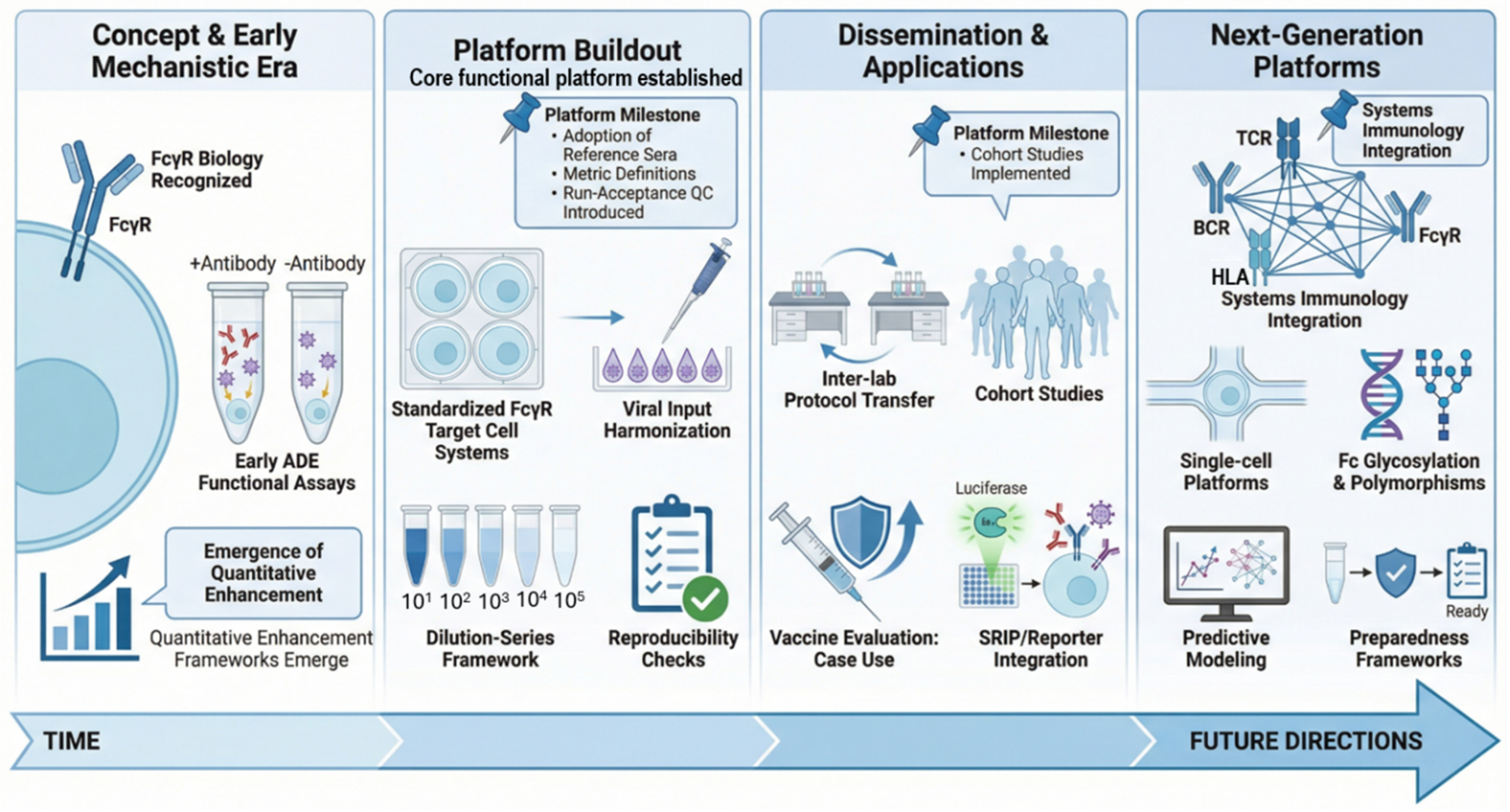
Figure 2.
End-to-end functional ADE platform pipeline for standardized evaluation and interpretation. Modular representation of an integrated functional ADE assessment platform, illustrating key analytical stages from experimental inputs to decision-relevant outputs. Module A defines core inputs, including serum or purified immunoglobulin, viral preparations (live virus, reporter systems, or SRIPs), FcγR-relevant target cells, and reference controls. Module B depicts immune-complex formation across standardized dilution series under controlled incubation conditions. Module C represents FcγR-dependent uptake and entry, influenced by receptor density and cellular state. Module D summarizes primary functional readouts, including infection frequency, reporter activity, viral RNA or antigen levels, progeny production, and optional cytokine measurements. Module E outlines normalization and quality-control procedures, incorporating virus-only baselines, positive control sera, plate controls, batch tracking, and acceptance thresholds to enable cross-site harmonization. Module F illustrates quantitative metrics and interpretive frameworks, including peak enhancement (E_max), area-under-curve (AUC) measures, threshold-based indices, and enhancement–neutralization zoning. Module G provides an optional advanced layer integrating immune repertoire, Fc glycosylation, host genetic, and single-cell data to support contextualized risk stratification and translational decision-making.
Figure 2.
End-to-end functional ADE platform pipeline for standardized evaluation and interpretation. Modular representation of an integrated functional ADE assessment platform, illustrating key analytical stages from experimental inputs to decision-relevant outputs. Module A defines core inputs, including serum or purified immunoglobulin, viral preparations (live virus, reporter systems, or SRIPs), FcγR-relevant target cells, and reference controls. Module B depicts immune-complex formation across standardized dilution series under controlled incubation conditions. Module C represents FcγR-dependent uptake and entry, influenced by receptor density and cellular state. Module D summarizes primary functional readouts, including infection frequency, reporter activity, viral RNA or antigen levels, progeny production, and optional cytokine measurements. Module E outlines normalization and quality-control procedures, incorporating virus-only baselines, positive control sera, plate controls, batch tracking, and acceptance thresholds to enable cross-site harmonization. Module F illustrates quantitative metrics and interpretive frameworks, including peak enhancement (E_max), area-under-curve (AUC) measures, threshold-based indices, and enhancement–neutralization zoning. Module G provides an optional advanced layer integrating immune repertoire, Fc glycosylation, host genetic, and single-cell data to support contextualized risk stratification and translational decision-making.
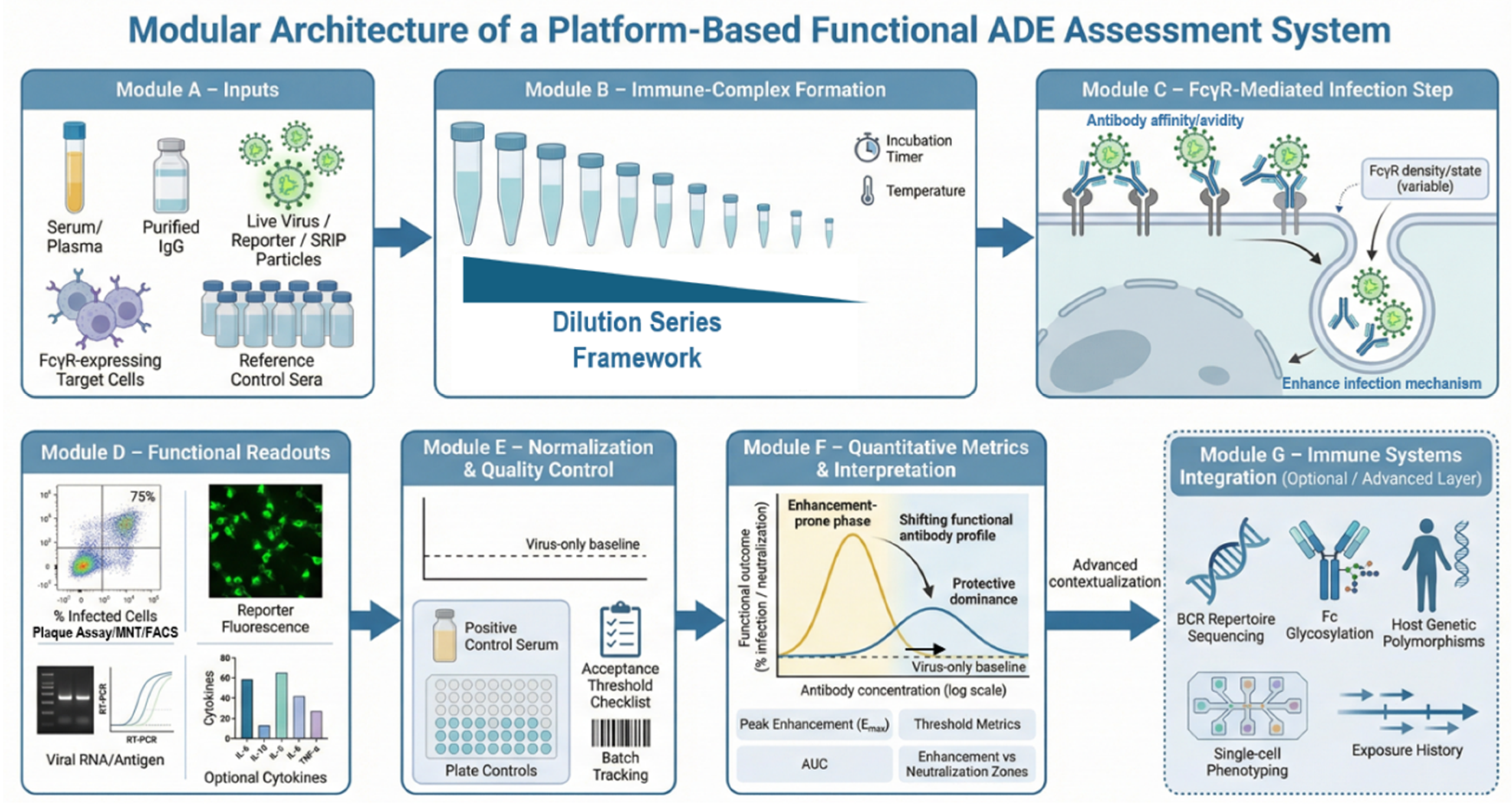
Figure 3.
Standardized assay-metric framework for consistent quantification and reporting of ADE. Framework summarizing recommended terminology, response profiles, and reporting standards for functional ADE analyses. (A) Terminology box defining commonly used quantitative metrics, including enhancement fold-change relative to virus-only baselines, peak enhancement (E_max), enhancement area under the curve (E_AUC), delineation of neutralization and enhancement zones, and threshold-based measures. (B) Representative functional response profiles observed across antibody dilution series in polyclonal flavivirus immunity, illustrating enhancement-dominant, neutralization-dominant, and transitional patterns. These profiles reflect graded shifts in functional dominance rather than binary classification. (C) Context-aware reporting standards for vaccine evaluation, cohort studies, and surveillance applications, highlighting key parameters required for reproducibility and inter-study comparability, including dilution range, baseline definition, replicate structure, viral input specification, and verification of FcγR-relevant target-cell characteristics. Together, these components support harmonized data interpretation and facilitate cross-platform integration.
Figure 3.
Standardized assay-metric framework for consistent quantification and reporting of ADE. Framework summarizing recommended terminology, response profiles, and reporting standards for functional ADE analyses. (A) Terminology box defining commonly used quantitative metrics, including enhancement fold-change relative to virus-only baselines, peak enhancement (E_max), enhancement area under the curve (E_AUC), delineation of neutralization and enhancement zones, and threshold-based measures. (B) Representative functional response profiles observed across antibody dilution series in polyclonal flavivirus immunity, illustrating enhancement-dominant, neutralization-dominant, and transitional patterns. These profiles reflect graded shifts in functional dominance rather than binary classification. (C) Context-aware reporting standards for vaccine evaluation, cohort studies, and surveillance applications, highlighting key parameters required for reproducibility and inter-study comparability, including dilution range, baseline definition, replicate structure, viral input specification, and verification of FcγR-relevant target-cell characteristics. Together, these components support harmonized data interpretation and facilitate cross-platform integration.
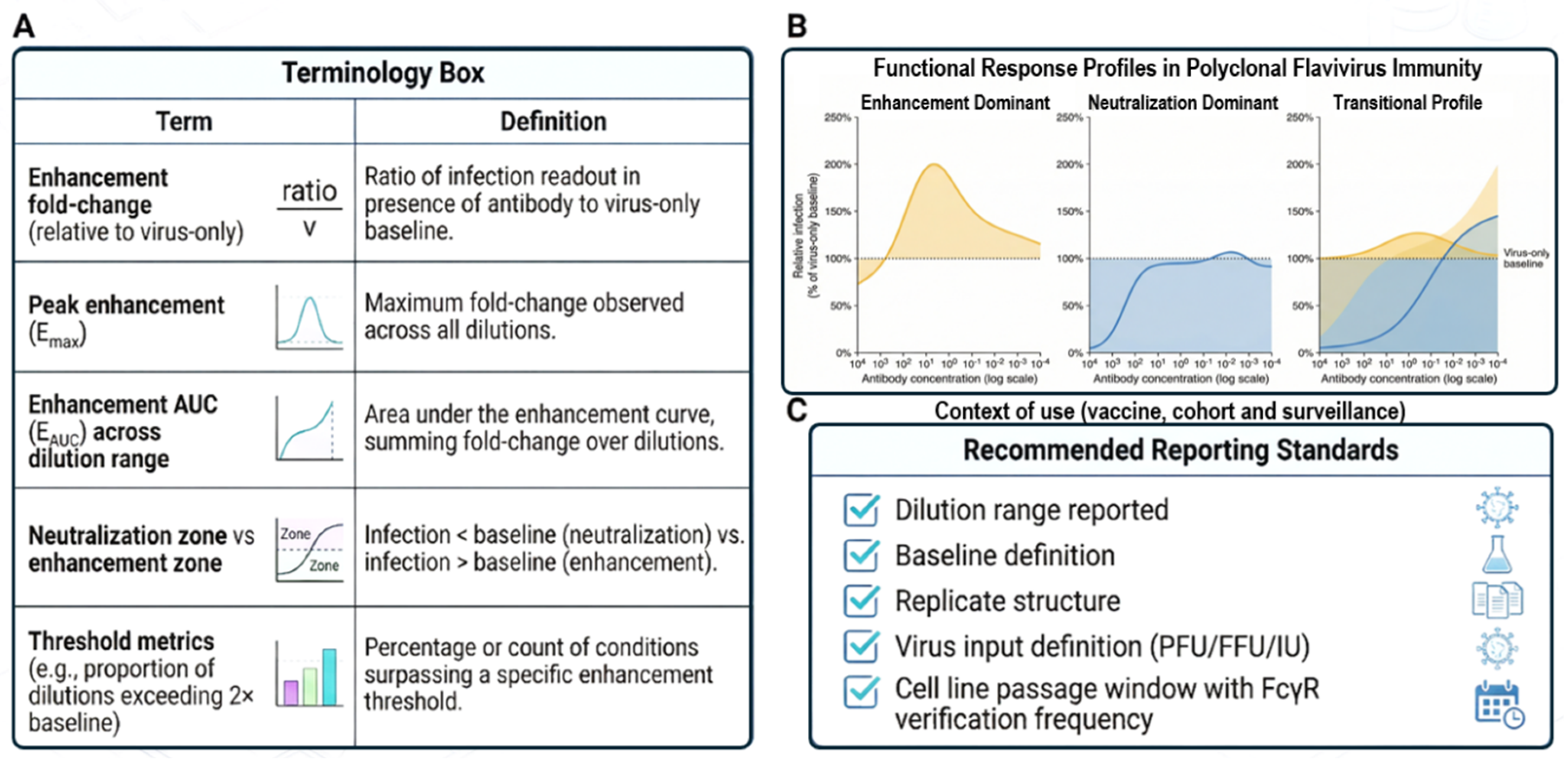
Figure 4.
Functional interpretation of antibody-dependent enhancement as a dynamic immune state. Conceptual model illustrating how neutralization and enhancement emerge as interrelated functional outcomes across antibody concentration and immune-context gradients. Yellow shading denotes enhancement-prone (ADE) functional states, whereas blue shading denotes neutralization-dominant protective states. (A) Representative antibody dilution–response profiles demonstrating overlapping neutralization (blue) and enhancement (yellow) zones within polyclonal sera, including coexistence regions and context-dependent transitions. (B) Influence of epitope specificity, Fcγ receptor engagement, and cellular context on functional outcomes following immune-complex uptake and endosomal processing. (C) Longitudinal evolution of functional antibody profiles following sequential flavivirus exposure. In immunologically naïve individuals, functional readouts remain near baseline. Following primary infection, cross-reactive and subneutralizing antibodies generate a transient enhancement-prone profile. After secondary infection and immune maturation, profiles progressively shift toward neutralization-dominant states, reflecting increased affinity, breadth, and stoichiometric coverage. This trajectory illustrates that functional ADE signatures evolve dynamically over time rather than representing fixed immunological status. (D) Platform-based interpretation pipeline integrating quantitative enhancement metrics with clinical and immunological context to support translational interpretation and precision risk stratification. This framework interfaces with emerging systems immunology and repertoire-based analytics, enabling integration of functional ADE metrics with BCR/TCR profiling, Fc glycosylation patterns, host genetic variation, and predictive modeling. Together, these panels emphasize that ADE represents a context-dependent, dynamic functional state rather than an intrinsic indicator of vaccine failure or adverse immunological risk.
Figure 4.
Functional interpretation of antibody-dependent enhancement as a dynamic immune state. Conceptual model illustrating how neutralization and enhancement emerge as interrelated functional outcomes across antibody concentration and immune-context gradients. Yellow shading denotes enhancement-prone (ADE) functional states, whereas blue shading denotes neutralization-dominant protective states. (A) Representative antibody dilution–response profiles demonstrating overlapping neutralization (blue) and enhancement (yellow) zones within polyclonal sera, including coexistence regions and context-dependent transitions. (B) Influence of epitope specificity, Fcγ receptor engagement, and cellular context on functional outcomes following immune-complex uptake and endosomal processing. (C) Longitudinal evolution of functional antibody profiles following sequential flavivirus exposure. In immunologically naïve individuals, functional readouts remain near baseline. Following primary infection, cross-reactive and subneutralizing antibodies generate a transient enhancement-prone profile. After secondary infection and immune maturation, profiles progressively shift toward neutralization-dominant states, reflecting increased affinity, breadth, and stoichiometric coverage. This trajectory illustrates that functional ADE signatures evolve dynamically over time rather than representing fixed immunological status. (D) Platform-based interpretation pipeline integrating quantitative enhancement metrics with clinical and immunological context to support translational interpretation and precision risk stratification. This framework interfaces with emerging systems immunology and repertoire-based analytics, enabling integration of functional ADE metrics with BCR/TCR profiling, Fc glycosylation patterns, host genetic variation, and predictive modeling. Together, these panels emphasize that ADE represents a context-dependent, dynamic functional state rather than an intrinsic indicator of vaccine failure or adverse immunological risk.
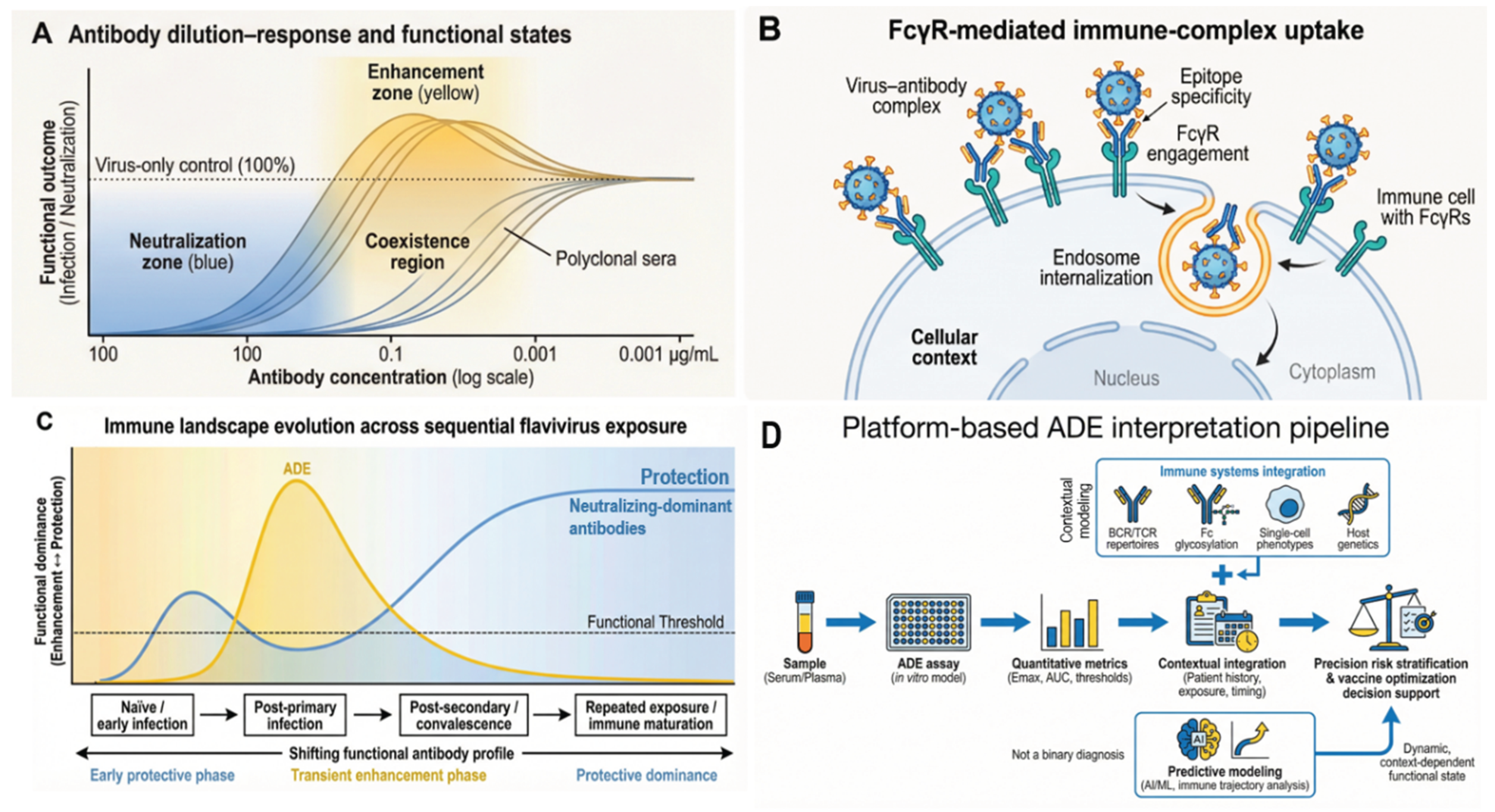
Disclaimer/Publisher’s Note: The statements, opinions and data contained in all publications are solely those of the individual author(s) and contributor(s) and not of MDPI and/or the editor(s). MDPI and/or the editor(s) disclaim responsibility for any injury to people or property resulting from any ideas, methods, instructions or products referred to in the content. |
© 2026 by the authors. Licensee MDPI, Basel, Switzerland. This article is an open access article distributed under the terms and conditions of the Creative Commons Attribution (CC BY) license (http://creativecommons.org/licenses/by/4.0/).
Copyright: This open access article is published under a Creative Commons CC BY 4.0 license, which permit the free download, distribution, and reuse, provided that the author and preprint are cited in any reuse.