
Submitted:
06 February 2026
Posted:
11 February 2026
You are already at the latest version
Abstract
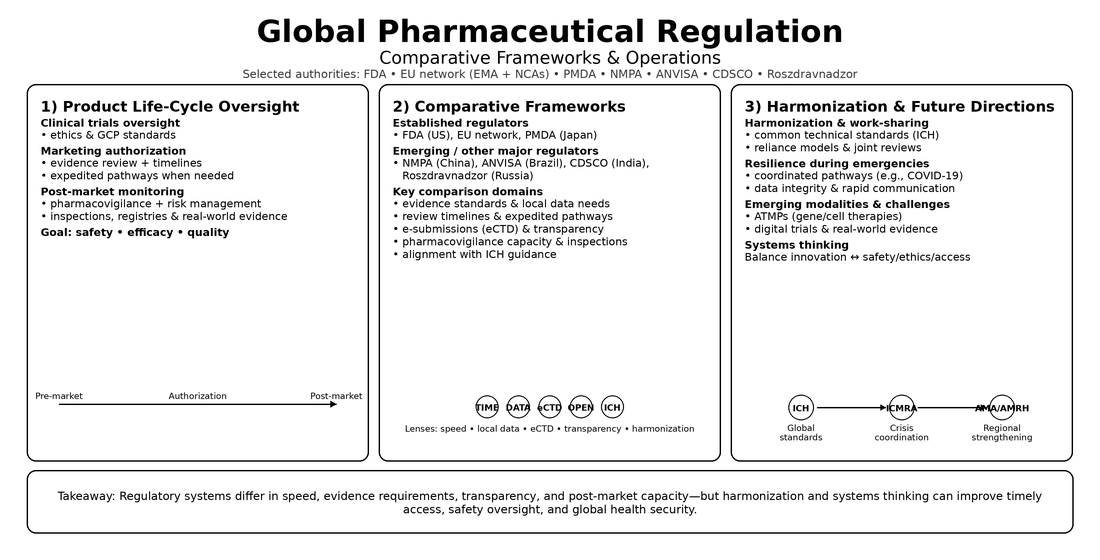
Pharmaceutical regulation and healthcare governmental agencies are central to protecting public health by governing clinical trials, market authorization, and post-market safety monitoring of medicinal products worldwide. Although substantial literature describes major established systems, particularly the United States Food and Drug Administration (FDA), Japan's Pharmaceuticals and Medical Devices Agency (PMDA), and the European Union regulatory network coordinated by the European Medicines Agency (EMA) together with national competent authorities, comparative analysis that integrate both established and emerging regulatory authorities remain limited. This review examines the core functions of regulatory affairs across the product life cycle and compares key features of global regulatory frameworks, including approval pathways, evidentiary expectations, data transparency, and pharmacovigilance approaches. It emphasizes the need for systems thinking to balance innovation with safety, efficacy, and quality, while anticipating unintended consequences of new therapies. This evaluation also highlights how region‑specific constraints and enabling infrastructures, such as national drug‑utilization registries in parts of Europe, can shape regulatory decision‑making and post‑market evaluation. Finally, this paper discusses opportunities for stronger international alliances and greater harmonization to improve efficiency, support timely patient access to essential therapies, strengthen risk management, and reinforce global health security in an increasingly interconnected healthcare environment.
Keywords:
pharmacovigilance
; drug development
; post-marketing surveillance
; global pharmaceutical regulation
; regulatory frameworks
Copyright: This open access article is published under a Creative Commons CC BY 4.0 license, which permit the free download, distribution, and reuse, provided that the author and preprint are cited in any reuse.


