

Submitted:
08 February 2026
Posted:
10 February 2026
You are already at the latest version
Abstract
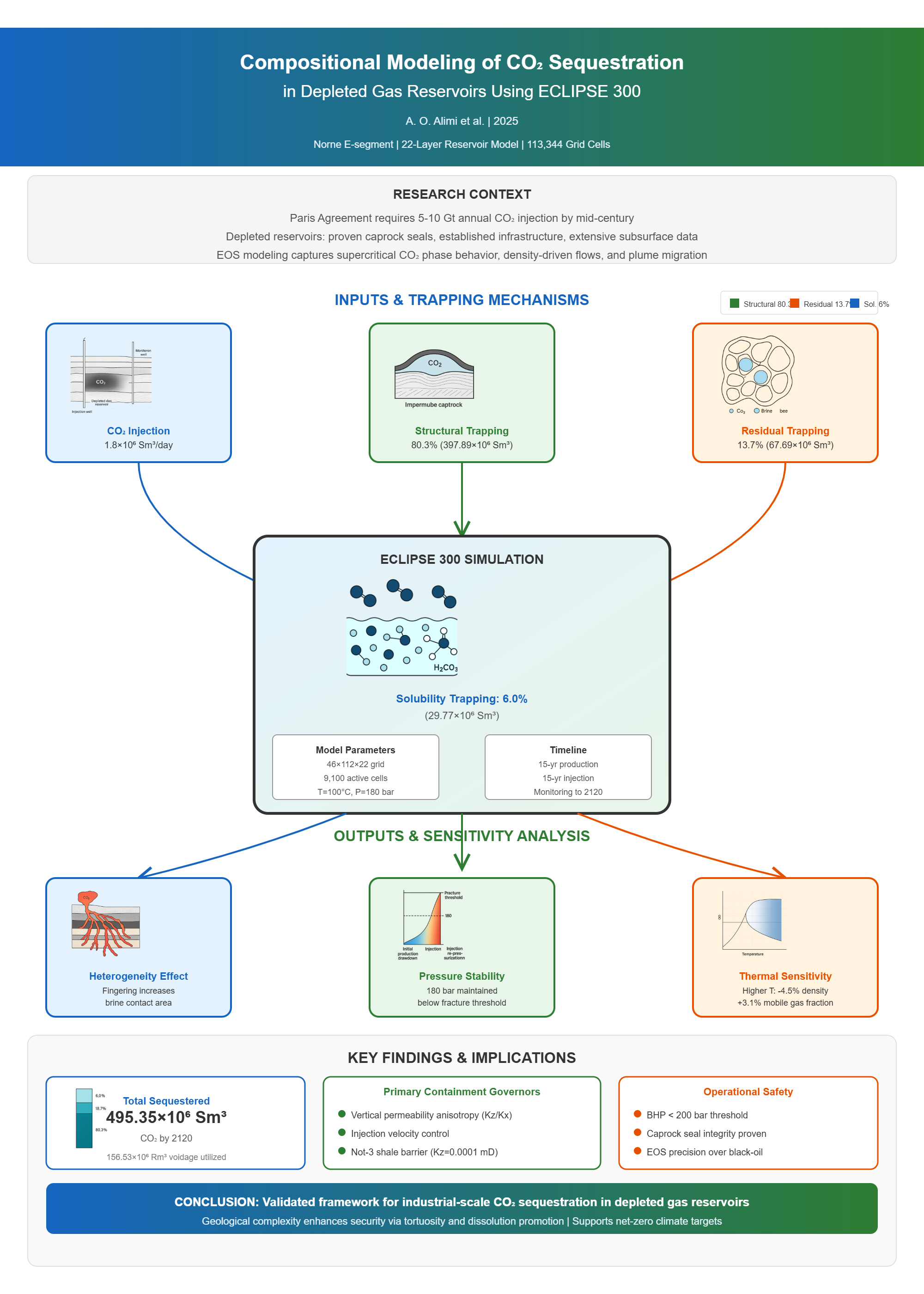
Utilizing depleted gas reservoirs for geological carbon sequestration offers a robust, technically viable pathway for large-scale greenhouse gas mitigation. This research utilizes ECLIPSE 300 to execute a rigorous compositional reservoir simulation, advancing a preliminary undergraduate investigation into a high-fidelity assessment of subsurface CO2 behavior. Central to this study is a sophisticated equation-of-state (EOS) model designed to track the long-term lifecycle of injected CO2, specifically focusing on plume migration patterns, pressure stabilization, and the multifaceted trapping mechanisms that ensure storage integrity. By systematically varying parameters such as permeability anisotropy, thermal regimes, and geological heterogeneity, the analysis identifies vertical permeability and injection velocity as the primary determinants of containment efficiency. The findings demonstrate that while depleted fields possess the capacity for significant CO2 volumes, the accuracy of storage projections depends heavily on compositional modeling rather than simplified black-oil approaches. These insights provide a refined framework for the technical screening and operational design of industrial-scale sequestration initiatives.
Keywords:
CO2 sequestration
; depleted gas reservoirs
; compositional modeling
; ECLIPSE300
; sensitivity analysis
; structural trapping
; CO2 storage
; reservoir heterogeneity
Copyright: This open access article is published under a Creative Commons CC BY 4.0 license, which permit the free download, distribution, and reuse, provided that the author and preprint are cited in any reuse.


