Submitted:
11 February 2026
Posted:
13 February 2026
You are already at the latest version
Abstract
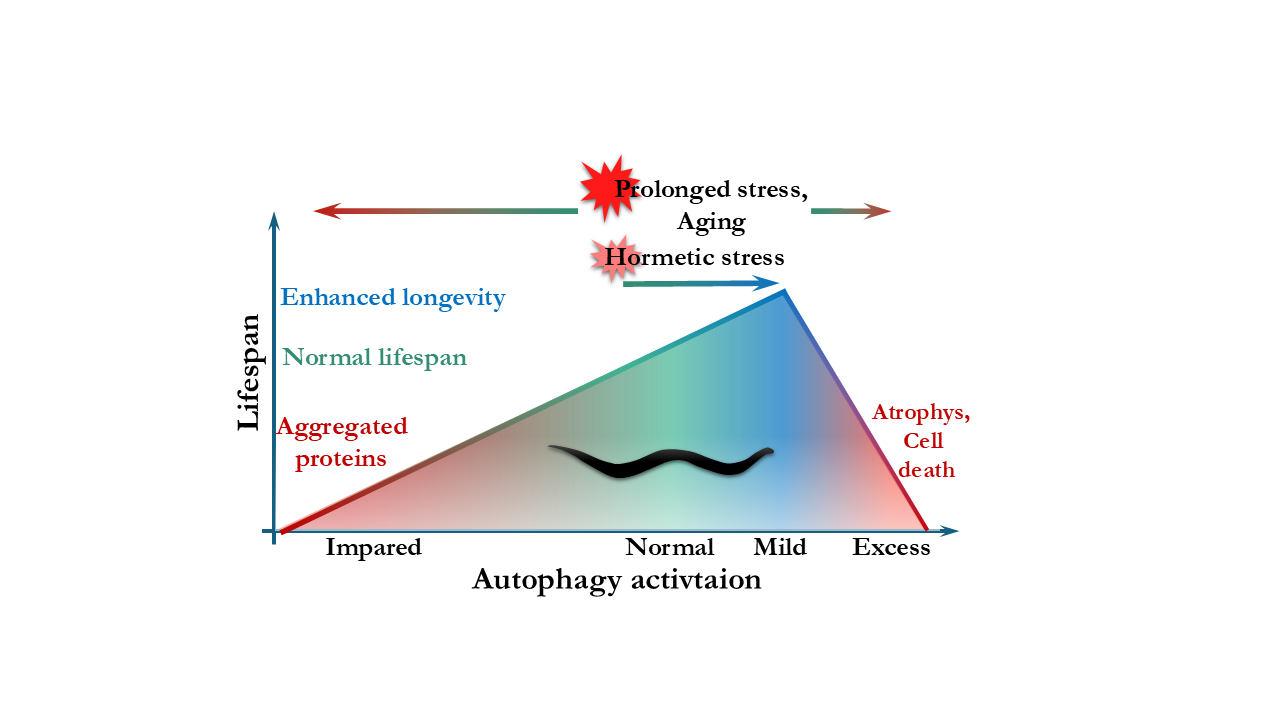
Autophagy is a tightly regulated catabolic process essential for cellular homeostasis, stress adaptation, and regeneration. In the nematode Caenorhabditis elegans, with its short lifespan, transparent body, and well-defined genetics, the process can be investigated at tissue- and age-specific manner, making it an excellent model to study the connection between autophagy and longevity. While autophagy is indispensable for development and homeostasis, recent studies have revealed that its role in aging is more complex than previously thought. During post-reproductive life, autophagic flux and the degradative capacity of lysosomes decline, resulting in the accumulation of undegraded material and cellular stress. Several studies have demonstrated that the experimental modulation of core autophagy in aged or post-reproductive C. elegans, particularly in neurons, can improve proteostasis, preserve tissue integrity, and extend lifespan. Here we review the current results obtained using the genetic model system Caenorhabditis elegans that link autophagy to lifespan regulation. We focus on studies that investigate unexpected, context-dependent, or deleterious effects of inhibiting autophagy-related genes during aging. We also discuss how age- and tissue-specific modulation of autophagy could define the most effective strategies for promoting healthy aging. This could provide relevant insights for the therapeutic targeting of autophagy in humans.