

Submitted:
08 February 2026
Posted:
09 February 2026
Read the latest preprint version here
Abstract
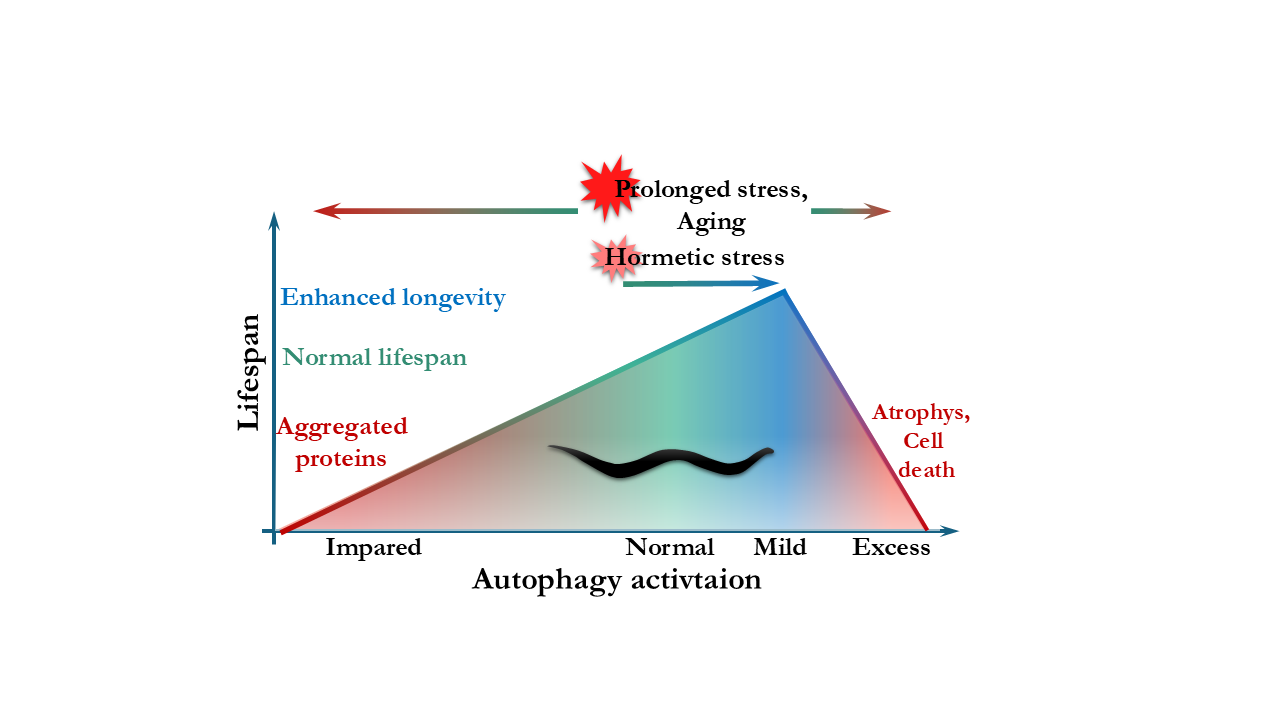
Autophagy is a tightly regulated catabolic process essential for cellular homeostasis, stress adaptation, and regeneration. In the nematode Caenorhabditis elegans, with its short lifespan, transparent body, and well-defined genetics, the process can be investigated at tissue- and age-specific manner, making it an excellent model to study the connection between autophagy and longevity. While autophagy is indispensable for development and homeostasis, recent studies have revealed that its role in aging is more complex than previously thought. During post-reproductive life, autophagic flux and the degradative capacity of lysosomes decline, resulting in the accumulation of undegraded material and cellular stress. Several studies have demonstrated that the experimental modulation of core autophagy in aged or post-reproductive C. elegans, particularly in neurons, can improve proteostasis, preserve tissue integrity, and extend lifespan. Here we review the current results obtained using the genetic model system Caenorhabditis elegans that link autophagy to lifespan regulation. We focus on studies that investigate unexpected, context-dependent, or deleterious effects of inhibiting autophagy-related genes during aging. We also discuss how age- and tissue-specific modulation of autophagy could define the most effective strategies for promoting healthy aging. This could provide relevant insights for the therapeutic targeting of autophagy in humans.
Keywords:
1. Introduction
2. C. elegans as a Model Organism to Study Autophagy
2. Elevated Autophagic Activity Is Required for Lifespan Extension
3. Dysregulation of Autophagy Can Lead to Disadvantageous Effects in C. elegans
4. Unexpected Negative Effects of Autophagy on Lifespan in C. elegans
4. Context-Dependent Effect of Autophagy on Aging
5. Relevance to Human Disease
6. Conclusions
Author Contributions
Funding
Institutional Review Board Statement
Informed Consent Statement
Data Availability Statement
Acknowledgments
Conflicts of Interest
Abbreviations
| AID | Auxin-inducible degradation |
| atg | Autophagy-related genes |
| C. elegans | Caenorhabditis elegans |
| FOXA | Forkhead box A |
| HLH-30 | Helix-loop-helix protein 30 |
| IGF-1 | Insulin growth factor 1 |
| PHA-4 | Pharynx Defective protein 4 |
| PLPs | Pseudocoelomic lipoprotein pools |
| RNAi | RNA interference |
| SID | Systemic RNA interference defective |
| TFEB | Transcription factor EB |
| TOR | Target of Rapamycin |
| TLs | Tubular lysosomes |
References
- Mizushima, N. A brief history of autophagy from cell biology to physiology and disease. Nat. Cell Biol. 2018, 20, 521–527. [CrossRef]
- Mizushima. N., Komatsu, M. Autophagy: renovation of cells and tissues. Cell. 2011 11;147(4):728-41. [CrossRef]
- Levine, B.; Kroemer, G. Biological functions of autophagy genes: A disease perspective. Cell 2019, 176, 11–42. [CrossRef]
- Hollenstein, D.M.; Kraft, C. Autophagosomes are formed at a distinct cellular structure. Curr. Opin. Cell Biol. 2020, 65, 50–57. [CrossRef]
- Mizushima, N. Autophagy: Process and function. Genes Dev. 2007, 21, 2861–2873. [CrossRef]
- Ohsumi, Y. Historical landmarks of autophagy research. Cell Res. 2014, 24, 9–23. [CrossRef]
- Kuma, A.; et al. The role of autophagy during the early neonatal starvation period. Nature 2004, 432, 1032–1036. [CrossRef]
- Gatica, D.; Lahiri, V.; Klionsky, D.J. Cargo recognition and degradation by selective autophagy. Nat. Cell Biol. 2018, 20, 233–242. [CrossRef]
- Palmisano, N.J.; Meléndez, A. Autophagy in C. elegans development. Dev. Biol. 2019, 447, 103–125. [CrossRef]
- Tian, Y.; et al. C. elegans screen identifies autophagy genes specific to multicellular organisms. Cell 2010, 141, 1042–1055. [CrossRef]
- Tóth, M.L.; et al. Longevity pathways converge on autophagy genes to regulate life span in Caenorhabditis elegans. Autophagy 2008, 4, 330–338. [CrossRef]
- Hars, E.S.; et al. Autophagy regulates ageing in C. elegans. Autophagy 2007, 3, 93–95. [CrossRef]
- Wilhelm, T.; et al. Neuronal inhibition of autophagy extends lifespan. Genes Dev. 2017, 31, 1561–1572. [CrossRef]
- Ezcurra, M.; et al. Intestinal autophagy in aging. Curr. Biol. 2018, 28, 2544–2556.e5. [CrossRef]
- Alberti, A.; Michelet, X.; Djeddi, A.; Legouis, R. The autophagosomal protein LGG-2 acts synergistically with LGG-1 in dauer formation and longevity in C. elegans. Autophagy 2010, 6, 622–633. [CrossRef]
- Palikaras, K.; Tavernarakis, N. In vivo mitophagy monitoring in Caenorhabditis elegans to determine mitochondrial homeostasis. Bio Protoc. 2017, 7, e2215. [CrossRef]
- Kumsta, C.; et al. The autophagy receptor p62/SQST-1 promotes proteostasis and longevity in C. elegans. Nat. Commun. 2019, 10, 5648. [CrossRef]
- Palikaras, K.; Lionaki, E.; Tavernarakis, N. Coordination of mitophagy and mitochondrial biogenesis during ageing in C. elegans. Nature 2015, 521, 525–528. [CrossRef]
- Blackwell, T.K.; Sewell, A.K.; Wu, Z.; Han, M. TOR signaling in Caenorhabditis elegans development, metabolism, and aging. Genetics 2019, 213, 329–360. [CrossRef]
- Vellai, T.; et al. Influence of TOR kinase on lifespan in C. elegans. Nature 2003, 426, 620. [CrossRef]
- Kenyon, C.; et al. A C. elegans mutant that lives twice as long as wild type. Nature 1993, 366, 461–464. [CrossRef]
- Lan, J.; et al. Translational regulation of non-autonomous mitochondrial stress response promotes longevity. Cell Rep. 2019, 28, 1050–1062.e6. [CrossRef]
- Panowski, S.H.; et al. PHA-4/Foxa mediates diet-restriction-induced longevity of C. elegans. Nature 2007, 447, 550–555. [CrossRef]
- O’Rourke, E.J.; Ruvkun, G. MXL-3 and HLH-30 link lipolysis and autophagy to nutrient availability. Nat. Cell Biol. 2013, 15, 668–676. [CrossRef]
- Visvikis, O.; et al. Innate host defense requires TFEB-mediated transcription. Immunity 2014, 40, 896–909. [CrossRef]
- Hansen, M.; et al. Autophagy in lifespan extension by dietary restriction in C. elegans. PLoS Genet. 2008, 4, e24. [CrossRef]
- Guo, B.; et al. Genome-wide screen identifies regulators of autophagy in C. elegans. EMBO Rep. 2014, 15, 705–713. [CrossRef]
- Bördén, K.; Vellai, T.; Sigmond, T. Developing endogenous autophagy reporters in C. elegans. Int. J. Mol. Sci. 2025, 26, 10178. [CrossRef]
- Conte, D.; et al. RNA interference in C. elegans. Curr. Protoc. Mol. Biol. 2015, 109, 26.3.1–26.3.30. [CrossRef]
- Maher, K.N.; et al. Large-scale gene knockdown in C. elegans. J. Vis. Exp. 2013, 79, e50693. [CrossRef]
- Calixto, A.; et al. Enhanced neuronal RNAi in C. elegans. Nat. Methods 2010, 7, 554–559. [CrossRef]
- Whangbo, J.S.; et al. SID-1 domains important for dsRNA import. G3 2017, 7, 3887–3899. [CrossRef]
- Vicencio, J.; et al. Engineering the auxin-inducible degron system. Nat. Commun. 2025, 16, 10848. [CrossRef]
- Son, H.G.; et al. Age-dependent biomarkers in C. elegans. Aging Cell 2019, 18, e12853. [CrossRef]
- Meléndez, A.; et al. Autophagy genes are essential for dauer development. Science 2003, 301, 1387–1391. [CrossRef]
- Long, X.; et al. TOR deficiency causes developmental arrest. Curr. Biol. 2002, 12, 1448–1461. [CrossRef]
- Gelino, S.; et al. Intestinal autophagy improves healthspan. PLoS Genet. 2016, 12, e1006135. [CrossRef]
- Hsieh, P.N.; et al. Conserved KLF-autophagy pathway. Nat. Commun. 2017, 8, 914. [CrossRef]
- Vérièpe-Salerno, J.; et al. MALT-1 shortens lifespan. Autophagy Rep. 2023, 2, 2277584. [CrossRef]
- Villalobos, T.V.; et al. Tubular lysosome induction. Nat. Aging 2023, 3, 1091–1106. [CrossRef]
- Sigmond, T.; Vellai, T. Lysosomal alteration links food limitation to longevity. Nat. Aging 2023, 3, 1048–1050. [CrossRef]
- Dolese, D.A.; et al. Tubular lysosomes link pexophagy and aging. Autophagy 2021, 1–12. [CrossRef]
- Kumsta, C.; et al. Hormetic heat stress induces autophagy. Nat. Commun. 2017, 8, 14337. [CrossRef]
- Lapierre, L.R.; et al. Autophagy genes regulate lipid levels. Autophagy 2013, 9, 278–286. [CrossRef]
- Chen, Y.-L.; et al. PAQR-2 regulates longevity via autophagy. Nat. Commun. 2019, 10, 2602. [CrossRef]
- Edwards, C.; et al. Amino acid-mediated lifespan extension. BMC Genet. 2015, 16, 8. [CrossRef]
- Yang, J.; et al. miR-34 regulates lifespan via atg9. Age 2013, 35, 11–22. [CrossRef]
- Hansen, M.; Rubinsztein, D.C.; Walker, D.W. Autophagy and longevity. Nat. Rev. Mol. Cell Biol. 2018, 19, 579–593. [CrossRef]
- Madeo, F.; et al. Essential role for autophagy in lifespan extension. J. Clin. Invest. 2015, 125, 85–93. [CrossRef]
- Castillo-Quan, J.I.; et al. Genetics of longevity. Adv. Genet. 2015, 90, 1–101. [CrossRef]
- Gelino, S.; Hansen, M. Autophagy and aging. J. Clin. Exp. Pathol. 2012, Suppl. 4. [CrossRef]
- Maiuri, M.C.; Kroemer, G. Autophagy in stress and disease. Cell Death Differ. 2015, 22, 365–366. [CrossRef]
- Levine, B.; Kroemer, G. Autophagy in aging and disease. Cell Death Differ. 2009, 16, 1–2. [CrossRef]
- Tóth, M.L.; et al. Autophagy genes and neurodegeneration. J. Cell Sci. 2007, 120, 1134–1141. [CrossRef]
- Kang, C.; You, Y.; Avery, L. Dual roles of autophagy in starvation. Genes Dev. 2007, 21, 2161–2171. [CrossRef]
- Zhou, B.; et al. Mitochondrial permeability and lifespan. Cell 2019, 177, 299–314.e16. [CrossRef]
- Sakai, N.; et al. TORC2 signaling in learning. PLoS ONE 2017, 12, e0177900. [CrossRef]
- Franco-Juárez, B.; et al. High glucose induces autophagy. Aging 2018, 10, 2657–2667. [CrossRef]
- Takacs, Z.; et al. ATG-18 and EPG-6 in lifespan control. Cells 2019, 8, 236. [CrossRef]
- Lu, Q.; et al. EPG-6 regulates autophagosome formation. Dev. Cell 2011, 21, 343–357. [CrossRef]
- Polson, H.E.J.; et al. WIPI2 regulates LC3 lipidation. Autophagy 2010, 6, 506–522. [CrossRef]
- Hashimoto, Y.; et al. Suppression of autophagy extends lifespan. Genes Cells 2009, 14, 717–726. [CrossRef]
- Byrne, J.; Wilhelm, T.; Richly, H. Neuronal autophagy and longevity. Aging 2017, 9, 1953–1954. [CrossRef]
- Perez, M.F.; Lehner, B. Vitellogenins in C. elegans. Front. Physiol. 2019, 10, 1067. [CrossRef]
- Mizunuma, M.; et al. mTORC2-SGK-1 in longevity. Aging Cell 2014, 13, 869–878. [CrossRef]
- Meléndez, A.; et al. Monitoring autophagy in aging. Methods Enzymol. 2008, 451, 493–520. [CrossRef]
- Palmisano, N.J.; et al. RAB-10 promotes autophagy. Autophagy 2017, 13, 1742–1753. [CrossRef]
- Jenzer, C.; et al. Autophagy in apoptosis. Autophagy 2019, 15, 228–241. [CrossRef]
- Jenzer, C.; et al. Human GABARAP rescues autophagy. Autophagy 2014, 10, 1868–1872. [CrossRef]
- McGhee, J.D. The C. elegans intestine. WormBook 2007, 1–36. [CrossRef]
- Yang, Y.; et al. ATG-16.2 mediates neuronal autophagy. Nat. Aging 2024, 4, 198–212. [CrossRef]
- Jung, R.; et al. Tissue-specific resistance to aggregation. PLoS Biol. 2023, 21, e3002284. [CrossRef]
- Gallardo-Campos, M.; et al. KFERQ-selective autophagy. PLoS ONE 2025, 20, e0330339. [CrossRef]
- Mukherjee, A.; et al. Selective microautophagy in Drosophila. Autophagy 2016, 12, 1984–1999. [CrossRef]
- Nixon, R.A. Autophagy in neurodegeneration. Nat. Med. 2013, 19, 983–997. [CrossRef]
- Murley, A.; et al. Macroautophagy and lysosomal damage. Cell 2025, 188, 2670–2686.e14. [CrossRef]
- Zhong, R.; Richardson, C.E. Lysosomal expansion protects neurons. PLoS Biol. 2025, 23, e3002957. [CrossRef]
- Bansal, A.; et al. Lifespan vs. healthspan. Proc. Natl. Acad. Sci. USA 2015, 112, E277–E286. [CrossRef]
- Huang, C.; et al. Physiological predictors of lifespan. Proc. Natl. Acad. Sci. USA 2004, 101, 8084–8089. [CrossRef]
- Podshivalova, K.; et al. Aging and late-life decline. Cell Rep. 2017, 19, 441–450. [CrossRef]
- Kondapuram, S.K.; et al. Targeting autophagy in cancer. JCMT 2019. [CrossRef]
- Thorburn, A.; et al. Autophagy and cancer therapy. Mol. Pharmacol. 2014, 85, 830–838. [CrossRef]
- Shintani, T.; Klionsky, D.J. Autophagy in health and disease. Science 2004, 306, 990–995. [CrossRef]
- Wong, S.Q.; et al. Autophagy in aging. Hum. Genet. 2020, 139, 277–290. [CrossRef]
- Stavoe, A.K.H.; Holzbaur, E.L.F. Autophagy in neurons. Annu. Rev. Cell Dev. Biol. 2019, 35, 477–500. [CrossRef]
- Djajadikerta, A.; et al. Autophagy induction as therapy. J. Mol. Biol. 2020, 432, 2799–2821. [CrossRef]
- Rahman, M.A.; Rhim, H. Autophagy in neurodegeneration. BMB Rep. 2017, 50, 345–354. [CrossRef]
- Kovács, T.; et al. AUTEN-99 protects against neurodegeneration. Sci. Rep. 2017, 7, 42014. [CrossRef]
- Papp, D.; et al. AUTEN-67 and neuroprotection. Autophagy 2016, 12, 273–286. [CrossRef]
- Billes, V.; et al. AUTEN-67 in Huntington’s disease. J. Huntingtons Dis. 2016, 5, 133–147. [CrossRef]
- Madonna, R.; et al. Empagliflozin and autophagy. Cardiovasc. Res. 2023, 119, 1175–1189. [CrossRef]
- Wei, S.; et al. Arsenic-induced autophagy. J. Hazard. Mater. 2020, 384, 121390. [CrossRef]
- Hartmann, J.; et al. Secretory autophagy and neurodegeneration. Nat. Commun. 2024, 15, 2635. [CrossRef]
- Kaushik, S.; Cuervo, A.M. Proteostasis and aging. Nat. Med. 2015, 21, 1406–1415. [CrossRef]
- Rubinsztein, D.C.; Mariño, G.; Kroemer, G. Autophagy and aging. Cell 2011, 146, 682–695. [CrossRef]
Disclaimer/Publisher’s Note: The statements, opinions and data contained in all publications are solely those of the individual author(s) and contributor(s) and not of MDPI and/or the editor(s). MDPI and/or the editor(s) disclaim responsibility for any injury to people or property resulting from any ideas, methods, instructions or products referred to in the content. |
© 2026 by the authors. Licensee MDPI, Basel, Switzerland. This article is an open access article distributed under the terms and conditions of the Creative Commons Attribution (CC BY) license (http://creativecommons.org/licenses/by/4.0/).


