

Submitted:
21 April 2026
Posted:
07 May 2026
You are already at the latest version
Abstract
This paper introduces the Generalized Coordinate System (GCS) as a framework for analyzing and generating rhetorical modes---the conventional patterns of discourse. The GCS is composed of low-dimensional, mediating and high-dimensional axes. The low-dimensional axes are Thing, Feature, Quantitative Attribute, Qualitative Attribute, Formal Attribute axes and form the objects or foundational elements for rhetorical modes. The mediating axes are Basic Expressive-Representational Elements and Rhetorical Mode axes and transform the raw material into communicable languages. The high-dimensional axes include Cognitive Function axis, Epistemic Purpose axis and the Five-Level Expression Staircase axis (Depth axis). The high-dimensional axes determine the cognitive depth and ultimate purpose, and capture the developmental progression of language competence- from raw perception to paradigm-shattering insight. Three types of semantic or modal mapping are defined: low-dimensional mapping (from low-dimensional axes to the mediating axes), high-dimensional mapping (from the mediating axes to high-dimensional axes), and full-dimensional mapping. These mappings form a pyramidal hierarchy, progressing from foundational elements (things, features, and attributes) to higher-order cognitive functions and epistemic purposes. By employing three core logical structures---combinatory, parallel, and embedded---the GCS consolidates infinite expressive possibilities within the finite intersections of its axes. The system's generative capacity, quantifiable by the number of axis intersections (generalized mode number), enables the navigation of nearly infinite expressive variations while steering practical applications toward finite, purpose-driven goals. The GCS transitions rhetorical modes from a static taxonomy to a dynamic analytical system for discourse construction and analysis, offering possibly insights for the development of large language models through the integration of a programmable rhetorical mode system.
Keywords:
rhetorical modes
; generalized coordinate system
; cognitive functions
; low-dimensional mapping
; high-dimensional mapping
; full-dimensional mapping
1. Introduction
Rhetorical modes have a long and rich history of development, dating back to the foundational works of Aristotle (c. 335 BCE/2007), Bain (1866), Hill (1895), and Connors (1997). Modern comprehensive composition textbooks continue to highlight an overlapping cluster of rhetorical modes (e.g., Corbett & Connors, 1999; Hacker & Sommers, 2022; Kirszner & Mandell, 1986; Lunsford, 2021; Lunsford, Ruszkiewicz & Walters, 2021; Nadell, Langan & Coxwell-Teague, 2019; Oshima & Hogue, 2007; Smalley, Ruetten & Kozyrev, 2011). These modes are primarily known through their application in writing practice. For example, rhetorical modes serve as the second layer in the progressive four-level writing method that progresses from the basic expression layer, through the academic mapping layer, to the functional unit layer, and finally, to the thesis integral layer (Wu, 2026).
In contemporary times, despite the ongoing evolution of academic discourse, a core group of rhetorical modes remains central in numerous authoritative writing and rhetoric textbooks (e.g., Corbett & Connors, 1999; Lunsford, 2021). This enduring presence underscores the theoretical vitality and practical utility of rhetorical modes, both as analytical tools and pedagogical methods. While the spectrum of rhetorical modes continues to evolve, recent proposals, such as Wu’s (2025) duality mode operation method, offer new ways to generate and expand these modes.
However, a review of this tradition reveals that much of the research and pedagogical focus has centered on identifying and imitating rhetorical modes, often treating them as isolated textual techniques. Despite the growing diversity of modes, there remains a lack of an integrated theoretical framework that bridges linguistic form, cognitive processes, and real-world applications. Specifically, existing systems have yet to systematically address several interconnected core questions that can be pointed to multi-modes in the real world (Figure 1):
- What specific objects (entities) do these modes operate upon?
- What multimodal semiotic resources (media) do they rely on?
- How do they align with fundamental human cognitive functions (mind)?
- How do they ultimately serve real-world social practices (purpose)?
- More importantly, how does an individual’s competence in utilizing these modes progressively develop and differentiate (agent development)?
To address these questions, this paper proposes a theoretical framework - the General Coordinate System (GCS) of Rhetorical Modes, following ontologies which explicitly represent domains by defining the entities, properties, and relationships that constitute the real world and serve as semantic models, capturing and representing various aspects of reality (Obrst et al., 2007). The GCS consists of ten dimensions as shown in Table 1, each corresponding to a generalized coordinate axis, with specific expressions represented as generalized coordinate points within this system.
These generalized coordinate axes fall into three types: low-dimensional axes, mediating and ontological axes, and high-dimensional axes. Low-dimensional refers to the foundational, more basic axes and includes the Thing Axis (Object Category), the Feature Axis (Analytic Feature), the Quantitative Attribute Axis, the Qualitative Attribute Axis, the Formal Attribute Axis. The mediating axes makes bridge between low-dimensional axes and high-dimensional axes, and include Basic Expressive-Representational Elements Axis (Multimodal Symbolic Resources) and the Ontological or Rhetorical Mode axis (Various Rhetorical Modes). High-dimensional refers to higher-level axes, including the Cognitive Function axis, the Epistemic Purposes axis, and the Five-Level Expression Staircase Model Axis (User Competency Development Ladder).
The generalized coordinate axes are designed to encompass all elements relevant to the application of rhetorical modes. Each of the ten generalized coordinate axes listed in Table 1 is divided into several representative (though not necessarily exhaustive) subcategories, which we dub major ticks (MT). The representativeness of these major ticks can be further specified by minor ticks beneath them. Section 2-4 describe the low-dimensional axes, the mediating axes and the high-dimensional axes.
The GCS allows for the construction of a pyramid-like mapping model that spans from "what acts upon" (things, features, and attributes), "what to express with" (basic elements), "how to express" (mode types), "what is the purpose" (cognition and application), to "who expresses" (competency development). This model converges infinite expressive possibilities within the finite intersections of the ten axes. Section 5 delves into the transition from static "axes" to a dynamic "system," exploring how various mapping methods can generate and operationalize meaning. The nesting functions mentioned in Section 3 will be defined in Appendix A.
Based on the exposition of the coordinate system’s static composition and dynamic mapping in the preceding sections, Section 6 subjects the descriptive power of this framework to quantitative verification. By calculating the "Generalized Modes Number" (GMn) under mappings from low-dimensional to high-dimensional and full-dimensional configurations, this section visually reveals the near-infinite combinatorial possibilities inherent within the system, thereby providing mathematical confirmation of its richness and expansive potential as a powerful engine for meaning generation.
Section 7 provides a short summary of the work and limitation.
2. Low-Dimensional Coordinate Axes
Low-dimensional axes include the Thing Axis, Analytic Feature Axis, Quantitative Attribute Axis, Qualitative Attribute Axis, and Formal Attribute Axis.
2.1. Introduction of Low-Dimensional Axes
2.1.1. Thing Type Axis (Th)
The first generalized coordinate axis is the Thing Type Axis. We denote the set of major ticks on the Thing Axis (Things) as , where denotes the total number of major ticks on this axis, and (for ) represents the name of each major tick, i.e., the thing category. Here, we introduce five basic thing categories, setting . As illustrated in Figure 2 for the thing axis, the major ticks are:
1. Physical Entity (k=1)
2. Abstract Thing (k=2)
3. Event and Process (k=3)
4. Relation and System (k=4)
5. Mind and Experience (k=5)
Each major tick can be further divided into minor ticks, with varying numbers, potentially inexhaustible. See Table 2 for examples.
2.1.2. Analytic Feature Axis (Ft)
The second generalized coordinate axis is the Analytic Feature Axis. We denote the set of major ticks on the Feature Axis (Features) as , where denotes the total number of major ticks on this axis, and (for ) is the name of each major tick, i.e., the feature category. This paper classifies seven basic feature types, setting . As illustrated in Figure 3 for the feature axis, there are seven major ticks:
1. Morphology and Composition (k=1)
2. State (k=2)
3. Dynamic (k=3)
4. Function (k=4)
5. Relation (k=5)
6. Cognition and Representation (k=6)
7. Origin and History (k=7)
Each major tick can be further divided into minor ticks. For example, minor ticks under "Morphology and Composition" include: - External form - Internal composition - Organizational structure, etc. More details are given in Table 3. For instance, Cognition & Representative focuses on how a phenomenon is received, understood, and expressed by a cognitive agent (such as an observer, user, or theorist). It covers the entire chain from direct sensory experience to the formation of abstract concepts, aiming to analyze how we know a phenomenon and how we analyze it.
2.1.3. Quantitative Attribute Axis (Qt)
The third generalized coordinate axis is Quantitative Attribute. We denote the set of major ticks on the Quantitative Attribute Axis (Quantitative Attributes) as , where denotes the total number of major ticks on this axis, and (for ) is the name of each major tick, i.e., the quantitative attribute category. This paper classifies three basic quantitative attribute types, setting . As illustrated in Figure 4 for this axis, the major ticks are:
1. Basic Measurement (k=1)
2. Quantity and Frequency (k=2)
3. Ratio and Intensity (k=3)
Each major tick can be further divided into minor ticks. For example, minor ticks under "Basic Measurement" include: - Size - Length - Area - Volume - Mass - Temperature - Time point - Coordinates, etc. See Table 4 for more details.
2.1.4. Qualitative Attribute Axis (Ql)
The fourth generalized coordinate axis is Qualitative Attribute. We denote the set of major ticks on the Qualitative Attribute Axis (Qualitative Attributes) as , where denotes the total number of major ticks on this axis, and (for ) is the name of each major tick, i.e., the qualitative attribute category. This paper classifies five basic qualitative attribute types, setting . As illustrated in Figure 5 for this axis, the major ticks are:
1. Shape and Configuration (k=1)
2. Color and Pattern (k=2)
3. Texture and Perception (k=3)
4. Position and Orientation (k=4)
5. Material and Composition (k=5)
Each major tick can be further divided into minor ticks. Each qualitative attribute may have both concrete and abstract ones, see Table 5 for more details.
2.1.5. Formal Attribute Axis (Fm)
The fifth generalized coordinate axis is Formal Attribute. We denote the set of major ticks on the Formal Attribute Axis (Formal Attributes) as , where denotes the total number of major ticks on this axis, and (for ) is the name of each major tick, i.e., the formal attribute category. This paper classifies four basic formal attribute types, setting . As illustrated in Figure 6 for this axis, the major ticks are:
1. Logical Relation (k=1)
2. Functional Structure (k=2)
3. Rule and Constraint (k=3)
4. Symbol and Formula (k=4)
Each major tick can be further divided into minor ticks. For example, minor ticks under "Logical Relation" include: - Inclusion - Equivalence - Causality - Implication, etc. See Table 6 for details.
2.2. Perspectival Low-dimensional Axis Multiplicity
Low-dimensional axes form the foundational bases. Figure 7 shows the relations between various low-dimensional axes, showing that analytical features may be used for each thing, quantitative attribute can be used for things, features, qualitative attribute can be used for things, features, quantative attribute, and formal attribute can be used for things, features, quantative attribute and qualitative attribute.
Perspectival low-dimensional axis multiplicity means that the same referent (thing, feature, or attribute) can be assigned to different major ticks or elements of another low-dimensional axis.
2.2.1. Thing Axis: Perspectival Categorical Multiplicity
For the thing axis, the same referent can be assigned to different major ticks on the Thing Axis, depending on the perspective or the aspect under consideration. We term this property "perspectival categorical multiplicity" or simply "multi-aspectual belonging". For example, consider the entity "student". Depending on which thing category we adopt, the way the student belongs to that category shifts:
- When a student is treated as a Physical Entity, the belonging concerns objective existence: e.g., whether the student exists, is enrolled, or belongs to a certain grade or class.
- When treated as an Abstract Thing, the belonging concerns the attribution of identity or role: e.g., whether the person is a student, a registered student, a domestic or international student, a current or former student.
- When treated as an Event and Process, the belonging concerns the "studenthood" period: its start, end, duration, or stages (e.g., whether the person has received higher education).
- When treated as a Relation and System, the belonging concerns the relational network: e.g., whether the person has a teacher, classmate, or alumni relationship with others.
- When treated as Mind and Experience, the belonging concerns internal perception and experiential facts: e.g., whether the person has a student-like temperament or has experienced a particular learning event.
This example demonstrates that the Thing Axis is not a rigid taxonomy but a flexible framework where the same referent can be re-categorized along different perspectives, each yielding a distinct mode of belonging.
2.2.2. Feature Axis: Perspectival Feature Multiplicity
The same thing can be analyzed along different feature categories depending on which aspect of its nature we focus on. We term this property "perspectival feature multiplicity" or "multi-aspectual feature attribution". For example, consider a "river". Depending on the feature category adopted, the way we characterize the river shifts:
- Under Morphology and Composition: shape, length, width, depth, sediment, water quality.
- Under State: current flow velocity, temperature, turbidity, flooding or drying condition.
- Under Dynamic: erosion, meandering, seasonal variation, long-term course shifts.
- Under Function: water supply, ecosystem support, transportation, hydroelectric power.
- Under Relation: tributaries, watershed boundaries, role within a drainage system.
- Under Cognition and Representation: map naming, cultural significance, scientific measurements.
- Under Origin and History: geological age, glacial source, historical course changes.
This example shows that the Feature Axis, like the Thing Axis, is a flexible framework where the same target can be characterized under multiple feature categories, each offering a distinct analytical lens.
In general, features are considered as features of things. But features can also be considered as things. For instance, each feature can be considered as an abstract thing, and the Relation feature can further be considered as a Relation and System.
2.2.3. Quantitative Attribute Axis: Perspectival Quantitative Multiplicity
Quantitative attributes can be applied to things and features. The same thing or feature can be described using different types of quantitative measures, depending on what aspect of "how much" or "how often" we emphasize. We term this “perspectival quantitative multiplicity”. For example, consider the "growth of a plant", a dynamic feature:
- As Basic Measurement: height 15 cm, leaf area 25 cm2, biomass 30 g.
- As Count and Frequency: number of leaves = 8, watering frequency = 3 times per week.
- As Ratio and Intensity: growth rate = 1.2 cm/day, photosynthetic efficiency = 42%, nutrient concentration = 150 ppm.
Thus, the same plant growth process can be quantified from purely dimensional, frequency-based, or derived intensity perspectives, each revealing a different layer of information.
2.2.4. Qualitative Attribute Axis: Perspectival Qualitative Multiplicity
Thing, Features and Quantitative attributes can be characterized using different qualitative categories, depending on the sensory or metaphorical lens we adopt. We term this "perspectival qualitative multiplicity". For example, consider a "piece of music", an abstract thing:
- Under Shape and Configuration: the melody has an arch-shaped contour, repetitive circular phrases.
- Under Color and Pattern: the timbre is bright and warm, with shimmering texture.
- Under Texture and Perception: the rhythm feels smooth and flowing, the harmony is rich and dense.
- Under Position and Orientation: the main theme appears at the beginning and recurs at the end.
- Under Material and Composition: the composition contains elements of jazz and classical idioms.
Hence, the same musical piece can be qualitatively described from geometric, chromatic, tactile, spatial, and material perspectives, each providing a distinct experiential framing.
2.2.5. Formal Attribute Axis: Perspectival Formal Multiplicity
For formal attributes, the same phenomenon (thing, feature, quantitaive attribute and qualitative attribute) can be expressed through different formal systems, depending on the level of abstraction or the modeling language we choose. We term this "perspectival formal multiplicity". For example, consider the "causal relationship between study time and exam performance", a relation feature:
- As Logical Relation: if study time increases, then exam performance improves (implication).
- As Action Structure: a flow of information from input (study hours) through a processing unit (learning) to output (score).
- As Rule and Constraint: the relationship must satisfy that total study time does not exceed 24 hours per day.
- As Symbol and Formula: , where P is performance and T is study time.
Thus, the same underlying dependency can be formalized logically, structurally, normatively, or mathematically, each offering a different formal grip on the phenomenon.
In summary, the low-dimensional axes-thing, Feature, Quantitative Attribute, Qualitative Attribute, Formal Attribute-each exhibit perspectival multiplicity. This means that any given entity, property, or relation can be relocated across different major ticks within the same axis, or even across axes, depending on the analytical purpose. Such multiplicity is not a defect but a design feature of the coordinate system, enabling flexible, multi-perspective description and reasoning.
3. Mediating/Ontological Axes
The mediating axes serve to transform raw materials represented by lower dimensional axes into a communicable package.
3.1. Basic Expressive-Representational Elements Axis or Basic Element Axis (Be)
Any presentation needs to rely on specific symbolic materials, just as an architect needs bricks, stones, wood, and glass. These materials together form a Basic Expressive-Representational Elements Axis. Language is a natural element. However, language is just one type of basic element. We denote the set of major ticks on the Basic Expressive-Representational Elements Axis as , where denotes the total number of major ticks on this axis, and (for ) is the name of each major tick, i.e., the basic element category. In practical applications, the types of basic elements are diverse. This paper summarizes them into seven major types of expressive resources, setting . The major ticks are:
1. Language (k=1)
2. Numbers and Symbols (k=2)
3. Mathematical Formulas and Equations (k=3)
4. Images and Diagrams (k=4)
5. Data and Relation Visualization (k=5)
6. Sound, Gesture, and Dynamic Demonstration (k=6)
7. Notation/Markup (k=7)
Each major tick can be further divided into numerous and diverse minor ticks. For example, minor ticks under "Language" include: - Terms and directional words - Topic sentences of paragraphs - Transitional phrases - Cross-references - Outline and heading hierarchy, etc.
Table 7 gives more details on the seven major ticks of the Basic Expressive-Representational Elements Axis.
Gesture, though difficult to appear in text, may have importance in oral communication (Rizzo, Berger, & Zhou, 2025). Note that rhetorical modes are not only used in written text but also in oral communication. The use of gestures can play a significant role in enhancing meaning and engagement in face-to-face communication, helping to express nuances that are difficult to convey through words alone.
3.2. Ontological Axis: Rhetorical Modes
The ontological axis, placed at the seventh, refers to rhetorical modes (Rm), and is a mediating layer between low- and high-dimensional coordinate axes.
We denote the set of major ticks on the Rhetorical Mode Axis as , where denotes the total number of major ticks on this axis, and () is the name of the major tick, i.e., the specific rhetorical mode.
This paper considers 18 rhetorical modes (), the major ticks are The major ticks are:
1. Description (k=1)
2. Comparison (k=2)
3. Contrast (k=3)
4. Analogy (k=4)
5. Cause and Effect (k=5)
6. Exemplification (k=6)
7. Evidence (k=7)
8. Classification (k=8)
9. Division (k=9)
10. Process Analysis (k=10)
11. Narration (k=11)
12. Definition (k=12)
13. Evaluation (k=13)
14. Argumentation (k=14)
15. Persuasion (k=15)
16. Exposition (k=16)
17. Question (k=17)
18. Answer (k=18)
3.3. Beyond Language: The six non-linguistic basic elements as Rhetorical Enhancers
The basic expressive-representational elements include the language and the six non-linguistic basic elements (Numbers and Symbols; Mathematical Formulas and Equations; Images and Diagrams; Data and Relation Visualization; Sound, Gesture, and Dynamic Demonstration; Notation/Markup). Traditionally, we build rhetorical modes only with language. But if we also use numbers, symbols, formulas, images, diagrams, charts, sound, gestures, animations, and markup as additional expressive-representational elements, we can make our communication clearer, more complete, more useful, and more logically consistent. This matters most in high-level tasks, which we will describe later with high-dimensional axes.
3.3.1. Co-Cognitive Prosthetics: They Change How We Think
The six non-linguistic basic elements are not just extra channels for sending out ready-made thoughts. They work like external thinking aids – prosthetics for your mind. They reshape how meaning comes into being. Language alone pushes us toward linear, step-by-step reasoning. But when we combine symbols, images, motion, and sound at the same time, we can process meaning in parallel, much like a neural network where each sense sharpens and limits the others.
3.3.2. Collapsing Medium and Message: A Formula Does the Work Itself
With six non-linguistic basic elements, the old line between the medium (how you say it) and the message (what you say) disappears. A math equation is not just a translation of words. It is a rhetorical move that packs cause-and-effect logic into a form you can flip, combine, and reuse. From that, you get new insights that no single sentence could give you. Likewise, a gesture or a live data chart does not just illustrate a point. It acts out the point through time, space, and body feeling. The audience becomes part of the thinking process, not just listeners.
3.3.3. Trans-Biological Rhetoric: Talking to Machines and Math Spaces
Beyond human-to-human talk, these six non-linguistic basic elements let us do trans-biological rhetoric. That means we can communicate with AI, lab instruments, or even abstract math spaces. A well-built formula, run inside a computer, becomes a rhetorical act that "persuades" a simulator to give you a certain result. A piece of markup, placed inside a neural network’s attention layer, can steer hidden meaning paths without ever turning into natural language.
3.3.4. Rhetorical Superposition: Holding Multiple Meanings at Once through Quantum Rhetoric
Here is an idea that goes beyond current cognitive science: rhetorical superposition. This is when all seven elements are active at the same time, but none is fully fixed. A single act of communication carries many – even contradictory – logical paths. Only when the context collapses do we force one interpretation. This is like quantum decoherence, but applied to meaning. We call it "quantum rhetoric". The same set of symbols, gestures, and visuals can be true in one way of knowing and purely beautiful in another. The listener’s own mental state decides which side becomes real.
3.3.5. Cross-Linguistic Rhetoric: Posssibly No Translation Needed
These six non-linguistic basic elements also help us jump over language barriers. A picture, a formula, or a well-made diagram can carry the same core meaning to a Chinese speaker, an English speaker, and an Arabic speaker – without going through translation. This is not just about universal symbols. It is about anchoring meaning in spatial, logical, or sensory basics that all humans share. In high-stakes situations, like international science, airplane safety rules, or global health warnings, using only words risks confusion. But diagrams, number codes, color maps, or standard gestures can give immediate understanding across languages. So the seven elements act as a universal base for rhetoric that brings people together, rather than splitting them apart.
3.3.6. Meta-Rhetorical Systems: What Clarity, Completeness, Utility, and Consistency Really Mean
So six non-linguistic basic elements are not just a better toolbox for explaining things. They are the building blocks of meta-rhetorical systems. These systems change what we mean by "clear", "complete", "useful", and "consistent". In such a system: - Clarity is not the absence of ambiguity. It is the ability to move through controlled ambiguity. - Completeness is not listing everything. It is being closed under rules that let you transform one expression into another. - Utility is not just getting a job done. It is resonating across many cognitive dimensions at once. - Consistency is not avoiding contradiction. It is staying coherent when you shift your point of view. These properties are hard to imagine if you only use language. But they become normal working conditions for high-dimensional rhetorical acts.
3.3.7. Conclusion: Stretching the Horizons of Rhetorical Modes
In short, using six non-linguistic basic elements challenges old views by introducing new concepts: parallel semantic processing, trans-biological rhetoric, rhetorical superposition, cross-linguistic rhetoric, and meta-rhetorical systems. Our goal is to stretch what you think rhetorical modes can become.
4. High-Dimensional Coordinate Axes
High-dimensional axes include Cognitive Function Axis, the Epistemic Purpose Axis, and the Five-Level Expression Staircase Model Axis. Within the Generalized Coordinate System of Rhetorical Modes, elements on high-dimensional axes primarily serve as dependent variables, although some can also act as independent variables.
4.1. Cognitive Function Axis (Cf)
Cognitive functions are the internal mental operations that rhetorical modes directly serve. Each rhetorical act, whether describing, comparing, arguing, or questioning, ultimately supports one or more underlying cognitive functions. We denote the set of major ticks on the Cognitive Function Axis (Cognitive functions) as , where denotes the total number of major ticks on this axis, and (for ) represents the name of each major tick, i.e., the specific cognitive function. Wu (2025) introduced 14 cognitive functions (). In the present framework, we replace three of them, Compare, Classify, and Evaluate, with Alignment, Partition, and Judgement, respectively, while keeping the remaining eleven unchanged. The resulting major ticks are as follows:
1. Observation (k=1)
2. Identification (k=2)
3. Alignment (k=3)
4. Partition (k=4)
5. Abstraction (k=5)
6. Hypothesis (k=6)
7. Modeling (k=7)
8. Inference (k=8)
9. Testing/Verification (k=9)
10. Explanation (k=10)
11. Judgment (k=11)
12. Prediction (k=12)
13. Integration/Synthesis (k=13)
14. Reflection/Metacognitive Evaluation (k=14)
The meanings of each cognitive functions are briefly described in Table 9, where possible correspondence to rhetorical modes are outlined.
4.2. Epistemic Purpose Axis (Ep)
Epistemic purposes represent the ultimate real-world applications that cognitive functions serve. In other words, while cognitive functions describe internal mental operations, epistemic purposes locate those operations in concrete social and professional practices. Each rhetorical act, when examined at this level, aims to fulfill one or more epistemic goals, such as forming knowledge, making a discovery, solving a problem, or implementing a policy.
We denote the set of major ticks on the Epistemic Purpose Axis (Epistemic functions) as , where denotes the total number of major ticks on this axis, and (for ) represents the name of each major tick, i.e., the specific epistemic purpose category.
We consider the 8 categories introduced by Wu (2025), thus setting . The major ticks are:
1. Knowledge Formation (k=1)
2. Scientific Discovery (k=2)
3. Writing and Communication (k=3)
4. Teaching/Learning (k=4)
5. Problem-Solving (k=5)
6. Innovation/Design (k=6)
7. Evaluation/Decision-Making (k=7)
8. Policy/Action Implementation (k=8)
See Table 10 for more details.
4.3. Five-Level Expression Staircase (Depth) Axis (Es) and Level of Competence
The Expression Staircase Axis, the depth axis, captures the developmental progression of rhetorical competence. It answers the question: At what level of mastery does a person use rhetorical modes? From basic sensory description to advanced knowledge design, each level reflects a higher order of cognitive integration and communicative purpose. This axis thus directly corresponds to the notion of level of competence, the increasing ability to select, combine, and transform rhetorical modes for increasingly complex tasks.
We denote the set of major ticks on the Expression Staircase Axis (Expression staircase) as , where denotes the total number of major ticks on this axis, and (for ) represents the name of each major tick, i.e., the specific expression level.
This paper adopts a five-layer developmental model from basic to high-order, thus setting . The major ticks are:
1. Sensory Level (k=1)
2. Autonomous Expression Level (k=2)
3. Academic Standard Level (k=3)
4. Methodological Level (k=4)
5. Knowledge Enlightenment Level (k=5)
See Table 11 for explanation of each level.
4.4. How the Three High-Dimensional Axes Fit Together
We can think of the three high-dimensional axes as a simple chain:
1. Cognitive functions are what your mind does internally, observing, comparing, inferring, judging, etc.
2. Epistemic purposes are what you want to achieve in the real world with those mental operations, forming new knowledge, solving a problem, making a decision, teaching someone.
3. The five-level staircase describes how well you can perform those operations to achieve those purposes. It is about your level of competence.
Here is the logical flow: You cannot serve an epistemic purpose (say, scientific discovery) without using certain cognitive functions (hypothesizing, testing, explaining). And you cannot use those cognitive functions effectively unless you have reached a certain level on the staircase.
For example, a student at the Sensory Level can observe and describe a falling apple, but cannot yet form and test a hypothesis about gravity. At the Methodological Level, the same person can design an experiment, analyze data, and explain the results, because the necessary cognitive functions have matured through practice and training.
Thus, the three axes are not separate lists. They form a nested progression:
Lower levels of the staircase rely on basic cognitive functions (observation, identification) and serve simple epistemic goals (knowledge formation for oneself). Higher levels integrate complex functions (synthesis, reflection, prediction) to serve advanced purposes (innovation, policy implementation, knowledge enlightenment for others).
In short: what you can do (cognitive) determines what you can aim for (epistemic), and how well you can do it is your level on the staircase (competence).
6. The Potential of the Generalized Coordinate System
This section explores the number of coordinate points in the generalized coordinate system when mapping from low-dimensional to high-dimensional to full-dimensional, aiming to reveal the near-infinite modal possibilities generated by various combinations within the system. This quantification will help intuitively demonstrate the descriptive potential and expressive richness contained in the framework.
6.1. Generalized Modes Number (GMn)
The number of coordinate points corresponds to the total number of combinatorial possibilities, called the Generalized Modes Number (GMn), which varies depending on the chosen "dependent variable axis."
Definition: For a chosen dependent variable axis, its Generalized Modes Number (GMn) equals the product of the number of major ticks on all axes considered as independent variables.
According to the above definition, we can calculate the GMn for four core application layers, from basic to advanced, step by step.
Recall the number of major ticks for each axis given in Section 2: , , , , , , , , , .
Let
The quantity is shown in Table 12.
Table 12 quantifies the explosive growth of descriptive possibilities within the framework. As the mapping scope expands, progressively incorporating the Rhetorical Mode axis (Rm), the Cognitive Function axis (Cf), the Epistemic Purpose axis (Ep), and finally the Five-Level Expression Staircase (Es) as independent variables, the Generalized Modes Number escalates from 14,700 to nearly 148 million.
This exponential increase, governed by the product formula , means nearly infinite modal possibilities. It visually substantiates the role of the Ontological Axis (Rm) as a pivotal mediator: by combining low-dimensional elements (axes 1–6), it generates a vast, structured space of options that serve high-dimensional cognitive and epistemic purposes. The global GMn value (approximately 1.5) defines the comprehensive combinatorial space available for computational text analysis under this model.
6.2. From Infinite Possibilities to Finite Purposes
The data of Generalized Modes reveals the fact that the modal number is extremely large. This fact, on one hand, illustrates the infiniteness of rhetorical mode expression; on the other hand, it indicates the need to consider finite goals in specific practice.
The combinatorial calculations based on major ticks have revealed a structurally hierarchical modal landscape of staggering scale: without considering minor tick refinements, the Generalized Modes Number for Rhetorical Modes has reached 14,700; the Cognitive Function modal number leaps to 264,600; the Epistemic Purpose modal number soars to 3,704,400; and the modal number for the Five-Level Expression Staircase reaches an astronomical 29,635,200. This is merely the combination of major ticks. If minor ticks under each major coordinate axis, with quantities not less than an order of magnitude of 10, are taken into account, the number of unique modes that can be generated for rhetorical modes alone will surpass , while the modal numbers for the rest will move towards profound mathematical spaces difficult for human intuition to grasp.
This nearly infinite modal number is not a theoretical fiction but a faithful mapping of the infinite complexity of the world and cognition itself. It symbolizes four aspects:
- 1.
-
Infinite Details of the Objective WorldAll things exhibit infinite details due to their wide spectrum of kinds, multi-dimensional features, and triple attributes.
- 2.
-
Infinite Paths of Cognitive ProcessesHuman understanding and interpretation of things inherently have countless possible entry points and combinations of thought.
- 3.
-
Infinite Possibilities of Meaning GenerationLanguage and expression are not closed boxes but open, creative systems that can be infinitely combined and regenerated.
- 4.
-
Infinite Levels of Competency AdvancementFrom sensory capture to wisdom enlightenment, the ascent of expressive ability is a never-ending, finely describable process, not merely divisible into Sensory Level, Autonomous Expression Level, Academic Standard Level, Methodological Level, and Knowledge Enlightenment Level.
Therefore, the Generalized Modes Number is not a fixed list to be memorized but a coordinate system capable of navigating infinite possibilities, a powerful meaning generation engine.
A mechanical application of the Generalized Coordinate System of Rhetorical Modes is to create static classification tables, mechanically applying low-dimensional, high-dimensional, and full-dimensional mapping methods. Such mechanical application can be achieved with the help of artificial intelligence tools like large language models. The Generalized Coordinate System of Rhetorical Modes we propose provides a viable path for how future large language models might approach rhetorical modes.
However, in human practice, we need to jump out from static classification table mode and adopt a dynamic, dialectical method to construct rhetorical modes and cognitive functions. For this purpose, there are three directions to choose from.
- 1.
-
Forward NavigationForward navigation is the most direct application logic. We start from insights into things, features, and attributes, select and combine multimodal resources from the basic element library to form rhetorical modes, ultimately aiming to achieve specific cognitive functions and application purposes. This is the goal of low-dimensional and high-dimensional mapping.
- 2.
-
Reverse NavigationHowever, this process can also operate in reverse: when we have clear intentions for cognitive functions and epistemic purposes, the coordinate system will guide us in reverse to discover or design the rhetorical modes and basic elements that best achieve these purposes. This is a method that can be considered for full-dimensional mapping.
- 3.
-
Omni-directional NavigationThis is precisely the essence of the "map and compass" metaphor: the map shows the whole picture, the compass guides the direction—only by combining the two can one chart their own course amidst infinite possibilities. We are no longer confined to irreversible thinking; reversible thinking allows us to navigate in various directions.
Regardless of the direction of navigation, achieving cognitive functions and purposes, and advancing along the Five-Level Expression Staircase, will be the yardstick by which we measure the height and depth of navigation, marking the competency progression from sensory depiction to knowledge creation.
7. Summary, limitation and Future Directions
The core contribution of this work lies in the construction of the Generalized Coordinate System of Rhetorical Modes, an integrative theoretical framework. This system unifies the operational logic of rhetorical modes across five dimensions: Acting Upon What (objects, features, attributes), Expressed With What (multimodal basic elements), What They Are (four categories of 18 core modes), How to Express (cognitive functions and epistemic purposes), and Who Expresses (the Five-Level Expression Staircase). By doing so, it elevates rhetorical modes from a static typology to a dynamic, navigable cognitive and practical operating system.
This coordinate system reveals the tripartite nature of rhetorical modes: they serve as formal discourse structures, functional cognitive tools, and strategic communicative acts. Its fundamental value lies in providing a set of "grammars of thought" that converge infinite expressive possibilities into a finite, structured, and analyzable space, guiding practitioners from unconscious use to methodological awareness.
This paper presents a complete theoretical coordinate system and paradigm, rather than an exhaustive enumeration of its near-infinite combinations. Its "finiteness" serves as the starting point for practical application. The primary future direction is to develop a formal, derivable, and programmable theory based on this Generalized Coordinate System. Specific pathways for future development include:
- Formal Modeling: Transforming the axes and their relationships into computable formal rules and constraint logics.
- Algorithmic Implementation: Exploring the integration of this formal system into computational architectures, such as Large Language Models (LLMs), enabling them to understand, generate, and evaluate complex rhetorical structures aligned with cognitive purposes.
- Tool Development: Building intelligent assistants for analysis, writing, and pedagogy based on the above model.
Ultimately, by empowering various applications with this structured "grammar of thought," this research aims to provide a solid theoretical foundation and a programmable pathway for enhancing the level of deep cognitive collaboration and creative expression between humans and machines.
Acknowledgements
This paper was initially drafted in Chinese. Large language models, including ChatGPT and DeepSeek, were utilized interchangeably to assist in translating the text into English, and to improve some text. HAN Min-en (Master student) and MA Xin-Yu (an intern) helped to design most of the figures.
Appendix A Three Basic Logical Structures of Nesting Functions
Nesting functions are defined as organizational methods among elements from various axes. Nesting functions can be divided into three basic logical structures: Combinatory, Parallel, and Embedded. They correspond to combination operations of different scales and natures, collectively determining the form, density, and complexity of information flow. The three logical structures can also be mixed to form comprehensive logical structures. When introducing nesting functions, we also introduce symbolic expressions. Similarly, it needs to be stated that the current symbolic expressions are only for illustrative purposes and are not strict mathematical expressions.
Appendix A.1. Combinatory Structure
Definition: Combinatory Structure refers to the direct combination of basic elements (from Th, Ft, Qt, Ql, Fm, Be) across different independent variable dimensions at the lexical, phrasal, or simple sentence level to form a meaningful expression unit. This is the atomic operation for constructing all complex expressions.
Manifestation: Often manifested as multiple modifiers, compound noun phrases, or closely related short sentences.
Example: "The fitness trainer’s waist-to-hip ratio is 0.80." This sentence combines elements from three dimensions: Thing, Feature, and Quantitative Attribute.
- Thing (Th): Person among living organisms (fitness trainer)
- Feature (Ft): Morphology and composition (waist-to-hip ratio)
- Quantitative Attribute (Qt): Ratio and intensity (0.80)
Symbolic representation: When describing the combination of basic elements, use the multiplication symbol "|" to connect elements from different dimensions, emphasizing their cross-composite relationship. The general expression is , where .
For example: , where .
Function: Achieving precise reference and basic propositional statements. It is the most basic and frequently invoked operation in the base mapping function , responsible for “gluing” discrete coordinate ticks into expression blocks with specific meanings. We focus on explaining core combinatory patterns such as "" (Feature–Quantitative), "" (Feature–Qualitative), "" (Feature–Formal), etc.
Appendix A.2. Parallel Structure
Definition: Parallel Structure refers to multiple elements (Rm or Cf) of the same dimension being deployed sequentially in text or thought flow, with equal status and relatively independent semantics. They are related by jointly serving the same higher-level goal, akin to parallel circuits.
Symbolic representation: Use "" to connect elements in a sequence, emphasizing their parallel nature and cumulative relationship. For example:
Function: Expanding breadth and coverage. Suitable for situations requiring multi-angle, multi-evidence, modular coverage of a complex topic.
Appendix A.3. Embedded Structure
Definition: Embedded Structure refers to the organic integration of one or more other elements (often from the same dimension) within the unfolding process of an element (Rm or Cf), forming a hierarchical and encapsulating relationship, like Russian nesting dolls.
Symbolic representation: Use "→" to denote embedding, with the main element on the left and the embedded element on the right. For example, "" means "comparing within description." Another example: "" means "identifying while observing." Sometimes, multiple nested structures can be formed, e.g.,
Function: Increasing depth and complexity. Suitable for situations requiring instant completion of multi-layer cognitive processing within a core operation, or making expression more precise and thinking more economical.
Appendix A.4. Comprehensive Example
A complex “Scientific Discovery” purpose () realization can clearly demonstrate the coordination of the three structures:
This sequence indicates that scientific discovery begins with an observation activity embedded with identification, followed by the parallel proposal of hypotheses. It then achieves the “testing” function through a combination of two parallel modes: experimental procedures and data analysis (which is embedded with comparison). Finally, inference and evaluation are conducted in parallel. Moreover, the generation of each rhetorical mode itself relies on the combination of fundamental dimensional elements through a large number of combinatory structures at the underlying level.
By formalizing nesting relationships () and the three logical structures (), pyramid mapping transforms from a theoretical diagram into an operational blueprint that can be parsed, designed, and replicated. This provides a key methodological bridge for readers to move from understanding the framework to actively constructing with it.
References
- Aristotle. On rhetoric: A theory of civic discourse, 2nd ed.; Kennedy, G. A., Translator; Oxford University Press, 2007. [Google Scholar]
- Bain, A. English composition and rhetoric: A manual. In Alexander and Shepheard; 1866. [Google Scholar]
- Baldwin, J.; Ulusoy, E.; Durfee, M.; Busselle, R.; Ewoldsen, D. R. Watching one more episode and reading one more chapter: What entertainment contexts lead to retrospective imaginative involvement? Acta Psychol. 2025, 242, 105101. [Google Scholar] [CrossRef] [PubMed]
- Carroll, L. Through the Looking-Glass, and What Alice Found There (Chapter 4: Tweedledum and Tweedledee); Macmillan, 1871. [Google Scholar]
- Connors, R. J. Composition-rhetoric: Backgrounds, theory, and pedagogy; University of Pittsburgh Press, 1997. [Google Scholar]
- Corbett, E. P. J.; Connors, R. J. Classical rhetoric for the modern student, 4th ed.; Oxford University Press, 1999. [Google Scholar]
- Davis, M. S. That’s interesting!: Towards a phenomenology of sociology and a sociology of phenomenology. Philos. Soc. Soc. 1971, 1(2), 309–344. [Google Scholar] [CrossRef]
- Hacker, D.; Sommers, N. A Writer’s Reference, 10th ed.; Bed ford/St. Martin’s, 2020. [Google Scholar]
- Hill, A. S. The principles of rhetoric and their application; Harper & Brothers, 1895. [Google Scholar]
- Kirszner, L. G.; Mandell, S. R. Patterns for College Writing: A Rhetorical Reader and Guide; St. Martin’s Press, 1986. [Google Scholar]
- Krasznahorkai, L. Satantango; Szirtes, G., Translator; Harvill Press, 1992. [Google Scholar]
- Lunsford, A. A. The St. Martin’s handbook, 9th ed.; Bedford/St. Martin’s, 2021. [Google Scholar]
- Lunsford, A. A.; Ruszkiewicz, J. J.; Walters, K. Everything’s an Argument, 9th ed.; Bedford/St. Martin’s, 2021. [Google Scholar]
- Nadell, J.; Langan, J.; Coxwell-Teague, D. The Longman Reader, 12th ed.; Pearson, 2019. [Google Scholar]
- Obrst, L.; Ceusters, W.; Mani, I.; Ray, S.; Smith, B. The Evaluation of Ontologies. In Semantic Web; Baker, C.J.O., Cheung, K.H., Eds.; Springer: Boston, MA, 2007. [Google Scholar]
- Oshima, A.; Hogue, A. Writing Academic English, 4th ed.; Pear- son Longman, 2007. [Google Scholar]
- Rizzo, G. L. C.; Berger, J.; Zhou, M. EXPRESS: Talking with Your Hands: How Hand Gestures Influence Communication. J. Mark. Res. 2025, 2025. [Google Scholar] [CrossRef]
- Smalley, R. L.; Ruetten, M. K.; Kozyrev, J. R. Refining Composition Skills: Rhetoric and Grammar for ESL Students, 6th ed.; Heinle Cengage, 2011. [Google Scholar]
- Thomasson, A. Categories. In The Stanford Encyclopedia of Philosophy; Zalta, E. N., Ed.; 2004. [Google Scholar]
- Wu, Z. N. Duality-based mode operation and pyramid multilayer mapping for rhetorical modes. arXiv 2025, arXiv:2511.06601. [Google Scholar] [CrossRef]
- Wu, Z. N. The Four-Level Approach to Thesis Writing. (in Chinese). Shaanxi Normal University Press, 2026. [Google Scholar]
Figure 1.
Multimodes in real world.
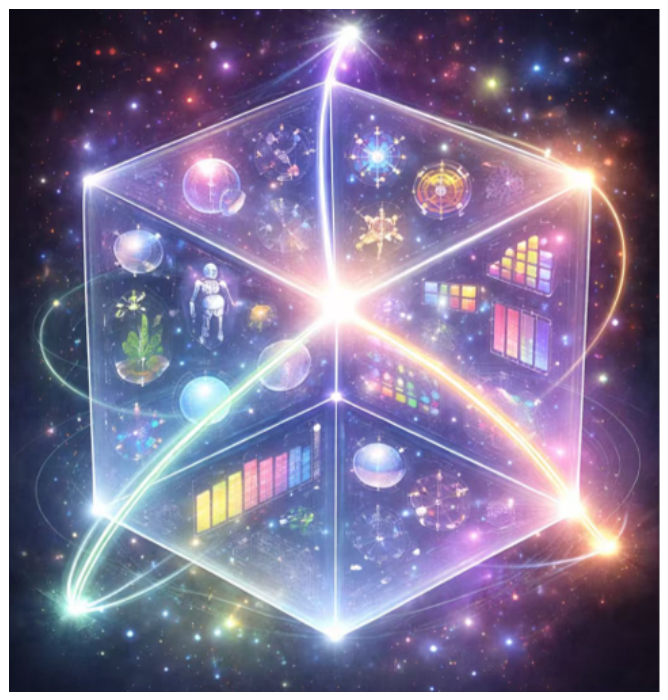
Figure 2.
Schematic display of thing axis.

Figure 3.
Schematic display of feature axis.

Figure 4.
Schematic display of quantitative attribute axis.
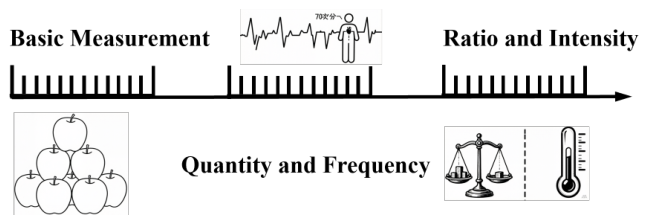
Figure 5.
Schematic display of qualitative attribute axis.

Figure 6.
Schematic display of formal attribute axis.
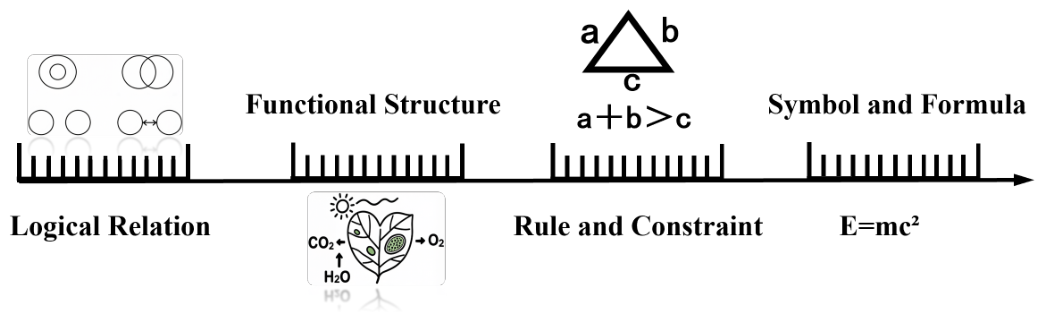
Figure 7.
Inter-relations between various low-dimensional axes.
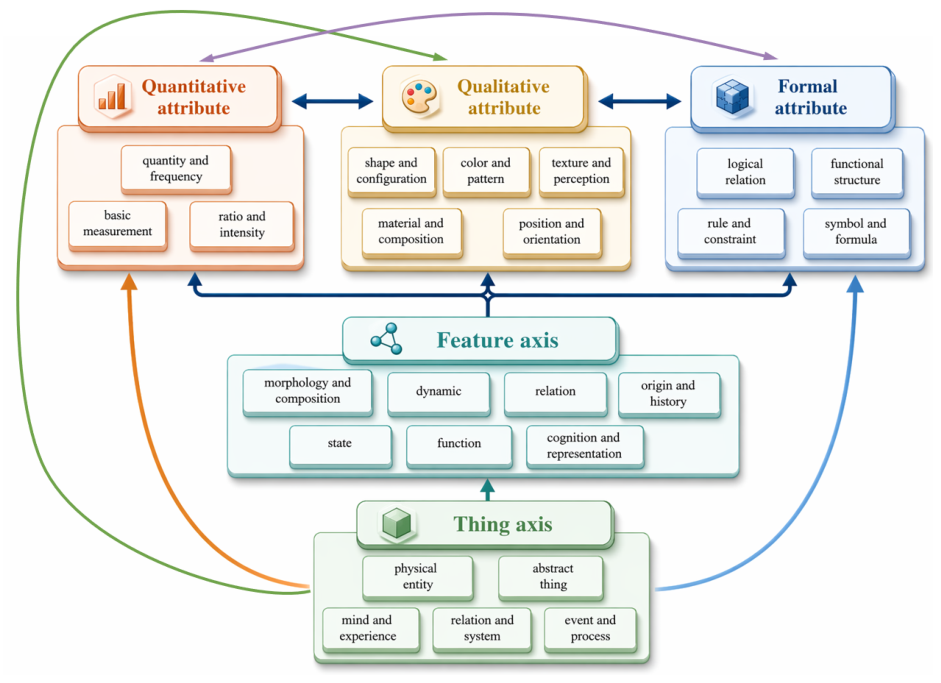
Figure 8.
Schematic display of low- dimensional and high- dimensional mappings.
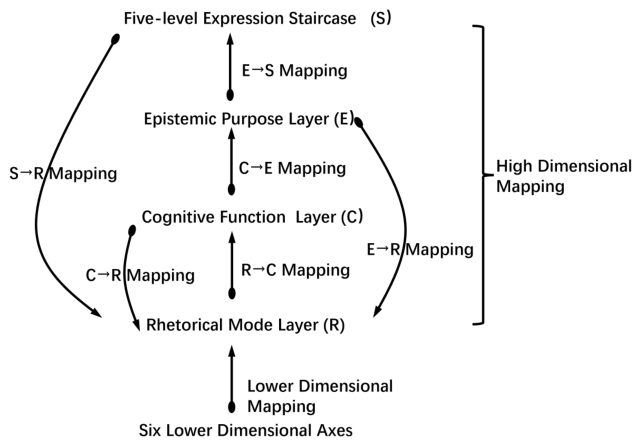

Table 1.
Generalized Coordinate Axes of Rhetorical Modes
| No. | Axis | MT Number | Example | Dimension Level |
|---|---|---|---|---|
| 1 | Thing | 5 | Physical Entity, etc. | Low Dimension |
| 2 | Features | 7 | Morphology and Composition, etc. | Low Dimension |
| 3 | Quantitative Attributes | 3 | Basic Measurement, etc. | Low Dimension |
| 4 | Qualitative Attributes | 4 | Shape and Configuration, etc. | Low Dimension |
| 5 | Formal Attributes | 4 | Logical Relation, etc. | Low Dimension |
| 6 | Basic Elements | 7 | Language, etc. | Mediating Layer |
| 7 | Rhetorical Modes | 18 | Description Mode, etc. | Ontological/Mediating Layer |
| 8 | Cognitive Functions | 14 | Observation, etc. | High Dimension |
| 9 | Epistemic Purposes | 8 | Knowledge Formation, etc. | High Dimension |
| 10 | Five-Level Expression Staircase | 5 | Sensory Level, etc. | High Dimension |
Table 2.
Types of Things
| No. | Category | Brief Description | Examples |
|---|---|---|---|
| 1 | Physical Entity | Occupies physical space and has observable form; the most direct object of interaction. | Natural entities (mountains, rivers, minerals, celestial bodies); artificial entities (tools, books, buildings, vehicles); living organisms and humans. |
| 2 | Abstract Thing | Exists in the realm of thought and symbols; independent of specific physical carriers; basic units of public knowledge. | Concepts (triangle, gravity, sustainable development); theories (Newtonian mechanics, atomic model); rules (grammar, laws); formal systems (mathematical formulas); data (statistics); knowledge works (research paper). |
| 3 | Event and Process | Occurs in time, with a beginning and a sequence of changes; core is "dynamicity". | Events (meeting, experiment, historical change); processes (photosynthesis, cosmic evolution, learning cycle); actions (welding, coding, speech). |
| 4 | Relation and System | A unified whole formed by multiple things through specific connections; core is "relatedness" and "wholeness". | Relations (spatial, logical, quantitative, interactive); systems (ecosystem, economic system, immune system, organization, software). |
| 5 | Mind and Experience | Inner, subjective cognitive, emotional, and experiential states of individuals or groups; core is "subjectivity". | Perceptions (pain, warmth); emotions (joy, anxiety); cognitive states (understanding, belief); aesthetic experiences (art, music); comprehensive experiences (immersion, belonging). |
Table 3.
Analytic Features
| No. | Feature | Description | Example / Key Terms |
|---|---|---|---|
| 1 | Morphology & Composition | Spatial form, constituent parts, and organization | height, components, connections |
| 2 | State | Appearance and condition under specific space,time and condition circumstances | temperature, occupancy, mode |
| 3 | Dynamic | Changes of position, behavior, evolution and process over time (sequence, causality, pattern) | acceleration, color transition |
| 4 | Function | Role, purpose, or effect within a system | communication, calculation, support |
| 5 | Relation | Connections or interactions with others | spatial, logical, competitive |
| 6 | Cognition & Representation | Perception, interpretation, abstraction, and modeling | emotion, classification, formula |
| 7 | Origin & History | Beginning and evolutionary path over time | birthplace, founding event, revisions |
Table 4.
Quantitative attributes.
| No. | Category | Brief Description | Examples |
|---|---|---|---|
| 1 | Basic Measurement | Direct measurement of continuous physical quantities; answers "how much" with a numerical value and unit. | length 175 cm, weight 60 kg, temperature 25 deg., coordinates (10, 20) |
| 2 | Count and Frequency | Counting discrete individuals or event occurrences; answers "how many" "how often" (integer or ratio). | 5 apples, failure rate 0.5 per week, population density 500 per km. |
| 3 | Ratio and Intensity | Composite indicators derived from basic measurements or counts; describes rate, efficiency, concentration, or degree. | speed 5 m/s, tensile strength 50 MPa, efficiency 85%, satisfaction score 7.2/10 |
Table 5.
Qualitative attributes.
| No. | Category | Brief Description | Concrete Vs Abstract examples |
|---|---|---|---|
| 1 | Shape and Configuration | Describes geometric form, contour, or spatial arrangement of parts; starting point of visual cognition. | Concrete: circular, streamlined, symmetric, concave, sparse; Abstract: linear, cyclic, hierarchical, matrix. |
| 2 | Color and Pattern | Captures visual hue, gloss, and pattern combinations on the object’s surface. | Concrete: vermilion, metallic, striped, gradient; Abstract: bright, dull, warm (positive), ambiguous. |
| 3 | Texture and Perception | Conveys direct sensory experience (touch, sight, hearing, smell, taste) beyond physical parameters. | Concrete: smooth/rough, crisp/dull, fragrant, sweet/sour; Abstract: fluent/obscure, sharp/mild, dry/vivid. |
| 4 | Position and Orientation | Describes location and direction in physical space or system via relative relations. | Concrete: above/below, inside/outside, adjacent; Abstract: premise/conclusion, core/periphery, parallel. |
| 5 | Material and Composition | Specifies the substance or key components that constitute the object. | Concrete: wooden, metallic, ceramic, contains; Abstract: element, gene, foundation, pure/mixed. |
Table 6.
Formal attributes.
| No. | Category | Brief Description | Examples / Key Terms |
|---|---|---|---|
| 1 | Logical Relation | Abstract ways in which parts relate; formal characterization of the Relation feature. | causality, inverse proportion, inclusion, equivalence, implication, feedback loop |
| 2 | Functional Structure | Pathways and modes of energy, force, information, or matter flow and transformation; formal characterization of Function and Dynamic features. | sequential flow (resistor to capacitor to inductor), chain reaction, cyclic process |
| 3 | Rule and Constraint | Stipulated protocols, syntax, or boundary conditions that behavior must obey. | syntax rules (statement ends with semicolon), checksum protocol, boundary conditions |
| 4 | Symbol and Formula | Concise language expressing the above relations; can summarize core relationships via formulas. | PV = nRT, s = vt, mathematical notation, logical operators |
Table 7.
Basic expressive-representational elements
| No. | Basic Element | Brief Description (Function) | Subcategories / Examples |
|---|---|---|---|
| 1 | Language | The most fundamental and versatile material; almost any thing, feature, or attribute can be expressed. | Words (terms), phrases, sentences, paragraphs; transitional phrases, topic sentences, outlines, heading hierarchies. |
| 2 | Numbers and Symbols | Transforms things and features into quantifiable, comparable forms; direct carrier of quantitative attributes. | Numbers (5 cm, 73%), symbols (>, ≈, Fe, pH). |
| 3 | Mathematical Formulas and Equations | Presents formal attributes concisely; reveals intrinsic relationships among variables. | Descriptive (cosine curve), definitional (Mach number), relational (Pythagorean theorem), law (Newton’s second law). |
| 4 | Images and Diagrams | Presents spatial information, morphological features, and structural relations holistically. | Real images (photos, micrographs), schematic diagrams (flowcharts, structure diagrams, principle diagrams). |
| 5 | Data and Relation Visualization | Translates abstract data into perceptible shapes and layouts; serves state, dynamic, and relation features. | Line charts, bar charts, scatter plots, pie charts, heatmaps, network graphs. |
| 6 | Sound, Gesture, and Dynamic Demonstration | Continuously presents processes in time; serves dynamic, functional, and perceptual features. | Animations, voice (tempo, stress), gestures (depictive vs. pointing), live demonstrations. |
| 7 | Notation/Markup | Auxiliary marks that organize, annotate, or reference other elements; supports clarity and navigation. | Cross-references, footnotes, citations, highlighting, comments, tags. |
Table 8.
Rhetorical Modes
| No. | Rhetorical Mode | Brief Introduction (Function) | Category |
|---|---|---|---|
| 1 | Description | Depicts sensory or factual attributes in detail. | Foundational Modes |
| 2 | Comparison | Highlights similarities between entities. | Relational Modes |
| 3 | Contrast | Highlights differences between entities. | Relational Modes |
| 4 | Analogy | Explains an unfamiliar idea by mapping to a familiar one. | Relational Modes |
| 5 | Cause and Effect | Traces relationships between actions/events and outcomes. | Relational Modes |
| 6 | Exemplification | Uses specific examples to illustrate or support a point. | Organizational Modes |
| 7 | Evidence | Introduces and interprets data or facts as proof. | Organizational Modes |
| 8 | Classification | Groups items into categories based on shared principles. | Organizational Modes |
| 9 | Division | Breaks a whole into its constituent parts. | Organizational Modes |
| 10 | Process Analysis | Explains the sequence of steps in a procedure. | Organizational Modes |
| 11 | Narration | Presents events or experiences in chronological order. | Organizational Modes |
| 12 | Definition | Establishes the meaning or scope of a concept. | Comprehensive Modes |
| 13 | Evaluation | Makes a judgment about value or significance based on criteria. | Comprehensive Modes |
| 14 | Argumentation | Constructs reasoned claims supported by logic and evidence. | Comprehensive Modes |
| 15 | Persuasion | Aims to influence beliefs, attitudes, or actions. | Comprehensive Modes |
| 16 | Exposition | Provides a clear, factual explanation of an idea. | Comprehensive Modes |
| 17 | Question | Raises inquiries to probe issues or guide discourse. | Comprehensive Modes |
| 18 | Answer | Offers responses or solutions to posed questions. | Comprehensive Modes |
Table 9.
Cognitive Functions.
| No. | Cognitive Function | Meaning | Operation (typical rhetorical modes) |
|---|---|---|---|
| 1 | Observe | Register phenomena and qualitative data. | Perceptual reception and registration of external information(desc., expo., narr., exempli., evid.) |
| 2 | Identify | Distinguish entities or patterns. | Recognizing specific objects or regularities (desc., expo., def., comp., contr., class., evid.) |
| 3 | Alignment | Relate attributes or outcomes by matching and aligning different representations or information sources. | Analyzing and establishing connections between properties or consequences of different things, including sub-operations such as comparison, contrast, correspondence finding, and discrepancy detection, all oriented toward relational construction (desc., expo., comp., contr., anal., eval.) |
| 4 | Partition | Assign objects into structured groups. | Systematic categorization according to features including classification, grading, decomposition (desc., expo., class., div., def.) |
| 5 | Abstract | Extract general properties or patterns. | Generalizing universal regularities or features from concrete instances (desc., expo., exempli., illus., anal.) |
| 6 | Hypothesize | Formulate possible explanations, theories, or propositions. | Putting forward tentative principles or causes based on existing information (desc., expo., prob., caus., arg.) |
| 7 | Model | Symbolically represent systems or relations. | Constructing a simplified representation to reveal underlying structures (desc., proc. anal., anal., expo.) |
| 8 | Infer | Derive implications or rules. | Drawing logical conclusions from known premises or specific instances through induction, deduction, or abduction (desc., expo., caus., arg.) |
| 9 | Test / Validate | Evaluate hypotheses or models against evidence. | Confirming validity through examination (desc., expo., exempli., comp., evid., eval.) |
| 10 | Explain | Provide causal or functional accounts. | Clarifying how something works or why it is the case (desc., expo., caus., proc. anal.) |
| 11 | Judgment | Judge validity or relevance of claims. | Applying criteria for critical appraisal giving defensible value determinations (desc., expo., eval., comp., arg., persu.) |
| 12 | Predict | Anticipate outcomes or states. | Forecasting based on existing patterns (desc., expo., caus., proc. anal., arg.) |
| 13 | Integrate / Synthesize | Combine diverse reasoning into a coherent whole. | Merging multiple sources into new understanding (desc., def., class., comp., contr., caus., exempli., evid., arg., expo.) |
| 14 | Reflect / Meta-cognitive Assessment | Assess one’s own reasoning processes or knowledge limits. | High-order monitoring and reflection (desc., eval., def., prob., sol., expo., persu.) |
Table 10.
Epistemic Purposes.
| No. | Epistemic Purpose | Brief Description | Typical Cognitive Functions Involved |
|---|---|---|---|
| 1 | Knowledge Formation | Constructs new cognitive structures in individuals (especially students) through self-learning, coursework, or practice. | Observe, Identify, Abstract, Integrate/Synthesize |
| 2 | Scientific Discovery | Forms and tests new hypotheses; expands the boundaries of knowledge through systematic inquiry. | Hypothesize, Test/Validate, Infer, Explain |
| 3 | Writing and Communication | Disseminates knowledge via text or speech; organizes and transmits information effectively. | Alignment, Partition, Model, Explain |
| 4 | Teaching/Learning | Enables instructional transfer and absorption of knowledge; designs and undergoes a process that fosters cognitive growth. | Explain, Integrate/Synthesize, Reflect/Meta-cognitive Assessment |
| 5 | Problem-Solving | Applies knowledge to practical or scientific challenges; finds and implements effective solutions. | Identify, Hypothesize, Test/Validate, Infer |
| 6 | Innovation/Design | Generates novel systems or methods creatively; breaks existing frameworks to produce valuable new ideas. | Abstract, Model, Integrate/Synthesize, Hypothesize |
| 7 | Evaluation/Decision-Making | Judges and selects among policies or strategies based on evidence; weighs information to make optimal judgments. | Judgment, Test/Validate, Alignment |
| 8 | Policy/Action Implementation | Applies knowledge to real-world contexts to produce concrete change; turns cognitive outcomes into practice. | Predict, Judgment, Reflect/Meta-cognitive Assessment |
Table 11.
The Five-Level Expression Staircase
| Level | Name | Explanation | Corresponding Stage |
|---|---|---|---|
| 1 | Sensory Level | Expressing what is directly perceived; knowledge of things and features stems primarily from senses and personal experience. Rhetorical modes emerge in natural language. | Childhood / Early Development |
| 2 | Autonomous Expression Level | Actively selecting, organizing, and combining rhetorical modes to serve one’s own expressive purposes. | Basic Education and Beyond |
| 3 | Academic Standard Level | Transitioning from personal expression to using rhetorical modes within the formal norms and conventions of the academic community. | Undergraduate to Academic Career |
| 4 | Methodological Level | Integrating rhetorical modes into a methodological framework to conduct and disseminate research, guided by cognitive and epistemic purposes. | Research Career (Graduate level and beyond) |
| 5 | Knowledge Enlightenment Level | Using rhetorical modes at the epistemic level to design understanding for others, deconstructing complex knowledge to create teachable pathways. | Teaching, Advanced Authorship, Knowledge Leadership |
Table 12.
Number of generalized modes for five cases of mapping
| No. | Dependent Axis | Independent Axes | ||
|---|---|---|---|---|
| 1 | Rhetorical Mode (Rm) | Th, Ft, Qt, Ql, Fm, Be | 6 | 14,700 |
| 2 | Cognitive Function (Cf) | Th, Ft, Qt, Ql, Fm, Be, Rm | 7 | 264,600 |
| 3 | Epistemic Purpose (Ep) | Th, Ft, Qt, Ql, Fm, Be, Rm, Cf | 8 | 3,704,400 |
| 4 | Five-Level Staircase (Es) | Th, Ft, Qt, Ql, Fm, Be, Rm, Cf, Ep | 9 | 29,635,200 |
| 5 | (All Axes) | Th, Ft, Qt, Ql, Fm, Be, Rm, Cf, Ep, Es | 10 | 148,176,000 |
Disclaimer/Publisher’s Note: The statements, opinions and data contained in all publications are solely those of the individual author(s) and contributor(s) and not of MDPI and/or the editor(s). MDPI and/or the editor(s) disclaim responsibility for any injury to people or property resulting from any ideas, methods, instructions or products referred to in the content. |
© 2026 by the authors. Licensee MDPI, Basel, Switzerland. This article is an open access article distributed under the terms and conditions of the Creative Commons Attribution (CC BY) license (http://creativecommons.org/licenses/by/4.0/).
Copyright: This open access article is published under a Creative Commons CC BY 4.0 license, which permit the free download, distribution, and reuse, provided that the author and preprint are cited in any reuse.