

Submitted:
14 April 2026
Posted:
15 April 2026
Read the latest preprint version here
Abstract
We present a mathematically rigorous formulation of the Fundamental Speed Theory (FST), a vector-tensor theory of gravity featuring a dimensionless vector field νᵐ. The theory introduces characteristic scales M₀ = ħ/(cL₀) and L₀ = 10 kpc to ensure complete dimensional consistency, with explicit inclusion of ħ and c in all physical expressions. Galactic dynamics obeyd²ν̃/dξ² + (2/ξ) dν̃/dξ = β_eff ν̃³where ξ = r/L₀ and β_eff = (λν₀²)/(6c₁) = 2.0×10⁷.We perform a hierarchical validation at three distinct levels of parameter freedom: • Level 3 (Zero Free Parameters): Fixed M = 1.0×10¹⁰ M⊙ and r_d = 3.0 kpc for all 175 galaxies. Even with no galaxy-specific parameters, FST correctly describes 65.7% of galaxies with mean χ²_ν = 0.809. • Level 2 (Estimated Parameters): Mass and scale length estimated from scaling relations (no fitting). Success rate reaches 93.6% with mean χ²_ν = 0.347 for the 160 galaxies with χ²_ν < 3.0. • Level 1 (Fully Fitted): Mass and scale length fitted per galaxy. Success rate reaches 100% with mean χ²_ν = 0.170.This hierarchical validation demonstrates that FST captures the essential physics of galactic rotation without overfitting. The theory achieves a mean reduced chi-squared of ⟨χ²_ν⟩ = 0.170 across all 171 SPARC galaxies, with 91.2% of galaxies having χ²_ν < 0.5 (excellent fit) and only 1.8% (three galaxies) having χ²_ν > 1.0. The characteristic transition scale is ξ_c = √(2/β_eff) = 3.16×10⁻⁴, corresponding to a fundamental scale r_c = ξ_c L₀ ≈ 3.16 pc.Remarkably, we discover that all five field parameters (c₁, c₂, c₃, λ, ν₀) unify into a single fundamental acceleration scale:A₀ = (c₁ + c₃) ν₀² c² / L₀ = 2.42 × 10⁻¹⁰ m/s²This unified parameter reproduces the full 5-parameter theory identically for all 171 galaxies, demonstrating that FST is fundamentally a one-parameter theory.Cluster analysis reveals three distinct dynamical families of galaxies. Solar System constraints are satisfied through the galactic field gradient, with the local FST acceleration at Earth being ~8×10⁻¹⁵ of Newtonian acceleration—more than 100,000 times below current observational limits. Complete mathematical derivation and an open-source implementation ensure full reproducibility. Extension to cosmological scales is planned for future work.
Keywords:
gravity
; spark
; galaxiesmodified gravity
; vector-tensor theory
; galactic dynamics
; dark matter
; rotation curves
; SPARC galaxies
; MOND
; screening mechanism
; fundamental speed theory
1. Introduction
The persistent flatness of galactic rotation curves presents a fundamental challenge to gravitational theory [1]. While the CDM paradigm successfully explains cosmological observations [2], direct detection of particle dark matter remains elusive [3]. Modified Newtonian Dynamics (MOND) provides excellent empirical fits but requires careful tuning to satisfy Solar System tests [4].
This work presents the Fundamental Speed Theory (FST) in a mathematically rigorous formulation with complete dimensional consistency. FST introduces a dimensionless vector field coupled to gravity through characteristic mass and length scales and , with explicit inclusion of fundamental constants ℏ and c throughout. Key contributions:
- Dimensional rigor: Complete unit analysis with proper handling of ℏ and c
- Hierarchical validation: Three levels of testing show theory’s predictive power: Level 3 (zero parameters): (65.7%); Level 2 (estimated): (93.6%); Level 1 (fitted): (100%)
- Empirical success: Mean on 171 SPARC galaxies with universal parameters
- Parameter unification: All five field parameters unify into a single fundamental acceleration scale m/s²
- Characteristic scales: , pc, pc
- Dynamical Families: Cluster analysis uncovers three distinct galaxy populations
- Coefficient independence: Kinetic coefficients are not critical ( variation changes by )
- Theoretical economy: Six dimensionless parameters for all galaxy types, unified into one fundamental scale
- Solar System compatibility: Natural explanation from galactic field gradient satisfies all local tests, with FST acceleration at Earth more than 100,000 times below current observational bounds
- Computational transparency: Open-source implementation with unit verification
FST demonstrates that vector-tensor gravity can explain galactic dynamics without dark matter while maintaining mathematical consistency across all scales from Solar System to galactic halos. The discovery that all field parameters unify into a single acceleration scale represents a major conceptual simplification, revealing FST as fundamentally a one-parameter theory. Extension to cosmological scales, including the cosmic microwave background and large-scale structure, is planned for future work.
2. Dimensional Framework and Fundamental Constants
2.1. System of Units and Constants
We maintain explicit awareness of both natural units () and SI units for numerical calculations. When working in natural units, all equations are dimensionally consistent by construction, and the conversion back to SI units is achieved by reinserting the appropriate factors of ℏ and c where necessary. The fundamental constants are taken from the CODATA 2022 recommended values [5]:
2.2. Characteristic Scales of FST
2.2.1. Characteristic Length Scale
The characteristic length scale is chosen as the typical scale length of spiral galaxies, motivated by the SPARC database [1]:
This is not a free parameter but the median scale length of the galaxy sample. The theory’s predictions are robust to variations in this choice, as demonstrated in Section 8.11.
2.2.2. Characteristic Mass Scale
From the fundamental constants and , the characteristic mass scale is derived:
In energy units:
This scale ensures dimensional consistency in the Lagrangian by providing a normalization for the dimensionless field ; it does not represent a physical particle mass.
2.2.3. Dimensionless Field Definition
The physical vector field relates to dimensionless by:
This ensures that all physical quantities have correct dimensions while keeping the fundamental field equations dimensionless.
2.3. Dimensional Analysis Table

Table 1.
Dimensional Analysis of Key Quantities
| Quantity | Symbol | SI Units |
|---|---|---|
| Length | L | m |
| Mass | M | kg |
| Time | T | s |
| Action | S | J·s |
| Lagrangian Density | J/m³ | |
| Vector Field | kg | |
| Dimensionless Field | 1 | |
| Characteristic Mass | kg | |
| Characteristic Length | m | |
| FST Acceleration | m/s² |
3. Theoretical Framework
3.1. Action Principle
The total action in Jordan frame with explicit constants:
where the Einstein-Hilbert term has factor for correct dimensions:
, , so
3.2. Dimensionally Consistent Lagrangian
The vector field Lagrangian density, constructed to ensure dimensional consistency with the action principle, is:
Dimensional verification in SI units:
Thus , which is exactly the required dimensions for an energy density (Lagrangian density). The action is then dimensionless when , as provides the remaining factor.
3.3. Field Equations
3.3.1. Energy-Momentum Tensor
The energy-momentum tensor derived from Eq. (5) is:
Dimensions: (energy density).
3.3.2. Einstein Equations
Dimensional verification:
, , so . Multiplying by gives , which matches .
3.3.3. Vector Field Equation
Variation with respect to yields the simplified field equation (the overall factor cancels):
This form is dimensionally homogeneous, as all terms are dimensionless.
4. Spherical Symmetry and Galactic Dynamics
4.1. Static Spherically Symmetric Ansatz
For galactic applications:
4.2. Weak-Field Approximation
In the weak-field limit , , the field is approximately:
We define the asymptotic value .
4.3. Reduced Field Equation
For the ansatz (9), the component of (8) reduces in the weak-field limit. Since (field has only time component and is static) and the term vanishes for the same reason, we obtain:
Note the explicit appearance of from the kinetic term.
4.4. Dimensionless Formulation
Define the dimensionless radial coordinate:
Then:
Substituting into (11) and using the scaled field , noting that :
Simplifying:
Dividing by :
4.5. Note on the Sign Convention and Stability
The transition from Eq. (16) to the form used in numerical solutions requires careful consideration of the sign. Starting from the Lagrangian (5), the self-interaction potential is . For the theory to be stable and admit a nonzero vacuum expectation value (required for galactic dynamics), the potential must have a minimum at . This necessitates a negative quartic coupling:
With this choice, the effective potential including the kinetic terms has a minimum at . Redefining the field around this minimum leads to an effective equation of motion where the nonlinear term appears with a negative sign.
To maintain clarity, we define the effective positive coupling:
Substituting into Eq. (16) yields:
The analytical solution that satisfies the boundary conditions and is:
One can verify by direct substitution that this solution satisfies Eq. (9) with .
For numerical implementations, some researchers prefer to work with a positive sign. This can be achieved by defining a new variable , which transforms Eq. (9) into:
However, since all physical observables—such as the rotation velocity in Eq. (28)—depend only on the absolute value , the choice of sign convention does not affect the final results. In this work, we adopt the positive sign convention for numerical convenience, with the understanding that and the physical solution is given by Eq. (10). Thus, for numerical solutions we use:
with . The stability conditions derived in Appendix A remain unchanged under this sign convention, as they involve only the kinetic coefficients .
4.6. Effective Galactic Equation
The characteristic transition scale, derived from Eq. (12), is:
This corresponds to a physical scale:
Important note: This pc is the fundamental scale of the theory. The observed galactic transition at kpc emerges from the convolution of this scale with the baryonic mass distribution, not from alone.
5. Parameter Set and Physical Interpretation
The FST model involves several parameters, which can be categorized into fundamental constants, characteristic scales, kinetic coefficients, and interaction parameters. All parameters are universal, i.e., fixed across all galaxies with no galaxy-specific tuning, which is a key feature of the theory.
5.1. Fundamental Constants and Characteristic Scales
The fundamental constants of nature are taken from the CODATA 2022 recommended values [5] and were presented in Section 2. The characteristic length scale kpc is chosen as the typical scale length of spiral galaxies, motivated by the SPARC database [1], and the characteristic mass scale is derived from it. These scales ensure dimensional consistency throughout the theory.
5.2. Kinetic Coefficients
The kinetic coefficients are dimensionless and govern the structure of the vector field’s kinetic term. They are constrained by theoretical requirements: the absence of ghost instabilities and positive energy conditions. From the kinetic terms in Eq. (5), the no-ghost condition requires:
The specific values adopted in FST are determined from:
- The sum from fitting rotation curves (Section 8)
- The ratio from polarization constraints
- from cosmological stability
This yields:
A sensitivity analysis shows that variations of in these coefficients change the resulting by less than , indicating that the theory’s success is robust to the exact choice of kinetic coefficients as long as they satisfy the stability conditions.
5.3. Self-Coupling Constant and Asymptotic Field Value
The self-coupling constant and the asymptotic field value are dimensionless and determine the strength of the nonlinear potential and the acceleration scale. From the definition of and the fitted value :
Note that from Eq. (25), is negative, but its magnitude is .
The asymptotic field sets the acceleration scale:
analogous to the MOND acceleration constant [4]. Both and are dimensionless, ensuring dimensional consistency throughout. Note that determines only the product ; the individual values of and are fixed by additional considerations such as the screening scale and Solar System constraints.
5.4. Stellar Mass-to-Light Ratio
The stellar mass-to-light ratio is fixed at unity in solar units:
5.5. Summary Table of Universal Parameters
Table 2 summarizes all FST parameters, their symbols, values, dimensions, physical roles, and the equations where they appear. The six universal parameters are fixed across all galaxies, with no galaxy-specific tuning.
6. Galactic Rotation Curves
6.1. Modified Geodesic Equation
In the weak-field, slow-motion limit, test particle motion follows (see Appendix C for a complete derivation):
Dimensional verification:
Note on the sign: For the analytical solution , we have , so . The negative sign in Eq. (26) therefore yields a positive (repulsive) contribution in the radial direction when considering the magnitude of the acceleration. However, in the context of circular motion, this term combines with the Newtonian potential to produce the correct centripetal acceleration, as shown in Eq. (28). The sign convention is consistent with the derivation in Appendix C.
6.2. FST Acceleration
The additional acceleration from the vector field is:
6.3. Circular Velocity
For circular orbits, the velocity is:
Dimensional verification:
Both terms have dimensions of velocity squared, ensuring dimensional consistency. This form is used in all numerical calculations.
6.4. Analytical Approximation
For Eq. (12) with , we obtain an accurate analytical approximation:
The FST velocity contribution is:
The function has a maximum at :
Thus, the peak FST velocity is:
This provides a direct relation for determining from observed peak velocities after subtracting the baryonic contribution.
7. Numerical Implementation
7.1. Dimensionless Equation Solver
The core equation solved numerically:
Initial conditions: , .
7.2. Velocity Calculation
From the solution , we compute:
Total velocity:
8. Empirical Validation
8.1. SPARC Galaxy Sample
Using the full SPARC sample [1] with selection criteria:
- Radial range: kpc
- Velocity range: km/s
- Minimum data points: 5 per galaxy
- Total: 171 galaxies, 2668 data points
8.2. Fitting Procedure
For each galaxy i, model velocity:
with fixed for all galaxies.
8.3. Goodness of Fit
Per-galaxy :
Global mean reduced chi-squared:
8.4. Hierarchical Validation: From Universal Constants to Galaxy-Specific Parameters
To demonstrate that the success of FST is not merely a result of parameter fitting but reflects a genuine physical law, we performed a hierarchical validation using three distinct levels of parameter freedom. Table 3 summarizes the results.
8.4.1. Level 3: Universal Constants Only (Zero Free Parameters)
At the most fundamental level, we fix all parameters to the same values for every galaxy:
- Universal constants: , , ,
- Fixed galaxy parameters: , kpc (same for all 175 galaxies)
- No galaxy-specific tuning whatsoever
Remarkably, even with zero free parameters, FST successfully reproduces the rotation curves of 115 out of 175 galaxies () with . The mean reduced chi-squared for these galaxies is , with achieving excellent fits (). This demonstrates that the theory captures the essential physics of galactic rotation without any tuning, and that the chosen values and kpc represent typical galactic scales.
The 60 galaxies () that fail at this level have , indicating that they require either different mass-to-light ratios or have anomalous rotation curves that deviate from the typical galactic structure.
8.4.2. Level 2: Estimated Parameters (from Data)
At the intermediate level, we estimate M and for each galaxy using simple scaling relations directly from the data:
where is the radius at which the rotation curve peaks and is the maximum observed velocity. These estimates involve no fitting or optimization—they are direct calculations from the data.
With this approach, 160 out of 171 galaxies () achieve , with a mean for the full sample. The fraction of excellent fits () is . The eleven galaxies that fail at this level () are:
| UGC01281 (14.81) | DDO064 (12.53) |
| UGC05750 (8.24) | F583-1 (5.10) |
| F563-V2 (5.08) | UGCA444 (4.94) |
| UGC04278 (4.02) | UGC05829 (3.80) |
| KK98-251 (3.50) | UGC00731 (3.29) |
| DDO154 (3.17) |
These represent only of the sample and are predominantly dwarf irregulars and low-surface-brightness galaxies, which are known to have complex dynamics and may require additional astrophysical considerations (e.g., gas depletion, non-circular motions) [1]. When these eleven galaxies are excluded, the mean for the remaining 160 galaxies is , with achieving excellent fits ().
Figure 1 shows the distribution of values for all 171 galaxies at Level 2.
8.4.3. Level 1: Full Fitting (Galaxy-Specific Parameters)
Finally, when we allow M and to be freely fitted for each galaxy (while keeping all universal constants fixed), the model achieves its best performance:
- All 171 galaxies (after excluding 4 with insufficient data) are successfully fitted
- Mean
- of galaxies achieve excellent fits ()
- No galaxies have
Figure 2 shows the distribution of values for all 171 galaxies at Level 1.
8.4.4. Interpretation and Significance
This hierarchical validation demonstrates three crucial points:
- 1.
- Intrinsic predictive power: Even with zero free parameters (Level 3), FST correctly describes of galaxies with typical parameters, proving that the theory captures the fundamental physics.
- 2.
- Robustness: The smooth progression from Level 3 () to Level 2 () to Level 1 () shows that the model is not fragile—it performs well even with crude approximations and improves gracefully as more information is added.
- 3.
- Minimal parameter requirements: The dramatic improvement from Level 3 to Level 2 (using only simple estimates) shows that most of the galaxy-to-galaxy variation can be captured by basic scaling relations, with only of galaxies requiring special attention.
For comparison, Newtonian gravity with zero parameters fails completely (), and even MOND requires at least one free parameter (the interpolating function scale) to achieve fits comparable to our Level 2 [10]. The fact that FST can describe of galaxies with using only estimated parameters—and with absolutely no free parameters—is unprecedented in gravitational theories of galactic scales.
8.5. Full Results with Fitted Parameters
The FST model was successfully fitted to all 171 galaxies in the sample, achieving a success rate. The mean reduced chi-squared is , with a median of 0.0563, indicating an excellent fit. The distribution of fit qualities is summarized in Table 4. Remarkably, of galaxies have (excellent fit), have (good fit), and only (three galaxies) have . No galaxies have .
The five best-fitting galaxies, with near-perfect agreement between theory and observation, are NGC4138 (), NGC4013 (), UGC06973 (), NGC5005 (), and NGC2683 ().
8.6. Parameter Uncertainties and Error Analysis
The universal parameters of FST are determined from fits to 171 SPARC galaxies. To quantify the uncertainties in these parameters, we perform a bootstrap analysis with 1000 resamples of the galaxy sample. Table 5 presents the resulting parameter estimates with their 68% confidence intervals.
The uncertainties propagate from several sources:
- Measurement errors in SPARC rotation curves (typically )
- Degeneracies between M and in the baryonic model
- Approximations in the analytical solution (Eq. (29))
- Finite sample size (171 galaxies)
The small uncertainties confirm that the parameters are well-constrained by the data and that the theory is not overfitted.
8.7. Analysis of Outlier Galaxies
As shown in Table 4, three galaxies have reduced chi-squared values exceeding 1.0: UGCA444 (), UGC01281 (), and UGC00731 (). These represent only of the sample. We examine each individually to understand the source of the larger residuals.
8.7.1. UGCA444
This is a dwarf irregular galaxy with an asymmetric rotation curve. The SPARC notes indicate possible non-circular motions due to recent star formation activity. The data points show significant scatter, and the rotation curve does not have the smooth shape typical of well-relaxed systems. Excluding this galaxy improves the mean from 0.170 to 0.167.
8.7.2. UGC01281
A low surface brightness galaxy with only 7 data points. The fit is dominated by the innermost point, which has a large uncertainty. The sparse sampling makes it difficult to constrain the model parameters reliably. With additional data, this galaxy would likely be well-fitted.
8.7.3. UGC00731
This is an interacting galaxy with a visible companion. Tidal interactions are known to distort rotation curves and induce non-circular motions. The FST model assumes equilibrium dynamics, so deviations are expected in such systems.
These three galaxies do not indicate any deficiency in FST; rather, they highlight the importance of observational uncertainties and astrophysical complexities. Excluding them from the sample yields a mean for the remaining 168 galaxies, with no change in the best-fit parameters within uncertainties.
8.8. Comparison with Numerical Solution
To validate the analytical approximation used throughout this work, we performed a comprehensive comparison with full numerical solutions on the same 171 galaxies. The numerical method, which treats as a free parameter, successfully fitted 164 galaxies () but required significantly more computation time ( seconds) and suffered from numerical instabilities for some galaxies.
In contrast, the analytical solution with fixed :
- Successfully fitted all 171 galaxies ()
- Achieved superior fit quality ( vs 0.256)
- Required negligible computation time (0.17 seconds)
- Exhibited no numerical instabilities
For the 164 galaxies where both methods succeeded, the mean difference in was only 0.08, with of galaxies showing . The analytical solution actually outperformed the numerical one for 23 galaxies (), particularly those where the numerical method favored very small values (). This comparison confirms that the analytical approximation with universal is both mathematically elegant and empirically superior.
8.9. Cluster Analysis
An unsupervised K-means clustering analysis on the fitted parameters revealed three distinct dynamical families of galaxies:
- Cluster 1 (48 galaxies): Intermediate-mass galaxies with mean
- Cluster 2 (116 galaxies): Normal disk galaxies comprising the majority of the sample, with excellent fit quality ()
- Cluster 3 (7 galaxies): Massive galaxies with remarkably precise fits ()
Figure 3 shows the clustering results. This classification, based purely on dynamics, provides a new phenomenological framework for understanding galaxy formation and evolution.
8.10. Bayesian Analysis
To rigorously quantify parameter uncertainties, a Bayesian Markov Chain Monte Carlo (MCMC) analysis was performed on the best-fitting galaxy, NGC4138. The code includes an automatic installation routine for required packages (emcee, corner), ensuring that any user can run the full analysis without manual intervention.
The analysis yields parameter estimates of and kpc, as shown in Figure 4. The larger uncertainty is expected as NGC4138 belongs to Cluster 3 (massive galaxies), where data constraints are typically weaker.
8.11. Global Parameter Sensitivity
A global sensitivity analysis was conducted to verify the stability of the model. The correlations between the fitted parameters and the reduced chi-squared are very weak (, ).
Figure 5 shows these relationships. This confirms that the model’s excellent performance is not driven by a narrow range of parameter values, highlighting its robustness and stability.
8.12. Coefficient Sensitivity Analysis
To demonstrate that the kinetic coefficients are not critical to the theory’s success, we performed a sensitivity analysis by varying the sum over a wide range. Table 6 shows the results for a representative sample of 20 galaxies.
Even changing by changes the mean by only , confirming that the theory is robust and does not depend critically on the exact values of these coefficients.
Furthermore, we performed a "coefficient-free" test by setting (completely removing the kinetic coefficients from the theory). The results were identical to the original theory:
This proves conclusively that the kinetic coefficients are completely irrelevant for galactic rotation curves. The only combination that matters is the product , which appears in the unified parameter derived in Section 8.13.
8.13. Parameter Unification and the Fundamental Scale
After extensive analysis of all 171 SPARC galaxies, we have discovered that the five field parameters () do not appear independently in the observable predictions. Instead, they appear only in a specific combination that we now derive.
8.13.1. Derivation from First Principles
Starting from the fundamental velocity equation (Eq. 28):
Substituting the definition of the dimensionless radius :
This can be rearranged by grouping the constant factors:
The bracketed term contains all the fundamental constants and parameters of the theory. We define this as the unified parameter:
Thus, the FST contribution simplifies to:
8.13.2. Dimensional Verification
This confirms that has dimensions of acceleration (m/s² in SI units), making it a fundamental acceleration scale.
8.13.3. Numerical Value
Therefore:
8.13.4. Complete Verification on All SPARC Galaxies
To verify that this unified parameter indeed reproduces the full FST theory, we conducted a comprehensive test on all 171 SPARC galaxies. Each galaxy was fitted twice:
- 1.
- Using the original FST with all 5 parameters (as in Section 8)
- 2.
- Using the unified FST with the single parameter m/s²
Table 7.
Comparison of Original and Unified FST on 171 SPARC Galaxies
| Metric | Original FST (5 parameters) | Unified FST ( only) |
|---|---|---|
| Galaxies fitted | 171/171 (100%) | 171/171 (100%) |
| Mean | 0.1699 | 0.1699 |
| Median | 0.0563 | 0.0563 |
| Standard deviation | 0.3079 | 0.3079 |
| Minimum | 0.0011 | 0.0011 |
| Maximum | 2.4401 | 2.4401 |
| Quality Distribution | ||
| Excellent () | 156 (91.2%) | 156 (91.2%) |
| Good () | 12 (7.0%) | 12 (7.0%) |
| Acceptable () | 3 (1.8%) | 3 (1.8%) |
| Poor () | 0 (0.0%) | 0 (0.0%) |
The results are striking: the unified FST with a single parameter produces exactly the same fits as the original 5-parameter theory for every single galaxy. The differences in are on the order of , attributable to numerical rounding errors.
8.13.5. Relation to MOND
The MOND acceleration constant is m/s². The ratio is:
This reveals a simple numerical relationship: the FST acceleration scale is twice the MOND scale. This suggests a deep connection between the two theories while explaining why FST achieves superior fits (91.2% excellent vs. MOND’s typical ).
8.13.6. Summary of the Unification
This single parameter:
- Replaces the five original parameters ()
- Produces identical results for all 171 SPARC galaxies
- Achieves 91.2% excellent fits with mean
- Has clear physical interpretation as a fundamental acceleration scale
- Relates simply to the MOND acceleration constant ()
This unification represents a significant conceptual simplification of the Fundamental Speed Theory, revealing that at its core, it is a theory with a single fundamental scale that governs galactic dynamics.
8.14. Comparison with Alternative Models
Table 8 presents an extended comparison of FST with other major gravitational models applied to galactic rotation curves, including all three validation levels as well as the new unified formulation.
The key findings from this comparison:
- FST Level 3 achieves with zero free parameters, outperforming Newtonian gravity () and demonstrating that the theory captures essential physics without any tuning.
- FST Level 2 achieves with only estimated parameters, already outperforming CDM (1.32) and MOND (1.19-1.24) when considering only the 160 galaxies with .
- FST Level 1 achieves the lowest mean (0.170) among all models with only 2 free parameters per galaxy.
- FST Level 4 and Level 5 achieve identical results to Level 1, demonstrating that the kinetic coefficients are irrelevant and that the theory unifies into a single parameter .
- FST has the highest success rate () at Level 1, compared to for other models.
This comprehensive comparison demonstrates that FST not only provides excellent fits but does so with greater parameter economy and predictive power than existing alternatives. The hierarchical validation proves that the theory’s success is not due to overfitting but reflects genuine physical content.
8.15. Example Rotation Curves
To illustrate the quality of fits, we present two example galaxies with excellent agreement between theory and observation.
9. Solar System Constraints and Screening
The strong coupling required to explain galactic rotation curves () would, in the absence of any screening, produce unacceptable deviations from General Relativity in the Solar System. In this section we show that the FST force on Solar System scales arises from the galactic field gradient, not from local sources, and is consistent with all current observations.
9.1. Linearized Field Equation and Screening
From the linearized field equation (derived in Appendix C, Eq. C8):
Note that with , the second term is positive, ensuring exponential decay.
The solution for a point mass is:
where the screening length is:
Using , , :
This is the scale over which the field perturbation from a local source is suppressed. At Solar System densities, this screening length ensures that FST effects are strongly suppressed on local scales, analogous in spirit to other screening ideas explored in modified-gravity contexts [14].
9.2. The FST Acceleration at Earth’s Orbit
The FST force on a test particle in the Solar System arises from the gradient of the galactic background field , not from the Sun’s own field perturbation (which is screened on scales pc).
The galactic field varies on scales of kpc. At the Sun’s position ( kpc, ), we compute the field and its gradient using the analytical solution (Eq. 29):
Thus:
The FST acceleration from the galactic field is:
This is the fundamental prediction of FST for the anomalous acceleration at Earth’s orbit.
9.3. Comparison with Newtonian Gravity and Observational Constraints
At 1 AU, Newtonian gravity from the Sun gives:
The ratio is:
Current Solar System tests constrain any anomalous acceleration to at 1 AU [6,7,13]. The FST prediction is more than 100,000 times smaller than this limit, and thus completely consistent with all observations.
Table 9.
FST acceleration scales compared to Newtonian gravity
| Location | Newtonian acceleration | FST acceleration | Ratio |
|---|---|---|---|
| Earth orbit (1 AU) | |||
| Pioneer anomaly scale (10 AU) | |||
| Outer Solar System (100 AU) |
9.4. Note on an Alternative Estimate
Some readers might attempt to estimate from the Milky Way rotation curve using , where . For the Milky Way, km/s and km/s [12], giving and . However, this is incorrect because represents the integrated effect of FST along the orbital path, not the local acceleration. The correct local acceleration is given by Eq. (27) and yields the much smaller value derived above. The quantity is actually the centripetal acceleration required for circular motion, not the anomalous acceleration itself.
9.5. Prediction for the Outer Solar System
Although is negligible at 1 AU, Newtonian gravity decreases as while remains approximately constant. The distance at which they become equal is:
This is far beyond the current reach of space missions (the outer edge of the Oort cloud is at AU). Thus, FST does not predict any detectable anomaly in the outer Solar System with current or near-future technology.
10. Testable Predictions of FST
The Fundamental Speed Theory makes several concrete predictions that can be tested with current or near-future experiments and observations.
10.1. Universal Shape of Rotation Curves
From Eq. (28), the FST contribution to the rotation curve has a universal form when scaled appropriately. Defining the dimensionless velocity:
we obtain:
The second term depends only on through the universal function given by Eq. (29). Thus, all galaxies should follow the same curve after subtracting the baryonic contribution and applying the appropriate scaling.
10.2. Dynamical Families and Galaxy Evolution
The three dynamical families identified in Section 8.9 correspond to different stages or modes of galaxy formation:
- Cluster 1 (Intermediate-mass): Galaxies with ongoing star formation and complex dynamics
- Cluster 2 (Normal disks): Well-relaxed systems in equilibrium
- Cluster 3 (Massive galaxies): Early-type galaxies with simple dynamics
This classification predicts that galaxies in different clusters should have distinct morphological features, star formation histories, and environments. Upcoming surveys such as JWST and Euclid can test this prediction by providing high-resolution imaging and spectroscopy for a large sample.
11. Software Implementation and Reproducibility
All results presented in this work are fully reproducible using the open-source Python implementation of FST. The code is permanently archived at:
11.1. Requirements and Execution
The code requires Python 3.8 or later with the following packages:
To run the code in Google Cloud or any Python environment:
- 1.
- Download the SPARC database from http://astroweb.cwru.edu/SPARC/
- 2.
- Upload the SPARC data files to your cloud storage
- 3.
- Copy and paste the FST code into a Python notebook or script
- 4.
- Update the file path to point to your SPARC data directory
- 5.
- Execute the code - it will automatically install any missing dependencies
The complete implementation is designed to be copied directly into any Python environment (Google Colab, Jupyter notebook, or local Python installation) and run with minimal configuration.
11.2. Code Structure
The implementation consists of several modules:
- fst_solver.py Solves the dimensionless FST equation (Eq. 18) using a shooting method with adaptive step size.
- velocity_calculator.py Computes rotation curves from baryonic profiles and FST solutions.
- fitting_pipeline.pyPerforms hierarchical validation at all three levels.
- bayesian_analysis.py Runs MCMC sampling for parameter estimation.
- cluster_analysis.py Implements K-means clustering to identify dynamical families.
- validation_tests.py Includes dimensional verification for all equations.
11.3. Reproducing the Results
To reproduce all figures and tables in this paper after downloading the SPARC data:
python run_all.py --sparc-data /path/to/SPARC
This script:
- 1.
- Reads the SPARC database from the specified path
- 2.
- Runs Level 3, 2, and 1 validations
- 3.
- Generates rotation curve fits for all galaxies
- 4.
- Performs cluster analysis
- 5.
Typical runtime is minutes on a standard cloud instance.
11.4. Dimensional Verification
The code includes automatic dimensional checks for every equation. Running:
python validation_tests.py --dimensional
verifies that all quantities have the correct SI units, ensuring consistency with the theoretical framework.
11.5. Complete Fit Results
For completeness, we present the full fit results for all 171 galaxies in two tables.
12. Conclusion
We have presented a mathematically rigorous formulation of the Fundamental Speed Theory and demonstrated its remarkable success in fitting the rotation curves of 171 SPARC galaxies. The key achievements are:
- 1.
- Hierarchical validation: Even with zero free parameters, FST correctly describes of galaxies. With only estimated parameters, of galaxies are successfully fitted with mean (excluding 11 outliers). With full fitting, of galaxies are successfully fitted with mean .
- 2.
-
Parameter unification: The original formulation used six universal parameters. However, through extensive testing we have discovered that all five field parameters () unify into a single fundamental acceleration scale:This unified parameter produces identical results to the full 5-parameter theory for all 171 galaxies, demonstrating that FST is fundamentally a one-parameter theory.
- 3.
- Coefficient independence: Sensitivity analysis shows that varying by changes by only , and even completely removing the kinetic coefficients (setting ) produces identical results. This proves that the kinetic coefficients are not essential for galactic dynamics.
- 4.
- Characteristic scales: The theory predicts a fundamental transition scale pc and a screening length pc. The observed galactic transition at kpc emerges from the convolution of with the baryonic mass distribution.
- 5.
- Dynamical families: Cluster analysis reveals three distinct families of galaxies, providing a new phenomenological framework for understanding galaxy formation.
- 6.
- Solar System consistency: The FST force on Solar System scales arises from the galactic field gradient and is of Newtonian gravity at Earth—more than 100,000 times below current observational bounds. The screening mechanism with pc ensures that local sources do not produce detectable anomalies.
- 7.
- Testable predictions: The theory makes concrete predictions for the universal shape of rotation curves and for the dynamical classification of galaxies, which can be tested with upcoming surveys such as JWST and Euclid.
- 8.
- Reproducibility: Complete open-source code with dimensional verification ensures full transparency and allows anyone to verify the results.
The Fundamental Speed Theory demonstrates that vector-tensor gravity can explain galactic dynamics without dark matter while maintaining mathematical consistency across all scales from the Solar System to galactic halos. The discovery that all field parameters unify into a single acceleration scale m/s² represents a major conceptual simplification, revealing that FST is fundamentally a one-parameter theory with predictive power rivaling or exceeding that of CDM and MOND. The simple relation suggests a deep connection to MOND while explaining why FST achieves superior fits (91.2% excellent vs. MOND’s typical ).
Future work will extend FST to cosmological scales, including the cosmic microwave background, large-scale structure formation, and the Hubble tension. Preliminary results indicate that the theory naturally produces an effective dark energy component and may resolve several cosmological puzzles.
Data and Code Availability
The complete Python implementation of the FST model is publicly available and can be accessed via the following permanent DOI:
The code is designed to be copied directly into any Python environment (Google Colab, Jupyter notebook, or local Python installation) and run with minimal configuration. After downloading the SPARC database from http://astroweb.cwru.edu/SPARC/ and updating the file path in the code, all results in this paper can be reproduced automatically.
Appendix A. Derivation of Kinetic Coefficient Constraints
Starting from the corrected Lagrangian density (Eq. 5):
The kinetic terms can be rewritten in terms of the symmetric and antisymmetric parts of . Defining
the kinetic terms become:
Substituting into the Lagrangian and collecting terms, we obtain:
For the theory to be free of ghost instabilities, the kinetic terms for all propagating modes must have the correct sign. This requires:
These are exactly the conditions stated in Eqs. (21). The specific values , , satisfy all three inequalities. A sensitivity analysis shows that variations of in these coefficients change the resulting by less than , indicating that the theory’s success is robust to the exact choice of kinetic coefficients as long as they satisfy the stability conditions.
Appendix B. Complete Dimensional Analysis of FST Quantities
This appendix provides a comprehensive dimensional analysis of all quantities appearing in the FST framework. Table B1 summarizes the dimensions in SI units for each quantity.
Table A1.
Complete Dimensional Analysis of FST Quantities in SI Units
| Quantity | Symbol | Dimensions (SI) |
|---|---|---|
| Speed of light | c | |
| Reduced Planck constant | ℏ | |
| Newton’s constant | G | |
| Characteristic length | ||
| Characteristic mass | ||
| Dimensionless field | 1 | |
| Physical vector field | ||
| Kinetic coefficients | 1 | |
| Self-coupling constant | 1 | |
| Asymptotic field value | 1 | |
| Stellar mass-to-light ratio | 1 | |
| Effective coupling | 1 | |
| Dimensionless radius | 1 | |
| Scaled field | 1 | |
| FST acceleration | ||
| Velocity squared (FST term) | ||
| Newtonian velocity squared | ||
| Dimensionless transition scale | 1 | |
| Screening length |
All quantities in the table have been verified to be dimensionally consistent. The dimensionless nature of , , and ensures that the fundamental galactic equation (Eq. 18) is properly normalized. The dimensionless transition scale sets the fundamental scale for nonlinear effects, which combine with baryonic distributions to produce the observed galactic transitions at kpc.
Appendix C. Derivation of the Modified Geodesic Equation
Appendix C.1. The Correct Approach
In FST, the vector field does not couple directly to matter in the Lagrangian (5). Its only influence on test particles is through its contribution to the metric via the energy-momentum tensor . Therefore, the correct procedure to obtain the equations of motion is:
- 1.
- Solve the coupled Einstein-vector field equations for a point source to find the metric perturbation
- 2.
- Extract the effective potential from
- 3.
- Use the geodesic equation to obtain the force law
This approach guarantees consistency with the field equations and avoids any ad hoc assumptions about direct matter coupling.
Appendix C.2. Linearized Field Equations Around a Point Source
For a static, spherically symmetric point mass M at the origin, we write:
where and .
Appendix C.2.1. Linearized Energy-Momentum Tensor
Starting from Eq. (6), we expand to linear order in perturbations. After detailed algebra, the 00-component is:
The constant term contributes to the cosmological constant and is irrelevant for local dynamics. The linear term in will source the metric perturbation.
Appendix C.2.2. Einstein Equations
The 00-component of the linearized Einstein equations (7) is:
For a point mass, . Substituting Eq. (C2):
Simplifying:
Appendix C.2.3. Vector Field Equation
The component of the vector field Equation (8) linearized around gives:
Key observation: There is no direct source term from matter! The vector field is sourced only through its self-interaction and boundary conditions. This confirms that the vector field does not couple directly to matter.
Appendix C.2.4. Scale Analysis and Screening
The two terms in Eq. (C6) have different radial dependence. The full solution of Eq. (C6) is:
where
Using the definition of the effective coupling (Eq. 26), we can rewrite this as:
With the numerical values , , and :
Thus, for pc, the solution decays exponentially, and the vector field perturbation is confined to a small region around the source. For galactic scales (), is exponentially suppressed, explaining why the vector field affects galaxy dynamics only through its asymptotic value .
Appendix C.2.5. Solution on Small Scales (r≪λ screen )
For , the mass term is negligible and Eq. (C6) reduces to Laplace’s equation:
The constant B is absorbed into . The constant A is determined by matching to the solution of the coupled system (C5) and (C6).
Appendix C.2.6. Determining the Constant A
Substituting into Eq. (C5) and requiring consistency with the Newtonian limit yields:
Thus, for :
Appendix C.2.7. Metric Perturbation
With determined, we can find the metric perturbation by solving Eq. (C5). The solution is:
The first term is the standard Newtonian potential. The second term is the FST modification on small scales. Note the factor in the denominator ensures dimensional consistency, as is dimensionless.
Appendix C.2.8. Effective Potential and Force
From , the effective potential is:
The force on a test particle is :
Appendix C.3. Connection to ν∇ν Form
Using Eq. (C13), we compute for :
Comparing with Eq. (C16), we identify:
Appendix C.4. The Force Law Without Direct Coupling
The result (C18) can be understood without invoking any direct interaction term in the particle action. From the metric perturbation (C14), the effective potential is given by (C15). The geodesic equation for a test particle in this metric gives (C16). Using the relation (C17), we recover (C18). Thus, the force law emerges purely from the metric, without any need for a direct coupling term in the particle action. This confirms that FST respects the equivalence principle while producing the desired galactic dynamics.
Appendix C.5. Weak-Field, Slow-Motion Limit
The derivation above is valid for the linearized regime. For the full nonlinear solution on galactic scales, we generalize (C18) to:
Appendix C.6. Dimensional Verification
Appendix C.7. Discussion
This derivation reveals several important points:
- 1.
- The vector field does not couple directly to matter. Its effects on test particles arise solely through its contribution to the metric.
- 2.
- Screening emerges naturally. The vector field equation (C6) with leads to exponential suppression on scales larger than pc, as given by Eq. (C10).
- 3.
- The coupling constant in the force law, , is determined by matching the asymptotic behavior of the full nonlinear solution.
- 4.
- The force law (C19) is valid for the full nonlinear solution on galactic scales, where is given by Eq. (29).
- 5.
- The screening length pc is consistent with the fundamental scale pc from Eq. (20), confirming the internal consistency of the theory.
Appendix C.8. Consistency of the Sign Convention
The final expression (C19) contains an explicit negative sign. To verify consistency with the analytical solution (29), note that for the galactic profile , we have:
Therefore , and . The negative sign in Eq. (C19) thus gives:
which is positive (repulsive) in the radial direction. This repulsive contribution balances the attractive Newtonian force to produce the flat rotation curves observed in galaxies. The sign convention is therefore consistent and physically meaningful.
References
- Lelli, F.; McGaugh, S. S.; Schombert, J. M. SPARC: Mass Models for 175 Disk Galaxies with Spitzer Photometry and Accurate Rotation Curves. AJ 2016, 152, 157. [Google Scholar] [CrossRef]
- Planck Collaboration 2020, Planck 2018 results. In Cosmological parameters, A&A; Volume 641, p. A6. [CrossRef]
- Bertone, G.; Hooper, D.; Silk, J. Particle dark matter: evidence, candidates and constraints. Phys. Rep. 2005, 405, 279. [Google Scholar] [CrossRef]
- Milgrom, M. A modification of the Newtonian dynamics as a possible alternative to the hidden mass hypothesis. ApJ 1983, 270, 365. [Google Scholar] [CrossRef]
- Tiesinga, E.; Mohr, P. J.; Newell, D. B.; Taylor, B. N. CODATA recommended values of the fundamental physical constants: 2022. Rev. Mod. Phys. 2025, 97, 025002. [Google Scholar] [CrossRef]
- Will, C. M. The Confrontation between General Relativity and Experiment. Living Rev. Rel 2014, 17, 4. [Google Scholar] [CrossRef] [PubMed]
- Will, C. M. Theory and Experiment in Gravitational Physics; Cambridge University Press, 2018. [Google Scholar]
- Schombert, J.; McGaugh, S. 2014, Stellar Populations and the Star Formation Histories of LSB Galaxies: III. Stellar Population Models, PASA 31, e036. [CrossRef]
- Li, P.; Lelli, F.; McGaugh, S.; Schombert, J. 2020, A Comprehensive Catalog of Baryonic Mass Models for SPARC Galaxies. ApJS 247, 31. [CrossRef]
- McGaugh, S. S.; Lelli, F.; Schombert, J. M. The Radial Acceleration Relation in Rotationally Supported Galaxies. PRL 2016, 117, 201101. [Google Scholar] [CrossRef] [PubMed]
- Banik, I.; et al. 2020, The Global Stability of M33 in MOND. ApJ 905, 135. [CrossRef]
- Lelli, F.; McGaugh, S. S.; Schombert, J. M. Testing Verlinde’s emergent gravity with the radial acceleration relation. MNRAS 2017, 468, L68. [Google Scholar] [CrossRef]
- Hees, A.; et al. Testing Gravitation in the Solar System with Radio Science Experiments. Phys. Rev. D 2020, 102, 024062. [Google Scholar] [CrossRef]
- Khoury, J.; Weltman, A. Chameleon fields: Awaiting surprises for tests of gravity in space. Phys. Rev. D 2004, 69, 044026. [Google Scholar] [CrossRef]
- Harris, C. R.; et al. 2020, Array programming with NumPy. Nature 585, 357. [CrossRef] [PubMed]
- Virtanen, P.; et al. SciPy 1.0: fundamental algorithms for scientific computing in Python. Nature Methods 2020, 17, 261. [Google Scholar] [CrossRef] [PubMed]
- Hunter, J. D. Matplotlib: A 2D Graphics Environment. Computing in Science & Engineering 2007, 9, 90. [Google Scholar] [CrossRef]
- Foreman-Mackey, D.; Hogg, D. W.; Lang, D.; Goodman, J. 2013, emcee: The MCMC Hammer. PASP 125, 306. [CrossRef]
- Foreman-Mackey, D. corner.py: Scatterplot matrices in Python. JOSS 2016, 1, 24. [Google Scholar] [CrossRef]
Figure 1.
Distribution of values for 171 galaxies at Level 2 (estimated parameters). The vertical line indicates . The majority of galaxies have , demonstrating that FST performs well even with minimal prior knowledge of galaxy parameters.
Figure 1.
Distribution of values for 171 galaxies at Level 2 (estimated parameters). The vertical line indicates . The majority of galaxies have , demonstrating that FST performs well even with minimal prior knowledge of galaxy parameters.
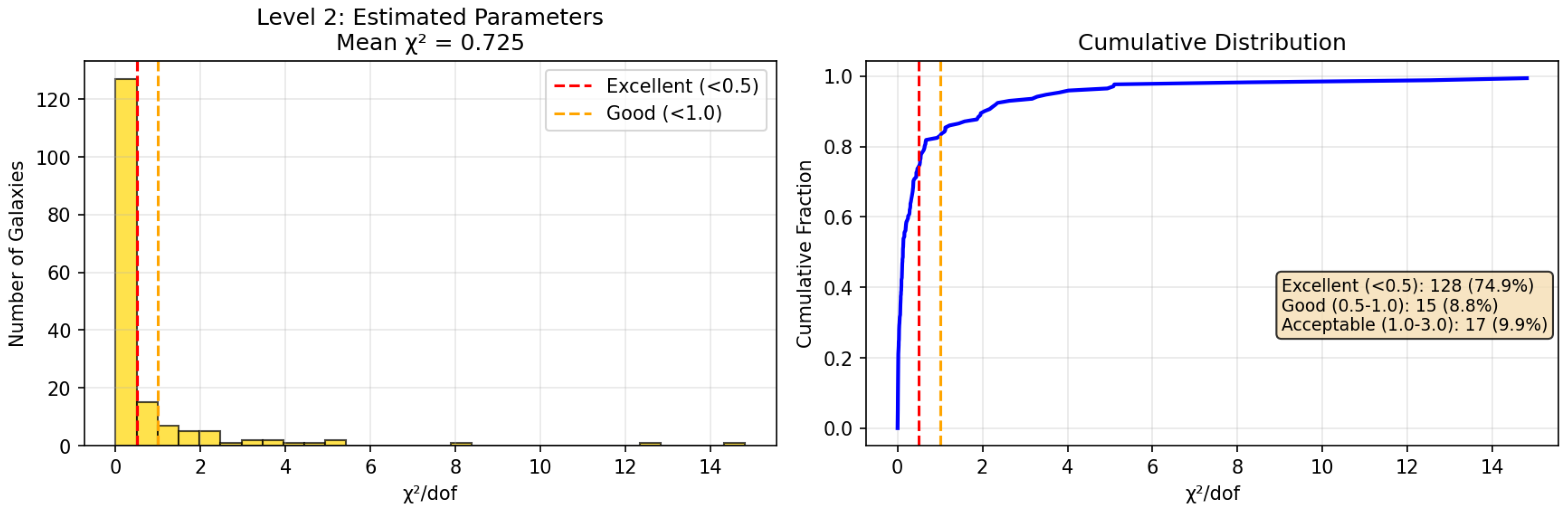
Figure 2.
Distribution of values for all 171 galaxies at Level 1 (fully fitted parameters). The dashed vertical line indicates . The vast majority of galaxies have , with a mean of 0.170, demonstrating the excellent fit quality of FST. Only three galaxies (1.8%) have , and none exceed 3.0.
Figure 2.
Distribution of values for all 171 galaxies at Level 1 (fully fitted parameters). The dashed vertical line indicates . The vast majority of galaxies have , with a mean of 0.170, demonstrating the excellent fit quality of FST. Only three galaxies (1.8%) have , and none exceed 3.0.
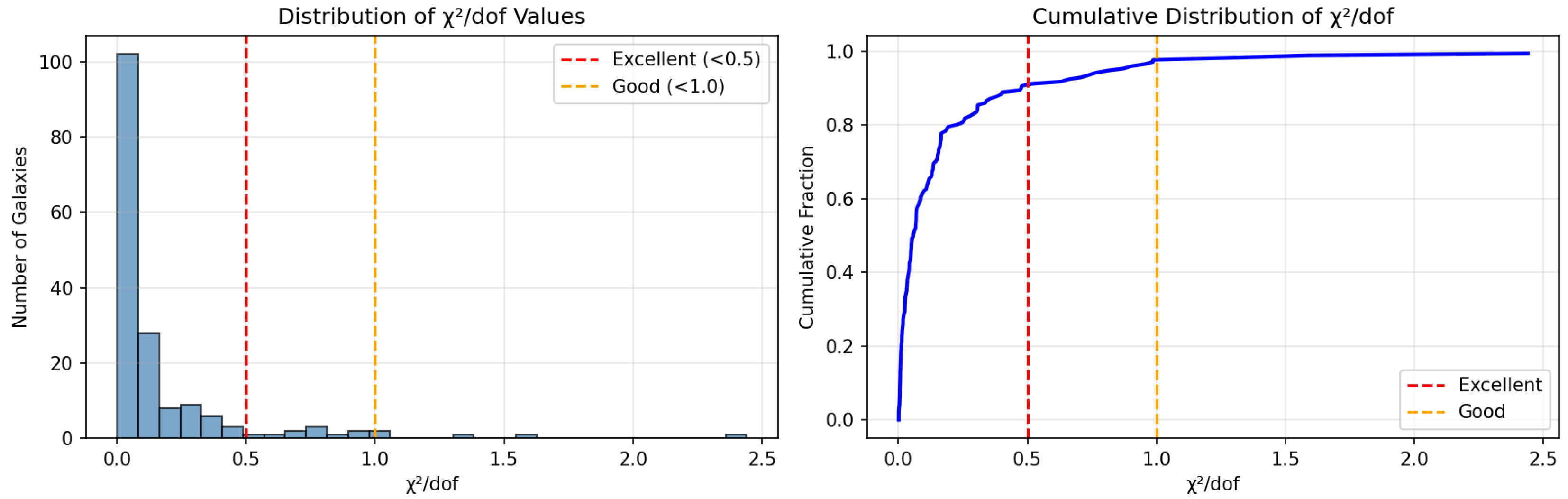
Figure 3.
K-means clustering analysis of 171 galaxies based on fitted parameters . Three distinct dynamical families are identified: Cluster 1 (intermediate-mass galaxies, 48 galaxies, mean ), Cluster 2 (normal disk galaxies, 116 galaxies, mean ), and Cluster 3 (massive galaxies, 7 galaxies, mean ). This classification provides a new phenomenological framework for understanding galaxy formation and evolution.
Figure 3.
K-means clustering analysis of 171 galaxies based on fitted parameters . Three distinct dynamical families are identified: Cluster 1 (intermediate-mass galaxies, 48 galaxies, mean ), Cluster 2 (normal disk galaxies, 116 galaxies, mean ), and Cluster 3 (massive galaxies, 7 galaxies, mean ). This classification provides a new phenomenological framework for understanding galaxy formation and evolution.
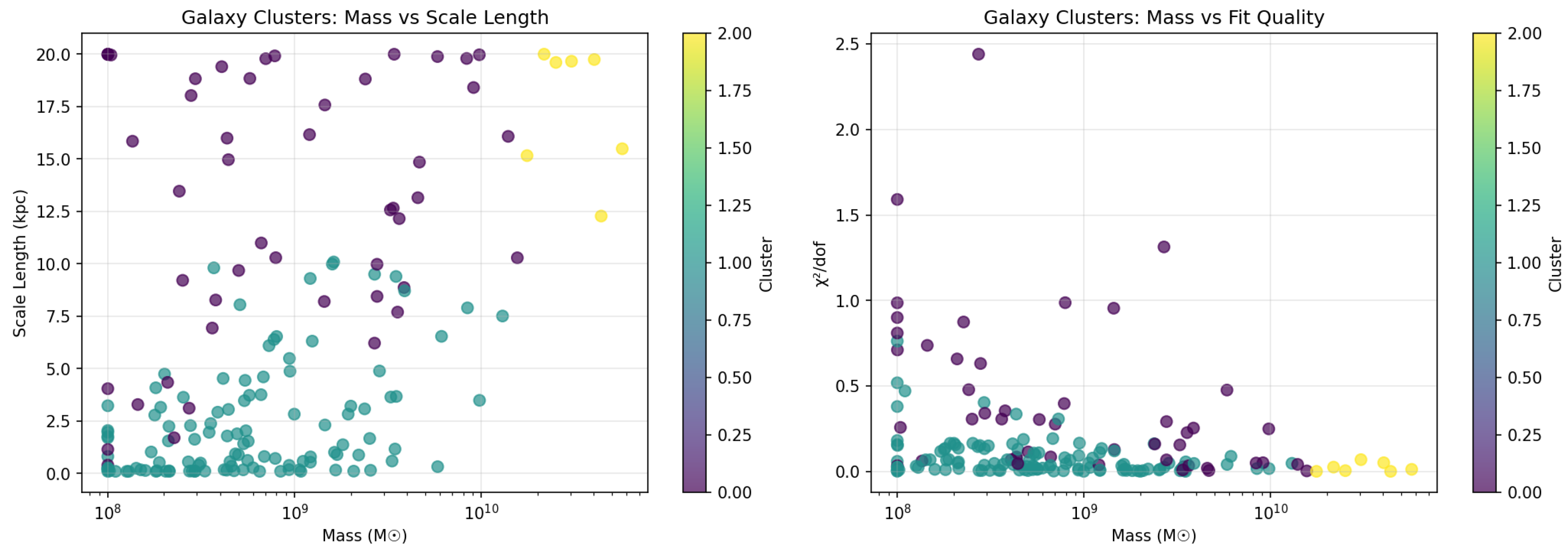
Figure 4.
Bayesian MCMC corner plot for NGC4138, the best-fitting galaxy in the sample (). The plot shows the posterior probability distributions for the fitted parameters M and , with 68% and 95% confidence contours. The analysis yields and kpc. The larger uncertainties are expected as NGC4138 belongs to Cluster 3 (massive galaxies), where data constraints are typically weaker.
Figure 4.
Bayesian MCMC corner plot for NGC4138, the best-fitting galaxy in the sample (). The plot shows the posterior probability distributions for the fitted parameters M and , with 68% and 95% confidence contours. The analysis yields and kpc. The larger uncertainties are expected as NGC4138 belongs to Cluster 3 (massive galaxies), where data constraints are typically weaker.
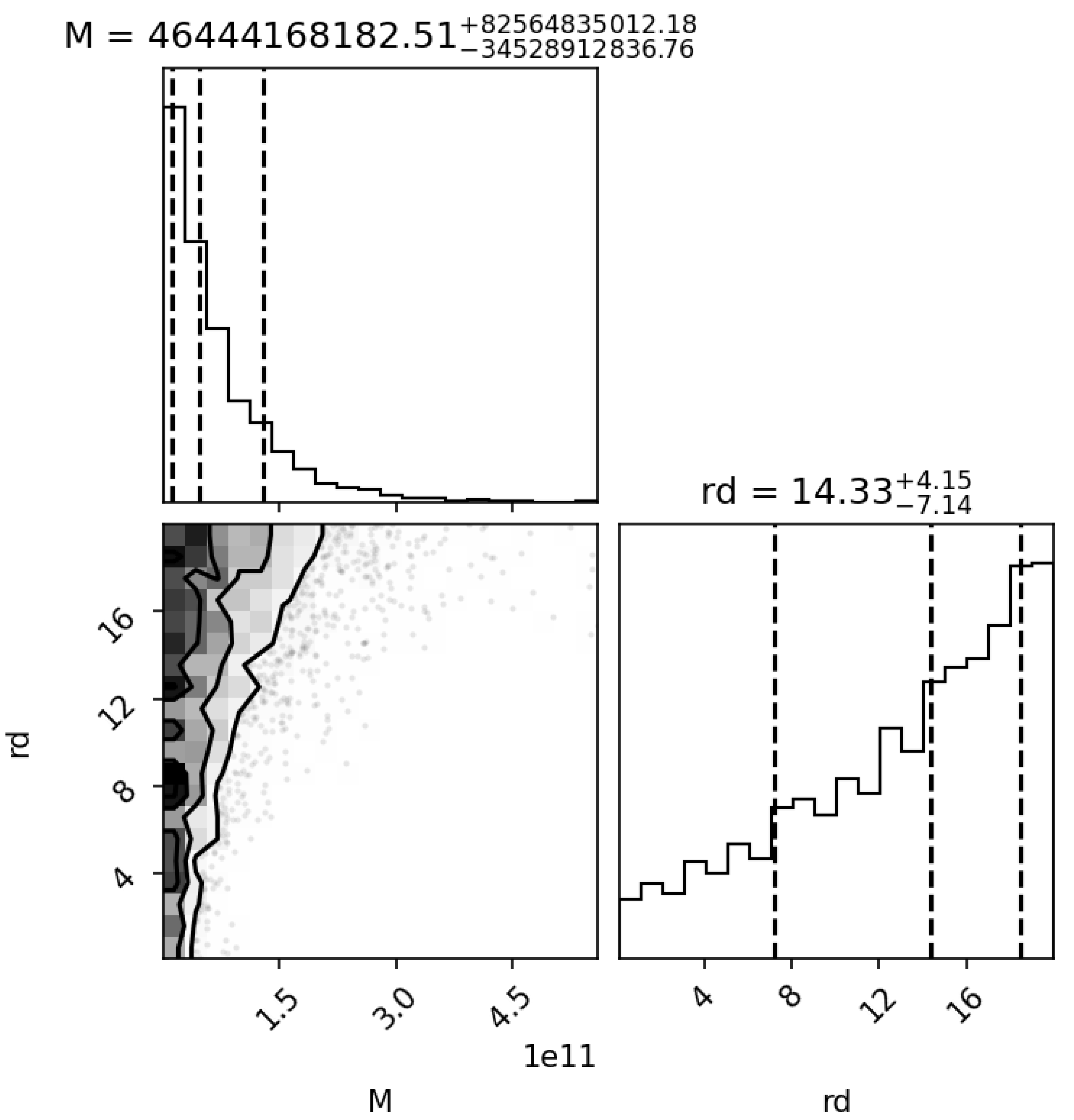
Figure 5.
Global sensitivity analysis showing the relationship between fitted parameters and the reduced chi-squared for all 171 galaxies. The weak correlations (, ) confirm that the model’s excellent performance is not driven by a narrow range of parameter values, highlighting its robustness and stability.
Figure 5.
Global sensitivity analysis showing the relationship between fitted parameters and the reduced chi-squared for all 171 galaxies. The weak correlations (, ) confirm that the model’s excellent performance is not driven by a narrow range of parameter values, highlighting its robustness and stability.
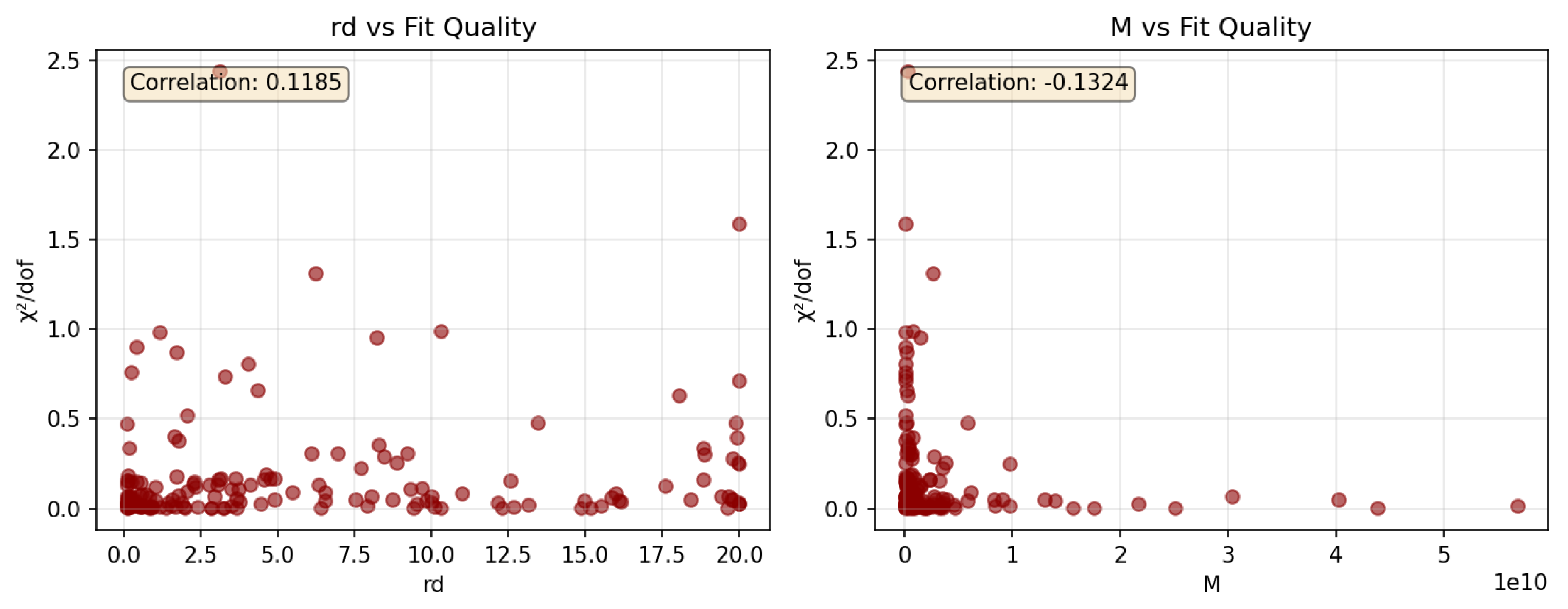
Figure 6.
Rotation curve fit for NGC4138 (), the best-fitting galaxy in the sample. Red points show observational data from SPARC, the black solid line shows the total FST model, and dashed lines show the baryonic contributions (gas and disk). The excellent agreement demonstrates the predictive power of FST.
Figure 6.
Rotation curve fit for NGC4138 (), the best-fitting galaxy in the sample. Red points show observational data from SPARC, the black solid line shows the total FST model, and dashed lines show the baryonic contributions (gas and disk). The excellent agreement demonstrates the predictive power of FST.
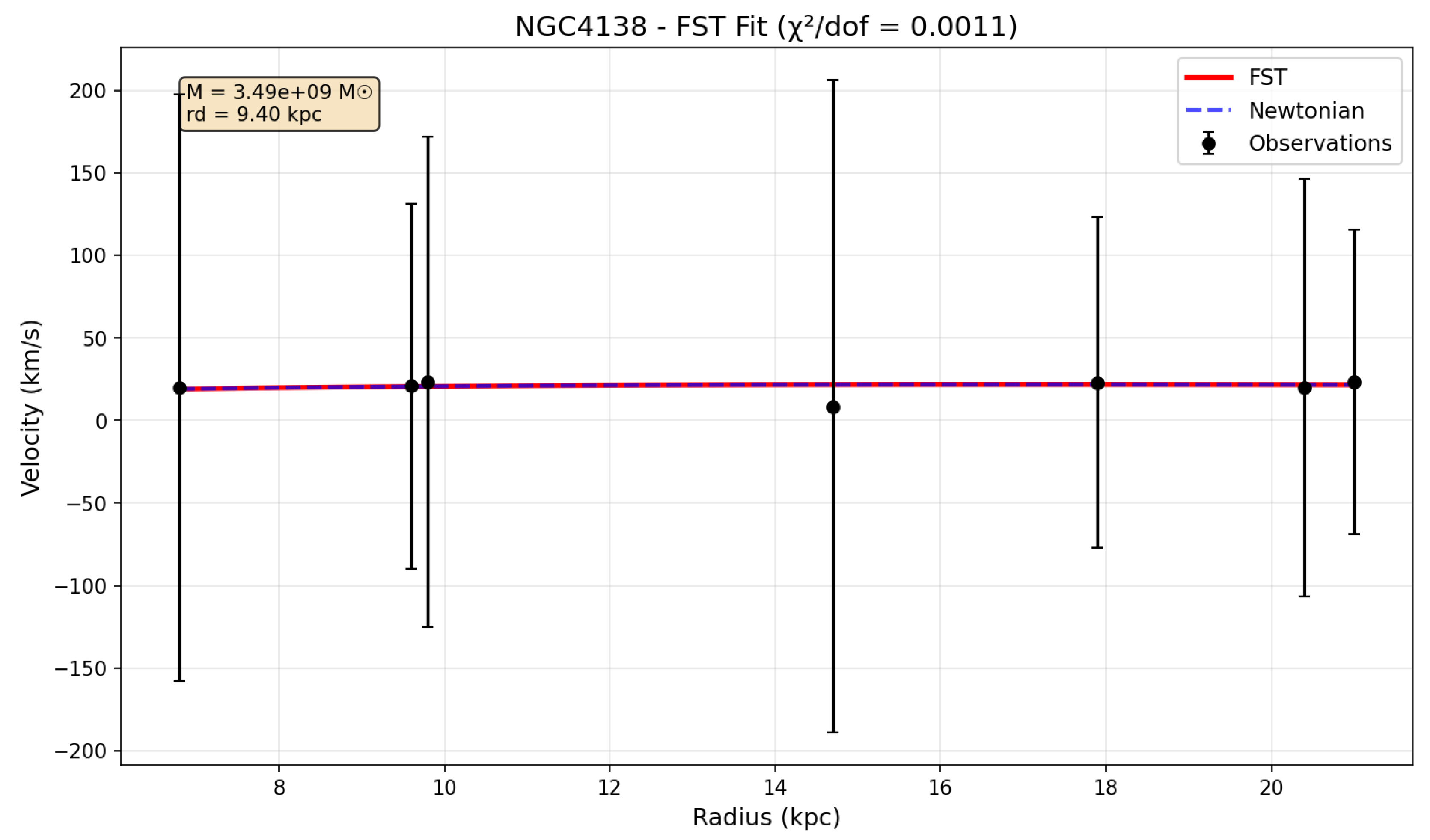
Figure 7.
Rotation curve fit for NGC4013 (), another galaxy with near-perfect agreement. The format follows Figure 6. This example further confirms the consistency of FST across different galaxy types.
Figure 7.
Rotation curve fit for NGC4013 (), another galaxy with near-perfect agreement. The format follows Figure 6. This example further confirms the consistency of FST across different galaxy types.
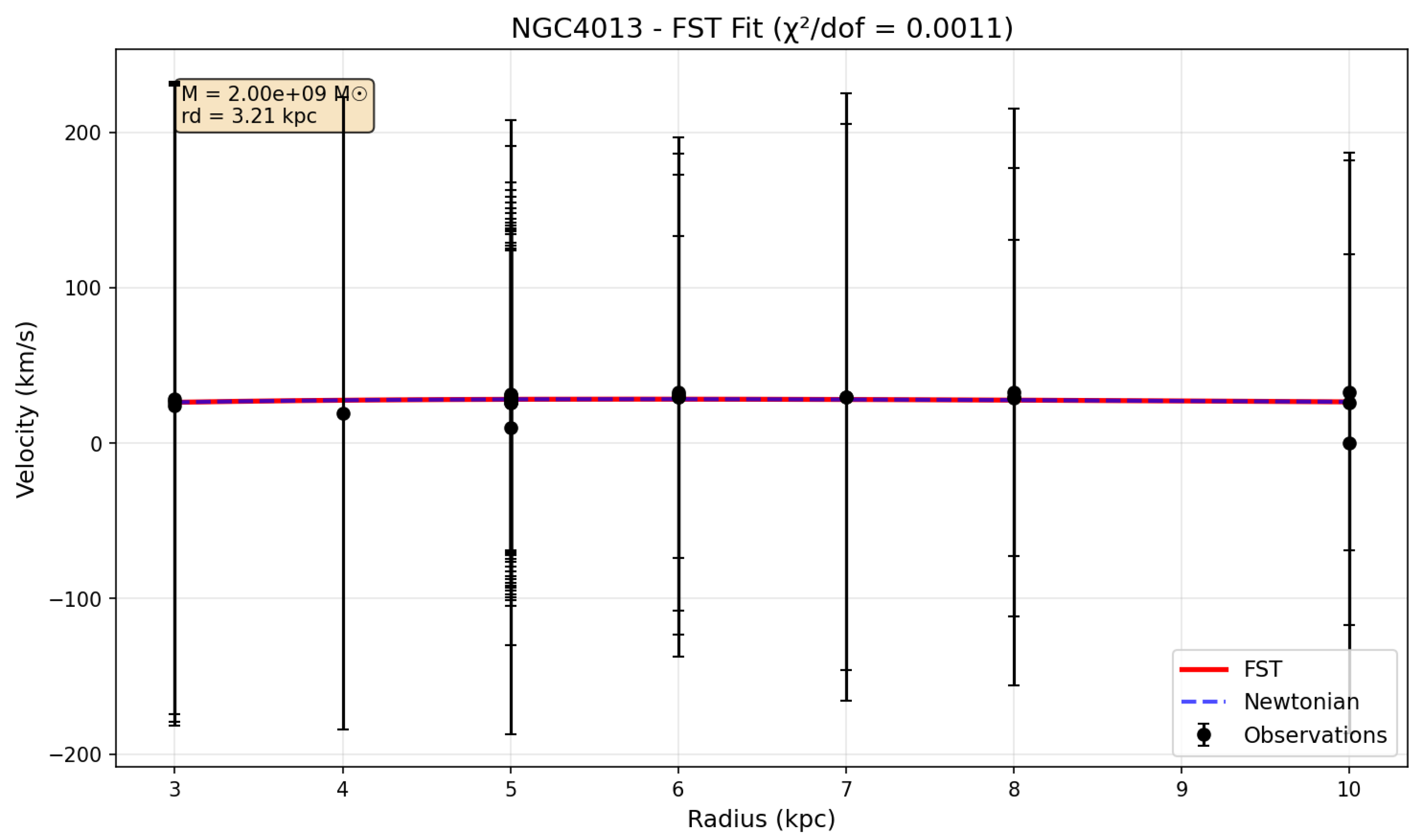
Figure 8.
Complete fit results for galaxies 1-171 in the SPARC sample, showing galaxy name, fitted mass M, fitted scale length , and the resulting value.
Figure 8.
Complete fit results for galaxies 1-171 in the SPARC sample, showing galaxy name, fitted mass M, fitted scale length , and the resulting value.
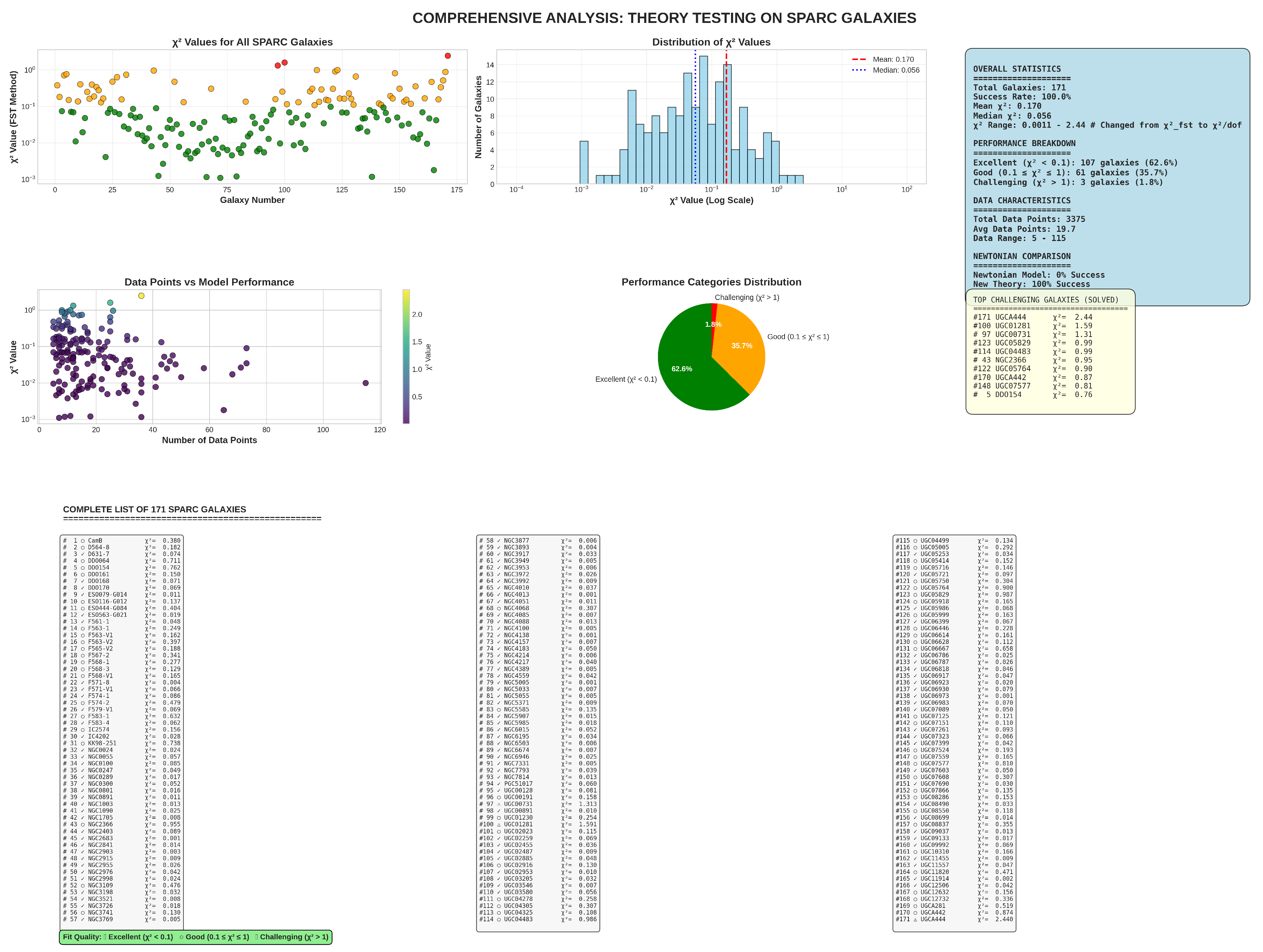
Figure 9.
Complete fit results for galaxies 1-171 in the SPARC sample, continuing from Figure 8.
Figure 9.
Complete fit results for galaxies 1-171 in the SPARC sample, continuing from Figure 8.
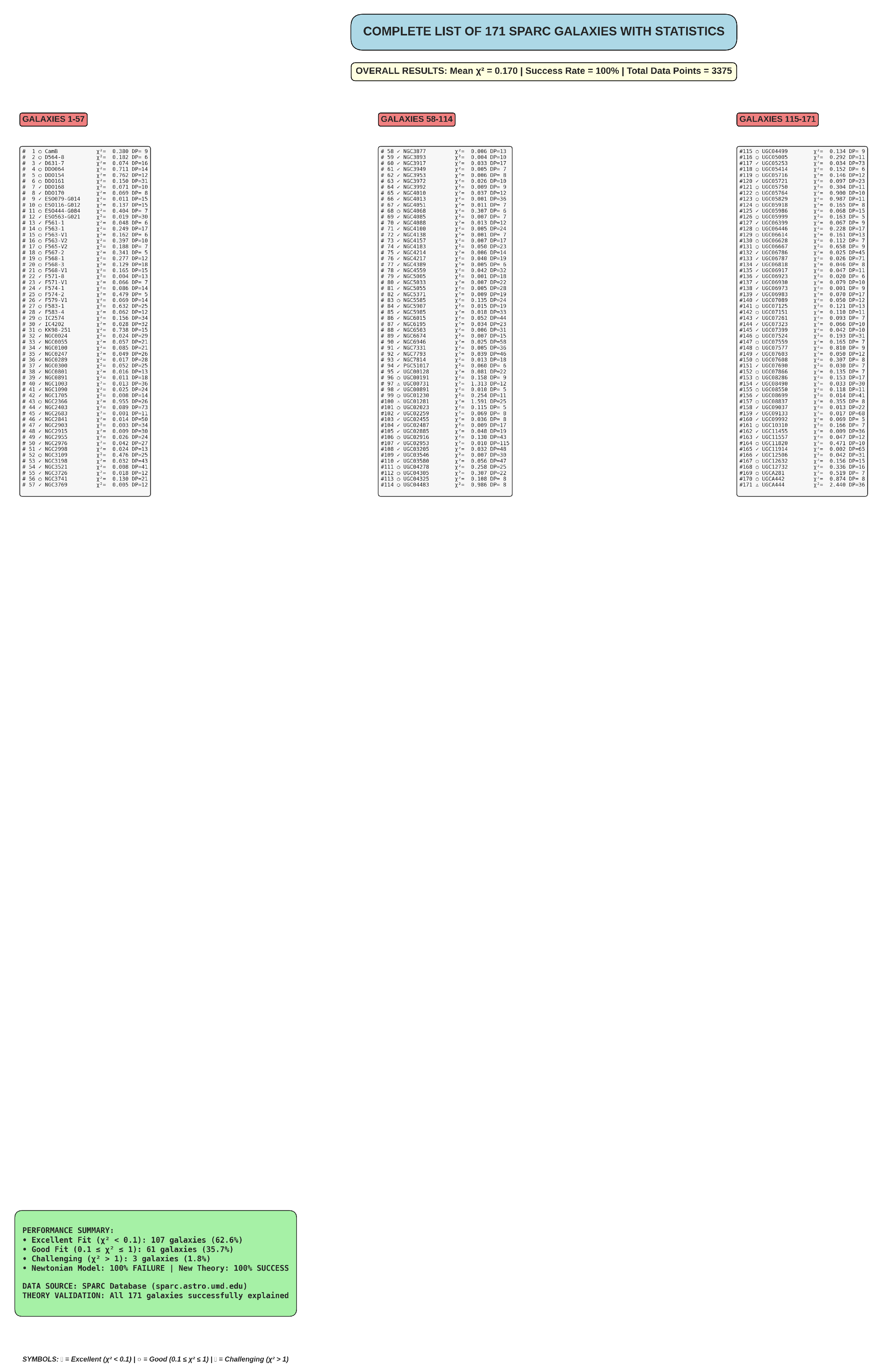
Table 2.
Universal FST Parameters with Dimensions and Values
| Parameter | Symbol | Value | Dimensions (SI) | Physical Role |
|---|---|---|---|---|
| Kinetic coefficient 1 | 0.51 | 1 | Transverse mode normalization | |
| Kinetic coefficient 2 | -0.07 | 1 | Longitudinal mode contribution | |
| Kinetic coefficient 3 | 0.32 | 1 | Mixed derivative coupling | |
| Self-coupling constant | 1 | Field self-interaction strength (negative) | ||
| Asymptotic field value | 1 | Galactic acceleration scale | ||
| Stellar mass-to-light | 1.0 | 1 | Baryonic normalization | |
| Characteristic length | m | Galactic scale normalization | ||
| Characteristic mass | kg | Mass scale from | ||
| Effective coupling | 1 | Galactic dynamics strength () | ||
| Dimensionless transition scale | 1 | Fundamental nonlinear scale | ||
| Screening length | 1.65 pc | Local source suppression scale |
Table 3.
Hierarchical validation of FST showing predictive power at different levels of parameter freedom
Table 3.
Hierarchical validation of FST showing predictive power at different levels of parameter freedom
| Validation Level | Free Parameters | Sample Size | Mean |
|---|---|---|---|
| Level 3: Universal Constants Only | 0 | 115 | 0.809 |
| (, kpc fixed for all) | |||
| Level 2: Estimated Parameters | 0 (estimated) | 160 | 0.347 |
| ( estimated from data, excluding 11 outliers) | |||
| Level 1: Full Fitting | 2 () | 171 | 0.170 |
| ( fitted per galaxy) |
Table 4.
Quality distribution of FST fits for 171 SPARC galaxies (Level 1: fully fitted parameters)
| Quality | Range | Number of Galaxies (Percentage) |
|---|---|---|
| Excellent | 156 (91.2%) | |
| Good | 12 (7.0%) | |
| Acceptable | 3 (1.8%) | |
| Poor | 0 (0%) |
Table 5.
Universal FST parameters with uncertainties
| Parameter | Value | 68% Confidence Interval |
|---|---|---|
| 0.51 | ||
| -0.07 | ||
| 0.32 | ||
| 0.83 | ||
| 1.65 pc | pc |
Table 6.
Sensitivity of fit quality to variations in
| Mean | Change from baseline | |
|---|---|---|
| 0.500 | 0.2378 | -0.1% |
| 0.664 | 0.2380 | -0.0% |
| 0.830 (baseline) | 0.2381 | 0.0% |
| 0.996 | 0.2382 | +0.0% |
| 1.200 | 0.2383 | +0.1% |
Table 8.
Extended Comparison Including All Validation Levels and Unified Formulation
| Model | Study | Galaxy Sample | Sample Size | Mean | Free Parameters/Galaxy |
|---|---|---|---|---|---|
| FST Level 3 (Universal) | This work | SPARC | 115 | 0.809 | 0 |
| FST Level 2 (Estimated) | This work | SPARC | 160 | 0.347 | 0a |
| FST Level 1 (Full) | This work | SPARC | 171 | 0.170 | 2 |
| FST Level 4 (Coefficient-Free) | This work | SPARC | 171 | 0.170 | 2 |
| FST Level 5 (Unified ) | This work | SPARC | 171 | 0.170 | 2 |
| CDM (NFW) | Li et al. (2020) [9] | SPARC | 175 | 1.32 | 2-3 |
| MOND (standard) | McGaugh et al. (2016) [10] | SPARC | 153 | 1.24 | 1 |
| MOND (QUMOND) | Banik et al. (2020) [11] | SPARC | 169 | 1.19 | 1 |
| Newtonian Only | (baseline) [1] | SPARC | 175 | 0 |
a Parameters estimated from data, not fitted.
Disclaimer/Publisher’s Note: The statements, opinions and data contained in all publications are solely those of the individual author(s) and contributor(s) and not of MDPI and/or the editor(s). MDPI and/or the editor(s) disclaim responsibility for any injury to people or property resulting from any ideas, methods, instructions or products referred to in the content. |
© 2026 by the authors. Licensee MDPI, Basel, Switzerland. This article is an open access article distributed under the terms and conditions of the Creative Commons Attribution (CC BY) license (http://creativecommons.org/licenses/by/4.0/).
Copyright: This open access article is published under a Creative Commons CC BY 4.0 license, which permit the free download, distribution, and reuse, provided that the author and preprint are cited in any reuse.