

Submitted:
05 February 2026
Posted:
06 February 2026
You are already at the latest version
Abstract
Livestock production continues to serve as a critical foundation for livelihoods and economic resilience in the arid and semi-arid lands (ASALs) of northern Kenya, where pastoralism remains the dominant livelihood strategy. In the rangeland ecosystems of Turkana and West Pokot counties, the sustainability of pastoral systems is vital for the socio-economic well-being of local communities. However, these systems face increasing pressure from recurrent droughts and climate variability, which severely threaten forage availability and livestock productivity. These challenges underscore the urgent need for innovative and scalable risk management approaches. This study examines the effectiveness of Index-Based Livestock Insurance (IBLI) as a tool for supporting sustainable rangeland-based pastoral systems in northern Kenya. Specifically, it assesses the empirical impact of IBLI adoption using the Enhanced Vegetation Index (EVI) as a proxy for forage availability. Employing a Difference-in-Differences (DID) approach with fixed effects, we analyze panel data derived from high-resolution MODIS-NASA satellite imagery spanning the years 2003 to 2021. The analysis focuses on determining the causal effects of IBLI adoption on rangeland health and pastoralist resilience in Turkana and West Pokot. Our findings indicate that IBLI adoption is associated with a statistically significant improvement in rangeland conditions, estimated at approximately 4%. Additional DID analyses suggest that this improvement is driven by enhanced forage sustenance, which itself shows a positive effect in the range of 3% to 4%. These results highlight the dual role of IBLI as both a household-level financial risk buffer and an enabler of ecological stability in pastoral systems. Overall, the study provides robust empirical evidence supporting the role of IBLI as an effective climate risk mitigation strategy. It contributes to the growing body of knowledge on sustainable pastoralism in ASALs and offers timely, policy-relevant insights for the expansion of IBLI programs across other drought-prone regions of Sub-Saharan Africa. By fostering both economic and ecological resilience, IBLI represents a promising pathway for strengthening the adaptive capacity of pastoralist communities in the face of escalating climate risks.
Keywords:
livestock production
; IBLI
; EVI
; NDVI
; difference-in-differences (DID)
Introduction
Agriculture continues to serve as a primary source of livelihood for millions globally, particularly within pastoral communities residing in arid and semi-arid lands (ASALs) [1]. In these regions, where alternative economic opportunities are often limited due to harsh climatic and environmental conditions, agricultural activities provide not only sustenance but also economic stability. Among the various agricultural subsectors, livestock production stands out as a pivotal contributor, accounting for more than half of global agricultural output [2]. This underscores the strategic importance of livestock systems in supporting rural economies and enhancing household resilience.
Investing in livestock development is therefore not only critical for driving economic growth but also for achieving broader social and developmental goals. Livestock production contributes directly to poverty alleviation by generating income, providing employment, and improving food and nutritional security. In line with the United Nations Sustainable Development Goals (SDGs), especially those related to ending poverty (SDG 1), achieving zero hunger (SDG 2), and promoting sustainable economic growth (SDG 8), the promotion of sustainable livestock systems is of paramount importance [2].
As Moyo and Swanepoel [3] note, livestock rearing is indispensable to the livelihoods of people living in rangelands across developing countries. It ensures access to essential dietary proteins, supports a dignified standard of living, and, when managed appropriately, contributes to environmental sustainability. Beyond its direct consumption value, livestock also supplies a wide array of by-products that fuel local industries. Banda et al. [4] emphasize that animals provide raw materials such as hides, skins, bones, and manure, which support sectors ranging from leather and fertilizer production to artisanal crafts.
In the rangelands of northern Kenya, pastoral systems play an indispensable role in supporting local livelihoods by providing both food and income [5]. These systems not only underpin household subsistence but also contribute significantly to the broader rural economy through their integration into agricultural value chains. As Herrero et al. [6] argue pastoralism constitutes a critical livelihood strategy, particularly in arid and semi-arid regions, offering employment opportunities across various nodes of livestock production, processing, and marketing. Moreover, livestock assets serve as a vital source of economic security and social capital, especially for women and marginalized populations in developing countries, where access to alternative income-generating opportunities may be limited. Despite their socioeconomic importance, a range of environmental stressors increasingly threatens pastoral systems in northern Kenya and similar regions across Sub-Saharan Africa. Chief among these are climate variability, recurrent droughts, and other extreme weather events, which have intensified in frequency and severity over recent decades [7,8]. These climatic pressures not only reduce pasture availability and water access but also exacerbate vulnerabilities to food insecurity and heighten the risk of resource-based conflicts among pastoral communities. In countries such as Kenya and Ethiopia, where pastoralism forms the backbone of rural livelihoods in arid and semi-arid lands (ASALs), ensuring the sustainability and resilience of pastoral systems is therefore both a developmental and humanitarian imperative.
Droughts represent a significant and recurrent threat to pastoral production systems, particularly in arid and semi-arid regions such as the rangelands of Northern Kenya [9]. These climatic shocks severely disrupt livelihoods dependent on livestock by reducing forage availability, increasing mortality rates, and exacerbating food insecurity. In response to these challenges, pastoralist communities have historically relied on informal risk management strategies, such as increased mobility and intensified nomadism. However, these traditional coping mechanisms have proven largely inadequate in the face of increasingly frequent and severe drought events [10,11,12].
Attempts to introduce formal financial instruments, such as indemnity-based or conventional livestock insurance, have also been largely unsuccessful in these contexts. These schemes have suffered from persistent market failures, including high administrative and transaction costs, asymmetric information leading to adverse selection, and moral hazard problems, rendering them unsustainable in low-income, mobile pastoral settings [13,14,15].
In light of these shortcomings, an innovative alternative—Index-Based Livestock Insurance (IBLI)—was introduced in 2010. The IBLI program was developed through a partnership between international organizations, the Government of Kenya, and academic institutions with the aim of offering a viable, scalable drought-risk solution tailored to pastoralist needs in the region [16]. Unlike conventional insurance models that require on-the-ground verification of losses, IBLI leverages remote sensing technologies to monitor vegetation conditions via the Normalized Difference Vegetation Index (NDVI), a satellite-derived indicator of forage availability. Payouts are triggered when vegetation indices fall below predetermined thresholds, thereby signaling the onset of drought-related stress [17]. This design helps reduce costs, improves transparency, and mitigates some of the information asymmetries that plague conventional schemes.
Although there is a growing body of literature advocating for the promotion of sustainable pastoral systems and climate-resilient livelihoods in dryland areas, there remains a notable gap in empirical research specifically examining the impact of IBLI on pastoral systems. To address this knowledge deficit, this study evaluates the effects of IBLI implementation on pastoral livelihoods in Northern Kenya. Using a difference-in-differences (DID) estimation strategy with fixed effects, we compare pastoral outcomes in Turkana County—where IBLI has been operationalized—with those in the neighboring West Pokot County, which has not adopted the program. This approach allows us to isolate the impact of IBLI while controlling for unobserved, time-invariant heterogeneity between the counties. The remainder of this paper is structured as follows: Section 2 presents a conceptual and theoretical framework for Index-Based Livestock Insurance (IBLI).Section 3 reviews existing empirical studies related to IBLI and its socio-economic impacts. Section 4 describes the study area, data sources, and methodology employed. Section 5 presents the empirical findings. Section 6 discusses the limitations of the study and outlines areas for future research. Section 7 concludes with a synthesis of findings and their implications for policy and practice.
2. Theoretical Framework of Index-Based Livestock Insurance (IBLI)
Index-Based Livestock Insurance (IBLI) represents a novel approach to agricultural risk management, specifically tailored to the needs of pastoralist communities vulnerable to climate-induced shocks. Developed as a means to mitigate the adverse impacts of droughts on livestock-dependent livelihoods, IBLI has been implemented since 2010 in the arid and semi-arid rangelands of northern Kenya [18].
Unlike traditional indemnity-based insurance, which requires field-based assessment and verification of individual claims, IBLI employs a parametric model wherein payouts are triggered by deviations in a remotely sensed environmental index. In this case, the insurance product uses the Normalized Difference Vegetation Index (NDVI)—a satellite-derived measure of vegetation greenness—as a proxy for forage availability [15,19,20,21]. This design allows for rapid, objective, and cost-effective loss assessment across large, remote areas.
The theoretical foundation of IBLI rests on a well-documented relationship between forage availability and livestock mortality in pastoral production systems [22]. In dryland regions, livestock survival is highly dependent on access to adequate grazing resources. NDVI effectively captures the dynamics of forage conditions, making it a suitable index for estimating drought-induced losses. Low NDVI values, which indicate reduced vegetation greenness, are typically associated with increased livestock mortality. Conversely, periods of higher NDVI reflect sufficient forage, supporting herd health and survival [11,12,16,23].
IBLI operates through a threshold-based payout structure. For instance, when NDVI values fall below a predefined minimum threshold (e.g., 15%), indicating extreme forage scarcity, and the policyholder receives the minimum insurance payout. As vegetation, conditions deteriorate further—approaching a higher loss threshold (e.g., 60%)—the payout increases proportionally. This relationship between NDVI levels and payout amounts is illustrated schematically in Figure 1.
While IBLI is not without limitations—most notably the presence of basis risk, wherein actual losses may not correspond to the index signal—it offers several advantages over conventional insurance products. By relying on objective, remotely sensed indicators rather than subjective loss assessments, IBLI effectively addresses key barriers to insurance uptake in rural settings. These include high transaction costs, information asymmetries, adverse selection, and moral hazard [10,16,19,21]. As such, IBLI presents a scalable and innovative tool for climate risk management among vulnerable pastoralist populations.
3. Prior Study and Research Hypothesis
- Despite growing interest in Index-Based Livestock Insurance (IBLI) as a risk management tool for pastoral communities, there remains a notable gap in the literature concerning its impacts at the county or broader administrative levels. The majority of empirical studies focus primarily on household-level outcomes or the unit-area of insurance, offering limited insights into how IBLI shapes systemic change across entire pastoral systems.
Household-level studies provide robust evidence that IBLI can significantly alter pastoralist behavior and outcomes. For instance, Matsuda et al. [24], using household survey data, find that IBLI encourages a transition away from informal, often inefficient risk-coping strategies—such as distress sales of livestock or reliance on social networks—toward more reliable, market-based mechanisms for managing drought-related risks. Ikegami et al. [25] report similar findings and again by Matsuda et al. [24], who show that IBLI coverage is positively associated with asset accumulation, suggesting improved long-term resilience.
Timu et al. [26] further extend this evidence by demonstrating that IBLI improves household food security, with particularly strong effects observed among female-headed households. Gallenstein et al. [27] highlight that insured households are more likely to access formal credit and participate in high-risk, high-return investment opportunities—activities typically avoided due to the high exposure to climate-related shocks. Additionally, IBLI appears to mitigate the fear of covariate losses, which often drive premature and distress-induced livestock sales. By reducing this fear, IBLI helps pastoralists maintain their herds during periods of climatic stress, contributing to the sustainability of their livelihoods (see also [20]).
Jensen et al. [28] provide further evidence of the positive welfare effects of IBLI, noting improvements in both health and economic well-being among insured pastoralists. Gebrekidan [17] finds a positive correlation between IBLI coverage and poultry ownership, interpreting this as a behavioral adaptation to downside basis risk—the risk that losses are incurred but the insurance is not triggered. Poultry, being less susceptible to drought, may serve as a buffer in such situations, offering an additional layer of household resilience.
The literature also points to potential limitations and unintended consequences. Bulte and Haagsma [29], for example, describe the welfare impacts of IBLI as “ambiguous,” warning that insurance could inadvertently reinforce inefficiencies such as overstocking, which may further degrade already fragile rangeland ecosystems. Similarly, Carter et al. [30] contend that the effects of remote-sensing-based insurance schemes on livestock production are mixed and, in many cases, inconclusive. Takahashi et al. [31] find no statistically significant impact of IBLI on the use of informal risk-sharing mechanisms, suggesting that traditional social networks may remain resilient or indispensable, regardless of insurance uptake.
Other studies examine the differential effects of IBLI on household consumption and resilience. Carter et al. [32] report that uninsured households consume fewer meals than their insured counterparts, indicating a direct welfare benefit of IBLI during times of shock. Likewise, Cisse et al. [33] provide evidence that IBLI contributes to enhancing the overall resilience of pastoralist communities.
Gebrekidan [17] also documents a positive influence of IBLI on household saving behavior. According to the study, insurance allows pastoralists to avoid distress sales by enabling them to retain their livestock until market prices are more favorable. This strategic timing of sales increases income potential and facilitates both consumption and cash savings, thereby strengthening long-term economic stability.
Taken together, the existing body of research underscores the significant promise of IBLI as a mechanism for improving household-level outcomes in pastoral communities. However, the predominant focus on micro-level impacts leaves open critical questions about how these individual-level changes aggregate to influence broader pastoral systems, including county-level development, natural resource management, and institutional dynamics. A more integrated, multi-scalar research approach is needed to assess the systemic effects of IBLI and to inform policy interventions that aim to support climate resilience and sustainable pastoralism at scale.
By focusing on Turkana and West Pokot counties, this study contributes to the literature by analyzing the county-level effects of Index-Based Livestock Insurance (IBLI) on pastoral systems in the rangelands of northern Kenya. Specifically, we test the null hypothesis that IBLI has no effect on pastoral systems, using the Enhanced Vegetation Index (EVI) Being open-access rangelands, reliable data on livestock production is unavailable. The nomadic lifestyle makes it difficult to maintain formal records of production. On the other hand, data based on herders’ recollection of production events may be inaccurate due to their limited ability to remember every detail from years ago. The rationale here is that if sustainable forage consumption is established in these open-access rangelands, livestock production will improve. as a proxy for pastoral systems. However, the findings presented in the subsequent sections lead us to reject this hypothesis, suggesting that IBLI does enhance pastoral systems in these rangelands of northern Kenya.
4. Research Settings and Methodology
4.1. Study Area
The rangelands of northern Kenya are among the economically distressed regions of the country [35]. This study focuses on two neighboring counties within these rangelands: Turkana and West Pokot. Rain-fed pastoral systems are the primary economic activity in both counties, making livestock a central livelihood resource and a critical asset for poor communities in these areas [36,37,38,39].
However, overdependence on rain-fed livestock production exposes these counties to climate variability, which can negatively affect livelihoods and lead to food insecurity [40]. Additionally, resource-use-induced conflicts occasionally arise, further disrupting economic activities—particularly pastoral systems [16,41].
To enhance the sustainability of pastoral systems, agricultural risk management tools have been introduced among pastoral communities in these rangelands. The most prominent of these is Index-Based Livestock Insurance (IBLI), which was introduced in 2010. Since its introduction, more than 90% of pastoralists with IBLI coverage have been enrolled in the Kenya Livestock Insurance Program (KLIP)—a highly subsidized program. To date, over 300,000 cattle equivalents (worth approximately USD 145 million) have benefited from the IBLI program [42]. Figure 2 shows the study counties of Turkana and West Pokot.
4.2. Methodology
4.2.1. Benchmark Model-Difference-in- Differences (DID) Model
The introduction of index-based livestock insurance (IBLI) in 2010 provides an opportunity to use it as a quasi-natural experiment to test its effects on pastoral systems in the rangelands of northern Kenya, using a difference-in-differences (DID) model. The DID models are well-suited for policy or program evaluation, as they represent a quasi-experimental design that helps researchers assess causal relationships in situations where Randomized Controlled Trials (RCTs) are not feasible for various reasons including high cost of implementing them [43].
These econometric models, commonly referred to as DID models, compare two sets of groups: the treated group (which was subjected to the policy) and the control or untreated group (which was not). DID models primarily compare within-group variations between the treated and untreated groups over time [44,45,46].
The robustness of DID model results depends on several key indicators, as proposed by Huntington-Klein [44]. For unbiased DID estimation, it is important to ensure there is no reason to expect a sudden change in the control group during the treatment period. According to Huntington-Klein [44], other crucial assumptions for DID models include strong similarities between the treated and control groups and the presence of similar pre-treatment trends in the dependent variable for both groups—known as the parallel trends assumption.
By enabling a comparison of pre- and post-policy intervention outcomes for both the treated and control groups, DID models help address issues of endogeneity and time-invariant differences between the two groups [47].
The IBLI program was implemented in 2010 [16]. In this study, Turkana County serves as the treatment entity (i.e., the county where the IBLI program was implemented), while Pokot West County serves as the control entity (i.e., the county where the IBLI program was not implemented). Equation (1) represents the benchmark DID model for this study:
Where i refers to the country and t indicates the year. The dependent variable stands for ‘pastoral systems’, which is proxied by the logarithm of the Enhanced Vegetation Index (EVI), an indicator of forage availability—denoted as evi_log in Table 1. The policy variable, which corresponds to our coefficient of interest (β₁), is a dummy variable indicating the IBLI program. It is the interaction between the policy dummy variable (with IBLI or treated) and the time dummy variable (after the year 2010, or post).Since Turkana County has an active IBLI program, Treat = 1; otherwise, Treat = 0. Similarly, Post = 1 when t is after the year 2010 (the year of IBLI program implementation); otherwise, Post = 0. Controls refer to a set of control variables, represents time fixed effects, represents country fixed effects, and is the random disturbance term. The key coefficient in equation (1) is β₁, representing the effect of the IBLI program/policy. It reflects the impact of Index-Based Livestock Insurance (IBLI) on pastoral systems in the rangelands (Turkana and West Pokot counties) of northern Kenya. Statistically, if β₁ > 0 and is significant, then the IBLI program enhances livestock production in the rangelands of northern Kenya.
4.2.2. Testing the Parallel Trends Assumption
Satisfying the parallel trends assumption before the policy intervention for the experimental and control groups is critical to obtaining unbiased results. This means the validity of the Difference-in-Differences (DID) estimation depends on passing the parallel trends assumption test [48]. To meet this condition in this research, the trends in pastoral systems in Turkana County (with the IBLI program) and West Pokot County (without the IBLI program) should be consistent before the policy (IBLI) implementation. To test this assumption, this study conducts a test for the parallel trends assumption.
Researchers typically use two approaches to test the parallel trends assumption in DID models: graphical and statistical [49]. This research adopts the statistical approach. In this approach, an interaction term between the time dummy variable (before treatment) and the treatment group is included in a fixed-effects regression. If we fail to reject the coefficient of the ‘before treatment’ interaction term at the 5% significance level, the parallel trends test is considered to have passed [50]. Following Riveros-Gavilanes [51], equation (2) represents the statistical approach to testing this study parallel trends assumption:
In equation (2), i denote the county (or county/unit) and t the year. The outcome or dependent variable, Yit, represents logathimic of enhanced vegetation index (EVI), a proxy for pastoral systems. The term λt captures year fixed effects to account for time-varying shocks common across units, while ψi accounts for unit (county) fixed effects to control for time-invariant heterogeneity across counties. The terms and represent the dummy variables which identify the pretreatment and post treatment, respectively, while is a treatment dummy that identify whether or not unit i has ever received treatment.
Equation (2) includes the coefficient of interest α, which measures the difference in pre-policy slopes between treated counties (i.e., Turkana County with the operational IBLI program) and control counties (i.e., West Pokot County without the program), relative to the baseline year 2010—the year the IBLI program was implemented. The coefficient τ captures the effect of the policy in the post-treatment period. The model also includes a vector of covariates X and is the idiosyncratic error term.
The primary objective of equation (2) is to test for differential pre-treatment trends between the treated and control groups. Following Riveros-Gavilanes (2023) [51], this is formally tested using the null hypothesis 0. Failure to reject this null hypothesis indicates that the treated and control groups were following parallel trends prior to the policy intervention, thus supporting the validity of the parallel trends assumption necessary for causal interpretation of a difference-in-differences (DiD) framework.
4.2.3. Placebo Test
In Difference-in-Differences (DID) models, the implementation of policy interventions other than the intervention of interest may introduce bias into the estimated treatment effects [52]. To test whether this is the case, we employ a placebo test. This method originally derived from the field of medicine—where a placebo refers to an ineffective treatment used to measure the efficacy of a drug—has been adapted in economics as a robustness check to strengthen causal inferences [53].
In the context of DID, a placebo test involves assigning a fictitious or “fake” treatment to a group that was not actually treated and estimating the policy effect. If the estimated treatment effect from this placebo group is statistically significant, it suggests that the observed effects in the actual analysis may be driven by other unobserved factors, thus undermining the credibility of the original findings. In this study, which evaluates the impact of the Index-Based Livestock Insurance (IBLI) program in the rangelands of Northern Kenya, potential sources of confounding influence may include other agricultural risk mitigation interventions. By implementing a placebo test with a fictitious treatment unrelated to the IBLI program, we can assess whether such external factors are biasing our results. A statistically significant coefficient on the placebo treatment would indicate a failed test and raise concerns about the reliability of the estimated policy effect of the actual IBLI intervention.
4.2.4. Data
This paper evaluates the impact of the Index-Based Livestock Insurance (IBLI) program on pastoral systems in the rangelands of northern Kenya, using a difference-in-differences (DID) approach. Introduced in Turkana County in 2010, the IBLI program serves as a quasi-natural policy intervention, with neighboring West Pokot County—where the program was not implemented—serving as the control group.
The analysis draws on panel data from 2003 to 2021, sourced from MODIS-NASA remote sensing products. Two primary variables are examined: precipitation, a key driver of forage growth in rangelands of tropical regions, and the Enhanced Vegetation Index (EVI), which is used as a proxy for forage availability and, by extension, pastoral systems. While both the EVI and the Normalized Difference Vegetation Index (NDVI) indicate vegetation health, EVI is preferred for its ability to minimize the effects of soil and atmospheric interference.
Table 1 presents summary statistics for the dataset, including transformed variables—such as logarithmic and lagged forms—used in the empirical analysis.
5. Results and Discussions
To address potential selection bias, we adopt a difference-in-differences (DID) model with fixed effects as our benchmark specification. This methodology is consistently applied across all subsequent regression models in the study. Control variable(s) are included in all regressions to account for observable heterogeneity.
Table 2 presents the results of the benchmark DID regression. Columns (1) presents estimates without controlling for fixed effects, while Column (2) incorporates both county and year fixed effects. The primary specification of interest is shown in Column (2), which also reports standard errors clustered at the county level to account for potential within-county correlations not eliminated by the DID differencing.
The DID estimates in Column (2) indicate that the Index-Based Livestock Insurance (IBLI) program exerts a statistically significant positive effect on pastoral systems in Turkana County, a rangeland region in northern Kenya. Specifically, participation in IBLI is associated with an approximate 4.1% improvement in pastoral system outcomes, significant at the 1% level. These findings suggest that IBLI serves as an effective mechanism for agricultural risk mitigation and resilience enhancement in pastoral regions.
5.1. Robustness Test Based on Parallel Trend and Placebo Tests
5.1.1. Results of Parallel Trend Test
One of the most critical assumptions for obtaining reliable estimates in Difference-in-Differences (DID) models is that the treatment and control groups follow parallel trends prior to the policy implementation, a condition commonly referred to as the parallel trends assumption. To assess this assumption, we estimated Equation (2) using a fixed effects method, following the approach outlined by Riveros-Gavilanes (2023) [51].
The results, as shown in Table 3, reveal that the coefficient for the pre-treatment period is statistically insignificant. This lack of significance reinforces the validity of the parallel trends assumption, aligning with the criteria established by Riveros-Gavilanes [51]. As a result, this finding strengthens the robustness of the benchmark DID estimates presented in Table 2.
5.1.2. Results of Placebo Test
Another key assumption of DID models is the uniqueness of the policy intervention, meaning that the IBLI program should be the primary driver of changes in pastoral systems in northern Kenya’s rangelands during the study period. To test this assumption, we introduce two placebo (or “fake”) treatment years—2004 and 2008—when the IBLI program had not yet been implemented.
The results, shown in Table 4, reveal that the DID estimates for both placebo years are not statistically significant. This lack of significant effects supports the robustness of our main DID findings (reported in Table 2), suggesting that no other concurrent policies influenced pastoral systems in Turkana County during the study period. These placebo tests, therefore, reinforce the causal interpretation of the IBLI program’s impact on pastoral systems in northern Kenya’s rangelands.
5.2. Mechanism Analysis
While the preceding analysis demonstrates that the IBLI program has a statistically significant effect on pastoral systems in the rangelands of Turkana County, northern Kenya, it does not clarify the specific mechanisms through which these effects are realized. In other words, the analysis does not yet explain how IBLI, as an agricultural risk mitigation program, enhances pastoral systems.
To investigate the transmission channels of the IBLI policy, we adopt the methodological approach outlined by Wen & Liu [56] and Y. Liu et al. [57]. Specifically, we estimate the regression equations (3) and (4), where represents a set of intermediary (or mediating) variables that potentially capture the pathways through which the IBLI program affects pastoral systems. These variables may include factors such as investments in veterinary services, access to feed, household consumption smoothing, and herd management strategies.
In this context, equation (4) incorporates an interaction term between the IBLI policy implementation and the intermediary variable. The coefficient on this interaction term is of primary interest, as it reveals how the IBLI policy operates. Specifically, it indicates whether and how the intermediary variable mediates the relationship between policy implementation and pastoral systems in these rangelands.
Table 5 reports the regression results based on Equation (3). Columns (1) and (2) present estimates from difference-in-differences (DID) models with fixed effects. The key results are shown in Column (2), where standard errors are clustered at the county level to account for within-county correlation and to improve the robustness of the estimates. Using the lagged Enhanced Vegetation Index (EVI) as the dependent variable—serving as a proxy for pasture conditions from the previous season that were not overgrazed—the estimated impact of the Index-Based Livestock Insurance (IBLI) policy indicates a 3.6% increase, statistically significant at the 5% level. This finding suggests that the IBLI policy may possess an inherent optimizing effect that promotes forage sustainability and strengthens the resilience of pastoral systems in these rangelands. A plausible mechanism is that IBLI provides incentives for pastoralists to manage herd sizes more efficiently and reduce excessive nomadic movements, thereby fostering more sustainable herding practices.
Table 6 reports additional results from the mechanism analysis, examining the interaction between the Index-Based Livestock Insurance (IBLI) program—estimated using a difference-in-differences (DID) specification—and the one-year lag of the Enhanced Vegetation Index (EVI), which serves as a proxy for forage sustenance (i.e., residual forage from previous seasons that was not grazed). This interaction is considered a plausible channel through which the IBLI program influences livestock production in the rangelands of northern Kenya. The key findings, presented in column (2) with standard errors clustered at the county level, indicate that the interaction term between the DID estimator and the lagged EVI is positive and statistically significant. Specifically, the estimated coefficient of approximately 2.5%, significant at the 5% level, suggests that the IBLI program enhances pastoral productivity partly by sustaining forage availability over time.
6. Study limitation and Future Study
This study utilizes county-level MODIS-NASA panel data from 2003 to 2021. A limitation of cross-county analyses like this is the risk of overlooking localized dynamics that are essential for accurately assessing the phenomena under investigation. Furthermore, the scope of index-based livestock insurance (IBLI) presents a constraint, as the program currently operates only in Kenya and Ethiopia. However, this limitation is expected to diminish over time as more countries adopt IBLI programs, offering future researchers broader opportunities for analysis. In terms of geographic scope, this study focuses on two counties within the rangelands of northern Kenya. Future research could expand this analysis by including additional counties in the region or by replicating the study in Ethiopia, thereby improving generalizability and providing valuable comparative insights.
7. Conclusion and Policy Recommendation
As the world grapples with the escalating challenges posed by climate change, there is an urgent need to strengthen efforts to ensure food security and promote sustainable economic development. Extensive research indicates that arid lands, or rangelands, are particularly vulnerable, with communities in these regions employing various strategies to sustain their livelihoods. Since 2010, northern Kenya’s rangelands have benefited from the Index-Based Livestock Insurance (IBLI) program, designed primarily to support livestock systems in these vulnerable areas.
Using a difference-in-differences (DID) model with fixed effects and analyzing panel data from 2003 to 2023, sourced from MODIS-NASA; we assessed the impact of the IBLI program on pastoral systems in northern Kenya’s rangelands and investigated the mechanisms driving this impact. The key findings of the study are (a) The IBLI program has a significant positive effect on pastoral systems in arid lands/rangelands, with an estimated increase of 4.0%, statistically significant at the 5% level. These results are robust, confirmed by the parallel trends assumption test. Additionally, the robustness of the main DID regression results (Table 2) is supported by a placebo test, which verifies that IBLI was the sole policy influencing pastoral systems in Turkana County, where the program was implemented, and (b) The program’s impact primarily operates through the sustenance of forage availability. Based on these empirical findings, the study recommends the following policies:
- Governments, in partnership with the private sector and research institutions, should scale up the IBLI program to rangelands across the Horn of Africa that currently lack this insurance scheme. This expansion will enhance pastoral systems and improve food security throughout the region.
- Given the evidence that IBLI effectively mitigates rangeland degradation, policymakers should promote the program as a sustainable strategy to preserve rangelands and support their role as carbon sinks.
Author Contributions
Conceptualization, S.M., M.M., G.L.T., N.H. and J.A.; Methodology, S.M.; Investigation, S.M.; Writing—original draft, S.M., M.M. and G.L.T.; Writing—review & editing, S.M., M.M., G.L.T., N.H., J.A. and N.K.; Supervision, M.M., G.L.T., N.H. and J.A. All authors have read and agreed to the published version of the manuscript.
Funding
This work is supported by funding from the following grant project: NASA-SERVIR Applied Science Team (Grant #80NSSC20K0162).
Institutional Review Board Statement
Not applicable.
Informed Consent Statement
Not Applicable.
Data Availability Statement
Data is contained in the article.
Acknowledgments
This research paper is one part of an Interdisciplinary Ph.D. training, jointly supported by SERVIR and New Mexico State University. We highly appreciate their technical and financial support.
Conflicts of Interest
The authors declare no conflicts of interest.
References
- Upton, M. The Role of Livestock in Economic Development and Poverty Reduction.2004. [CrossRef]
- Nouala, S.; Pica-Ciamarra, U.; Otte, J.; Nguetta, A. Investing in Livestock to Drive Economic Growth in Africa: Rationales and Priorities. 2011. Available online: https://hdl.handle.net/10568/16999 (accessed on 12 December 2023).
- Moyo, S.; Swanepoel, F. Multifunctionality of Livestock in Developing Communities. Role Livest. Dev. Communities Enhancing Multifunct. 2010, 3, 69. Available online: https://hdl.handle.net/10568/3043 (accessed on 13 Octomber 2022).
- Banda, L.J.; Tanganyika, J. Livestock Provide More than Food in Smallholder Production Systems of Developing Countries. Anim. Front. 2021, 11, 7–14.doi: 10.1093/af/vfab001.
- Paul, B.K.; Groot, J.C.; Maass, B.L.; Notenbaert, A.M.; Herrero, M.; Tittonell, P.A. Improved Feeding and Forages at a Crossroads: Farming Systems Approaches for Sustainable Livestock Development in East Africa. Outlook Agric. 2020, 49, 13–20. doi: 10.1177/0030727020906170.
- Herrero, M.; Grace, D.; Njuki, J.; Johnson, N.; Enahoro, D.; Silvestri, S.; Rufino, M.C. The Roles of Livestock in Developing Countries. animal 2013, 7, 3–18. doi: 10.1017/S1751731112001954.
- Pricope, N.G.; Husak, G.; Lopez-Carr, D.; Funk, C.; Michaelsen, J. The Climate-Population Nexus in the East African Horn: Emerging Degradation Trends in Rangeland and Pastoral Livelihood Zones. Glob. Environ. Change 2013, 23, 1525–1541. [CrossRef]
- Rishmawi, K.; Prince, S.D.; Xue, Y. Vegetation Responses to Climate Variability in the Northern Arid to Sub-Humid Zones of Sub-Saharan Africa. Remote Sens. 2016, 8, 910. [CrossRef]
- Sakketa, T.G.; Maggio, D.; McPeak, J. The Protective Role of Index Insurance in the Experience of Violent Conflict: Evidence from Ethiopia∗. J. Dev. Econ. 2024, 103445. doi: 10.1016/j.jdeveco.2024.103445.
- Maina, S.; Miller, M.; Torell, G.L.; Hanan, N.; Anchang, J.; Kahiu, N. Index Insurance for Forage, Pasture, and Rangeland: A Review of Developed (USA and Canada) and Developing (Kenya and Ethiopia) Countries. Sustainability 2024, 16, 3571. [CrossRef]
- Mude, A.; Barrett, C.B.; Carter, M.R.; Chantarat, S.; Ikegami, M.; McPeak, J.G. Index Based Livestock Insurance for Northern Kenya’s Arid and Semi-Arid Lands: The Marsabit Pilot. Available SSRN 1844758 2009. [CrossRef]
- Mude, A.G.; Chantarat, S.; Barrett, C.B.; Carter, M.R.; Ikegami, M.; McPeak, J.G. Insuring against Drought-related Livestock Mortality: Piloting Index Based Livestock Insurance in Northern Kenya. Available SSRN 1844745 2010. [CrossRef]
- Jensen, N.D.; Fava, F.P.; Mude, A.G.; Barrett, C.B.; Wandera-Gache, B.; Vrieling, A.; Taye, M.; Takahashi, K.; Lung, F.; Ikegami, M. Escaping Poverty Traps and Unlocking Prosperity in the Face of Climate Risk: Lessons from Index-Based Livestock Insurance; Cambridge University Press, 2024; ISBN 1-00-955827-7. [CrossRef]
- Linhoff, M.; Mußhoff, O.; Parlasca, M.C. Insuring against Droughts: Addressing Issues of Trust, Transparency and Liquidity in the Demand for Livestock Index Insurance. Clim. Dev. 2023, 15, 240–250. [CrossRef]
- Ye, T.; Li, Y.; Gao, Y.; Wang, J.; Yi, M. Designing Index-Based Livestock Insurance for Managing Snow Disaster Risk in Eastern Inner Mongolia, China. Int. J. Disaster Risk Reduct. 2017, 23, 160–168. [CrossRef]
- Gehring, K.; Schaudt, P. Insuring Peace: Index-Based Livestock Insurance, Droughts, and Conflict. Droughts Confl. January 22 2024 2024. doi: 10.2139/ssrn.4456354.
- Gebrekidan, T. Effect of Index-Based Livestock Insurance on Uninsured Poultry Production: Experimental Evidence from Southern Ethiopia. 2021. [CrossRef]
- Belissa, T.; Lensink, R.; Winkel, A. Effects of Index Insurance on Demand and Supply of Credit: Evidence from Ethiopia. Am. J. Agric. Econ. 2020, 102, 1511–1531. [CrossRef]
- Chantarat, S.; Mude, A.G.; Barrett, C.B.; Carter, M.R. Designing Index-based Livestock Insurance for Managing Asset Risk in Northern Kenya. J. Risk Insur. 2013, 80, 205–237. Available online : 10.1111/j.1539-6975.2012.01463.x (accessed on 17 May 2023).
- Gebrekidan, T.; Guo, Y.; Bi, S.; Wang, J.; Zhang, C.; Wang, J.; Lyu, K. Effect of Index-Based Livestock Insurance on Herd Offtake: Evidence from the Borena Zone of Southern Ethiopia. Clim. Risk Manag. 2019, 23, 67–77. [CrossRef]
- Gebrekidan, T.; Kaiyu, L. Effect of Index-Based Livestock Insurance on Loan Uptake: Evidence from the Borena Zone of Southern Ethiopia. Agric. Finance Rev. 2019, 79, 426–442. [CrossRef]
- McPeak, J.; Chantarat, S.; Mude, A. Explaining Index-based Livestock Insurance to Pastoralists. Agric. Finance Rev. 2010, 70, 333–352. [CrossRef]
- Kramer, B.; Hazell, P.; Alderman, H.; Ceballos, F.; Kumar, N.; Timu, A.G. Is Agricultural Insurance Fulfilling Its Promise for the Developing World? A Review of Recent Evidence. Annu. Rev. Resour. Econ. 2022, 14, 291–311. [CrossRef]
- Matsuda, A.; Takahashi, K.; Ikegami, M. Direct and Indirect Impact of Index-Based Livestock Insurance in Southern Ethiopia. Geneva Pap. Risk Insur.-Issues Pract. 2019, 44, 481–502. doi: 10.1057/s41288-019-00132-y.
- Ikegami, M.; Barrett, C.B.; Chantarat, S. Dynamic Effects of Index Based Livestock Insurance on Household Intertemporal Behavior and Welfare.; 2012; pp. 11–12. Available online: https://hdl.handle.net/10568/69352 accessed on 21 January 2025).
- Timu, A.G.; Gustafson, C.R.; Mieno, T. The Gendered Impacts of Index-Insurance on Food-Consumption: Evidence from Southern Ethiopia. Clim. Serv. 2023, 30, 100355. [CrossRef]
- Gallenstein, R.A.; Flatnes, J.E.; Dougherty, J.P.; Sam, A.G.; Mishra, K. The Impact of Index-insured Loans on Credit Market Participation and Risk-taking. Agric. Econ. 2021, 52, 141–156. doi: 10.1111/agec.12611.
- Jensen, N.D.; Barrett, C.B.; Mude, A.G. The Favourable Impacts of Index-Based Livestock Insurance: Evaluation Results from Ethiopia and Kenya. ILRI Res. Brief 2015. Availabe online: https://hdl.handle.net/10568/66652 (accessed on 16 February 2025).
- Bulte, E.; Haagsma, R. The Welfare Effects of Index-Based Livestock Insurance: Livestock Herding on Communal Lands. Environ. Resour. Econ. 2021, 78, 587–613. [CrossRef]
- Carter, M.R.; Cheng, L.; Sarris, A. Where and How Index Insurance Can Boost the Adoption of Improved Agricultural Technologies. J. Dev. Econ. 2016, 118, 59–71. [CrossRef]
- Takahashi, K.; Barrett, C.B.; Ikegami, M. Does Index Insurance Crowd in or Crowd out Informal Risk Sharing? Evidence from Rural Ethiopia. Am. J. Agric. Econ. 2019, 101, 672–691. [CrossRef]
- Carter, M.R.; Janzen, S.A. Coping with Drought: Assessing the Impacts of Livestock Insurance in Kenya. 2012. Available online: https://hdl.handle.net/10568/16827 (accessed on 14 September 2022).
- Cissé, J.D.; Ikegami, M. Does Insurance Improve Resilience? Measuring the Impact of Index-Based Livestock nsurance on Development Resilience in Northern Kenya. Int. Livest. Res. Inst. Work. Pap. 2016. Available online: Google Scholar (accessed on 17 January 2025).
- Gebrekidan, T. Does Index-Based Livestock Insurance Change the Cash Saving Behaviour of Pastoralists in outhern Ethiopia. 2021. Available online: 10.22004/ag.econ.315876 (accessed on 16 August 2022).
- Zaal, F. Economic Integration in Pastoral Areas; Commercialisation and Social Change among Kenya’s Maasai. Nomadic Peoples 1999, 3, 97–114. [CrossRef]
- Little, P.D. From Household to Region: The Marketing/Production Interface among the Il Chamus of Northern Kenya Available online: http://erepository.uonbi.ac.ke:8080/xmlui/handle/123456789/23918 (accessed on 12 March 2022).
- Notenbaert, A.; Mude, A.; van de Steeg, J.; Kinyangi, J. Options for Adapting to Climate Change in Livestock-Dominated Farming Systems in the Greater Horn of Africa. J. Geogr. Reg. Plan. 2010, 3, 234. Available online: https://hdl.handle.net/10568/3459 (accessed on 16 March 2023).
- Nunow, A.A. Pastoralists and Markets: Livestock Commercialization and Food Security in North-Eastern Kenya. people 2000, 11, 191.Available online: Google Scholar (accessed on 7 May 2023).
- Simpkin, P.; Cramer, L.; Ericksen, P.J.; Thornton, P.K. Current Situation and Plausible Future Scenarios for Livestock Management Systems under Climate Change in Africa. CCAFS Work. Pap. 2020. Available online: https://hdl.handle.net/10568/108139 (accessed on 3 November 2024).
- Osima, S.; Indasi, V.S.; Zaroug, M.; Endris, H.S.; Gudoshava, M.; Misiani, H.O.; Nimusiima, A.; Anyah, R.O.; Otieno, G.; Ogwang, B.A. Projected Climate over the Greater Horn of Africa under 1.5 C and 2 C Global Warming. Environ. Res. Lett. 2018, 13, 065004. [CrossRef]
- Opiyo, F.; Wasonga, O.; Schilling, J.; Mureithi, S. Resource-Based Conflicts in Drought-Prone Northwestern Kenya: The Drivers and Mitigation Mechanisms. 2012. Available online: http://erepository.uonbi.ac.ke:8080/xmlui/handle/123456789/11805 (accessed on 17 June 2024).
- Taye, M.; Alulu, V.; Gobu, W.; Jensen, N. Livestock Insurance Payouts and Coping Strategies of Pastoralists during Drought. Economics 2019, 129, 14–28. Available online: https://hdl.handle.net/10568/101632 (accessed on 19 July 2024).
- Wing, C.; Simon, K.; Bello-Gomez, R.A. Designing Difference in Difference Studies: Best Practices for Public Health Policy Research. Annu. Rev. Public Health 2018, 39, 453–469. [CrossRef]
- Huntington-Klein, N. The Effect: An Introduction to Research Design and Causality; Chapman and Hall/CRC, 2021; ISBN 1-00-322605-1. [CrossRef]
- Imai, K.; Tingley, D.; Yamamoto, T. Experimental Designs for Identifying Causal Mechanisms. 2013. [CrossRef]
- Imbens, G.W. Causality in Econometrics: Choice vs Chance. Econometrica 2022, 90, 2541–2566.doi: 10.3982/ECTA21204.
- Abadie, A. Semiparametric Difference-in-Differences Estimators. Rev. Econ. Stud. 2005, 72, 1–19. Available online: http://hdl.handle.net/10.1111/0034-6527.00321 (accessed on 5 January 2025).
- Rambachan, A.; Roth, J. A More Credible Approach to Parallel Trends. Rev. Econ. Stud. 2023, 90, 2555–2591. [CrossRef]
- Marcus, M.; Sant’Anna, P.H. The Role of Parallel Trends in Event Study Settings: An Application to Environmental Economics. J. Assoc. Environ. Resour. Econ. 2021, 8, 235–275. [CrossRef]
- Roth, J.; Sant’Anna, P.H.; Bilinski, A.; Poe, J. What’s Trending in Difference-in-Differences? A Synthesis of the Recent Econometrics Literature. J. Econom. 2023, 235, 2218–2244. [CrossRef]
- Riveros-Gavilanes, J. A Simple Test of Parallel Pre-Trends for Differences-in-Differences. 2023. Available online: https://mpra.ub.uni-muenchen.de/id/eprint/119367 (accessed on 3 August 2024).
- Liu, H.; Wang, C.; Zhang, M.; Wang, S. Evaluating the Effects of Air Pollution Control Policies in China Using a Difference-in-Differences Approach. Sci. Total Environ. 2022, 845, 157333. [CrossRef]
- Eggers, A.C.; Tuñón, G.; Dafoe, A. Placebo Tests for Causal Inference. Am. J. Polit. Sci. 2024, 68, 1106–1121. [CrossRef]
- Cain, J.W.; Gedir, J.V.; Marshal, J.P.; Krausman, P.R.; Allen, J.D.; Duff, G.C.; Jansen, B.D.; Morgart, J.R. Extreme Precipitation Variability, Forage Quality and Large Herbivore Diet Selection in Arid Environments. Oikos 2017, 126, 1459–1471. [CrossRef]
- Son, N.; Chen, C.; Chen, C.; Minh, V.; Trung, N. A Comparative Analysis of Multitemporal MODIS EVI and NDVI Data for Large-Scale Rice Yield Estimation. Agric. For. Meteorol. 2014, 197, 52–64. [CrossRef]
- Wen, S.; Liu, H. Research on Energy Conservation and Carbon Emission Reduction Effects and Mechanism: Quasi-Experimental Evidence from China. Energy Policy 2022, 169, 113180. doi: 10.1016/j.enpol.2022.113180.
- Liu, Y.; Liu, S.; Shao, X.; He, Y. Policy Spillover Effect and Action Mechanism for Environmental Rights Trading on Green Innovation: Evidence from China’s Carbon Emissions Trading Policy. Renew. Sustain. Energy Rev. 2022, 153, 111779. [CrossRef]
Figure 1.
Hypothetical illustration of IBLI: Adopted from Gebrekidan et al. [17].
Figure 1.
Hypothetical illustration of IBLI: Adopted from Gebrekidan et al. [17].
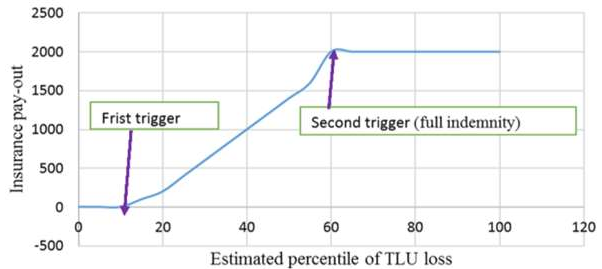
Figure 2.
Turkana and West Pokot counties, adopted from: Opiyo et al. [41].
Figure 2.
Turkana and West Pokot counties, adopted from: Opiyo et al. [41].
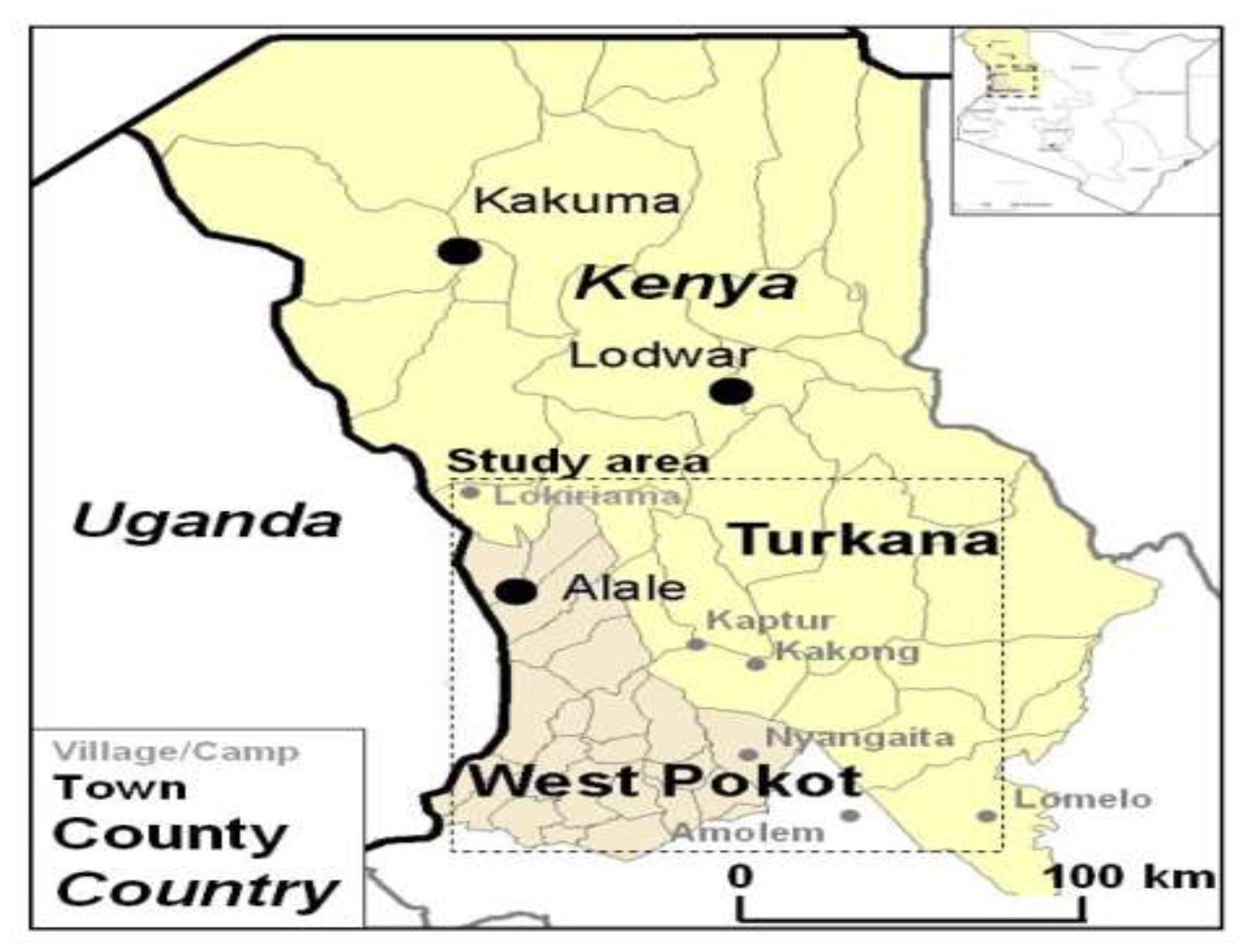

Table 1.
Descriptive statistics.
| Variables | N | Mean | St. Dev. | Min | Max | |
|---|---|---|---|---|---|---|
| precip | 931 | 654.046 | 446.453 | 84.172 | 2,371.706 | |
| evi | 931 | 9.554 | 4.634 | 3.081 | 21.732 | |
| evi_log | 931 | 2.133 | 0.509 | 1.125 | 3.079 | |
| precip_log | 931 | 6.233 | 0.739 | 4.433 | 7.771 | |
| precip_lag | 930 | 6.232 | 0.739 | 4.433 | 7.771 | |
| evi_lag | 930 | 2.132 | 0.509 | 1.125 | 3.079 | |
Table 2.
Benchmark Difference-in-differences regression.
| (1) | (2) | |
| Dependent variable: Enhanced Vegetation Index (EVI) | ||
| DID Model (IBLI effect) | 0.041* | 0.041*** |
| (0.024) | (0.000) | |
| Precipitation | 0.552*** | 0.552*** |
| (0.015) | (0.001) | |
| Precipitation_1 | −0.063*** | −0.063 |
| (0.015) | (0.027) | |
| Num.Obs. | 930 | 930 |
| R2 | 0.604 | 0.883 |
| R2 Adj. | 0.594 | 0.881 |
| R2 Within | 0.604 | |
| R2 Within Adj. | 0.603 | |
| AIC | −606.4 | −568.4 |
| BIC | −587.1 | −457.2 |
| RMSE | 0.17 | 0.17 |
| Std.Errors | by: County name | |
| FE:county name | X | |
| FE: year | X | |
| * p < 0.1, ** p < 0.05, *** p < 0.01 | ||
Table 3.
Results of parallel trends assumption.
| (1) | |
| Dependent variable: EVI (Pastoral systems) | |
| Pre-treatment period | −0.036 |
| (0.055) | |
| Post-treatment period | 0.010 |
| (0.053) | |
| Precipitation | 0.552*** |
| (0.015) | |
| Precipitation_1 | −0.063*** |
| (0.015) | |
| Num.Obs. | 930 |
| R2 | 0.883 |
| R2 Adj. | 0.880 |
| * p < 0.1, ** p < 0.05, *** p < 0.01 |
Table 4.
Results of Placebo test.
| (1) | (2) | |
| Dependent variable: EVI (Pastoral systems) | ||
| ‘Fake’ treatment 1 | −0.042 | |
| (0.038) | ||
| Precipitation | 0.553*** | 0.554*** |
| (0.015) | (0.015) | |
| Precipitation_1 | −0.063*** | −0.061*** |
| (0.015) | (0.015) | |
| ‘Fake’ treatment 2 | 0.071 | |
| (0.053) | ||
| Num.Obs. | 930 | 930 |
| R2 | 0.603 | 0.603 |
| R2 Adj. | 0.594 | 0.594 |
| * p < 0.1, ** p < 0.05, *** p < 0.01 | ||
Table 5.
Policy mechanism test 1.
| (1) | (2) | ||
| Dependent variable: EVI_1 (proxy for forage sustainability) | |||
| DID (IBLI program/policy) | 0.036 | 0.036** | |
| (0.025) | (0.001) | ||
| Precipitation | −0.040*** | −0.040 | |
| (0.015) | (0.029) | ||
| Precipitation_1 | 0.547*** | 0.547*** | |
| (0.015) | (0.008) | ||
| Num.Obs. | 930 | 930 | |
| R2 | 0.880 | 0.880 | |
| R2 Adj. | 0.877 | 0.877 | |
| Std.Errors | - | by: County name | |
| FE: County name | X | X | |
| FE: year | X | X | |
| * p < 0.1, ** p < 0.05, *** p < 0.01 | |||
Table 6.
IBLI policy mechanism test 2.
| (1) | (2) | ||
| Dependent: EVI (Pastoral systems) | |||
| DID x EVI_1 | 0.025** | 0.025** | |
| (0.012) | (0.012) | ||
| Precipitation | 0.553*** | 0.553*** | |
| (0.015) | (0.015) | ||
| Precipitation_1 | −0.069*** | −0.069*** | |
| (0.015) | (0.015) | ||
| Num.Obs. | 930 | 930 | |
| R2 | 0.883 | 0.604 | |
| R2 Adj. | 0.881 | 0.595 | |
| Std.Errors | - | by: County name | |
| FE: County name | X | X | |
| FE: year | X | X | |
Disclaimer/Publisher’s Note: The statements, opinions and data contained in all publications are solely those of the individual author(s) and contributor(s) and not of MDPI and/or the editor(s). MDPI and/or the editor(s) disclaim responsibility for any injury to people or property resulting from any ideas, methods, instructions or products referred to in the content. |
© 2026 by the authors. Licensee MDPI, Basel, Switzerland. This article is an open access article distributed under the terms and conditions of the Creative Commons Attribution (CC BY) license (http://creativecommons.org/licenses/by/4.0/).
Copyright: This open access article is published under a Creative Commons CC BY 4.0 license, which permit the free download, distribution, and reuse, provided that the author and preprint are cited in any reuse.


