

Submitted:
05 February 2026
Posted:
06 February 2026
You are already at the latest version
Abstract
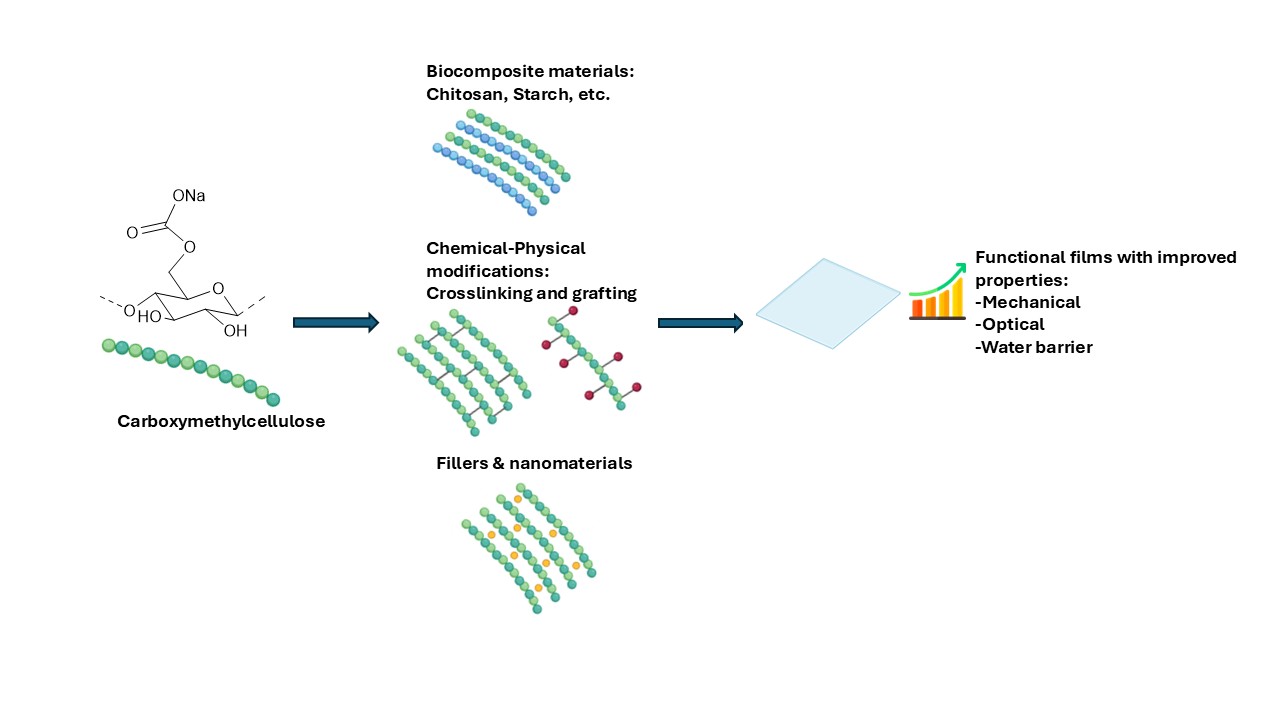
The growing environmental impact of petroleum-based plastics has intensified re-search into sustainable, biodegradable alternatives for food packaging. Among bio-derived polymers, carboxymethyl cellulose (CMC) has attracted increasing atten-tion due to its abundance, non-toxicity, biodegradability, and excellent film-forming ability. Nevertheless, the intrinsic hydrophilicity and limited mechanical strength of neat CMC restrict its direct application in packaging systems. This review provides a comprehensive and critical overview of recent strategies developed between 2015 and 2025 to enhance the performance of CMC-based films for food packaging applications. Emphasis is placed on physical and chemical modification routes, including polymer blending, polyelectrolyte complex formation, incorporation of functional fillers and nanomaterials, and ionic or covalent crosslinking approaches. The influence of these strategies on key functional properties, such as mechanical behavior, water barrier performance, antimicrobial and antioxidant activity, is systematically discussed. Par-ticular attention is given to CMC-rich systems, enabling meaningful comparison across studies. By highlighting structure-property relationships and identifying current limi-tations, this review aims to provide guidance for the rational design of advanced CMC-based materials as viable, eco-friendly alternatives to conventional plastic packaging.
Keywords:
carboxymethyl cellulose
; physical modifications
; chemical modifications
; polyelectrolyte complexes
; composite polymer blends
; cross-linking
; biobased packaging
; food packaging
1. Introduction
The extensive use of non-biodegradable, petroleum-based polymers is causing serious environmental problems [1]. Due to their high chemical and biochemical stability, these materials persist in the environment and break down into small particles, contributing to micro and nano plastic pollution [2,3,4], endangering life on Earth [5,6]. The packaging industry is a major driver of global plastic consumption, representing nearly 40% of total plastic usage, according to the Plastics Industry Association [7]. This includes packaging for food, beverages, consumer products, and industrial goods. Currently, recycling remain limited, with only 9% of plastic waste being recycled globally [8] and therefore, the need to develop eco-friendly and biodegradable alternatives with acceptable performances, supporting both economic growth and environmental protection is of utmost urgency. Consequently, increasing attention is being addressed towards bio-based, bio-degradable plastics from renewable resources [9,10,11].
Cellulose is an unbranched, natural polymer composed of repeating glucose units (C6H10O5)n [12], considered as the most common organic polysaccharide on Earth. Due to its high abundance in nature, it is one of the most studied biopolymers as a potential feedstock to produce biobased materials [13,14,15,16]. Historically, cellulosic materials found their primary use in the paper and textile industry [17] however, a significant expansion in their applications has been reported in the last decade, including various fields such as biomedicine [18,19,20,21,22,23], packaging [24,25,26,27,28,29], nanocomposites [30,31,32,33] among others [34,35,36,37,38].
Cellulose is significantly valuable for packaging applications due to its biodegradability, non-toxicity, and biocompatibility [18,39,40,41]. However, its insolubility in water and common solvents limits its direct use in applications like film preparation or functional coatings. Consequently, various cellulose derivatives have been developed over the years to enhance its processability and expand its application, particularly within the packaging sector [42,43,44,45,46].
The presence of hydroxyl groups in cellulose allows for chemical modification, and the introduction of functional groups like acids, chlorides, or oxides, improving its properties, increasing solubility and allowing to engineer novel materials [47,48,49,50].
Most common water-soluble cellulose derivatives are hydroxyethyl cellulose and carboxymethylcellulose (CMC), obtained by alkali-catalyzed etherification with ethylene oxide and chloroacetic acid, respectively [51,52]. Currently, these two derivatives are employed at industrial level in different areas, as for example by the food, pharmaceutical, cosmetics, detergent, and textile industry [53,54,55,56,57,58]. CMC is largely the most used and synthesized cellulose derivate, with an annual production of 658,000 tons [59,60]. Despite its potential and ease of processability, poor water vapor barrier properties, together with poor physical-mechanical properties and the strong affinity of CMC for water remain major limitations, especially when the focus is the production of packaging films. Nevertheless, between 2015 and 2025, research interest in CMC-based films has increased markedly, driven by increasing environmental concerns and regulatory pressure to reduce plastic waste, as part of a broader effort to develop sustainable alternatives to conventional plastic packaging materials [53,61,62,63,64,65,66]. In fact, much of the current research focuses on strategies to improve CMC properties by chemical or physical modifications [22,27,67], the production of composites [59,68] or reinforced nano-based materials [23,43,69]. CMC-based films are also particularly attractive for edible and biodegradable packaging due to their transparency, safety for food contact, and compatibility with bioactive compounds [70].
Although several reviews have been published in recent years addressing the properties, applications, and future perspectives of CMC [53], the present work specifically focuses on strategies aimed at enhancing the performance of CMC-based films for packaging applications. This review discusses five key areas: (i) physical and chemical modifications of CMC, (ii) polyelectrolyte complexes and ionic interactions, (iii) polymer blending and CMC-based composites, (iv) nanocomposites and reinforcement with functional fillers, and (v) crosslinking approaches. To the best of our knowledge, despite the availability of recent reviews, this focused and application-oriented perspective on CMC-based packaging materials remains relatively unexplored and provides a comprehensive framework for understanding current advances and future research directions in this rapidly evolving field.
2. Methodology
This review was carried out in accordance with the Preferred Reporting Items for Systematic Reviews and Meta-Analyses (PRISMA) guidelines to ensure transparency, reproducibility, and methodological rigor in the identification, screening, and selection of relevant literature.
2.1. Data Sources and Search Strategy
A systematic literature search was performed using Scopus and Web of Science, which were selected for their broad coverage of peer-reviewed journals in material science, polymer chemistry, and food packaging. The search focused on publications addressing the preparation, modification, and application of CMC-based films, with particular emphasis on food packaging systems.
Search queries were constructed using combinations of keywords related to CMC, film formation, polymer blending, and functional additives. The primary search included: carboxymethyl cellulose OR CMC OR sodium carboxymethyl cellulose AND starch AND (film OR films) AND (blend OR composite OR biocomposite OR bio nanocomposite) AND (casting OR solution casting OR extrusion OR film forming); (carboxymethyl cellulose OR CMC) AND starch AND film AND (nanoparticle OR ZnO OR essential oil OR anthocyanin OR curcumin OR chitosan OR plant extract OR natural pigment OR crosslink OR glycerol OR sorbitol). Additional records were identified through manual screening of reference lists from relevant review articles and key research papers to ensure comprehensive coverage of the topic.
2.2. Eligibility Criteria
Studies were selected based on predefined inclusion and exclusion criteria. Inclusion criteria were: i) Peer-reviewed journal articles published between 2015 and 2025. Studies reporting the preparation and characterization of CMC-based films; ii) research focusing on packaging-related properties, including mechanical performance, water and gas barrier behavior, antimicrobial or antioxidant activity, and functional responsiveness; iii) film systems in which CMC represented at least 50 wt% of the polymeric matrix, enabling meaningful comparison across studies. Exclusion criteria were: i) studies in which CMC was used only as a minor additive or processing aid; ii) works primarily focused on starch, chitosan, or other polymers where CMC content was below the defined threshold (<50%); iii) conference proceedings, book chapters, patents, and non-peer-reviewed literature; iv) studies lacking sufficient physicochemical or functional characterization relevant to packaging applications
2.3. Study Selection Process
The study selection process followed a PRISMA-based screening workflow. Initially, all records retrieved from the databases were combined and duplicate entries removed. Titles and abstracts were then independently screened to exclude articles that did not meet the inclusion criteria. Full-text versions of the remaining articles were subsequently assessed for eligibility based on polymer composition, processing method, and relevance to packaging applications. Only studies meeting all inclusion criteria have been discussed in this review.
2.4. Data Extraction and Synthesis
From each selected study, relevant data were systematically extracted, including: i) polymer composition and CMC content; ii) film preparation technique (with particular emphasis on solution casting); iii) type and concentration of additives, fillers, or crosslinking agents; iv) mechanical properties (tensile strength, elongation at break, Young’s modulus); v) Barrier properties (water vapor permeability, oxygen transmission rate); vi) functional properties (antimicrobial, antioxidant, optical, or responsive behavior); vii) reported molecular weight and degree of substitution of CMC, when available.
Due to variations in experimental conditions, raw materials, and testing protocols, a meta-analysis was not performed. Instead, a comparative qualitative analysis was conducted, and representative data were summarized in tables to highlight trends and structure–property relationships.
2.5. Scope and Limitations
This review intentionally focuses on CMC-rich films prepared by solution casting, as this remains the most widely adopted laboratory-scale method and enables consistent comparison across studies. While extrusion, coating, and electrospinning approaches are acknowledged, they are discussed only when directly relevant to packaging applications. It is important to note that comparison among studies is sometimes limited by incomplete reporting of key parameters, such as CMC molecular weight and degree of substitution. These limitations are explicitly addressed, where relevant, to avoid overinterpretation of reported results.
3. Preparation of CMC Films
Over the years, several processing techniques have been employed for the fabrication of CMC-based films, including solution casting, electrospinning, extrusion, coating, and spray-based technologies [18,62,70,71]. Among these methods, solution casting remains by far the most widely adopted approach at laboratory scale due to its simplicity, versatility, and suitability for incorporating additives, fillers, and functional compounds in a controlled manner [16,42,72,73,74,75,76,77,78,79,80,81,82,83,84].
CMC is dissolved in water with plasticizers (e.g., glycerol) and additives, poured into molds, and dried to form coherent films; this method is straightforward and allows easy incorporation of functional agents such as antimicrobials or nanomaterials to tailor film properties [62,85,86]. For more industrially relevant processing, thermo-mechanical techniques (extrusion and compression molding) have been developed, in which partially plasticized CMC or CMC blends are processed in the melt, offering higher compatibility with conventional plastic-film lines [70]. Film performance can further be tailored by blending and crosslinking: CMC is combined with starch, proteins, or synthetic biopolymers, and its hydrophilicity is reduced via ionic (Ca2+, Zn2+), chemical (aldehydes, citric acid), or photo-crosslinking treatments to enhance water resistance and mechanical strength [87]. Recent reviews on CMC-based and CMC/chitosan (CHI) packaging systems emphasize that the choice and optimization of these preparation techniques, casting vs thermo-mechanical processing, type and level of plasticizer, emulsion formulation, and crosslinking strategy, are crucial to balance transparency, strength, barrier properties, and biodegradability for specific food applications [62,88].
Electrospinning has emerged as a promising method to produce CMC-based nanofibrous mats with high surface area and tunable porosity, often blended with carriers like polyvinyl alcohol (PVA) or polyvinyl pyrrolidone to overcome processing challenges. These electrospun films can act as breathable, lightweight packaging layers with potential for active food preservation [89], although presently its application remains limited due to processing complexity and scalability constraints.
Spray drying is not a film-forming method per se, but is used in some advanced formulations for CMC-based materials: solutions or emulsions containing CMC and functional components can be atomized into powders or microcapsules, which may then be further processed into coatings or composite films with controlled release characteristics [90,91]. Finally, coating techniques, including extrusion coating and simpler liquid application methods, are used to deposit thin layers of CMC solutions onto foods or other packaging substrates to form, for example, edible coatings, enhancing barrier performance and shelf life without forming standalone free films [45,92,93,94].
Each of these preparation methods offers distinct advantages and challenges, and the choice among them depends on the desired film morphology, mechanical strength, barrier properties, scalability, and specific food packaging application. Since solution casting emerges as the most common technique used for the preparation of CMC films, the present review will focus on this methodology.
It should be underlined that, although numerous works report the preparation of CMC films by solution casting, enabling tailored control over mechanical, barrier, optical, and antimicrobial properties, however, direct comparison of reported data is often challenging due to variations in experimental conditions, including CMC molecular weight, degree of substitution, polymer source, and testing protocols, which are not always consistently reported. To address this issue, the present review summarizes key performance parameters, including tensile strength (TS), elongation at break (EB%), water vapor permeability (WVP), moisture content (MC), and water uptake, reported in the literature (Table 1, Table 2, Table 3, Table 4 and Table 5 and supporting information section). Where available, CMC molecular weight and degree of substitution are also included to facilitate meaningful comparison. In addition, values obtained for control samples are reported, offering a more comprehensive overview of the effects of formulation and processing strategies on CMC film performance. Finaly, to evaluate the potentiality of innovative solutions reported below, physical mechanical data of commercially available polymeric films (both fossil and bio-based) for different food packaging applications, have been reported in Table 1 [95,96,97].
4. Preparation of CMC Films
Due to the presence of carboxylate groups, CMC is an anionic polyelectrolyte which, in different reaction conditions, can be mixed with a cationic polymer to form a polyelectrolyte complexes (PEC). These physically modified networks, formed by ionic interactions, hydrogen bonding and chain entanglement rather than covalent bonding, generally outperform single-component films, and properties can be further improved by adding active molecules and nanofillers [62,70,98]. For this reason, physical modification of CMC is particularly attractive for the preparation of films for food packaging applications because they avoid chemical reagents, reduce regulatory concerns, and preserve the biodegradability and safety of the polymer [99,100]. Polymer blends are generally prepared with a very easy protocol, by solubilization of polymers, incorporation of target chemicals (additives, plasticizers among others) and film prepared by casting technology (Figure 1).
Blending CMC with polysaccharides (starch, chitosan) or other biopolymers (also derived from agro-industrial waste) has been extensively investigated in the last 10 years (see below), as an interesting strategy to improve tensile properties, water resistance and reduce brittleness while maintaining film-forming ability [101,102,103,104,105,106,107]. Main CMC blends prepared with different polysaccharides or proteins (gelatin) by casting technology published between 2015 and 2025 are discussed below.
4.1. CMC Starch Polymer Blends
Within the many publications present in the literature regarding CMC/Corn Starch (CS) films it is important to mention that many of them have as main component CS and CMC is only present in minor percentages and therefore have not been reviewed in this work [108,109,110,111,112]. Only polymeric blends prepared with at least 50 wt% of CMC are reported.
Different CMC/CS formulations have been studied, and, in many cases, different additives have been used to achieve specific functionalities such as pH responsiveness or antimicrobial activities for the preparation of intelligent or active packaging for food.
Kibar et al., for example, studied composite films based on CS, methylcellulose, and CMC, using glycerol or polyethylene glycol (PEG) as plasticizers [113]. The influence of polymer blend composition and plasticizer on film microstructure, water vapor permeability (WVP), opacity, and solubility was systematically examined. SEM analysis revealed that films plasticized with glycerol possessed a uniform and continuous matrix, indicating good structural cohesion, in contrast to PEG-plasticized films. The WVP values ranged from 1.5 × 10⁻¹¹ to 13.3 × 10⁻¹¹ gm/m2Pa.s, and all composite films exhibited improved water resistance compared to CS films. Additional information on the mechanical and WVP properties of CMC/CS films were later reported by Tavares et al. [114]. Tensile strength, EB%, Young’s modulus (E), together with WVP of CMC/CS (80/20 wt/wt) films reached intermediate values compared to CMC (Table 1) and a modest decrease in thermal properties, due to the lower stability of CMC compared to CS.
In another case, Jiang et al. employed CMC/CS films containing anthocyanins (ATH) extracted from purple sweet potato (PSP) as intelligent packaging to monitor fish freshness [115]. Specifically, these films showed overall good physical mechanical properties (Table 1) and color change from red to blue and green, when exposed to different pH or ammonia, used as label to monitor fish freshness.
Following the work by Jiang, Yun et al. developed intelligent CMC/CS films containing purple sweet potato pigment (PSP) as a redox indicator enabling ready detection of the degree of oil oxidation for household applications [116]. The study reports that CMC/CS films (80/20 wt/wt) containing 0.25 wt% PSP exhibited the highest sensitivity to oxidized oil, although physical mechanical characteristics were significantly different from other CMC/CS films, showing rather low TS and very high EB%, comparable to BOPP (Table 1). Another example of pH sensitive films based on CS/CMC/PSP composite films has been reported by Silva et al. for the preparation of smart food packaging, yet in this case the main component of the polymeric blend is CS and therefore results are not easily comparable with those reported by Yun [116,117].

Table 1.
CMC/Starch and CMC/CHI composite films.
| Composition | MW(1) | DS(2) | TS(MPa)(3) | EB(%)(4) | E (MPa)(5) | Ɵ (°)(6) | WVP(7) | MC(%)(8) | Inh. Zone E. Coli(9) | Inh. Zone S. Aureus(9) | Ref |
|---|---|---|---|---|---|---|---|---|---|---|---|
| BOPP(10) | - | - | 120 | 150 | 102.1 | 25(11) | [97] | ||||
| LDPE(12) | - | - | 24 | 400 | 80 | 40(11) | |||||
| PLA(13) | - | - | 75 | 190 | 81 | 180(11) | |||||
| Mater Bi(14) | - | - | 30 | 280 | 90 | 220(11) | |||||
| Ecovio(15) | - | - | 25 | 500 | 75 | 520(11) | |||||
| CMC | - | - | 15.80±0.58 | 11.62±0.63 | 3.24×10⁻¹⁰ | 25.83±0.33 | - | - | [103] | ||
| CMC | - | - | 21.01±2.0 | 24.96 | 714.58±25.0 | 31.25±5.0 | 8.95×10⁻¹⁰ | 27.91±1.81 | - | - | [118] |
| CMC | - | - | 50.20±6.90 | 7.6±2.2 | 684.3±49.1 | 53.95±4.76(16) | - | - | - | - | [114] |
| CMC | - | - | 28.0±2.0 | 3.0±0.3 | 1700±50 | 380±5.0(11) | [119] | ||||
| CMC | - | - | 40.1±0.9 | 35.9±1.8 | 1040±40 | 39.2±1.8 | 1.40×10⁻⁹ | [120] | |||
| CMC | - | - | 21.85±3.12 | 23.42±2.0 | 385±63 | 9.2×10⁻¹¹ | [69] | ||||
| CMC | - | - | 30.83±1.61 | 7.15±1.5 | [121] | ||||||
| CMC | - | - | 6.10±0.24 | 201.73±0.15 | 0.78×10⁻¹⁰ | [85] | |||||
| CS | - | - | 3.80±0.20 | 35.1±8.50 | 47.3±12.5 | 62.38±3.99(16) | 4.90×10⁻⁶ | [114] | |||
| CMC80/CS20 | - | - | 32.60±2.10 | 21.2±4.3 | 250.6±2.3 | 56.73±4.02(16) | 1.57×10⁻⁶ | - | - | - | |
| CMC60/CS40/ATH 0.9(17) | 26219 | 0.9 | 23.69±0.91 | 14.1±0.55 | - | - | - | 14.10±0.55 | - | - | [115] |
| CMC80/CS20/PSP 0.25(18) | 2.08±0.06 | 158.27±0.72 | 20.67±0.61 | [116] | |||||||
| CMC70/CSS30/Q/TBHQ(19) | 150 | - | [122] | ||||||||
| CMC50/CS50/LA 1.5 (20) | - | 0.9 | 4.80±0.56 | 73.17±2.90 | - | - | 5.56×10⁻¹¹ | 23.67 | - | 4.17±0.21 | [123] |
| CMC50/CS50/Men2/Cur2(21) | 250 | 0.7 | 36.57±0.10 | 28.10±0.09 | 75.30±5.00 | 2.77×10⁻¹¹ | 17.5 | 16.5 | [124] | ||
| CMC70/CHI30/OA50/CEO3(22) | 41 | - | 3.1±0.4 | 124.3±9.3 | 35.6±2.3 | 0.27×10⁻⁷ | [125] | ||||
| CMC70/CHI30/OA50/GEO3(22) | 41 | - | 2.7±0.4 | 61.4±8.8 | 29.3±1.9 | 0.99×10⁻⁷ | |||||
| CMC60/CHI40/EO12(23) | - | - | 5.83±0.30 | 51.20±6.97 | 0.12±0.02 | 119.0 | 19.21±1.10 | 7.19 | [126] | ||
| CMC/HTCC(24) | - | - | 21.82 | 2.27 | 28.61±0.37 | 117.0 | [127] | ||||
| CMC90/HTCC10/cry-CaCO3 4(24) | - | - | 35.02±1.68 | 14.43±0.65 | 18.72±0.85 | 68.0±2.6 | 5.9×10⁻¹¹ | [128] | |||
| CMC/HTCMCh1(25) | - | - | 12.5±2.0 | 15.0±1.5 | 20±0.5 | 70.60±0.61 | 10.0±0.5 | 11.0±0.1 | [129] |
1 CMC (MW): Molecular weight of CMC in KDa; 2 DS: degree of substitution of CMC; 3 TS: Tensile strength (MPa); 4 EB%: Elongation at break; 5 E: Young’s modulus (MPa); 6 Ɵ: Water contact angle; 7 WVP: Water vapor permeability (gm/m2Pa.s); 8 MC%: Moisture content; 9 Inh. Zone: Inhibition Zone (mm); 10 BOPP P30: Biaxially oriented coextruded polypropylene film; 11 WVTR g/m2d; 12 LDPE: low density polyethylene film; 13 PLA: polylactic acid film; 14 Mater Bi: aromatic/aliphatic biodegradable polyester film; 15 Ecovio: PolyButyrate Adipate Terephthalate (PBAT) and PLA based polymeric film; 16.Water contact angle measured after 60 sec; 17.CMC60/CS40/ATH0.9: Films prepared with CMC/CS 60/40 wt/wt and 0.9 wt/vol anthocyanins (ATH); 18.PSP: Purple sweet potato anthocyanins; 19.CSS: Cassava starch, Q: quercetin, TBHQ: tert-butylhydroquinone; 20.LA: Lactococcus lactis; 21.Men: N-Boc L- tryptophan L-menthol ester, Cur: Curcumin; 22.CHI: Chitosan, OA: oleic acid, CEO: cinnamon essential oil, GEO: ginger essential oil; 23.EO: essential oil; 24.HTCC: N-(2-hydroxyl)-propyl-3-trimethyl ammonium chitosan chloride; 25 HTCMCh: N-2-hydroxylpropyl-3-trimethylammonium-O-carboxymethyl chitosan.
Tongdeesoontorn and coworkers additionally studied the properties of CMC/Cassava starch composite films containing 30 wt% glycerol as plasticizer and variable wt% of quercetin or tert-butylhydroquinone (TBHQ) as antioxidant [122]. In general, increasing the amount of quercetin or TBHQ, a slight decrease in water solubility and EB% were observed, while TS increased compared to control samples (Table 1), probably due to hydrogen bond formation between the additive and the biopolymers chains. These films were tested to reduce redness of pork meat, observing that the composite films containing quercetin significantly slowed down the decrease in redness of the meat from 50% (control sample) to 25%, slowing the oxidation process of the lard from 35 days to 70 days.
Lan et al. further reported the preparation of CMC/CS antimicrobial films containing Lactococcus lactis as a source of Nisin [123]. Best composite films were obtained with a CMC/CS 50/50 wt/wt ratio and 1.5% L. lactis, in terms of WVP (5.54 × 10⁻¹¹ gm/m2Pa.s) and antimicrobial activity against Staphylococcus aureus (53.53%) after 8 days. This work is an interesting example of a viable strategy to produce antimicrobial films for food packaging, albeit with modest TS compared to other CMC/CS films (Table 1).
Very recently Jiang et al. reported the synthesis of two novel esters of L-tryptophan (L-Trp) with L-Menthol or Borneol to develop a fully bio-based and sustainable food packaging with antibacterial and antioxidant properties [124]. A multifunctional composite film was prepared employing CMC/CS (50/50 wt/wt) in the presence of variable wt% of the esters synthesized and curcumin. Data reported demonstrate that CMC/CS composite films containing 2wt% of the menthol ester and 2wt% of curcumin, were highly biocompatible with low cytotoxicity and nearly complete antibacterial efficiency against both Escherichia coli and Staphylococcus aureus. Within the panorama of CMC/CS composites films reported in the literature, albeit the additional complexity due to the synthesis of the esters, these fully natural material-based films represent a new approach for future green, and renewable bio-based food packaging materials.
Few examples also exist of CMC polymeric blends prepared with carboxylated starch to prepare the film with enhanced mechanical and hydrophobic properties, although generally starch is the main component of the polymeric blend and therefore beyond the scope of this review [130].
In general, from data reported in Table 1, it emerges that in most cases the addition of an additive (antioxidant, antimicrobial) not only allows to achieve films potentially efficient as active or intelligent packaging, but overall physical mechanical characteristics are also enhanced. For example, WVP of CMC/CS (80/20 wt/wt, 1.57×10⁻⁶ gm/m2Pa.s) is five orders of magnitude higher than that reported for CMC50/CS50/1.5LA (5.56×10⁻¹¹ gm/m2Pa.s) or CMC50/CS50/Men2/Cur2 (2.77×10⁻¹¹ gm/m2Pa.s), which is of great importance especially for food packaging applications.
4.2. CMC Chitosan Polymer Blends
In food packaging applications, CMC/chitosan (CMC/CHI) blends are particularly interesting due to the formation of physically driven PEC, the properties of which strongly depend on pH, charge density, polymer ratio, and ionic strength [88,110]. These variables influence mechanical properties and hydrophobicity, enhancing film cohesion and moisture resistance while also enabling antimicrobial functionality, making such systems suitable for active and edible food packaging [70,93]. A dedicated review on CMC/CHI PEC films recently published highlights how electrostatic interactions underpin improved performances relevant to food packaging [88]. Information on most frequently optimized parameters are given such as i) CMC/CHI ratio which is known to control net charge balance and PEC density [129,131,132], ii) influence of pH [133], iii) crosslinking/ionic strengthening which reduce water solubility and improve stability [42,134,135,136], iv) influence of plasticizers and active filler loading such as antimicrobials, antioxidants, nanomaterials [125,126,137,138,139,140,141].
CMC/CHI composite films exhibit better performances compared to films prepared from a single component. In addition, key characteristics, including mechanical strength, antibacterial effectiveness, and antioxidant capacity, can be significantly improved by incorporating bioactive agents such as essential oils and nanomaterials [142]. Numerous studies have explored the use of CMC/CHI edible films for packaging vegetables, fruits, dry foods, dairy products, and meat products [70], but recent studies most frequently report the use of ionic or covalent crosslinkers to enhance the mechanical properties of CMC/CHI based films and will be further discussed below [139,143,144].
Noshirvani et al. examined the influence of cinnamon and ginger essential oils (CEO and GEO) on the properties of CMC/CHI films emulsified with oleic acid (OA) [125]. Water contact angles and EB% raised as oil concentration increased (Table 1), with CEO producing a more pronounced barrier effect (Table 1), and stronger in vitro antifungal activity against Aspergillus Niger compared to those containing GEO. Results indicate that essential oils, especially CEO, can effectively act as plasticizing agents in CMC/CHI films, enhancing moisture barrier performance while retaining antifungal functionality, thereby highlighting their potential for food packaging applications.
Despite the potential of essential oils, limitations in biopolymer-based films due to poor solubility and reduced functional stability have been reported [126]. To address these issues, antibacterial CMC/CHI films have been prepared with nano emulsions of the essential oil (EON) from Persicaria minor Huds [126]. Best emulsion formulation identified was incorporated into CMC/CS films (1.5/1.0 wt/v) with EON between 4 and 12% (v/v). Incorporation of EON gave very low Young’s modulus of the composite films (0.12 ± 0.02 MPa), indicating improved flexibility (EB% 51.20 ± 6.97%, Table 1). Films also exhibited the most favorable properties, in terms of opacity, water solubility (65.5%), and moisture content (19.21%). Additionally, this formulation had strong antibacterial activity against E. coli and Bacillus subtilis, with inhibition zones of 7.19 and 7.85 mm, respectively.
Few studies have alternatively investigated the use of chitosan based quaternary ammonium salts in CMC film forming polymer blends with improved physicochemical characteristics. For example, Wang reported the influence of N-(2-hydroxypropyl)-3-trimethylammonium chitosan chloride (HTCC) on the physicochemical characteristics of CMC films [127]. Film-forming solutions composed of HTCC and CMC at different mass ratios displayed pronounced shear-thinning behavior and typical pseudoplastic flow. Among the formulations, HTCC/CMC films containing 15% HTCC showed the greatest apparent viscosity and the lowest crossover frequency, which can be attributed to the development of strong intermolecular interactions. Although very low EB% were observed (2.27%), TS values are comparable to those of LDPE (21.82 and 24 MPa respectively), with one of the highest water contact angles for composite CMC films (117°, Table 1), evidencing the role of HTCC in enhancing CMC-based films performances for food packaging.
Based on Wang results [127], additional studies were carried out to verify the possibility to improve CMC/HTCC film performances (90/10 wt/wt), by addition of CaCO3 [128]. Calcium carbonate was crystallized in situ (cry-CaCO3) within HTCC/CMC film-forming solutions, and its influence on film characteristics, including microstructure, mechanical strength, thermal behavior, optical whiteness, and surface wettability, systematically evaluated. Films containing commercially available calcium carbonate (com-CaCO3) were prepared for comparison. The results revealed that cry-CaCO3 facilitated a more uniform dispersion of the CMC/HTCC matrix improving TS and EB%, yet with reduced hydrophobicity. (Table 1).
Zhang et al. synthesized a zwitterionic chitosan derivative, N-2-hydroxylpropyl-3-trimethylammonium-O-carboxymethyl chitosan (HTCMCh), which was incorporated into CMC films to enhance mechanical strength and impart antibacterial functionality [129]. The films were prepared by casting technology in the presence of glycerol as a plasticizer (30 wt% on total biopolymer weight). The presence of 10wt% HTCMCh with a DS of 0.58 generated the best performing film with an increased contact angle (from 46.20° ± 0.50 to 70.60° ± 0.61), a strong improvement of TS and EB% (+130.9% and +351.6% compared to control sample, respectively) and a delayed bacteria growth on fresh pork surface up to 48 h. These studies clearly demonstrate that the composite design of CMC-based films with other biopolymers, natural extracts, or functional molecules is an effective strategy to overcome the intrinsic limitations of pure CMC. Significant improvements can be achieved in terms of mechanical strength, barrier performance, antioxidant, and antimicrobial properties, making these materials more suitable for advanced packaging applications.
4.3. CMC Polymer Blends with Other Polysaccharides or Gelatin
Different works have been reported on the preparation of binary polyelectrolyte blends made from CMC and various polysaccharides derived from agro-industrial wastes. This strategy is becoming increasingly popular as totally biodegradable materials can be produced recycling waste, reducing primary sources depletion and costs [145,146].
For example, Ballesteros et al., studied the incorporation of spent coffee grounds (SCG), rich in polysaccharides (arabinose, mannose and galactose), for the preparation, by casting technology, of CMC films [102]. Physical mechanical characteristics of CMC/SCG (90/10 wt/wt) are similar to those reported for other CMC/CS composites, but an extraordinarily high-water contact angle (111°) was achieved evidencing a high hydrophobic nature of SCG (Table 2).
Another interesting agro-industrial waste is chickpea hulls, an abundant, renewable by-product with considerable potential added value. Few examples of CMC films containing polysaccharides derived from chickpea hulls (CHPS), also in nanocrystal form have been reported [69,103].
For example, Akhtar studied the incorporation of up to 1 wt% of CHPS with CMC and glycerol (70/30 wt/wt) [103], showing good TS (31.0 ± 0.56 MPa), and WVP (1.23 x 10⁻¹⁰ gm/m2Pa.s), together with antioxidant and antibacterial activity against E. Coli (inhibition zone 10.55 ± 0.69 mm) and S. aureus (inhibition zone 13.82 ± 0.44 mm). Additionally, they observed reduced swelling behavior, water solubility and EB% compared to CMC control film (Table 1 and Table 2).
Table 2.
CMC binary and ternary polymer blends with various polysaccharides or gelatin.
| Composition | MW(1) | DS(2) | TS (MPa)(3) | EB(%)(4) | E (MPa)(5) | Ɵ (°)(6) | WVP(7) | MC(%)(8) | Inh. Zone E. Coli(9) | Inh. Zone S. Aureus(9) | Ref |
|---|---|---|---|---|---|---|---|---|---|---|---|
| CMC90/SCE10(10) | - | - | 22.33±2.35 | 6.56±0.86 | 111.48±3.38 | 3.64×10⁻¹⁰ | 20.97±0.82 | 11.07±0.78 | 14.25±0.37 | [102] | |
| CMC70/Gly30/CHPS 1(11) | - | - | 31.0±0.56 | 5.96±0.76 | 1.23×10⁻¹⁰ | 20.34±0.69 | 10.55±0.69 | 13.82±0.44 | [103] | ||
| CMC50/SA50(12) | - | - | 4.29±0.69 | 27.50±2.08 | [147] | ||||||
| CMC50/SA50/EGCG 040(13) | - | - | 10.78±0.15 | 11.20±1.57 | |||||||
| CMC50/Agar50 | - | - | 5.5 | 40 | 42.4±2.4 | 2.6×10⁻¹⁰ | [148] | ||||
| CMC50/Agar50/SSEO 1(14) | - | - | 7.5 | 55 | 58.3±2.4 | 3.0×10⁻¹⁰ | 33.45±2.76 | ||||
| CMC90/MLP10(15) | - | - | 34.86 | 14.23 | 970 | 65.45±5.0 | 5.21×10⁻¹⁰ | 14.12±1.70 | 11.75 | 9.41 | [118] |
| CMC90/P10/TO3(16) | - | - | 70.06 | 13.39 | 533.0 | 0.34×10⁻¹⁰ | [149] | ||||
| CMC70/Gelatin30/CaCl2 5 | - | - | 53.91±1.69 | 12.26±5.05 | 1.27×10⁻¹⁰ | [92] | |||||
| CMC85/SA/CS15 | - | - | 65.32±14.31 | 17.85±3.86 | 8.98±1.51 | 12.5 | 10.0 | [150] | |||
| SA/CMC/PS 1/1/1(17) | - | - | 31.95±0.66 | 13.78±0.44 | 62.79±1.00 | 2.26×10⁻⁹ | 16.21±0.34 | [64] |
1 CMC (MW): Molecular weight of CMC in KDa; 2 DS: degree of substitution of CMC; 3 TS: Tensile strength (MPa); 4 EB%: Elongation at break; 5 E: Young’s modulus (MPa); 6 Ɵ: Water contact angle; 7 WVP: Water vapor permeability (gm/m2Pa.s); 8 MC%: Moisture content; 9 Inh. Zone: Inhibition Zone (mm); 10.SCE: Polysaccharides extracted from spent coffee; 11.Gly: glycerol; CHPS: chickpea hull polysaccharides; 12. SA: Sodium alginate; EGCG: epigallocatechin gallate; 13. SSEO: summer savory essential oil; 14. SSEO: summer savory essential oil; 15. MLP: Mulberry leaf polysaccharide; 16. P: citrus pectin, TO: Thymol oil; 17.PS: Potato starch.
Ruan et al. evaluated the performances of composite films based on CMC and sodium alginate (SA) in 50:50 weight ratio [[147]Ruan 2019]. Epigallocatechin gallate (EGCG), extracted from tea plants, was added in different quantities for evaluating its impact on films performances. They found that the addition of 40wt% of EGCG (on total mass of biopolymers) was able to improve the TS of CMC/SA films from 4.29 ± 0.69 MPa to 10.78 ± 0.15 MPa, although rather lower than pristine CMC and of commercially available biofilms (Table 1 and Table 2).
Abdollahi et al. studied the preparation of CMC/agar biocomposite films (50/50 wt/wt) via solvent casting, and the effects of incorporating summer savory essential oil (SSEO, between 0.5 and 1.5% (v/v)) on physical mechanical performances and antimicrobial activity of the films [148]. Results show that SSEO imparted significant antimicrobial activity against S. aureus, Bacillus cereus, and Listeria monocytogenes but lower efficacy against E. coli. With 1.0% v/v SSEO concentrations microstructural heterogeneity was observed, leading to good WVP (3.0x10⁻¹⁰ gm/m2Pa.s), although with modest mechanical characteristics (Table 2).
Polysaccharides from mulberry leaves (MLP) have also been investigated for the development of novel CMC active packaging materials [118]. In China mulberry leaves are commonly used for various purposes and therefore large quantities of residual leaves are available [35]. Akhtar et al. reported the preparation of CMC composite films containing variable wt% of MLP (1, 5, and 10% w/w). In particular, CMC/MPL films (90/10 wt/wt) showed substantial reduction of MC% (from 27.91% to 14.12%), WVP (from 8.95 to 5.21×10⁻¹⁰ gm/m2Pa.s), and swelling ratio (from 59.11% to 37.45%) compared to CMC. Also, mechanical performance gradually improved at higher MLP concentrations (Table 1 and Table 2). Additionally, the composite films effectively delay lipid oxidation, highlighting their protective functionality and potentiality as active materials for food packaging applications.
Finaly, Spinei et al. reported the formulation of CMC composite films, containing 10wt% pectin (P), 10wt% glycerol, and two essential oils, bee bread oil (BBO) and thyme oil (TO) [149]. Incorporation of pectin into CMC-based films led to an improvement of TS compared to CMC (from 56.17 to 65.39 MPa respectively) which further increased to 70.06 MPa when 3wt% of TO was added, while simultaneously lowering barrier properties (Table 1 and Table 2). Notably, films containing 2% and 3% BBO or TO underwent complete biodegradation within 20 days of soil burial, demonstrating the promising characteristics of CMC/P/TO films for food packaging applications.
Besides polysaccharides gelatin is widely used in film production because it combines excellent functional performance with biocompatibility and sustainability, making it especially attractive for food, pharmaceutical, and biomedical applications [151,152].
In this context, CMC/Gelatin (70/30 wt/wt) films containing 5wt% CaCl2 were developed by He et al., and performances of films dried in different conditions compared (between 2 °C and 23 °C) [92]. Data evidence that variations in drying conditions significantly influenced the size and distribution of surface pores, which in turn affected the films’ mechanical strength and WVP. Best WVP and TS values (1.27 ± 0.07 10-10 gm/m2sPa and 53.91 ± 1.69 MPa), were obtained for composites prepared at lowest temperatures, suggesting that slow evaporation of water generates a stronger network between polymer chains.
4.4. CMC Ternary Polymer Blends
Ternary films containing three different biopolymers have also been studied, yet generally CMC is added only in moderate to very low quantities (<20wt%) [153,154,155,156]. To the best of our knowledge only two examples of ternary polymer blends have been published in the last decade, containing over 50wt% of CMC.
In particular, Lan and coworkers studied the formulation of ternary composite films based on CMC, SA, CHI, and CaCl2 [150]. A SA/CHI film-forming solution was added to an aqueous CMC solution, casted, and dried. Then films containing 85wt% of CMC and 15wt% of the SA/CHI mixture (50/50 wt/wt) were immersed in a CaCl2 solution to induce ionic cross-linking, followed by air drying to obtain CMC/SA/CHI composite films with high TS, enhanced EB% and WVTR compared to CMC (Table 1 and Table 2). Additionally, chitosan imparted effective antimicrobial activity against E. coli against S. aureus (95.7 ± 5.4% and 93.4 ± 4.7%, respectively).
Functional packaging films based on SA, CMC, and potato starch (PS) were also prepared by Ramakrishnan et al. using a solvent casting approach [64]. Film formulations were prepared by varying the relative proportions of SA/CMC and PS. In one case SA/CMC/PS in a 1/1/1 wt% ratio was tested showing good mechanical characteristics (barrier performance against UV radiation, oxygen, and WVP), while simultaneously reducing moisture content and film extensibility (Table 2). Films containing PS exhibited homogeneous thickness, improved thermal resistance, and increased TS.
4.5. CMC Polymer Blends Containing Nano Polymer Compounds
Another very interesting and widely explored approach involves the combination of CMC or CMC polymer blends with nanocrystalline cellulose (NC), nanofiber form (NF) or nanochitosan (NCHI), to improve several key-aspects of composites films, such as UV and gas barrier, physical-mechanical properties, and, depending on the nature of the nanomaterial, antimicrobial activity [18,62]. The addition of nanoparticles, however, should be carefully studied, since high concentrations may lead to the formation of agglomerates that make the film heterogeneous, with consequent decrease in overall performances [69,85].
Mandal et al. prepared CMC films reinforced with nanocellulose (NC) from sugarcane bagasse by solvent casting, and mechanical characteristics, thermal stability, morphology, and WVTR determined [119]. At optimal NC loading (CMC/NC 50/50 wt/wt), a substantial enhancement in TS compared to neat CMC was achieved (TS 42.5 ± 1.5 MPa and 28.0 ± 1.5 MPa respectively), although with very low EB% (1.3 ± 0.5%). Additionally, very transparent composite films were obtained exhibiting improved thermal resistance and superior WVP properties (Table 3). Later studies have shown that controlled spray drying conditions can highly improve EB% of the CMC/NC films [90] (Table 3).
Table 3.
CMC polymer blends containing nano polymer compounds.
| Composition | MW(1) | DS(2) | TS (MPa)(3) | EB(%)(4) | E (MPa)(5) | Ɵ (°)(6) | WVP(7) | MC(%)(8) | Inh. Zone S. Aureus(9) | Ref. |
|---|---|---|---|---|---|---|---|---|---|---|
| CMC50/NC50(10) | - | - | 42.5±1.5 | 1.3±0.5 | 3750±100 | 4.32×10⁻¹¹ | [119] | |||
| CMC50/NC50(10) | 80 | 0.8 | 34.86±2.90 | 2308±143 | 72.0±10.0 | 6.18×10⁻¹¹ | [90] | |||
| CMC/CMC-NF4(11) | 226 | 0.8 | 52.5±2.0 | 3.5±0.3 | [121] | |||||
| CMC90/CNF10(12) | - | - | 49.2±2.1 | 26.6±2.2 | 1330±200 | 23.9±1.7 | 1.44×10⁻⁹ | [120] | ||
| CMC/CL-CNF(13) | - | - | 81.5±3.6 | 22.9±2.1 | 2637±59 | 31.5±4.5 | 1.75×10⁻⁹ | [157] | ||
| CMC70/Gly30/CHI-NC5/GSE(14) | 250 | 0.9 | 51.0±0.9 | 14.2±1.2 | 1900±4 | 1.36×10⁻⁹ | [158] | |||
| CMC/CHPS-NC5(15) | - | - | 32.95±4.06 | 20.32±0.32 | 1100±76.78 | 4.20×10⁻¹¹ | [69] | |||
| CMC/NC1 | - | - | 12.3±0.3 | 89.53±0.18 | 0.28×10⁻¹⁰ | 22.0±1.3 | [85] | |||
| CMC/NC0.5/NCHI0.5(16) | - | - | 9.95±0.45 | 4.96±0.11 | 0.11×10⁻¹⁰ | 15.0±1.0 | 3.66±0.57 | |||
| CMC70/CS30/SB-NC2.5 | - | - | 99.06±4.95 | 20.88±0.83 | 1375.34±68.80 | 3.50×10⁻⁷ | [159] | |||
| CMC50/Agar50/OP-NC5/ShK10(17) | 250 | 0.9 | 61.7±5.2 | 8±2 | 2600±200 | 50±4 | 0.81×10⁻⁹ | [98] | ||
| CMC70/TS30/CHI-NP(18) | 700 | 0.9 | 81.08 | 11.3 | 3.57×10⁻⁷ | 12.17±0.89 | [87] | |||
| CMC50/Gelatin50/GMMT3/ATH1/PLE1.5(19) | 700 | 0.9 | 99.5±0.5 | 5.69×10⁻¹⁰ | 10.0±0.34 | [160] |
1 CMC (MW): Molecular weight of CMC in KDa; 2 DS: degree of substitution of CMC; 3 TS: Tensile strength (MPa); 4 EB%: Elongation at break; 5 E: Young’s modulus (MPa); 6 Ɵ: Water contact angle; 7 WVP: Water vapor permeability (gm/m2Pa.s); 8 MC%: Moisture content; 9 Inh. Zone: Inhibition Zone (mm); 10.NC: nano cellulose; 11.CMC-NF: carboxymethyl cellulose nanofibrils; 12.CNF: Crystalline cellulose nanofibril; 13.CL-CNF: cotton linter crystalline nanocellulose; 14.Gly: glycerol, CHI-NC: Chitosan nanocrystals, GSE: grapefruit seed extract; 15.CHPS-NC: chickpea hull cellulose nanocrystals; 16.NCHI: nanochitosan; 17.OP-NC: onion peel nanocrystals, ShK: shikonin; 18.TS: Tapioca starch, CHI-NP: chitosan nanoparticles; 19.GMMT: gelatin montmorillonite; PLE: Pistacia leaf extract.
Wei et al. studied CMC composites prepared in combination with tree-like CMC nanofibrils (CMC-NFs) and rod-shaped CMC nanocrystals (CMC-NCs) and reinforcing effects of these nanofillers in CMC-based composite films [121]. CMC films containing 4wt% CMC-NFs showed higher TS compared to CMC-NCs and pristine CMC (Table 3), although with very low EB%. In another study between 1 and 10 wt% of crystalline cellulose nanofibrils extracted from cotton linter pulp (CL-CNFs), were employed as reinforcing fillers in CMC films [120]. Incorporation of 5 wt% CL-CNF led to increases in TS from 40.1 ± 0.9 MPa for CMC to 81.5 ± 3.6 MPa, accompanied by a modest reduction in EB% compared to CMC (Table 1 and Table 3). Further improvement of CMC/CL-CNF films was later reported by Oun and coworkers using ammonium persulfate and grapefruit seed extract as antimicrobial agent (Table 3) [157,158].
Another example of the exploitation of chickpea hull waste has been reported by Li et al. for the preparation of chickpea hull cellulose nanocrystals (CHPS-NCs, between 1wt% and 10wt%), and their incorporation in CMC films as reinforcement agents [69]. With CHPS-NCs contents ≤ 5 wt%, SEM analysis revealed its uniform dispersion within the CMC matrix, resulting in homogeneous film structures. Incorporation of 5wt% CHPS-NCs significantly enhanced UV barrier capacity, TS (32.95 ± 4.06 MPa), WVP (4.2 x 10⁻¹¹ gm/m2Pa.s), and thermal stability of the films compared with neat CMC films (Table 3). Higher wt% of CHPS-NC, however, lead to an increase of the WVP and lower mechanical properties (TS 21.85 ± 3.12), probably as a consequence of the formation of CHPS-NCs agglomerates that reduce the homogeneity of the films.
Jannatyha et al. reported the use of nanochitosan (NCHI) and nanocellulose (NC), into CMC film-forming solutions at concentrations of 0.1, 0.5, and 1wt% together with 50 wt% glycerol [85]. The incorporation of both NCHI and NC significantly reduced water solubility, and moisture absorption of the CMC films, with the most pronounced effects observed with 1wt% nanoparticles loading (see Table 3). These reductions were significantly greater in CMC/NCHI films compared to CMC/NC films, while WVP decreased as the nanofiller content increased in both nanocomposite systems. In addition, TS and EB% improved with increasing nanofiller concentration, however higher nanofiller loading (>1%) resulted in partial nanoparticle aggregation within the CMC matrix. Antibacterial activity of the NCHI films was evaluated against five pathogenic microorganisms, showing strong inhibitory effects (Table 3).
Recently, Mohammadi et al. employed response surface methodology (RSM) to evaluate how different wt% of CMC (0.75–1.75 wt%), Commiphora mukul polysaccharide (CMP, 0–1 wt%), and chitosan nanofibers (CHI-NF, 0–1 wt%) influence the physical and antimicrobial performances of CMC-based nanocomposite films [161]. The optimization strategy focused on maximizing TS, EB%, and antibacterial efficiency, while simultaneously reducing WVP, solubility, swelling behavior, moisture content, opacity, and total color difference. The results showed that the addition of both CMP and CHI-NF contributed to lower moisture content and WVP, as well as improved tensile strength. In contrast, increasing the concentrations of CMP and CHI-NF produced mixed effects on EB%, color difference, and swelling capacity. CMP incorporation led to higher opacity and solubility, whereas CHI-NF addition decreased these parameters. Using the RSM-based optimization approach, the formulation comprising 1.5 wt% CMC, 0.25 wt% CMP, and 0.75 wt% CHI-NF was identified as optimal, exhibiting balanced physical, mechanical, and antimicrobial properties.
El Miri et al. focused on the preparation of environmentally friendly bio-nanocomposite films based on CMC/CS blends (70/30 wt/wt) reinforced with sugarcane bagasse cellulose nanocrystals (SB-NCs) at varying concentrations ranging from 0.5 to 5.0 wt% [159]. The authors deeply studied the rheological behavior of the films such as steady shear viscosity and dynamic viscoelastic properties, demonstrating that the presence of SB-NCs allowed to obtain film forming formulations processable at room temperature. With SB-NCs content up to 2.5% a noticeable reduction in WVP was observed, along with gradual improvements in EB% and TS (Table 3). Overall, this study outlines an effective approach for producing sustainable bio-nanocomposite films by combining CMC, CS, and NC, yielding materials with enhanced transparency, moisture barrier performance, and mechanical strength suitable for packaging applications.
Additionally, multifunctional smart films based on CMC and agar blends were developed by Roy et al. incorporating cellulose nanocrystals (NC) extracted from onion peel (OP) along with shikonin (ShK), a traditional Chinese medicine extracted from the roots of Lithospermum erythrorhizon [98]. The incorporation of OP-NC markedly enhanced TS, water resistance, and optical performance of the films (Table 3). Meanwhile, the presence of shikonin imparted additional functionalities, such as pH-sensitive color responsiveness as well as antioxidant and antimicrobial activities, without noticeably affecting WVP or thermal stability. In addition, films were highly transparent, with improved UV light shielding, and strong antioxidant and antibacterial activity. Owing to the combination of improved structural and functional properties, these smart films show interesting performances for active food packaging and quality-monitoring applications.
Amaregouda et al. reported new biocomposite films based on CMC and CS (70/30 wt/wt), reinforced with chitosan nanoparticles (CHI-NPs) [87]. The CHI-NPs were synthesized through an ionic gelation process involving CHI and SA and subsequently incorporated as a reinforcing component in CMC/CS matrices. A series of CMC/CS/CHI-NPs bio nanocomposite films were prepared with varying nanoparticle loadings (between 1wt% and 9wt%). The incorporation of CHI-NPs led to marked enhancements in TS compared to CMC/CS films (Table 3). Practical application studies further revealed that these films were effective in prolonging the shelf life of chicken meat by up to 56 hours, indicating their potential for active food packaging systems.
Another example of CMC/gelatin-based bio-nanocomposites has been studied [160]. CMC was combined with gelatin-modified montmorillonite (GMMT) as a nanofiller, anthocyanins (ATH) extracted from red cabbage as a pH-responsive color indicator, and Pistacia leaf extract (PLE) as a bioactive component. The incorporation of ATH and PLE resulted in noticeable color changes and decreased film transparency, while significantly enhancing UV shielding (up to 98%). Increasing the PLE concentration led to denser film structures and rougher surfaces, accompanied by reductions in moisture content (from 15.10% to 12.33%), swelling capacity (from 354.55% to 264.58%), surface wettability (contact angle increasing from 80.1° to 92.49°), WVP (from 7.37 to 5.69 × 10⁻¹⁰ gm/m2Pa.s), and mechanical values, without compromising thermal stability (Table 2). Films containing ATH exhibited distinct pH-dependent color responses, with enhanced pigment stability attributed to the formation of ATH–Al3+ complexes. The addition of PE imparted strong antioxidant activity, as well as pronounced antimicrobial effects, particularly in films with higher PLE content (1.5 wt%). Albeit its complexity, the developed CMC/Gelatin based bio-nanocomposite films, combining antioxidant and antimicrobial functions with pH-sensitive colorimetric behavior, show interesting potentials for advanced food packaging applications.
4.6. CMC Polymer Blends Containing Metal Nanoparticles
Also, metallic nanoparticles are widely employed in the preparation of CMC composites, to improve physical-mechanical and antimicrobial properties. The approach involves the preparation of pure CMC or CMC blend solutions and the incorporation of metal nanoparticles before film casting [162,163].
Noshirvani et al. studied active nanocomposite films composed of CMC, chitosan, and oleic acid (CMC/CHI/OA) containing variable wt% of ZnO-NPs (0.5 to 2 wt%) [164]. The incorporation of ZnO-NPs resulted in a reduction in TS, and thermal stability, while simultaneously increasing EB% and surface hydrophobicity (Table 4). In addition, UV light transmission at 280 nm decreased markedly from 17.3% in the control film to 0.2%, 0.1%, and 0.1% in films containing 0.5, 1, and 2 wt% ZnO-NPs, respectively, demonstrating enhanced UV-shielding capability and strong inhibitory effects against Aspergillus niger, for film containing 2 wt% ZnO-NPs. These results indicate that CMC/CH/OA/ZnO-NPs films are efficient materials for antimicrobial and UV-protective applications, although the very low TS may limit their use.
Table 4.
CMC polymer blends containing metal nanoparticles.
| Composition | MW(1) | DS(2) | TS (MPa)(3) | EB(%)(4) | E (MPa)(5) | Ɵ (°)(6) | WVP(7) | MC(%)(8) | Inh. Zone E. Coli(9) | Inh. Zone S. Aureus(9) | Ref. |
|---|---|---|---|---|---|---|---|---|---|---|---|
| CMC70/CHI30/OA50 | 50-190 | 0.7-0.8 | 7.34±0.8 | 13.14±5.27 | 55.9±2.8 | 22.9±2.3 | [164] | ||||
| CMC70/CHI30/OA50/ZnO-NP1 | 50-190 | 0.7-0.8 | 4.38±0.59 | 42.37±3.82 | 30.27±3.84 | 47.40±1.25 | 8.27×10⁻⁷ | ||||
| CMC50/CHI50/ZnO-NP8 | 420000 | 0.7 | 12.6 | 95.6 | 9.0 | 11.0 | [165] | ||||
| CMC50/PVA50/Gly25 | 240.2 | - | 15.80 | 80.0 | [166] | ||||||
| CMC50/PVA50/Gly25/ZnO-NP 0.5 | 240.2 | - | 35.50 | 220.0 | 0.85±0.22 | 1.45±0.27 | |||||
| CMC50/PVA50 | - | 0.7 | 25 | 22 | 15 | 61.66±0.57 | [167] | ||||
| CMC50/PVA50/TiO2-NP 1/SiME 5(10) | - | 0.7 | 33 | 47 | 30 | 25.66±0.57 | |||||
| CMC80/CS20 | - | - | 20.83±2.00 | 25.87±3.09 | 45.50 | 1.49×10⁻¹⁰ | [104] | ||||
| CMC80/CS20/ZnO-NP3 | 14.91±2.50 | 31.29±2.90 | - | 87.85±1.43 | 1.18×10⁻¹⁰ | 14.76±0.55 | 27.92±0.13 | 25.27±0.26 | |||
| CMC80/CS20/ZnO-NP3/ATH 0.1g | 13.19±1.69 | 32.14±2.01 | - | 88.52±0.72 | 9.64×10⁻¹¹ | 13.90±0.63 | 31.15±0.21 | 28.56±0.45 | |||
| CMC80/PS20(11) | 250 | 0.9 | 16.0±1.0 | 11.0±5.0 | 410(12) | [106] | |||||
| CMC80/PS20/Te-NP1/UDA1(11) | 250 | 0.9 | 14.85±0.32 | 12.45±3.85 | 374.2(12) |
1 CMC (MW): Molecular weight of CMC in KDa; 2 DS: degree of substitution of CMC; 3 TS: Tensile strength (MPa); 4 EB%: Elongation at break; 5 E: Young’s modulus (MPa); 6 Ɵ: Water contact angle; 7 WVP: Water vapor permeability (gm/m2Pa.s); 8 MC%: Moisture content; 9 Inh. Zone: Inhibition Zone (mm); 10.SiME: silicone microemulsion; 11.PS: potato starch, Te-NP: tellurium nanoparticles, UDA: undecanoic acid; 12.WVTR g/m2d.
Based on Noshirvani’s work, Youssef et al. studied a more simplified formulation of bio nanocomposite films for packaging adding zinc oxide nanoparticles (ZnO-NPs) into a CMC/CHI matrix (50/50 wt/wt), without the addition of oleic acid [165]. CMC/CHI containing 8 wt% of ZnO-NP showed enhanced TS, and the water contact angle almost doubled compared to CMC/CHI/OA/ZnO-NP blends (Table 4). Moreover, the films exhibited strong antimicrobial activity against S. aureus, P. aeruginosa and E. coli. effectively extending the shelf life of soft white cheese, demonstrating their potential suitability for food packaging applications.
Additionally, Helmiyati et al. study aimed to evaluate the influence of ZnO–NPs on the physicochemical characteristics of CMC/PVA films (50/50 wt/wt) and 25wt% glycerol [166]. Incorporation of 0.5wt% ZnO-NPs enhanced the mechanical performance of the films, increasing TS from 15.80 MPa for CMC/PVA (50/50 wt/wt) to 35.50 MPa and EB% from 80% to 220%. The films exhibited effective antibacterial activity against both E. coli and S. aureus, with inhibition zones of 0.85 ± 0.22 mm and 1.45 ± 0.27 mm, respectively (Table 4). Overall, CMC/PVA/ZnO-NP films show strong potential as sustainable and environmentally friendly materials for food packaging applications, since due to the presence of PVA and glycerol, these films have very similar mechanical characteristics to commercially available polymers reported in Table 1.
Another example of CMC/PVA blends containing variable percentages of TiO2-NP and a silicone microemulsion (SiME), has been recently reported by Hasanin et al. [167]. The optimal CMC/PVA blending ratio (50/50 wt/wt) containing 1 wt% TiO2-NPs and 5wt% SiME improved film structure and mechanical performance compared to CMC/PVA films (50/50 wt/wt), while water contact angle decreased with increasing quantities of SiMe (Table 4). Minimum inhibitory concentration (MIC) values were determined to be 3.125 mg/mL for different bacterial strains, 6.25 mg/mL for unicellular fungi, and 12.5 mg/mL for filamentous fungi.
Li et al. developed multifunctional active films based on CMC/CS (80/20 wt/wt), ZnO-NPs, 0-5wt% with or without anthocyanins (ATH) [104]. The inclusion of ZnO-NPs significantly enhanced film flexibility, and resistance to water. In addition, increasing ZnO-NPs content changed the properties of the surface from hydrophilic to hydrophobic, with the water contact angle rising markedly from 63.44° to 114.22°. Antibacterial tests revealed that 1wt% ZnO-NPs was sufficient to achieve effective suppression of E. coli and S. aureus. Films formulated with both anthocyanins and ZnO-NPs additionally exhibited strong pH responsiveness across a wide pH range (2–11), an important characteristic for active packaging. Overall, an optimized formulation consisting of CMC/CS 80/20 wt/wt ratio, 3% ZnO-NPs, and 0.1g ATH was identified as a promising candidate for active food packaging applications (Table 4).
More recently Kyong and coworkers reported the preparation of novel composite films using CMC and potato starch (PS), reinforced with tellurium nanoparticles (Te-NPs) extracted from banana peel extracts, with strong antibacterial and antioxidant activities [106]. Film prepared with CMC/PS (80/20 wt/wt) and the addition of 1 mg of Te-NPs and undecanoic acid showed high water vapor barrier properties (WVTR 374.20 ± 2.80 g/m2·d), mechanical characteristics (TS 14.85 ± 0.32 MPa, EB% 12.45 ± 3.85%), and high efficiency against E. Coli and S. Aureus (Table 4).
4.7. CMC Films Obtained by Crosslinking
Crosslinking is a common strategy to improve CMC’s performance by forming covalent or ionic bonds between polymer chains, resulting in increased stability, reduced solubility, and improved mechanical integrity [168,169,170]. This modification expands the potential of CMC-based materials for sustainable and functional packaging solutions [171,172,173,174]. Different strategies can be adopted for the chemical modification of CMC and in particular by direct crosslinking of CMC in the presence of a condensation agent, an aldehyde (CA, glutaraldehyde) or in combination with different polymers, as described below [46,175,176,177,178,179].
4.7.1. CMC Films Obtained by Direct Cross-Linking
An interesting approach has been reported in the literature for the self-crosslinking of the carboxylate and hydroxyl groups present on the CMC backbone through an esterification reaction mediated by 4-(4,6-dimethoxy-1,3,5-triazin-2-yl)-4-methylmorpholinium chloride (DMTMM) [46]. DMTMM is a quaternary ammonium salt originally developed for peptide synthesis [180,181,182], collagen cross-linking [183,184,185,186], amine grafting on hyaluronan [187,188], which has been successfully employed also for the cross-linking of CMC [46]. It enables esterification by forming an intermediate active ester, by reacting with the carboxylate groups, which then readily undergoes nucleophilic substitution with an alcohol or an amine. Importantly, the by-products of this reaction, 2,4-dimethoxy-6-hydroxy-1,3,5-triazine (DMTOH) and N-methyl morpholinium hydrochloride (NMM-HCl), are non-toxic and easily removed from the system (Figure 2) [135,187,189].
CMC crosslinked films were prepared by solution casting at 40 °C using DMTMM (2.5 to 10 wt%) and glycerol (25 to 100 wt%) as a plasticizer. The addition of 10wt% DMTMM and 50wt% glycerol significantly enhanced the hydrophobic character of the films due to the formation of a compact crosslinked network, leading to a 67% reduction in moisture uptake (MU%) and a 40% decrease in WVP, yielding films that were both flexible and functionally enhanced (Table 5).
Building on these results, further research [45] explored DMTMM-mediated crosslinking in the presence of alkyl diamines of varying lengths (2, 4, and 6 methylene groups) to evaluate the impact of amine-based crosslinkers and amide bond formation on the final properties of CMC films. These studies were designed to assess how varying the diamine chain length and the molar ratios between the CMC carboxyl groups, DMTMM, and the diamines influenced the degree of crosslinking and, consequently, the film’s performance. The results highlighted that the covalent incorporation of diamines significantly improved mechanical resistance and lowered MC%. This was rationalized by considering that diamines promote more efficient bridging between different polymer chains, resulting in a denser and more interconnected network. Furthermore, the presence of aliphatic chains within the diamine structure likely contributes to more favorable molecular packing and increased hydrophobicity, ultimately reinforcing the overall physico-mechanical performance and reducing water sensitivity of the material.
Alternatively, citric acid (CA) is a widely employed crosslinking agent, since it is a biobased, non-toxic, biodegradable tricarboxylic acid, which can form covalent ester bonds with the hydroxyl groups of CMC. Main differences to DMTMM cross-linked CMC is that CA is retained with in the CMC structure and higher temperatures and reaction times are generally required. Recently Nongnual et al. prepared CA crosslinked CMC films to preserve bananas. Films were prepared in the presence of glycerol as plasticizer and CA (between 5wt% and 20wt%) [175]. The crosslinking reaction was carried out for 10 min at 110 °C, followed by one hour at 60 °C and overnight at 50 °C to obtain films by casting technology. Films exhibited a gradual increase in opacity at higher CA loading and a very strong reduction in water uptake. In fact, non-crosslinked CMC films exhibited a very high WU% (about 4000%) after thirty minutes of water immersion, while crosslinked films showed WU% between 40% and 60% after 24h water immersion. Morais et al. also studied the impact of increasing amounts of CA (from 10wt% to 30wt%) on the hydrophobicity of CMC and guar gum (GG) films [190]. The crosslinking reaction was carried out at 140 °C for 30 min. The authors observed a decrease in WVTR from 400 g/m2day for CMC to 150 g/m2day for CMC crosslinked with 30wt% CA. Unfortunately, both Nongnual and Morais do not report any mechanical characteristic of the films and therefore comparison with other results reported in the literature is difficult to make.
Wang developed CMC-based films crosslinked through a strong bonding network obtained by adding H2SO4 to an aqueous solution of CMC [176]. The crosslinked films exhibited enhanced water contact angle, while water uptake (WU%) was significantly reduced, with the control film dissolving completely in water after 24 hours, whereas acid treated CMC retained its integrity with only 25% water uptake (Table 5).
Table 5.
Cross-linked CMC.
| Composition | MW(1) | DS(2) | TS (MPa)(3) | EB(%)(4) | E (MPa)(5) | Ɵ (°)(6) | WVP(7) | MC(%)(8) | Inh. Zone E. Coli(9) | Inh. Zone S. Aureus(9) | Ref. |
|---|---|---|---|---|---|---|---|---|---|---|---|
| CMC/Gly50/DMTMM10(12) | 90 | 0.7 | 52.0±3.0 | 37.0±1.5 | 1.09×10⁻⁷ | 45.59±2.01 | [46] | ||||
| CMC/DMTMM1/EDA0.5 | 90 | 0.7 | 75±2.9 | 4.7±0.6 | 2.67±0.21x10⁻¹⁰ | 38.5±4.3 | [45] | ||||
| CMC/CA20 | 0.84 | 320(10) | 20±2 | [175] | |||||||
| CMC50/GG50/CA10(11) | - | - | 308±48(10) | [190] | |||||||
| CMC50/CS50/Gly15 | - | 0.25 | 6.19 | 55.48 | 13.37 | 1.05×10⁻¹⁰ | 16.00 | [191] | |||
| CMC50/CS50/Gly15/CA1.3 | - | 0.25 | 7.36 | 77.82 | 23.32 | 6.42×10⁻¹¹ | 13.37 | ||||
| CMC/H2SO4 5 | - | - | 29.6±5.0 | 80.0 | [176] | ||||||
| CMC70/CHI30/CEO/OA/GA | 41 | - | 7.99±0.97 | 66.97±3.85 | 6.23×10⁻⁶ | [139] | |||||
| CMC60/PVA40 | - | - | 45.0 | 22.0 | 3.0×10⁻¹⁰ | [177] | |||||
| CMC60/PVA40/DCNC 3(13) | - | - | 90.0 | 7.0 | 2.0×10⁻¹⁰ | [177] | |||||
| CMC2/PVA1/GA1/PEI0.5 | - | - | 65.17 | 7.12 | 2800 | 85 | 0.3×10⁻¹⁰ | [178] | |||
| CMC8/CNF1/Gly/GA5/TP10(14) | - | - | 112.60 | 4.12 | 85.25±2.5 | [192] | |||||
| CMC80/NMMT20/CA20/TiO2 1 | 700 | 0.9 | 106.83±5.00 | 2.6±1.0 | 31.5±0.50 | 28.67±1.04 | [193] | ||||
| CMC50/CHI50/CA30/Gly38 | 150-250 | 0.55-0.65 | 7.12 | 35.95 | 0.22 | 45.19 | 2.10×10⁻¹² | [194] | |||
| CMC50/CHI50/CA30/Gly38/ZnO-NP3 | 150-250 | 0.55-0.65 | 7.54 | 29.27 | 0.96 | 60.43 | 1.11×10⁻¹² |
1 CMC (MW): Molecular weight of CMC in KDa; 2 DS: degree of substitution of CMC; 3 TS: Tensile strength (MPa); 4 EB%: Elongation at break; 5 E: Young’s modulus (MPa); 6 Ɵ: Water contact angle; 7 WVP: Water vapor permeability (gm/m2Pa.s); 8 MC%: Moisture content; 9 Inh. Zone: Inhibition Zone (mm); 10.GG: guar gum; 11.DMTMM: 4-(4,6-dimethoxy-1,3,5-triazin-2-yl)-4-methylmorpholinium chloride; 12.DCNC: dialdehyde nanocellulose; 13.GA: Glutaraldehyde; TP: tea polyphenols; EDA ethylene-diamine.
Further studies by Santos et al.[191] report the formulation of CMC/CS films (50/50 wt/wt) crosslinked with different concentrations of CA (between 5wt% and 20wt%) and 15wt% glycerol. The addition of CA to the CMC/CS films reduced water swelling, moisture absorption, and WVP which is one order of magnitude lower than control sample (CMC50/CS50/Gly15). Although TS is rather low and not significantly different from CMC50/CS50/Gly15 films (7.36 and 6.19 MPa, respectively), a good enhancement in EB% was obtained (Table 5). Thus, our results demonstrate that the crosslinking promoted by CA in CMC/CS films has a profound influence on their water susceptibility and tensile properties
4.7.2. CMC Crosslinked Polymer Blends
Valizadeh et al. evaluated the impact of incorporating cinnamon essential oil (CEO) and oleic acid (OA)in the presence of GA on the antimicrobial, antioxidant, mechanical, physical, and morphological characteristics of CMC/CHI composite films (70/30 wt/wt) [139]. FT-IR analysis confirmed effective cross-linking induced by GA, which led to a significant enhancement in mechanical strength and a reduction in WVP (Table 5). Crosslinked films containing CEO exhibited antioxidant activity, along with notable in vitro antimicrobial effectiveness against Listeria monocytogenes and Pseudomonas aeruginosa. Results demonstrate that the incorporation of CEO and GA into CMC/CHI films effectively enhance their antimicrobial, antioxidant, mechanical, and physicochemical performances.
Very recently, Fu and coworkers [177], developed a blend based on CMC, PVA and dialdehyde cellulose nanofibers CNC (DCNC). Crosslinking takes place thanks to the reaction between the hydroxyl group of polymers and aldehyde groups of DCNC to obtain a compact network. The authors found that the best formulation (60wt% CMC, 40wt% PVA, 3wt% DNCN) showed a good balance between WVP and oxygen permeability barrier (WVP 2.0x10⁻¹⁰ gm/m2Pa.s and OTP 17.0x10⁻¹⁶ cm3·cm/cm2·s·Pa), with an improvement in WVP and TS (Table 5). A practical example in strawberry preservation showed a significant improvement of crosslinked samples which preserved strawberries for up to eight days without significant decay. This data is particularly significant since previous studies have shown that strawberries packaged with conventional PE film and stored at ambient temperature exhibit pronounced deterioration and decay within four days [195]. Consequently, the application of these films significantly delays spoilage and offers an efficient approach for extending strawberries shelf life.
Shan and colleagues developed ternary blend films composed of CMC, PVA, and polyethyleneimine (PEI), crosslinked using GA [178]. In their study, the amounts of CMC, PVA, and GA were kept constant (2:1:1 in weight), while PEI content varied from 0 to 50 wt% compared to the total weight of biocomposite. The crosslinking was supposed to occur through different mechanisms, including acetal-acetal, imine-imine, and imine-acetal bridges. The formulation containing 50 wt% PEI exhibited the most notable improvements in WU%, WVP, TS, UV-shielding capability, and total suppression of E. coli and S. aureus (Table 5). These enhancements were attributed to the high crosslinking efficiency via Schiff base formation and the intrinsic polycationic nature of PEI, which effectively inhibits bacterial growth.
The oxidation mediated by (2,2,6,6-tetramethylpiperidin-1-yl)oxyl radical (TEMPO) is a very efficient solution to produce oxidized cellulose nanofibers (TEMPO-CNFs) with film-forming capacity for many different applications [95,196,197,198,199,200,201]. TEMPO-CNF can be used for the improvement of CMC films and Ge et al. studied the development of composite films combining CMC/TEMPO-CNF (90/10 wt/wt), 15wt% glycerol as a plasticizer and 5 wt% or 10wt% GA as a cross-linking agent, resulting in high TB (112.60 MPa) and consequently modest elasticity (EB% 4.12%, Table 5) [192]. Interestingly, TB values obtained for CMC/TEMPO-CNF films are highly above those of LDPE and other biopolymers commercially available (Table 1 and Table 5) [195]. To impart active functionality, tea polyphenols (TP) were added (between 2.5wt% and 15.0wt%), showing almost total antimicrobial efficacy against S. aureus but low efficiency against E. coli. The performances of films studied in this work highlight the potential of CMC/TEMPO-CNF based films as environmentally friendly alternatives to petroleum-derived materials for food packaging applications, although the use of GA and the complexity of the matrix probably make its use at industrial level difficult to adopt.
Additionally, Liang et al. reported the preparation of CMC films in the presence of 1wt% TiO2 and variable quantities of CA and nano-montmorillonite (NMMT) (10 and 20wt%) [193]. The structure was formed through the self-assembly of CMC and nano-montmorillonite (NMMT), along with the formation of a dual crosslinked network involving both chemical and physical interactions induced by CA and TiO2 nanoparticles. Films prepared with CMC/NMMT (80/20 wt/wt) containing 1% TiO2 exhibited outstanding TS (106.83 MPa), exceeding the performance of most previously reported CMC-based materials and also fossil based polymers (Table 1 and Table 5). In addition to its mechanical strength, the material showed improved water resistance, with water uptake reduced to 42.88%, as well as enhanced thermal stability and UV shielding. The films also demonstrated excellent environmental compatibility, undergoing complete soil degradation within three months.
Sabzevari et al. studied CMC/CS (50/50 wt/wt) nanocomposite hydrogel films containing 38 wt% glycerol, crosslinked with 25 wt% CA and reinforced with ZnO-NPs (0.5–3 wt%), for the active packaging of fresh broccoli [202]. Films containing 3 wt% ZnO-NP showed the highest WVP (1.11 × 10⁻¹² gm/m2Pa.s), reported in the literature for CMC polymer blends, although also control sample has an extraordinary WVP (2.1 × 10⁻¹² gm/m2Pa.s), probably due to the high molecular weight of CMC. Additionally, contact angle (60.43°), TS and Young’s modulus were equivalent to CMC/CS films. Antibacterial tests revealed considerable log reductions against E. coli (2.41) and Listeria monocytogenes (5.69) within 24 h, preserving the freshness and visual appearance of broccoli for 7 days under ambient storage, performing better than traditional polypropylene film packaging. The combination of biodegradability, barrier, mechanical properties, and antimicrobial performance indicates the potential of this CMC/CS/CA/ZnO-NPs system as a promising candidate for application in sustainable active food packaging technology.
Finaly, a very interesting work recently published which reports the influence of CMC substitution degree (DS) on the physicochemical performances of CMC, potato starch (PS) mixtures (70/30 wt/wt), crosslinked with CA (15wt%) [194]. The crosslinked films exhibited a substantial increase in water uptake, accompanied by enhanced rheological behavior. CMC samples with higher DS (1.2) showed superior water absorption, viscosity, and flow properties compared to those with lower substitution levels. Structural characterization further indicated that, although CMC samples with different DS shared similar backbone architectures, higher DS contributed to improved structural stability. However, excessive substitution reduced intermolecular interactions, leading to a partial weakening of the polymer network.
In conclusion, while crosslinking significantly enhances in most cases TS and barrier properties of CMC-based films, achieving an optimal balance is essential to avoid excessive rigidity. Maintaining sufficient elongation at break remains crucial to ensure the material’s flexibility and practical applicability in packaging.
5. Conclusions
Carboxymethyl cellulose has emerged as one of the most versatile and promising bio-based polymers for the development of sustainable food packaging materials. Its renewability, safety, and film-forming capability make CMC an attractive candidate to replace petroleum-derived plastics; however, its inherent water sensitivity and moderate mechanical performance require targeted modification strategies.
This review highlights that significant improvements in CMC film performance can be achieved through polymer blending, polyelectrolyte complex formation, incorporation of functional additives and nanofillers, and chemical or ionic crosslinking. In particular, blending CMC with polysaccharides such as starch, chitosan, alginate, or agro-waste-derived biopolymers effectively enhances mechanical strength, flexibility, and barrier properties while maintaining biodegradability. The formation of polyelectrolyte complexes with cationic polymers, especially chitosan, represents a powerful physical modification route, enabling improved cohesion, moisture resistance, and antimicrobial functionality without compromising environmental compatibility.
The incorporation of nanomaterials, including cellulose nanocrystals, nanofibers, and metal or metal-oxide nanoparticles, further expands the functional potential of CMC-based films, leading to enhanced mechanical reinforcement, UV shielding, and active packaging performance. Chemical crosslinking strategies, using both conventional and bio-based crosslinkers, offer substantial gains in water resistance and structural stability, although careful optimization is required to preserve sufficient flexibility for practical use.
Overall, the studies reviewed demonstrate that no single modification strategy is universally optimal; rather, the final film performance strongly depends on polymer composition, degree of substitution, processing conditions, and additive selection. Future research should focus on scalable processing methods, standardized reporting of material parameters, and life-cycle assessment to facilitate industrial translation. With continued optimization, CMC-based films represent a realistic and environmentally responsible alternative for next-generation food packaging applications.
Supplementary Materials
The following supporting information can be downloaded at the website of this paper posted on Preprints.org.
Author Contributions
Conceptualization, V.B. and D.S.; methodology, V.B. and D.S.; formal analysis, V.B., S.C. and D.S.; investigation, V.B. and D.S.; resources, V.B.; data curation, V.B., S.C. and D.S.; writing—original draft preparation, V.B., S.C. and D.S.; writing—review and editing, V.B., S.C. and D.S.; supervision, V.B.; project administration, V.B.; funding acquisition, V.B. All authors have read and agreed to the published version of the manuscript.
Funding
The work was supported by PNRR funding for the 38th PhD cycle “Dottorato di Interesse Nazionale in Desing per il Made in Italy: Identità, Innovazione e Sostenibilità”, administrative headquarter University of Campania “Luigi Vanvitelli”, Caserta (Italy).
Institutional Review Board Statement
Not applicable.
Data Availability Statement
Data will be available on request.
Conflicts of Interest
The authors declare no conflicts of interest.
Abbreviations
The following abbreviations are used in this manuscript:
| ATH | Anthocyanins |
| BBO | Bee bread oil |
| CA | Citric acid |
| CEO | Cinnamon essential oil |
| CESO | Clove essential oil |
| CHI | Chitosan |
| CHI-NF | Chitosan nanofibers |
| CHI-NP | Chitosan nanoparticles |
| CHPS | Chickpea hull polysaccharides |
| CHPS-NCs | Chickpea hull polysaccharide nanocrystals |
| CL-CNFs | Cotton linter cellulose nanofibrils |
| CMC | Carboxymethyl cellulose |
| CMC-NCs | Carboxymethyl cellulose nanocrystals |
| CMC-NFs | Carboxymethyl cellulose nanofibrils |
| CMP | Commiphora mukul polysaccharide |
| CNC/CNCs | Cellulose nanocrystal(s) |
| CNF/CNFs | Cellulose nanofiber(s) |
| CS | Corn starch |
| CIEO | Cinnamon essential oil (nano emulsion form) |
| DCNC | Dialdehyde cellulose nanofibers |
| DMTOH | 2,4-Dimethoxy-6-hydroxy-1,3,5-triazine |
| DMTMM | 4-(4,6-Dimethoxy-1,3,5-triazin-2-yl)-4-methylmorpholinium chloride |
| DS | Degree of substitution |
| EB% | Elongation at break |
| EGCG | Epigallocatechin gallate |
| EON | Essential oil nano emulsion |
| FT-IR | Fourier-transform infrared spectroscopy |
| GA | Glutaraldehyde |
| GEO | Ginger essential oil |
| GG | Guar gum |
| GMMT | Gelatin-modified montmorillonite |
| HTCC | N-(2-hydroxypropyl)-3-trimethylammonium chitosan chloride |
| HTCMCh | N-2-hydroxylpropyl-3-trimethylammonium-O-carboxymethyl chitosan |
| LA | Lactococcus lactis |
| MC% | Moisture content % |
| MLP | Mulberry leaf polysaccharides |
| MS-Q188 | Quaternized starch (Q188 grade) |
| MU% | Moisture uptake |
| NC | Nanocellulose |
| NCHI | Nanochitosan |
| NMMT | Nano-montmorillonite |
| OA | Oleic acid |
| OP-NC | Onion peel nanocellulose |
| OTR | Oxygen transmission rate |
| PEC | Polyelectrolyte complex |
| PE | Polyethylene |
| PEI | Polyethyleneimine |
| PLE | Pistacia leave extract |
| PRISMA | Preferred Reporting Items for Systematic Reviews and Meta-Analyses |
| PS | Potato starch |
| PSP | Purple sweet potato pigment |
| PVA | Poly(vinyl alcohol) |
| RSM | Response surface methodology |
| SA | Sodium alginate |
| SB-NC | Sugarcane bagasse cellulose nanocrystals |
| SCG | Spent coffee grounds |
| SEM | Scanning electron microscopy |
| ShK | Shikonin |
| SSEO | Summer savory essential oil |
| TBHQ | tert-Butylhydroquinone |
| TEMPO | (2,2,6,6-Tetramethylpiperidin-1-yl)oxyl radical |
| TEMPO-CNF | TEMPO-oxidized cellulose nanofibers |
| TO | Thymol oil |
| TP | Tea polyphenols |
| TS | Tensile strength |
| UV | Ultraviolet |
| WVTR | Water vapor transmission rate |
| WVP | Water vapor permeability |
| WU% | Water uptake percentage |
| ZnO-NPs | Zinc oxide nanoparticles |
References
- Jambeck, J.R.; Geyer, R.; Wilcox, C.; Siegler, T.R.; Perryman, M.; Andrady, A.; Narayan, R.; Law, K.L. Plastic Waste Inputs from Land into the Ocean. Science 2015, 347, 768–771. [Google Scholar] [CrossRef]
- Basumatary, T.; Dey, R.; Nava, A.R.; Irnidayanti, Y.; Narayan, M.; Sarma, H. Micro, Nano, and Biodegradable Plastics: Hidden Threats to Plant Health and Soil Function. Rev. Environ. Contam. Toxicol. 2026, 264, 2. [Google Scholar] [CrossRef]
- Luo, D.; Chu, X.; Wu, Y.; Wang, Z.; Liao, Z.; Ji, X.; Ju, J.; Yang, B.; Chen, Z.; Dahlgren, R.; et al. Micro- and Nano-Plastics in the Atmosphere: A Review of Occurrence, Properties and Human Health Risks. J. Hazard. Mater. 2024, 465, 133412. [Google Scholar] [CrossRef]
- Rehman, M.U.; Nabi, S.U.; Yatoo, A.M.; Ali, S.; Raina, A.A.; Hussain, I.; Rashid, S.; Mushtaq, S.; Masoodi, M.H. Microplastic (MP) Pollution: Environmental Fate, Eco-Toxicity and Sustainable Remediation. Water. Air. Soil Pollut. 2024, 235, 384. [Google Scholar] [CrossRef]
- Menon, V.; Sharma, S.; Sharma, D.; Gupta, S. The Environmental Journey of Micro- and Nanoplastics: Fate, Transport, and Toxicity. Environ. Monit. Assess. 2026, 198, 130. [Google Scholar] [CrossRef] [PubMed]
- Wijesinghe, S.M.K.; Karunarathna, B.G.H.D.; Kumarawansha, W.K.M.G.; Liyanage, K.L.A.A.R.; Pahathkumbura, P.H.M.S.R.; Rajawardhana, A.G.M.I.; Samaranayake, W.M.N.K.; Sawmiya, M.I.F.; Wetthasinghe, K.S.; Ratnayake, A.S. Marine Pollution: The Global Challenge of Ocean Contaminants and Mitigation Efforts. Anthr. Coasts 2026, 9, 5. [Google Scholar] [CrossRef]
- Plastics the Fast Facts 2025. Available online: https://plasticseurope.org/wp-content/uploads/2025/09/PE_TheFacts_25_digital-1pager-scrollable.pdf.
- UNEP Plastic Pollution. Available online: https://www.unep.org/topics/chemicals-and-pollution-action/plastic-pollution.
- Visco, A.; Scolaro, C.; Facchin, M.; Brahimi, S.; Belhamdi, H.; Gatto, V.; Beghetto, V. Agri-Food Wastes for Bioplastics: European Prospective on Possible Applications in Their Second Life for a Circular Economy. Polymers 2022, 14, 2752. [Google Scholar] [CrossRef]
- Lambert, S.; Wagner, M. Environmental Performance of Bio-Based and Biodegradable Plastics: The Road Ahead. Chem. Soc. Rev. 2017, 46, 6855–6871. [Google Scholar] [CrossRef]
- Sokra, I.; Meta, H. Bioplastics in the Circular Bioeconomy: Production Pathways, Biodegradation Mechanisms, and Environmental Implications. J. Agric. Technol. 2026, 2, 23–35. [Google Scholar] [CrossRef]
- French, A.D. Glucose, Not Cellobiose, Is the Repeating Unit of Cellulose and Why That Is Important. Cellulose 2017, 24, 4605–4609. [Google Scholar] [CrossRef]
- Chi, K.; Catchmark, J.M. Improved Eco-Friendly Barrier Materials Based on Crystalline Nanocellulose/Chitosan/Carboxymethyl Cellulose Polyelectrolyte Complexes. Food Hydrocoll. 2018, 80, 195–205. [Google Scholar] [CrossRef]
- Putri, Rr.D.A.; Universitas Negeri Semarang, Indonesia; Anggraini, P.D.; Universitas Negeri Semarang, Indonesia Physical Properties of Edible Sorgum Starch Film Added with Carboxymethyl Cellulose. J. Phys. Sci. 2018, 29, 185–194. [CrossRef]
- Moustafa, H.; Nasr, H.E.; Youssef, A.M. Development of Antibacterial Carboxymethyl Cellulose/Quaternized Starch Bionanocomposites Based on Cinnamon Essential Oil Nanoemulsion for Wound Healing Applications. Biomass Convers. Biorefinery 2024, 14, 27477–27489. [Google Scholar] [CrossRef]
- Ahamed, A.; Loganathan, V.; Mullaivendhan, J.; Alodaini, H.A.; Akbar, I. Synthesis of Chitosan and Carboxymethyl Cellulose Connect Flavonoid (CH-Fla-CMC) Composite and Their Investigation of Antioxidant, Cytotoxicity Activities. Int. J. Biol. Macromol. 2025, 300, 140081. [Google Scholar] [CrossRef]
- Karmazsin, E. Thermal Analysis in the Cellulose, Paper and Textile Industry. Thermochim. Acta 1987, 110, 471–475. [Google Scholar] [CrossRef]
- Li, Y.; Liu, W.; Wang, Y.; Lu, S. Cellulose Based Nano-Scaffolds for Targeted Cancer Therapies: Current Status and Future Perspective. Int. J. Nanomedicine 2025, 20, 199–213. [Google Scholar] [CrossRef] [PubMed]
- More, V.R.; Antanitta, S.V.; Khonde, R.; Kandasubramanian, B. Cellulose and Derivatives Serving as Natural, Versatile and Biocompatible Polymers in Biomedical Applications. Int. J. Polym. Mater. Polym. Biomater. 2025, 74, 923–937. [Google Scholar] [CrossRef]
- Awere, C.O.; Anadebe, V.C.; Sabapathi, D.; Mounish, B.S.C.; Rakkammal, K.; Muthuramalingam, P.; Varadharajan, V.; Arinzechukwu, M.C.; Kumar, P.; Ebenso, E.E.; et al. From Waste to Wealth: Plant-Derived Cellulose Nanocrystal Hydrogel for Anticancer, Antibacterial, and Anticorrosion Studies. Carbohydr. Polym. Technol. Appl. 2025, 9, 100656. [Google Scholar] [CrossRef]
- Marinho, E. Cellulose: A Comprehensive Review of Its Properties and Applications. Sustain. Chem. Environ. 2025, 11, 100283. [Google Scholar] [CrossRef]
- Ates, B.; Koytepe, S.; Ulu, A.; Gurses, C.; Thakur, V.K. Chemistry, Structures, and Advanced Applications of Nanocomposites from Biorenewable Resources. Chem. Rev. 2020, 120, 9304–9362. [Google Scholar] [CrossRef]
- Trache, D.; Thakur, V.K.; Boukherroub, R. Cellulose Nanocrystals/Graphene Hybrids—A Promising New Class of Materials for Advanced Applications. Nanomaterials 2020, 10, 1523. [Google Scholar] [CrossRef] [PubMed]
- Tyagi, V.; Thakur, A. Applications of Biodegradable Carboxymethyl Cellulose-Based Composites. Results Mater. 2023, 20, 100481. [Google Scholar] [CrossRef]
- Xu, Y.; Deng, Q.; Ruan, C.; Xu, D.; Zeng, K. Application of Carboxymethyl Cellulose and Its Edible Composite Coating in Fruit Preservation. Packag. Technol. Sci. 2024, 37, 781–792. [Google Scholar] [CrossRef]
- Cheng, J.; Gao, R.; Zhu, Y.; Lin, Q. Applications of Biodegradable Materials in Food Packaging: A Review. Alex. Eng. J. 2024, 91, 70–83. [Google Scholar] [CrossRef]
- Liu, Y.; Ahmed, S.; Sameen, D.E.; Wang, Y.; Lu, R.; Dai, J.; Li, S.; Qin, W. A Review of Cellulose and Its Derivatives in Biopolymer-Based for Food Packaging Application. Trends Food Sci. Technol. 2021, 112, 532–546. [Google Scholar] [CrossRef]
- Liu, X.; Qin, Z.; Ma, Y.; Liu, H.; Wang, X. Cellulose-Based Films for Food Packaging Applications: Review of Preparation, Properties, and Prospects. J. Renew. Mater. 2023, 11, 3203–3225. [Google Scholar] [CrossRef]
- Liu, X.; Xu, Y.; Liao, W.; Guo, C.; Gan, M.; Wang, Q. Preparation and Characterization of Chitosan/Bacterial Cellulose Composite Biodegradable Films Combined with Curcumin and Its Application on Preservation of Strawberries. Food Packag. Shelf Life 2023, 35, 101006. [Google Scholar] [CrossRef]
- Chen, L.; Yu, L.; Qi, L.; Eichhorn, S.J.; Isogai, A.; Lizundia, E.; Zhu, J.Y.; Chen, C. Cellulose Nanocomposites by Supramolecular Chemistry Engineering. Nat. Rev. Mater. 2025, 10, 728–749. [Google Scholar] [CrossRef]
- Rahman, A.F.A.; Arsad, A.; Abdurrahman, M.; Sidek, A. Sustainable Sensor Technologies: Intrinsically Conductive Polymer-Biowaste Cellulose Nanocomposites. Cellulose 2025, 32, 3529–3566. [Google Scholar] [CrossRef]
- Rhim, J.-W.; Ng, P.K.W. Natural Biopolymer-Based Nanocomposite Films for Packaging Applications. Crit. Rev. Food Sci. Nutr. 2007, 47, 411–433. [Google Scholar] [CrossRef]
- Antony Jose, S.; Cowan, N.; Davidson, M.; Godina, G.; Smith, I.; Xin, J.; Menezes, P.L. A Comprehensive Review on Cellulose Nanofibers, Nanomaterials, and Composites: Manufacturing, Properties, and Applications. Nanomaterials 2025, 15, 356. [Google Scholar] [CrossRef]
- Chandrika, K.S.V.P.; Singh, A.; Prasad, R.D.; Yadav, P.; Dhara, M.; Kavya, M.; Kumar, A.; Gopalan, B. Porous Crosslinked CMC-PVA Biopolymer Films: Synthesis, Standardization, and Application in Seed Coating for Improved Germination. Carbohydr. Polym. Technol. Appl. 2025, 11, 100900. [Google Scholar] [CrossRef]
- Yuan, H.; Wei, X.; Chen, C.; Yu, H.; Huang, J.; Tian, H. Recent Developments in Cellulose-Based Emulsion Systems for Food Applications: A Review. Food Hydrocoll. 2025, 163, 111089. [Google Scholar] [CrossRef]
- Sharma, C.; Raza, M.A.; Purohit, S.D.; Pathak, P.; Gautam, S.; Corridon, P.R.; Han, S.S. Cellulose-Based 3D Printing Bio-Inks for Biomedical Applications: A Review. Int. J. Biol. Macromol. 2025, 305, 141174. [Google Scholar] [CrossRef]
- Poudel, J.; Bhattarai, S.; Tara, A.; Rahman, Md.F.; Nath, N.; Tanti, B. Recent Progress in Microcrystalline Cellulose for Solar Cell Applications: A Comprehensive Review. J. Opt. 2025. [Google Scholar] [CrossRef]
- Abdullah; Cai, J.; Hafeez, M.A.; Wang, Q.; Farooq, S.; Huang, Q.; Tian, W.; Xiao, J. Biopolymer-Based Functional Films for Packaging Applications: A Review. Front. Nutr. 2022, 9, 1000116. [Google Scholar] [CrossRef] [PubMed]
- Pawase, P.A.; Rout, S.; Tripathy, S.; Pathare, A.M.; Srivastav, P.P.; Bashir, O.; Panghal, A. Recent Advances in Cellulose, Chitosan, and Protein-Based Edible Films for Sustainable Food Packaging: A Comprehensive Review. Int. J. Biol. Macromol. 2025, 321, 146172. [Google Scholar] [CrossRef]
- Elfawal, G.F.; Šišková, A.O.; Andicsová, A.E. Ecological Packaging and Creating Sustainable Solutions for Biodegradable Cellulose Derivatives: A Review. Int. J. Biol. Macromol. 2025, 309, 142348. [Google Scholar] [CrossRef]
- Santandrea, D.; Caldato, J.; Beghetto, V. Amidated Carboxymethylcellulose: Synthesis, Characterization and Evaluation of Their Performance in Paper Coating Application. Cellulose 2026, 33, 481–503. [Google Scholar] [CrossRef]
- Yang, F.; Chen, L.; Cui, S.; Yu, D.; Zheng, S.; Zhao, D.; Yin, X.; Lai, C.; Chen, J. Asymmetric Chitosan-Derivative/Carboxymethylcellulose Layer-by-Layer Film Combining Antimicrobial and Vascular Regeneration for the Repair of Infected Wounds. Int. J. Biol. Macromol. 2024, 269, 132031. [Google Scholar] [CrossRef]
- Seddiqi, H.; Oliaei, E.; Honarkar, H.; Jin, J.; Geonzon, L.C.; Bacabac, R.G.; Klein-Nulend, J. Cellulose and Its Derivatives: Towards Biomedical Applications. Cellulose 2021, 28, 1893–1931. [Google Scholar] [CrossRef]
- Li, W.; Liu, Q.; Zhang, Y.; Li, C.; He, Z.; Choy, W.C.H.; Low, P.J.; Sonar, P.; Kyaw, A.K.K. Biodegradable Materials and Green Processing for Green Electronics. Adv. Mater. 2020, 32, 2001591. [Google Scholar] [CrossRef]
- Santandrea, D.; Beghetto, V. 4-(4,6-Dimethoxy-1,3,5-Triazin-2-Yl)-4-Methyl-Morpholinium Chloride-Assisted Amide Crosslinking of Carboxymethyl Cellulose for High-Performing Films. RSC Adv. 2025, 15, 34846–34860. [Google Scholar] [CrossRef]
- Beghetto, V.; Gatto, V.; Conca, S.; Bardella, N.; Buranello, C.; Gasparetto, G.; Sole, R. Development of 4-(4,6-Dimethoxy-1,3,5-Triazin-2-Yl)-4-Methyl-Morpholinium Chloride Cross-Linked Carboxymethyl Cellulose Films. Carbohydr. Polym. 2020, 249, 116810. [Google Scholar] [CrossRef]
- Yang, W.; Li, W.; Lei, Y.; He, P.; Wei, G.; Guo, L. Functionalization of Cellulose-Based Sponges: Design, Modification, Environmental Applications, and Sustainability Analysis. Carbohydr. Polym. 2025, 348, 122772. [Google Scholar] [CrossRef] [PubMed]
- Kurhade, R.R.; Shaikh, M.S.; Nagulwar, V.; Kale, M.A. Advancements in Carboxymethyl Cellulose (CMC) Modifications and Their Diverse Biomedical Applications: A Comprehensive Review. Int. J. Polym. Mater. Polym. Biomater. 2025, 74, 1043–1067. [Google Scholar] [CrossRef]
- Madhushree, M.; Vairavel, P.; Mahesha, G.T.; Bhat, K.S. Oxidative Modifications of Cellulose: Methods, Mechanisms, and Emerging Applications. J. Nat. Fibers 2025, 22, 2497910. [Google Scholar] [CrossRef]
- Xing, W.; Wang, Z.; Zhang, K.; Xu, Y.; Pan, Y.; Zhang, G. Flame-Retardant and Antibacterial Multifunctional Cellulose Fibers with Carbamate Esterification and Phosphorylation Modification. Ind. Crops Prod. 2025, 233, 121482. [Google Scholar] [CrossRef]
- Liesiene, J.; Kazlauske, J. Functionalization of Cellulose: Synthesis of Water-Soluble Cationic Cellulose Derivative. Cellul. Chem. Technol. 2021, 47, 515–523. [Google Scholar]
- Heinze, T.; Pfeiffer, K. Studies on the Synthesis and Characterization of Carboxymethylcellulose. Angew. Makromol. Chem. 1999, 266, 37–45. [Google Scholar] [CrossRef]
- Hashem, A.; Farag, S.; Badawy, S.M. Carboxymethyl Cellulose: Past Innovations, Present Applications, and Future Horizons. Results Chem. 2025, 17, 102534. [Google Scholar] [CrossRef]
- Paganelli, S.; Massimi, N.; Di Michele, A.; Piccolo, O.; Rampazzo, R.; Facchin, M.; Beghetto, V. Use of Carboxymethyl Cellulose as Binder for the Production of Water-Soluble Catalysts. Int. J. Biol. Macromol. 2024, 270, 132541. [Google Scholar] [CrossRef] [PubMed]
- Suriyatem, R.; Auras, R.A.; Rachtanapun, P. Utilization of Carboxymethyl Cellulose from Durian Rind Agricultural Waste to Improve Physical Properties and Stability of Rice Starch-Based Film. J. Polym. Environ. 2019, 27, 286–298. [Google Scholar] [CrossRef]
- Uyanga, K.A.; Daoud, W.A. Carboxymethyl Cellulose-Chitosan Composite Hydrogel: Modelling and Experimental Study of the Effect of Composition on Microstructure and Swelling Response. Int. J. Biol. Macromol. 2021, 181, 1010–1022. [Google Scholar] [CrossRef] [PubMed]
- Rasheed, H.A.; Adeleke, A.; Nzerem, P.; Ajayi, O.; Ikubanni, P.; Yahya, A.M. A Review on the Use of Carboxymethyl Cellulose in Oil and Gas Field Operations. Cellulose 2023, 30, 9899–9924. [Google Scholar] [CrossRef]
- Zulqarnain, M.; Tabasum, S.; Zia, K.M.; Noreen, A. Synthesis and Characterization of Hydroxy Ethyl Cellulose (HEC)-Based Polyurethane Dispersions for Textile Applications. Arab. J. Sci. Eng. 2025. [Google Scholar] [CrossRef]
- Moura, H.O.M.A.; Souza, E.C.D.; Silva, B.R.D.; Pereira, E.S.; Bicudo, T.D.C.; Rodríguez-Castellón, E.; Carvalho, L.S.D. Optimization of Synthesis Method for Carboxymethylcellulose (CMC) from Agro-Food Wastes by Response Surface Methodology (RSM) Using D-Optimal Algorithm. Ind. Crops Prod. 2024, 220, 119413. [Google Scholar] [CrossRef]
- Badry, R.; Sabry, N.M.; Ibrahim, M.A. Enhancing the Structural and Optoelectronic Properties of Carboxymethyl Cellulose Sodium Filled with ZnO/GO and CuO/GO Nanocomposites for Antimicrobial Packaging Applications. Sci. Rep. 2024, 14, 30591. [Google Scholar] [CrossRef] [PubMed]
- Beghetto, V.; Gatto, V.; Samiolo, R.; Scolaro, C.; Brahimi, S.; Facchin, M.; Visco, A. Plastics Today: Key Challenges and EU Strategies towards Carbon Neutrality: A Review. Environ. Pollut. 2023, 334, 122102. [Google Scholar] [CrossRef]
- Yildirim-Yalcin, M.; Tornuk, F.; Toker, O.S. Recent Advances in the Improvement of Carboxymethyl Cellulose-Based Edible Films. Trends Food Sci. Technol. 2022, 129, 179–193. [Google Scholar] [CrossRef]
- Yao, Y.; Sun, Z.; Li, X.; Tang, Z.; Li, X.; Morrell, J.J.; Liu, Y.; Li, C.; Luo, Z. Effects of Raw Material Source on the Properties of CMC Composite Films. Polymers 2022, 14, 32. [Google Scholar] [CrossRef] [PubMed]
- Ramakrishnan, R.; Kulandhaivelu, S.V.; Roy, S.; Viswanathan, V.P. Characterisation of Ternary Blend Film of Alginate/Carboxymethyl Cellulose/Starch for Packaging Applications. Ind. Crops Prod. 2023, 193, 116114. [Google Scholar] [CrossRef]
- Facchin, M.; Gatto, V.; Samiolo, R.; Conca, S.; Santandrea, D.; Beghetto, V. May 1,3,5-Triazine Derivatives Be the Future of Leather Tanning? A Critical Review. Environ. Pollut. 2024, 345, 123472. [Google Scholar] [CrossRef]
- Yaradoddi, J.S.; Banapurmath, N.R.; Ganachari, S.V.; Soudagar, M.E.M.; Mubarak, N.M.; Hallad, S.; Hugar, S.; Fayaz, H. Biodegradable Carboxymethyl Cellulose Based Material for Sustainable Packaging Application. Sci. Rep. 2020, 10, 21960. [Google Scholar] [CrossRef]
- Jiang, X.; Yang, Z.; Peng, Y.; Han, B.; Li, Z.; Li, X.; Liu, W. Preparation, Characterization and Feasibility Study of Dialdehyde Carboxymethyl Cellulose as a Novel Crosslinking Reagent. Carbohydr. Polym. 2016, 137, 632–641. [Google Scholar] [CrossRef]
- Yang, M.; Chen, Y.; Abdalkarim, S.Y.H.; Chen, X.; Yu, H.-Y. Efficient Cellulose Dissolution and Derivatization Enabled by Oxalic/Sulfuric Acid for High-Performance Cellulose Films as Food Packaging. Int. J. Biol. Macromol. 2024, 276, 133799. [Google Scholar] [CrossRef] [PubMed]
- Li, H.; Shi, H.; He, Y.; Fei, X.; Peng, L. Preparation and Characterization of Carboxymethyl Cellulose-Based Composite Films Reinforced by Cellulose Nanocrystals Derived from Pea Hull Waste for Food Packaging Applications. Int. J. Biol. Macromol. 2020, 164, 4104–4112. [Google Scholar] [CrossRef] [PubMed]
- Kong, P.; Rosnan, S.M.; Enomae, T. Carboxymethyl Cellulose–Chitosan Edible Films for Food Packaging: A Review of Recent Advances. Carbohydr. Polym. 2024, 346, 122612. [Google Scholar] [CrossRef]
- Kasle, P.; Bains, A.; Goksen, G.; Dhull, S.B.; Ali, N.; Nagarik, R.; Fareed, M.; Chawla, P. Exploring the Properties of Carboxymethyl Cellulose Blended With Other Polymeric Compounds for the Formulation of Biodegradable Packaging Films and Edible Coatings: A Review. Compr. Rev. Food Sci. Food Saf. 2025, 24, e70215. [Google Scholar] [CrossRef]
- Qin, S.; Sun, H.; Wan, X.; Wu, Y.; Lin, X.; Kan, H.; Hou, D.; Zheng, Z.; He, X.; Liu, C. Carboxymethylcellulose Reinforced Starch Films and Rapid Detection of Spoiled Beverages. Front. Bioeng. Biotechnol. 2023, 10, 1099118. [Google Scholar] [CrossRef]
- Arifin, H.R.; Djali, M.; Nurhadi, B.; Azlin-Hasim, S.; Masruchin, N.; Vania, P.A.; Hilmi, A. Corn Starch-Based Bionanocomposite Film Reinforced With ZnO Nanoparticles and Different Types of Plasticizers. Front. Sustain. Food Syst. 2022, 6, 886219. [Google Scholar] [CrossRef]
- Mirpoor, S.F.; Massironi, A.; Winning, D.; Lignou, S.; Ghawi, S.K.; Trotta, F.; Charalampopoulos, D. Agar/Carboxymethyl Cellulose Blended Films with Green-Synthesised Silver Nanoparticles as a Sustainable Alternative for Food Packaging Applications. Polymers 2025, 17, 3126. [Google Scholar] [CrossRef] [PubMed]
- Doveri, L.; Diaz Fernandez, Y.A.; Dacarro, G.; Grisoli, P.; Milanese, C.; Urena, M.; Sok, N.; Karbowiak, T.; Pallavicini, P. Active Pectin/Carboxymethylcellulose Composite Films for Bread Packaging. Molecules 2025, 30, 2257. [Google Scholar] [CrossRef] [PubMed]
- Wang, K.; Li, W.; Wu, L.; Li, Y.; Li, H. Preparation and Characterization of Chitosan/Dialdehyde Carboxymethyl Cellulose Composite Film Loaded with Cinnamaldehyde@zein Nanoparticles for Active Food Packaging. Int. J. Biol. Macromol. 2024, 261, 129586. [Google Scholar] [CrossRef]
- Abdulkhani, A.; Najd Mazhar, A.; Hedjazi, S.; Hamzeh, Y. Preparation of Xylan Bio-Composite Films Reinforced with Oxidized Carboxymethyl Cellulose and Nanocellulose. Polym. Bull. 2020, 77, 6227–6239. [Google Scholar] [CrossRef]
- Franco, T.S.; Amezcua, R.M.J.; Rodrìguez, A.V.; Enriquez, S.G.; Urquíza, M.R.; Mijares, E.M.; De Muniz, G.B. Carboxymethyl and Nanofibrillated Cellulose as Additives on the Preparation of Chitosan Biocomposites: Their Influence Over Films Characteristics. J. Polym. Environ. 2020, 28, 676–688. [Google Scholar] [CrossRef]
- Zheng, T.; Yu, X.; Pilla, S. Mechanical and Moisture Sensitivity of Fully Bio-Based Dialdehyde Carboxymethyl Cellulose Cross-Linked Soy Protein Isolate Films. Carbohydr. Polym. 2017, 157, 1333–1340. [Google Scholar] [CrossRef]
- Kim, N.; Seo, E.; Kim, Y. Physical, Mechanical and Water Barrier Properties of Yuba Films Incorporated with Various Types of Additives. J. Sci. Food Agric. 2019, 99, 2808–2817. [Google Scholar] [CrossRef]
- Thungphotrakul, N.; Prapainainar, P. Development of Polyvinyl Alcohol/Carboxymethylcellulose-Based Bio-Packaging Film with Citric Acid Crosslinking and Clove Essential Oil Encapsulated Chitosan Nanoparticle Pickering Emulsion. Int. J. Biol. Macromol. 2024, 282, 137223. [Google Scholar] [CrossRef]
- Jia, Y.; Hsu, Y.-I.; Uyama, H. Dual-Crosslinked Starch/Carboxymethyl Cellulose Blend Film with Ion-Responsive Dissolution Properties. Polym. Degrad. Stab. 2023, 215, 110453. [Google Scholar] [CrossRef]
- Fernández-Santos, J.; Valls, C.; Cusola, O.; Roncero, M.B. Composites of Cellulose Nanocrystals in Combination with Either Cellulose Nanofibril or Carboxymethylcellulose as Functional Packaging Films. Int. J. Biol. Macromol. 2022, 211, 218–229. [Google Scholar] [CrossRef]
- Antosik, A.K.; Miądlicki, P.; Wilpiszewska, K.; Markowska-Szczupak, A.; Koren, Z.C.; Wróblewska, A. Polysaccharide Films Modified by Compounds of Natural Origin and Silver Having Potential Medical Applications. Cellulose 2021, 28, 7257–7271. [Google Scholar] [CrossRef]
- Jannatyha, N.; Shojaee-Aliabadi, S.; Moslehishad, M.; Moradi, E. Comparing Mechanical, Barrier and Antimicrobial Properties of Nanocellulose/CMC and Nanochitosan/CMC Composite Films. Int. J. Biol. Macromol. 2020, 164, 2323–2328. [Google Scholar] [CrossRef] [PubMed]
- Wang, H.; Han, P.; Zhao, Y.; Lu, L.; Qi, W.; Zhao, K.; Shu, Y.; Zhang, Z. Preparation and Characteristics of Carboxymethyl Cellulose-Based Films Embedding Cinnamon Essential Oil and Their Application on Mutton Preservation. Front. Nutr. 2025, 12, 1559833. [Google Scholar] [CrossRef] [PubMed]
- Amaregouda, Y.; Kamanna, K. Carboxymethyl Cellulose/Starch-Based Films Incorporating Chitosan Nanoparticles for Multifunctional Food Packaging. Cellulose 2024, 31, 2413–2427. [Google Scholar] [CrossRef]
- Li, M.; Yang, G.; Zhou, P.; Li, Y.; Wang, B.; Liu, Z.; Wu, S.; Zhou, T.; Ruan, W.; Li, D. Preparation, Optimizations, and Applications of (Carboxymethyl Cellulose)-Chitosan Polyelectrolyte Composite Films in Food Packaging: A Review. Int. J. Biol. Macromol. 2025, 315, 144443. [Google Scholar] [CrossRef]
- Hashmi, M.; Ullah, S.; Ullah, A.; Saito, Y.; Haider, Md.K.; Bie, X.; Wada, K.; Kim, I.S. Carboxymethyl Cellulose (CMC) Based Electrospun Composite Nanofiber Mats for Food Packaging. Polymers 2021, 13, 302. [Google Scholar] [CrossRef]
- Nadeem, H.; Naseri, M.; Shanmugam, K.; Dehghani, M.; Browne, C.; Miri, S.; Garnier, G.; Batchelor, W. An Energy Efficient Production of High Moisture Barrier Nanocellulose/Carboxymethyl Cellulose Films via Spray-Deposition Technique. Carbohydr. Polym. 2020, 250, 116911. [Google Scholar] [CrossRef]
- Nadeem, H.; Dehghani, M.; Miri, S.; Pazirofteh, M.; Garnier, G.; Batchelor, W. Highly Hydrophobic and Moisture Barrier Nanocellulose Based Films Produced via Spray Deposition. Cellulose 2023, 30, 5157–5170. [Google Scholar] [CrossRef]
- He, B.; Wang, S.; Lan, P.; Wang, W.; Zhu, J. Topography and Physical Properties of Carboxymethyl Cellulose Films Assembled with Calcium and Gelatin at Different Temperature and Humidity. Food Chem. 2022, 382, 132391. [Google Scholar] [CrossRef]
- Chen, H.; Meng, X.; Zhang, F.; Chen, J.; Ding, X.; Jian, T.; Niu, G.; Tong, B.; Gai, Y.; Zhao, H.; et al. Development of Chitosan-Carboxymethyl Cellulose Edible Films Loaded with Blackberry Anthocyanins and Tea Polyphenols and Their Application in Beef Preservation. Food Hydrocoll. 2025, 164, 111198. [Google Scholar] [CrossRef]
- Peng, Y.; Zhang, X.; Liu, W.; Li, C. Development of Hydrophobic Sodium Carboxymethyl Cellulose/Polyvinyl Alcohol/Chitosan Paper-Based Antimicrobial Indicator Cards Based on a Non-Fluorinated Silane Coating for Monitoring Carp Freshness. Int. J. Biol. Macromol. 2025, 309, 142951. [Google Scholar] [CrossRef]
- Kumar, L.; Tyagi, P.; Lucia, L.; Pal, L. Innovations in Edible Packaging Films, Coatings, and Antimicrobial Agents for Applications in Food Industry. Compr. Rev. Food Sci. Food Saf. 2025, 24, e70217. [Google Scholar] [CrossRef]
- Yue, S.; Zhang, T.; Wang, S.; Han, D.; Huang, S.; Xiao, M.; Meng, Y. Recent Progress of Biodegradable Polymer Package Materials: Nanotechnology Improving Both Oxygen and Water Vapor Barrier Performance. Nanomaterials 2024, 14, 338. [Google Scholar] [CrossRef]
- Briassoulis, D.; Giannoulis, A. Evaluation of the Functionality of Bio-Based Food Packaging Films. Polym. Test. 2018, 69, 39–51. [Google Scholar] [CrossRef]
- Roy, S.; Kim, H.-J.; Rhim, J.-W. Synthesis of Carboxymethyl Cellulose and Agar-Based Multifunctional Films Reinforced with Cellulose Nanocrystals and Shikonin. ACS Appl. Polym. Mater. 2021, 3, 1060–1069. [Google Scholar] [CrossRef]
- Dąbrowska, G.B.; Antoszewski, M.; Szydłowska-Czerniak, A.; Raszkowska-Kaczor, A.; Jędrzejewski, T.; Wrotek, S.; Bartkowiak, M.; Swiontek Brzezinska, M.; Zborowska, M. New Biodegradable Carboxymethyl Cellulose-Based Films with Liquid Products of Wood Pine Pyrolysis with Antibacterial and Antioxidant Properties. Materials 2025, 18, 2228. [Google Scholar] [CrossRef] [PubMed]
- Ramakrishnan, R.; Kim, J.T.; Roy, S.; Jayakumar, A. Recent Advances in Carboxymethyl Cellulose-Based Active and Intelligent Packaging Materials: A Comprehensive Review. Int. J. Biol. Macromol. 2024, 259, 129194. [Google Scholar] [CrossRef]
- Thomas, S.; Soloman, P.A.; Rejini, V.O. Preparation of Chitosan- CMC Blends and Studies on Thermal Properties. Procedia Technol. 2016, 24, 721–726. [Google Scholar] [CrossRef]
- Ballesteros, L.F.; Cerqueira, M.A.; Teixeira, J.A.; Mussatto, S.I. Production and Physicochemical Properties of Carboxymethyl Cellulose Films Enriched with Spent Coffee Grounds Polysaccharides. Int. J. Biol. Macromol. 2018, 106, 647–655. [Google Scholar] [CrossRef]
- Akhtar, H.M.S.; Riaz, A.; Hamed, Y.S.; Abdin, M.; Chen, G.; Wan, P.; Zeng, X. Production and Characterization of CMC-Based Antioxidant and Antimicrobial Films Enriched with Chickpea Hull Polysaccharides. Int. J. Biol. Macromol. 2018, 118, 469–477. [Google Scholar] [CrossRef]
- Li, N.; Jiang, D.; Zhou, Z.; Lu, Y.; Lei-Zhong; Law, W.C.; Tang, C.Y. Development of Carboxymethyl Cellulose/Starch Films Enriched with ZnO-NPs and Anthocyanins for Antimicrobial and pH-Indicating Food Packaging. Int. J. Biol. Macromol. 2024, 282, 136814. [Google Scholar] [CrossRef]
- Morandini, A.; Spadati, E.; Leonetti, B.; Sole, R.; Gatto, V.; Rizzolio, F.; Beghetto, V. Sustainable Triazine-Derived Quaternary Ammonium Salts as Antimicrobial Agents. RSC Adv. 2021, 11, 28092–28096. [Google Scholar] [CrossRef]
- Kyong, Y.Y.; Zhang, L.; Lu, Y.; Ryu, S.-J.; Han, K.; Wang, M.-H.; Kim, H.-Y.; Sathiyaseelan, A. Biocompatible Carboxymethyl Cellulose–Potato Starch Film with Biosynthesized Tellurium Nanoparticles and Undecanoic Acid for Enhanced Antimicrobial Protection in Post-Harvest Tomato Preservation. Int. J. Biol. Macromol. 2025, 322, 146858. [Google Scholar] [CrossRef]
- Beghetto, V. Waste Cooking Oils into High-Value Products: Where Is the Industry Going? Polymers 2025, 17, 887. [Google Scholar] [CrossRef]
- Roy, J.C.; Ferri, A.; Giraud, S.; Jinping, G.; Salaün, F. Chitosan–Carboxymethylcellulose-Based Polyelectrolyte Complexation and Microcapsule Shell Formulation. Int. J. Mol. Sci. 2018, 19, 2521. [Google Scholar] [CrossRef] [PubMed]
- Fekete, T.; Borsa, J.; Takács, E.; Wojnárovits, L. Synthesis of Carboxymethylcellulose/Starch Superabsorbent Hydrogels by Gamma-Irradiation. Chem. Cent. J. 2017, 11, 46. [Google Scholar] [CrossRef] [PubMed]
- Altam, A.A.; Zhu, L.; Huang, W.; Huang, H.; Yang, S. Polyelectrolyte Complex Beads of Carboxymethylcellulose and Chitosan: The Controlled Formation and Improved Properties. Carbohydr. Polym. Technol. Appl. 2021, 2, 100100. [Google Scholar] [CrossRef]
- Tavares, K.M.; Campos, A.D.; Mitsuyuki, M.C.; Luchesi, B.R.; Marconcini, J.M. Corn and Cassava Starch with Carboxymethyl Cellulose Films and Its Mechanical and Hydrophobic Properties. Carbohydr. Polym. 2019, 223, 115055. [Google Scholar] [CrossRef]
- Chen, J.; Li, H.; Fang, C.; Cheng, Y.; Tan, T.; Han, H. In Situ Synthesis and Properties of Ag NPs/Carboxymethyl Cellulose/Starch Composite Films for Antibacterial Application. Polym. Compos. 2020, 41, 838–847. [Google Scholar] [CrossRef]
- Arik Kibar, E.A.; Us, F. Starch–Cellulose Ether Films: Microstructure and Water Resistance. J. Food Process Eng. 2017, 40, e12382. [Google Scholar] [CrossRef]
- Tavares, K.M.; Campos, A.D.; Luchesi, B.R.; Resende, A.A.; Oliveira, J.E.D.; Marconcini, J.M. Effect of Carboxymethyl Cellulose Concentration on Mechanical and Water Vapor Barrier Properties of Corn Starch Films. Carbohydr. Polym. 2020, 246, 116521. [Google Scholar] [CrossRef]
- Jiang, G.; Hou, X.; Zeng, X.; Zhang, C.; Wu, H.; Shen, G.; Li, S.; Luo, Q.; Li, M.; Liu, X.; et al. Preparation and Characterization of Indicator Films from Carboxymethyl-Cellulose/Starch and Purple Sweet Potato (Ipomoea Batatas (L.) Lam) Anthocyanins for Monitoring Fish Freshness. Int. J. Biol. Macromol. 2020, 143, 359–372. [Google Scholar] [CrossRef] [PubMed]
- Yun, D.; Wu, Y.; Yong, H.; Tang, C.; Chen, D.; Kan, J.; Liu, J. Recent Advances in Purple Sweet Potato Anthocyanins: Extraction, Isolation, Functional Properties and Applications in Biopolymer-Based Smart Packaging. Foods 2024, 13, 3485. [Google Scholar] [CrossRef]
- Silva, M.T.D.C.; Cunha Júnior, P.C.D.; Miranda, C.G.; Sato, A.C.K.; Machado, M.T.D.C.; Ferreira, E.H.D.R. Development and Application of pH -indicator Film Based on Freeze-dried Purple-fleshed Sweet Potato, Starch, and CMC. Int. J. Food Sci. Technol. 2023, 58, 6689–6697. [Google Scholar] [CrossRef]
- Akhtar, H.M.S.; Ahmed, S.; Olewnik-Kruszkowska, E.; Gierszewska, M.; Brzezinska, M.S.; Dembińska, K.; Kalwasińska, A. Carboxymethyl Cellulose Based Films Enriched with Polysaccharides from Mulberry Leaves (Morus Alba L.) as New Biodegradable Packaging Material. Int. J. Biol. Macromol. 2023, 253, 127633. [Google Scholar] [CrossRef]
- Mandal, A.; Chakrabarty, D. Studies on Mechanical, Thermal, and Barrier Properties of Carboxymethyl Cellulose Film Highly Filled with Nanocellulose. J. Thermoplast. Compos. Mater. 2018, 32, 995–1014. [Google Scholar] [CrossRef]
- Oun, A.A.; Rhim, J.-W. Preparation and Characterization of Sodium Carboxymethyl Cellulose/Cotton Linter Cellulose Nanofibril Composite Films. Carbohydr. Polym. 2015, 127, 101–109. [Google Scholar] [CrossRef]
- Wei, J.; Jia, S.; Zhang, L.; Zhou, Y.; Lv, Y.; Zhang, X.; Shao, Z. Preparation of Treelike and Rodlike Carboxymethylated Nanocellulose and Their Effect on Carboxymethyl Cellulose Films. J. Appl. Polym. Sci. 2021, 138, 50092. [Google Scholar] [CrossRef]
- Tongdeesoontorn, W.; Mauer, L.J.; Wongruong, S.; Sriburi, P.; Rachtanapun, P. Physical and Antioxidant Properties of Cassava Starch–Carboxymethyl Cellulose Incorporated with Quercetin and TBHQ as Active Food Packaging. Polymers 2020, 12, 366. [Google Scholar] [CrossRef] [PubMed]
- Lan, W.; Zhang, R.; Ji, T.; Sameen, D.E.; Ahmed, S.; Qin, W.; Dai, J.; He, L.; Liu, Y. Improving Nisin Production by Encapsulated Lactococcus Lactis with Starch/Carboxymethyl Cellulose Edible Films. Carbohydr. Polym. 2021, 251, 117062. [Google Scholar] [CrossRef]
- Jiang, Q.; Liu, L.; Yuan, X.; Li, H.; Wang, Y.; Li, J. A Completely Bio-Based Corn Starch/Sodium Carboxymethyl Cellulose Film with Antibacterial and Antioxidant Performance Modified by a Natural Alcohol Ester of Amino Acid and Curcumin. Carbohydr. Polym. 2025, 362, 123686. [Google Scholar] [CrossRef]
- Noshirvani, N.; Ghanbarzadeh, B.; Gardrat, C.; Rezaei, M.R.; Hashemi, M.; Le Coz, C.; Coma, V. Cinnamon and Ginger Essential Oils to Improve Antifungal, Physical and Mechanical Properties of Chitosan-Carboxymethyl Cellulose Films. Food Hydrocoll. 2017, 70, 36–45. [Google Scholar] [CrossRef]
- How, Y.-H.; Lim, E.M.-Y.; Kong, I.; Kee, P.-E.; Pui, L.-P. Development of Carboxymethyl Cellulose–Chitosan Based Antibacterial Films Incorporating a Persicaria Minor Huds. Essential Oil Nanoemulsion. Sustain. Food Technol. 2024, 2, 400–414. [Google Scholar] [CrossRef]
- Wang, B.; Yang, X.; Qiao, C.; Li, Y.; Li, T.; Xu, C. Effects of Chitosan Quaternary Ammonium Salt on the Physicochemical Properties of Sodium Carboxymethyl Cellulose-Based Films. Carbohydr. Polym. 2018, 184, 37–46. [Google Scholar] [CrossRef]
- Li, Y.; Li, Y.; Chen, T.; Yang, X.; Qiao, C.; Hao, F.; Liu, M. N-(2-Hydroxyl)-Propyl-3-Trimethylammonium Chitosan Chloride/Carboxymethyl Cellulose Films Filled with in-Situ Crystallized Calcium Carbonate. Carbohydr. Polym. 2022, 278, 118975. [Google Scholar] [CrossRef] [PubMed]
- Zhang, C.; Yang, X.; Li, Y.; Qiao, C.; Wang, S.; Wang, X.; Xu, C.; Yang, H.; Li, T. Enhancement of a Zwitterionic Chitosan Derivative on Mechanical Properties and Antibacterial Activity of Carboxymethyl Cellulose-Based Films. Int. J. Biol. Macromol. 2020, 159, 1197–1205. [Google Scholar] [CrossRef]
- Liu, C.; Qin, S.; Xie, J.; Lin, X.; Zheng, Y.; Yang, J.; Kan, H.; Shi, Z. Using Carboxymethyl Cellulose as the Additive With Enzyme-Catalyzed Carboxylated Starch to Prepare the Film With Enhanced Mechanical and Hydrophobic Properties. Front. Bioeng. Biotechnol. 2021, 9, 638546. [Google Scholar] [CrossRef] [PubMed]
- Feng, S.; Liu, F.; Guo, Y.; Ye, M.; He, J.; Zhou, H.; Liu, L.; Cai, L.; Zhang, Y.; Li, R. Exploring the Role of Chitosan in Affecting the Adhesive, Rheological and Antimicrobial Properties of Carboxymethyl Cellulose Composite Hydrogels. Int. J. Biol. Macromol. 2021, 190, 554–563. [Google Scholar] [CrossRef]
- Mohammadi, M.; Azizi, M.H.; Zoghi, A. Antimicrobial Activity of Carboxymethyl Cellulose–Gelatin Film Containing Dianthus Barbatus Essential Oil against Aflatoxin-producing Molds. Food Sci. Nutr. 2020, 8, 1244–1253. [Google Scholar] [CrossRef] [PubMed]
- Yang, D.; Gong, L.; Li, Q.; Fan, B.; Ma, C.; He, Y.-C. Preparation of a Biobased Polyelectrolyte Complex from Chitosan and Sodium Carboxymethyl Cellulose and Its Antibacterial Characteristics. Int. J. Biol. Macromol. 2023, 227, 524–534. [Google Scholar] [CrossRef]
- Uyanga, K.A.; Daoud, W.A. Green and Sustainable Carboxymethyl Cellulose-Chitosan Composite Hydrogels: Effect of Crosslinker on Microstructure. Cellulose 2021, 28, 5493–5512. [Google Scholar] [CrossRef]
- Sole, R.; Buranello, C.; Di Michele, A.; Beghetto, V. Boosting Physical-Mechanical Properties of Adipic Acid/Chitosan Films by DMTMM Cross-Linking. Int. J. Biol. Macromol. 2022, 209, 2009–2019. [Google Scholar] [CrossRef]
- Wu, J.-K.; Wang, X.-S.; Chen, K.-F.; Zhou, G.-J.; Li, X.; Xu, J.; An, Q.-F. The States of Sulfate Groups Affect the Mechanical and Separation Properties of Carboxymethyl Cellulose/Chitosan Complex Membranes. RSC Adv. 2016, 6, 26352–26360. [Google Scholar] [CrossRef]
- Riaz, A.; Lei, S.; Akhtar, H.M.S.; Wan, P.; Chen, D.; Jabbar, S.; Abid, M.; Hashim, M.M.; Zeng, X. Preparation and Characterization of Chitosan-Based Antimicrobial Active Food Packaging Film Incorporated with Apple Peel Polyphenols. Int. J. Biol. Macromol. 2018, 114, 547–555. [Google Scholar] [CrossRef]
- Riaz, A.; Lagnika, C.; Luo, H.; Nie, M.; Dai, Z.; Liu, C.; Abdin, M.; Hashim, M.M.; Li, D.; Song, J. Effect of Chinese Chives (Allium Tuberosum) Addition to Carboxymethyl Cellulose Based Food Packaging Films. Carbohydr. Polym. 2020, 235, 115944. [Google Scholar] [CrossRef] [PubMed]
- Valizadeh, S.; Naseri, M.; Babaei, S.; Hosseini, S.M.H.; Imani, A. Development of Bioactive Composite Films from Chitosan and Carboxymethyl Cellulose Using Glutaraldehyde, Cinnamon Essential Oil and Oleic Acid. Int. J. Biol. Macromol. 2019, 134, 604–612. [Google Scholar] [CrossRef]
- Thakkar, A.; Patel, B.; Sahu, S.K.; Yadav, V.K.; Patel, R.; Sahoo, D.K.; Joshi, M.; Patel, A. Potato Starch Bioplastic Films Reinforced with Organic and Inorganic Fillers: A Sustainable Packaging Alternative. Int. J. Biol. Macromol. 2025, 306, 141630. [Google Scholar] [CrossRef] [PubMed]
- Ragab, H.M.; Diab, N.S.; AlElaimi, M.; Alghamdi, A.M.; Farea, M.O.; Farea, A. Retraction of Fabrication and Characterization of Silver Nanoparticle-Doped Chitosan/Carboxymethyl Cellulose Nanocomposites for Optoelectronic and Biological Applications. ACS Omega 2026, 11, 3663–3663. [Google Scholar] [CrossRef] [PubMed]
- Roy, S.; Rhim, J.-W. Carboxymethyl Cellulose-Based Antioxidant and Antimicrobial Active Packaging Film Incorporated with Curcumin and Zinc Oxide. Int. J. Biol. Macromol. 2020, 148, 666–676. [Google Scholar] [CrossRef]
- Jiang, S.; Qiao, C.; Liu, R.; Liu, Q.; Xu, J.; Yao, J. Structure and Properties of Citric Acid Cross-Linked Chitosan/Poly(Vinyl Alcohol) Composite Films for Food Packaging Applications. Carbohydr. Polym. 2023, 312, 120842. [Google Scholar] [CrossRef]
- Zhang, W.; Roy, S.; Ezati, P.; Yang, D.-P.; Rhim, J.-W. Tannic Acid: A Green Crosslinker for Biopolymer-Based Food Packaging Films. Trends Food Sci. Technol. 2023, 136, 11–23. [Google Scholar] [CrossRef]
- Hejna, A.; Barczewski, M.; Kosmela, P.; Aniśko, J.; Szulc, J.; Skórczewska, K.; Piasecki, A.; Kuang, T. More than Just a Beer – Brewers’ Spent Grain, Spent Hops, and Spent Yeast as Potential Functional Fillers for Polymer Composites. Waste Manag. 2024, 180, 23–35. [Google Scholar] [CrossRef]
- Visco, A.; Bardella, N.; Scolaro, C.; Belhamdi, H.; Brahimi, S.; Gatto, V.; Samiolo, R.; Beghetto, V. Reuse of Beer Spent Grain for the Industrial Production of Biodegradable Bio-Composites. Ind. Crops Prod. 2025, 235, 121684. [Google Scholar] [CrossRef]
- Ruan, C.; Zhang, Y.; Wang, J.; Sun, Y.; Gao, X.; Xiong, G.; Liang, J. Preparation and Antioxidant Activity of Sodium Alginate and Carboxymethyl Cellulose Edible Films with Epigallocatechin Gallate. Int. J. Biol. Macromol. 2019, 134, 1038–1044. [Google Scholar] [CrossRef]
- Abdollahi, M.; Damirchi, S.; Shafafi, M.; Rezaei, M.; Ariaii, P. Carboxymethyl Cellulose-Agar Biocomposite Film Activated with Summer Savory Essential Oil as an Antimicrobial Agent. Int. J. Biol. Macromol. 2019, 126, 561–568. [Google Scholar] [CrossRef]
- Spinei, M.; Oroian, M.; Ursachi, V.-F. Characterization of Biodegradable Films Based on Carboxymethyl Cellulose and Citrus Pectin Films Enriched with Bee Bread Oil and Thyme Oil. LWT 2024, 214, 117088. [Google Scholar] [CrossRef]
- Lan, W.; He, L.; Liu, Y. Preparation and Properties of Sodium Carboxymethyl Cellulose/Sodium Alginate/Chitosan Composite Film. Coatings 2018, 8, 291. [Google Scholar] [CrossRef]
- Reji, R.E.; Mathew, C.B.; V, J.; Sabu, C.S.; Roy, S. A Review on Gelatin Films and Coatings for Active Food Packaging: Functional Properties and Applications. Food Innov. Adv. 2025, 4, 423–436. [Google Scholar] [CrossRef]
- Hassan, A.M.; Altemimi, A.B.; Ghanbarzadeh, B.; Adun, P.; Arab, K.; Ibrahim, S.; Awlqadr, F.H.; Hesarinejad, M.A.; Abedelmaksoud, T.G. Extending the Shelf Life of Strawberries: Physicochemical and Antibacterial Effects of Carboxymethyl Cellulose and Gelatin Coatings With Lemon Essential Oil. Food Sci. Nutr. 2025, 13, e70222. [Google Scholar] [CrossRef]
- Wang, K.; Du, L.; Zhang, C.; Lu, Z.; Lu, F.; Zhao, H. Preparation of Chitosan/Curdlan/Carboxymethyl Cellulose Blended Film and Its Characterization. J. Food Sci. Technol. 2019, 56, 5396–5404. [Google Scholar] [CrossRef]
- Ke, F.; Liu, D.; Qin, J.; Yang, M. Functional pH-Sensitive Film Containing Purple Sweet Potato Anthocyanins for Pork Freshness Monitoring and Cherry Preservation. Foods 2024, 13, 736. [Google Scholar] [CrossRef]
- Hu, X.; Zhang, W.; Qi, X.; Cheng, L.; Shen, M.; Wen, H.; Xie, J. Development of a Highly Responsive and Stable pH-Responsive Smart Film Using Co-Pigmentation: Preparation, Characterization, and Application for Fish Freshness Monitoring. Food Packag. Shelf Life 2026, 53, 101680. [Google Scholar] [CrossRef]
- Plaeyao, K.; Talodthaisong, C.; Yingyuen, W.; Kaewbundit, R.; Tun, W.S.T.; Saenchoopa, A.; Kayunkid, N.; Wiwattananukul, R.; Sakulsombat, M.; Kulchat, S. Biodegradable Antibacterial Food Packaging Based on Carboxymethyl Cellulose from Sugarcane Bagasse/Cassava Starch/Chitosan/Gingerol Extract Stabilized Silver Nanoparticles (Gin-AgNPs) and Vanillin as Cross-Linking Agent. Food Chem. 2025, 466, 142102. [Google Scholar] [CrossRef] [PubMed]
- Oun, A.A.; Rhim, J.-W. Characterization of Carboxymethyl Cellulose-Based Nanocomposite Films Reinforced with Oxidized Nanocellulose Isolated Using Ammonium Persulfate Method. Carbohydr. Polym. 2017, 174, 484–492. [Google Scholar] [CrossRef] [PubMed]
- Oun, A.A.; Rhim, J.-W. Preparation of Multifunctional Carboxymethyl Cellulose-Based Films Incorporated with Chitin Nanocrystal and Grapefruit Seed Extract. Int. J. Biol. Macromol. 2020, 152, 1038–1046. [Google Scholar] [CrossRef]
- El Miri, N.; Abdelouahdi, K.; Barakat, A.; Zahouily, M.; Fihri, A.; Solhy, A.; El Achaby, M. Bio-Nanocomposite Films Reinforced with Cellulose Nanocrystals: Rheology of Film-Forming Solutions, Transparency, Water Vapor Barrier and Tensile Properties of Films. Carbohydr. Polym. 2015, 129, 156–167. [Google Scholar] [CrossRef]
- Sadi, A.; Ferfera-Harrar, H. Cross-Linked CMC/Gelatin Bio-Nanocomposite Films with Organoclay, Red Cabbage Anthocyanins and Pistacia Leaves Extract as Active Intelligent Food Packaging: Colorimetric pH Indication, Antimicrobial/Antioxidant Properties, and Shrimp Spoilage Tests. Int. J. Biol. Macromol. 2023, 242, 124964. [Google Scholar] [CrossRef]
- Mohammadi, H.; Rezaeigolestani, M.; Mohsenzadeh, M. Optimization of Antimicrobial Nanocomposite Films Based on Carboxymethyl Cellulose Incorporating Chitosan Nanofibers and Guggul Gum Polysaccharide. Sci. Rep. 2024, 14, 13693. [Google Scholar] [CrossRef]
- Wawrzyńczak, A.; Chudzińska, J.; Feliczak-Guzik, A. Metal and Metal Oxides Nanoparticles as Nanofillers for Biodegradable Polymers. ChemPhysChem 2024, 25, e202300823. [Google Scholar] [CrossRef]
- T.U., G; Jaiswal, S.; Jain, N.V.; Gowtham, G.K.; Somashekar, R. Biodegradable Polymer Composite Materials for Sustainable Food Packaging Applications: A Review. Polym. Bull. 2026, 83, 167. [Google Scholar] [CrossRef]
- Noshirvani, N.; Ghanbarzadeh, B.; Mokarram, R.R.; Hashemi, M.; Coma, V. Preparation and Characterization of Active Emulsified Films Based on Chitosan-Carboxymethyl Cellulose Containing Zinc Oxide Nano Particles. Int. J. Biol. Macromol. 2017, 99, 530–538. [Google Scholar] [CrossRef]
- Youssef, Ahmed.M.; EL-Sayed, S.M.; EL-Sayed, H.S.; Salama, H.H.; Dufresne, A. Enhancement of Egyptian Soft White Cheese Shelf Life Using a Novel Chitosan/Carboxymethyl Cellulose/Zinc Oxide Bionanocomposite Film. Carbohydr. Polym. 2016, 151, 9–19. [Google Scholar] [CrossRef]
- Helmiyati, H.; Hidayat, Z.S.Z.; Sitanggang, I.F.R.; Liftyawati, D. Antimicrobial Packaging of ZnO–Nps Infused into CMC–PVA Nanocomposite Films Effectively Enhances the Physicochemical Properties. Polym. Test. 2021, 104, 107412. [Google Scholar] [CrossRef]
- Hasanin, M.S.; Ibrahim, N.A.; Kamel, S. Fabrication and Characterization of Sustainable Multifunctional Films Based on Carboxymethyl Cellulose and Poly (Vinyl Alcohol) Doped with TiO2 Nanoparticles and Silicone Microemulsion. J. Inorg. Organomet. Polym. Mater. 2025. [Google Scholar] [CrossRef]
- Thakare, N.R.; Gogoi, P.; Bharali, P.; Hazarika, S. Influence of Copper Ion Cross-Linked CMC-PVA Film on Cell Viability and Cell Proliferation Study. Int. J. Biol. Macromol. 2024, 282, 136645. [Google Scholar] [CrossRef] [PubMed]
- Skulborisutsuk, C.; Saisriyoot, M.; Suramitr, S.; Yingchutrakul, Y.; Butkinaree, C.; Egashira, R.; Vayachuta, L.; Prompinit, P. Valorization of Pineapple Peel Waste through Immobilized Crude Bromelain for Enhanced Feed Protein Hydrolysis. ACS Omega 2026, acsomega.5c08847. [Google Scholar] [CrossRef]
- Vyas, A.; Ng, S.; Fu, T.; Anum, I. ZnO-Embedded Carboxymethyl Cellulose Bioplastic Film Synthesized from Sugarcane Bagasse for Packaging Applications. Polymers 2025, 17, 579. [Google Scholar] [CrossRef] [PubMed]
- Alavarse, A.C.; Frachini, E.C.G.; Da Silva, R.L.C.G.; Lima, V.H.; Shavandi, A.; Petri, D.F.S. Crosslinkers for Polysaccharides and Proteins: Synthesis Conditions, Mechanisms, and Crosslinking Efficiency, a Review. Int. J. Biol. Macromol. 2022, 202, 558–596. [Google Scholar] [CrossRef]
- Deng, H.; Zhang, W.; Ramezan, Y.; Riahi, Z.; Khan, A.; Huang, Z. Antibacterial and Antioxidant Plant-derived Aldehydes: A New Role as Cross-linking Agents in Biopolymer-based Food Packaging Films. Compr. Rev. Food Sci. Food Saf. 2025, 24, e70089. [Google Scholar] [CrossRef]
- Shahbazi, M.; Ahmadi, S.J.; Seif, A.; Rajabzadeh, G. Carboxymethyl Cellulose Film Modification through Surface Photo-Crosslinking and Chemical Crosslinking for Food Packaging Applications. Food Hydrocoll. 2016, 61, 378–389. [Google Scholar] [CrossRef]
- Hu, G.; Lan, X.; Peng, B.; Liao, J.; Xiong, Y. Water Resistant, Biodegradable and Flexible Corn Starch/Carboxymethyl Cellulose Composite Film for Slow-Release Fertilizer Coating Materials. Int. J. Biol. Macromol. 2024, 260, 129476. [Google Scholar] [CrossRef]
- Nongnual, T.; Butprom, N.; Boonsang, S.; Kaewpirom, S. Citric Acid Crosslinked Carboxymethyl Cellulose Edible Films: A Case Study on Preserving Freshness in Bananas. Int. J. Biol. Macromol. 2024, 267, 131135. [Google Scholar] [CrossRef]
- Wang, M.; Jia, X.; Liu, W.; Lin, X. Water Insoluble and Flexible Transparent Film Based on Carboxymethyl Cellulose. Carbohydr. Polym. 2021, 255, 117353. [Google Scholar] [CrossRef]
- Fu, X.; Xu, S.; Ma, M. Preparation of DCNC Chemically Cross-Linked CMC/PVA Composite Film for Sustainable and Strawberry Preservation Active Packaging. Int. J. Biol. Macromol. 2025, 306, 141671. [Google Scholar] [CrossRef] [PubMed]
- Shan, Z.; Huang, J.; Huang, Y.; Zhou, Y.; Li, Y. Glutaraldehyde Crosslinked Ternary Carboxymethylcellulose/Polyvinyl Alcohol/Polyethyleneimine Film with Enhanced Mechanical Properties, Water Resistance, Antibacterial Activity, and UV-Shielding Ability without Any UV Absorbents. Int. J. Biol. Macromol. 2024, 277, 134563. [Google Scholar] [CrossRef]
- Scrivanti, A.; Sole, R.; Bortoluzzi, M.; Beghetto, V.; Bardella, N.; Dolmella, A. Synthesis of New Triazolyl-Oxazoline Chiral Ligands and Study of Their Coordination to Pd(II) Metal Centers. Inorganica Chim. Acta 2019, 498, 119129. [Google Scholar] [CrossRef]
- Kunishima, M.; Kawachi, C.; Iwasaki, F.; Terao, K.; Tani, S. Synthesis and Characterization of 4-(4,6-Dimethoxy-1,3,5-Triazin-2-Yl)-4-Methylmorpholinium Chloride. Tetrahedron Lett. 1999, 40, 5327–5330. [Google Scholar] [CrossRef]
- Gatto, V.; Conca, S.; Bardella, N.; Beghetto, V. Efficient Triazine Derivatives for Collagenous Materials Stabilization. Materials 2021, 14, 3069. [Google Scholar] [CrossRef]
- Beghetto, V.; Agostinis, L.; Gatto, V.; Samiolo, R.; Scrivanti, A. Sustainable Use of 4-(4,6-Dimethoxy-1,3,5-Triazin-2-Yl)-4-Methylmorpholinium Chloride as Metal Free Tanning Agent. J. Clean. Prod. 2019, 220, 864–872. [Google Scholar] [CrossRef]
- Beghetto, V.; Gatto, V.; Conca, S.; Bardella, N.; Scrivanti, A. Polyamidoamide Dendrimers and Cross-Linking Agents for Stabilized Bioenzymatic Resistant Metal-Free Bovine Collagen. Molecules 2019, 24, 3611. [Google Scholar] [CrossRef]
- Sole, R.; Gatto, V.; Conca, S.; Bardella, N.; Morandini, A.; Beghetto, V. Sustainable Triazine-Based Dehydro-Condensation Agents for Amide Synthesis. Molecules 2021, 26, 191. [Google Scholar] [CrossRef]
- Petta, D.; Eglin, D.; Grijpma, D.W.; D’Este, M. Enhancing Hyaluronan Pseudoplasticity via 4-(4,6-Dimethoxy-1,3,5-Triazin-2-Yl)-4-Methylmorpholinium Chloride-Mediated Conjugation with Short Alkyl Moieties. Carbohydr. Polym. 2016, 151, 576–583. [Google Scholar] [CrossRef] [PubMed]
- Morandini, A.; Leonetti, B.; Riello, P.; Sole, R.; Gatto, V.; Caligiuri, I.; Rizzolio, F.; Beghetto, V. Synthesis and Antimicrobial Evaluation of Bis-morpholine Triazine Quaternary Ammonium Salts. ChemMedChem 2021, 16, 3172–3176. [Google Scholar] [CrossRef]
- D’Este, M.; Eglin, D.; Alini, M. A Systematic Analysis of DMTMM vs EDC/NHS for Ligation of Amines to Hyaluronan in Water. Carbohydr. Polym. 2014, 108, 239–246. [Google Scholar] [CrossRef]
- Amadio, E.; Scrivanti, A.; Bortoluzzi, M.; Bertoldini, M.; Beghetto, V.; Matteoli, U.; Chessa, G. A New Palladium(II)–Allyl Complex Containing a Thioether-Triazole Ligand as Active Catalyst in Suzuki–Miyaura Reaction. Use of Tetraalkylammonium Salts as Promoters: Influence of the Salt Anion and Cation on the Catalytic Activity. Inorganica Chim. Acta 2013, 405, 188–195. [Google Scholar] [CrossRef]
- Scrivanti, A.; Bortoluzzi, M.; Sole, R.; Beghetto, V. Synthesis and Characterization of Yttrium, Europium, Terbium and Dysprosium Complexes Containing a Novel Type of Triazolyl–Oxazoline Ligand. Chem. Pap. 2018, 72, 799–808. [Google Scholar] [CrossRef]
- Morais, M.A.P.; Silva, M.; Barros, M.; Halley, P.; Almeida, Y.; Vinhas, G. Impact of Citric Acid on Guar Gum Carboxymethylcellulose Crosslinked Blend Films. J. Appl. Polym. Sci. 2024, 141, e56162. [Google Scholar] [CrossRef]
- Santos, M.B.; Souza, J.A.D.S.; Cândido, V.S.; Del Nero, J.; Paschoal Junior, W.; Maia, A.A.B.; Viegas, B.M.; Alves Junior, S.; Alberto Brito Da Silva, C.; Vinícius Da Silva Paula, M. Corn Starch/Carboxymethyl Cellulose Films: Influence of Citric Acid on Water Susceptibility, Morphological and Tensile Properties. ACS Omega 2026, 11, 5479–5488. [Google Scholar] [CrossRef]
- Ge, J.; Lu, W.; Zhang, H.; Gong, Y.; Wang, J.; Xie, Y.; Chang, Q.; Deng, X. Exploring Sustainable Food Packaging: Nanocellulose Composite Films with Enhanced Mechanical Strength, Antibacterial Performance, and Biodegradability. Int. J. Biol. Macromol. 2024, 259, 129200. [Google Scholar] [CrossRef]
- Liang, Y.; Peng, Y.; Zhou, X.; Chen, S.; Li, W.; Li, J.; Niu, X.; Guo, W. A Robust and Biodegradable Carboxymethyl Cellulose-Based Bioplastic Inspired by Nacre. Int. J. Biol. Macromol. 2025, 310, 143513. [Google Scholar] [CrossRef]
- Zhao, C.; Li, L.; Xiao, H.; Huang, Y.; Zhao, Y.; Ma, L.; Tian, Y. Physicochemical Properties and Structural Characterization of Crosslinking Modifications of Carboxymethyl Cellulose with Varying Degrees of Substitution. Food Chem. 2025, 496, 146617. [Google Scholar] [CrossRef]
- Kadioglu, E.; Demirbas, O.; Nas, M.S.; Calimli, M.H.; Bekmezci, M.; Sen, F. Synthesis and Characterizations of a Novel Composite Films Composed of Polyethylene/Oxide Minerals. Mater. 2023, 1, 100037. [Google Scholar] [CrossRef]
- Sanchez-Salvador, J.L.; Duque, A.; Lopez-Monte, D.; Cañadas, R.; Tarrés, Q.; Delgado-Aguilar, M.; Blanco, A.; Negro, C. Process-Intensified Production of TEMPO-Oxidized Cellulose Nanofibrils: Application to Several Lignocellulosic Feedstocks. Carbohydr. Polym. Technol. Appl. 2026, 13, 101079. [Google Scholar] [CrossRef]
- Santandrea, D.; Sillard, C.; Beghetto, V.; Bras, J. Aqueous-Phase Surface Amidation of TEMPO-CNF Films for Improved Adsorption of Organic Pollutants in Water. ChemPlusChem 2025, 90, e202500398. [Google Scholar] [CrossRef] [PubMed]
- Thakur, V.; Guleria, A.; Kumar, S.; Sharma, S.; Singh, K. Recent Advances in Nanocellulose Processing, Functionalization and Applications: A Review. Mater. Adv. 2021, 2, 1872–1895. [Google Scholar] [CrossRef]
- Tang, Z.; Lin, X.; Yu, M.; Mondal, A.K.; Wu, H. Recent Advances in TEMPO-Oxidized Cellulose Nanofibers: Oxidation Mechanism, Characterization, Properties and Applications. Int. J. Biol. Macromol. 2024, 259, 129081. [Google Scholar] [CrossRef]
- Tahir, D.; Karim, M.R.A.; Hu, H.; Naseem, S.; Rehan, M.; Ahmad, M.; Zhang, M. Sources, Chemical Functionalization, and Commercial Applications of Nanocellulose and Nanocellulose-Based Composites: A Review. Polymers 2022, 14, 4468. [Google Scholar] [CrossRef]
- Ma, H.; Wang, W.; Yu, W.; Kong, F.; Wang, S.; Liu, K.; Zhou, Z.; Wei, G.; Wang, X.; Liu, Y. Preparation of Dispersible TEMPO-CNF Ultrafine Powder and Its Application in Achieving Superhydrophobicity. Cellulose 2025, 32, 2245–2260. [Google Scholar] [CrossRef]
- Sabzevari, S.; Farrokhzad, H.; Poorkhalil, A. Development of Citric Acid-Crosslinked Carboxymethyl Cellulose /Chitosan Hydrogel Films Reinforced with ZnO Nanoparticles for Active Broccoli Packaging. Food Packag. Shelf Life 2025, 52, 101623. [Google Scholar] [CrossRef]
Figure 1.
General method for the preparation of CMC films by casting technology.
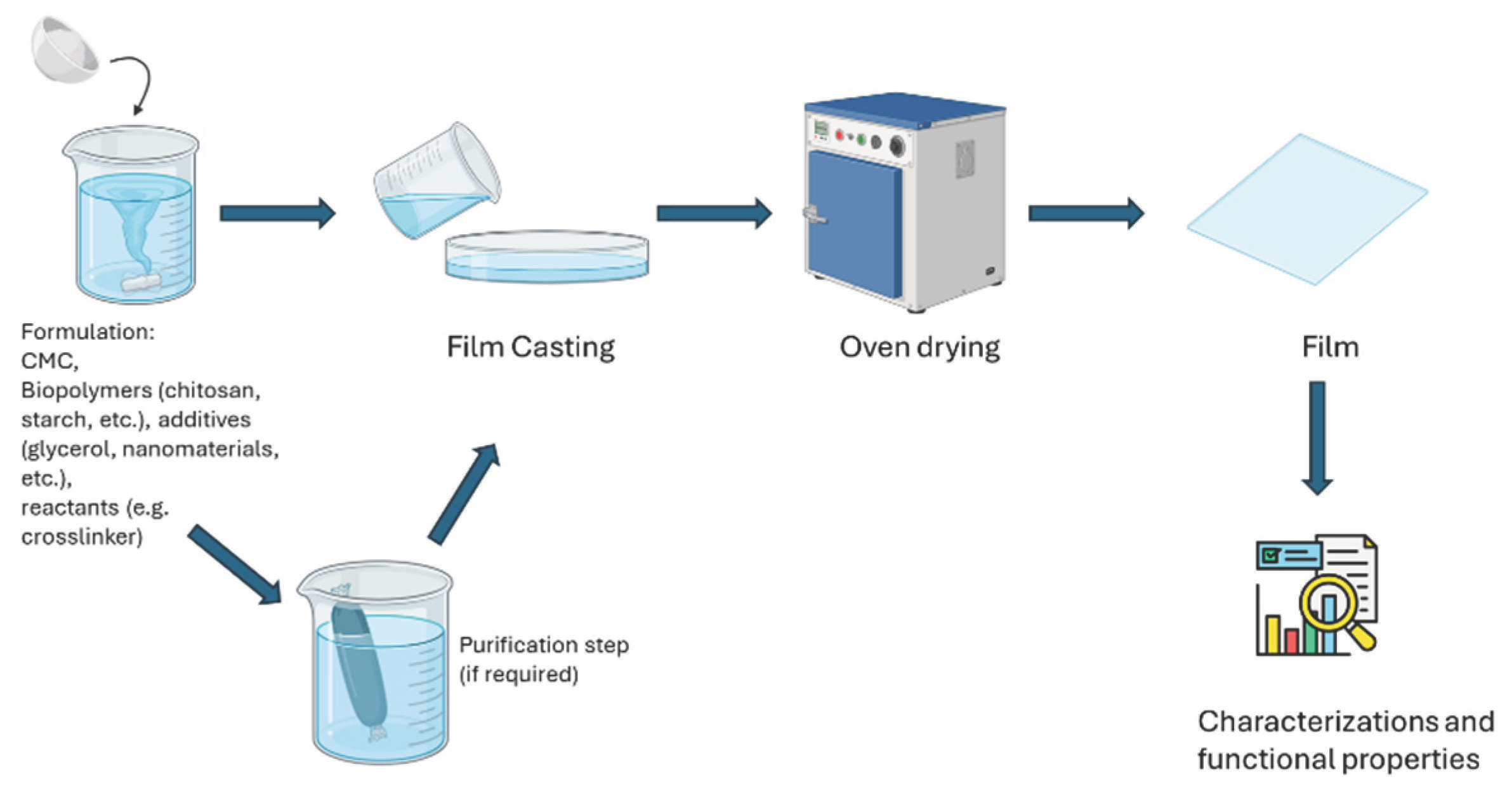
Figure 2.
CMC cross-linking in the presence of DMTMM: self condensation (above) and in presence of a diamine (below)[45].
Figure 2.
CMC cross-linking in the presence of DMTMM: self condensation (above) and in presence of a diamine (below)[45].
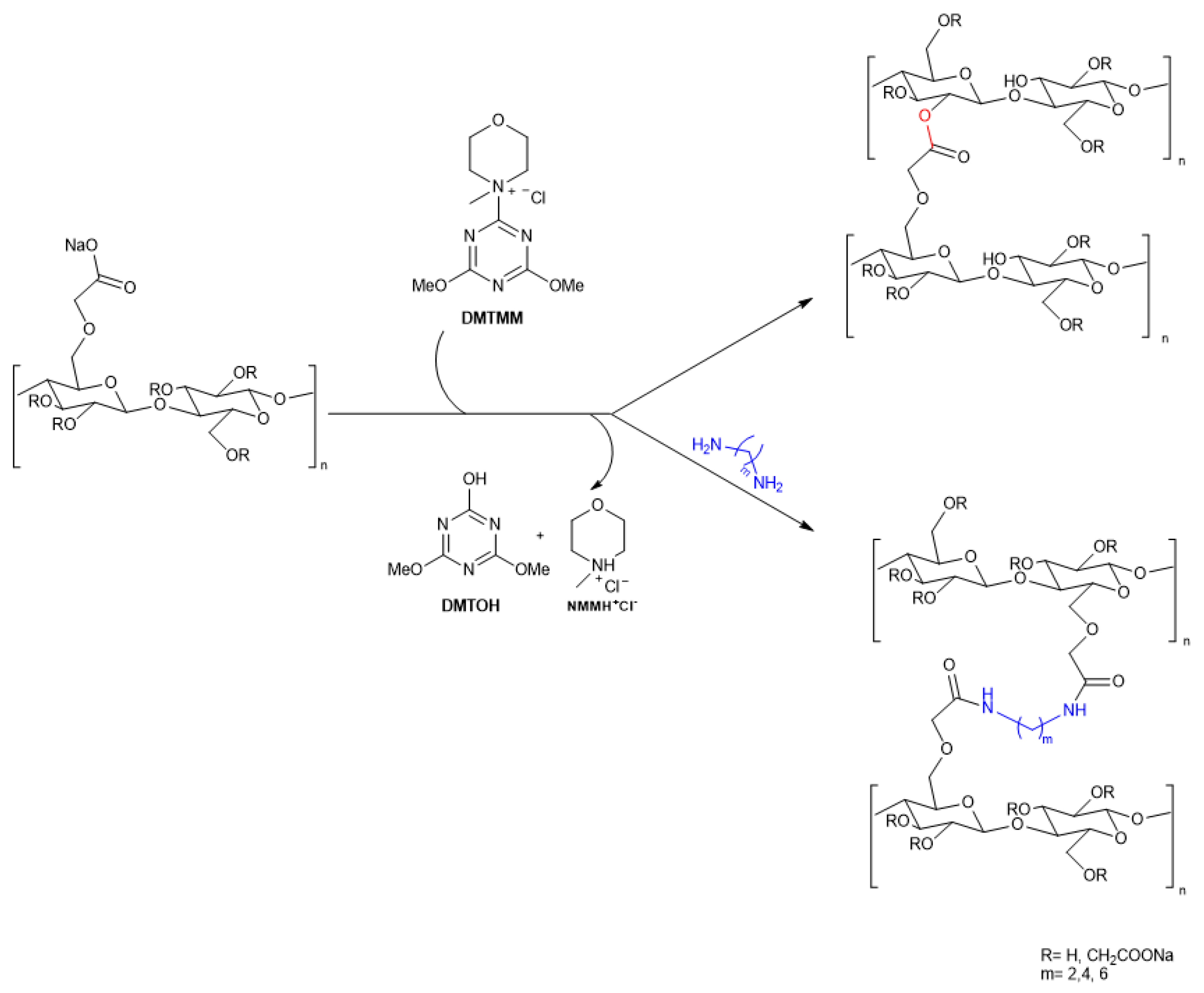
Disclaimer/Publisher’s Note: The statements, opinions and data contained in all publications are solely those of the individual author(s) and contributor(s) and not of MDPI and/or the editor(s). MDPI and/or the editor(s) disclaim responsibility for any injury to people or property resulting from any ideas, methods, instructions or products referred to in the content. |
© 2026 by the authors. Licensee MDPI, Basel, Switzerland. This article is an open access article distributed under the terms and conditions of the Creative Commons Attribution (CC BY) license (http://creativecommons.org/licenses/by/4.0/).
Copyright: This open access article is published under a Creative Commons CC BY 4.0 license, which permit the free download, distribution, and reuse, provided that the author and preprint are cited in any reuse.


