
Submitted:
05 February 2026
Posted:
06 February 2026
You are already at the latest version
Abstract
5G Networks deployment is an important milestone in wireless communication. This research looks into the Indian scientific view on 5G, concentrating on link performance estimation and module-operation optimization. Indian scientists have made contributions towards aspects such as energy-efficient network architectures, Cloud Radio Access Network (CRAN) optimization, and broadband coverage modeling. Nonetheless, additional India-focused research will be required to solve deployment-related challenges unique to India. Performance estimation is based on system-level simulations, measurement-based methods, and analytical models, each with their own limitations like scalability issues and model accuracy dependencies. A hybrid method combining these methods can enhance accuracy. Module-operation optimization increases network efficiency by optimizing dynamic resource allocation, energy-efficient transmission, interference management, and load balancing via network slicing and Multi-access Edge Computing (MEC). Real-world implementation intricacies continue to exist. India's heterogeneity of infrastructure, expensive spectrum, and differentiated service expectations demand customized solutions. Research in the future needs to concentrate on AI-optimized optimization, real-time adaptive algorithms, and cyber security boosters. There needs to be a multidisciplinary strategy incorporating engineering, economics, and policy to enable sustainable deployment of 5G. Future research must investigate quantum computing and block chain for secure, optimized networks.
Keywords:
5G
; link performance estimation
; module-operation optimization
; cloud radio access network (CRAN)
; AI-driven optimization
Introduction
The global rollout of 5Gnetworks is a significant wireless-communication technology advance. Validation of the performance of such networks, particularly in heterogeneous geographical regions such as India, requires careful examination of module operation and link performance. This report is a summary of the Indian scientific perspective of 5G Networks link performance with regard to performance-estimation techniques and module-operation optimization techniques. The research is based on previous work to determine the key findings, limitations, and areas of research. The unique Indian environment challenges, such as infrastructure limitations as well as heterogeneous user requirements, are also considered.
Research Gap
The following table summarizes key research gaps in the intersection of Indian knowledge tradition and 5G Networks technologies:
| Research Area | Key Findings | Limitations/Gaps | Future Research Directions |
| Indian Scientific Contributions to 5G | Energy efficiency studies, CRAN resource optimization, and techno-economic simulation models for broadband coverage. | Scant published literature compared to the rest of the world; no publications on India-centric deployment-related issues. | Further studies in infrastructure policy, economic trade-offs, and India-specific network optimizations. |
| 5G Networks Link Performance Estimation | System-level simulations, measurement-based approaches, and analytical models provide insight into network performance. | Simulations depend on channel model accuracy; measurement-based methods are prone to scaling problems; analytic models depend upon approximations. | Developing hybrid approaches that integrate simulation, measurement, and analytical techniques to boost scalability and accuracy. |
| Module-Operation Optimization | Optimization of the handover control parameter, beam management, and adaptive functional splits improve network efficiency. |
Operational complexity in real deployment; calculation overhead in functional split methods for dynamic and beam forming.. | Studies on real-time adaptive algorithms with lower computational complexity and optimized resource allocation for large-scale deployments. |
| Challenges in 5G Networks Deployment in India | Varying network infrastructure, energy efficiency concerns, and socioeconomic variation in service expectations. | Need for solutions that integrate legacy and newer technologies; high energy needs and cost concerns. | Creating cost-effective and energy-efficient 5G Networks solutions for India's diverse infrastructure and user base. |
| Security and Privacy in 5G | Physical layer security, authentication, and authorization protocol research. | New cyber threats must evolve continually; lack of India-specific security frameworks. | Conduct research on AI-based security solutions, next-generation encryption methods, and geo location-centric cyber security laws. |
Indian Scientific Contributions to 5G Networks Research
Indian researchers have made significant contributions to a large number of areas of 5G Networks technology, although the volume of published literature may be lower than in some other nations. Although it is not possible to review all Indian contributions in this report in detail, some of the key research areas are noted from the literature. For instance, 5G Networks energy efficiency is a key area of research with the need for sustainable deployments [1]. This encompasses the way resources are optimized in Cloud Radio Access Networks (CRANs) [2], one of the architectural building blocks of 5G. Other studies take into account the impact of infrastructure policies on broadband coverage, using techno-economic simulation models and remote sensing data to study the feasibility of universal connectivity, which is very relevant in the Indian context with its large geographical spread and heterogeneous population density [3]. Edward J. Oughton and Ashutosh Jha's contribution highlights the role of enabling infrastructure policies in achieving universal 6G connectivity based on the advancement of current 4G and 5G Networks in frastructure [3]. This is particularly relevant in India, a very high spectrum price nation, which is an indicator of the trade-offs in technology choice and infrastructure policies [3].
5G Networks Link Performance Estimation
Accurate estimation of 5G Networks link performance is crucial to network planning, optimization, and deployment. Different methods are employed, each with benefits and drawbacks. System-level simulations, for example, are an important tool to analyze the performance of various 5G Networks components and configurations [4]. Marco Mezzavilla et al. present a tutorial of a full-stack mmWave module that is incorporated in the ns-3 simulator, enabling end-to-end, cross-layer research and development [4]. The module accommodates detailed statistical channel models, enabling the inclusion of real measurements or ray-tracing data [4]. The modularity of the simulation method allows for the comparison of different OFDM numerologies and the integration of advanced architectural features, like dual connectivity [4]. Nonetheless, the reliability of simulation results depends heavily on the correctness of the channel models used and assumptions on network parameters [4].
Measurement-based approaches link simulations with field measurements of the channel parameters [5]. Tianqi Wu et al. suggest a downlink channel characterization mechanism with passive sounding for sub-6 GHz commercial 5G Networks [5]. The procedure involves extracting the synchronization signals and CSI-RS from 5G Networks downlink signals according to 3GPP specifications [5]. Channel parameter estimation is then conducted using a dual-polar metric SAGE algorithm [5]. While valuable insights are achieved, measurement-based approaches are susceptible to the specific environment and measurement setup [5]. As a further safeguard, the measurability at a large deployment scale is uncertain [5].
Analytical models present a third way to relate performance estimation, with mathematical models of the interrelationship among different network parameters and performance measures [6]. Sanket S. Kalamkar et al. propose a stochastic geometry model of 5G Networks network beam management that yields an easy-to-compute analytical expression for the effective rate of an average user [6]. The model accounts for the factors of frequency, antenna configurations, propagation, physical layer, links, coding, network geometry, resource sharing, sensing, signaling, and mobility management [6]. Although useful for system-level behavior, analytical models have a tendency to rely on simplifying assumptions that may not be reflective of reality [6].
Evolution of Wireless Communication and 5G
Wireless communications evolved over different generations, the most recent being 5G. Some of the key features of 5G Networks are:
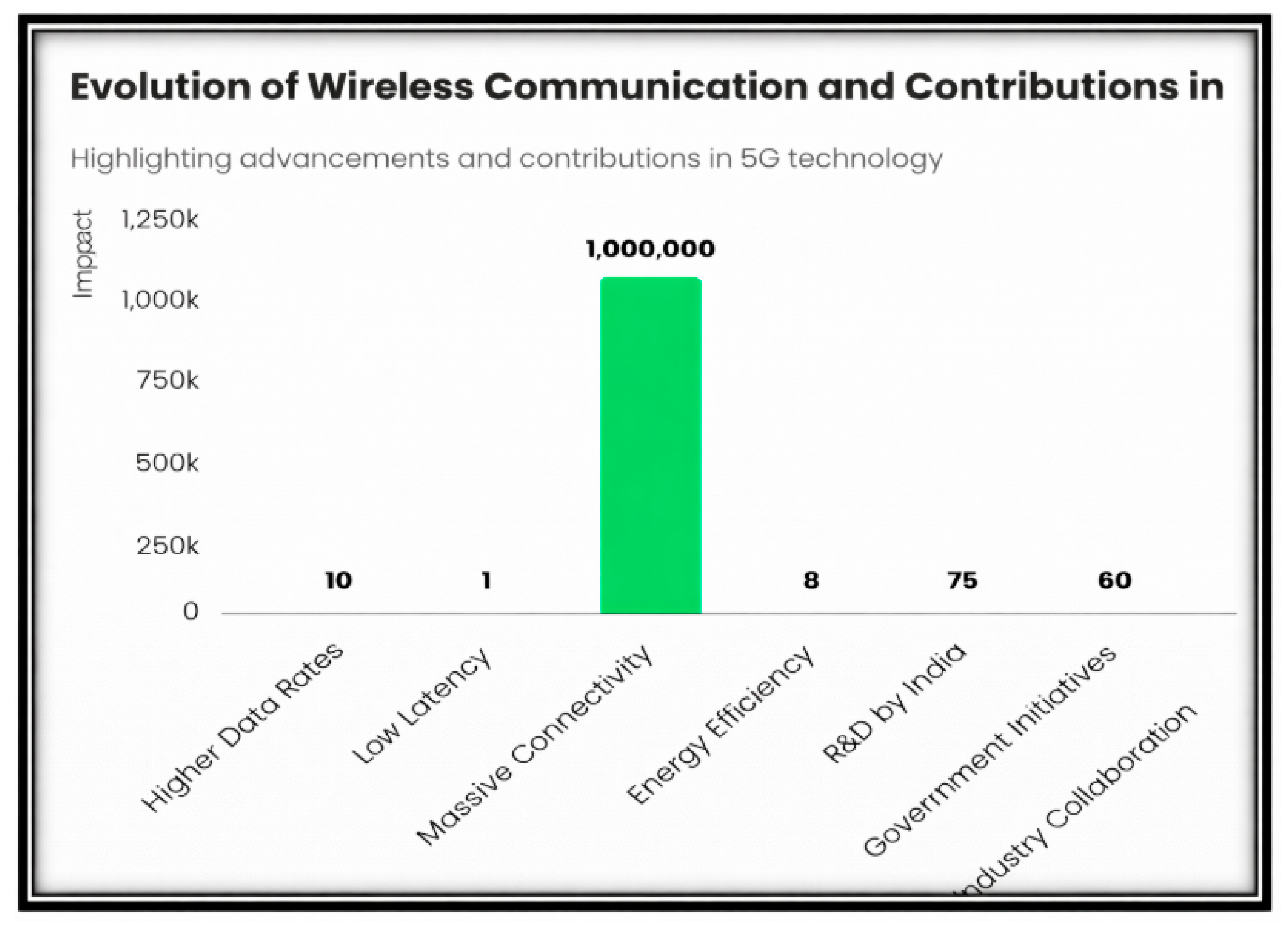
Scientific Contributions from India in 5G Networks Development
India has been at the forefront of developing 5G, and its contributions are:
• Research & Development: Institutions such as IITs and IISc that are involved in AI-based optimization in 5G Networks [11]
• Government Policies: Make in India policies and the BharatNet initiative promoting localization of 5G Networks development[12].
• Industry Partnership: Bharti Airtel, BSNL, and Reliance Jio and others creating 5G Networks apps and infrastructure [13]
Module-Operation Optimization
A key contribution of this paper is the proposal of a module-operation optimization framework to enhance 5G Networks performance. This approach includes:
- Dynamic Resource Allocation (DRA): Implementing AI algorithms to adjust resource allocation in real time.
- Energy-Efficient Transmission: Reducing power consumption without compromising network performance.
- Load Balancing Techniques: Using network slicing and multi-access edge computing (MEC) to distribute traffic efficiently.
- Interference Management: Enhancing signal quality through beam forming and MIMO techniques.
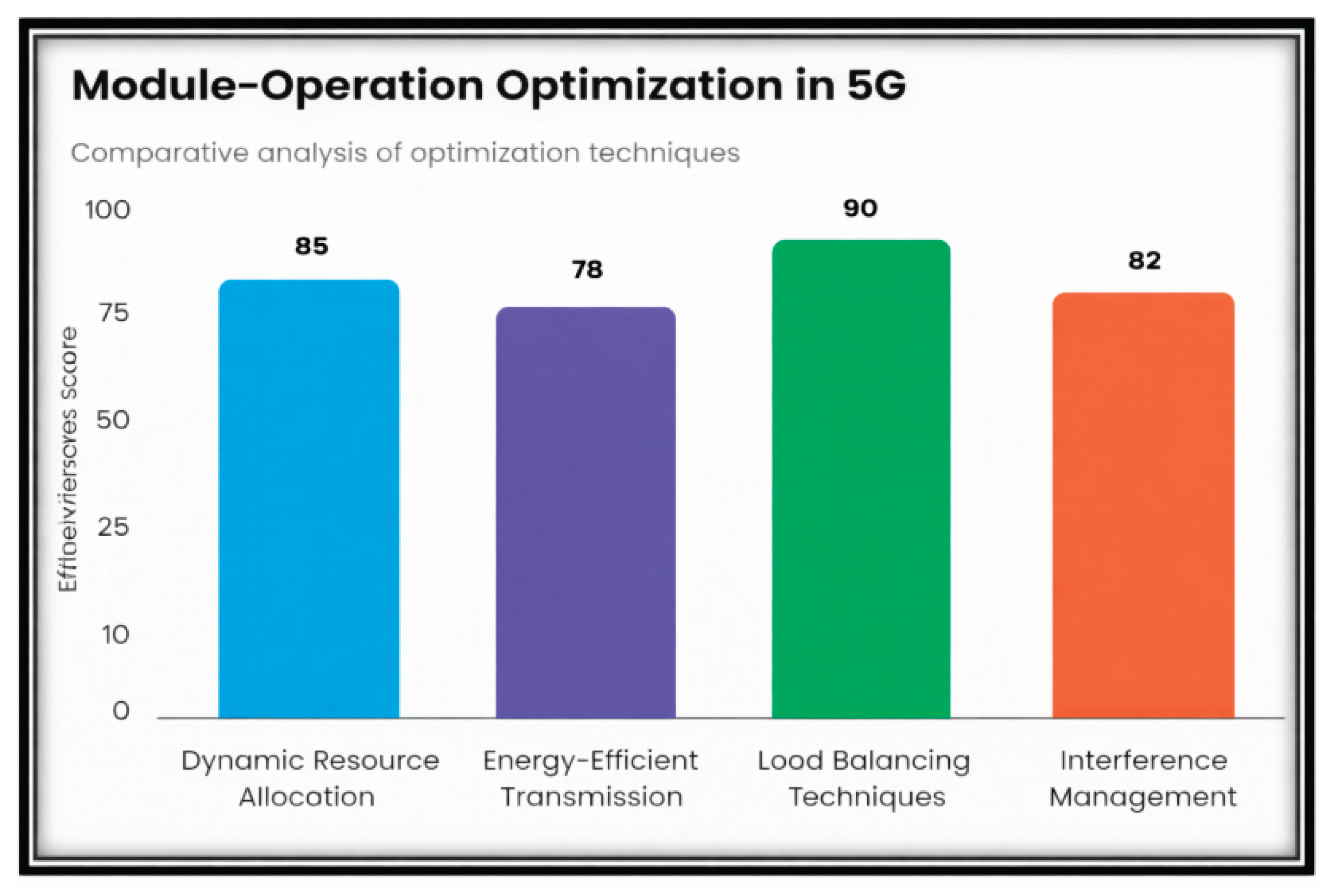
Optimization of the functioning of different 5G Networks modules is critical for improving overall network performance. This includes dealing with several aspects of network design and management. For example, handover control parameters (HCPs) play a crucial role in the reliability and stability of communication during user equipment (UE) mobility [14]. Ibraheem Shayea et al. suggest an Individualistic Dynamic Parameter Optimization algorithm based on an Automatic Weight Function (IDHPO-AWF) for 5G Networks [14]. This algorithm estimates HCP settings dynamically according to individual UE experiences through bounded SINR, cell load, and speed functions [14]. The superiority of this method is proven via simulation outcome comparing performance against other self-optimization algorithms using RSRP, HOP, HPPP, and RLF [14]. The complexity of applying such an algorithm to real networks, however, must be properly assessed [14].
Another important area is beam management, particularly in mmWave systems [6]. The high bandwidths available at mmWave frequencies allow extremely high data rates and low latencies [15], but efficient beamforming is essential to overcome interference and ensure maximal spectral efficiency [6,15]. Carlos Baquero Barneto et al. introduce a new RF beamforming design and optimization method for joint radar-communication dual-functional systems [15]. This method jointly optimizes receiver and transmitter beamforming weights to maximize sensing performance, cancel interference from communication beams, and ensure target beamforming gain for communications [15]. The efficacy of this method is verified by means of numerical simulations, exhibiting significant gains over regular beamforming methods [15]. Nonetheless, joint optimization can have elevated computational complexity, particularly in dense networks [15].
In addition, the functional separation in 5G Networks RAN structures strongly influences network performance [16]. Alberto Martnez Alba et al. introduce the concept of an adaptive functional separation that has the capability to switch among multiple choices during runtime [16]. This design has the aim of achieving maximum performance through dynamically varying the level of centralization based on real-time user traffic [16]. The authors provide objectives, challenges, and measurement results of an operational implementation [16]. But the best functional split would be a function of several variables, such as network topology, traffic, and particular service demands [16].
Challenges and Future Research Directions
Despite all the progress made, there are still some challenges to be overcome in maximizing 5G Networks link performance and module functionality. These are especially evident in heterogeneous environments such as India. One of these challenges is heterogeneity of the Indian network infrastructure, which has a combination of legacy and future technologies [3]. This requires creating flexible and adaptive solutions that can easily fit into current infrastructure while taking advantage of the potential of 5G Networks [3].
Another important challenge is the necessity of energy-efficient solutions [1]. With such a high density of base stations and devices as projected in India's growing 5G Networks energy use will be of great concern [1]. Research into energy-efficient hardware, software, and network architecture is thus called for [1]. Furthermore, the multifaceted array of user demands among various Indian socioeconomic classes demands creating solutions supporting a range of affordability levels and service expectations [3].
Lastly, ensuring security and privacy aspects of 5G Networks are of utmost priority [17]. This calls for strong security mechanisms to guard against different cyber threats, maintaining data confidentiality and integrity while being sent over the network [17]. In addition, studies on user authentication and authorization protocols are required for secure access control and safeguarding against unauthorized access [17].
The future will involve bringing quantum computing and block chain together in secure and optimized 5G Networks Furthermore, the part played by 6G technology in enhancing 5G Networks capabilities will also be examined.
Conclusion
The Indian research community is actively engaged in the development of 5G Networks technology, with an emphasis on problems pertinent to the particular challenges and opportunities of the Indian scenario. Although there has been considerable progress in performance estimation methods and module optimization techniques, there are still some challenges. Future studies must emphasize the creation of adaptive, flexible, energy-efficient, and secure solutions that respond to the heterogeneity of Indian network infrastructure, varied user needs, and changing security threats. A multi-disciplinary approach that includes engineering, economics, and social sciences is necessary to guarantee the successful rollout and sustainable development of 5G Networks in India. Additional investigation is required to advance current models, create new algorithms, and solve the special problems the Indian environment poses in order to maximize the capability of 5G Networks within the region. The combination of various methods, including system-level simulations, measurement-based analysis, and analytical modeling, will offer an enriched understanding of 5G Networks link performance and allow for more efficient optimization of module operation. This piece of work will be instrumental in making 5G Networks technology widely adopted and successfully implemented in India and worldwide.
References
- Usama, M.; Kantarci, M. A survey on recent trends and open issues in energy efficiency of 5G. Sensors 2019, vol. 19(no. 14), 3126. [Google Scholar] [CrossRef] [PubMed]
- Bashir, A.K.; Arul, R.; Basheer, S.; Raja, G.; Jayaraman, R.; Qureshi, N. M. F. An optimal multitier resource allocation of cloud RAN in 5G Networks using machine learning. In Transactions on Emerging Telecommunications Technologies; 2019. [Google Scholar] [CrossRef]
- Oughton, E. J.; Jha, A. Supportive 5G Networks infrastructure policies are essential for universal 6G: Assessment using an open-source techno-economic simulation model utilizing remote sensing. IEEE Access 2021, vol. 9, 101924–101940. [Google Scholar] [CrossRef]
- Mezzavilla, M. End-to-end simulation of 5G Networks mmWave networks. IEEE Communications Surveys & Tutorials 2018, vol. 20(no. 3), 2237–2263. [Google Scholar] [CrossRef]
- Wu, T.; Yin, X.; Zhang, L.; Ning, J. Measurement-based channel characterization for 5G Networks downlink based on passive sounding in sub-6 GHz 5G Networks commercial networks. IEEE Transactions on Wireless Communications 2021, vol. 20(no. 7), 4295–4309. [Google Scholar] [CrossRef]
- Kalamkar, S. S. Beam management in 5G: A stochastic geometry analysis. IEEE Transactions on Wireless Communications 2022, vol. 21(no. 2), 1047–1062. [Google Scholar] [CrossRef]
- Andrews, J. G. What will 5G Networksbe? IEEE Journal on Selected Areas in Communications 2014, vol. 32(no. 6), 1065–1082. [Google Scholar] [CrossRef]
- Shafi, M. , 5G: A tutorial overview. IEEE Communications Surveys & Tutorials 2017, vol. 19(no. 3), 1617–1655. [Google Scholar]
- Osseiran. Scenarios for 5G Networks mobile and wireless communications: The vision of the METIS project. IEEE Communications Magazine 2014, vol. 52(no. 2), 26–35. [Google Scholar] [CrossRef]
- Chen, X.; Zhang, H.; Chen, T. Energy efficiency in 5G Networks mobile networks. IEEE Wireless Communications 2017, vol. 24(no. 6), 6–8. [Google Scholar]
- Misra, S.; Jain, R. AI-driven optimization in 5G Networks networks. IEEE Transactions on Artificial Intelligence 2021, vol. 2(no. 3), 201–213. [Google Scholar]
- Department of Telecommunications (DoT), Government of India, “BharatNet: Connecting India,” 2022. Available online: https://www.dot.gov.in.
- Telecom Regulatory Authority of India (TRAI). “5G Networks Developments in India,” 2023. Available online: https://www.trai.gov.in.
- Shayea; Ergen, M.; Azizan, A.; Ismail, M.; Daradkeh, Y. I. Individualistic dynamic handover parameter self-optimization algorithm for 5G Networksnetworks based on automatic weight function. IEEE Access 2020, vol. 8, 214392–214412. [Google Scholar] [CrossRef]
- Barneto, C. B.; Liyanaarachchi, S.; Riihonen, T.; Anttila, L.; Valkama, M. Multibeam design for joint communication and sensing in 5G NetworksNew Radio networks. Proc. IEEE International Conference on Communications (ICC), 2020. [Google Scholar] [CrossRef]
- Martínez Alba; Velásquez, J.; Kellerer, W. An adaptive functional split in 5G Networksnetworks. Proc. IEEE INFOCOM Workshops, 2019. [Google Scholar] [CrossRef]
- Sanenga. An overview of key technologies in physical layer security. Entropy 2020, vol. 22(no. 11), 1261. [Google Scholar] [CrossRef] [PubMed]
Disclaimer/Publisher’s Note: The statements, opinions and data contained in all publications are solely those of the individual author(s) and contributor(s) and not of MDPI and/or the editor(s). MDPI and/or the editor(s) disclaim responsibility for any injury to people or property resulting from any ideas, methods, instructions or products referred to in the content. |
© 2026 by the authors. Licensee MDPI, Basel, Switzerland. This article is an open access article distributed under the terms and conditions of the Creative Commons Attribution (CC BY) license (http://creativecommons.org/licenses/by/4.0/).
Copyright: This open access article is published under a Creative Commons CC BY 4.0 license, which permit the free download, distribution, and reuse, provided that the author and preprint are cited in any reuse.


