

Submitted:
05 February 2026
Posted:
06 February 2026
You are already at the latest version
Abstract
This paper synthesizes evidence on how artificial intelligence (AI) and service robots may be adopted in Nigeria’s hospitality sector and the key factors that should be evaluated before large-scale deployment. Using a structured review approach, we searched hospitality and tourism scholarship and relevant institutional reports with keywords covering AI, robotics, service automation, hotels, and Nigeria. Twenty-six records were identified and screened; fourteen sources met the eligibility criteria for thematic synthesis. The review indicates that while AI-enabled applications such as chatbots, self-service check-in, smart room systems, and robotic cleaning are technically feasible, adoption in Nigeria is likely to be constrained by enabling conditions: acquisition and lifecycle costs, unreliable power supply and connectivity, limited local maintenance capacity, data governance and privacy concerns, and employee and guest acceptance in a service culture that values human interaction. Drawing on technology acceptance and diffusion perspectives, the study proposes a conceptual framework linking perceived value, organizational readiness, and the external environment to adoption outcomes. The paper contributes a Nigeria-focused adoption lens and practical recommendations for phased, hybrid human–technology service designs that protect service quality while strengthening skills and infrastructure.
Keywords:
artificial intelligence
; service robots
; hospitality industry
; Nigeria
; technology adoption
; digital infrastructure
1. Introduction
Across hospitality markets, AI and service robots are increasingly used to automate routine tasks, support decision making, and reshape the guest journey through self-service, personalization, and contactless interaction (Bulchand-Gidumal, 2020; Ivanov & Webster, 2017). In global research, these technologies are often treated under the broader umbrella of service automation and robotics-enabled service encounters, with attention to operational value, customer experience, and acceptance (Belanche et al., 2020; Samala et al., 2022).
Nigeria’s hospitality sector is strategically important for employment and economic diversification, yet it operates in a business environment characterized by infrastructure gaps and uneven service capabilities (Adeola & Ezenwafor, 2016; Omodero, 2019). This creates a distinctive adoption problem. Automation can improve service consistency and responsiveness, but technology projects in hotels are exposed to power and connectivity disruptions, skills shortages, and high sensitivity to costs in price-competitive markets (Ogunleye, 2021; UNESCO, 2021).
The aim of this study is to identify and organize the main factors that influence AI and robot adoption decisions in Nigeria’s hospitality sector and to clarify the likely implications for service operations and employment. Specifically, the paper (i) maps key AI and service-robot applications relevant to hotel operations, (ii) synthesizes the principal drivers and barriers reported in hospitality and technology-adoption scholarship and in Africa-focused readiness reports, and (iii) proposes a conceptual framework that links determinants of adoption to operational and stakeholder outcomes.
The remainder of the paper describes the review method (Section 2), presents findings organized as adoption themes (Section 3), interprets these findings through established adoption theories and derives practical implications (Section 4), and concludes with recommendations and priorities for future research (Section 5).
2. Materials and Methods
A structured literature review was used to consolidate evidence and develop an adoption-focused synthesis for the Nigerian hospitality context.
Searches were conducted in academic databases and scholarly collections commonly used for tourism and hospitality research: Google Scholar, Scopus, Web of Science, ScienceDirect, and Emerald Insight. In addition, institutional reports relevant to AI readiness and digital infrastructure in Africa and Nigeria were considered to contextualize adoption constraints (e.g., UNESCO and CITRIS Policy Lab reports).
Core search strings combined hospitality terms with AI/robotics terms. Examples included: (“artificial intelligence” OR AI OR “service robot*” OR robotics OR “service automation” OR chatbot*) AND (hospitality OR hotel* OR tourism) AND (Nigeria OR Africa OR “emerging econom*”).
Inclusion criteria were: (i) peer-reviewed journal articles, scholarly book chapters, or reputable institutional reports; (ii) explicit discussion of AI, robotics, or service automation in tourism/hospitality contexts; (iii) relevance to adoption drivers, barriers, outcomes, or governance; (iv) English language; and (v) publication between 2014 and 2025 to capture recent adoption debates. Exclusion criteria were: (i) purely technical robotics/AI papers without hospitality implications; (ii) opinion pieces lacking a clear evidence base; and (iii) duplicate records.
Records were screened in two stages (title/abstract, then full text). Of 26 records identified, 12 were excluded during screening because they did not meet the eligibility criteria or were duplicates, leaving 14 sources for synthesis. From each included source, we extracted: publication type and context, technology category, stated adoption drivers and barriers, stakeholder impacts (guests/employees), and any implementation considerations. Findings were synthesized using thematic coding and then interpreted through technology adoption theories (TAM, UTAUT, and Diffusion of Innovations) to produce an integrated conceptual framework.
Because empirical Nigeria-specific studies on AI and service robots in hotels remain limited, the synthesis combines general hospitality evidence with Nigeria/Africa readiness reports. This increases the relevance of the framework for the local context, but it also means conclusions should be treated as indicative rather than predictive for all hotel segments.
3. Results
3.1. AI and Robotics Applications Relevant to Hotel Operations
Across the reviewed literature, hotel-relevant applications cluster around guest communication and self-service (chatbots, kiosks, biometric check-in), operational automation (robotic cleaning and delivery), and data-driven management (forecasting, demand analytics, and personalization) (Bulchand-Gidumal, 2020; Ivanov & Webster, 2017; Sousa et al., 2024). Across the 14 included sources, five discussed concrete AI/robot application categories in hospitality operations, which informed the application map in Table 1.
Table 1 indicates that the most accessible starting points tend to be software-led tools (e.g., chatbots) and retrofit technologies with clear cost savings, whereas delivery or humanoid robots require higher capital outlays and stronger enabling infrastructure.
3.2. Adoption Drivers
Frequency patterns in the 14-source synthesis suggest that perceived operational value is the most consistently stated driver. Operational value (speed, consistency, and cost efficiency) was discussed in six of the fourteen sources (Belanche et al., 2020; Bulchand-Gidumal, 2020; Ivanov & Webster, 2017; Rogers, 2003; Samala et al., 2022; Sousa et al., 2024). Customer-facing value such as convenience and contactless interaction was discussed in four sources (Belanche et al., 2020; Bulchand-Gidumal, 2020; Samala et al., 2022; Sousa et al., 2024). Competitive pressure and brand positioning appear as secondary drivers in the hospitality literature, particularly where new technologies are visible to guests and therefore signal modernity and service quality (Belanche et al., 2020).
3.3. Adoption Barriers and Risks
The barriers most relevant to Nigeria are enabling-condition constraints. Lifecycle cost and return-on-investment uncertainty were discussed in five sources (Adeola & Ezenwafor, 2016; Ivanov & Webster, 2017; Ogunleye, 2021; Omodero, 2019; UNESCO, 2021). Infrastructure reliability is another binding constraint: power interruptions and uneven internet connectivity were discussed in six sources (Adeola & Ezenwafor, 2016; Bulchand-Gidumal, 2020; Nwakanma et al., 2014; Ogunleye, 2021; Omodero, 2019; UNESCO, 2021). Skills and local technical support needs were discussed in five sources (Adeola & Ezenwafor, 2016; Bulchand-Gidumal, 2020; Ogunleye, 2021; Sousa et al., 2024; UNESCO, 2021).
Beyond operational barriers, governance risks include data protection, accountability for automated decisions, and cybersecurity of networked devices and biometric systems. Governance and privacy concerns appeared in five sources in the synthesis (Belanche et al., 2020; Bulchand-Gidumal, 2020; Ogunleye, 2021; Sousa et al., 2024; UNESCO, 2021).
3.4. Workforce and Service-Experience Implications
Service automation affects employees and guests through more than employment counts. Workforce impacts, including job insecurity, turnover intentions, and changes in autonomy or meaning, were discussed in five sources (Belanche et al., 2020; Bulchand-Gidumal, 2020; Ivanov & Webster, 2017; Li et al., 2019; Nikolova et al., 2024). For guests, acceptance depends on service context: automation is often welcomed for routine, low-empathy tasks, but many customers still prefer human interaction for complex or emotionally sensitive requests. Guest acceptance conditions were discussed in four sources (Belanche et al., 2020; Bulchand-Gidumal, 2020; Ivanov & Webster, 2017; Samala et al., 2022).
4. Discussion
To translate these themes into an adoption explanation, we interpret the evidence through technology acceptance and diffusion lenses. In the Technology Acceptance Model (TAM), perceived usefulness and perceived ease of use shape intention to adopt (Davis, 1989). In the Unified Theory of Acceptance and Use of Technology (UTAUT), performance expectancy, effort expectancy, social influence, and facilitating conditions shape adoption and sustained use (Venkatesh et al., 2003). Diffusion of Innovations further highlights compatibility with existing practices, observability of benefits, trialability, and perceived complexity (Rogers, 2003).
Applied to Nigeria’s hospitality context, facilitating conditions are likely to be decisive. Even when managers perceive high value in automation, unreliable electricity and connectivity, limited vendor support, and constrained financing can turn implementation into a risk to service continuity (Ogunleye, 2021; UNESCO, 2021). This supports staged adoption: start with applications that can operate with minimal hardware dependence, offer visible operational value, and can be piloted without disrupting the whole service system. Chatbots, basic analytics, and narrowly scoped robotic cleaning are examples of technologies that can be trialed and scaled more safely than fully integrated humanoid service systems.
A second implication concerns the service culture and workforce. Nigerian hotels often rely on human-centered service as a differentiator, and the sector’s employment role makes labour-displacement narratives socially sensitive (Adeola & Ezenwafor, 2016; Omodero, 2019). The evidence therefore supports hybrid service designs where robots handle repetitive or hazardous tasks while staff focus on high-contact and exception-handling activities. Such designs can also reduce job-insecurity effects by reframing automation as augmentation, combined with training and internal mobility pathways (Li et al., 2019; Nikolova et al., 2024).
Figure 1 integrates the review into an adoption framework. The framework positions technology perceptions, organizational readiness, and the external environment as upstream determinants of adoption intention and implementation quality. In Nigeria, organizational readiness (infrastructure, skills, and financing) and external environment (vendor ecosystem and regulation) are expected to moderate whether perceived benefits translate into stable deployment. The framework also highlights that adoption outcomes should be evaluated in two ways: operational performance (speed, consistency, and cost structure) and stakeholder effects (guest satisfaction and employee well-being).
Finally, the synthesis surfaces a risk management agenda. Hotels considering AI or robots should evaluate lifecycle costs and maintenance pathways before procurement, define data governance rules for guest information and biometrics, and plan for manual service fallback when systems fail. At the sector level, stronger local technical capacity and clearer standards for privacy and accountability would reduce uncertainty and enable more responsible experimentation (UNESCO, 2021).
5. Conclusions
This study identified the main factors shaping AI and robot adoption in Nigeria’s hospitality sector and clarified their implications. Adoption decisions are driven by perceived operational and customer-facing value, but constrained by enabling conditions: cost and financing, infrastructure reliability, local maintenance capacity, governance risks, and acceptance by employees and guests.
Three practical recommendations follow. First, hotels should adopt AI and robotics through phased pilots that prioritize low-risk, high-utility applications (e.g., chatbots, narrow analytics, smart energy controls) before scaling to complex robotics. Second, managers should invest in readiness: backup power and connectivity, vendor support contracts, cybersecurity practices, and staff training aligned to redesigned roles. Third, hotels should protect service quality through hybrid service models that preserve human interaction for empathy-intensive moments while automating routine tasks.
Future research should prioritize primary empirical studies in Nigerian hotels to quantify costs and benefits, compare guest acceptance across hotel categories, and evaluate workforce impacts under different adoption strategies. Such evidence would allow more precise guidance on which technologies generate sustainable value under Nigeria’s operating conditions.
Author Contributions
Conceptualization: N.C.C. and C.J.O.; Methodology and synthesis: N.C.C.; Writing (original draft): N.C.C.; Writing (review and editing): D.A.A. and C.J.O.
Funding
This research received no external funding.
Data Availability Statement
No new datasets were generated for this study. All sources used in the synthesis are cited in the reference list.
Conflicts of Interest
The authors declare no conflict of interest.
Abbreviations
The following abbreviations are used in this manuscript:
| MDPI | Multidisciplinary Digital Publishing Institute |
| DOAJ | Directory of open access journals |
| TLA | Three letter acronym |
| LD | Linear dichroism |
References
- Adeyinka, T. Understanding the Hospitality Industry in Nigeria: A, B, C’s of the Industry. LinkedIn. 2024. Available online: https://www.linkedin.com/pulse/understanding-hospitality-industry-nigeria-b-cs-tayo-adeyinka-a57yf (accessed on 2 February 2024).
- Aina, D.; Olufemi, D. Nigeria’s Unemployment Rate Rises to 5%: NBS. The Punch. Available online: https://punchng.com/nigerias-unemployment-rate-hits-0-8-in-2023-q3-nbs-report (accessed on 2 February 2024).
- Ajayi, V.O. A review of primary sources of data and secondary sources of data. Eur. J. Educ. Pedagog. 2023, 2, 1–7. [Google Scholar]
- Ajayi, V.O. A review on primary sources of data and secondary sources of data. Univers. J. Arts Humanit. Sci. Technol. Educ. Res. 2023, 2, 1–3. [Google Scholar] [CrossRef]
- Alli, F. Robots Taking Over Jobs from Factory Workers. Vanguard. 2017. Available online: https://www.vanguardngr.com/2017/01/robots-taking-jobs-factory-workers/ (accessed on 8 February 2024).
- Bağıran, Ö.D.; Aktaş, E.; Kurgun, O.A. Applications and implications of service robots in hospitality sector: A case study. J. Bus. Res.-Turk 2022, 14, 3081–3104. [Google Scholar] [CrossRef]
- Basit, J. Nigerian Man Delighted to Receive Food from Robot at Restaurant Shares Video, Trends on Instagram. Vanguard. 2023. Available online: https://www.vanguardngr.com/2017/01/robots-taking-jobs-factory-workers (accessed on 6 February 2024).
- Belanche, D.; Casaló, L.V.; Flavián, C.; Schepers, J. Service robot implementation: A theoretical framework and research agenda. Serv. Ind. J. 2020, 40, 203–225. [Google Scholar] [CrossRef]
- Ben-Ari, M.; Mondada, F. Robots and their applications. In Elements of Robotics; Springer: Cham, Switzerland, 2018. [Google Scholar] [CrossRef]
- Bowen, G.A. Document analysis as a qualitative research method. Qual. Res. J. 2009, 9, 27–40. [Google Scholar] [CrossRef]
- Bulchand-Gidumal, J. Impact of artificial intelligence in travel, tourism, and hospitality. In Handbook of e-Tourism; Xiang, Z., Fuchs, M., Gretzel, U., Höpken, W., Eds.; Springer: Cham, Switzerland, 2020; pp. 1–20. [Google Scholar] [CrossRef]
- Delbridge, A. (Ed.) The Macquarie Dictionary, 2nd ed.; Macquarie University Press: Sydney, NSW, Australia, 1991. [Google Scholar]
- Ebiendele, H.; Ebiendele, P. Information and communication technology (ICT): A panacea for hotel service delivery in Osun State, Nigeria. J. Travel Tour. Recreat. 2020, 2, 25–33. [Google Scholar] [CrossRef]
- Ferreira, M.I.A.; Sequeira, J.S.; Tokhi, M.O.; Kadar, E.; Virk, G.S. (Eds.) A World with Robots: International Conference on Robot Ethics: ICRE 2015; Springer: Cham, Switzerland, 2017; Volume 84. [Google Scholar] [CrossRef]
- Gbandi, E.C.; Ilavbare, B.E. Information and communication technology (ICT) and customers’ satisfaction with hotel services in Benin City, Nigeria. Ife Soc. Sci. Rev. 2023, 31, 51–62. Available online: https://issr.oauife.edu.ng/index.php/ISSR/article/download/223/138/270.
- Gibbons, J.H. Exploratory Workshop on the Social Impact of Robotics: Summary and Issues; U.S. Government Printing Office: Washington, DC, USA, 1982. [Google Scholar]
- Gim, G.C.; Desa, N.M.; Ramayah, T. Competitive psychological climate and turnover intention with the mediating role of affective commitment. Procedia—Soc. Behav. Sci. 2015, 172, 658–665. [Google Scholar] [CrossRef]
- Hodibert, V.A.; Anderson, A.N.; Neequaye, K. AI/Robotics in the tourism and hospitality sector: Technological realities and imaginaries in the Ghana context. Int. J. Res. Innov. Soc. Sci. 2024, 8, 2454–6186. [Google Scholar] [CrossRef]
- Hudson, N.; Runge, J. Recruitment of Workers into Low-Paid Occupations and Industries: An Evidence Review; National Institute of Economic and Social Research; Equality and Human Rights Commission: Sydney, NSW, Australia, 2020. [Google Scholar]
- Ivanov, S.; Webster, C. Adoption of robots, artificial intelligence and service automation by travel, tourism and hospitality companies: A cost-benefit analysis. In Proceedings of the International Scientific Conference “Contemporary Tourism—Traditions and Innovations”; Sofia University: Sofia, Bulgaria, 2017; pp. 19–21. [Google Scholar]
- Ivanov, S.; Webster, C.; Berezina, K. Adoption of robots and service automation by tourism and hospitality companies. Rev. Tur. Desenvolv. 2017, 27, 1501–1517. [Google Scholar]
- Kalu, A.O.U.; Unachukwu, L.C.; Ibiam, O. Accessing secondary data: A literature review. Singaporean J. Bus. Econ. Manag. Stud. 2018, 6, 53–63. [Google Scholar]
- Köseoglu, M.A.; Morvillo, A.; Altin, M.; De Martino, M.; Okumus, F. Competitive intelligence in hospitality and tourism: A perspective article. Tour. Rev. 2020, 75, 239–242. [Google Scholar] [CrossRef]
- Lee, K.F. Automation, computerization and future employment in Singapore. J. Southeast Asian Econ. 2017, 34, 388–399. [Google Scholar] [CrossRef]
- Li, J.J.; Bonn, M.A.; Ye, B.H. Hotel employees’ artificial intelligence and robotics awareness and its impact on turnover intention: The moderating roles of perceived organizational support and competitive psychological climate. Tour. Manag. 2019, 73, 172–181. [Google Scholar] [CrossRef]
- Limna, P. Artificial intelligence (AI) in the hospitality industry: A review article. Int. J. Comput. Sci. Res. 2023, 7, 1306–1317. [Google Scholar] [CrossRef]
- Martijn, B. Robots in the Hospitality Industry. Revfine. 2024. Available online: https://www.revfine.com/robots-hospitality-industry/ (accessed on 15 February 2024).
- Mithichar, B.; Gunajit, S. The use of artificial intelligence in tourism industry of India: A critical insight. Migr. Lett. 2024, 27, 111–119. [Google Scholar] [CrossRef]
- National Bureau of Statistics. Nigeria Labour Force Survey: Q3 2023. 2023. Available online: https://microdata.nigerianstat.gov.ng/index.php/catalog/76/pdf-documentation.
- Nikolova, M.; Cnossen, F.; Nikolaev, B. Robots, meaning, and self-determination. Res. Policy 2024, 53, 104987. [Google Scholar] [CrossRef]
- Nikolova, M.; Cnossen, F.; Nikolaev, B. Robots, Meaning, and Self-Determination (GLO Discussion Paper No. 1191). Global Labor Organization. 2022. Available online: https://www.econstor.eu/bitstream/10419/258768/1/GLO-DP-1191.pdf.
- Nwakanma, I.C.; Ubani, E.C.; Asiegbu, B.C.; Nwokonkwo, O.C. Factor affecting the adoption of ICT in the hospitality industry in Imo State. Int. J. Comput. Sci. Issues 2014, 11, 170–181. [Google Scholar]
- Odum, C.J. Innovation in tourism industry: Insight from Nigeria [Conference presentation]. In Proceedings of the Ahi Evran International Conference on Scientific Research, Kırşehir, Türkiye, 21–23 October 2022. [Google Scholar]
- Odum, C.J.; Ukekwe, C. Tourism and virtual reality (VR) in developing nations. Afr. J. Hosp. Tour. Leis. 2020, 9, 1–16. [Google Scholar]
- Ojoye, T.; Ihua-Maduenyi, M. AI, Automation to Boost Hotel Revenues by 10%: Report. The Punch. 2019. Available online: https://punchng.com/ai-automation-to-boost-hotel-revenues-by-10-report/.
- Ogunleye, I. Artificial Intelligence for Economic Development in Nigeria. CITRIS Policy Lab. 2021. Available online: https://citrispolicylab.org/wp-content/uploads/2021/12/Artificial-Intelligence-for-Economic-Development-in-Nigeria_Ifejesu-Ogunleye.pdf.
- Omodero, C.O. Nigeria’s economic diversification with an emphasis on hospitality and tourism sector as a necessity. Manag. Dyn. Knowl. Econ. 2019, 7, 147–164. [Google Scholar] [CrossRef]
- Onyeonoro, C.O.; Okpaleke, V.C.; Ononuju, V.I.; Onyeonoro, F.N. Economic recession and hotel performance in Abia State, Nigeria. Eur. J. Hosp. Tour. Res. 2023, 11, 1–21. [Google Scholar] [CrossRef]
- RisingMax. How Much Does AI Cost in 2024. 2024. Available online: https://risingmax.com/blog/how-much-does-artificial-intelligence-cost (accessed on 24 February 2024).
- Samala, N.; Katkam, B.S.; Bellamkonda, R.S.; Rodriguez, R.V. Impact of AI and robotics in the tourism sector: A critical insight. J. Tour. Futures 2022, 8, 73–87. [Google Scholar] [CrossRef]
- Schrock, W.A.; Hughes, D.E.; Fu, F.Q.; Richards, K.A.; Jones, E. Better together: Trait competitiveness and competitive psychological climate as antecedents of salesperson organizational commitment and sales performance. Mark. Lett. 2016, 27, 351–360. [Google Scholar] [CrossRef]
- Smith, A.; Anderson, J. AI, Robotics, and the Future of Jobs. Pew Research Center. 2014. Available online: https://www.pewresearch.org/internet/2014/08/06/ai-robotics-and-the-future-of-jobs/.
- Social Tables. Robots in Hotels: 6 Hotel Brands Leading the Way. 2024. Available online: https://www.socialtables.com/blog/hospitality-technology/hotel-brands-robot/ (accessed on 2 March 2024).
- Sousa, A.E.; Pais, S.; Viana, A.S. Applications of artificial intelligence in tourism and hospitality: A systematic literature review. In Management, Tourism and Smart Technologies (ICMTT 2023); Montenegro, C., Rocha, Á., Lovelle, J.M.C., Eds.; Springer: Cham, Switzerland, 2024; pp. 291–302. [Google Scholar] [CrossRef]
- Technavio. Hospitality Robots MARKET Analysis: North America, Europe, APAC, South America, Middle East and Africa (US, China, Germany, UK, France): Size and Forecast 2024–2028. 2024. Available online: https://www.technavio.com/report/hospitality-robots-market-industry-analysis (accessed on 4 March 2024).
- Tezpur University. Introduction to Robot and Robotics. n.d. Available online: https://www.tezu.ernet.in/dmech/people/New_Faculty_Details/ZK/notes/Introduction_to_robotics/Introduction.pdf (accessed on 23 March 2024).
- UNESCO. Artificial Intelligence Needs Assessment Survey in Africa. 2021. Available online: https://www.unesco.org/en/artificial-intelligence/needs-assessment-survey-africa.
- WebFX. AI Pricing: How Much Does Artificial Intelligence Cost? 2024. Available online: https://www.webfx.com/martech/pricing/ai/ (accessed on 2 February 2024).
- Yadav, J.K.; Verma, D.C.; Jangirala, S.; Srivastava, S.K. An IAD-type framework for blockchain-enabled smart tourism ecosystem. J. High Technol. Manag. Res. 2021, 32, 100404. [Google Scholar] [CrossRef]
- Yasar, K.; Hanna, K.T. Robotics. TechTarget. 2024. Available online: https://www.techtarget.com/whatis/definition/robotics (accessed on 2 February 2024).
- Young, C.S. LG Electronics to Develop Hotel-Exclusive Robots. KED Global. 2024. Available online: https://www.kedglobal.com/robotics/newsView/ked202402210014 (accessed on 2 February 2024).
Figure 1.
Conceptual framework linking adoption determinants to operational and stakeholder outcomes.
Figure 1.
Conceptual framework linking adoption determinants to operational and stakeholder outcomes.
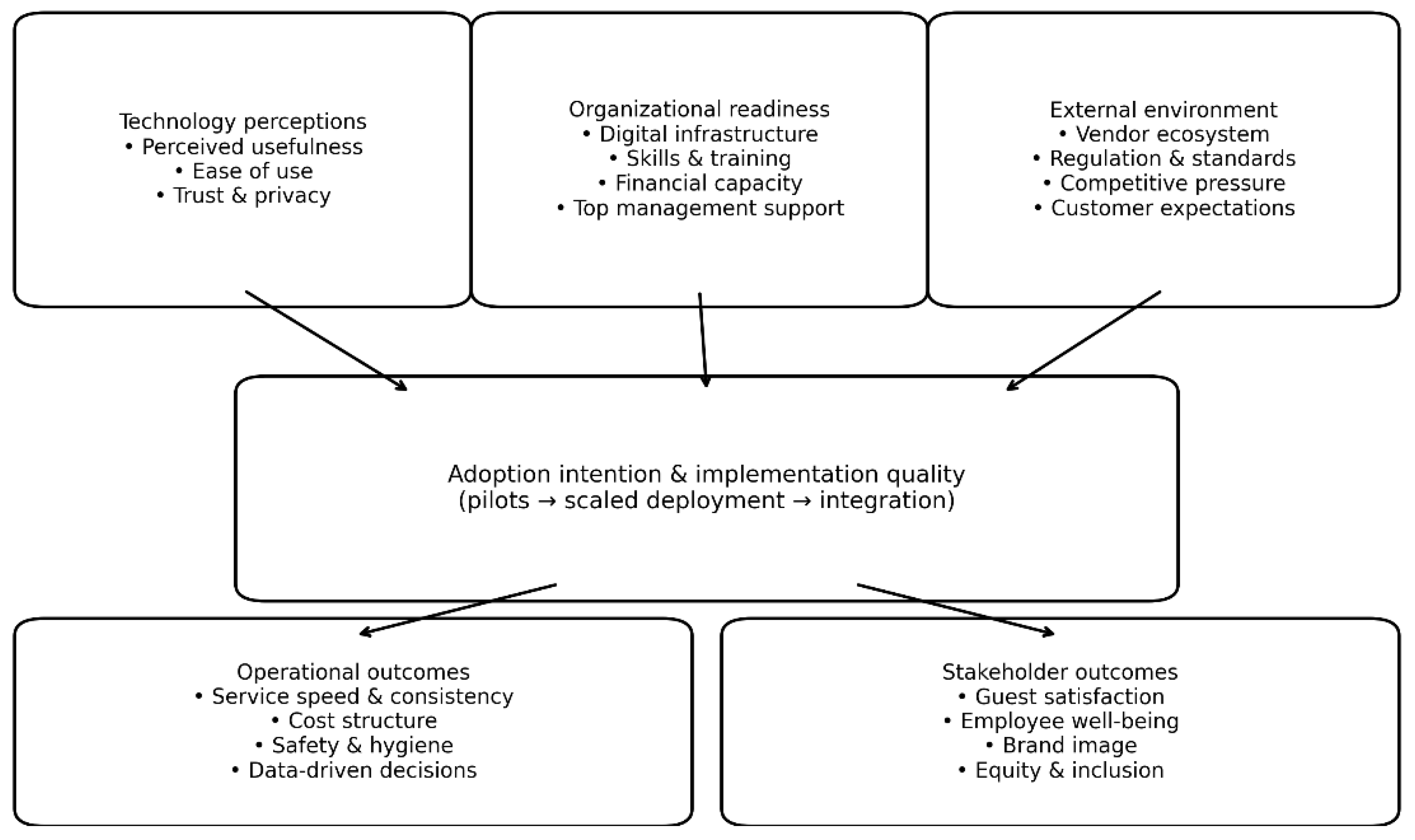

Table 1.
Summary of AI and service-robot technologies, functions, barriers, and local relevance for Nigerian hotels.
Table 1.
Summary of AI and service-robot technologies, functions, barriers, and local relevance for Nigerian hotels.
| Technology/Application | Primary Hotel function(s) | Expected Value | Salient barriers/Risks in Nigeria | Local Relevance (Adoption Note) |
|---|---|---|---|---|
| AI chatbots and messaging assistants | Reservations, FAQs, guest support | 24/7 response; reduced front-desk load; consistent information | Language/intent errors; data privacy; integration with PMS | High feasibility as a low-cost entry point; best as human-backed escalation |
| Self-service kiosks and biometric check-in | Check-in/out, identity verification | Reduced queues; contactless service; standardized processes | Hardware cost; power/connectivity reliability; regulatory compliance for biometrics | More suitable for upscale/chain hotels with stable ICT and governance capacity |
| Smart rooms/IoT (energy & comfort controls) | Energy management, in-room experience | Cost savings; comfort personalization; predictive maintenance | Upfront retrofit costs; interoperability; cybersecurity; local technical support | Strong potential where electricity costs are high; requires reliable maintenance |
| Robotic cleaning (vacuum, scrubbers; UV disinfection) | Housekeeping, hygiene and safety | Task consistency; reduced exposure to hazardous cleaning; faster turnaround | Maintenance and spare parts; staff acceptance; uneven layouts and space constraints | Practical for corridors/lobbies; complements (not replaces) housekeeping teams |
| Delivery and concierge robots | Room service delivery, wayfinding | Novelty/brand differentiation; labour substitution for repetitive runs | High acquisition cost; navigation challenges; guest acceptance; security concerns | Best piloted in controlled environments (large properties, malls, conference hotels) |
| AI-enabled CCTV analytics and access control | Security monitoring, anomaly detection | Faster incident response; deterrence; staff allocation | Privacy/legal risk; false positives; governance and accountability | Relevant where security risks are salient; requires clear policies and oversight |
Disclaimer/Publisher’s Note: The statements, opinions and data contained in all publications are solely those of the individual author(s) and contributor(s) and not of MDPI and/or the editor(s). MDPI and/or the editor(s) disclaim responsibility for any injury to people or property resulting from any ideas, methods, instructions or products referred to in the content. |
© 2026 by the authors. Licensee MDPI, Basel, Switzerland. This article is an open access article distributed under the terms and conditions of the Creative Commons Attribution (CC BY) license (http://creativecommons.org/licenses/by/4.0/).
Copyright: This open access article is published under a Creative Commons CC BY 4.0 license, which permit the free download, distribution, and reuse, provided that the author and preprint are cited in any reuse.


