
Submitted:
05 February 2026
Posted:
06 February 2026
You are already at the latest version
Abstract
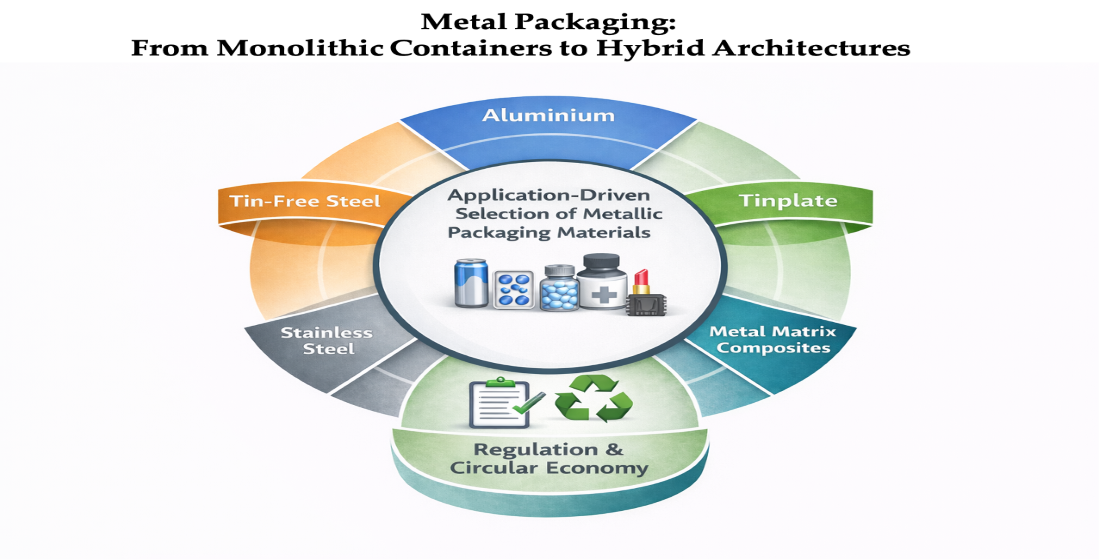
Metal packaging materials remain fundamental across food, beverage, pharmaceutical, cosmetic, and technical sectors owing to their combination of mechanical robustness, total light and gas barrier performance, thermal resistance, and established recyclability. Aluminum alloys, tinplate, tin-free steel (TFS/ECCS), stainless steels, metal–matrix composites (MMCs), and metal–polymer or metal–paper laminates define distinct metal-based packaging architectures whose metallurgical and interfacial design governs forming behaviour, corrosion and migration pathways, coating integrity, and mechanical reliability. In this review, these architectures are examined from a materials- and systems-oriented perspective, linking composition, microstructure, processing routes, and surface engineering to functional performance across rigid, semi-rigid, and flexible formats. The analysis also considers the ongoing transition from bisphenol A (BPA)-based epoxy linings to BPA-free and hybrid coating chemistries, the use of nano-structured metallic and metal-oxide surfaces, and the role of composite laminates in which thin metallic foils are combined with polymeric or paper-based structural layers. These material and architectural aspects are discussed together with safety, regulatory, and circularity considerations that increasingly influence the design and selection of metal-based packaging. Ion migration, coating degradation, and corrosion under realistic storage environments are considered in relation to EU, FDA, ISO, and sector-specific requirements, while attention is also paid to the contrast between well-established closed-loop recycling infrastructures for aluminum and steel and the more complex end-of-life management of coated metals and multilayer laminates. The review provides a unified framework connecting materials selection, metallurgical design, processing, performance, regulatory compliance, and sustainability in metal-based packaging systems. Applications spanning consumer goods, pharmaceuticals, cosmetics, and advanced electronics are integrated to support an overall understanding of how metallic and hybrid metal-based architectures underpin functional reliability and life-cycle sustainability.
Keywords:
metallic packaging
; aluminum cans
; tinplate
; food-contact materials
; corrosion and migration
; surface coatings
; regulatory compliance
; circular economy
; recyclability
; sustainability
Copyright: This open access article is published under a Creative Commons CC BY 4.0 license, which permit the free download, distribution, and reuse, provided that the author and preprint are cited in any reuse.


