

Submitted:
04 February 2026
Posted:
06 February 2026
You are already at the latest version
Abstract
The purpose of this study is to evaluate the impact of AI-based route optimization on carbon emission reduction in urban construction logistics, with a particular focus on the mediating role of vehicle load optimization.The study adopts a cross-sectional quantitative research approach, targeting three urban locations in Ghana. The stratified random sampling was adopted to select 405 participants who answered a 5-point likert scale self-administered structured questionnaire. The data was entered and cleaned into SPSS. The descriptives, reliability and correlations were analyzed. The study further used the linear regression and mediation analysis to investigate the relationship between the study variables.The study findings showed that AI-based route optimization had a positive significant effect on carbon emission reduction and vehicle load optimization. Vehicle load optimization had a positive significant effect on carbon emissions reduction. Furthermore, the findings pointed to a partial mediation of AI-based route optimization on carbon emission reduction through vehicle load optimization.Ghanaian policymakers should invest in AI technologies and endorse vehicle load optimization solutions to meet carbon reduction targets, enhancing urban logistical efficiency. Future research should use longitudinal design, and focusing on rural construction logistics.
Keywords:
AI-based routes
; Ghana
; urban construction
; carbon emissions
; vehicle load optimization
; logistics
1. Introduction
The construction industry is among the biggest contributors to carbon emissions globally, accounting for an estimated 37% of all global carbon emissions (UN Environment Programme, 2023). This environmental impact is greatly influenced by the manufacturing and usage of building-essential materials including cement, steel, and aluminum which are integral to construction. Within the European Union, the building sector generates 40% of waste yearly, consumes 40% of raw materials, and uses 40% of the primary energy (BUILD UP Team, 2024; European Commission, 2023; European Environment Agency, 2024). Globally, Cooper (2023) asserts that buildings account for 40% of energy consumption and 33% of greenhouse gas (GHG) emissions mostly from transportation activity, manufacturing of building materials, and usage of construction equipment. Although most of the industry's carbon-cutting initiatives have historically concentrated on lowering "operational" emissions from building operations—that is, heating, cooling, and lighting—less thought has been paid to construction logistics. Especially in urban areas, construction logistics is a major contributor to greenhouse gas emissions (World Bank Gap Fund, 2021). Research by Sufyanullah et al. (2022) shows the significant influence of construction transportation. Studies by Seo et al. (2016) quantify it further, stating that construction transportation alone accounts for 2.4% to 5.5% of CO2 emissions, while Sezer and Fredriksson (2021) note that the transportation of materials contributes up to 16% of a project's total emissions. These figures not only highlight the scope of the difficulty but also help to define the urgency of innovative solutions to reduce carbon emissions associated with construction logistics, especially in urban construction environments.
The urgency to reduce carbon emissions in construction logistics in urban environments is underscored by a growing body of literature highlighting the sector’s significant contribution to environmental degradation. Numerous studies emphasize that the transportation and delivery of construction materials account for a substantial portion of the carbon emissions within urban construction projects (L. Chen et al., 2023; Hao et al., 2020; Sizirici et al., 2021). With cities becoming increasingly congested, the inefficiencies of traditional logistics systems, such as empty or partially loaded vehicles, excessive fuel consumption, and the use of outdated equipment, exacerbate the environmental impact. Researchers argue that decarbonizing construction logistics can yield substantial reductions in greenhouse gas emissions, which are critical for meeting global climate targets (Johnsson et al., 2020; Karlsson et al., 2020; Korra & Valaboju, 2024). Furthermore, urban areas face unique challenges such as limited space for material storage, traffic congestion, and regulatory constraints (Ahani et al., 2023; Kamarulzaman et al., 2023), all of which compound the difficulty of reducing emissions in construction logistics (Inkinen & Hämäläinen, 2020). As urban construction projects grow in scale and complexity, the adoption of more efficient, sustainable logistics solutions—such as AI-based route optimisation—has become an urgent priority to mitigate the environmental footprint of the sector.
AI-based route optimization refers to the use of artificial intelligence technologies to determine the most efficient paths for vehicles, minimizing travel time, fuel consumption, and associated costs. In urban construction logistics, where material transportation is a significant source of carbon emissions, AI-based systems can significantly reduce environmental impacts (Goswami et al., 2021; Hu et al., 2020; Iyer, 2021). By analyzing real-time data such as traffic patterns, road conditions, and delivery schedules, AI algorithms optimize routes to avoid congestion and reduce unnecessary mileage. This leads to lower fuel consumption, directly translating to reduced CO2 emissions. As urban construction projects continue to grow, the adoption of AI-driven route optimization offers a scalable and effective solution for decarbonizing logistics operations while improving overall efficiency (Bibri et al., 2024; Shah et al., 2024). While AI-based route optimization optimizes vehicles paths, reduce travel time and fuel consumption, contributing to carbon emission reduction in urban construction, it can further be improved through vehicle-load optimization.
Vehicle load optimization can be seen as the process of maximizing the use of available vehicle capacity in order to improve transportation efficiency, reduce the number of trips, and minimize fuel consumption and emissions (Li et al., 2024; Nolz, 2021). In the context of logistics, particularly in urban construction, it involves ensuring that vehicles are loaded with the maximum possible amount of material or goods, without exceeding their weight or volume limits. This optimization can be achieved through strategic planning, load-matching algorithms, and real-time adjustments to ensure that each vehicle operates at or near its full capacity (Liu et al., 2021; Zhang & Pan, 2020). Studies indicate that inefficient load management, such as underloading or overloading, significantly contributes to increased fuel consumption and emissions due to the need for additional trips or strained engine performance (Roy et al., 2024; Stanula et al., 2023; Zhang et al., 2021). Optimizing vehicle loads ensures that transportation resources are utilized to their full capacity, thereby reducing the number of trips required and, consequently, the overall emissions.
Moreover, computational models integrated with AI and Internet of Things (IoT) technologies have been instrumental in advancing vehicle load optimization by enabling real-time load monitoring and dynamic route adjustments. This synergy has proven effective in minimizing unnecessary mileage and idle times, critical factors in urban construction logistics characterized by high traffic congestion and regulatory constraints (Chen & Liu, 2020). For example, machine learning and predictive analytics have increasingly been used to forecast return volumes and optimize vehicle utilization, which are particularly critical in the context of growing e-commerce. According to a 2023 McKinsey report cited by Mandal and Mohammed (2024) AI-driven predictive analytics in logistics is expected to reduce transportation costs by up to 15% and improve fuel efficiency by 10-20%. Furthermore, deep learning models are being leveraged to analyze vast amounts of real- time data, including traffic patterns, weather conditions, and customer behavior, to dynamically adjust routes and schedules. Recent studies have shown significant progress in AI adoption for reverse logistics. The study by Ye et al. (2022) demonstrated how genetic hybrid algorithms were successfully implemented indicating a carbon emission cost decrease by 5.6% in transportation-related emissions. This highlights the potential for AI to contribute to environmental sustainability in logistics.
While AI-based Route Optimization identifies the most efficient paths to minimize travel time and fuel consumption, its full potential in reducing emissions is realized when combined with effective load management. Vehicle Load Optimization ensures that vehicles are utilized to their maximum capacity, reducing the number of trips required and optimizing resource use. In essence, Vehicle Load Optimization acts as a mediating mechanism between AI-based Route Optimization and carbon emission reduction by enhancing the efficiency of logistics operations. This interplay between AI-driven Route Optimization and Vehicle Load Optimization creates a synergistic effect, where optimized routes and loads work together to minimize unnecessary mileage, fuel wastage, and greenhouse gas emissions, thereby amplifying the impact of AI technologies on sustainable logistics practices.
Although existing literature suggests the dynamics and relationships between AI-Based Route Optimization, Carbon Emission Reduction and Vehicle Load Optimization, there remains limited empirical evidence to substantiate them. As previously noted, much of the scholarly focus and practical interventions on carbon emission reduction within the construction sector have centered on prominent aspects such as heating, cooling, construction materials, and lighting (Luo & Chen, 2020; Mostafavi et al., 2021; Pylsy et al., 2020). In contrast, the carbon emissions associated with construction logistics in urban areas have received comparatively less attention. Consequently, the current study sought to evaluate the impact of AI-based route optimization on carbon emission reduction in urban construction logistics, with a particular focus on the mediating role of vehicle load optimization.
2. Literature Review
Theory Of Planned Behaviour
The theory of planned behaviour (TPB) proposed by Ajzen (1991) proposes that behaviour is influenced by three main fundamental factors: attitudes, subjective norms and perceived behavioural control. Attitudes represent individual’s positive or negative evaluations of a behaviour. Subjective norms relate to the impact of society and organisational constraints, including environmental regulations and industry trends towards sustainability. Perceived behavioural control highlights an individual’s belief in their capacity to execute a behaviour effectively, considering available resources and support. These components together shape the intentions to influence actual behaviour (Hagger et al., 2022; Hasan & Suciarto, 2020).
Within urban construction logistics, TPB highlights the implementation of AI-based route optimization and vehicle load optimization technologies. Positive attitudes towards AI’s capacity to improve efficiency and decrease carbon emissions can motivate decision-makers to implement these systems. Likewise, societal and governmental influence encourage standards that encourage adherence to sustainability goals. Perceived control such as confidence in technical competencies or resource availability indicate where logistics firms are prepared to execute AI solutions effectively. This application of TPB indicate the interaction between psychological and external elements to technology adoption and achieving carbon emissions reduction.
AI-Based Route Optimization and Carbon Emission Reduction in Urban Construction Logistics
Urban logistics, which involves the transportation and delivery of goods within city environments, is a crucial aspect of contemporary urban planning and management. Thus, in construction in the urban environment, the transportation and delivery of goods within urban city environments is what constitute Urban Construction Logistics (Rai et al., 2022; Sezer & Fredriksson, 2021). Bosona (2020) noted that increased urban populations demands efficient logistics leading to challenges in the construction process, particular when aiming to reduce carbon footprint in construction.
The integration of artificial intelligence (AI) in route optimization has emerged as a transformative approach to addressing carbon emissions in urban construction logistics. Studies demonstrate that AI algorithms, including machine learning and heuristic methods, effectively analyze complex urban traffic patterns to identify the most fuel-efficient routes, minimizing travel distance and idle time. For instance, a study by Chen et al. (2021) highlights that AI-enabled routing can reduce fuel consumption by up to 25%, translating to significant reductions in carbon dioxide emissions. Furthermore, AI-driven systems incorporate real-time traffic updates, construction zone information, and environmental constraints, enabling dynamic adjustments to routes that align with sustainability objectives (Dikshit et al., 2023). While the technology has shown promise, barriers such as high implementation costs and the lack of widespread digital infrastructure in developing economies remain challenges (Maqsoom et al., 2023). Nonetheless, the growing adoption of AI solutions in urban logistics reflects a shift toward greener operational practices.
In addition to route optimization, AI facilitates the integration of predictive analytics to improve logistical decision-making, enhancing its potential for carbon emission reduction. Research by Zhang et al. (2022) demonstrates that AI models trained on historical transportation data can predict high-emission periods and suggest load consolidation strategies to maximize vehicle utilization. These insights optimise routing and improve vehicle load factors, a key determinant in minimizing emissions. Studies further underscore the synergy between AI and sustainable logistics when paired with green technologies such as electric vehicles and low-emission zones.
Nevertheless, a considerable number of evidence suggests that AI-based route optimization significantly impacts carbon emission reduction in urban construction logistics. For instance, carbon-aware routing protocols, such as those proposed by Ng et al. (2024), incorporate factors like module weight and travel distance to minimize emissions during transportation. Multi-objective optimization approaches, such as the M-NSGA-II algorithm, have also shown success in balancing distribution costs and carbon reduction goals (Yin, 2022). Furthermore, AI models that utilize real-time data analytics dynamically adjust routes, enhancing operational efficiency and reducing carbon footprints (W. Chen et al., 2024).
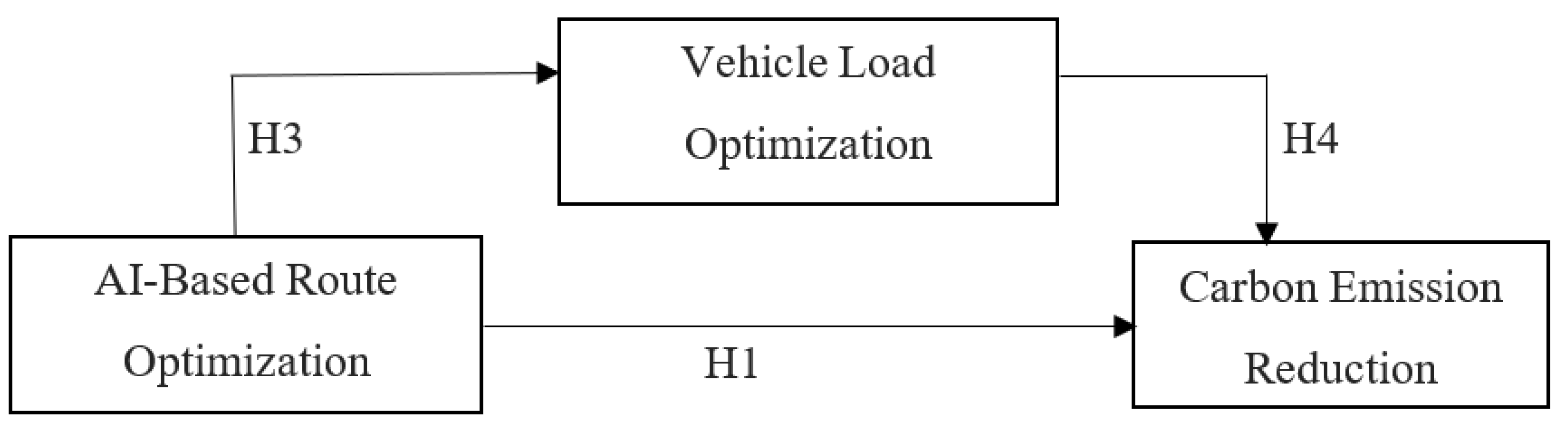
However, while AI-based route optimization presents significant opportunities for reducing carbon footprints, these are heightened through vehicle load optimization. This collaboration reduced operational inefficiencies and maximized the potential of AI-based routing to decrease emissions. Empirical studies substantiate this mediating impact, indicating that the integration of load and route optimization can diminish carbon emissions in urban areas (H. Wang et al., 2024) and in construction supply chains (Ogundipe et al., 2024). Additionally, construction logistics utilizing this integrated solution claim major advantages in sustainability and cost-effectiveness (Abbasnejad et al., 2024; Hussein et al., 2021). These findings highlight the revolutionary potential of integrating AI-based route optimization with vehicle load optimization to reduce carbon emissions. Based on this evidence, the following hypothesis is proposed
H1
There is a significant positive impact of AI-based route optimization on carbon emission reduction in urban construction logistics.
H2:
Vehicle load optimization positively mediates the relationship between AI-based route optimization and carbon emission reduction.
AI-Based Route Optimization and Vehicle Load Optimization
AI-based route optimization and vehicle load optimization are increasingly integrated to enhance transportation efficiency and reduce carbon emissions, particularly in urban logistics (W. Chen et al., 2024). AI-based route optimization utilizes advanced algorithms that analyze real-time data such as traffic patterns, weather, and road conditions to determine the most efficient routes for vehicles (Dikshit et al., 2023). This optimization reduces travel time, fuel consumption, and CO₂ emissions. However, the full potential of AI-based route optimization is realized when paired with vehicle load optimization, which focuses on maximizing the vehicle's carrying capacity, reducing the number of trips, and minimizing fuel use. Vehicle load optimization ensures that vehicles are loaded to their optimal capacity, avoiding underloading or overloading that would lead to inefficiencies and excessive emissions.
The integration of AI-based route optimization and vehicle load optimization creates a synergistic effect. AI-based route optimization optimizes the route by considering fuel consumption, while vehicle load optimization ensures that each vehicle is fully utilized, further minimizing the need for additional trips. Studies have shown that when vehicle load optimization is applied alongside AI-based route optimization, the combined strategies lead to a substantial reduction in emissions and overall operational costs. For example, research by Rinchi et al. (2024) demonstrates how AI-driven algorithms, coupled with load optimization techniques, significantly decrease carbon footprints in logistics, especially in urban environments with high congestion. Together, AI-based route optimization and vehicle load optimization provide a holistic approach to sustainable urban logistics. This study therefore hypothesizes that:
H3:
AI-Based Route Optimization has a positive effect on Vehicle Load Optimization.
Vehicle Load Optimization and Carbon Emission Reduction
Vehicle load optimization plays a pivotal role in reducing carbon emissions in urban construction logistics by enhancing operational efficiency and minimizing fuel consumption (El Moussaoui, 2024). Inefficient vehicle loading—characterized by underutilized or unevenly distributed loads—results in unnecessary trips and increased energy expenditure per unit of transported material (McKinnon, 2021; Milewski & Milewska, 2023). Load optimization maximizes vehicle capacity utilization, enabling fewer trips to achieve the same transportation objectives, thereby significantly reducing emissions (C.-N. Wang et al., 2020). Urban logistics, especially in construction, involves complex material flows requiring precise scheduling and volume forecasting. Recent advancements in AI and Internet of Things (IoT) technologies have made dynamic load balancing and real-time adjustments feasible, enabling optimized vehicle operations even in high-demand settings (Abbasnejad et al., 2024). For example, AI-driven solutions can analyze delivery schedules, load types, and urban traffic patterns to ensure optimal load distribution across fleets, further cutting energy consumption and associated carbon footprints. Research underscores the synergy between vehicle load optimization and other sustainable logistics practices, such as route optimization, as a key driver of reduced emissions, highlighting the systemic nature of these interventions (W. Chen et al., 2024; Muchenje, 2024)
Moreover, vehicle load optimization directly addresses one of the critical inefficiencies in urban logistics: idling and partial loading caused by congestion and limited loading/unloading spaces. Urban construction sites, constrained by tight schedules and restrictive delivery windows, often struggle with ad hoc transportation, exacerbating emissions (González-Feliu et al., 2018). By implementing integrated logistics systems, firms can optimize their loading strategies, effectively reducing fuel consumption by up to 20% (Moriarty & Honnery, 2019). Load optimization also promotes the use of eco-friendly freight consolidation, wherein smaller loads are aggregated into a single delivery trip, thereby mitigating the environmental impact of fragmented transport. Additionally, regulatory frameworks in cities—such as low-emission zones and payload restrictions—have heightened the importance of optimizing vehicle loads to remain compliant while minimizing operational costs. Scholarly evidence suggests that load optimization not only reduces carbon emissions but also enhances profitability and supply chain resilience (Piecyk & Björklund, 2015). Thus, optimizing vehicle loads emerges as an essential strategy within urban construction logistics, offering significant environmental and economic benefits that align with sustainable urban development objectives. Based on this, the study hypothesizes the following:
H4: Vehicle load optimization has a positive effect on carbon emission reduction.
Conceptual Model
Figure 1.
Conceptual framework. Source: Author’s construct, 2024.
3. Method
Research Design
This study adopts a quantitative approach, employing a cross-sectional research design to examine the impact of AI-based route optimization on carbon emission reduction in urban construction logistics and the mediating role of vehicle load optimization in this relationship. A cross-sectional research design identifies and measures the current state study variables without manipulating them, making it suitable for setting the stage for deep exploration into the matter.
Study Population and Sample Size
The study population comprised logistics and transportation firms operating in urban construction sites across three major urban cities in Ghana – Accra, Kumasi, and Sekondi-Takoradi. These urban cities were chosen because they are the fastest growing urbanized citied in the country (Songsore, 2020). These firms were actively engaged in fleet operations, material supply, and waste removal within urban construction projects. The individuals who participated in the study were professionals directly involved in logistics and transportation management, such as Fleet Managers, Logistics Coordinators, Operations Managers and Drivers or Vehicle Operators. These respondents were selected based on their roles and expertise to ensure the collected data accurately reflected operational realities and strategic decisions in urban construction logistics. The sample size was calculated using the Cochran (1977) formula:
A calculated sample size was 385 respondents, assuming a confidence level of 95% and a 5% margin of error. The sample size was later increased by 5% to account for invalid questionnaire responses and other issues often encountered in the field. Hence the final sample size was 405. This sample size was deemed sufficient to evaluate the relationships among AI-based route optimization, vehicle load optimization, and carbon emission reduction within urban construction logistics.
Sampling Technique
A stratified random sampling method was employed to ensure proportional representation across different roles in logistics and transportation management. Stratification ensured that insights were captured from diverse perspectives within firms, from strategic managers to operational staff. Table 1 below indicate how the sample size were distributed.
Data Collection Methods
Data for this study were collected using a self-administered structured questionnaires distributed through emails and in-person. The structured questionnaire was in two sections. The first section required participants’ demographics. The second section included a 5-point likert scale questionnaire with 15 items each measuring AI-based route optimization, vehicle load optimization, and carbon emissions variables.
Data Analysis Techniques
The collected data was entered, coded and cleaned using Statistical Product and Service Solutions (SPSS) version 29. The study employed SPSS for descriptive analysis of the questionnaires, providing means, standard deviation and normality tests. Furthermore, the Cronbach’s alpha was used to test the reliability of the study constructs, setting a minimum threshold of 0.70 (Shrestha, 2021). Bivariate correlations were used to investigate the relationship among the main study constructs. The linear regression analysis was used to test the effect of vehicle load optimization and AI-based route optimization on carbon emissions. Furthermore, the Process Macro Model following the Hayes (2013) procedure estimated the mediating effect of vehicle load optimization in the relationship between AI-based route optimization and carbon emissions.
Validity and Reliability
The validity and reliability of the research instruments were rigorously ensured to enhance the credibility of the findings. Content validity was established through expert reviews by professionals in logistics and environmental studies, who evaluated the survey items to confirm their alignment with the study objectives and their relevance to the constructs being measured. To ensure reliability, Cronbach’s alpha was calculated for the survey items to assess internal consistency, with acceptable thresholds indicating that the items reliably measured the intended variables. This comprehensive approach to validity and reliability guaranteed the robustness and trustworthiness of the data used in the analysis.
Ethical Considerations
Before data collecting, informed permission was sought from every participant guaranteeing that they are completely aware of the goal, methods, and rights of the study including their voluntary nature of participation and their capacity to withdraw at any moment without consequences. To uphold anonymity and stop the identification of firms, all firm-specific data were anonymized. Following ethical standards for privacy and data security, the study guaranteed safe preservation of all gathered data.
4. Results
Demographics
The results reveal that drivers or vehicle operators constitute the largest group (39.5%), followed by operations managers (25.9%), logistics coordinators (17.3%) and fleet managers (17.3%). Most of the participants have between 5-15 years of experience, with 27.2% holding 10-15 years while respondents with 5-10 years of experience represent 25.9%. The details of the study demographics are displayed on Table 2 below.
Descriptives, normality and reliability
The descriptive results show that AI-driven route optimization, Carbon emission reduction and vehicle load optimization had mean scores of 3.11, 3.03 and 3.23 respectively, indicating moderate agreement with the constructs. The skewness (0.111-0.271) and kurtosis (0.439-1.083) were within acceptable limits suggesting the data’s eligibility for parametric analysis (Matore & Khairani, 2020).
The reliability analysis indicates strong internal consistency for all constructs with Cronbach’s alpha values of 0.821 (AI-based route optimization), 0.832 (carbon emission reduction), and 0.851 (vehicle load optimization), beyond the 0.70 threshold. These findings validate that the scales are dependable and suitable for further analysis of the relationships between the variables.

Table 3.
Results of descriptives, normality and reliability.
| N | Number of items | Mean | SD | Skewness | Kurtosis | Cronbach’s α | |
|---|---|---|---|---|---|---|---|
| AI-based Route Optimization | 405 | 15 | 3.11 | 0.80 | 0.271 | 1.083 | 0.821 |
| Carbon Emission Reduction | 405 | 15 | 3.03 | 0.82 | 0.111 | 0.967 | 0.832 |
| Vehicle Load Optimization | 405 | 15 | 3.23 | 0.85 | 0.131 | 0.439 | 0.851 |
Correlation
The correlation results demonstrate significant relationships among the three constructs. AI-based route optimization exhibits a moderate positive association with carbon emission reduction (r = 0.260, p < 0.001) and a weaker but significant association with vehicle load optimization (r = 0.121, p < 0.05). this indicates that improvements in AI-based route optimization leads to improved carbon emissions reduction and associated with slight increase in vehicle load optimization. Additionally, carbon emission reduction is positively correlated with vehicle load optimization (r = 0.167, p < 0.001) indicating that greater vehicle load optimization contributes to emission reduction efforts.
Table 4.
Correlation results.
| 1 | 2 | 3 | |
|---|---|---|---|
| 1. AI-based Route Optimization | 1 | ||
| 2. Carbon Emission Reduction | .260*** | 1 | |
| 3. Vehicle Load Optimization | .121* | .167*** | 1 |
*p<0.05, **p<0.01, ***p<0.001.
Linear Regression
The linear regression results from Models 1 and 2 indicate the effect of AI-based route optimization and vehicle load optimization, respectively on carbon emission reduction. In Model 1, AI-based route optimization had a positive significant effect on carbon emission reduction (β = 0.260, t = 5.411, p < 0.001). This supports the study hypothesis 1, indicating that AI-based route optimization effectively contributes to reducing carbon emissions in urban construction logistics. The R2 value of 0.068 indicates that AI-based route optimization accounts for 6.8% of the variance in carbon emissions reduction. The F-value (F = 29.284, p < 0.001) further supports the overall importance of the model.
The Model 2 indicates that vehicle load optimization had a positive significant effect on carbon emissions reduction (β = 0.167, t = 3.392, p < 0.001), supporting Hypothesis 4. This signals that optimizing vehicle loads contributes positively to lowering carbon emissions. The R2 value of 0.028 signifies that vehicle load optimization accounts for 2.8% of the variance in carbon emissions, accompanied by an F-value of 11.506 (p < 0.001), corroborating the model’s significance.
Table 5.
Results of linear regression.
| Model 1 | Model 2 | ||||||
|---|---|---|---|---|---|---|---|
| Predictors | Β (t) | p | Predictors | Β (t) | p | ||
| Constant | (13.974) | 0.000 | Constant | (15.838) | 0.000 | ||
| AI-based route optimization | .260(5.411) | 0.000 | Vehicle load optimization | 0.167(3.392) | 0.000 | ||
| R2 | .068 | 0.000 | R2 | .028 | 0.000 | ||
| F value | 29.284 | 0.000 | F-value | 11.506 | 0.000 | ||
| Decision | H1: Accepted | Decision | H4: Accepted | ||||
Dependent variable: Carbon Emission Reduction.
Mediation analysis
The mediation results indicate the AI-based route optimization exerts a direct positive effect on the decrease of carbon emissions reduction (β = 0.244, t = 5.074, p < 0.001) and an increased total effect (β = 0.260, t = 5.411, p < 0.001). This indicates that AI directly aids in the reduction of carbon emissions, with the overall result demonstrating a significant relationship between AI-based route optimization and carbon emissions reduction.
The indirect effect of AI-based route optimization on vehicle load optimization is positive and significant (β = 0.121, t = 2.442, p < 0.05), supporting Hypothesis 3. This indicates that AI contributes to enhancing vehicle load management, by optimizing route planning to improve vehicle capacity use. Moreover, the indirect effect of vehicle load optimization on carbon emission reduction is also significant (β = 0.137, t = 2.956, p < 0.01), indicating that better vehicle load management favourably effects emission reduction.
Moreover, the indirect impact of AI-based route optimization on carbon emissions reduction via vehicle load optimization is statistically significant (β = 0.017, 95%CI [0.000, 0.044]), indicating that the association between AI-based route optimization and carbon emission reduction is partially mediated by vehicle load optimization. This supports hypothesis 2 supporting the notion that AI’s beneficial influence on carbon emissions reduction is partially driven to its capacity through vehicle load optimization. This mediation effect highlights the necessity of optimizing vehicle loads as a mechanism for maximizing the environmental benefits of AI-based route optimization.
Table 6.
Results of mediating effects.
| Model | Path | R2 | β | t | p | Effect [LLCI, ULCI] |
|---|---|---|---|---|---|---|
| AI→CE | Direct | 0.244 | 5.074 | 0.000 | 0.249***[0.153,0.346] | |
| AI→VL | Indirect | 0.015* | 0.121 | 2.442 | 0.015 | 0.017***[0.000,0.044] |
| VL→CE | Indirect | 0.086*** | 0.137 | 2.856 | 0.005 | |
| AI→CE | Total | 0.068*** | 0.260 | 5.411 | 0.000 | 0.266***[0.169,0.363] |
| Decision | H2: Accepted | |||||
| H3: Accepted | ||||||
*p<0.05, **p<0.01, ***p<0.001. Note: AI – AI-based Route Optimization, CE – Carbon Emission Reduction, VL – Vehicle Load Optimization.
5. Discussion
The study findings highlight the significant effect of AI-based route optimization on carbon emission reduction, aligning closely with the Theory of Planned Behaviour (TPB). TPB highlights the impact of perceived behavioural control on decision making as demonstrated by AI’s ability to optimize routes. This enables logistics planners to effectively tackle urban traffic challenges, thereby minimize carbon emissions. This corresponds with empirical studies from Chen et al. (2021), who emphasized AI’s capacity t reduce fuel usage and emissions by as much as 25%. While the TPB highlights human intention and perceived control, the integration of AI indicates a more automated and data-driven approach for decision-making, potentially diminishing dependence on human involvement.
Empirical research corroborates these findings. Research conducted by Dikshit et al. (2023) highlights AI’s ability to integrate real-time environmental restrictions, hence sustaining the assertion that AI route optimization significantly decreases emissions. However, obstacles such as high implementation costs, noted by Maqsoom et al. (2023) were not explicitly considered in this study. However, this is essential for contextualizing these results in emerging countries like Ghana.
Furthermore, the positive impact of vehicle load optimization on carbon emission reduction highlights the importance of enhancing operational efficiency, as anticipated by the TPB on perceived control. TPB posits that the perceived simplicity of attaining environmentally sustainable logistics positively affects behaviour. This study similarly illustrates that optimizing vehicle loads decreases emissions, corroborating the empirical findings of Wang et al. (2020). Their study emphasized the significance of load optimization in reducing unnecessary trips and fuel usage.
Empirical research like McKinnon (2021) and Milewski and Milewska (2023) corroborate these findings by demonstrating the environmental and operationsla advantages of combining smaller loads into fewer trips. These studies also indicate technological and infrastructural barriers that may restrict the execution of such tools in Ghanaian urban areas.
The mediation analysis verified the synergistic relationship between AI-based route optimization and vehicle load optimization in reducing carbon emissions. This finding aligns with empirical studies by Ogundipe et al. (2024), demonstrating that the incorporation of these strategies of these interventions, where vehicle load optimization serves as a mechanism for enhancing the environmental advantages of AI.
Theoretically, the TPB’s focus on intention and perceived behavioural control corresponds with the identified mediation effect. AI enhances route optimization, shaping views on logistical feasibility and encouraging load optimization strategies. This link corroborates empirical research by Rinchi et al. (2024), which documented the synergistic effects of AI and load optimization on urban logistics.
6. Conclusion
This study highlights that AI-based route and vehicle load optimization significantly decreases carbon emissions in urban construction logistics. The interplay of these strategies, validated by the mediation analysis highlight their collective potential to improve logistical efficiency and environmental sustainability. The findings further correspond with the TPB highlight the significance of perceived control and systemic approaches in decision-making. This study emphasizes the need to overcome infrastructure and technological barriers to fully harness the advantages of these initiatives, especially in emerging economies like Ghana.
The study findings provide critical implications for several stakeholders. Ghanaian policymakers should invest in AI technologies and endorse vehicle load optimization solutions to meet carbon reduction targets, enhancing urban logistical efficiency. The use of these solutions provides construction logistics firms with a cost-efficient and environmentally sustainable operations. Furthermore, the study highlights that stakeholders should emphasise the enhancement of digital infrastructure and capacity-building measures to address adoption obstacles.
7. Limitations and future research
This study possesses several limitations. The study’s cross-sectional research design offers a snapshot of the variables, restricting the ability to determine causality between AI-based route optimization, vehicle load optimization and carbon emission reduction. The study’s dependence on self-reported data creates the potential for response bias, as participants may overstate or undertake their practices and outcomes. The study’s concentration on urban construction logistics firms in Ghana’s three principal urban cities may limit the applicability of its findings to rural regions of the country.
Future studies should employ a longitudinal design to investigate the enduring the long-term impacts of AI-based and vehicle load optimization strategies on carbon emissions. Broadening the focus to encompass rural construction logistics or comparative studies across countries with varying levels of urbanization and technological adoption could yield more thorough insights. Utilizing mixed methods approaches that integrate qualitative interviews and quantitative surveys would effectively highlight the impact of AI-based route optimization on carbon emissions reduction in urban construction logistics.
Question
Section A: Demographics
- Role: a. Driver/ Vehicle Operators [ ] b. Logistics coordinators [ ] c. Operations Manager [ ] d. Fleet Managers [ ]
- Years of experience: a. 3-5 years [ ] b. 5-10 years [ ] c. 10-15 years [ ] d. 15+ years [ ]
- Size of firm: a. 1-50 employees [ ] b. 51-100 employees [ ] c. 101-200 employees [ ] d. 201+ employees [ ]
Section B
AI-based route optimization
| Items | Strongly Disagree | Strongly Agree | ||||
| AI1 | AI-based route optimization reduces the time required for logistics in urban construction projects. | 1 ☐ | 2 ☐ | 3 ☐ | 4 ☐ | 5 ☐ |
| AI2 | AI systems effectively identify the shortest possible routes for construction material delivery. | 1 ☐ | 2 ☐ | 3 ☐ | 4 ☐ | 5 ☐ |
| AI3 | I feel AI application in route optimisation help in avoiding traffic congestion. | 1 ☐ | 2 ☐ | 3 ☐ | 4 ☐ | 5 ☐ |
| AI4 | I feel AI systems have improved the consistency of meeting delivery deadlines | 1 ☐ | 2 ☐ | 3 ☐ | 4 ☐ | 5 ☐ |
| AI5 | I feel AI-based systems facilitate better coordination of multi-vehicle logistics | 1 ☐ | 2 ☐ | 3 ☐ | 4 ☐ | 5 ☐ |
| AI6 | I feel AI technology has improved route planning for high-density urban areas | 1 ☐ | 2 ☐ | 3 ☐ | 4 ☐ | 5 ☐ |
| AI7 | I feel AI-based systems are effective in identifying the most cost-efficient delivery routes | 1 ☐ | 2 ☐ | 3 ☐ | 4 ☐ | 5 ☐ |
| AI8 | I feel the adoption of AI for route optimisation has increased overall customer satisfaction | 1 ☐ | 2 ☐ | 3 ☐ | 4 ☐ | 5 ☐ |
| AI9 | I feel route optimisation through AI has reduced overall fuel consumption | 1 ☐ | 2 ☐ | 3 ☐ | 4 ☐ | 5 ☐ |
| AI10 | I feel AI tools enhance the ability to adapt to unexpected route changes | 1 ☐ | 2 ☐ | 3 ☐ | 4 ☐ | 5 ☐ |
| AI11 | I feel the integration of AI tools into logistics has reduced travel distances for vehicles. | 1 ☐ | 2 ☐ | 3 ☐ | 4 ☐ | 5 ☐ |
| AI12 | I feel the implementation of AI tools has minimized the number of empty vehicle trips | 1 ☐ | 2 ☐ | 3 ☐ | 4 ☐ | 5 ☐ |
| AI13 | I feel AI-based systems are user-friendly and easy to integrate into logistics operations | 1 ☐ | 2 ☐ | 3 ☐ | 4 ☐ | 5 ☐ |
| AI14 | I feel the use of AI for route optimisation has enhanced driver productivity | 1 ☐ | 2 ☐ | 3 ☐ | 4 ☐ | 5 ☐ |
| AI15 | I feel improve the accuracy of estimated time of time of arrival (ETA) predictions | 1 ☐ | 2 ☐ | 3 ☐ | 4 ☐ | 5 ☐ |
CARBON Emission reduction
| Items | Strongly Disagree | Strongly Agree | ||||
| CE1 | I feel my firm actively tracks carbon emissions from logistics operations | 1 ☐ | 2 ☐ | 3 ☐ | 4 ☐ | 5 ☐ |
| CE2 | I feel the implementation of AI route optimisation directly supports our carbon reduction goals | 1 ☐ | 2 ☐ | 3 ☐ | 4 ☐ | 5 ☐ |
| CE3 | I feel AI-based systems help lower carbon emissions from our vehicles by minimizing idle times | 1 ☐ | 2 ☐ | 3 ☐ | 4 ☐ | 5 ☐ |
| CE4 | I feel AI powered route planning has reduced the need for multiple delivery trips, decreasing emissions | 1 ☐ | 2 ☐ | 3 ☐ | 4 ☐ | 5 ☐ |
| CE5 | I feel the use of AI systems in route optimisation supports our sustainability and environment goals | 1 ☐ | 2 ☐ | 3 ☐ | 4 ☐ | 5 ☐ |
| CE6 | I feel our firm has seen a noticeable decrease in emissions since adopting AI for route optimization | 1 ☐ | 2 ☐ | 3 ☐ | 4 ☐ | 5 ☐ |
| CE7 | I feel AI-based route optimisation reduces the overall number of vehicles needed for logistics, lowering emissions | 1 ☐ | 2 ☐ | 3 ☐ | 4 ☐ | 5 ☐ |
| CE8 | I feel AI-powered route adjustment help avoid congested areas, therefore reducing fuel consumption and emissions | 1 ☐ | 2 ☐ | 3 ☐ | 4 ☐ | 5 ☐ |
| CE9 | I feel AI-based route optimization enables my firm to operate more eco-friendly vehicles, reducing our carbon footprint | 1 ☐ | 2 ☐ | 3 ☐ | 4 ☐ | 5 ☐ |
| CE10 | I feel by optimizing logistics planning, AI helps to reduce the overall fuel demand in our construction operations | 1 ☐ | 2 ☐ | 3 ☐ | 4 ☐ | 5 ☐ |
| CE11 | I feel AI-based route optimization helps our company reduce the environmental impact of urban logistics | 1 ☐ | 2 ☐ | 3 ☐ | 4 ☐ | 5 ☐ |
| CE12 | I feel the use of AI in route planning has significantly improved our energy efficiency, leading to lower emissions | 1 ☐ | 2 ☐ | 3 ☐ | 4 ☐ | 5 ☐ |
| CE13 | I feel AI technology has contributed to the reduction of carbon emissions in our fleet | 1 ☐ | 2 ☐ | 3 ☐ | 4 ☐ | 5 ☐ |
| CE14 | I feel AI-driven logistics have decreased our overall carbon emissions from construction logistics | 1 ☐ | 2 ☐ | 3 ☐ | 4 ☐ | 5 ☐ |
| CE15 | I feel AI route optimization results in fewer vehicles being used, reducing overall emissions | 1 ☐ | 2 ☐ | 3 ☐ | 4 ☐ | 5 ☐ |
Vehicle load optimization
| Items | Strongly Disagree | Strongly Agree | ||||
| VL1 | I believe my firm ensures that our vehicles are loaded to their optimal capacity for every trip | 1 ☐ | 2 ☐ | 3 ☐ | 4 ☐ | 5 ☐ |
| VL2 | I believe my firm uses vehicle load optimization leading to fewer delays in the delivery process | 1 ☐ | 2 ☐ | 3 ☐ | 4 ☐ | 5 ☐ |
| VL3 | I believe our vehicles are rarely under-loaded thanks to optimized load planning | 1 ☐ | 2 ☐ | 3 ☐ | 4 ☐ | 5 ☐ |
| VL4 | I believe my firm optimizes vehicle loads in reducing operational costs for our logistics | 1 ☐ | 2 ☐ | 3 ☐ | 4 ☐ | 5 ☐ |
| VL5 | I believe my firm uses vehicle load optimization to avoid unnecessary trips and reduces traffic congestion | 1 ☐ | 2 ☐ | 3 ☐ | 4 ☐ | 5 ☐ |
| VL6 | I believe my firm adjusts the load distribution to ensure that no vehicle exceeds its capacity | 1 ☐ | 2 ☐ | 3 ☐ | 4 ☐ | 5 ☐ |
| VL7 | I believe my firm optimizes vehicle load planning to help our logistics teams meet delivery deadlines more efficiently | 1 ☐ | 2 ☐ | 3 ☐ | 4 ☐ | 5 ☐ |
| VL8 | I believe my firm uses AI-based systems help us plan the optimal load for each vehicle based on the delivery requirements. | 1 ☐ | 2 ☐ | 3 ☐ | 4 ☐ | 5 ☐ |
| VL9 | I believe my firm follows best practices for vehicle load optimization to increase operational efficiency. | 1 ☐ | 2 ☐ | 3 ☐ | 4 ☐ | 5 ☐ |
| VL10 | I believe my firm uses vehicle load optimization to play a significant role in improving the sustainability of our logistics operations. | 1 ☐ | 2 ☐ | 3 ☐ | 4 ☐ | 5 ☐ |
| VL11 | I believe my firm have noticed a decrease in transportation costs due to improved vehicle load optimization | 1 ☐ | 2 ☐ | 3 ☐ | 4 ☐ | 5 ☐ |
| VL12 | I believe my logistics team uses data driven insights to make load optimization decisions | 1 ☐ | 2 ☐ | 3 ☐ | 4 ☐ | 5 ☐ |
| VL13 | I believe my logistics team uses vehicle load optimization to streamline our delivery process, increasing efficiency | 1 ☐ | 2 ☐ | 3 ☐ | 4 ☐ | 5 ☐ |
| VL14 | I believe my logistics team optimizes vehicle loads to lead to better overall performance and reliability of our logistics operations | 1 ☐ | 2 ☐ | 3 ☐ | 4 ☐ | 5 ☐ |
| VL15 | I believe my logistics team uses load optimization process to reduce the number of vehicles required for transportation | 1 ☐ | 2 ☐ | 3 ☐ | 4 ☐ | 5 ☐ |
References
- Abbasnejad, B.; Soltani, S.; Karamoozian, A.; Gu, N. A systematic literature review on the integration of Industry 4.0 technologies in sustainability improvement of transportation construction projects: State-of-the-art and future directions. In Smart and Sustainable Built Environment; 2024; Available online: https://www.emerald.com/insight/content/doi/10.1108/sasbe-11-2023-0335/full/html.
- Ahani, P.; Arantes, A.; Garmanjani, R.; Melo, S. Optimizing Vehicle Replacement in Sustainable Urban Freight Transportation Subject to Presence of Regulatory Measures. Sustainability 2023, 15(16), 12266. [Google Scholar] [CrossRef]
- Ajzen, I. The Theory of planned behavior. Organizational Behavior and Human Decision Processes 1991, 50(2), 179–211. [Google Scholar] [CrossRef]
- Bibri, S. E.; Krogstie, J.; Kaboli, A.; Alahi, A. Smarter eco-cities and their leading-edge artificial intelligence of things solutions for environmental sustainability: A comprehensive systematic review. Environmental Science and Ecotechnology 2024, 19, 100330. [Google Scholar] [CrossRef]
- Bosona, T. Urban freight last mile logistics—Challenges and opportunities to improve sustainability: A literature review. Sustainability 2020, 12(21), 8769. [Google Scholar] [CrossRef]
- BUILD UP Team. Circular construction and materials for a sustainable building sector | BUILD UP. EU BUILD UP. 2024. Available online: https://build-up.ec.europa.eu/en/resources-and-tools/articles/circular-construction-and-materials-sustainable-building-sector.
- Chen, L.; Huang, L.; Hua, J.; Chen, Z.; Wei, L.; Osman, A. I.; Fawzy, S.; Rooney, D. W.; Dong, L.; Yap, P.-S. Green construction for low-carbon cities: A review. Environmental Chemistry Letters 2023, 21(3), 1627–1657. [Google Scholar] [CrossRef]
- Chen, W.; Men, Y.; Fuster, N.; Osorio, C.; Juan, A. A. Artificial intelligence in logistics optimization with sustainable criteria: A review. Sustainability 2024, 16(21), 9145. [Google Scholar] [CrossRef]
- Cochran, W. G. Sampling techniques. In Johan Wiley & Sons Inc; 1977. [Google Scholar]
- Cooper, D. ENERGY EFFICIENCY FOR BUILDINGS; UNEP, 2023; Available online: https://renewableinstitute.org/images/unep%20info%20sheet%20-%20ee%20buildings.pdf.
- Dikshit, S.; Atiq, A.; Shahid, M.; Dwivedi, V.; Thusu, A. The use of artificial intelligence to optimize the routing of vehicles and reduce traffic congestion in urban areas. EAI Endorsed Transactions on Energy Web 2023, 10. Available online: https://publications.eai.eu/index.php/ew/article/view/4613. [CrossRef]
- El Moussaoui, A. E. Impact of logistics pooling on reduction of CO2 emissions in last-mile logistics. In Management & Sustainability: An Arab Review; 2024; Available online: https://www.emerald.com/insight/content/doi/10.1108/MSAR-04-2024-0023/full/html.
- European Commission. Buildings and construction—European Commission. 2023. Available online: https://single-market-economy.ec.europa.eu/industry/sustainability/buildings-and-construction_en.
- European Environment Agency. Buildings and construction. 21 October 2024. Available online: https://www.eea.europa.eu/en/topics/in-depth/buildings-and-construction.
- Goswami, P.; Mukherjee, A.; Hazra, R.; Yang, L.; Ghosh, U.; Qi, Y.; Wang, H. AI based energy efficient routing protocol for intelligent transportation system. IEEE Transactions on Intelligent Transportation Systems 2021, 23(2), 1670–1679. [Google Scholar] [CrossRef]
- Hagger, M. S.; Cheung, M. W.-L.; Ajzen, I.; Hamilton, K. Perceived behavioral control moderating effects in the theory of planned behavior: A meta-analysis. Health Psychology 2022, 41(2), 155. [Google Scholar] [CrossRef]
- Hao, J. L.; Cheng, B.; Lu, W.; Xu, J.; Wang, J.; Bu, W.; Guo, Z. Carbon emission reduction in prefabrication construction during materialization stage: A BIM-based life-cycle assessment approach. Science of the Total Environment 2020, 723, 137870. [Google Scholar] [CrossRef]
- Hasan, H. N.; Suciarto, S. The influence of attitude, subjective norm and perceived behavioral control towards organic food purchase intention. Journal of Management and Business Environment (JMBE) 2020, 1(2), 132. [Google Scholar] [CrossRef]
- Hayes, A. F. Introduction to mediation, moderation, and conditional process analysis. Journal of Educational Measurement 2013, 51(3), 335–337. [Google Scholar]
- Hu, W.-C.; Wu, H.-T.; Cho, H.-H.; Tseng, F.-H. Optimal route planning system for logistics vehicles based on artificial intelligence. Journal of Internet Technology 2020, 21(3), 757–764. [Google Scholar]
- Hussein, M.; Eltoukhy, A. E.; Karam, A.; Shaban, I. A.; Zayed, T. Modelling in off-site construction supply chain management: A review and future directions for sustainable modular integrated construction. Journal of Cleaner Production 2021, 310, 127503. [Google Scholar] [CrossRef]
- Inkinen, T.; Hämäläinen, E. Reviewing truck logistics: Solutions for achieving low emission road freight transport. Sustainability 2020, 12(17), 6714. [Google Scholar] [CrossRef]
- Iyer, L. S. AI enabled applications towards intelligent transportation. Transportation Engineering 2021, 5, 100083. [Google Scholar] [CrossRef]
- Johnsson, F.; Karlsson, I.; Rootzén, J.; Ahlbäck, A.; Gustavsson, M. The framing of a sustainable development goals assessment in decarbonizing the construction industry–Avoiding “Greenwashing”. Renewable and Sustainable Energy Reviews 2020, 131, 110029. [Google Scholar] [CrossRef]
- Kamarulzaman, A. M. M.; Jaafar, W. S. W. M.; Said, M. N. M.; Saad, S. N. M.; Mohan, M. UAV Implementations in Urban Planning and Related Sectors of Rapidly Developing Nations: A Review and Future Perspectives for Malaysia. Remote Sensing 2023, 15(11), 2845. [Google Scholar] [CrossRef]
- Karlsson, I.; Rootzén, J.; Toktarova, A.; Odenberger, M.; Johnsson, F.; Göransson, L. Roadmap for decarbonization of the building and construction industry—A supply chain analysis including primary production of steel and cement. Energies 2020, 13(16), 4136. [Google Scholar] [CrossRef]
- Korra, C.; Valaboju, A. S. Green warehouses: The benefits, challenges, and strategies of industrial building decarbonization. Journal of Sustainable Industrial Practices 2024, 1(1), 1–12. [Google Scholar] [CrossRef]
- Li, M.; Wang, Y.; Peng, P.; Chen, Z. Toward Efficient Smart Management: A Review of Modeling and Optimization Approaches in Electric Vehicle-Transportation Network-Grid Integration. Green Energy and Intelligent Transportation 2024, 100181. [Google Scholar] [CrossRef]
- Liu, J.; Cao, S.; Chen, X.; Yang, H.; Peng, J. Energy planning of renewable applications in high-rise residential buildings integrating battery and hydrogen vehicle storage. Applied Energy 2021, 281, 116038. [Google Scholar] [CrossRef]
- Luo, L.; Chen, Y. Carbon emission energy management analysis of LCA-Based fabricated building construction. Sustainable Computing: Informatics and Systems 2020, 27, 100405. [Google Scholar] [CrossRef]
- Mandal, J.; Mohammed, I. A. Implementation of AI Transportation Routing in Reverse Logistics to Reduce CO2 Footprint. International Journal of Supply Chain Management 2024, 9(5), 1–12. [Google Scholar] [CrossRef]
- Maqsoom, A.; Zulqarnain, M.; Irfan, M.; Ullah, F.; Alqahtani, F. K.; Khan, K. I. A. Drivers of, and barriers to, the adoption of mixed reality in the construction industry of developing countries. Buildings 2023, 13(4), 872. [Google Scholar] [CrossRef]
- Matore, E. M.; Khairani, A. Z. The pattern of skewness and kurtosis using mean score and logit in measuring adversity quotient (AQ) for normality testing. International Journal of Future Generation Communication and Networking 2020, 13(1), 688–702. [Google Scholar]
- McKinnon, A. Maximizing capacity utilization in freight transport. PRAISE FOR GLOBAL LOGISTICS 2021, 119. [Google Scholar]
- Milewski, D.; Milewska, B. Efficiency of the Consumption of Energy in the Road Transport of Goods in the Context of the Energy Crisis. Energies 2023, 16(3), 1257. [Google Scholar] [CrossRef]
- Mostafavi, F.; Tahsildoost, M.; Zomorodian, Z. Energy efficiency and carbon emission in high-rise buildings: A review (2005-2020). Building and Environment 2021, 206, 108329. [Google Scholar] [CrossRef]
- Muchenje, K. C. Green Logistics and Supply Chain Management. In Contemporary Solutions for Sustainable Transportation Practices; IGI Global, 2024; pp. 33–61. Available online: https://www.igi-global.com/chapter/green-logistics-and-supply-chain-management/352769.
- Ng, C.-L.; Wu, H.; Li, M.; Zhong, R. Y.; Qu, X.; Huang, G. Q. A carbon-aware routing protocol for optimizing carbon emissions in modular construction logistics. 2024 IEEE 20th International Conference on Automation Science and Engineering (CASE), 2024; pp. 2852–2856. Available online: https://ieeexplore.ieee.org/abstract/document/10711520/.
- Nolz, P. C. Optimizing construction schedules and material deliveries in city logistics: A case study from the building industry. Flexible Services and Manufacturing Journal 2021, 33(3), 846–878. [Google Scholar] [CrossRef]
- Ogundipe, O. B.; Okwandu, A. C.; Abdulwaheed, S. A. Optimizing construction supply chains through AI: Streamlining material procurement and logistics for project success. GSC Advanced Research and Reviews 2024, 20(1), 147–158. [Google Scholar] [CrossRef]
- Pylsy, P.; Lylykangas, K.; Kurnitski, J. Buildings’ energy efficiency measures effect on CO2 emissions in combined heating, cooling and electricity production. Renewable and Sustainable Energy Reviews 2020, 134, 110299. [Google Scholar] [CrossRef]
- Rai, H. B.; Kang, S.; Sakai, T.; Tejada, C.; Yuan, Q. J.; Conway, A.; Dablanc, L. ‘Proximity logistics’: Characterizing the development of logistics facilities in dense, mixed-use urban areas around the world. Transportation Research Part A: Policy and Practice 2022, 166, 41–61. [Google Scholar] [CrossRef]
- Rinchi, O.; Alsharoa, A.; Shatnawi, I.; Arora, A. The Role of Intelligent Transportation Systems and Artificial Intelligence in Energy Efficiency and Emission Reduction. arXiv 2024, arXiv:2401.14560. [Google Scholar] [CrossRef]
- Roy, A.; McCabe, B. Y.; Saxe, S.; Posen, I. D. Review of factors affecting earthworks greenhouse gas emissions and fuel use. Renewable and Sustainable Energy Reviews 2024, 194, 114290. [Google Scholar] [CrossRef]
- Seo, M.-S.; Kim, T.; Hong, G.; Kim, H. On-site measurements of CO2 emissions during the construction phase of a building complex. Energies 2016, 9(8), 599. [Google Scholar] [CrossRef]
- Sezer, A. A.; Fredriksson, A. Environmental impact of construction transport and the effects of building certification schemes. Resources, Conservation and Recycling 2021, 172, 105688. [Google Scholar] [CrossRef]
- Shah, J.; Arssegi, G.; Chen, K.; Zhang, J.; Zhu, J.; Li, H.-C. AI for Decarbonisation: Capability, Current Practice and Policy Priorities. 2024. Available online: https://www.ucl.ac.uk/steapp/sites/steapp/files/4_final_report_-_ai_for_decarbonisation.pdf.
- Shrestha, N. Factor analysis as a tool for survey analysis. American Journal of Applied Mathematics and Statistics 2021, 9(1), 4–11. [Google Scholar] [CrossRef]
- Sizirici, B.; Fseha, Y.; Cho, C.-S.; Yildiz, I.; Byon, Y.-J. A review of carbon footprint reduction in construction industry, from design to operation. Materials 2021, 14(20), 6094. [Google Scholar] [CrossRef]
- Songsore, J. The urban transition in Ghana: Urbanization, national development and poverty reduction. Ghana Social Science Journal 2020, 17(2), 57–57. [Google Scholar]
- Stanula, Z.; Wieruszewski, M.; Mydlarz, K.; Adamowicz, K. Fuel Use Reduction and Economic Savings from Optimization of Road Transportation of Coniferous Roundwood. Energies 2023, 16(14), 5334. [Google Scholar] [CrossRef]
- Sufyanullah, K.; Ahmad, K. A.; Ali, M. A. S. Does emission of carbon dioxide is impacted by urbanization? An empirical study of urbanization, energy consumption, economic growth and carbon emissions-Using ARDL bound testing approach. Energy Policy 2022, 164, 112908. [Google Scholar] [CrossRef]
- UN Environment Programme. Building Materials And The Climate: Constructing A New Future. 2023. Available online: https://www.unep.org/resources/report/building-materials-and-climate-constructing-new-future.
- Wang, C.-N.; Dang, T.-T.; Le, T. Q.; Kewcharoenwong, P. Transportation optimization models for intermodal networks with fuzzy node capacity, detour factor, and vehicle utilization constraints. Mathematics 2020, 8(12), 2109. [Google Scholar] [CrossRef]
- Wang, H.; Wang, X.; Yin, Y.; Deng, X.; Umair, M. Evaluation of urban transportation carbon footprint- Artificial intelligence based solution. Transportation Research Part D: Transport and Environment 2024, 136, 104406. [Google Scholar] [CrossRef]
- World Bank Gap Fund. PRIMER ON URBAN FORM AND GREENHOUSE GAS EMISSIONS. (Technical Note #3; City Climate Finance Gap Fund). 2021. Available online: https://thedocs.worldbank.org/en/doc/d28cb017b4fe2e1f626315a36e875daa-0200022021/original/Gap-Fund-Technical-Note-3-Urban-Form-and-GHGs.pdf.
- Ye, C.; Liu, F.; Ou, Y.; Xu, Z. Optimization of Vehicle Paths considering Carbon Emissions in a Time-Varying Road Network. Journal of Advanced Transportation 2022, 2022(1), 9656262. [Google Scholar] [CrossRef]
- Yin, N. Multiobjective optimization for vehicle routing optimization problem in low-carbon intelligent transportation. IEEE Transactions on Intelligent Transportation Systems 2022, 24(11), 13161–13170. [Google Scholar] [CrossRef]
- Zhang, Z.; Pan, W. Lift planning and optimization in construction: A thirty-year review. Automation in Construction 2020, 118, 103271. [Google Scholar] [CrossRef]
Table 1.
Sampling distribution.
| Role | Sample Size |
|---|---|
| Fleet Managers | 70 |
| Logistics Coordinators | 70 |
| Operations Managers | 105 |
| Drivers/Vehicle Operators | 160 |
| Total | 405 |
Table 2.
Study demographics.
| Frequency | Percent % | ||
|---|---|---|---|
| Role | Fleet Managers | 70 | 17.3% |
| Logistics Coordinators | 70 | 17.3% | |
| Operations Managers | 105 | 25.9% | |
| Drivers/Vehicle Operators | 160 | 39.5% | |
| Total | 405 | 100.0% | |
| Years of experience | 3-5 years | 90 | 22.2% |
| 5-10 years | 105 | 25.9% | |
| 10-15 years | 110 | 27.2% | |
| 15+ years | 100 | 24.7% | |
| Size of firm/company | 1-50 employees | 153 | 37.8% |
| 51-100 employees | 146 | 36.0% | |
| 101-200 employees | 69 | 17.0% | |
| 201+ employees | 37 | 9.1% |
Disclaimer/Publisher’s Note: The statements, opinions and data contained in all publications are solely those of the individual author(s) and contributor(s) and not of MDPI and/or the editor(s). MDPI and/or the editor(s) disclaim responsibility for any injury to people or property resulting from any ideas, methods, instructions or products referred to in the content. |
© 2026 by the authors. Licensee MDPI, Basel, Switzerland. This article is an open access article distributed under the terms and conditions of the Creative Commons Attribution (CC BY) license.
Copyright: This open access article is published under a Creative Commons CC BY 4.0 license, which permit the free download, distribution, and reuse, provided that the author and preprint are cited in any reuse.


