

Submitted:
03 February 2026
Posted:
05 February 2026
You are already at the latest version
Abstract
Long-term studies have shown that systematic use of organic and organo-mineral fertilization systems improves the nutrient regime of typical chernozem, resulting in differentiated distribution of phosphorus and potassium within the plow layer under prolonged minimal tillage. A tendency toward increased soil bulk density was observed in the 20 - 40 cm and 40 - 60 cm layers under continuous shallow loosening, in which density exceeded the upper limit of the optimal range (1.0 - 1.3 g/cm³). Incorporation of manure and mineral fertilizers, compared with surface loosening, enables an additional annual sequestration of 0.3 - 0.4 t/ha of carbon - equivalent to 1.2 - 1.6 t of carbon dioxide.
Based on the 20-year mean and maximum yields of silage maize, shallow loosening yielded 10% less biomass than combined tillage across fertilization variants. Winter wheat after silage maize was only weakly affected by tillage method; under reduced production costs, shallow loosening is advisable. In favorable years, the straw-to-grain ratio in wheat increased significantly. Sugar beet showed a compensatory effect of fertilization that mitigated the negative impact of minimal tillage. Under near-optimal conditions, the ratio of main to by-product increased from 0.5 to 1.0.
Under favorable hydrothermal conditions and natural soil fertility, as well as under long-term application of organic fertilization systems for soybean, minimal tillage proved suitable, whereas organo-mineral systems required combined tillage. Declines in long-term average productivity of soybean, spring barley, and pea under minimal tillage compared with combined tillage were observed only under specific fertilization variants. Under optimal moisture and temperature, the grain-to-straw ratio in soybean decreased. For winter wheat after pea, shallow loosening showed a tendency to outperform combined tillage, with a significantly higher grain-to-straw ratio in favorable conditions. Maize for grain responded more strongly to combined tillage, which exceeded shallow loosening by 6 - 10% depending on fertilization. In favorable conditions, the stalk-to-grain ratio increased markedly, especially under fertilized treatments.
Among all studied crops, sugar beet productivity fluctuated the most in response to annual weather variation, while winter wheat after pea and grain maize fluctuated less. In terms of long-term average crop rotation productivity, minimal tillage was 4 - 8% lower than combined tillage at a 5% significance level. For livestock-oriented production systems with manure application, combined tillage is recommended. For crop-oriented systems, surface loosening is economically justified for all crops.
Keywords:
soil tillage
; organic fertilization
; organo-mineral fertilization
; typical chernozem
; carbon sequestration
; soil bulk density
; nutrient availability
; crop productivity
; crop rotation
1. Introduction
The primary objective of soil tillage in modern agriculture is to create optimal conditions for sowing, as well as for the subsequent growth and development of crop plants [1,2,3,4,5,6]. At the same time, improving the profitability of agricultural production requires reducing the use of chemical and technogenic inputs without compromising crop yields or the overall productivity of crop rotations [7,8,9]. Consequently, increasing attention is being directed toward improving existing and developing new energy-efficient tillage technologies that consider their effects on soil agrochemical, hydro-physical, physicochemical, and other properties [10,11,12].
Within agricultural systems, soil tillage remains one of the most effective tools for controlling harmful organisms, particularly weeds [13,14,15,16,17]. Tillage practices are closely linked to erosion processes and the rate of soil organic matter mineralization [18,19,20,21,22]. When implemented rationally, tillage improves the availability of mineral nutrients and soil moisture for crop plants, thereby exerting a decisive influence on the final productivity of agroecosystems [23,24,25,26].
Many tillage-related challenges depend largely on the physical and physico-mechanical properties of soil, especially bulk density. These parameters should be kept as close as possible to optimal values - those that ensure favorable conditions for plant growth. Elevated soil density adversely affects gas exchange between soil and the atmosphere, as well as water absorption and evaporation processes [27,28,29,30]. When bulk density in the seedbed is maintained within optimal limits, particularly before sowing and during early growth stages, crops can achieve maximum yield potential. Therefore, reducing mechanical soil disturbance - including the adoption of no-till systems - requires achieving a state in which the soil’s equilibrium bulk density matches the specific biological requirements of the cultivated crop [31,32,33,34,35,36,37].
Thus, the development of an optimal tillage system for a crop rotation - taking into account local soil and climatic conditions, production specialization, and fertilization strategy - remains a highly relevant scientific and practical challenge. Of particular interest is assessing the long-term impact of different tillage systems on the properties of typical chernozem and on crop productivity in the Left-Bank Forest-Steppe of Ukraine, where both crop- and livestock-oriented production systems are widespread.
The objective of this study is to determine the direction and magnitude of changes in the properties of typical chernozem, crop yields, and the overall productivity of a representative crop rotation for the Left-Bank Forest-Steppe of Ukraine under prolonged application of minimal and differentiated tillage systems combined with organic and organo-mineral fertilization schemes corresponding to either crop-oriented or livestock-oriented agricultural production.
2. Materials and Methods
This study was based on data from a long-term stationary field experiment was established in 1987 and continues to the present conducted at the Poltava State Agricultural Research Station named after M .I . Vavilov of the Institute of Pig Breeding and Agroindustrial Production of the National Academy of Agrarian Sciences of Ukraine, Poltava region, Ukraine (Figure 1).
2.1. Site Characteristics
The experimental soil is a typical chernozem containing 5% humus, with low plant-available nitrogen, moderate phosphorus availability, and elevated potassium levels.
The crop rotation includes the following sequence: corn for silage → winter wheat → soybean → sugar beet → barley → pea → winter wheat → grain corn.
2.2. Tillage Systems
Two primary tillage systems were examined:
- Combined system – moldboard plowing for row crops and shallow tillage to seed depth with a combined implement for other crops.
- Shallow no-plow system – shallow tillage to seed depth for all crops using the same combined implement.
2.3. Fertilization Treatments
Five fertilization systems were evaluated (Table 1):
- Control (C): no fertilizer
- Manure (M): 10 t/ha applied per crop rotation area
- Manure + N₅₂P₅₂K₅₂ (M + NPK)
- By-product (BP)
- By-product + NPK (BP + NPK) .
Manure-based treatments model livestock-oriented production systems, whereas the control and crop-residue treatments simulate crop-oriented agriculture.
2.4. Statistical Analysis
Interannual variability of crop yields and crop rotation productivity was assessed using the coefficient of variation (V). calculated as:
where: V - the coefficient of variation (%). σ - the standard deviation of the parameter, and x - is its arithmetic mean.
According to the accepted qualitative scale, the calculated coefficient of variation is interpreted as follows: below 15% – low variability; 15–30% – medium variability; above 30% – high variability [27].
3. Results and Discussion
Firstly, it is important to note that at the time of the experiment initiation, the content of easily hydrolyzable nitrogen compounds, available phosphorus, and exchangeable potassium in the 0-20 cm soil layer averaged 155, 70, and 152 mg/kg, respectively, across the treatments. In the 20-40 cm soil layer, the values were 137, 58, and 124 mg/kg. Over the years of research, an improvement in the nutrient regime of typical chernozem was observed on all fertilization backgrounds, especially under minimum tillage systems, where nitrogen availability shifted from low to medium, and phosphorus and potassium availability increased to high and very high levels.
One of the negative consequences of using minimum or zero tillage systems could be soil compaction. This compaction can be exacerbated by heavy machinery use, micro-relief features, soil structure, improper irrigation, or fertilizer application, leading to significant yield losses. High soil density hinders the normal development of plant root systems and restricts water movement down the profile, resulting in water saturation in the upper layers and oxygen deficiency for the roots. Additionally, soil compaction affects nutrient availability, particularly nitrogen and manganese. Under anaerobic conditions, denitrification can lead to significant nitrogen losses to the atmosphere. Addressing soil compaction due to over-tillage can result in a significant economic benefit, with yield increases of up to 20%. The optimal soil density for most agricultural crops is 1.0-1.3 g/cm3, and when the density exceeds the optimal range by 0.1 g/cm3, grain yield can decrease by 10-30% [38,39,40,41,42].
Studies on the impact of fertilization and soil tillage systems on the agrophysical properties of typical chernozem did not show significant changes in the equilibrium bulk density of the plowed soil layer, which ranged from 1.30 to 1.35 g/cm across the treatments. There was a tendency towards increased density in the 20-40 cm and 40-60 cm layers under systematic shallow tillage (Figure 2), exceeding the upper limit of the optimal range of 1.0-1.3 g/cm3 on all fertilization treatments except the control. This could be attributed to the formation of different moisture reserves below 20 cm due to the prolonged use of the soil loosening methods, possibly resulting from the formation or destruction of the plow sole.
If traditional and minimum tillage systems have different effects on the agrophysical indicators of typical chernozem, it can be assumed that other properties may change over time [36,43,44,45,46,47]. For instance, the tillage systems did not significantly affect the nitrogen and phosphorus content in the 0-20 cm layer [48,49,50]. However, a trend towards lower levels of these nutrients was observed in the 20-40 cm horizon under reduced tillage (Figure 3). Only the exchangeable potassium content was higher in the lower part of the profile under shallow tillage, likely due to its greater mobility compared to phosphorus.
On fertilized backgrounds, differentiation in the upper part of the soil profile was also observed in terms of total phosphorus content. Plowing resulted in higher phosphorus levels in the deeper 20-40 cm layer and lower levels in the upper 0-20 cm layer compared to surface tillage. No such trends were observed for total nitrogen.
All of these findings suggest that regarding the hydrophysical properties of the soil, the choice of tillage system and fertilization practices can have a significant impact on nutrient availability and soil compaction levels, ultimately affecting crop productivity .
For both studied systems, the humus reserves in the 0-40 cm layer without fertilizers amounted to 277 t/ha. At first glance, it seems that systematic manure application is accompanied by an increase in organic matter content (Figure 4). It is logical that the organo-mineral fertilization system promotes increased crop yields in crop rotation and improves the humus status of typical chernozem due to additional accumulation of root and post-harvest residues, especially when using a combined soil tillage system.
However, balance studies show that without fertilizer application in crop rotation, humus reserves in the 0-40 cm layer decreased by 5 t/ha, with the initial level of this indicator being 282 t/ha. Therefore, the manure fertilization system with surface distribution does not ensure the reproduction of the humus status of typical chernozem, while with the combined system, humus reserves are maintained at the initial level. In backgrounds with manure supplementation with mineral fertilizers, stabilization of organic matter reserves occurs with surface tillage and accumulation (5 t/ha) when using an organo-mineral fertilization system. In the latter case, this is explained by creating better conditions for humification processes due to a more uniform distribution of organic biomass with a narrow nitrogen-carbon ratio in the profile of the upper plowed layer. A similar but more pronounced direction of transformation processes of fresh organic matter is observed when using crop by-products as fertilizer. It is important to emphasize the equivalence of these tillage methods from this perspective.
As a result, it can be considered that tillage methods, under certain conditions, allow for effective carbon sequestration from the atmosphere in the soil. For example, the incorporation of manure and mineral fertilizers compared to surface tillage allows for additional annual sequestration of 0.3-0.4 t/ha of carbon, equivalent to 1.2-1.6 t of carbon dioxide. It is clear that this aspect needs to be taken into account when assessing the feasibility of soil tillage technologies.
Thus, minimizing soil tillage is accompanied by changes in various soil parameters, which should lead to deviations in the yields of individual crops from the background of the traditional combined system, especially regarding variable agrometeorological factors. In specific conditions of a particular year, one system may prevail over another in terms of favorability for growing a certain crop. To establish these peculiarities, the studied tillage technologies were compared based on: the average long-term and maximum yields of 7 crops on 5 fertilization backgrounds; the increase in crop productivity from the combined action of tillage methods and fertilizers compared to the natural fertility background; the ratio of main to by-product production.
The analysis of the research results showed that both the average long-term and maximum corn silage yields were on average 10% lower with shallow tillage compared to combined tillage. The increase in average crop yield from fertilizers for both tillage methods was 1.2 times. In favorable growing conditions, fertilizers increased the green mass yield only with combined tillage. On all fertilization backgrounds, the productivity of crops in favorable conditions increased closer to the average long-term level with shallow tillage (Table 2).
For winter wheat after corn silage, there is also a tendency for a decrease in its yield with shallow tillage (Table 3). Compared to other fertilization systems, the increase in both average and high yields compared to the control without fertilizers did not depend on the tillage method and was lowest with long-term manure application. at 1.1-1.2 times, and higher on other backgrounds. at 1.5-1.6 times.
On the contrary, the ratio of high yield in a favorable year to the average long-term yield among other fertilization options (1.6-1.7) is wider against the background of manure, indicating an increase in its effectiveness under close to optimal hydrothermal conditions. Overall, it can be noted that for all investigated fertilization systems, winter wheat reacts weakly to tillage methods, and it is advisable to use shallow tillage with lower costs for its cultivation.
From a technological point of view, as well as for conducting balance calculations, an important indicator is the ratio of straw to grain. According to average long-term yield data, this indicator varied within the range of 1.3-1.4 for fertilization and tillage options. However, in favorable conditions during the most productive year, this ratio significantly expands and reaches, depending on the tillage, 2.3-2.4 in the control, 1.8-2.0 with manure and by-products, and 1.5-1.8 for organo-mineral fertilization systems.
For sugar beets, there is also a tendency to decrease both the average and maximum yields in a favorable year in terms of yield on the background of shallow tillage with an average level of fertilization by 10% (Table 4). It should be noted that the negative impact is significantly reduced with the prolonged use of plant fertilizer waste, and in close to optimal thermal and moisture conditions, it is completely neutralized. The average long-term growth coefficient of root yield compared to the control is 1.2-1.3 with manure and 1.6-1.8 with other fertilization options, indicating the mitigating effect of fertilizers on the negative impact of shallow tillage. In favorable hydrothermal conditions, similar but less pronounced patterns can be observed. Comparing the root yield in such conditions with the average long-term indicator, a higher growth rate can be noted in the variant without fertilizers, indicating an increase in the efficiency of sugar beet plants using the natural fertility background in favorable weather conditions.
The average long-term ratio of grain to straw in soybean crops was relatively stable at 0.4-0.5 in all study variants. However, under conditions close to optimal heat and moisture supply with control and organo-mineral fertilization, the ratio of main to side production increases to 0.9-1.0. It is known that this ratio is influenced by the soil nutrient regime, particularly nitrogen. It is evident that due to the increased biological activity of the soil under sufficient moisture conditions, a significant amount of nutrients is released even without fertilizers, leading to rapid biomass growth during vegetation. Conversely, with the systematic application of organic fertilization systems, especially using only a low-cost portion of the yield, excess nitrogen will be bound by soil biota in an environment with a wide C/N ratio, stabilizing this indicator at 0.4-0.5.
Trends in decreasing the average long-term productivity of soybean crops with minimal soil tillage compared to combined tillage are observed only in specific fertilization options (Table 5).
In favorable conditions, especially in the most productive years, the positive impact of reduced soil tillage on crop yield compared to traditional technology is mostly noted. The increase in yield compared to control in different fertilization and soil tillage variants varies significantly, which may be influenced by other plant growth and development factors. In favorable hydrothermal conditions on the natural fertility background, as well as with the prolonged use of organic fertilization systems for soybeans, it is advisable to prepare the soil using minimal technology, either with organic-mineral systems or combined systems.
Based on long-term yield data, the grain-to-straw ratio in soybean crops mostly stands at 1.4 across variants, with a tendency to expand under shallow tillage, particularly against the systematic application of fertilizers from by-products (1.6). Unlike previous winter wheat and sugar beet crops, under conditions close to optimal heat and moisture supply, the grain-to-straw ratio in soybeans does not expand but rather narrows to 0.9-1.2.
In the most productive year with active microbiological processes in the soil, combined tillage has an advantage only in variants with manure application, indicating the need for plowing it in after application. This position is also supported by the fact that the increase in barley grain yield under manure fertilization systems is always significantly lower against the backdrop of shallow soil tillage (Table 6). Moreover, the degree of yield increase in favorable conditions compared to average data is also noticeably higher when plowing in manure.
In most studied variants, the grain-to-straw ratio of barley ranges from 1.3 to 1.4. There is also a tendency for a slight expansion of this indicator in close to optimal hydrothermal conditions.
Both based on average long-term yield data for peas and data from a single most productive year, a trend towards a 5-10% advantage of the combined tillage system over minimized tillage is observed on almost all fertilization backgrounds (Table 7).
The average yield of this crop is almost independent of the fertilization system except for after manure application, with a significant negative difference compared to other backgrounds where the productivity coefficient ranges from 1.2 to control. It is difficult to explain why this fertilization system resulted in significantly higher grain yield in a favorable year compared to other variants. Consequently, the productivity increase of peas from optimizing growing conditions in the context of an organic fertilization system with manure reaches 100% compared to 50-60% in other options.
The grain-to-straw ratio in peas, according to average multi-year yield data, is usually around 1.1, with fluctuations between 1.0-1.3. In favorable years, there is a tendency for this ratio to expand to 1.3-1.5, except for the organic system with manure - 1.1.
Unlike other crops, winter wheat after peas, both in terms of average and high yields, practically does not respond to soil tillage practices under all fertilization options (Table 8). There is even a tendency towards shallow tillage. Similar to peas, the organic system with manure stands out with significantly lower yields and growth coefficients compared to the control. It is evident that in favorable conditions, during the most productive year, the positive effect of peas as a predecessor is enhanced by the high yield on the control and the low growth coefficient under almost all studied fertilization systems. The role of practices close to optimal regimes is evident in the significant increase in wheat productivity compared to average multi-year data, indicating a low frequency of such conditions.
Assessment of the grain-to-straw ratio based on average multi-year yield data suggests that systematic application of fertilizers to utilize the entire low-value portion of crop yields in crop rotation can contribute to expanding this ratio from 1.3-1.4 to 1.4-1.5, and even up to 1.7-2.2 under conditions close to optimal. There is also a trend towards increasing this ratio with shallow tillage.
Unlike other cultures, crop rotation in all studied fertilization systems has a lesser impact on the grain yield of corn (Table 9). The increase in yield compared to the control ranges from 1.1 to 1.2, which is clearly related to biological characteristics and the ability to more fully utilize the available soil-climatic potential. The crop responds better to a combined tillage system, which results in a 6-10% higher grain yield compared to shallow tillage in the fertilization variants. In conditions close to optimal, in the most productive year, this advantage is maintained only when using fertilization systems with manure application. In such conditions, against the natural fertility background, the productivity of corn crops is 10% higher with minimal tillage, at 8.1 compared to 7.4 t/ha in the combined tillage system. The increase in crop yield in a favorable year compared to average multi-year yield data was higher with shallow tillage in all studied fertilization systems.
The average grain-to-stem ratio of corn yield varies depending on the fertilization methods, ranging from 1.7 in most cases to 2.1 in favorable conditions. The control group without fertilizers, as well as the organo-mineral fertilization system with incorporation of crop residues in crop rotation, show ratios of 2.6 and 2.5 respectively, with a tendency to decrease under shallow soil tillage.
The research results indicate significant fluctuations in crop yields under the influence of various factors. The coefficient of variation in crop productivity across different years and under different fertilization and soil tillage systems is high, reflecting the impact of variable weather conditions on plant growth and development. Sugar beets show the highest variability in productivity (50%), followed by winter wheat, peas, and grain corn (30%).
Shallow tillage increases the yield variability of silage and grain corn, while reducing it for soybeans. Organomineral fertilization systems tend to reduce variability, especially for winter wheat in both crop rotations.
Due to the high year-to-year instability in hydrothermal conditions, the overall productivity of crop rotation fluctuates to a lesser extent across years. The coefficient of variation for this indicator ranges from 15-18% for fertilization systems and 13% for the control group without fertilizers. Crop rotation plays a crucial role in responding to different factors, with a more diverse crop rotation system enhancing agricultural sustainability.
In terms of the average long-term productivity of crop rotation, shallow tillage lags behind combined systems by 4-8% with a 5% confidence level (Table 10). The systematic application of manure with shallow tillage results in lower feed unit output compared to combined tillage systems, likely due to the varying quality of organic fertilizer incorporation into the plow layer. The drawbacks of minimizing tillage are offset by the use of crop residues as fertilizer. Optimizing hydrothermal conditions can increase the average long-term productivity of crop rotation by 1.6-1.8 times across all tillage and fertilization variants to a level of 6-7 t/ha.
The use of manure fertilization systems increases crop productivity in crop rotation by 0.2 t/ha compared to shallow tillage. This translates to an additional profit of 400 UAH/ha for winter wheat. However, fuel costs are higher by 5 liters/ha in the first case, equivalent to 150 UAH/ha. This indicates that for livestock specialization with the production of a significant amount of organic animal-based fertilizers, it is beneficial to use a combined tillage system. For crop-oriented agricultural production to save fuel across all crops, surface tillage should be applied.
4. Conclusions
Soil tillage methods under different fertilization systems significantly affect certain properties of typical chernozem soil. Shallow tillage tends to increase subsoil density, differentiate the upper horizon by nitrogen, phosphorus, and potassium content, and increase humus reserves.
Of the studied crops, only winter wheat almost does not respond to tillage methods, especially after peas, due to the time gap between previous plowing and better nitrogen conditions. Shallow tillage reduces the yield of spring crops relative to plowing, especially in systems with systematic manure application. This is likely due to the reduced efficiency of organic fertilizers with surface distribution without incorporation, resulting in uneven mixing with the plowed soil layer.
In favorable moisture conditions, the negative impact of shallow tillage is mitigated by the systematic use of crop residues as fertilizer for sugar beets, corn, peas, and barley cultivation. This can be explained by the positive effect of mulch from previously left fertilizer by-products, which decompose faster in favorable hydrothermal conditions, releasing additional macro- and microelements. Soybeans always respond well to straw fertilization under both studied soil tillage systems.
The increase in crop productivity from different fertilization systems varies significantly across crops, depending on favorable conditions and soil tillage systems, with crop rotation productivity mostly ranging from 1.2 to 1.3. A favorable year for feed output exceeds average long-term levels by 1.7-1.8 times.
The use of manure fertilization systems increases crop productivity in crop rotation by 0.2 t/ha compared to shallow tillage. This translates to an additional profit of 400 UAH/ha for winter wheat. However, fuel costs are higher by 5 liters/ha in the first case, equivalent to 150 UAH/ha. This indicates that for livestock specialization with the production of a significant amount of organic animal-based fertilizers, it is beneficial to use a combined tillage system. For crop-oriented agricultural production to save fuel across all crops, surface tillage should be applied.
In certain conditions, tillage methods allow for effective carbon sequestration in the soil, which should be considered when evaluating the feasibility of soil tillage technologies.
References
- Balabukh, V. O. (2017) The change in climatic conditions in Ukraine and its impact on agricultural production. https://www.researchgate.net/publication/326301047_Zmina_klimaticnih_umov_v_ Ukraini_ta_ii_vpliv_na_silskogospodarske_virobnictvo #fullTextFileContent.
- Degodyuk, S. E., & Degodyuk, E. G. (2008). Specialization of agriculture in Ukraine depending on climate changes. Collection of scientific works of the National Scientific Center “Institute of Agriculture of the Ukrainian Academy of Sciences”. Kyiv: VD. EKMO, (Special issue), 69–77.
- Gladiy, M. V., & Yu, L. (2020). Ya. (2020). Land reform: Modern problems and ways to solve them. Economy of APC, (2), 6–19.
- Guidance on meteorological forecasting (2019). Res. L. Humonenko and others. Ukrainian hydrometeorological center. Kyiv: 2019.
- Irrigation and drainage strategy in Ukraine for the period up to 2030. (2019). Approved by the Cabinet of Ministers of Ukraine, 2019. Nº 688-r. p.
- Ivanyuta, S. P., Kolomiets, O. O., Malinovska, O. A., & Yakushenko, L. M. (2020). Climate change: consequences and adaptation measures: analyst. Report. Kyiv. 110 p.
- Ivashchenko, O. O. Ways of agricultural adaptation in the conditions of climate change. In Collection of scientific works of the National Scientific Center “Institute of Agriculture of the Ukrainian Academy of Sciences”; VD. EKMO, (Special issue): Kyiv, 2008; pp. 15–21. [Google Scholar]
- Parry, M. L.; Porter, J. H.; Carter, T. R. Climatic Change and its Implications for Agriculture. Outlook on Agriculture 1990, 19(1), 9–15. [Google Scholar] [CrossRef] [PubMed]
- Rokochinskiy, A., Kuzmych, L., & Volk, P. (Eds.). (2023). Handbook of Research on Improving the Natural and Ecological Conditions of the Polesie Zone. IGI Global. [CrossRef]
- Rokochinskiy, A., Kuzmych, L., & Volk, P. (Eds.). (2023). Preface. Handbook of Research on Improving the Natural and Ecological Conditions of the Polesie Zone, p. xxii.
- Saiko, V. F. (2008). Agriculture in the context of climate change. Collection of scientific works of the National Scientific Center “Institute of Agriculture of the Ukrainian Academy of Sciences”. Kyiv: VD. EKMO, 2008(Special issue), 3–14.
- Shevchenko, O. G.; Snizhko, S. I. Peculiarities of the formation of demand for meteorological products among agricultural producers in modern conditions. In Second All-Ukrainian Hydrometeorological Congress: theses of reports; Odesa State Environmental University: Odesa, October 7-9, 2021; p. P. 32−33. [Google Scholar]
- Romashchenko M.I. (2019) The impact of climate change on the state of Ukraine's provision of water resources. “Water for all”: dedicated to the World Water Resources Day: International. science and practice conference: theses add. Kyiv, 2019. P. 11−12.
- Rokochinskiy A., Korobiichuk I., Kuzmych L., Volk P., Kuzmych A. (2020) The System Optimization of Technical, Technological and Construction Parameters of Polder Systems. AUTOMATION 2020, AISC 1140, PP. 78-86. [CrossRef]
- Prykhodko, N.; Koptyuk, R.; Kuzmych, L.; Kuzmych, A. Formation and predictive assessment of drained lands water regime of Ukraine Polesie Zone. Handbook of Research on Improving the Natural and Ecological Conditions; IGI Global of Timely Knowledge: Hershey, Pennsylvania 17033-1240, USA, 2023; pp. 51–74. [Google Scholar] [CrossRef]
- Korobiichuk, I., Drevetsky, V., Kuzmych, L., & Kovela, I. (2020). The method of multi-criteria parametric optimization. Advances in Intelligent Systems and Computing. Volume 1140, 2020. Automation 2020: Towards Industry of the Future. Pages 87-97. . - Available at: https://link.springer.com/chapter/10.1007/978-3-030 -40971-5_9.
- Korobiichuk, I.; Kuzmych, L; Kvasnikov, V.; Nowak, P. The use of remote ground sensing data for assessment of environmental and crop condition of the reclaimed land. In Advances in intelligent systems and computing (AISC); ICA 2017: AUTOMATION 2017, 2017; volume 550, pp. PP 418–424. [Google Scholar]
- Kuzmych, L. (2023) “System for Diagnostics of Critical Technical Structures as an Element of Risk Monitoring,” 2023 13th International Conference on Dependable Systems, Services and Technologies (DESSERT), Athens, Greece, 2023, pp. 1-5, Computing Systems: Technology and Applications (IDAACS), Dortmund, Germany, 2023, pp. 47-50. [CrossRef]
- Kuzmych, L.; Furmanets, O.; Usatyi, S.; Kozytskyi, O.; Mozol, N.; Kuzmych, A.; Polishchuk, V.; Voropai, H. Water Supply of the Ukrainian Polesie Ecoregion Drained Areas in Modern Anthropogenic Climate Changes. Archives of Hydro-Engineering and Environmental Mechanics 2022, 69(1), 79–96. [Google Scholar] [CrossRef]
- Kuzmych, L.; Voropai, H. Environmentally Safe and Resource-Saving Water Regulation Technologies on Drained Lands. Handbook of Research on Improving the Natural and Ecological Conditions of the Polesie Zone; IGI Global of Timely Knowledge: Hershey, Pennsylvania 17033-1240, USA, 2023; pp. P. 75–96. [Google Scholar] [CrossRef]
- Kuzmych, L., Voropai, H., Kharlamov, O., Kotykovych, I., & Kuzmych, S. (2023) Study of contemporary climate changes in the Ukrainian humid zone (on the example of the Volyn Region). IOP Conference Series: Earth and Environmental Science, Volume 1269, 3rd International Conference on Environmental Sustainability in Natural Resources Management 2023 20/10/2023 - 20/10/2023 Batumi, Georgia. P. 1-8. [CrossRef]
- Kuzmych, L., Voropai, H., & Kuzmych, S. (2023) Mathematical Modeling of the Groundwater Level Regime for Substantiation of Resource-Saving Technological Parameters of Drained Lands Water Regulation. 2023 IEEE 12th International Conference on Intelligent Data Acquisition and Advanced Computing Systems: Technology and Applications (IDAACS), Dortmund, Germany, 2023, pp. 47-50. [CrossRef]
- Koval S.I., Zosimchuk O.A. (2014). Productivity of fodder crop rotations from rare fodder crops on drained peat soils of Western Polissia. Bulletin of the National University of Water Management and Nature Management. - No. 65 (1). - Rivne, - P. 64 - 72. Rivne.
- Kuzmych, L., Voropai, H., Moleshcha, N., Kharlamov, O., & Kotykovych, I. (2023). Analysis of the Consequences of the Russian Occupation of Drained Lands of the Sumy Region, Ukraine. International Conference of Young Professionals “GeoTerrace 2023”. [CrossRef]
- Kuzmych, L., Voropai, H., Moleshcha, N., Kharlamov, O., Kotykovych, I., & Voloshin, M. (2023). Study of the features of the water regime formation of drained soils in the current conditions of climate change. 17th International Conference Monitoring of Geological Processes and Ecological Condition of the Environment, p. 1. [CrossRef]
- Kuzmych, L.; Voropai, H.; Poliakov, V.; Furmanets, O.; Kharlamov, O. Technical and Technological Features of the Drainage Systems Functioning of the Ukrainian Humid Zone During the War and Their Post-War Reconstruction. In International Conference of Young Professionals “GeoTerrace 2023”; 2023. [Google Scholar] [CrossRef]
- Kuzmych, L., Voropai, H., Poliakov, V., Furmanets, O., & Kharlamov, O. (2023). Study of contemporary climate changes in the humid zone of Ukraine (on the example of the Rivne region. 17th International Conference Monitoring of Geological Processes and Ecological Condition of the Environment, p. 1. [CrossRef]
- Gabrijel Ondrasek, Zed Rengel, Dragutin Petosic, Vilim Filipovic. Chapter 13 – Land and Water Management Strategies for the Improvement of Crop Production. In: Parvaiz Ahmad, Saiema Rasool, editors. Emerging Technologies and Management of Crop Stress Tolerance. Academic Press; 2014. p. 291–313. ISBN 9780128008751. [CrossRef]
- Várallyay, G. The impact of climate change on soils and on their water management. Agronomy Research 2010, 8(Special Issue II), 385–396. [Google Scholar]
- Lykhatsievich, A.P.; Lykhatsievich, A.P. Irrigation of agricultural crops: Basics of regime in case of unstable natural moisture supply; Bel. science: Minsk, 2005; p. 278 p. [Google Scholar]
- State Register of plant varieties suitable for dissemination in Ukraine in 2011 / Ministry of Agrarian Policy of Ukraine, State Service of Intellectual Property - Extract as of 15.04.11. - Kyiv: TOV "Alefa", 2011. - 301 p.
- Land reclamation. (2015). Collective monograph (edited by S.A. Balyuk, M.I.Romashchenko, R.S. Truskavetskiy). Kherson: Grin D.S., 2015. 668 p.
- Malézieux. E.. Crozat. Y.. Dupraz. C.. Laurans. M.. Makowski. D.. Ozier-Lafontaine. H. Rapidel. B. De Tourdonnet. S. & Valantin-Morison. M. (2009). Mixing plant species in cropping systems: Concepts. tools and models: A review. Sustainable Agriculture. 329–353.
- Nechyporenko, O. State and prospects of adaptation of the agrarian sector of the economy of Ukraine to global climate changes. Economist 2008, 2018(11), 10–14. [Google Scholar]
- Onanko, A. P., Dmytrenko, O. P., Pinchuk-Rugal, T. M., Onanko, Y. A., Charnyi, D. V., & Kuzmych, A. A. (2022). Characteristics of monitoring and mitigation of water resources clay particles pollution by ζ-potential research. 16th International Conference Monitoring of Geological Processes and Ecological Condition of the Environment (Vol. 2022, pp. 1–5). [CrossRef]
- Kuzmych, L., Guryn, V., Radchuk, M., & Kuzmych, S. (2023). Methodology for calculating the stability of the base of riverside slopes reinforced concrete slabs. 4th EAGE Workshop on Assessment of Landslide Hazards and Impact on Communities, Landslide 2023. Volume 2023, p.1 - 5. [CrossRef]
- Kuzmych, L., Voropay, G., Kuzmych, A., Polishchuk, V., & Kuzmych, A. (2022) Concept of creation of the automated system of remote deformation monitoring and control of the technical condition of engineering infrastructure. International Conference of Young Professionals «GeoTerrace-2022», Oct 2022, Volume 2022, p.1 - 5. [CrossRef]
- Slyusar, I. T. (2008). The use of drained lands of the humid zone in the context of global climate changes. Collection of scientific works of the National Scientific Center “Institute of Agriculture of the Ukrainian Academy of Sciences” Kyiv: VD. EKMO, 2008(Special issue), 42–49.
- Slyusar, I. T.; Hera, O. M.; Solyanyk, O. P.; Serbenyuk, V. O. Nature conservation use of drained lands of the humid zone; Zemlerobstvo, 2015; Kyiv. Nº 2; pp. 51–55. [Google Scholar]
- Yakymchuk, A.; Kuzmych, L.; Skrypchuk, P.; Kister, A.; Khumarova, N.; Yakymchuk, Y. Monitoring in Ensuring Natural Capital Risk Management: System of Indicators of Socio-Ecological and Economic Security. In 16th International Conference Monitoring of Geological Processes and Ecological Condition of the Environment; 2022; Volume 2022, pp. 1–5. [Google Scholar] [CrossRef]
- Hadzalo IaM, Stashuk VA, Rokochynskyi AM, editors. [Land reclamation and arrangement of Ukrainian Polissya]. Melioratsiia i oblashtuvannia Ukrainskoho Polissia. Kherson: OLDI-PLJUS; 2017.
- Handbook for radiological services of the Ministry of Agrarian Policy of Ukraine. "Methodology for sampling agricultural products and food products for laboratory analysis for radionuclide content (edited by Prister B.I.)". - Kyiv, 1995 - 126 p.
- Groundwater and unsaturated zone. Definition, designation, and theory: DSTU ISO 15709:2004. - [Effective from 2006-04-01]. - Kyiv: State Standard of Ukraine, 2007. - 8 p. - (National Standard of Ukraine).
- Kuzmych, S., Radchuk, M., Guryn, V., & Kuzmych, L. (2023). Study of the deformation characteristics of the base soil of shore fortification with reinforced concrete slabs. 4th EAGE Workshop on Assessment of Landslide Hazards and Impact on Communities, Landslide 2023. Volume 2023, p.1 - 5. [CrossRef]
- vasnikov, V., Kuzmych, L., Yehorova, S., Kuzmych, A., & Guryn, V. (2023) Automated Modeling Verification Complex of the Intelligent Instrument System. 4 ICST 2023 Information Control Systems & Technologies 2023. Proceedings of the 11-th International Conference “Information Control Systems & Technologies” Odesa, Ukraine, September 21–23, 2023. pp. 302-313. chrome-extension://efaidnbmnnnibpcajpcglclefindmkaj/https://ceur-ws.org/Vol-3513/paper25.pdf.
- Čiuberkis, S; Čiuberkis, S. The influence of traditional and reduced soil tillage on crop weed infestation in crop rotation. Vagos 2008, Vol. 79(32), P. 37–42. [Google Scholar]
- Deveikytė, I; Deveikytė, I.; Semaškienė, R.; Leistrumaitė, A. The competition between cereals and weeds under the conditions of organic agriculture. Zemdirbyste - Agriculture 2008, Vol. 95(2), P. 3–15. [Google Scholar]
- Skuodeiene, R; Skuodeiene, R.; Karcauskiene, D.; Čiuberkis, S.; Repsiene, R.; Ambrazaitiene, D. The influence of primary soil tillage on soil weed seed bank and weed incidence in a cereal - grass crop rotation. Zemdirbyste - Agriculture 2013, Vol. 100. No. 1, P. 25–32. [Google Scholar] [CrossRef]
- Velykis, A; Velykis, A.; Maikštėnienė, S. The effect of soil loosening and presowing tillage on mechanical composition of heavy soils. In Žemės ūkio mokslai; 1995; Vol. 3, pp. P. 18–23. [Google Scholar]
- Berouty C . A . Transformations and losses of fertilizes nitrogen on no - till and continual still soils / Berouty C . A. Nelson D . V .. Sommers L . E . // Fert . Res .. 1986 . - V . 10 . - № 2 . - P . 135 - 146. [CrossRef]
Figure 1.
Plan of the chernozem massif of the Poltava State Agricultural Research Station named after M .I . Vavilov of the Institute of Pig Breeding and Agroindustrial Production of the National Academy of Agrarian Sciences of Ukraine (Poltava region. Ukraine). Source: soil resources department. NSC ISSAR. Kharkiv.
Figure 1.
Plan of the chernozem massif of the Poltava State Agricultural Research Station named after M .I . Vavilov of the Institute of Pig Breeding and Agroindustrial Production of the National Academy of Agrarian Sciences of Ukraine (Poltava region. Ukraine). Source: soil resources department. NSC ISSAR. Kharkiv.
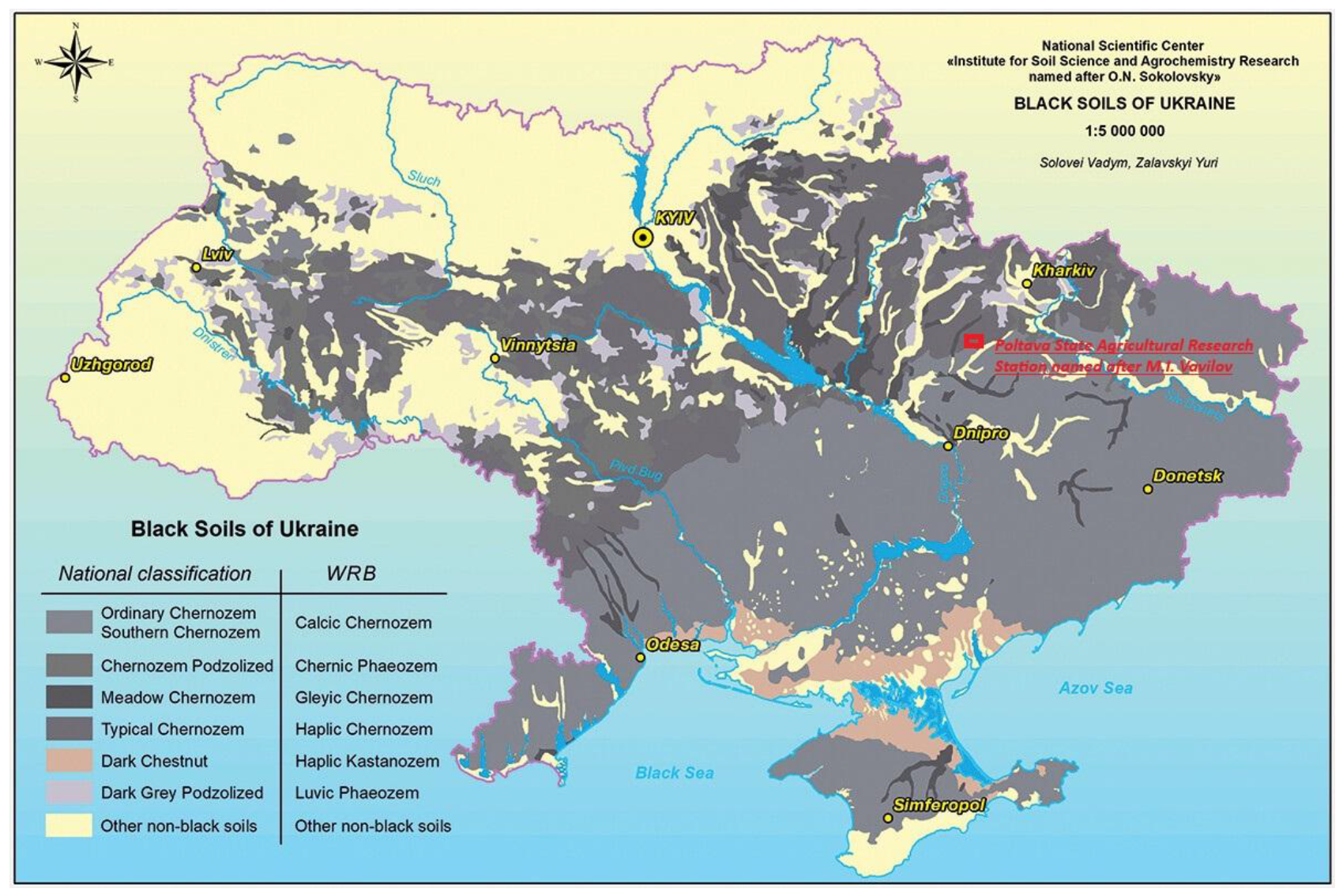
Figure 2.
The impact of soil tillage systems on the bulk density of a 20-60 cm layer of typical chernozem.
Figure 2.
The impact of soil tillage systems on the bulk density of a 20-60 cm layer of typical chernozem.
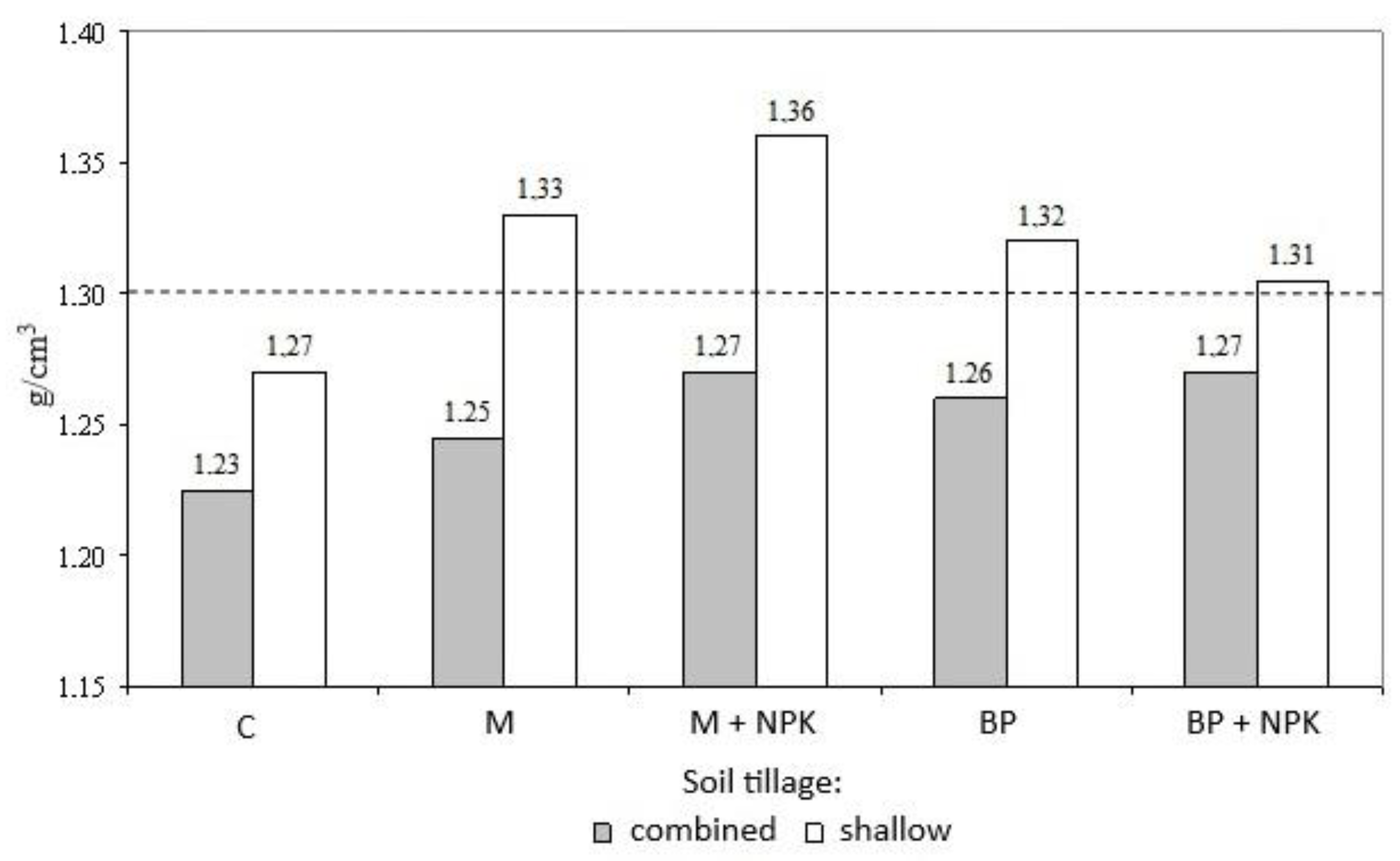
Figure 3.
The impact of soil tillage systems on the nutrient content in a typical chernozem soil under regular application of manure and mineral fertilizers.
Figure 3.
The impact of soil tillage systems on the nutrient content in a typical chernozem soil under regular application of manure and mineral fertilizers.
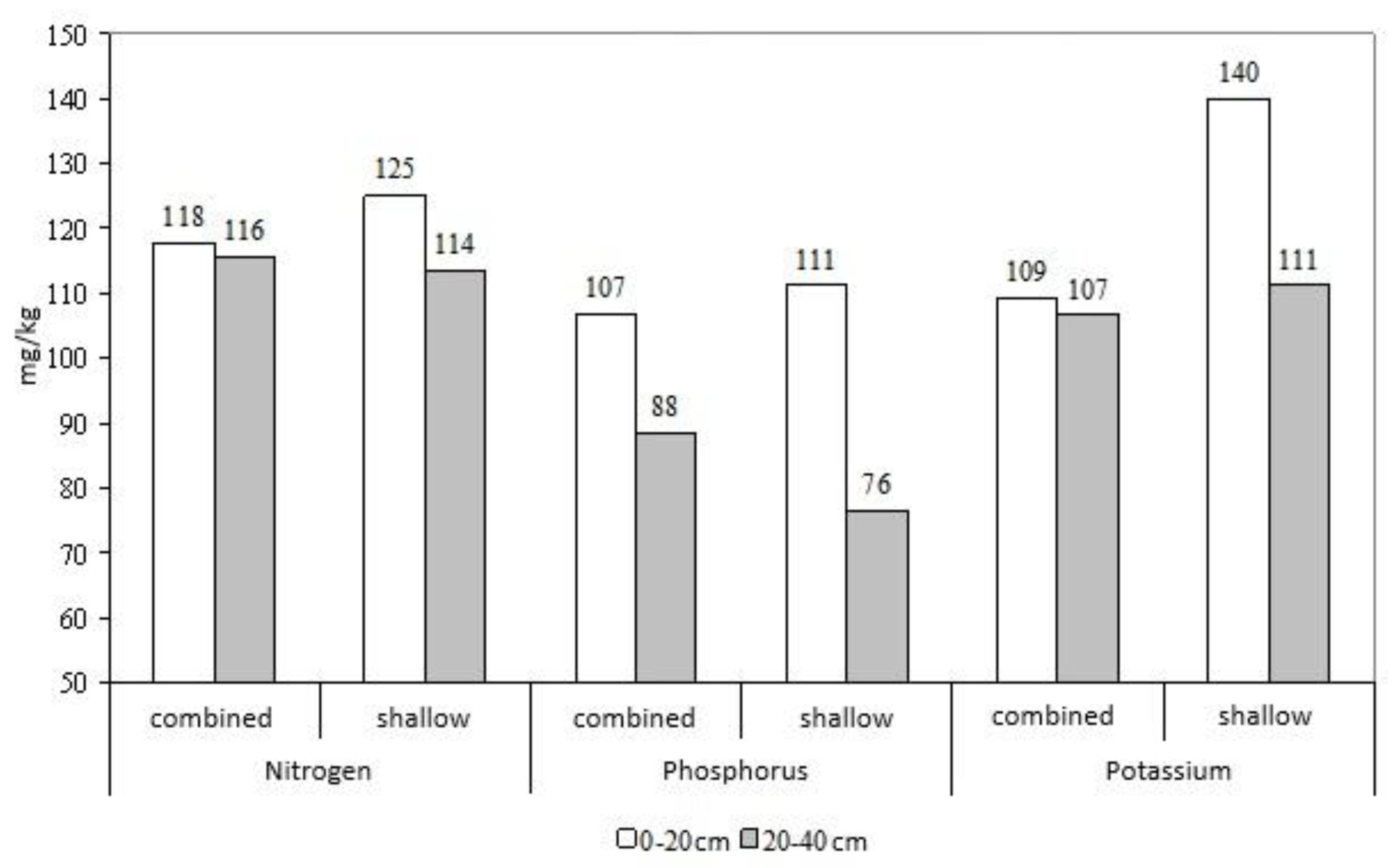
Figure 4.
The impact of fertilization systems and soil tillage on humus reserves in the 0-40 cm layer of typical chernozem.
Figure 4.
The impact of fertilization systems and soil tillage on humus reserves in the 0-40 cm layer of typical chernozem.
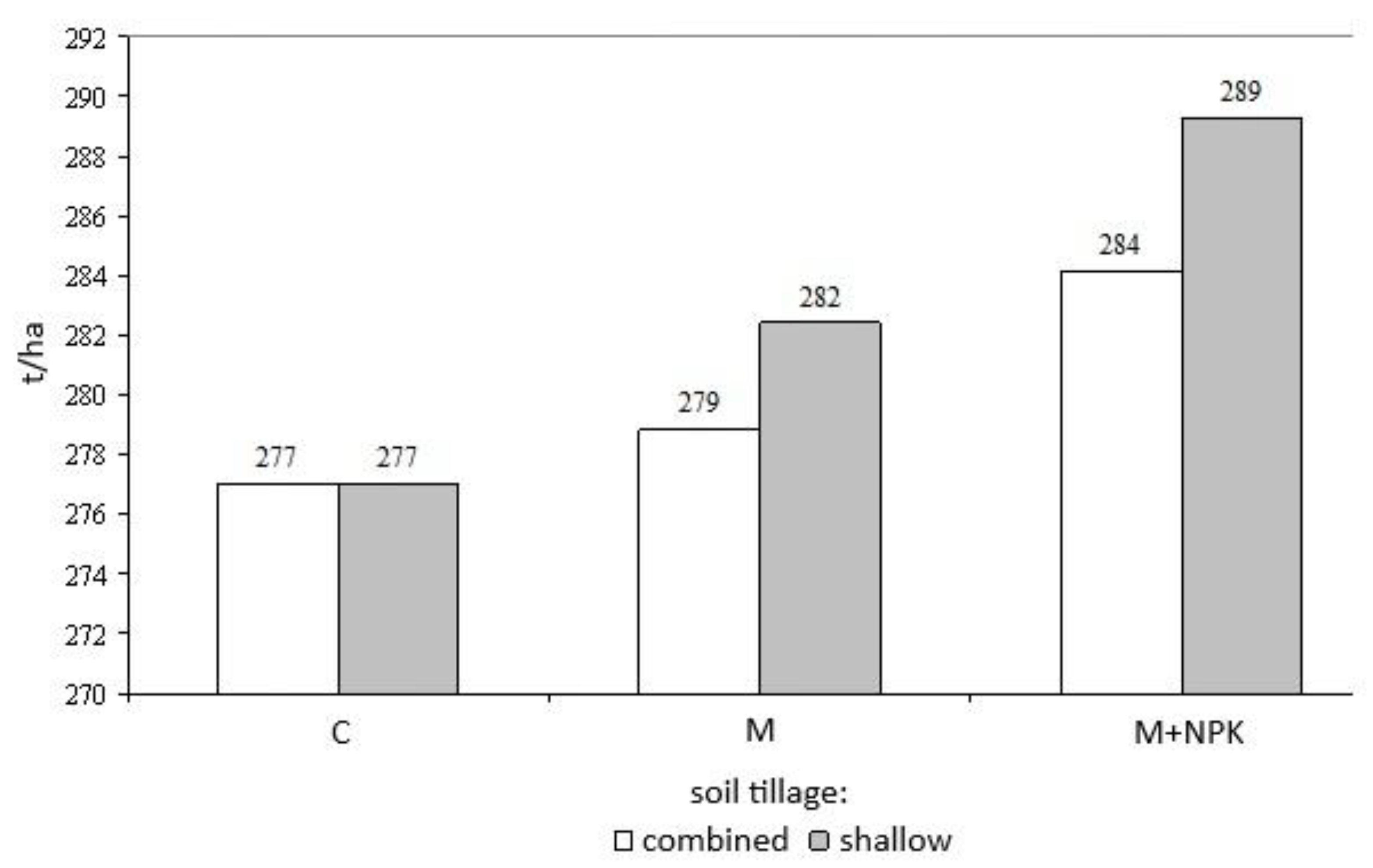

Table 1.
Crop fertilization scheme in crop rotation.
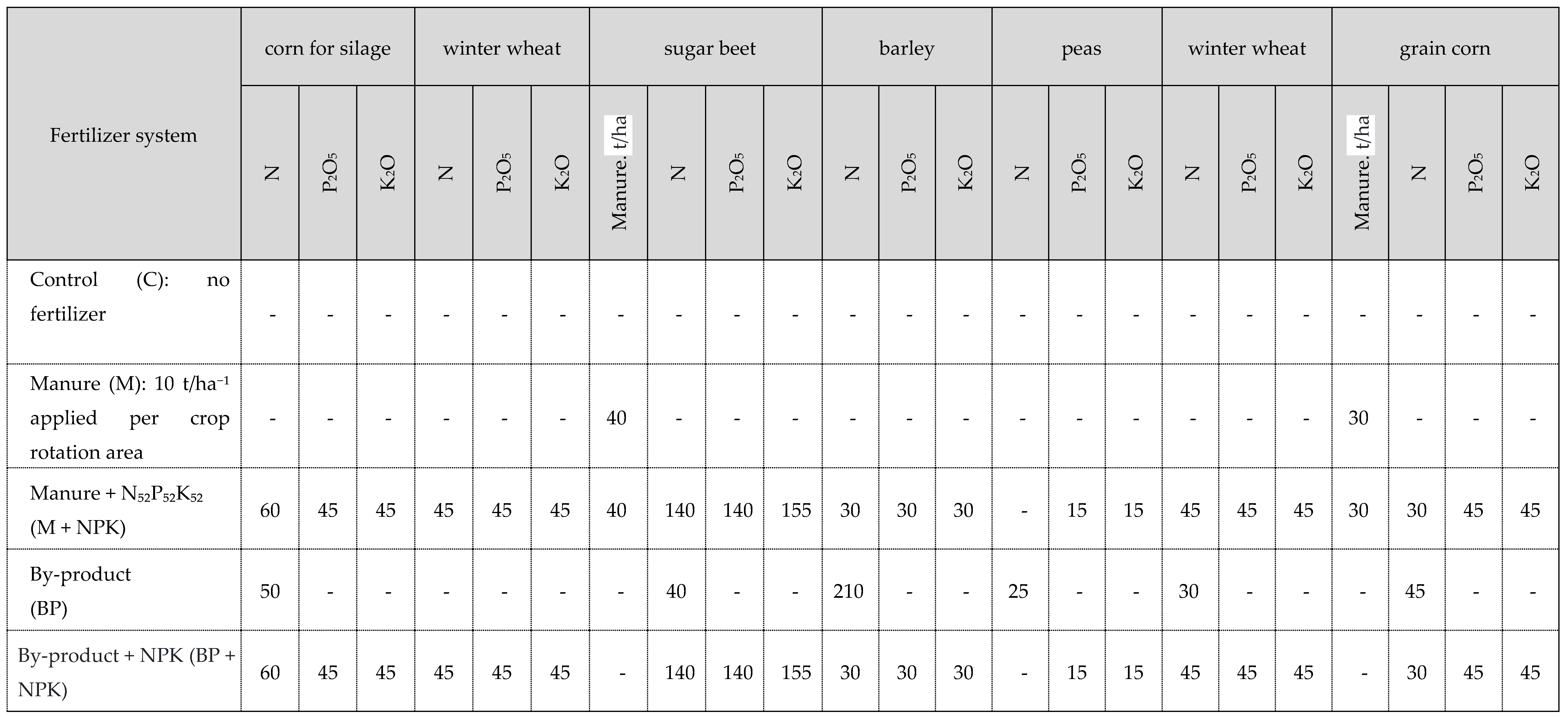
Table 2.
The impact of soil tillage practices on the yield of corn for silage under different fertilization systems.
Table 2.
The impact of soil tillage practices on the yield of corn for silage under different fertilization systems.
| Yield | Soil tillage | Fertilization options | ||||
| C | M | M + NРК | BP | BP + NPK | ||
| Average, t/ha | Combined | 30.8 | 35.8 | 40.1 | 38.2 | 39.5 |
| Shallow | 29.0 | 32.0 | 35.4 | 33.6 | 36.4 | |
| Difference . % | -7 | -13 | -15 | -8 | -3 | |
| The increase in average crop yield from fertilizers | Combined | - | 1.2 | 1.3 | 1.2 | 1.3 |
| Shallow | - | 1.1 | 1.2 | 1.2 | 1.3 | |
| Maximum, t/ha | Combined | 65.1 | 75.0 | 82.1 | 70.5 | 74.6 |
| Shallow | 69.6 | 65.2 | 70.1 | 65.1 | 72.3 | |
| Difference . % | -6 | -10 | -12 | -12 | -8 | |
| The increase in average crop yield from fertilizers | Combined | - | 1.2 | 1.3 | 1.1 | 1.1 |
| Shallow | - | 0.9 | 1.0 | 0.9 | 1.0 | |
| Maximum to average | Combined | 2.3 | 1.8 | 1.7 | 1.7 | 1.8 |
| Shallow | 2.4 | 2.0 | 2.0 | 1.9 | 2.0 | |
Table 3.
The impact of soil tillage practices on the yield of winter wheat after corn under different fertilization systems.
Table 3.
The impact of soil tillage practices on the yield of winter wheat after corn under different fertilization systems.
| Yield | Soil tillage | Fertilization options | ||||
| C | M | M + NРК | BP | BP + NPK | ||
| Average, t/ha | Combined | 2.2 | 2.5 | 3.5 | 3.2 | 3.6 |
| Shallow | 2.2 | 2.4 | 3.4 | 3.1 | 3.4 | |
| Difference . % | -2 | -5 | -3 | -2 | -4 | |
| The increase in average crop yield from fertilizers | Combined | - | 1.1 | 1.6 | 1.5 | 1.6 |
| Shallow | - | 1.1 | 1.6 | 1.5 | 1.6 | |
| Maximum, t/ha | Combined | 3.7 | 4.8 | 5.6 | 5.4 | 5.9 |
| Shallow | 3.7 | 4.5 | 5.6 | 5.3 | 5.7 | |
| Difference . % | 0 | -6 | 0 | -1 | -5 | |
| The increase in average crop yield from fertilizers | Combined | - | 1.3 | 1.5 | 1.5 | 1.6 |
| Shallow | - | 1.2 | 1.5 | 1.4 | 1.5 | |
| Maximum to average | Combined | 1.7 | 1.9 | 1.6 | 1.7 | 1.7 |
| Shallow | 1.7 | 1.9 | 1.6 | 1.7 | 1.6 | |
Table 4.
The impact of soil tillage practices on the yield of sugar beets under different fertilization systems.
Table 4.
The impact of soil tillage practices on the yield of sugar beets under different fertilization systems.
| Yield | Soil tillage | Fertilization options | ||||
| C | M | M + NРК | BP | BP + NPK | ||
| Average, t/ha | Combined | 25.4 | 31.3 | 40.1 | 39.5 | 41.6 |
| Shallow | 21.3 | 26.8 | 35.8 | 36.9 | 38.2 | |
| Difference . % | -16 | -14 | -11 | -7 | -8 | |
| The increase in average crop yield from fertilizers | Combined | - | 1.2 | 1.6 | 1.6 | 1.6 |
| Shallow | - | 1.3 | 1.7 | 1.7 | 1.8 | |
| Maximum, t/ha | Combined | 37.6 | 42.8 | 52.7 | 50.5 | 52.9 |
| Shallow | 35.4 | 39.8 | 43.4 | 53.8 | 53.6 | |
| Difference . % | -6 | -7 | -18 | 7 | 1 | |
| The increase in average crop yield from fertilizers | Combined | - | 1.1 | 1.4 | 1.3 | 1.4 |
| Shallow | - | 1.1 | 1.2 | 1.5 | 1.5 | |
| Maximum to average | Combined | 1.5 | 1.4 | 1.3 | 1.3 | 1.3 |
| Shallow | 1.7 | 1.5 | 1.2 | 1.5 | 1.4 | |
Table 5.
The impact of soil tillage practices on soybean yield under different fertilization systems.
Table 5.
The impact of soil tillage practices on soybean yield under different fertilization systems.
| Yield | Soil tillage | Fertilization options | ||||
| C | M | M + NРК | BP | BP + NPK | ||
| Average, t/ha | Combined | 1.2 | 1.4 | 1.7 | 1.5 | 1.6 |
| Shallow | 1.2 | 1.3 | 1.7 | 1.6 | 1.7 | |
| Difference . % | 1 | -7 | -1 | 3 | 9 | |
| The increase in average crop yield from fertilizers | Combined | - | 1.2 | 1.5 | 1.3 | 1.3 |
| Shallow | - | 1.1 | 1.4 | 1.3 | 1.4 | |
| Maximum, t/ha | Combined | 1.9 | 2.2 | 3.1 | 2.6 | 2.3 |
| Shallow | 2.2 | 2.7 | 2.8 | 3.1 | 2.8 | |
| Difference . % | 17 | 19 | -10 | 21 | 18 | |
| The increase in average crop yield from fertilizers | Combined | - | 1.2 | 1.6 | 1.3 | 1.2 |
| Shallow | - | 1.2 | 1.2 | 1.4 | 1.2 | |
| Maximum to average | Combined | 1.6 | 1.6 | 1.8 | 1.7 | 1.5 |
| Shallow | 1.9 | 2.0 | 1.6 | 2.0 | 1.6 | |
Table 6.
Impact of soil tillage practices on the yield of spring barley under different fertilization systems.
Table 6.
Impact of soil tillage practices on the yield of spring barley under different fertilization systems.
| Yield | Soil tillage | Fertilization options | |||||
| C | M | M + NРК | BP | BP + NPK | |||
| Average, t/ha | Combined | 1.7 | 2.2 | 2.7 | 2.6 | 2.7 | |
| Shallow | 1.7 | 2.0 | 2.7 | 2.5 | 2.7 | ||
| Difference . % | 1 | -9 | -1 | -5 | 0 | ||
| The increase in average crop yield from fertilizers | Combined | - | 1.3 | 1.6 | 1.5 | 1.6 | |
| Shallow | - | 1.1 | 1.5 | 1.5 | 1.6 | ||
| Maximum, t/ha | Combined | 3.0 | 4.5 | 4.9 | 4.6 | 4.7 | |
| Shallow | 3.2 | 3.2 | 4.6 | 5.0 | 4.7 | ||
| Difference . % | 9 | -28 | -7 | 8 | 0 | ||
| The increase in average crop yield from fertilizers | Combined | - | 1.5 | 1.7 | 1.6 | 1.6 | |
| Shallow | - | 1.0 | 1.4 | 1.6 | 1.5 | ||
| Maximum to average | Combined | 1.7 | 2.0 | 1.8 | 1.8 | 1.7 | |
| Shallow | 1.9 | 1.6 | 1.7 | 2.0 | 1.7 | ||
Table 7.
The impact of soil tillage practices on pea yield under different fertilization systems.
| Yield | Soil tillage | Fertilization options | ||||
| C | M | M + NРК | BP | BP + NPK | ||
| Average, t/ha | Combined | 2.4 | 2.6 | 3.0 | 2.8 | 2.8 |
| Shallow | 2.2 | 2.5 | 2.7 | 2.6 | 2.7 | |
| Difference . % | -6 | -6 | -10 | -5 | -7 | |
| The increase in average crop yield from fertilizers | Combined | - | 1.1 | 1.2 | 1.2 | 1.2 |
| Shallow | - | 1.1 | 1.2 | 1.2 | 1.2 | |
| Maximum, t/ha | Combined | 3.9 | 5.1 | 4.6 | 4.0 | 4.4 |
| Shallow | 3.3 | 4.9 | 4.1 | 4.0 | 4.2 | |
| Difference . % | -15 | -4 | -10 | 0 | -3 | |
| The increase in average crop yield from fertilizers | Combined | - | 1.3 | 1.2 | 1.0 | 1.1 |
| Shallow | - | 1.5 | 1.3 | 1.2 | 1.3 | |
| Maximum to average | Combined | 1.6 | 1.9 | 1.6 | 1.5 | 1.5 |
| Shallow | 1.5 | 2.0 | 1.6 | 1.5 | 1.6 | |
Table 8.
Influence of soil tillage practices on winter wheat yield after peas under different fertilization systems.
Table 8.
Influence of soil tillage practices on winter wheat yield after peas under different fertilization systems.
| Yield | Soil tillage | Fertilization options | ||||
| C | M | M + NРК | BP | BP + NPK | ||
| Average, t/ha | Combined | 3.0 | 3.4 | 3.9 | 3.8 | 3.8 |
| Shallow | 3.2 | 3.4 | 3.9 | 3.9 | 3.9 | |
| Difference . % | 6 | 0 | 1 | 2 | 2 | |
| The increase in average crop yield from fertilizers | Combined | - | 1.1 | 1.3 | 1.3 | 1.3 |
| Shallow | - | 1.1 | 1.2 | 1.2 | 1.2 | |
| Maximum, t/ha | Combined | 5.1 | 5.2 | 5.6 | 5.7 | 5.2 |
| Shallow | 5.0 | 5.5 | 5.7 | 5.6 | 5.9 | |
| Difference . % | -3 | 7 | 1 | -1 | 12 | |
| The increase in average crop yield from fertilizers | Combined | - | 1.0 | 1.1 | 1.1 | 1.0 |
| Shallow | - | 1.1 | 1.1 | 1.1 | 1.2 | |
| Maximum to average | Combined | 1.7 | 1.5 | 1.5 | 1.5 | 1.4 |
| Shallow | 1.5 | 1.6 | 1.5 | 1.4 | 1.5 | |
Table 9.
The impact of soil tillage practices on the grain yield of corn under different fertilization systems.
Table 9.
The impact of soil tillage practices on the grain yield of corn under different fertilization systems.
| Yield | Soil tillage | Fertilization options | ||||
| C | M | M + NРК | BP | BP + NPK | ||
| Average, t/ha | Combined | 47 | 52 | 54 | 54 | 55 |
| Shallow | 43 | 47 | 51 | 49 | 51 | |
| Difference . % | -8 | -10 | -6 | -8 | -7 | |
| The increase in average crop yield from fertilizers | Combined | - | 1.1 | 1.2 | 1.2 | 1.2 |
| Shallow | - | 1.1 | 1.2 | 1.1 | 1.2 | |
| Maximum, t/ha | Combined | 74 | 91 | 99 | 86 | 84 |
| Shallow | 81 | 83 | 97 | 87 | 87 | |
| Difference . % | 10 | -9 | -2 | 2 | 4 | |
| The increase in average crop yield from fertilizers | Combined | - | 1.2 | 1.3 | 1.2 | 1.0 |
| Shallow | - | 1.0 | 1.2 | 1.1 | 1.1 | |
| Maximum to average | Combined | 1.6 | 1.7 | 1.8 | 1.6 | 1.5 |
| Shallow | 1.9 | 1.8 | 1.9 | 1.8 | 1.7 | |
Table 10.
The Impact of Soil Tillage Practices on Crop Rotation Productivity under different fertilization systems.
Table 10.
The Impact of Soil Tillage Practices on Crop Rotation Productivity under different fertilization systems.
| Yield | Soil tillage | Fertilization options | ||||
| C | M | M + NРК | BP | BP + NPK | ||
| Average, t/ha | Combined | 3.2 | 3.6 | 4.2 | 4.1 | 4.2 |
| Shallow | 3.0 | 3.4 | 4.0 | 3.9 | 4.1 | |
| Difference . % | -5 | -8 | -6 | -5 | -4 | |
| The increase in average crop yield from fertilizers | Combined | - | 1.1 | 1.3 | 1.3 | 1.3 |
| Shallow | - | 1.0 | 1.3 | 1.2 | 1.3 | |
| Maximum, t/ha | Combined | 5.4 | 6.5 | 7.2 | 6.5 | 6.6 |
| Shallow | 5.5 | 6.0 | 6.7 | 6.6 | 6.7 | |
| Difference . % | 3 | -7 | -7 | 1 | 2 | |
| The increase in average crop yield from fertilizers | Combined | - | 1.2 | 1.3 | 1.2 | 1.2 |
| Shallow | - | 1.1 | 1.2 | 1.2 | 1.2 | |
| Maximum to average | Combined | 1.7 | 1.8 | 1.7 | 1.6 | 1.6 |
| Shallow | 1.8 | 1.8 | 1.7 | 1.7 | 1.7 | |
Disclaimer/Publisher’s Note: The statements, opinions and data contained in all publications are solely those of the individual author(s) and contributor(s) and not of MDPI and/or the editor(s). MDPI and/or the editor(s) disclaim responsibility for any injury to people or property resulting from any ideas, methods, instructions or products referred to in the content. |
© 2026 by the authors. Licensee MDPI, Basel, Switzerland. This article is an open access article distributed under the terms and conditions of the Creative Commons Attribution (CC BY) license (http://creativecommons.org/licenses/by/4.0/).
Copyright: This open access article is published under a Creative Commons CC BY 4.0 license, which permit the free download, distribution, and reuse, provided that the author and preprint are cited in any reuse.


