

Submitted:
05 February 2026
Posted:
05 February 2026
You are already at the latest version
Abstract
Dominant models of nature conservation are rooted in colonial ideologies that displace and attempt to erase Indigenous peoples. This paper critiques the global conservation sector through the lens of the Traffic Light Displacement Model (TLDM), a conceptual framework that illustrates how protected areas perpetuate cycles of philosophical, physical, and violent exclusion. The paper examines how institutions such as the IUCN, NGOs, and colonial governments uphold exclusionary practices under the guise of ecological protection. It critiques the Kunming-Montreal Global Biodiversity Framework’s 30x30 target that risk repeating historical injustices. The paper presents a toolkit for ethical, Indigenous-led conservation, grounded in relational accountability, knowledge co-production, and polycentric governance. Global case studies illustrate the global reach of these dynamics and the resistance movements challenging them. The paper concludes by calling for a shift to relational care and socio-environmental justice. Conservation must be reconstructed as a practice of codesign, justice, and Indigenous sovereignty.
Keywords:
decolonial conservation
; indigenous governance
; protected areas
; traffic light displacement model (TLDM)
; 30x30 global biodiversity framework
; green militarization
; fortress conservation
; indigenous land rights
; ethical conservation
; polycentric environmental governance
1. Introduction
Human relationships with nature are diverse and deeply rooted across cultures. While nature conservation is often framed as a shared value, the philosophies underpinning it differ significantly. Many globalised conservation strategies, particularly those shaped by Western institutions, position humans as separate from nature, aiming to protect “pristine” environments by excluding people. In this sense, there is more investment in preservation of an environment as it exists without humans than conservation of mobile ecological systems. In contrast, many Indigenous approaches to being emphasise humans as part of nature with reciprocal responsibilities and kinship-based stewardship [1,2].
This philosophical divide has ongoing ethical consequences. The establishment of protected areas, especially National Parks, has historically relied on the displacement of Indigenous peoples from their lands. These practices, rooted in colonial ideologies of Western Enlightenment and imperialism, continue under many contemporary conservation frameworks [3,4]. One of the most prominent examples is the Kunming–Montreal Global Biodiversity Framework’s 30×30 target, which calls for the effective protection of 30% of the world’s lands and waters by 2030. Without strict ethical regulation and Indigenous leadership, such targets risk perpetuating cycles of exclusion and harm [5,6].
This paper aims to inform and mobilise conservation professionals towards socio-environmental justice-based conservation, particularly those who may be unaware of these histories but are open to change. It also proposes the Traffic Light Displacement Model to conceptualise how protected areas are established through escalating forms of displacement and offers an ethical conservation toolkit. Through academic and grey-literature reviews, this paper aims to inform and mobilise non-Indigenous conservation professionals, particularly those in the Global North, to critically examine the sector’s colonial foundations. The justification for the use of grey literature and the term “Indigenous” can be found in Supplementary Material (SM1). The burden of change lies not with those displaced but with those who have benefited from and continue to uphold these systems. To understand how these philosophical divides have shaped conservation practice, we must examine the historical systems through which exclusion and control have been institutionalised.
2. Systems of Oppression in Conservation
Oppression is a pillar of colonisation. In conservation, it often manifests through the dismantling of culture, denial of land access and abuse of human rights. These harms are perpetuated globally through three interlinked structures: the Yellowstone Model, Fortress Conservation and Green Militarisation.
2.1. The Yellowstone Model
Yellowstone National Park, established in 1872, is often celebrated as the birthplace of modern conservation. It sits on the lands of the Shoshone, Lakota, Crow, Blackfoot, Flathead, Bannock, and Nez Perce peoples, who have lived there for over 11,000 years. Early colonial naturalists like John Muir romanticised the landscape as “wilderness” devoid of humans, despite its long history of Indigenous stewardship [7,8,9]. Muir’s writings, which included racist depictions of Native Americans (see SM1), helped shape the founding philosophy of National Parks: nature must be protected from people. This idea draws from the Western Enlightenment school of thought, which separated humans from nature and positioned the latter as something to be controlled. Anthropocentrism and Eurocentrism became dominant conservation paradigms, enforced through colonisation. In contrast, many Indigenous worldviews see humans as part of nature, with kinship-based responsibilities towards land and species [1,2].
The Yellowstone Model institutionalised the belief that protecting nature requires removing people from it. This has led to the alleged forced displacement of countless Indigenous communities, justified by conservation goals. The model has caused cultural erasure, trauma, and in many cases, death—all in the name of environmental protection.2.1. The Yellowstone Model
2.2. Fortress Conservation
Once people are removed, conservation systems must maintain that exclusion. This is where Fortress Conservation emerges: the use of physical barriers to enforce boundaries around protected areas. Fences, walls, and restricted zones symbolise colonial ideas of ownership and control. Though these lands are often publicly owned, they are managed by governments, states, or entities like the British Crown institutions with colonial legacies [10,11]. In many African nations, colonisers brought with them the notion of protecting resources from “uncivilised” locals. Charismatic megafauna became commodities for tourism and trophy hunting, and conservation areas were fortified to protect these assets. Park wardens, often ex-military personnel, enforced boundaries with barbed wire, electric fences, and stone walls. These are tools of war repurposed for conservation.
These fortresses ignore and deny pre-existing relationships between Indigenous peoples and their lands. Communities lose access to resources, livelihoods, and cultural sites. The conservation narrative frames this as protection from “dangerous” wildlife, but in reality, it protects stolen resources from rightful custodians. Fortress Conservation is not just physical; it is symbolic of power, exclusion, and colonial entitlement.
2.3. Green Militarisation
Maintaining control over protected areas often involves more than fences. In many regions, especially the Global South, conservation has adopted military tactics, now termed Green Militarisation. Armed guards, surveillance technologies, and paramilitary operations are deployed to prevent local people from entering conservation zones [12,13,14,15]. This approach has colonial roots. During empire-building, the British deployed ex-military personnel to clear and control conservation areas. Today, similar tactics are justified through anti-poaching narratives. The term “poaching” is politically constructed, often criminalising Indigenous subsistence practices. Local people are targeted, incarcerated, or killed, frequently without evidence or due process.
Green Militarisation extends beyond park boundaries, infiltrating surrounding communities and creating a climate of fear. Conservation is enforced through coercion, prioritising species and landscapes over human rights.
Displacement often follows. Indigenous peoples are forcibly “resettled” on the periphery of protected areas, confined to marginal lands with limited access to resources, cultural sites, or economic opportunities. In South Africa, apartheid-era Bantustans displaced Black and Indigenous communities from fertile, ecologically rich areas, some later designated as national parks. In the United States, Native American reservations were established through forced relocation, often on lands far from traditional territories and with little regard for ecological or cultural suitability [16]. Many reservations sit adjacent to protected areas, yet Indigenous peoples are often denied access to sacred sites and subsistence zones within them.
Despite the widespread use of protected areas as a conservation strategy, there is growing uncertainty about how well these systems actually work. Fortress conservation, which relies on fencing and exclusion, can disrupt ecological balance, leading to overpopulation of some species, extinction of others, and the fragmentation of habitats [10]. These unintended consequences challenge the assumption that physical barriers equate to ecological protection. Moreover, the global polycrisis of climate change, biodiversity loss, and ecological collapse has emerged not in spite of conservation, but in parallel with it largely since the onset of global colonisation. This context underscores the importance of Indigenous stewardship, which has sustained biodiversity for millennia. Today, Indigenous peoples manage or have tenure rights over approximately 25 percent of the world’s land surface, including some of the most ecologically intact areas [17]. Their governance systems offer relational, adaptive, and place-based approaches that contrast sharply with exclusionary models and must be central to any future conservation efforts.
3. The Traffic Light Model of Displacement
Displacement begins not with fences or laws but with ideas. One of the most insidious foundations of conservation-related displacement is the dehumanisation of Indigenous peoples. The pervasive narrative of Indigenous peoples as “savages” or “barbarians” has historically justified their removal from lands deemed valuable. This ideological erasure is the first step in the displacement cycle: it renders Indigenous presence illegible to Western conservation frameworks and sets the stage for exclusion [18,19,20].
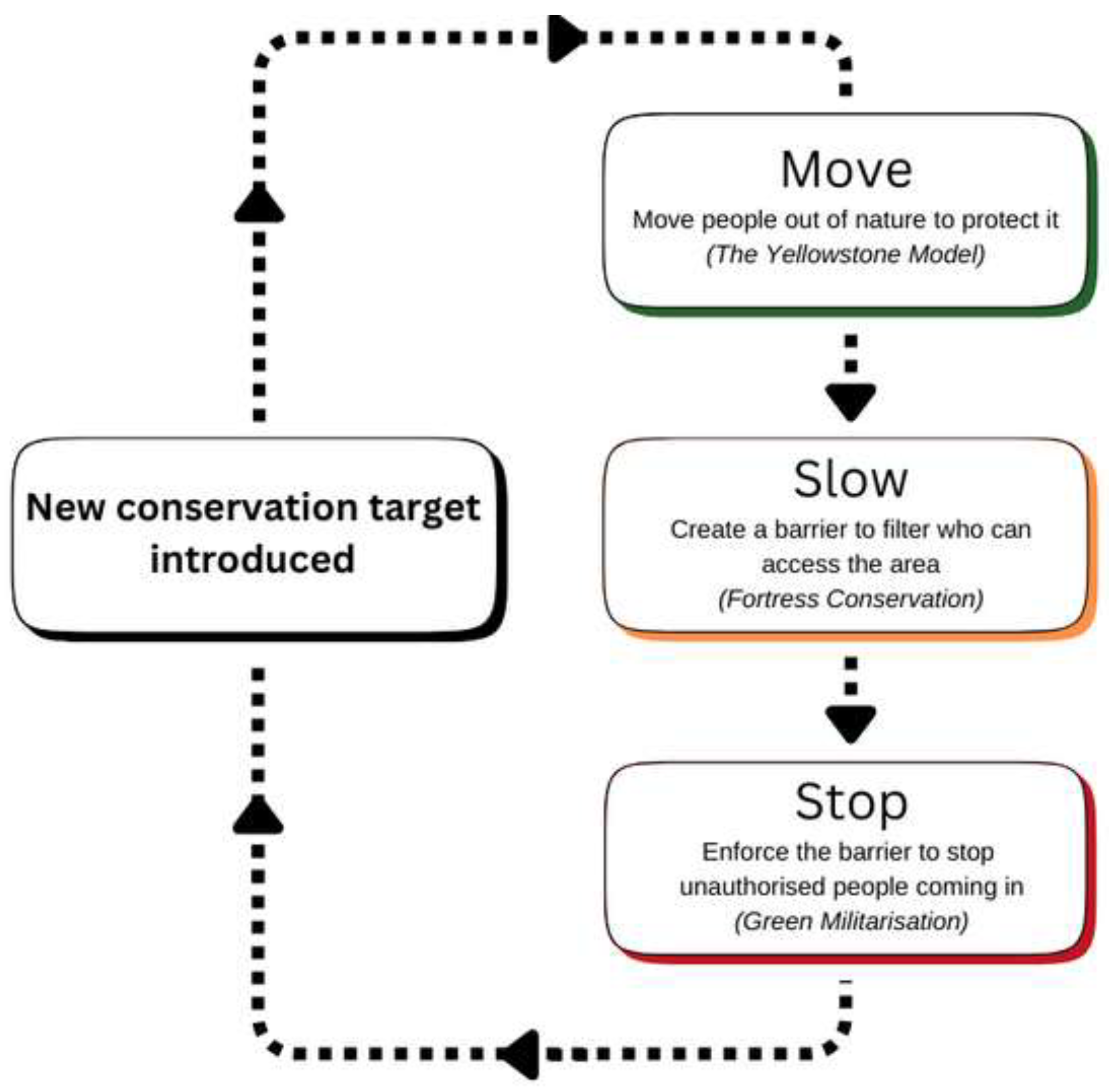
The Traffic Light Displacement Model (TLDM) is a conceptual framework proposed to illustrate how the establishment and maintenance of protected areas often follow a recurring cycle of Indigenous displacement. It draws on the familiar symbolism of traffic lights to represent escalating forms of exclusion and control. The model is cyclical, repeating with each new conservation initiative or global target.
3.1. Green
The green light first represents the initial ideological separation of people from nature, as supported by the Yellowstone Model. This phase is rooted in Western Enlightenment thinking and colonial naturalism, where landscapes were romanticised as “pristine wilderness” and Indigenous peoples rendered invisible or harmful [1,2]. Conservation narratives at this stage frame nature as something to be protected from humans, despite millennia of Indigenous stewardship. Displacement occurs when Indigenous knowledge systems and peoples are legally moved off their traditional lands, then excluded from conservation planning. Land is redefined as “uninhabited” or “untouched,” justifying the designation of protected areas without consent or recognition of existing relationships to land.
3.2. Orange
The orange light signals conditional access and the imposition of physical and bureaucratic barriers, as enforced by Fortress Conservation systems. This includes fencing, zoning, permits, and surveillance—tools that restrict Indigenous peoples’ ability to access, manage, or maintain cultural practices on their lands. While some conservation programs may involve Indigenous participation (e.g., ranger programs or co-management agreements), they often do so under terms set by non-Indigenous institutions [11].
These arrangements can appear inclusive but frequently lack genuine autonomy or decision-making power. Orange displacement is thus a form of managed exclusion, where access is slowed, monitored, or made contingent on external approval.
3.3. Red
The red light represents the enforcement phase, where conservation is militarised and resistance is criminalised, as shown through Green Militarisation. This includes the use of armed guards, anti-poaching units, and surveillance technologies to prevent Indigenous peoples from entering or using their lands. In many cases, these interventions result in violence, incarceration, or death [12,13,14,15].
This phase is often justified through narratives of “poaching” or “illegal encroachment,” which obscure the fact that many of those targeted are engaging in traditional subsistence or cultural practices. Red displacement is the most visible and brutal form of conservation violence—but it is enabled by the earlier stages of exclusion.
Figure 1 summarises this cyclical process of how the cornerstone protected areas is displacement of people, culture and rights.
3.4. The Displacement Loop
The Traffic Light Displacement Model (TLDM) is not a one-off process. It resets with each new conservation initiative, especially those driven by the time-sensitive pressure of global targets. As new areas are identified for protection, the cycle of erasure, restriction, and enforcement begins again. This is particularly relevant to the Kunming–Montreal Global Biodiversity Framework’s 30×30 target, which aims to protect 30% of the world’s terrestrial and marine areas by 2030. Without safeguards, Indigenous leadership, and rights-based frameworks, the 30×30 target risks becoming a mandate for renewed displacement [5,21,22].
Displacement in the name of conservation is a contemporary crisis. The term “conservation refugees” describes millions of people—often Indigenous or land-connected communities—who have been forcibly removed to make way for protected areas. These evictions frequently occur without consent or compensation, leaving communities impoverished and culturally dislocated. Estimates suggest up to 14 million people have been displaced globally [10,23].
4. Institutional Perpetrators
Protected areas rely on institutional support financially, legally, and operationally. This section reviews three key actors that often perpetuate colonial conservation: the IUCN, NGOs, and colonial governments.
4.1. The International Union for Conservation of Nature (IUCN)
The IUCN, founded in 1948, is a global authority on conservation and species management. It advises the UN and shapes global agendas through tools like the Red List and protected area categories. However, its frameworks often exclude Indigenous knowledge and prioritise ecological metrics over cultural relationships [23,24].

Table 1.
the definition of each IUCN protected area category (IUCN 2013) .
| Category | Name | Objectives | Selection |
|---|---|---|---|
| Ia | Strict Nature Reserve | Preserve species, habitats and ecosystems for scientific purposes |
Relatively free of direct human influence and capable of remaining so |
| Ib | Wilderness Area | Preserve natural attributes for future generations | High natural quality, significant features and opportunity for solitude |
| II | National Park | Protected natural/scenic areas of national significance for research, education and recreation | Representative example large enough to contain entire relatively unmodified ecosystem(s) |
| III | Natural Monument or Feature | Preserve specific outstanding natural features | Contains feature(s) of outstanding significance; large enough to protect integrity of feature |
| IV | Habitat/Species Management Area | Conserve habitat of significant species (e.g. rare) through active management | Habitat important to the species survival (e.g. breeding areas) |
| V | Protected Landscape/Seascape | Maintain harmonious interaction of nature and culture; provide for recreation/tourism | High scenic quality and diversity, unique or traditional land use patterns |
| VI | Protected Area with Sustainable Use of Natural Resources | Sustainable use of natural resources through sound management, while maintaining biodiversity | Two-thirds of areas must be in natural condition; large enough to absorb sustainable use |
The IUCN protected area classification system, while globally influential, reflects a conservation logic that often marginalises Indigenous peoples and oversimplifies complex human–nature relationships. Each category is framed around ecological objectives and selection criteria that presume a separation between humans and nature, reinforcing colonial assumptions about who belongs in these landscapes [26,27].
Category Ia (Strict Nature Reserve) and Ib (Wilderness Area) idealise landscapes “free of human influence,” ignoring the fact that many such areas have been shaped by Indigenous stewardship for millennia. The notion of “wilderness” is also a colonial narrative that humans are “bad” for nature and the environment, and nature needs to be protected from humans, which is antithetical to most Indigenous ontologies and pedagogies.
Category II (National Park) assumes that areas must be “relatively unmodified” to qualify, even when Indigenous communities have lived sustainably within and modified them for thousands of years. This framing erases long-standing relationships with land and legitimises exclusionary practices under the guise of protection.
Category III (Natural Monument or Feature) uses language that can be problematic. Terms like “monument” imply static, objectified landscapes, rather than living systems embedded in cultural and spiritual meaning.
Category IV (Habitat/Species Management Area) focuses on species-specific conservation through active management yet lacks clarity on who defines significance and who leads that management. Without Indigenous governance, such efforts risk reinforcing top-down control.
Category V (Protected Landscape/Seascape) acknowledges cultural interaction but fails to recognise that many of these landscapes have been continuously modified by Indigenous peoples not as a disruption, but as a form of care and continuity.
Category VI (Protected Area with Sustainable Use of Natural Resources) introduces flexibility, yet again raises the question: who decides what counts as “sustainable”? This category can be used to justify extractive practices under a conservation label, sidelining Indigenous authority.
Overall, the IUCN framework institutionalises a hierarchy of nature that privileges scientific and recreational values over Indigenous sovereignty. Without structural reform and Indigenous-led governance, these categories risk becoming tools of displacement rather than protection.
4.2. Non-Government Organisations
NGOs such as WWF, Conservation International, and Fauna & Flora International wield significant influence in conservation. Founded in the Global North, many share exclusionary philosophies with the IUCN. Their campaigns often ignore Indigenous histories, and some have been implicated in violent enforcement, including torture and incarceration of local people [5,28]. Branding and public narratives mask these harms, enabling neocolonial conservation under the guise of protection.
In contrast, Indigenous-led NGOs like Survival International and Cultural Survival centre sovereignty and challenge the TLDM cycle. These organisations advocate for Indigenous rights, support land return, and promote conservation as a relational practice rooted in self-determination and cultural continuity [29,30].
4.3. Colonial Governments
Colonial governments—historically and presently—have shaped conservation through land theft and exclusion. In Commonwealth nations, vast tracts remain Crown property, undermining Indigenous land return and sovereignty [19,31]. Figures like Prince William, affiliated with conservation NGOs, symbolise this contradiction: promoting protection while upholding colonial hierarchies.
These governments often lack the cultural knowledge for ethical stewardship and continue to resist Indigenous autonomy. Conservation must be led by those with lived relationships to land, not distant institutions.
5. Socio-Cultural Perpetrators
Beyond institutional actors, cultural forces such as tourism, voluntourism, white saviourism, and social media play a powerful role in sustaining colonial conservation narratives. These practices often reinforce exclusion under the guise of goodwill. Tourists can pay to access protected areas from which Indigenous peoples have been displaced. Ecotourism commodifies nature and privileges outsiders, while voluntourism enables unregulated organisations that rarely involve Indigenous leadership or consent [32,33]. Hunting tourism further exposes the colonial logic of access, allowing wealthy visitors to exploit species while local communities are denied entry.
White saviourism manifests when non-Indigenous conservationists enter communities to “educate” or “empower” without collaboration. These efforts are often celebrated in the Global North but lack legitimacy among those they claim to help. Outreach programs and research partnerships may be well-intentioned, yet they frequently condescend Indigenous knowledge and autonomy [26,34]. Social media amplifies charismatic species and dramatic landscapes, shaping public perception while obscuring systemic issues. The killing of Cecil the lion sparked global outrage, yet the displacement of Indigenous peoples and colonial land management received little attention [35]. In contrast, alleged abuses by WWF-funded wardens in Nepal surfaced years later with minimal coverage [5].
However, when used ethically and on Indigenous terms, social media can amplify voices, share stories, and build solidarity. Platforms must centre Indigenous sovereignty to become tools of resistance rather than replication of colonial hierarchies.
5. Decolonial Practices and Alternatives: A Toolkit for Ethical, Indigenous-Led Conservation
By working together, conservationists and Indigenous communities can co-create ethical and effective conservation futures. Conservation must confront its colonial roots and actively dismantle the systems that perpetuate exclusion, dispossession and epistemic violence. Historically, protected areas have been established through the displacement of Indigenous peoples, often under the guise of ecological protection. These legacies persist in global conservation targets such as the 30x30 goal, which risk reproducing harm unless reframed through Indigenous-led, rights-based approaches.
This toolkit offers a set of practices and principles for ethical, Indigenous-led conservation, grounded in co-benefit, co-design and adaptive governance. These approaches are not supplementary; they are foundational to achieving biodiversity goals without reproducing harm. They require a shift from conservation as control to conservation as relationship, from exclusion to inclusion, and from monocentric governance to polycentric, pluralistic, and place-based systems.
5.1. Repatriating Land, Law and Autonomy
Decolonial conservation begins with returning land and sovereignty to Indigenous peoples. This is not symbolic; it is a material, legal, and ethical necessity. Land return enables the restoration of Indigenous governance, cultural practices, and ecological stewardship.
These instruments must be more than bureaucratic; they must be grounded in Indigenous law and relational accountability. In regions with limited state recognition, bottom-up approaches offer inclusive alternatives. Community-led conservation initiatives, such as those documented by Hernandez [24] and the IUCN [36], demonstrate how Indigenous stewardship can thrive outside formal state systems, especially when rooted in cultural values and local governance.
5.2. Building Relationships and Accountability
Reciprocity is central to many Indigenous philosophies of nature. It asks not only what is taken from the environment, but what is given back. Non-Indigenous conservation often extracts data, resources, and knowledge without reciprocal care. Ethical conservation must restore both ecosystems and relationships. This begins with respectful, iterative consultation grounded in trust, reciprocity, and long-term engagement. Indigenous peoples must be recognised not as stakeholders, but as rights-holders and co-creators. Co-design means shared decision-making from project inception to evaluation, ensuring conservation is culturally safe and locally relevant [37,38,39].
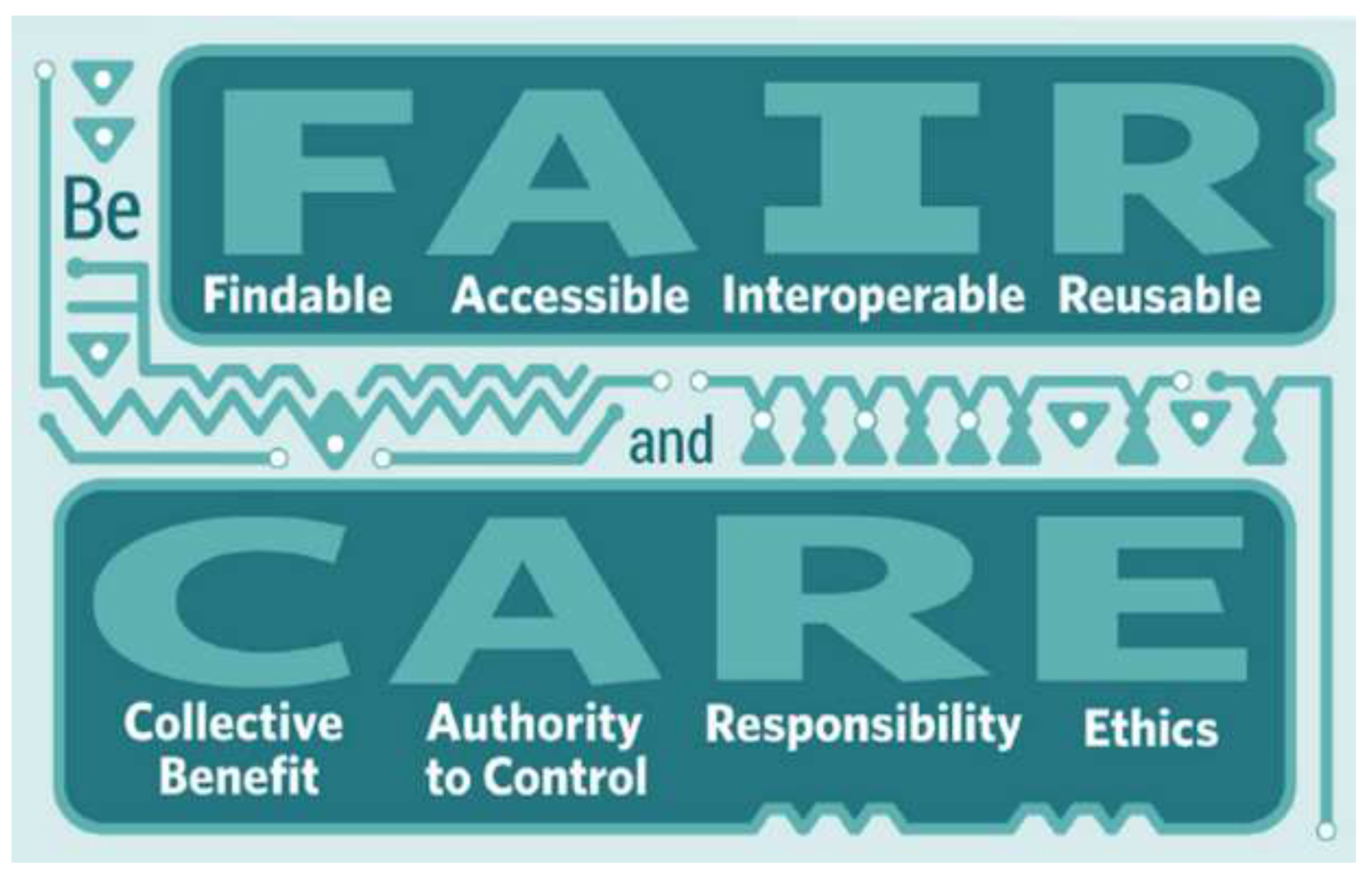
This ethic is exemplified by Mabu Liyan, meaning “good spirit” in the Yawuru language of the Kimberley region in Australia. It reflects a worldview in which wellbeing is inseparable from Country, kinship, and cultural continuity. Yawuru people have embedded Mabu Liyan into land and sea management strategies, including Indigenous Protected Areas and ranger programs. These initiatives incorporate cultural protocols, seasonal knowledge, and community-defined priorities, offering a model grounded in relational accountability rather than technocratic metrics [40,41,42]. However, Mabu Liyan is constrained by institutional frameworks shaped by state-defined funding cycles and reporting requirements. These structures can limit Indigenous autonomy and reinforce extractive data practices. The CARE Principles embed Indigenous values into data governance, ensuring that conservation data supports sovereignty and cultural safety [43,44,45].
Figure 3.
The CARE Principles for Indigenous Data Governance as self-determined by the Global Indigenous Data Alliance. .
Figure 3.
The CARE Principles for Indigenous Data Governance as self-determined by the Global Indigenous Data Alliance. .
5.3. Weaving Technologies with Indigenous Knowledges in Conservation
Knowledge weaving is not about fitting Indigenous knowledges into Western frameworks, but about meeting halfway. It requires epistemic humility and recognition that all knowledge is situated. Technologies like GIS, drones, and mobile apps can support Indigenous-led conservation when governed by community protocols. These tools must extend, not replace, Indigenous knowledge, and be guided by principles of care, reciprocity, and responsibility.
GIS mapping has helped Indigenous communities in Australia document songlines, sacred sites, and biodiversity hotspots, strengthening Native Title claims and cultural heritage protections [46,47,48]. In the Amazon, the Awajún in Peru and the Achuar Nation in Ecuador use satellite imagery to monitor illegal logging and assert territorial rights [49,50]. On Cape York, Indigenous landowners collaborate with scientists to use AI and real-time tracking to protect endangered turtle nests [51,52]. In the Arctic, Inuit communities developed the SIKU app, integrating traditional ice knowledge with sensor data to navigate changing sea ice conditions [53,54].
These examples show that technologies can support Indigenous-led conservation when they are co-designed and co-benefitting. Without Indigenous governance, however, they risk becoming tools of surveillance or simplification. Projects must begin with community-defined goals, respect data sovereignty, and support adaptive learning and intergenerational knowledge transfer [43,55,56].
5.4. Community-Based Natural Resource Management (CBNRM) and Adaptive Governance
One pathway toward this transformation is Community-Based Natural Resource Management (CBNRM), which offers a model of conservation that is locally governed, economically viable, and ecologically adaptive. In Namibia, community conservancies have enabled local governance of wildlife and tourism revenues, with profits reinvested into social infrastructure, education, and health services [57,58,59]. These conservancies are not without challenges—elite capture, gender inequities, and state interference remain concerns—but they demonstrate the potential of place-based conservation that aligns ecological goals with community-defined priorities [60,61,62].
In Australia, Native Title determinations have led to the creation of Indigenous Protected Areas (IPAs) and Ranger Programs, which blend cultural knowledge with ecological monitoring. While these programs have supported employment and cultural resurgence, they are often constrained by short-term funding cycles, bureaucratic reporting requirements, and externally imposed conservation targets [63,64,65]. Native Title offers a legal pathway for land recognition, but it is a compromise. Aboriginal cultures do not conceptualise land as property—it is kin and part of Country. Native Title reframes this relationship through Western legal systems, requiring proof of continuous connection and often excluding those displaced by colonisation [66,67,68].
It is a necessary evil in a system that demands ownership to recognise belonging. As such, these frameworks risk reproducing colonial dynamics unless restructured to prioritise Indigenous governance, relational accountability, and long-term autonomy.
5.5. Polycentric Governance: Bridging Scales, Cultures, and Institutions
A more robust framework for inclusive conservation is polycentric governance, which involves multiple decision-making centres—local, regional, national, and international—working semi-autonomously but collaboratively. In Vietnam and Indonesia, forest and watershed governance is managed through nested institutions, from village committees to national ministries, enabling co-beneficial outcomes that respect customary law and ecological complexity [69,70].
In Suriname, migratory species conservation across Bigi Pan and Galibi Nature Reserve involves Indigenous communities, national agencies, and international NGOs. These arrangements foster dialogue and shared decision-making, though they remain vulnerable to donor dependency and exclusionary practices [71,72,73]. In the Arctic, the Arctic Council exemplifies transnational polycentric governance, integrating Indigenous knowledge holders, scientists, and diplomats to inform policy across nations [74,75].
These models show how institutional diversity can support adaptive, culturally safe conservation, especially in regions where state recognition of Indigenous governance is limited or contested.
5.6. Economic Transitions and the Politics of Value
In Zimbabwe and other parts of southern Africa, economic transitions from agriculture to conservation have been driven by the higher market value of ecotourism. Former farmlands have become communal conservancies under local governance, supporting biodiversity and livelihoods. The CAMPFIRE program in Zimbabwe exemplifies this shift, enabling communities to manage wildlife and tourism revenues, reinvesting profits into education, health, and infrastructure [76,77,78]. These transitions are not without challenges. Political instability, market fluctuations, and external control can undermine local autonomy and resilience [77,79,80].
A decolonial approach requires that economic models be locally defined, culturally grounded, and resilient to external shocks. Conservation must not become a new form of dependency or dispossession. Critics of market-based conservation warn that commodifying nature through luxury tourism and wildlife estates can perpetuate inequality and ecological harm [81,82]. Instead, conservation should support community-defined priorities and long-term economic sovereignty.
5.7. Promoted Areas and Indigenous Data Sovereignty
As conservation transitions toward Indigenous-led models, the concept of promoted areas has emerged as a counterpoint to imposed protected areas. Promoted areas are spaces where Indigenous communities actively define, govern, and protect landscapes based on cultural values, ecological knowledge, and community priorities. These areas are not designated by external authorities but promoted by Indigenous peoples themselves, often using tools like GIS, oral histories, and seasonal calendars to articulate their significance [83,84,85].
To safeguard these areas, Indigenous data governance is essential. Protocols such as the CARE Principles—Collective Benefit, Authority to Control, Responsibility, Ethics—ensure that spatial and ecological data are governed by Indigenous communities, not extracted or repurposed by external actors [43,44,45]. Promoted areas thus represent a culturally safe transition zone, where conservation is embedded in Indigenous law and relational ethics, rather than bureaucratic frameworks [86].
5.8. Convivial Conservation and Ethical Pluralism
The concept of convivial conservation, as proposed by Büscher and Fletcher, calls for a shift from protected areas to protected relationships between people, species and places. It rejects the binary of human vs. nature and embraces plural ontologies where multiple ways of knowing and being are valued. This approach aligns with Indigenous philosophies of relationality, kinship and reciprocity, offering a powerful counter-narrative to colonial conservation. It also supports place-based ethics, where conservation is embedded in lived relationships rather than abstract metrics. Convivial conservation is a concept developed in Europe and will need several rounds of iterative consultation with any Indigenous communities before being adapted and applied to their lands.
5.9. Public Education and Cultural Shifts
Decolonial conservation is not only about policy, but also about pedagogy. Public education campaigns, school curricula, and media storytelling must challenge dominant conservation narratives and amplify Indigenous voices. Initiatives like Right Way Science in Australia and Guardians of the Forest in the Amazon show how Indigenous-led education can build support for rights-based conservation [87,88]. Education must be participatory, locally grounded, and designed to foster empathy, critical thinking, and ecological responsibility [89,90].
This transformation begins in our minds. To decolonise conservation, we must first decolonise our thinking about nature, knowledge, and power. Education is key. Non-Indigenous conservationists must commit to learning, unlearning, and relearning. This means engaging with Indigenous scholarship, listening to community voices, and challenging the assumptions that underpin dominant conservation paradigms [91,92,93].
6. Redirecting 30x30
Protected areas are not inherently harmful. In the context of the current polycrisis (climate change, biodiversity loss and ecological collapse), they are necessary. However, their establishment and maintenance must be reconsidered.
The Kunming-Montreal Global Biodiversity Framework (GBF) and its flagship 30x30 target to protect 30% of the planet’s land and sea by 2030 has galvanised international conservation efforts. Yet, as currently framed, the target risks perpetuating colonial conservation practices by prioritising spatial metrics over social justice and by failing to centre Indigenous rights, governance and consent. The TLDM offers a lens to critically assess the 30x30 target and guide its ethical reframing.
6.1. Critiquing 30x30 Through the TLD Model
The 30x30 target, when implemented without safeguards, risks activating all three zones. In Red Zones, land acquisition for protected areas may override Indigenous land claims or customary tenure. In Yellow Zones, conservation regulations may limit traditional practices or impose external ecological baselines. In Green Zones, Indigenous participation may be tokenistic, framed as consultation rather than co-governance. The emphasis on numerical targets can incentivise rapid territorial expansion without adequate attention to who governs, how decisions are made and whose knowledge counts. This metric-driven approach risks sidelining Indigenous peoples as obstacles to conservation rather than as leaders of ecological stewardship.
6.2. Reframing the Target: Indigenous-Governed Conservation
In England and much of Europe, protected areas are managed by the people who are from there. This model, where local governance and cultural continuity are central, is rarely applied globally. Re-Indigenising conservation means restoring governance to Indigenous peoples—not romanticising them as Noble Savages. It must be done on Indigenous self-determined and self-governed terms, not through imposed frameworks. To move beyond displacement, the 30x30 target must be reframed as a commitment to Indigenous-led conservation. This means recognising Indigenous peoples as rights-holders, not stakeholders, and ensuring that conservation initiatives are grounded in Indigenous law, governance, and relational ethics [94,95,96].
Indigenous-led conservation is already practiced across diverse landscapes. These approaches prioritise relational accountability, place-based ethics, and intergenerational knowledge, offering models of conservation that are both ecologically effective and socially just [97,98,99]. Reframing 30x30 through Indigenous leadership also requires structural changes: funding mechanisms must support long-term autonomy, legal frameworks must recognise Indigenous governance, and conservation science must be co-produced with Indigenous communities [100,101,102].
Rather than applying a universal spatial target, conservation must adopt context-sensitive goals that reflect local ecologies, governance systems, and cultural values. In some regions, 30% protection may be ecologically unnecessary or socially harmful; in others, higher levels of protection may be appropriate if defined and led by Indigenous communities [103,104].
6.3. Accountability Mechanisms and the Right to Say No
A reframed 30x30 target must include robust accountability mechanisms to ensure that conservation does not reproduce harm. This includes:
- Free, Prior and Informed Consent (FPIC) as a non-negotiable standard.
- Transparent reporting on Indigenous consultation, governance and outcomes.
- Independent monitoring by Indigenous organisations and rights bodies.
- Legal recourse for communities affected by conservation-related displacement.
Crucially, Indigenous peoples must have the right to say no to conservation initiatives that do not align with their values, priorities or governance systems. Consent and consultation must be ongoing, revocable and grounded in relational accountability, not a one-time procedural formality.
The right to say no is not a barrier to conservation; it is a safeguard for justice. It ensures that conservation is not imposed but co-created and that ecological protection does not come at the cost of cultural survival. Consent-based conservation is not a compromise; it is a commitment to justice, care and co-existence. It is the only path forward if biodiversity protection is to be meaningful, inclusive and enduring. All these concepts are tied together by where—and with whom—power in decision-making sits.
7. Underrepresented Voices and the Politics of Inclusion
Decolonial conservation is not only about land, governance, and ecological outcomes—it is also about power: who speaks, who decides, and whose knowledge shapes the future. Reclaiming power means dismantling the structures that silence, exclude, and erase, and building conservation futures that are plural, relational, and just [105,106,107]. Indigenous peoples are often framed as stakeholders, rather than as sovereign nations with distinct laws, governance systems, and worldviews.
Conservation must move beyond tokenistic inclusion to redistribute power, ensuring that underrepresented voices are not only heard but are central to decision-making. This requires rethinking leadership, funding, and institutional design to support gender-diverse Indigenous governance, and recognising that ecological knowledge is held and transmitted in diverse ways—including through ceremony, kinship, and storytelling [108,109,110].
7.1. Dismantling Expertise
Reframing conservation also requires rethinking expertise. Western science has long positioned itself as the sole authority on ecological knowledge, sidelining Indigenous ways of knowing. True transformation means respecting, acknowledging, and re-empowering other epistemologies—those rooted in ceremony, kinship, and lived experience. Expertise is not only found in peer-reviewed journals; it is held in stories, practices, and relationships [106,111,112]. Examples include the leadership of Indigenous women in the Amazon, who defend forests through spiritual and political activism, and First Nations matriarchs in Canada, who lead land reclamation and water protection efforts [113,114,115]. These movements show that conservation is not only ecological—it is also about healing, justice, and sovereignty [105,116].
7.2. Indigenous Philosophies of Nature
Indigenous philosophies of nature offer radically different understandings of the human–environment relationship. Rather than viewing nature as separate, passive, or in need of control, Indigenous worldviews often emphasise relationality, reciprocity, and kinship. Land is not a resource; it is a relative. Species are not objects; they are beings with agency, story, and spirit. These philosophies challenge the epistemic foundations of Western conservation, which often rely on extractive science, spatial metrics, and utilitarian logic. Instead, Indigenous philosophies call for ethical pluralism, where multiple ways of knowing and being are valued and protected [111,117,118].
For example, Inuit Qaujimajatuqangit in the Arctic integrates ecological knowledge with values of respect, consensus, and humility [119,120]. Sumak Kawsay in the Andes frames wellbeing as harmony between humans, nature, and the cosmos [121,122]. Mabu Liyan in Australia centres good feeling and relational accountability as the basis for land stewardship [123,124]. These philosophies are not abstract—they are lived, practiced, and politically potent.
8. Conclusion
This paper has traced the violent underpinnings of global conservation through the Traffic Light Displacement Model (TLDM), revealing how protected areas have historically, and continue to, displace Indigenous peoples through philosophical erasure, physical exclusion, and militarised enforcement. Conservation zones have too often relied on colonial logics of control, extraction, and exclusion.
The 30x30 target within the Kunming-Montreal Global Biodiversity Framework exemplifies the risk of repeating these patterns. Without Indigenous leadership, context-sensitive goals, and robust accountability, such targets risk becoming instruments of renewed displacement. Unless conservation is fundamentally reimagined, history will repeat itself. Colonisation is not a series of historical events but an ongoing process, and conservation has been one of its most enduring expressions. Decolonisation cannot be passive or symbolic; it requires the return of land, the dismantling of institutions, and the disruption of entrenched power structures.
This does not mean ecologists, policymakers, and conservationists must abandon their work. Instead, they must decentre themselves—moving from authority to allyship, listening to Indigenous peoples, respecting their governance, and co-creating conservation futures that are relational, ethical, and inclusive. Decentring Western conservation also means challenging its epistemic foundations. Indigenous philosophies of nature offer radically different understandings of the human–environment relationship. These are not alternative views but foundational worldviews that have sustained biodiversity for millennia. Conservation must embrace ethical pluralism, where multiple ways of knowing and being are valued and practiced. Storytelling maps relationships, responsibilities, and ecological rhythms, challenging dominant narratives and articulating visions of care, sovereignty, and coexistence. Conservation must make space for these stories as guiding frameworks.
Ultimately, this is a call to action for all who care about nature. Conservationists, policymakers, and ecologists must reposition themselves as collaborators and listeners, working alongside Indigenous peoples toward shared goals. The future of conservation depends not on how much land is protected but on how and by whom. It is time to redraw the boundaries—not of protected areas, but of power, responsibility, and care.
Supplementary Materials
The following supporting information can be downloaded at the website of this paper posted on Preprints.org, SI 1: Quotes from John Muir, SI 2: Terminology and grey literature, S1 3: Case Studies: Global Expressions of the TLDM .
Author Contributions
Rachael B Gross is responsible for all contributions including “Conceptualization, investigation, resources, writing—original draft preparation, writing—review and editing, visualization, project administration. All authors have read and agreed to the published version of the manuscript.” Please turn to the CRediT taxonomy for the term explanation. Authorship must be limited to those who have contributed substantially to the work reported.
Funding
This research received no external funding.
Acknowledgments
I offer my deepest thanks to the Indigenous peoples whose patience, generosity, and continued stewardship have guided the thinking behind this manuscript. I am grateful for the time, knowledge, and strength that so many have shared in the face of ongoing injustices. I also acknowledge Ngunnawal Country, whose lands have held me safely and inspired me throughout this work.
Conflicts of Interest
The authors declare no conflicts of interest.
Abbreviations
| AHRC — Australian Human Rights Commission |
| ARDC — Australian Research Data Commons |
| AWF — African Wildlife Foundation |
| CBNRM — Community-Based Natural Resource Management |
| CARE — Collective Benefit, Authority to Control, Responsibility, Ethics (Indigenous Data Governance Principles) |
| CAMPFIRE — Communal Areas Management Programme for Indigenous Resources |
| CSIRO — Commonwealth Scientific and Industrial Research Organisation |
| DBCA — Department of Biodiversity, Conservation and Attractions (Western Australia) |
| FPIC — Free, Prior and Informed Consent |
| GBF — Kunming–Montreal Global Biodiversity Framework |
| GIDA — Global Indigenous Data Alliance |
| GIS — Geographic Information System |
| ICCAs — Indigenous and Community Conserved Areas |
| IUCN — International Union for Conservation of Nature |
| IPA — Indigenous Protected Area |
| MEFT — Ministry of Environment, Forestry and Tourism (Namibia) |
| NACSO — Namibian Association of CBNRM Support Organisations |
| NIAA — National Indigenous Australians Agency |
| NGO — Non-Government Organisation |
| NPS — National Park Service (United States) |
| SDG — Sustainable Development Goal |
| TLDM — Traffic Light Displacement Model |
| UNDRR — United Nations Office for Disaster Risk Reduction |
| UNEP — United Nations Environment Programme |
| WCS — Wildlife Conservation Society |
References
- Gadgil M, Berkes F, Folke C. Indigenous knowledge for biodiversity conservation. Ambio. 1993;22:151–156.
- Gegeo DW, Watson-Gegeo KA. “How We Know”: Kwara’ae Rural Villagers Doing Indigenous Epistemology. Contemp Pac. 2001;13:55–88. [CrossRef]
- Tyrrell I. America’s National Parks: The Transnational Creation of National Space in the Progressive Era. J Am Stud. 2012;46:1–21. [CrossRef]
- Bearss EC. The National Park Service and Its History Program: 1864–1986. Public Historian. 1987;9:10–11. [CrossRef]
- Survival International. WWF and conservation NGOs accused of funding abuse. 2022.
- Affinito F et al. Assessing coverage of the monitoring framework… Nat Ecol Evol. 2025. [CrossRef]
- NPS. Indigenous Connections to Yellowstone. 2024.
- Fox S. John Muir and His Legacy. 1981.
- Solnit R. John Muir in Native America. Sierra Magazine. 2021.
- Survival International. Fortress Conservation: A Global Threat… 2024.
- Corry S. Parks Need Peoples. 2015.
- Lunstrum E. Green militarization: Anti-poaching efforts… Ann Assoc Am Geogr. 2014. [CrossRef]
- Lunstrum E. Conservation meets militarisation… Conserv Soc. 2015. [CrossRef]
- Massé F, Lunstrum E, Holterman D. Linking green militarization… Crit Mil Stud. 2017. [CrossRef]
- Foster S. Green militarization and the necessity of local involvement. Potentia. 2018. [CrossRef]
- Thornton R. American Indian Holocaust and Survival. 1984.
- UNEP. Indigenous peoples and the nature they protect. 2021.
- Smith LT. Decolonizing Methodologies. 1999.
- Steinman E. Settler colonial power… Int Polit Sociol. 2012.
- Greaves T. Conservation and the colonial gaze… J Polit Ecol. 2020.
- UNEP. Indigenous peoples and the nature they protect. 2022.
- Schleicher J et al. Protecting half the planet… Nat Sustain. 2019. [CrossRef]
- Dowie M. Conservation Refugees. 2009.
- Fernández-Llamazares Á et al. Towards inclusive and equitable biodiversity conservation… Conserv Sci Pract. 2024.
- Hernandez J. Indigenous knowledge & conservation: a critical review… J Polit Ecol. 2022.
- IUCN. Guidelines for Applying Protected Area Management Categories. 2013.
- Gamborg C et al. Ethics and research methodologies… Forest Policy Econ. 2012. [CrossRef]
- Watson JEM et al. The performance and potential of protected areas. Nature. 2018. [CrossRef]
- Global Witness. Last Line of Defence. 2021.
- Cultural Survival. Indigenous-led conservation… 2023a.
- Cultural Survival. Indigenous voices in conservation… 2023b.
- Greer S. Settler colonialism and the Crown… J Polit Ecol. 2019.
- Spenceley A, Snyman S. Protected area tourism… 2017.
- Shang Y, Spenceley A, Snyman S. Voluntourism and ecotourism… Tour Manag Perspect. 2023.
- McAllister K et al. Reframing conservation partnerships… Conserv Sci Pract. 2025.
- Hernandez J. Conservation spectacle and systemic silence… J Polit Ecol. 2025.
- IUCN. ICCA Recognition Guidelines. 2021.
- Butler T et al. Co-design vs faux-design… Lowitja Institute. 2025.
- Dillon M. Co-design in Indigenous policy… ANU. 2021.
- NIAA. Co-Design Lessons Learned. 2023.
- Yap M, Yu E. Mabu Liyan: The Yawuru Way. 2019.
- Nyamba Buru Yawuru. Mabu Liyan Framework. 2021.
- NIAA. Yawuru IPA & Rangers. 2017.
- Carroll SR et al. The CARE Principles… Data Sci J. 2020. [CrossRef]
- ARDC. CARE Principles. 2025.
- GIDA. CARE Principles. 2025.
- Holcombe S. Indigenous Cultural Mapping in Australia. 2023.
- Indigenous Mapping Workshop. 2024.
- Virtual Songlines. 2024.
- Conservation International. Earth Observations for Indigenous-Led Land Management. 2025.
- Cool Earth. Protecting the Awajún Legacy. 2024.
- CSIRO. Teaming Up for Turtles. 2021.
- Microsoft. Indigenous Knowledge & AI Help Protect Baby Turtles. 2021.
- Arctic Eider Society. SIKU. 2025.
- Canadian Space Agency. SIKU & Satellite Data. 2025.
- Tattersall E et al. Affirming Indigenous Data Sovereignty… People Nat. 2025.
- Native Nations Institute. Indigenous Data Sovereignty. 2024.
- NACSO. Community Conservation Namibia. 2022.
- MEFT. CBNRM Policy. 2013.
- Conservation Namibia. Annual Report 2022. 2023.
- King AR et al. Gender differences in governance… 2024.
- Flintan F. Women and CBNRM in Namibia. 2001.
- Green Climate Fund. Gender Assessment FP024. 2017.
- NIAA. Indigenous Rangers Program. 2025.
- Country Needs People. Indigenous Rangers & IPAs. 2025.
- DBCA. Aboriginal Ranger Program. 2025.
- AHRC. Native Title. 2015.
- Glaskin K. Social Effects of Native Title. 2003.
- Hamid-Walker F. Native Title & the Juridical Field. 2025.
- Amaruzaman S et al. Polycentric governance… Forests. 2022.
- UNDRR. Polycentric Water Governance in Indonesia. 2023.
- Djosetro M, Arts B. Polycentric governance in Suriname… Int J Commons. 2024. [CrossRef]
- Pané R. Cultural Survival Quarterly. 2010.
- Caribbean Biodiversity. Collaborative Governance in Bigi Pan. 2023.
- Arctic Council. Indigenous Knowledge in Global Climate Governance. 2025.
- Indigenous Peoples’ Secretariat. 2025.
- CAMPFIRE Association. State of Community Conservation. 2025.
- AWF. Zimbabwe Biodiversity Economy. 2023.
- ZimParks. Community Conservancies. 2024.
- Ntuli H et al. Local Communities & Wildlife Conservation. 2019.
- Kutumba M et al. Wildlife Conservation & Local Economic Development. 2024.
- Koot S et al. Southern Africa’s wildlife economy critique. 2024.
- Büscher B et al. Southern Africa’s wildlife economy… Environ Plan E. 2024.
- Esri. Documenting Oral History through ArcGIS. 2020.
- Atlas. Indigenous GIS Use Cases. 2025.
- MapLibrary. Mapping Indigenous Cultural Landscapes. 2025.
- IUCN. Indigenous Peoples, Local Communities & Protected Areas Guidelines. 2024.
- Bush Heritage Australia. Right-Way Science. 2024.
- Amazon Frontlines. Decolonising education in the Amazon. 2023.
- Michie M et al. Two-Ways Thinking & Two-Eyed Seeing… Discip Interdiscip Sci Educ Res. 2023.
- Bajaj M. Decolonial approaches to curriculum. Lond Rev Educ. 2022.
- Dei GJS, Cacciavillani A. Actualizing decolonization. J Philos Educ. 2024. [CrossRef]
- Shabalala NP. Decolonising environmental education… Disc Sust. 2025.
- Shahjahan RA et al. Decolonizing curriculum & pedagogy. 2021.
- Corbera E et al. Decolonizing biodiversity conservation. J Polit Ecol. 2024. [CrossRef]
- Domínguez L, Luoma C. Decolonising conservation policy. Land. 2020. [CrossRef]
- Survival International. Decolonize Conservation. 2025.
- Fernández-Llamazares Á, Cabeza M. 2017.
- Red Feather. Indigenous Governance Narrative Project. 2025.
- Talking Stories. Indigenous storytelling for governance. 2025.
- Gauthier PE et al. Mother Earth Kinship… Curr Opin Psychol. 2025. [CrossRef]
- Kimmerer RW. Braiding Sweetgrass. 2013.
- Rainforest Foundation US. Indigenous Women Rising. 2025.
- WCS Canada. Conservation Matriarchs. 2025.
- Amazon Frontlines. Indigenous-led conservation findings. 2023.
- Dawson NM et al. Decolonizing conservation science… Ecol Soc. 2023. [CrossRef]
- Salmón E. Kincentric ecology. Ecol Appl. 2000. [CrossRef]
- Cortés-Capano G et al. Ethics in biodiversity conservation. Biol Conserv. 2022. [CrossRef]
- Tagalik S. Inuit Qaujimajatuqangit & wellness. 2012.
- Pearce T et al. Inuit Traditional Ecological Knowledge. Arctic. 2015. [CrossRef]
- Castelo J. Sumak Kawsay. 2025.
- Garrido MB et al. Sumak Kawsay in resistance. 2025.
- Yawuru. Mabu Liyan Framework. 2021.
- Margetts V. Liyan-ngan Nyirrwa Cultural Wellbeing Centre. 2019.
Figure 1.
The Traffic Light Displacement Model (TLD) shows the global cycle of displacing peoples from natural areas deemed important for conservation. .
Figure 1.
The Traffic Light Displacement Model (TLD) shows the global cycle of displacing peoples from natural areas deemed important for conservation. .
Disclaimer/Publisher’s Note: The statements, opinions and data contained in all publications are solely those of the individual author(s) and contributor(s) and not of MDPI and/or the editor(s). MDPI and/or the editor(s) disclaim responsibility for any injury to people or property resulting from any ideas, methods, instructions or products referred to in the content. |
© 2026 by the authors. Licensee MDPI, Basel, Switzerland. This article is an open access article distributed under the terms and conditions of the Creative Commons Attribution (CC BY) license (http://creativecommons.org/licenses/by/4.0/).
Copyright: This open access article is published under a Creative Commons CC BY 4.0 license, which permit the free download, distribution, and reuse, provided that the author and preprint are cited in any reuse.


