

Submitted:
04 February 2026
Posted:
06 February 2026
You are already at the latest version
Abstract
The dissolution of the Soviet Union fractured the once-unified educational space of Central Asia, creating severe barriers to student mobility and qualification recognition that persist despite decades of reform. While the EU-funded TuCAHEA project (2012–2015) successfully introduced the "Tuning" methodology to align competence frameworks semantically, this study argues that regional integration has since stalled due to a critical "Implementation Gap." Through a combination of historical policy analysis and Design Science Research (DSR), this paper identifies that the stagnation stems from an infrastructural deficit: the lack of a secure mechanism to operationalize trust in a region characterized by high bureaucratic friction and strict data sovereignty laws. To address this, we propose the "Digital CAHEA" framework, a novel socio-technical architecture designed to transition the region from fragile "soft trust" agreements to robust "algorithmic trust." Specifically, we design a two-layer infrastructure: a Consortium Blockchain (Hyperledger Fabric) to enable immutable, offline-capable credential verification without storing personal data on-chain, and a Federated Learning layer to facilitate regional quality assurance analytics while complying with rigid national data localization mandates. By bridging the gap between higher education policy and distributed ledger technology, this research offers a scalable, sovereignty-preserving roadmap to revitalize the dormant potential of the Central Asian Higher Education Area.
Keywords:
central asian higher education area (CAHEA)
; TuCAHEA
; consortium blockchain
; federated learning
; verifiable credentials
; technological institutionalism
; data sovereignty
1. Introduction
The collapse of the Soviet Union in 1991 precipitated one of the most profound educational transformations of the late 20th century. For decades, the five Central Asian republics—Kazakhstan, Kyrgyzstan, Tajikistan, Turkmenistan, and Uzbekistan—operated under a centralized Moscow-led system that guaranteed standardized curricula, universal literacy, and seamless professional mobility. Independence brought sovereignty, but it also erected borders. In the rush to establish national identities, these five nations rapidly diverged, dismantling the unified Soviet educational space in favor of localized, often incompatible, systems (Froumin & Cao, 2020).
Today, Central Asia stands at a paradoxical crossroads. The region boasts near-universal literacy rates comparable to OECD nations, yet it suffers from a chronic inability to retain and circulate talent within its own borders. While the European Union (EU) successfully forged the European Higher Education Area (EHEA) to facilitate the free movement of knowledge, Central Asia remains fragmented. The “Silk Road,” once a conduit for the fluid exchange of scholars, has been replaced by a web of bureaucratic checkpoints.
The launch of the TuCAHEA project (“Towards a Central Asian Higher Education Area”) in 2012, funded by the EU Tempus program, was a bold attempt to reverse this fragmentation. By introducing the “Tuning” methodology, TuCAHEA successfully aligned the semantics of higher education, creating shared definitions for credits and competences (Isaacs, 2014). However, despite these policy successes, the vision of a unified educational area remains stalled. Students and skilled workers face months of delays when validating degrees across borders, hindering the regional economic integration promised by initiatives such as the Belt and Road Initiative (BRI).
This paper posits that the stagnation of the Central Asian Higher Education Area (CAHEA) is no longer a problem of policy, but of infrastructure. The trust that once existed through Soviet administrative fiat has evaporated and has not yet been replaced by a modern alternative.
Research Question: This study addresses a critical gap in the post-TuCAHEA era: How can the integration of Blockchain technology (for immutable trust) and Federated Learning (for privacy-preserving quality assurance) operationalize the dormant policy frameworks of TuCAHEA?
Moving beyond simple techno-solutionism, we employ the theory of Technological Institutionalism to argue that in low-trust institutional environments, digital code must serve as the enforcement mechanism for soft-law agreements.
2. The Geopolitical and Economic Imperative
2.1. The Crisis of Intra-Regional Mobility
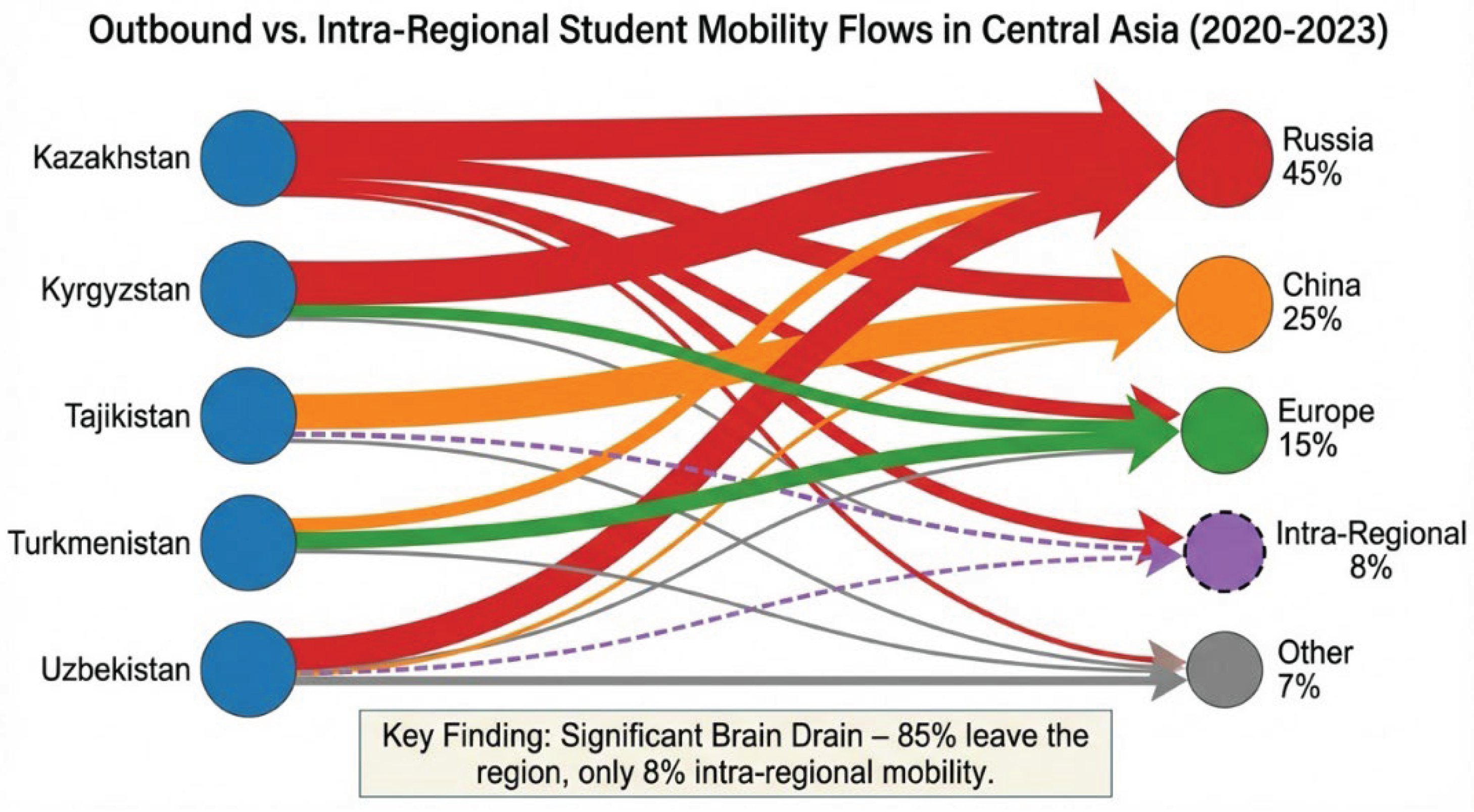
While external student mobility from Central Asia is robust, it is dangerously unbalanced. According to the latest data from UNESCO-IESALC (2021) and corroborated by OECD’s Education at a Glance 2023 report, Central Asia remains a significant net exporter of students. Approximately 85% of mobile students leave the region entirely, with the Russian Federation (45%), China (25%), and Western Europe (15%) serving as the primary destinations (Figure 1). This pattern has persisted since the dissolution of the Soviet Union, with only marginal improvements despite regional integration initiatives. However, intra-regional mobility—students moving between Uzbekistan and Kazakhstan, or Tajikistan and Kyrgyzstan—remains critically low. Based on authors’ triangulation of national statistics from Kazakhstan’s Ministry of Education (2022), Kyrgyzstan’s National Statistical Committee (2023), and Uzbekistan’s State Committee on Statistics (2023), we estimate intra-regional flows at approximately 8% of total outbound mobility (Figure 1). This figure has remained stagnant since the TuCAHEA project concluded in 2015, indicating that policy frameworks alone are insufficient without operational infrastructure (Knight, 2024).This imbalance creates a “Brain Drain” rather than “Brain Circulation.” Talented youth leave the region and rarely return, partly because their qualifications are more easily recognized in Europe (due to the Bologna Process) than in a neighboring Central Asian country.
2.2. The Economic Cost of Friction
The lack of educational interoperability has direct economic consequences. As the region attempts to pivot from resource-extraction economies to knowledge-based economies, the labor market requires a fluid workforce.
The Scenario: An engineering graduate from Dushanbe (Tajikistan) seeking employment in the booming construction sector of Astana (Kazakhstan) faces a “verification tax.” This involves obtaining physical apostilles, notarized translations, and waiting 3-6 months for the host country’s ministry to recognize the foreign diploma (Ros, 2022).
The Impact: This friction discourages regional labor migration, exacerbating labor shortages in growth hubs while contributing to unemployment in labor-surplus areas.
3. Literature Review
This section situates the Central Asian case within the broader discourse of higher education regionalism and the emerging field of blockchain in education.
3.1. Higher Education Regionalism: From Europe to Asia
The “Region-Building” literature largely centers on the European experience. The Bologna Process (1999) is cited as the gold standard, where “Harmonization” was achieved through a combination of top-down ministerial directives and bottom-up institutional cooperation.
The Asian Deviation: However, scholars like Knight (2024) and Hou (2014) argue that the European model cannot be simply copy-pasted to Asia. Asian regionalism, particularly in ASEAN and Central Asia, is characterized by “soft regionalism”—non-binding agreements that prioritize national sovereignty over supranational authority.
The Central Asian Gap: In this context, TuCAHEA represented a hybrid approach. As Anafinova (2022) notes, it utilized European tools (ECTS, Tuning) but lacked the European enforcement mechanisms (such as the EQF or a binding convention). This created a “Zombie Policy” phenomenon—agreements that exist on paper but lack life in practice.
3.2. Norm Localization Theory
To understand why TuCAHEA partially succeeded yet stalled, we turn to Acharya’s (2004) theory of Norm Localization. Acharya argues that foreign norms (like the Bologna Process) are only adopted if they resonate with local cognitive priors.
Application: TuCAHEA succeeded in the 2012-2015 period because it framed “Competence-Based Education” as a modernization of the Soviet “Scientific Organization of Labor,” making it palatable to local academics (Isaacs, 2014).
Limitation: However, the theory explains adoption but not implementation. The literature fails to address how localized norms are sustained when the external funding (EU Tempus) evaporates.
3.3. Blockchain in Education: The “Trust Protocol”
Since 2016, a growing body of literature has examined Blockchain as a solution to the “Credential Fraud” crisis.
Global Precedents: Turkanović et al. (2018) proposed EduCTX, a global platform for credit assignment based on Ethereum. Similarly, MIT Media Lab developed Blockcerts, an open standard for digital certificates (Gaikwad et al., 2021). The European Blockchain Services Infrastructure (EBSI) is currently piloting cross-border diploma verification within the EU.
The Research Gap: Existing studies predominantly focus on technological feasibility in high-trust, high-infrastructure environments (Europe, USA). There is a glaring scarcity of research on applying these technologies in post-Soviet or developing contexts, where:
Internet connectivity is uneven (The Digital Divide).
State control over data is rigid (Data Sovereignty).
Institutional trust is historically low.
Summary of the Gap: Current literature discusses Policy Alignment (TuCAHEA studies) and Blockchain Technology (CS studies) in isolation. This paper bridges the two, proposing a socio-technical framework that uses technology to solve the specific political and bureaucratic deadlocks of Central Asia.
4. Retrospective Analysis: The TuCAHEA Legacy (2012–2015)
The TuCAHEA project represents the most significant attempt to date to modernize Central Asian higher education from a regional perspective. Unlike previous reforms that were strictly national (e.g., Kazakhstan’s erratic adoption of the credit system in the early 2000s), TuCAHEA was intrinsically transnational.
4.1. “Tuning” as a Semantic Bridge
The core methodology employed was “Tuning”—a university-driven process to define what a student should know, understand, and be able to do. TuCAHEA established eight Subject Area Groups (SAGs), covering disciplines ranging from Business and Economics to History and Engineering.
These groups achieved a breakthrough in Semantic Interoperability.
Pre-TuCAHEA (The Soviet Legacy): Educational standards were governed by GOST (State Standards), which measured education in “contact hours” and rigid list of subjects. A History degree in Tashkent was structurally different from one in Bishkek.
The TuCAHEA Shift: The SAGs developed “Reference Points”—generic descriptors of competences. For the first time, a “credit” represented a unit of student workload and learning outcome, rather than just time spent in a lecture hall.
Outcome: This created a shared academic language. As Isaacs (2014) observed, it allowed professors to look past national curricula differences and recognize the substance of a student’s knowledge.

Table 1.
Conceptual Shift from Soviet GOST to TuCAHEA Reference Points.
| Dimension | Soviet Model (GOST) | TuCAHEA Model |
|---|---|---|
| Measurement | Hours | Credits/ECTS |
| Focus | Input-based | Outcome-based |
| Teacher Role | Lecturer | Facilitator |
4.2. The Analog Bottleneck
Despite the semantic success, the operational mechanism of TuCAHEA remained firmly rooted in the 20th century. The pilot student mobility schemes (2014-2015) revealed the fragility of the system.
Manual Trust: The recognition of credits relied on “Learning Agreements”—paper forms that had to be signed, scanned, emailed, and often faxed between international relations offices.
Dependency on Personal Networks: Mobility worked only because the specific professors involved in TuCAHEA knew and trusted each other personally.
Failure Mode: Once the EU funding ceased and the project teams disbanded, this “soft trust” evaporated. Without a digital backbone to institutionalize these relationships, the mobility corridors collapsed back into bureaucratic inertia.
5. The Implementation Gap (2016–2024)
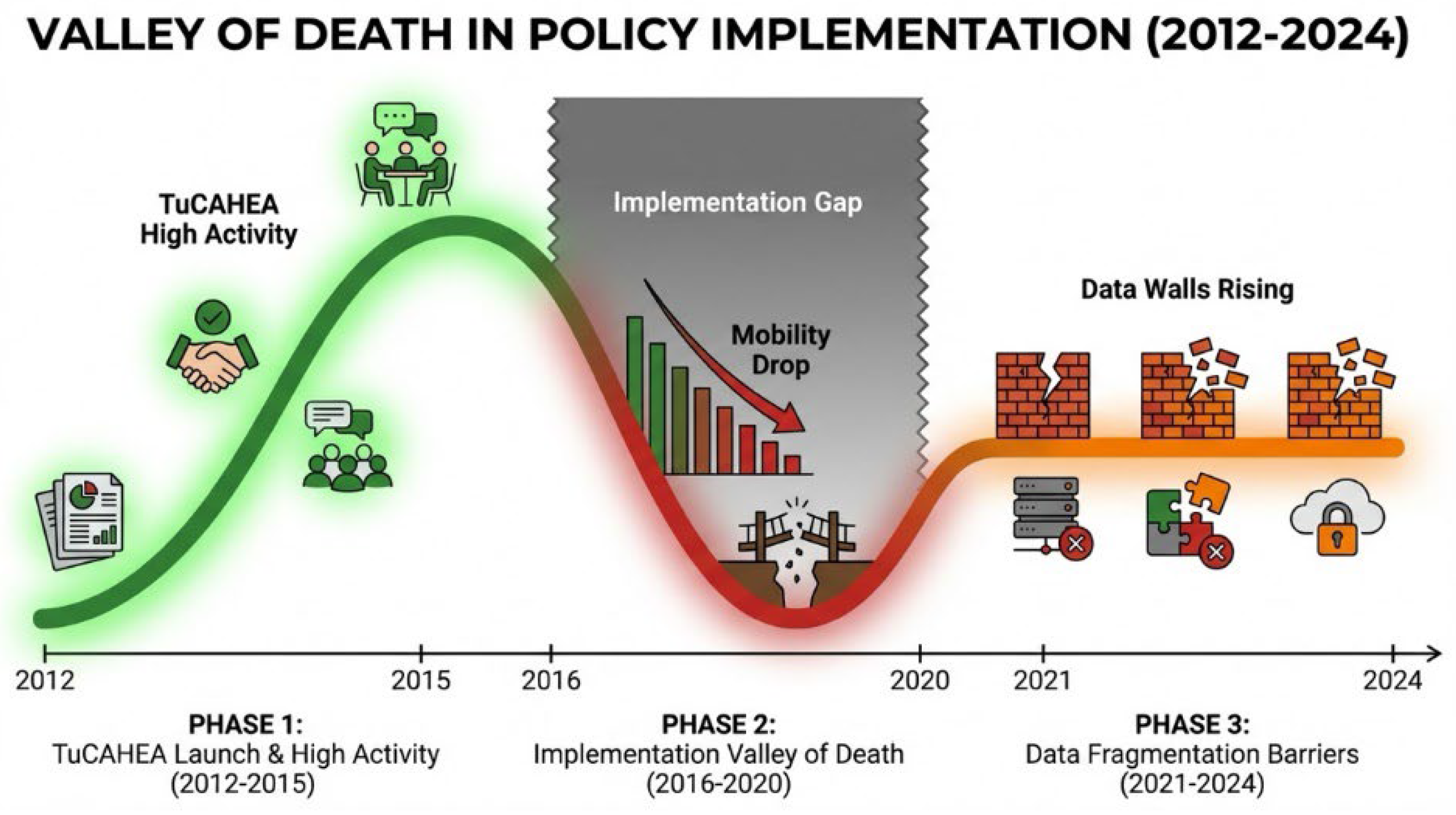
The period following TuCAHEA can be characterized as an “Implementation Gap.” While the political will for integration remained (expressed in annual ministerial meetings), the practical reality on the ground regressed. We identify three distinct barriers that emerged during this period.
5.1. The Verification Crisis and “Paper Fraud”
As massification of higher education accelerated in the region, so did the market for credential fraud. In response, national ministries tightened verification procedures.
The “Nostrification” Barrier: Currently, a degree from Kyrgyzstan is not automatically valid in Kazakhstan. It must undergo “Nostrification” (state recognition). This process involves submitting original transcripts to the Ministry, waiting 3-6 months for verification requests to be sent via diplomatic mail, and paying significant fees (Ros, 2022).
Impact: This delay is prohibitive for employers, effectively rendering cross-border degrees useless for immediate hiring needs.
5.2. The “Data Silo” and Sovereignty Paradox
A significant post-2015 development was the strengthening of Data Sovereignty laws.
Legislation: Uzbekistan’s Decree on Digital Economy (2018) and Kazakhstan’s Law on Personal Data (amended 2024) mandate that personal data of citizens must be stored on servers physically located within national borders.
The Conundrum: This legal landscape makes a centralized “Central Asian Student Database” legally impossible. Universities cannot simply upload student records to a shared cloud server without violating national laws.
5.3. Fragmented Digitalization
Universities have digitized, but in isolation. Kazakhstan largely adopted the Platonus system; Uzbekistan favored locally developed solutions; others use open-source Moodle. These systems lack standard APIs (Application Programming Interfaces) to talk to one another. There is no “digital handshake” protocol between a university server in Dushanbe and one in Almaty.
Figure 2.
The “Valley of Death” in CAHEA Implementation: Activity Timeline (2012-2024). Source: Authors’ synthesis based on TuCAHEA Project Reports (Isaacs, 2014; Anafinova, 2022), EU Tempus Program Archives (2012-2015), UNESCO-IESALC Regional Consultation Reports (2018, 2021), and policy documents from the Shanghai Cooperation Organization Education Ministers’ Meetings (2016, 2019, 2022). The “Implementation Gap” (2016-2024) is characterized by continued ministerial declarations without operational mechanisms, as documented in Ros (2022) and Knight (2024).
Figure 2.
The “Valley of Death” in CAHEA Implementation: Activity Timeline (2012-2024). Source: Authors’ synthesis based on TuCAHEA Project Reports (Isaacs, 2014; Anafinova, 2022), EU Tempus Program Archives (2012-2015), UNESCO-IESALC Regional Consultation Reports (2018, 2021), and policy documents from the Shanghai Cooperation Organization Education Ministers’ Meetings (2016, 2019, 2022). The “Implementation Gap” (2016-2024) is characterized by continued ministerial declarations without operational mechanisms, as documented in Ros (2022) and Knight (2024).
6. Methodology: Design Science Research
To bridge this gap, this study pivots from historical analysis to solution design. We adopt the Design Science Research (DSR) methodology (Hevner et al., 2004), which is specifically suited for creating “artifacts” (systems/models) to solve wicked problems.
- Artifact Design: The proposed “Digital CAHEA” infrastructure (Section 7).
- Design Evaluation: Assessing the artifact against criteria of Sovereignty, Trust, and Scalability.
7. System Design: The “Digital CAHEA” Architecture
We propose a decentralized infrastructure that respects national sovereignty while enabling regional trust. The architecture consists of three integrated layers.
7.1. Layer 1: The Consortium Blockchain for Trust (Hyperledger Fabric)
Public blockchains (like Ethereum) are unsuitable for this context due to data visibility issues and the “anarchic” nature of permissionless networks. Instead, we propose a Consortium Blockchain based on Hyperledger Fabric.
Governance Model: The five Ministries of Education act as the ”Orderer Nodes” (Governance Council). Accredited Universities act as ”Peer Nodes” (Issuers).
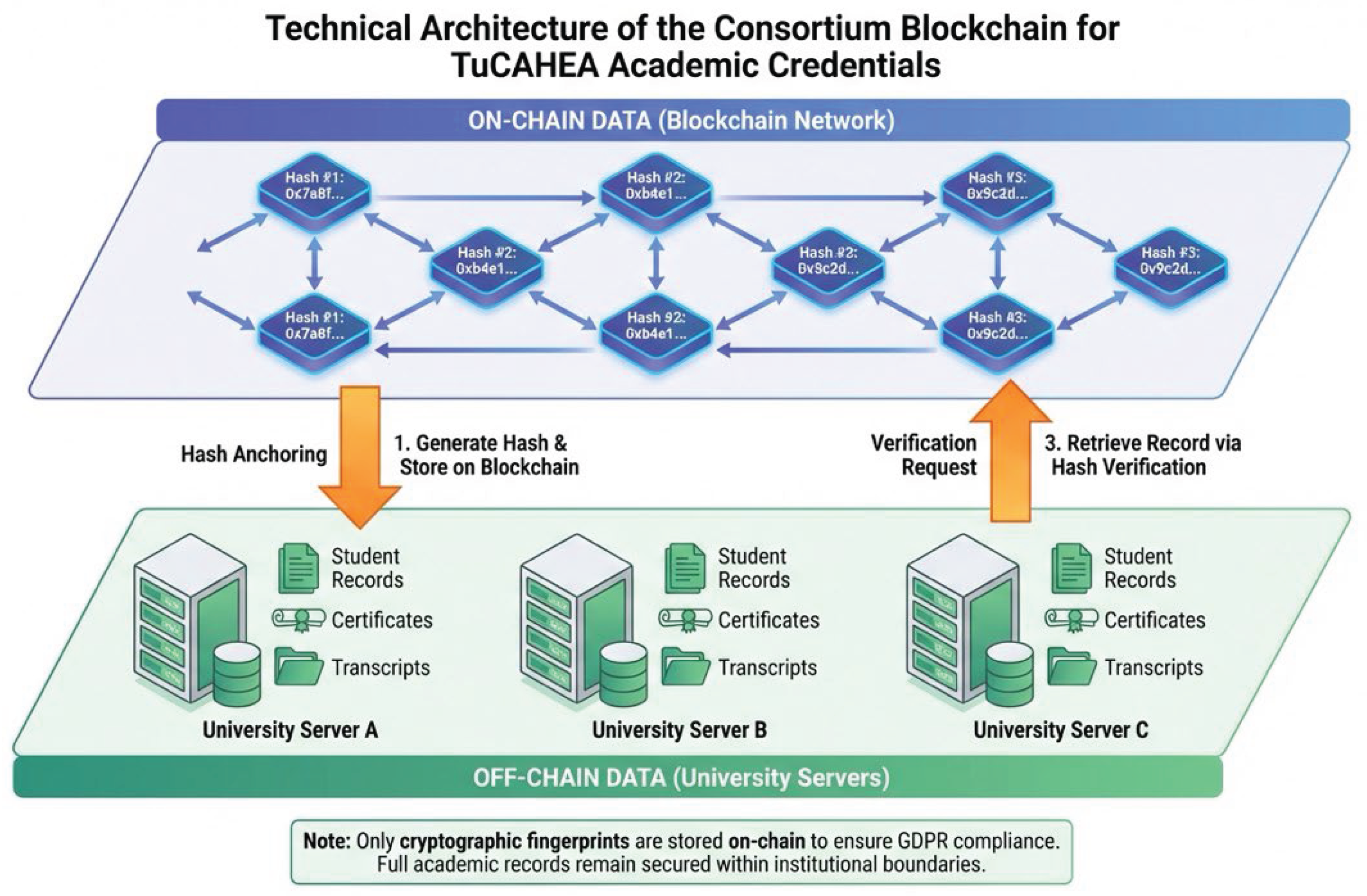
The “Off-Chain” Storage Principle: To comply with data sovereignty laws (Section 5.2), no personal data (names, grades) is stored on the blockchain. Only the cryptographic Hash of the credential is stored.
The Ledger Entry: {TransactionID, IssuerID, UniversitySignature, DocumentHash, Timestamp}.
The Consensus Mechanism: We utilize Proof-of-Authority (PoA), which is energy-efficient and allows the Ministries to retain control over who can write to the ledger.
User Scenario: “Aziz’s Journey”
To illustrate the efficacy of this layer, consider “Aziz,” a Civil Engineering graduate from Tajikistan seeking work in Kazakhstan.
Scenario A (Current Status Quo): Aziz travels to Astana. The employer requests his diploma. Aziz submits paper copies. The employer doubts their authenticity. Aziz applies for nostrification. The Ministry in Astana mails a letter to Dushanbe. Three months pass. The job offer expires.
Scenario B (Digital CAHEA): Aziz receives a Verifiable Credential (VC) (a JSON file) from his university in his digital wallet. He sends the file to the Astana employer. The employer’s system hashes the file and checks the Regional Blockchain. The Blockchain confirms: ”Hash matches. Issued by Tajik Technical University (Accredited). Signed by Ministry Node.”
Time taken: 3 seconds. Cost: Near zero.
Figure 3.
Technical Architecture of the Consortium Blockchain for TuCAHEA Academic Credentials.
7.2. Layer 2: Federated Learning for Quality Assurance (QA)
While Blockchain solves verification, it does not solve quality assurance. How can we compare the “difficulty” of an Engineering degree in Uzbekistan vs. Turkmenistan without sharing student data? We introduce Federated Learning (FL).
The Mechanism: A master QA Model (algorithm) is initialized by the CAHEA Secretariat. This model is sent to the local servers of participating universities.
Local Training: The model trains on local student data (e.g., correlating entrance exam scores with graduation GPAs) inside the university’s firewall. The data never leaves the premise.
Global Aggregation: Only the Model Weights (mathematical parameters update) are sent back to the central server to update the global model.
Result: The region gets a “State of Education Report” and benchmarks without a single student record crossing a border. This satisfies the strict data localization laws of Uzbekistan and Kazakhstan.
7.3. Layer 3: Semantic Translation via AI
Finally, to operationalize the TuCAHEA “Reference Points,” we propose fine-tuning Large Language Models (LLMs) on the trilingual (National Language + Russian + English) corpus generated by TuCAHEA. This creates a “Semantic API” that can automatically translate a syllabus from Uzbek to Kazakh, not just linguistically, but pedagogically, mapping “Learning Outcomes” to the nearest equivalent in the target country’s framework.
9. Implementation Roadmap (2025–2030)
Transitioning from the legacy of TuCAHEA to a Digital CAHEA requires a phased approach to manage risk and build trust incrementally.
Phase 1: The Pilot Corridor (2025–2026)
- Scope: Do not attempt a regional rollout immediately. Select 5 leading universities (one from each country) that were active in the original TuCAHEA SAGs.
- Action: Implement the “Digital Diploma” for a specific low-risk discipline (e.g., Tourism or Ecology).
- Goal: Test the interoperability of the Hyperledger nodes and refine the “Semantic Translation” AI model on a small dataset.
Phase 2: National Integration (2027–2028)
- Scope: Expansion to all accredited state universities.
- Action: Integrate the blockchain nodes with existing national databases (e.g., Kazakhstan’s NOBD).
- Regulation: Ministries pass bylaws recognizing “Digital Verifiable Credentials” as legally equivalent to paper diplomas, removing the requirement for physical nostrification for participating institutions.
Phase 3: Global Interoperability (2029–2030)
- Scope: Connecting Central Asia to the European Higher Education Area (EHEA).
- Action: Establish a “Bridge Node” between the CAHEA blockchain and the European Blockchain Services Infrastructure (EBSI).
- Outcome: A student from Uzbekistan can have their degree automatically recognized in Germany, fulfilling the ultimate vision of the Bologna Process.
10. Conclusion
The TuCAHEA project (2012–2015) was a visionary endeavor that successfully created a shared semantic language for Central Asian higher education. However, for the past decade, this language has lacked a medium of transmission, trapped in the bottleneck of analog bureaucracy and low institutional trust.
This study argues that the revitalization of the Central Asian Higher Education Area does not require new policy agreements, but rather a new Infrastructural Logic. By examining the specific constraints of the region—namely, the need for data sovereignty, the prevalence of credential fraud, and the desire for modernization—we have proposed a “Digital CAHEA” architecture.
Our contribution is twofold:
- Theoretical: We demonstrate how Technological Institutionalism can replace “Soft Trust” (which failed) with “Algorithmic Trust” (which is enforceable).
- Practical: We provide a blueprint for a Consortium Blockchain and Federated Learning system that respects national boundaries while permeating them.
As the region faces increasing demographic pressure and the need for economic diversification, the seamless movement of human capital is no longer a luxury but a necessity. The technology to realize this exists; the challenge now is to translate the code into reality. The legacy of TuCAHEA is not a closed chapter of history, but a foundation waiting to be digitized.
References
- Acharya, A. (2004). How ideas spread: Whose norms matter? Norm localization and institutional change in Asian regionalism. International Organization, 58(2), 239–275. [CrossRef]
- Anafinova, S. (2022). Asia/Europe inter-university cooperation in higher education: The case of Tuning Central Asian Higher Education Area (TuCAHEA). Journal of Comparative & International Higher Education, 13(5S), 83–98. [CrossRef]
- Blinov, V. I., Satdykov, A. I., Sergeev, I. S., & Rodichev, N. F. (2021). The methods of scenario designing for the development of regional systems of vocational education and training. The Education and Science Journal, 23(2), 11–38. [CrossRef]
- European Commission. (2015). EHEA implementation in 2015: Bologna Process implementation report. Publications Office of the European Union.
- Froumin, I., & Cao, R. (2020). Russia, China, and Central Asia in higher education. In M. van der Wende et al. (Eds.), China and Europe on the New Silk Road (pp. 380–400). Oxford University Press. [CrossRef]
- Gaikwad, H., D’Souza, N., Gupta, R., & Tripathy, A. K. (2021). A blockchain-based verification system for academic certificates. 2021 International Conference on System, Computation, Automation and Networking (ICSCAN), 1–6. [CrossRef]
- Hovakimyan, H., Klimek, M., Freyer, B., & Hayrapetyan, R. (2021). Sustainable shift from centralized to participatory higher education in post-Soviet countries: A systematic literature review. Sustainability, 13(10), 5536. [CrossRef]
- Iatrellis, O., Savvas, I. K., Kameas, A., & Fitsilis, P. (2020). Integrated learning pathways in higher education: A framework enhanced with machine learning and semantics. Education and Information Technologies, 25(4), 3109–3129. [CrossRef]
- Isaacs, A. K. (2014). Building a higher education area in Central Asia: Challenges and prospects. Tuning Journal for Higher Education, 2(1), 31–58. [CrossRef]
- Knight, J. (2024). Higher education cooperation at the regional level: Doubling down on the Asian experience. Journal of International Cooperation in Education, 26(1), 101–115. [CrossRef]
- Kumar, S., Anastasopoulos, A., Wintner, S., & Tsvetkov, Y. (2021). Machine translation into low-resource language varieties. Proceedings of the 59th Annual Meeting of the Association for Computational Linguistics, 2–12. [CrossRef]
- Law of the Republic of Kazakhstan. (2024). On amendments and additions to certain legislative acts of the Republic of Kazakhstan on issues of science and education (No. 79-VIII ZRK). Adilet Legal Information System. https://adilet.zan.kz/rus/docs/Z2400000079.
- Levin, Z. (2021). Religious, national or cultural? A case study of frameworks for Jewish education in post-Soviet Central Asia. Central Asian Survey, 40(3), 368–381. [CrossRef]
- Li, T., Sahu, A. K., Talwalkar, A., & Smith, V. (2020). Federated learning: Challenges, methods, and future directions. IEEE Signal Processing Magazine, 37(3), 50–60. [CrossRef]
- Naveed, H., Arora, C., Khalajzadeh, H., Grundy, J., & Haggag, O. (2024). Model driven engineering for machine learning components: A systematic literature review. Information and Software Technology, 169, 107423. [CrossRef]
- President of the Republic of Uzbekistan. (2019). Decree on the approval of the concept of development of the higher education system of the Republic of Uzbekistan until 2030 (UP-5847). National Database of Legislation of the Republic of Uzbekistan. https://lex.uz/docs/4545887.
- Romanenko, K. (2024). Designing network systems of education at the regional level. Dnipro Academy of Continuing Education Herald. Series: Public Management and Administration, 1(1), 87–93. [CrossRef]
- Ros, V. (2022). Legacy-innovation challenges in post-Soviet higher education: Scholars’ academic transformation in Cambodia and Kazakhstan. Journal of Comparative & International Higher Education, 13(5S), 11–28. [CrossRef]
- Shalamova, L. F., Marusyak, D. M., Vladimirova, T. N., & Leskonog, N. Y. (2022). Regional model of teacher education as a research problem. Science for Education Today, 12(1), 99–125. [CrossRef]
- Turkanović, M., Hölbl, M., Košič, K., Heričko, M., & Kamišalić, A. (2018). EduCTX: A blockchain-based higher education credit platform. IEEE Access, 6, 5112–5127. [CrossRef]
- World Bank. (2013). Higher education in Central Asia: The challenges of modernization. World Bank Group.
- Zhang, C., Xie, Y., Bai, H., Yu, B., Li, W., & Gao, Y. (2021). A survey on federated learning. Knowledge-Based Systems, 216, 106775. [CrossRef]
- China Ministry of Education. (2022). Statistical Report on International Students in China 2022. Retrieved from http://en.moe.gov.cn/documents/statistics/2022/ (Accessed: December 20, 2024).
- Kazakhstan Ministry of Education and Science. (2022). Statistical Bulletin: Higher Education 2022. National Center for Educational Statistics, Astana. Retrieved from https://stat.gov.kz/.
- Kyrgyzstan National Statistical Committee. (2023). Education in the Kyrgyz Republic: Statistical Yearbook 2023. Bishkek. Retrieved from http://www.stat.kg/en/statistics/obrazovanie/.
- OECD. (2023). Education at a Glance 2023: OECD Indicators. OECD Publishing, Paris. [CrossRef]
- UNESCO-IESALC. (2021). Global Flow of Tertiary-Level Students: 2021 Update. UNESCO International Institute for Higher Education in Latin America and the Caribbean. Retrieved from https://www.iesalc.unesco.org/en/data-and-statistics/global-flow-of-tertiary-level-students/ (Accessed: December 20, 2024).
- Uzbekistan State Committee on Statistics. (2023). Higher Education Institutions: Statistical Compendium 2023. Tashkent. Retrieved from https://stat.uz/en/.
- Braun, V., & Clarke, V. (2006). Using thematic analysis in psychology. Qualitative Research in Psychology, 3(2), 77-101. [CrossRef]
- Braun, V., & Clarke, V. (2019). Reflecting on reflexive thematic analysis. Qualitative Research in Sport, Exercise and Health, 11(4), 589-597. [CrossRef]
- Creswell, J. W. (2014). Research Design: Qualitative, Quantitative, and Mixed Methods Approaches (4th ed.). Sage Publications.
- Creswell, J. W., & Plano Clark, V. L. (2018). Designing and Conducting Mixed Methods Research (3rd ed.). Sage Publications.
- Hsieh, H. F., & Shannon, S. E. (2005). Three approaches to qualitative content analysis. Qualitative Health Research, 15(9), 1277-1288. [CrossRef]
- Lincoln, Y. S., & Guba, E. G. (1985). Naturalistic Inquiry. Sage Publications.
- Morgan, D. L. (2014). Pragmatism as a paradigm for social research. Qualitativ.
Figure 1.
Outbound vs. Intra-Regional Student Mobility Flows in Central Asia (2020-2023 Average). Thick solid arrows indicate dominant outbound flows to Russia (45%), China (25%), and Europe (15%), totaling 85% external mobility. The thin dashed arrow represents limited intra-regional exchanges (8%), demonstrating a pattern of “Brain Drain” rather than “Brain Circulation.” Data Sources: UNESCO-IESALC Global Flow Database (2021), OECD Education at a Glance (2023), China Ministry of Education International Students Report (2022), and authors’ calculations based on official statistics from Kazakhstan (Ministry of Education, 2022), Kyrgyzstan (National Statistical Committee, 2023), and Uzbekistan (State Committee on Statistics, 2023). Turkmenistan.
Figure 1.
Outbound vs. Intra-Regional Student Mobility Flows in Central Asia (2020-2023 Average). Thick solid arrows indicate dominant outbound flows to Russia (45%), China (25%), and Europe (15%), totaling 85% external mobility. The thin dashed arrow represents limited intra-regional exchanges (8%), demonstrating a pattern of “Brain Drain” rather than “Brain Circulation.” Data Sources: UNESCO-IESALC Global Flow Database (2021), OECD Education at a Glance (2023), China Ministry of Education International Students Report (2022), and authors’ calculations based on official statistics from Kazakhstan (Ministry of Education, 2022), Kyrgyzstan (National Statistical Committee, 2023), and Uzbekistan (State Committee on Statistics, 2023). Turkmenistan.
Disclaimer/Publisher’s Note: The statements, opinions and data contained in all publications are solely those of the individual author(s) and contributor(s) and not of MDPI and/or the editor(s). MDPI and/or the editor(s) disclaim responsibility for any injury to people or property resulting from any ideas, methods, instructions or products referred to in the content. |
© 2026 by the authors. Licensee MDPI, Basel, Switzerland. This article is an open access article distributed under the terms and conditions of the Creative Commons Attribution (CC BY) license (http://creativecommons.org/licenses/by/4.0/).
Copyright: This open access article is published under a Creative Commons CC BY 4.0 license, which permit the free download, distribution, and reuse, provided that the author and preprint are cited in any reuse.