

Submitted:
03 February 2026
Posted:
04 February 2026
You are already at the latest version
Abstract
In the present work, we synthesize 2-(4-allyl-2-methoxyphenoxy)-1-(4-phenylpiperazin-1-yl)ethan-1-one, a semisynthetic de-rivative of the natural product eugenol. The compound was synthesized via a three-step synthetic pathway involving esterification, hydrolysis, and subsequent coupling with 4-phenylpiperazine, as confirmed by FTIR, 1H NMR, 13C NMR, and mass spectrometric data.
Keywords:
eugenol
; piperazine
; semisynthetic derivative
1. Introduction
Natural products have long been used as therapeutic agents and continue to contribute significantly to drug discovery. The structurally complex molecules found in natural products provide unique chemical features that are difficult to replicate through synthetic methods. This creates new opportunities for biological modulation and drug development [1]. Semisynthetic derivatization of natural products, involving strategic functional modification of naturally occurring molecules, has led to the development of many semisynthetic drugs approved for clinical use. Frequently, semisynthetic modifications of natural products have significantly expanded the chemical space of bioactive molecules and altered other pharmacological parameters, such as potency, solubility, selectivity, and pharmacokinetic parameters [2,3].
In cancer therapy, assessments of drug approvals over the past several decades reveal that a substantial proportion of approved small-molecule drugs are either natural molecules or semisynthetic derivatives [4].
The incorporation of nitrogen-containing moieties, such as piperazine, represents a strategic approach in drug design and is frequently found in bioactive and clinically approved drugs. Structural modification of the piperazine scaffold has been extensively explored in natural product derivatives owing to its favorable physicochemical properties and its ability to enhance biological interactions [5,6].
Eugenol, the main phenylpropanoid component of clove oil, has been widely recognized as a versatile framework for chemical modification because of its broad range of pharmacological effects, including antimicrobial, anti-inflammatory, antioxidant, and anticancer activities. Numerous studies have explored structural modifications of eugenol to produce derivatives with improved or new biological activities, such as antibacterial, anti-inflammatory, and anti-proliferative effects, thereby demonstrating its potential as a useful scaffold in medicinal chemistry and drug discovery [7,8,9,10,11,12].
Given the biological relevance of eugenol and the frequent incorporation of piperazine moieties in clinically used drugs, the development of a hybrid structure combining both motifs is a promising approach to novel, medicinally relevant compounds.
2. Results & Discussion
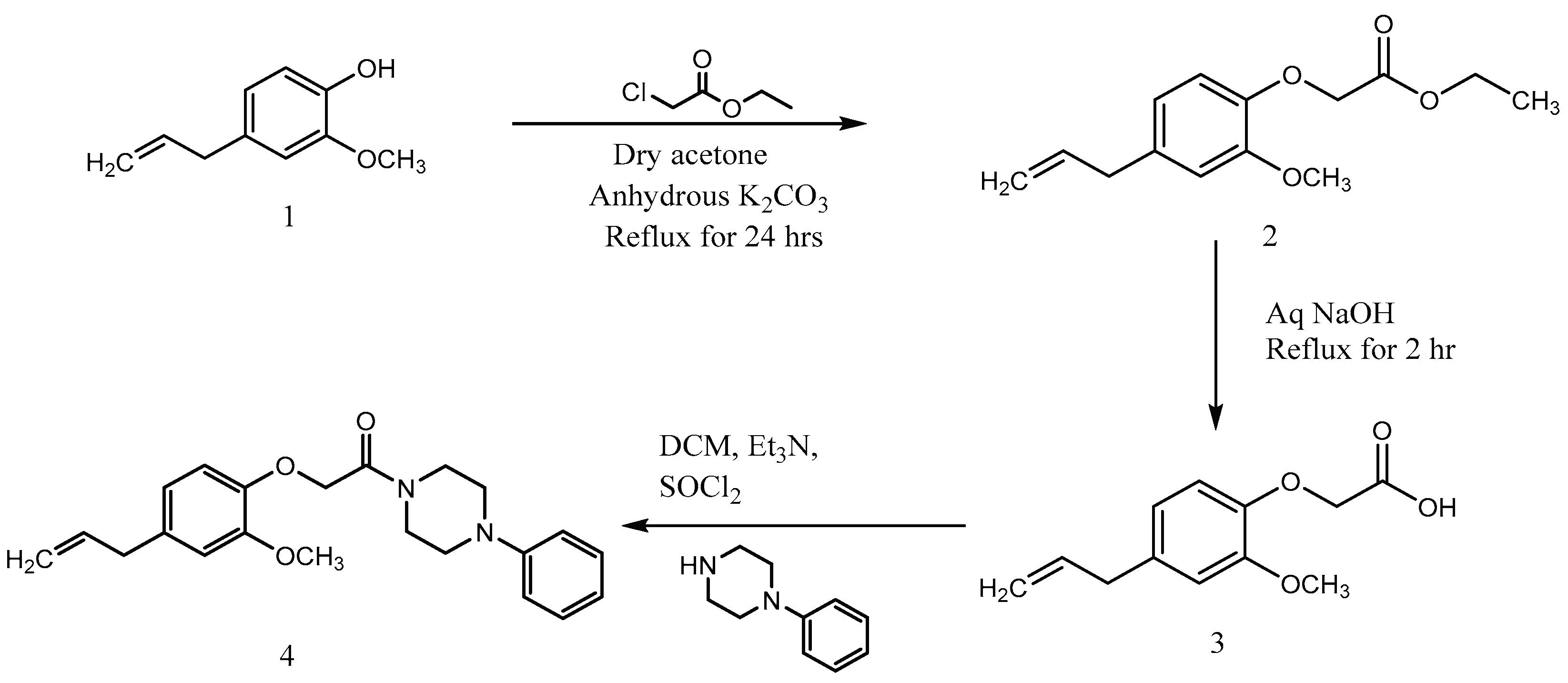
Compound 4 was synthesized through a three-step procedure, as outlined in Scheme 1. In the first step, eugenol (1) was reacted with ethyl chloroacetate to introduce an ethyl acetate group. This nucleophilic substitution reaction was carried out by increasing the nucleophilic power of the oxygen atom with potassium carbonate, forming the eugenol ester intermediate (2) [13]. The resultant compound was obtained by extraction, dried under reduced pressure, and used without further purification. The corresponding ester group was hydrolyzed with aqueous sodium hydroxide solution (alkaline hydrolysis) to form the respective eugenol acid (3). Subsequent activation of the acid using thionyl chloride in dichloromethane, followed by reaction with phenylpiperazine in the presence of trimethylamine, yielded the desired amide derivative (4).
The 4. exhibited a characteristic amide C=O stretching band at 1651 cm-1, whereas the carbonyl group at 1715 cm-1 in the eugenol acid intermediate had disappeared, confirming amide formation. The absorption bands at 1258 and 1145 cm-1 were attributed to C-O-C and C-N stretching vibrations, respectively, confirming incorporation of the piperazine moiety. The 1H NMR spectrum of compound 4 showed aromatic protons as a multiplet at δ 6.75–7.32 ppm (eugenol and piperazine-linked phenyl rings), allylic double bond protons at δ 5.07-5.92 ppm, an allylic methylene group at δ 3.30–3.40 ppm, and a methoxy singlet at δ ~3.82 ppm. An ester-linked methylene (-O-CH2-CO-) at δ 4.1-4.3 ppm and piperazine methylene protons as a broad multiplet at δ 2.5-3.6 ppm, consistent with a tertiary amide-linked piperazine ring. The 13C NMR showed an ester carbonyl carbon at δ 166.7 ppm, aromatic carbons at δ 112–150 ppm, olefinic carbons at δ 116–136 ppm, a methoxy carbon at δ 55.8 ppm, an ester methylene (–O–CH₂–) at δ 65–67 ppm, and piperazine methylene carbons at δ 45–55 ppm. The ESI-MS spectrum (positive ion mode) showed a base peak at m/z 367.59 corresponding to the protonated molecular ion [M+H]⁺, in good agreement with the calculated molecular weight (MW = 366.46), thereby supporting the proposed structure.
3. Materials and Methods
All reagents and solvents were obtained from Sigma-Aldrich and used without further purification. Reactions were monitored by thin-layer chromatography (TLC) on pre-coated silica gel plates (Merck Kieselgel 60 F254), with visualization under UV light at 254 nm. Solvent evaporation and concentration were performed under reduced pressure using a Buchi-Rotavapor R-210. Melting points and boiling points were determined using a Lab Junction Digital Melting Point/Boiling Point Apparatus (SKU: TI-LJ-46918) and are uncorrected. FT-IR spectra were recorded on a Bruker Alpha II spectrophotometer. 1H and 13C NMR spectra were recorded on a Bruker Avance III 400 MHz spectrometer using CDCl3 as solvent; chemical shifts (δ) are reported in ppm relative to TMS. Mass spectra were obtained on a Waters Quattro Micro API triple quadrupole mass spectrometer.
3.1. Synthesis of Ethyl [2-methoxy-4-(prop-2-en-1-yl)phenoxy]acetate (Compound 2)
A mixture of 4-allyl-2-methoxyphenol (15.4 mL, 0.1 mol) and anhydrous potassium carbonate (20.7 g, 0.15 mol) was dissolved in dry acetone (50 mL) in a 250 mL round-bottom flask. Ethyl chloroacetate (21.39 mL, 0.2 mol) was added dropwise, and the reaction mixture was refluxed at 40 °C for 24 h. After completion, the solvent was removed under reduced pressure, and the residue was poured into ice-cold water. The product was extracted with diethyl ether, and the organic layer was dried over anhydrous sodium sulfate. Removal of the solvent under reduced pressure afforded compound 2. The compound 2 was previously reported in the literature [13].
Ethyl [2-methoxy-4-(prop-2-en-1-yl)phenoxy]acetate (Compound 2): Brown-colored liquid (b.p. 280-282 °C) Yield 79%, TLC: Rf = 0.79 (n-hexane/ethyl acetate 7/3% v/v) FTIR (cm-1): 1756 (C=O), 1259 (C-O-C), 1510 (C=C). ESI-MS (negative mode) m/z: 249.89 [M-H]-.
3.2. Synthesis of 2-(4-allyl-2-methoxyphenoxy)acetic Acid (Compound 3)
Ethyl[2-methoxy-4-(prop-2-en-1-yl)phenoxy]acetate (2) (2.52 g, 0.01 mol) was dissolved in 40 mL of aqueous sodium hydroxide (10% w/v) in a 250 mL round-bottom flask and refluxed at 80 °C for 2 h. Reaction progress was monitored by TLC using n-hexane/ethyl acetate (7/3 v/v) as the mobile phase. After completion, the reaction mixture was cooled to room temperature and poured into distilled water. The solution was acidified with dilute hydrochloric acid, resulting in the precipitation of a white solid. The solid was filtered, washed with water, and recrystallized from water to afford compound 3.
2-(4-allyl-2-methoxyphenoxy)acetic acid (compound 3): White solid (m.p. 90-92 °C) Yield 76.4%, TLC: Rf = 0.25 (n-hexane/ethyl acetate 7/3% v/v) FTIR (cm-1): 3522 (-OH), 1715 (C=O), 1637 (C=C). ESI-MS (negative mode) m/z: 221.28 [M-H]-.
3.3. Synthesis of 2-(4-allyl-2-methoxyphenoxy)-1-(4-phenylpiperazin-1-yl) ethan-1-one (Compound 4)
To a stirred solution of 2-(4-allyl-2-methoxyphenoxy)acetic acid (0.222 g, 1 mmol) and 4-phenylpiperazine (1.25 mmol) in dichloromethane was added triethylamine (0.303 mL, 3 mmol) at room temperature. Thionyl chloride (0.119 mL, 1 mmol) was then added dropwise, and the reaction mixture was stirred at room temperature for 2 h. After completion of the reaction, the solvent was removed under reduced pressure. The residue was dissolved in dichloromethane and successively washed with 1 N hydrochloric acid (2 × 20 mL) and 1N sodium bicarbonate (2 × 20 mL). The organic layer was dried over anhydrous sodium sulfate and concentrated under reduced pressure. The crude product was purified by column chromatography on silica gel using n-hexane/ethyl acetate mixtures as eluents to afford compound 4.
2-(4-allyl-2-methoxyphenoxy)-1-(4-phenylpiperazin-1-yl) ethan-1-one (Compound 4):
White solid (m.p. 160-162 °C), yield 72.9%. Rf = 0.70 (n-hexane/ethyl acetate = 7/3 v/v).
FTIR (cm-1): 1651 (C=O), 1504 (C=C), 1258 (C-N), 1145 (C-O-C). 1H NMR (400 MHz, CDCl3) δ 7.32–6.75 (m, Ar–H, phenyl and eugenol rings), 5.92 (m, 1H, -CH=), 5.15 (d, J=17.0 Hz, 1H, =CH2), 5.07 (d, J=10.2 Hz, 1H, =CH2), 4.20 (s, 2H, -O-CH₂-CO-), 3.82 (s, 3H, OCH3), 3.60-2.50 (m, 8H, piperazine-CH2), 3.33 (d, J=6.5 Hz, 2H, -CH₂-CH=). 13C NMR (100 MHz, CDCl3) δ 166.7 (-C=O, ester), 150.9, 149.4 (Ar–C–O), 143.5 (Ar–C), 137.5 (-CH=), 134.5, 129.2, 128.9, 126.5, 122.3, 120.5, 115.3, 112.4 (aromatic and olefinic carbons), 67.4 (-O-CH₂-CO), 55.8 (OCH₃), 55.3, 49.3 (piperazine-CH₂), 39.8 (-CH₂-CH=). ESI-MS (positive mode) m/z: 367.59 [M+H]⁺.
4. Conclusions
A new piperazine-linked eugenol derivative was successfully synthesized in a multi-step synthetic route from eugenol. The target compound was obtained in good yield, and its structure was confirmed by FTIR, 1H NMR, 13C NMR, and ESI-MS analyses. Spectroscopic data were fully consistent with the proposed molecular structure, confirming successful amide formation and piperazine incorporation. This work demonstrates the utility of eugenol as a versatile scaffold for semisynthetic modification and provides a structurally well-characterized molecule that may serve as a useful reference for future medicinal chemistry and natural product-based derivatization studies.
Author Contributions
Conceptualization, M.G.Y.N. and C.K.C.; Methodology, M.G.Y.N. and C.K.C.; Investigation, M.G.Y.N.; writing-original draft preparation, review and editing, S.R.S; Data curation, S.K, B.M. All authors have read and agreed to the published version of the manuscript.
Funding
This research received no external funding.
Data Availability Statement
The data presented in this study are available in this article.
Acknowledgments
The authors thank the Faculty of Pharmacy, Government College of Pharmacy, and the Food Safety and Drug Administration, Government of Karnataka, for providing the necessary facilities and support. The authors also acknowledge Poornayu Research Labs, and Indian Institute of Science (IISc.) Bengaluru for spectral data.
Conflicts of Interest
The authors declare no conflict of interest.
References
- Atanasov, A. G.; Zotchev, S. B.; Dirsch, V. M.; Supuran, C. T. Natural Products in Drug Discovery: Advances and Opportunities. Nat. Rev. Drug Discov. 2021, 20, 200–216. [Google Scholar] [CrossRef]
- Goel, B.; Jain, S. K. Semisynthesis: Bridging Natural Products and Novel Anticancer Therapies. Eur. J. Med. Chem. Rep. 2024, 12, 100218. [Google Scholar] [CrossRef]
- Naeem, A.; Hu, P.; Yang, M.; Zhang, J.; Liu, Y.; Zhu, W.; Zheng, Q. Natural Products as Anticancer Agents: Current Status and Future Perspectives. Molecules 2022, 27, 8367. [Google Scholar] [CrossRef] [PubMed]
- Newman, D. J.; Cragg, G. M. Natural Products as Sources of New Drugs over the Nearly Four Decades from 01/1981 to 09/2019. J. Nat. Prod. 2020, 83, 770–803. [Google Scholar] [CrossRef] [PubMed]
- Zhang, R. H.; Guo, H. Y.; Deng, H.; Li, J.; Quan, Z. S. Piperazine Skeleton in the Structural Modification of Natural Products: A Review. J. Enzyme Inhib. Med. Chem. 2021, 36, 1165–1197. [Google Scholar] [CrossRef]
- Faizan, M.; Kumar, R.; Mazumder, A.; Salahuddin; Kukreti, N.; Kumar, A.; Chaitanya, M. V. N. L. The Medicinal Chemistry of Piperazines: A Review. Chem. Biol. Drug Des. 2024, 103, e14537. [Google Scholar] [CrossRef]
- Fadilah, F.; Yanuar, A.; Arsianti, A.; Andrajati, R. Phenylpropanoids, Eugenol Scaffold, and Its Derivatives as Anticancer Agents. Asian J. Pharm. Clin. Res. 2017, 10, 41–46. [Google Scholar] [CrossRef]
- Da Silva, F. F. M.; Monte, F. J. Q.; de Lemos, T. L. G.; et al. Eugenol Derivatives: Synthesis, Characterization, and Evaluation of Antibacterial and Antioxidant Activities. Chem. Cent. J. 2018, 12, 34. [Google Scholar] [CrossRef] [PubMed]
- FernandesMelo Reis, R. C.; Pontes Silva, A. V.; Veiga Torres, A. D.; de Cassia Alves Iemini, R.; Lapa, I. R.; Franco, L. L.; Pinto Braga, S. F.; Carvalho, D. T.; Dias, D. F.; de Souza, T. B. From Clove Oil to Bioactive Agents: Synthetic Routes, Antimicrobial and Antiparasitic Activities of Eugenol Derivatives. Future Med. Chem. 2024, 16(20), 2169–2188. [Google Scholar] [CrossRef] [PubMed]
- Nazreen, S.; Elbehairi, S. E. I.; Malebari, A. M.; et al. New Natural Eugenol Derivatives as Anti-proliferative Agents: Synthesis, Biological Evaluation, and Computational Studies. ACS Omega 2023, 8(21), 18811–18822. [Google Scholar] [CrossRef] [PubMed]
- Alam, M. M.; Elbehairi, S. E. I.; Shati, A. A.; Hussien, R. A.; Alfaifi, M. Y.; Malebari, A. M.; et al. Design, Synthesis, and Biological Evaluation of New Eugenol Derivatives Containing 1,3,4-Oxadiazole as Novel Inhibitors of Thymidylate Synthase. New J. Chem. 2023, 47(10), 5021–5032. [Google Scholar] [CrossRef]
- Anjum, N. F.; Shanmugarajan, D.; Shivaraju, V. K.; Faizan, S.; Naishima, N. L.; Prashantha Kumar, B. R.; Javid, S.; Purohit, M. N. Novel Derivatives of Eugenol as Potent Anti-Inflammatory Agents via PPARγAgonism: Rational Design, Synthesis, Biological Evaluation, and Computational Studies. RSC Adv. 2022, 12, 16966–16978. [Google Scholar] [CrossRef]
- Rohane, S. H.; Chauhan, A. J.; Fuloria, N. K.; Fuloria, S. Synthesis and in vitro antimycobacterial potential of novel hydrazones of eugenol. Arab. J. Chem. 2020, 13, 4496–4508. [Google Scholar] [CrossRef]
Scheme 1.
Synthetic pathway for 2-(4-allyl-2-methoxyphenoxy)-1-(4-phenylpiperazin-1- yl)ethan -1-one (Compound 4).
Scheme 1.
Synthetic pathway for 2-(4-allyl-2-methoxyphenoxy)-1-(4-phenylpiperazin-1- yl)ethan -1-one (Compound 4).
Disclaimer/Publisher’s Note: The statements, opinions and data contained in all publications are solely those of the individual author(s) and contributor(s) and not of MDPI and/or the editor(s). MDPI and/or the editor(s) disclaim responsibility for any injury to people or property resulting from any ideas, methods, instructions or products referred to in the content. |
© 2026 by the authors. Licensee MDPI, Basel, Switzerland. This article is an open access article distributed under the terms and conditions of the Creative Commons Attribution (CC BY) license (http://creativecommons.org/licenses/by/4.0/).
Copyright: This open access article is published under a Creative Commons CC BY 4.0 license, which permit the free download, distribution, and reuse, provided that the author and preprint are cited in any reuse.