

Submitted:
03 February 2026
Posted:
04 February 2026
You are already at the latest version
Abstract
Entrepreneurial activity on Instagram increasingly depends on how founders construct and communicate their identities through digital branding practices. This study examines the interrelationship between entrepreneurial identity formation, psychological branding mechanisms, and business sustainability within the Instagram ecosystem. Drawing on identity theory and consumer psychology, the paper explores how entrepreneurs use narrative self-presentation, authenticity cues, and emotional symbolism to foster trust, engagement, and long-term customer relationships. Through a synthesis of recent empirical literature and platform-specific branding dynamics, the study demonstrates that psychologically resonant branding strengthens perceived credibility and enhances audience loyalty, thereby supporting sustainable business performance. The findings suggest that entrepreneurs who strategically align personal identity with brand values are better positioned to achieve consistent engagement, adaptive growth, and resilience in competitive digital markets. This research contributes to the growing discourse on digital entrepreneurship by highlighting the psychological foundations of branding as a critical driver of sustainability on social media platforms.
Keywords:
entrepreneurial identity
; psychological branding
; instagram marketing
; digital entrepreneurship
; business sustainability
; consumer trust
1. Introduction
1.1. Background of Instagram-Based Entrepreneurship
The proliferation of social media platforms has transformed how entrepreneurial activities are initiated, developed, and sustained. Instagram, in particular, has evolved into a prominent digital space where entrepreneurs combine visual communication, storytelling, and interpersonal interaction to promote business offerings. Unlike traditional marketing channels, Instagram enables entrepreneurs to operate as both brand creators and brand representatives, making personal visibility a central component of business success [2]. This environment has intensified the role of identity construction in entrepreneurial practice.
1.2. Entrepreneurial Identity Formation in Digital Contexts
Entrepreneurial identity formation involves the continuous development and expression of an entrepreneur’s professional self-concept. In digital environments, this process is highly performative and shaped by audience feedback, platform norms, and content aesthetics. Research indicates that entrepreneurs use Instagram to negotiate authenticity, credibility, and professional legitimacy through curated self-presentation [1,6]. The visibility and immediacy of Instagram interactions amplify the psychological dimensions of identity expression, making identity formation a dynamic and ongoing process.
1.3. Psychological Branding on Instagram
Psychological branding refers to branding strategies that appeal to emotions, perceptions, and symbolic meanings rather than solely functional attributes. On Instagram, entrepreneurs employ psychological branding through consistent visual identity, narrative framing, and emotionally resonant messaging. Such practices influence how audiences perceive trustworthiness, relatability, and brand value [3,5]. By aligning personal identity with brand symbolism, entrepreneurs can establish deeper psychological connections that extend beyond short-term promotional outcomes.
1.4. Business Sustainability in Social Media Entrepreneurship
Business sustainability in Instagram-based ventures depends on maintaining long-term engagement, adaptability, and audience trust. Sustainable performance is not solely driven by sales metrics but also by the entrepreneur’s ability to nurture enduring relationships with followers. Studies suggest that entrepreneurs who integrate identity-driven branding with sustainable values are better positioned to achieve continuity and resilience in competitive digital markets [4,7]. This highlights sustainability as a multidimensional outcome influenced by both psychological and strategic factors.
1.5. Research Gap and Study Objectives
Although prior studies have examined entrepreneurial identity, psychological branding, and Instagram marketing, these elements are often explored independently. Limited research has addressed how entrepreneurial identity formation and psychological branding jointly influence business sustainability on Instagram. This fragmentation restricts a comprehensive understanding of identity-based digital entrepreneurship. Therefore, the present study aims to analyze the interconnected roles of entrepreneurial identity formation and psychological branding in supporting sustainable business outcomes on Instagram.
1.6. Significance of the Study
This research contributes to the literature on digital entrepreneurship by integrating identity theory with psychological branding perspectives in a social media context. Practically, the study offers insights for entrepreneurs seeking to develop sustainable Instagram-based businesses through identity-aligned branding strategies. By highlighting the psychological foundations of branding and sustainability, the study provides a framework for more intentional and resilient entrepreneurial practices.
2. Literature Review
2.1. Entrepreneurial Identity Formation
Entrepreneurial identity formation has been widely examined as a process through which individuals develop a sense of self in relation to their entrepreneurial roles. This identity is shaped by personal values, professional aspirations, and social interactions. In digital settings, identity formation becomes more visible and socially negotiated, as entrepreneurs actively present themselves to audiences through online platforms. Research highlights that social media enables entrepreneurs to continuously refine their identities by responding to audience expectations and platform norms [6]. This ongoing interaction influences how entrepreneurs perceive themselves and how they are perceived by others.
2.2. Identity Construction Through Instagram Use
Instagram provides a distinct environment for identity construction due to its emphasis on visual storytelling and public engagement. Entrepreneurs use images, captions, and interactive features to convey professionalism, creativity, and authenticity. Studies suggest that Instagram facilitates intentional self-branding practices where personal narratives are closely intertwined with business messaging [1]. The platform’s design encourages entrepreneurs to perform identity in a way that aligns personal experiences with commercial objectives, reinforcing the connection between self-representation and entrepreneurial legitimacy.
2.3. Psychological Branding and Consumer Perception
Psychological branding focuses on influencing consumer perceptions by appealing to emotions, beliefs, and symbolic meanings. On Instagram, psychological branding strategies include narrative consistency, emotional resonance, and symbolic imagery that reflect the entrepreneur’s values and lifestyle. Prior research demonstrates that such branding enhances audience trust and perceived brand authenticity, which are critical for follower engagement and long-term loyalty [3,5]. These psychological cues allow entrepreneurs to differentiate their brands in saturated digital markets.
2.4. Social Media Branding Strategies for Entrepreneurial Survival
Social media branding has been identified as a key survival strategy for businesses operating in highly competitive environments. Instagram-based branding enables entrepreneurs to reach targeted audiences, maintain visibility, and adapt marketing strategies in real time. Empirical studies indicate that consistent content creation and interactive communication contribute to brand recognition and customer retention [2]. These strategies are particularly important for small and emerging ventures that rely heavily on digital platforms for market access.
2.5. Entrepreneurial Sustainability and Long-Term Engagement
Business sustainability in digital entrepreneurship extends beyond financial performance to include long-term engagement, adaptability, and value alignment. Entrepreneurs who integrate sustainable practices and values into their branding are more likely to foster enduring relationships with their audiences. Research on Instagram-based entrepreneurs highlights the role of reflective learning and evolving expectations in achieving sustainable outcomes [7]. Sustainability, therefore, emerges as a dynamic process influenced by both identity development and branding strategies.
2.6. Synthesis and Research Gap
While existing studies provide valuable insights into entrepreneurial identity, psychological branding, and Instagram marketing, the literature remains fragmented. Few studies explicitly examine how entrepreneurial identity formation interacts with psychological branding to support business sustainability on Instagram. Most research addresses these constructs separately, limiting an integrated understanding of identity-driven digital entrepreneurship. This study addresses this gap by synthesizing identity formation and psychological branding perspectives to explore their combined influence on sustainable entrepreneurial outcomes.
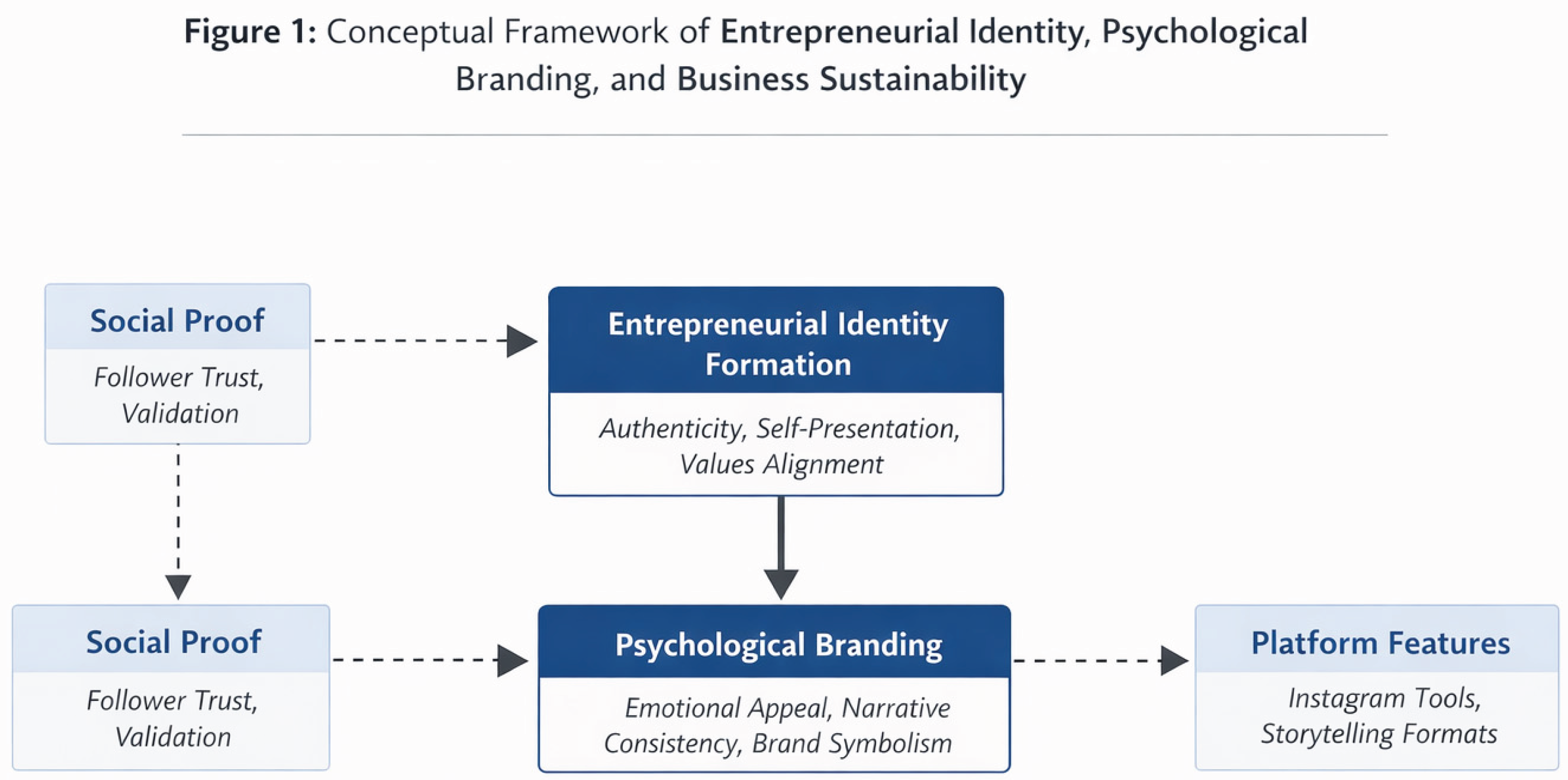
Based on the reviewed literature, a conceptual framework was developed to illustrate the relationships among Instagram-enabled personal branding, audience engagement, and entrepreneurial survival. The framework also considers the moderating effects of platform features and environmental challenges (Figure 1).
3. Methodology
3.1. Research Design
This study adopts a quantitative research design to examine the relationships between entrepreneurial identity formation, psychological branding, and business sustainability on Instagram. A cross-sectional approach was employed to capture perceptions and branding practices of entrepreneurs at a specific point in time. The quantitative design was selected to allow for systematic measurement of psychological and behavioral constructs and to test the proposed relationships in a structured manner.
3.2. Population and Sample Selection
The target population consisted of entrepreneurs who actively use Instagram as a primary platform for business promotion and brand communication. Participants were required to manage a business-oriented Instagram account and to engage in regular content creation. A purposive sampling technique was used to ensure that respondents possessed relevant experience with Instagram-based entrepreneurship. This sampling approach is consistent with prior research focusing on social media-driven entrepreneurial activity.
3.3. Data Collection Procedure
Data were collected through a structured online questionnaire distributed to eligible participants via Instagram and email communication. The survey included a brief introduction outlining the purpose of the study and assuring respondents of confidentiality and voluntary participation. To enhance response accuracy, only complete questionnaires were included in the final analysis. The data collection process was conducted over a defined period to ensure consistency.
3.4. Measurement of Constructs
The questionnaire was divided into multiple sections corresponding to the study variables. Entrepreneurial identity formation was measured using items that assessed self-presentation, authenticity, and alignment between personal values and business representation on Instagram. Psychological branding was measured through indicators related to emotional appeal, narrative consistency, and perceived brand symbolism. Business sustainability was measured using indicators reflecting long-term engagement, follower loyalty, and perceived stability of the business. All items were measured using a Likert-type scale ranging from strong disagreement to strong agreement.
3.5. Data Analysis Techniques
The collected data were analyzed using statistical software. Descriptive statistics were used to summarize respondent characteristics and overall trends. Reliability analysis was conducted to assess the internal consistency of the measurement scales. Inferential analysis, including correlation and regression techniques, was employed to examine the relationships between entrepreneurial identity formation, psychological branding, and business sustainability. These techniques enabled the evaluation of the study’s objectives.
3.6. Reliability, Validity, and Ethical Considerations
Reliability of the measurement instruments was assessed using internal consistency indicators. Content validity was ensured through careful item development based on established literature. Ethical considerations were strictly observed throughout the research process. Participation was voluntary, informed consent was obtained, and respondent anonymity was maintained. The study adhered to standard ethical guidelines for social science research involving human participants.
4. Results
4.1. Respondent Profile and Descriptive Statistics
A total of valid responses were included in the final analysis. The respondents consisted of entrepreneurs actively using Instagram as a business platform across various sectors, including retail, creative services, and personal branding–based ventures. Most participants reported managing their accounts independently and engaging in frequent content posting. Descriptive statistics indicated moderate to high levels of entrepreneurial identity expression, psychological branding practices, and perceived business sustainability across the sample.
4.2. Reliability Analysis
The internal consistency of the measurement scales was assessed using reliability coefficients. All constructs demonstrated acceptable reliability values, exceeding commonly recommended thresholds. Entrepreneurial identity formation, psychological branding, and business sustainability each exhibited strong internal consistency, indicating that the measurement items reliably captured the intended constructs.
4.3. Correlation Analysis
Correlation analysis revealed positive and statistically significant relationships among the study variables. Entrepreneurial identity formation was positively associated with psychological branding practices, suggesting that stronger identity expression is linked to more effective psychological branding on Instagram. Additionally, psychological branding showed a positive relationship with business sustainability, indicating that emotionally and symbolically aligned branding contributes to long-term entrepreneurial outcomes.
4.4. Regression Analysis
Regression analysis was conducted to examine the predictive relationships between the variables. The results indicated that entrepreneurial identity formation significantly predicted psychological branding practices. Furthermore, psychological branding was found to have a significant positive effect on business sustainability. When included together in the model, entrepreneurial identity formation and psychological branding explained a meaningful proportion of variance in business sustainability, supporting the proposed relationships.
4.5. Summary of Key Findings
Overall, the results demonstrate that entrepreneurial identity formation plays a foundational role in shaping psychological branding strategies on Instagram. Psychological branding, in turn, acts as a key mechanism through which sustainable business outcomes are achieved. These findings provide empirical support for the interdependent nature of identity, branding psychology, and sustainability in Instagram-based entrepreneurship.
5. Discussion
5.1. Interpretation of Key Findings
The findings of this study indicate that entrepreneurial identity formation significantly influences psychological branding practices on Instagram. Entrepreneurs who actively articulate their personal values, professional roles, and authentic narratives are more likely to engage in branding strategies that resonate psychologically with their audiences. This supports prior research suggesting that identity expression on Instagram is not merely performative but serves as a strategic mechanism for brand meaning creation [1,6]. The results further demonstrate that psychological branding acts as a critical link between identity formation and sustainable business outcomes.
5.2. Entrepreneurial Identity and Psychological Branding
The positive relationship between entrepreneurial identity formation and psychological branding highlights the importance of self-concept alignment in digital branding. Entrepreneurs who present coherent and consistent identities tend to employ emotionally driven branding cues that enhance perceived authenticity and trust. This finding aligns with earlier studies emphasizing the role of self-presentation and symbolic communication in shaping audience perceptions on social media platforms [3,5]. The results suggest that identity-driven branding strengthens the psychological bond between entrepreneurs and their followers.
5.3. Psychological Branding and Business Sustainability
The study also reveals that psychological branding significantly contributes to business sustainability on Instagram. Branding practices that appeal to emotions, values, and symbolic meanings appear to foster long-term engagement and follower loyalty. These outcomes are consistent with research highlighting the strategic role of Instagram branding in entrepreneurial survival and growth [2]. Moreover, psychologically aligned branding supports adaptive business performance by enabling entrepreneurs to maintain relevance in rapidly evolving digital environments [4].
5.4. Theoretical Implications
From a theoretical perspective, this study extends existing literature by integrating entrepreneurial identity theory with psychological branding frameworks in a social media context. While previous research has examined these constructs independently, the present findings demonstrate their interdependence in shaping sustainable entrepreneurial outcomes. This contributes to a more holistic understanding of digital entrepreneurship by positioning psychological branding as a mediating mechanism between identity formation and sustainability [7].
5.5. Practical Implications for Instagram Entrepreneurs
The findings offer practical insights for entrepreneurs operating on Instagram. Entrepreneurs are encouraged to intentionally align personal identity with brand narratives to strengthen psychological engagement with audiences. Rather than focusing solely on promotional content, entrepreneurs may benefit from storytelling approaches that reflect authentic experiences and values. Such strategies can enhance trust, differentiate brands, and support long-term business sustainability in competitive social media markets.
5.6. Study Limitations
Despite its contributions, this study has certain limitations. The cross-sectional research design limits causal interpretation of the relationships among variables. Additionally, reliance on self-reported data may introduce response bias. The study’s focus on Instagram also restricts the generalizability of findings to other social media platforms. These limitations should be considered when interpreting the results.
6. Conclusion
6.1. Summary of Main Findings
This study investigated the interplay between entrepreneurial identity formation, psychological branding, and business sustainability on Instagram. The findings reveal that entrepreneurs who actively develop and communicate their personal and professional identities are more likely to implement psychologically resonant branding strategies. These strategies, in turn, significantly contribute to long-term business sustainability by fostering follower engagement, trust, and loyalty [1,3,5]. The study demonstrates the interdependent nature of identity, branding, and sustainability in digital entrepreneurship.
6.2. Theoretical Contributions
The research contributes to digital entrepreneurship literature by integrating identity formation and psychological branding into a unified framework. Unlike prior studies that examined these constructs in isolation, this study shows that identity-driven branding serves as a key mechanism through which sustainable business outcomes are achieved [6,7]. These insights advance theoretical understanding of how psychological factors mediate the relationship between personal identity and entrepreneurial performance in social media contexts.
6.3. Practical Implications
For practitioners, the study highlights the importance of intentional identity alignment in Instagram-based business strategies. Entrepreneurs should focus on authentic storytelling, consistent visual and narrative branding, and values-driven messaging to enhance psychological engagement and long-term sustainability [2,4]. By leveraging identity as a foundation for branding, entrepreneurs can differentiate their offerings and maintain relevance in competitive digital markets.
6.4. Directions for Future Research
Future research could extend this study by examining longitudinal data to capture changes in identity expression, branding practices, and business sustainability over time. Comparative studies across multiple social media platforms may provide additional insights into platform-specific branding strategies. Moreover, incorporating qualitative methods such as interviews or content analysis could deepen understanding of the nuanced psychological processes underlying entrepreneurial identity and branding [5,7].
6.5. Closing Remarks
In conclusion, entrepreneurial identity formation and psychological branding are integral to achieving sustainable business outcomes on Instagram. By strategically aligning personal identity with branding practices, entrepreneurs can cultivate meaningful audience connections, enhance perceived authenticity, and support long-term resilience in digital entrepreneurship. This study underscores the value of a psychologically informed approach to branding as a driver of sustainable entrepreneurial success.
Declaration of Interest
The author(s) declare that there are no known competing financial interests or personal relationships that could have appeared to influence the work reported in this paper. This research was conducted independently, and all sources of funding, if any, have been appropriately acknowledged.
References
- Trivedi, P., & Chitraju, S. (2025). Entrepreneurial Identity Formation and Personal Branding: Psychological Insights from Instagram Use. Available at SSRN 5988014.
- Trivedi, P., & Pal, R. (2022). A Research Paper On Strategies That Businesses Use To Survive Through Social Media Marketing With Reference To Instagram. Towards Excellence, June, 30, 1718–1728. [CrossRef]
- Ahmad, S. (2025). Entrepreneurial Identity and Personal Branding: Psychological Perspectives from Instagram Use.
- Kathy, S. (2026). The Personal Branding on Instagram as a Strategic Tool for Entrepreneurial Sustainability. ScienceOpen Preprints.
- Aslam, S., Hussain, B., & Hussain, S. (2024). The Influence of Social Media on Entrepreneurial Identity and Self-Presentation. Journal of Media and Entrepreneurial Studies, 4, 97–106. [CrossRef]
- Horst, S. O., Järventie-Thesleff, R., & Perez-Latre, F. J. (2020). Entrepreneurial identity development through digital media. Journal of Media Business Studies, 17(2), 87–112. [CrossRef]
- Aboytes, J. G. R., Barth, M., & Fischer, D. (2022). Evolution of entrepreneurs’ expectations using Instagram as a business practice: A transformative learning perspective in the case of sustainable fashion entrepreneurs in Mexico. World Development Sustainability, 1, 100005. [CrossRef]
Disclaimer/Publisher’s Note: The statements, opinions and data contained in all publications are solely those of the individual author(s) and contributor(s) and not of MDPI and/or the editor(s). MDPI and/or the editor(s) disclaim responsibility for any injury to people or property resulting from any ideas, methods, instructions or products referred to in the content. |
© 2026 by the authors. Licensee MDPI, Basel, Switzerland. This article is an open access article distributed under the terms and conditions of the Creative Commons Attribution (CC BY) license (http://creativecommons.org/licenses/by/4.0/).
Copyright: This open access article is published under a Creative Commons CC BY 4.0 license, which permit the free download, distribution, and reuse, provided that the author and preprint are cited in any reuse.


